

Potential gains can make gold and US dollar CFDs look like a shortcut to financial change. The reality is more measured: a CFD can magnify the effect of market movements on your money, in either direction. Understanding how these positions work is essential before weighing their possible financial impact. Clear communication matters in finance, too, including when considering how to explain crypto payments to customers.
If terms such as leverage, margin, and exposure feel unfamiliar, it’s reasonable to want a straightforward explanation before acting. This guide explains what a CFD position represents, how shifts in gold and the US dollar can affect it, and what risks to consider when deciding whether trading fits your financial circumstances.
You’ll learn why gold and USD movements can be connected, what may influence those markets, and how leverage can amplify both gains and losses. CFDs are complex, high-risk instruments, so understanding the mechanics is only a first step toward making an informed decision.
Key Takeaways
- A CFD tracks an asset’s price movement; it doesn’t give you ownership of the underlying gold or currency.
- Gold and USD CFDs have distinct market drivers. Compare what could move each market before considering a position.
- Leverage can increase market exposure with less initial capital, but it can also amplify losses.
- Use a pre-trade review to understand the product, set risk limits, assess affordability, and consider possible outcomes. CFDs aren’t a guaranteed route to financial improvement.
- Gold and USD markets can interact, but they represent different exposures. Consider the specific instrument and the factors that may affect its price.
What Gold and USD CFD Trading Means for Your Financial Decisions
Before considering how a gold or US dollar CFD might affect your finances, separate the underlying market from the contract used to gain exposure to it. A contract for difference, or CFD, is a financial agreement linked to an asset’s price movement. It doesn’t mean you own the asset itself. The Contract for Difference (CFD) reference offers further background on how these instruments work.
CFD exposure means your potential outcome is linked to the price change between opening and closing a position, not ownership of the underlying asset. The outcome depends on how the market moves relative to your position, as well as the size of your exposure. There’s no guaranteed result.
How a CFD position relates to an underlying market
A position begins at an opening price and is closed at a later price. If the market moves in the direction the position anticipates, the price change may create a gain. If it moves against that direction, it may create a loss. The exact financial result also depends on position size and applicable terms.
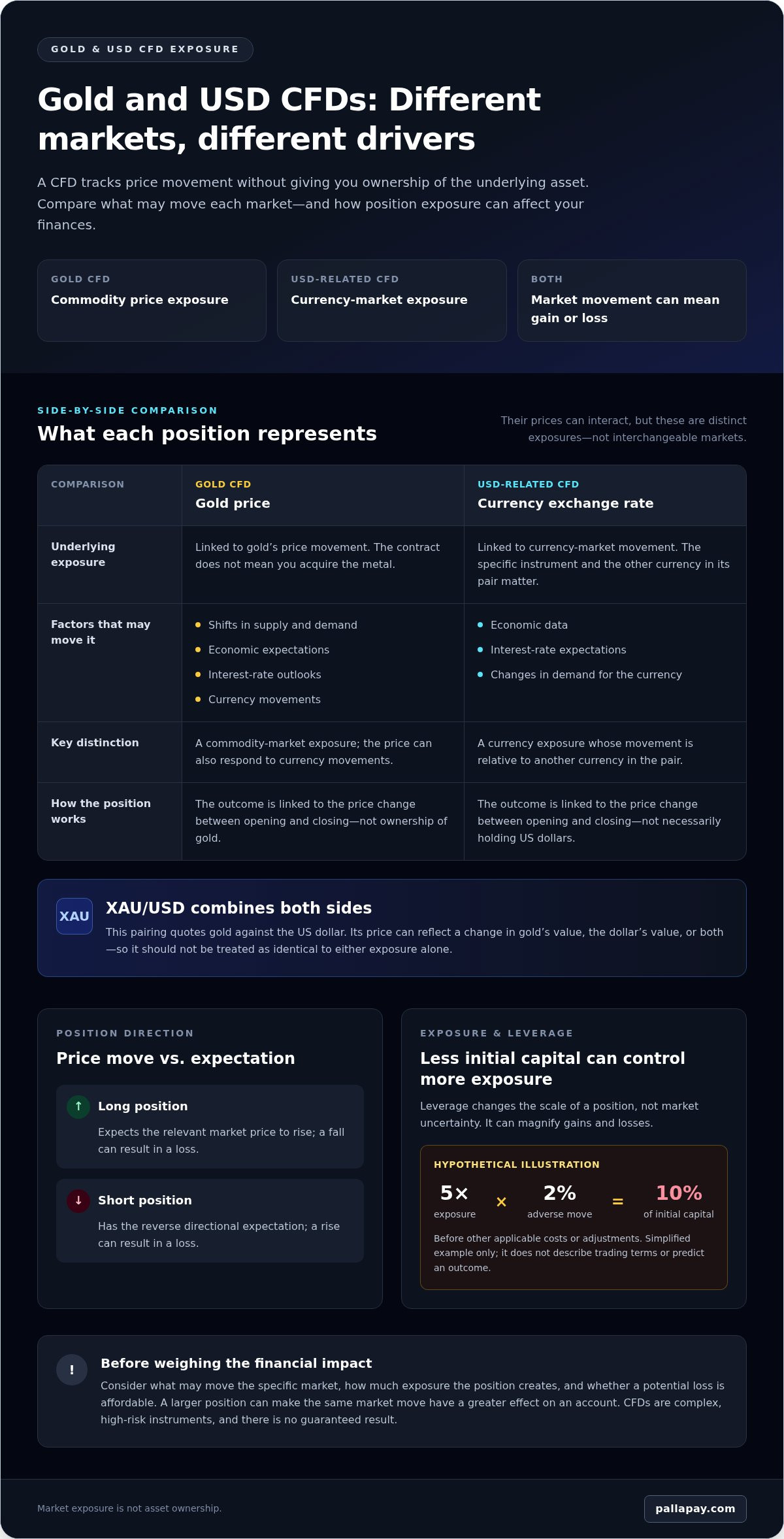
This differs from purchasing physical gold or holding currency. A gold CFD provides price exposure without acquiring the metal. A USD-related CFD provides exposure to currency-market movements without necessarily holding US dollars. Gold CFDs and USD-related CFDs also refer to distinct markets, each influenced by its own mix of factors. XAU/USD, for example, expresses the price of gold in US dollars, so movements in either can affect the quoted relationship.
Why financial impact depends on both direction and exposure
Direction matters, but it isn’t the whole picture. A larger position means a given market move can have a greater effect on the account than the same move on a smaller position. If the market moves against the position, account value can fall. That can make an apparently modest price change financially important, particularly when exposure is larger than the funds committed to open the position.
Consider a hypothetical long position: the trader expects the relevant market price to rise, but it falls before the position closes. That adverse move can result in a loss. A short position has the reverse directional expectation, but it can also lose if the market rises instead. These examples explain mechanics only. They’re not forecasts, recommendations, or assurances of an outcome.
For gold and USD CFDs, the practical question is not only which way a price might move, but also how much exposure a position creates and whether a potential loss is affordable. Assess both the market and the position before deciding what the financial implications could be.
How Gold and USD CFDs Work: Price Movements, Exposure, and Leverage
A CFD position remains exposed to market prices for as long as it’s open. If the relevant price changes, the position’s unrealised result changes too. Closing it turns that movement into a realised outcome, subject to the instrument’s terms. The How CFD Trading Works overview explains the basic principle of trading price movements without owning the underlying asset.
Leverage magnifies market exposure, and it can magnify losses as well as gains. It allows a trader to control a larger position with less initial capital than the full exposure would otherwise require. That changes the scale of the position, not the uncertainty of the market. A smaller initial commitment doesn’t make the potential risk small.
What can move gold and USD markets?
Gold prices can respond to shifts in supply and demand, economic expectations, interest-rate outlooks, and currency movements. USD exchange rates may also react to economic data, interest-rate expectations, and changes in demand for the currency. These influences can interact, but they aren’t reliable signals of what prices will do next.
XAU/USD is the market pairing that quotes gold against the US dollar. Its price can reflect changes in gold’s value, the dollar’s value, or both. When assessing this pairing, consider that relationship rather than treating gold and the USD as identical exposures.
How leverage changes the scale of a position
Hypothetical example: Imagine a position with exposure five times the initial capital committed. If the underlying market moves 2% against it, the position’s loss would be equivalent to 10% of that initial capital, before any other applicable costs or adjustments. A move in the favourable direction could magnify the potential gain in similar fashion, but it can’t be assumed or relied on.
This illustration uses a simplified ratio only. It doesn’t describe Pallapay’s trading terms or predict an outcome. Actual results depend on the position and applicable contract details. The practical takeaway is to assess the full exposure and the effect of an adverse move, not just the amount initially committed.
Plain language helps make complex financial ideas easier to examine. The same care used to explain unfamiliar financial topics, including how to explain crypto payments to customers, can help traders distinguish market movement, position size, and leverage before making decisions. Readers exploring gold and USD exposure can also learn about Pallapay’s Forex and CFD trading.
Gold CFDs vs. USD CFDs: Compare Exposure Before Choosing a Market
Gold and USD CFDs can both create exposure to financial-market movements, but they don’t represent interchangeable choices. Gold is a commodity market; USD-related exposure depends on the specific currency instrument and the other currency in its pair. Their prices can interact, yet the drivers and risks you need to assess are distinct.
| Comparison point | Gold CFD | USD-related CFD |
|---|---|---|
| Underlying market | Gold-price movement, commonly represented by XAU/USD. | A currency pairing involving the US dollar; the other currency also matters. |
| Potential drivers | Supply and demand, economic expectations, and currency movements may influence gold prices. | Economic expectations, interest-rate outlooks, and changing demand for either currency may affect the pair. |
| Key exposure question | Do you understand what may move gold and how the position responds to a price change? | Can you assess both currencies in the pair, rather than focusing on the USD alone? |
What distinguishes gold CFD exposure?
A gold CFD links the position’s outcome to changes in gold’s price, without giving the trader ownership of physical gold. Gold can respond to shifts in supply and demand, broader economic expectations, and movements in currencies such as the US dollar. These are possible influences, not dependable signals of future direction. Before evaluating exposure, consider whether you understand how the gold price is quoted and what could affect it.
What distinguishes USD-related CFD exposure?
A USD-related CFD isn’t a single, context-free bet on the dollar. In a currency pair, one currency is measured against another, so a price change reflects their relative values. A stronger USD against one currency doesn’t necessarily mean the same movement against every other currency. Identify the instrument and understand both sides of its pairing before assessing what a position could mean financially.
Choose a market based on your understanding, not a ranking of which asset is “better.” Consider your familiarity with each market, your tolerance for volatility, and whether you can monitor an open position in a way that fits your circumstances. A market you know well can still move unexpectedly; an unfamiliar market may require more learning before you can assess its exposure.
A clear comparison starts with precise terms, much like explaining how to explain crypto payments to customers: identify what is being discussed before drawing conclusions. For CFDs, name the underlying market, its potential drivers, and the questions you need answered about your position. Neither gold nor USD exposure is inherently safer or suitable for everyone.
How to Assess CFD Risk Before Putting Personal Finances at Stake
Risk assessment starts with more than a view on whether gold or a currency pair might rise or fall. CFDs are complex, high-risk instruments, and a position can produce losses. Trading isn’t a guaranteed route to financial improvement. Potential gains are possible outcomes, not assured results.
Separate the main considerations before deciding whether to proceed: market risk is the chance that prices move against your position; platform and operational considerations relate to accessing, monitoring, and managing a position; personal financial risk concerns whether a loss could affect essential needs or other financial priorities. A sound decision considers all three.
Questions to answer before opening a position
- 1. Understand the product. Can you explain how the CFD works, what market it tracks, and how your position responds to price changes?
- 2. Define your risk boundary. Decide in advance what loss you could tolerate. Consider what you would do if the market moved against your expectations, rather than waiting until the position is under pressure.
- 3. Assess affordability. Don’t use money needed for housing, food, bills, or other essential commitments. Avoid relying on borrowed money to fund a high-risk position.
- 4. Review how you’ll manage it. Consider how you’ll monitor the position, what could affect your ability to act, and how you’ll evaluate the outcome afterward. Understand the relevant platform processes and position terms before committing funds.
How to think about trading’s financial impact
Outcomes depend on market movement, the size of the exposure, and decisions made while the position is open. Imagine a gold CFD opened with the expectation that gold will rise. If the price rises, the position may show a gain; if it falls, it may show a loss. If the price changes little, the result may be limited, though applicable terms can still affect the final outcome. These scenarios illustrate possibilities, not forecasts.
For your wider finances, consider whether a potential loss would change your ability to meet existing goals. Trading should not replace budgeting or saving, and this general information isn’t a substitute for professional financial advice. Clear explanations help people assess complex choices: identify the moving parts before acting, whether you’re considering CFD risk or how to explain crypto payments to customers.
If you’ve assessed the product, exposure, and affordability and want to explore trading, explore Pallapay’s Forex and CFD trading. Weigh the risks against your personal financial circumstances before making a decision.
A Responsible Next Step for Exploring Gold and USD CFD Trading
Education should come before action. A measured progression is simple: learn how a CFD works, identify the market and exposure involved, assess the financial risk, then decide whether to explore trading further. Understanding the mechanics won’t remove uncertainty, but it can help you make a more considered choice.
A practical checklist for informed exploration
- Explain the exposure. Can you describe the underlying market, what price movement affects the position, and how the position’s value may change?
- Revisit affordability. Would a loss affect essential expenses, savings priorities, or other financial commitments?
- Set a boundary. Decide what level of loss you could accept before considering a position. Don’t rely on essential living funds or borrowed money.
- Consider your time. Do you have a realistic way to monitor the position and respond to changing market conditions?
If the instrument’s mechanics, terms, or potential risks remain unclear, pause. Taking more time to understand the exposure is a sound decision, not a missed opportunity.
Explore trading with realistic expectations
CFD trading is a high-risk financial activity, not a guaranteed wealth strategy. Outcomes depend on market movements, the exposure taken, and decisions made while a position is open. A favourable outcome is possible, but so is a loss; neither should be treated as certain. Trading also shouldn’t replace budgeting, saving, or advice tailored to your personal finances.
Clear explanations help people make sense of unfamiliar topics, including how to explain crypto payments to customers. For CFD exposure, the next step should follow understanding, not assumptions.
After reviewing the mechanics and your own risk considerations, explore Pallapay’s Forex and CFD trading services. Approach any decision with realistic expectations and a clear view of the financial risk.
Make Your Next Trading Decision with Clarity
Gold and USD CFDs offer exposure to price movements, not ownership of gold or currency. Their markets have different drivers, and leverage can magnify the effect of price changes on a position. Understanding the instrument, considering how much exposure you’re taking, and deciding what loss you could afford are essential steps before acting.
CFD trading is high risk, and a potential gain is never assured. Clear explanations matter in finance, whether you’re assessing market exposure or considering how to explain crypto payments to customers. A careful decision starts with knowing what you’re trading and how the outcome could affect your finances.
Pallapay offers Forex trading, CFD trading, and gold trading, including XAU/USD. If you’ve reviewed the mechanics and risks and want to explore further, explore Pallapay’s trading services. Take the next step at a pace that supports informed decisions and realistic expectations.
Frequently Asked Questions
What is a CFD in gold or USD trading?
A CFD is a contract that gives exposure to an asset’s price movement without transferring ownership of the asset. With a gold CFD, the position responds to gold-price changes. A USD-related CFD usually reflects a currency pair, so its value depends on the relative movement of the US dollar and another currency. The outcome depends on price movement, position size, and the relevant contract terms.
Can gold or USD CFD trading change your financial situation?
It can affect your finances, but the result could be positive, negative, or limited. The impact depends on market movement, exposure, and decisions about the position. Leverage can increase the effect of price changes, including losses. CFDs are complex, high-risk instruments, so they shouldn’t be treated as a reliable way to improve your financial situation or as a substitute for budgeting and saving.
How does leverage affect a gold or USD CFD?
Leverage lets a trader control greater market exposure with less initial capital than the full exposure would require. This magnifies the effect of price movements on the position: a move in the trader’s favour can increase a potential gain, while an adverse move can increase a loss. The smaller initial commitment doesn’t mean the position carries less risk. Understand the total exposure before deciding whether to proceed.
Is gold CFD trading the same as buying physical gold?
No. Buying physical gold means acquiring the metal, while a gold CFD provides exposure to changes in its price without ownership of the gold itself. The CFD’s result depends on how the relevant price moves during the position. Before trading, understand the instrument and its terms. If your goal is to own physical gold, a CFD doesn’t provide that ownership.
What happens if the gold or USD market moves against my CFD position?
If the market moves against your position, its value can decline and you may incur a loss. For example, a position that anticipates a rise may lose value if the relevant price falls. The financial impact depends on the size of the exposure and the price movement, along with applicable terms. Consider your acceptable loss boundary before opening a position, not after an adverse move occurs.
How can a beginner assess whether CFD trading is suitable?
A beginner can start by checking whether they can explain the instrument, underlying market, price exposure, and possible loss in plain language. Clear wording also matters when explaining unfamiliar topics, including how to explain crypto payments to customers. Assess affordability, avoid using essential funds or borrowed money, and consider whether you can monitor a position. If risks remain unclear, pause and seek appropriate financial guidance.
Are gold and USD CFDs guaranteed to produce a profit?
No. Gold and USD CFDs don’t guarantee a profit, and a favourable market view can still be wrong. Prices may move against a position, and leverage can magnify the resulting loss. Treat any potential gain as uncertain, not assured. Before considering a trade, understand its exposure and assess whether a possible loss is affordable within your personal financial circumstances.
Disclaimer
The information provided on this website and blog is for general informational and educational purposes only and does not constitute financial, investment, legal, tax, or other professional advice.
Cryptocurrency and digital asset services may be subject to regulatory restrictions in certain jurisdictions. Users are solely responsible for ensuring compliance with applicable local laws and regulations before using any products or services mentioned on this website.
PallaPay does not guarantee the accuracy, completeness, or timeliness of any information published and accepts no liability for any loss or damages arising from reliance on the content. Any opinions expressed are those of the respective authors and may change without notice.
Certain services, features, or products referenced may be provided through third-party partners, licensed entities, or affiliated service providers subject to separate terms and regulatory approvals. Availability of services may vary by country or region.
This website may contain references to digital assets, virtual currencies, or blockchain-related services that are not available to residents of certain jurisdictions, including where prohibited by law. Nothing on this website constitutes an offer, solicitation, or recommendation to buy or sell any financial instrument or virtual asset.
Leave a Reply