

A gold or USD CFD can move your finances in either direction, but it doesn’t mean you own gold or dollars. Even a question like how to buy crypto with cash safely concerns acquiring an asset; CFD trading instead creates exposure to price movements, often with leverage that can magnify losses as well as gains. That distinction matters before considering whether a trade could make a meaningful difference to your financial life.
If leverage, margin, and trading costs feel difficult to compare, you’re not alone. Understanding how a CFD tracks an underlying market is an essential first step, not a guarantee of a particular outcome. This guide explains how gold and USD CFD positions work, what can influence their prices, and how spreads, financing, and leverage can affect a trade. It also sets out a cautious way to assess the risks and explains how buying crypto with cash differs from CFD trading.
Key Takeaways
- A gold or USD CFD tracks price movements without transferring ownership of the underlying asset. Learn how that exposure differs from owning gold or currency.
- Margin is the funds required to open or maintain a position, while leverage can magnify both gains and losses. Understand these mechanics before setting an exposure level.
- Gold and USD CFDs respond to different market drivers, and their relationship can change. Compare the factors affecting each market before forming a trade thesis.
- CFDs can provide market exposure, but they can also lead to rapid losses and ongoing costs. Don’t treat trading as a reliable route to changing your financial circumstances.
- Separate CFD decisions from questions such as how to buy crypto with cash safely. For either activity, understand the transaction, assess the risks, and avoid acting on assumptions.
What Gold and USD CFDs Let You Trade, and What You Actually Own
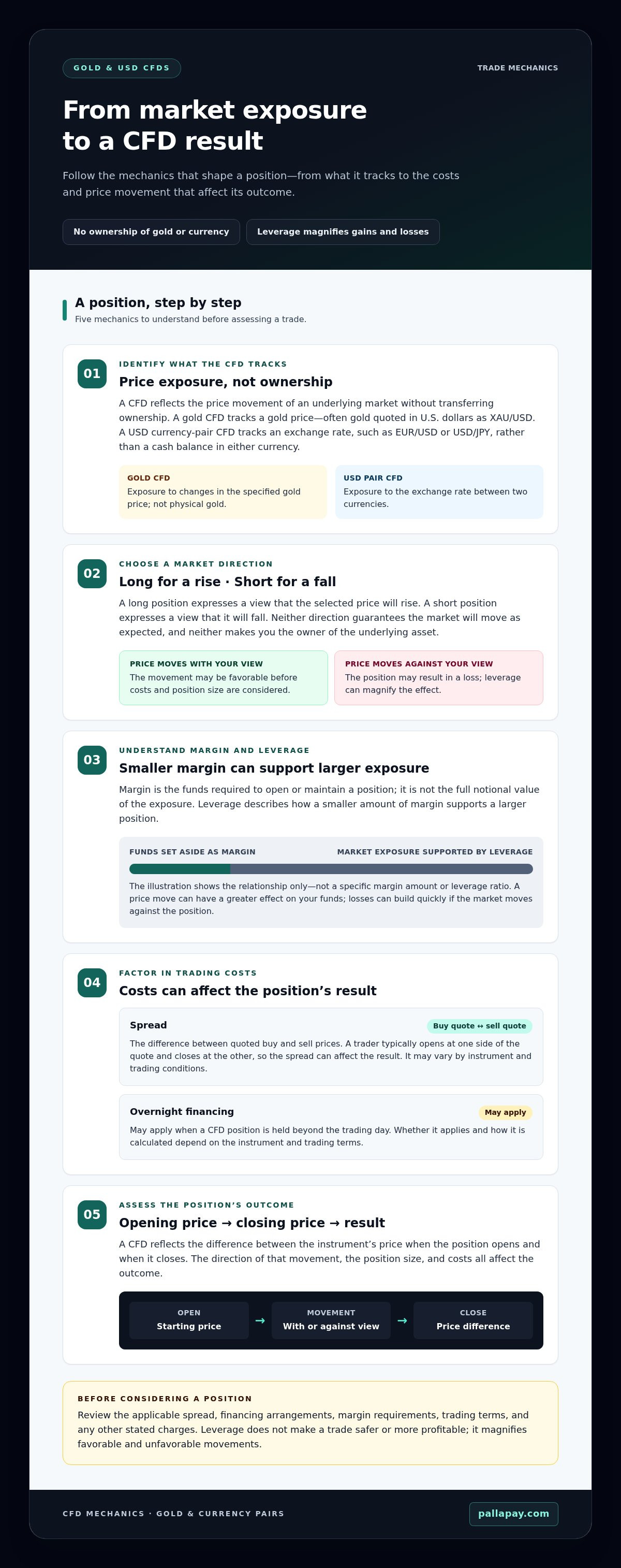
A contract for difference (CFD) tracks an asset’s price movement without transferring ownership of that asset. With a gold CFD, you get exposure to changes in a gold price, not physical gold. With a USD currency-pair CFD, your exposure follows the exchange rate between two currencies, not a cash balance in either one. The distinction is central: a CFD is a trading agreement, not a purchase of the underlying asset. The Contract for Difference reference provides a general overview of how these contracts work.
How a CFD position follows a market price
A CFD reflects the difference between the instrument’s price when a position opens and when it closes. If the closing price moves in the direction of your position, the price movement may be favorable; if it moves against you, it may result in a loss. Costs and the position size also affect the outcome.
A long position expresses a view that the selected price will rise. A short position expresses a view that it will fall. Neither direction guarantees the market will move as expected, and neither makes you the owner of gold or currency. For example, taking a long position on a gold CFD means your result is tied to changes in the gold price specified by that instrument, not to holding bullion.
Gold exposure versus USD currency exposure
Gold is a commodity market. A gold CFD, often represented by XAU/USD, tracks gold’s price quoted in U.S. dollars. A USD currency-pair CFD instead tracks an exchange rate, such as EUR/USD or USD/JPY. In a pair, the first currency is compared with the second, so a position reflects the pair’s exchange-rate movement rather than the value of the U.S. dollar in isolation.
The selected instrument determines which price movement affects your position. Gold and currency pairs can respond to different forces, and their movements should not be assumed to follow a fixed relationship. Imagine a trader expects gold to rise and opens a long gold CFD. If gold falls instead, the position moves against that view. A separate position on a USD currency pair could move differently because it follows that pair’s exchange rate.
This differs from learning how to buy crypto with cash safely. Buying crypto with cash involves acquiring a digital asset, while a CFD provides price exposure through a contract. When acquiring crypto, check that you understand the asset, the quoted amount, any transaction costs, and the destination details before completing a purchase. Knowing what you own, and what you don’t, helps clarify the risks of either transaction.
How Gold and USD CFD Trades Work: Margin, Leverage, and Costs
With a CFD, the amount needed to open a position can be smaller than the full market exposure. That difference comes from margin and leverage, which affect how gains and losses respond to price movements. Understanding both, alongside trading costs, helps you assess what a position could mean for your funds before entering it.
What margin and leverage mean in practice
Margin is the funds required to open or maintain a CFD position; it isn’t the full notional value of the exposure. Leverage describes how a smaller amount of margin supports a larger position, so a price movement can have a greater effect on your funds than it would without leverage.
Imagine setting aside a portion of your available funds as margin to open exposure to a gold CFD. The position’s market exposure is larger than that initial amount, so even a modest move in gold’s price can affect the position proportionally. If the price moves in your favor, the effect may be positive; if it moves against you, the loss can build quickly and may reduce the funds in your account. Leverage doesn’t make a trade safer or more profitable. It magnifies both favorable and unfavorable movements.
This is why Australian Government’s Moneysmart resource explains the high-risk nature of CFDs, including the role of leverage and the potential for losses. Margin requirements and the consequences of a position moving against you depend on its terms, so understand them before trading.
Which trading costs can affect a CFD position
The spread is the difference between the quoted buy and sell prices. Because a trader typically opens at one side of the quote and closes at the other, the spread can affect the position’s result. It may vary by instrument and trading conditions, so don’t assume the cost is identical for gold and USD currency-pair CFDs.
Overnight financing may also apply when a CFD position is held beyond the trading day. Whether it applies, and how it is calculated, depends on the instrument and the trading terms. Review the applicable spread, financing arrangements, margin requirements, and any other stated charges before opening a position; no single cost assumption fits every trade.
Understanding how to buy crypto with cash safely also means paying attention to the transaction and its costs, but a cash crypto purchase is different from a leveraged CFD position. Pallapay offers the option to buy USDT with cash. Before any purchase, make sure you understand the asset and transaction details involved.
Gold CFDs vs. USD CFDs: Compare Market Drivers Before Taking a Position
Choosing between a gold CFD and a USD currency-pair CFD means assessing different underlying markets. Gold is a commodity priced against a currency, while a currency pair shows one currency’s value relative to another. Their prices can react to overlapping events, but neither follows a fixed relationship with the other. Compare what drives the instrument and what your position would actually respond to before forming a view.
| Instrument | Possible price drivers | Exposure question |
|---|---|---|
| Gold CFD, such as XAU/USD | Interest-rate expectations, currency movements, and investor demand | What could influence gold’s price in the quote currency? |
| USD currency-pair CFD, such as EUR/USD | Economic data and central-bank decisions affecting either currency | Which currency may strengthen relative to the other, and why? |
What can influence gold CFD prices?
Gold prices may respond to changing expectations about interest rates, movements in the U.S. dollar, and shifts in investor demand. These influences can interact: an event may affect currency markets and investor preferences at the same time. The result isn’t automatic. A factor that appears supportive of gold doesn’t guarantee its price will rise, and market expectations may already shape prices before new information arrives.
For a gold CFD quoted in U.S. dollars, consider both the gold market and the currency used to quote it. Ask what could change the market’s view, rather than treating a single headline or indicator as a certain signal. A useful check is to identify what information would challenge your thesis, not just what appears to support it.
What can influence USD currency CFD prices?
A currency pair measures the relative value of its two currencies. Economic releases, such as information about growth or inflation, and central-bank decisions can influence expectations for either side of the pair. Their impact depends on what markets expected and how the news compares with those expectations.
A USD position isn’t a standalone measure of dollar strength. For example, if the U.S. dollar strengthens against one currency but also faces changing conditions against another, different pairs can behave differently. Identify the pair’s base and quote currencies, then consider the factors affecting both.
Use the same discipline that underpins decisions about how to buy crypto with cash safely: understand the asset or instrument and the transaction before acting. For added context on CFD risk, the North American Securities Administrators Association outlines the dangers of CFDs. Market drivers can inform a thesis, but they can’t guarantee its outcome.
Can Gold and USD CFD Trading Change Your Financial Life? Understand the Risks
Gold and USD CFDs can provide access to price movements, but they can’t reliably transform personal finances or replace stable income. A position may move in your favor, yet it can also lose value quickly, and trading costs can affect the result. Risk limits and a written plan can support more disciplined decisions, but they can’t remove uncertainty or guarantee an outcome.
Why leverage makes loss exposure easy to underestimate
Leverage means your market exposure can exceed the margin set aside for a position. As a result, a relatively small adverse price movement may have a material effect on the funds supporting that trade. The same mechanism applies whether the position tracks gold or a USD currency pair, though each instrument responds to its own market drivers.
Price changes may be abrupt. Volatility can intensify movements, and a market gap may mean the next available price differs from the one you expected. If you hold a position overnight, financing costs may also affect its overall result. Position size, price movement, and applicable charges all matter, so don’t assess risk by looking only at the margin required to open a trade.
What responsible expectations look like
CFD trading shouldn’t be treated as dependable income, a planned way to repay debt, or a reliable wealth-building strategy. Before considering a position, think about whether you can afford a loss and whether the risk fits your personal circumstances. Money needed for essential expenses should not be exposed to uncertain market outcomes.
A written plan can help you define why you’re considering a trade, how much exposure you’re willing to take, and what conditions would prompt you to review or close it. Risk limits can help contain decisions, but they can’t prevent every loss, eliminate execution uncertainty, or make a strategy successful. Reassess your assumptions as market conditions change rather than relying on a hoped-for result.
Just as how to buy crypto with cash safely involves understanding the steps and risks of acquiring crypto, CFD trading calls for clarity about the product and potential loss before acting. This information is educational, not individualized financial advice. If you’re considering buying USDT with cash, Pallapay offers that service. For a CFD, first understand the product’s terms, costs, and risks.
A Practical First-Trade Framework for Gold and USD CFDs
Preparation can’t remove market risk, but a clear process can help you understand the exposure before committing funds. Use these steps to assess whether a gold or USD CFD trade fits your knowledge, financial position, and risk tolerance.
- Choose the market. Decide whether you’re studying gold exposure, such as XAU/USD, or a particular USD currency pair. They track different markets, so identify which price movement would affect your position.
- Learn the instrument’s terms. Review how the CFD is priced and how long you might hold it. Understand the required margin, leverage, spread, possible overnight financing, and how costs could affect your result.
- Write down your thesis. State why you’re considering the trade and which market conditions support your view. Include an invalidation point, the condition that would show your reasoning may no longer hold. A market view is a possibility, not a prediction you can rely on.
- Set exposure limits. Decide in advance the maximum loss you could accept and the position size consistent with that limit. Consider that leverage can magnify adverse price movements, and that volatility or a gap may complicate the price at which a position can be closed.
- Plan your review. Set out when you’ll reassess the position and what changes in your thesis would prompt action. Record the outcome and any costs so you can evaluate whether your process was disciplined, separate from whether one trade gained or lost.
The question of how to buy crypto with cash safely concerns acquiring a crypto asset. Preparing for a CFD trade is different: it means understanding contractual price exposure and deciding what loss you can tolerate before entering a position. Don’t use funds needed for essential expenses, and don’t rely on trading to provide dependable income or meet financial obligations.
Explore buying USDT with cash through Pallapay
If your goal is to acquire crypto rather than take CFD exposure, Pallapay offers a way to buy USDT with cash. Before proceeding, understand the transaction details, asset, and costs involved. A cash crypto purchase and a leveraged CFD are different products, with different risks and outcomes.
Buy USDT with cash through Pallapay
Approach Gold and USD CFDs With a Clear Plan
Gold and USD CFDs provide exposure to price movements, not ownership of gold or currency. Margin and leverage can amplify market moves, while spreads and possible overnight financing can affect the outcome. Before considering a position, identify the market, write down your thesis, set an affordable exposure limit, and decide when you’ll review the trade.
Trading shouldn’t be treated as guaranteed income or a dependable way to transform your finances. As with understanding how to buy crypto with cash safely, sound decisions begin with knowing what the transaction involves and what risks you’re accepting. A cash purchase of USDT through Pallapay is a separate option for acquiring crypto, not a CFD trade.
Explore buying USDT with cash through Pallapay if you want to acquire a crypto asset. For CFD trading, keep your approach informed, measured, and aligned with your personal risk tolerance.
Frequently Asked Questions
What is a CFD in gold or forex trading?
A CFD, or contract for difference, is an agreement whose value reflects the price change of an underlying market between opening and closing a position. A gold CFD tracks gold’s price, while a forex CFD tracks the exchange rate between two currencies. The trader’s result depends on the price movement and applicable costs. A CFD provides market exposure through a contract, not ownership of the underlying asset.
Can you trade gold and USD CFDs without owning gold or currency?
Yes. A gold CFD provides exposure to changes in gold’s price without transferring ownership of physical gold. A USD currency-pair CFD follows the exchange rate between the U.S. dollar and another currency, rather than giving you ownership of either currency. For example, an EUR/USD CFD tracks the pair’s relative price movement. Check the instrument’s terms to understand exactly which market price determines your position’s result.
How does leverage affect gold and USD CFD trades?
Leverage lets a trader take market exposure larger than the margin set aside for a position. This magnifies the effect of price changes on the funds supporting the trade: a favorable movement may have a greater effect, but an adverse move can also increase losses quickly. Leverage doesn’t make a position safer or guarantee a gain. Consider the exposure and potential loss, not just the initial margin.
What costs can apply when trading CFDs?
Costs can include the spread, which is the difference between quoted buy and sell prices, and overnight financing when a position is held beyond the trading day. Other charges may apply depending on the instrument and its terms. Costs affect the overall result, so review the applicable pricing, financing arrangements, and other stated charges before opening a position. Don’t assume gold and currency CFDs have identical costs.
Is gold CFD trading safer than USD CFD trading?
Neither market is inherently safer. Gold and USD currency-pair CFDs respond to different influences, and both can move unpredictably. Leverage can magnify losses in either, while spreads and possible financing charges can affect the outcome. Assess the instrument’s volatility, market drivers, position size, and terms against your own risk tolerance. Choosing a market you understand may support better-informed decisions, but it can’t remove the possibility of loss.
Can trading gold and USD CFDs guarantee a profit?
No. There’s no guaranteed profit from trading gold or USD CFDs. Prices may move against your position, and leverage can magnify the effect of those movements. Trading costs can also reduce a positive result or add to a loss. CFDs shouldn’t be treated as dependable income or a reliable way to transform your finances. Only consider risking funds you can afford to lose, and make decisions based on a clear plan.
What should a beginner understand before placing a CFD trade?
Before trading, understand that a CFD provides price exposure rather than ownership, and learn how margin, leverage, spreads, and possible overnight financing apply. Choose whether you’re studying gold or a specific currency pair, write down your reason for the trade, and set an exposure limit and review plan. Knowing how to buy crypto with cash safely concerns acquiring crypto, a different process from taking leveraged CFD exposure.
Disclaimer
The information provided on this website and blog is for general informational and educational purposes only and does not constitute financial, investment, legal, tax, or other professional advice.
Cryptocurrency and digital asset services may be subject to regulatory restrictions in certain jurisdictions. Users are solely responsible for ensuring compliance with applicable local laws and regulations before using any products or services mentioned on this website.
PallaPay does not guarantee the accuracy, completeness, or timeliness of any information published and accepts no liability for any loss or damages arising from reliance on the content. Any opinions expressed are those of the respective authors and may change without notice.
Certain services, features, or products referenced may be provided through third-party partners, licensed entities, or affiliated service providers subject to separate terms and regulatory approvals. Availability of services may vary by country or region.
This website may contain references to digital assets, virtual currencies, or blockchain-related services that are not available to residents of certain jurisdictions, including where prohibited by law. Nothing on this website constitutes an offer, solicitation, or recommendation to buy or sell any financial instrument or virtual asset.