

Tag: leverage

  • How to Choose a Crypto Business License in Business Bay Dubai

    How to Choose a Crypto Business License in Business Bay Dubai

    Choosing a crypto business licence starts with identifying the activities your company will carry out and matching them to the licence scope. If you’re searching for a crypto office in Business Bay, Dubai, remember that an office address alone does not determine which licence applies. Alongside regulatory standing, managing physical corporate premises requires careful operational planning, similar to how organizations rely on accredited providers like Insight Security Training to ensure premises security and staff readiness. The intended services and operating structure matter too.

    Consider location alongside regulatory status, permitted activities and practical transaction needs. For teams establishing their operating structure, managing crypto accounting and tax compliance through specialists like block3finance.com helps align financial workflows with regulatory requirements. A clear plan helps separate the office decision from the question of whether a company is authorized to provide a particular crypto service.

    Use this guide to assess how to verify an office address and a company’s regulatory status, identify risks before visiting or transacting, and decide whether a crypto debit card could suit your needs.

    Key Takeaways

    • Set clear financial goals and a trading plan before entering the forex or gold markets.
    • Understand that XAU/USD tracks gold against the US dollar, while forex trading focuses on currency pairs.
    • Account for leverage: it can magnify both gains and losses, so position sizing and risk controls matter.
    • Use forex accounts and signals as tools for a structured process, not as substitutes for your own trading decisions.

    How can I verify a crypto company’s Dubai office address and regulatory status?

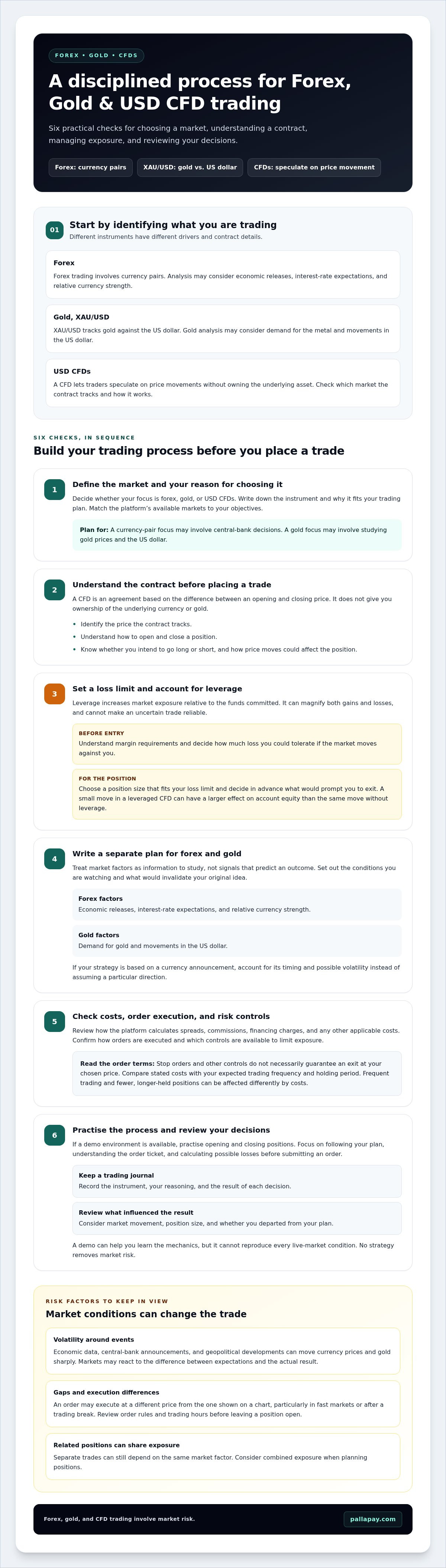
    1. Define the market you intend to trade. Before opening an account, decide whether you plan to trade forex, gold or USD CFDs. Forex involves trading currency pairs, while XAU/USD tracks gold against the US dollar. CFDs let traders speculate on price movements without owning the underlying asset. Because these markets have different drivers, identify your focus before comparing account features.

      For example, someone following central bank decisions may focus on currency pairs, while someone tracking gold prices may study XAU/USD. Write down the instrument and why it fits your trading plan. This makes it easier to assess whether a platform’s available markets match your objectives.

    2. Understand the contract before placing a trade. A CFD is an agreement based on the difference between an opening and closing price. It does not give you ownership of the underlying currency or gold. Read the product description to identify the price the contract tracks, how to open a position and what could affect its value.

      For a USD CFD, distinguish the market exposure from the contract itself. Note whether you intend to go long or short and how price movements could affect the position. Don’t rely on a product label alone. The contract terms should explain how the instrument works and what happens when you close a position.

    3. Review leverage and potential losses before choosing a position. Leverage increases market exposure relative to the funds committed, magnifying both gains and losses. Understand the margin requirements and how adverse price movements could affect your account. Leverage cannot make an uncertain trade reliable.

      Before entering a trade, work out how much loss you could tolerate if the market moves against your position. Choose a position size that fits that limit and decide in advance what would prompt you to exit. A small move in a leveraged CFD can have a larger effect on account equity than the same move without leverage.

    4. Build a separate plan for forex and gold. Currency pairs and gold can respond to different market conditions. Forex analysis may consider economic releases, interest-rate expectations and relative currency strength. Gold analysis may consider demand for the metal and movements in the US dollar. Treat these as factors to study, not as signals that predict an outcome.

      Use a written plan for each instrument. Record the market conditions you’re watching, your reason for entering, and what would invalidate your original idea. For instance, a strategy based on a currency announcement should account for its timing and possible volatility, rather than assume a particular direction.

    5. Check trading costs and order mechanics. Before trading, understand how the platform calculates spreads, commissions, financing charges and any other applicable costs. Confirm how orders are executed and what controls are available to limit exposure. These details can affect a trade’s outcome, especially if a position stays open or the market moves quickly.

      Read the terms for stop orders and other risk controls. Don’t assume they guarantee an exit at your chosen price. Compare the stated costs with your expected trading frequency and holding period. Frequent-trading strategies can be affected differently by costs than strategies involving fewer, longer-held positions.

    6. Test your decision process before increasing exposure. If a demo environment is available, practise opening and closing forex, gold or USD CFD positions. Focus on following your plan, understanding the order ticket and calculating possible losses before submitting an order. A demo can help you learn the mechanics, but it cannot reproduce every live-market condition.

      Keep a trading journal recording the instrument, your reasoning and the result of each decision. Review whether losses came from market movement, position size or departing from your plan. Use those observations to refine your process before changing your exposure. No strategy removes market risk, so disciplined decisions remain essential.

    Check the company’s stated Dubai office address separately from the details it provides about its regulatory status. The page describes VARA as the world’s first dedicated crypto regulator. It also states that UAE crypto companies must appoint a Money Laundering Reporting Officer (MLRO) and a Compliance Officer. Verify these points in the company’s own materials rather than assuming an office address establishes regulatory status.
    How to Choose a Crypto Business License in Business Bay Dubai

    What risks should traders consider with forex, gold, and USD CFDs?

    1. Plan for volatility around market events. Currency prices and gold can move sharply when economic data, central bank announcements or geopolitical developments surprise the market. A forex position opened before a major announcement may face a very different price environment moments later. XAU/USD can also react to movements in the US dollar and shifts in demand for gold.

      Before trading, check the calendar for events related to your chosen instrument. Decide in advance whether to hold, reduce or close your exposure. Don’t assume an expected announcement will move the market in the direction you anticipate. Markets may react to the difference between expectations and the actual result.

    2. Account for gaps and execution differences. A chart may show one price while an order executes at another, particularly in fast markets or after a trading break. This can affect forex, gold and USD CFDs. A stop order can help define an exit level, but the execution price may differ when the market moves quickly.

      For example, a position left open through a market closure may face a new opening price after important news. Review the platform’s order rules and trading hours before keeping a position open. Don’t base your risk plan on the assumption that every order will execute at its exact trigger price.

    3. Watch combined exposure across related positions. Separate trades can still depend on the same market factor. A long position in one currency pair and a gold position may both be affected by a shift in the US dollar. Treating each trade as independent can understate your account’s overall risk.

      List your open positions and identify shared drivers, such as the US dollar or interest-rate expectations. Consider how one market move could affect several trades at once. If positions may respond to the same event, assess and manage the combined exposure rather than judging each trade in isolation.

    4. Set a loss limit that protects your trading capital. CFD losses can accumulate when positions are oversized or kept open after the original rationale changes. Decide the maximum loss you can accept before entering, and include all open positions in that calculation. Don’t add funds to a losing trade simply to delay a decision.

      For example, if a currency position moves against your plan, reassess why you’re holding it. A lower entry price does not make the trade safer by itself. Close or reduce exposure when your predefined conditions require it, rather than increasing risk to recover earlier losses.

    5. Recognize holding costs and time exposure. Keeping a CFD open may involve charges or adjustments described in the provider’s terms. The effect depends on the instrument and how long the position stays open. A trade that looks attractive based only on its entry price may have a different outcome after costs and market movements.

      Before holding a forex, gold or USD CFD position overnight, review the applicable terms and planned holding period. Compare the expected market opportunity with the cost of staying exposed. Revisit the position if its time horizon changes, rather than letting a short-term trade become an unplanned long-term holding.

    6. Control emotional decisions after gains or losses. A winning trade can encourage overconfidence, while a losing trade can trigger rushed attempts to recover. Either reaction can lead you away from your original plan. Record why you entered and what would invalidate the idea before placing an order.

      After a loss, pause before opening another position. Review whether the outcome came from ordinary market movement or from ignoring your rules. After a gain, assess the next trade on its own merits. A previous result does not predict the direction of the next forex or gold move.

    7. Keep trading funds separate from essential money. Forex and CFD trading carries a risk of loss, so don’t expose money needed for routine expenses to market movements. Decide in advance how much capital is available for trading and avoid borrowing to increase exposure. Mixing trading funds with money set aside for obligations can make a financial setback harder to manage.

      Review your budget before funding an account, and keep records of deposits and withdrawals. If you find yourself relying on a trade to cover an essential payment, step back from new positions. Keeping trading capital separate from everyday finances helps you make measured decisions.

    Best Crypto Debit Cards 2026: Visa & Mastercard Compared: crypto debit card

    Best Crypto Debit Cards 2026: Visa & Mastercard Compared helps readers assess whether a crypto debit card fits their spending needs after reviewing an office’s identity and transaction controls. A debit card is a practical option for spending crypto-linked funds, while cash services address different needs.

    When comparing payment options, consider the card network, supported regions, conversion process and card terms. Pallapay offers a crypto debit card, as well as services to sell Bitcoin for cash, sell USDT for cash and buy Ethereum with cash. Choose according to whether you need card spending, a cash sale or an Ethereum purchase.

    To explore the comparison and related options, visit pallapay.com.

    Make Your Next Decision Deliberate

    Choosing a crypto office in Business Bay, Dubai, is only one part of building a sound crypto strategy. First define how you plan to use digital assets, the transaction experience you need and the records you’ll keep. Separate business-location decisions from personal spending choices, then assess each on its own terms.

    For everyday access to crypto-linked spending, consider whether a debit card fits your needs. If you want to convert assets to cash, focus on the transaction process and the information you need to decide. A clear purpose helps you compare options without confusing office credentials with payment features.

    Keep your priorities practical: understand the service, review its terms, and retain your own transaction records. When you’re ready to explore card options and related crypto services, visit Pallapay to explore crypto debit card options. Take the next step at a pace that supports confident, well-informed decisions.

    Frequently Asked Questions

    Does a crypto office need approval from a UAE regulator?

    Not automatically. Authorization depends on a company’s activities and the jurisdiction governing them. An office address or general trade licence alone does not establish permission to provide crypto services. For example, a firm offering exchange services should have authorization covering that activity, not simply a licence for unrelated consultancy or technology work. Assess the specific service and the entity providing it before deciding whether its regulatory status suits your intended transaction.

    Disclaimer

    The information provided on this website and blog is for general informational and educational purposes only and does not constitute financial, investment, legal, tax, or other professional advice.
    Cryptocurrency and digital asset services may be subject to regulatory restrictions in certain jurisdictions. Users are solely responsible for ensuring compliance with applicable local laws and regulations before using any products or services mentioned on this website.
    PallaPay does not guarantee the accuracy, completeness, or timeliness of any information published and accepts no liability for any loss or damages arising from reliance on the content. Any opinions expressed are those of the respective authors and may change without notice.
    Certain services, features, or products referenced may be provided through third-party partners, licensed entities, or affiliated service providers subject to separate terms and regulatory approvals. Availability of services may vary by country or region.
    This website may contain references to digital assets, virtual currencies, or blockchain-related services that are not available to residents of certain jurisdictions, including where prohibited by law. Nothing on this website constitutes an offer, solicitation, or recommendation to buy or sell any financial instrument or virtual asset.

  • Gold and USD CFD Trading: How to Understand the Mechanics and Financial Impact

    Gold and USD CFD Trading: How to Understand the Mechanics and Financial Impact

    Potential gains can make gold and US dollar CFDs look like a shortcut to financial change. The reality is more measured: a CFD can magnify the effect of market movements on your money, in either direction. Understanding how these positions work is essential before weighing their possible financial impact. Clear communication matters in finance, too, including when considering how to explain crypto payments to customers.

    If terms such as leverage, margin, and exposure feel unfamiliar, it’s reasonable to want a straightforward explanation before acting. This guide explains what a CFD position represents, how shifts in gold and the US dollar can affect it, and what risks to consider when deciding whether trading fits your financial circumstances.

    You’ll learn why gold and USD movements can be connected, what may influence those markets, and how leverage can amplify both gains and losses. CFDs are complex, high-risk instruments, so understanding the mechanics is only a first step toward making an informed decision.

    Key Takeaways

    • A CFD tracks an asset’s price movement; it doesn’t give you ownership of the underlying gold or currency.
    • Gold and USD CFDs have distinct market drivers. Compare what could move each market before considering a position.
    • Leverage can increase market exposure with less initial capital, but it can also amplify losses.
    • Use a pre-trade review to understand the product, set risk limits, assess affordability, and consider possible outcomes. CFDs aren’t a guaranteed route to financial improvement.
    • Gold and USD markets can interact, but they represent different exposures. Consider the specific instrument and the factors that may affect its price.

    What Gold and USD CFD Trading Means for Your Financial Decisions

    Before considering how a gold or US dollar CFD might affect your finances, separate the underlying market from the contract used to gain exposure to it. A contract for difference, or CFD, is a financial agreement linked to an asset’s price movement. It doesn’t mean you own the asset itself. The Contract for Difference (CFD) reference offers further background on how these instruments work.

    CFD exposure means your potential outcome is linked to the price change between opening and closing a position, not ownership of the underlying asset. The outcome depends on how the market moves relative to your position, as well as the size of your exposure. There’s no guaranteed result.

    How a CFD position relates to an underlying market

    A position begins at an opening price and is closed at a later price. If the market moves in the direction the position anticipates, the price change may create a gain. If it moves against that direction, it may create a loss. The exact financial result also depends on position size and applicable terms.

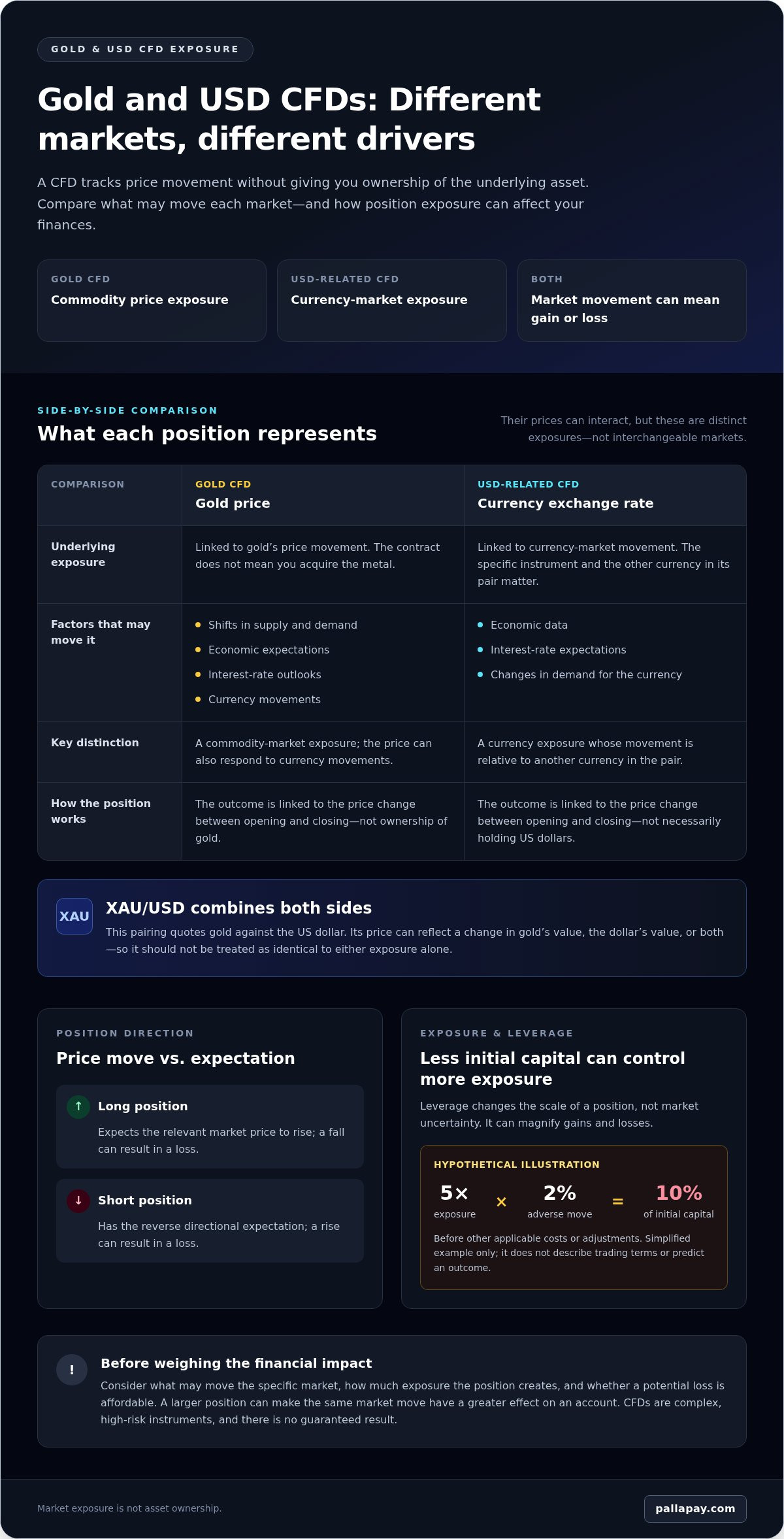
    This differs from purchasing physical gold or holding currency. A gold CFD provides price exposure without acquiring the metal. A USD-related CFD provides exposure to currency-market movements without necessarily holding US dollars. Gold CFDs and USD-related CFDs also refer to distinct markets, each influenced by its own mix of factors. XAU/USD, for example, expresses the price of gold in US dollars, so movements in either can affect the quoted relationship.

    Why financial impact depends on both direction and exposure

    Direction matters, but it isn’t the whole picture. A larger position means a given market move can have a greater effect on the account than the same move on a smaller position. If the market moves against the position, account value can fall. That can make an apparently modest price change financially important, particularly when exposure is larger than the funds committed to open the position.

    Consider a hypothetical long position: the trader expects the relevant market price to rise, but it falls before the position closes. That adverse move can result in a loss. A short position has the reverse directional expectation, but it can also lose if the market rises instead. These examples explain mechanics only. They’re not forecasts, recommendations, or assurances of an outcome.

    For gold and USD CFDs, the practical question is not only which way a price might move, but also how much exposure a position creates and whether a potential loss is affordable. Assess both the market and the position before deciding what the financial implications could be.

    How Gold and USD CFDs Work: Price Movements, Exposure, and Leverage

    A CFD position remains exposed to market prices for as long as it’s open. If the relevant price changes, the position’s unrealised result changes too. Closing it turns that movement into a realised outcome, subject to the instrument’s terms. The How CFD Trading Works overview explains the basic principle of trading price movements without owning the underlying asset.

    Leverage magnifies market exposure, and it can magnify losses as well as gains. It allows a trader to control a larger position with less initial capital than the full exposure would otherwise require. That changes the scale of the position, not the uncertainty of the market. A smaller initial commitment doesn’t make the potential risk small.

    What can move gold and USD markets?

    Gold prices can respond to shifts in supply and demand, economic expectations, interest-rate outlooks, and currency movements. USD exchange rates may also react to economic data, interest-rate expectations, and changes in demand for the currency. These influences can interact, but they aren’t reliable signals of what prices will do next.

    XAU/USD is the market pairing that quotes gold against the US dollar. Its price can reflect changes in gold’s value, the dollar’s value, or both. When assessing this pairing, consider that relationship rather than treating gold and the USD as identical exposures.

    How leverage changes the scale of a position

    Hypothetical example: Imagine a position with exposure five times the initial capital committed. If the underlying market moves 2% against it, the position’s loss would be equivalent to 10% of that initial capital, before any other applicable costs or adjustments. A move in the favourable direction could magnify the potential gain in similar fashion, but it can’t be assumed or relied on.

    This illustration uses a simplified ratio only. It doesn’t describe Pallapay’s trading terms or predict an outcome. Actual results depend on the position and applicable contract details. The practical takeaway is to assess the full exposure and the effect of an adverse move, not just the amount initially committed.

    Plain language helps make complex financial ideas easier to examine. The same care used to explain unfamiliar financial topics, including how to explain crypto payments to customers, can help traders distinguish market movement, position size, and leverage before making decisions. Readers exploring gold and USD exposure can also learn about Pallapay’s Forex and CFD trading.

    Gold CFDs vs. USD CFDs: Compare Exposure Before Choosing a Market

    Gold and USD CFDs can both create exposure to financial-market movements, but they don’t represent interchangeable choices. Gold is a commodity market; USD-related exposure depends on the specific currency instrument and the other currency in its pair. Their prices can interact, yet the drivers and risks you need to assess are distinct.

    Comparison point Gold CFD USD-related CFD
    Underlying market Gold-price movement, commonly represented by XAU/USD. A currency pairing involving the US dollar; the other currency also matters.
    Potential drivers Supply and demand, economic expectations, and currency movements may influence gold prices. Economic expectations, interest-rate outlooks, and changing demand for either currency may affect the pair.
    Key exposure question Do you understand what may move gold and how the position responds to a price change? Can you assess both currencies in the pair, rather than focusing on the USD alone?

    What distinguishes gold CFD exposure?

    A gold CFD links the position’s outcome to changes in gold’s price, without giving the trader ownership of physical gold. Gold can respond to shifts in supply and demand, broader economic expectations, and movements in currencies such as the US dollar. These are possible influences, not dependable signals of future direction. Before evaluating exposure, consider whether you understand how the gold price is quoted and what could affect it.

    What distinguishes USD-related CFD exposure?

    A USD-related CFD isn’t a single, context-free bet on the dollar. In a currency pair, one currency is measured against another, so a price change reflects their relative values. A stronger USD against one currency doesn’t necessarily mean the same movement against every other currency. Identify the instrument and understand both sides of its pairing before assessing what a position could mean financially.

    Choose a market based on your understanding, not a ranking of which asset is “better.” Consider your familiarity with each market, your tolerance for volatility, and whether you can monitor an open position in a way that fits your circumstances. A market you know well can still move unexpectedly; an unfamiliar market may require more learning before you can assess its exposure.

    A clear comparison starts with precise terms, much like explaining how to explain crypto payments to customers: identify what is being discussed before drawing conclusions. For CFDs, name the underlying market, its potential drivers, and the questions you need answered about your position. Neither gold nor USD exposure is inherently safer or suitable for everyone.

    Gold and USD CFD Trading: How to Understand the Mechanics and Financial Impact

    How to Assess CFD Risk Before Putting Personal Finances at Stake

    Risk assessment starts with more than a view on whether gold or a currency pair might rise or fall. CFDs are complex, high-risk instruments, and a position can produce losses. Trading isn’t a guaranteed route to financial improvement. Potential gains are possible outcomes, not assured results.

    Separate the main considerations before deciding whether to proceed: market risk is the chance that prices move against your position; platform and operational considerations relate to accessing, monitoring, and managing a position; personal financial risk concerns whether a loss could affect essential needs or other financial priorities. A sound decision considers all three.

    Questions to answer before opening a position

    1. Understand the product. Can you explain how the CFD works, what market it tracks, and how your position responds to price changes?
    2. Define your risk boundary. Decide in advance what loss you could tolerate. Consider what you would do if the market moved against your expectations, rather than waiting until the position is under pressure.
    3. Assess affordability. Don’t use money needed for housing, food, bills, or other essential commitments. Avoid relying on borrowed money to fund a high-risk position.
    4. Review how you’ll manage it. Consider how you’ll monitor the position, what could affect your ability to act, and how you’ll evaluate the outcome afterward. Understand the relevant platform processes and position terms before committing funds.

    How to think about trading’s financial impact

    Outcomes depend on market movement, the size of the exposure, and decisions made while the position is open. Imagine a gold CFD opened with the expectation that gold will rise. If the price rises, the position may show a gain; if it falls, it may show a loss. If the price changes little, the result may be limited, though applicable terms can still affect the final outcome. These scenarios illustrate possibilities, not forecasts.

    For your wider finances, consider whether a potential loss would change your ability to meet existing goals. Trading should not replace budgeting or saving, and this general information isn’t a substitute for professional financial advice. Clear explanations help people assess complex choices: identify the moving parts before acting, whether you’re considering CFD risk or how to explain crypto payments to customers.

    If you’ve assessed the product, exposure, and affordability and want to explore trading, explore Pallapay’s Forex and CFD trading. Weigh the risks against your personal financial circumstances before making a decision.

    A Responsible Next Step for Exploring Gold and USD CFD Trading

    Education should come before action. A measured progression is simple: learn how a CFD works, identify the market and exposure involved, assess the financial risk, then decide whether to explore trading further. Understanding the mechanics won’t remove uncertainty, but it can help you make a more considered choice.

    A practical checklist for informed exploration

    • Explain the exposure. Can you describe the underlying market, what price movement affects the position, and how the position’s value may change?
    • Revisit affordability. Would a loss affect essential expenses, savings priorities, or other financial commitments?
    • Set a boundary. Decide what level of loss you could accept before considering a position. Don’t rely on essential living funds or borrowed money.
    • Consider your time. Do you have a realistic way to monitor the position and respond to changing market conditions?

    If the instrument’s mechanics, terms, or potential risks remain unclear, pause. Taking more time to understand the exposure is a sound decision, not a missed opportunity. Exploring modern trading communities and fintech platforms, such as tyriantrade.com, can also offer useful perspective on how verified participation and shared insights shape today’s markets.

    Explore trading with realistic expectations

    CFD trading is a high-risk financial activity, not a guaranteed wealth strategy. Outcomes depend on market movements, the exposure taken, and decisions made while a position is open. A favourable outcome is possible, but so is a loss; neither should be treated as certain. Trading also shouldn’t replace budgeting, saving, or advice tailored to your personal finances.

    Clear explanations help people make sense of unfamiliar topics, including how to explain crypto payments to customers. For CFD exposure, the next step should follow understanding, not assumptions.

    After reviewing the mechanics and your own risk considerations, explore Pallapay’s Forex and CFD trading services. Approach any decision with realistic expectations and a clear view of the financial risk.

    Make Your Next Trading Decision with Clarity

    Gold and USD CFDs offer exposure to price movements, not ownership of gold or currency. Their markets have different drivers, and leverage can magnify the effect of price changes on a position. Understanding the instrument, considering how much exposure you’re taking, and deciding what loss you could afford are essential steps before acting.

    CFD trading is high risk, and a potential gain is never assured. Clear explanations matter in finance, whether you’re assessing market exposure or considering how to explain crypto payments to customers. A careful decision starts with knowing what you’re trading and how the outcome could affect your finances.

    Pallapay offers Forex trading, CFD trading, and gold trading, including XAU/USD. If you’ve reviewed the mechanics and risks and want to explore further, explore Pallapay’s trading services. Take the next step at a pace that supports informed decisions and realistic expectations.

    Frequently Asked Questions

    What is a CFD in gold or USD trading?

    A CFD is a contract that gives exposure to an asset’s price movement without transferring ownership of the asset. With a gold CFD, the position responds to gold-price changes. A USD-related CFD usually reflects a currency pair, so its value depends on the relative movement of the US dollar and another currency. The outcome depends on price movement, position size, and the relevant contract terms.

    Can gold or USD CFD trading change your financial situation?

    It can affect your finances, but the result could be positive, negative, or limited. The impact depends on market movement, exposure, and decisions about the position. Leverage can increase the effect of price changes, including losses. CFDs are complex, high-risk instruments, so they shouldn’t be treated as a reliable way to improve your financial situation or as a substitute for budgeting and saving.

    How does leverage affect a gold or USD CFD?

    Leverage lets a trader control greater market exposure with less initial capital than the full exposure would require. This magnifies the effect of price movements on the position: a move in the trader’s favour can increase a potential gain, while an adverse move can increase a loss. The smaller initial commitment doesn’t mean the position carries less risk. Understand the total exposure before deciding whether to proceed.

    Is gold CFD trading the same as buying physical gold?

    What happens if the gold or USD market moves against my CFD position?

    If the market moves against your position, its value can decline and you may incur a loss. For example, a position that anticipates a rise may lose value if the relevant price falls. The financial impact depends on the size of the exposure and the price movement, along with applicable terms. Consider your acceptable loss boundary before opening a position, not after an adverse move occurs.

    How can a beginner assess whether CFD trading is suitable?

    A beginner can start by checking whether they can explain the instrument, underlying market, price exposure, and possible loss in plain language. Clear wording also matters when explaining unfamiliar topics, including how to explain crypto payments to customers. Assess affordability, avoid using essential funds or borrowed money, and consider whether you can monitor a position. If risks remain unclear, pause and seek appropriate financial guidance.

    Are gold and USD CFDs guaranteed to produce a profit?

    No. Gold and USD CFDs don’t guarantee a profit, and a favourable market view can still be wrong. Prices may move against a position, and leverage can magnify the resulting loss. Treat any potential gain as uncertain, not assured. Before considering a trade, understand its exposure and assess whether a possible loss is affordable within your personal financial circumstances.

    Disclaimer

    The information provided on this website and blog is for general informational and educational purposes only and does not constitute financial, investment, legal, tax, or other professional advice.
    Cryptocurrency and digital asset services may be subject to regulatory restrictions in certain jurisdictions. Users are solely responsible for ensuring compliance with applicable local laws and regulations before using any products or services mentioned on this website.
    PallaPay does not guarantee the accuracy, completeness, or timeliness of any information published and accepts no liability for any loss or damages arising from reliance on the content. Any opinions expressed are those of the respective authors and may change without notice.
    Certain services, features, or products referenced may be provided through third-party partners, licensed entities, or affiliated service providers subject to separate terms and regulatory approvals. Availability of services may vary by country or region.
    This website may contain references to digital assets, virtual currencies, or blockchain-related services that are not available to residents of certain jurisdictions, including where prohibited by law. Nothing on this website constitutes an offer, solicitation, or recommendation to buy or sell any financial instrument or virtual asset.