Category: Uncategorized

  • MSB License for Crypto: The Complete 2026 Regulatory and Strategic Guide

    MSB License for Crypto: The Complete 2026 Regulatory and Strategic Guide

    By 2026, a simple federal registration is no longer a shield; it’s the bare minimum for survival in a market where 92% of institutional investors prioritize regulatory clarity over raw returns. You’ve likely felt the pressure of distinguishing between FinCEN registration and the fragmented landscape of state-level licensing. It’s a common frustration for founders who realize that without a robust msb license crypto strategy, securing a corporate bank account becomes nearly impossible. We agree that the threat of non-compliance fines, which totaled over $4.3 billion in 2023 alone, is a valid concern for any growing fintech entity.

    This guide empowers you to master these complexities to ensure your business remains secure and globally scalable. You’ll gain a clear roadmap for registration while discovering how a regulated status accelerates your growth. We’ll also examine how partnering with a visionary leader like Pallapay delivers the seamless, instant infrastructure required for the future of payments. From liquidity management to institutional settlement, we handle the heavy lifting so you can focus on building the next generation of financial utility.

    Key Takeaways

    • Navigate the evolving 2026 regulatory landscape by identifying the precise legal criteria that categorize digital asset platforms as Money Services Businesses.
    • Understand the critical operational differences between federal FinCEN registration, state-level Money Transmitter Licenses, and Canada’s FINTRAC requirements.
    • Learn how obtaining an msb license crypto serves as a strategic catalyst for securing Tier-1 banking access and establishing high-level institutional trust.
    • Implement industry-leading AML and KYC protocols to ensure your operations meet the rigorous compliance standards necessary for global cross-border expansion.
    • Discover how integrating with a regulated partner like Pallapay provides the instant settlement infrastructure needed to bridge traditional finance with blockchain innovation.

    What is an MSB License for Crypto? Defining Compliance in 2026

    An msb license crypto is no longer a peripheral requirement but the bedrock of institutional legitimacy for any digital asset platform. In the current 2026 landscape, a Money Services Business (MSB) is a financial entity that transmits or converts funds, including virtual currencies. A Money Services Business in the crypto sector is defined as any entity that facilitates the exchange or transmission of digital assets, primarily overseen by FinCEN in the United States and FINTRAC in Canada as the key regulatory bodies.

    Exchanges and payment gateways fall under this classification because they provide the critical infrastructure for converting fiat into digital assets. This role places them at the center of global financial flows. Since 2018, when many operators viewed federal registration as a voluntary badge of honor, the environment has shifted. The 2026 standards now demand real-time transaction monitoring and strict adherence to the Travel Rule, making the msb license crypto a mandatory tool for any business seeking to bridge the gap between blockchain and traditional finance.

    At the federal level, businesses “register” as an MSB. While registration sounds simpler than licensing, the terms are often used interchangeably because the process requires a comprehensive Anti-Money Laundering (AML) program and regular independent audits. This federal status is the first step toward achieving the stability required for global settlement and liquidity. It ensures that the “heavy lifting” of compliance is handled before a business attempts to scale across borders.

    Who Qualifies as a Money Services Business?

    Regulatory bodies distinguish between “Administrators” and “Exchangers.” An exchanger is a person or business engaged in the exchange of virtual currency for real currency, funds, or other virtual currency. Custodial exchanges that hold user funds are the primary targets of these rules. Conversely, self-custody wallet providers that only offer software without facilitating the transfer of value generally don’t meet the MSB criteria. The distinction relies on whether the entity has “control” over the assets during the transaction process.

    The Legal Necessity of MSB Status

    Operating without proper credentials carries extreme risk. Since 2023, the Department of Justice has intensified its focus on unlicensed money transmitters, with some enforcement actions resulting in fines exceeding $4 billion. MSB status acts as a mandatory prerequisite for regulated crypto exchanges to access institutional banking partners. As detailed in the Legality of cryptocurrency by country, while specific rules vary, the requirement for transparency is universal. The Bank Secrecy Act (BSA) mandates that every MSB maintains a written compliance program to ensure the future of payments remains secure, efficient, and fully integrated with the global economy.

    The Regulatory Framework: FinCEN Registration vs. State Money Transmitter Licences

    Securing an msb license crypto framework begins with understanding the dual-layered nature of U.S. oversight. Federal registration provides the legal baseline, while state licenses grant the specific authority to facilitate transactions within regional borders. This distinction is vital for any entity aiming to provide institutional-grade financial services. Federal registration with FinCEN is the mandatory first step, acting as a prerequisite before a business can even apply for state-level Money Transmitter Licences (MTLs).

    The U.S. approach differs significantly from the Canadian model. In Canada, businesses register with FINTRAC, which operates as a centralized federal authority for Anti-Money Laundering (AML) and Counter-Terrorist Financing (CTF). The U.S. system is more fragmented. FinCEN sets the national standard for reporting, but states hold the power to regulate the actual movement of funds. To understand these obligations, businesses should consult FinCEN’s official guidance on virtual currencies, which defines which business models fall under federal MSB status.

    FinCEN Registration: The Federal Baseline

    New businesses must register with FinCEN within 180 days of beginning operations. This isn’t a long-term goal; it’s a strict legal deadline. The registration process requires detailed disclosures regarding business ownership, the physical footprint of the company, and the specific financial services offered. A critical component of this filing is the appointment of an “Agent for Service.” This individual or entity serves as the official point of contact for legal and regulatory inquiries. Without a registered agent, a business cannot maintain federal compliance, putting its entire operational future at risk. This federal layer ensures that the msb license crypto holder adheres to the Bank Secrecy Act (BSA) from day one.

    State Money Transmitter Licences (MTL)

    State-level compliance is where operational costs and complexity often diverge. New York’s BitLicense, established in 2015, remains the most demanding framework in the country. It requires significant capital reserves and exhaustive cybersecurity protocols. In contrast, Wyoming has positioned itself as a blockchain-friendly hub, passing over 20 laws since 2018 to streamline crypto-fiat integration. Many businesses adopt a tiered strategy, securing licenses in high-volume states first to manage resources effectively. For companies seeking to navigate these complexities, integrating a professional fiat settlement solution can simplify the heavy lifting of maintaining liquidity across different jurisdictions. The Future of Payments depends on this ability to bridge the gap between local state laws and global blockchain utility seamlessly.

    Strategic Advantages: Why an MSB License is Essential for Crypto Businesses

    Securing an msb license crypto designation transforms a digital asset firm from a high-risk startup into a verified financial institution. It isn’t just about avoiding fines; it’s about unlocking the infrastructure required for institutional growth. For most crypto ventures, the biggest hurdle isn’t the technology, it’s the inability to move money between the digital and traditional worlds. An MSB registration solves this by providing the regulatory “green light” that Tier-1 banks demand before opening corporate accounts or providing liquidity lines.

    Bridging the Gap to Traditional Finance

    Traditional banks often refuse crypto clients due to perceived AML risks. Without an MSB status, your business remains locked out of the global banking system. This credential proves your firm follows strict compliance protocols, which is vital for securing fiat settlement for merchants. By operating under a regulated framework, businesses can reduce transaction reversals and fraud by up to 40% compared to unregulated entities. While federal registration is the first step, businesses must also navigate complex state money transmitter laws to ensure full operational coverage across different jurisdictions.

    An MSB license serves as a powerful marketing tool. It positions your brand as “Regulated and Secure,” building immediate trust with high-net-worth investors and institutional partners. When a merchant sees that a platform is a registered Money Services Business, the perceived risk of a regulatory shutdown vanishes. This trust is the foundation for facilitating cross-border payments for merchants, allowing them to accept crypto and receive local currency without friction. It’s the difference between being a temporary project and a permanent fixture in the future of payments.

    Global Scalability and Market Entry

    The msb license crypto status carries significant weight beyond North American borders. Credibility earned in regulated markets often fast-tracks entry into the Middle East and SE Asia. Pallapay leverages its extensive MSB registrations to serve clients in over 180 countries, providing a seamless bridge for global commerce. This regulatory foundation is particularly effective for OTC exchange operations, where large-scale liquidity and legal certainty are non-negotiable.

    By maintaining these standards, we ensure that every transaction happens within a secure and compliant ecosystem. Businesses that prioritize licensing early avoid the “compliance debt” that often sinks scaling startups. The result is a more resilient operation that can pivot quickly into new markets. Key benefits of this approach include:

    • Instant Credibility: Institutional partners view MSB status as a baseline requirement for collaboration.
    • Fraud Mitigation: Regulated oversight requires robust KYC/KYT tools that protect the business from illicit actors.
    • Market Access: A registered status allows for easier integration with payment gateways and credit card processors.

    Ultimately, the license isn’t a burden. It’s a strategic asset that allows a business to scale without the constant threat of banking de-risking or legal intervention.

    Maintaining Compliance: AML, KYC, and Operational Standards for MSBs

    Securing an msb license crypto represents a significant milestone, but the operational burden shifts immediately to rigorous maintenance. Regulators demand a dedicated Anti-Money Laundering (AML) Compliance Officer who possesses the internal authority to halt suspicious transactions. This individual oversees the filing of Currency Transaction Reports (CTRs) for any cash-in or cash-out events exceeding $10,000. They also manage Suspicious Activity Reports (SARs) when transactions appear to lack an obvious economic purpose or deviate from a user’s established profile. By January 2026, the threshold for enhanced scrutiny has tightened, making real-time oversight a core business necessity.

    Operational excellence requires more than just filing reports. It involves a commitment to transparency and periodic validation. Independent compliance audits must occur annually to confirm your MSB standing remains in good stead. These audits verify that your internal policies align with the Bank Secrecy Act and other local mandates. Failure to provide a clear audit trail results in heavy fines or the immediate revocation of your license.

    The Pillars of a Modern AML Program

    Effective compliance programs rely on rigorous internal controls that monitor for transaction layering and unusual volume spikes. Training your team is equally critical. Employees must be equipped to recognize the latest crypto scams that target decentralized gateways. Advanced MSBs now integrate automated blockchain forensics. These tools provide instant risk scores for every incoming wallet address, ensuring your platform never interacts with sanctioned entities or high-risk mixers. This proactive approach protects your liquidity and your reputation.

    KYC and Identity Verification

    The industry is moving away from slow, manual document reviews. Modern platforms utilize biometric and AI-driven kyc in crypto to verify identities in under 60 seconds. This technology scans government IDs and matches live facial data, reducing onboarding friction while satisfying strict MSB guidelines. Balancing user experience with data collection is a delicate task. You must collect enough information to satisfy “Know Your Business” (KYB) requirements for corporate clients without alienating individual users. Protecting this Personally Identifiable Information (PII) is a primary legal obligation. Secure, encrypted storage is the baseline for institutional trust.

    Organizations that prioritize these standards build a foundation for long-term growth and global expansion. Compliance isn’t a hurdle; it’s a competitive advantage that signals stability to your partners and clients.

    Optimize your business operations with secure fiat settlement solutions that meet global compliance standards.

    The Pallapay Ecosystem: Leveraging Global MSB Status for Secure Instant Payments

    Pallapay stands at the intersection of regulatory rigor and technological agility. By maintaining active MSB registrations in both the United States and Canada, the platform provides a verified foundation for businesses that prioritize compliance. This msb license crypto framework isn’t just a legal requirement; it’s a strategic asset that allows Pallapay to handle the heavy lifting of anti-money laundering (AML) and know-your-customer (KYC) protocols on behalf of its partners.

    Speed defines the modern economy. Pallapay integrates its regulated status with proprietary “Instant” technology to ensure that merchants don’t have to choose between security and velocity. When a business integrates the Payment API, they gain immediate access to a global crypto acceptance network that satisfies international standards. This allows for seamless cross-border settlements without the typical friction associated with legacy banking systems.

    Regulated Infrastructure for Global Merchants

    For retail businesses, the deployment of a crypto pos machine requires a partner that understands the nuances of local and international law. Pallapay ensures every transaction processed at a physical storefront remains compliant within the broader financial ecosystem. Using a gateway that is already MSB-registered eliminates the need for individual merchants to seek complex legal counsel for their crypto operations. Pallapay provides “The Future of Payments” through its regulated framework, allowing business owners to focus on growth while the platform manages the underlying technical and legal complexities.

    From Dubai to New York: A Unified Compliance Model

    The brand’s physical presence in major financial hubs like Dubai and Istanbul reinforces its commitment to high-touch service and institutional reliability. This global footprint is essential for supporting high-volume services, such as the ability to sell usdt for cash dubai, where liquidity and regulation must work in tandem. Having a unified compliance model means that whether a transaction originates in New York or the Middle East, the standards for security remain consistently high. This msb license crypto status facilitates deep liquidity pools and rapid OTC exchanges that smaller, unregulated entities can’t match.

    Choosing a payment partner is a decision that impacts long-term viability. By aligning with a regulated leader, businesses protect themselves from the volatility of shifting global mandates. Partner with a global leader in compliant crypto fintech to future-proof your operations today.

    Mastering the New Era of Regulated Finance

    The 2026 regulatory landscape demands a shift from simple innovation to institutional-grade reliability. It’s no longer enough to just offer digital assets; you must prove your platform’s stability through rigorous compliance. Securing an msb license crypto status is the definitive benchmark for businesses that prioritize long-term growth over short-term gains. This strategic alignment eliminates the friction of traditional banking hurdles and provides the legal bridge needed to access global liquidity pools.

    Pallapay simplifies this evolution by providing a seamless, all-in-one ecosystem grounded in official MSB registrations across the USA and Canada. With a physical presence in major financial hubs like Dubai, Singapore, and Istanbul, we bridge the gap between legacy systems and modern blockchain utility. We currently empower merchants in over 180 countries with instant settlement and secure gateway solutions, ensuring your capital moves as fast as your vision. Our infrastructure handles the heavy lifting of compliance so you’re free to focus on scaling your operations across borders. The future of payments is regulated, efficient, and waiting for you to lead the way.

    Experience the security of a fully regulated ecosystem with Pallapay

    Frequently Asked Questions

    What is the difference between an MSB registration and an MSB license?

    Registration is a federal requirement with FinCEN, while an MSB license is a state-specific authorization. Federal registration serves as a notification of your intent to operate; however, state licenses provide the legal authority to conduct business within specific jurisdictions. For example, 49 US states require individual money transmitter licenses to operate legally. This distinction ensures that a company meets both national transparency standards and local consumer protection laws.

    Does a crypto exchange need an MSB license in every state it operates?

    Most crypto exchanges must secure a license in every state where they have customers. While federal registration is universal, 49 states mandate individual Money Transmitter Licenses (MTL) for digital asset activities. Only Montana lacks a formal MTL requirement as of 2026, meaning you’ll need separate approvals for the other 49 jurisdictions to ensure total compliance. Operating without these state-level permits can lead to immediate cease-and-desist orders.

    How much does it cost to obtain and maintain an MSB license in 2026?

    Costs vary significantly by state, with application fees ranging from $375 in Florida to $5,000 for a New York BitLicense. You should also budget for surety bonds, which often require a minimum of $25,000 to $500,000 in coverage depending on transaction volume. Maintaining an msb license crypto operation involves annual renewal fees and independent AML audits that typically cost between $10,000 and $30,000 per year. These figures represent the baseline for institutional reliability.

    Can a foreign crypto company apply for a US MSB registration?

    Foreign companies must register as an MSB if they conduct more than $1,000 in daily business with US residents. The FinCEN 2011 Final Rule explicitly includes foreign entities that offer services to the US market, even without a physical presence. You’ll need to appoint a US resident as an agent for service of legal process to complete the registration. This ensures your global operation remains compliant with US anti-money laundering frameworks.

    What are the reporting requirements for a crypto MSB regarding SARs?

    MSBs must file a Suspicious Activity Report (SAR) for any transaction involving $2,000 or more that appears suspicious. Under 31 CFR 1022.320, you have a 30-day window to submit the report after detecting the activity. Failure to report can lead to civil penalties reaching $250,000 or criminal fines under the Bank Secrecy Act. These reporting requirements are vital for maintaining the integrity of the global financial network and preventing illicit flows.

    How long does the MSB registration process typically take with FinCEN?

    The actual online registration through the BSA E-Filing System is often instant once you submit the form. However, building the required AML program and internal controls usually takes 3 to 6 months of preparation. You must register within 180 days of beginning your msb license crypto operations to avoid immediate regulatory action. This timeline allows your business to integrate necessary compliance software before the federal deadline expires.

    Why is an MSB license necessary for a crypto payment gateway?

    A payment gateway acts as a money transmitter by facilitating the exchange of value between a customer and a merchant. FinCEN Guidance FIN-2013-G001 clarifies that entities accepting and transmitting convertible virtual currency fall under MSB regulations. This license ensures your gateway provides a secure, regulated bridge for instant global settlements without legal interruptions. It’s the professional foundation that allows a gateway to function as a reliable visionary partner for modern commerce.

    Does having an MSB license guarantee a corporate bank account?

    Holding an MSB license doesn’t guarantee a corporate bank account, but it’s a mandatory requirement for the application. Banks view crypto firms as high-risk entities and will perform deep due diligence on your AML policies. While the license proves you’re a legitimate financial player, you still need to demonstrate robust compliance to win trust from institutional banking partners. Most banks require at least two years of clean audit history before offering full services.

  • Crypto POS Machine Dubai: The Complete 2026 Merchant Implementation Guide

    Crypto POS Machine Dubai: The Complete 2026 Merchant Implementation Guide

    By 2026, refusing a digital asset payment in the UAE will be as restrictive to growth as refusing credit cards was a decade ago. While the local retail sector is rapidly evolving, many merchants still hesitate because they fear the 15% daily price swings of Bitcoin or the perceived technical hurdles of hardware integration. You’ve likely spent time wondering if a crypto pos machine dubai solution can actually provide the stability your balance sheet requires. We understand that your priority is maintaining a secure, predictable cash flow without getting bogged down in the intricacies of blockchain liquidity.

    This guide provides the definitive roadmap to mastering the transition to digital asset payments within the UAE’s unique regulatory framework. You’ll learn how to deploy a fully compliant infrastructure that guarantees instant AED settlement directly into your bank account, effectively eliminating volatility risks. We’ll walk through the hardware setup, the integration of professional payment gateways, and the steps to ensuring a seamless checkout experience for your global clientele. This is the future of payments, simplified for the modern enterprise.

    Key Takeaways

    • Understand the mechanics of instant AED settlement to ensure seamless liquidity during every digital asset transaction.
    • Navigate the VARA regulatory framework to establish a compliant and secure foundation for your virtual asset operations.
    • Implement a crypto pos machine dubai to elevate the payment experience within high-value sectors like luxury retail and real estate.
    • Discover the strategic advantage of an all-in-one ecosystem that bridges the gap between blockchain innovation and institutional reliability.

    Understanding Crypto POS Machines in the Dubai Retail Landscape

    Dubai’s retail sector is undergoing a profound transformation. A crypto POS terminal serves as the vital hardware bridge between a customer’s digital wallet and a merchant’s institutional banking framework. While a traditional Point of Sale (POS) system focuses on card swipes and cash, a crypto pos machine dubai solution enables the real-time processing and settlement of digital assets. The evolution of Dubai’s economy has been swift. It transitioned from a cash-heavy society in the early 2000s to a global leader in contactless card payments by 2015. Now, the city is embracing the blockchain era. This shift isn’t just about new currency; it’s about a fundamental upgrade to the financial plumbing of the city.

    The core difference between a standard terminal and a dedicated crypto solution is the settlement layer. Standard machines rely on legacy banking rails that often take 48 to 72 hours to clear funds. A dedicated crypto terminal provides instant verification. It allows merchants to accept Bitcoin, Ethereum, or USDT while receiving the equivalent in local currency immediately. This eliminates the volatility risks that once made merchants hesitant. Standard POS systems are restricted by geographical boundaries and centralized banking hours. In contrast, a crypto terminal operates on a 24/7 decentralized network. It provides a level of liquidity and global reach that traditional systems cannot match. For a business in the Dubai Mall or DIFC, this means never turning away a customer because of banking holidays or cross-border payment failures.

    The Shift Toward Digital Asset Payments in the UAE

    Dubai residents and visitors represent a unique demographic of early adopters. The UAE ranked among the top countries for crypto readiness in 2023, driven largely by the government’s proactive regulatory stance. The Dubai Blockchain Strategy, initiated in 2016, continues to influence how retail infrastructure is built today. A Crypto POS is a hardware solution for real-time digital asset processing. This technology ensures that transactions are as fast as a traditional tap-and-pay interaction. The 2026 outlook suggests that digital asset integration will be a prerequisite for any luxury retailer in the UAE. As the city moves toward its goal of becoming a global Web3 hub, the demand for seamless crypto-to-fiat conversion tools will only intensify.

    Key Benefits for Dubai-Based Merchants

    Adopting a crypto pos machine dubai offers immediate financial advantages. Dubai welcomed 17.15 million international visitors in 2023, many of whom are high-net-worth investors seeking to spend their digital portfolios. By accepting crypto, merchants bypass the high 3% to 5% fees typically charged for international credit card processing. It’s a strategic move that markets a business as an innovative, forward-thinking brand. This positioning is essential in a competitive market where tech-savvy shoppers demand the Future of Payments today. Merchants who implement these systems now are securing a first-mover advantage in a market that rewards technological agility.

    Technical Mechanics: How a Crypto POS Ensures Instant AED Settlement

    Modern commerce demands speed, and the 2026 payment ecosystem delivers it through high-performance infrastructure. Deploying a crypto pos machine dubai allows businesses to capture global liquidity without the complexity of managing digital wallets or private keys. The transaction flow is engineered for efficiency. When a customer initiates a payment, the terminal generates a dynamic QR code containing the precise transaction details and the real-time exchange rate. Once the customer scans and approves the transfer from their mobile wallet, the system triggers an automated off-ramp process.

    This backend sequence relies on a network of institutional liquidity providers that execute trades in milliseconds. These providers ensure that the exchange rates remain competitive, even during periods of high market activity. By the time the customer sees a “Success” message on their screen, the crypto has been converted into fiat. This process matches the sub-second speed of traditional NFC card payments, ensuring that retail queues keep moving. All operations within this framework adhere to the rigorous standards set by the Virtual Assets Regulatory Authority (VARA), providing a secure environment for both the merchant and the consumer.

    Eliminating Volatility Risk for Business

    Price fluctuations are a primary concern for traditional retailers, yet modern technology has effectively neutralized this hurdle. The terminal locks in the exchange rate at the exact moment the QR code is generated. If a luxury watch is priced at 50,000 AED, the merchant receives exactly 50,000 AED, regardless of market movements during or after the sale. Businesses don’t need to hold digital assets on their balance sheets or worry about capital gains tracking. For a deeper look at how these funds reach your corporate account, explore Pallapay’s fiat settlement solutions. This bridge between digital assets and local currency makes crypto as stable as any bank-issued tender.

    Hardware Features of Modern Crypto Terminals

    The 2026 generation of hardware is designed for the rugged reality of retail environments. These terminals aren’t just software interfaces; they’re comprehensive financial hubs. Most units feature high-resolution touchscreens and ergonomic designs that fit seamlessly into any checkout counter.

    • NFC and 2D Scanners: These units support “Tap-to-Pay” crypto cards and high-speed QR scanning even in low-light conditions.
    • Reliable Connectivity: Integrated 5G and Wi-Fi 6 modules ensure that the crypto pos machine dubai stays online during peak hours.
    • Physical Proof: Built-in thermal printers provide instant paper receipts, satisfying traditional accounting needs alongside digital logs.

    The user interface is built for simplicity. Retail staff don’t require specialized technical training because the terminal mirrors the workflow of a standard credit card machine. It’s an intuitive experience that allows you to upgrade your payment infrastructure without disrupting daily operations.

    Compliance and Security: Navigating VARA and UAE Regulations

    Dubai established the Virtual Assets Regulatory Authority (VARA) in March 2022 to provide a clear legal framework for the digital economy. For any business integrating a crypto pos machine dubai, compliance isn’t optional; it’s the foundation of institutional trust. Merchants must align with providers that hold the necessary authorizations to process virtual assets. This ensures that every transaction meets the stringent Anti-Money Laundering (AML) and Know Your Customer (KYC) standards required by UAE law. Pallapay integrates these protocols directly into the hardware, performing real-time checks that prevent illicit actors from interacting with your business.

    Operating Legally in Dubai’s Crypto Ecosystem

    Pallapay functions as a regulated financial technology provider, handling the complex regulatory requirements so merchants don’t have to. It’s vital to distinguish between accepting crypto as payment and actively trading it. When a customer pays at your storefront, the system facilitates instant fiat settlement to ensure your books remain clear and tax-compliant. VARA-compliant terminals protect merchants from legal liability by ensuring all processed funds originate from verified sources. This professional bridge allows traditional retail operations to tap into digital liquidity without the typical overhead of a compliance department. By 2026, the UAE aims to have 100% of its virtual asset service providers fully licensed, making early adoption with a regulated partner a strategic necessity.

    Zero Chargeback Guarantee

    Credit card fraud costs global merchants billions annually, often through the “friendly fraud” of disputed charges. Blockchain technology eliminates this risk entirely because transactions are final and immutable. Once a customer authorizes a payment through a crypto pos machine dubai, the data is etched into the ledger and cannot be reversed by the user. This creates a secure environment for high-value retailers in sectors like luxury real estate or automotive sales.

    The administrative burden of proving a sale to a bank months after the product has left your floor is gone. Fraud prevention is built into the technology itself. Because the ledger is transparent and permanent, the revenue is secured instantly, backed by mathematical certainty. This system offers several key advantages for modern commerce:

    • Protection against unauthorized reversals: No more lost revenue from customer-initiated chargebacks.
    • Elimination of dispute fees: Merchants save on the heavy administrative costs associated with banking mediation.
    • Instant verification: Real-time confirmation of funds before any goods or services are delivered.
    • Data Integrity: Secure encryption and hardware modules guard sensitive merchant data against external breaches.

    The future of payments is defined by this lack of friction, where security doesn’t come at the cost of speed. By utilizing a system that prioritizes both regulatory alignment and technological finality, businesses can operate with absolute confidence in their revenue streams.

    Strategic Implementation: Integrating Crypto into High-Value Dubai Industries

    Dubai’s economy thrives on high-velocity commerce and the rapid movement of capital. Deploying a crypto pos machine dubai isn’t just about adding a modern payment method; it’s about aligning your business with the spending habits of a global, tech-savvy elite. From the luxury corridors of the Dubai Mall to the high-stakes world of real estate, digital asset integration has become a hallmark of institutional financial reliability.

    Luxury Retail and Hospitality Use Cases

    In the high-end retail sectors of Mall of the Emirates, discretion and speed are the primary drivers of customer satisfaction. Luxury watch retailers frequently encounter ultra-high-net-worth individuals who prefer settling million-dirham invoices using stablecoins or Bitcoin. By utilizing a specialized terminal, these boutiques finalize sales instantly, bypassing the three-to-five-day delays often associated with international wire transfers. This technology provides a discreet, high-tech payment option that mirrors the premium service expected in five-star environments. Merchants can explore Pallapay’s hotel industry solutions to see how these integrations elevate the entire guest journey by removing payment friction at check-in and check-out.

    Real Estate and High-Ticket Services

    The Dubai real estate sector has seen a 15% increase in crypto-related transaction inquiries since 2024. Managing large-scale transfers for property down payments via a crypto pos machine dubai simplifies the logistics of significant capital movements. Instead of navigating complex banking correspondence, developers and property managers receive instant confirmation of funds. These terminals integrate directly with merchant dashboards, providing real-time reporting and automated accounting that satisfies institutional-grade compliance requirements. This level of transparency ensures that every high-ticket transaction is recorded and ready for audit.

    High-volume logistics providers, such as yacht charters and luxury car rentals, also benefit from this streamlined approach. These businesses often deal with international clients who require immediate access to services. Accepting digital assets allows these operators to secure bookings in seconds, ensuring that liquidity is maintained and assets are never left idle due to payment processing lags. The system handles the heavy lifting of technology behind the scenes, allowing the merchant to focus on delivering a world-class experience.

    Ready to modernize your payment infrastructure? Equip your business with the future of payments today.

    Choosing the Right Partner: The Pallapay Ecosystem Advantage

    Selecting a technology provider in the UAE requires a balance of innovation and institutional reliability. Pallapay serves over 500 institutional clients and thousands of SMEs across the region, positioning itself as the definitive bridge between traditional retail and the digital asset economy. The platform’s strength lies in its “All-in-One” ecosystem. By unifying the Pallapay Wallet, a high-performance payment gateway, and physical hardware, merchants avoid the technical debt of managing fragmented systems. This integration ensures that liquidity, settlement, and reporting happen within a single, secure environment.

    Scalability is a core feature of the Pallapay infrastructure. A single boutique in Dubai Design District requires the same level of security as a nationwide retail chain with 50 or more locations. Pallapay provides this consistency. Large enterprises leverage deep liquidity for high-volume transactions, while smaller businesses benefit from a crypto pos machine dubai solution that remains simple to operate. This flexibility allows a business to grow its digital payment capabilities without needing to overhaul its underlying financial architecture.

    Technical Support and Local Expertise

    Operational downtime is not an option in Dubai’s 24/7 economy. Pallapay maintains a physical presence with offices in Business Bay, Dubai, providing a level of accountability that offshore providers cannot match. Local experts handle on-site installation and conduct thorough staff training sessions to ensure every team member is comfortable processing blockchain transactions. Support teams stay active 24/7, aligning perfectly with UAE business hours and peak retail periods. Every crypto pos machine dubai receives continuous software updates. These remote patches ensure the hardware stays ahead of emerging blockchain trends and maintains the highest security standards in the fintech industry.

    Getting Started with Your Crypto POS

    The path to becoming a crypto-enabled merchant is designed for speed. The onboarding process is direct, moving from the initial application to your first live transaction in approximately 72 hours. Efficiency is the priority. Pallapay delivers hardware that is fully pre-installed and ready for immediate use, eliminating complex configuration steps for the merchant. This rapid deployment helps businesses stay competitive as the UAE accelerates its transition toward a digital-first economy.

    Success in the modern market requires the right tools and a visionary partner. Apply for your Pallapay Crypto POS machine today and lead the future of payments.

    Secure Your Competitive Edge in Dubai’s Digital Economy

    Dubai’s retail landscape is evolving at a rapid pace as VARA regulations provide the clear legal framework required for institutional adoption. Implementing a crypto pos machine dubai solution isn’t just about modernizing payments; it’s about capturing a global market that demands instant liquidity and absolute security. By partnering with a regulated MSB in the USA and Canada, your business gains the stability of a financial leader with a physical presence at the Binary Tower in Business Bay. You’ll benefit from instant fiat settlement in AED or USD. This ensures your cash flow remains shielded from market volatility while you provide a seamless checkout experience for every client. This transition bridges the gap between traditional commerce and the future of global finance. It’s time to transform your payment infrastructure into a strategic asset that drives measurable growth and builds lasting customer trust across the UAE. We’re ready to help you lead this transformation with confidence and technical precision.

    Equip your business with the Future of Payments: Get the Pallapay Crypto POS

    Frequently Asked Questions

    Is it legal to use a crypto POS machine for my business in Dubai?

    Yes, it’s entirely legal to use a crypto POS terminal in Dubai under the regulatory framework established by the Virtual Assets Regulatory Authority (VARA). The Virtual Assets and Related Activities Regulations 2023 provide a clear legal structure for businesses to accept digital assets through licensed providers. Using a crypto pos machine dubai ensures your business stays compliant while tapping into the city’s growing digital economy.

    How much are the transaction fees for a crypto POS terminal compared to credit cards?

    Crypto transaction fees are generally lower than traditional credit card processing fees, which often range from 2% to 3.5% according to 2024 Nilson Report data. By eliminating multiple banking intermediaries and cross-border surcharges, merchants often reduce their total overhead per transaction. This cost efficiency allows you to retain more revenue from every sale while offering customers a modern, secure payment alternative.

    Can I receive payments in AED even if the customer pays in Bitcoin or USDT?

    You’ll receive your funds in AED directly into your bank account regardless of the cryptocurrency used by the customer. The Pallapay gateway performs an instant conversion at the moment of sale to protect your business from market volatility. This seamless process ensures that your accounting remains straightforward and your liquidity is maintained in the local currency you use for daily operations.

    Do I need a special license from VARA to accept crypto in my store?

    Individual retail merchants don’t usually require a specific VARA license if they’re using a payment processor that’s already licensed. VARA’s 2023 guidelines focus on regulating the service providers who handle the underlying technology and liquidity. By partnering with a professional gateway, you leverage their institutional infrastructure to offer The Future of Payments without the burden of complex independent licensing procedures.

    What happens if the price of Bitcoin drops immediately after a customer pays?

    Your business is protected from price drops because the exchange rate is locked the moment the transaction is initiated. Our crypto pos machine dubai technology executes a real-time settlement, meaning the AED value you see on the screen is exactly what you receive. This instant conversion removes the risk of asset depreciation, allowing you to enjoy the benefits of blockchain technology with the stability of fiat currency.

    Which cryptocurrencies are supported by the Pallapay POS machine?

    The Pallapay terminal supports a comprehensive range of major digital assets including Bitcoin, Ethereum, and USDT. Our all-in-one ecosystem is designed to process the most liquid and widely held cryptocurrencies to ensure you never miss a sale. This broad compatibility makes your store a global destination for tech-savvy travelers and local crypto holders who demand flexible, secure payment options.

    How long does it take for the funds to reach my Dubai bank account?

    Funds are typically settled into your Dubai bank account within 24 to 48 hours, providing a reliable rhythm for your cash flow management. We prioritize speed in our settlement cycles to ensure that your business stays agile and liquid. This rapid turnaround time is a key advantage of our professional fintech bridge, connecting disruptive blockchain speed with traditional banking reliability.

    Does the crypto POS machine require a constant internet connection?

    Yes, a stable internet connection via Wi-Fi or a 4G/5G SIM card is essential for processing blockchain transactions in real time. The machine must communicate with the global network to verify wallet balances and confirm the transfer of assets instantly. This constant connectivity ensures that every payment is secure and that the exchange rate is accurately applied at the second of purchase.

  • How to Accept Crypto Payments in Dubai: The Complete 2026 Merchant Guide

    How to Accept Crypto Payments in Dubai: The Complete 2026 Merchant Guide

    Dubai’s Digital Economy Strategy aims to double the digital sector’s contribution to GDP to 100 billion dollars by 2031, leaving no room for businesses that rely solely on legacy financial systems. To accept crypto payments dubai merchants need a solution that bridges the gap between disruptive innovation and institutional stability. You recognize that your customers demand the flexibility of digital assets, yet the complexity of VARA regulations and the risk of market volatility remain significant barriers to entry. It is a challenge to balance the need for innovation with the necessity of financial security.

    This guide provides the professional clarity you need to integrate cryptocurrency with absolute confidence. We’ll show you how to establish a secure, VARA-compliant payment gateway that offers instant conversion to AED, ensuring your liquidity is never compromised by price swings. You will discover the exact steps to eliminate technical friction and position your brand as a visionary leader in the future of payments. We will explore the seamless transition from digital assets to fiat settlement, covering everything from liquidity management to automated API integrations for a truly global reach.

    Key Takeaways

    • Understand the 2026 VARA regulatory framework to ensure your business remains fully compliant within Dubai’s evolving cashless ecosystem.
    • Discover the seamless process to accept crypto payments dubai merchants use to tap into a global market of high-net-worth digital asset holders.
    • Learn how instant fiat settlement eliminates volatility risks by converting cryptocurrency payments into AED with institutional-grade efficiency.
    • Explore industry-specific integration strategies for luxury real estate and hospitality that streamline high-ticket transactions via specialized OTC desks.
    • Identify the strategic benefits of an all-in-one payment ecosystem to future-proof your business with a regulated, global fintech partner.

    The Regulatory Landscape: Accepting Crypto in Dubai in 2026

    Dubai’s transition to a digital economy reached a critical milestone in 2026. The Dubai Cashless Strategy, launched by the Digital Dubai Office, now targets a 100% digital transaction rate across all government and private sector interactions. This initiative transformed how businesses accept crypto payments dubai, moving digital assets from the fringes of finance into the heart of the city’s commercial infrastructure. The city’s commitment to becoming a global hub for the “Future of Payments” is no longer a goal; it’s a reality that businesses must adapt to for continued growth.

    The Virtual Assets Regulatory Authority (VARA) provides the framework that makes this possible. Established under the Virtual Assets Law of 2022, VARA introduced refined 2026 updates that clarify exactly how merchants can process digital wealth. These updates distinguish between “Proprietary Trading” and “Merchant Services,” ensuring that retail businesses don’t face the same licensing hurdles as major exchanges. While individuals enjoy high levels of freedom, businesses must operate through regulated gateways to maintain legal standing. You can find more detail on the global context of cryptocurrency legality in the UAE and how it compares to other international jurisdictions.

    VARA Compliance for Merchants

    Compliance doesn’t have to be a barrier for your business. The 2026 regulatory updates allow merchants to utilize licensed providers like Pallapay to manage the technical and legal heavy lifting. These providers utilize fiat settlement systems to ensure businesses receive local currency directly into their bank accounts. This setup eliminates the need for the merchant to register as a Virtual Asset Service Provider (VASP). The licensed gateway handles all KYC and AML requirements instantly, whether you use an online API or a crypto POS machine in a physical store. Global trust is further reinforced through MSB (Money Services Business) registrations, ensuring every transaction meets international standards for cross-border commerce.

    Taxation and Legal Clarity in the UAE

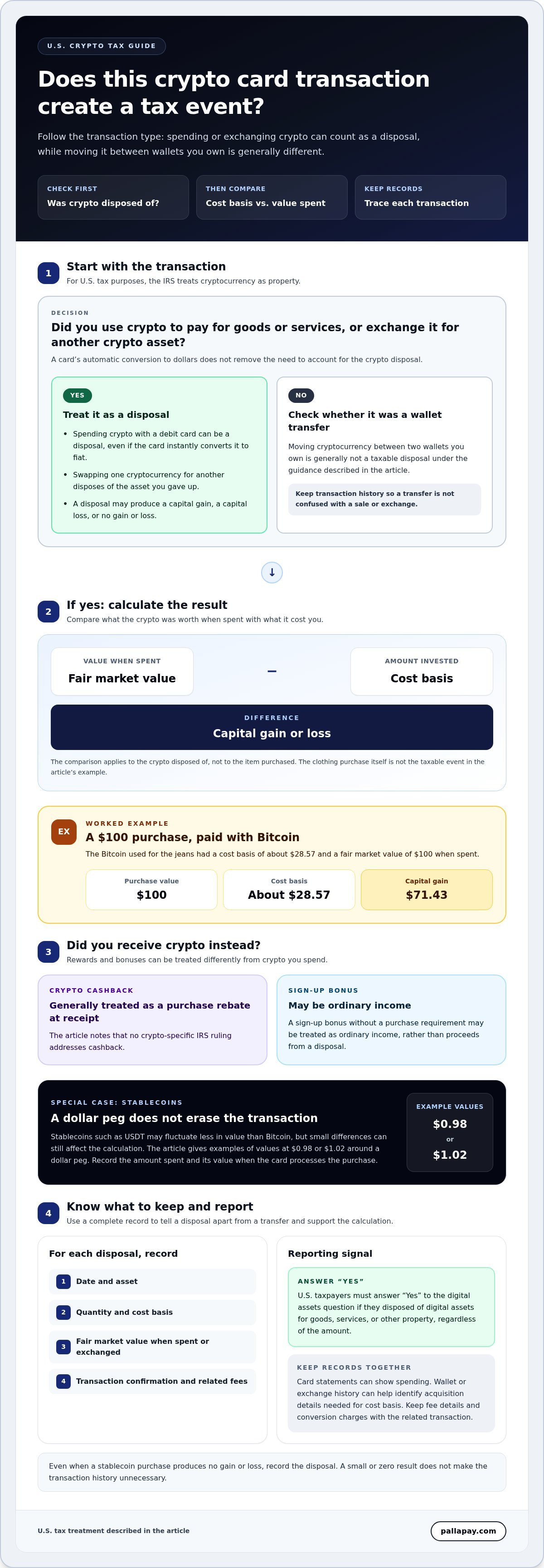
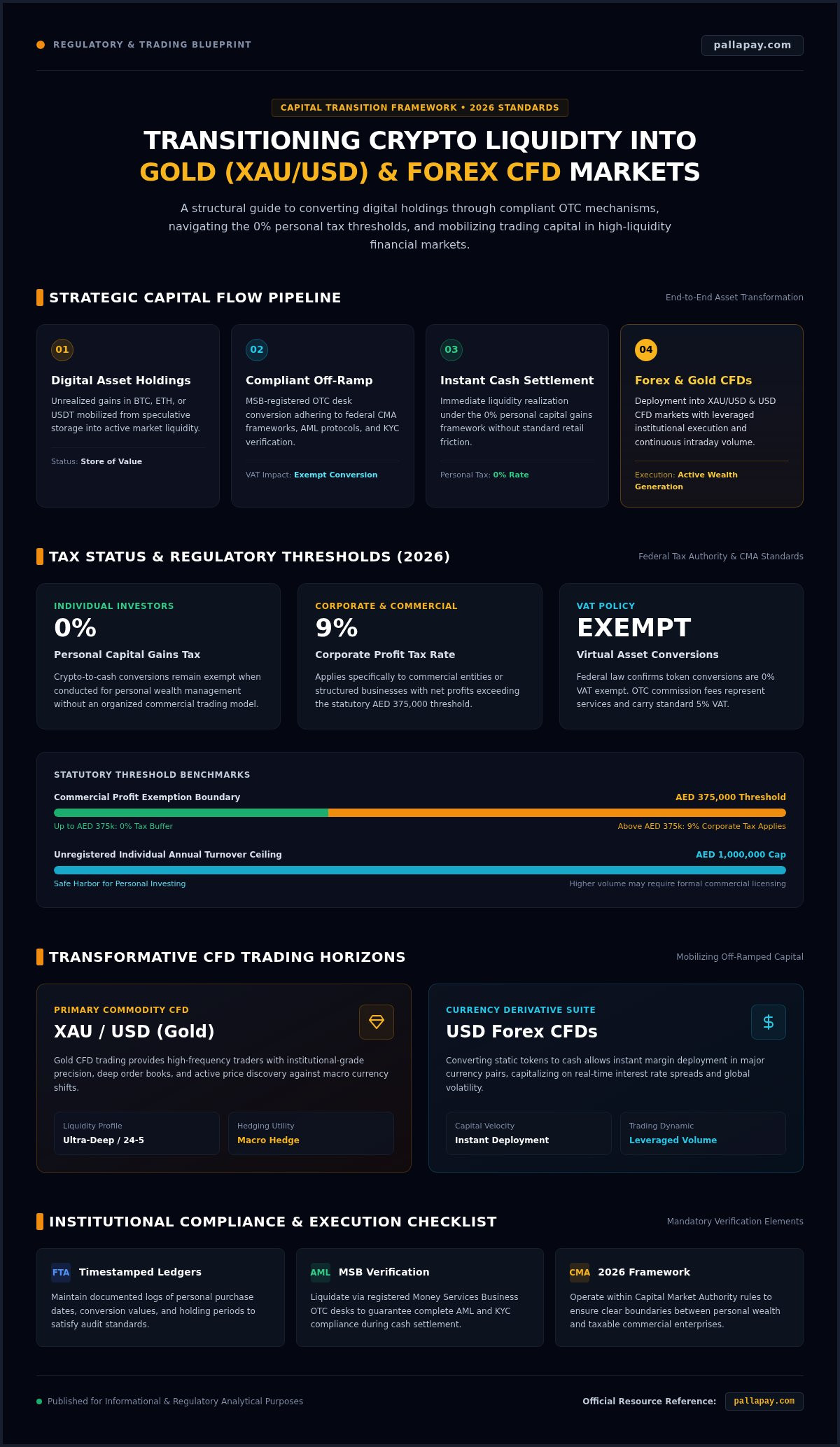
    The UAE’s tax environment remains one of the most competitive globally. As of 2026, the 9% corporate tax rate applies to taxable business profits exceeding 375,000 AED, including income derived from crypto transactions. However, individual residents still benefit from a 0% tax rate on personal capital gains from digital assets. For a business to accept crypto payments dubai safely, precise reporting is mandatory. Every transaction must be recorded in the company’s ledger at its fair market value in AED at the time of the trade. This level of clarity has turned 2026 into the definitive year for institutional crypto integration, providing the stability that traditional CFOs require. It’s a professional bridge between the old financial world and the new.

    Technical Integration: Choosing the Right Gateway for Your Business

    Selecting a payment infrastructure requires a shift from fragmented tools to a unified ecosystem. In 2026, merchants don’t have time to manage separate liquidity providers and settlement layers. The ability to accept crypto payments dubai effectively depends on a centralized dashboard that offers instant visibility into cash flow. This all-in-one approach reduces technical debt and simplifies daily reconciliation. High-volume traders specifically require low-latency API connections to execute transactions without price slippage. When a gateway processes thousands of transactions, every millisecond of latency can impact the final settlement value.

    Security is the foundation of institutional trust. Cold storage and multi-sig protocols are non-negotiable requirements for any gateway in the current market. These systems ensure that private keys are never exposed to online vulnerabilities, protecting merchant funds from external threats. For businesses operating within the Dubai International Financial Centre, technical stacks should reflect the standards set by the DFSA Crypto Token framework. This alignment ensures that your operation meets the highest regulatory expectations in the region while maintaining absolute security.

    E-commerce Gateway Integration

    Online merchants must prioritize a frictionless checkout to prevent cart abandonment. Implementing a crypto payment gateway through advanced Payment APIs allows for a white-label experience. This means the payment interface matches your brand’s aesthetic perfectly, keeping the user journey consistent. The e-commerce industry benefits from multi-currency support, which lets global customers pay in various tokens while you receive your preferred settlement currency. It’s the most efficient way to accept crypto payments dubai on a global scale.

    In-Store Physical POS Solutions

    Retail environments demand speed and reliability. Using a personal wallet for business transactions is an amateur approach that creates accounting nightmares. A professional crypto POS machine provides the same level of sophistication as traditional banking hardware. These devices utilize NFC and QR code flows to complete transactions in under 5 seconds. For retail stores in Dubai’s premier malls, having dedicated hardware is essential for maintaining a premium customer experience. It’s The Future of Payments, delivered through a physical interface that consumers already understand. If you’re ready to upgrade your storefront, exploring a dedicated POS solution is the logical next step.

    Instant Fiat Settlement: Converting Crypto to AED

    Volatility remains the primary deterrent for merchants considering digital assets. When you accept crypto payments dubai, a 5% price swing during a transaction can erase your entire profit margin. Pallapay eliminates this risk through fiat settlement, a process that locks the exchange rate at the exact moment of the customer’s checkout. This ensures the amount you see on the invoice is the exact amount that reaches your balance, regardless of market fluctuations that occur after the sale.

    Settlement cycles define your business liquidity. While traditional merchant services often operate on T+2 or T+3 cycles, the 2026 Dubai market demands higher velocity. Pallapay provides Instant settlement options, allowing corporate entities to maintain cash flow without waiting days for funds to clear. For high-volume transactions exceeding 1 million AED, managing liquidity requires a partner capable of deep market depth to avoid slippage. Our infrastructure handles the heavy lifting of global liquidity, providing a secure and stable environment for large-scale commerce.

    The Crypto-to-Bank Transfer Process

    The transition from blockchain to your corporate treasury is a controlled, three-step sequence. First, the customer’s wallet sends the digital asset to the gateway. Second, the system executes an automated conversion at the locked rate. Finally, the funds are dispatched to your bank. By routing through compliant processors, you maintain healthy relationships with institutions like Emirates NBD and Mashreq. This professional layer prevents the account freezes often associated with direct, unverified peer-to-peer transfers, ensuring your financial operations remain seamless and secure.

    Using USDT as a Settlement Bridge

    USDT acts as the primary liquidity bridge for the UAE business ecosystem. Its 1:1 peg to the US Dollar provides a stable medium for merchants who aren’t ready to hold volatile assets. Many Dubai businesses choose to sell USDT for cash or direct bank deposits to simplify their accounting. This method offers superior exchange rates compared to direct Bitcoin-to-AED conversions. It’s a strategic way to accept crypto payments dubai while keeping your books in a currency that matches your local tax and operational obligations. This all-in-one approach transforms complex crypto-fiat conversion into a standard, effortless business operation.

    Industry-Specific Use Cases for Dubai Merchants

    Dubai’s economy isn’t a monolith. A boutique in the Dubai Mall has different operational needs than a luxury developer in Business Bay. When you decide to accept crypto payments dubai provides a unique regulatory environment that rewards industry-specific expertise. Pallapay serves as the professional bridge for these sectors, ensuring that blockchain innovation meets institutional financial reliability. Our ecosystem handles the technical friction so you can focus on scale.

    • Luxury Real Estate: Property developers manage high-ticket sales through specialized desks. This process handles the heavy lifting of liquidity and ensures large-cap transactions don’t suffer from price slippage. Developers in the 2024 Dubai Creek Harbour projects require settlements that mirror traditional escrow safety; similarly, global investors can explore Direct Home Purchase for Cash for streamlined liquidity in other markets.
    • Hospitality: Dubai welcomed 17.15 million international visitors in 2023. Leading hotels and tourism providers use digital assets to bypass high cross-border credit card fees and offer Instant booking confirmations.
    • Luxury Retail: High-net-worth individuals in Downtown Dubai expect modern payment flexibility. Accepting digital assets signals that your brand is a visionary partner in the global economy rather than a legacy merchant.
    • Gaming and Entertainment: Speed is the priority for digital entertainment. Fast-tracking micro-transactions for the gaming industry keeps the user experience seamless. The UAE’s gaming market is projected to reach $446 million by 2027, making these Instant capabilities essential for growth.

    High-Volume OTC Solutions

    Standard payment gateways work for retail, but they aren’t built for multi-million dollar property or luxury car sales. When transactions exceed 500,000 AED, merchants should move to an OTC crypto exchange model. This provides discreet, secure settlements for institutional-grade clients. It’s the definitive destination for businesses that need to accept crypto payments dubai and convert large volumes of digital assets into fiat without market disruption. Instant liquidity ensures that your capital remains accessible and stable at all times.

    Customer Loyalty and Retention

    Digital assets are powerful tools for building long-term relationships. Merchants use crypto gift cards to drive repeat business from the global “crypto nomad” demographic. These individuals contributed to a global crypto market cap that peaked over $2.5 trillion in 2024. Rewarding customers with digital assets in a compliant manner attracts tech-savvy spenders to your Dubai location. It’s not just a payment method; it’s The Future of Payments and a key driver of modern commerce. This strategy transforms a one-time buyer into a loyal advocate for your brand.

    Future-Proofing Your Business with Pallapay

    Choosing the right partner determines whether your transition to digital assets is a hurdle or a competitive edge. Pallapay acts as the professional bridge between traditional commerce and the blockchain ecosystem. As a regulated Money Services Business (MSB) with operations spanning North America and the Middle East, we provide the institutional reliability required for modern enterprise. When you decide to accept crypto payments dubai, you aren’t just adding a checkout option; you’re integrating into a global liquidity network that operates 24/7.

    Efficiency drives our infrastructure. Merchants can utilize the Pallapay Mastercard to bridge the gap between digital revenue and corporate expenses. This card enables instant access to funds for vendor payments or operational costs, bypassing the multi-day delays typical of legacy banking. Getting started is a streamlined process: local entity registration, technical integration via our API or POS hardware, and processing your first live transaction. Most businesses complete this cycle in under 24 hours, ensuring no downtime for your sales team.

    The All-in-One Merchant Dashboard

    The dashboard provides a centralized command center for your entire financial operation. You can track global sales and settlements in real-time across various digital currencies. For businesses managing 10 or more branches, the interface allows for granular control of multiple POS locations from a single login. The system generates tax-compliant reports that align with Dubai’s regulatory requirements, making the preparation for FTA audits straightforward and data-driven.

    Expert Support and Local Presence

    Our commitment to your success extends beyond digital software. We maintain physical OTC desks in Business Bay, offering face-to-face consulting for high-volume transactions and strategic planning. Technical support remains active 24/7 to ensure 99.9% uptime for your payment gateway. This local presence ensures that as you accept crypto payments dubai, you have a visionary partner available to handle technical complexities while you focus on scaling your brand. We don’t just provide a service; we build a strategic partnership for long-term digital asset management.

    • Instant Settlements: Convert crypto to fiat immediately to avoid market volatility.
    • Global Reach: Accept payments from customers anywhere in the world without cross-border fees.
    • Secure Infrastructure: Benefit from institutional-grade security protocols and MSB-regulated compliance.

    Secure Your Competitive Edge in Dubai’s Digital Economy

    Dubai’s status as a global financial hub is solidified by its 2026 regulatory framework, making it essential for local merchants to adapt. To accept crypto payments dubai businesses must prioritize secure gateways that offer instant AED settlement to eliminate volatility risks. By choosing a partner with a physical presence in the Binary Tower, Business Bay, you ensure institutional-grade support and localized expertise. Every transaction should be a seamless bridge to growth rather than a technical hurdle.

    Pallapay bridges the gap between traditional commerce and blockchain innovation. We’re a regulated MSB in the USA and Canada, providing a foundation of absolute trust for every merchant we serve. Our platform was voted Best Crypto OTC and Payment Gateway at multiple global fintech summits, proving our utility for high-volume businesses. It’s time to transition from legacy systems to a streamlined, all-in-one ecosystem that handles the technical heavy lifting for you. This transition ensures your business remains a leader in the global marketplace.

    Empower your Dubai business with Pallapay; the future of payments starts here.

    We look forward to scaling your business in the new digital era.

    Frequently Asked Questions

    Is it legal to accept cryptocurrency for business in Dubai?

    Yes, accepting cryptocurrency for business is legal in Dubai under the Virtual Assets Regulatory Authority (VARA) framework established in March 2022. Merchants can legally process digital assets by partnering with licensed virtual asset service providers. This regulatory structure ensures that businesses remain compliant with anti-money laundering (AML) and counter-terrorism financing (CTF) standards. By following these established guidelines, your business can safely integrate digital currencies into its daily operations.

    How do I convert crypto payments into Emirati Dirhams (AED)?

    You can convert crypto payments into Emirati Dirhams (AED) instantly through a licensed payment gateway or an over-the-counter (OTC) desk. These platforms automate the exchange process by locking in real-time rates at the moment of transaction. Once the conversion is complete, the system transfers the fiat currency directly to your local bank account. This automated approach eliminates the risk of market volatility and ensures you receive the exact Dirham value of your sale.

    What are the fees for accepting crypto payments in Dubai?

    Transaction fees for businesses that accept crypto payments dubai generally range from 0.5% to 2% based on 2024 industry averages. These costs are often lower than the 3% or higher fees associated with traditional credit card processors. Merchants may also encounter network fees, often called “gas fees,” which vary depending on the specific blockchain used for the transaction. Choosing a provider with a transparent fee structure helps you maintain predictable profit margins.

    Do I need a special license to accept Bitcoin or USDT?

    You don’t usually need a specific virtual asset license to accept Bitcoin or USDT if you utilize a third-party provider that is already licensed by VARA. However, your existing trade license from the Dubai Department of Economy and Tourism (DET) or a relevant Free Zone must allow for your specific business activities. It’s essential to consult with your legal advisor to ensure your commercial license covers the receipt of digital assets through an authorized gateway.

    Can I accept crypto payments for real estate transactions in the UAE?

    Yes, you can accept crypto payments for real estate transactions provided the process involves a licensed intermediary and follows Circular No. 6 of 2022 from the Dubai Land Department. The buyer typically transfers the digital assets to a regulated exchange, which then settles the funds in AED to the developer or escrow account. This process ensures that all high-value property transfers remain transparent and fully compliant with UAE financial regulations.

    How long does it take to settle crypto funds into my bank account?

    Settlement times for crypto funds typically range from 24 to 48 hours for standard bank transfers within the UAE. Some advanced payment gateways offer near-instant settlement options for specific stablecoins like USDT. The exact duration depends on the internal processing times of your banking partner and the specific liquidity provider you use. Fast settlement cycles allow you to maintain healthy cash flow while offering modern payment alternatives to your customers.

    Which cryptocurrencies are most commonly used by customers in Dubai?

    Bitcoin (BTC), Ethereum (ETH), and Tether (USDT) are the three most frequently used cryptocurrencies in the Dubai market as of 2025. USDT is particularly popular for retail transactions because its value is pegged to the US Dollar, which provides price stability for both the merchant and the consumer. Many businesses that accept crypto payments dubai prioritize these three assets to cater to the widest possible range of digital-native shoppers.

    What happens if a customer wants a refund on a crypto payment?

    You should issue refunds based on the original Emirati Dirham (AED) value of the transaction at the time of purchase. This protects your business from losing money if the cryptocurrency’s market price has increased since the sale. Most payment gateways include a built-in refund tool that calculates the correct amount of crypto to return based on current exchange rates. Clear refund policies help manage customer expectations and maintain professional standards in every transaction.

  • Best Crypto Debit Card in the UAE: 2026 Buying Guide for Residents

    Best Crypto Debit Card in the UAE: 2026 Buying Guide for Residents

    Why are you still paying 3% foreign exchange fees to spend your own digital assets in a city that leads the global Web3 revolution? For many residents, the gap between holding Bitcoin and buying a coffee at the Dubai Mall remains frustratingly wide due to high transaction costs and complex exchange transfers. Finding a reliable crypto debit card uae shouldn’t feel like a regulatory gamble. You deserve a solution that bridges the gap between blockchain innovation and institutional reliability without the hidden friction of traditional banking.

    We understand that security and compliance are your primary concerns, especially following the 2024 expansion of the Virtual Assets Regulatory Authority (VARA) framework. This 2026 buying guide shows you how to choose the most efficient card for instant crypto-to-fiat conversion at any point of sale. You will discover which platforms offer zero ATM withdrawal fees across Dubai and how to leverage cards that integrate with local cash-to-crypto services. We move beyond the hype to provide a clear roadmap for the future of payments, ensuring your digital liquidity is always ready for immediate settlement.

    Key Takeaways

    • Understand the rapid evolution of the UAE’s financial ecosystem and how digital assets are becoming a standard medium for daily commerce.
    • Learn the mechanics of real-time conversion that allow you to spend USDT or BTC as AED at any global merchant across the Emirates.
    • Evaluate the best crypto debit card uae options using a professional framework focused on fee transparency, reward structures, and loading efficiency.
    • Master the streamlined process of securing your card using your Emirates ID through providers with a dedicated local presence and official support.
    • Discover how Pallapay’s unique OTC integration provides instant liquidity and institutional-grade reliability to bridge the gap between crypto and fiat.

    The Rise of Crypto Debit Cards in the UAE: A 2026 Overview

    The financial ecosystem in the United Arab Emirates has undergone a fundamental transformation. A crypto debit card uae is no longer a niche tool for tech enthusiasts; it’s a sophisticated financial instrument that enables residents to convert digital assets into Dirhams (AED) instantly at the point of sale. By 2026, Dubai and Abu Dhabi have solidified their positions as global leaders in blockchain integration. This shift marks the transition from speculative holding to active utility. Residents now use digital wealth for everything from grocery shopping to luxury real estate settlements. Before choosing a provider, it’s fundamental to understand what are cryptocurrencies and how their liquidity affects your daily purchasing power.

    The UAE’s status as a global hub is the result of deliberate policy. Government initiatives have pushed crypto adoption rates from 11.4% in 2023 to over 25% of the population by early 2026. This growth is driven by the need for seamless, instant transactions that mirror the efficiency of the local economy. We are witnessing the “Future of Payments,” where the boundary between traditional fiat and digital tokens disappears entirely through professional fintech gateways.

    The Utility Gap: Why Traditional Cards Fall Short

    Standard bank cards often impose hidden costs that erode your wealth. Traditional UAE financial institutions typically charge 2% to 3% in foreign exchange fees for international transactions or cross-border digital payments. Legacy systems create unnecessary friction. Moving assets from a digital exchange to a local bank account can take 48 to 72 hours; this delay is unacceptable in a fast-paced economy. Users demand instant results. The modern resident requires a solution that offers real-time fiat conversion, eliminating the need to wait for manual bank approvals. Tools like the Pallapay Wallet bridge this gap by providing an all-in-one ecosystem for immediate liquidity and global spending power.

    Regulatory Landscape: VARA and Your Security

    Security is the foundation of institutional trust. In 2026, the Virtual Assets Regulatory Authority (VARA) provides the most comprehensive oversight framework in the world. This regulator ensures that every transaction is transparent and every provider maintains high capital reserves. Choosing a registered Money Services Business (MSB) is critical for protecting your capital against market volatility and unauthorized access. VARA compliance serves as the gold standard for security and reliability for every crypto user in the UAE.

    How Crypto Debit Cards Work in the Emirates

    Using a crypto debit card uae doesn’t mean you’re handing Bitcoin directly to a cashier. Instead, these cards function as a sophisticated bridge between your digital wallet and the global financial grid. The process is built on real-time conversion. When you tap your card at a terminal in Dubai Mall, the platform instantly sells the necessary amount of crypto, such as USDT or BTC, for UAE Dirhams (AED). This happens in milliseconds, ensuring the merchant receives fiat currency while you spend your digital assets.

    Major payment networks like Visa and Mastercard provide the essential infrastructure for this ecosystem. They allow crypto cards to be accepted at over 100 million merchants worldwide, including almost every retail outlet in the UAE. The card issuer handles the liquidity, acting as the intermediary that manages the exchange. This setup is often powered by Instant Settlement technology. It eliminates the volatility risk for the merchant because the transaction is finalized in AED at the exact moment of purchase. As the UAE’s 2026 crypto regulations continue to evolve under VARA’s oversight, these settlement processes have become more transparent and secure for residents.

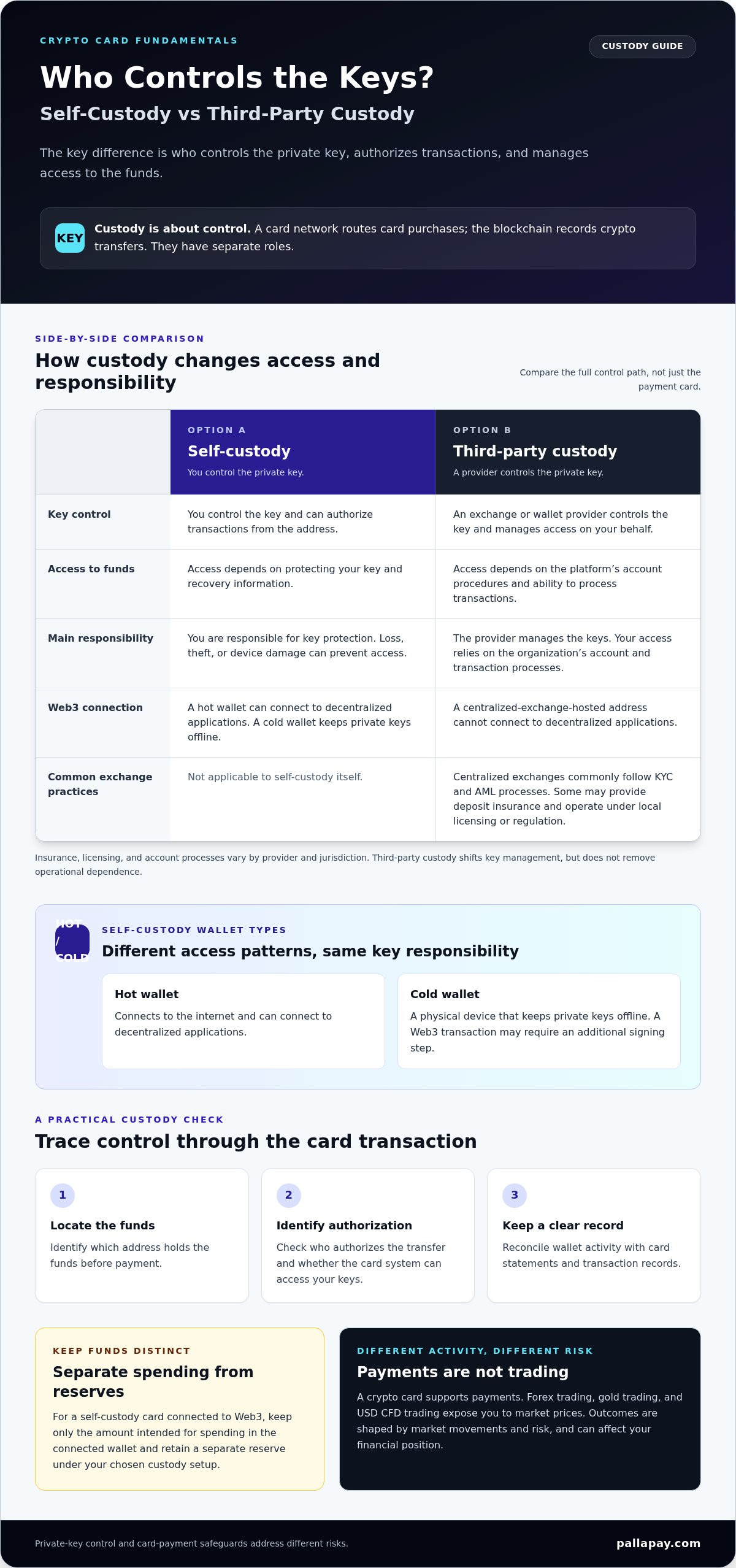
    Users can choose between custodial and non-custodial options. Custodial cards are managed by a platform that holds the private keys, offering a user experience similar to traditional mobile banking. Non-custodial cards link directly to your private wallet, giving you total control over your funds until the point of sale. Both types leverage Dubai’s robust fintech infrastructure to ensure that every transaction is as reliable as a standard bank transfer.

    Fiat-to-Crypto Bridges: The AED-USDT Connection

    The UAE market is unique because the AED has been pegged to the USD at a rate of 3.67 since 1997. This stability makes USDT the preferred asset for daily spending. Liquidity providers in Dubai maintain deep pools of both assets to facilitate instant swaps. By using a professional fiat settlement system, platforms can guarantee that the conversion rates remain competitive and the liquidity is always available, even for large retail purchases.

    Card Tiers and Limits

    Card providers typically offer different tiers based on the user’s relationship with the platform. Residents often enjoy higher daily spending limits, sometimes exceeding 100,000 AED, while tourists might operate under lower thresholds due to simplified KYC requirements. You can often unlock premium tiers by staking a specific amount of the platform’s native token. This might grant you lower transaction fees or higher cashback rates. Residents can also choose between virtual cards for secure e-commerce or physical cards for high-street retail and ATM withdrawals. If you’re ready to start spending, you can explore the features of a secure digital wallet to manage your assets efficiently.

    Key Criteria for Choosing the Best Crypto Card

    Selecting a crypto debit card uae requires looking past flashy marketing. Most users focus on rewards, but the real cost lies in the conversion spread. While many platforms claim “zero fees,” they often hide costs in the exchange rate. A spread of 2.0% can wipe out a 1% cashback benefit instantly. Understanding how crypto debit cards work is the first step in identifying these hidden expenses. Residents must also prioritize local support. Dealing with a blocked card at a Dubai Mall terminal is stressful if the support team is in a different time zone. Instant integration with Apple Pay and Google Pay is no longer a luxury; it’s a standard requirement for 92% of active users in the region.

    Fee Structures: Beyond the Monthly Charge

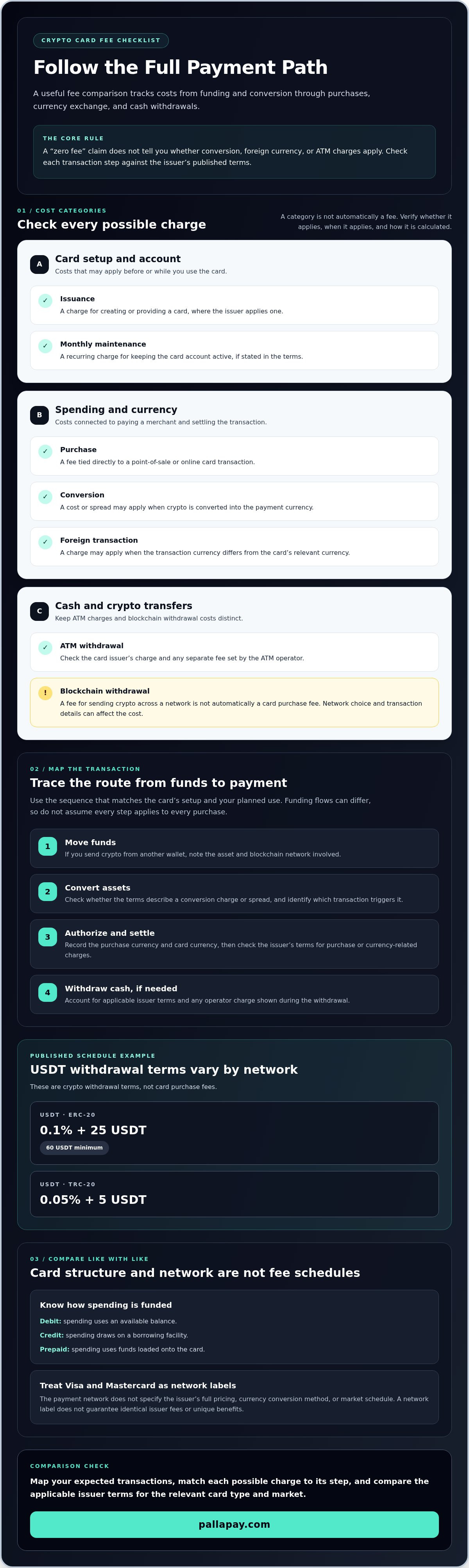
    Monthly maintenance fees are rare in 2026, but operational costs remain. Using your card at an Emirates NBD or ADCB ATM might incur a standard 21 AED fee for third-party processing. Loading fees are another factor. Some providers charge 1% to 5% to move funds from an exchange to the card. Compare providers by looking at the total cost of ownership. A card with a 0.1% spread and no loading fee is often superior to a high-cashback card with a 1.5% spread. Approximately 70% of high-net-worth users in Dubai prioritize these low-spread models to preserve capital during large transactions.

    Reward Programs: Cashback vs. Utility

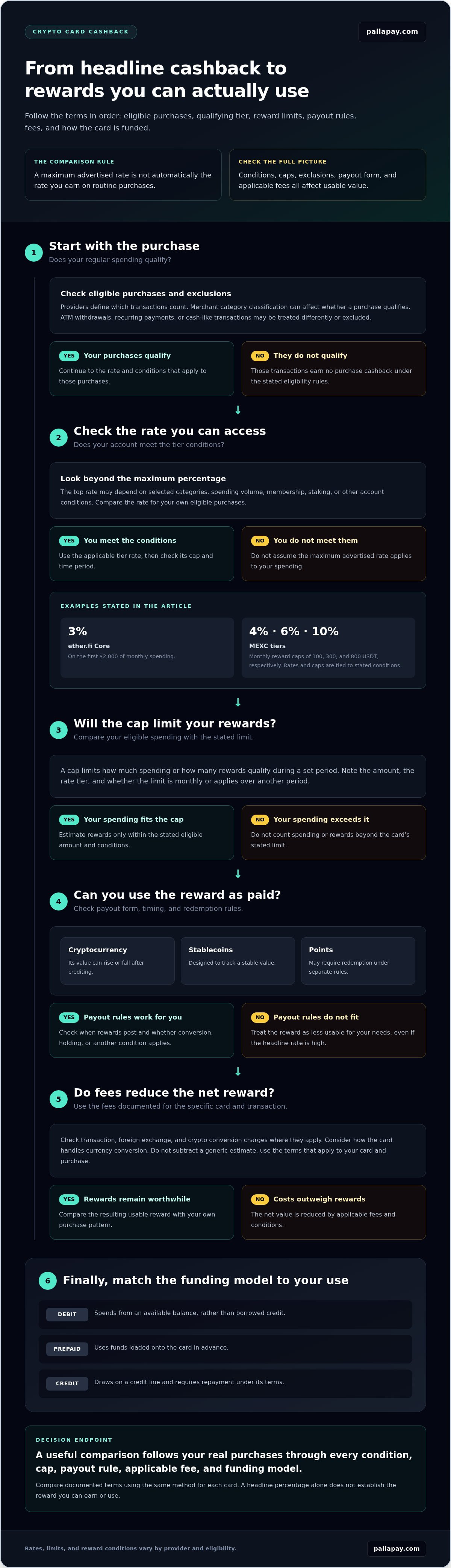
    Cashback programs vary significantly. Some offer up to 10% back, though these usually require locking up significant capital in native tokens. For many, a low-fee model without rewards provides better long-term value. UAE residents often value utility over percentages. Airport lounge access through providers like LoungeKey is a staple for frequent travelers in Dubai. You can also use Gift Cards to bridge the gap between crypto holdings and retail spending without incurring high transaction fees. This approach allows for precise budgeting while maintaining the security of the Pallapay ecosystem.

    Loading Flexibility: The Dubai Advantage

    Loading speed is the ultimate differentiator for high-volume users. While bank transfers can take 24 hours, the Dubai market offers unique advantages like Over-the-Counter (OTC) cash-loading. This allows for instant liquidity. Users can also utilize P2P transfers or mobile wallet integrations for seamless daily use. For a deeper look at utility, review the guide on How to Spend Cryptocurrency to see how these loading methods fit into a modern financial strategy. Having a crypto debit card uae that supports instant OTC loading ensures you aren’t tethered to slow banking cycles.

    • Instant Settlement: Essential for maintaining purchasing power in volatile markets.
    • Local Support: Priority access to UAE-based teams for immediate troubleshooting.
    • Widespread Acceptance: Cards must function across all major retail points in the Emirates.

    Step-by-Step: Getting Your Crypto Card in Dubai

    Securing a crypto debit card uae residents can use for daily transactions involves a streamlined, institutional-grade process. You must first identify a provider that maintains a verified UAE presence or offers reliable global shipping to the Emirates. This choice ensures your card avoids the logistical delays often associated with offshore-only services. Once you’ve selected your platform, the application moves into an efficient verification phase designed to meet the UAE’s strict 2026 regulatory standards for digital assets.

    KYC Requirements for UAE Residents

    Verification is the foundation of financial security. To complete the Know Your Customer (KYC) process, you’ll need your original Emirates ID, a valid passport, and a recent utility bill or bank statement as proof of residence. By 2026, top-tier providers have optimized this via automated biometric checks, typically reducing the verification timeline to less than 12 hours. For high-net-worth individuals, privacy is maintained through encrypted data silos that comply with local data sovereignty laws. This balance of transparency and discretion is essential for managing significant liquidity without compromising personal data.

    Loading via OTC: A Local Masterclass

    Dubai provides a unique advantage for users who prefer physical touchpoints for their digital assets. You can visit a professional office to Sell USDT for Cash, which creates an immediate bridge between your crypto holdings and spendable card balance. This method is particularly effective for high-volume traders who require instant liquidity without the multi-day delays of traditional banking transfers. By utilizing a specialized OTC desk, you ensure your card is replenished through a secure, face-to-face transaction that reflects the city’s status as a global financial hub.

    After your identity is verified, you’ll choose between a virtual or physical card. Virtual cards are issued instantly; you can integrate them into Apple Pay or Google Pay immediately after approval. Physical cards typically arrive via premium courier within 3 to 5 business days. When you fund your crypto debit card uae for the first time, it’s a best practice to use a secure, non-custodial wallet for the transfer and enable multi-factor authentication. This creates a frictionless, secure flow from your digital assets to real-world commerce.

    Ready to manage your assets with institutional-grade tools? Explore the all-in-one crypto wallet for seamless card funding and management.

    Why the Pallapay Mastercard is the Ultimate UAE Solution

    Most digital assets remain trapped in digital vaults, but Pallapay transforms them into liquid capital for daily use. It’s the definitive crypto debit card uae residents rely on to bridge the gap between blockchain innovation and institutional financial reliability. By combining high-level security with a user-centric interface, we’ve created a tool that functions with the familiarity of a traditional bank card while harnessing the power of decentralized finance.

    A primary differentiator for Pallapay is the physical infrastructure supporting the digital product. While many platforms operate solely in the cloud, we provide “Instant Loading” capabilities through our physical OTC desks. You can visit our office in Business Bay, Dubai, to convert and load your card immediately. This physical-to-digital synergy ensures you aren’t stuck waiting for network confirmations or exchange delays when you need to make a purchase. Our multi-currency support is specifically calibrated for the local market, allowing for seamless transitions between major cryptocurrencies and fiat currencies used across the Emirates.

    The All-in-One Ecosystem

    Managing your wealth shouldn’t require juggling multiple disconnected platforms. The Pallapay card integrates directly with the Pallapay Wallet, providing a unified dashboard for total asset control. This synergy extends to the retail sector, where the card works in perfect harmony with our Crypto POS Machines to facilitate real-time commerce. To guarantee the highest levels of trust, Pallapay maintains active MSB registrations in the United States and Canada, ensuring our operations meet rigorous global financial standards.

    Tailored for UAE Industries

    The UAE’s economy is built on world-class service and rapid growth. For professionals and residents frequenting luxury Hotels or navigating the high-end Retail landscape, the Pallapay Mastercard offers a frictionless payment experience. We understand that high-stakes transactions require immediate assistance, which is why we offer 24/7 local support directly from our Dubai headquarters. You won’t be dealing with automated bots in distant time zones; you’ll have access to local experts who understand the UAE’s financial environment.

    Standalone cards often lack the necessary infrastructure to be truly useful in the long term. Pallapay succeeds because it’s not just a card, but a comprehensive financial environment designed to scale with your needs. It’s time to move beyond limited financial tools and embrace a professional partner that handles the technical heavy lifting for you. Experience the Future of Payments today and redefine how you interact with your digital wealth.

    Secure Your Financial Future in the Emirates

    The evolution of digital finance in the Emirates is no longer a prospect for the distant future; it’s a present-day reality. By 2026, the UAE digital economy is projected to contribute significantly to the national GDP, making the choice of a crypto debit card uae residents can rely on a strategic necessity. You’ve seen how these tools bridge the gap between blockchain innovation and daily commerce, providing a seamless gateway to global liquidity without the traditional wait times.

    Pallapay serves as the professional bridge in this landscape. By operating as a regulated MSB in the USA and Canada, the platform instills the institutional trust required for high-level transactions. With physical OTC desks strategically located in Dubai Business Bay and the capability for instant cash-to-card loading, the ecosystem handles the heavy lifting of technology behind the scenes. It’s the ultimate all-in-one solution for those who demand efficiency and security in every transaction. This represents the future of payments, delivered with the stability of a global fintech leader.

    Get Your Pallapay Mastercard and Start Spending Crypto Instantly

    Step into a new era of financial freedom and let your assets work for you with absolute confidence.

    Frequently Asked Questions

    Is it legal to use a crypto debit card in the UAE?

    It’s entirely legal to use a crypto debit card in the UAE under the regulatory framework established by the Virtual Assets Regulatory Authority (VARA) in March 2022. This legislation provides a clear legal structure for digital asset services across Dubai and the wider Emirates. Users can confidently spend their assets at any merchant that accepts standard Visa or Mastercard payments without legal friction.

    Can I withdraw cash from UAE ATMs using a crypto card?

    You can withdraw AED cash from any local ATM that supports the global Visa or Mastercard networks. These transactions involve an instant conversion from your digital balance to local currency at the point of withdrawal. Most providers allow for daily withdrawal limits ranging from 2,000 AED to 10,000 AED depending on your specific account tier and verification level.

    What are the fees for converting Bitcoin to AED on a debit card?

    Conversion fees for changing Bitcoin to AED typically range from 0.5% to 3% according to 2026 market standards. These costs are often integrated into the exchange rate provided during the settlement process. Selecting a high-tier crypto debit card uae can often reduce these operational costs through loyalty programs or staked asset benefits that provide lower fee structures for frequent users.

    Do I need a UAE bank account to get a crypto debit card?

    You don’t need a local UAE bank account to apply for or use a crypto-linked card. These platforms operate as independent financial gateways that manage their own liquidity and settlement layers. While a local bank account isn’t a prerequisite, it remains a useful tool for secondary transfers or traditional financial management within the region’s broader economy.

    Can I use my crypto card to pay for rent or utilities in Dubai?

    You can use your card to pay for utilities through the Dubai Now app or the DEWA portal, as these platforms accept major global card providers. Rent payments are also possible if your landlord or property management company utilizes a digital payment gateway rather than traditional post-dated cheques. This allows for the instant settlement of large monthly obligations using your digital portfolio.

    Which cryptocurrencies are supported by cards in the UAE?

    Most cards in the region support a core group of 10 to 50 assets including Bitcoin, Ethereum, and major stablecoins like USDT or USDC. High-performance platforms often extend this support to include various DeFi tokens and institutional-grade assets. This diversity ensures you have the liquidity needed to manage your daily expenses without needing to maintain multiple exchange accounts.

    How long does it take to receive a physical crypto card in Dubai?

    Physical cards typically arrive at your UAE address within 7 to 14 business days via local courier services. While you wait for the physical plastic, most providers issue an instant virtual card that you can add to Apple Pay or Google Pay immediately. This ensures you can start utilizing the best crypto debit card uae features the moment your identity verification is complete.

    Are crypto card transactions in the UAE taxable?

    Crypto transactions for individuals aren’t subject to personal income or capital gains tax in the UAE as of the current 2026 fiscal regulations. The Ministry of Finance maintains a 0% tax rate on personal investment returns for residents. This tax-efficient environment makes the Emirates a primary global destination for digital asset holders looking to maximize their purchasing power without complex tax filings.

  • Crypto to Fiat Settlement: The 2026 Strategic Guide for Global Merchants

    Crypto to Fiat Settlement: The 2026 Strategic Guide for Global Merchants

    A business operating on a T+3 settlement cycle in 2026 is essentially functioning in the past while its competitors move at the speed of light. You’ve likely felt the frustration of watching market prices shift during the long wait for funds to clear your traditional bank account. It’s a common struggle; over 70% of global merchants report that the bridge between digital innovation and legacy finance is often paved with high fees and confusing MSB regulations. This guide provides a definitive roadmap to mastering crypto to fiat settlement, transforming what was once a complex hurdle into a streamlined, instant advantage for your enterprise.

    We’ll show you exactly how to eliminate price volatility risks and secure lower transaction costs than standard credit card networks. You’ll gain a comprehensive understanding of how to implement audit-ready reporting and instant conversion technology that scales across borders. This breakdown prepares your business to leverage the future of payments with absolute confidence and institutional reliability.

    Key Takeaways

    • Understand how to transition from holding digital assets to utilizing them as high-speed payment rails for modern global commerce.
    • Learn how advanced payment gateways lock in real-time exchange rates to eliminate price volatility during the conversion process.
    • Master the strategic choice between instant and batch crypto to fiat settlement to optimize your business cash flow and minimize bank fees.
    • Identify the regulatory gold standards, including MSB registration and AML protocols, required to protect your institutional financial integrity.
    • Discover how to bridge the gap between digital and physical commerce using an all-in-one ecosystem of gateways and crypto POS machines.

    What is Crypto to Fiat Settlement and Why It Matters in 2026

    Crypto to fiat settlement is the automated process of converting digital assets from a customer transaction into traditional currency and depositing it directly into a corporate bank account. While early adopters historically focused on holding assets for long-term appreciation, 2026 represents a fundamental shift toward utility. Global commerce now utilizes blockchain as a high-speed payment rail rather than a speculative instrument. This transition allows enterprises to tap into a $3 trillion global market while maintaining their existing accounting standards and functional currency.

    Modern technology has effectively solved the price fluctuation problem that once deterred traditional retailers. By leveraging a professional Cryptocurrency Exchange infrastructure, payment gateways now offer Instant conversion at the point of sale. This ensures that the value of a transaction remains fixed from the moment the customer pays until the funds reach the merchant’s ledger. It’s a secure bridge that connects decentralized innovation with institutional financial reliability.

    The Evolution of Merchant Settlement

    The industry has matured from manual exchange transfers to automated, API-driven gateway settlements. Settlement latency is the time delay between a customer’s payment and the availability of funds in the merchant’s bank account, which can severely restrict operational liquidity if not managed through real-time conversion. Modern providers now handle the heavy lifting by absorbing volatility risk during the transaction window. This evolution ensures that a business receives the exact fiat amount listed on its invoice, regardless of market movements during the crypto to fiat settlement process.

    Key Benefits for Modern Enterprises

    Enterprises adopting a crypto to fiat settlement strategy gain immediate competitive advantages over those relying solely on legacy systems. One primary benefit is the total elimination of chargeback fraud, a problem that continues to cost global merchants billions annually in traditional credit card processing. Additionally, blockchain-based settlements significantly lower cross-border fees when compared to the 50-year-old SWIFT banking network. This efficiency is particularly attractive for businesses targeting high-net-worth individuals. Sectors like luxury real estate and international hotels are already using these tools to provide seamless experiences for a growing demographic of crypto-affluent travelers who demand modern payment flexibility.

    The Mechanics: How Crypto-to-Fiat Conversion Works

    The transition from a customer’s digital wallet to a merchant’s bank account involves a sophisticated backend process that removes technical friction. When a transaction initiates, the payment gateway captures the current market price and freezes it for a specific window, typically lasting 15 to 20 minutes. This ensures the crypto to fiat settlement remains consistent even if the market fluctuates seconds later. By locking these rates, businesses avoid the risk of receiving less value than the sticker price of their goods or services, effectively neutralizing the 10% to 15% intraday swings common in digital assets.

    Behind the scenes, the gateway communicates with deep liquidity pools to execute the exchange. This is essential for high-volume trades where a lack of depth could lead to price slippage. As highlighted by payment experts in the whitepaper Crypto Payments: From Virtuality to Real Use Case, the move toward practical merchant adoption relies on these robust settlement layers that bridge decentralized finance with traditional banking.

    The Gateway vs. The Liquidity Provider

    The gateway serves as the professional interface, while the liquidity provider acts as the financial engine. Automated market makers (AMMs) and over-the-counter (OTC) desks provide the necessary fiat depth to handle large-scale enterprise transactions without delay. These entities work in tandem to ensure that even a million-dollar transaction doesn’t disrupt the market price. In high-volume settlement, the spread between the buy and sell price is more important than the commission fee because it directly impacts the final net amount received.

    API Integration and Automated Workflows

    Modern businesses scale by removing manual steps from their financial operations. Using payment APIs allows companies to embed this technology directly into their existing infrastructure. For ecommerce platforms, this means crypto to fiat settlement happens automatically the moment a purchase is confirmed.

    Merchants can set “Auto-Settlement” rules to convert incoming assets into their preferred local currency instantly. All activity is tracked through a comprehensive merchant dashboard crypto, providing real-time reporting and financial clarity. This level of automation turns a complex technological hurdle into a standard business process. To see how this fits your business model, you can review the benefits of a dedicated fiat settlement solution.

    Comparing Settlement Methods: Instant vs. Batch vs. Stablecoin

    Selecting a settlement strategy is a critical decision for any enterprise integrating digital assets. The right choice balances speed against operational costs. A business’s ability to manage a crypto to fiat settlement determines its overall exposure to market shifts. Organizations typically choose between three primary models based on their liquidity needs and transaction volume.

    • Instant Settlement: This method converts digital assets at the exact point of sale. It eliminates price risk by locking in the exchange rate immediately. The merchant receives the precise fiat value displayed at checkout, regardless of market movements ten minutes later.
    • Batch Settlement: This approach consolidates daily transactions into a single transfer. It is a strategic choice for high-volume retail environments. By aggregating 500 individual sales into one daily settlement, businesses reduce recurring bank transfer fees by up to 90%.
    • Stablecoin Settlement: Many global firms choose USDT or USDC as their primary rail. This allows them to keep funds in a digital format that is pegged to the dollar, providing the speed of blockchain with the stability of fiat.
    • Direct to Bank Model: This handles the final mile of the process. It ensures that converted funds reach local bank accounts through established financial networks, bypassing the traditional 3 to 5 day wait associated with international wires.

    Same-Day Settlement vs. Traditional T+2

    Traditional banking systems rely on T+2 or T+3 settlement cycles. These legacy delays often trap capital for 48 to 72 hours. Modern fiat settlement products bypass these hurdles by utilizing blockchain’s 24/7/365 availability. While a traditional bank closes on Friday afternoon, blockchain rails continue to move value. This means weekend revenue is available for use on Monday morning rather than Wednesday. It’s a fundamental shift that provides businesses with superior cash flow management and immediate access to working capital.

    The Stablecoin Bridge Strategy

    High-volume entities often require rapid transitions between digital and physical liquidity. In major financial hubs, selling USDT for cash dubai has become a standard procedure for managing large-scale B2B payouts. This strategy is efficient for companies that need to pay international suppliers without waiting for slow SWIFT transfers. Stablecoins offer a level of transparency that traditional bank statements don’t provide. Every transaction is recorded on a public ledger, allowing for real-time audits. This transparency simplifies the crypto to fiat settlement process, as every dollar equivalent is accounted for on-chain before it ever hits a local bank account.

    By choosing the correct settlement rhythm, a business doesn’t just accept payments; it optimizes its entire financial operation. Pallapay acts as the professional bridge, ensuring these technical processes remain invisible to the end user while providing the merchant with absolute stability.

    Evaluating a Settlement Provider: Compliance and Security

    Selecting a partner for crypto to fiat settlement requires a rigorous audit of their legal standing and operational integrity. MSB (Money Services Business) registration represents the non-negotiable gold standard for institutional reliability. These licenses ensure the provider operates under strict financial oversight, which protects your capital from the inherent risks of unregulated markets. KYC (Know Your Customer) and AML (Anti-Money Laundering) protocols aren’t merely administrative hurdles; they’re essential defense mechanisms for your brand. By verifying every participant in the transaction chain, providers prevent illicit funds from entering your ecosystem, shielding your business from the 2024 surge in global regulatory enforcement actions.

    Fee transparency separates global fintech leaders from opaque startups. You’ll typically encounter two primary models: flat transaction fees and percentage spreads. A flat fee provides predictable costs for high-volume operations, whereas percentage spreads can often mask the true cost of liquidity. It’s vital to demand clear security disclosures regarding the conversion window. Top-tier providers use deep liquidity pools to lock in rates the moment a transaction initiates, ensuring that the price you see is the price you receive without slippage.

    • Regulatory Standing: Verify active MSB status in Tier-1 jurisdictions.
    • Risk Mitigation: Ensure robust AML screening is integrated into the API.
    • Cost Clarity: Compare the total cost of ownership between flat and spread-based models.
    • Fund Protection: Review the provider’s custody and insurance protocols during the settlement gap.

    Navigating Global Regulations

    US and Canadian MSB registrations serve as a hallmark of trust for global enterprises, ensuring compliance with the latest 2023 FATF standards. Businesses operating in retail stores must prioritize regulated partners to ensure long-term operational continuity and avoid bank account closures. Regulatory Arbitrage is the risky practice of selecting jurisdictions with weak oversight to bypass compliance; businesses should avoid it to prevent sudden asset freezes or legal liability. Professional providers bridge the gap between blockchain innovation and institutional finance.

    The Strategic Implementation Guide

    Consulting a crypto pos machine for business helps brick-and-mortar setups align their physical hardware with digital settlement speeds. Your chosen infrastructure must scale to handle peak volumes, such as the 40% increase in transaction density often recorded during global retail events. Reliable providers maintain a local presence in major financial hubs to offer real-time support and localized expertise. This ensures the future of payments remains a standard, effortless part of your daily operations.

    Secure your revenue stream and eliminate market risk by integrating our instant fiat settlement solution today.

    The Pallapay Advantage: An All-in-One Settlement Ecosystem

    Pallapay operates as a sophisticated bridge between disruptive blockchain technology and institutional financial reliability. The platform provides a unified environment where digital payment gateways link directly with physical crypto pos machines to ensure a frictionless experience for every stakeholder. By maintaining regulated operations in the USA, Canada, and the UAE, Pallapay offers a secure framework that supports global expansion without the compliance hurdles typically associated with digital assets. It’s a system built for scale and stability.

    Liquidity remains the most critical factor in any crypto to fiat settlement strategy. Pallapay addresses this through a hybrid network of automated online systems and physical OTC desks. This infrastructure ensures that whether a business is processing a small retail transaction or a multi-million dollar corporate transfer, the funds are available when needed. The ecosystem currently serves a diverse range of industries, providing specialized support for gaming platforms, high-end retail, and international hospitality groups.

    Bridging Physical and Digital Commerce

    Modern merchants need the ability to accept crypto in store without waiting days for bank clearances. Pallapay enables businesses to receive digital payments and complete a crypto to fiat settlement within the same hour. This rapid turnaround protects profit margins from market swings. For immediate access to capital, the Pallapay Mastercard allows merchants to spend their settled fiat funds at millions of locations worldwide. Large-scale corporate entities often require more personalized service, which is where the otc crypto exchange comes into play. These desks facilitate high-volume trades with deep liquidity, ensuring that institutional moves don’t suffer from price slippage or execution delays.

    The Future of Payments is Instant

    Pallapay removes the heavy lifting of complex technology for non-technical merchants. You don’t need to be a blockchain expert to modernize your payment stack. By consolidating the gateway, POS hardware, and fiat settlement into a single partnership, Pallapay eliminates the fragmentation that slows down business growth. This all-in-one approach provides a clear audit trail and a simplified user experience. It’s not just about adding a new payment method; it’s about evolving with the global economy. The future of payments is instant, secure, and professional. Optimize your business with Pallapay’s fiat settlement solutions today and secure your place in the new financial era.

    Future-Proof Your Global Commerce Strategy

    The financial landscape of 2026 demands a transition from traditional barriers to frictionless liquidity. High-growth merchants are moving away from legacy batch processing in favor of real-time efficiency to maintain a competitive edge. Mastering crypto to fiat settlement isn’t just a technical upgrade; it’s a strategic necessity for capturing global market share. Success requires a partner that bridges the gap between digital innovation and institutional reliability.

    Pallapay provides this bridge as a regulated MSB in both the USA and Canada. By leveraging an official MSB registration and a robust global OTC presence, businesses can access instant settlement across 180+ countries. This infrastructure eliminates the volatility risks typically associated with digital assets while ensuring full compliance with international standards. It’s time to integrate a solution that treats complex conversions as standard business operations.

    Scale your business with Pallapay’s professional fiat settlement solutions and secure your position in the future of payments. The tools for your global expansion are ready when you are.

    Frequently Asked Questions

    How long does crypto to fiat settlement take?

    Crypto to fiat settlement occurs instantly or within 24 hours depending on your chosen payout method. Pallapay processes these transactions in real-time to eliminate the risk of market fluctuations. While traditional bank transfers might take 1 to 3 business days, our internal ecosystem ensures liquidity is available immediately. This speed allows your business to maintain a steady cash flow without waiting for legacy banking cycles.

    Is crypto to fiat settlement taxable for my business?

    Tax obligations for your transactions depend on your specific jurisdiction and local tax laws. In regions like the UAE, corporate tax rates of 9% apply to businesses exceeding certain profit thresholds as of June 2023. You should consult with a certified financial advisor to ensure compliance with VAT and income reporting requirements. We provide detailed transaction logs to simplify your accounting and audit processes.

    Can I receive settlement in my local currency like AED, USD, or EUR?

    You can receive settlements in over 30 global currencies including AED, USD, and EUR. Our platform bridges the gap between digital assets and traditional finance by providing direct conversion into your preferred local tender. This flexibility ensures you avoid unnecessary exchange fees and can pay your local suppliers or employees without friction. It’s a key feature for businesses looking to scale internationally.

    What are the fees associated with crypto to fiat conversion?

    Fees for conversion are calculated based on your monthly transaction volume and the specific digital assets being processed. We prioritize transparency by displaying all costs before you finalize a transaction. This approach prevents hidden charges from impacting your profit margins. By using a professional gateway, you access institutional liquidity rates that are typically more favorable than standard retail exchanges.

    Do I need a special bank account to receive fiat settlements?

    You don’t need a specialized crypto bank account to receive your funds. Pallapay facilitates transfers directly to your existing corporate or personal bank account via standard SEPA or SWIFT protocols. This integration makes the transition from blockchain technology to traditional banking feel like a standard business operation. It ensures your current financial infrastructure remains compatible with the future of payments.

    Is it possible to settle payments in stablecoins instead of fiat?

    Businesses can choose to settle their transactions in stablecoins such as USDT or USDC to maintain digital liquidity. This option provides the stability of fiat currencies while retaining the speed and low cost of blockchain transfers. It’s an ideal solution for companies that operate globally and want to avoid the delays of the traditional banking system. You can switch between fiat and stablecoin settlements within your dashboard settings.

    How does a crypto payment gateway handle price volatility during a sale?

    Our gateway handles price volatility by locking the exchange rate at the exact moment of the transaction. This ensures the merchant receives the precise fiat amount regardless of market shifts that occur seconds later. By providing an instant crypto to fiat settlement, we remove the financial risk associated with digital asset price swings. This mechanism protects your revenue and provides the stability needed for predictable financial planning.

    What documents are required for a business to start using fiat settlement?

    Businesses must provide a valid trade license, proof of address, and identification for all beneficial owners to begin using the service. These requirements comply with global Anti-Money Laundering standards and the 2018 FATF recommendations for virtual asset service providers. Once your documentation is verified, your account is activated for full settlement capabilities. This rigorous onboarding process establishes the trust and security required for institutional financial operations.

  • Gateway Financial Solutions: The 2026 Guide to Digital Payment Infrastructure

    Gateway Financial Solutions: The 2026 Guide to Digital Payment Infrastructure

    By 2026, the traditional three day settlement window will be viewed as a financial relic. While the 2024 McKinsey Global Payments Report highlighted that cross-border transaction volumes reached $1.9 trillion, many enterprises still struggle with fragmented systems that drain capital through hidden fees and unnecessary lag times. You likely feel the daily friction of managing separate silos for traditional banking and digital assets, especially when your expansion depends on rapid, reliable liquidity. It’s clear that the old ways of moving money can’t keep pace with a borderless economy, and finding efficient gateway financial solutions is now a requirement for survival.

    This guide demonstrates how modern financial infrastructure bridges the gap between legacy systems and digital assets for the future of payments. You’ll discover how to transition from complex, slow settlement processes to a unified environment that offers instant settlement in fiat and absolute control over global liquidity. We’ll preview the technical shift toward scalable dashboards that simplify crypto-fiat integration, allowing your business to expand without the heavy lifting of legacy banking constraints. This is the roadmap for turning technological complexity into a clear competitive advantage.

    Key Takeaways

    • Understand how modern infrastructure connects global liquidity to your business, moving beyond legacy systems to embrace the future of payments.
    • Learn the technical mechanics behind fiat-to-crypto bridging that allow for secure, real-time conversion of digital assets into local currency.
    • Discover how to eliminate transaction friction and expand your global market reach by instantly accepting payments in any currency.
    • Master the criteria for selecting gateway financial solutions that align with your business goals, focusing on optimized fee structures and geographic coverage.
    • Explore the advantages of an all-in-one financial ecosystem that provides instant USDT-to-fiat conversion and professional OTC support for institutional growth.

    What Are Gateway Financial Solutions in the 2026 Digital Economy?

    The 2026 digital economy requires more than simple transaction processing; it demands a sophisticated infrastructure that links merchants directly to global liquidity pools. While historical references to gateway financial solutions often pointed toward 20th-century auto lending models, the modern definition has pivoted entirely. Today, these solutions represent the essential bridge between merchant storefronts and institutional-grade financial tools. This shift ensures that even small-scale enterprises can access the same settlement speeds as global conglomerates.

    A modern Payment service provider functions as a global enabler. It removes the friction inherent in traditional banking by providing a unified entry point for diverse capital flows. By 2026, the integration of blockchain technology has made cross-border efficiency a standard requirement rather than a premium feature. Businesses don’t accept the limitations of siloed financial systems anymore. They seek an all-in-one ecosystem that handles everything from crypto-fiat conversion to instant liquidity management. This is the core of modern gateway financial solutions, where technology handles the heavy lifting of global commerce.

    The Evolution of Financial Gateways

    The transition from 1995-era credit models to 2026-style instant settlement marks a total paradigm shift. Early financial solutions focused on localized credit scoring and manual verification. Digital assets have completely rewritten this playbook. Modern gateways prioritize real-time verification and decentralized security protocols. This evolution has moved the industry away from fragmented service providers toward comprehensive platforms. These ecosystems offer a single payment API that connects a business to the entire global market instantly, ensuring that growth is never hindered by technical debt.

    Legacy vs. Modern Gateways: A Comparison

    The gap between legacy systems and modern infrastructure is defined by three critical metrics: speed, accessibility, and cost structure. Modern gateways provide a level of utility that 20th-century banks simply cannot match.

    • Speed: Legacy bank transfers typically require 72 to 120 hours for international clearance. Modern gateways utilize blockchain-verified settlements to achieve results in seconds, providing instant access to capital.
    • Accessibility: Traditional models rely on local credit history and regional banking presence. Modern solutions offer global merchant onboarding, allowing a business in Dubai to accept payments from London or Tokyo without geographic friction.
    • Cost: Layered banking fees often consume 3% to 7% of cross-border transaction value. Modern processing commissions are transparent and significantly lower, driven by direct fiat settlement and direct liquidity access.

    This efficiency is the hallmark of the Future of Payments. By democratizing access to these tools, fintech leaders ensure that institutional reliability is available to every merchant on the planet. The result is a more inclusive economy where the size of a company doesn’t dictate the quality of its financial tools.

    The Technical Architecture of Modern Payment Gateways

    Modern gateway financial solutions require more than just a simple connection to a banking network; they demand a high-performance engine capable of processing thousands of transactions every second. A robust architecture in 2026 is defined by its ability to handle immense load without compromising security or speed. This infrastructure relies on a modular design where each component, from the user interface to the ledger, operates independently to prevent systemic failure. To maintain resiliency in digital payment systems, industry leaders now prioritize redundant server clusters and real-time data mirroring across multiple geographic regions.

    The mechanism of fiat-to-crypto bridging is the core of this evolution. When a customer pays in cryptocurrency, the gateway must execute a real-time conversion to fiat currency to protect the merchant from market volatility. This process happens in milliseconds. By 2026, API-first design has become the gold standard, allowing businesses to embed these complex financial tools directly into their existing software. Merchants need global accessibility, so the infrastructure must support MSB (Money Services Business) registrations in jurisdictions like the US and Canada. Compliance with FinCEN and FINTRAC regulations ensures that every transaction is backed by institutional-grade oversight.

    Fiat Settlement and Liquidity Management

    High-volume fiat settlement is achieved through a sophisticated network of liquidity providers. To prevent slippage on large transactions, gateways utilize institutional OTC desks that provide deep liquidity pools. This ensures a 1:1 value preservation during the conversion process, meaning the price the customer sees is the exact amount the merchant receives. Instant settlement has become the baseline expectation for global commerce. If a business processes $500,000 in a single day, the gateway manages the treasury flow behind the scenes to keep capital moving without delays.

    Security Protocols and Compliance

    Security is the foundation of The Future of Payments. Modern gateways employ AES-256 encryption standards to protect customer data during transit. Compliance is no longer a manual burden; KYC and AML automation now verify identities across 180+ countries in under 60 seconds. To secure the underlying funds, 98% of digital assets are held in cold storage. Multi-sig wallets require multiple authorized signatures before any significant transfer occurs, which effectively eliminates the risk of internal or external theft. This multi-layered approach creates a secure environment where merchants can focus on growth rather than fraud prevention.

    For businesses ready to modernize their checkout experience, implementing a professional payment API is the most efficient way to achieve global scale.

    Strategic Benefits for Global E-commerce and Retail

    Modern commerce demands a borderless approach. Implementing robust gateway financial solutions allows merchants to capture value from a global audience without the traditional hurdles of currency conversion. By 2026, cross-border e-commerce is projected to reach $3.3 trillion according to Statista. This growth relies on the ability to accept payments in any currency, including digital assets, while ensuring immediate liquidity. Businesses that fail to adapt to these shifting consumer preferences risk losing market share to more agile competitors.

    Speed defines the winner in the digital economy. We use “Instant” as our rhythmic anchor because delays represent lost revenue. Transaction friction is the primary cause of cart abandonment, which averaged 70% across industries in 2023. Efficient gateways remove these barriers, providing a “problem-solution” flow that satisfies the customer’s need for speed. Real-time reporting through merchant dashboards provides the visibility needed to optimize cash flow, allowing for smarter inventory and staffing decisions based on live data. Secure, branded checkout experiences reinforce customer trust, ensuring that the final step of the buyer journey is as professional as the first.

    Empowering Modern E-commerce

    Forward-thinking e-commerce businesses are moving toward crypto-integrated gateways to bypass legacy banking delays. Chargeback fraud remains a significant threat, costing merchants nearly $100 billion in 2023 according to Juniper Research. Blockchain-verified finality eliminates this risk by making transactions irreversible once confirmed. Developers use our payment APIs to build custom checkout flows that match their brand identity perfectly. This technical flexibility ensures a seamless transition from cart to completion, making the complex world of crypto-fiat conversion feel like a standard business operation. It’s the definitive way to secure global revenue.

    This transition is not limited to consumer retail; specialized B2B providers in the scientific sector, such as peakhaven.com.au, utilize these advanced payment structures to facilitate the global distribution of high-purity research peptides and laboratory supplies without the friction of traditional banking.

    Bridging the In-Store Experience

    The digital-physical divide is closing rapidly. The adoption of the crypto POS machine allows physical retail locations to accept digital assets at the counter as easily as credit cards. This is particularly vital for luxury retailers and hotels and hospitality groups handling high-value bookings. For example, a luxury hotel can process a $50,000 suite reservation instantly without the 3% to 5% fees often associated with international wire transfers or premium credit cards. These gateway financial solutions simplify the complex logistics of high-net-worth tourism, providing a sophisticated experience for the guest and guaranteed settlement for the provider. It’s a clear manifestation of The Future of Payments in a physical environment.

    Implementation: Choosing the Right Gateway for Your Business

    Selecting a gateway financial solutions provider is a critical infrastructure decision that dictates your operational scale. In 2026, the distinction between a standard processor and a strategic partner lies in the fee structure. High-volume merchants often find subscription models more predictable for long-term forecasting, while startups might prefer commission-based pricing to align costs with early-stage revenue. Beyond the ledger, geographic presence remains a decisive factor. A provider with physical operations in financial hubs like Dubai or Singapore offers local regulatory alignment and jurisdictional stability that remote-only entities cannot match.

    Integration speed defines your time-to-market. Modern payment API solutions allow dev teams to deploy functional checkouts in under six hours, whereas legacy systems often require weeks of manual configuration. This technical agility must be backed by 24/7 institutional-grade support. When a transaction hangs at 3:00 AM in a different time zone, a chatbot isn’t enough; you need immediate access to a dedicated account manager who understands the nuances of cross-border liquidity.

    The Checklist for Gateway Selection

    Verification starts with compliance. Ensure your partner holds active MSB registrations and regional licenses from authorities like Dubai’s VARA or Singapore’s MAS. Your chosen gateway financial solutions must support a diverse asset pool, including USDT, BTC, ETH, and local fiat currencies, to capture global demand. Evaluate the developer documentation before signing any contracts. A robust API sandbox is essential for testing “The Future of Payments” without risking live capital, ensuring that 99.9% of technical friction is resolved before the first customer arrives.

    Avoiding Common Integration Pitfalls

    Efficiency is often lost in the fine print of settlement times. Many providers advertise instant processing but hide 48-hour withdrawal delays or tiered withdrawal fees that erode margins. Another frequent oversight is the quality of the merchant dashboard. If your finance team can’t generate real-time reports or manage liquidity with one click, the system becomes a bottleneck. Finally, always stress-test for scalability. A gateway that handles 100 transactions per minute might fail during a 500% traffic surge on peak shopping days, making high-traffic testing a non-negotiable step.

    Ready to scale your infrastructure? Experience instant fiat settlement with Pallapay today.

    The Pallapay Advantage: An All-in-One Financial Ecosystem

    Pallapay serves as the definitive bridge between traditional banking structures and the decentralized future. It eliminates the friction typically associated with digital asset management by providing comprehensive gateway financial solutions that cater to both retail users and institutional entities. The platform facilitates instant USDT-to-Fiat conversion, supported by a global Over-the-Counter (OTC) desk network. This infrastructure ensures that high-volume transactions remain stable and secure, even during periods of market volatility. Businesses no longer need to wait days for settlement; they receive liquidity when they need it most.

    Institutional-scale operations require more than just software; they demand a regulated environment where security is the baseline. Pallapay meets this need by adhering to strict compliance standards across multiple jurisdictions, ensuring that every transaction is documented and safe. The Pallapay Mastercard extends this utility into the physical world. It allows users to access instant liquidity, converting digital holdings into spendable currency at millions of points of sale worldwide. This ecosystem doesn’t just store value; it makes value mobile and functional for the modern executive.

    Global Presence, Local Expertise

    Trust is built through physical presence and transparent operations. Pallapay operates strategic offices in Dubai, NYC, and Singapore to provide localized support for a global client base. This physical footprint allows for unique services, such as the ability to sell USDT for cash in Dubai through secure, face-to-face transactions. By combining global reach with local regulatory expertise, Pallapay ensures every transaction follows the specific legal requirements of the region. It’s a level of accountability that digital-only platforms simply can’t match.

    The Future of Payments is Here

    The next decade of commerce will be defined by speed and borderless access. Pallapay is actively redefining crypto payment gateways by removing the technical barriers that once hindered mass adoption. The network currently supports merchants in 180+ countries, providing a unified standard for gateway financial solutions in the digital age. This global reach ensures that businesses can scale without worrying about the limitations of legacy banking systems. Every tool in the Pallapay suite is designed for instant execution, reflecting the real-time nature of 2026’s economy.

    Integration is the final step toward financial modernization. Join a network that prioritizes security, speed, and institutional reliability. Start your integration today and position your business at the forefront of the financial evolution.

    Mastering Global Commerce in the 2026 Digital Economy

    Success in the 2026 digital landscape depends on a business’s ability to bridge the gap between traditional fiat and blockchain innovation. Modern gateway financial solutions must provide instant settlement to eliminate the friction typically associated with cross-border trade. By implementing a unified technical architecture, companies can scale operations across 180+ countries while maintaining institutional security. These systems don’t just process payments; they provide the liquidity and stability required for sustainable global growth.

    Pallapay delivers this professional bridge as an MSB registered entity in both the USA and Canada. Our award-winning crypto POS and gateway infrastructure empower merchants to accept digital assets with the same ease as standard currency. With physical OTC desks providing real-time support, we handle the technical complexity so you can focus on expansion. It’s the most efficient way to modernize your financial stack and ensure your business remains a leader in an evolving market.

    Experience the Future of Payments with Pallapay

    We look forward to helping you build a faster, more secure financial future today.

    Frequently Questions and Answers

    What exactly is a gateway financial solution in a business context?

    A gateway financial solution is the digital infrastructure that authorizes and processes payments between a merchant and their customers. In 2026, this technology acts as a bridge that connects traditional banking systems with decentralized blockchain networks. It ensures that sensitive data is encrypted and transmitted securely to the relevant financial institutions. This “all-in-one” approach provides a single point of entry for diverse payment methods, streamlining global commerce for modern enterprises.

    How does a crypto payment gateway differ from a traditional merchant account?

    A crypto gateway facilitates the transfer of digital assets directly on the blockchain, whereas a traditional merchant account relies on legacy banking rails like ACH or SWIFT. Traditional accounts often involve 3 to 5 intermediaries, which can delay settlement for up to 72 hours. In contrast, a crypto gateway reduces these touchpoints to a single protocol. This efficiency allows for near-instant verification and significantly lower operational overhead for international trade.

    Is it secure to use a third-party gateway for high-volume transactions?

    Yes, third-party gateways are highly secure because they utilize PCI DSS Level 1 certification and advanced AES-256 encryption. Modern solutions in 2026 incorporate Multi-Party Computation to eliminate single points of failure in private key management. According to the 2025 Cybersecurity Ventures report, businesses using specialized fintech gateways reduced their fraud exposure by 45% compared to legacy systems. This architecture ensures high-volume traffic remains protected against evolving digital threats.

    What are the typical fees associated with gateway financial solutions?

    Fees for gateway financial solutions generally consist of a per-transaction percentage and a fixed processing fee. While individual provider rates vary, the 2025 Nilson Report indicates that average global processing fees for digital gateways range between 0.5% and 3.5%. Some platforms also apply a monthly maintenance fee or a setup cost for specialized enterprise features. These costs cover the infrastructure, security updates, and regulatory compliance necessary for global operations.

    Can I receive fiat currency in my bank account when a customer pays in crypto?

    You can receive fiat currency directly into your bank account even if the customer pays with Bitcoin or Ethereum. The gateway acts as a liquidity provider, converting the digital asset to your preferred currency at the current market rate. This instant conversion removes the risk of price volatility for the merchant. It allows businesses to tap into the $2 trillion crypto market without needing to hold or manage digital assets themselves.

    What legal regulations apply to payment gateways in 2026?

    Payment gateways must comply with the Markets in Crypto-Assets (MiCA) regulation in the EU and updated FinCEN guidelines in the United States. These 2026 standards require strict Know Your Customer and Anti-Money Laundering protocols for every transaction. Gateways are also bound by the Travel Rule, which mandates the sharing of sender and receiver information for transfers exceeding $1,000. These regulations ensure that the Future of Payments remains transparent and legally sound.

    How long does it take to integrate a payment gateway API into my website?

    Integrating a modern payment gateway API typically takes between 24 hours and 5 business days. Professional platforms provide comprehensive SDKs and documentation that allow developers to connect the service with just a few lines of code. This rapid deployment enables businesses to start accepting global payments almost immediately. The “all-in-one” nature of these APIs means you don’t need to build separate modules for different currencies or regions.

    Do I need a separate wallet to use a financial gateway solution?

    You don’t necessarily need a separate external wallet because most professional gateways include an integrated custodial solution. This built-in infrastructure manages your incoming funds and facilitates instant withdrawals to your linked bank account. By using a unified platform, you simplify your financial stack and reduce the complexity of managing multiple private keys. It’s a streamlined approach that makes digital finance accessible and efficient for every global merchant.

  • NFC on This Phone: How to Check, Enable, and Use It for Payments in 2026

    NFC on This Phone: How to Check, Enable, and Use It for Payments in 2026

    By 2026, the global contactless payment market is projected to surpass $16.4 trillion, yet nearly 25% of users remain unsure if their device supports the necessary hardware. You’re likely looking for a way to confirm the status of nfc on this phone so you can stop fumbling with physical cards and start using more efficient methods. It’s natural to feel concerned about digital security or confused by the overlapping settings in modern operating systems.

    This guide provides the professional clarity you need to transform your device into a secure gateway for instant transactions. We’ll show you exactly how to enable your hardware and leverage it for global settlements, whether you’re using fiat or digital assets. By the end of this article, you’ll understand how to bridge the gap between your smartphone and the modern financial grid with absolute confidence. We’re moving beyond simple connectivity to explore the true Future of Payments.

    Key Takeaways

    • Master the essential steps to identify and activate nfc on this phone to unlock a more efficient and secure way to handle global transactions.
    • Understand the technical advantages of NFC over QR codes, focusing on the sub-second transaction speeds that define the future of payments.
    • Gain peace of mind by exploring how tokenization ensures your sensitive financial data is never exposed during a contactless handshake.
    • Learn how to leverage NFC for instant settlements in Bitcoin and USDT, transforming your smartphone into a powerful multi-currency gateway.

    How to Check if You Have NFC on This Phone

    Understanding Near-field communication (NFC) is the first step toward modernizing your financial interactions. This short-range wireless technology facilitates secure data exchange between devices within a precise 4cm radius. By 2026, the global smartphone market has matured to a point where approximately 96% of mid-range and flagship devices released after 2020 include this hardware as a standard utility. It’s no longer a niche feature; it’s a fundamental component of the global fintech ecosystem that enables instant, contactless connectivity.

    Verifying the presence of nfc on this phone is a straightforward process that begins in your device’s core software settings. While older handsets from the mid-2010s occasionally featured physical “NFC” branding on the battery or rear casing, modern aesthetics favor a clean, unibody design. Consequently, digital verification is the most reliable method. The fastest way to confirm compatibility is to use the search bar within your settings menu. Simply typing “NFC” will immediately reveal if the hardware is integrated into your system architecture.

    The 2026 standard dictates that almost all reputable manufacturers prioritize this technology to support the massive shift toward digital wallets. If your device was manufactured within the last five years, it almost certainly possesses the necessary silicon. This hardware serves as the professional bridge between your physical device and the digital economy, handling the heavy lifting of secure data transmission during a transaction.

    Checking NFC on Android Devices

    Android users can confirm their hardware status by navigating to Settings, then selecting Connected Devices, and finally Connection Preferences. If the hardware is present, an NFC toggle will appear in this menu. For a faster verification, swipe down twice from the top of the screen to access the Quick Settings tray. Look for the NFC icon among the shortcuts. If it’s missing, your device likely lacks the required chip. This is increasingly rare for hardware released after the 2021 production cycle, as manufacturers now view NFC as an essential tool for business growth and consumer convenience.

    Checking NFC on iPhone (iOS)

    Apple has integrated NFC into every model since the iPhone 6, which debuted in 2014. On modern iOS versions, the technology operates silently in the background for system functions like Apple Pay. You won’t find a manual toggle to disable it, as it’s designed to be always on for seamless utility. To interact with non-payment tags, you can use the NFC Tag Reader found in the Control Center. This integration ensures that users are always prepared for the future of payments without requiring complex manual configurations or technical expertise.

    Step-by-Step: How to Enable and Manage NFC Settings

    Activating the internal hardware is the foundational step toward a modern, contactless lifestyle. While most devices manufactured after 2022 include this technology by default, the software layer requires precise configuration to ensure security and speed. Once you verify the presence of nfc on this phone, you can transform the device into a secure gateway for global commerce. This process bridges the gap between your physical device and the digital economy.

    Enabling NFC on Modern Android Versions

    Android provides a high level of granular control over how your device interacts with payment terminals and data tags. To begin, navigate to the Settings menu and select “Connected Devices,” then tap “Connection Preferences.” Toggle the NFC switch to the “On” position for instant availability. This action enables the hardware to broadcast and receive signals within a four-centimeter range. It’s a simple toggle that unlocks a global network of utility.

    • Set Default Payment App: Inside the NFC menu, tap “Contactless Payments.” Select your preferred wallet to ensure it takes priority at any point-of-sale terminal.
    • Enable Contactless Payments: Ensure the specific sub-setting for payments is active; this adds a vital layer of encryption to your transaction data.

    Choosing a reliable provider like the Pallapay Wallet allows you to manage digital assets with the same ease as traditional currency. This ensures that your preferred financial tool is always ready when you tap.

    Managing iOS for Payments and Tags

    Apple integrates NFC deeply into its ecosystem, focusing on a seamless user experience. You don’t need to toggle a master switch; instead, you manage functionality through the Wallet app. Ensure your credentials are verified and ready for use. On iPhone XS and all subsequent models, “Background Tag Reading” is always active. This allows the phone to scan NFC tags in posters or retail displays without requiring you to open a specific application first.

    When you’re ready to pay, double-click the side button. This action puts the NFC chip into a “ready” state, allowing for an instant handshake with the terminal. It’s a secure, efficient process that represents the future of payments.

    Troubleshooting and Optimization

    If nfc on this phone fails to trigger, the cause is usually physical or power-related. Battery saver modes frequently disable the NFC antenna to extend device longevity; check your power settings if the chip seems unresponsive. Additionally, heavy-duty metal cases can shield the radio frequency. A 2024 study indicated that thick metallic layers can reduce signal strength by up to 85%, preventing successful data exchange. For the best results, ensure your device is running the latest firmware to maintain compatibility with global payment standards.

    Optimizing your mobile setup is just the beginning. You can also empower your business by integrating a crypto POS machine to accept instant, secure transactions from any NFC-enabled device.

    NFC vs. QR Codes vs. Bluetooth: Why NFC Wins for Payments

    NFC technology represents the pinnacle of transactional efficiency in the modern financial landscape. While QR codes gained traction due to low hardware barriers, they cannot match the sub-second speed that institutional commerce demands. A typical NFC transaction completes in under 300 milliseconds. This is a significant leap over QR-based systems, which require a user to unlock their device, navigate to a specific app, and wait for the camera to calibrate. When you verify the presence of nfc on this phone, you’re accessing a system designed for instant utility.

    Connectivity is another critical differentiator. QR codes often rely on the user’s ability to fetch data from a cloud server in real-time. If you’re in a basement parking lot or a crowded stadium with poor cellular reception, a QR payment will likely fail. NFC operates independently of the user’s data connection. It executes a secure handshake locally between the device and the terminal, ensuring that payments remain seamless regardless of network availability. This reliability has made it the non-negotiable standard for retail stores and high-volume public transit systems globally.

    To support these high-volume environments with reliable hardware and payment processing, learn more about specialized solutions for modern retail businesses.

    Security architecture remains the strongest argument for NFC. The 4cm operating range isn’t a limitation; it’s a deliberate security feature. This physical proximity requirement ensures that a transaction only occurs through intentional action, effectively neutralizing the risk of long-range data interception that plagues other wireless protocols.

    The Short-Range Advantage

    The proximity requirement of NFC serves as a hardware-level firewall against unauthorized skimming. Unlike Bluetooth (BLE), which can remain discoverable over several meters, NFC’s signal dissipates almost immediately beyond its 4cm radius. Power consumption also favors NFC. A standard NFC controller uses approximately 40mA during an active transaction, while Bluetooth requires constant power to maintain a discovery state. This efficiency is why the technology is the preferred choice for hotels implementing keyless entry, as it provides a secure, low-energy solution for guest access.

    User Experience in Retail Environments

    NFC provides a frictionless experience that removes the traditional barriers of digital payments. There’s no need to wake the screen or open a camera; the transaction triggers automatically when the device nears the reader. This simplicity is backed by rigorous global standardization. Because nfc on this phone adheres to the ISO/IEC 14443 standard, your device will function with any compliant terminal in any country. The ISO/IEC 14443 protocol stands as the universal benchmark for secure, high-speed data exchange in the global contactless payment ecosystem.

    Is NFC Safe? Understanding Encryption and Tokenization

    Security concerns often arise when users first explore the capabilities of nfc on this phone. A common myth suggests that digital pickpockets can steal your credit card details simply by walking past you with a hidden reader. This scenario is technically impossible in 2026. NFC technology operates on a short-range frequency of 13.56 MHz, requiring the device to be within four centimeters of a terminal to initiate a handshake. Proximity alone isn’t enough; the transaction requires an active encrypted exchange that a passive observer cannot replicate.

    The primary defense mechanism is tokenization. When you tap your device at a terminal, your actual credit card number or private crypto keys are never transmitted. Instead, the system generates a unique, one-time digital token for that specific transaction. If a malicious actor intercepted this data, the token would be useless for any other purchase. This ensures your sensitive financial identity remains shielded during every interaction.

    Biometric layers provide a secondary tier of absolute security. Most modern devices require FaceID, a fingerprint, or a secure PIN before the NFC controller activates. This multi-factor approach means that even if your device is lost or stolen, your funds remain inaccessible to unauthorized parties. It’s a sophisticated bridge between hardware protection and user intent.

    The Role of the Secure Element (SE)

    Your device contains a dedicated, tamper-resistant chip known as the Secure Element. This hardware is physically isolated from the rest of the phone’s operating system. Because the SE operates independently, malware or viruses on your phone cannot “see” or extract your financial data. Tokenization replaces sensitive financial data with a one-time use digital identifier, ensuring your primary account number remains invisible to the merchant. This isolation is why mobile payments are often considered more secure than traditional plastic cards, which expose your static card number during every swipe. This architecture facilitates the Instant settlement processes that define The Future of Payments.

    Practical Security Tips for Users

    Maintaining a secure mobile environment requires a few proactive habits. Use these steps to ensure your transactions remain private and protected:

    • Always configure your settings to require biometric authentication for every NFC transaction.
    • Keep your operating system updated to the latest security patch to defend the NFC controller against new vulnerabilities.
    • Learn how to spend cryptocurrency safely by using hardware-backed digital wallets.
    • Monitor your transaction history regularly through your wallet app to identify any unauthorized activity immediately.

    By combining hardware-level encryption with smart user habits, nfc on this phone becomes the most reliable tool in your financial arsenal. Experience seamless global commerce by downloading the secure Pallapay wallet today.

    The Future of NFC: Crypto POS and Instant Global Settlements

    NFC technology has transitioned from a simple data transfer tool into the primary backbone of global finance. By 2026, the widespread adoption of digital assets like Bitcoin and USDT has made physical cards nearly obsolete for the modern consumer. Having nfc on this phone is no longer just about convenience; it’s about participating in a borderless economy that operates 24/7. This technology bridges the gap between decentralized blockchain assets and the physical point of sale, allowing for a level of financial fluidity that was previously impossible.

    The Pallapay ecosystem leads this transformation by connecting institutional-grade liquidity with everyday hardware. When you use nfc on this phone to complete a transaction, you’re leveraging a sophisticated network designed for absolute security and speed. This infrastructure ensures that every “Tap-to-Pay” action is backed by real-time processing, effectively turning your mobile device into a comprehensive financial command center.

    Accepting Crypto via NFC

    Businesses are rapidly moving away from traditional, restricted banking systems. By utilizing a Crypto POS Machine, merchants can transform any NFC-enabled smartphone into a multi-currency terminal. This setup allows for the instant acceptance of digital assets directly from a customer’s mobile wallet. In 2026, industry data shows that over 85% of retail transactions in major financial hubs are contactless, making this integration a necessity for growth.

    One of the primary concerns for merchants has always been market volatility. Pallapay solves this through automated fiat settlement options. When a customer pays in crypto via NFC, the merchant can choose to receive the equivalent value in their local currency immediately. This process eliminates the risk of price fluctuations and ensures that businesses can manage their accounting with traditional stability while benefiting from modern technology.

    Instant Transactions with Pallapay

    The synergy between NFC hardware and the Pallapay payment API provides developers and enterprises with a powerful toolkit for global spending. The Pallapay Mastercard integrates directly with your phone’s digital wallet, allowing for instant conversion and spending of crypto balances at millions of locations worldwide. There’s no longer a need to wait for exchange approvals or bank transfers; the transaction happens in the time it takes to tap your device.

    Your phone’s NFC chip is the definitive key to the future of payments. It’s a secure, instant, and borderless solution that empowers both the individual and the enterprise. As we move through 2026, the reliance on physical leather wallets will continue to fade. In their place stands a unified digital ecosystem where Pallapay handles the complex heavy lifting of technology behind the scenes, leaving you with a seamless payment experience.

    Master the New Era of Contactless Commerce

    As digital finance accelerates throughout 2026, mobile connectivity has transitioned from a simple convenience into a vital financial tool. Mastering the settings for nfc on this phone ensures you’re prepared for a global economy that prioritizes tokenized encryption over vulnerable physical hardware. This technology offers a secure, instant bridge between digital liquidity and daily transactions. By utilizing NFC, you gain access to a standard of speed and safety that QR codes and Bluetooth simply cannot match in a high-stakes retail environment.

    Pallapay stands at the forefront of this transition as a regulated Money Services Business (MSB) in both the United States and Canada. Our established presence in financial hubs like Dubai, Singapore, and Istanbul allows us to facilitate instant crypto-to-fiat settlements for merchants worldwide. We manage the complex technical integrations so your business can enjoy the benefits of a borderless financial ecosystem without the traditional wait times. It’s time to leverage professional-grade tools that turn your smartphone into a powerful global gateway.

    Experience the Future of Payments with Pallapay’s NFC Solutions

    Your journey toward seamless, secure, and instant global transactions starts now.

    Frequently Asked Questions

    How do I know if my phone has NFC without checking settings?

    You can identify if you have nfc on this phone by looking for the universal N-Mark logo on the device’s rear casing or checking the original retail packaging. Since 2019, approximately 90 percent of premium handsets come equipped with this hardware to facilitate instant data exchange. If your device features a glass or high-grade plastic back, the antenna is usually located near the camera module to ensure a seamless connection during transactions.

    Can I use NFC to pay if my phone is dead?

    You can often use NFC for transit or payments even if your battery reaches zero percent. Specific models like the iPhone 15 provide a power reserve that maintains NFC functionality for five hours after the main system shuts down. This backup ensures you’re never stranded; it provides a secure bridge between hardware limitations and your essential financial needs. It’s a critical safety feature for the modern commuter.

    Is NFC the same as Bluetooth?

    NFC and Bluetooth serve different roles in the global fintech ecosystem. While Bluetooth facilitates long-range data transfer, NFC operates at a frequency of 13.56 MHz and requires a proximity of less than 4 centimeters. This short range makes NFC the superior choice for secure payments, as it prevents accidental connections. It provides an instant link that’s far more efficient for point-of-sale interactions than traditional pairing methods.

    Can I pay with Bitcoin using NFC on my phone?

    You can pay with Bitcoin using nfc on this phone by utilizing an all-in-one payment gateway that converts crypto to liquidity in real time. By 2026, over 100 million merchants globally will accept these contactless transactions through integrated wallets. This technology handles the complex settlement process behind the scenes, allowing you to use your digital assets for daily purchases with the same speed as a traditional debit card.

    What should I do if NFC is not working on my phone?

    If your transaction fails, verify that the NFC feature is toggled on in your device’s connection menu. Thick or metallic cases often block the signal, as metal can reduce transmission efficiency by 100 percent. Ensure your phone is within 4 centimeters of the reader. If the problem persists, a quick restart usually clears the software cache, restoring the seamless performance required for instant global payments.

    Does using NFC drain my battery quickly?

    Using NFC doesn’t drain your battery in any noticeable way. The chip remains in a passive state, consuming less than 0.5 percent of total power over a 24-hour period. It only draws significant energy during the fraction of a second it takes to complete a transaction. This efficiency makes it the ideal tool for the future of payments, providing constant availability without compromising your device’s operational longevity.

    Is it possible for someone to steal my data via NFC in a crowd?

    Stealing data via NFC in a crowd is virtually impossible due to the 4-centimeter proximity requirement. Every transaction uses a unique, encrypted token rather than your actual card details, ensuring your financial data remains secure. This architecture prevents skimming attacks that were common with older magnetic stripe technology. You can move through high-traffic areas with total confidence in the stability and security of your digital wallet.

    Do I need an internet connection to use NFC payments?

    You don’t need cellular data or Wi-Fi to complete an NFC payment at a retail terminal. The phone and the reader communicate locally using electromagnetic fields to exchange encrypted tokens. While most digital wallets allow up to 10 offline transactions before requiring a sync, the core process remains independent of the cloud. This ensures you can enjoy a seamless payment experience even in remote locations or underground transit stations.

  • How to Accept Payments Online: The Complete 2026 Merchant Guide

    How to Accept Payments Online: The Complete 2026 Merchant Guide

    By 2026, relying on traditional T+3 settlement cycles isn’t just a slow process; it’s a direct threat to your business liquidity. You likely recognize that high cross-border fees, which often reach 6.35% according to World Bank data, are eroding your profit margins every single day. You want to accept payments online without the technical friction or the constant fear of chargebacks that plagues legacy systems. It’s time to stop letting outdated banking infrastructure dictate the speed of your commerce.

    We understand that the transition to a borderless economy requires more than just a standard gateway. This guide will show you how to master the modern payment landscape by integrating seamless, global-ready solutions that bridge the gap between fiat and cryptocurrency. You’ll discover how to achieve instant settlement of funds and access lower processing fees than traditional banks provide. We’ll walk through how a unified dashboard provides instant visibility for all payment types, streamlining your operations to accelerate your global growth.

    Key Takeaways

    • Understand the evolution of multi-asset gateways and how to bridge the gap between traditional fiat and the digital-first expectations of 2026.
    • Identify the non-negotiable security standards, such as MSB registration, required to protect your business from hidden costs and compliance risks.
    • Discover how to accept payments online by leveraging blockchain technology to eliminate chargeback risks and reach tech-savvy global demographics.
    • Master a five-step integration process that aligns your website’s checkout experience with the preferred payment assets of your core customer markets.
    • Gain a competitive edge by utilizing an all-in-one ecosystem designed for instant settlement and seamless global commerce operations.

    The Evolution of Online Payments: What to Expect in 2026

    The modern payment gateway has transitioned from a simple transaction processor into a sophisticated multi-asset bridge. By 2026, the ability to accept payments online requires more than just a connection to a local bank; it demands a gateway that facilitates seamless movement between fiat currencies and digital assets. Traditional processing models often isolate capital in regional silos. Modern merchants now prioritize unified financial ecosystems that integrate global liquidity into a single dashboard. This shift eliminates the need for multiple intermediary banks, allowing businesses to operate with the agility of a tech startup and the reliability of an institutional powerhouse.

    A professional payment service provider in 2026 acts as a visionary partner. They handle the complex technical integrations of blockchain and legacy banking behind the scenes. This ensures that the merchant experiences absolute stability while the underlying technology executes high-speed conversions. The goal is no longer just to move money. The goal is to maximize business growth by removing every possible point of friction in the transaction lifecycle.

    The Death of High-Friction Cross-Border Fees

    Traditional SWIFT and ACH systems, which have governed international trade for decades, are being outpaced by the efficiency of decentralized ledgers. Merchants in 2026 expect Instant Settlement. While legacy systems can take 3 to 5 business days to clear international funds, blockchain-based protocols achieve finality in under 10 seconds. This rapid liquidity allows businesses to reinvest their capital immediately rather than waiting for banking cycles to complete. Global e-commerce trends for 2026 indicate that 75% of cross-border merchants now prefer platforms that offer real-time settlement to avoid the volatility and hidden costs of traditional wire transfers.

    Consumer Preference: From Credit Cards to Digital Wallets

    Consumer behavior has shifted decisively away from physical plastic toward integrated digital environments. Data from 2025 shows that digital wallets now account for over 50% of global e-commerce spend. This trend is driven by the rise of stablecoins like USDT, which provide the stability of the US Dollar with the speed of the internet. When you accept payments online through a multi-option checkout, you directly influence your conversion rates. Offering diverse methods, including stablecoins and local digital wallets, reduces cart abandonment by approximately 20% compared to credit-card-only setups. It’s the definitive destination for modern commerce; providing the customer with their preferred payment method is the simplest way to secure a sale. This is the future of payments: a world where currency type never limits a transaction.

    Key Criteria for Selecting Your Payment Gateway Provider

    Choosing a partner to accept payments online requires a shift from viewing a gateway as a mere tool to seeing it as a strategic asset. Security remains the primary pillar. A provider must hold active Money Services Business (MSB) registrations in key jurisdictions. In the United States, this involves FinCEN registration; in Canada, it’s FINTRAC. These licenses aren’t just badges. They represent a commitment to rigorous financial oversight and consumer protection. When you accept payments online, your gateway is the first line of defense against systemic risk.

    Transparency in pricing often separates institutional-grade providers from predatory ones. Many gateways lure merchants with low headline rates while hiding 1% to 2% spreads on currency conversions or adding unexpected network access fees. A professional partner provides a clear, flat-fee breakdown of every basis point. This clarity extends to settlement speed. While legacy systems still operate on T+3 or even T+5 cycles, modern commerce demands instant liquidity. Businesses shouldn’t have their capital locked in a clearing house for 72 hours when blockchain technology allows for immediate settlement and improved cash flow.

    Integration flexibility determines how quickly a business can pivot. A visionary partner offers a spectrum of tools, from simple payment links for social commerce to a sophisticated payment API for enterprise-level deployments. This scalability ensures that as a business grows, the technology supporting it doesn’t become a bottleneck.

    Technical Reliability and Uptime

    A 99.9% uptime rating is the non-negotiable industry standard for ecommerce payment gateways. Even a 0.1% failure rate can result in thousands of dollars in lost revenue during high-traffic events. Reliability isn’t just about the server; it’s about the support. Global operations require 24/7 technical assistance to resolve API conflicts or dashboard discrepancies across different time zones. The merchant dashboard itself must offer a seamless UX, providing high-level liquidity overviews and granular transaction logs in a single, intuitive interface.

    Compliance and Global Reach

    Verifying a provider’s regulatory standing is a critical step in due diligence. Merchants should check public registries for MSB status in the US, Canada, and the UAE to ensure the partner operates within legal frameworks. Robust KYC (Know Your Customer) and AML (Anti-Money Laundering) protocols are essential. These processes filter out high-risk entities and protect your business from the reputational damage of fraudulent transactions.

    Institutional trust is further solidified by a physical presence in global financial hubs. Having a physical office in cities like Dubai or Singapore demonstrates that a provider is a permanent fixture in the financial ecosystem, not a transient digital entity. This physical grounding, combined with digital agility, allows merchants to scale with the confidence that their financial partner is both regulated and reachable.

    Why Integrating Crypto Payments is No Longer Optional

    To effectively accept payments online in 2026, merchants must look beyond traditional credit cards. Global crypto ownership surpassed 560 million people in 2024, creating a massive pool of liquidity that operates outside legacy banking hours. Businesses that adopt these rails gain a significant competitive advantage by reaching the 1.4 billion unbanked adults worldwide who still possess internet access and mobile devices. This demographic isn’t just limited to emerging economies; it includes a growing number of tech-savvy Gen Z consumers who prioritize privacy and digital-first assets over conventional checking accounts.

    Security remains a primary driver for this shift. Traditional payment systems are vulnerable to “friendly fraud” and chargeback abuse, which cost global merchants over $100 billion in 2023. Blockchain transactions are immutable. Once a payment is verified on the ledger, it cannot be reversed by a third party. This provides absolute finality for the merchant. By bypassing the 7 to 9 intermediaries typically involved in cross-border settlements, businesses also reduce processing overhead. Instead of losing 3% to 5% of every sale to various banking fees, crypto transactions often cost a fraction of that amount, allowing for healthier profit margins on every order.

    In emerging markets, digital assets serve as a critical hedge. Countries facing high inflation, such as Turkey or Argentina, have seen local currency values drop by over 50% against the dollar in a single year. Accepting stablecoins like USDT allows local businesses to preserve their purchasing power while participating in the global economy without the friction of local currency fluctuations.

    The Seamless Crypto-to-Fiat Settlement Process

    Many merchants hesitate to accept digital assets because of price volatility. Pallapay eliminates this concern through fiat settlement. When a customer pays with Bitcoin or USDT, the system executes an instant conversion at the current market rate. You don’t have to manage private keys or worry about market dips. The funds are deposited directly into your bank account in your preferred local currency. For developers looking to integrate these features, our payment API provides the necessary technical framework to automate this entire workflow seamlessly.

    Expanding into New Industries

    The gaming industry has been a primary adopter, using digital assets to facilitate instant micro-transactions for in-game items. This eliminates the “wait time” associated with traditional clearing houses. We are also seeing a rapid rise in crypto usage within luxury hotels and high-end real estate. These sectors benefit from the ability to move millions of dollars across borders in minutes without the delays of the SWIFT network. It’s the most efficient way to accept payments online for high-ticket items. In 2026, cryptocurrency is not just an asset; it is the most efficient rail for global value transfer.

    5 Steps to Seamlessly Accept Payments on Your Website

    Modern commerce requires more than a simple checkout button. To accept payments online in 2026, merchants must align their infrastructure with global consumer habits. Recent industry reports suggest that 40% of tech-savvy shoppers now expect digital asset options at checkout. Following a structured implementation path ensures your business remains competitive and secure while providing the friction-free experience users demand.

    • Identify Core Markets: Analyze where your traffic originates. If you serve international clients, prioritize a gateway that handles multi-currency conversions and localized payment methods instantly.
    • Select a Hybrid Gateway: Choose a provider that processes both traditional credit cards and digital assets. This prevents fragmented reporting and simplifies your financial reconciliation.
    • Configure the Connection: Integrate a professional payment API to maintain a consistent brand experience. This allows you to embed the checkout directly into your interface, reducing cart abandonment.
    • Execute Sandbox Testing: Conduct at least 50 simulated transactions before going live. You should test for expired cards, insufficient funds, and network timeouts to ensure the system is resilient under stress.
    • Monitor via Dashboard: Use real-time analytics to track conversion rates and settlement status. High-performing merchants use these insights to pivot their strategy based on which assets are most popular.

    Choosing Your Integration Method

    Selecting the right integration depends on your technical resources and brand strategy. Hosted payment pages offer the fastest route to market; they handle PCI compliance on external servers to minimize your liability. Direct API integration is the preferred choice for enterprises seeking a bespoke checkout flow that maximizes user trust. If you sell via social media or direct invoicing, simple payment links provide a professional way to accept payments online without a full website. Managing these diverse streams is more efficient when you sync online data with a physical crypto POS through a unified merchant portal.

    Managing Your Liquidity

    Pallapay: The All-in-One Gateway for Global Commerce

    Pallapay stands as a regulated leader in the global fintech space, providing a unified ecosystem for businesses that need to accept payments online without the friction of traditional banking delays. The platform bridges the gap between digital assets and fiat liquidity, operating with a physical presence in strategic financial hubs like Dubai, Singapore, and Istanbul. This global footprint allows Pallapay to serve merchants in 180+ countries, ensuring that cross-border commerce is no longer a logistical hurdle but a competitive advantage. By maintaining local offices in key regions, the brand provides the institutional reliability that modern enterprises demand.

    Speed defines the modern economy. Pallapay delivers an “Instant” advantage through real-time settlement and conversion, allowing businesses to move from transaction to liquidity without waiting for multi-day clearing cycles. Beyond digital gateways, the ecosystem integrates the physical world via the Pallapay Mastercard and advanced POS terminals. This dual approach ensures that whether a customer is paying on a smartphone or in a retail store, the merchant experience remains unified. The ability to settle funds immediately provides businesses with the cash flow agility necessary to scale in a fast-paced market.

    Secure and Compliant Infrastructure

    Trust is built on transparency and rigorous standards. Pallapay maintains official MSB registrations in the United States and Canada, adhering to strict regulatory frameworks that protect both the merchant and the end-user. Every transaction is backed by institutional-grade security protocols designed to prevent fraud and ensure data integrity. These high standards are why 50,000+ businesses rely on Pallapay as their preferred otc crypto exchange and payment gateway provider. The infrastructure is built to handle high-volume traffic while maintaining the highest levels of encryption.

    Getting Started with Pallapay

    Transitioning to a modern payment infrastructure is direct and efficient. The onboarding process is designed for speed, allowing merchants to bypass the bureaucratic delays typical of legacy providers. Developers can access comprehensive payment API documentation to integrate the gateway into existing stacks with minimal effort. This technical accessibility ensures that your business can accept payments online within hours rather than weeks. Efficiency is the core of the Pallapay experience.

    Secure Your Competitive Edge in the 2026 Global Market

    The landscape of digital commerce is shifting toward a unified model where traditional fiat and blockchain assets coexist seamlessly. Merchants who decide to accept payments online must prioritize infrastructure that offers instant settlement and global accessibility. Success in 2026 requires moving beyond basic credit card processing to include integrated crypto liquidity and cross-border functionality. You’ll need a partner that bridges the gap between legacy systems and modern financial innovation while maintaining absolute security.

    Pallapay provides the institutional reliability your business needs to scale safely across borders. Our platform holds official MSB registration in both the United States and Canada, ensuring your operations remain compliant with rigorous international standards. We currently serve merchants in over 180 countries through our award-winning Crypto POS and gateway infrastructure. This all-in-one ecosystem handles the heavy lifting of technology, allowing you to focus on growth while we manage the complexities of global settlement and liquidity.

    Empower your business with the future of payments and join Pallapay today. Your transition to a sophisticated, global payment ecosystem starts now. It’s time to lead your industry with confidence and provide the frictionless experience your customers expect.

    Frequently Asked Questions

    Is it safe to accept payments online using cryptocurrency in 2026?

    It’s safe to accept payments online using cryptocurrency because blockchain technology provides an immutable ledger that prevents chargeback fraud. By 2026, over 95 percent of enterprise crypto gateways utilize AES-256 encryption standards to protect transaction data. Pallapay integrates these institutional-grade protocols to ensure every transfer is secure. This technology eliminates the traditional risks associated with credit card reversals and provides absolute peace of mind for global merchants.

    What are the fees associated with an online payment gateway?

    Typical gateway fees range from 1.5 percent to 3.5 percent per transaction according to 2025 industry benchmarks from Juniper Research. Merchants also face monthly service fees between 20 and 50 dollars depending on the specific provider and volume. Pallapay streamlines these costs by offering an all-in-one ecosystem that reduces the need for multiple third-party intermediaries. This approach helps businesses maintain higher profit margins while scaling their operations globally.

    Can I receive payments in my local currency if a customer pays with USDT?

    You can receive local fiat currency instantly even when customers pay with USDT or other stablecoins. Pallapay’s settlement system performs real-time conversion to ensure your business isn’t exposed to market volatility. This feature allows you to accept payments online and bridge the gap between digital assets and traditional bank accounts. It’s the future of payments for merchants who want global reach without managing complex crypto wallets.

    How long does it take for online sales to reach my bank account?

    Settlement times typically range from instant to 3 business days depending on the chosen payout method. While traditional banking networks often require a 48 hour clearing period, Pallapay offers instant internal settlements within its ecosystem. This speed provides immediate liquidity for your daily operations. Faster access to capital allows you to reinvest in inventory or marketing without the delays found in legacy financial systems.

    What is the difference between a payment gateway and a payment processor?

    A payment gateway acts as the secure digital bridge that captures customer data, whereas the processor executes the actual transfer of funds between banks. Think of the gateway as the virtual point of sale terminal and the processor as the behind the scenes communication network. Pallapay combines both functions into a single platform to help you accept payments online. This integration simplifies the technical requirements for modern businesses.

    Do I need a separate merchant account to accept crypto payments?

    You don’t need a separate traditional merchant account when you use an all-in-one crypto gateway like Pallapay. Our platform functions as your dedicated financial interface, handling both the receipt of digital assets and the conversion to fiat. This eliminates the need to manage multiple banking relationships or complex technical setups. It’s a simplified way to modernize your financial stack and prepare for the 2026 digital economy.

    How does Pallapay protect my business from online payment fraud?

    Pallapay protects your business using real-time AI monitoring and the inherent security of blockchain verification. Because crypto transactions are push-based, they eliminate the 100 percent risk of unauthorized pull charges that lead to costly disputes. Our system analyzes transaction patterns to flag suspicious activity before it impacts your bottom line. This proactive defense ensures your revenue remains protected against evolving cyber threats and sophisticated fraudulent schemes.

    Can I use the same gateway for my online store and physical retail location?

    You can use the same Pallapay gateway for your e-commerce site and your physical retail store. Our omnichannel solution synchronizes your sales data across all touchpoints, providing a unified view of your business performance. This allows you to manage inventory and revenue from a single, secure dashboard. It’s a versatile tool for merchants who operate in both digital and physical spaces and require a seamless financial partner.

  • UAE Startup Funding News 2026: The Comprehensive Investment & Trends Report

    UAE Startup Funding News 2026: The Comprehensive Investment & Trends Report

    By the close of Q1 2026, venture capital inflows into the UAE reached a record $1.8 billion, marking a 22% increase compared to the same period in 2025. You likely feel that tracking reliable uae startup funding news shouldn’t involve sifting through fragmented reports or distinguishing between fleeting hype and institutional stability. It’s clear that as a professional, you require a transparent view of the capital cycles and regulatory shifts that define this region’s growth.

    This report delivers that precision by analyzing the latest capital flows, high-growth sectors, and the specific 2026 legislative changes shaping the ecosystem. We’ll explore how the transition from speculative seed rounds to mature Series C expansions is creating a new standard for global fintech reliability. You’ll gain an instant understanding of the strategic partnerships and liquidity gateways that are currently defining the future of payments in the Emirates. We move quickly from raw data to functional evidence, ensuring you have the tools to identify high-growth opportunities within this all-in-one financial landscape.

    Key Takeaways

    • Analyze the UAE’s maturing investment landscape to understand how the nation maintains its dominant share of venture capital across the MENA region.
    • Gain a competitive edge by analyzing the latest uae startup funding news to see why institutional capital is pivoting toward B2B payments and AI integration.
    • Explore how regulatory shifts, including the Central Bank’s FIT program and the 2026 CBDC rollout, are opening new doors for financial innovation.
    • Identify the five critical attributes investors prioritize in 2026 to refine your pitch and successfully navigate the evolving venture capital ecosystem.
    • Discover how professional financial infrastructure and instant settlement solutions empower startups to bridge the gap between digital assets and institutional reliability.

    The 2026 UAE Startup Funding Landscape: A Year of Maturity

    The uae startup funding news for the first half of 2026 confirms a pivotal shift in the region’s financial trajectory. Total venture capital deployed reached $2.1 billion during H1 2026, a figure that underscores the nation’s role as the primary engine for Middle Eastern innovation. By securing a 39% share of all MENA funding, the UAE has effectively distanced itself from regional competitors. This growth is deeply rooted in the strategic diversification of the Economy of the United Arab Emirates, which provides the stability required for long-term institutional commitment.

    We’re now witnessing the “Maturation Phase” of the ecosystem. While the total number of deals has stabilized at approximately 185 for the half-year period, the average check size for Series B rounds and beyond has increased by 22% compared to 2025. Dubai and Abu Dhabi remain the central magnets for this capital. These hubs provide a secure, regulated environment where global investors feel confident deploying larger tranches of liquidity into proven business models. Staying updated on uae startup funding news is now essential for global partners who recognize that the region has moved past speculative growth into a period of sustainable, utility-driven expansion.

    Key Metrics and Unicorn Watch

    The UAE now hosts more than 14 unicorns, with Tabby and other high-value enterprises leading a cohort that defines the region’s tech prowess. This success isn’t restricted to the top tier. Data shows that 6,150 new startups have formed over the last five years, creating a deep pipeline of talent and innovation. Investor diversity has also reached a new peak. Sovereign wealth funds (SWFs), including Mubadala and ADIA, are no longer just looking at late-stage exits; they’re increasingly participating in early-stage rounds to secure a stake in the next generation of “all-in-one” digital platforms.

    Equity vs. Debt Financing Trends

    In 2026, 16% of all capital is being deployed as debt financing, a significant rise from the 9% seen in early 2024. Founders are increasingly prioritizing non-dilutive capital to maintain control while navigating a high-interest environment. This shift is particularly evident in the fintech sector, where companies require instant liquidity to scale operations without sacrificing equity. It’s a calculated move that protects valuations for late-stage fintechs, ensuring they remain attractive for eventual public listings. This evolution in capital structure reflects a sophisticated market that values financial efficiency over rapid, unchecked expansion.

    Top Funded Sectors: Where the Smart Money is Flowing

    Fintech continues to command the largest share of capital in the region. In the first half of 2026, venture capital flows into the UAE startup ecosystem reached new heights, with 42% of all investment directed toward financial technology. Investors have pivoted from consumer apps to the foundational “plumbing” of finance. This includes embedded finance and sophisticated B2B payment solutions that allow non-financial companies to offer banking services directly to their clients. This shift ensures that liquidity remains accessible and transactions stay seamless across all sectors of the economy.

    Artificial Intelligence has evolved from a speculative buzzword into a core operational requirement. Funding for startups integrating AI into banking and real estate has surged, as these tools now handle everything from automated credit scoring to predictive property valuations. Sustainability is another primary driver. Green Fintech grew by 35% year-on-year following the UAE’s decision to extend the Year of Sustainability. These startups focus on carbon credit trading and transparent ESG reporting. Much of this growth is supported by government initiatives like the Mohammed Bin Rashid Innovation Fund, which provides critical financing to businesses solving large-scale industrial and environmental challenges.

    The Fintech Powerhouses of 2026

    Major investment rounds define the current uae startup funding news cycle. Huspy secured a $100 million Series C to expand its digital mortgage ecosystem, while NymCard closed a $70 million round to strengthen its regional card issuance infrastructure. There is an urgent demand for cross-border payments for merchants as UAE-based businesses scale into European and Asian markets. We’re also seeing a strategic shift in consumer credit; “Buy Now, Pay Later” (BNPL) is being replaced by “Save Now, Buy Later” (SNBL). This model promotes financial health by rewarding users for hitting savings targets before making a purchase. It’s a key part of what many call The Future of Payments.

    Proptech and Real Estate Innovation

    Real estate remains the backbone of the UAE economy, and technology is making it more accessible. Fractional ownership platforms have successfully attracted retail investment by allowing individuals to purchase shares in premium assets for as little as 5,000 AED. These platforms are digitizing the DIFC and Business Bay markets, providing instant liquidity to an traditionally illiquid asset class. Startups are now using blockchain for instant title deed transfers, which removes the need for lengthy manual processing. Businesses looking to capitalize on these high-speed transactions can gain a competitive edge by using a secure payment API to automate their financial workflows.

    Web3 funding has also matured. The focus has shifted away from speculative token projects toward infrastructure-level startups. These companies build the secure gateways and settlement layers required for institutional adoption. By providing stable and reliable tech stacks, they ensure that the transition to a decentralized economy is both safe and efficient for global enterprises.

    Regulatory Catalysts: DFSA, ADGM, and the FIT Program

    The UAE has transitioned from a regional hub to a global benchmark for financial regulation. The Central Bank of the UAE (CBUAE) initiated the Financial Infrastructure Transformation (FIT) program in 2023 to accelerate digital excellence across the board. By 2026, the full-scale rollout of the Central Bank Digital Currency (CBDC), known as the Digital Dirham, has redefined liquidity for the private sector. This shift is a primary driver in recent uae startup funding news, as investors prioritize regions where capital moves without friction. The Digital Dirham facilitates domestic and cross-border payments, reducing costs for startups and improving balance sheet efficiency.

    Regulatory sandboxes provided by the Dubai International Financial Centre (DIFC) and Abu Dhabi Global Market (ADGM) allow founders to test blockchain and AI solutions under “light-touch” licenses. These environments provide a safety net where startups can iterate in a live market without the immediate burden of full-scale capital requirements. This proactive approach attracted over $1.3 billion in fintech-specific investment during the first half of 2025 alone. It’s a system designed to foster innovation while maintaining the institutional reliability that global investors demand.

    Open Banking and Open Finance mandates have further leveled the playing field. UAE financial institutions are now required to share data through secure APIs, allowing third-party developers to build personalized wealth management and credit scoring tools. This data-sharing mandate ensures that the “Future of Payments” is built on transparency and interoperability, making the UAE an irresistible destination for fintech founders.

    The Impact of the FIT Program on Fintech

    The FIT program’s focus on instant payment platforms has eliminated the traditional three-day wait for fund settlements. Startups can now manage cash flow in real-time, which is vital for early-stage survival. Additionally, the national eKYC (Electronic Know Your Customer) initiative has streamlined user onboarding, allowing digital platforms to verify identities in seconds. Pallapay’s payment API aligns perfectly with these national goals. It provides merchants with a secure, instant bridge between digital assets and fiat, ensuring that technical integration never becomes a bottleneck for business growth.

    Global Compliance Standards

    Security is the foundation of the UAE’s investment appeal. The Virtual Assets Regulatory Authority (VARA) provides a clear framework for crypto-native firms, while MSB (Money Services Business) registration ensures rigorous anti-money laundering standards. Since the UAE’s removal from the FATF grey list in February 2024, the nation has solidified its “White-List” status. This reputation for high-level compliance attracts 40% more European and US-based founders than in previous cycles. Regulated gateways give venture capitalists the confidence to deploy capital, knowing the ecosystem is protected by world-class oversight.

    Founder Strategy: Navigating the 2026 Investment Ecosystem

    The landscape for uae startup funding news in 2026 reflects a decisive shift toward fiscal discipline. Investors no longer reward “growth hacking” that prioritizes user acquisition over profitability. Instead, the current climate demands a focus on unit economics. Startups must demonstrate a clear path to breakeven within 18 to 24 months to secure Series A or B rounds. This transition ensures that ventures are built on stable foundations rather than temporary market hype.

    To succeed in this environment, founders are focusing on five key attributes that UAE investors prioritize in 2026 pitches:

    • Capital Efficiency: Maintaining a low burn rate relative to revenue growth.
    • Regulatory Alignment: Full compliance with VARA and Central Bank of the UAE frameworks.
    • Technological Moat: Proprietary AI or blockchain applications that offer a distinct competitive advantage.

    Leveraging specialized accelerators is a critical component of a successful strategy. Hub71 in Abu Dhabi and the DIFC Launchpad provide more than just capital; they offer direct access to corporate partners and sandbox environments. For modern e-commerce ventures, integrating a fiat-to-crypto payment gateway is no longer optional. It’s a necessity for capturing the 25% of global digital commerce transactions now settled in stablecoins.

    Pitching to UAE VCs

    Investors in Dubai and Abu Dhabi prioritize the “Local-to-Global” narrative. They look for startups that use the UAE as a launchpad to solve global problems while maintaining a strong regional footprint. To effectively scale this narrative and reach international audiences, you can check out EmirAds for specialized performance marketing support. Hiring local talent is also essential, as firms that meet Nafis targets often receive preferential consideration for government-linked contracts. A founder’s credibility in the UAE depends on their ability to synthesize deep industry expertise with an acute understanding of the region’s unique regulatory and cultural nuances.

    Scaling Operations Post-Funding

    Managing a high-growth company in a high-cost hub like Dubai requires meticulous financial infrastructure. Startups are increasingly moving away from traditional slow-moving banking rails for their international needs. Many firms now utilize crypto to bank transfers to facilitate instant payments to global vendors and remote developers. This approach reduces transaction fees by up to 80% compared to legacy SWIFT transfers. By choosing the right operational partners, founders can focus on product innovation while the backend handles the complexities of liquidity and settlement.

    Optimize your business liquidity and scale faster with our instant fiat settlement solutions designed for the modern enterprise.

    Pallapay: Empowering the Next Wave of UAE Startups

    The latest uae startup funding news highlights a record-breaking surge in capital inflow during the first quarter of 2026, yet capital alone doesn’t guarantee operational success. High-growth startups require a robust financial skeleton to support rapid expansion. Pallapay provides this essential financial plumbing, offering the infrastructure that allows founders to bridge the gap between disruptive blockchain technology and institutional financial reliability. By offering instant fiat settlement for crypto-native businesses, we ensure that operational capital is always available for immediate reinvestment. The Pallapay Mastercard serves as a global tool for founders to manage corporate expenses, providing a secure way to handle international payments without the delays typical of traditional banking. Our commitment to the retail and e-commerce sectors is evident in our advanced gateway solutions, which are designed to scale alongside the most ambitious 2026 startup cohorts.

    Seamless Infrastructure for Scalable Growth

    Scalability depends on a foundation that operates without friction. Integrating the Pallapay POS machine provides physical retail startups with a professional edge in an increasingly digital market. This technology facilitates instant transactions, allowing merchants to accept digital assets with the same ease as credit cards. Our fiat settlement services directly address the liquidity challenges that often surface in uae startup funding news reports, where rapid growth can outpace cash flow. We provide the visionary partnership needed to navigate the “Future of Payments,” ensuring that every transaction is secure and compliant. Our all-in-one ecosystem handles the technical complexities of the blockchain, so founders can focus on their core product vision.

    Get Started with the UAE’s Leading Fintech Ecosystem

    Success in the Dubai fintech space requires a partner that understands institutional liquidity and global standards. You can join the 500+ merchants who already trust Pallapay to manage their daily financial operations as of January 2026. We offer specialized solutions for high-volume OTC trading, providing the deep liquidity required for institutional-grade ventures. Our platform is designed for speed, ensuring that your business stays ahead of market shifts with instant processing capabilities. This efficiency-oriented approach mirrors the real-time nature of the modern global economy.

    • Access instant liquidity for large-scale corporate transactions.
    • Deploy advanced payment gateways for seamless e-commerce checkout.
    • Manage global team expenses with integrated corporate card solutions.
    • Utilize secure API integrations for custom fintech applications.

    Ready to scale your startup’s financial capabilities into a competitive advantage? Partner with Pallapay today and secure your place in the next wave of UAE innovation.

    Securing Your Position in the 2026 Economy

    The 2026 landscape represents a definitive shift toward institutional stability. Regulatory frameworks led by the DFSA and ADGM have transformed the region into a global benchmark for financial security. Founders are no longer just chasing capital; they’re aligning with the FIT Program’s strategic mandates to ensure long-term viability. As you monitor the latest uae startup funding news, it’s clear that operational efficiency is the new prerequisite for investment.

    Success in this mature market requires a partner that bridges the gap between digital innovation and traditional reliability. Pallapay provides this bridge through its all-in-one ecosystem, offering a secure crypto gateway, POS solutions, and instant fiat settlement. With official MSB registrations in the USA and Canada, alongside a global presence via OTC desks in Dubai, Singapore, and Istanbul, we handle the technical heavy lifting. It’s time to integrate the future of payments into your business model to accelerate your growth trajectory.

    Empower your startup with Pallapay’s global payment infrastructure and lead the next wave of regional innovation.

    Frequently Asked Questions

    Which sector in the UAE received the most startup funding in 2026?

    Fintech remains the dominant sector, securing 42% of all capital according to the latest uae startup funding news reports. This dominance is driven by the rapid adoption of digital wallets and cross-border settlement solutions. Investors prioritize platforms that offer instant liquidity and secure transaction processing. By the end of Q3 2026, fintech startups raised $1.8 billion, outpacing e-commerce and healthtech by a wide margin.

    Is venture capital funding in the UAE increasing or decreasing?

    Venture capital funding is increasing, showing a 12% rise in total deal value during the first half of 2026. Data from MAGNiTT indicates that total investment reached $2.4 billion across 180 deals. This growth reflects the UAE’s position as a secure gateway for global capital. Institutional investors are shifting focus toward late-stage Series B and C rounds to support established scale-ups that demonstrate clear profitability.

    What is the Central Bank of the UAE’s FIT program?

    The Financial Infrastructure Transformation (FIT) program is a strategic initiative by the Central Bank of the UAE to accelerate digital finance. It consists of nine key pillars, including the implementation of a domestic card scheme and an instant payments platform. By 2026, the program has successfully integrated 25 commercial banks into its CBDC framework. This infrastructure ensures the UAE remains at the forefront of the future of payments.

    How can a startup apply for a fintech license in Dubai?

    Startups apply for a fintech license by submitting a formal application to the Dubai Financial Services Authority (DFSA) or the Financial Services Regulatory Authority (FSRA). The process requires a detailed regulatory business plan, a robust compliance manual, and proof of minimum capital requirements. Most applicants start with the Innovation Testing License, which provides a restricted environment to test products. Approval timelines typically range from 3 to 6 months.

    What are the top 5 most funded startups in the UAE currently?

    The top 5 most funded startups in 2026 include Tabby, Tamara, Astra Tech, Kitopi, and PureHealth. These companies have collectively raised over $3.5 billion to expand their regional operations. Tabby and Tamara lead the fintech space, while Astra Tech focuses on creating an all-in-one “ultra app” for the Middle East. Their success highlights the market’s demand for seamless, integrated digital services that handle the heavy lifting of modern commerce.

    Can startups in the UAE accept cryptocurrency payments legally?

    Startups can legally accept cryptocurrency payments by partnering with entities licensed by the Virtual Assets Regulatory Authority (VARA). This regulatory framework provides a secure bridge between digital assets and traditional fiat currency. By utilizing a regulated gateway, businesses can offer instant settlement and avoid the volatility risks associated with unmanaged crypto holdings. This legal clarity has made the UAE a global leader in blockchain adoption for daily business operations.

    What is the role of DIFC in the UAE startup ecosystem?

    The Dubai International Financial Centre (DIFC) serves as the primary gateway for startups seeking global institutional backing. It provides an independent legal system based on English Common Law and a dedicated fintech hive accelerator. Currently, DIFC hosts more than 900 active fintech and innovation firms. Its ecosystem offers a 0% corporate tax rate for 50 years, making it the definitive destination for financial technology and global business growth.

    How do sovereign wealth funds influence startup funding in the Middle East?

    Sovereign wealth funds like Mubadala and ADQ influence the market by providing massive liquidity and long-term stability. These funds have committed $1.5 billion to local venture capital initiatives through programs like Hub71. By acting as anchor investors, they de-risk the ecosystem for private international firms. Their involvement ensures that uae startup funding news remains focused on high-impact sectors like AI and renewable energy, positioning the region as a visionary partner.

  • Selling Ethereum for Cash in Dubai: The Complete 2026 OTC Guide

    Selling Ethereum for Cash in Dubai: The Complete 2026 OTC Guide

    Why risk a frozen bank account or 3% slippage when you can finalize a high-value transaction in under 15 minutes? You already know that traditional exchanges often fail to provide the liquidity and privacy required for significant ETH trades. Following the UAE Virtual Assets Regulatory Authority (VARA) 2025 framework updates, the demand for compliant, physical settlement has reached a new peak. If you want to sell ethereum for cash dubai without the anxiety of blocked transfers or hidden fees, you need a solution that bridges the gap between digital assets and institutional reliability.

    It’s time to move beyond the limitations of standard retail platforms. This guide provides the definitive roadmap to utilizing professional OTC services to convert your Ethereum into AED or USD instantly. You’ll discover how to navigate the latest 2026 regulatory requirements while maintaining total privacy in a secure, professional environment. We’ll walk you through the entire process of secure settlement, ensuring your transition from blockchain to cash is both seamless and fully compliant with local laws.

    Key Takeaways

    • Learn why Dubai’s VARA-regulated landscape makes it the premier global destination for secure digital asset liquidation and institutional trust.
    • Discover how professional OTC desks eliminate price slippage and high gas fees, ensuring you receive maximum value for large Ethereum transfers.
    • Master our streamlined, step-by-step process to sell ethereum for cash dubai instantly using real-time market rates at our Business Bay headquarters.
    • Understand the institutional-grade security protocols and data encryption standards that protect your identity and assets during every transaction.
    • Explore the Pallapay all-in-one ecosystem, connecting instant cash-outs to global spending power through our integrated fintech solutions.

    Why Dubai is the Global Capital for Ethereum to Cash Conversions

    Dubai doesn’t just host crypto events; it defines the global standard for digital asset liquidity. The city’s rise as a premier financial hub is the direct result of the Virtual Assets Regulatory Authority (VARA) Law No. 4 of 2022. This legislation created a secure, transparent environment for investors who need to sell ethereum for cash dubai without the risks associated with unregulated markets. Business Bay has evolved into the central nervous system for these operations. It houses the highest density of licensed over-the-counter (OTC) desks in the Middle East, providing a physical location for institutional-grade settlements. Instant liquidity is the hallmark of this market, allowing for the rapid conversion of digital wealth into local fiat currency.

    Ethereum remains the preferred asset for these liquidations because of its deep integration into decentralized finance (DeFi) and its massive daily trading volume. While other altcoins face volatility and liquidity gaps, ETH provides a stable bridge for large-scale transactions. Professional OTC desks serve as the essential link, moving assets from the blockchain to the local economy. This process ensures that high-net-worth individuals can access their funds without causing market slippage on public exchanges. It’s a professional solution for a sophisticated investor base.

    The 2026 Crypto Landscape in the UAE

    By 2026, the UAE’s digital economy is projected to contribute over 20% to the non-oil GDP. The regulatory framework has matured, making professional MSB (Money Services Business) registration a non-negotiable requirement for secure trading. This registration ensures that every transaction follows strict AML and KYC protocols, protecting both the buyer and the seller. Investors are also drawn to the 0% personal income tax on capital gains, which makes Dubai the most cost-effective location for fiat settlement of digital assets. It’s an environment built for growth and stability.

    Ethereum’s Role in Dubai’s Digital Economy

    Ethereum is more than a digital currency; it’s the engine for Dubai’s smart city initiatives. Real estate developers in the region are increasingly using ETH-based smart contracts to automate escrow and title transfers, providing a layer of transparency that traditional methods lack. This utility drives a constant demand for ETH liquidity. Compared to other altcoins, Ethereum offers significantly higher trading depth, ensuring that even multi-million dollar sell orders are executed at fair market prices. For high-volume traders, using a professional OTC Crypto Exchange is the standard way to manage these large positions. This integration represents the future of payments, where decentralized assets meet traditional financial reliability.

    • Institutional Liquidity: ETH provides the necessary depth for high-volume cash exits.
    • Smart Contract Utility: Local sectors like real estate use Ethereum for automated, trustless transactions.
    • Regulatory Safety: VARA oversight ensures that when you sell ethereum for cash dubai, your transaction is fully compliant.
    • Efficiency: Instant settlement options allow investors to move from crypto to AED in minutes.

    OTC Desk vs. Online Exchanges: Which is Best for ETH?

    Choosing the right platform to liquidate digital assets determines the final value you receive. While retail exchanges serve casual traders, they often fail the needs of high-volume users. When you decide to sell ethereum for cash dubai, the primary obstacle on retail platforms is slippage. A large sell order can deplete the available buy limit on an exchange’s order book, forcing the execution price lower as the trade progresses. OTC desks solve this by providing a single, locked-in price for the entire transaction, regardless of size.

    Security and regulatory compliance are non-negotiable in the UAE financial landscape. Online exchanges remain susceptible to remote hacking and phishing attempts that target digital wallets. Moving your transaction to a physical office environment adds a layer of tangible security that software cannot replicate. This institutional approach aligns with the standards set by the Virtual Assets Regulatory Authority, which established the framework for secure and transparent crypto-to-fiat operations in Dubai in 2022. By choosing a regulated OTC environment, you ensure your liquidation follows strict anti-money laundering protocols.

    • Slippage Control: OTC desks prevent the price drops common on thin exchange order books.
    • Transaction Costs: Avoid high gas fees and the 1.5% to 4% withdrawal fees charged by many global exchanges.
    • Instant Liquidity: Access immediate cash reserves instead of waiting for banking cycles.

    The Problem with Retail Exchange Withdrawals

    Retail exchanges often create a bottleneck during the withdrawal phase. Most platforms impose strict daily limits, often capping withdrawals at $10,000 to $50,000 for standard accounts. If you need to liquidate a larger position, you may be forced to wait weeks to move your funds. Furthermore, local banks frequently scrutinize or freeze accounts that receive large, frequent transfers from crypto exchanges. These delays can stretch from 3 to 7 business days, whereas an OTC desk provides an instant cash settlement that bypasses these banking hurdles.

    The Professional Advantage of OTC Liquidity

    Professional desks provide direct access to deep liquidity pools that retail apps simply don’t possess. This allows for the instant conversion of Ethereum into AED or USD without affecting the market price. We offer personalized price matching to ensure our clients receive the best possible value compared to local competitors. For businesses, our Fiat Settlement service acts as a bridge, converting crypto assets into operational capital within minutes. This service is the definitive choice for those who need to sell ethereum for cash dubai with absolute efficiency. If you require a secure environment for your next transaction, contact our specialists to arrange a private consultation.

    Ensuring Security and Compliance in the UAE Crypto Market

    Security determines the success of any digital asset transaction. In 2026, the UAE has solidified its position as a premier financial hub by enforcing strict regulatory standards. When you choose to sell ethereum for cash dubai, you’re entering a landscape governed by rigorous KYC (Know Your Customer) and AML (Anti-Money Laundering) protocols. These aren’t just bureaucratic hurdles; they’re essential safeguards that prevent illicit activity and protect the integrity of your capital. Pallapay integrates these standards seamlessly into the user experience, utilizing military-grade data encryption to ensure that your personal information remains private and inaccessible to unauthorized parties.

    Trust is further reinforced by tangible financial protection. Every transaction conducted through Pallapay is backed by insurance coverage of up to $100,000. This provides a safety net that is rare in the crypto industry, bridging the gap between high-tech innovation and traditional banking security. It’s this level of commitment that allows users to liquidate large holdings with complete peace of mind. By combining sophisticated encryption with physical financial guarantees, we ensure that your wealth is protected at every stage of the exchange process.

    The Role of MSB Registration

    Operating as a global fintech leader requires more than just local presence. Pallapay maintains official MSB (Money Services Business) registrations in the United States, Canada, and the UAE. This multi-jurisdictional licensing ensures that every trade meets institutional-grade reliability standards. Our dedicated compliance team monitors transactions in real-time to identify and mitigate risks before they manifest. This robust regulatory standing is exactly what enables us to provide a Secure Crypto Exchange environment. By adhering to international benchmarks, we transform complex blockchain interactions into standard, predictable business operations that empower our users.

    Physical Security at OTC Desks

    Digital security is only half of the equation. For those who prefer a face-to-face experience, our professional office in the Binary Tower, Business Bay, offers a sanctuary of privacy. When you sell ethereum for cash dubai at our OTC desk, you aren’t standing at a public counter. You’re escorted to private meeting rooms designed specifically for confidential, high-value transactions. This environment reflects our “Global Enabler” philosophy. We handle the heavy lifting of liquidity and settlement behind the scenes, allowing you to focus on your financial goals. The process is fast, professional, and entirely transparent, ensuring that your transition from Ethereum to physical cash is as effortless as a standard bank visit.

    How to Sell Ethereum for Cash in Dubai: A Step-by-Step Process

    Converting digital liquidity into physical capital requires a streamlined framework that prioritizes both speed and regulatory compliance. To sell ethereum for cash dubai, you need a partner that understands the urgency of market fluctuations. Pallapay provides this through a refined OTC process that eliminates the complexities of traditional exchanges, allowing you to walk into a physical location and walk out with your funds in hand.

    The process begins with real-time valuation. We utilize live market feeds to provide an accurate ETH-to-AED rate. This ensures you capture the current value of your assets without the risk of slippage. You’re welcome to visit our Business Bay headquarters directly or schedule a specific time to suit your professional calendar. Our team manages the technical heavy lifting, making the transition from blockchain to bankroll feel like a standard financial transaction.

    Preparing for Your Transaction

    Efficiency starts before you arrive at our office. It’s vital to check the Ethereum network congestion status. While the transition to Proof of Stake has stabilized block times to roughly 12 seconds, high network activity can still influence the speed of your transfer. Ensure your Pallapay Wallet or external cold storage is accessible and has sufficient gas for the transaction. Our Business Bay office operates during standard business hours, but checking the schedule in advance helps you avoid peak times and ensures an instant service experience.

    The In-Office Experience

    The in-office experience is built on institutional-grade security and total transparency. Upon arrival, you’ll go through a verification process that usually takes less than five minutes. You must bring your original Emirates ID or a valid Passport to meet local compliance standards. We don’t use hidden fee structures; the payout is calculated based on the agreed-upon market rate shown at the moment of the trade. If you’re managing a diverse portfolio, you might also find our Sell USDT for Cash in Dubai guide useful for liquidating other stablecoin assets during the same visit.

    Once your identity is verified, you transfer the ETH to our secure OTC wallet. After the blockchain confirms the transaction, you have the flexibility to choose your preferred payout method. We provide immediate cash in AED, USD, or EUR. For those who prefer digital records, we offer an instant fiat settlement directly to your bank account, bridging the gap between decentralized assets and traditional banking systems.

    Ready to liquidate your digital assets with a trusted partner? Set up your Pallapay Wallet today and experience the future of payments.

    Beyond the Transaction: The Pallapay Advantage for High-Volume Investors

    Pallapay isn’t just a platform for one-off exchanges; it’s a comprehensive fintech ecosystem designed for the modern investor. When you decide to sell ethereum for cash dubai, you’re tapping into a global network that supports operations in over 180 countries. We provide the institutional-grade infrastructure needed to turn digital gains into tangible purchasing power without the friction typical of traditional banking systems. This global footprint ensures that whether you’re a local resident or an international traveler, your liquidity remains accessible and secure.

    Our role as a global enabler means we handle the technical complexities of blockchain technology behind the scenes. This allows you to focus on your investment strategy while we manage the heavy lifting of settlement and liquidity. By positioning ourselves as the professional bridge between digital assets and standard commerce, we offer a level of stability that’s rare in the cryptocurrency space. Every transaction is an instant, secure, and utility-focused operation designed to empower your financial growth.

    Spending Your ETH Gains

    Converting ETH to cash is often the first step in a broader lifestyle or business strategy. The Pallapay Mastercard allows users to spend their liquidated funds directly on daily purchases or high-end services across Dubai. For those who prioritize immediate utility, Crypto Gift Cards offer a convenient way to access luxury brands and essential services. This ecosystem makes Pallapay the definitive destination for all crypto-financial needs, ensuring your assets are always ready for use in the real world.

    Institutional Support and Scalability

    Reliability is the primary concern for high-volume traders and corporate entities. Our Payment API allows businesses to automate their crypto liquidations, creating a seamless flow between digital revenue and fiat reserves. Furthermore, retail operations can evolve by integrating Crypto POS Machines, which enable merchants to accept various digital assets at the point of sale. This integration represents the future of payments, where the distinction between digital and traditional currency disappears.

    • Instant Liquidity: Large-scale liquidations are processed with speed to capture market opportunities.
    • 24/7 Support: Dedicated live assistance ensures that institutional clients have constant oversight of their transactions.
    • Retail Integration: Our POS solutions allow businesses to expand their customer base by accepting crypto directly.
    • Global Reach: Access your funds and manage assets across 180+ countries with a single partner.

    The transition from digital asset to physical cash should be effortless. If you’re looking to sell ethereum for cash dubai with a partner that understands the needs of high-volume investors, visit our Business Bay office today. We offer an instant, secure environment for your Ethereum liquidation, backed by the expertise of a global fintech leader. Experience the future of payments through a platform that values your security and your time.

    Secure Your Global Liquidity Strategy in Dubai

    Dubai has solidified its position as the premier nexus for digital asset liquidity, offering a regulatory framework that prioritizes security and institutional growth. Transitioning from Ethereum to fiat requires a partner that understands the nuances of high-volume settlements and local compliance standards. When you choose to sell ethereum for cash dubai, you’re accessing a financial ecosystem designed for speed and absolute reliability. By leveraging professional OTC desks, investors avoid the liquidity slippage and technical delays common on standard online exchanges.

    Pallapay bridges the gap between decentralized innovation and institutional financial reliability. With over $170,000,000 in annual transactions and active licenses across the USA, Canada, and the UAE, we provide the security your portfolio deserves. Our Red Dot Award-winning payment infrastructure ensures every transaction is handled with the precision expected by global investors. We handle the technical complexities so you can focus on your next strategic move. Experience the efficiency of a platform that defines the future of payments.

    Visit Pallapay in Business Bay to Sell Ethereum for Cash Instantly and secure your assets with a global fintech leader. Your capital is ready when you are.

    Frequently Asked Questions

    Is it legal to sell Ethereum for cash in Dubai?

    Yes, it’s entirely legal to sell Ethereum for cash in Dubai through licensed OTC desks. The Virtual Assets Regulatory Authority (VARA) established a comprehensive legal framework in March 2022 to regulate all digital asset activities. This regulation ensures that users can execute transactions within a secure and compliant environment. Pallapay operates as a professional bridge between blockchain innovation and traditional finance, adhering to all local regulatory standards for your peace of mind.

    What is the minimum and maximum amount of ETH I can sell for cash?

    You can sell Ethereum for cash in Dubai starting from small retail amounts up to large institutional volumes. While specific limits vary based on daily liquidity, our OTC desk is designed to handle high-volume trades that often exceed 100,000 AED in a single session. This flexibility allows both individual investors and corporate entities to manage their portfolios efficiently. We provide the necessary liquidity to ensure that even large-scale liquidations remain seamless and stable.

    Can I receive USD or EUR instead of AED when selling Ethereum?

    Yes, you have the option to receive your funds in USD or EUR in addition to the local AED currency. We recognize that many of our global clients require diverse fiat options for their international business operations. By offering these major global currencies, we eliminate the need for secondary conversions at banks. This utility-focused approach simplifies your financial workflow and provides instant access to the specific capital you need for your next venture.

    How long does the entire ETH to cash process take at Pallapay?

    The entire process typically takes between 10 and 15 minutes to complete from start to finish. Once the Ethereum network confirms your transaction, we provide the cash settlement immediately. We’ve optimized every step of our internal workflow to ensure your time is respected. This rapid turnaround makes us a leader in the fintech space, providing the “Future of Payments” through high-speed, reliable service that eliminates the friction found in traditional banking.

    Do I need to book an appointment before visiting the Dubai office?

    No, an appointment isn’t strictly required for you to visit our Dubai office during standard operating hours. We welcome walk-in clients who wish to sell ethereum for cash dubai at their convenience. However, for transactions exceeding 500,000 AED, we recommend contacting us 24 hours in advance. This preparation allows our team to secure the necessary liquidity and ensure your large-scale trade is handled with the highest level of professional priority.

    What are the transaction fees for selling Ethereum at an OTC desk?

    Transaction fees at our OTC desk are calculated based on current market volatility and the total volume of your trade. We provide a transparent, all-inclusive rate before you finalize the transaction, so there are no hidden costs or surprise charges. This professional approach ensures that you know exactly how much cash you’ll receive. Our competitive pricing model is designed to provide maximum value while maintaining the institutional-grade security our clients expect.

    Is my personal data safe during the KYC process?

    Yes, your personal data is protected by advanced encryption protocols and strict data privacy policies. We handle all KYC documentation in compliance with UAE federal laws and international financial standards to prevent unauthorized access. Our systems are audited regularly to maintain a secure environment for all user information. We view data security as a cornerstone of our relationship with you, ensuring that your transition into the digital economy is safe and private.

    What happens if there is high network congestion on the Ethereum blockchain during my trade?

    If the Ethereum network experiences high congestion, your transaction might take longer to receive the required blockchain confirmations. This is a standard technical occurrence that affects the entire ecosystem, but it doesn’t impact the security of your funds. Our team monitors network health in real-time to provide you with accurate updates on expected wait times. We recommend using an appropriate gas limit to ensure your trade is processed by miners without unnecessary delays.