

What if the greatest threat to your digital assets isn’t a hacker, but the lack of a physical office? You likely still feel the sting of the 2022 FTX collapse, which erased $8 billion in user value and proved that a secure crypto exchange requires more than just complex code. It’s natural to worry about regulatory uncertainty or the complexity of moving high-volume OTC trades when most platforms exist only in the cloud. You want the speed of blockchain without the fear of insolvency or legal ambiguity.
This guide explains the critical security benchmarks for 2026 and why a regulated, all-in-one ecosystem is the safest choice for your capital. You’ll discover how to move large amounts of cash to crypto without slippage while maintaining full legal compliance. We will examine how integrated gateways provide instant settlement and the legal protection you need to grow your wealth with absolute confidence.
Key Takeaways
- Understand the transition from basic security measures to institutional-grade custody and why technical protocols alone are no longer sufficient.
- Identify the critical regulatory benchmarks that define a truly secure crypto exchange, including the importance of MSB registration and global compliance.
- Discover how physical OTC desks and “Cash-to-Crypto” protocols provide a layer of accountability and transparency that online-only platforms lack.
- Master a professional audit checklist to verify license numbers, regulatory status, and public Proof of Reserves before committing your assets.
- Learn how an integrated, all-in-one ecosystem minimizes external attack vectors to provide a seamless and instant bridge for modern commerce.
Defining the Secure Crypto Exchange Standards of 2026
The definition of a secure crypto exchange has evolved from basic account protection to a complex framework of institutional-grade custody. In the wake of the 2022 market volatility, technical security alone no longer satisfies the requirements of a sophisticated global market. Trust is now built on the foundation of real-time transparency and Proof of Reserves (PoR). A modern Cryptocurrency exchange must operate with the same rigor as a global investment bank, ensuring that user assets are never commingled or leveraged without explicit consent. By 2026, the industry has moved toward a standard where solvency is verified every minute via Merkle Tree structures, rather than quarterly audits.
This evolution represents a shift from reactive security to proactive resilience. Early platforms focused on simple two-factor authentication (2FA), but today’s leaders implement end-to-end encryption across every layer of the transaction lifecycle. This institutional approach bridges the gap between disruptive blockchain innovation and traditional financial reliability. It transforms the digital asset space into a professional environment where businesses and individuals can operate with absolute confidence.
The Hierarchy of Digital Asset Custody
Effective custody relies on isolating assets from the reach of online threats. Leading platforms now ensure that 95% or more of all digital assets remain in cold storage, which means they’re kept in hardware devices completely disconnected from the internet. This physical air-gapping prevents remote exploitation and serves as the primary defense against large-scale breaches. While hot wallets facilitate instant liquidity for daily trading, they only hold a small percentage of total platform value.
- Cold Storage: Assets are stored offline in geographically distributed vaults.
- Multi-Sig Protocols: These require authorization from multiple independent parties before any significant movement of funds can occur.
- Real-Time Auditing: Users can verify platform holdings on-chain at any moment.
Multi-Sig acts as the digital equivalent of a bank vault requiring multiple keys. This protocol eliminates the single point of failure, ensuring that no single compromised employee or stolen credential can jeopardize the ecosystem’s liquidity. It’s a standard that transforms transaction approval into a collaborative, secure process.
Cybersecurity Beyond the Wallet
Protection must extend beyond the storage layer to the user interface and the underlying network infrastructure. Sophisticated platforms implement anti-phishing codes that verify the authenticity of every communication sent to the client. Advanced biometric authentication has largely replaced vulnerable SMS-based 2FA, utilizing facial recognition and hardware security keys to prevent unauthorized access. This level of account security is essential for maintaining the integrity of high-volume trading environments.
High-availability infrastructure and DDoS protection ensure that trading remains instant even during periods of extreme market volatility. Pallapay implements these rigorous standards within the Pallapay Wallet, providing a seamless bridge between high-level security and daily utility. By 2026, the integration of these technical pillars creates an environment where digital asset management feels as stable as traditional fiat banking. The result is a secure, efficient ecosystem that handles the heavy lifting of technology behind the scenes, allowing users to focus on growth.
The Legal Layer: Why MSB Registration and Regulation are Vital
Trust in digital assets is built on a foundation of accountability. A secure crypto exchange doesn’t hide behind offshore jurisdictions to avoid scrutiny. Instead, it embraces the transparency required by global financial authorities to ensure user protection. In North America, the primary benchmark for this transparency is MSB registration. This status confirms that the provider is recognized as a legitimate financial entity under US and Canadian law. It mandates rigorous Anti-Money Laundering (AML) and Know Your Customer (KYC) protocols. These systems do more than just verify identities; they shield users from being counter-parties to fraudulent transactions and ensure that the platform isn’t used for illicit activities.
The distinction between unregulated offshore exchanges and compliant financial providers is stark. Offshore platforms often lack the legal frameworks that provide users with recourse in the event of a dispute. Compliant providers operate with a clear “problem-solution” mandate, where legal compliance is the solution to the problem of market volatility and fraud. By 2026, the industry has shifted toward these regulated entities as users prioritize the safety of their capital over the anonymity of unverified platforms.
Compliance as a Security Feature
Regulated exchanges offer a level of operational stability that unverified platforms can’t match. When a platform is compliant, it’s far less likely to experience the sudden asset freezes or government shutdowns that have plagued the industry since the high-profile collapses of 2022. Pallapay maintains active compliance standards across 180+ countries, ensuring that users have continuous access to their funds regardless of local shifts in policy. Regular third-party audits verify the exchange’s solvency, proving that user assets are held 1:1 and aren’t being misused for internal lending. This creates a transparent environment where the math, not just the brand, guarantees security.
Global Regulatory Footprint
Strategic presence in major financial hubs like Dubai and Singapore is a hallmark of a mature provider. These regions have established clear frameworks, such as Dubai’s VARA, which provide legal recourse for institutional and retail traders alike. For those looking to handle high-volume transactions, understanding these safety measures is crucial. You can explore the OTC Crypto Exchange Guide to see how institutional trading safety is managed within these regulated environments. By 2026, the gap between compliant financial providers and fly-by-night operations has become a chasm. Choosing a partner with a North American MSB status remains the gold standard for global users seeking long-term security. If you’re ready to transition to a more stable environment, you can open a secure account today and experience the future of payments.
Physical vs. Online Security: The OTC Advantage
Online-only platforms often struggle with the transparency required by institutional investors. A truly secure crypto exchange in 2026 must offer more than digital encryption; it requires a physical anchor. Over-the-counter (OTC) desks provide this accountability through direct human interaction and verified protocols. These desks handle high-volume transactions that would otherwise trigger massive slippage on public order books. By trading directly with a provider, you eliminate the risk of a trade failing due to lack of liquidity.
Institutional security is about mitigating every possible point of failure. Just as major industry players established a captive insurance company to protect custodial assets, physical OTC providers use face-to-face verification to stop identity theft. This physical presence acts as a deterrent for bad actors who thrive in the anonymity of the web. It creates a professional bridge between traditional finance and the digital asset space.
The Safety of OTC Desks in Dubai and Beyond
Physical verification is the strongest defense against digital fraud. When you are selling USDT for cash in Dubai, the ability to walk into a professional office changes the risk profile entirely. Pallapay maintains a physical presence in global hubs like Dubai, Istanbul, and Singapore. These locations serve as trust anchors. They ensure that every high-value transaction is backed by a verifiable entity. It’s a level of security that a mobile app simply can’t replicate. This approach delivers the instant peace of mind required for large-scale capital movements.
Secure Fiat-to-Crypto Onramps
Peer-to-Peer (P2P) trading carries significant counterparty risk. You don’t always know where the other party’s funds originated, which often leads to frozen bank accounts or legal complications. A regulated OTC provider solves this through structured fiat settlement processes. This ensures funds arrive in your account without being flagged by compliance algorithms. This method represents the future of payments for those who prioritize stability over speculation.
By removing the middleman and the uncertainty of anonymous order books, OTC desks provide a secure crypto exchange environment for high-net-worth individuals. The process is clean, efficient, and professional. It moves the conversation away from the “wild west” of crypto and into the realm of institutional-grade finance. Businesses can accelerate their growth when they know their gateway is both digitally encrypted and physically accountable.
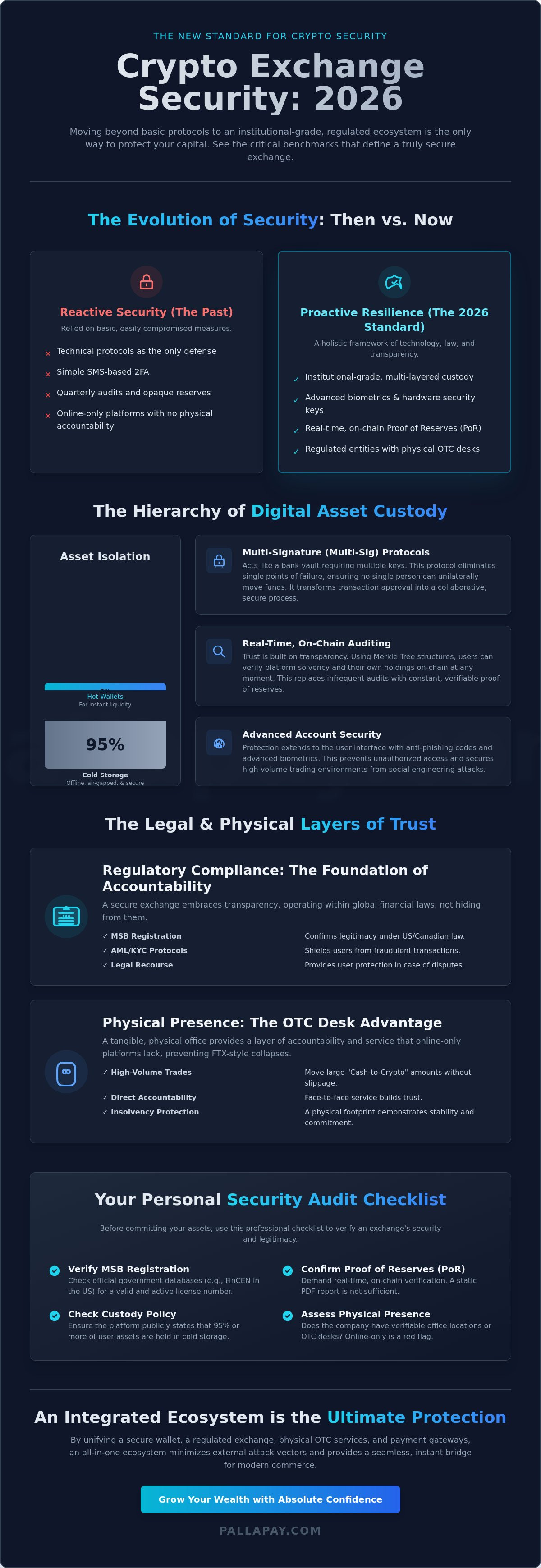
Security Checklist: How to Audit an Exchange Yourself
Identifying a secure crypto exchange in 2026 requires more than a glance at marketing slogans; it demands a rigorous, manual audit of the platform’s operational infrastructure. Security isn’t a static feature but a verifiable set of protocols. You should start by verifying the exchange’s regulatory status and license numbers. A professional platform will publicly list its Money Services Business (MSB) registrations and regional licenses. By 2025, top-tier global exchanges made these searchable in real-time, allowing users to confirm the entity’s standing with financial authorities instantly.
Transparency is the next pillar of your audit. Look for a public Proof of Reserves (PoR) or a transparency dashboard. These tools use Merkle Tree proofs to demonstrate that the exchange holds assets in a 1:1 ratio to user deposits. If an exchange doesn’t provide a real-time view of its reserves, it isn’t meeting the security standards of the modern financial era. Additionally, evaluate the account-level features available to you. A secure crypto exchange must offer more than just a password. Ensure the platform supports:
- Multi-Factor Authentication (MFA): Support for hardware security keys like YubiKey rather than just SMS-based codes.
- Address Whitelisting: The ability to lock withdrawals to specific, pre-approved wallet addresses.
- Biometric Integration: Secure mobile access using encrypted facial or fingerprint recognition.
- History of Resilience: Research if the company has faced breaches. Focus on their response; professional firms reimburse users and patch vulnerabilities within 24 hours.
Finally, prioritize an “All-in-One” ecosystem. Moving funds between different platforms introduces transfer risks and potential phishing vulnerabilities. Using a unified environment, like the Pallapay ecosystem, minimizes these touchpoints and keeps your assets within a singular, hardened security perimeter.
Analyzing the Terms of Service
The fine print often holds the most critical security data. Look specifically at what happens to your funds if the platform faces liquidation. Professional exchanges segregate user funds from corporate operating capital, ensuring your assets aren’t treated as general property during a bankruptcy. You should also verify the insurance policies for digital assets. By early 2026, institutional-grade platforms have secured comprehensive coverage against third-party hacks. Clear, transparent fee structures are another sign of a professional operation; hidden costs often mask a lack of underlying liquidity or poor financial management.
Testing Customer Support Responsiveness
Customer support is a vital security feature. In the event of an account compromise, every second counts. Test the platform by sending a technical inquiry during off-peak hours. If you don’t receive a response from a human agent within minutes, the platform’s security response time is likely insufficient. Pallapay addresses this by providing dedicated account managers for high-volume traders, ensuring instant, personalized support. For practical safety tips on managing your transactions, refer to the Sell USDT for Cash Guide for step-by-step security protocols.
Experience the security of a global fintech leader today. Secure your assets with the Pallapay Wallet.
The Pallapay Ecosystem: A Unified Approach to Security
Security in 2026 is no longer defined solely by the strength of a password or the isolation of a cold wallet. It’s defined by the integrity of the entire financial lifecycle. Pallapay operates as a secure crypto exchange by utilizing a closed-loop ecosystem that integrates point-of-sale terminals, global payment gateways, and branded card solutions. This unified architecture significantly minimizes external attack vectors. When assets move within a single, regulated infrastructure, the risks associated with third-party handoffs and “man-in-the-middle” vulnerabilities are effectively neutralized.
The bridge between traditional banking and blockchain technology requires more than just a conversion tool; it needs a foundation of institutional reliability. By providing a direct path for users to spend their digital assets via the Pallapay Mastercard, the platform removes the need for multiple, high-risk transfers between exchanges and external bank accounts. This streamlined process ensures that the “Future of Payments” remains both accessible and shielded from the exploits that often plague fragmented financial services.
Securing Merchant Transactions
For modern Retail Stores and high-volume E-commerce platforms, security is synonymous with stability. The Crypto POS Machine serves as a hardened endpoint that protects both merchant and customer data through hardware-level encryption. Businesses can accept digital payments without the traditional anxieties of the blockchain space. The Pallapay system provides several key advantages for the retail sector:
- Instant Fiat Conversion: Merchants receive local currency immediately, which eliminates the risk of crypto price volatility during the settlement period.
- Data Sovereignty: Transaction details are processed through secure, private channels that meet global financial compliance standards.
- Fraud Prevention: The integrated nature of the POS hardware reduces the likelihood of “double-spend” attacks or fraudulent chargebacks.
Institutional Reliability for Global Commerce
Global enterprises require a level of liquidity and technical depth that standard retail platforms can’t provide. Pallapay meets this demand through high-liquidity OTC desks designed for large-scale corporate settlements. These desks allow for the movement of significant capital without causing market slippage or exposing the transaction to public order books prematurely. This institutional focus is what cements Pallapay’s reputation as a secure crypto exchange for the professional sector.
Developers and global platforms utilize the Payment API to create a secure bridge between their existing software and the blockchain. This API is built with a focus on low-latency performance and high-level security protocols, allowing businesses to scale their operations across borders without compromising on safety. Pallapay is the “Global Enabler” for secure crypto-fiat operations, providing the professional tools necessary to thrive in an evolving financial landscape.
Securing Your Position in the Future of Payments
Navigating the digital asset landscape in 2026 requires more than just a digital wallet; it demands a partner that bridges the gap between blockchain innovation and institutional reliability. Choosing a secure crypto exchange involves verifying official MSB registrations in the US and Canada to ensure full compliance with evolving global standards. A unified ecosystem that combines online speed with a physical presence in 180+ countries provides the stability necessary for high-volume transactions. Pallapay simplifies this complexity by offering 24/7 institutional support and dedicated OTC desks, ensuring liquidity and settlement are always within reach. By integrating these layers of protection, users focus on growth while the platform manages the heavy lifting of security. The future of finance isn’t just about decentralization; it’s about the trust built through a professional, all-in-one financial gateway. It’s time to transition from fragmented tools to a cohesive, global infrastructure that prioritizes your peace of mind.
Join the Most Secure Crypto Ecosystem: Create Your Pallapay Account Today
Step into a new era of financial freedom where safety and innovation work in perfect harmony.
Frequently Asked Questions
Is any crypto exchange 100% secure in 2026?
No platform can claim 100% security, but Pallapay minimizes risk through institutional-grade infrastructure and regulatory compliance. We follow the NIST Cybersecurity Framework to detect and mitigate threats in real time. This proactive approach ensures that while no system is invincible, our defense layers provide the highest level of protection available in the 2026 financial market.
What is MSB registration and why is it important for crypto security?
MSB registration signifies that a platform is a licensed Money Services Business, which requires strict adherence to AML and CTF regulations. Pallapay holds MSB registration M20431321 in Canada, ensuring we meet global transparency standards. This registration is vital for a secure crypto exchange as it subjects the platform to regular government audits and rigorous financial reporting requirements.
How does an OTC desk provide more security than a standard online exchange?
OTC desks offer enhanced security by facilitating large trades away from public order books, which protects users from market manipulation. Pallapay’s OTC service provides a private, high-liquidity environment for institutional clients. By using a direct settlement process, we eliminate the risks of price slippage and ensure that funds move through verified, compliant channels without public exposure.
Can I safely sell large amounts of USDT for cash in Dubai?
You can safely sell USDT for cash at Pallapay’s regulated physical branches in Dubai. These offices provide a transparent environment where you can complete large transactions in person. This method removes the uncertainty of online P2P transfers and guarantees instant cash delivery. It’s a reliable way to liquidate assets while maintaining full compliance with UAE financial regulations.
What are the risks of using an unregulated crypto exchange?
Using an unregulated exchange exposes you to the risk of total fund loss without any legal path for recovery. These platforms often ignore the 2024 MiCA regulations, leaving your data and assets vulnerable to internal mismanagement. Without oversight, there’s no guarantee of liquidity, which means you might not be able to withdraw your funds during periods of high market volatility.
How does Pallapay protect my assets from being hacked?
Pallapay secures your assets by storing more than 95% of funds in cold storage, keeping them isolated from online threats. We utilize Multi-Party Computation technology to ensure that no single point of failure can compromise the system. This multi-layered defense strategy establishes our platform as a secure crypto exchange that protects both retail and institutional capital from sophisticated cyberattacks.
Is it safer to store crypto on an exchange or in a private wallet?
Private wallets provide autonomy, but a regulated exchange offers professional custody and asset recovery features that self-custody cannot match. Pallapay uses institutional-grade encryption to protect your account while offering 24/7 monitoring. For many, the risk of losing a private key is higher than using a regulated platform that provides a secure, insured environment for long-term asset management.
How does a crypto payment gateway ensure secure transactions for my business?
A payment gateway secures business transactions by automating the conversion of crypto to fiat instantly, removing the risk of price fluctuations. Pallapay’s gateway uses secure API integrations to process payments without exposing sensitive merchant data. This system provides a seamless bridge for businesses to accept digital currencies while ensuring that every transaction is verified and settled into their accounts.
Disclaimer
The information provided on this website and blog is for general informational and educational purposes only and does not constitute financial, investment, legal, tax, or other professional advice.
Cryptocurrency and digital asset services may be subject to regulatory restrictions in certain jurisdictions. Users are solely responsible for ensuring compliance with applicable local laws and regulations before using any products or services mentioned on this website.
PallaPay does not guarantee the accuracy, completeness, or timeliness of any information published and accepts no liability for any loss or damages arising from reliance on the content. Any opinions expressed are those of the respective authors and may change without notice.
Certain services, features, or products referenced may be provided through third-party partners, licensed entities, or affiliated service providers subject to separate terms and regulatory approvals. Availability of services may vary by country or region.
This website may contain references to digital assets, virtual currencies, or blockchain-related services that are not available to residents of certain jurisdictions, including where prohibited by law. Nothing on this website constitutes an offer, solicitation, or recommendation to buy or sell any financial instrument or virtual asset.
Leave a Reply