

The era of accepting 3% slippage as a standard cost of doing business is officially over. You’ve likely felt the frustration of watching profits evaporate through hidden fees or waiting days for a KYC process that should take minutes. It’s a common reality where 65% of institutional traders cited liquidity fragmentation as their primary hurdle in late 2025. Finding a reliable crypto to fiat exchange that doesn’t trigger a bank account freeze shouldn’t feel like a gamble in a professional ecosystem.
You deserve a bridge that connects digital innovation with institutional stability. We’ll show you how to master a secure, compliant off-ramping strategy that provides instant liquidity without the traditional friction of legacy banking. This guide explores high-speed OTC settlements and the regulatory frameworks that ensure your capital remains mobile across 170 countries. We’re moving beyond the “wait and see” approach to provide the definitive blueprint for the future of payments. By the end of this deep dive, you’ll have the tools to convert assets with absolute confidence and accelerate your financial momentum.
Key Takeaways
- Understand the mechanics of professional off-ramps and how liquidity providers ensure stable, institutional-grade conversion rates during every transaction.
- Evaluate the premier methods for a crypto to fiat exchange, including the strategic advantages of direct bank settlements and private OTC desks for high-volume investors.
- Secure your capital by identifying regulated platforms that utilize MSB registration to provide a transparent, compliant, and secure conversion environment.
- Empower your business with instant settlement models that eliminate market volatility while expanding your global payment reach through seamless fiat integration.
- Access a comprehensive, all-in-one liquidity solution that facilitates instant USDT-to-fiat conversions across 180+ countries via the Pallapay ecosystem.
What is a Crypto to Fiat Exchange and How Does it Work?
A crypto to fiat exchange serves as the professional bridge between digital ledger assets and the sovereign currencies required for global commerce. To build a foundation for this technology, it’s helpful to define the core infrastructure: What is a cryptocurrency exchange? Essentially, it’s a high-performance environment where blockchain-based assets are liquidated into traditional bank deposits. By 2026, the industry has moved beyond simple swap-only platforms. Modern users now demand an “all-in-one” ecosystem that integrates secure storage with fiat settlement capabilities, ensuring that assets don’t just sit in a wallet but remain active and liquid.
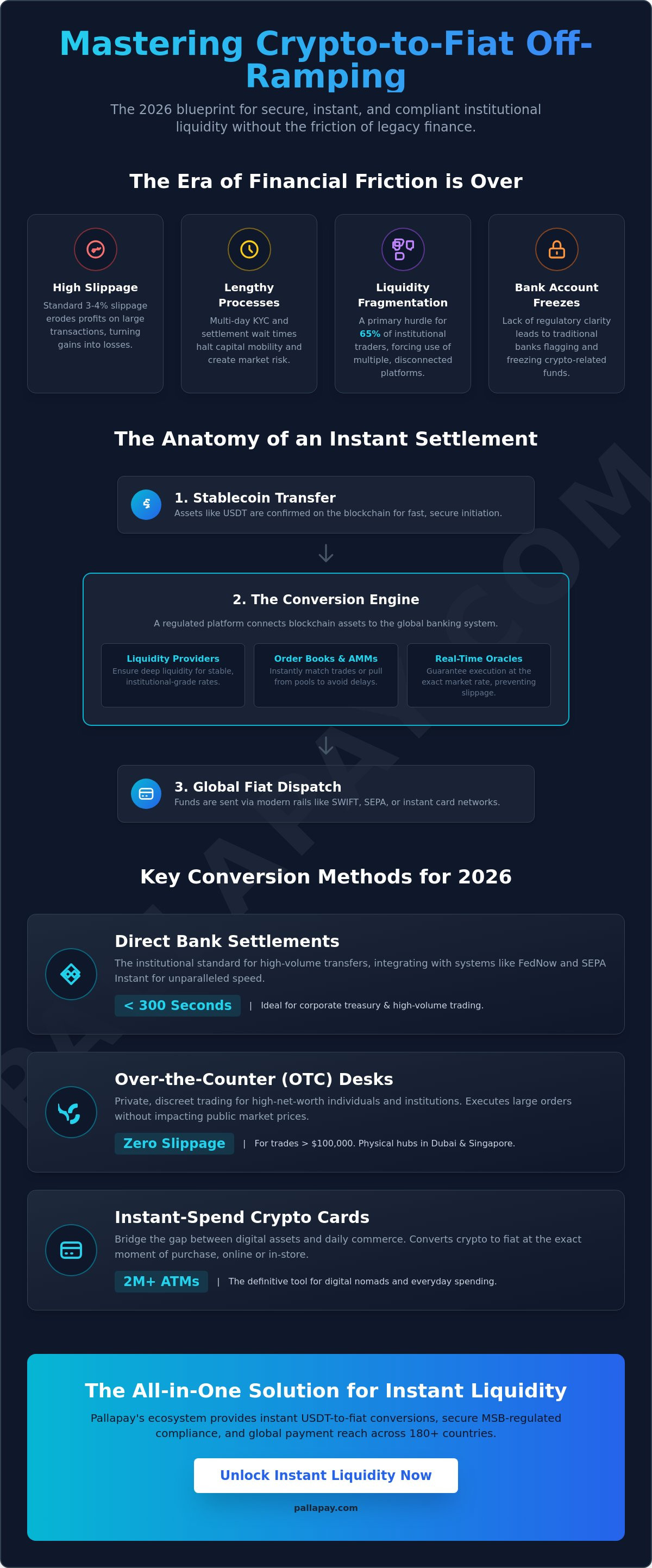
The role of liquidity providers is central to this process. These institutional entities supply the depth necessary to maintain stable exchange rates during large conversions. Without them, a single large transaction could cause a price slippage of 4% or higher, eroding the value of the trade. While decentralized (DEX) workarounds exist, they often rely on complex peer-to-peer matching that can take hours. Centralized (CEX) off-ramps provide a more direct route, connecting the blockchain’s transparency with the banking sector’s reliability. This professional integration allows businesses to move capital without the friction of manual matching or excessive wait times.
The Mechanics of Fiat Liquidity
Liquidity is managed through two primary systems: order books and automated market makers (AMMs). Order books match buyers and sellers at specific price points, while AMMs use mathematical formulas to provide instant liquidity from a pre-funded pool. The “spread” represents the difference between these prices; it often impacts your final payout more than the headline commission fee. To ensure precision, platforms utilize real-time price oracles that aggregate data from multiple global sources. This technology guarantees that your conversion reflects the exact market rate at the millisecond of execution.
Digital Assets vs. Traditional Rails
Stablecoins like USDT have become the primary intermediary for conversion because they offer the speed of a blockchain with the price stability of the US Dollar. The transition process follows a logical sequence. First, the digital asset is confirmed on the blockchain. Second, the exchange converts this into fiat currency through an internal ledger. Finally, the funds are dispatched via traditional rails such as SWIFT, SEPA, or instant card networks. An off-ramp is the critical utility that transforms digital wealth into spendable, real-world value for global adoption. This seamless movement between networks is what defines the future of payments.
Key Methods for Converting Crypto to Fiat in 2026
2026 has redefined the infrastructure of liquidity. High-volume institutional settlements now rely on direct bank transfers that integrate with real-time gross settlement systems like FedNow or SEPA Instant. These systems allow for a crypto to fiat exchange that completes in under 300 seconds. It’s a significant leap from the multi-day delays that plagued earlier market cycles. While digital rails provide speed, the human element of finance remains vital for large-scale operations.
OTC Trading for High-Volume Liquidity
Institutional investors and high-net-worth individuals prioritize discretion and price stability. Over-the-Counter (OTC) desks provide a private environment where trades exceeding $100,000 can occur without triggering market slippage on public order books. For those looking to Sell USDT for Cash in Dubai, physical exchange offices offer a secure, face-to-face experience. These hubs in Dubai and Singapore utilize strict KYC/AML protocols to ensure every transaction remains compliant with 2026 global financial regulations. This personalized service handles the heavy lifting of compliance and liquidity sourcing for the world’s largest traders.
Instant Spending via Crypto Cards
The Pallapay Mastercard has bridged the gap between digital assets and daily commerce. It’s the definitive tool for digital nomads who require instant access to their funds. The card converts your crypto balance into fiat at the exact moment of purchase. Physical cards offer ATM withdrawal capabilities at over 2 million locations worldwide, while virtual versions provide immediate security for e-commerce. This seamless crypto to fiat exchange happens behind the scenes, ensuring the user experience is identical to traditional banking.
Direct Cash Exchange
Physical liquidity remains a cornerstone of global trade. Selling USDT or Bitcoin for physical cash is now a standardized process in major financial centers. Users can Sell USDT in Dubai through professional OTC desks that provide immediate local currency or USD. This method bypasses traditional banking delays, offering a secure way to exit the market. Transaction security is maintained through blockchain verification and on-site security protocols, ensuring that funds are transferred only when the cash is ready for collection.
Retailers are also transforming into liquidity providers. By using a crypto POS machine, merchants can accept digital payments and receive instant fiat settlement, effectively turning every storefront into a micro-exchange. This ecosystem represents the future of payments, where liquidity is never more than a tap away. In 2025, retail crypto adoption grew by 40%, leading to the current 2026 standard where physical stores act as the primary bridge between digital wealth and tangible goods.
Security and Compliance: Choosing a Regulated Exchange
The single most frequent question we encounter is simple: Is my crypto safe during the conversion process? In a market where 100% security is the only acceptable standard, the answer depends entirely on the regulatory framework of your chosen crypto to fiat exchange. Security isn’t just about code; it’s about the legal accountability of the institution holding your funds. When you bridge the gap between blockchain and traditional banking, you need a partner that operates with institutional-grade oversight.
The Importance of MSB Registration
Money Services Business (MSB) registration serves as the gold standard for financial trust. Pallapay maintains active compliance and registration in both the United States and Canada, ensuring we operate under the direct oversight of federal financial regulators. This distinction is critical. Unlike unregulated “instant swaps” that often operate in legal gray zones, a licensed provider must maintain rigorous capital reserves and undergo regular third-party audits. Regulation provides a safety net that protects users from the fraudulent schemes that often plague offshore, unlicensed platforms.
- Legal Accountability: Registered entities are subject to the same strict standards as traditional banks.
- Asset Segregation: User funds are kept separate from operational capital to ensure liquidity is always available.
- Fraud Prevention: Mandatory reporting helps identify and block suspicious transactions before they can impact the ecosystem.
Protecting Your Digital Assets
We utilize a sophisticated security architecture to manage the exchange lifecycle. 98% of digital assets are kept in cold storage; this means they’re physically isolated from internet connectivity to prevent remote hacking. For corporate accounts, we implement multi-signature (multi-sig) protocols where several authorized parties must approve a transaction before it’s processed. This eliminates the risk of a single point of failure and ensures internal controls are as strong as our external defenses.
Every interaction with our gateway is protected by high-level SSL encryption, ensuring that your financial data remains private. To understand how these security layers integrate with broader commerce, you can explore our Ultimate Guide to Crypto Payment Gateways. In 2026, the industry has moved beyond simple passwords. We mandate two-factor authentication (2FA) and biometric verification to ensure that only you can access your liquidity.
By 2026, KYC (Know Your Customer) and AML (Anti-Money Laundering) protocols have become the backbone of a stable crypto to fiat exchange. These aren’t just bureaucratic hurdles; they’re the tools that allow crypto to integrate with the global banking system. By verifying the identity of every user, we ensure that the liquidity flowing through our platform remains untainted by illicit activity. This professional approach provides the confidence you need to scale your business internationally without the fear of regulatory blowback.
The Merchant Perspective: Accepting Crypto and Settling in Fiat
Modern commerce demands a level of flexibility that legacy banking systems often struggle to provide. Merchants are rapidly shifting toward “Accept Crypto, Receive Fiat” models to tap into a global market of digital asset users, which exceeded 560 million individuals by 2024. This transition isn’t driven by a desire to hold volatile assets, but by the need for a high-speed, global crypto to fiat exchange that functions as a reliable payment rail. By converting digital payments into local currency instantly, businesses gain access to a broader customer base without exposing their balance sheets to market fluctuations.
For e-commerce and luxury retail, the advantages are particularly clear. High-value transactions that typically face 3 to 5 day settlement delays in the traditional banking system are now processed with immediate finality. This eliminates the risk of chargebacks and reduces the overhead costs associated with cross-border payment processing. Luxury brands operating internationally use these rails to bypass the friction of multiple intermediary banks, ensuring that liquidity is available exactly when and where it’s needed.
Automated Fiat Settlement
The Pallapay Fiat Settlement service removes market risk by locking in exchange rates at the exact moment of a transaction. The workflow is designed for professional efficiency: a customer pays in BTC, USDT, or other supported assets, and the merchant receives the equivalent value in their local bank account. This automated crypto to fiat exchange reduces transaction fees significantly compared to the 2.5% or 3.5% often charged by credit card processors. Integrating these flows into existing accounting software is seamless via a Payment API, which automates reconciliation and ensures tax compliance is handled without manual intervention.
In-Store Liquidity with Crypto POS
Physical retail environments are being transformed by the Pallapay Crypto POS Machine. This hardware allows storefronts to accept digital payments with the same ease as a standard chip-and-pin card. For a deeper look at the technology, consult our Crypto POS Machine: The Complete Guide for Merchants. This solution has seen rapid adoption within Hotels and Retail Stores, where instant verification is required for high-ticket sales. The POS system handles the complex conversion in the background, allowing the merchant to focus on service while the platform manages the heavy lifting of liquidity and settlement.
The Future of Payments is built on the premise of choice. Whether a business operates a global online store or a boutique physical location, the ability to bridge the gap between blockchain innovation and institutional reliability is a competitive necessity. By removing the technical barriers to entry, Pallapay empowers merchants to lead their industries into a more efficient financial era.
Ready to modernize your payment infrastructure? Enable instant fiat settlement for your business today.
Pallapay: The All-in-One Solution for Instant Liquidity
Pallapay represents the pinnacle of modern financial infrastructure. With a service reach extending across 180 countries, it provides the essential rails for global commerce. The platform functions as a sophisticated crypto to fiat exchange that operates at the speed of digital markets; it bridges the gap between blockchain assets and traditional bank accounts. For high-net-worth individuals and institutional players, Pallapay maintains high-volume OTC desks in Dubai, Istanbul, and Singapore. These physical hubs allow for the conversion of massive volumes without the slippage or delays often found on retail platforms. This global presence ensures that liquidity is always accessible, regardless of your geographic location.
The Pallapay Mastercard serves as a primary tool for individual liquidity. It allows for instant USDT to fiat conversion at millions of merchant locations worldwide. Instead of waiting days for bank transfers, users can spend their digital assets in real-time. This utility transforms cryptocurrency from a speculative asset into a practical medium of exchange for daily transactions.
The Pallapay Ecosystem Advantage
Efficiency is the primary driver of the Pallapay ecosystem. By integrating a secure Wallet, a globally accepted debit card, and advanced POS hardware into a single platform, the company eliminates the friction of moving funds between multiple providers. It’s a unified approach to the Future of Payments where crypto and commerce exist in a single flow. This ecosystem reduces the technical hurdles for merchants who want to accept digital payments but require fiat stability. To ensure absolute reliability, Pallapay provides 24/7 dedicated support for institutional clients to handle complex settlement requirements at any hour.
Getting Started with Your First Exchange
Setting up a Pallapay account is a streamlined process designed for immediate utility. You’ll begin by creating a profile and completing the necessary verification steps to unlock fiat withdrawal capabilities. Once your account is active, you can deposit digital assets and execute a crypto to fiat exchange with a few clicks. For enterprises, the integration of the Payment API allows for automated business flows. This API enables real-time settlement for e-commerce platforms, ensuring that digital sales are converted to local currency without manual intervention. It’s a scalable solution for businesses that need to manage global cash flow with precision.
Ready to streamline your financial operations? Experience the Future of Payments with Pallapay today.
Mastering Your Global Liquidity Strategy
The financial landscape of 2026 requires a seamless bridge between digital assets and traditional currency. Achieving instant liquidity depends on selecting a regulated crypto to fiat exchange that prioritizes security through institutional-grade compliance. Pallapay provides this stability by operating as a registered Money Services Business (MSB) in both the USA and Canada. We’ve established physical offices in 5 global hubs to ensure professional, localized support while serving users across 180 countries. Our all-in-one ecosystem handles the technical heavy lifting, which allows you to focus on scaling your business operations. Speed is the new benchmark for success in the digital economy. By integrating these professional settlement tools, you’re not just moving money; you’re adopting the future of payments. It’s time to transition from fragmented processes to a unified financial solution that works as fast as you do.
Start your secure crypto to fiat exchange with Pallapay today
Your journey toward efficient, global capital management starts with a partner you can trust.
Frequently Asked Questions
How long does a crypto to fiat exchange take?
Most digital transactions on our platform process in less than 10 minutes. While traditional banking transfers often require 1 to 3 business days; our infrastructure enables instant liquidity. You’ll see funds reflected in your account immediately after the blockchain confirms the transaction. This speed ensures you can react to market volatility without waiting for legacy banking delays.
Is it legal to exchange crypto for cash in Dubai?
It’s completely legal to exchange crypto for cash in Dubai under the Virtual Assets Regulatory Authority (VARA) framework established in March 2022. This regulatory clarity makes the UAE a global hub for digital finance. You can safely visit licensed physical branches to complete your crypto to fiat exchange without legal friction or security concerns.
What are the fees for converting USDT to fiat on Pallapay?
Pallapay utilizes a competitive fee structure based on current market liquidity and transaction volume. You’ll receive transparent, real-time quotes before confirming any conversion. These institutional-grade rates ensure you retain the maximum value of your USDT during the settlement process. We prioritize cost-efficiency to support your long-term business growth and financial stability.
Can I withdraw fiat currency directly to my bank account?
You can withdraw fiat currency directly to your local or international bank account via SEPA or SWIFT networks. Most transfers reach their destination within 24 hours. Our gateway connects your digital assets to over 150 different banking jurisdictions globally; providing a reliable link between blockchain assets and traditional financial institutions that you already trust.
Do I need to undergo KYC to exchange crypto for fiat?
You must complete a Know Your Customer (KYC) verification to comply with international anti-money laundering (AML) standards. This process typically takes less than 15 minutes to finish on our platform. Providing a valid passport or national ID ensures your account remains secure and fully compliant with the global financial regulations that govern modern fintech operations.
What is the difference between an OTC desk and an online exchange?
An Over-the-Counter (OTC) desk handles large-volume trades privately to prevent market slippage. Online exchanges use a public order book for smaller, automated transactions. If you’re moving more than $50,000; our OTC services provide a personalized, secure bridge for your crypto to fiat exchange needs. This high-touch service ensures price stability for significant institutional settlements.
Which cryptocurrencies can I convert to fiat instantly?
You can instantly convert major assets including Bitcoin, Ethereum, and USDT into various fiat currencies. Our platform supports the top 50 cryptocurrencies by market capitalization as of 2024. This broad selection ensures you can access liquidity whenever the market moves. We’re constantly expanding our asset list to include emerging tokens that meet our strict security and liquidity requirements.
How does the Pallapay Mastercard handle crypto-to-fiat conversion at ATMs?
The Pallapay Mastercard converts your digital balance into local currency in real-time at the moment of withdrawal. You can access cash at over 2 million ATMs worldwide that accept Mastercard. It’s a seamless solution that eliminates the need for manual transfers before you spend your funds. This technology bridges the gap between your digital portfolio and everyday physical commerce.
Disclaimer
The information provided on this website and blog is for general informational and educational purposes only and does not constitute financial, investment, legal, tax, or other professional advice.
Cryptocurrency and digital asset services may be subject to regulatory restrictions in certain jurisdictions. Users are solely responsible for ensuring compliance with applicable local laws and regulations before using any products or services mentioned on this website.
PallaPay does not guarantee the accuracy, completeness, or timeliness of any information published and accepts no liability for any loss or damages arising from reliance on the content. Any opinions expressed are those of the respective authors and may change without notice.
Certain services, features, or products referenced may be provided through third-party partners, licensed entities, or affiliated service providers subject to separate terms and regulatory approvals. Availability of services may vary by country or region.
This website may contain references to digital assets, virtual currencies, or blockchain-related services that are not available to residents of certain jurisdictions, including where prohibited by law. Nothing on this website constitutes an offer, solicitation, or recommendation to buy or sell any financial instrument or virtual asset.
Leave a Reply