

Tag: USD CFDs

  • Gold and USD CFD Trading: How to Understand the Mechanics and Financial Impact

    Gold and USD CFD Trading: How to Understand the Mechanics and Financial Impact

    Potential gains can make gold and US dollar CFDs look like a shortcut to financial change. The reality is more measured: a CFD can magnify the effect of market movements on your money, in either direction. Understanding how these positions work is essential before weighing their possible financial impact. Clear communication matters in finance, too, including when considering how to explain crypto payments to customers.

    If terms such as leverage, margin, and exposure feel unfamiliar, it’s reasonable to want a straightforward explanation before acting. This guide explains what a CFD position represents, how shifts in gold and the US dollar can affect it, and what risks to consider when deciding whether trading fits your financial circumstances.

    You’ll learn why gold and USD movements can be connected, what may influence those markets, and how leverage can amplify both gains and losses. CFDs are complex, high-risk instruments, so understanding the mechanics is only a first step toward making an informed decision.

    Key Takeaways

    • A CFD tracks an asset’s price movement; it doesn’t give you ownership of the underlying gold or currency.
    • Gold and USD CFDs have distinct market drivers. Compare what could move each market before considering a position.
    • Leverage can increase market exposure with less initial capital, but it can also amplify losses.
    • Use a pre-trade review to understand the product, set risk limits, assess affordability, and consider possible outcomes. CFDs aren’t a guaranteed route to financial improvement.
    • Gold and USD markets can interact, but they represent different exposures. Consider the specific instrument and the factors that may affect its price.

    What Gold and USD CFD Trading Means for Your Financial Decisions

    Before considering how a gold or US dollar CFD might affect your finances, separate the underlying market from the contract used to gain exposure to it. A contract for difference, or CFD, is a financial agreement linked to an asset’s price movement. It doesn’t mean you own the asset itself. The Contract for Difference (CFD) reference offers further background on how these instruments work.

    CFD exposure means your potential outcome is linked to the price change between opening and closing a position, not ownership of the underlying asset. The outcome depends on how the market moves relative to your position, as well as the size of your exposure. There’s no guaranteed result.

    How a CFD position relates to an underlying market

    A position begins at an opening price and is closed at a later price. If the market moves in the direction the position anticipates, the price change may create a gain. If it moves against that direction, it may create a loss. The exact financial result also depends on position size and applicable terms.

    This differs from purchasing physical gold or holding currency. A gold CFD provides price exposure without acquiring the metal. A USD-related CFD provides exposure to currency-market movements without necessarily holding US dollars. Gold CFDs and USD-related CFDs also refer to distinct markets, each influenced by its own mix of factors. XAU/USD, for example, expresses the price of gold in US dollars, so movements in either can affect the quoted relationship.

    Why financial impact depends on both direction and exposure

    Direction matters, but it isn’t the whole picture. A larger position means a given market move can have a greater effect on the account than the same move on a smaller position. If the market moves against the position, account value can fall. That can make an apparently modest price change financially important, particularly when exposure is larger than the funds committed to open the position.

    Consider a hypothetical long position: the trader expects the relevant market price to rise, but it falls before the position closes. That adverse move can result in a loss. A short position has the reverse directional expectation, but it can also lose if the market rises instead. These examples explain mechanics only. They’re not forecasts, recommendations, or assurances of an outcome.

    For gold and USD CFDs, the practical question is not only which way a price might move, but also how much exposure a position creates and whether a potential loss is affordable. Assess both the market and the position before deciding what the financial implications could be.

    How Gold and USD CFDs Work: Price Movements, Exposure, and Leverage

    A CFD position remains exposed to market prices for as long as it’s open. If the relevant price changes, the position’s unrealised result changes too. Closing it turns that movement into a realised outcome, subject to the instrument’s terms. The How CFD Trading Works overview explains the basic principle of trading price movements without owning the underlying asset.

    Leverage magnifies market exposure, and it can magnify losses as well as gains. It allows a trader to control a larger position with less initial capital than the full exposure would otherwise require. That changes the scale of the position, not the uncertainty of the market. A smaller initial commitment doesn’t make the potential risk small.

    What can move gold and USD markets?

    Gold prices can respond to shifts in supply and demand, economic expectations, interest-rate outlooks, and currency movements. USD exchange rates may also react to economic data, interest-rate expectations, and changes in demand for the currency. These influences can interact, but they aren’t reliable signals of what prices will do next.

    XAU/USD is the market pairing that quotes gold against the US dollar. Its price can reflect changes in gold’s value, the dollar’s value, or both. When assessing this pairing, consider that relationship rather than treating gold and the USD as identical exposures.

    How leverage changes the scale of a position

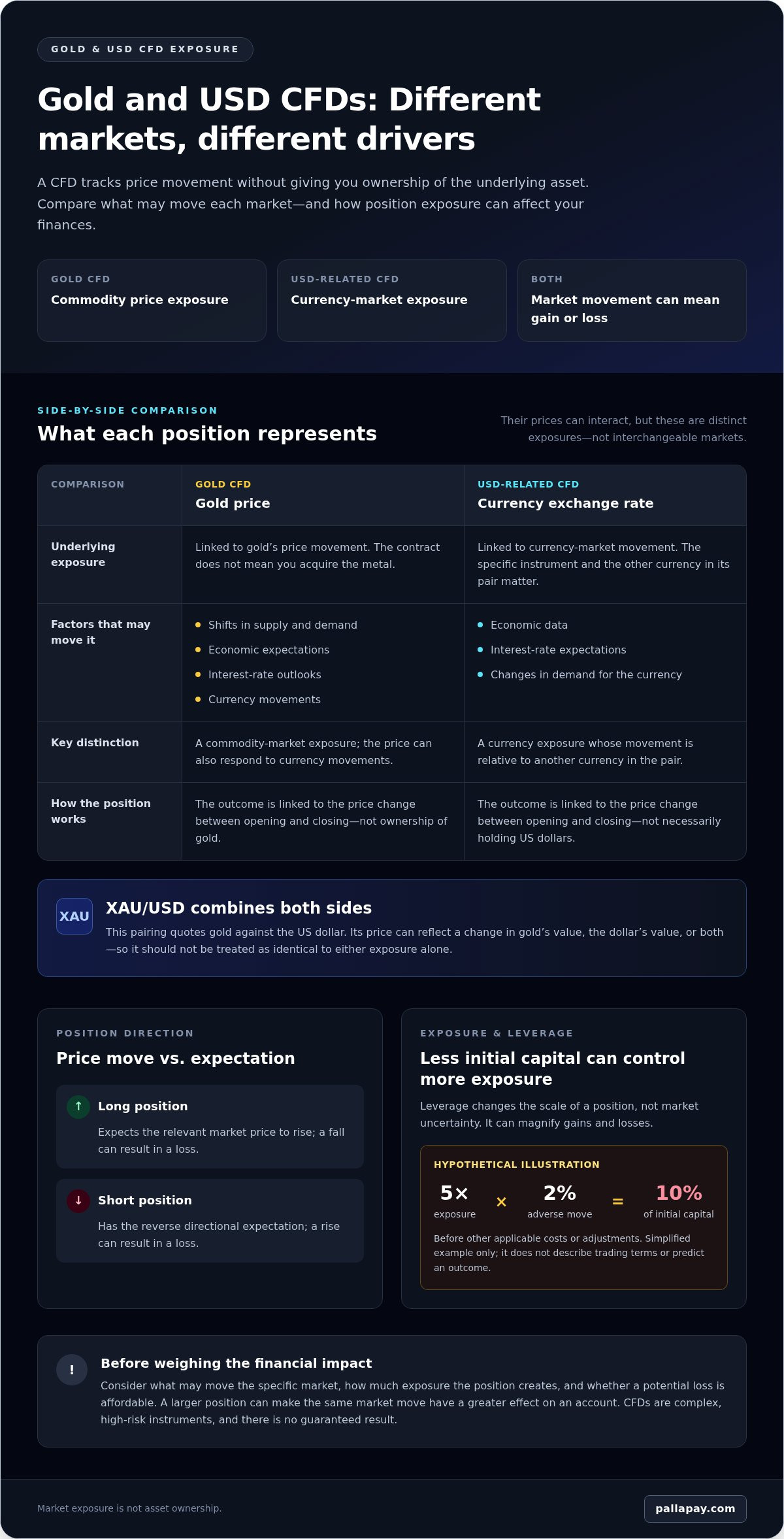
    Hypothetical example: Imagine a position with exposure five times the initial capital committed. If the underlying market moves 2% against it, the position’s loss would be equivalent to 10% of that initial capital, before any other applicable costs or adjustments. A move in the favourable direction could magnify the potential gain in similar fashion, but it can’t be assumed or relied on.

    This illustration uses a simplified ratio only. It doesn’t describe Pallapay’s trading terms or predict an outcome. Actual results depend on the position and applicable contract details. The practical takeaway is to assess the full exposure and the effect of an adverse move, not just the amount initially committed.

    Plain language helps make complex financial ideas easier to examine. The same care used to explain unfamiliar financial topics, including how to explain crypto payments to customers, can help traders distinguish market movement, position size, and leverage before making decisions. Readers exploring gold and USD exposure can also learn about Pallapay’s Forex and CFD trading.

    Gold CFDs vs. USD CFDs: Compare Exposure Before Choosing a Market

    Gold and USD CFDs can both create exposure to financial-market movements, but they don’t represent interchangeable choices. Gold is a commodity market; USD-related exposure depends on the specific currency instrument and the other currency in its pair. Their prices can interact, yet the drivers and risks you need to assess are distinct.

    Comparison point Gold CFD USD-related CFD
    Underlying market Gold-price movement, commonly represented by XAU/USD. A currency pairing involving the US dollar; the other currency also matters.
    Potential drivers Supply and demand, economic expectations, and currency movements may influence gold prices. Economic expectations, interest-rate outlooks, and changing demand for either currency may affect the pair.
    Key exposure question Do you understand what may move gold and how the position responds to a price change? Can you assess both currencies in the pair, rather than focusing on the USD alone?

    What distinguishes gold CFD exposure?

    A gold CFD links the position’s outcome to changes in gold’s price, without giving the trader ownership of physical gold. Gold can respond to shifts in supply and demand, broader economic expectations, and movements in currencies such as the US dollar. These are possible influences, not dependable signals of future direction. Before evaluating exposure, consider whether you understand how the gold price is quoted and what could affect it.

    What distinguishes USD-related CFD exposure?

    A USD-related CFD isn’t a single, context-free bet on the dollar. In a currency pair, one currency is measured against another, so a price change reflects their relative values. A stronger USD against one currency doesn’t necessarily mean the same movement against every other currency. Identify the instrument and understand both sides of its pairing before assessing what a position could mean financially.

    Choose a market based on your understanding, not a ranking of which asset is “better.” Consider your familiarity with each market, your tolerance for volatility, and whether you can monitor an open position in a way that fits your circumstances. A market you know well can still move unexpectedly; an unfamiliar market may require more learning before you can assess its exposure.

    A clear comparison starts with precise terms, much like explaining how to explain crypto payments to customers: identify what is being discussed before drawing conclusions. For CFDs, name the underlying market, its potential drivers, and the questions you need answered about your position. Neither gold nor USD exposure is inherently safer or suitable for everyone.
    Gold and USD CFD Trading: How to Understand the Mechanics and Financial Impact

    How to Assess CFD Risk Before Putting Personal Finances at Stake

    Risk assessment starts with more than a view on whether gold or a currency pair might rise or fall. CFDs are complex, high-risk instruments, and a position can produce losses. Trading isn’t a guaranteed route to financial improvement. Potential gains are possible outcomes, not assured results.

    Separate the main considerations before deciding whether to proceed: market risk is the chance that prices move against your position; platform and operational considerations relate to accessing, monitoring, and managing a position; personal financial risk concerns whether a loss could affect essential needs or other financial priorities. A sound decision considers all three.

    Questions to answer before opening a position

    • 1. Understand the product. Can you explain how the CFD works, what market it tracks, and how your position responds to price changes?
    • 2. Define your risk boundary. Decide in advance what loss you could tolerate. Consider what you would do if the market moved against your expectations, rather than waiting until the position is under pressure.
    • 3. Assess affordability. Don’t use money needed for housing, food, bills, or other essential commitments. Avoid relying on borrowed money to fund a high-risk position.
    • 4. Review how you’ll manage it. Consider how you’ll monitor the position, what could affect your ability to act, and how you’ll evaluate the outcome afterward. Understand the relevant platform processes and position terms before committing funds.

    How to think about trading’s financial impact

    Outcomes depend on market movement, the size of the exposure, and decisions made while the position is open. Imagine a gold CFD opened with the expectation that gold will rise. If the price rises, the position may show a gain; if it falls, it may show a loss. If the price changes little, the result may be limited, though applicable terms can still affect the final outcome. These scenarios illustrate possibilities, not forecasts.

    For your wider finances, consider whether a potential loss would change your ability to meet existing goals. Trading should not replace budgeting or saving, and this general information isn’t a substitute for professional financial advice. Clear explanations help people assess complex choices: identify the moving parts before acting, whether you’re considering CFD risk or how to explain crypto payments to customers.

    If you’ve assessed the product, exposure, and affordability and want to explore trading, explore Pallapay’s Forex and CFD trading. Weigh the risks against your personal financial circumstances before making a decision.

    A Responsible Next Step for Exploring Gold and USD CFD Trading

    Education should come before action. A measured progression is simple: learn how a CFD works, identify the market and exposure involved, assess the financial risk, then decide whether to explore trading further. Understanding the mechanics won’t remove uncertainty, but it can help you make a more considered choice.

    A practical checklist for informed exploration

    • Explain the exposure. Can you describe the underlying market, what price movement affects the position, and how the position’s value may change?
    • Revisit affordability. Would a loss affect essential expenses, savings priorities, or other financial commitments?
    • Set a boundary. Decide what level of loss you could accept before considering a position. Don’t rely on essential living funds or borrowed money.
    • Consider your time. Do you have a realistic way to monitor the position and respond to changing market conditions?

    If the instrument’s mechanics, terms, or potential risks remain unclear, pause. Taking more time to understand the exposure is a sound decision, not a missed opportunity.

    Explore trading with realistic expectations

    CFD trading is a high-risk financial activity, not a guaranteed wealth strategy. Outcomes depend on market movements, the exposure taken, and decisions made while a position is open. A favourable outcome is possible, but so is a loss; neither should be treated as certain. Trading also shouldn’t replace budgeting, saving, or advice tailored to your personal finances.

    Clear explanations help people make sense of unfamiliar topics, including how to explain crypto payments to customers. For CFD exposure, the next step should follow understanding, not assumptions.

    After reviewing the mechanics and your own risk considerations, explore Pallapay’s Forex and CFD trading services. Approach any decision with realistic expectations and a clear view of the financial risk.

    Make Your Next Trading Decision with Clarity

    Gold and USD CFDs offer exposure to price movements, not ownership of gold or currency. Their markets have different drivers, and leverage can magnify the effect of price changes on a position. Understanding the instrument, considering how much exposure you’re taking, and deciding what loss you could afford are essential steps before acting.

    CFD trading is high risk, and a potential gain is never assured. Clear explanations matter in finance, whether you’re assessing market exposure or considering how to explain crypto payments to customers. A careful decision starts with knowing what you’re trading and how the outcome could affect your finances.

    Pallapay offers Forex trading, CFD trading, and gold trading, including XAU/USD. If you’ve reviewed the mechanics and risks and want to explore further, explore Pallapay’s trading services. Take the next step at a pace that supports informed decisions and realistic expectations.

    Frequently Asked Questions

    What is a CFD in gold or USD trading?

    A CFD is a contract that gives exposure to an asset’s price movement without transferring ownership of the asset. With a gold CFD, the position responds to gold-price changes. A USD-related CFD usually reflects a currency pair, so its value depends on the relative movement of the US dollar and another currency. The outcome depends on price movement, position size, and the relevant contract terms.

    Can gold or USD CFD trading change your financial situation?

    It can affect your finances, but the result could be positive, negative, or limited. The impact depends on market movement, exposure, and decisions about the position. Leverage can increase the effect of price changes, including losses. CFDs are complex, high-risk instruments, so they shouldn’t be treated as a reliable way to improve your financial situation or as a substitute for budgeting and saving.

    How does leverage affect a gold or USD CFD?

    Leverage lets a trader control greater market exposure with less initial capital than the full exposure would require. This magnifies the effect of price movements on the position: a move in the trader’s favour can increase a potential gain, while an adverse move can increase a loss. The smaller initial commitment doesn’t mean the position carries less risk. Understand the total exposure before deciding whether to proceed.

    Is gold CFD trading the same as buying physical gold?

    No. Buying physical gold means acquiring the metal, while a gold CFD provides exposure to changes in its price without ownership of the gold itself. The CFD’s result depends on how the relevant price moves during the position. Before trading, understand the instrument and its terms. If your goal is to own physical gold, a CFD doesn’t provide that ownership.

    What happens if the gold or USD market moves against my CFD position?

    If the market moves against your position, its value can decline and you may incur a loss. For example, a position that anticipates a rise may lose value if the relevant price falls. The financial impact depends on the size of the exposure and the price movement, along with applicable terms. Consider your acceptable loss boundary before opening a position, not after an adverse move occurs.

    How can a beginner assess whether CFD trading is suitable?

    A beginner can start by checking whether they can explain the instrument, underlying market, price exposure, and possible loss in plain language. Clear wording also matters when explaining unfamiliar topics, including how to explain crypto payments to customers. Assess affordability, avoid using essential funds or borrowed money, and consider whether you can monitor a position. If risks remain unclear, pause and seek appropriate financial guidance.

    Are gold and USD CFDs guaranteed to produce a profit?

    No. Gold and USD CFDs don’t guarantee a profit, and a favourable market view can still be wrong. Prices may move against a position, and leverage can magnify the resulting loss. Treat any potential gain as uncertain, not assured. Before considering a trade, understand its exposure and assess whether a possible loss is affordable within your personal financial circumstances.

    Disclaimer

    The information provided on this website and blog is for general informational and educational purposes only and does not constitute financial, investment, legal, tax, or other professional advice.
    Cryptocurrency and digital asset services may be subject to regulatory restrictions in certain jurisdictions. Users are solely responsible for ensuring compliance with applicable local laws and regulations before using any products or services mentioned on this website.
    PallaPay does not guarantee the accuracy, completeness, or timeliness of any information published and accepts no liability for any loss or damages arising from reliance on the content. Any opinions expressed are those of the respective authors and may change without notice.
    Certain services, features, or products referenced may be provided through third-party partners, licensed entities, or affiliated service providers subject to separate terms and regulatory approvals. Availability of services may vary by country or region.
    This website may contain references to digital assets, virtual currencies, or blockchain-related services that are not available to residents of certain jurisdictions, including where prohibited by law. Nothing on this website constitutes an offer, solicitation, or recommendation to buy or sell any financial instrument or virtual asset.


  • How to Transfer Crypto to a Bank Account: The 2026 Strategic Guide

    How to Transfer Crypto to a Bank Account: The 2026 Strategic Guide

    Transferring your digital assets to a traditional financial institution shouldn’t feel like a high-stakes gamble against institutional gatekeepers. You’ve navigated the complexities of the blockchain to build your portfolio, yet the final step often remains the most stressful. Whether it’s the fear of a sudden bank freeze or the frustration of losing a significant portion of your capital to hidden spreads, the process of learning how to transfer crypto to bank account remains a major hurdle for many professional traders. We understand that you view your digital assets as more than just a balance; they’re a strategic bridge to broader market opportunities.

    This 2026 guide provides the definitive roadmap for secure, regulated fiat settlement. You’ll master the mechanics of moving capital efficiently while adhering to the latest SEC rulemaking and cost-basis reporting requirements that took effect on January 1st. Beyond simple liquidation, we’ll demonstrate how to transform your crypto gains into active trading power. By the end of this article, you’ll have the confidence to manage your off-ramp process and leverage that liquidity to trade USD CFDs and gold with institutional-grade precision. This isn’t just about cashing out; it’s about pivoting your wealth into the global markets.

    Key Takeaways

    • Identify why MSB registration serves as the institutional gold standard for securing high-volume crypto-to-fiat settlements.
    • Master the efficient procedure of how to transfer crypto to bank account by leveraging stablecoins to eliminate high slippage and hidden fees.
    • Transition your digital capital into the global Forex and gold markets to harness the transformative potential of USD CFD trading.
    • Integrate your financial operations through a comprehensive ecosystem that supports everything from professional market analysis to daily utility with a Pallapay Mastercard.

    The Mechanics of Crypto-to-Bank Transfers in 2026

    The process of moving capital from a decentralized ledger to a centralized banking ledger is technically defined as an off-ramp. Understanding how to transfer crypto to bank account requires a clear grasp of the technical and regulatory infrastructure that connects these two distinct financial systems. In 2026, this operation is no longer a clumsy series of manual trades; it is a streamlined financial procedure managed by high-level liquidity providers. These entities ensure that even during periods of high market volatility, your conversion rate remains stable, preventing the value erosion that often plagues retail-level exchanges.

    Efficiency is the primary hallmark of modern financial integration. While a standard international wire transfer via SWIFT can still take between one and five business days to settle, 2026 technology has introduced near-instantaneous alternatives. Regulated off-ramp solutions now utilize stablecoin liquidity pools to bypass traditional bottlenecks, reducing wait times from days to mere minutes. This speed is critical for traders who need to move capital quickly to capitalize on emerging opportunities in other asset classes.

    Choosing the right architecture for your transfer is essential for security. Many individual users still rely on peer-to-peer (P2P) transfers, which carry significant risks of bank freezes and counterparty fraud. Professional investors instead utilize an institutional cryptocurrency exchange that offers direct fiat gateways. These gateways act as a professional bridge, ensuring that every transaction is cleared through regulated channels, providing a transparent audit trail that satisfies both internal compliance and external tax mandates.

    The Evolution of Fiat Settlement

    Modern financial ecosystems now rely on sophisticated APIs to connect digital wallets directly to the global banking grid. This technological shift has replaced the volatile nature of early digital asset transfers with the reliability of stable sovereign currencies. Professional investors prioritize these regulated gateways because they offer institutional-grade security. By using a dedicated system for fiat settlement, you ensure that your capital moves through a secure, audited pipeline rather than an opaque, unregulated exchange, protecting your gains from the risks of the “shadow” crypto economy.

    Key Terminology for Off-Ramping

    Success in digital finance requires a command of the underlying terminology. You must choose between different payment “rails” such as SEPA for European transactions, SWIFT for global wires, or Faster Payments for immediate local transfers. Each rail has a different cost structure, often defined by slippage and spread. Slippage refers to the price change between the start and completion of a trade, while the spread is the difference between the buy and sell price. Minimizing these costs is vital when executing a large-scale transfer to your bank account, as even a small percentage difference can impact your final settlement.

    Choosing a Secure Provider: The Importance of MSB Regulation

    Professional security in digital finance is defined by the regulatory framework a provider operates within. When you are determining how to transfer crypto to bank account, the most critical factor is the provider’s status as a Money Service Business (MSB). This designation isn’t just a label; it’s a commitment to federal oversight by agencies like FinCEN. Unregulated “shadow” exchanges may offer lower entry barriers, but they lack the institutional safeguards required to process large-scale bank transfers safely.

    The risks of non-compliance are severe. By July 2026, the SEC shifted its focus toward comprehensive rulemaking, requiring brokers to report cost-basis data for all asset sales. Providers operating without these licenses often face immediate scrutiny, which can lead to your funds being frozen mid-transit. Choosing a regulated partner ensures that your capital is cleared through legitimate Anti-Money Laundering (AML) protocols, preventing the bureaucratic delays that often derail high-value liquidations. Institutional-grade platforms also offer transparent fee structures, eliminating the hidden spreads that often consume profits on unregulated sites.

    Evaluating Institutional Reliability

    Institutional reliability is evidenced by official registrations in major jurisdictions like the US and Canada. A provider with a global presence across 180+ countries demonstrates the operational maturity needed to handle complex cross-border settlements. Understanding how a secure crypto payment gateway functions is essential for any investor looking to maintain fund safety during the transition from digital assets to fiat.

    Avoiding Common Security Pitfalls

    The most common pitfall for traders is the “frozen fund” scenario, typically caused by non-compliant off-ramps triggering bank red flags. To avoid this, investors should look for a provider with a robust fiat settlement infrastructure. Reviewing professional guides on how to sell bitcoin helps ensure best practices. When you plan how to transfer crypto to bank account, prioritize platforms using multi-signature wallets. Utilizing a regulated off-ramp ensures your capital arrives safely.

    Step-by-Step: How to Transfer Crypto to Your Bank Account

    Executing a successful off-ramp requires a methodical approach to ensure both security and speed. Before initiating the process of how to transfer crypto to bank account, you must prepare your digital assets for conversion. Most professional traders prefer converting volatile holdings into high-liquidity stablecoins like USDT or USDC first. This strategic move locks in your gains and protects your capital from market fluctuations during the settlement window. Once your assets are stabilized, you can link your traditional bank account to a regulated provider to begin the final clearing process.

    The transition from blockchain to bank ledger is a precise operation. It involves moving funds through secure channels that comply with federal MSB Regulation standards. This compliance ensures that your bank recognizes the source of funds, significantly reducing the risk of flagged transactions or administrative holds. By following a structured protocol, you can move from digital ownership to fiat liquidity with institutional efficiency.

    Step 1: Selecting Your Off-Ramp Destination

    Begin by transferring your digital assets to a professional off-ramp service that supports your specific banking region. You must ensure network compatibility between your private wallet and the destination address, specifically distinguishing between ERC-20, TRC-20, or Polygon layers to avoid permanent loss of funds. To guarantee address accuracy, perform a “Z-pattern” check by visually verifying the first four and last four characters of the destination wallet address before confirming the broadcast. This simple verification step is the most effective way to prevent manual entry errors in decentralized environments.

    Step 2: Verification and Compliance

    High-value transfers require a robust identity verification process to satisfy global AML standards. You’ll need to complete a standard KYC (Know Your Customer) protocol, which typically involves providing government-issued identification and proof of residence. Security is further enhanced by activating two-factor authentication (2FA) via a dedicated app rather than SMS. Once verified, you can securely input your bank details, choosing between SEPA for European settlements or SWIFT for international delivery, ensuring all IBAN and BIC codes are precise.

    Step 3: Confirmation and Settlement

    Before the final execution, review the real-time exchange rate and any applicable service fees to understand the total settlement value. After initiating the trade, you can monitor the progress through a comprehensive merchant dashboard that provides updates on both blockchain confirmations and banking rail status. If a transfer is delayed by the receiving bank, check for any requests for additional documentation regarding the source of funds. Most modern systems settle in minutes, though traditional SWIFT wires may still require one to five business days depending on the intermediary banks involved.

    How to Transfer Crypto to a Bank Account: The 2026 Strategic Guide

    Strategic Diversification: Moving from Crypto to Gold and Forex

    Transitioning from digital assets to bank liquidity is a tactical maneuver rather than a simple exit strategy. Once you have mastered how to transfer crypto to bank account, the focus shifts to capital preservation and long-term growth. Realized gains from the cryptocurrency market are often best protected within the deep liquidity of the global Forex and gold markets. This transition allows you to pivot from the high-beta volatility of blockchain assets into the institutional stability of sovereign currencies and precious metals. By diversifying into these established markets, you transform speculative gains into a sustainable financial foundation.

    Funding a professional trading account is the natural progression following a secure fiat settlement. By using a regulated infrastructure, you ensure that your trading capital is moved through audited channels, providing the peace of mind necessary for high-stakes market participation. This integrated approach allows you to move seamlessly from digital speculation to professional market operation, ensuring your wealth is working efficiently across multiple asset classes.

    The Power of Gold (XAU) in a Digital Portfolio

    Gold remains the institutional gold standard for hedging against the systemic risks inherent in digital asset volatility. Sophisticated investors frequently rotate capital between Bitcoin and XAU/USD to balance their portfolios during periods of economic uncertainty. By trading gold CFDs, you can capitalize on global macroeconomic shifts without the logistical burden of physical storage. This relationship between gold and the US dollar provides a reliable framework for stabilizing wealth, ensuring that your portfolio remains resilient even when digital markets face downward pressure. The transition from digital speculation to commodity trading marks a significant evolution in an investor’s strategic journey.

    Forex Trading: The High-Liquidity Alternative

    The foreign exchange market offers a high-liquidity alternative for managing currency risk after a successful crypto off-ramp. Leveraging USD pairs allows you to maintain exposure to the world’s reserve currency while seeking profit from fluctuations in global exchange rates. Through the mechanics of CFD trading, you can profit from both rising and falling markets by taking long or short positions. It is essential to recognize that CFD leverage can significantly amplify your financial impact by allowing you to control larger market positions with a smaller initial capital outlay. This capability allows individuals to access institutional-level market movements, potentially altering their long-term financial landscape through disciplined trading strategies.

    If you are ready to diversify your portfolio and explore the potential of global markets, you can access professional off-ramp services to bridge your digital assets into the world of Forex and gold trading.

    Optimizing Your Financial Life with an Integrated Ecosystem

    Mastering the technical process of how to transfer crypto to bank account is a foundational skill, but true financial optimization lies in the integration of these assets into a cohesive strategy. In 2026, the most successful investors don’t view digital assets and traditional finance as separate entities. Instead, they utilize a single, comprehensive ecosystem to manage exchange, settlement, and daily spending. This unified approach eliminates the friction of moving capital between fragmented services, ensuring that your wealth remains agile and your operational costs stay low. By centralizing your financial activities, you gain a high-level overview of your liquidity across digital tokens, fiat currencies, and commodities.

    A sophisticated financial infrastructure provides the tools necessary to scale from individual transfers to global business settlements. The Pallapay Mastercard serves as a professional bridge in this regard, allowing you to bypass traditional banking delays by spending your digital gains directly. This real-time utility ensures that your wealth is never trapped in a single ledger, providing the flexibility to move between asset classes as market conditions shift. Whether you are funding a new USD CFD position or managing international vendor payments, an integrated platform provides the technological answer to complex operational needs.

    Beyond the Bank: Real-World Utility

    Modern financial ecosystems extend your purchasing power far beyond the confines of a standard bank account. High-volume investors often leverage their crypto gains to fund a global lifestyle, utilizing specialized hotel industry integrations for seamless travel arrangements. Virtual cards complement this by offering instant online purchase capabilities, allowing for secure and efficient capital deployment. This level of integration reduces total transaction costs by removing the need for multiple intermediary conversions. When every part of your financial life is connected, the process of learning how to transfer crypto to bank account becomes just one component of a much larger, more efficient wealth management strategy.

    Building a Financial Legacy

    Long-term asset protection requires a verifiable financial history built on a foundation of regulatory compliance. Using professional gateways for fiat settlement ensures that your path from digital innovation to institutional reliability is fully documented and transparent. This clarity is essential for protecting your legacy and ensuring that your capital can be deployed into traditional markets like gold and Forex without administrative friction. By adopting these professional solutions, you position yourself as a forward-thinking strategic partner in the global economy. You can start your strategic transfer today to experience the speed and security of a truly integrated financial ecosystem.

    Mastering Your Global Capital Flow

    The evolution of digital finance has transformed the off-ramp process into a precise tool for professional wealth management. By prioritizing institutional providers with official MSB registrations in the US and Canada, you eliminate the risks associated with unregulated gateways and ensure a transparent audit trail. This strategic mastery of how to transfer crypto to bank account serves as the definitive bridge to global market participation. Whether you’re rotating gains into the stability of gold or capitalizing on the transformative potential of USD CFD trading, a secure settlement is the foundation of your financial legacy.

    Pallapay provides the institutional-grade security and compliance required to manage these operations across 180+ countries. You can execute your secure crypto-to-bank transfer with Pallapay to integrate your digital assets with the traditional financial grid. It’s time to transition from speculative digital holdings to a diversified, multi-asset portfolio that thrives in the global economy. Secure your capital and begin your next strategic move with confidence.

    Frequently Asked Questions

    How long does it take to transfer crypto to a bank account in 2026?

    Settlement times vary based on the specific financial rail utilized for the transaction. Instant fiat settlement protocols can complete the process in mere minutes; however, traditional international SWIFT wires generally require one to five business days to clear. Using a regulated off-ramp allows you to bypass many of the manual verification delays common in legacy banking systems, ensuring your capital is available when you need it.

    Is it safe to link my bank account to a crypto exchange?

    Linking your bank account is safe when you utilize a platform with official MSB registration in jurisdictions like the US and Canada. These regulated entities must adhere to strict institutional security standards and federal data protection protocols. You should avoid unregulated “shadow” exchanges; instead, prioritize providers that offer a secure, audited bridge between digital assets and traditional banking ledgers to protect your financial integrity.

    What are the fees associated with transferring crypto to fiat?

    Total costs include network gas fees, exchange service commissions, and potential bank processing charges or foreign exchange markups. Professional traders should also account for the spread, which is the difference between the market price and the execution price. Regulated institutional platforms typically offer more transparent fee structures than retail exchanges, helping you preserve a larger portion of your realized gains during the conversion process.

    Can I transfer crypto gains directly into a Forex trading account?

    You can seamlessly fund a Forex trading account by using an integrated financial ecosystem that supports both crypto-to-fiat settlement and market operations. Once your digital assets are converted to USD or other sovereign currencies, the capital can be deployed into gold or currency CFDs. This streamlined flow allows you to rotate speculative crypto profits into more stable, high-liquidity markets without ever exiting the professional ecosystem.

    Why does my bank sometimes flag crypto-related transfers?

    Banks often flag transfers that lack a verifiable audit trail or originate from non-compliant, unregulated sources. Financial institutions are mandated to follow strict Anti-Money Laundering (AML) protocols, and transfers from platforms without proper licensing often trigger internal risk alerts. Using a regulated MSB ensures that your transaction is accompanied by the necessary compliance data, significantly reducing the likelihood of administrative holds or account freezes.

    Do I need to pay taxes when I transfer crypto to my bank account?

    Selling or exchanging cryptocurrency is typically a taxable event that results in a capital gain or loss. As of January 1, 2026, brokers are required to report cost-basis information to relevant tax authorities for all asset sales. You should maintain precise records of your acquisition and disposal prices to ensure accurate reporting and compliance with your local jurisdiction’s tax laws, as digital assets are treated as property.

    What is the best cryptocurrency to use for a bank transfer?

    Stablecoins like USDT or USDC are the most efficient assets for executing a bank transfer because they eliminate price volatility during the conversion window. When you analyze how to transfer crypto to bank account, you’ll find that stabilizing your assets first protects your capital from sudden market shifts. Using high-liquidity tokens ensures that your final fiat settlement matches your expected valuation without the risk of slippage.

    Can I transfer crypto to a bank account in a different country?

    Cross-border transfers are entirely possible through providers with a global presence in major financial hubs. Regulated ecosystems supporting over 180 countries allow you to settle digital assets into international bank accounts via SWIFT or regional payment rails. This capability is essential for global business operations and professional investors who manage wealth across multiple jurisdictions while seeking to capitalize on global Forex and gold markets.

    Disclaimer

    The information provided on this website and blog is for general informational and educational purposes only and does not constitute financial, investment, legal, tax, or other professional advice.
    Cryptocurrency and digital asset services may be subject to regulatory restrictions in certain jurisdictions. Users are solely responsible for ensuring compliance with applicable local laws and regulations before using any products or services mentioned on this website.
    PallaPay does not guarantee the accuracy, completeness, or timeliness of any information published and accepts no liability for any loss or damages arising from reliance on the content. Any opinions expressed are those of the respective authors and may change without notice.
    Certain services, features, or products referenced may be provided through third-party partners, licensed entities, or affiliated service providers subject to separate terms and regulatory approvals. Availability of services may vary by country or region.
    This website may contain references to digital assets, virtual currencies, or blockchain-related services that are not available to residents of certain jurisdictions, including where prohibited by law. Nothing on this website constitutes an offer, solicitation, or recommendation to buy or sell any financial instrument or virtual asset.