Tag: Forex Trading

  • Self-Custodial Crypto Card: Complete Web3 Guide

    Self-Custodial Crypto Card: Complete Web3 Guide

    The lowest-fee card isn’t always the lowest-cost option: exchange rates and conversion charges also affect spending. A self-custodial crypto card for Web3 lets you spend from a wallet whose private keys you control, though a purchase may still involve converting crypto into fiat. Forex trading, gold trading, and USD CFD trading are separate financial activities, with outcomes shaped by market movements and risk.

    It makes sense to want convenient payments without giving up control of your digital assets. It also helps to distinguish spending tools from trading decisions: a crypto card supports payments, while Forex, gold, and USD CFD trading expose you to market prices and can affect your financial position.

    This guide explains how card costs, exchange rates, custody, security, and availability shape spending choices. It also provides context for understanding how trading fits into a broader financial plan, so you can assess these options according to your priorities.

    Key Takeaways

    • Compare the full transaction path, including currency conversion and foreign-exchange charges, rather than judging a card by its headline fee alone.
    • Understand that self-custody gives you control of your private keys and responsibility for protecting them.
    • Trace how a card converts crypto into fiat during payment to see where settlement, exchange rates, and transaction costs may affect spending.
    • Assess security and dispute protections separately: wallet key control and card transaction safeguards address different risks.
    • Compare card networks, regional availability, and eligibility requirements against where and how you plan to spend.

    Foreign-exchange and transaction costs

    A crypto card can turn a blockchain balance into a familiar card payment, but the conversion process determines the cost. In the United States, spending cryptocurrency can count as disposing of an asset and may have tax consequences if its value has changed since you acquired it. Keep records of the purchase cost, amount spent, transaction date, and value at disposal.

    Break the card’s transaction flow into its component steps. A purchase can trigger a crypto-to-fiat conversion, a payment-network currency conversion, or both. The order depends on the card program, supported asset, merchant currency, and settlement currency. Review each step in the transaction record instead of treating the displayed purchase amount as the full cost.

    Foreign-exchange costs matter when the purchase currency differs from the card’s settlement currency. For example, a U.S. cardholder paying a merchant in another currency could face a conversion through the payment network, even if the crypto was already converted into dollars. Compare the quoted exchange rate with the settlement rate, and account for any transaction or conversion charges shown by the program.

    Before Web3 card programs, spending self-custodied crypto commonly meant moving funds to an exchange, converting them to fiat, then transferring the proceeds to a bank account. A card may shorten that route, but the key question remains: at what point does the crypto become spendable fiat? A gift-card purchase is another payment route, but it does not explain the conversion mechanics of a crypto card. Pallapay’s gift card options are separate from that card-payment flow.

    Web3 transactions add another layer. A self-custody wallet can connect to decentralized applications, while a centralized-exchange-hosted address cannot connect to those applications. Check that a transaction is recorded clearly, including the asset, amount, conversion, and final currency. A wallet holds private keys; the crypto remains on its blockchain. That distinction helps you reconcile wallet activity with card statements.

    Web3 card standards include access to transaction history and the ability to reverse transactions. Those features help users review activity and address eligible payment issues, but they do not erase blockchain activity or guarantee reversal in every case. Keep card records alongside wallet and exchange records so each conversion and payment can be traced.

    For a practical cost review, compare the final amount charged with the value of crypto used. Note whether conversion happened before authorization or during settlement, then identify any foreign-currency conversion separately. This makes the self-custodial crypto card Web3 payment path easier to evaluate without confusing exchange-rate effects with card transaction charges.

    Self custody versus third-party custody

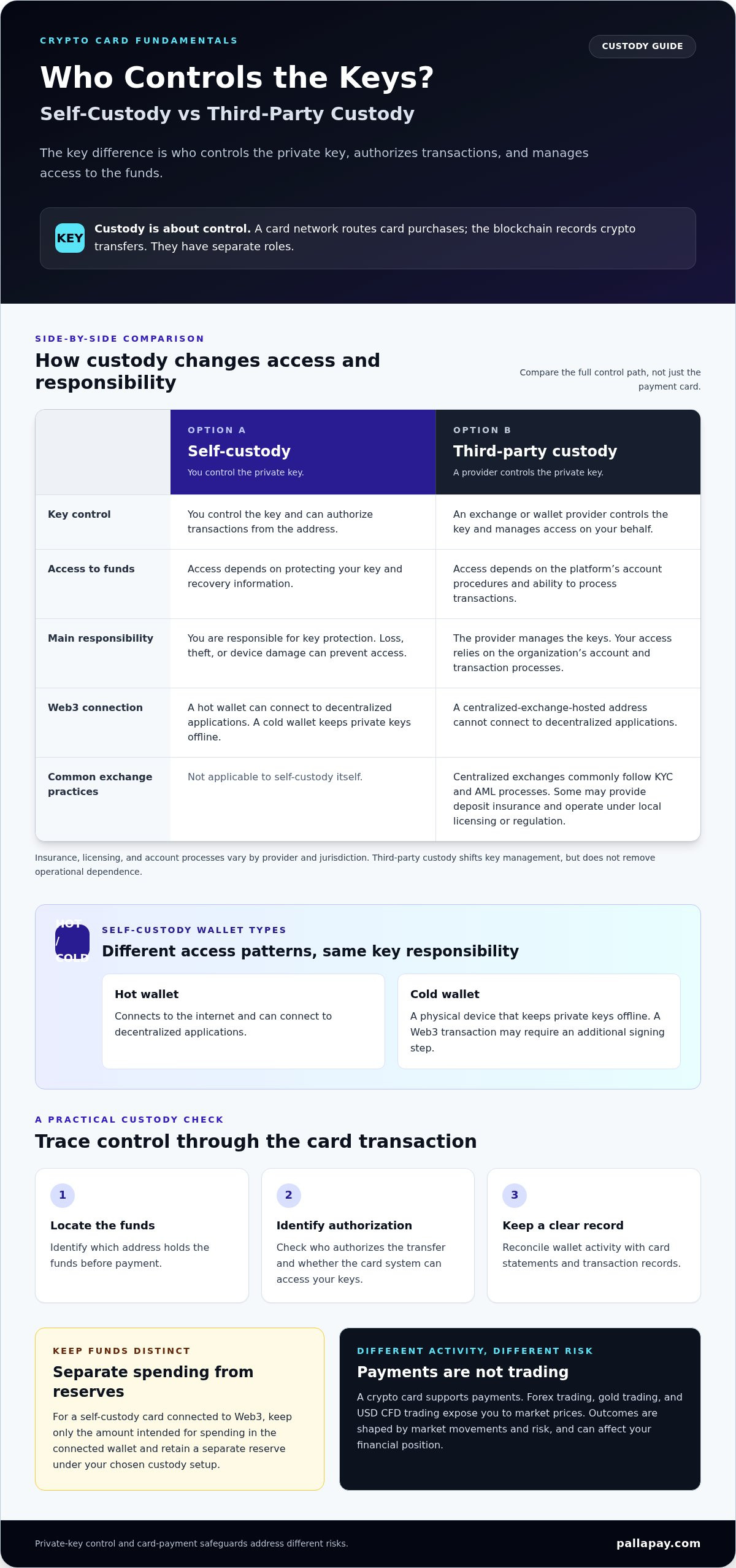
    Custody depends on who controls the private key for a crypto address. With self-custody, you control that key and can authorize transactions from the address. With third-party custody, an exchange or wallet provider controls the key and manages access on your behalf. The blockchain records assets at addresses, while wallets manage the keys used to access them.

    That distinction determines who can move funds. If you control a Bitcoin address’s private key, you control the assets associated with it. If an exchange controls the key, the exchange manages withdrawals and access through its account processes. A card linked to self-custodied assets therefore raises a key question: does spending preserve your control, or must funds move into an account controlled by an intermediary?

    Self-custody offers direct control, but makes key protection your responsibility. A hot wallet connects to the internet and can connect to decentralized applications. A cold wallet is a physical device that keeps private keys offline. Each changes how you access funds: a Web3 transaction may need an online wallet connection, while a cold wallet may require an additional signing step.

    Key loss and theft create practical risks. A lost recovery phrase, compromised device, or damaged physical wallet can prevent access to assets. Floods and fires can also damage a device holding keys. Keep spending funds separate from longer-term holdings, and store recovery information separately from the device. Account abstraction can support more user-friendly recovery, but designs vary by wallet and do not remove the need to understand who can authorize access.

    Third-party custody shifts key management to an organization. Centralized crypto exchanges commonly follow KYC and AML processes, may provide insurance for user deposits, and operate under licensing or regulation in their jurisdictions. These arrangements can offer account-based access, but the exchange controls the keys. Your access therefore depends on the platform’s account procedures and ability to process transactions.

    Compare custody by tracing control through each card transaction. Identify which address holds the funds before payment, who authorizes the transfer, and whether the card system can access your keys. Then distinguish the card’s payment network from the blockchain: Visa or Mastercard routes card purchases, while the blockchain records crypto transfers. These systems have separate roles.

    For a self-custody card connected to Web3, assess the balance between direct control and payment convenience. Keep only the amount intended for spending in the connected wallet, and retain a separate reserve under your chosen custody setup. That approach limits the exposure of everyday payments without assuming that either self-custody or third-party custody eliminates operational risk.

    Spending crypto through payment cards

    A crypto payment card connects digital assets to a familiar checkout process. The card network routes a merchant’s authorization request, while the card program determines how crypto funds the purchase. Crypto may be converted into fiat before authorization or during settlement. That timing affects which balance is used and what records you need to reconcile.

    Follow a purchase from start to finish. You present the card at a merchant, the payment network routes the request, and the card program checks whether the payment can proceed. The program then applies its funding method, which may convert supported crypto into the settlement currency. The merchant receives payment through the card system, not directly from your wallet’s crypto.

    This distinction matters for Web3 users. A card that connects to a self-custody wallet may use a different setup from one funded by an exchange account or a preloaded balance. The word “connect” does not by itself explain who controls the keys, when funds move, or what permissions the wallet grants. Read the transaction flow and authorization terms as separate parts of the product design.

    Card type also changes how spending works:

    • Debit card: spending draws from an available balance, which may involve crypto conversion.
    • Prepaid card: spending draws from funds loaded onto the card beforehand.
    • Credit card: spending uses a credit line, which may be backed by collateral in some crypto products.

    Visa and Mastercard are payment networks, not wallet types. Their logos identify the network routing a card transaction, while the issuer and card program determine funding, conversion, and account terms. Acceptance depends on the merchant supporting the network and the card’s regional availability. A network logo alone does not mean a self-custody wallet can connect to the card.

    Some regulated centralized crypto exchanges have launched cards with issuing banks, payment networks, and technology providers. Local regulators may require safeguards for these programs. Payment-card programs may include identity checks, transaction records, and procedures for handling reversals. These features relate to payment-card operations, while blockchain transfers follow the rules of their respective networks.

    Before using a card, trace three points: which balance funds the purchase, when conversion happens, and where the final transaction appears. Then compare the card statement with wallet activity. A card record may show the merchant charge, while a wallet or blockchain record may show a separate transfer or authorization. This distinction can explain differences between the card amount and the crypto movement.

    A self-custody card can simplify everyday spending, but it doesn’t make every purchase a direct Web3 transaction. At a physical or online checkout, the merchant typically processes a card payment through its supported network. A decentralized application, by contrast, interacts with a wallet and blockchain. Keep those two payment paths distinct when assessing access, control, and transaction records.
    Self-Custodial Crypto Card: Complete Web3 Guide

    Card security and chargeback protections

    A crypto card combines two security domains: wallet access and card payments. The wallet controls private-key access to crypto, while the card uses payment credentials to authorize purchases. Protecting one does not automatically secure the other. A stolen card credential and a compromised wallet key, for instance, create different risks and require different responses.

    Start with the wallet connection. Review the permissions requested when connecting a self-custody wallet to a card service or Web3 application. Grant access only to the function you intend to use, and avoid signing an unfamiliar request. A card transaction should not require you to share a private key or recovery phrase with a merchant.

    Separate spending funds from long-term holdings. If a connected wallet contains a large portfolio, a compromised device or unsafe approval could expose more than the amount needed for purchases. Keep a limited spending balance in the connected wallet, and store recovery information separately. A cold wallet keeps private keys offline, while a hot wallet supports internet-connected actions.

    Payment-card disputes address a different problem. If a merchant charges the wrong amount or a purchase is unauthorized, the card program’s transaction history can help identify the relevant payment. Web3 card standards include access to transaction records and the ability to reverse transactions. Reversal applies to the card-payment process; it does not necessarily undo a separate blockchain transfer or rewrite its record.

    Use the transaction details to distinguish among these cases:

    • Unrecognized card charge: identify the merchant, amount, and transaction status in the card record.
    • Incorrect merchant amount: compare the receipt with the card transaction before raising a dispute.
    • Unexpected wallet movement: review the wallet address and blockchain activity separately from the card statement.

    That separation matters because a merchant payment and a wallet transaction may appear in different records. A card reversal can address a payment dispute through the card process, while a crypto transfer requires reviewing blockchain activity and wallet permissions. Keep receipts, card records, and relevant wallet transaction details together when investigating an issue.

    Account security also depends on your recovery setup. Losing a private key can prevent access to the crypto at its address, while theft can give another person control of those assets. Account abstraction can support more user-friendly wallet recovery, but the recovery method and its permissions still matter. Understand who can initiate recovery and what access the process restores.

    For a self-custodial crypto card, assess security by tracing the full path: wallet permissions, card authorization, transaction records, and dispute handling. Treat chargeback access as protection for card payments, not insurance against lost keys or every blockchain loss. This distinction helps you choose safeguards that match the risk at each step.

    Self-custody card rankings, fees, and availability

    Compare cards by custody model, supported regions, network, conversion terms, and payment protections. A self-custodial crypto card for Web3 should also be assessed by how its wallet connection and spending permissions work.

    Card Rankings and Availability

    Rankings order cards according to selected comparison criteria, so their usefulness depends on your priorities.

    Compare each card’s stated custody model, supported assets, network, and regional access. A card available in one market may not be offered in another. Check whether it is available where you live and plan to spend. Treat a ranking as a comparison aid, not proof that one card suits every wallet, region, or purchase.

    Card Fees

    Card fees can apply to issuing, maintaining, funding, or using a card. Comparing fee categories helps reveal costs that a headline charge may not show.

    Review the card’s terms for issuance, maintenance, crypto conversion, foreign exchange, and ATM use. Trace a sample purchase from its crypto funding source through settlement. If the purchase currency differs from the settlement currency, a network conversion may apply separately from crypto conversion. Compare the quoted and settled amounts, distinguishing explicit charges from exchange-rate effects.

    Comparison point What to assess
    Fees Issuance, maintenance, conversion, foreign exchange, and ATM charges
    Network Visa or Mastercard, plus acceptance where you plan to spend
    Rewards Whether cashback applies and which terms govern eligibility
    Verification Identity requirements and account setup conditions

    Choosing and Setting Up a Web3 Card

    Setup connects a card program to a wallet or funding method. Reviewing the connection first helps you understand the access and permissions it requires.

    Confirm regional availability, supported assets, and network before choosing. Identify who controls the private keys and how spending is authorized. Connect the intended wallet, review its requested permissions, and protect recovery details. After setup, review a purchase in the card record and wallet activity to understand how the records relate.

    Use the table’s criteria to compare options consistently, then prioritize what matters most. For Web3 access, focus on wallet compatibility; for travel, compare currency treatment and availability. Visa and Mastercard are distinct payment networks, and acceptance can vary by location. Also distinguish debit, prepaid, and credit cards by how each funds a purchase. Explore wallet and asset management options when considering how to organize funds for card spending.

    Best Crypto Debit Cards 2026: Visa & Mastercard Compared: crypto debit card

    Best Crypto Debit Cards 2026: Visa & Mastercard Compared gives you a practical next step for comparing card options. Use the guide to assess network, regional availability, custody arrangements, conversion mechanics, and fee categories against your spending needs. Visa and Mastercard are separate payment networks, so acceptance and settlement details can differ by card program and location.

    If you’re considering a crypto debit card, Pallapay offers the Pallapay Crypto Card alongside services for selling Bitcoin or USDT for cash and buying Ethereum with cash. Compare the card’s stated features with the self-custody requirements discussed above, especially who controls the wallet keys and how transactions are funded.

    Visit Pallapay.com to explore the Pallapay Crypto Card and its available features.

    Set a Clear Spending Policy for Web3

    Choose a self-custodial crypto card for Web3 as part of a deliberate spending policy, not as a replacement for one. Decide what role crypto payments should play in your day-to-day finances, which wallet you intend to use, and how much responsibility you’re comfortable taking for access and recovery. A clear policy makes it easier to assess whether a card fits your habits as they change.

    Before acting, write down what matters most to you: convenient spending, control of your assets, and the level of card support you expect. Use those priorities to guide your comparison, then revisit them as your needs evolve. A good decision is one you understand and can manage confidently.

    To explore Pallapay’s crypto services and take your next step, visit Pallapay. Continue shaping a self-custodial crypto card Web3 approach that fits your priorities, with clarity and confidence.

    Frequently Asked Questions

    How Much Do Self-Custody Cards Cost?

    Costs depend on the card’s fee structure and how you use it. To estimate your spending, separate fixed charges from costs triggered by specific activity. Fixed charges may include card issuance or account maintenance, while transaction-related costs can arise from currency conversion, crypto conversion, or ATM use. Compare these categories with your expected use, including occasional cash withdrawals, rather than judging by one advertised fee.

    What is a self-custodial crypto card and how does it work?

    A self-custodial crypto card lets a user spend crypto while retaining control of the wallet’s private keys, depending on the card’s payment design. For example, someone who keeps long-term holdings offline might use a separate wallet balance for routine purchases. The card connects a crypto funding source to conventional card payments, but the merchant generally receives payment through the card network, not directly from the user’s blockchain wallet.

    How does a self-custodial crypto card connect to a wallet and authorize payments?

    The wallet connection and payment authorization depend on the card’s design. During setup, inspect the wallet address, requested permissions, and any transaction or spending approval before signing. A wallet connection should not require you to share your private key or recovery phrase. If a screen requests authority beyond the intended card use, stop and review what that permission enables before proceeding.

    Can users spend stablecoins and cryptocurrencies directly, or are funds converted at checkout?

    Cardholders may fund spending with supported cryptocurrencies or stablecoins, but a purchase usually requires conversion into the card’s settlement currency. The timing varies: conversion may happen before authorization or during processing. Holding a dollar-pegged stablecoin, for example, does not mean the merchant receives that token. Check which assets and blockchain networks the card supports, since compatibility affects funding.

    Disclaimer

    The information provided on this website and blog is for general informational and educational purposes only and does not constitute financial, investment, legal, tax, or other professional advice.
    Cryptocurrency and digital asset services may be subject to regulatory restrictions in certain jurisdictions. Users are solely responsible for ensuring compliance with applicable local laws and regulations before using any products or services mentioned on this website.
    PallaPay does not guarantee the accuracy, completeness, or timeliness of any information published and accepts no liability for any loss or damages arising from reliance on the content. Any opinions expressed are those of the respective authors and may change without notice.
    Certain services, features, or products referenced may be provided through third-party partners, licensed entities, or affiliated service providers subject to separate terms and regulatory approvals. Availability of services may vary by country or region.
    This website may contain references to digital assets, virtual currencies, or blockchain-related services that are not available to residents of certain jurisdictions, including where prohibited by law. Nothing on this website constitutes an offer, solicitation, or recommendation to buy or sell any financial instrument or virtual asset.

  • Gold and USD CFD Trading: How to Understand the Mechanics and Financial Impact

    Gold and USD CFD Trading: How to Understand the Mechanics and Financial Impact

    Potential gains can make gold and US dollar CFDs look like a shortcut to financial change. The reality is more measured: a CFD can magnify the effect of market movements on your money, in either direction. Understanding how these positions work is essential before weighing their possible financial impact. Clear communication matters in finance, too, including when considering how to explain crypto payments to customers.

    If terms such as leverage, margin, and exposure feel unfamiliar, it’s reasonable to want a straightforward explanation before acting. This guide explains what a CFD position represents, how shifts in gold and the US dollar can affect it, and what risks to consider when deciding whether trading fits your financial circumstances.

    You’ll learn why gold and USD movements can be connected, what may influence those markets, and how leverage can amplify both gains and losses. CFDs are complex, high-risk instruments, so understanding the mechanics is only a first step toward making an informed decision.

    Key Takeaways

    • A CFD tracks an asset’s price movement; it doesn’t give you ownership of the underlying gold or currency.
    • Gold and USD CFDs have distinct market drivers. Compare what could move each market before considering a position.
    • Leverage can increase market exposure with less initial capital, but it can also amplify losses.
    • Use a pre-trade review to understand the product, set risk limits, assess affordability, and consider possible outcomes. CFDs aren’t a guaranteed route to financial improvement.
    • Gold and USD markets can interact, but they represent different exposures. Consider the specific instrument and the factors that may affect its price.

    What Gold and USD CFD Trading Means for Your Financial Decisions

    Before considering how a gold or US dollar CFD might affect your finances, separate the underlying market from the contract used to gain exposure to it. A contract for difference, or CFD, is a financial agreement linked to an asset’s price movement. It doesn’t mean you own the asset itself. The Contract for Difference (CFD) reference offers further background on how these instruments work.

    CFD exposure means your potential outcome is linked to the price change between opening and closing a position, not ownership of the underlying asset. The outcome depends on how the market moves relative to your position, as well as the size of your exposure. There’s no guaranteed result.

    How a CFD position relates to an underlying market

    A position begins at an opening price and is closed at a later price. If the market moves in the direction the position anticipates, the price change may create a gain. If it moves against that direction, it may create a loss. The exact financial result also depends on position size and applicable terms.

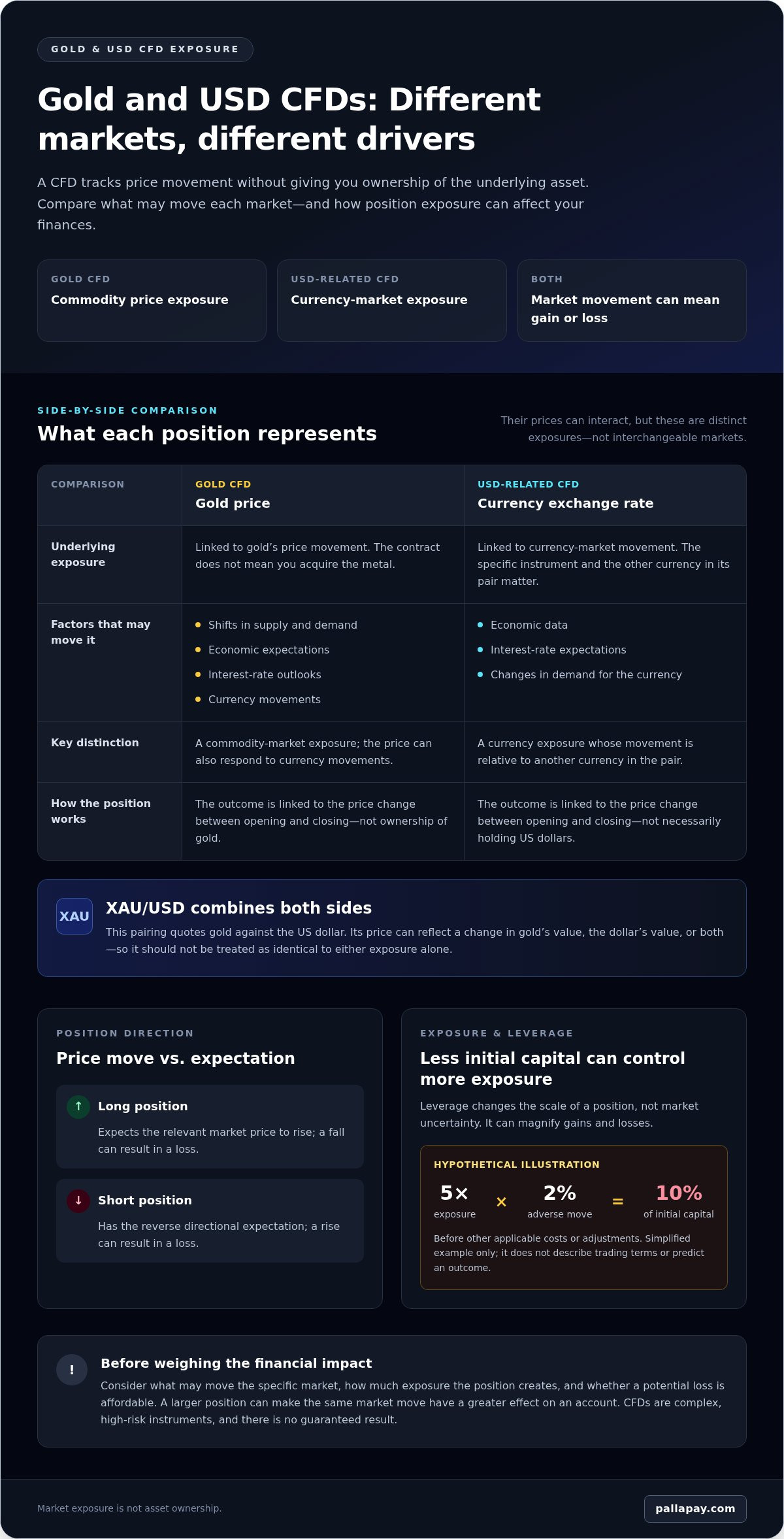
    This differs from purchasing physical gold or holding currency. A gold CFD provides price exposure without acquiring the metal. A USD-related CFD provides exposure to currency-market movements without necessarily holding US dollars. Gold CFDs and USD-related CFDs also refer to distinct markets, each influenced by its own mix of factors. XAU/USD, for example, expresses the price of gold in US dollars, so movements in either can affect the quoted relationship.

    Why financial impact depends on both direction and exposure

    Direction matters, but it isn’t the whole picture. A larger position means a given market move can have a greater effect on the account than the same move on a smaller position. If the market moves against the position, account value can fall. That can make an apparently modest price change financially important, particularly when exposure is larger than the funds committed to open the position.

    Consider a hypothetical long position: the trader expects the relevant market price to rise, but it falls before the position closes. That adverse move can result in a loss. A short position has the reverse directional expectation, but it can also lose if the market rises instead. These examples explain mechanics only. They’re not forecasts, recommendations, or assurances of an outcome.

    For gold and USD CFDs, the practical question is not only which way a price might move, but also how much exposure a position creates and whether a potential loss is affordable. Assess both the market and the position before deciding what the financial implications could be.

    How Gold and USD CFDs Work: Price Movements, Exposure, and Leverage

    A CFD position remains exposed to market prices for as long as it’s open. If the relevant price changes, the position’s unrealised result changes too. Closing it turns that movement into a realised outcome, subject to the instrument’s terms. The How CFD Trading Works overview explains the basic principle of trading price movements without owning the underlying asset.

    Leverage magnifies market exposure, and it can magnify losses as well as gains. It allows a trader to control a larger position with less initial capital than the full exposure would otherwise require. That changes the scale of the position, not the uncertainty of the market. A smaller initial commitment doesn’t make the potential risk small.

    What can move gold and USD markets?

    Gold prices can respond to shifts in supply and demand, economic expectations, interest-rate outlooks, and currency movements. USD exchange rates may also react to economic data, interest-rate expectations, and changes in demand for the currency. These influences can interact, but they aren’t reliable signals of what prices will do next.

    XAU/USD is the market pairing that quotes gold against the US dollar. Its price can reflect changes in gold’s value, the dollar’s value, or both. When assessing this pairing, consider that relationship rather than treating gold and the USD as identical exposures.

    How leverage changes the scale of a position

    Hypothetical example: Imagine a position with exposure five times the initial capital committed. If the underlying market moves 2% against it, the position’s loss would be equivalent to 10% of that initial capital, before any other applicable costs or adjustments. A move in the favourable direction could magnify the potential gain in similar fashion, but it can’t be assumed or relied on.

    This illustration uses a simplified ratio only. It doesn’t describe Pallapay’s trading terms or predict an outcome. Actual results depend on the position and applicable contract details. The practical takeaway is to assess the full exposure and the effect of an adverse move, not just the amount initially committed.

    Plain language helps make complex financial ideas easier to examine. The same care used to explain unfamiliar financial topics, including how to explain crypto payments to customers, can help traders distinguish market movement, position size, and leverage before making decisions. Readers exploring gold and USD exposure can also learn about Pallapay’s Forex and CFD trading.

    Gold CFDs vs. USD CFDs: Compare Exposure Before Choosing a Market

    Gold and USD CFDs can both create exposure to financial-market movements, but they don’t represent interchangeable choices. Gold is a commodity market; USD-related exposure depends on the specific currency instrument and the other currency in its pair. Their prices can interact, yet the drivers and risks you need to assess are distinct.

    Comparison point Gold CFD USD-related CFD
    Underlying market Gold-price movement, commonly represented by XAU/USD. A currency pairing involving the US dollar; the other currency also matters.
    Potential drivers Supply and demand, economic expectations, and currency movements may influence gold prices. Economic expectations, interest-rate outlooks, and changing demand for either currency may affect the pair.
    Key exposure question Do you understand what may move gold and how the position responds to a price change? Can you assess both currencies in the pair, rather than focusing on the USD alone?

    What distinguishes gold CFD exposure?

    A gold CFD links the position’s outcome to changes in gold’s price, without giving the trader ownership of physical gold. Gold can respond to shifts in supply and demand, broader economic expectations, and movements in currencies such as the US dollar. These are possible influences, not dependable signals of future direction. Before evaluating exposure, consider whether you understand how the gold price is quoted and what could affect it.

    What distinguishes USD-related CFD exposure?

    A USD-related CFD isn’t a single, context-free bet on the dollar. In a currency pair, one currency is measured against another, so a price change reflects their relative values. A stronger USD against one currency doesn’t necessarily mean the same movement against every other currency. Identify the instrument and understand both sides of its pairing before assessing what a position could mean financially.

    Choose a market based on your understanding, not a ranking of which asset is “better.” Consider your familiarity with each market, your tolerance for volatility, and whether you can monitor an open position in a way that fits your circumstances. A market you know well can still move unexpectedly; an unfamiliar market may require more learning before you can assess its exposure.

    A clear comparison starts with precise terms, much like explaining how to explain crypto payments to customers: identify what is being discussed before drawing conclusions. For CFDs, name the underlying market, its potential drivers, and the questions you need answered about your position. Neither gold nor USD exposure is inherently safer or suitable for everyone.

    Gold and USD CFD Trading: How to Understand the Mechanics and Financial Impact

    How to Assess CFD Risk Before Putting Personal Finances at Stake

    Risk assessment starts with more than a view on whether gold or a currency pair might rise or fall. CFDs are complex, high-risk instruments, and a position can produce losses. Trading isn’t a guaranteed route to financial improvement. Potential gains are possible outcomes, not assured results.

    Separate the main considerations before deciding whether to proceed: market risk is the chance that prices move against your position; platform and operational considerations relate to accessing, monitoring, and managing a position; personal financial risk concerns whether a loss could affect essential needs or other financial priorities. A sound decision considers all three.

    Questions to answer before opening a position

    • 1. Understand the product. Can you explain how the CFD works, what market it tracks, and how your position responds to price changes?
    • 2. Define your risk boundary. Decide in advance what loss you could tolerate. Consider what you would do if the market moved against your expectations, rather than waiting until the position is under pressure.
    • 3. Assess affordability. Don’t use money needed for housing, food, bills, or other essential commitments. Avoid relying on borrowed money to fund a high-risk position.
    • 4. Review how you’ll manage it. Consider how you’ll monitor the position, what could affect your ability to act, and how you’ll evaluate the outcome afterward. Understand the relevant platform processes and position terms before committing funds.

    How to think about trading’s financial impact

    Outcomes depend on market movement, the size of the exposure, and decisions made while the position is open. Imagine a gold CFD opened with the expectation that gold will rise. If the price rises, the position may show a gain; if it falls, it may show a loss. If the price changes little, the result may be limited, though applicable terms can still affect the final outcome. These scenarios illustrate possibilities, not forecasts.

    For your wider finances, consider whether a potential loss would change your ability to meet existing goals. Trading should not replace budgeting or saving, and this general information isn’t a substitute for professional financial advice. Clear explanations help people assess complex choices: identify the moving parts before acting, whether you’re considering CFD risk or how to explain crypto payments to customers.

    If you’ve assessed the product, exposure, and affordability and want to explore trading, explore Pallapay’s Forex and CFD trading. Weigh the risks against your personal financial circumstances before making a decision.

    A Responsible Next Step for Exploring Gold and USD CFD Trading

    Education should come before action. A measured progression is simple: learn how a CFD works, identify the market and exposure involved, assess the financial risk, then decide whether to explore trading further. Understanding the mechanics won’t remove uncertainty, but it can help you make a more considered choice.

    A practical checklist for informed exploration

    • Explain the exposure. Can you describe the underlying market, what price movement affects the position, and how the position’s value may change?
    • Revisit affordability. Would a loss affect essential expenses, savings priorities, or other financial commitments?
    • Set a boundary. Decide what level of loss you could accept before considering a position. Don’t rely on essential living funds or borrowed money.
    • Consider your time. Do you have a realistic way to monitor the position and respond to changing market conditions?

    If the instrument’s mechanics, terms, or potential risks remain unclear, pause. Taking more time to understand the exposure is a sound decision, not a missed opportunity.

    Explore trading with realistic expectations

    CFD trading is a high-risk financial activity, not a guaranteed wealth strategy. Outcomes depend on market movements, the exposure taken, and decisions made while a position is open. A favourable outcome is possible, but so is a loss; neither should be treated as certain. Trading also shouldn’t replace budgeting, saving, or advice tailored to your personal finances.

    Clear explanations help people make sense of unfamiliar topics, including how to explain crypto payments to customers. For CFD exposure, the next step should follow understanding, not assumptions.

    After reviewing the mechanics and your own risk considerations, explore Pallapay’s Forex and CFD trading services. Approach any decision with realistic expectations and a clear view of the financial risk.

    Make Your Next Trading Decision with Clarity

    Gold and USD CFDs offer exposure to price movements, not ownership of gold or currency. Their markets have different drivers, and leverage can magnify the effect of price changes on a position. Understanding the instrument, considering how much exposure you’re taking, and deciding what loss you could afford are essential steps before acting.

    CFD trading is high risk, and a potential gain is never assured. Clear explanations matter in finance, whether you’re assessing market exposure or considering how to explain crypto payments to customers. A careful decision starts with knowing what you’re trading and how the outcome could affect your finances.

    Pallapay offers Forex trading, CFD trading, and gold trading, including XAU/USD. If you’ve reviewed the mechanics and risks and want to explore further, explore Pallapay’s trading services. Take the next step at a pace that supports informed decisions and realistic expectations.

    Frequently Asked Questions

    What is a CFD in gold or USD trading?

    A CFD is a contract that gives exposure to an asset’s price movement without transferring ownership of the asset. With a gold CFD, the position responds to gold-price changes. A USD-related CFD usually reflects a currency pair, so its value depends on the relative movement of the US dollar and another currency. The outcome depends on price movement, position size, and the relevant contract terms.

    Can gold or USD CFD trading change your financial situation?

    It can affect your finances, but the result could be positive, negative, or limited. The impact depends on market movement, exposure, and decisions about the position. Leverage can increase the effect of price changes, including losses. CFDs are complex, high-risk instruments, so they shouldn’t be treated as a reliable way to improve your financial situation or as a substitute for budgeting and saving.

    How does leverage affect a gold or USD CFD?

    Leverage lets a trader control greater market exposure with less initial capital than the full exposure would require. This magnifies the effect of price movements on the position: a move in the trader’s favour can increase a potential gain, while an adverse move can increase a loss. The smaller initial commitment doesn’t mean the position carries less risk. Understand the total exposure before deciding whether to proceed.

    Is gold CFD trading the same as buying physical gold?

    No. Buying physical gold means acquiring the metal, while a gold CFD provides exposure to changes in its price without ownership of the gold itself. The CFD’s result depends on how the relevant price moves during the position. Before trading, understand the instrument and its terms. If your goal is to own physical gold, a CFD doesn’t provide that ownership.

    What happens if the gold or USD market moves against my CFD position?

    If the market moves against your position, its value can decline and you may incur a loss. For example, a position that anticipates a rise may lose value if the relevant price falls. The financial impact depends on the size of the exposure and the price movement, along with applicable terms. Consider your acceptable loss boundary before opening a position, not after an adverse move occurs.

    How can a beginner assess whether CFD trading is suitable?

    A beginner can start by checking whether they can explain the instrument, underlying market, price exposure, and possible loss in plain language. Clear wording also matters when explaining unfamiliar topics, including how to explain crypto payments to customers. Assess affordability, avoid using essential funds or borrowed money, and consider whether you can monitor a position. If risks remain unclear, pause and seek appropriate financial guidance.

    Are gold and USD CFDs guaranteed to produce a profit?

    No. Gold and USD CFDs don’t guarantee a profit, and a favourable market view can still be wrong. Prices may move against a position, and leverage can magnify the resulting loss. Treat any potential gain as uncertain, not assured. Before considering a trade, understand its exposure and assess whether a possible loss is affordable within your personal financial circumstances.

    Disclaimer

    The information provided on this website and blog is for general informational and educational purposes only and does not constitute financial, investment, legal, tax, or other professional advice.
    Cryptocurrency and digital asset services may be subject to regulatory restrictions in certain jurisdictions. Users are solely responsible for ensuring compliance with applicable local laws and regulations before using any products or services mentioned on this website.
    PallaPay does not guarantee the accuracy, completeness, or timeliness of any information published and accepts no liability for any loss or damages arising from reliance on the content. Any opinions expressed are those of the respective authors and may change without notice.
    Certain services, features, or products referenced may be provided through third-party partners, licensed entities, or affiliated service providers subject to separate terms and regulatory approvals. Availability of services may vary by country or region.
    This website may contain references to digital assets, virtual currencies, or blockchain-related services that are not available to residents of certain jurisdictions, including where prohibited by law. Nothing on this website constitutes an offer, solicitation, or recommendation to buy or sell any financial instrument or virtual asset.

  • Gold and USD CFD Trading: How It Works, What It Risks, and What to Consider in 2026

    Gold and USD CFD Trading: How It Works, What It Risks, and What to Consider in 2026

    A gold or USD CFD can move your finances in either direction, but it doesn’t mean you own gold or dollars. Even a question like how to buy crypto with cash safely concerns acquiring an asset; CFD trading instead creates exposure to price movements, often with leverage that can magnify losses as well as gains. That distinction matters before considering whether a trade could make a meaningful difference to your financial life.

    If leverage, margin, and trading costs feel difficult to compare, you’re not alone. Understanding how a CFD tracks an underlying market is an essential first step, not a guarantee of a particular outcome. This guide explains how gold and USD CFD positions work, what can influence their prices, and how spreads, financing, and leverage can affect a trade. It also sets out a cautious way to assess the risks and explains how buying crypto with cash differs from CFD trading.

    Key Takeaways

    • A gold or USD CFD tracks price movements without transferring ownership of the underlying asset. Learn how that exposure differs from owning gold or currency.
    • Margin is the funds required to open or maintain a position, while leverage can magnify both gains and losses. Understand these mechanics before setting an exposure level.
    • Gold and USD CFDs respond to different market drivers, and their relationship can change. Compare the factors affecting each market before forming a trade thesis.
    • CFDs can provide market exposure, but they can also lead to rapid losses and ongoing costs. Don’t treat trading as a reliable route to changing your financial circumstances.
    • Separate CFD decisions from questions such as how to buy crypto with cash safely. For either activity, understand the transaction, assess the risks, and avoid acting on assumptions.

    What Gold and USD CFDs Let You Trade, and What You Actually Own

    A contract for difference (CFD) tracks an asset’s price movement without transferring ownership of that asset. With a gold CFD, you get exposure to changes in a gold price, not physical gold. With a USD currency-pair CFD, your exposure follows the exchange rate between two currencies, not a cash balance in either one. The distinction is central: a CFD is a trading agreement, not a purchase of the underlying asset. The Contract for Difference reference provides a general overview of how these contracts work.

    How a CFD position follows a market price

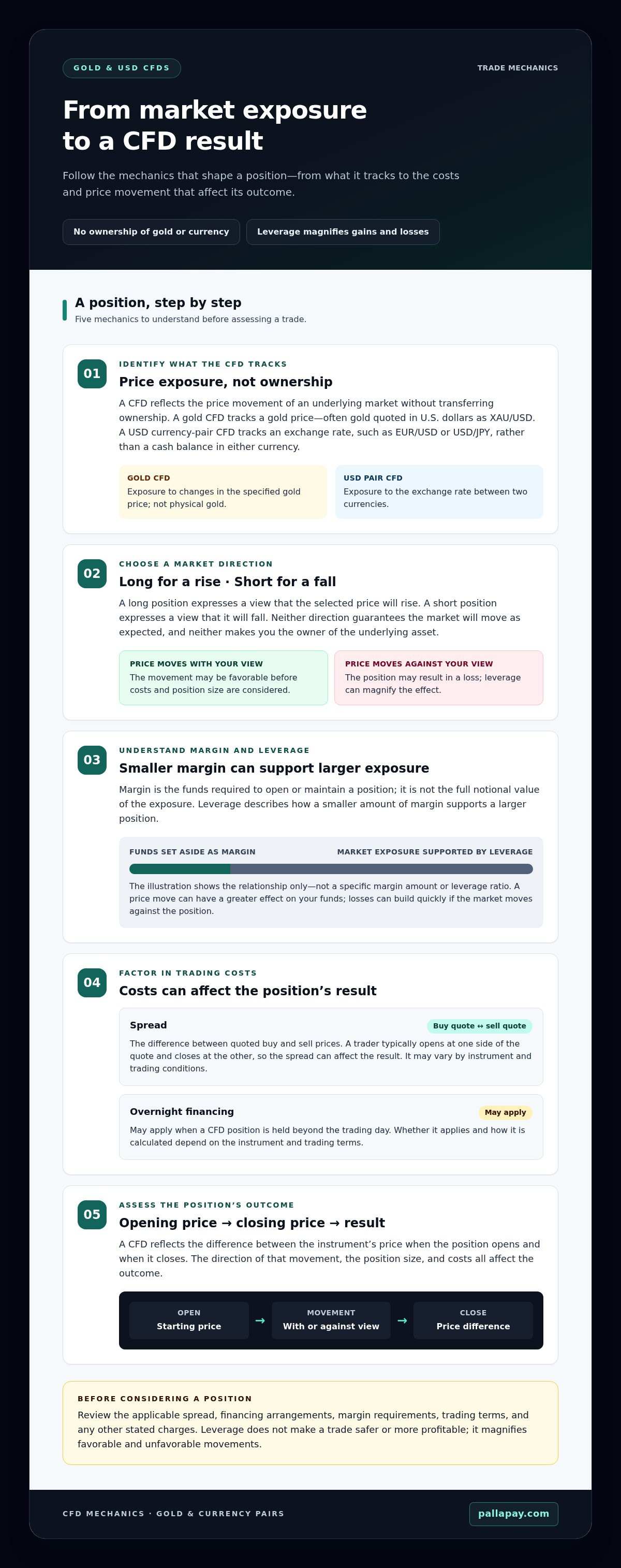
    A CFD reflects the difference between the instrument’s price when a position opens and when it closes. If the closing price moves in the direction of your position, the price movement may be favorable; if it moves against you, it may result in a loss. Costs and the position size also affect the outcome.

    A long position expresses a view that the selected price will rise. A short position expresses a view that it will fall. Neither direction guarantees the market will move as expected, and neither makes you the owner of gold or currency. For example, taking a long position on a gold CFD means your result is tied to changes in the gold price specified by that instrument, not to holding bullion.

    Gold exposure versus USD currency exposure

    Gold is a commodity market. A gold CFD, often represented by XAU/USD, tracks gold’s price quoted in U.S. dollars. A USD currency-pair CFD instead tracks an exchange rate, such as EUR/USD or USD/JPY. In a pair, the first currency is compared with the second, so a position reflects the pair’s exchange-rate movement rather than the value of the U.S. dollar in isolation.

    The selected instrument determines which price movement affects your position. Gold and currency pairs can respond to different forces, and their movements should not be assumed to follow a fixed relationship. Imagine a trader expects gold to rise and opens a long gold CFD. If gold falls instead, the position moves against that view. A separate position on a USD currency pair could move differently because it follows that pair’s exchange rate.

    This differs from learning how to buy crypto with cash safely. Buying crypto with cash involves acquiring a digital asset, while a CFD provides price exposure through a contract. When acquiring crypto, check that you understand the asset, the quoted amount, any transaction costs, and the destination details before completing a purchase. Knowing what you own, and what you don’t, helps clarify the risks of either transaction.

    How Gold and USD CFD Trades Work: Margin, Leverage, and Costs

    With a CFD, the amount needed to open a position can be smaller than the full market exposure. That difference comes from margin and leverage, which affect how gains and losses respond to price movements. Understanding both, alongside trading costs, helps you assess what a position could mean for your funds before entering it.

    What margin and leverage mean in practice

    Margin is the funds required to open or maintain a CFD position; it isn’t the full notional value of the exposure. Leverage describes how a smaller amount of margin supports a larger position, so a price movement can have a greater effect on your funds than it would without leverage.

    Imagine setting aside a portion of your available funds as margin to open exposure to a gold CFD. The position’s market exposure is larger than that initial amount, so even a modest move in gold’s price can affect the position proportionally. If the price moves in your favor, the effect may be positive; if it moves against you, the loss can build quickly and may reduce the funds in your account. Leverage doesn’t make a trade safer or more profitable. It magnifies both favorable and unfavorable movements.

    This is why Australian Government’s Moneysmart resource explains the high-risk nature of CFDs, including the role of leverage and the potential for losses. Margin requirements and the consequences of a position moving against you depend on its terms, so understand them before trading.

    Which trading costs can affect a CFD position

    The spread is the difference between the quoted buy and sell prices. Because a trader typically opens at one side of the quote and closes at the other, the spread can affect the position’s result. It may vary by instrument and trading conditions, so don’t assume the cost is identical for gold and USD currency-pair CFDs.

    Overnight financing may also apply when a CFD position is held beyond the trading day. Whether it applies, and how it is calculated, depends on the instrument and the trading terms. Review the applicable spread, financing arrangements, margin requirements, and any other stated charges before opening a position; no single cost assumption fits every trade.

    Understanding how to buy crypto with cash safely also means paying attention to the transaction and its costs, but a cash crypto purchase is different from a leveraged CFD position. Pallapay offers the option to buy USDT with cash. Before any purchase, make sure you understand the asset and transaction details involved.

    Gold CFDs vs. USD CFDs: Compare Market Drivers Before Taking a Position

    Choosing between a gold CFD and a USD currency-pair CFD means assessing different underlying markets. Gold is a commodity priced against a currency, while a currency pair shows one currency’s value relative to another. Their prices can react to overlapping events, but neither follows a fixed relationship with the other. Compare what drives the instrument and what your position would actually respond to before forming a view.

    Instrument Possible price drivers Exposure question
    Gold CFD, such as XAU/USD Interest-rate expectations, currency movements, and investor demand What could influence gold’s price in the quote currency?
    USD currency-pair CFD, such as EUR/USD Economic data and central-bank decisions affecting either currency Which currency may strengthen relative to the other, and why?

    What can influence gold CFD prices?

    Gold prices may respond to changing expectations about interest rates, movements in the U.S. dollar, and shifts in investor demand. These influences can interact: an event may affect currency markets and investor preferences at the same time. The result isn’t automatic. A factor that appears supportive of gold doesn’t guarantee its price will rise, and market expectations may already shape prices before new information arrives.

    For a gold CFD quoted in U.S. dollars, consider both the gold market and the currency used to quote it. Ask what could change the market’s view, rather than treating a single headline or indicator as a certain signal. A useful check is to identify what information would challenge your thesis, not just what appears to support it.

    What can influence USD currency CFD prices?

    A currency pair measures the relative value of its two currencies. Economic releases, such as information about growth or inflation, and central-bank decisions can influence expectations for either side of the pair. Their impact depends on what markets expected and how the news compares with those expectations.

    A USD position isn’t a standalone measure of dollar strength. For example, if the U.S. dollar strengthens against one currency but also faces changing conditions against another, different pairs can behave differently. Identify the pair’s base and quote currencies, then consider the factors affecting both.

    Use the same discipline that underpins decisions about how to buy crypto with cash safely: understand the asset or instrument and the transaction before acting. For added context on CFD risk, the North American Securities Administrators Association outlines the dangers of CFDs. Market drivers can inform a thesis, but they can’t guarantee its outcome.

    Gold and USD CFD Trading: How It Works, What It Risks, and What to Consider in 2026

    Can Gold and USD CFD Trading Change Your Financial Life? Understand the Risks

    Gold and USD CFDs can provide access to price movements, but they can’t reliably transform personal finances or replace stable income. A position may move in your favor, yet it can also lose value quickly, and trading costs can affect the result. Risk limits and a written plan can support more disciplined decisions, but they can’t remove uncertainty or guarantee an outcome.

    Why leverage makes loss exposure easy to underestimate

    Leverage means your market exposure can exceed the margin set aside for a position. As a result, a relatively small adverse price movement may have a material effect on the funds supporting that trade. The same mechanism applies whether the position tracks gold or a USD currency pair, though each instrument responds to its own market drivers.

    Price changes may be abrupt. Volatility can intensify movements, and a market gap may mean the next available price differs from the one you expected. If you hold a position overnight, financing costs may also affect its overall result. Position size, price movement, and applicable charges all matter, so don’t assess risk by looking only at the margin required to open a trade.

    What responsible expectations look like

    CFD trading shouldn’t be treated as dependable income, a planned way to repay debt, or a reliable wealth-building strategy. Before considering a position, think about whether you can afford a loss and whether the risk fits your personal circumstances. Money needed for essential expenses should not be exposed to uncertain market outcomes.

    A written plan can help you define why you’re considering a trade, how much exposure you’re willing to take, and what conditions would prompt you to review or close it. Risk limits can help contain decisions, but they can’t prevent every loss, eliminate execution uncertainty, or make a strategy successful. Reassess your assumptions as market conditions change rather than relying on a hoped-for result.

    Just as how to buy crypto with cash safely involves understanding the steps and risks of acquiring crypto, CFD trading calls for clarity about the product and potential loss before acting. This information is educational, not individualized financial advice. If you’re considering buying USDT with cash, Pallapay offers that service. For a CFD, first understand the product’s terms, costs, and risks.

    A Practical First-Trade Framework for Gold and USD CFDs

    Preparation can’t remove market risk, but a clear process can help you understand the exposure before committing funds. Use these steps to assess whether a gold or USD CFD trade fits your knowledge, financial position, and risk tolerance.

    • Choose the market. Decide whether you’re studying gold exposure, such as XAU/USD, or a particular USD currency pair. They track different markets, so identify which price movement would affect your position.
    • Learn the instrument’s terms. Review how the CFD is priced and how long you might hold it. Understand the required margin, leverage, spread, possible overnight financing, and how costs could affect your result.
    • Write down your thesis. State why you’re considering the trade and which market conditions support your view. Include an invalidation point, the condition that would show your reasoning may no longer hold. A market view is a possibility, not a prediction you can rely on.
    • Plan your review. Set out when you’ll reassess the position and what changes in your thesis would prompt action. Record the outcome and any costs so you can evaluate whether your process was disciplined, separate from whether one trade gained or lost.

    The question of how to buy crypto with cash safely concerns acquiring a crypto asset. Preparing for a CFD trade is different: it means understanding contractual price exposure and deciding what loss you can tolerate before entering a position. Don’t use funds needed for essential expenses, and don’t rely on trading to provide dependable income or meet financial obligations.

    Explore buying USDT with cash through Pallapay

    If your goal is to acquire crypto rather than take CFD exposure, Pallapay offers a way to buy USDT with cash. Before proceeding, understand the transaction details, asset, and costs involved. A cash crypto purchase and a leveraged CFD are different products, with different risks and outcomes.

    Buy USDT with cash through Pallapay

    Approach Gold and USD CFDs With a Clear Plan

    Gold and USD CFDs provide exposure to price movements, not ownership of gold or currency. Margin and leverage can amplify market moves, while spreads and possible overnight financing can affect the outcome. Before considering a position, identify the market, write down your thesis, set an affordable exposure limit, and decide when you’ll review the trade.

    Trading shouldn’t be treated as guaranteed income or a dependable way to transform your finances. As with understanding how to buy crypto with cash safely, sound decisions begin with knowing what the transaction involves and what risks you’re accepting. A cash purchase of USDT through Pallapay is a separate option for acquiring crypto, not a CFD trade.

    Explore buying USDT with cash through Pallapay if you want to acquire a crypto asset. For CFD trading, keep your approach informed, measured, and aligned with your personal risk tolerance.

    Frequently Asked Questions

    What is a CFD in gold or forex trading?

    A CFD, or contract for difference, is an agreement whose value reflects the price change of an underlying market between opening and closing a position. A gold CFD tracks gold’s price, while a forex CFD tracks the exchange rate between two currencies. The trader’s result depends on the price movement and applicable costs. A CFD provides market exposure through a contract, not ownership of the underlying asset.

    Can you trade gold and USD CFDs without owning gold or currency?

    Yes. A gold CFD provides exposure to changes in gold’s price without transferring ownership of physical gold. A USD currency-pair CFD follows the exchange rate between the U.S. dollar and another currency, rather than giving you ownership of either currency. For example, an EUR/USD CFD tracks the pair’s relative price movement. Check the instrument’s terms to understand exactly which market price determines your position’s result.

    How does leverage affect gold and USD CFD trades?

    Leverage lets a trader take market exposure larger than the margin set aside for a position. This magnifies the effect of price changes on the funds supporting the trade: a favorable movement may have a greater effect, but an adverse move can also increase losses quickly. Leverage doesn’t make a position safer or guarantee a gain. Consider the exposure and potential loss, not just the initial margin.

    What costs can apply when trading CFDs?

    Costs can include the spread, which is the difference between quoted buy and sell prices, and overnight financing when a position is held beyond the trading day. Other charges may apply depending on the instrument and its terms. Costs affect the overall result, so review the applicable pricing, financing arrangements, and other stated charges before opening a position. Don’t assume gold and currency CFDs have identical costs.

    Is gold CFD trading safer than USD CFD trading?

    Neither market is inherently safer. Gold and USD currency-pair CFDs respond to different influences, and both can move unpredictably. Leverage can magnify losses in either, while spreads and possible financing charges can affect the outcome. Assess the instrument’s volatility, market drivers, position size, and terms against your own risk tolerance. Choosing a market you understand may support better-informed decisions, but it can’t remove the possibility of loss.

    Can trading gold and USD CFDs guarantee a profit?

    No. There’s no guaranteed profit from trading gold or USD CFDs. Prices may move against your position, and leverage can magnify the effect of those movements. Trading costs can also reduce a positive result or add to a loss. CFDs shouldn’t be treated as dependable income or a reliable way to transform your finances. Only consider risking funds you can afford to lose, and make decisions based on a clear plan.

    What should a beginner understand before placing a CFD trade?

    Before trading, understand that a CFD provides price exposure rather than ownership, and learn how margin, leverage, spreads, and possible overnight financing apply. Choose whether you’re studying gold or a specific currency pair, write down your reason for the trade, and set an exposure limit and review plan. Knowing how to buy crypto with cash safely concerns acquiring crypto, a different process from taking leveraged CFD exposure.

    Disclaimer

    The information provided on this website and blog is for general informational and educational purposes only and does not constitute financial, investment, legal, tax, or other professional advice.
    Cryptocurrency and digital asset services may be subject to regulatory restrictions in certain jurisdictions. Users are solely responsible for ensuring compliance with applicable local laws and regulations before using any products or services mentioned on this website.
    PallaPay does not guarantee the accuracy, completeness, or timeliness of any information published and accepts no liability for any loss or damages arising from reliance on the content. Any opinions expressed are those of the respective authors and may change without notice.
    Certain services, features, or products referenced may be provided through third-party partners, licensed entities, or affiliated service providers subject to separate terms and regulatory approvals. Availability of services may vary by country or region.
    This website may contain references to digital assets, virtual currencies, or blockchain-related services that are not available to residents of certain jurisdictions, including where prohibited by law. Nothing on this website constitutes an offer, solicitation, or recommendation to buy or sell any financial instrument or virtual asset.
  • Gold and USD CFD Trading: How It Works, What Shapes Risk, and Its Financial Impact

    Gold and USD CFD Trading: How It Works, What Shapes Risk, and Its Financial Impact

    Crypto payment gateway integration and gold or USD CFD trading address different financial activities. A gateway helps merchants accept crypto payments, while a CFD is a contract tied to price movements. Neither account funding nor payment processing indicates whether a trade is suitable or likely to profit. The risks of a CFD depend on how the position works, its terms, how much leverage is involved, and what you can afford to lose.

    CFD terminology can be difficult to assess, especially when potential gains receive more attention than the possibility of losses. With a CFD, you trade on price movements rather than owning the underlying asset. Your result depends on the direction and size of the move, as well as the position’s terms and costs. Leverage can magnify losses as well as gains.

    This article explains how gold and USD CFD positions work, what market changes and trading conditions can affect outcomes, and which practical questions to consider before trading. It also explains how payment gateway integration differs from trading and notes Pallapay’s listed CFD and gold trading offerings, without assuming that trading will improve your financial situation.

    Key Takeaways

    • Distinguish a CFD position from owning gold or currency, and check the instrument’s specific terms before trading.
    • Assess how price direction, position size, and entry and exit points can shape a trade’s result.
    • Compare favourable and adverse price scenarios to understand how leverage can magnify both gains and losses.
    • Use a practical risk framework to consider affordability and define acceptable exposure before placing a position.
    • Recognize that crypto payment gateway integration supports merchant payment processing, not the profitability of a gold or USD CFD trade.

    Gold and USD CFDs: What You Trade and What You Do Not Own

    Before considering a gold or currency CFD, be clear about the financial exposure you’re taking. A Contract for Difference, or CFD, is an agreement in which the parties settle the difference between an instrument’s value when the position opens and its value when it closes. The result depends on the price movement and the position’s terms. For a foundational overview, see Contract for difference.

    A CFD gives you exposure to price changes without giving you ownership of the underlying asset. A gold CFD doesn’t transfer physical gold to you, and a forex CFD doesn’t mean you’ve exchanged and now hold the currencies in the pair. You’re entering a contract based on price movement, not acquiring the asset itself.

    How a gold CFD reflects the price of gold

    A gold CFD tracks changes in a quoted gold price. XAU/USD is a common market notation for gold priced in US dollars. If that quoted price rises or falls, the value of a CFD position may change accordingly, subject to its terms. The position does not give you physical gold or ownership rights to it.

    Check the provider’s instrument name and contract details before interpreting a quote. Trading conditions and instrument specifications can vary by provider, so don’t assume the same label means identical terms.

    What USD exposure means in a forex CFD

    A forex pair expresses the relative value of one currency against another. In EUR/USD, for example, the euro is the first, or base, currency and the US dollar is the second, or quote, currency. A rising pair means the euro is strengthening relative to the dollar; a falling pair means it is weakening relative to the dollar. A view on the USD therefore depends on the pair and the direction of the position.

    With a forex CFD, you’re speculating on that relative price movement rather than exchanging one currency for another. Opening a position doesn’t, by itself, leave you holding US dollars or euros. Review the provider’s contract specifications to understand how the quoted pair translates into exposure and how the position is settled.

    Payment processing is separate from market exposure. Crypto payment gateway integration enables merchants to accept digital payments; it does not change what a gold or forex CFD represents. A gateway is not evidence that a CFD is available for funding through crypto, or that a trade is suitable.

    How Gold and USD CFD Positions Turn Price Movements into Results

    A CFD position has three basic stages: choose an instrument and direction, monitor how its quoted price changes, then close the position. The result reflects the price difference between entry and exit, adjusted for position size and any applicable charges. It isn’t predetermined. An adverse price move can produce a loss.

    Direction matters. A long position generally benefits if the price rises and is disadvantaged if it falls; a short position generally benefits if the price falls and is disadvantaged if it rises. Position size determines how strongly a given price change affects the result. Review the provider’s contract terms to understand how those mechanics apply to a specific instrument.

    A simple hypothetical gold CFD example

    Illustration only, not a market quote: Assume a gold CFD position represents one ounce, its value changes one-for-one with a hypothetical gold price, and charges are excluded. If you open a long position at $2,000 and close it at $2,010, the illustrative result before charges is a $10 gain. If the price instead falls to $1,990 before you close, the result is a $10 loss.

    The example shows the same exposure working in opposite directions. Actual contract specifications, position sizing, charges, and settlement terms can change the calculation, so don’t treat it as a forecast or an estimate of any particular provider’s offering.

    How USD currency pairs affect a CFD position

    A currency pair shows one currency’s value relative to another. In the hypothetical EUR/USD example below, the pair moves from 1.1000 to either 1.1050 or 1.0950. A long position expresses a view that EUR/USD will rise, meaning the euro strengthens relative to the US dollar; a short position expresses a view that it will fall. Neither direction guarantees a favourable outcome.

    • Hypothetical long: If the pair rises from 1.1000 to 1.1050, the move is in the anticipated direction.
    • Hypothetical short: If it falls from 1.1000 to 1.0950, the move is in the anticipated direction.

    The financial result still depends on position size, entry and exit prices, and the provider’s terms. Crypto payment gateway integration concerns merchant payment processing, not a CFD position’s price movement or result. For a broader discussion of leverage and pricing risk, Australia’s government Moneysmart guidance on high-risk investments explains key CFD risks. Read the relevant instrument terms before considering a position.

    Potential Gains, Losses, and Leverage: What CFD Trading Can Mean Financially

    A CFD’s financial impact depends on the size and direction of the price move, your position’s exposure, and applicable charges. A favourable move may produce a gain, but an adverse move can produce a loss. The scenarios below use the same hypothetical position size to show both outcomes.

    Illustrative scenario Assumption Gross result before charges
    Favourable move Exposure of 1,000 account-currency units; underlying price rises by 1% Gain of 10 account-currency units
    Adverse move Same exposure; underlying price falls by 1% Loss of 10 account-currency units

    Illustration only: This simplified example assumes the position’s value changes proportionally with the underlying price. It isn’t a forecast or a representation of any provider’s terms. Actual results can also be affected by the instrument’s specifications and applicable charges.

    Why leverage changes the scale of exposure

    Exposure is the value of the market position whose price movement affects your result. Committed funds are the amount allocated to open or maintain that position under the provider’s terms. With leverage, exposure can be larger than the funds committed, so a relatively small market movement may have a larger effect on those funds. The same mechanism magnifies losses as well as gains.

    Leverage mechanics, margin requirements, and other conditions depend on the provider and instrument. Check the specific terms rather than assuming a particular leverage level or protection applies. Forbes discusses CFDs as highly speculative products, reinforcing why potential gains need to be weighed against the risk of loss.

    Can CFD trading transform an individual’s financial life?

    Trading can affect personal finances, but the outcome is uncertain. A profitable position is one possible result, not a dependable income plan or a guaranteed path to wealth. Losses can affect money needed for everyday expenses or other financial priorities, particularly when leverage increases exposure.

    Before considering a trade, assess your financial circumstances, the amount you could afford to lose, and your tolerance for risk. Market access alone doesn’t improve financial wellbeing. Payment processing and trading suitability are separate considerations.

    Gold and USD CFD Trading: How It Works, What Shapes Risk, and Its Financial Impact

    A Practical Framework for Assessing Gold and USD CFD Risk

    A structured review can help you decide whether a gold or USD CFD is understandable and financially appropriate before you consider a position. Work through these steps without rushing. If a key detail remains unclear, pause rather than relying on assumptions.

    1. Understand the instrument and its terms. Identify what price the CFD follows, how its value is calculated, and what charges or other conditions may apply. Confirm the provider’s current specifications for that instrument.
    2. Explain the position in plain language. Write down whether you’re considering a long or short position and what price movement would make the position move against you.
    3. Assess affordability. Consider your income, essential expenses, existing commitments, and financial priorities. Decide what amount you could lose without putting those obligations at risk.
    4. Set an acceptable risk level. Define the maximum loss you’re prepared to tolerate before considering a trade. Don’t assume a stop or other instruction will work in a particular way without checking the provider’s terms.
    5. Write a plan. Record your reason for considering the position, how you’ll monitor it, and what conditions would prompt you to exit. Revisit the plan if circumstances or assumptions change.

    Know the possible loss before you enter a trade, not after the market moves against you. This reminder is especially important if leverage is involved, since it can increase the effect of price changes on your committed funds.

    Questions to answer before considering a CFD position

    Use these questions as a final readiness check. If you can’t answer any of them clearly, review the instrument information and terms rather than proceeding on guesswork.

    • Can you explain what the CFD tracks and why you’re considering this direction?
    • Can you describe an unfavourable scenario and estimate its possible effect on your finances?
    • Have you checked the provider’s current terms, including the instrument-specific details and applicable charges?

    Separate a trading decision from a financial goal

    Start with the goal, then ask whether a CFD is appropriate at all. Don’t treat trading as a guaranteed way to meet a financial target or replace dependable income. A decision should reflect your circumstances and risk tolerance, not urgency, hype, or pressure to act.

    If the instrument, possible loss, or trading terms still feel unclear, pause. A crypto payment gateway integration can help a merchant process digital payments, but it can’t resolve uncertainty about a CFD trade or make its risks suitable for you.

    If you’re researching payment processing for a business, explore Pallapay’s crypto payment gateway. If you’re considering a CFD, check its current instrument details and terms separately before making any decision.

    Exploring Pallapay’s CFD Trading Offering: Informed Next Steps

    After understanding how gold and USD CFDs work, verify the details of any provider offering you’re considering. Pallapay lists CFD Trading among its offerings, alongside gold trading and forex-related services. That information alone doesn’t confirm which instruments are currently available or establish their trading terms, costs, execution arrangements, or protections.

    Product details matter. Before assessing whether a particular position fits your circumstances, confirm the current information directly with the provider. Don’t infer that gold or USD instruments are available under a specific CFD offering without checking.

    What to verify about a CFD offering

    Use a short checklist to guide your review. Seek clear answers before making a decision:

    • Available instruments: Which gold and USD-related CFDs, if any, are currently offered, and how are they named?
    • Product terms: How is each instrument defined, and what do its contract specifications say about position size and settlement?
    • Costs and conditions: What fees or other charges may apply, and what trading conditions should you understand?
    • Risk details: How could the position lose value, and what provider-specific terms affect how that risk plays out?
    • Current information: Are the details you’re reviewing up to date and specific to the instrument you’re considering?

    Check these points in the provider’s current materials. Don’t assume a term, protection, or regulatory status applies unless it’s explicitly verified for the relevant service and your circumstances.

    A measured next step for interested readers

    Keep the decision separate from any expectation of financial improvement. First compare verified terms with your own finances, risk tolerance, and written trading plan. If you can’t explain the possible loss or the conditions attached to a position, take more time before deciding.

    Crypto payment gateway integration concerns merchant payment processing, not the suitability, terms, or likely outcome of a CFD position. Keep those questions distinct as you review financial products.

    To continue your research, review Pallapay’s listed CFD Trading offering and verify the current details before deciding whether it merits further consideration. Treat that review as an information-gathering step, not a recommendation or a promise of results.

    Make Your Next CFD Decision with Clarity

    Gold and USD CFDs provide exposure to price movements, not ownership of physical gold or currency. Your outcome depends on the direction and size of the move, your position, and the terms that apply. Leverage can magnify losses as well as gains, so consider what you could afford to lose before deciding whether a trade fits your finances.

    A considered decision starts with understanding the instrument, checking current provider terms, and writing down your rationale, monitoring approach, and exit conditions. Account funding and payment processing are separate from a CFD’s market risks and can’t guarantee a result.

    Pallapay lists CFD Trading and gold trading among its offerings. Review the available information and verify current instrument details and terms before making a decision. For businesses seeking crypto payment gateway integration, explore Pallapay’s crypto payment gateway and API offerings. Treat this as an informational next step, not a promise of financial improvement. With clear questions and a measured approach, you can make a more informed choice about what comes next.

    Frequently Asked Questions

    What is a gold CFD, and do I own physical gold when I trade it?

    A gold CFD is a contract whose result is based on changes in a quoted gold price, not ownership of physical gold. You don’t receive gold bars or acquire ownership rights to gold by opening the position. The outcome depends on how the price changes between opening and closing, your position size, and the provider’s terms and applicable charges. Read the instrument specifications to understand the contract before considering a trade.

    How does an XAU/USD CFD position work?

    XAU/USD is a market quotation for gold priced in US dollars. An XAU/USD CFD gives you exposure to movements in that quoted price through a contract with a provider. A long position generally benefits if the price rises, while a short position generally benefits if it falls. Neither direction guarantees a gain. The position’s result also depends on its size, entry and exit prices, contract terms, and applicable charges.

    Can leverage increase both gains and losses in CFD trading?

    Yes. Leverage increases market exposure relative to the funds committed to a position. This can magnify the effect of a price move on your result: a favourable movement may increase a gain, while an adverse movement may increase a loss. The precise mechanics depend on the provider and instrument. Check the applicable terms and don’t assume a particular leverage level or loss protection applies unless it’s confirmed for your account and position.

    What factors affect the result of a gold or USD CFD position?

    The result is shaped by the direction and size of the price movement, your position size, and the prices at which you open and close. Applicable charges and instrument-specific terms can also affect the final outcome. For a USD forex CFD, the quoted pair expresses one currency relative to another, so the result depends on the pair’s movement, not the dollar in isolation. Review contract details before calculating potential outcomes.

    Can trading gold and USD CFDs provide a reliable income?

    Gold and USD CFD trading can’t be treated as a reliable or guaranteed source of income. Results vary with market movements, position choices, leverage, and applicable terms, and a trade can result in a loss. A possible profitable outcome is not the same as a dependable income plan. Consider whether the risks fit your financial circumstances, and don’t rely on trading gains to meet essential expenses or obligations.

    How can a beginner assess the risks of CFD trading before starting?

    Begin by making sure you can explain what the CFD tracks, the direction you’re considering, and how an adverse move could affect your finances. Check the instrument’s current terms and decide what loss you could tolerate without disrupting essential expenses or commitments. Write down your reason for considering a position, how you would monitor it, and what might prompt you to exit. If key details remain unclear, pause.

    What should I check about a provider’s CFD terms before trading?

    Confirm which instruments are currently offered, how each contract is specified, how position size affects exposure, and what charges or other trading conditions may apply. Check how positions are opened, valued, and closed, along with any terms affecting losses. Don’t infer protections or regulatory status from unrelated information. Crypto payment gateway integration, if used for merchant payment processing, is separate from the CFD contract and doesn’t determine a trade’s suitability or result.

    Disclaimer

    The information provided on this website and blog is for general informational and educational purposes only and does not constitute financial, investment, legal, tax, or other professional advice.
    Cryptocurrency and digital asset services may be subject to regulatory restrictions in certain jurisdictions. Users are solely responsible for ensuring compliance with applicable local laws and regulations before using any products or services mentioned on this website.
    PallaPay does not guarantee the accuracy, completeness, or timeliness of any information published and accepts no liability for any loss or damages arising from reliance on the content. Any opinions expressed are those of the respective authors and may change without notice.
    Certain services, features, or products referenced may be provided through third-party partners, licensed entities, or affiliated service providers subject to separate terms and regulatory approvals. Availability of services may vary by country or region.
    This website may contain references to digital assets, virtual currencies, or blockchain-related services that are not available to residents of certain jurisdictions, including where prohibited by law. Nothing on this website constitutes an offer, solicitation, or recommendation to buy or sell any financial instrument or virtual asset.

  • Tax on Selling Crypto for Cash in the UAE: 2026 Guide

    Tax on Selling Crypto for Cash in the UAE: 2026 Guide

    Your digital assets are no longer just speculative holdings; they are the high-velocity fuel for a sophisticated trading portfolio in the UAE’s tax-optimized landscape. You have likely felt the tension between wanting to realize your crypto gains and the anxiety of navigating the evolving tax implications of selling crypto for cash uae. It is natural to feel confused by the 9 percent corporate tax threshold or the rigorous AML requirements that accompany high-volume liquidity events.

    This guide clarifies exactly how you can maintain a 0 percent personal capital gains tax rate while seamlessly transitioning your digital wealth into the transformative markets of Gold and Forex CFDs. By understanding the 2026 regulatory framework set by the Capital Market Authority, you can move from simple asset holding to active wealth generation. We will explore the mechanics of compliant off-ramping, the specifics of the AED 375,000 tax threshold, and how to leverage your capital to trade XAU/USD with institutional-grade precision. Discover how to turn your digital liquidity into a strategic advantage in the global currency and commodity markets.

    Key Takeaways

    • Confirm your eligibility for the 0% personal capital gains tax rate while identifying the specific business turnover thresholds that trigger the 9% corporate tax.
    • Navigate the regulatory landscape by understanding the tax implications of selling crypto for cash uae to ensure full compliance with the 2026 CMA framework.
    • Identify the essential AML and KYC protocols required to safely utilize MSB-registered OTC desks for high-volume digital asset liquidation.
    • Learn how to strategically transition crypto liquidity into the gold and USD CFD markets to unlock transformative financial potential through professional trading.
    • Discover how instant cash settlement facilitates immediate reinvestment into the Forex market, allowing you to capitalize on real-time price movements in XAU/USD.

    Understanding the UAE Tax Position on Cryptocurrency Transactions in 2026

    The UAE has solidified its status as a premier global hub for digital asset liquidity by establishing a transparent and sophisticated regulatory framework. This environment attracts traders who seek to maximize their capital efficiency without the friction of traditional fiscal hurdles. Central to this appeal is the general absence of personal income and capital gains tax for residents, a policy that remains a cornerstone of the nation’s economic strategy in 2026. The Legality of Cryptocurrency in the UAE is governed by federal bodies like the Capital Market Authority (CMA), which ensures that the transition from digital assets to fiat currency is both secure and regulated. However, understanding the tax implications of selling crypto for cash uae requires a clear distinction between personal wealth management and commercial activity.

    The Federal Tax Authority (FTA) actively monitors virtual asset flows to maintain the integrity of the tax system. While individual investors enjoy significant exemptions, those engaging in high-volume, organized trading may fall under different classifications. It’s vital to recognize that the 9 percent corporate tax applies only to business profits exceeding AED 375,000. For most individuals, digital assets represent a powerful vehicle for liquidity that can be redirected into transformative markets like Gold and Forex CFDs. By converting crypto into cash, you unlock the capital necessary to engage in sophisticated XAU/USD trading, potentially changing your financial trajectory through strategic market participation.

    The Zero-Tax Advantage for Individual Investors

    Selling personal cryptocurrency for cash remains largely tax-free in 2026, provided the activity is classified as a personal investment. You’re generally considered an individual investor if your transactions don’t constitute a structured business model or exceed the AED 1 million annual turnover threshold for unregistered individuals. Maintaining clear, timestamped transaction records is essential for future audits to prove the personal nature of your holdings. This tax-exempt status provides a unique opportunity to liquidate digital gains and immediately fund a crypto offramp to enter the USD CFD market, where leverage can further amplify your trading potential.

    VAT Implications on Crypto-to-Cash Exchanges

    The UAE continues to support market liquidity through favorable Value Added Tax (VAT) policies. Most virtual asset exchange services are classified as VAT-exempt, meaning the core value of your Bitcoin or Ethereum isn’t eroded by a 5 percent levy during conversion. While the assets themselves are exempt, the commission fees charged by OTC desks or service providers are typically subject to VAT as they represent a professional service. As of September 2026, the official stance confirms that all virtual asset transfers and conversions are exempt from VAT under federal law. This exemption ensures that your capital remains intact as you move from digital tokens to the highly liquid Forex and Gold trading arenas.

    Personal vs. Corporate: Navigating Capital Gains and Income Tax Thresholds

    Distinguishing between individual wealth and commercial enterprise is the most critical step in assessing the tax implications of selling crypto for cash uae. While personal gains remain tax-exempt, the UAE federal corporate tax regime applies a 9 percent rate on business profits exceeding AED 375,000. For traders utilizing crypto liquidity to fund high-volume Forex and Gold CFD accounts, this distinction determines whether your exit strategy is a simple conversion or a taxable event. If you operate through a corporate entity, every USDT or Bitcoin sale contributes to your gross income, potentially pushing you past the tax-free threshold.

    When Does Selling Crypto Become a Taxable Business Activity?

    Professional trading is defined by intent, frequency, and scale. If your activities involve high-frequency trading or the use of a Freelance License to manage funds, the FTA views this as a commercial enterprise. The AED 375,000 profit threshold acts as a buffer for smaller operations, but once you scale your XAU/USD or USD CFD strategies, professional accounting becomes mandatory. Maintaining separate ledgers for personal and business digital assets is the only way to safeguard your personal tax exemptions while ensuring corporate compliance. Accurate reporting allows you to leverage your crypto off-ramp services without triggering unnecessary tax liabilities.

    Free Zone Exemptions and 2026 Regulatory Updates

    The regulatory environment in 2026 offers distinct advantages for businesses registered in designated Free Zones compared to Mainland entities. Qualifying Free Zone Persons may still benefit from a 0 percent tax rate on specific income types, provided they maintain adequate substance and comply with the latest CMA guidelines. Mainland companies, conversely, are subject to the standard 9 percent rate on all taxable income above the threshold. To remain compliant while liquidating crypto for trading capital, businesses should follow this checklist:

    • Register for Corporate Tax if annual turnover exceeds AED 1 million.
    • Determine if you qualify for Small Business Relief, which is available for revenue under AED 3 million for tax periods ending on or before December 31, 2026.
    • Ensure all OTC cash transactions are mapped to audited financial statements to maintain transparency.
    • Verify the “Qualifying Income” status of virtual asset gains within your specific Free Zone jurisdiction to maximize tax efficiency.

    Transitioning digital assets into the Forex market is a transformative financial move. It shifts your wealth from static holdings into active, leveraged instruments that can redefine your financial future. By managing these tax thresholds effectively, you ensure that more of your capital is available to capture the volatility of the gold and currency markets. The speed of cash settlement allows you to react to global economic shifts instantly, turning digital liquidity into a strategic advantage.

    Beyond Cash: Leveraging Crypto Liquidity for Gold and Forex CFD Trading

    Realizing gains from digital assets is only the first step in a sophisticated wealth strategy. Once you’ve navigated the tax implications of selling crypto for cash uae, the focus shifts toward preserving and growing that capital in markets with institutional-grade stability. Diversifying into Gold and Forex CFDs allows you to hedge against the inherent volatility of the crypto sector. By converting digital tokens into immediate cash liquidity, you gain the agility required to enter high-leverage positions in the global currency markets. This transition isn’t merely about asset rotation; it’s about utilizing digital wealth to access the transformative potential of traditional finance.

    The Power of Gold and USD CFD Trading

    Gold remains the premier asset for investors seeking a secure store of value. Trading XAU/USD provides a unique combination of commodity stability and currency liquidity, making it an essential component of a diversified portfolio. Because the local economy operates on a dollar-pegged currency, USD CFD trading offers a distinct advantage by reducing exchange rate risk during the transition. Mastering these markets can fundamentally change your financial life. It moves you from the speculative nature of emerging tech into the grounded reality of global trade. The emotional confidence gained from successfully navigating commodity cycles is as valuable as the financial returns themselves.

    Transitioning from Digital Assets to Global Commodities

    A successful strategy involves moving USDT profits into a balanced Forex portfolio with precision. Speed is the most critical factor here. Markets don’t wait for slow settlement times. You need a bridge that converts digital assets into tradable fiat without friction. Using Pallapay’s off-ramp services ensures that your capital moves at the speed of the market. This allows you to liquidate Bitcoin or Ethereum and immediately fund a CFD account to capture price movements in the Euro or Japanese Yen. The efficiency of this process ensures that your digital gains are never left idle.

    The mechanics of this transition are straightforward when you have the right partner. You sell your crypto for cash through a secure OTC desk, then use that liquidity to open leveraged CFD positions. This approach allows you to control a larger market share with less upfront capital, maximizing the utility of every dirham converted. In the 2026 financial landscape, the ability to pivot between decentralized assets and global commodities is what defines a resilient investor. By leveraging these tools, you transform digital liquidity into a stable, long-term financial foundation.

    Tax on Selling Crypto for Cash in the UAE: 2026 Guide

    Regulatory Compliance: AML, KYC, and MSB-Registered Partners

    Compliance is the foundation of any successful wealth strategy. When you evaluate the tax implications of selling crypto for cash uae, you must also prioritize the legal integrity of the transaction. The UAE’s strict Anti-Money Laundering (AML) framework, specifically Federal Decree-Law No. (20) of 2018, requires every high-volume liquidity event to be documented and transparent. Unregulated peer-to-peer (P2P) methods for cash might seem convenient, but they carry extreme risks, including account freezes and legal scrutiny. Professional traders avoid these pitfalls by partnering with regulated entities that ensure every dirham is accounted for, allowing them to focus on the transformative potential of gold and currency trading.

    Why MSB Registration Matters for Global Compliance

    MSB registration isn’t just a formality; it’s a shield for your financial reputation. Pallapay maintains Money Services Business (MSB) registrations in both the United States and Canada, adhering to some of the world’s most rigorous financial standards. These international benchmarks provide a level of security that unregulated platforms simply cannot match. By choosing an MSB-registered partner, you ensure that your digital-to-fiat conversion meets global compliance requirements, protecting your legal standing as you move capital into the Forex market. MSB status serves as the definitive bridge of institutional trust between disruptive technology and traditional financial systems.

    Ensuring Your Cash Liquidation is Bank-Grade Secure

    Large cash transactions require a clear “Source of Funds” narrative to satisfy UAE banking institutions. Professional OTC desks provide the comprehensive paper trail necessary to prove that your liquidity originated from legitimate digital asset gains. This documentation is vital when you reinvest that capital into high-leverage USD CFD positions or physical gold markets. Without it, you risk friction when attempting to transfer funds to your trading accounts. For a deeper dive into these processes, consult the OTC Crypto Exchange guide for institutional insights. This level of transparency is essential for anyone looking to master the tax implications of selling crypto for cash uae while building a long-term trading legacy.

    Securing your digital exit is the final hurdle before entering the world of commodity and currency trading. By following these compliance standards, you protect the capital you’ve worked hard to accumulate. The transition from digital tokens to a diversified Forex portfolio should be seamless, secure, and legally sound. Once your liquidity is verified and settled, you’re free to pursue the market movements that can redefine your financial future.

    Ready to secure your digital liquidity with a regulated partner? Convert your crypto to fiat instantly with Pallapay.

    Pallapay: Facilitating Secure Crypto-to-Cash and Global Trading Liquidity

    Digital wealth requires a physical bridge to reach its full potential in the traditional financial markets. Pallapay serves as the definitive ecosystem for traders who demand institutional-grade security and immediate access to capital. Navigating the tax implications of selling crypto for cash uae is simpler when you utilize a professional partner that understands the intersection of digital assets and modern commerce. By providing a secure off-ramp, Pallapay enables you to transition from the volatile crypto space into the structured world of Gold and Forex CFD trading. This shift allows you to leverage your gains to capture movements in global currency pairs and precious metals, effectively turning digital liquidity into a foundation for long-term financial freedom.

    Instant Off-Ramping for High-Volume Traders

    Speed is the primary currency for professional traders. The process of selling USDT, BTC, or Ethereum for cash at a physical office is designed for maximum efficiency and transparency. You benefit from competitive spreads and a total absence of hidden fees, ensuring that the maximum amount of your capital is preserved for market reinvestment. This instant settlement is crucial for those looking to fund a Forex account during high-volatility events in the XAU/USD market. For real-time management of your digital assets before a liquidation event, the Pallapay Wallet provides the sophisticated interface required for professional-grade asset oversight.

    A Strategic Partner for Your Financial Evolution

    Pallapay functions as more than just a service provider; it’s a strategic partner in your financial evolution. The integration of the Pallapay Mastercard allows you to manage global trading profits with the same ease as standard business operations. Whether you’re realizing gains from a successful USD CFD position or liquidating gold holdings, this ecosystem ensures your wealth is always accessible. The bridge between crypto and traditional markets is now shorter and more secure than ever before. For traders who understand the tax implications of selling crypto for cash uae, the focus remains on growth and compliance. By adopting these regulated solutions, you gain the momentum needed to accelerate your progress in the global markets. Secure your liquidity today and begin the journey toward a transformative financial future through professional Forex and commodity trading.

    Unlocking the Next Phase of Your Financial Evolution

    Mastering the tax implications of selling crypto for cash uae is the definitive step toward securing your digital wealth and expanding into mainstream financial markets. The 2026 regulatory framework provides individual investors with a clear path to maintain a 0 percent personal capital gains tax rate while successfully navigating the AED 375,000 corporate threshold. By executing a compliant off-ramp strategy, you transition static digital assets into active, high-leverage trading capital. Reinvesting this liquidity into the highly stable Gold and Forex CFD markets allows you to capitalize on global price movements in real time, unlocking a transformative financial life.

    Achieving this level of market agility requires a reliable, institutional-grade infrastructure. Pallapay provides the professional bridge you need, offering official MSB registration in the USA and Canada alongside secure OTC desks in major global hubs for real-time settlement of high-volume trades. This structured ecosystem ensures your conversions are bank-grade secure, allowing you to deploy capital into XAU/USD and currency markets without frictional delays. Take control of your digital liquidity and elevate your trading portfolio today. Secure your trading liquidity with Pallapay’s regulated OTC services and embrace the future of global commerce with complete confidence.

    Frequently Asked Questions

    Is selling crypto for cash taxable for individuals in the UAE in 2026?

    Selling cryptocurrency for personal investment remains tax-free for individuals in 2026. You don’t pay capital gains or personal income tax on these transactions as long as the activity isn’t classified as a commercial business. Understanding the tax implications of selling crypto for cash uae is vital for maintaining this exemption. If your annual turnover from business activities exceeds AED 1 million, you must register for corporate tax accordingly.

    What is the corporate tax threshold for crypto trading businesses?

    The corporate tax threshold for businesses dealing in cryptocurrency is set at AED 375,000. Taxable income up to this amount is subject to a 0 percent rate, while profits exceeding this figure are taxed at 9 percent. Small businesses with revenue under AED 3 million may also qualify for Small Business Relief until the end of 2026. This structure ensures that smaller trading entities can grow their capital efficiently.

    Can I use cash from crypto sales to trade Gold and Forex CFDs?

    You can absolutely use cash liquidity from crypto sales to fund Gold and Forex CFD trading. This strategy allows you to transition digital gains into traditional commodity markets like XAU/USD. Mastering these markets can fundamentally change your financial life by providing exposure to global currency fluctuations. High-volume traders often use OTC desks to secure the immediate liquidity required for high-leverage positions in the USD CFD market.

    Do I need to register for VAT when selling Bitcoin for cash?

    You aren’t required to register for VAT when selling Bitcoin or other virtual assets for cash. The transfer and conversion of virtual assets are exempt from the standard 5 percent VAT under current federal regulations. However, you should note that VAT still applies to goods and services purchased with cryptocurrency. Commission fees charged by service providers for the exchange itself are also subject to VAT as professional services.

    Why should I use an MSB-registered OTC desk instead of a P2P exchange?

    MSB-registered OTC desks provide institutional-grade security and a legal paper trail that P2P exchanges lack. Pallapay maintains official MSB registrations in the USA and Canada, ensuring adherence to rigorous global AML and KYC standards. This compliance protects your legal standing and facilitates smoother interactions with traditional financial institutions. Using a regulated provider eliminates the risks of account freezes often associated with undocumented peer-to-peer cash transactions.

    Are there limits on how much crypto I can sell for cash in one transaction?

    There are no statutory limits on the amount of cryptocurrency you can sell for cash in a single transaction. However, high-volume trades trigger enhanced due diligence requirements under AML laws. Regulated OTC desks are equipped to handle large-scale liquidity events that might be restricted on standard retail platforms. You must provide comprehensive documentation for high-value sales to satisfy regulatory reporting requirements and maintain the absolute security of the transaction.

    How do I prove the source of funds for my crypto-to-cash transactions?

    Proving your source of funds involves providing a clear history of your digital asset acquisition. You should maintain timestamped transaction records and exchange statements. These documents verify that your wealth originated from legitimate investment activities. Regulated partners help you navigate the tax implications of selling crypto for cash uae by establishing a credible paper trail. This documentation is essential for satisfying the compliance departments of financial institutions.

    What are the benefits of USD CFD trading compared to holding crypto?

    USD CFD trading offers the advantage of high leverage and reduced volatility compared to holding raw cryptocurrency. Since the local currency is pegged to the dollar, trading USD-based instruments minimizes exchange rate risks. This approach allows you to hedge your portfolio against digital market swings while participating in the global Forex market. Diversifying into Gold and currency CFDs provides a stable foundation for long-term wealth preservation and growth.

    Disclaimer

    The information provided on this website and blog is for general informational and educational purposes only and does not constitute financial, investment, legal, tax, or other professional advice.
    Cryptocurrency and digital asset services may be subject to regulatory restrictions in certain jurisdictions. Users are solely responsible for ensuring compliance with applicable local laws and regulations before using any products or services mentioned on this website.
    PallaPay does not guarantee the accuracy, completeness, or timeliness of any information published and accepts no liability for any loss or damages arising from reliance on the content. Any opinions expressed are those of the respective authors and may change without notice.
    Certain services, features, or products referenced may be provided through third-party partners, licensed entities, or affiliated service providers subject to separate terms and regulatory approvals. Availability of services may vary by country or region.
    This website may contain references to digital assets, virtual currencies, or blockchain-related services that are not available to residents of certain jurisdictions, including where prohibited by law. Nothing on this website constitutes an offer, solicitation, or recommendation to buy or sell any financial instrument or virtual asset.
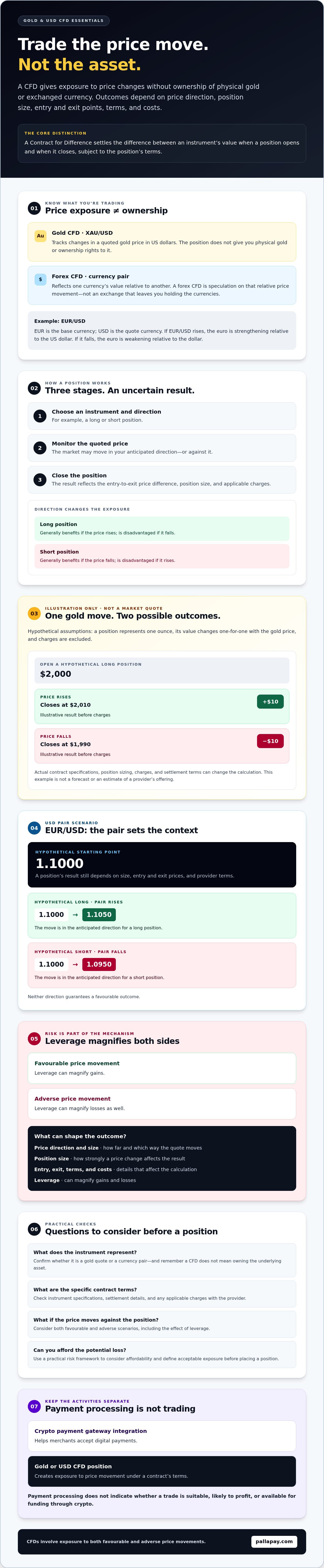
  • Best Way to Liquidate Crypto Assets: Transitioning Capital into Gold and Forex CFDs in 2026

    Best Way to Liquidate Crypto Assets: Transitioning Capital into Gold and Forex CFDs in 2026

    What if the true value of your digital holdings isn’t in waiting out the next market cycle, but in redeploying that capital where macro momentum moves trillions daily? For serious market participants, identifying the best way to liquidate crypto assets isn’t merely an exit strategy; it’s an operational pivot. You already know the sheer frustration of unpredictable conversion slippage, complex banking delays, and watching static balances sit idle while inflation erodes your purchasing power. Cashing out shouldn’t mean retreating to the sidelines.

    By establishing an efficient bridge between blockchain liquidity and established derivative markets, you can transform dormant digital balances into active market leverage. In this guide, you’ll discover how streamlined off-ramps eliminate traditional settlement friction, allowing you to deploy strategic capital directly into Gold (XAU/USD) and Forex CFD trading. We’ll examine the operational mechanics of compliant liquidation, the targeted advantages of trading gold against the US dollar, and how disciplined currency trading can decisively accelerate your financial growth in 2026.

    Key Takeaways

    • Discover why bypassing exchange slippage and settlement friction through direct infrastructure represents the best way to liquidate crypto assets into immediate trading liquidity.
    • Learn how direct crypto-to-fiat off-ramps eliminate complex banking hold-ups, turning digital wealth into usable capital in real time.
    • Understand the strategic risks of letting liquidated funds sit idle in cash accounts while inflation diminishes overall purchasing power.
    • Explore how Gold (XAU/USD) and Forex CFD trading can transform your financial life through flexible, two-way market exposure and structured leverage.
    • See how an integrated multi-asset broker bridges digital blockchain holdings directly into global derivative markets across more than 180 countries.

    Evaluating the Best Methods to Liquidate Crypto Assets in 2026

    Automated Off-Ramps vs. Institutional OTC Liquidation

    Automated retail gateways provide rapid utility for standard conversions, converting digital tokens to spending balances in seconds. However, automated protocols struggle when processing substantial capital blocks. Routing a six-figure position through standard order books fragments execution across descending bid tiers, triggering severe price depreciation.

    For high-volume balances, an institutional OTC crypto exchange structure provides critical market shielding. Rather than broadcasting sell pressure to public order books, OTC desks settle transactions privately through deep liquidity pools at a locked, predetermined price. For substantial portfolios, this personalized execution is the best way to liquidate crypto assets without forfeiting gains to market impact.

    Evaluating Security, Compliance, and Counterparty Risk

    Execution speed provides no benefit if your capital becomes trapped mid-settlement. Understanding international standards in cryptocurrency regulation helps traders select partners that prevent sudden account freezes. Financial institutions immediately flag large, unverified deposits from non-compliant sources, stalling access to your trading funds for days or weeks.

    Partnering with providers holding verified MSB status in North America ensures that anti-money laundering (AML) and know-your-customer (KYC) verifications happen proactively. This institutional-grade compliance creates a frictionless gateway, allowing you to transition blockchain wealth into clean fiat balances that are immediately ready for active Forex and commodity markets.

    Streamlining the Conversion: From Crypto Holdings to Liquid Fiat

    Converting volatile digital tokens into liquid cash requires a clear settlement path. When you liquidate directly to bank accounts, traditional legacy corridors often introduce multiple clearing houses, extending settlement latency over days. Moving through a direct crypto off-ramp reduces those processing layers, linking decentralized liquidity directly with clearing rails for instant fiat readiness.

    Direct Crypto-to-Bank Settlement Protocols

    Bypassing multi-tier intermediary banks prevents unexplained processing holds. Direct fiat settlement routes deliver capital directly into domestic or international bank accounts using verified clearing rails. This clean operational structure also simplifies recordkeeping. Converting digital assets triggers tax events, so reviewing verified IRS virtual currency tax guidance ensures you track capital gains liabilities clearly across every liquidation tier.

    Execution timing impacts your bottom line as well. Initiating conversions during core market hours aligns high banking liquidity with deep broker books, reducing bid-ask spreads. Streamlined settlement is the best way to liquidate crypto assets when your priority is immediate capital redeployment without intermediary friction.

    Preserving Purchasing Power Through Stable Asset Intermediaries

    Sudden downward swings can erase portfolio gains before your bank transfer clears. Staging your liquidation through reliable stable assets protects capital value during intermediate operational phases:

    • Convert highly volatile holdings into USD-pegged stablecoins like USDT immediately to lock in dollar valuations.
    • Hold funds safely inside an integrated crypto wallet while coordinating banking details or preparing CFD accounts.
    • Isolate capital from rapid token market downturns while routine compliance reviews complete.

    Securing value before running final banking rails establishes the best way to liquidate crypto assets safely. If you are preparing to transition digital equity into global commodity markets, you can explore seamless fiat conversions through pallapay.com to secure fast capital readiness.

    Strategic Capital Redeployment: Transitioning Liquidity into Forex and Gold Markets

    Most liquidation guides treat the conversion of cryptocurrency into cash as the final step of an investment cycle. In practice, parking newly acquired cash in a conventional savings account exposes your wealth to silent destruction. Inflation steadily reduces the real purchasing power of idle balances. Seeking the best way to liquidate crypto assets is only the first phase of wealth preservation; deploying that freed liquidity into dynamic, highly liquid global markets is where sustained financial performance begins.

    The Limitations of Holding Static Cash Balances

    Cash balances provide transactional utility, but they represent a declining asset class over time. Traditional retail accounts offer negligible returns that fail to outpace broader monetary depreciation. Active derivative markets, by contrast, operate independently of localized economic slowdowns. By moving capital out of stagnant depository accounts, traders reposition their resources to capture macro momentum rather than absorbing passive losses.

    Why Gold (XAU/USD) and Major Currencies Attract Crypto Capital

    Commodity and currency markets offer unmatched liquidity depth, absorbing substantial capital allocations without price dislocation. For digital asset holders accustomed to structural volatility, gold and foreign exchange provide clear institutional advantages:

    • Macroeconomic Breadth: Global foreign exchange processes trillions of dollars in daily volume, ensuring that order execution occurs instantly at tight spreads without liquidity drought.
    • Strategic Commodity Pairing: Gold quoted against the US dollar (XAU/USD) serves as both a defensive hedge against geopolitical instability and a responsive momentum vehicle during monetary policy shifts.
    • Regulatory Clarity: Clear classifications, such as formal perspectives from the CFTC on virtual currency and traditional derivatives, offer defined operational frameworks that protect institutional capital.

    Transitioning capital into currency pairs and precious metals creates a balanced portfolio profile. Market participants maintain exposure to sharp price swings while resting on deep, institutional foundations. Executing this transition through integrated multi-asset platforms represents the best way to liquidate crypto assets for long-term portfolio growth, turning dormant blockchain balances into flexible, active market opportunities.

    Best Way to Liquidate Crypto Assets: Transitioning Capital into Gold and Forex CFDs in 2026

    The Transformative Financial Impact of Gold and USD CFD Trading

    Moving from a buy-and-hold crypto posture to active derivative execution marks a profound turning point in your financial journey. Holding digital assets ties your net worth to broad market sentiment, forcing you to endure months of stagnant or downward momentum. Deploying converted capital into Contract for Difference (CFD) trading shifts that dynamic entirely. Through contracts tracking Gold (XAU/USD) and major USD currency pairs, you trade market movement directly without taking physical ownership of bullion or banknotes. For traders targeting continuous portfolio growth, finding the best way to liquidate crypto assets to fund a multi-asset trading balance unlocks genuine financial agility.

    Understanding CFD Mechanics: Two-Way Trading Agility

    CFDs allow you to speculate on price trajectories in both expanding and contracting markets. When global macroeconomic data signals a weakening currency, you can enter short positions to capture downward trends as easily as taking long exposure during rallies. Trading XAU/USD through digital derivatives eliminates vaulting logistics, transit insurance, and physical delivery fees, ensuring your capital remains liquid, nimble, and immediately deployable across fresh trade setups.

    Leverage as an Accelerator for Personal Wealth Transformation

    Leverage trading bridges the gap between limited initial balances and institutional-sized market access. By posting a fraction of a trade’s total value as margin, you control larger positions in major currency pairs and commodities. This mechanism transforms everyday market moves into significant wealth-generating opportunities:

    • Enhanced Capital Efficiency: Amplify market exposure while retaining a substantial liquidity reserve to manage risk.
    • Proactive Income Generation: Replace passive waiting with active, daily engagement across high-volume currency sessions.
    • Financial Sovereignty: Master technical execution on high-liquidity pairs to generate independent trading returns regardless of broader market cycles.

    Essential Risk Architecture: Stop-Losses and Position Sizing

    Sustainable financial freedom demands strict capital defense. Leverage magnifies both returns and drawdowns, making systematic risk controls mandatory. Implement hard stop-loss orders on every XAU/USD position to cap downside exposure before executing. Maintain asymmetric risk-to-reward ratios, targeting setups where potential gains comfortably exceed your committed risk. Pairing disciplined position sizing with the best way to liquidate crypto assets creates an institutional workflow that protects your principal while compounding trading profits over the long term.

    Ready to put your digital wealth to work in high-liquidity global markets? Take control of your financial future and start CFD trading with Pallapay today.

    Executing Your Liquidation and Trading Strategy with Pallapay

    Bridging decentralized tokens with global capital markets requires an institutional gateway built for speed and regulatory integrity. Fragmented solutions often force traders to juggle multiple platforms, wasting critical trading hours while market momentum shifts. Operating as a regulated MSB in North America and serving market participants across more than 180 countries, Pallapay provides the integrated infrastructure needed to move seamlessly between blockchain holdings and traditional financial derivatives. Identifying the best way to liquidate crypto assets means removing the friction between off-ramping digital value and deploying capital onto professional broker screens.

    Seamless Liquidation directly into Trading Capital

    Converting assets across separate retail exchanges, intermediary banks, and external brokerages routinely drains capital through stacked transfer fees and clearing delays. Pallapay consolidates this entire pipeline into a single environment. You can convert major holdings like Bitcoin, Ethereum, and USDT directly into liquid trading balances without waiting days for external wire settlements. This direct connectivity eliminates intermediary settlement friction, preserving your net capital and ensuring that institutional pricing spreads protect your balances right from the start.

    Full-Spectrum Brokerage Solutions for Serious Traders

    Once your liquidation settles into usable fiat value, you don’t have to navigate separate platforms to take market positions. The brokerage ecosystem connects your newly established balance directly to international currency pairs and precious metals:

    • Direct Commodity Exposure: Trade Gold (XAU/USD) CFDs instantly, capturing volatility against the US dollar without storage or vaulting fees.
    • Dynamic Forex Trading: Access deep liquidity across global foreign exchange pairs with rapid execution engines.
    • Strategic Leverage Controls: Apply flexible leverage trading models to maximize capital efficiency while adhering to strict stop-loss rules.
    • Professional Trading Resources: Utilize live Forex signals and comprehensive analytical charting tools to time your entries during peak market volatility.

    Combining compliant conversion rails with active derivative access represents the best way to liquidate crypto assets for forward-looking traders. Opening your Pallapay account gives you the regulatory security, institutional liquidity, and execution speed required to turn passive blockchain assets into a disciplined, life-changing trading career.

    Transforming Digital Wealth into Active Market Sovereignty

    Transitioning capital from volatile tokens into disciplined derivative markets creates an active defense against currency depreciation. Converting directly through unified conversion pipelines eliminates multi-day delays, protects trade balances from order-book slippage, and ensures your funds remain secure under recognized regulatory standards. For ambitious market participants, establishing direct connectivity to Gold (XAU/USD) and high-volume currency pairs is the best way to liquidate crypto assets while keeping your purchasing power working dynamically.

    Your hard-earned capital doesn’t have to sit idle in stagnant bank accounts. Pallapay unites rapid off-ramps with an institutional Forex and CFD brokerage under official Money Services Business registrations across the United States and Canada. Serving verified clients in more than 180 countries, this secure global infrastructure gives you the execution speed, leverage controls, and market tools needed to master real-time price action. Accelerate your financial journey: Liquidate crypto and trade Gold CFDs with Pallapay. Take charge of your trading future today and let your capital build lasting financial momentum.

    Frequently Asked Questions

    What is the best way to liquidate crypto assets without paying excessive fees?

    The best way to liquidate crypto assets without excessive costs is to match your transaction volume to the proper settlement channel. For standard sums, direct off-ramp rails bypass intermediary banking layers. For large balances, institutional OTC desks prevent slippage by executing trades against dedicated liquidity pools at agreed prices rather than across public order books.

    Can I turn my liquidated crypto balance directly into active trading capital?

    Yes, unified multi-asset platforms allow you to convert digital holdings straight into working brokerage balances. Instead of withdrawing funds to a third-party commercial bank and waiting on clearing wires, direct pipelines convert Bitcoin, Ethereum, or USDT into usable fiat margin instantly, letting you take positions in foreign exchange and commodity markets immediately.

    What makes trading Gold (XAU/USD) CFDs different from holding physical gold or crypto?

    Trading Gold CFDs provides direct exposure to the metal’s price fluctuations without vault storage fees, security logistics, or delivery delays. Unlike physical metal or crypto tokens, CFDs allow you to execute long or short positions rapidly with high liquidity, letting you capitalize on both upside rallies and downside corrections.

    How does leverage work when trading Forex and commodity CFDs?

    Leverage enables you to control a larger market exposure by committing only a fraction of the total position value as collateral. This amplifies both gains and losses from minor price shifts in assets like XAU/USD. Successful execution requires disciplined stop-loss placement and controlled position sizing to manage market risk effectively.

    How quickly can funds be liquidated through a compliant crypto off-ramp?

    Compliant conversion infrastructure processes liquidations in minutes once routine identity verifications are complete. Direct crypto-to-fiat pipelines immediately convert digital tokens into usable fiat reserves or trading margin, completely bypassing the multi-day clearing hold-ups typical of traditional cross-border banking rails.

    Is it possible to profit from falling prices when trading commodity and currency CFDs?

    Yes, CFD contracts facilitate two-way market flexibility. If market indicators suggest a downward shift for gold or a currency pair against the US dollar, you can open a short position. If the price declines, the contract settles the difference in your favor, unlocking profitable opportunities during market downturns.

    What security measures protect my capital during crypto off-ramping and brokerage trading?

    Legitimate gateways protect client funds through strict institutional protocols and regulatory oversight. Operating as a registered Money Services Business in the United States and Canada ensures comprehensive adherence to anti-money laundering standards, counterparty risk management, and rigorous fund-segregation practices across all trading accounts.

    Disclaimer

    The information provided on this website and blog is for general informational and educational purposes only and does not constitute financial, investment, legal, tax, or other professional advice.
    Cryptocurrency and digital asset services may be subject to regulatory restrictions in certain jurisdictions. Users are solely responsible for ensuring compliance with applicable local laws and regulations before using any products or services mentioned on this website.
    PallaPay does not guarantee the accuracy, completeness, or timeliness of any information published and accepts no liability for any loss or damages arising from reliance on the content. Any opinions expressed are those of the respective authors and may change without notice.
    Certain services, features, or products referenced may be provided through third-party partners, licensed entities, or affiliated service providers subject to separate terms and regulatory approvals. Availability of services may vary by country or region.
    This website may contain references to digital assets, virtual currencies, or blockchain-related services that are not available to residents of certain jurisdictions, including where prohibited by law. Nothing on this website constitutes an offer, solicitation, or recommendation to buy or sell any financial instrument or virtual asset.

  • Secure Off-Ramping: Bridging Crypto Liquidity and Global Forex Markets in 2026

    Secure Off-Ramping: Bridging Crypto Liquidity and Global Forex Markets in 2026

    With the global foreign exchange market reaching a staggering $9.6 trillion in daily turnover, the opportunity for capital growth has never been more significant. You likely recognize that while your digital assets hold immense value, the friction of moving them into traditional markets often results in missed entries and frustrating slippage. Achieving secure off-ramping crypto to fiat is no longer just a technical necessity; it’s the strategic foundation for any trader looking to capitalize on gold prices that now fluctuate near $4,380 per ounce.

    We understand that the complexity of bridging crypto wallets with trading accounts can feel like a barrier to your financial evolution. This article demonstrates how a compliant, high-speed bridge from USDT to USD allows you to access institutional-grade leveraged trading in the XAU/USD and Forex sectors. You’ll learn how instant settlement and sophisticated liquidity solutions can transform your trading efficiency by removing the traditional delays between your digital wallet and the global markets. We will explore the mechanics of professional-grade off-ramping and how it serves as your essential gateway to the most liquid markets in the world.

    Key Takeaways

    • Learn how to maintain a competitive edge by converting digital liquidity into fiat in under five minutes, ensuring you never miss a critical market entry.
    • Understand the mechanics of secure off-ramping crypto to fiat as a regulated gateway to the $9.6 trillion daily turnover of the global Forex market.
    • Discover the financial impact of XAU/USD CFD trading, using leveraged positions to capitalize on gold price shifts without the burden of physical custody.
    • Identify the critical role of MSB registered infrastructure in the US and Canada for maintaining regulatory compliance during high-volume capital movements.
    • Explore how integrating crypto to bank transfers into your strategy creates a professional bridge between digital innovation and institutional financial reliability.

    Secure Off-Ramping: Why It Is Critical for Traders

    Capital mobility defines the success of a professional trader. In the fast-paced environment of global finance, the ability to move value between decentralized protocols and traditional bank accounts determines whether you can capitalize on a market shift or remain a spectator. Secure off-ramping crypto to fiat is the technological bridge that transforms digital wealth into actionable capital for the $9.6 trillion daily foreign exchange market.

    Liquidity is the lifeblood of this transition. When spot gold (XAU/USD) moves within its late 2026 range of $4,300 to $4,540 per ounce, every second spent waiting for a conversion is a second of lost opportunity. Professional traders don’t just hold assets; they rotate them. By establishing a reliable path to fiat, you move from the passive stance of a long-term holder to the active, strategic position of a CFD trader. This shift allows you to use digital gains to enter high-leverage markets where the potential for financial transformation is significantly amplified.

    The Mechanics of a Secure Conversion

    Off-ramping is the critical link between blockchain assets and global banking systems. While standard retail exchanges often suffice for small transactions, institutional-grade movement requires a more sophisticated approach. High-volume traders typically favor OTC (Over-the-Counter) desks over traditional exchanges to avoid the pitfalls of public order books. The primary advantage of a secure off-ramping crypto to fiat strategy through an OTC gateway is the mitigation of slippage. Large orders on standard exchanges can move the market price against the trader, eroding the very capital intended for a new Forex position. A professional bridge ensures that the value you see is the value you receive in your USD account.

    Risks of Substandard Off-Ramp Providers

    Selecting an unverified or unregulated provider introduces systemic risks that can derail a trading career. Platforms operating in regulatory grey areas often trigger bank freezes due to non-compliance with the FATF Travel Rule, which requires strict originator and beneficiary data transmission for transfers over $1,000. Using a provider with MSB registrations in the US and Canada mitigates this risk by ensuring every transaction meets institutional compliance standards. Reliability also impacts your bottom line through settlement speed. Traditional banking delays of three to five days are unacceptable when a Forex signal requires immediate action. Infrastructure reliability ensures that your funds are available in under five minutes, preserving your ability to act on real-time market data. A professional partner handles these background complexities, allowing you to focus on market analysis rather than procedural friction.

    Leveraging Crypto Liquidity for Gold and Forex Trading

    The 2026 market landscape rewards traders who bridge asset classes with precision. While digital assets offer significant growth, the ability to rotate those gains into the $9.6 trillion daily Forex market is what separates retail participants from institutional-grade strategists. Moving USDT or Bitcoin into USD provides immediate liquidity, and for holders of alternative network tokens, resources like pifiatconvert.com facilitate converting Pi Coin into fiat currencies to prepare funds for traditional market deployment. This maneuver minimizes downtime between taking digital profits and capitalizing on a fresh Forex signal, ensuring your capital is never idle.

    Establishing a protocol for secure off-ramping crypto to fiat is the primary mechanism for this transition. By converting digital holdings into USD bank settlements in under five minutes, you ensure that your capital remains productive. This speed is essential when market conditions shift rapidly. It allows you to move from a volatile crypto position into the relative stability of major currency pairs without the usual three-day banking delay that often plagues legacy systems.

    Emphasizing Gold (XAU/USD) in a Modern Portfolio

    Gold remains a definitive hedge against the inherent volatility of digital assets. With spot gold trading in a range of $4,300 to $4,540 per ounce in late 2026, the commodity offers a sophisticated layer of protection for any diversified portfolio. Traders utilize Pallapay Fiat Settlement to bridge the gap between their crypto wallets and the gold market. This integration allows for the rapid deployment of capital into XAU/USD CFDs, ensuring you can act on central bank policy shifts as they happen. Using USD as the primary quote currency simplifies the transition, making it easier to manage risk across different asset classes.

    Forex Trading: The Global Stage for Capital Growth

    Forex is the most liquid market in the world, and it offers a natural synergy for crypto-native traders. The 24/5 nature of the currency markets mirrors the constant activity of the blockchain, yet it provides a different set of technical and fundamental drivers. Trading USD pairs allows you to engage with a market where the U.S. dollar is involved in 89.2% of all transactions. USD CFD trading allows for profit in both rising and falling markets. This bidirectional potential means your financial trajectory isn’t tied to a single market direction. By using a professional crypto offramp, you can maintain a constant flow of capital to where the highest volatility and opportunity reside.

    The Transformative Potential of CFD Trading

    CFD trading fundamentally alters an individual’s financial trajectory by providing professional access to the world’s most liquid markets. It’s the difference between waiting for a single digital asset to appreciate and actively managing a portfolio across global currency and commodity dimensions. By utilizing leverage, such as the standard 1:20 ratio for gold or 1:30 for major Forex pairs, you control larger positions with a smaller capital outlay. This maximizes your capital efficiency and changes your fundamental relationship with wealth. You stop being a passive saver and start being a strategic growth manager.

    CFDs as a Catalyst for Financial Independence

    Risk Management in a Leveraged Environment

    Professional risk management starts with the security of your assets before they ever reach the trading floor. Using a Pallapay Wallet allows for secure asset management in the preliminary stages of your capital rotation. Once you’re ready to enter the market, secure off-ramping crypto to fiat becomes the definitive bridge that respects your financial privacy while ensuring institutional compliance. This transition is vital for maintaining a professional trading account. It ensures your initial margin is settled quickly, allowing you to implement stop-loss orders and position sizing with the exactitude that modern commerce requires. By removing the friction of capital movement, you can focus entirely on managing your risk and protecting your gains.

    Secure Off-Ramping: Bridging Crypto Liquidity and Global Forex Markets in 2026

    Evaluating Off-Ramp Infrastructure: Regulatory Compliance

    Institutional reliability isn’t a byproduct of technology alone; it’s the result of rigorous regulatory adherence. For traders moving significant capital into the USD CFD markets, the infrastructure must be beyond reproach. This is where Money Services Business (MSB) registrations in the United States and Canada become non-negotiable. These registrations ensure that the gateway operates under the scrutiny of FinCEN and FINTRAC, providing a layer of protection that unregulated entities can’t match. When you’re managing wealth at this level, institutional-grade compliance is what protects you from the legal complications that often plague the digital asset sector.

    There’s a vast difference between unregulated peer-to-peer (P2P) transfers and professional OTC services. P2P platforms often expose users to counterparty risk and the danger of frozen bank accounts due to suspicious source-of-funds issues. Professional OTC desks provide a controlled, compliant environment for high-volume transactions. By utilizing a global infrastructure that spans over 180 countries, you ensure that your capital movements respect international standards like the FATF Travel Rule. This compliance is essential for maintaining a clean financial record as you rotate crypto gains into global Forex accounts.

    The Checklist for a Secure Off-Ramp

    Before committing capital, you must verify that a provider has a verifiable physical office presence and transparent licensing. High-volume traders require absolute clarity on fee structures and exchange rates to maintain their trading margins. It’s also vital to review Crypto Security in 2026 to understand the deeper safety protocols required for modern digital asset protection. A secure off-ramping crypto to fiat process is only as strong as the regulatory foundation it sits upon. Transparency isn’t just a feature; it’s the bedrock of trust in institutional finance.

    Speed and Reliability: The Institutional Standard

    Real-time settlement is a requirement for anyone engaging in the fast-moving Gold and Forex markets. If your conversion takes days, you’ve already lost the competitive edge provided by your analysis. Institutional standards demand settlement in under five minutes to ensure you can act on XAU/USD price shifts instantly. For those running automated systems or high-frequency strategies, API stability is paramount. The Pallapay Payment API offers the high-frequency conversion capabilities needed to bridge digital liquidity with traditional market opportunities without friction. Efficiency in settlement is what allows a business to accelerate its own progress in the global markets.

    Ready to secure your market entry with a regulated partner? Establish your professional off-ramp today.

    Pallapay: Your Professional Gateway to Global Market Access

    Pallapay is the definitive destination for traders who require absolute precision in their capital movements. It’s built to handle the transition from decentralized assets to the $9.6 trillion daily Forex market with institutional reliability. By providing a streamlined path for secure off-ramping crypto to fiat, the platform ensures your digital holdings aren’t trapped behind technical or regulatory barriers. This integration is essential for those who view crypto not just as an investment, but as a liquid bridge to the world’s most significant financial opportunities.

    The synergy between digital innovation and financial reliability is at the core of our service. We provide the infrastructure that allows you to move value between asset classes without the volatility and delays typical of legacy systems. Whether you’re rotating profits from a successful crypto cycle or funding a new position in the USD currency market, our gateway acts as your strategic partner. We handle the complex background processes of compliance and settlement, allowing you to focus entirely on your market analysis and execution.

    Tailored Solutions for Professional Traders

    High-volume traders often face the challenge of market impact when converting large sums on public exchanges. Pallapay addresses this through regulated OTC desks designed for minimal slippage and maximum privacy. You can move large amounts of USDT, BTC, or ETH directly into USD bank settlements, providing the immediate capital needed for leveraged Gold (XAU/USD) positions. These direct crypto-to-bank transfers eliminate the friction of multiple intermediaries, allowing you to fund your CFD accounts in under five minutes. This speed is a competitive advantage in a market where gold prices can shift by $200 in a single trading session.

    Getting Started with Pallapay

    Integrating our gateway into your wider trading strategy is a logical step toward financial acceleration. The process begins with a secure account setup, followed by a verification process that meets international compliance standards in the US and Canada. Once established, you can initiate conversions through our intuitive interface or utilize the Pallapay Payment API for automated settlement flows. This system allows you to rotate profits from digital assets into the USD market with the confidence of a global industry leader. It’s time to bridge the gap between your digital wallet and the transformative potential of the global Forex markets.

    Mastering Capital Mobility for the Next Financial Era

    The financial landscape of 2026 demands more than just holding digital assets; it requires the agility to rotate capital into the $9.6 trillion Forex market and the historical stability of gold. Establishing a protocol for secure off-ramping crypto to fiat is the definitive step in this evolution. This process transforms digital wealth into the high-leverage power of USD CFDs, allowing you to manage global market shifts with institutional precision. By utilizing a bridge that is MSB registered in the United States and Canada, you ensure your financial progress is built on absolute trust.

    Pallapay provides global OTC desks and serves over 180 countries, delivering the settlement speed necessary for professional traders to maintain a competitive edge. It’s time to move beyond passive holding and embrace active strategic growth through a platform that prioritizes security and utility. Your financial trajectory is no longer limited by the boundaries of the blockchain. Take the final step to integrate your digital liquidity with the world’s most transformative trading opportunities.

    Securely off-ramp your crypto to fiat with Pallapay and begin your professional trading journey today.

    Frequently Asked Questions

    Is secure off-ramping legal for individuals and businesses?

    Yes, secure off-ramping crypto to fiat is fully legal for individuals and businesses when utilizing a provider with the correct regulatory registrations. Regulated entities like Pallapay operate under Money Services Business (MSB) frameworks in the United States and Canada. These registrations require strict adherence to Anti-Money Laundering (AML) and Know Your Customer (KYC) protocols. This compliance ensures that your capital movements are recognized as legitimate by global banking systems, preventing the common issue of frozen accounts.

    How long does it take to convert crypto to fiat for Forex trading?

    Professional off-ramping infrastructure allows you to convert digital assets into fiat in under five minutes. This speed is a critical requirement for Forex and Gold CFD traders who must capitalize on real-time market opportunities. While traditional banking settlements can take three to five business days, institutional-grade gateways provide near-instant liquidity. This efficiency ensures that your trading account is funded exactly when a signal appears, removing the opportunity cost typically associated with legacy financial delays.

    What are the benefits of trading Gold CFDs over physical gold?

    Trading Gold CFDs (XAU/USD) provides significant operational advantages over physical bullion ownership. You avoid the logistical costs of secure storage, insurance, and physical transportation while still gaining full exposure to price movements. Additionally, CFD trading allows you to use leverage to control larger positions with a smaller capital outlay. This flexibility also enables you to profit from both rising and falling markets, a feature that physical gold ownership cannot offer without complex hedging strategies.

    Can I off-ramp high volumes of USDT to my bank account securely?

    High-volume USDT conversions are handled securely through regulated OTC desks rather than public exchange order books. This method is specifically designed to handle large-scale movements without causing significant market slippage or price impact. By using a secure off-ramping crypto to fiat protocol, professional traders can move substantial digital liquidity directly into their USD bank accounts. This process maintains high levels of privacy and ensures that the transaction complies with institutional reporting requirements across 180 countries.

    Why should I use a regulated OTC desk like Pallapay instead of a standard exchange?

    Regulated OTC desks offer a level of security and efficiency that standard retail exchanges often lack. Unlike public exchanges, OTC desks provide a fixed-price execution that protects you from the volatility of public order books during large trades. A regulated provider like Pallapay also offers direct integration with global banking rails, ensuring that your funds move from the blockchain to your trading account without multiple intermediaries. This professional structure is essential for preserving capital and ensuring transaction finality.

    What documents are required for a secure off-ramping process?

    A secure off-ramping process requires standard institutional documentation to comply with global AML and KYC regulations. Individual users typically need to provide a government-issued identification document and proof of residential address. For high-volume or business transactions, you’re also required to provide evidence of the source of funds. These requirements are a hallmark of a regulated gateway and serve to protect your assets from the risks associated with illicit financial activities and regulatory scrutiny.

    How does leverage work in USD CFD trading?

    Leverage in USD CFD trading allows you to multiply your market exposure by borrowing capital from your broker. For example, a leverage ratio of 1:20 on gold means you can control a $20,000 position with just $1,000 of initial margin. While this significantly amplifies your potential for financial growth, it also increases your risk profile. Professional traders manage this by utilizing robust risk controls, such as stop-loss orders, to protect their capital while maximizing their overall capital efficiency.

    What is the impact of MSB registration on my transaction security?

    MSB registration in the United States and Canada indicates that a provider is subject to rigorous federal oversight. This status ensures that your transactions follow the FATF Travel Rule, which mandates the secure transmission of originator and beneficiary data for transfers. This regulatory alignment is the primary factor in preventing bank-level rejections and ensuring that your off-ramped fiat is accepted by institutional trading platforms. It transforms a complex technical conversion into a standard, compliant business operation.

    Disclaimer

    The information provided on this website and blog is for general informational and educational purposes only and does not constitute financial, investment, legal, tax, or other professional advice.
    Cryptocurrency and digital asset services may be subject to regulatory restrictions in certain jurisdictions. Users are solely responsible for ensuring compliance with applicable local laws and regulations before using any products or services mentioned on this website.
    PallaPay does not guarantee the accuracy, completeness, or timeliness of any information published and accepts no liability for any loss or damages arising from reliance on the content. Any opinions expressed are those of the respective authors and may change without notice.
    Certain services, features, or products referenced may be provided through third-party partners, licensed entities, or affiliated service providers subject to separate terms and regulatory approvals. Availability of services may vary by country or region.
    This website may contain references to digital assets, virtual currencies, or blockchain-related services that are not available to residents of certain jurisdictions, including where prohibited by law. Nothing on this website constitutes an offer, solicitation, or recommendation to buy or sell any financial instrument or virtual asset.
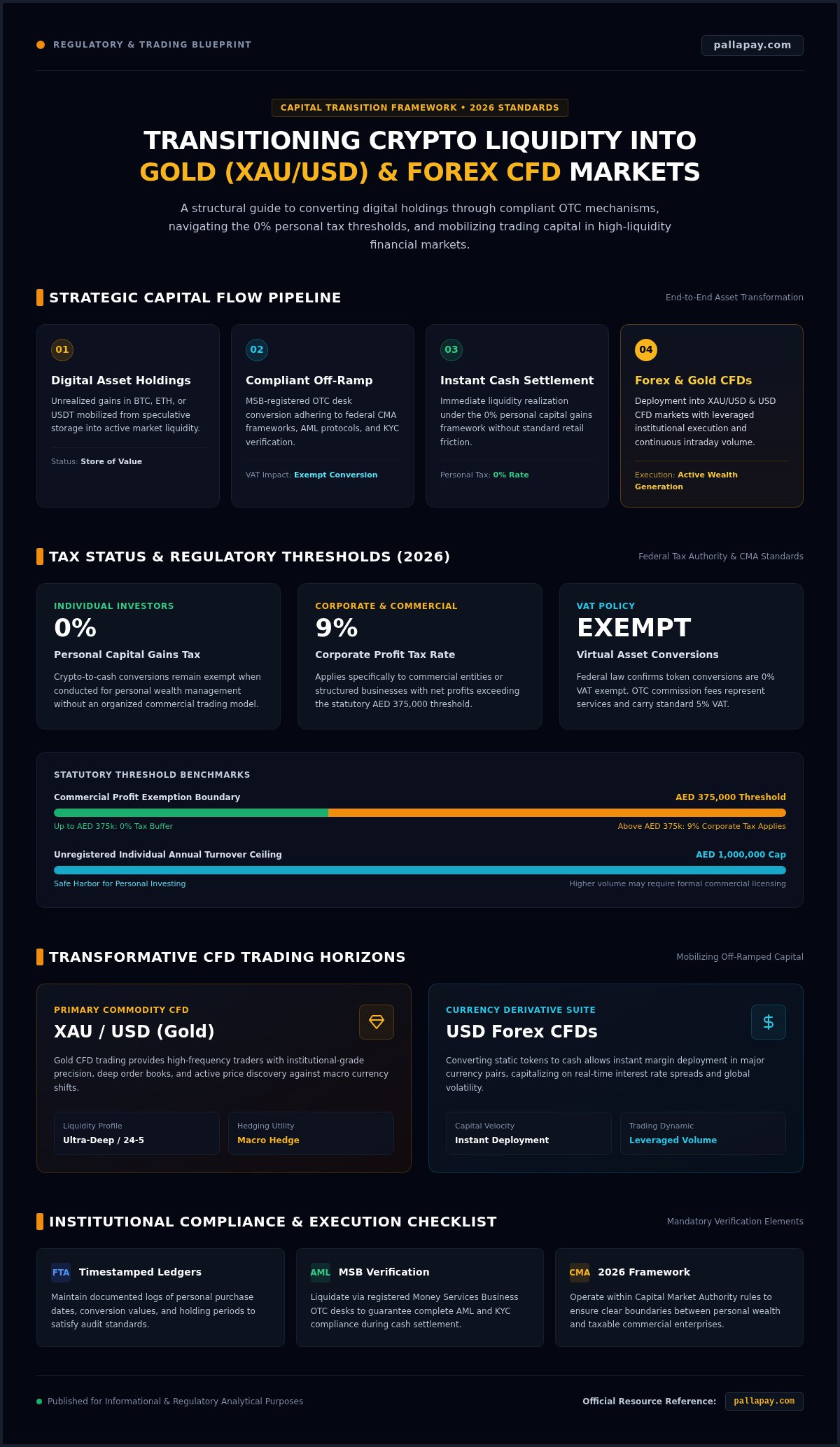
  • How to Verify a Crypto Company Is Legitimate: The 2026 Professional Guide

    How to Verify a Crypto Company Is Legitimate: The 2026 Professional Guide

    In the high-stakes world of digital finance, the difference between a life-changing financial breakthrough and a total loss of capital often comes down to a single due diligence check. Knowing how to verify a crypto company is legitimate is a fundamental requirement for anyone looking to bridge the gap between digital assets and traditional markets. You’re right to feel cautious; the market is currently saturated with shadow platforms that mimic professional fintech leaders with alarming precision.

    Whether you’re scaling your portfolio through XAUUSD or managing USD CFD positions, your success depends entirely on the stability of your financial partner. It’s exhausting to filter through the hype while trying to find a secure environment for your Forex and gold trading ambitions. This guide provides you with a clear vetting checklist to ensure your capital remains secure and your trading remains profitable.

    We’ll explore the essential framework used by institutional professionals to validate global fintech providers. You’ll gain the confidence to choose a long-term partner by understanding the importance of multi-jurisdictional MSB registrations and tangible physical infrastructure. We’ll also examine how a secure crypto bridge can transform your trading experience by providing a reliable, professional path between digital assets and traditional commodity markets.

    Key Takeaways

    • Learn to identify why active MSB registrations in the United States and Canada serve as the primary indicator of a provider’s institutional reliability.
    • Master the professional framework on how to verify a crypto company is legitimate by cross-referencing global regulatory databases and anti-money laundering protocols.
    • Evaluate the importance of physical infrastructure, including OTC desks in Singapore and Istanbul, to differentiate established leaders from digital-only shadow platforms.
    • Secure your path toward financial transformation by verifying price feed transparency for high-impact Gold (XAUUSD) and USD CFD trading.
    • Discover how a regulated payment gateway functions as a secure off-ramp to protect and manage the profits generated from your Forex market operations.

    The 2026 Landscape: Why Crypto Company Verification Is Critical

    The 2026 financial landscape has shifted into a high-tech frontier where the line between innovation and deception is thinner than ever. AI tools now generate perfectly spoofed trading environments that mirror institutional platforms with terrifying accuracy. Professional investors realize that unregulated options are no longer a viable risk category. Learning how to verify a crypto company is legitimate is the only way to safeguard your capital before committing to the markets.

    Institutional grade security is the prerequisite for modern wealth management. As digital assets increasingly serve as the primary gateway to broader financial instruments like Forex and Gold (XAUUSD), the stakes have never been higher. You aren’t just looking for a place to swap tokens; you’re looking for a professional bridge that connects disruptive tech with established financial reliability.

    The Evolution of Digital Asset Scams

    Digital asset scams have transitioned from crude phishing emails to deep-fake brokers and multi-layered social engineering. These criminals often leverage the high-growth appeal of Gold and USD CFD markets to lure victims into “pig butchering” schemes. By the time a trader realizes the platform is a hollow shell, their capital has already vanished into the complex web of cryptocurrency fraud and crime that plagues the unregulated sector.

    The psychological cost of this financial insecurity is devastating. Scammers use sophisticated trading interfaces that show fake profits, encouraging users to deposit more before the inevitable “liquidity lock” occurs. Identifying these red flags early is essential for anyone serious about long-term market participation.

    The Transformative Power of Legitimate Trading

    While the risks are real, the potential for financial transformation through secure trading remains unparalleled. Accessing the Forex market or trading Gold CFDs with a regulated partner can redefine an individual’s financial trajectory. It’s about moving beyond speculation and into a structured environment where technology facilitates growth rather than hindering it. Understanding how to verify a crypto company is legitimate allows you to focus on market strategy instead of platform solvency.

    A legitimate partner provides the foundation for long-term wealth generation by offering a reliable bridge between crypto liquidity and fiat stability. Utilizing a professional off-ramp ensures that your trading profits are accessible and secure. When your financial provider operates with the transparency of a regulated MSB in the United States and Canada, the friction of the digital-to-traditional transition disappears. This stability empowers you to trade with the confidence of a global industry leader, knowing your capital is backed by tangible infrastructure and institutional compliance.

    The 5-Point Regulatory Checklist for Global Fintech

    Proactive vetting is the primary defense against capital loss. Relying on enforcement agencies to report scams after they occur is a reactive strategy that rarely recovers lost funds. To protect your capital, you must understand how to verify a crypto company is legitimate before you initiate your first trade. This requires a systematic evaluation of five critical regulatory and operational markers.

    • MSB Registration: A legitimate provider must hold active Money Services Business (MSB) status in reputable jurisdictions like the United States and Canada.
    • AML and KYC Protocols: Robust Anti-Money Laundering and Know Your Customer procedures aren’t just legal hurdles; they’re essential safety nets that prevent platform insolvency and legal seizure.
    • Asset Protection: Look for professional indemnity insurance or dedicated asset protection funds that safeguard user capital against operational failures.
    • Corporate Transparency: Legitimate firms appoint dedicated Compliance Officers and maintain clear corporate structures that are accessible to the public.
    • Security Certifications: For companies offering payment gateways or card services, PCI-DSS compliance is a non-negotiable standard for data security.

    Deep Dive: Understanding MSB Registration

    Verifying a company’s legal standing starts with the FinCEN database in the U.S. and the FINTRAC database in Canada. These registrations prove that the entity has submitted to federal oversight and maintains strict reporting standards. MSB status is a mandatory requirement for any provider facilitating crypto-to-fiat operations. A “tech startup” without these credentials is simply an unregulated risk; a “regulated financial technology provider” is a secure partner. This distinction is vital when you’re moving high-volume profits from Gold (XAUUSD) or USD CFD trading back into the traditional banking system. For those seeking professional oversight on the accounting side of these transitions, fvaccounts.com provides chartered services to ensure your financial reporting remains as robust as your trading strategy.

    In 2026, a multi-jurisdictional presence indicates that a company has passed the institutional vetting processes of several different regulatory bodies. This layer of oversight protects you as much as the company. When a platform requires detailed KYC, it ensures that the entire ecosystem remains clean, reducing the risk of your account being frozen due to third-party criminal activity. For those focused on the transformative potential of the markets, learning how Pallapay ensures secure fiat settlement provides a blueprint for how these compliance layers function in real-time operations.

    Selecting a partner that meets these five points allows you to focus on market strategy. If you’re ready to bridge your digital assets with institutional reliability, you can explore professional off-ramp solutions that prioritize your financial security.

    Physical vs. Digital Presence: Verifying Infrastructure

    A digital-only presence is a significant red flag for high-volume exchange services. While many startups operate entirely in the cloud, institutional-grade partners maintain a physical footprint in global financial hubs. Physical offices and Over-the-Counter (OTC) desks in locations like Singapore and Istanbul provide a layer of accountability that a website simply cannot match. When you’re managing large-scale profits from gold trading or USD CFD positions, you need the assurance that your partner has a tangible base of operations.

    Understanding how to verify a crypto company is legitimate requires looking beyond the screen to the company’s physical presence. Scammers often list prestigious addresses that belong to co-working spaces or unrelated businesses. A legitimate provider will have a verifiable presence where you can conduct high-volume OTC crypto exchange in person. Cross-referencing these addresses with local business registries and mapping services is a critical step in your due diligence process.

    The Value of Tangible OTC Desks

    Physical locations act as an anchor for institutional trust. They facilitate the transition between digital assets and traditional currency for high-net-worth individuals and corporate entities. For those trading XAUUSD, the ability to off-ramp profits via a physical desk adds an extra layer of security to the entire financial lifecycle. It proves the company isn’t just a collection of code; it’s a strategic partner grounded in the practicalities of modern commerce. This physical infrastructure ensures that there’s a real-world destination for your capital and a human point of contact for complex transactions.

    Hardware and Ecosystem Integration

    A company’s commitment to the industry is often visible through its hardware and technical integrations. Legitimate leaders don’t just offer an exchange; they provide a comprehensive ecosystem including crypto POS machines, Mastercard programs, and secure APIs. This level of infrastructure requires significant capital investment and deep partnerships with traditional financial systems. It signals a long-term business commitment rather than a temporary setup. To see how these tools work in the real world, you can explore our retail store solutions for secure crypto integration.

    By assessing the depth of a provider’s POS hardware and wallet ecosystem, you gain a clearer picture of their operational stability. A company that invests in physical card issuance and retail payment machines is building for the future of global commerce. This level of integration makes it much harder for a company to disappear overnight, providing the security you need to trade Forex and gold with total peace of mind. Learning how to verify a crypto company is legitimate means looking for these signs of deep, multi-layered industry commitment.

    How to Verify a Crypto Company Is Legitimate: The 2026 Professional Guide

    Verifying Platforms for Forex and Gold CFD Trading

    The mechanics of CFD (Contract for Difference) trading mean that you don’t own the underlying asset; you enter into a contract with a broker. In this model, the broker’s solvency and integrity are your primary risk factors. If the platform fails, your capital and your unrealized profits vanish. This is why knowing how to verify a crypto company is legitimate is the most important step before opening a position. You must confirm that the provider uses segregated account structures, ensuring that client funds are legally separated from the company’s operational capital.

    The Financial Impact of Gold and USD CFDs

    Trading Gold (XAUUSD) and major USD currency pairs offers a unique path toward financial independence. The volatility in these markets provides the liquidity necessary for significant portfolio growth. When executed through a professional partner, this type of trading can change an individual’s financial life by offering a scalable way to build wealth. However, this transformative potential is only realized when you have access to instant execution and low latency. Every millisecond counts when you’re trading commodities or currency CFDs. When researching how to verify a crypto company is legitimate, pay close attention to the execution speed and the source of their liquidity. You should verify price feed transparency by cross-referencing the platform’s quotes with institutional data from providers like Bloomberg or Reuters.

    Red Flags Specific to Trading Brokers

    The trading sector is unfortunately prone to aggressive marketing and deceptive promises. You should be wary of any company offering “guaranteed returns” or “secret” trading signals that promise a 100% win rate. These are classic hallmarks of fraudulent operations. High-pressure sales tactics, such as brokers calling you to demand more deposits to “save” a losing trade, are immediate disqualifiers. A professional fintech provider won’t pressure you into market exposure.

    A legitimate partner focuses on the utility of the bridge. You should always verify the “off-ramp” process before making your first deposit. A reliable provider makes it easy to securely off-ramp your trading profits to fiat. If the withdrawal process is shrouded in mystery or hidden fees, it’s a sign that the company isn’t a safe long-term partner. Secure your financial future by choosing a broker that prioritizes transparency over hype. Establish your professional trading account with a regulated leader today.

    The Pallapay Standard: A Blueprint for Secure Fintech

    Pallapay sets the benchmark for what institutional reliability looks like in the 2026 financial landscape. By integrating Money Services Business (MSB) regulations from both the United States and Canada into its global operations, the platform provides the exact compliance framework required for high-volume trading. Learning how to verify a crypto company is legitimate leads most professional investors to a single conclusion: transparency is the only currency that matters. Pallapay proves its standing through a multi-layered security architecture that protects every transaction within its Wallet and Payment Gateway.

    The transition between disruptive innovation and institutional stability is often where capital is most at risk. Pallapay bridges this gap by offering a comprehensive service suite that includes OTC crypto exchange services, physical POS machines, and the Pallapay Mastercard. This physical infrastructure serves as the ultimate proof of legitimacy. It moves the conversation beyond digital promises and into the realm of tangible financial utility. When you manage significant positions in gold or USD CFDs, you need a partner that handles the complex background processes of fiat settlement with effortless precision.

    A Global Partner for Professional Traders

    Professional traders in over 180 countries rely on Pallapay to facilitate the movement of their capital. High-volume exchange needs aren’t met by simple apps; they require 24/7 professional support and transparent fee structures that don’t erode your margins. Traders navigating the complexities of XAUUSD and USD CFD markets require a partner that doesn’t just promise security but proves it through operational depth. For a deeper look at protecting your portfolio, read our Definitive Guide to Crypto Security to understand the protocols that keep your digital assets safe.

    Empowering the Future of Commerce

    Pallapay enables both merchants and individuals to thrive in a digital economy that demands speed and safety. Secure APIs and retail-ready POS terminals turn complex technical conversions into standard business operations. This ecosystem allows you to focus on the transformative potential of the markets rather than the mechanics of the bridge. By providing a regulated environment for Forex and gold trading profits, Pallapay ensures your financial trajectory remains on an upward path. Experience the security of a regulated global leader. Get started with Pallapay today.

    Understanding how to verify a crypto company is legitimate is the first step toward financial freedom. By choosing a partner that meets the highest regulatory standards, you secure your capital and empower your future. Whether you’re off-ramping trading profits or integrating crypto payments into your business, Pallapay provides the stability you need to succeed in the modern commerce era.

    Securing Your Position in the 2026 Financial Evolution

    Success in the modern market requires more than just technical skill; it demands a foundation of absolute trust. Mastering how to verify a crypto company is legitimate is the first step toward a transformative trading career. By prioritizing providers with active MSB registrations in the United States and Canada, you ensure your capital is handled with institutional-grade compliance. Remember that physical infrastructure, such as OTC desks in Singapore and Istanbul, provides a level of accountability that digital-only platforms cannot replicate.

    Whether you’re scaling your wealth through XAUUSD or managing complex USD CFD positions, your choice of partner determines your long-term stability. A regulated partner operating across 180 countries offers the security needed to turn market volatility into a strategic advantage. This professional bridge allows you to focus on the mechanics of growth while your background processes remain secure. Secure your financial future with Pallapay; the regulated bridge to global crypto and fiat markets. You have the tools and the framework to trade with confidence. It’s time to step into the future of global commerce with a partner that values your security as much as your success.

    Frequently Asked Questions

    How can I check if a crypto company is registered as an MSB?

    You can check registration status through official federal databases. In the United States, use the FinCEN MSB Registrant Search tool. In Canada, verify credentials via the FINTRAC registry. These platforms allow you to input a company’s legal name to confirm their standing. This process is a critical component of learning how to verify a crypto company is legitimate. Regulated firms like Pallapay maintain active registrations to ensure institutional reliability for all users.

    What are the most common red flags of a fake Forex or Gold trading platform?

    Common red flags include guaranteed high returns and a lack of transparent regulatory disclosure. Fake platforms often use high-pressure sales tactics or promote exclusive trading signals. If a broker doesn’t provide a verifiable physical address or clear fee structures, it’s likely a shadow operation. Legitimate CFD trading for Gold (XAUUSD) requires a regulated environment that prioritizes price feed transparency. Avoid any platform that pressures you to deposit more capital to save a position.

    Is it safe to buy USDT with cash at an OTC desk?

    It’s safe provided the desk is operated by a regulated MSB with a physical footprint. Tangible OTC locations in cities like Singapore and Istanbul offer a level of accountability that digital-only platforms lack. You’ll need to complete KYC protocols to ensure the transaction remains compliant. Regulated providers ensure that the transition between cash and digital assets is secure. This protects your capital from the risks often found in unregulated peer-to-peer trading environments.

    How do I verify a crypto company’s physical office locations?

    Start by cross-referencing listed addresses with local business registries and mapping services. A professional global entity will have a verifiable presence in financial hubs like Singapore or Istanbul. Look for evidence of physical infrastructure, such as OTC desks or retail POS machines. Verifying these tangible assets is a reliable strategy when you’re researching how to verify a crypto company is legitimate. Don’t rely on a website’s footer alone; confirm the location’s operational status.

    What is the difference between a crypto exchange and a CFD broker?

    A crypto exchange facilitates the direct purchase and ownership of digital assets, allowing users to transfer holdings to self-custody solutions like Lumo Wallet where private keys remain safely on their own device. A CFD broker allows you to trade price movements without owning the underlying commodity or currency. CFD trading often involves leverage and covers diverse instruments like Forex and Gold (XAUUSD). While an exchange provides asset liquidity, a broker focuses on market execution. This means the broker’s regulatory status and solvency are your primary risk factors when trading these contracts.

    Why is MSB registration in the US and Canada important for global users?

    These jurisdictions maintain some of the highest anti-money laundering and consumer protection standards globally. When a company registers with FinCEN or FINTRAC, it submits to rigorous vetting and mandatory reporting. This oversight provides a universal trust signal for users in over 180 countries. Even if you aren’t based in North America, choosing a partner that meets these strict requirements ensures your capital is managed by a globally recognized and professional fintech leader.

    Can I use crypto to trade Gold (XAUUSD) and Forex safely?

    Trading these markets is safe when you utilize a regulated bridge that connects digital liquidity with traditional assets. The transformative potential of Gold and USD CFD trading can redefine your financial trajectory when managed through a secure partner. Confirm that your provider uses segregated account structures and offers low-latency execution. This professional setup allows you to safely use your crypto capital to access the growth opportunities found in the global Forex and commodity markets.

    What should I do if I suspect a crypto company is a scam?

    Cease all deposits immediately and attempt to withdraw any remaining capital. You should report the entity to federal authorities like the FTC or the Canadian Anti-Fraud Centre. Document every communication, transaction ID, and wallet address associated with the platform. Alerting the website’s hosting provider and payment processors can also help disrupt their operations. Warning the broader trading community on reputable forums is a vital step in preventing further capital loss within the ecosystem.

    Disclaimer

    The information provided on this website and blog is for general informational and educational purposes only and does not constitute financial, investment, legal, tax, or other professional advice.
    Cryptocurrency and digital asset services may be subject to regulatory restrictions in certain jurisdictions. Users are solely responsible for ensuring compliance with applicable local laws and regulations before using any products or services mentioned on this website.
    PallaPay does not guarantee the accuracy, completeness, or timeliness of any information published and accepts no liability for any loss or damages arising from reliance on the content. Any opinions expressed are those of the respective authors and may change without notice.
    Certain services, features, or products referenced may be provided through third-party partners, licensed entities, or affiliated service providers subject to separate terms and regulatory approvals. Availability of services may vary by country or region.
    This website may contain references to digital assets, virtual currencies, or blockchain-related services that are not available to residents of certain jurisdictions, including where prohibited by law. Nothing on this website constitutes an offer, solicitation, or recommendation to buy or sell any financial instrument or virtual asset.

  • USDT Transaction Fees Explained: The 2026 Guide to Maximizing Trading Profitability

    USDT Transaction Fees Explained: The 2026 Guide to Maximizing Trading Profitability

    With the Tron network alone processing over $28 trillion in USDT transaction volume during the first quarter of 2026, it’s clear that stablecoins have become the primary engine for global liquidity. However, for many traders, these gains are often diluted by unpredictable gas spikes on the Ethereum network and the complexity of choosing between TRC-20, ERC-20, or various Layer 2 solutions. Having usdt transaction fees explained is no longer just a technical necessity; it’s a strategic requirement for anyone serious about high-volume trading and capital efficiency.

    You likely understand that every cent lost to a network fee is a cent taken directly from your potential ROI. We’ll show you how to master these mechanics to minimize overhead and accelerate your financial transformation in the global Forex and Gold CFD markets. This guide provides a definitive framework for selecting the cheapest networks, understanding the impact of fees on XAU/USD profitability, and utilizing a reliable off-ramp solution to bridge the gap between digital assets and traditional commerce. By the end of this article, you’ll possess the knowledge to transform these operational costs into a distinct competitive advantage.

    Key Takeaways

    • Gain a strategic advantage by having usdt transaction fees explained through a professional lens, ensuring your capital remains focused on growth rather than overhead.
    • Learn to distinguish between network gas and platform service fees to select the most efficient transport layers for your specific trading volume.
    • Unlock the transformative potential of Gold and USD CFD trading by using USDT as a high-speed bridge to traditional financial markets.
    • Implement advanced cost-saving techniques, such as timing transfers during low-congestion windows, to maintain institutional-grade efficiency in your operations.
    • Secure your financial future by integrating with a regulated MSB ecosystem that provides a reliable off-ramp from digital assets to fiat currency.

    Understanding the Friction: What Are USDT Transaction Fees?

    Transaction fees represent the digital friction of moving capital across decentralized networks. To have usdt transaction fees explained, you must view them as the mandatory cost of processing data on a blockchain. Unlike traditional wire transfers that rely on centralized bank ledgers, every USDT movement requires computational work from a global network of validators. These entities verify your transaction and record it permanently on the ledger. As the most widely adopted stablecoin, Tether (USDT) functions as a smart contract interaction rather than a simple balance transfer. This complexity often results in higher costs compared to native tokens like Bitcoin or Ethereum.

    The “Gas” mechanic serves as an incentive system for these network validators. When you initiate a transfer, you’re essentially bidding for space in the next block. During periods of high network congestion, which we’ve seen escalate in 2026 as Tron processed over $28 trillion in USDT volume, these bids can skyrocket. Validators naturally prioritize transactions with higher gas fees, meaning your capital can become trapped in a queue if you don’t understand the real-time pricing dynamics of the network you’ve chosen.

    The Components of a Transaction Cost

    Total overhead is rarely a single number. It’s a combination of three distinct layers that every professional trader must monitor. Network or Gas fees are the non-negotiable costs paid to the blockchain itself. Exchange or service fees are the commissions charged by platforms for facilitating your trade or conversion. Finally, withdrawal fees are the fixed costs associated with moving assets to external wallets or utilizing a crypto offramp to secure your profits in fiat currency. Managing these three layers is the difference between a profitable quarter and an operational deficit.

    Why Fees Matter for Financial Transformation

    In the high-stakes world of Gold (XAUUSD) and USD CFD trading, micro-fees act as a slow leak in your capital bucket. While a few dollars might seem negligible for a single trade, these costs accumulate over hundreds of positions, eroding your long-term trading capital. Successful traders have shifted their psychology from viewing these as “spending” to seeing them as “optimizing” overhead. By operating in low-fee environments, you increase your trading frequency and agility. This allows you to capitalize on minor market fluctuations in the Forex market that would otherwise be unprofitable. Mastering usdt transaction fees explained in this context is the first step toward institutional-grade efficiency, turning saved overhead into active leverage for your next big position.

    Network vs. Service Fees: A Technical Breakdown

    Understanding the financial impact of stablecoins requires a precise distinction between network-level gas and platform-level service charges. When you have usdt transaction fees explained through this lens, you realize that your choice of transport layer is the most significant variable in your trading ROI. As highlighted in the U.S. Treasury report on stablecoins, the infrastructure supporting these assets is critical for market integrity. Professional traders don’t just look at the total cost; they dissect it to find the most efficient path for their capital. Every transaction involves a smart contract interaction, which is inherently more complex and costly than moving a native token like Ethereum or Bitcoin.

    USDT on Ethereum (ERC-20) vs. Tron (TRC-20)

    In 2026, the Ethereum network remains a pillar of security, yet its ERC-20 fees often range from $2 to $10 per transfer. For high-frequency Forex traders, these costs are often unsustainable. Conversely, the Tron network (TRC-20) has solidified its position as the industry workhorse, processing over $28 trillion in volume during early 2026. With fees typically hovering around $1, or reaching zero for users with staked resources, it provides the speed necessary for rapid capital reallocation. For those trading XAU/USD CFDs, where timing is everything, the TRC-20 layer offers a superior balance of liquidity and cost-efficiency. Layer 2 solutions like Polygon and Solana have also matured, offering costs as low as $0.001, though they may lack the deep exchange integration found on the Tron network.

    Service Fees and Exchange Spreads

    Beyond the blockchain, service fees represent the operational margins of the platforms you use. Many retail exchanges claim “zero fees” but actually hide their costs within the exchange spread. This is a subtle tax on your financial transformation. If the market price for USDT is 1.00 but your platform sells it at 1.02, you’ve effectively paid a 2% fee before even entering a trade. Professional OTC desks and regulated providers like Pallapay offer a more transparent alternative by simplifying fee structures for high-volume traders. By utilizing a professional off-ramp, you can avoid these hidden spreads and ensure your capital remains intact for your next position. Choosing a partner that functions as a strategic bridge between digital innovation and institutional reliability is essential for maintaining a competitive edge in the global CFD markets.

    Beyond the Fee: USDT in Forex and Gold CFD Trading

    While previous sections detailed the technical costs, the true value emerges when we view these numbers in the context of active market participation. Having usdt transaction fees explained as a strategic variable rather than a fixed cost empowers traders to optimize their entry and exit points in the XAU/USD market. Using USDT as a base currency for CFD trading transforms the financial landscape by allowing for near-instant capital reallocation. This agility is essential for those seeking a total financial transformation through the global markets, where a delay of even a few minutes can result in missed opportunities during high-impact news events.

    Traditional SWIFT transfers often act as a barrier to entry, requiring days to settle and incurring significant intermediary bank charges. By utilizing USDT, you bypass these legacy delays. This creates a “dry powder” reserve that remains ready for instant deployment. Whether you’re waiting for a specific gold setup or a major USD currency pair move, having your liquidity in a stable, digital format ensures you aren’t sidelined by banking hours or geographic restrictions. Global regulatory bodies, following the Financial Stability Board recommendations, are increasingly recognizing stablecoins as essential infrastructure for modern financial markets, reinforcing the long-term viability of this strategy.

    Maximizing ROI in Gold CFD Trading

    In the volatile Gold (XAUUSD) market, transaction friction directly impacts your risk management strategy. Lowering your operational costs allows for tighter stop-losses and more precise position sizing. Because the cost of entry is minimized, you can scale into positions with greater frequency without the overhead eroding your margins. Furthermore, USDT serves as an effective hedge against local currency volatility. You can hold your trading capital in a dollar-pegged asset while waiting for the perfect technical setup in the gold market, ensuring your purchasing power remains stable throughout the process.

    Forex Trading and Financial Independence

    The path to financial independence is built on efficiency and access to global liquidity. Trading USD CFDs settled in USDT removes the friction typically associated with cross-border currency conversions. USDT eliminates the standard 48-to-72-hour settlement lag inherent in traditional Forex markets, enabling near-instant capital rotation. This speed advantage allows you to move profits from a successful trade back into your off-ramp solution or into a new position without waiting for the legacy banking system to catch up. By integrating these modern tools, you transition from a participant in the market to a strategic operator with institutional-grade capabilities.

    USDT Transaction Fees Explained: The 2026 Guide to Maximizing Trading Profitability

    Strategic Fee Management: How to Minimize Costs

    Efficiency in capital movement is the hallmark of a professional trader. While having usdt transaction fees explained provides the necessary technical foundation, implementing a strategic management plan is what actually preserves your margins. High-volume operations in the Gold and USD CFD markets require more than just choosing a network; they demand a disciplined approach to timing and execution. By treating transaction costs as a manageable overhead rather than a fixed tax, you can significantly improve your net ROI. This transition from passive spending to active optimization is a critical step in your journey toward total financial transformation.

    Batching transactions is one of the most effective ways to reduce high-cost network interactions. Instead of moving small amounts of capital multiple times, group your transfers into a single, larger operation. This strategy is particularly effective for those utilizing the Ethereum network, where gas fees are flat regardless of the transaction size. Additionally, timing the market by using gas trackers allows you to execute transfers during low-activity windows. Even on high-speed networks, avoiding peak congestion can save substantial amounts over a fiscal year. For large-scale movements, utilizing a regulated OTC desk is essential. These platforms help you avoid the slippage and tiered fee structures often found on retail exchanges, ensuring your entry into a major Forex position remains as cost-effective as possible.

    A Step-by-Step Optimization Checklist

    • Monitor Congestion: Use real-time analytics to check network load before initiating any high-value transfer.
    • Verify Compatibility: Ensure the destination wallet or broker account fully supports your chosen USDT transport layer to avoid lost funds.
    • Calculate Net Impact: Compare the total cost of the move against the potential profit of the trade you’re entering.

    Advanced Techniques for High-Volume Traders

    Precision is vital when managing significant liquidity. Whitelisting your primary trading addresses reduces the risk of manual entry errors and the associated costs of “test” transactions. To streamline your workflow, you can use Pallapay’s Fiat Settlement to lock in your trading profits without the need for multiple intermediary hops. This direct path from digital asset to fiat currency minimizes the number of taxable and fee-bearing events in your cycle. For those running automated strategies, institutional-grade API integration allows for programmatic fee management. This ensures your systems always select the most efficient path for capital reallocation in real-time. To begin optimizing your high-volume movements with a regulated partner, explore our OTC exchange solutions today.

    The Pallapay Advantage: Seamless Integration for Global Traders

    Pallapay functions as the definitive professional bridge between the disruptive potential of digital assets and the institutional reliability required by serious market participants. While earlier sections have provided the technical foundation for having usdt transaction fees explained, the final step in your financial transformation is selecting a partner that eliminates operational friction. By operating as a regulated MSB in the United States and Canada, Pallapay offers a secure environment for high-volume capital movements that retail platforms simply cannot match. This regulatory standing ensures that your path from digital liquidity to traditional markets is both stable and compliant.

    One of the primary advantages of utilizing a professional OTC desk is the ability to bypass the unpredictable nature of standard network congestion. While retail traders are often at the mercy of fluctuating gas prices, institutional-grade providers facilitate large-scale movements with transparent, utility-focused service models. This stability is essential when managing the substantial liquidity required for Gold (XAUUSD) and major Forex CFD positions. By removing the complexity of tiered fee structures, we allow you to focus entirely on market strategy and profit maximization.

    Integrated Solutions for Modern Commerce

    Capital efficiency is only useful if it’s accessible and secure. Using the Pallapay Wallet provides a secure, low-friction storage solution that integrates directly with our global liquidity ecosystem. When you’re ready to realize the gains from your USD CFD trades, our infrastructure allows for instant off-ramping to fiat currency for reinvestment or real-world spending. This isn’t just about moving numbers on a screen; it’s about tangible financial growth. With the Pallapay Mastercard, you can spend your trading profits globally, bridging the gap between your digital success and your daily financial operations.

    Empowering Your Trading Future

    Professional traders choose Pallapay because we understand the requirements of high-volume OTC operations. Our systems are built to handle significant capital rotations without the slippage or delays that often plague decentralized bridges. The speed and safety of the Pallapay Off-Ramp ensure that your CFD profits are never trapped in a cycle of multiple network hops or excessive withdrawal fees. You’ve mastered the mechanics of fee optimization; now it’s time to deploy that knowledge within a comprehensive financial ecosystem. Explore the Pallapay ecosystem today to secure your position in the inevitable evolution of global commerce.

    Mastering Your Financial Evolution

    You now possess the technical foundation required for institutional-grade capital movement. By having usdt transaction fees explained through the lens of operational efficiency, you can transition from reactive spending to strategic optimization. Selecting the optimal transport layer and timing your transfers aren’t just technical choices; they’re essential components of your financial transformation in the global Gold and USD CFD markets. Efficiency is the ultimate competitive advantage for modern traders, and it’s your most reliable tool for long-term growth.

    Pallapay provides the professional bridge you need to scale with confidence. As a regulated MSB in the USA and Canada, we offer secure OTC desks for high-volume trades and instant crypto-to-fiat off-ramping. This ensures your hard-earned profits move seamlessly from digital liquidity to real-world utility without the friction of traditional systems. Start your financial transformation with Pallapay today and take control of your trading ROI. The global marketplace is evolving quickly, and you’re now equipped to lead that change.

    Frequently Asked Questions

    Why are USDT transaction fees higher on Ethereum than on Tron?

    Ethereum (ERC-20) fees are higher because the network uses a competitive bidding system for limited block space, and USDT transfers are complex smart contract interactions. Tron (TRC-20) uses a different resource model that prioritizes high-throughput stablecoin movements, resulting in significantly lower overhead. This technical distinction is why Tron processed over $28 trillion in USDT volume in early 2026. Choosing the right network is the first step toward optimizing your trading ROI.

    Can I send USDT from an ERC-20 wallet to a TRC-20 address?

    No, you cannot send USDT directly between these networks because they utilize incompatible blockchain protocols. Sending assets from an ERC-20 wallet to a TRC-20 address will result in the permanent loss of your capital. To move funds between layers, you must use a bridge or an exchange that supports both. Having usdt transaction fees explained correctly is vital to avoid these costly procedural errors and protect your trading liquidity.

    How much are the typical fees for a USDT to bank transfer in 2026?

    Typical costs involve a combination of blockchain network fees and the service provider’s conversion commission. While specific amounts vary, using a professional off-ramp solution helps minimize these expenses through efficient fiat settlement. Professional traders should prioritize regulated providers that offer transparent pricing rather than hidden spreads. This ensures that more of your Gold CFD profits are successfully transferred to your bank account, supporting your overall journey toward financial transformation.

    What is the cheapest way to buy USDT for Forex trading?

    Buying USDT with cash through a regulated OTC exchange is often the most efficient method for high-volume traders. This approach avoids the steep processing fees associated with traditional credit cards and provides access to institutional-grade liquidity. For those focused on Forex trading, minimizing the initial acquisition cost ensures that more capital is available for margin and leverage. This strategic entry is key to maximizing profitability in the global currency markets.

    Do transaction fees apply when I spend USDT with a crypto card?

    Yes, transaction fees generally apply in the form of conversion spreads or service charges when digital assets are swapped for fiat at the merchant. There may also be recurring maintenance or ATM fees depending on the specific card issuer. Despite these costs, the ability to spend trading profits instantly provides a level of financial agility that traditional banking cannot match. It allows you to utilize your market gains for real-world expenses without settlement delays.

    How do network fees impact the profitability of Gold CFD trading?

    Every dollar spent on network fees is a dollar removed from your active trading margin. In the XAU/USD market, high transaction costs can erode the profitability of frequent, smaller trades and limit your ability to manage risk effectively. By reducing this friction, you can execute more precise entries and exits, which is essential for scaling your portfolio. Lowering overhead is a fundamental requirement for anyone seeking a total financial transformation through trading.

    What happens if I set my gas fee too low for a USDT transaction?

    Setting a gas fee too low will cause your transaction to stall in the network queue, potentially for hours or days. This lack of speed can be devastating if you’re trying to capitalize on a sudden move in the Gold or Forex markets. While some wallets allow you to “speed up” a transaction by paying more, the initial delay can still result in missed opportunities. Always check current congestion levels before initiating a high-priority transfer.

    Why does Pallapay require MSB registration for its services?

    MSB registration in the United States and Canada ensures that the platform operates within a rigorous legal framework designed to protect the global financial system. This compliance provides institutional-grade security for users, particularly during high-volume OTC operations and bank settlements. It demonstrates a commitment to stability and transparency, which is why professional traders choose regulated partners. This oversight is a critical component of bridging the gap between digital innovation and traditional financial reliability.

    Disclaimer

    The information provided on this website and blog is for general informational and educational purposes only and does not constitute financial, investment, legal, tax, or other professional advice.
    Cryptocurrency and digital asset services may be subject to regulatory restrictions in certain jurisdictions. Users are solely responsible for ensuring compliance with applicable local laws and regulations before using any products or services mentioned on this website.
    PallaPay does not guarantee the accuracy, completeness, or timeliness of any information published and accepts no liability for any loss or damages arising from reliance on the content. Any opinions expressed are those of the respective authors and may change without notice.
    Certain services, features, or products referenced may be provided through third-party partners, licensed entities, or affiliated service providers subject to separate terms and regulatory approvals. Availability of services may vary by country or region.
    This website may contain references to digital assets, virtual currencies, or blockchain-related services that are not available to residents of certain jurisdictions, including where prohibited by law. Nothing on this website constitutes an offer, solicitation, or recommendation to buy or sell any financial instrument or virtual asset.
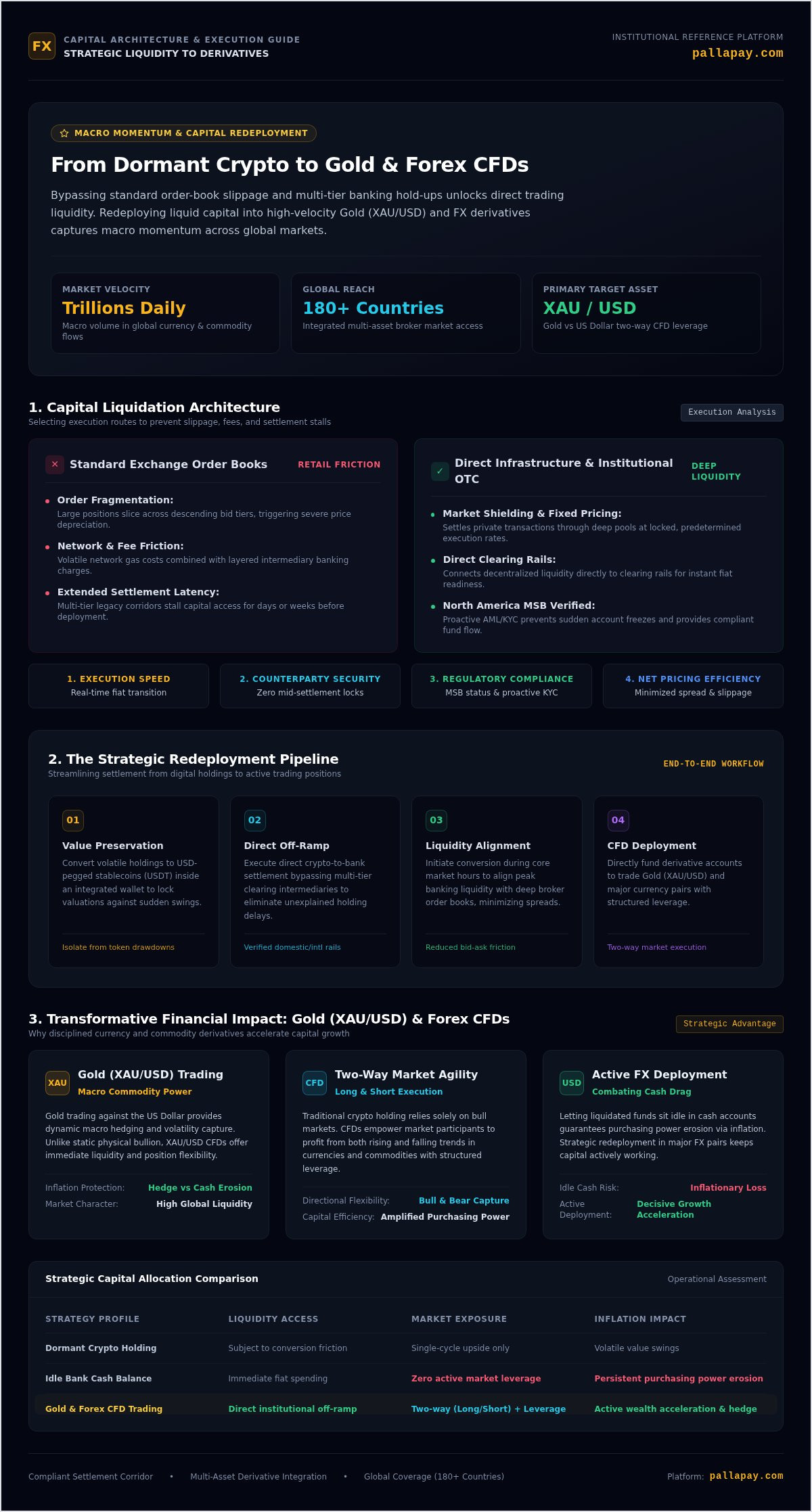
  • USDT Use Cases in 2026: Transforming Forex, Gold, and Global CFD Trading

    USDT Use Cases in 2026: Transforming Forex, Gold, and Global CFD Trading

    Why would a professional trader wait three days for a wire transfer to clear when the XAU/USD market moves in seconds? You’re likely tired of seeing your potential profits eroded by banking slippage and the excessive fees associated with traditional market entry. It’s frustrating when the inherent volatility of unpegged cryptocurrencies makes them unreliable as collateral for your most critical positions. Many sophisticated investors now choose to buy usdt for forex trading to bypass these legacy bottlenecks and secure immediate liquidity.

    This article reveals how USDT has evolved into the premier engine for professional Forex trading and Gold CFDs, enabling a total transformation of your financial strategy. You’ll discover the specific mechanics of USDT-paired Forex trades and learn how to leverage Gold CFDs for robust portfolio diversification. We’ll examine the operational shift toward real-time settlement and how this technology bridges the gap between traditional finance and modern efficiency. By the end, you’ll understand why Tether’s $183.3 billion market capitalization represents more than just a stablecoin; it’s the foundation for a more agile trading future in a world where gold has surpassed $4,600 per ounce.

    Key Takeaways

    • Learn how USDT serves as the primary liquidity bridge in 2026, allowing traders to bypass traditional banking delays and access global currency markets instantly.
    • Discover why professional investors choose to buy usdt for forex trading to secure millisecond execution speeds and maintain stable collateral for high-leverage positions.
    • Understand the mechanics of XAU/USD trading with USDT, enabling 24/7 exposure to gold markets without the friction of legacy commodity brokers.
    • Explore the institutional advantages of using regulated OTC desks to convert cash to digital assets, ensuring secure and compliant entry into the global CFD ecosystem.
    • Identify how stablecoin-integrated B2B settlements are transforming large-scale capital movement by reducing settlement times from days to mere minutes.

    What is USDT? The 2026 Standard for Professional Market Stability

    USDT represents the world’s most liquid stablecoin, serving as a sophisticated digital proxy for the US Dollar within the global financial ecosystem. It functions as “digital cash,” providing the rapid settlement capabilities of blockchain technology without the price swings typical of other digital assets. Professional traders utilize this stability to move capital across borders instantly, bypassing the three-to-five-day delays inherent in traditional banking systems. By maintaining a 1:1 peg with the dollar, it offers a reliable unit of account for complex international transactions.

    For those who choose to buy usdt for forex trading, the asset provides a level of reliability that Bitcoin or Ethereum cannot match. Volatile cryptocurrencies introduce unnecessary risk when used for account funding, as your collateral value could drop before you even place a trade. By managing capital through a secure Pallapay Wallet, you ensure your purchasing power remains intact while waiting for the perfect market entry. Tether (USDT) has become the definitive standard for this operational flow, bridging the gap between traditional fiat and the decentralized future.

    Why Stability Matters in Professional Trading

    Margin trading requires absolute precision. When you use volatile assets as collateral, you face the constant threat of “collateral liquidation” if the value of your margin asset drops independently of your trade. USDT eliminates this variable, allowing for predictability in margin requirements for high-leverage positions. This stability is particularly critical when trading Gold CFDs or major Forex pairs where even small price movements are amplified. USDT acts as the essential non-volatile bridge for modern CFD markets.

    The Evolution of Tether in 2026

    The financial landscape has matured significantly. As of September 2026, USDT’s market capitalization has climbed to $183.3 billion, backed by deep liquidity that supports institutional-grade volume. Regulatory advancements, including the full implementation of MiCA in the European Union, have shifted the perception of USDT from a speculative tool to a regulated institutional choice. Daily trading volumes now regularly exceed $48.09 billion, ensuring that large-scale traders can enter or exit positions without impacting the market price. Traders now view it as an active utility rather than a passive holding. This evolution allows for seamless integration into Forex brokerage environments, where it facilitates millisecond-level execution and immediate capital re-allocation across diverse global markets.

    USDT Use Cases in Forex and CFD Trading: Accelerating Capital Growth

    The global marketplace operates on a 24/7 cycle, yet traditional financial institutions still adhere to rigid banking hours and settlement windows. This discrepancy often forces traders to miss time-sensitive opportunities in the currency and commodity markets. When you buy usdt for forex trading, you effectively decouple your capital from the limitations of legacy systems like SWIFT or SEPA. This transition allows for near-instant funding of brokerage accounts, ensuring that your liquidity is always positioned where it can generate the highest return. By bypassing traditional intermediary fees, you retain a larger portion of your trading capital to fuel long-term financial growth.

    The integration of stablecoins into professional trading environments is no longer a niche practice. Recent analysis regarding stablecoin financial stability by the Federal Reserve underscores how these assets are becoming foundational to modern market infrastructure. For the individual trader, this means USDT serves as the primary liquidity pair for USD-based markets, offering a secure and transparent way to manage high-volume CFD positions without the friction of currency conversion at every step.

    Mastering Forex with USDT Pairs

    Trading major pairs such as EUR/USD or GBP/USD using USDT as the base currency provides a streamlined operational flow. It allows you to realize profits in a stable asset immediately, locking in gains without waiting for a bank to process your withdrawal. This speed is essential for scalp traders and day traders who require high turnover of their capital. Sophisticated participants often integrate the Pallapay Payment API to automate these transfers, ensuring that their trading bots or manual strategies are always backed by real-time liquidity.

    The Mechanics of CFD Trading

    Contracts for Difference (CFDs) allow you to speculate on price movements without owning the underlying asset, providing a powerful tool for capital acceleration through leverage. In this digital era, managing margin requirements becomes significantly more efficient when using USDT. Because the asset is pegged to the dollar, your margin calculations remain consistent, preventing the “margin creep” that occurs when using volatile cryptocurrencies as collateral. USDT eliminates the ‘weekend gap’ in traditional Forex funding because blockchain networks remain fully operational while global banking centers are closed. This continuous accessibility allows you to manage your risk and adjust your leverage at any hour of the day. For those looking to transition their gains into usable liquidity, exploring a professional crypto off-ramp can provide the final link in a successful trading cycle.

    Gold Trading (XAU/USD): Leveraging USDT for Millisecond Commodity Access

    Gold remains the ultimate safe haven for professional portfolios, especially given that central banks purchased a net 345 tonnes in the first half of 2026. While traditional investors struggle with physical delivery and high insurance premiums, professional traders use USDT to access synthetic gold exposure via CFDs. This approach provides millisecond precision for entering and exiting positions, a necessity when the price of gold has seen significant movements, reaching approximately $4,638 per ounce as of late August 2026. The shift toward digital settlement means you can react to global news cycles instantly rather than waiting for the next business day.

    Integrating gold into a digital strategy allows for superior portfolio diversification. By balancing the high-growth potential of currency markets with the stability of precious metals, you create a more resilient financial foundation. The ability to buy usdt for forex trading and then instantly reallocate those funds into XAU/USD positions ensures that your capital never sits idle. This strategy has become increasingly popular as central banks in China, India, and Turkey continue their de-dollarization efforts, providing structural support for gold’s long-term value.

    Why Trade Gold with USDT?

    Traditional bullion dealers often charge high spreads and recurring storage fees that eat into your margins. Trading Gold CFDs settled in USDT eliminates these overheads while providing the same exposure to price action. When you realize profits from a successful EUR/USD or GBP/USD trade, you can instantly hedge those gains into gold to protect against sudden dollar weakness. This digital format offers a psychological advantage, as it feels as liquid as cash while retaining the value-retention properties of a hard asset. XAU/USDT perpetual contracts allow for 24/7 trading with leverage, which is a significant upgrade over traditional gold futures that have set expiry dates and limited trading hours.

    XAU/USD Technical Integration

    Understanding the relationship between the US Dollar and gold is vital. Since USDT is pegged to the dollar, the XAU/USDT pairing closely tracks the traditional XAU/USD spot price. During periods of high commodity volatility, such as the geopolitical shifts seen in 2026, managing risk requires immediate liquidity. Traders can use Pallapay’s fiat settlement solutions to lock in gold profits directly into local currency. This ensures that a successful trade in the commodities market translates into tangible, real-world wealth without the delays of traditional banking off-ramps. This seamless flow from commodity gain to fiat liquidity is a cornerstone of modern financial transformation.

    USDT Use Cases in 2026: Transforming Forex, Gold, and Global CFD Trading

    Beyond the Trade: Institutional Utility and Cross-Border B2B Settlements

    USDT’s utility extends far beyond individual brokerage accounts. While many professionals buy usdt for forex trading, institutional entities use it to move large capital blocks across borders in minutes. This speed bypasses the traditional multi-day settlement cycles inherent in correspondent banking. It provides vital liquidity to emerging markets where local currencies often face high inflation or restricted access to USD. Globalized remote workforces also benefit, as companies use the asset to issue salary payments without the friction of international wire fees.

    USDT for Global Merchants

    Retailers and e-commerce platforms are increasingly adopting USDT for its stability and immediate finality. Unlike credit card transactions, blockchain-based settlements eliminate chargeback risks entirely. Businesses in e-commerce industries find that this reduces operational overhead and fraud loss. High-end hotels also use USDT for international bookings, ensuring that funds are secured instantly regardless of the guest’s home country banking restrictions. This shift toward stablecoin payments reflects a broader move toward a more efficient, borderless commercial landscape.

    Institutional Liquidity and OTC Desks

    Moving millions of dollars requires a sophisticated approach to avoid slippage or market impact. High-net-worth individuals and corporate entities rely on Over-the-Counter (OTC) desks to facilitate these high-volume transitions. Working with a regulated MSB provider in the US or Canada ensures that these large-scale operations remain compliant and secure. USDT has effectively become the lubricant of global digital trade, providing a frictionless medium for value exchange. This institutional-grade infrastructure is what allows professional traders to buy usdt for forex trading with the confidence that deep liquidity is always available. To experience professional-grade liquidity and secure settlement, exchange USDT through a regulated OTC platform today.

    The Path to Financial Transformation: Accessing USDT via Pallapay OTC

    The journey toward financial transformation concludes with a secure, high-speed gateway to the markets. While many retail platforms offer limited entry points, professional investors choose to buy usdt for forex trading via institutional OTC desks to ensure they have the necessary depth of liquidity. This professional experience bridges the gap between physical wealth and digital opportunity, allowing you to fund your strategies with precision. The ability to move from cash to a funded trading account in a single session is what separates modern traders from those still tethered to legacy banking delays. This agility is vital whether you are trading your own capital or participating in specialized programs; you can learn more about Reverse Trading to see how they provide unique opportunities for traders to explore unconventional account challenges.

    The physical OTC experience provides a level of service that purely digital applications can’t match. High-volume traders often prefer this method because it handles large capital blocks without the slippage or restrictive daily limits found on standard exchanges. You can visit a secure OTC location, complete a streamlined verification, and see your USDT arrive in your wallet in minutes. This immediate liquidity is what allows for the millisecond execution in Gold CFDs and major currency pairs. When it’s time to realize your gains, the Pallapay Off-Ramp service ensures your trading profits return to your bank or pocket with the same speed and security. This closed-loop system provides the agility needed to thrive in a 24/7 global economy.

    A Secure Ecosystem for Your Assets

    Operating within a regulated environment is non-negotiable for serious market participants. Pallapay is a regulated MSB in the USA and Canada, ensuring that every transaction meets rigorous institutional standards. This commitment to compliance provides the absolute trust and stability required to manage large-scale collateral for high-leverage positions. For a deeper look at maintaining your edge, our Crypto Security Guide offers the technical insights needed to protect your digital assets in the 2026 landscape. It’s a comprehensive resource for those who prioritize safety as much as growth.

    By choosing a partner that understands both the mechanics of commerce and the innovation of the blockchain, you position yourself at the forefront of the global economy. The Pallapay ecosystem serves as the definitive destination for your technical needs, from initial purchase to final settlement. It’s time to move beyond the limitations of traditional finance. Join the evolution of finance and start your trading journey today.

    Securing Your Competitive Edge in the Global Marketplace

    The integration of USDT into your trading strategy represents more than a technical upgrade; it’s a fundamental shift toward operational autonomy. By leveraging the speed of blockchain settlement, you eliminate the friction of legacy banking and secure millisecond execution for both Forex pairs and Gold CFDs. This agile approach ensures your capital is always positioned to capture volatility in the XAU/USD market without the burden of traditional storage fees or wire delays. Professional investors often choose to buy usdt for forex trading to maintain a constant state of market readiness while protecting their collateral from the volatility of unpegged assets.

    Success in modern commerce requires a partner that bridges the gap between digital innovation and institutional reliability. As a regulated MSB in the USA and Canada, Pallapay provides the secure infrastructure needed for high-volume transactions across 180+ countries globally. Our institutional-grade OTC desks are designed to handle complex capital movements with absolute discretion and speed. It’s time to take control of your financial evolution and trade with the confidence of a global industry leader.

    Start your financial transformation: Buy USDT with Cash at Pallapay and experience the future of professional trading today.

    Frequently Asked Questions

    What are the most common USDT use cases for professional traders in 2026?

    Professional traders primarily use USDT as a high-speed settlement layer for international currency markets and as stable collateral for leveraged positions. In 2026, it serves as the definitive bridge for moving capital between diverse asset classes like XAU/USD and major fiat pairs. Traders often choose to buy usdt for forex trading to ensure they can enter and exit positions without the multi-day delays associated with legacy banking systems.

    Can I use USDT to trade Forex and Gold CFDs directly on major platforms?

    Yes, a growing number of institutional and retail brokers like TradingPRO now accept USDT for deposits, withdrawals, and direct margin collateral. This integration allows you to trade EUR/USD or Gold CFDs with millisecond precision. By using USDT, you avoid the friction of converting between multiple fiat currencies, which is a transformative advantage for those managing diversified global portfolios. It simplifies the operational flow, making it easier to lock in profits from commodity price movements.

    How does USDT facilitate cross-border payments for global businesses?

    USDT facilitates cross-border payments by providing a blockchain-based alternative to the traditional SWIFT network. Global businesses use it to move large capital blocks in minutes rather than days, significantly improving cash flow management. This is particularly useful for B2B settlements in emerging markets where local currency volatility is high. By utilizing a stable digital asset, companies can ensure the value of their transfer remains consistent from the moment of dispatch to the final receipt.

    Is it possible to buy USDT with cash through a regulated MSB provider?

    Yes, professional traders can buy usdt for forex trading using cash through regulated Money Services Business (MSB) providers like Pallapay. This process typically occurs at a physical OTC desk where high-volume transactions are handled with institutional-grade security. Operating under official registrations in the United States and Canada, these providers ensure that every cash-to-crypto conversion is fully compliant with global financial regulations. This method is preferred by individuals who require immediate liquidity for their trading accounts.

    What are the advantages of using USDT over traditional bank transfers for trading?

    The primary advantages include 24/7 market access and near-instant settlement speeds that traditional banks cannot match. Bank transfers often involve intermediary fees and lengthy processing windows that can cause traders to miss critical market entries in the XAU/USD sector. USDT eliminates the “weekend gap” in funding, allowing you to rebalance your portfolio at any hour. This continuous availability provides a significant competitive edge in the fast-paced environment of modern CFD and Forex markets.

    How do I convert my USDT trading profits back into cash instantly?

    You can convert trading profits back into cash instantly by utilizing a professional crypto off-ramp or visiting an OTC exchange desk. Regulated providers allow for the immediate liquidation of digital assets into local currency, ensuring your gains are accessible for real-world use. For those who require ongoing liquidity, products like the Pallapay Mastercard offer a seamless way to spend USDT profits directly at millions of retail locations globally, bypassing the need for traditional bank withdrawals.

    Why is USDT preferred for high-leverage CFD trading compared to Bitcoin?

    USDT is preferred because its 1:1 peg to the US Dollar provides a stable unit of account for margin requirements. When you use Bitcoin as collateral, a sudden drop in its price can trigger a margin call even if your actual trade is performing well. This “collateral risk” is eliminated when using a stablecoin. Professional traders rely on this predictability to manage high-leverage positions in Forex and Gold markets without worrying about the volatility of their underlying funding asset.

    Is USDT a safe asset for long-term financial planning and market collateral?

    USDT has matured into a reliable institutional asset, supported by a market capitalization that exceeded $183 billion in late 2026. Its integration with regulated MSB infrastructure and widespread adoption by global brokers makes it a secure choice for market collateral. While no asset is without risk, the transparency provided by modern regulatory frameworks like MiCA has bolstered its position as a safe haven for traders. It serves as a dependable foundation for long-term financial strategies and portfolio diversification.

    Disclaimer

    The information provided on this website and blog is for general informational and educational purposes only and does not constitute financial, investment, legal, tax, or other professional advice.
    Cryptocurrency and digital asset services may be subject to regulatory restrictions in certain jurisdictions. Users are solely responsible for ensuring compliance with applicable local laws and regulations before using any products or services mentioned on this website.
    PallaPay does not guarantee the accuracy, completeness, or timeliness of any information published and accepts no liability for any loss or damages arising from reliance on the content. Any opinions expressed are those of the respective authors and may change without notice.
    Certain services, features, or products referenced may be provided through third-party partners, licensed entities, or affiliated service providers subject to separate terms and regulatory approvals. Availability of services may vary by country or region.
    This website may contain references to digital assets, virtual currencies, or blockchain-related services that are not available to residents of certain jurisdictions, including where prohibited by law. Nothing on this website constitutes an offer, solicitation, or recommendation to buy or sell any financial instrument or virtual asset.