

Your business growth isn’t just limited by your sales; it’s throttled by the legacy systems that process them. In 2026, relying on 3-5 day settlement cycles and high SWIFT fees is no longer a standard business cost; it’s a strategic liability. When evaluating a crypto payment gateway vs bank transfer for merchants, the choice defines whether your capital remains stagnant or moves at the speed of global markets. Traditional transfers often leave profit margins vulnerable to currency devaluations while you wait for funds to clear.
You’ve likely felt the frustration of watching market opportunities pass by while your revenue is locked in transit. It’s a common pain point for global businesses seeking more than just a simple way to accept payments. You deserve a financial ecosystem that treats your revenue as an active asset rather than a pending balance.
This guide reveals how modernizing your checkout process can accelerate your settlement speeds and unlock advanced financial growth through Gold and USD CFD trading. We’ll explore how near-instant global settlements provide the immediate liquidity needed to leverage XAU/USD market movements, turning your daily revenue into a sophisticated tool for wealth preservation and capital expansion.
Key Takeaways
- Learn how to eliminate multi-day settlement delays by transitioning from legacy banking intermediaries to direct blockchain-to-merchant protocols.
- Analyze the operational advantages of a crypto payment gateway vs bank transfer for merchants to achieve near-instant liquidity and reduced transaction overhead.
- Discover how to leverage business revenue for wealth preservation through integrated Gold (XAU/USD) and USD CFD trading opportunities.
- Navigate global compliance requirements with ease using an ecosystem backed by official MSB registrations in the United States and Canada.
- Explore how unified tools like the Crypto POS Machine bridge the gap between physical retail operations and advanced digital asset management.
Understanding the Shift: Crypto Payment Gateways vs. Traditional Bank Transfers
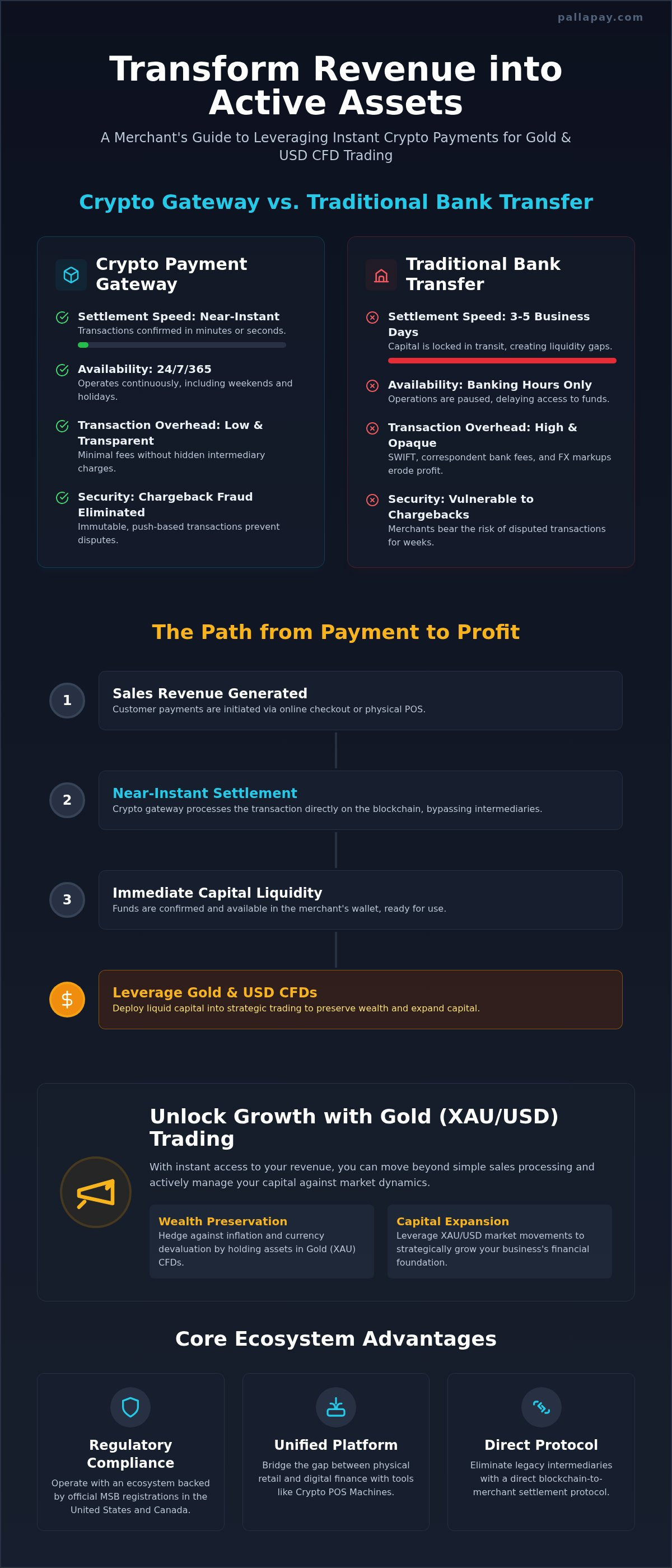
Modern commerce requires a fundamental rethink of how value moves across borders. Traditional bank transfers, primarily operating through the SWIFT or SEPA networks, are multi-intermediary processes that rely on a chain of legacy institutions. In contrast, a crypto payment gateway functions as a direct blockchain-to-merchant protocol. When comparing a crypto payment gateway vs bank transfer for merchants, the primary distinction lies in the architectural path the funds take. One path is cluttered with administrative hurdles; the other is a streamlined digital highway designed for the speed of the 2026 economy.
The Intermediary Problem in Traditional Banking
Traditional banking isn’t a straight line. When you initiate a global wire, the money often passes through multiple correspondent banks before reaching its destination. Each institution in this chain performs its own compliance checks and manual reviews, which directly causes the 3-5 day settlement delay common in the industry. These middlemen also introduce friction in the form of hidden currency conversion fees and wire charges that erode profit margins. There’s also the persistent risk of funds being frozen during a review process, leaving your business cash flow in a state of uncertainty. While a standard payment gateway for credit cards handles authorization, the underlying banking settlement remains tied to these antiquated schedules.
How Crypto Gateways Bypass Legacy Friction
Crypto gateways operate on a peer-to-peer model that removes the need for centralized clearinghouses. Transactions are verified by decentralized networks and settled directly into your merchant wallet. This system operates 24/7/365, meaning your revenue isn’t subject to banking holidays or weekend closures. By utilizing a sophisticated payment API, businesses can automate these flows for high-volume operations. This shift to instant settlement acts as a powerful business catalyst, providing immediate access to capital for reinvestment. Instead of waiting for a bank to release your funds, you can immediately convert revenue into high-performance assets like Gold or USD CFDs to hedge against inflation. Choosing a crypto payment gateway vs bank transfer for merchants allows you to capture value in real-time rather than waiting for a legacy system to catch up. A crypto gateway is a 2026 essential for global e-commerce, serving as the professional bridge between daily sales and sophisticated financial growth.
Operational Efficiency: Comparing Transaction Speeds and Scalability
Operational efficiency is the heartbeat of any scaling enterprise. When comparing a crypto payment gateway vs bank transfer for merchants, the most visible difference appears in the status of your capital. Traditional bank transfers often linger in a “Pending” state for 2 to 5 business days, creating a liquidity gap that hinders growth. In contrast, blockchain transactions achieve a “Confirmed” status on-chain within minutes or even seconds. This rapid finality eliminates the “middleman” delays discussed previously, ensuring that your revenue is ready for immediate deployment.
A significant operational advantage of crypto payments is the elimination of chargeback fraud. Traditional banking allows customers to dispute transactions weeks after the sale, often leaving merchants with lost inventory and additional fees. Since blockchain transactions are push-based and immutable, once they’re confirmed, the funds are secure. For high-volume businesses, managing these flows requires robust automation. Integrating a sophisticated Pallapay Payment API allows merchants to handle thousands of transactions simultaneously without the manual oversight required by legacy wire systems.
The Architecture of Instant Settlements
The speed of a crypto gateway isn’t just about the transfer; it’s about the verification. A gateway verifies funds across decentralized nodes in real-time. To mitigate the volatility of digital assets, merchants often utilize stablecoins like USDT. This ensures that the value received matches the invoice precisely. By using automated fiat settlements, businesses can instantly bridge their digital revenue into local currency or stable assets, maintaining a stable balance sheet while enjoying the speed of the blockchain.
Cost Analysis: Network Fees vs. Banking Commissions
Traditional cross-border commissions and credit card fees, which often range from 2.5% to 3.49%, can significantly drain revenue. High-volume merchants often save thousands annually by switching to crypto networks where fees typically range from 0.23% to 1%. Unlike the opaque fee structures of correspondent banks, blockchain ledgers provide a transparent, immutable record for accounting and auditing. This clarity simplifies financial reporting and allows for more precise treasury management. If you’re ready to optimize your overhead, you can start managing your digital assets with our secure ecosystem today.
Financial Transformation: Leveraging Gold and USD CFDs for Merchant Growth
Traditional business models often treat revenue as a stagnant balance waiting for clearance. When analyzing a crypto payment gateway vs bank transfer for merchants, the most profound advantage isn’t just the lower fee; it’s the speed at which revenue becomes an investable asset. By eliminating the multi-day lag of legacy banking, you transition from a passive merchant to an active financial strategist. This immediate liquidity allows you to redirect daily sales into high-performance markets, transforming your business treasury from a simple cash reserve into a vehicle for institutional-level growth. You no longer have to wait for a bank to authorize your own capital before you can act on market signals.
The Power of Gold Trading in 2026
Gold remains the definitive safe-haven asset for protecting profit margins against fiat currency devaluations. In the first quarter of 2026, central banks continued a strong buying trend by purchasing 244 tonnes of gold, signaling its enduring role in global wealth preservation. This follows a massive inflow of 801.2 tonnes into gold-backed ETFs in 2025. Merchants can now use crypto-settled revenue to enter the XAU/USD market instantly. Trading Gold CFDs provides the benefit of price exposure without the logistical burdens of physical custody. With gold trading near $4,400 per ounce in August 2026, keeping a portion of your revenue in gold-linked assets ensures that your hard-earned capital maintains its purchasing power even during periods of intense market volatility. It’s a reliable method for securing the long-term stability of your business revenue.
Maximizing Returns with USD CFD Trading
USD CFD trading offers a sophisticated path for merchants to capitalize on the constant fluctuations of the global currency markets. This isn’t just about hedging; it’s about active growth. Through a professional forex account, you can use leverage to amplify your market position, allowing your business revenue to work harder than it ever could in a standard savings account. This strategic approach to treasury management can fundamentally change an individual’s financial life by diversifying income streams beyond core business operations. Instead of letting your capital sit idle in a “pending” bank queue, you can capture opportunities in the USD market the moment a sale is confirmed on the blockchain. This level of agility is what separates modern, tech-forward merchants from those still tethered to the slow rhythms of traditional finance.
Security and Compliance: Navigating the 2026 Regulatory Landscape
Security is the foundation of institutional financial reliability. When choosing a crypto payment gateway vs bank transfer for merchants, the regulatory framework is as critical as the underlying technology. While traditional banks rely on legacy internal audits, a regulated gateway operates under rigorous, modern oversight designed for digital assets. Pallapay maintains official Money Services Business (MSB) registrations in both the United States and Canada. This ensures that every transaction adheres to the highest standards of financial integrity. This provides a level of institutional-grade security that bridges the gap between disruptive innovation and traditional stability.
Robust Know Your Customer (KYC) and Anti-Money Laundering (AML) protocols are not just regulatory requirements; they’re essential tools for merchant safety. These processes prevent illicit activity from entering the ecosystem, protecting your business accounts from the risks associated with fraudulent actors. By verifying every participant, the platform ensures that your revenue remains untainted and your path to trading Gold and USD CFDs remains clear and compliant. This proactive stance on safety allows you to focus on the transformative potential of your financial strategy rather than administrative risks.
Global Compliance Standards
Operating in over 180 countries requires a deep commitment to varying international standards. A regulated gateway protects you from “tainted” digital assets by using advanced chain analysis to monitor the provenance of funds. This proactive approach ensures that your business stays ahead of the EU’s Markets in Crypto-Assets (MiCA) requirements and the US GENIUS Act frameworks. It also prepares your treasury for upcoming shifts like the proposed SEC Regulation Crypto Assets. Working with a global leader provides the peace of mind necessary to focus on growth. For a deeper look at these protections, you can explore our crypto security guide.
Technical Protection Measures
Beyond compliance, technical safeguards like multi-signature (multi-sig) protocols and cold storage ensure that merchant funds are never vulnerable to single points of failure. End-to-end encryption secures all payment data, while 2FA and Hardware Security Modules (HSM) protect your merchant dashboard from unauthorized access. These measures extend to the final stages of the transaction lifecycle, ensuring a secure off-ramp when you decide to convert your trading profits or revenue back into fiat. To secure your business future, you should open your professional crypto wallet and begin your transition to a more resilient financial model today.
Implementing the Solution: How Pallapay Bridges Commerce and Trading
Adopting a modern financial infrastructure is more than a technical upgrade; it’s a strategic pivot. When evaluating a crypto payment gateway vs bank transfer for merchants, the ability to manage the entire financial lifecycle on a single, unified platform is the ultimate differentiator. Legacy systems force you to move funds through multiple disconnected institutions, each adding delays and fees. Pallapay integrates these flows, allowing you to accept digital assets at the point of sale and immediately execute a Gold CFD trade without leaving the ecosystem. This synergy ensures that your capital is always positioned for growth, moving effortlessly from a customer’s wallet to your professional trading account.
Large-scale operations often require specialized handling to maintain market efficiency. The integration between the merchant gateway and the OTC (Over-the-Counter) desk allows for high-volume conversions and trades with minimal slippage. This professional-grade infrastructure is essential for businesses that want to convert significant revenue into USD-pegged assets or commodity markets. By consolidating these services, you eliminate the friction of moving funds between external brokers and banks, maintaining a secure and efficient chain of custody for all business revenue.
Seamless Integration for E-commerce and Retail
The transition to a digital-first economy requires tools that work across every sales channel. For global online businesses, the E-commerce gateway provides a streamlined checkout experience that settles in real-time. Physical retail locations can achieve the same level of agility by deploying a Crypto POS Machine, which bridges the gap between in-person commerce and digital asset management. Both channels feed into a unified dashboard, giving you a comprehensive view of your sales and trading performance. This visibility allows you to make informed decisions about when to hold revenue and when to capitalize on XAU/USD market movements.
Your Journey to Financial Evolution
Viewing your revenue as a static balance is a relic of the traditional banking era. In the 2026 landscape, your sales are a dynamic tool for financial transformation. Pallapay builds the professional bridge that connects established commercial practices with modern financial innovation. You can start this evolution today by integrating our secure payment API into your existing workflow. This simple step grants you immediate access to near-instant settlements and the sophisticated world of Gold and USD CFD trading. Instead of waiting for a legacy bank to clear your funds, you can begin diversifying your income streams and preserving your wealth the moment your next sale is confirmed.
Securing Your Competitive Edge in the 2026 Economy
The choice between a crypto payment gateway vs bank transfer for merchants isn’t just a technical preference; it’s a decision about the velocity of your capital. By moving beyond the multi-day settlement delays of legacy banking, you secure the immediate liquidity required to transform your business revenue into a high-performance asset. Whether you’re hedging against inflation through Gold CFDs or capitalizing on market movements with USD trading, the ability to pivot instantly defines a modern financial leader.
Pallapay offers a professional bridge between traditional commerce and advanced digital finance. As a regulated MSB in the United States and Canada, our ecosystem is trusted by merchants in over 180 countries to provide secure payments, integrated POS solutions, and institutional OTC trading. You don’t have to remain tethered to antiquated systems that throttle your growth. Instead, you can adopt a unified destination for all your technical and financial needs.
Empower your business with Pallapay’s Crypto Payment Gateway today and take the first step toward a more resilient financial future. Your journey to global expansion and wealth preservation starts with a single, strategic integration.
Frequently Asked Questions
Is a crypto payment gateway more expensive than a bank transfer for merchants?
No, crypto gateways are typically more cost-effective than legacy systems. While traditional bank transfers and credit card processors often charge between 2.5% and 3.5%, crypto transaction fees generally range from 0.23% to 1%. This reduction in overhead allows businesses to retain more profit. When evaluating a crypto payment gateway vs bank transfer for merchants, the savings on cross-border wire charges and currency conversion fees further enhance the financial advantage of digital assets.
How long does it take for a merchant to receive fiat after a crypto payment?
Merchants can receive fiat settlements near-instantly or within minutes depending on the network used. Unlike traditional bank transfers that require 2 to 5 business days for funds to clear, blockchain protocols provide immediate finality. This rapid settlement cycle ensures that your revenue is available for reinvestment or trading without the administrative delays of legacy banking. It’s a seamless transition from digital payment to usable capital through automated fiat conversion tools.
Can I trade Gold and USD CFDs directly using my merchant revenue?
Yes, you can leverage your daily revenue to enter commodity and currency markets. Once your sales are settled, you can immediately redirect those funds into a forex account to trade Gold (XAU/USD) or USD CFDs. This capability transforms your revenue from a stagnant balance into a dynamic tool for wealth preservation and capital growth. It allows you to hedge against fiat inflation while capitalizing on global market movements the moment a sale is confirmed.
What are the main security risks for merchants accepting cryptocurrency?
The primary risks include price volatility, the potential for receiving “tainted” funds, and wallet security. Regulated gateways mitigate these risks by using real-time chain analysis to screen incoming transactions and offering instant fiat conversion to lock in value. Utilizing institutional-grade security measures like multi-signature protocols and cold storage further protects your assets. Choosing a provider with official MSB registrations ensures that your operations remain compliant with global safety standards and protected from illicit activity.
Do I need a separate merchant account to use a crypto payment gateway?
You don’t need a traditional merchant bank account to begin accepting digital assets. A crypto payment gateway operates as a standalone protocol that settles funds directly into your digital wallet. This independence allows you to bypass the restrictive requirements often imposed by legacy financial institutions. If you prefer to settle in local currency, the gateway can integrate with your existing bank account to facilitate seamless fiat off-ramps after the blockchain transaction is confirmed.
How does a crypto gateway handle the volatility of Bitcoin or Ethereum?
Gateways manage volatility by providing instant conversion to stablecoins like USDT or local fiat currencies at the moment of transaction. This ensures that the merchant receives the exact value specified on the invoice, regardless of price fluctuations in the broader market. When comparing a crypto payment gateway vs bank transfer for merchants, this real-time conversion removes the market risk typically associated with holding digital assets, providing the stability required for professional business accounting.
Is Pallapay regulated for US and Canadian business operations?
Yes, Pallapay is a fully regulated Money Services Business (MSB) in both the United States and Canada. These official registrations reflect a commitment to institutional financial reliability and strict compliance with anti-money laundering (AML) and know-your-customer (KYC) regulations. This regulatory standing provides merchants with the absolute trust and stability needed to conduct global commerce confidently across 180 countries while ensuring that all trading and payment activities remain within established legal frameworks.
Can I use a crypto POS machine in my physical retail location?
Yes, physical retail stores can easily integrate crypto payments using a dedicated Crypto POS Machine. These devices function similarly to traditional card terminals but are optimized for blockchain transactions. They allow customers to pay via mobile wallets, while the merchant receives confirmed funds in their dashboard. It’s a simple way for retail businesses to join the digital evolution, offering customers more flexibility while providing the merchant with immediate access to revenue for advanced trading strategies.
Disclaimer
The information provided on this website and blog is for general informational and educational purposes only and does not constitute financial, investment, legal, tax, or other professional advice.
Cryptocurrency and digital asset services may be subject to regulatory restrictions in certain jurisdictions. Users are solely responsible for ensuring compliance with applicable local laws and regulations before using any products or services mentioned on this website.
PallaPay does not guarantee the accuracy, completeness, or timeliness of any information published and accepts no liability for any loss or damages arising from reliance on the content. Any opinions expressed are those of the respective authors and may change without notice.
Certain services, features, or products referenced may be provided through third-party partners, licensed entities, or affiliated service providers subject to separate terms and regulatory approvals. Availability of services may vary by country or region.
This website may contain references to digital assets, virtual currencies, or blockchain-related services that are not available to residents of certain jurisdictions, including where prohibited by law. Nothing on this website constitutes an offer, solicitation, or recommendation to buy or sell any financial instrument or virtual asset.
Leave a Reply