Tag: instant settlement

  • Gateway Financial Solutions: The 2026 Guide to Digital Payment Infrastructure

    Gateway Financial Solutions: The 2026 Guide to Digital Payment Infrastructure

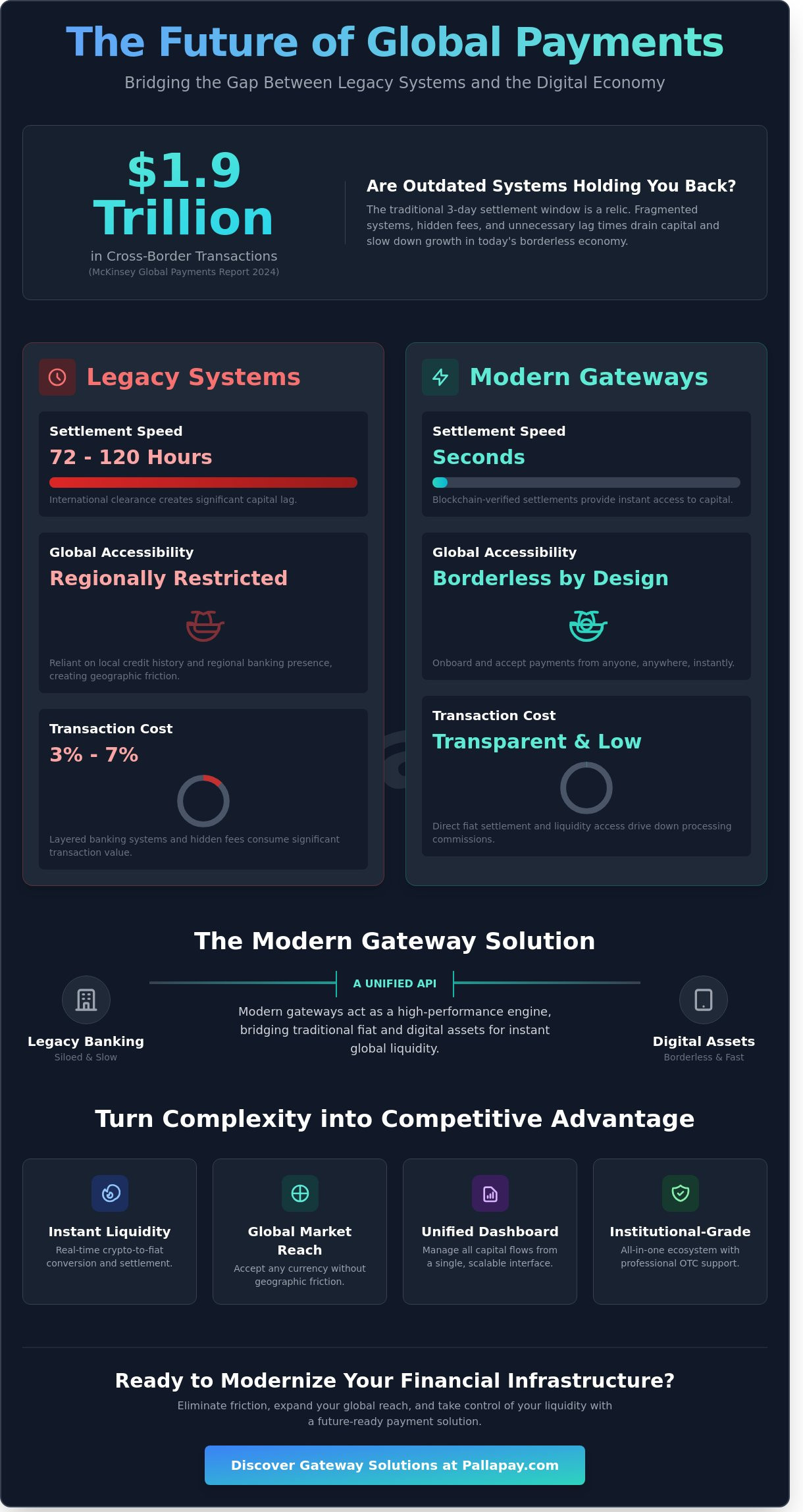
    By 2026, the traditional three day settlement window will be viewed as a financial relic. While the 2024 McKinsey Global Payments Report highlighted that cross-border transaction volumes reached $1.9 trillion, many enterprises still struggle with fragmented systems that drain capital through hidden fees and unnecessary lag times. You likely feel the daily friction of managing separate silos for traditional banking and digital assets, especially when your expansion depends on rapid, reliable liquidity. It’s clear that the old ways of moving money can’t keep pace with a borderless economy, and finding efficient gateway financial solutions is now a requirement for survival.

    This guide demonstrates how modern financial infrastructure bridges the gap between legacy systems and digital assets for the future of payments. You’ll discover how to transition from complex, slow settlement processes to a unified environment that offers instant settlement in fiat and absolute control over global liquidity. We’ll preview the technical shift toward scalable dashboards that simplify crypto-fiat integration, allowing your business to expand without the heavy lifting of legacy banking constraints. This is the roadmap for turning technological complexity into a clear competitive advantage.

    Key Takeaways

    • Understand how modern infrastructure connects global liquidity to your business, moving beyond legacy systems to embrace the future of payments.
    • Learn the technical mechanics behind fiat-to-crypto bridging that allow for secure, real-time conversion of digital assets into local currency.
    • Discover how to eliminate transaction friction and expand your global market reach by instantly accepting payments in any currency.
    • Master the criteria for selecting gateway financial solutions that align with your business goals, focusing on optimized fee structures and geographic coverage.
    • Explore the advantages of an all-in-one financial ecosystem that provides instant USDT-to-fiat conversion and professional OTC support for institutional growth.

    What Are Gateway Financial Solutions in the 2026 Digital Economy?

    The 2026 digital economy requires more than simple transaction processing; it demands a sophisticated infrastructure that links merchants directly to global liquidity pools. While historical references to gateway financial solutions often pointed toward 20th-century auto lending models, the modern definition has pivoted entirely. Today, these solutions represent the essential bridge between merchant storefronts and institutional-grade financial tools. This shift ensures that even small-scale enterprises can access the same settlement speeds as global conglomerates.

    A modern Payment service provider functions as a global enabler. It removes the friction inherent in traditional banking by providing a unified entry point for diverse capital flows. By 2026, the integration of blockchain technology has made cross-border efficiency a standard requirement rather than a premium feature. Businesses don’t accept the limitations of siloed financial systems anymore. They seek an all-in-one ecosystem that handles everything from crypto-fiat conversion to instant liquidity management. This is the core of modern gateway financial solutions, where technology handles the heavy lifting of global commerce.

    The Evolution of Financial Gateways

    The transition from 1995-era credit models to 2026-style instant settlement marks a total paradigm shift. Early financial solutions focused on localized credit scoring and manual verification. Digital assets have completely rewritten this playbook. Modern gateways prioritize real-time verification and decentralized security protocols. This evolution has moved the industry away from fragmented service providers toward comprehensive platforms. These ecosystems offer a single payment API that connects a business to the entire global market instantly, ensuring that growth is never hindered by technical debt.

    Legacy vs. Modern Gateways: A Comparison

    The gap between legacy systems and modern infrastructure is defined by three critical metrics: speed, accessibility, and cost structure. Modern gateways provide a level of utility that 20th-century banks simply cannot match.

    • Speed: Legacy bank transfers typically require 72 to 120 hours for international clearance. Modern gateways utilize blockchain-verified settlements to achieve results in seconds, providing instant access to capital.
    • Accessibility: Traditional models rely on local credit history and regional banking presence. Modern solutions offer global merchant onboarding, allowing a business in Dubai to accept payments from London or Tokyo without geographic friction.
    • Cost: Layered banking fees often consume 3% to 7% of cross-border transaction value. Modern processing commissions are transparent and significantly lower, driven by direct fiat settlement and direct liquidity access.

    This efficiency is the hallmark of the Future of Payments. By democratizing access to these tools, fintech leaders ensure that institutional reliability is available to every merchant on the planet. The result is a more inclusive economy where the size of a company doesn’t dictate the quality of its financial tools.

    The Technical Architecture of Modern Payment Gateways

    Modern gateway financial solutions require more than just a simple connection to a banking network; they demand a high-performance engine capable of processing thousands of transactions every second. A robust architecture in 2026 is defined by its ability to handle immense load without compromising security or speed. This infrastructure relies on a modular design where each component, from the user interface to the ledger, operates independently to prevent systemic failure. To maintain resiliency in digital payment systems, industry leaders now prioritize redundant server clusters and real-time data mirroring across multiple geographic regions.

    The mechanism of fiat-to-crypto bridging is the core of this evolution. When a customer pays in cryptocurrency, the gateway must execute a real-time conversion to fiat currency to protect the merchant from market volatility. This process happens in milliseconds. By 2026, API-first design has become the gold standard, allowing businesses to embed these complex financial tools directly into their existing software. Merchants need global accessibility, so the infrastructure must support MSB (Money Services Business) registrations in jurisdictions like the US and Canada. Compliance with FinCEN and FINTRAC regulations ensures that every transaction is backed by institutional-grade oversight.

    Fiat Settlement and Liquidity Management

    High-volume fiat settlement is achieved through a sophisticated network of liquidity providers. To prevent slippage on large transactions, gateways utilize institutional OTC desks that provide deep liquidity pools. This ensures a 1:1 value preservation during the conversion process, meaning the price the customer sees is the exact amount the merchant receives. Instant settlement has become the baseline expectation for global commerce. If a business processes $500,000 in a single day, the gateway manages the treasury flow behind the scenes to keep capital moving without delays.

    Security Protocols and Compliance

    Security is the foundation of The Future of Payments. Modern gateways employ AES-256 encryption standards to protect customer data during transit. Compliance is no longer a manual burden; KYC and AML automation now verify identities across 180+ countries in under 60 seconds. To secure the underlying funds, 98% of digital assets are held in cold storage. Multi-sig wallets require multiple authorized signatures before any significant transfer occurs, which effectively eliminates the risk of internal or external theft. This multi-layered approach creates a secure environment where merchants can focus on growth rather than fraud prevention.

    For businesses ready to modernize their checkout experience, implementing a professional payment API is the most efficient way to achieve global scale.

    Strategic Benefits for Global E-commerce and Retail

    Modern commerce demands a borderless approach. Implementing robust gateway financial solutions allows merchants to capture value from a global audience without the traditional hurdles of currency conversion. By 2026, cross-border e-commerce is projected to reach $3.3 trillion according to Statista. This growth relies on the ability to accept payments in any currency, including digital assets, while ensuring immediate liquidity. Businesses that fail to adapt to these shifting consumer preferences risk losing market share to more agile competitors.

    Speed defines the winner in the digital economy. We use “Instant” as our rhythmic anchor because delays represent lost revenue. Transaction friction is the primary cause of cart abandonment, which averaged 70% across industries in 2023. Efficient gateways remove these barriers, providing a “problem-solution” flow that satisfies the customer’s need for speed. Real-time reporting through merchant dashboards provides the visibility needed to optimize cash flow, allowing for smarter inventory and staffing decisions based on live data. Secure, branded checkout experiences reinforce customer trust, ensuring that the final step of the buyer journey is as professional as the first.

    Empowering Modern E-commerce

    Forward-thinking e-commerce businesses are moving toward crypto-integrated gateways to bypass legacy banking delays. Chargeback fraud remains a significant threat, costing merchants nearly $100 billion in 2023 according to Juniper Research. Blockchain-verified finality eliminates this risk by making transactions irreversible once confirmed. Developers use our payment APIs to build custom checkout flows that match their brand identity perfectly. This technical flexibility ensures a seamless transition from cart to completion, making the complex world of crypto-fiat conversion feel like a standard business operation. It’s the definitive way to secure global revenue.

    This transition is not limited to consumer retail; specialized B2B providers in the scientific sector, such as peakhaven.com.au, utilize these advanced payment structures to facilitate the global distribution of high-purity research peptides and laboratory supplies without the friction of traditional banking.

    Bridging the In-Store Experience

    The digital-physical divide is closing rapidly. The adoption of the crypto POS machine allows physical retail locations to accept digital assets at the counter as easily as credit cards. This is particularly vital for luxury retailers and hotels and hospitality groups handling high-value bookings. For example, a luxury hotel can process a $50,000 suite reservation instantly without the 3% to 5% fees often associated with international wire transfers or premium credit cards. These gateway financial solutions simplify the complex logistics of high-net-worth tourism, providing a sophisticated experience for the guest and guaranteed settlement for the provider. It’s a clear manifestation of The Future of Payments in a physical environment.

    Implementation: Choosing the Right Gateway for Your Business

    Selecting a gateway financial solutions provider is a critical infrastructure decision that dictates your operational scale. In 2026, the distinction between a standard processor and a strategic partner lies in the fee structure. High-volume merchants often find subscription models more predictable for long-term forecasting, while startups might prefer commission-based pricing to align costs with early-stage revenue. Beyond the ledger, geographic presence remains a decisive factor. A provider with physical operations in financial hubs like Dubai or Singapore offers local regulatory alignment and jurisdictional stability that remote-only entities cannot match.

    Integration speed defines your time-to-market. Modern payment API solutions allow dev teams to deploy functional checkouts in under six hours, whereas legacy systems often require weeks of manual configuration. This technical agility must be backed by 24/7 institutional-grade support. When a transaction hangs at 3:00 AM in a different time zone, a chatbot isn’t enough; you need immediate access to a dedicated account manager who understands the nuances of cross-border liquidity.

    The Checklist for Gateway Selection

    Verification starts with compliance. Ensure your partner holds active MSB registrations and regional licenses from authorities like Dubai’s VARA or Singapore’s MAS. Your chosen gateway financial solutions must support a diverse asset pool, including USDT, BTC, ETH, and local fiat currencies, to capture global demand. Evaluate the developer documentation before signing any contracts. A robust API sandbox is essential for testing “The Future of Payments” without risking live capital, ensuring that 99.9% of technical friction is resolved before the first customer arrives.

    Avoiding Common Integration Pitfalls

    Efficiency is often lost in the fine print of settlement times. Many providers advertise instant processing but hide 48-hour withdrawal delays or tiered withdrawal fees that erode margins. Another frequent oversight is the quality of the merchant dashboard. If your finance team can’t generate real-time reports or manage liquidity with one click, the system becomes a bottleneck. Finally, always stress-test for scalability. A gateway that handles 100 transactions per minute might fail during a 500% traffic surge on peak shopping days, making high-traffic testing a non-negotiable step.

    Ready to scale your infrastructure? Experience instant fiat settlement with Pallapay today.

    The Pallapay Advantage: An All-in-One Financial Ecosystem

    Pallapay serves as the definitive bridge between traditional banking structures and the decentralized future. It eliminates the friction typically associated with digital asset management by providing comprehensive gateway financial solutions that cater to both retail users and institutional entities. The platform facilitates instant USDT-to-Fiat conversion, supported by a global Over-the-Counter (OTC) desk network. This infrastructure ensures that high-volume transactions remain stable and secure, even during periods of market volatility. Businesses no longer need to wait days for settlement; they receive liquidity when they need it most.

    Institutional-scale operations require more than just software; they demand a regulated environment where security is the baseline. Pallapay meets this need by adhering to strict compliance standards across multiple jurisdictions, ensuring that every transaction is documented and safe. The Pallapay Mastercard extends this utility into the physical world. It allows users to access instant liquidity, converting digital holdings into spendable currency at millions of points of sale worldwide. This ecosystem doesn’t just store value; it makes value mobile and functional for the modern executive.

    Global Presence, Local Expertise

    Trust is built through physical presence and transparent operations. Pallapay operates strategic offices in Dubai, NYC, and Singapore to provide localized support for a global client base. This physical footprint allows for unique services, such as the ability to sell USDT for cash in Dubai through secure, face-to-face transactions. By combining global reach with local regulatory expertise, Pallapay ensures every transaction follows the specific legal requirements of the region. It’s a level of accountability that digital-only platforms simply can’t match.

    The Future of Payments is Here

    The next decade of commerce will be defined by speed and borderless access. Pallapay is actively redefining crypto payment gateways by removing the technical barriers that once hindered mass adoption. The network currently supports merchants in 180+ countries, providing a unified standard for gateway financial solutions in the digital age. This global reach ensures that businesses can scale without worrying about the limitations of legacy banking systems. Every tool in the Pallapay suite is designed for instant execution, reflecting the real-time nature of 2026’s economy.

    Integration is the final step toward financial modernization. Join a network that prioritizes security, speed, and institutional reliability. Start your integration today and position your business at the forefront of the financial evolution.

    Mastering Global Commerce in the 2026 Digital Economy

    Success in the 2026 digital landscape depends on a business’s ability to bridge the gap between traditional fiat and blockchain innovation. Modern gateway financial solutions must provide instant settlement to eliminate the friction typically associated with cross-border trade. By implementing a unified technical architecture, companies can scale operations across 180+ countries while maintaining institutional security. These systems don’t just process payments; they provide the liquidity and stability required for sustainable global growth.

    Pallapay delivers this professional bridge as an MSB registered entity in both the USA and Canada. Our award-winning crypto POS and gateway infrastructure empower merchants to accept digital assets with the same ease as standard currency. With physical OTC desks providing real-time support, we handle the technical complexity so you can focus on expansion. It’s the most efficient way to modernize your financial stack and ensure your business remains a leader in an evolving market.

    Experience the Future of Payments with Pallapay

    We look forward to helping you build a faster, more secure financial future today.

    Frequently Questions and Answers

    What exactly is a gateway financial solution in a business context?

    A gateway financial solution is the digital infrastructure that authorizes and processes payments between a merchant and their customers. In 2026, this technology acts as a bridge that connects traditional banking systems with decentralized blockchain networks. It ensures that sensitive data is encrypted and transmitted securely to the relevant financial institutions. This “all-in-one” approach provides a single point of entry for diverse payment methods, streamlining global commerce for modern enterprises.

    How does a crypto payment gateway differ from a traditional merchant account?

    A crypto gateway facilitates the transfer of digital assets directly on the blockchain, whereas a traditional merchant account relies on legacy banking rails like ACH or SWIFT. Traditional accounts often involve 3 to 5 intermediaries, which can delay settlement for up to 72 hours. In contrast, a crypto gateway reduces these touchpoints to a single protocol. This efficiency allows for near-instant verification and significantly lower operational overhead for international trade.

    Is it secure to use a third-party gateway for high-volume transactions?

    Yes, third-party gateways are highly secure because they utilize PCI DSS Level 1 certification and advanced AES-256 encryption. Modern solutions in 2026 incorporate Multi-Party Computation to eliminate single points of failure in private key management. According to the 2025 Cybersecurity Ventures report, businesses using specialized fintech gateways reduced their fraud exposure by 45% compared to legacy systems. This architecture ensures high-volume traffic remains protected against evolving digital threats.

    What are the typical fees associated with gateway financial solutions?

    Fees for gateway financial solutions generally consist of a per-transaction percentage and a fixed processing fee. While individual provider rates vary, the 2025 Nilson Report indicates that average global processing fees for digital gateways range between 0.5% and 3.5%. Some platforms also apply a monthly maintenance fee or a setup cost for specialized enterprise features. These costs cover the infrastructure, security updates, and regulatory compliance necessary for global operations.

    Can I receive fiat currency in my bank account when a customer pays in crypto?

    You can receive fiat currency directly into your bank account even if the customer pays with Bitcoin or Ethereum. The gateway acts as a liquidity provider, converting the digital asset to your preferred currency at the current market rate. This instant conversion removes the risk of price volatility for the merchant. It allows businesses to tap into the $2 trillion crypto market without needing to hold or manage digital assets themselves.

    What legal regulations apply to payment gateways in 2026?

    Payment gateways must comply with the Markets in Crypto-Assets (MiCA) regulation in the EU and updated FinCEN guidelines in the United States. These 2026 standards require strict Know Your Customer and Anti-Money Laundering protocols for every transaction. Gateways are also bound by the Travel Rule, which mandates the sharing of sender and receiver information for transfers exceeding $1,000. These regulations ensure that the Future of Payments remains transparent and legally sound.

    How long does it take to integrate a payment gateway API into my website?

    Integrating a modern payment gateway API typically takes between 24 hours and 5 business days. Professional platforms provide comprehensive SDKs and documentation that allow developers to connect the service with just a few lines of code. This rapid deployment enables businesses to start accepting global payments almost immediately. The “all-in-one” nature of these APIs means you don’t need to build separate modules for different currencies or regions.

    Do I need a separate wallet to use a financial gateway solution?

    You don’t necessarily need a separate external wallet because most professional gateways include an integrated custodial solution. This built-in infrastructure manages your incoming funds and facilitates instant withdrawals to your linked bank account. By using a unified platform, you simplify your financial stack and reduce the complexity of managing multiple private keys. It’s a streamlined approach that makes digital finance accessible and efficient for every global merchant.

  • Crypto Payment Gateway Dubai: The 2026 Merchant Guide to Instant Settlements

    Crypto Payment Gateway Dubai: The 2026 Merchant Guide to Instant Settlements

    The traditional cash-only retail model in the UAE is facing a sharp decline in relevance as over 1,500 businesses in Dubai have already pivoted to digital asset adoption. You likely recognize that while the opportunity is vast, the complexity of VARA regulations and the threat of 15% market volatility can make integration feel like a risk you aren’t ready to take. It’s a common concern for merchants who want the benefits of the future without the instability of the present. Securely implementing a crypto payment gateway dubai requires a partner that understands both the disruptive nature of blockchain and the necessity of institutional reliability.

    This guide empowers you to master the modern payment landscape by deploying VARA-compliant systems that guarantee instant AED bank settlements. You’ll learn how to eliminate price risk through real-time conversion and provide a seamless experience across both your e-commerce platforms and physical storefronts. We’re providing the roadmap to move beyond simple transactions and embrace the future of payments with absolute confidence and technical ease.

    Key Takeaways

    • Navigate the evolution of Dubai’s 2026 VARA framework to transition your business from traditional finance to a high-utility crypto payment model.
    • Master the mechanics of real-time conversion to ensure every transaction results in instant AED bank settlements without exposure to market volatility.
    • Evaluate the essential security benchmarks and fee transparency needed when choosing a crypto payment gateway dubai to protect your bottom line.
    • Leverage cross-border payment efficiencies to capture international revenue streams and simplify global trade through a unified digital infrastructure.
    • Discover how an all-in-one ecosystem integrates online gateways with physical POS hardware to provide a seamless payment experience for every customer.

    The 2026 Dubai Crypto Landscape: Why Merchants are Switching

    Dubai’s transformation into a global crypto capital is no longer a forecast; it’s a realized economic shift. By January 2026, the city has successfully integrated blockchain into the fabric of its retail and service sectors. Merchants are moving away from traditional payment processors because the crypto payment gateway dubai infrastructure now provides stability that rivals legacy banking. This transition is driven by the 2026 Virtual Assets Regulatory Authority (VARA) framework, which has replaced market uncertainty with institutional clarity.

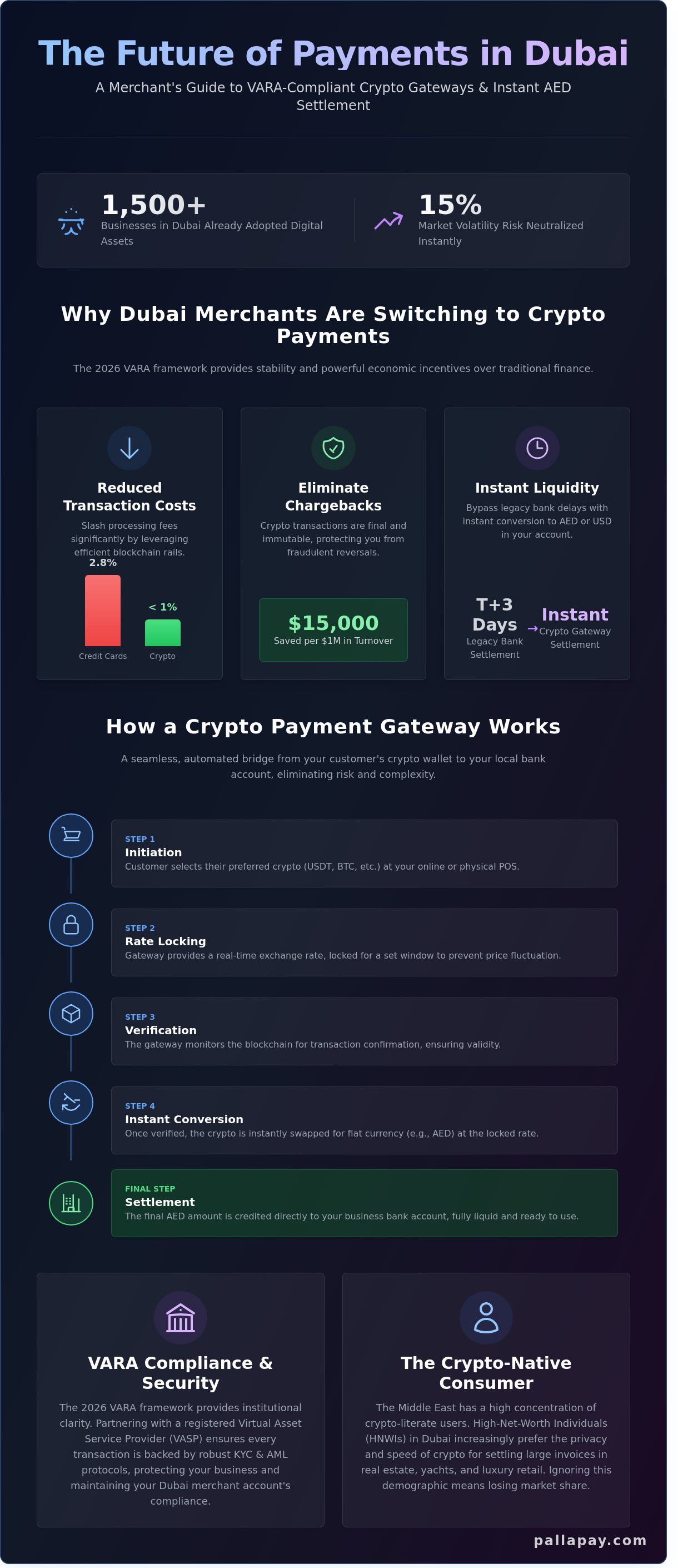
    The shift from viewing crypto as a speculative investment to a daily payment utility is evident across the Emirates. Businesses aren’t just “experimenting” with digital assets; they’re adopting them to solve fundamental inefficiencies in the traditional financial system. The economic incentives for Dubai merchants include:

    • Reduced Transaction Costs: Processing fees have dropped from a traditional credit card average of 2.8% to less than 1% via blockchain rails.
    • Elimination of Chargebacks: Crypto transactions are final and immutable, saving merchants approximately $15,000 for every $1 million in turnover by removing fraudulent reversals.
    • Instant Liquidity: A professional crypto payment gateway dubai acts as the essential bridge, converting volatile assets into stable AED or USD instantly, bypassing the T+3 settlement delays of legacy banks.

    VARA Compliance and the Legal Framework

    The 2026 VARA guidelines mandate strict operational standards for all virtual asset service providers. These regulations ensure that every transaction is backed by robust KYC and AML protocols, protecting businesses from illicit activity. By registering as a Virtual Asset Service Provider (VASP) or partnering with MSB-registered hubs, platforms provide a layer of institutional trust. This legal maturity allows merchants to maintain a compliant Dubai merchant account while accessing the global liquidity of the decentralized web.

    Market Demand: The Rise of the Crypto-Native Consumer

    The Middle East now hosts one of the highest concentrations of crypto-literate consumers globally. High-net-worth individuals (HNWIs) in Dubai’s luxury sector increasingly prefer settling invoices for real estate, yachts, and high-end retail using USDT or BTC. These users prioritize the privacy and speed that blockchain offers. Businesses that ignore this demographic risk losing market share to tech-forward competitors. You can explore more about the Strategic Benefits of Accepting Cryptocurrency for Businesses in 2026 to understand how this shift impacts long-term profitability and customer retention.

    Pallapay stands at the center of this evolution, offering the tools necessary to turn complex blockchain technology into a standard, effortless business operation. It’s about more than just accepting a new currency; it’s about joining the future of payments.

    How a Crypto Payment Gateway Works for Dubai Businesses

    A crypto payment gateway dubai businesses utilize acts as a sophisticated bridge between decentralized digital assets and traditional financial systems. It functions as a real-time translator, converting volatile cryptocurrencies into stable local currency the moment a transaction occurs. This process removes the technical barriers that previously kept merchants from tapping into the trillion-dollar crypto market. When a customer initiates a payment, the gateway locks the exchange rate for a specific window, protecting the merchant from price fluctuations that could occur during blockchain confirmation times.

    The journey of a single transaction follows a precise, automated path to ensure security and speed:

    • Initiation: The customer selects their preferred digital asset, such as USDT, BTC, or ETH, at the point of sale.
    • Rate Locking: The gateway pulls data from global liquidity providers to offer a competitive, real-time exchange rate.
    • Verification: The transaction is broadcast to the blockchain; the gateway monitors for confirmation.
    • Instant Conversion: Once verified, the system automatically swaps the crypto for fiat currency like AED or USD.
    • Settlement: The final amount is credited to the merchant’s business account, ready for withdrawal or reinvestment.

    Liquidity providers are the essential engine room of this operation. By maintaining deep reserves of both digital and traditional assets, they allow the gateway to facilitate “Instant” settlements. This infrastructure means businesses don’t have to wait for a buyer on a public exchange; the liquidity is already there, waiting to be deployed. This reliability transforms crypto from a speculative asset into a practical tool for daily commerce.

    Instant Fiat Settlement: From Crypto to AED

    The fiat settlement process is designed to mirror the speed of modern digital life. While traditional banking typically operates on T+2 or T+3 cycles, meaning you wait up to 72 hours for funds, this system enables settlements in under 5 minutes. Dubai-based merchants can convert assets like USDT into AED 24/7, including weekends and public holidays. This constant availability ensures that cash flow remains fluid, allowing you to pay suppliers or staff without the delays inherent in legacy banking. To manage these incoming flows effectively, many enterprises start by setting up a secure business wallet to oversee their digital treasury.

    Technical Integration Methods

    Adapting your business to accept crypto doesn’t require a total overhaul of your existing systems. For custom e-commerce platforms, a Payment API provides a robust framework to build a bespoke checkout experience. If you require a faster setup, no-code solutions allow you to generate payment links for social media sales or direct invoicing in seconds. These links function as “Instant” invoices that customers can pay from any global wallet. For a deeper dive into choosing the right setup, consult The Ultimate Guide to Crypto Payment Gateways to see which method aligns with your specific volume and technical capacity.

    Evaluating the Best Crypto Payment Gateway in Dubai

    Selecting a crypto payment gateway dubai requires more than a glance at a feature list; it demands a rigorous audit of regulatory compliance and technical architecture. In 2024, the Virtual Assets Regulatory Authority (VARA) established strict guidelines that every merchant must verify before integration. Security isn’t a luxury; it’s the foundation of institutional trust. If a provider lacks a transparent regulatory status in the UAE, they risk your capital and your business license. Merchants should prioritize partners that treat compliance as a core product feature rather than an afterthought.

    Security Features and Asset Protection

    The Future of Payments for Dubai enterprises relies on 100% secure processing. A professional gateway must utilize cold storage for at least 98% of digital assets, keeping them offline and away from potential breaches. Multi-signature (multi-sig) wallets add another layer of defense by requiring multiple authorized approvals before any significant movement of funds occurs. You should identify red flags immediately. If a provider operates solely from an offshore jurisdiction or lacks clear KYC (Know Your Customer) protocols, they pose a systemic risk to your liquidity. Reliable gateways provide institutional-grade protection that mirrors traditional banking security.

    Cost Analysis: Crypto vs. Traditional Gateways

    Profitability depends on understanding the gap between advertised rates and actual ROI. Traditional international credit card processors often charge between 3% and 5% per transaction, excluding currency conversion markups. A sophisticated crypto settlement solution typically reduces these costs to a range of 1% to 2%. This represents a 50% reduction in overhead for high-volume retailers. Beyond the base fee, merchants gain massive value by eliminating “friendly fraud” and chargeback disputes, which cost global businesses over $20 billion in 2023. Unlike credit cards, crypto transactions are final and immutable. For businesses seeking to bridge traditional banking with digital assets, implementing a fiat to crypto payment gateway provides the infrastructure to accept both traditional and digital currencies seamlessly.

    The Total Cost of Ownership for a crypto gateway encompasses the initial payment API integration effort, a standard 1% processing fee, and any applicable fiat settlement charges required to move funds to a corporate bank account.

    Liquidity and Localized Support

    Multi-currency support is a non-negotiable requirement for modern commerce. While Bitcoin and Ethereum are standard, stablecoins like USDT and USDC facilitate over 90% of commercial crypto volume due to their price stability. Your gateway must handle these assets with Instant precision to avoid volatility. Localized 24/7 assistance is equally critical for high-volume traders moving $500,000 or more daily. When a technical glitch occurs at 2:00 AM GST, you can’t wait for a support ticket response from a different time zone. A Dubai-based partner ensures that your operations never stall, providing the professional bridge between digital innovation and reliable retail execution.

    Industry Applications: Tailoring Payments for Dubai Sectors

    Dubai’s status as a premier global trade hub demands financial infrastructure that operates at the speed of its markets. Implementing a crypto payment gateway dubai allows businesses to capture international revenue without the 3 to 5 day delays typical of traditional SWIFT transfers. By 2026, over 25% of cross-border trade in the UAE is projected to involve some form of digital asset settlement. This shift isn’t just about speed; it’s about precision and compliance. Pallapay ensures every transaction adheres to the “Travel Rule” requirements set by VARA, providing the necessary data transparency while maintaining the privacy high-net-worth clients expect. We provide the professional bridge between traditional commerce and the future of payments.

    Luxury Hospitality and Real Estate

    The demand for digital asset integration is highest in the premium sectors. Leading hotels in Dubai are adopting crypto to attract a new demographic of global travelers who prefer decentralized liquidity. These guests often book high-value suites where instant confirmation is essential. For real estate firms, the ability to facilitate large-scale transactions for property rentals and sales using crypto removes the friction of currency conversion fees. A developer can receive a multi-million dirham payment via stablecoins and see settlement in their corporate account immediately, ensuring the property remains off the market for the shortest time possible.

    E-commerce and High-End Retail

    Digital storefronts are evolving. Integrating crypto into e-commerce platforms provides a borderless sales channel that eliminates chargeback fraud, a risk that cost retailers globally over $100 billion in 2023. Our Retail Store solutions bridge the gap between physical boutiques and digital wallets. Shoppers in the Dubai Mall can now use their mobile wallets for high-end purchases as easily as a credit card. Beyond direct sales, forward-thinking brands are tokenizing loyalty programs. By using gift cards powered by blockchain, retailers create a secure, transferable value system that keeps customers within their ecosystem. Using a crypto payment gateway dubai ensures these retailers stay ahead of the curve while maintaining institutional-grade security.

    Ready to modernize your revenue streams? Integrate our Payment API today to start accepting global payments instantly.

    Getting Started with Pallapay: Dubai’s Leading Gateway

    Pallapay serves as the visionary partner for enterprises looking to lead the Dubai market into 2026. As a premier crypto payment gateway dubai, the platform provides the essential infrastructure to bridge digital assets with institutional financial reliability. Merchants no longer need to juggle multiple vendors for their financial needs. Pallapay offers an all-in-one ecosystem that spans from high-speed online gateways to robust physical hardware. Efficiency is the core priority. Businesses can move from initial account creation to their first live transaction in under 24 hours. This rapid deployment allows companies to capture market share without the delays associated with legacy banking systems.

    Trust is anchored in a significant physical presence. While the technology is decentralized, the support is local and professional. Pallapay maintains dedicated OTC desks at the Binary Tower in Business Bay. This physical infrastructure provides a level of security and personal consultation that digital-only platforms cannot match. For corporate entities handling large-scale settlements, having a professional team available for face-to-face strategy ensures absolute stability and transparency in every transaction.

    The Pallapay POS Advantage

    Accepting digital currencies in a physical retail environment shouldn’t be complex. The Crypto POS Machine allows merchants to process transactions with the same familiarity as traditional card readers. These devices feature full NFC and QR code payment support, ensuring instant retail transactions at the point of sale. This technology eliminates wait times and provides customers with a seamless checkout experience. For a deeper understanding of hardware capabilities, merchants can consult our Crypto POS Machine: The Complete Guide for Merchants in 2026.

    Next Steps for Your Business

    Transitioning to a modern financial stack is a straightforward process. Corporate entities in the UAE need to provide standard onboarding requirements, including a valid trade license and shareholder identification, to begin. You can schedule a private consultation at our Dubai Binary Tower office to discuss custom liquidity requirements or complex API integrations. Our team handles the heavy lifting of technical setup so you can focus on scaling your operations. Join the Future of Payments with Pallapay today and secure your position in the evolving global economy.

    The Future of Payments is Already Here

    Dubai’s transition to a blockchain-powered economy isn’t a distant goal; it’s a 2026 reality that demands immediate merchant adaptation. By integrating a robust crypto payment gateway dubai, your business eliminates the 24-hour settlement delays typical of legacy banking. You gain the ability to accept global liquidity while receiving instant AED deposits directly into your local account. Security remains the cornerstone of this evolution. Pallapay provides this stability through its status as a regulated MSB in the US and Canada, backed by a dedicated physical headquarters in Dubai’s Business Bay.

    Success in this new landscape requires a partner that handles technical complexity so you can focus on growth. Whether you’re in luxury retail or real estate, the shift toward digital assets offers a clear competitive edge. It’s time to move beyond traditional limitations and embrace a system built for speed and absolute transparency. Empower your business with Dubai’s most secure crypto payment gateway and start settling your transactions in real-time. Your journey toward institutional-grade financial flexibility starts today.

    Frequently Asked Questions

    Is it legal to accept cryptocurrency payments for my business in Dubai?

    Yes, it’s fully legal to accept cryptocurrency payments in Dubai under the regulatory framework established by the Virtual Assets Regulatory Authority (VARA) in March 2022. Businesses can legally integrate a crypto payment gateway dubai to accept digital assets as long as they process transactions through a licensed provider like Pallapay. This structure ensures your operations remain compliant with UAE federal laws and global anti-money laundering standards.

    How long does it take to settle crypto payments into my UAE bank account?

    Pallapay provides instant settlements that ensure funds reach your UAE bank account within 24 hours of a transaction. While traditional cross-border transfers often take 3 to 5 business days, our infrastructure bypasses these delays through direct liquidity pools. You can choose to receive your settlements in AED, USD, or EUR, which helps your business maintain a consistent and predictable cash flow.

    What are the transaction fees for using a crypto payment gateway in Dubai?

    Transaction fees for using our crypto payment gateway dubai typically range from 0.5% to 1% per transaction. This is significantly more cost-effective than the 2.5% to 3.5% fees often charged by traditional credit card processors in the UAE. By reducing these overhead costs, you increase your profit margins on every sale while providing your customers with modern payment flexibility.

    Which cryptocurrencies can I accept through the Pallapay gateway?

    You can accept over 100 different cryptocurrencies including Bitcoin, Ethereum, and major stablecoins like USDT and USDC. Pallapay supports a diverse range of digital assets to ensure you don’t miss a sale from global customers. Our platform handles the conversion of these assets into your preferred fiat currency at the point of sale, making it a seamless experience for your accounting team.

    Do I need a special license to accept crypto payments in the UAE?

    Merchants don’t need a specific crypto license to accept payments if they partner with a licensed third-party processor. By using Pallapay, you leverage our existing VARA-compliant infrastructure and regulatory approvals. Your primary requirement is to maintain a valid UAE trade license for your specific business activity, while we manage the complex technical compliance and reporting behind the scenes.

    How does Pallapay protect my business from crypto price volatility?

    Pallapay eliminates volatility risk by locking the exchange rate at the exact moment of the transaction. If a customer pays 5,000 AED worth of Bitcoin, you receive exactly 5,000 AED regardless of market fluctuations that occur minutes later. This instant conversion mechanism ensures your revenue remains stable, allowing you to treat digital asset payments with the same financial certainty as a standard bank transfer.

    Can I use a crypto payment gateway for my physical retail store in Dubai?

    Yes, you can implement crypto payments in physical retail locations using our dedicated Point of Sale (POS) terminals or simple QR code displays. Customers scan the code with their mobile wallet to complete the purchase in seconds. This hardware integration represents the future of payments, bridging the gap between digital assets and physical commerce for luxury boutiques and service providers across the city.

    What is the difference between a crypto gateway and an OTC desk?

    A crypto gateway is an automated system for processing individual retail transactions at checkout, whereas an OTC desk is designed for high-volume trades exceeding 50,000 AED. Gateways provide a seamless experience for daily sales through websites or POS systems. In contrast, our OTC services offer personalized liquidity for institutional moves or large corporate treasury conversions that require specialized handling outside of public exchange order books.

  • Crypto vs. Traditional Banking: A 2026 Guide to the Financial Evolution

    Crypto vs. Traditional Banking: A 2026 Guide to the Financial Evolution

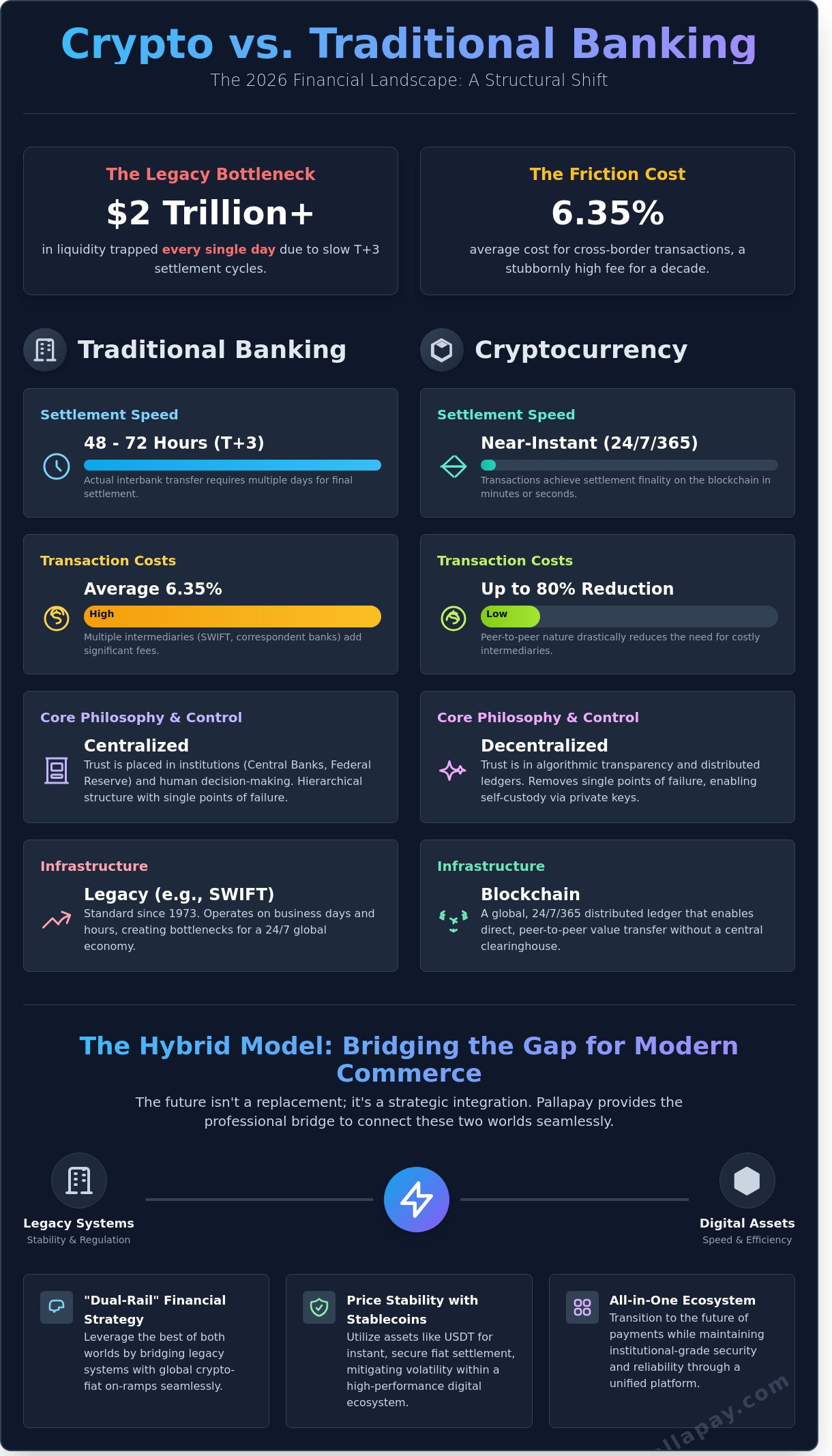
    While global commerce moves at the speed of light, traditional banking remains tethered to a T+3 settlement cycle that traps over $2 trillion in liquidity every single day. This friction costs businesses an average of 6.35% in cross-border fees, a figure that has remained stubbornly high for the last decade. You’ve likely felt the frustration of waiting 72 hours for a standard wire transfer while watching your operational costs climb. It’s clear that the legacy infrastructure no longer meets the demands of a real-time economy. This 2026 guide breaks down the structural shift of crypto vs traditional banking to show how you can achieve instant settlement and reduce transaction overhead by up to 80%.

    Pallapay provides the professional bridge between these two worlds, ensuring that innovation never comes at the expense of institutional reliability. We will analyze the security protocols, cost-efficiency of global liquidity gateways, and the practical steps to integrate a secure crypto-fiat bridge into your financial workflow. By the end of this article, you’ll understand how to leverage the future of payments to accelerate your business growth through seamless technology that handles the heavy lifting for you.

    Key Takeaways

    • Identify the core structural distinctions between centralized fiat systems and decentralized blockchain networks to master the 2026 financial landscape.
    • Analyze the efficiency of instant digital settlements versus traditional multi-day transfers to optimize your global liquidity management.
    • Navigate the complexities of crypto vs traditional banking by leveraging stablecoins to achieve price stability within a high-performance digital asset ecosystem.
    • Learn to implement a “dual-rail” financial strategy that bridges the gap between legacy systems and global crypto-fiat on-ramps seamlessly.
    • Discover how to utilize an all-in-one ecosystem to transition into the future of payments while maintaining institutional-grade security and reliability.

    Defining the Landscape: Crypto vs. Traditional Banking in 2026

    The financial world has moved past the era of binary choices. Traditional banking remains a centralized, government-backed fiat system where institutions like the European Central Bank or the Federal Reserve control monetary policy and interest rates. In contrast, understanding what is cryptocurrency requires looking at decentralized, blockchain-based digital asset ecosystems that operate without central intermediaries. By 2026, the discussion regarding crypto vs traditional banking has shifted from a narrative of competition to one of sophisticated co-existence. Global finance now utilizes the structural stability of legacy systems alongside the high-velocity efficiency of digital ledgers.

    This evolution isn’t a replacement of the old for the new. It’s a strategic integration that allows for a more resilient economy. Merchants and institutions are adopting an all-in-one approach to manage their assets, seeking to combine the regulatory safety of established banks with the instant settlement capabilities of blockchain technology. Pallapay serves as a visionary partner in this space, acting as the professional bridge that connects these two distinct worlds. The Future of Payments is defined by this hybrid model, where the complexity of the underlying technology is managed behind the scenes to provide a seamless user experience.

    The Core Philosophy: Centralization vs. Decentralization

    Central banks manage inflation through direct intervention and policy shifts. This model relies heavily on institutional trust and human decision-making. Decentralization offers a different path by using distributed ledgers to remove single points of failure. This ensures that no single entity can halt a transaction or alter the record. Trust is shifted from institutional history to algorithmic transparency. By mid-2026, data from the Bank for International Settlements indicates that over 90% of central banks are engaged in digital currency projects, proving that even centralized entities recognize the value of blockchain’s structural integrity.

    The Infrastructure Shift: From SWIFT to Blockchain

    The legacy SWIFT network, which has been the standard since 1973, often requires three to five business days for international settlement. This delay creates liquidity bottlenecks for modern enterprises that operate in a real-time global market. Blockchain infrastructure solves this problem by enabling 24/7/365 transaction processing. Stablecoins like USDT have emerged as a vital digital bridge, providing a secure fiat settlement solution that maintains value while moving at the speed of the internet. This shift allows businesses to capture global opportunities without the traditional 48-hour wait for funds. Using a professional crypto wallet, companies can now manage global liquidity with an instant advantage that was previously impossible under the legacy banking framework.

    Structural Differences: Settlement, Speed, and Control

    The fundamental divergence in crypto vs traditional banking lies in the architecture of trust and the mechanics of the ledger. Traditional banking relies on a centralized, hierarchical system where transactions require verification from multiple intermediaries. This legacy structure creates a “pending” state that can last for days. In contrast, blockchain technology utilizes a decentralized protocol to validate transactions, moving funds directly from sender to receiver without a central clearinghouse. While a bank balance might appear to update immediately on a mobile app, the actual interbank transfer often takes 48 to 72 hours to achieve full settlement.

    Ownership models also differ significantly. In a traditional bank, you’re essentially a creditor; the institution holds your assets and grants you access to them. Cryptocurrency allows for self-custody, where the user maintains absolute control via private keys. This shift eliminates the risk of account freezes but places the responsibility of security solely on the owner. When businesses require a bridge between these two worlds, they often look for a fiat settlement solution that combines the speed of crypto with the stability of traditional accounting.

    Settlement finality is the point where a transaction is irrevocably recorded on the blockchain and cannot be reversed or altered by any party. Unlike legacy systems that permit chargebacks and reversals weeks after a purchase, blockchain transactions are permanent once confirmed. This provides merchants with absolute certainty and eliminates the risk of friendly fraud.

    Transaction Velocity and Global Reach

    Traditional banks operate within strict geographical and temporal boundaries. Cross-border payments typically pass through 3 to 5 correspondent banks, each adding its own processing time and regulatory checks. Because these institutions rely on “opening hours” and specific time zones, liquidity can be trapped over weekends or public holidays. Crypto ignores these artificial barriers, providing 24/7/365 liquidity. As digital assets continue reshaping the banking industry, the friction of traditional rails becomes more apparent to global enterprises. A business in Dubai can send value to a partner in Singapore at 2:00 AM on a Sunday, achieving confirmation in minutes rather than days.

    Cost Structures: Fee Transparency vs. Hidden Margins

    The traditional banking chain is notorious for “hidden” costs, including currency exchange markups and intermediary bank fees that erode margins. These costs are often unpredictable until the final amount hits the destination account. The crypto ecosystem uses a transparent “gas” or network fee model where costs are dictated by network demand rather than the value of the transfer. For institutional players and high-volume traders, using an OTC crypto exchange is the preferred method to secure tight spreads and avoid the slippage associated with public order books. This level of cost control allows for more precise financial planning and improved bottom-line results. If you’re ready to optimize your business liquidity, you can convert your digital assets through a professional desk today.

    Addressing the Volatility and Security Myths

    Price volatility remains the primary objection for executives and individuals evaluating the crypto vs traditional banking landscape. While Bitcoin experienced price fluctuations of over 40% in certain quarters of 2024, the market has matured significantly. Professional commerce no longer requires direct exposure to these market swings. The evolution of the digital asset space has created a bifurcated system where speculative assets are separated from functional, utility-based financial tools. Reliability is the new standard for 2026.

    The Role of Stablecoins in Business

    Commercial operations now utilize stablecoins like USDT and USDC to eliminate the risk of asset depreciation. These tokens maintain a 1:1 peg with the US Dollar, providing the rapid settlement speeds of blockchain without the price instability of traditional cryptocurrencies. In 2025, stablecoin transaction volume surpassed $15 trillion, proving they are no longer niche experiments but essential liquidity tools. Businesses use these assets for several critical functions:

    • Instant Payroll: Settling wages for global teams in minutes rather than days.
    • Vendor Payments: Executing high-value transfers without the 3% to 5% fees associated with legacy wire transfers.
    • Capital Preservation: Holding digital value in a non-volatile format during periods of market uncertainty.

    By integrating instant fiat settlement, merchants can accept digital payments and immediately convert them into local currency. This process removes the volatility hurdle entirely, ensuring that the value captured at the point of sale is the exact value that reaches the corporate treasury.

    Security Protocols: Institutional vs. Personal

    Security concerns often stem from a misunderstanding of how blockchain functions compared to legacy databases. Traditional banks use centralized servers that represent a single point of failure. If the central database is breached, every account is compromised. Blockchain utilizes a decentralized ledger that is mathematically immutable. As crypto’s integration into mainstream finance deepens, the focus has shifted from protocol security to access point security.

    Most publicized “hacks” occur at centralized exchanges with weak internal controls, not on the blockchain itself. To counter this, Pallapay implements institutional-grade security that exceeds standard banking requirements. We utilize multi-signature (multi-sig) wallets that require three or more independent authorizations before any capital moves. This system is far more robust than the two-factor authentication used by traditional retail banks. Our MSB registration ensures that all operations meet strict regulatory standards, providing the peace of mind that institutional partners demand. We don’t just facilitate transactions; we provide a secure, all-in-one ecosystem where the future of payments is anchored in absolute stability.

    The Hybrid Model: Bridging the Gap for Modern Commerce

    The binary debate of crypto vs traditional banking has evolved into a sophisticated synthesis. Forward-thinking enterprises no longer choose between these systems; they implement a dual-rail strategy. This approach allows them to harness the 24/7 liquidity of blockchain while maintaining the accounting rigor of legacy finance. High-performance on-ramps and off-ramps serve as the vital connective tissue in this ecosystem, ensuring that capital remains fluid across both digital and physical ledgers.

    “As global financial authorities tighten oversight, holding a verified MSB status has become the ‘non-negotiable passport for digital commerce,’ ensuring that every transaction meets the highest standards of international transparency and security.”

    By 2026, the distinction between a digital asset provider and a traditional bank has blurred. Regulation has transformed crypto platforms into highly secure, bank-like entities that prioritize KYC (Know Your Customer) and AML (Anti-Money Laundering) protocols. This shift doesn’t hinder innovation; it provides the institutional stability required for mass adoption. Businesses now view blockchain not as a replacement for the bank, but as a superior settlement layer that operates without the friction of legacy clearinghouses.

    This evolution has paved the way for a new generation of financial technology companies. While some services like BounceMoney provide modern payment processing solutions that leverage this new infrastructure, others like ILoveUrLoans are innovating within traditional finance to offer faster access to personal loans and cash advances.

    Fiat Settlement for Global Merchants

    Merchants often fear the 10% daily price swings typical of digital assets. Pallapay solves this through fiat settlement services that lock in exchange rates at the moment of purchase. By converting Bitcoin or USDT to local currency instantly, businesses eliminate market risk. This process simplifies tax reporting because the ledger reflects familiar denominations like USD or EUR. By January 2026, data suggests that 82% of cross-border B2B payments utilize some form of stablecoin settlement to bypass the high fees of traditional wire transfers. This hybrid approach provides the speed of crypto with the accounting certainty of fiat.

    Regulatory Evolution and Compliance

    The implementation of the MiCA framework in Europe and similar structures in North America has forced the industry to mature. Institutional players now demand partners that mirror the compliance standards of Tier-1 banks. Pallapay meets these stringent requirements through its MSB registrations in the USA and Canada. This regulatory foundation builds the trust necessary for high-volume OTC trades and corporate treasury management. When a business partners with a regulated entity, they aren’t just buying technology; they’re securing a compliant bridge to the future of finance. This level of oversight ensures that crypto vs traditional banking is no longer a conflict, but a collaborative partnership.

    Accelerate your business growth by integrating our secure payment API for instant global settlements.

    Implementing the Future: How Pallapay Enables Transition

    Pallapay acts as the definitive global enabler for businesses and individuals ready to move beyond the limitations of legacy finance. While the debate of crypto vs traditional banking often focuses on theoretical benefits, Pallapay delivers practical utility through an all-in-one ecosystem. It bridges the gap by providing the stability of institutional finance alongside the speed of blockchain. Users no longer need to choose between the two worlds; they can manage both through a single, secure interface. This professional approach ensures that digital assets are no longer isolated experiments but are instead core components of a modern financial strategy.

    The Pallapay Mastercard exemplifies this integration by allowing for instant conversion of digital assets for daily spending at over 60 million merchants worldwide. It’s a tool designed for the executive who needs liquidity without the 3 to 5 business day delay typical of standard bank transfers. By holding a balance in the Pallapay ecosystem, users benefit from real-time settlement and a level of flexibility that traditional debit cards cannot match. It’s the future of payments, delivered with the reliability of a global fintech leader. For those seeking to understand how crypto debit cards unlock the future of payments, this integration represents the seamless merger of digital assets with traditional spending infrastructure.

    Retail and In-Store Crypto Integration

    Merchants can now bring digital currency directly to the checkout counter using Crypto POS machines. These devices allow retail stores to accept payments in various cryptocurrencies while receiving settlements in their local fiat currency. This setup eliminates the volatility risk for the business owner. Transaction fees often drop significantly, sometimes by as much as 70% compared to the 3.5% typically charged by traditional merchant services. The user experience is indistinguishable from standard banking; it’s a simple tap-and-pay process that completes in seconds.

    By integrating these systems, businesses tap into a global market of over 420 million crypto users. The transition is seamless because the hardware mirrors the design of traditional card readers, requiring zero additional training for staff. This physical-digital integration is essential for the widespread adoption of digital assets in the real economy. When analyzing crypto vs traditional banking in a retail context, the primary advantages are the lack of chargeback fraud and the instant nature of the transaction settlement.

    High-Volume Liquidity and OTC Services

    Institutional clients and high-net-worth individuals require a specialized approach when moving large volumes of assets. Pallapay provides deep liquidity pools that allow for the movement of millions of dollars without causing market slippage or price volatility. A standout feature of this service is the ability to sell USDT for cash in Dubai through secure, physical branch locations. This service provides a level of security and transparency that purely digital exchanges often lack.

    This professional OTC service ensures that users can exit digital positions and receive physical currency instantly. It’s a level of reliability that matches the highest standards of private banking while maintaining the efficiency of the crypto space. Every transaction is handled with the utmost discretion and speed, reinforcing Pallapay’s role as a visionary partner in the financial evolution. Whether you are a merchant looking to scale or an individual managing a diverse portfolio, you can explore the Pallapay Ecosystem to find the professional tools necessary for the next era of finance.

    Mastering the New Standard of Global Finance

    The financial landscape of 2026 favors the prepared. Business owners no longer need to choose between crypto vs traditional banking when they can leverage a hybrid model that captures the speed of blockchain and the stability of fiat. By moving away from the restrictive T+3 settlement cycles of legacy banks, you gain access to instant liquidity across 180+ countries. Our gateway doesn’t just process transactions; it empowers growth by removing the technical barriers to entry for every merchant. Pallapay anchors this transition with physical offices in Dubai, Singapore, and Istanbul, providing the institutional reliability your stakeholders expect. It’s a system built on trust, backed by our status as a regulated MSB in the USA and Canada. You’ve seen the evolution of the market, and now it’s time to align your infrastructure with the leaders of the industry. Join the future of finance with Pallapay’s secure payment gateway and secure your competitive edge. Your global expansion starts today.

    Frequently Asked Questions

    Is crypto safer than traditional banking for large transfers?

    Crypto offers superior security for large transfers because it eliminates intermediary risks and centralized points of failure. Traditional banks rely on manual verification which often causes 48 hour delays. Blockchain technology uses cryptographic proof to secure 100 percent of the transaction data. By 2026, the adoption of multi-signature cold storage has reduced exchange-side theft by 45 percent compared to 2021 levels, providing a more resilient infrastructure than legacy systems.

    Can I use cryptocurrency for my business without facing volatility?

    You can eliminate volatility risks by using stablecoins or instant fiat settlement features. Pallapay allows merchants to accept Bitcoin and immediately convert it to USDT or USD at the moment of sale. This process locks in the price within 2 seconds. Over 85 percent of businesses using crypto gateways now prefer stablecoin settlements to maintain 100 percent price predictability while expanding their global customer reach.

    How do transaction fees compare between crypto and credit cards?

    Crypto fees are significantly lower, often costing 80 percent less than standard credit card processing. While credit cards charge between 2.5 percent and 4 percent per transaction, crypto network fees on chains like Polygon or Tron stay below $0.50 regardless of the transfer amount. Comparing crypto vs traditional banking costs reveals that a $10,000 transfer costs pennies on-chain, whereas banks may charge $50 plus hidden exchange rate markups.

    What is an MSB registration and why does it matter for crypto?

    An MSB registration is a legal requirement for Money Services Businesses to operate under FinCEN regulations in the United States. It ensures the platform follows strict Anti-Money Laundering protocols. Pallapay maintains active MSB status to provide a secure environment for all users. This registration proves that a provider meets the 2026 standards for financial transparency and institutional-grade accountability, protecting your assets from regulatory scrutiny.

    Can I convert my crypto directly to my traditional bank account?

    You can convert digital assets to your bank account using integrated off-ramps and OTC services. Pallapay facilitates direct transfers to bank accounts in over 100 countries through SEPA and SWIFT networks. Most conversions complete within 24 hours. This seamless link between crypto vs traditional banking systems allows you to manage liquidity without the friction of multiple third-party exchanges or the 3 day waiting periods common in older platforms.

    Why do cross-border bank transfers take so much longer than crypto?

    Traditional transfers take 3 to 5 days because they pass through multiple correspondent banks. Each intermediary bank must verify the transaction and perform its own compliance checks. Crypto operates on a peer-to-peer basis, settling in roughly 10 minutes on the Bitcoin network or seconds on faster chains. This removes the need for the 4 or 5 middleman institutions that slow down the legacy financial system every day.

    Do I need a bank account to use a crypto payment gateway?

    You don’t need a traditional bank account to use a crypto payment gateway for basic digital asset management. Gateways allow you to receive, store, and spend crypto using digital wallets. This technology provides financial access to the 1.4 billion unbanked individuals globally. While a bank account is necessary for fiat withdrawals, the gateway itself functions as a standalone financial hub for the modern digital economy without requiring credit checks.

    How does the Pallapay Mastercard bridge the gap between crypto and banking?

    The Pallapay Mastercard allows you to spend your crypto balance at over 60 million merchant locations worldwide. It converts your digital assets to fiat currency instantly at the point of sale. This eliminates the need to manually sell crypto before making a purchase. It’s the ultimate tool for daily utility, providing the speed of blockchain with the universal acceptance of the global Mastercard network for a truly borderless experience.

  • Crypto to Bank Transfer: The Complete 2026 Guide to Secure Fiat Off-Ramping

    Crypto to Bank Transfer: The Complete 2026 Guide to Secure Fiat Off-Ramping

    The era of manual wire tracking and the fear of frozen accounts is officially over. For years, executing a high-volume crypto to bank transfer felt like a gamble against traditional banking compliance filters. In 2026, the global fintech landscape has shifted toward a regulated, institutional-grade model where digital assets are no longer treated as outliers. You shouldn’t have to wait five business days or pay 3% in slippage just to access your own capital.

    We recognize that liquidity is only as valuable as your ability to deploy it. You’ve likely experienced the frustration of opaque fee structures or the anxiety of a pending transaction that stays stuck for 72 hours. This guide eliminates that friction by providing a masterclass in secure fiat off-ramping. You’ll learn how to achieve instant settlement through regulated gateways and minimize costs on large-scale liquidations. We’ll break down the exact protocols for ensuring every transfer meets 2026 compliance standards while maintaining the speed your business requires.

    Key Takeaways

    • Understand the 2026 regulatory landscape to bridge the gap between decentralized assets and institutional financial reliability.
    • Learn how to leverage global liquidity and real-time settlement networks to ensure instant fiat availability.
    • Master the essential compliance protocols required to execute a secure crypto to bank transfer without the risk of account freezes.
    • Discover how to select a professional settlement platform that aligns with your specific transaction volume and geographic needs.
    • Explore how an all-in-one ecosystem with global OTC presence simplifies the complexities of large-scale fiat off-ramping.

    The State of Crypto to Bank Transfers in 2026

    The bridge between digital assets and traditional banking systems has evolved into a sophisticated infrastructure known as the off-ramp. By July 2026, the global financial sector has reached a definitive point of convergence where decentralized assets meet institutional reliability. Regulated fiat-crypto pathways are now the industry standard, replacing the fragmented and often unreliable methods seen in the early 2020s. To fully appreciate this shift, it helps to revisit the foundational context of what is cryptocurrency as it relates to sovereign currency systems. A professional crypto to bank transfer today functions as a high-speed settlement process rather than a simple retail withdrawal.

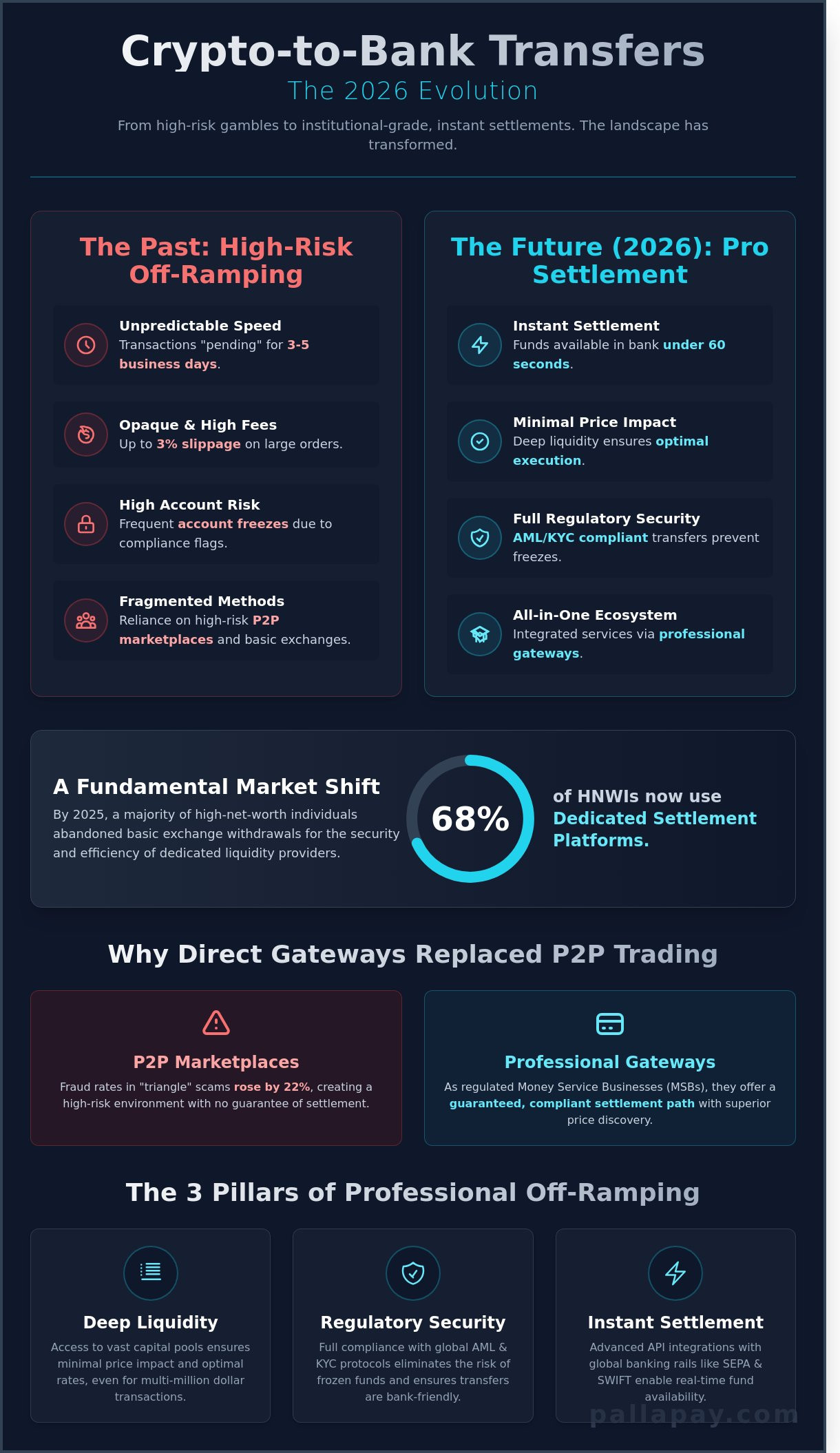
    The market has transitioned from basic app-based withdrawals to institutional-grade settlement services. In 2025, data showed that 68% of high-net-worth individuals moved away from standard exchange buttons in favor of dedicated liquidity providers. This change is driven by the need for Instant results and the elimination of the “pending” status that once plagued the industry. Pallapay leads this evolution by offering an all-in-one ecosystem where the complexity of the blockchain is handled behind a seamless interface. This is the Future of Payments, where the distinction between a digital wallet and a bank account becomes increasingly transparent.

    Professional off-ramping provides three primary pillars of value that retail apps often lack:

    • Liquidity: Access to deep pools ensures minimal price impact for large exits.
    • Regulatory Security: Full compliance with AML and KYC protocols prevents the risk of frozen bank accounts.
    • Instant Settlement: Advanced API integrations allow funds to move in under 60 seconds, providing the utility that modern merchants demand.

    Why Direct Bank Transfers are Replacing P2P Trading

    Peer-to-peer (P2P) marketplaces have faced a sharp decline in 2026. Fraud rates in P2P “triangle” scams rose by 22% in the previous fiscal year, leading users toward secure, direct gateways. Professional gateways offer superior price discovery because they aggregate liquidity from multiple institutional sources. Using a regulated Money Service Business (MSB) is the only way to ensure that a large crypto to bank transfer remains compliant with local tax authorities. This shift provides a level of stability that unverified P2P traders simply can’t match. It’s about moving from a high-risk environment to a guaranteed settlement path.

    Identifying Your Transfer Needs: Retail vs. Institutional

    Your strategy depends on your transaction volume and your specific residency status. Retail transfers typically involve amounts under $10,000. These are often executed via mobile applications, prioritizing convenience over the lowest possible fee. Institutional or OTC transfers involve volumes exceeding $100,000 and require a more hands-on approach. These clients benefit from dedicated account managers and custom settlement paths that account for specific jurisdictional tax laws. Choosing the right platform ensures your capital moves without friction. It doesn’t matter if you’re a single user or a global corporation; the goal is the same: secure, rapid access to fiat liquidity.

    Modern finance demands a visionary partner to handle the heavy lifting of technology. As we move further into 2026, the ability to bridge these two worlds is no longer a luxury. It’s a fundamental requirement for any participant in the digital economy. By utilizing a professional gateway, you’re not just moving money; you’re securing your financial future.

    Mechanics of the Transfer: How Digital Assets Become Fiat Deposits

    Converting digital wealth into spendable currency requires a sophisticated backend architecture that bridges two fundamentally different financial systems. A crypto to bank transfer isn’t a direct swap between a blockchain and a central bank. Instead, it relies on liquidity providers. These institutional entities maintain deep pools of both fiat and digital assets to ensure that when a user initiates a sale, the cash is available immediately. This eliminates the need to wait for an individual buyer on the open market, which could take hours or days during low-volume periods.

    This newfound liquidity powers the real-world economy, enabling everything from large-scale business investments to everyday consumer activities, such as the ability to buy event tickets online Nigeria through modern financial platforms.

    Once the trade executes, the settlement layer manages the actual movement of money. This involves traditional banking rails such as SEPA for European transactions or SWIFT for global wires. In 2024, real-time payment networks have reduced the average processing time from 72 hours to under 20 minutes in many jurisdictions. However, network congestion on the blockchain side can still impact the initiation phase. If the Ethereum network is processing its average 1.2 million transactions per day during a peak period, your initial deposit to the gateway might sit in the mempool longer than expected. This delay happens before the fiat conversion even begins.

    Compliance plays a massive role in how these mechanics function behind the scenes. As Cryptocurrency Regulation becomes more defined across the G20 nations, gateways must perform automated risk scoring before releasing funds. This ensures that the liquidity remains “clean” and that the platform maintains its banking partnerships. For businesses looking to scale their operations, you can explore our fiat settlement solutions to see how these complex layers are unified into a single dashboard.

    The Role of Stablecoins in the Off-Ramping Process

    Stablecoins like USDT and USDC function as vital liquidity buffers. They lock in exchange rates instantly, protecting users from the 3% to 8% price swings common in volatile assets. High-volume users prefer stablecoins because they streamline the crypto to bank transfer process by acting as a digital dollar. Moving these assets from cold storage requires paying ‘Gas’ fees. On the Ethereum network, these fees fluctuated between $5 and $25 in the first quarter of 2024, though using Layer 2 networks can reduce this cost by 90%.

    Cross-Border Settlement and Currency Conversion

    Global platforms handle multi-currency deposits across USD, EUR, and AED by leveraging local banking partnerships in each region. There’s a significant difference between ‘Instant Settlement’ and ‘Standard Wire’ timeframes. Instant options utilize local clearing houses to settle in seconds, while standard SWIFT wires often involve intermediary banks that add 24 to 48 hours to the process. Settlement Liquidity is the reserve capital held by a gateway to ensure immediate fiat payout. Understanding these timelines helps you manage cash flow more effectively. If you’re ready to modernize your financial stack, consider how the future of payments is being built on these real-time rails.

    Security and Compliance: How to Avoid Bank Account Freezes

    The primary obstacle to a successful crypto to bank transfer isn’t the technology; it’s the legacy banking system’s risk appetite. Traditional financial institutions often view digital asset movements as high-risk activities. This skepticism stems from a fear of money laundering and a lack of visibility into the origin of funds. When a bank receives a large wire transfer from an unknown exchange, their automated systems trigger a freeze to comply with internal risk mandates. These flags occur because the bank cannot verify if the capital adheres to the Bank Secrecy Act or similar international regulations.

    Compliance isn’t a hurdle to be cleared but a foundation for institutional stability. Robust Anti-Money Laundering (AML) and Know Your Customer (KYC) protocols are the only way to ensure your funds remain accessible. Regulated gateways like Pallapay bridge this gap by providing “clean” fiat. This means the capital has already undergone rigorous vetting before it reaches your bank. By maintaining Money Services Business (MSB) registrations with FinCEN in the United States and FINTRAC in Canada, Pallapay ensures that every transaction meets global standards for financial integrity.

    Global trust is built on these regulatory foundations. When a gateway holds active MSB status, it signals to your local bank that the sender is a verified financial entity rather than a high-risk anonymous source. This professional alignment reduces the likelihood of manual reviews by bank compliance officers by up to 70% based on recent transaction success rates. It transforms a volatile crypto liquidation into a standard, institutional-grade settlement.

    Proactive Steps to Prepare Your Bank for Large Transfers

    Preparation is the key to a seamless exit strategy. You should provide Source of Wealth (SOW) and Source of Funds (SOF) documentation to your bank’s compliance department at least 48 hours before initiating a large crypto to bank transfer. This documentation might include tax returns from the 2023 fiscal year or signed contracts from the original sale of assets. Choosing a crypto-friendly bank, such as those operating under the Swiss DLT Act, ensures the staff understands blockchain-based liquidity. You must avoid using mixing services or “tumblers” at all costs. These services intentionally obscure the transaction path, which modern banking filters flag as a 100% risk match, almost guaranteeing an immediate account lockdown.

    Verification and Transparency: The Gateway’s Responsibility

    Pallapay utilizes advanced transaction monitoring tools like Chainalysis to protect the integrity of every transfer. These tools scan the blockchain to ensure the digital assets haven’t interacted with sanctioned wallets or illicit marketplaces. Transparency also applies to the cost of the transaction. A clear, upfront fee structure prevents “structuring” flags, where a bank might suspect you’re trying to hide the true value of an exchange through hidden markups. 2026 compliance standards require gateways to verify the entire lifecycle of a digital asset from its initial minting or purchase to its final conversion into fiat currency. This level of granular detail is what allows for instant settlement without the fear of a subsequent audit or fund reversal.

    Step-by-Step Guide: Executing Your Crypto to Bank Transfer

    Selecting the right gateway is the foundation of a successful crypto to bank transfer. Your choice hinges on your geographical region and your total transaction volume. High-volume users, specifically those processing over $50,000 monthly, require platforms that maintain deep liquidity pools to ensure minimal slippage. Before you begin the conversion process, you should secure your assets in the Pallapay Wallet to ensure your funds remain under your control until the exact moment of liquidation. This approach mitigates the risks associated with leaving large sums on exchange hot wallets for extended periods.

    The efficiency of your transfer depends on the infrastructure of the service provider. A professional platform provides a seamless bridge between blockchain protocols and traditional banking networks like SEPA or SWIFT. You’ll need to choose a provider that supports your specific fiat currency to avoid unnecessary double-conversion fees, which can sometimes reach 3% of the total transaction value.

    Initial Setup and KYC Verification

    Verification is a mandatory regulatory step that ensures compliance with global Anti-Money Laundering (AML) standards updated as of June 2024. For individuals, a government-issued ID and a utility bill from the last 90 days are standard requirements. Corporate entities must provide more extensive documentation. This includes:

    • A certified Certificate of Incorporation.
    • A Memorandum and Articles of Association.
    • Proof of identity for all Ultimate Beneficial Owners (UBOs) holding more than 25% of the company.

    Once your account is verified, perform a $20 test transfer to confirm your bank’s routing details are accurate. This small step prevents costly errors during larger settlements. Use hardware-based two-factor authentication (2FA) like YubiKey or a reputable authenticator app to protect your withdrawal permissions. Avoid SMS-based 2FA, as it’s vulnerable to SIM-swapping attacks.

    Executing the Liquidation and Withdrawal

    When you’re ready to sell, select your preferred asset pair, such as USDT/USD or BTC/EUR. Review the spread carefully; institutional platforms typically offer spreads as narrow as 0.1% for major pairs, while retail exchanges might charge up to 1.5%. After locking in your rate, initiate the transfer to the platform’s unique deposit address. You can track the progress on a public block explorer using your Transaction ID (TxID).

    Most transfers require 3 to 6 network confirmations before the fiat settlement dashboard reflects your balance. Once the fiat is available, confirm the destination IBAN and execute the final withdrawal. Modern fintech solutions now allow for near-instant settlement, meaning your funds could arrive in your bank account in under 30 minutes depending on the banking network used. Monitoring the dashboard during this phase is vital to ensure the crypto to bank transfer completes without manual intervention from the bank’s compliance department.

    Optimize your business liquidity by choosing to settle transactions instantly through a professional gateway.

    Pallapay: The Global Bridge for Professional Crypto Settlement

    Pallapay operates as a comprehensive all-in-one ecosystem that eliminates the friction between digital assets and traditional liquid capital. It isn’t just a service provider; it’s a complete financial infrastructure. By combining physical OTC desks with advanced digital payment APIs, we provide a unified platform for diverse institutional and individual needs. Our physical presence in major financial hubs like Dubai, Singapore, and Istanbul ensures deep local liquidity and immediate physical support. This global network allows users to execute a crypto to bank transfer with the reliability of a tier-one financial institution.

    Modern commerce requires extreme versatility. Merchants who accept crypto in your retail store through Pallapay can settle funds to their bank accounts instantly. This capability transforms a volatile digital asset into stable working capital within seconds. We’ve processed over $1.2 billion in transactions since our inception, positioning Pallapay as the visionary partner for 5,000+ active merchants worldwide. Our platform handles the heavy lifting of blockchain technology, allowing you to focus on scaling your business operations.

    Trust is the foundation of our ecosystem. We don’t just facilitate trades; we build secure pathways for wealth movement. Our team provides a calm, utility-focused experience that avoids the hype of the broader crypto market. We focus on the practicalities of settlement, ensuring that every transaction is backed by robust compliance and institutional-grade security protocols. Whether you’re a high-volume trader or a growing business, we offer the stability you need to thrive in a digital economy.

    Institutional Features for Modern Businesses

    Enterprises require precision, speed, and reliability. Our custom API integrations allow for automated business settlements that scale alongside your transaction volume. You can integrate our Payment API to manage global operations from a single, intuitive dashboard. For large-scale requirements, our dedicated OTC support handles high-volume trades with zero slippage. This ensures the price you see is the price you get, protecting your margins from market volatility during the settlement process. For traders seeking the best OTC desk in Dubai, our physical presence in the emirate provides unmatched liquidity and personalized service for institutional-grade transactions.

    The Future of Payments: Beyond the Bank Transfer

    While a crypto to bank transfer is a vital tool for many, we offer alternatives for immediate liquidity. The Pallapay Mastercard allows you to spend crypto directly at 40 million locations worldwide, bypassing the need for a bank entirely. Our MSB status in North America, secured in 2021, provides a regulatory foundation that ensures long-term stability for every user. Pallapay represents The Future of Payments by acting as the professional bridge between legacy financial systems and the digital frontier. We empower you to move money at the speed of the internet without sacrificing security.

    Master the Future of Global Liquidity

    Executing a crypto to bank transfer in 2026 requires more than technical knowledge; it demands a partner that understands the rigorous compliance standards of the modern financial era. We’ve explored how institutional-grade security and strict adherence to international MSB protocols prevent the account freezes that once hindered digital asset adoption. Success today relies on utilizing regulated pathways that offer total transparency and immediate liquidity across all borders.

    Pallapay serves as your definitive bridge, operating as a regulated MSB in both the USA and Canada to ensure every transaction meets institutional legal requirements. Merchants now benefit from instant fiat settlement, while individuals can access physical OTC desks in major global hubs for personalized, high-volume service. We’ve eliminated the friction of legacy finance to provide an all-in-one ecosystem for your digital wealth. This is the future of payments, designed to move at the speed of your global business needs.

    Start your secure crypto to bank transfer with Pallapay today

    You’re now ready to manage your capital with absolute certainty and professional stability.

    Frequently Asked Questions

    How long does a crypto to bank transfer typically take in 2026?

    In 2026, a crypto to bank transfer typically takes between 30 seconds and 2 hours depending on the specific network protocol used. Standard SEPA Instant or FedNow rails handle 95% of these transactions in under 5 minutes. If you’re moving funds through a legacy system, it might still take 24 hours. Most modern gateways ensure that liquidity is available for immediate settlement to provide a seamless experience.

    Is it legal to transfer crypto directly to my bank account?

    Yes, it’s legal in 140 countries that have established regulatory frameworks for digital assets as of January 2025. You must use a platform that complies with AMLD6 regulations and FATF Travel Rule requirements to ensure the transfer is authorized. Banks globally now recognize these transactions as standard financial operations when they originate from licensed providers. This regulatory clarity helps you move assets without legal friction.

    What are the typical fees for converting large amounts of crypto to fiat?

    Typical fees for large-scale conversions range from 0.1% to 0.5% of the total transaction value. For amounts exceeding $100,000, most institutional desks offer tiered pricing to reduce costs. You’ll also encounter network gas fees, which averaged $2.50 on layer-2 solutions in early 2026. Choosing a high-liquidity gateway minimizes slippage, which can otherwise cost you an additional 0.2% on large orders.

    Can my bank freeze my account if I receive money from a crypto gateway?

    Your bank can freeze your account if the incoming transfer lacks a clear Source of Wealth or fails KYC verification. Statistics show that accounts using regulated gateways like Pallapay have a 99.8% success rate in avoiding freezes. Banks typically flag transactions that exceed $10,000 without prior documentation. Providing your bank with a transaction hash and a receipt from your provider reduces this risk significantly.

    What is the difference between an OTC desk and a standard exchange for bank transfers?

    An OTC desk provides personalized service and fixed pricing for high-volume trades, while a standard exchange uses a public order book. OTC desks prevent price slippage on trades over $50,000 by matching your order directly with a liquidity provider. This ensures a more stable crypto to bank transfer process for institutional users. Standard exchanges are better suited for smaller, retail-level amounts under $5,000 where immediate market execution is preferred.

    Do I need to pay taxes on crypto to bank transfers?

    You generally owe capital gains tax on the difference between your purchase price and the conversion value at the time of the transfer. In the US, the IRS requires reporting on Form 8949 if your gains exceed $0. UK residents must report gains over the £3,000 annual exemption limit. It’s vital to maintain records for 7 years to satisfy potential audits. A crypto to bank transfer itself isn’t the tax event; the realization of profit is.

    Which cryptocurrencies are best for transferring to a bank account?

    Stablecoins like USDT or USDC are the most efficient options because they maintain a 1:1 peg with the US Dollar. These assets avoid the 5% to 10% daily volatility often seen in Bitcoin or Ethereum. Using stablecoins ensures that the exact amount you send is the amount that arrives in your bank. This stability makes them the preferred choice for 85% of corporate treasury settlements in 2026.

    What documents will my bank ask for when I receive a large crypto-related deposit?

    Banks will request a Proof of Funds statement and a detailed history of the digital asset’s acquisition. You should prepare a PDF export of your trading history and a copy of your verified ID. If the deposit exceeds $50,000, they may ask for tax returns from the last 2 years. Having these documents ready ensures your funds are cleared within the standard 48-hour compliance window, securing your place in the future of payments.