

Did you know that stablecoins account for 70% of all digital payment volume as of 2025? As Singapore’s cryptocurrency market revenue reaches an estimated US$229.4 million this year, integrating a professional crypto payment gateway singapore has become a strategic necessity for modern merchants. You’re likely eager to capture this global liquidity, but the complexity of MAS regulations and the fear of crypto volatility affecting your profit margins can feel like a significant hurdle.
This guide will show you how to secure instant conversion from crypto to SGD while maintaining strict compliance with local AML and KYC laws. We’ll preview the July 2026 amendments to the Payment Services Act and explain how providers must now handle the new SGD 500,000 capital requirements for Major Payment Institutions. You’ll discover how to slash transaction fees and implement a seamless integration into your existing POS or e-commerce stack. It’s time to move beyond traditional financial friction and embrace a more efficient, secure way to settle transactions and grow your business.
Key Takeaways
- Navigate the 2026 Payment Services Act with ease to ensure your business meets all MAS regulatory standards and updated AML/KYC requirements.
- Leverage a crypto payment gateway singapore to achieve instant fiat settlement in SGD, effectively removing the risk of market volatility from your balance sheet.
- Identify the ideal integration strategy for your specific business model, ranging from high-performance APIs for e-commerce to secure POS machines for retail.
- Capitalize on the rapid growth of stablecoins to access global liquidity and offer customers a seamless, low-fee payment experience that bypasses traditional banking friction.
The Evolution of Crypto Payments in Singapore’s Financial Hub
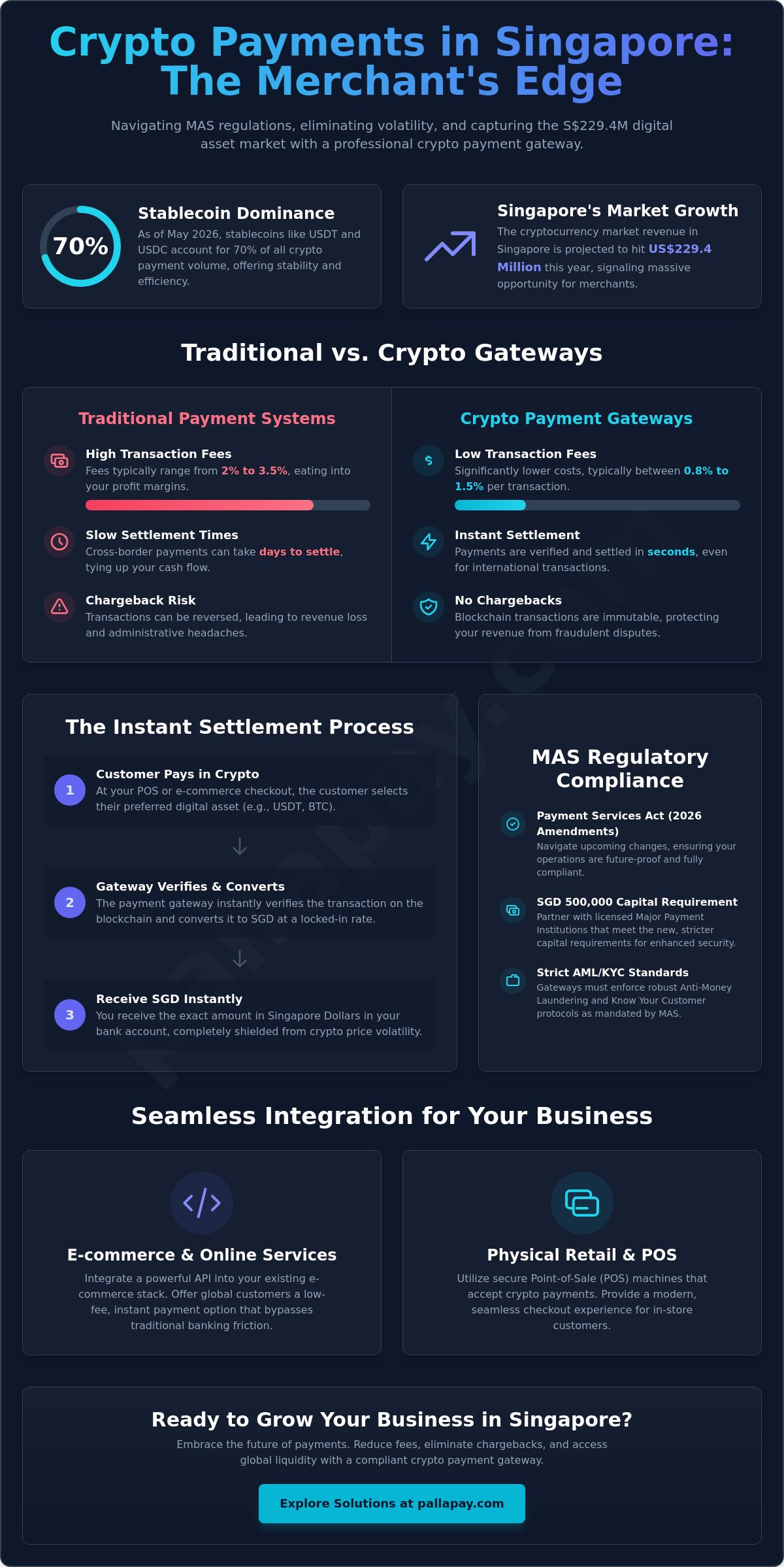
Singapore’s financial infrastructure has entered a new era of efficiency. The local economy now relies on digital payment token (DPT) services to maintain its competitive edge. A crypto payment gateway singapore is no longer a niche tool for tech enthusiasts; it’s a fundamental bridge for businesses seeking global liquidity and instant settlement. This evolution aligns with the “Smart Nation” initiative, where blockchain-based rails provide the transparency and speed that legacy banking systems often lack. The shift from speculative trading to real-world utility is clear. As of May 2026, stablecoins account for approximately 70% of all crypto payment volume. Local merchants increasingly favor USDT and USDC for both B2B and B2C transactions because these assets provide the stability of fiat with the technical advantages of the blockchain.
Singapore as a Global Leader in Digital Assets
Singapore consistently ranks at the top for digital asset adoption. The Monetary Authority of Singapore (MAS) has built a robust framework through the Payment Services Act 2019 and the Financial Services and Markets Act 2022. Understanding cryptocurrency legality in Singapore is essential for any merchant. With 36 Major Payment Institution licenses granted for DPT services as of January 2026, the regulatory environment offers a secure foundation for growth. The upcoming July 2026 amendments will further strengthen this by increasing capital requirements for Major Payment Institutions to SGD 500,000. This clarity allows SG-based firms to reduce cross-border friction, enabling them to settle international invoices in seconds rather than days.
Why Traditional Payment Gateways Are No Longer Enough
Legacy systems are struggling to keep pace with the demands of a global market. Traditional credit card processors often impose fees ranging from 2% to 3.5%, while a modern crypto payment gateway singapore typically costs between 0.8% and 1.5%. Beyond cost, the risk of chargebacks remains a primary concern for the ecommerce sector. Blockchain transactions are immutable; once a payment is verified, it can’t be reversed by a customer through a dispute process. This finality protects profit margins and simplifies accounting for local retailers. Today’s tech-savvy international customers expect the flexibility to pay with digital tokens, and businesses that fail to provide these options risk losing market share to more agile competitors.
How a Crypto Payment Gateway Works for Singaporean Merchants
A crypto payment gateway singapore functions as a high-performance financial bridge, translating complex blockchain data into usable fiat currency. The process begins with payment initiation, where the customer chooses their preferred digital asset at the point of sale. Once the transaction is broadcast, the gateway manages the blockchain verification, ensuring the funds are legitimate and confirmed. Finally, the system executes a fiat conversion, moving the value from the digital realm into the merchant’s local balance. To prevent slippage, top-tier gateways utilize real-time exchange rates backed by deep liquidity providers. This ensures that the price a customer sees is exactly what the merchant receives, regardless of market fluctuations during the few seconds of processing.
Architecture plays a vital role in security and speed. While non-custodial setups offer direct control, most Singaporean firms opt for custodial architectures because they facilitate much faster settlements. By managing the private keys and liquidity on the merchant’s behalf, these gateways can guarantee the “Instant” execution that modern commerce demands. Adhering to MAS regulations for crypto services, these providers ensure that every step of the verification process remains transparent and compliant with local financial standards.
Instant Fiat Settlement in SGD
One of the primary barriers to adoption is the perceived risk of asset volatility. Through a specialized fiat settlement process, merchants can accept volatile assets like Bitcoin or Ethereum without ever holding them on their balance sheets. The gateway converts the crypto to Singapore Dollars (SGD) at the exact moment of the transaction. This immediate conversion locks in the value, protecting profit margins from the erratic price swings often seen in the broader market. For businesses that need to manage cash flow precisely, utilizing an API for crypto payments allows for automated, predictable payouts directly to local bank accounts.
Stablecoins: The Backbone of Modern Commerce
Stablecoins like USDT and USDC have become the preferred medium for Singaporean businesses due to their 1:1 peg to the US Dollar. These tokens provide a reliable way to handle supplier payouts and payroll without the high costs of traditional wire transfers. By using stablecoins, SMEs can settle international invoices in minutes rather than days. Stablecoins represent the future of payments for SG SMEs because they combine the stability of traditional currency with the borderless efficiency of blockchain technology. To start optimizing your cash flow, you might consider how a crypto offramp can simplify your transition from digital assets back to traditional capital.
Evaluating Compliance: MAS Regulations and Security Standards
Compliance in Singapore is defined by the Payment Services Act (PSA). For any merchant integrating a crypto payment gateway singapore, the regulatory burden is significant but manageable through the right partner. By July 2026, the updated PSA amendments will mandate stricter governance standards and higher capital thresholds for providers. This ensures that only institutional-grade entities remain in the market. Providers must adhere to rigorous Anti-Money Laundering (AML) and Know Your Customer (KYC) protocols to mitigate financial crime. Beyond local laws, global credibility is often signaled by MSB registrations in major jurisdictions like the USA and Canada, which reinforces a gateway’s commitment to international financial standards.
The Legal Landscape for Digital Payment Tokens
In Singapore, the regulatory distinction between digital payment tokens and security tokens is critical. Most retail and B2B transactions involve payment tokens, which are regulated under the PSA rather than the Securities and Futures Act. Choosing a provider that understands these nuances is vital for accurate tax reporting and accounting. For instance, Singapore-based Dtcpay demonstrates how regulated gateways can successfully bridge digital assets with high-end commerce. Merchants must ensure their provider offers transparent transaction logs to satisfy local IRAS requirements and maintain clean financial records.
Enterprise-Grade Security Features
Technical security is the second pillar of a reliable crypto payment gateway singapore. Merchants should look for end-to-end encryption and robust API for crypto payments that prevent data interception at the point of sale. Protection goes beyond the transaction layer; it extends to how funds are stored and managed before settlement. Key security protocols include:
- Multi-signature wallets: These require multiple independent approvals for any fund movement, which eliminates single points of failure.
- Cold storage: Keeping the majority of digital assets in offline environments protects them from the cyber threats associated with internet-connected systems.
- Institutional-grade custody: Professional gateways use secure vaults and 24/7 monitoring to protect the merchant’s liquidity.
Securing your digital wallet involves more than just a strong password. It requires a sophisticated partner that handles the technical “heavy lifting” of blockchain protection. By offloading these complexities, you can focus on scaling your operations while the gateway ensures that every transaction remains secure, private, and fully compliant with the evolving legal standards of the 2026 financial market.
Integration Strategies for E-commerce and Retail in Singapore
Successful implementation of a crypto payment gateway singapore requires a structured approach that bridges digital storefronts with physical operations. Merchants must first decide on the technical depth of their integration. For those seeking rapid deployment, a hosted checkout or a pre-built plugin for mainstream platforms is ideal. Enterprise-level firms usually prefer a custom API integration to maintain full control over the user experience. Once the gateway is selected, the second step involves configuring the merchant dashboard for automated payouts. By setting your preferences to SGD settlement, you ensure that all incoming digital assets are instantly converted, maintaining liquidity in your local currency.
The third phase involves the actual technical rollout on your e-commerce site. This is followed by a crucial fourth step: staff training. Employees at physical locations need to understand how to generate QR codes and verify transaction confirmations on the spot. Finally, marketing your new capabilities to the local 2026 crypto community can significantly boost transaction volume. Highlighting your ability to accept digital assets can attract a demographic that prioritizes speed and financial privacy.
Optimizing for Singaporean Retail and Hospitality
Physical presence remains a cornerstone of the Singaporean economy. Implementing retail store solutions allows businesses to accept digital assets at the counter as easily as credit cards. In the hospitality sector, hotels are increasingly adopting these systems to facilitate high-value international bookings without the high fees associated with global credit cards. Using specialized crypto POS machines ensures that in-person payments are processed through a secure, dedicated terminal. This provides customers with a professional and familiar checkout experience while ensuring the merchant receives funds without delay.
Developer-First Implementation
For businesses with in-house technical teams, leveraging RESTful APIs allows for the creation of bespoke enterprise workflows. This flexibility is essential for complex order fulfillment processes. Webhooks play a critical role here, providing real-time notifications that trigger automated shipping or service activation the moment a payment is confirmed on the blockchain. Best practices for a smooth launch include extensive sandbox testing and thorough review of documentation to ensure every edge case is covered before going live. To begin your integration today, you can explore our API for crypto payments to see how easily digital assets can fit into your current stack.
Scaling Your Business with Pallapay’s All-in-One Gateway Ecosystem
Pallapay provides the definitive crypto payment gateway singapore for firms seeking to bridge the gap between blockchain technology and institutional finance. Unlike many digital-only competitors, Pallapay maintains a physical presence at International Plaza. This local footprint provides Singaporean merchants with a level of institutional support that purely online platforms can’t match. Managing a business becomes more efficient through a unified dashboard that consolidates online e-commerce sales with physical in-store transactions. This “all-in-one” ecosystem eliminates the need for fragmented service providers. For high-volume corporate treasury management, the off-ramp service allows for the seamless transfer of digital assets back into traditional capital, ensuring your business maintains the liquidity required for daily operations.
The transition from accepting payments to utilizing capital should be frictionless. By centralizing your financial operations within a single ecosystem, you reduce the technical “heavy lifting” often associated with digital assets. Merchants can move from a transaction confirmation to SGD settlement in record time, allowing for faster reinvestment into growth and inventory. This efficiency is what separates a standard tool from a visionary partner.
Beyond the Gateway: The Pallapay Mastercard
Profitability is only as useful as your ability to access it. The Pallapay Mastercard allows business owners to spend their crypto earnings directly, bypassing the traditional delays associated with bank transfers. You can choose between virtual cards for digital subscriptions or physical cards for corporate travel and entertainment expenses. This creates a powerful synergy between your merchant gateway and your spending power. It’s a complete financial loop where you accept payments, convert them, and deploy capital without leaving the ecosystem. Corporate expense management becomes significantly simpler when your revenue and your spending tools are part of the same secure platform.
High-Volume Solutions and Institutional Support
Large-scale operations require specialized tools that standard gateways don’t provide. Utilizing the OTC crypto exchange allows Singaporean enterprise clients to execute significant fiat conversions without impacting market prices. This institutional-grade liquidity is backed by dedicated account management, providing a personalized experience for firms processing millions in volume. You’re not just adopting a tool; you’re joining the future of payments with a partner deeply rooted in the local market. By choosing a professional crypto payment gateway singapore that offers this level of technical sophistication, you position your brand as a leader in the next evolution of global commerce.
Securing Your Lead in Singapore’s Digital Economy
The 2026 financial landscape in Singapore demands both agility and institutional reliability. By integrating a professional crypto payment gateway singapore, you’ve learned how to bypass traditional banking friction and secure instant SGD settlement. We’ve explored the importance of adhering to the July 2026 Payment Services Act amendments and the strategic advantage of using stablecoins to manage global liquidity. These tools aren’t just innovations; they’re essential components for any merchant aiming to scale in a borderless market.
Pallapay bridges the gap between blockchain disruption and real-world utility. With an official MSB registration and a commitment to global compliance, we provide the stability your enterprise requires. Our physical office at International Plaza in Singapore ensures you have a dedicated partner for high-volume operations and OTC needs. You don’t have to navigate technical complexities alone. Our ecosystem handles the heavy lifting of real-time conversion and secure custody so you can focus on growth.
Enable Crypto Payments for Your Singapore Business with Pallapay today. Your business is ready to embrace the future of global commerce with absolute confidence and stability.
Frequently Asked Questions
Is it legal to accept cryptocurrency payments for my business in Singapore?
Yes, accepting digital payment tokens is entirely legal for businesses in Singapore under the Payment Services Act. While your business doesn’t require a specific license to accept crypto as payment, you must ensure your chosen crypto payment gateway singapore is regulated by the Monetary Authority of Singapore (MAS). This regulatory framework provides a secure environment for merchants to capture global liquidity without legal uncertainty.
How long does it take to settle crypto payments into my Singaporean bank account?
Settlement typically occurs within 24 hours, though professional gateways now provide “Instant” conversion to SGD. Once a transaction is confirmed on the blockchain, the gateway locks in the exchange rate and initiates the transfer to your local account. This efficiency ensures that your cash flow remains consistent and predictable, mirroring the speed of traditional electronic payments but with significantly lower overhead.
Do I need a special license from MAS to use a crypto payment gateway?
Merchants don’t need a license from MAS to accept digital assets for goods or services. The licensing requirement applies only to the entities providing the digital payment token (DPT) services. As of January 7, 2026, MAS has granted 36 Major Payment Institution licenses to providers who handle these technical complexities, allowing you to focus on your core business operations.
What are the transaction fees for crypto payments compared to credit cards in Singapore?
Crypto transaction fees are significantly lower, ranging from 0.8% to 1.5% compared to the 2.0% to 3.5% typically charged by credit card networks. By reducing these intermediary costs, Singaporean merchants can protect their profit margins. Blockchain transactions also eliminate the risk of chargebacks, which saves businesses an additional 1% to 2% in lost revenue annually from fraudulent disputes.
Can I accept crypto payments in my physical retail store in Singapore?
Yes, you can accept digital assets in physical locations using a specialized crypto POS machine or static QR codes. These terminals function similarly to traditional card readers but generate a unique payment address for each transaction. This allows your retail staff to facilitate secure, in-person payments that settle instantly into your merchant dashboard, providing a seamless experience for tech-savvy customers.
Which cryptocurrencies are most commonly used for payments in Singapore?
USDT and USDC are the most common choices, accounting for 70% of payment volume as of May 2026. While Bitcoin and Ethereum remain popular for high-value transactions, the stability of pegged tokens makes them the preferred backbone for daily commerce. These stablecoins offer the speed of blockchain with the price predictability of fiat, making them ideal for Singaporean SMEs and retail stores.
How does a crypto payment gateway handle the volatility of Bitcoin or Ethereum?
Gateways mitigate volatility through real-time exchange rates and immediate fiat conversion. The moment a customer initiates a payment, the crypto payment gateway singapore calculates the exact amount of SGD required and locks that rate. The digital asset is converted instantly, ensuring the merchant receives the full fiat value of the sale regardless of market price swings that might occur later.
What happens if a customer wants a refund for a crypto transaction?
Refunds are usually processed in the fiat value of the original transaction to protect the merchant’s balance sheet. If a customer paid 100 SGD worth of Bitcoin, the refund is typically issued as 100 SGD. This approach prevents merchants from losing money due to price fluctuations. Professional gateways automate this process through their dashboards, ensuring that returns are handled with the same security as the initial sale.
Disclaimer
The information provided on this website and blog is for general informational and educational purposes only and does not constitute financial, investment, legal, tax, or other professional advice.
Cryptocurrency and digital asset services may be subject to regulatory restrictions in certain jurisdictions. Users are solely responsible for ensuring compliance with applicable local laws and regulations before using any products or services mentioned on this website.
PallaPay does not guarantee the accuracy, completeness, or timeliness of any information published and accepts no liability for any loss or damages arising from reliance on the content. Any opinions expressed are those of the respective authors and may change without notice.
Certain services, features, or products referenced may be provided through third-party partners, licensed entities, or affiliated service providers subject to separate terms and regulatory approvals. Availability of services may vary by country or region.
This website may contain references to digital assets, virtual currencies, or blockchain-related services that are not available to residents of certain jurisdictions, including where prohibited by law. Nothing on this website constitutes an offer, solicitation, or recommendation to buy or sell any financial instrument or virtual asset.
Leave a Reply