Tag: E-commerce Payments

  • Crypto Payment Gateway Singapore: The 2026 Merchant’s Guide to Digital Payments

    Crypto Payment Gateway Singapore: The 2026 Merchant’s Guide to Digital Payments

    Did you know that stablecoins account for 70% of all digital payment volume as of 2025? As Singapore’s cryptocurrency market revenue reaches an estimated US$229.4 million this year, integrating a professional crypto payment gateway singapore has become a strategic necessity for modern merchants. You’re likely eager to capture this global liquidity, but the complexity of MAS regulations and the fear of crypto volatility affecting your profit margins can feel like a significant hurdle.

    This guide will show you how to secure instant conversion from crypto to SGD while maintaining strict compliance with local AML and KYC laws. We’ll preview the July 2026 amendments to the Payment Services Act and explain how providers must now handle the new SGD 500,000 capital requirements for Major Payment Institutions. You’ll discover how to slash transaction fees and implement a seamless integration into your existing POS or e-commerce stack. It’s time to move beyond traditional financial friction and embrace a more efficient, secure way to settle transactions and grow your business.

    Key Takeaways

    • Navigate the 2026 Payment Services Act with ease to ensure your business meets all MAS regulatory standards and updated AML/KYC requirements.
    • Leverage a crypto payment gateway singapore to achieve instant fiat settlement in SGD, effectively removing the risk of market volatility from your balance sheet.
    • Identify the ideal integration strategy for your specific business model, ranging from high-performance APIs for e-commerce to secure POS machines for retail.
    • Capitalize on the rapid growth of stablecoins to access global liquidity and offer customers a seamless, low-fee payment experience that bypasses traditional banking friction.

    The Evolution of Crypto Payments in Singapore’s Financial Hub

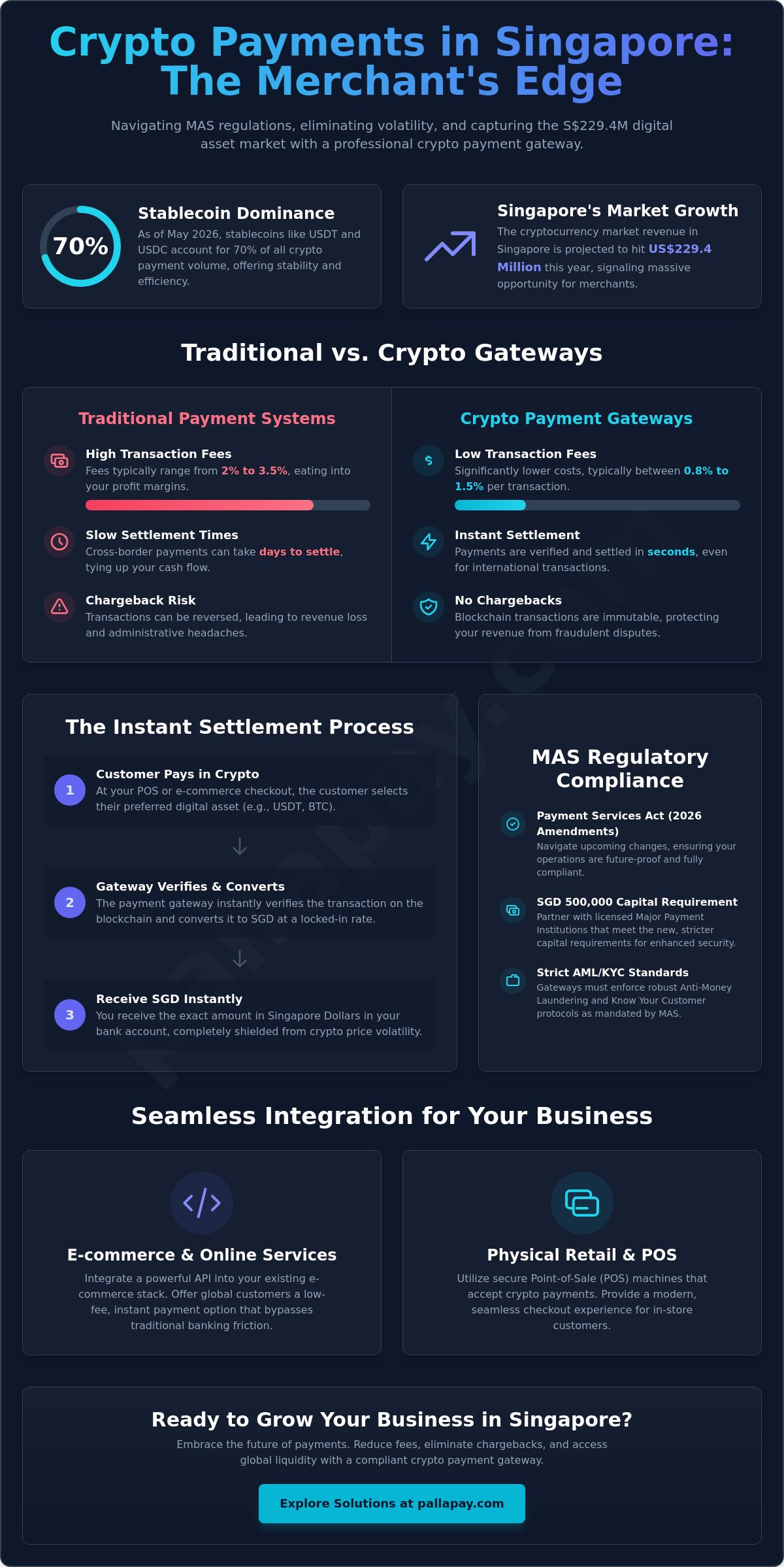
    Singapore’s financial infrastructure has entered a new era of efficiency. The local economy now relies on digital payment token (DPT) services to maintain its competitive edge. A crypto payment gateway singapore is no longer a niche tool for tech enthusiasts; it’s a fundamental bridge for businesses seeking global liquidity and instant settlement. This evolution aligns with the “Smart Nation” initiative, where blockchain-based rails provide the transparency and speed that legacy banking systems often lack. The shift from speculative trading to real-world utility is clear. As of May 2026, stablecoins account for approximately 70% of all crypto payment volume. Local merchants increasingly favor USDT and USDC for both B2B and B2C transactions because these assets provide the stability of fiat with the technical advantages of the blockchain.

    Singapore as a Global Leader in Digital Assets

    Singapore consistently ranks at the top for digital asset adoption. The Monetary Authority of Singapore (MAS) has built a robust framework through the Payment Services Act 2019 and the Financial Services and Markets Act 2022. Understanding cryptocurrency legality in Singapore is essential for any merchant. With 36 Major Payment Institution licenses granted for DPT services as of January 2026, the regulatory environment offers a secure foundation for growth. The upcoming July 2026 amendments will further strengthen this by increasing capital requirements for Major Payment Institutions to SGD 500,000. This clarity allows SG-based firms to reduce cross-border friction, enabling them to settle international invoices in seconds rather than days.

    Why Traditional Payment Gateways Are No Longer Enough

    Legacy systems are struggling to keep pace with the demands of a global market. Traditional credit card processors often impose fees ranging from 2% to 3.5%, while a modern crypto payment gateway singapore typically costs between 0.8% and 1.5%. Beyond cost, the risk of chargebacks remains a primary concern for the ecommerce sector. Blockchain transactions are immutable; once a payment is verified, it can’t be reversed by a customer through a dispute process. This finality protects profit margins and simplifies accounting for local retailers. Today’s tech-savvy international customers expect the flexibility to pay with digital tokens, and businesses that fail to provide these options risk losing market share to more agile competitors.

    How a Crypto Payment Gateway Works for Singaporean Merchants

    A crypto payment gateway singapore functions as a high-performance financial bridge, translating complex blockchain data into usable fiat currency. The process begins with payment initiation, where the customer chooses their preferred digital asset at the point of sale. Once the transaction is broadcast, the gateway manages the blockchain verification, ensuring the funds are legitimate and confirmed. Finally, the system executes a fiat conversion, moving the value from the digital realm into the merchant’s local balance. To prevent slippage, top-tier gateways utilize real-time exchange rates backed by deep liquidity providers. This ensures that the price a customer sees is exactly what the merchant receives, regardless of market fluctuations during the few seconds of processing.

    Architecture plays a vital role in security and speed. While non-custodial setups offer direct control, most Singaporean firms opt for custodial architectures because they facilitate much faster settlements. By managing the private keys and liquidity on the merchant’s behalf, these gateways can guarantee the “Instant” execution that modern commerce demands. Adhering to MAS regulations for crypto services, these providers ensure that every step of the verification process remains transparent and compliant with local financial standards.

    Instant Fiat Settlement in SGD

    One of the primary barriers to adoption is the perceived risk of asset volatility. Through a specialized fiat settlement process, merchants can accept volatile assets like Bitcoin or Ethereum without ever holding them on their balance sheets. The gateway converts the crypto to Singapore Dollars (SGD) at the exact moment of the transaction. This immediate conversion locks in the value, protecting profit margins from the erratic price swings often seen in the broader market. For businesses that need to manage cash flow precisely, utilizing an API for crypto payments allows for automated, predictable payouts directly to local bank accounts.

    Stablecoins: The Backbone of Modern Commerce

    Stablecoins like USDT and USDC have become the preferred medium for Singaporean businesses due to their 1:1 peg to the US Dollar. These tokens provide a reliable way to handle supplier payouts and payroll without the high costs of traditional wire transfers. By using stablecoins, SMEs can settle international invoices in minutes rather than days. Stablecoins represent the future of payments for SG SMEs because they combine the stability of traditional currency with the borderless efficiency of blockchain technology. To start optimizing your cash flow, you might consider how a crypto offramp can simplify your transition from digital assets back to traditional capital.

    Crypto Payment Gateway Singapore: The 2026 Merchant’s Guide to Digital Payments

    Evaluating Compliance: MAS Regulations and Security Standards

    Compliance in Singapore is defined by the Payment Services Act (PSA). For any merchant integrating a crypto payment gateway singapore, the regulatory burden is significant but manageable through the right partner. By July 2026, the updated PSA amendments will mandate stricter governance standards and higher capital thresholds for providers. This ensures that only institutional-grade entities remain in the market. Providers must adhere to rigorous Anti-Money Laundering (AML) and Know Your Customer (KYC) protocols to mitigate financial crime. Beyond local laws, global credibility is often signaled by MSB registrations in major jurisdictions like the USA and Canada, which reinforces a gateway’s commitment to international financial standards.

    The Legal Landscape for Digital Payment Tokens

    In Singapore, the regulatory distinction between digital payment tokens and security tokens is critical. Most retail and B2B transactions involve payment tokens, which are regulated under the PSA rather than the Securities and Futures Act. Choosing a provider that understands these nuances is vital for accurate tax reporting and accounting. For instance, Singapore-based Dtcpay demonstrates how regulated gateways can successfully bridge digital assets with high-end commerce. Merchants must ensure their provider offers transparent transaction logs to satisfy local IRAS requirements and maintain clean financial records.

    Enterprise-Grade Security Features

    Technical security is the second pillar of a reliable crypto payment gateway singapore. Merchants should look for end-to-end encryption and robust API for crypto payments that prevent data interception at the point of sale. Protection goes beyond the transaction layer; it extends to how funds are stored and managed before settlement. Key security protocols include:

    • Multi-signature wallets: These require multiple independent approvals for any fund movement, which eliminates single points of failure.
    • Cold storage: Keeping the majority of digital assets in offline environments protects them from the cyber threats associated with internet-connected systems.
    • Institutional-grade custody: Professional gateways use secure vaults and 24/7 monitoring to protect the merchant’s liquidity.

    Securing your digital wallet involves more than just a strong password. It requires a sophisticated partner that handles the technical “heavy lifting” of blockchain protection. By offloading these complexities, you can focus on scaling your operations while the gateway ensures that every transaction remains secure, private, and fully compliant with the evolving legal standards of the 2026 financial market.
    Integration Strategies for E-commerce and Retail in Singapore

    Successful implementation of a crypto payment gateway singapore requires a structured approach that bridges digital storefronts with physical operations. Merchants must first decide on the technical depth of their integration. For those seeking rapid deployment, a hosted checkout or a pre-built plugin for mainstream platforms is ideal. Enterprise-level firms usually prefer a custom API integration to maintain full control over the user experience. Once the gateway is selected, the second step involves configuring the merchant dashboard for automated payouts. By setting your preferences to SGD settlement, you ensure that all incoming digital assets are instantly converted, maintaining liquidity in your local currency.

    The third phase involves the actual technical rollout on your e-commerce site. This is followed by a crucial fourth step: staff training. Employees at physical locations need to understand how to generate QR codes and verify transaction confirmations on the spot. Finally, marketing your new capabilities to the local 2026 crypto community can significantly boost transaction volume. Highlighting your ability to accept digital assets can attract a demographic that prioritizes speed and financial privacy.

    Optimizing for Singaporean Retail and Hospitality

    Physical presence remains a cornerstone of the Singaporean economy. Implementing retail store solutions allows businesses to accept digital assets at the counter as easily as credit cards. In the hospitality sector, hotels are increasingly adopting these systems to facilitate high-value international bookings without the high fees associated with global credit cards. Using specialized crypto POS machines ensures that in-person payments are processed through a secure, dedicated terminal. This provides customers with a professional and familiar checkout experience while ensuring the merchant receives funds without delay.

    Developer-First Implementation

    For businesses with in-house technical teams, leveraging RESTful APIs allows for the creation of bespoke enterprise workflows. This flexibility is essential for complex order fulfillment processes. Webhooks play a critical role here, providing real-time notifications that trigger automated shipping or service activation the moment a payment is confirmed on the blockchain. Best practices for a smooth launch include extensive sandbox testing and thorough review of documentation to ensure every edge case is covered before going live. To begin your integration today, you can explore our API for crypto payments to see how easily digital assets can fit into your current stack.

    Scaling Your Business with Pallapay’s All-in-One Gateway Ecosystem

    Pallapay provides the definitive crypto payment gateway singapore for firms seeking to bridge the gap between blockchain technology and institutional finance. Unlike many digital-only competitors, Pallapay maintains a physical presence at International Plaza. This local footprint provides Singaporean merchants with a level of institutional support that purely online platforms can’t match. Managing a business becomes more efficient through a unified dashboard that consolidates online e-commerce sales with physical in-store transactions. This “all-in-one” ecosystem eliminates the need for fragmented service providers. For high-volume corporate treasury management, the off-ramp service allows for the seamless transfer of digital assets back into traditional capital, ensuring your business maintains the liquidity required for daily operations.

    The transition from accepting payments to utilizing capital should be frictionless. By centralizing your financial operations within a single ecosystem, you reduce the technical “heavy lifting” often associated with digital assets. Merchants can move from a transaction confirmation to SGD settlement in record time, allowing for faster reinvestment into growth and inventory. This efficiency is what separates a standard tool from a visionary partner.

    Beyond the Gateway: The Pallapay Mastercard

    Profitability is only as useful as your ability to access it. The Pallapay Mastercard allows business owners to spend their crypto earnings directly, bypassing the traditional delays associated with bank transfers. You can choose between virtual cards for digital subscriptions or physical cards for corporate travel and entertainment expenses. This creates a powerful synergy between your merchant gateway and your spending power. It’s a complete financial loop where you accept payments, convert them, and deploy capital without leaving the ecosystem. Corporate expense management becomes significantly simpler when your revenue and your spending tools are part of the same secure platform.

    High-Volume Solutions and Institutional Support

    Large-scale operations require specialized tools that standard gateways don’t provide. Utilizing the OTC crypto exchange allows Singaporean enterprise clients to execute significant fiat conversions without impacting market prices. This institutional-grade liquidity is backed by dedicated account management, providing a personalized experience for firms processing millions in volume. You’re not just adopting a tool; you’re joining the future of payments with a partner deeply rooted in the local market. By choosing a professional crypto payment gateway singapore that offers this level of technical sophistication, you position your brand as a leader in the next evolution of global commerce.

    Securing Your Lead in Singapore’s Digital Economy

    The 2026 financial landscape in Singapore demands both agility and institutional reliability. By integrating a professional crypto payment gateway singapore, you’ve learned how to bypass traditional banking friction and secure instant SGD settlement. We’ve explored the importance of adhering to the July 2026 Payment Services Act amendments and the strategic advantage of using stablecoins to manage global liquidity. These tools aren’t just innovations; they’re essential components for any merchant aiming to scale in a borderless market.

    Pallapay bridges the gap between blockchain disruption and real-world utility. With an official MSB registration and a commitment to global compliance, we provide the stability your enterprise requires. Our physical office at International Plaza in Singapore ensures you have a dedicated partner for high-volume operations and OTC needs. You don’t have to navigate technical complexities alone. Our ecosystem handles the heavy lifting of real-time conversion and secure custody so you can focus on growth.

    Enable Crypto Payments for Your Singapore Business with Pallapay today. Your business is ready to embrace the future of global commerce with absolute confidence and stability.

    Frequently Asked Questions

    Is it legal to accept cryptocurrency payments for my business in Singapore?

    Yes, accepting digital payment tokens is entirely legal for businesses in Singapore under the Payment Services Act. While your business doesn’t require a specific license to accept crypto as payment, you must ensure your chosen crypto payment gateway singapore is regulated by the Monetary Authority of Singapore (MAS). This regulatory framework provides a secure environment for merchants to capture global liquidity without legal uncertainty.

    How long does it take to settle crypto payments into my Singaporean bank account?

    Settlement typically occurs within 24 hours, though professional gateways now provide “Instant” conversion to SGD. Once a transaction is confirmed on the blockchain, the gateway locks in the exchange rate and initiates the transfer to your local account. This efficiency ensures that your cash flow remains consistent and predictable, mirroring the speed of traditional electronic payments but with significantly lower overhead.

    Do I need a special license from MAS to use a crypto payment gateway?

    Merchants don’t need a license from MAS to accept digital assets for goods or services. The licensing requirement applies only to the entities providing the digital payment token (DPT) services. As of January 7, 2026, MAS has granted 36 Major Payment Institution licenses to providers who handle these technical complexities, allowing you to focus on your core business operations.

    What are the transaction fees for crypto payments compared to credit cards in Singapore?

    Crypto transaction fees are significantly lower, ranging from 0.8% to 1.5% compared to the 2.0% to 3.5% typically charged by credit card networks. By reducing these intermediary costs, Singaporean merchants can protect their profit margins. Blockchain transactions also eliminate the risk of chargebacks, which saves businesses an additional 1% to 2% in lost revenue annually from fraudulent disputes.

    Can I accept crypto payments in my physical retail store in Singapore?

    Yes, you can accept digital assets in physical locations using a specialized crypto POS machine or static QR codes. These terminals function similarly to traditional card readers but generate a unique payment address for each transaction. This allows your retail staff to facilitate secure, in-person payments that settle instantly into your merchant dashboard, providing a seamless experience for tech-savvy customers.

    Which cryptocurrencies are most commonly used for payments in Singapore?

    USDT and USDC are the most common choices, accounting for 70% of payment volume as of May 2026. While Bitcoin and Ethereum remain popular for high-value transactions, the stability of pegged tokens makes them the preferred backbone for daily commerce. These stablecoins offer the speed of blockchain with the price predictability of fiat, making them ideal for Singaporean SMEs and retail stores.

    How does a crypto payment gateway handle the volatility of Bitcoin or Ethereum?

    Gateways mitigate volatility through real-time exchange rates and immediate fiat conversion. The moment a customer initiates a payment, the crypto payment gateway singapore calculates the exact amount of SGD required and locks that rate. The digital asset is converted instantly, ensuring the merchant receives the full fiat value of the sale regardless of market price swings that might occur later.

    What happens if a customer wants a refund for a crypto transaction?

    Refunds are usually processed in the fiat value of the original transaction to protect the merchant’s balance sheet. If a customer paid 100 SGD worth of Bitcoin, the refund is typically issued as 100 SGD. This approach prevents merchants from losing money due to price fluctuations. Professional gateways automate this process through their dashboards, ensuring that returns are handled with the same security as the initial sale.

    Disclaimer

    The information provided on this website and blog is for general informational and educational purposes only and does not constitute financial, investment, legal, tax, or other professional advice.
    Cryptocurrency and digital asset services may be subject to regulatory restrictions in certain jurisdictions. Users are solely responsible for ensuring compliance with applicable local laws and regulations before using any products or services mentioned on this website.
    PallaPay does not guarantee the accuracy, completeness, or timeliness of any information published and accepts no liability for any loss or damages arising from reliance on the content. Any opinions expressed are those of the respective authors and may change without notice.
    Certain services, features, or products referenced may be provided through third-party partners, licensed entities, or affiliated service providers subject to separate terms and regulatory approvals. Availability of services may vary by country or region.
    This website may contain references to digital assets, virtual currencies, or blockchain-related services that are not available to residents of certain jurisdictions, including where prohibited by law. Nothing on this website constitutes an offer, solicitation, or recommendation to buy or sell any financial instrument or virtual asset.

  • Crypto Payment Gateway Dubai: The 2026 Merchant Guide to Instant Settlements

    Crypto Payment Gateway Dubai: The 2026 Merchant Guide to Instant Settlements

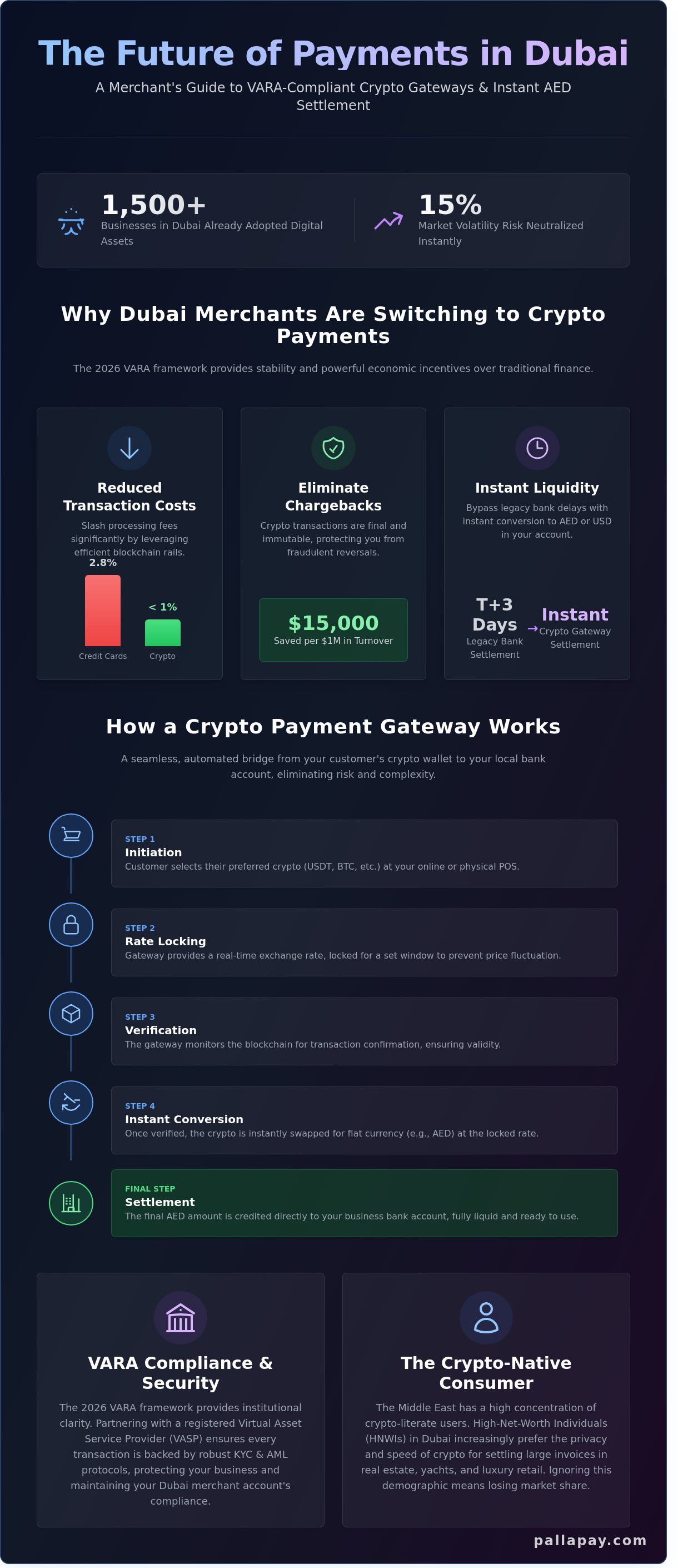
    The traditional cash-only retail model in the UAE is facing a sharp decline in relevance as over 1,500 businesses in Dubai have already pivoted to digital asset adoption. You likely recognize that while the opportunity is vast, the complexity of VARA regulations and the threat of 15% market volatility can make integration feel like a risk you aren’t ready to take. It’s a common concern for merchants who want the benefits of the future without the instability of the present. Securely implementing a crypto payment gateway dubai requires a partner that understands both the disruptive nature of blockchain and the necessity of institutional reliability.

    This guide empowers you to master the modern payment landscape by deploying VARA-compliant systems that guarantee instant AED bank settlements. You’ll learn how to eliminate price risk through real-time conversion and provide a seamless experience across both your e-commerce platforms and physical storefronts. We’re providing the roadmap to move beyond simple transactions and embrace the future of payments with absolute confidence and technical ease.

    Key Takeaways

    • Navigate the evolution of Dubai’s 2026 VARA framework to transition your business from traditional finance to a high-utility crypto payment model.
    • Master the mechanics of real-time conversion to ensure every transaction results in instant AED bank settlements without exposure to market volatility.
    • Evaluate the essential security benchmarks and fee transparency needed when choosing a crypto payment gateway dubai to protect your bottom line.
    • Leverage cross-border payment efficiencies to capture international revenue streams and simplify global trade through a unified digital infrastructure.
    • Discover how an all-in-one ecosystem integrates online gateways with physical POS hardware to provide a seamless payment experience for every customer.

    The 2026 Dubai Crypto Landscape: Why Merchants are Switching

    Dubai’s transformation into a global crypto capital is no longer a forecast; it’s a realized economic shift. By January 2026, the city has successfully integrated blockchain into the fabric of its retail and service sectors. Merchants are moving away from traditional payment processors because the crypto payment gateway dubai infrastructure now provides stability that rivals legacy banking. This transition is driven by the 2026 Virtual Assets Regulatory Authority (VARA) framework, which has replaced market uncertainty with institutional clarity.

    The shift from viewing crypto as a speculative investment to a daily payment utility is evident across the Emirates. Businesses aren’t just “experimenting” with digital assets; they’re adopting them to solve fundamental inefficiencies in the traditional financial system. The economic incentives for Dubai merchants include:

    • Reduced Transaction Costs: Processing fees have dropped from a traditional credit card average of 2.8% to less than 1% via blockchain rails.
    • Elimination of Chargebacks: Crypto transactions are final and immutable, saving merchants approximately $15,000 for every $1 million in turnover by removing fraudulent reversals.
    • Instant Liquidity: A professional crypto payment gateway dubai acts as the essential bridge, converting volatile assets into stable AED or USD instantly, bypassing the T+3 settlement delays of legacy banks.

    VARA Compliance and the Legal Framework

    The 2026 VARA guidelines mandate strict operational standards for all virtual asset service providers. These regulations ensure that every transaction is backed by robust KYC and AML protocols, protecting businesses from illicit activity. By registering as a Virtual Asset Service Provider (VASP) or partnering with MSB-registered hubs, platforms provide a layer of institutional trust. This legal maturity allows merchants to maintain a compliant Dubai merchant account while accessing the global liquidity of the decentralized web.

    Market Demand: The Rise of the Crypto-Native Consumer

    The Middle East now hosts one of the highest concentrations of crypto-literate consumers globally. High-net-worth individuals (HNWIs) in Dubai’s luxury sector increasingly prefer settling invoices for real estate, yachts, and high-end retail using USDT or BTC. These users prioritize the privacy and speed that blockchain offers. Businesses that ignore this demographic risk losing market share to tech-forward competitors. You can explore more about the Strategic Benefits of Accepting Cryptocurrency for Businesses in 2026 to understand how this shift impacts long-term profitability and customer retention.

    Pallapay stands at the center of this evolution, offering the tools necessary to turn complex blockchain technology into a standard, effortless business operation. It’s about more than just accepting a new currency; it’s about joining the future of payments.

    How a Crypto Payment Gateway Works for Dubai Businesses

    A crypto payment gateway dubai businesses utilize acts as a sophisticated bridge between decentralized digital assets and traditional financial systems. It functions as a real-time translator, converting volatile cryptocurrencies into stable local currency the moment a transaction occurs. This process removes the technical barriers that previously kept merchants from tapping into the trillion-dollar crypto market. When a customer initiates a payment, the gateway locks the exchange rate for a specific window, protecting the merchant from price fluctuations that could occur during blockchain confirmation times.

    The journey of a single transaction follows a precise, automated path to ensure security and speed:

    • Initiation: The customer selects their preferred digital asset, such as USDT, BTC, or ETH, at the point of sale.
    • Rate Locking: The gateway pulls data from global liquidity providers to offer a competitive, real-time exchange rate.
    • Verification: The transaction is broadcast to the blockchain; the gateway monitors for confirmation.
    • Instant Conversion: Once verified, the system automatically swaps the crypto for fiat currency like AED or USD.
    • Settlement: The final amount is credited to the merchant’s business account, ready for withdrawal or reinvestment.

    Liquidity providers are the essential engine room of this operation. By maintaining deep reserves of both digital and traditional assets, they allow the gateway to facilitate “Instant” settlements. This infrastructure means businesses don’t have to wait for a buyer on a public exchange; the liquidity is already there, waiting to be deployed. This reliability transforms crypto from a speculative asset into a practical tool for daily commerce.

    Instant Fiat Settlement: From Crypto to AED

    The fiat settlement process is designed to mirror the speed of modern digital life. While traditional banking typically operates on T+2 or T+3 cycles, meaning you wait up to 72 hours for funds, this system enables settlements in under 5 minutes. Dubai-based merchants can convert assets like USDT into AED 24/7, including weekends and public holidays. This constant availability ensures that cash flow remains fluid, allowing you to pay suppliers or staff without the delays inherent in legacy banking. To manage these incoming flows effectively, many enterprises start by setting up a secure business wallet to oversee their digital treasury.

    Technical Integration Methods

    Adapting your business to accept crypto doesn’t require a total overhaul of your existing systems. For custom e-commerce platforms, a Payment API provides a robust framework to build a bespoke checkout experience. If you require a faster setup, no-code solutions allow you to generate payment links for social media sales or direct invoicing in seconds. These links function as “Instant” invoices that customers can pay from any global wallet. For a deeper dive into choosing the right setup, consult The Ultimate Guide to Crypto Payment Gateways to see which method aligns with your specific volume and technical capacity.

    Crypto Payment Gateway Dubai: The 2026 Merchant Guide to Instant Settlements

    Evaluating the Best Crypto Payment Gateway in Dubai

    Selecting a crypto payment gateway dubai requires more than a glance at a feature list; it demands a rigorous audit of regulatory compliance and technical architecture. In 2024, the Virtual Assets Regulatory Authority (VARA) established strict guidelines that every merchant must verify before integration. Security isn’t a luxury; it’s the foundation of institutional trust. If a provider lacks a transparent regulatory status in the UAE, they risk your capital and your business license. Merchants should prioritize partners that treat compliance as a core product feature rather than an afterthought.

    Security Features and Asset Protection

    The Future of Payments for Dubai enterprises relies on 100% secure processing. A professional gateway must utilize cold storage for at least 98% of digital assets, keeping them offline and away from potential breaches. Multi-signature (multi-sig) wallets add another layer of defense by requiring multiple authorized approvals before any significant movement of funds occurs. You should identify red flags immediately. If a provider operates solely from an offshore jurisdiction or lacks clear KYC (Know Your Customer) protocols, they pose a systemic risk to your liquidity. Reliable gateways provide institutional-grade protection that mirrors traditional banking security.

    Cost Analysis: Crypto vs. Traditional Gateways

    Profitability depends on understanding the gap between advertised rates and actual ROI. Traditional international credit card processors often charge between 3% and 5% per transaction, excluding currency conversion markups. A sophisticated crypto settlement solution typically reduces these costs to a range of 1% to 2%. This represents a 50% reduction in overhead for high-volume retailers. Beyond the base fee, merchants gain massive value by eliminating “friendly fraud” and chargeback disputes, which cost global businesses over $20 billion in 2023. Unlike credit cards, crypto transactions are final and immutable. For businesses seeking to bridge traditional banking with digital assets, implementing a fiat to crypto payment gateway provides the infrastructure to accept both traditional and digital currencies seamlessly.

    The Total Cost of Ownership for a crypto gateway encompasses the initial payment API integration effort, a standard 1% processing fee, and any applicable fiat settlement charges required to move funds to a corporate bank account.

    Liquidity and Localized Support

    Multi-currency support is a non-negotiable requirement for modern commerce. While Bitcoin and Ethereum are standard, stablecoins like USDT and USDC facilitate over 90% of commercial crypto volume due to their price stability. Your gateway must handle these assets with Instant precision to avoid volatility. Localized 24/7 assistance is equally critical for high-volume traders moving $500,000 or more daily. When a technical glitch occurs at 2:00 AM GST, you can’t wait for a support ticket response from a different time zone. A Dubai-based partner ensures that your operations never stall, providing the professional bridge between digital innovation and reliable retail execution.

    Industry Applications: Tailoring Payments for Dubai Sectors

    Dubai’s status as a premier global trade hub demands financial infrastructure that operates at the speed of its markets. Implementing a crypto payment gateway dubai allows businesses to capture international revenue without the 3 to 5 day delays typical of traditional SWIFT transfers. By 2026, over 25% of cross-border trade in the UAE is projected to involve some form of digital asset settlement. This shift isn’t just about speed; it’s about precision and compliance. Pallapay ensures every transaction adheres to the “Travel Rule” requirements set by VARA, providing the necessary data transparency while maintaining the privacy high-net-worth clients expect. We provide the professional bridge between traditional commerce and the future of payments.

    Luxury Hospitality and Real Estate

    The demand for digital asset integration is highest in the premium sectors. Leading hotels in Dubai are adopting crypto to attract a new demographic of global travelers who prefer decentralized liquidity. These guests often book high-value suites where instant confirmation is essential. For real estate firms, the ability to facilitate large-scale transactions for property rentals and sales using crypto removes the friction of currency conversion fees. A developer can receive a multi-million dirham payment via stablecoins and see settlement in their corporate account immediately, ensuring the property remains off the market for the shortest time possible.

    E-commerce and High-End Retail

    Digital storefronts are evolving. Integrating crypto into e-commerce platforms provides a borderless sales channel that eliminates chargeback fraud, a risk that cost retailers globally over $100 billion in 2023. Our Retail Store solutions bridge the gap between physical boutiques and digital wallets. Shoppers in the Dubai Mall can now use their mobile wallets for high-end purchases as easily as a credit card. Beyond direct sales, forward-thinking brands are tokenizing loyalty programs. By using gift cards powered by blockchain, retailers create a secure, transferable value system that keeps customers within their ecosystem. Using a crypto payment gateway dubai ensures these retailers stay ahead of the curve while maintaining institutional-grade security.

    Ready to modernize your revenue streams? Integrate our Payment API today to start accepting global payments instantly.

    Getting Started with Pallapay: Dubai’s Leading Gateway

    Pallapay serves as the visionary partner for enterprises looking to lead the Dubai market into 2026. As a premier crypto payment gateway dubai, the platform provides the essential infrastructure to bridge digital assets with institutional financial reliability. Merchants no longer need to juggle multiple vendors for their financial needs. Pallapay offers an all-in-one ecosystem that spans from high-speed online gateways to robust physical hardware. Efficiency is the core priority. Businesses can move from initial account creation to their first live transaction in under 24 hours. This rapid deployment allows companies to capture market share without the delays associated with legacy banking systems.

    Trust is anchored in a significant physical presence. While the technology is decentralized, the support is local and professional. Pallapay maintains dedicated OTC desks at the Binary Tower in Business Bay. This physical infrastructure provides a level of security and personal consultation that digital-only platforms cannot match. For corporate entities handling large-scale settlements, having a professional team available for face-to-face strategy ensures absolute stability and transparency in every transaction.

    The Pallapay POS Advantage

    Accepting digital currencies in a physical retail environment shouldn’t be complex. The Crypto POS Machine allows merchants to process transactions with the same familiarity as traditional card readers. These devices feature full NFC and QR code payment support, ensuring instant retail transactions at the point of sale. This technology eliminates wait times and provides customers with a seamless checkout experience. For a deeper understanding of hardware capabilities, merchants can consult our Crypto POS Machine: The Complete Guide for Merchants in 2026.

    Next Steps for Your Business

    Transitioning to a modern financial stack is a straightforward process. Corporate entities in the UAE need to provide standard onboarding requirements, including a valid trade license and shareholder identification, to begin. You can schedule a private consultation at our Dubai Binary Tower office to discuss custom liquidity requirements or complex API integrations. Our team handles the heavy lifting of technical setup so you can focus on scaling your operations. Join the Future of Payments with Pallapay today and secure your position in the evolving global economy.

    The Future of Payments is Already Here

    Dubai’s transition to a blockchain-powered economy isn’t a distant goal; it’s a 2026 reality that demands immediate merchant adaptation. By integrating a robust crypto payment gateway dubai, your business eliminates the 24-hour settlement delays typical of legacy banking. You gain the ability to accept global liquidity while receiving instant AED deposits directly into your local account. Security remains the cornerstone of this evolution. Pallapay provides this stability through its status as a regulated MSB in the US and Canada, backed by a dedicated physical headquarters in Dubai’s Business Bay.

    Success in this new landscape requires a partner that handles technical complexity so you can focus on growth. Whether you’re in luxury retail or real estate, the shift toward digital assets offers a clear competitive edge. It’s time to move beyond traditional limitations and embrace a system built for speed and absolute transparency. Empower your business with Dubai’s most secure crypto payment gateway and start settling your transactions in real-time. Your journey toward institutional-grade financial flexibility starts today.

    Frequently Asked Questions

    Is it legal to accept cryptocurrency payments for my business in Dubai?

    Yes, it’s fully legal to accept cryptocurrency payments in Dubai under the regulatory framework established by the Virtual Assets Regulatory Authority (VARA) in March 2022. Businesses can legally integrate a crypto payment gateway dubai to accept digital assets as long as they process transactions through a licensed provider like Pallapay. This structure ensures your operations remain compliant with UAE federal laws and global anti-money laundering standards.

    How long does it take to settle crypto payments into my UAE bank account?

    Pallapay provides instant settlements that ensure funds reach your UAE bank account within 24 hours of a transaction. While traditional cross-border transfers often take 3 to 5 business days, our infrastructure bypasses these delays through direct liquidity pools. You can choose to receive your settlements in AED, USD, or EUR, which helps your business maintain a consistent and predictable cash flow.

    What are the transaction fees for using a crypto payment gateway in Dubai?

    Transaction fees for using our crypto payment gateway dubai typically range from 0.5% to 1% per transaction. This is significantly more cost-effective than the 2.5% to 3.5% fees often charged by traditional credit card processors in the UAE. By reducing these overhead costs, you increase your profit margins on every sale while providing your customers with modern payment flexibility.

    Which cryptocurrencies can I accept through the Pallapay gateway?

    You can accept over 100 different cryptocurrencies including Bitcoin, Ethereum, and major stablecoins like USDT and USDC. Pallapay supports a diverse range of digital assets to ensure you don’t miss a sale from global customers. Our platform handles the conversion of these assets into your preferred fiat currency at the point of sale, making it a seamless experience for your accounting team.

    Do I need a special license to accept crypto payments in the UAE?

    Merchants don’t need a specific crypto license to accept payments if they partner with a licensed third-party processor. By using Pallapay, you leverage our existing VARA-compliant infrastructure and regulatory approvals. Your primary requirement is to maintain a valid UAE trade license for your specific business activity, while we manage the complex technical compliance and reporting behind the scenes.

    How does Pallapay protect my business from crypto price volatility?

    Pallapay eliminates volatility risk by locking the exchange rate at the exact moment of the transaction. If a customer pays 5,000 AED worth of Bitcoin, you receive exactly 5,000 AED regardless of market fluctuations that occur minutes later. This instant conversion mechanism ensures your revenue remains stable, allowing you to treat digital asset payments with the same financial certainty as a standard bank transfer.

    Can I use a crypto payment gateway for my physical retail store in Dubai?

    Yes, you can implement crypto payments in physical retail locations using our dedicated Point of Sale (POS) terminals or simple QR code displays. Customers scan the code with their mobile wallet to complete the purchase in seconds. This hardware integration represents the future of payments, bridging the gap between digital assets and physical commerce for luxury boutiques and service providers across the city.

    What is the difference between a crypto gateway and an OTC desk?

    A crypto gateway is an automated system for processing individual retail transactions at checkout, whereas an OTC desk is designed for high-volume trades exceeding 50,000 AED. Gateways provide a seamless experience for daily sales through websites or POS systems. In contrast, our OTC services offer personalized liquidity for institutional moves or large corporate treasury conversions that require specialized handling outside of public exchange order books.

    Disclaimer

    The information provided on this website and blog is for general informational and educational purposes only and does not constitute financial, investment, legal, tax, or other professional advice.
    Cryptocurrency and digital asset services may be subject to regulatory restrictions in certain jurisdictions. Users are solely responsible for ensuring compliance with applicable local laws and regulations before using any products or services mentioned on this website.
    PallaPay does not guarantee the accuracy, completeness, or timeliness of any information published and accepts no liability for any loss or damages arising from reliance on the content. Any opinions expressed are those of the respective authors and may change without notice.
    Certain services, features, or products referenced may be provided through third-party partners, licensed entities, or affiliated service providers subject to separate terms and regulatory approvals. Availability of services may vary by country or region.
    This website may contain references to digital assets, virtual currencies, or blockchain-related services that are not available to residents of certain jurisdictions, including where prohibited by law. Nothing on this website constitutes an offer, solicitation, or recommendation to buy or sell any financial instrument or virtual asset.

  • The Definitive Guide to API for Crypto Payments: Scaling Global Commerce in 2026

    The Definitive Guide to API for Crypto Payments: Scaling Global Commerce in 2026

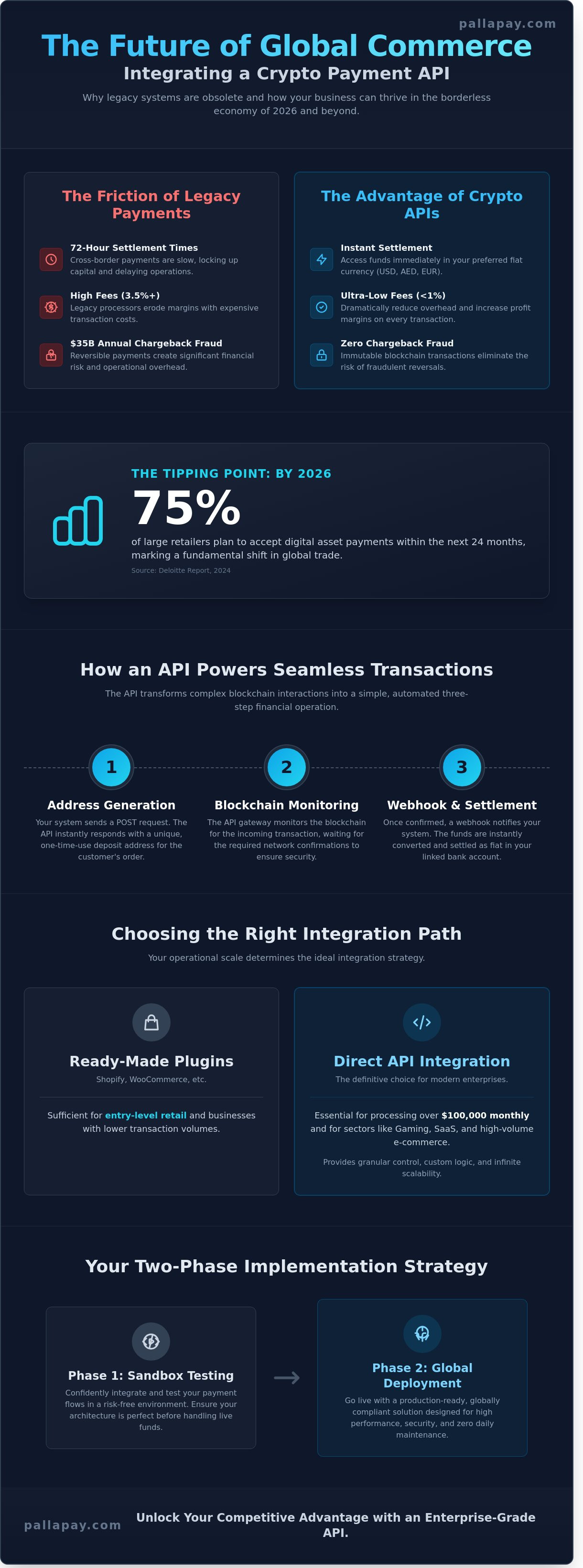
    By 2026, cross-border commerce will no longer rely on legacy banking rails that take 72 hours to clear. A 2024 report by Deloitte indicates that 75% of retailers with 500 million dollars in revenue plan to accept digital assets within the next 24 months. Choosing a robust api for crypto payments isn’t just a technical upgrade; it’s a strategic necessity for survival in a borderless economy. You’ve likely felt the friction of managing fragmented wallets or the constant anxiety of regulatory shifts. It’s frustrating to watch price volatility erode your margins during the 48 hour settlement window typical of traditional systems.

    This guide shows you how to integrate a secure API for crypto payments that automates global transactions, ensures total compliance, and unlocks instant fiat settlements in USD, AED, or EUR. We’ll explore the architecture of scalable USDT and BTC acceptance and how to build a regulated infrastructure that requires zero daily maintenance. From bridging the gap between blockchain innovation and institutional reliability to eliminating the heavy lifting of liquidity management, you’re about to discover the future of payments.

    Key Takeaways

    • Transition from manual wallet management to automated blockchain communication to future-proof your global commerce infrastructure for 2026.
    • Understand the complete technical lifecycle of a transaction to ensure your financial architecture supports seamless conversions from checkout to bank deposit.
    • Integrate a high-performance api for crypto payments to access over 100 digital assets while maintaining institutional-grade security and multi-signature authorization.
    • Follow a structured two-phase implementation strategy to move confidently from risk-free sandbox testing to a live, global deployment.
    • Unlock the competitive advantage of instant fiat settlements and total regulatory compliance through a partner designed for modern enterprise needs.

    What is an API for Crypto Payments and Why is it Essential in 2026?

    An api for crypto payments is a sophisticated set of protocols that enables your software to communicate directly with a blockchain gateway. This technology automates the processing, verification, and settlement of digital asset transactions. By 2026, the narrative around digital currency has shifted. It is no longer an experimental asset class; it is a fundamental pillar of global trade. Enterprises have moved beyond the risks of manual wallet management to embrace automated, programmable financial flows.

    The API serves as a vital financial bridge between decentralized assets and traditional bank settlements. It handles the heavy lifting of blockchain interactions behind the scenes, allowing merchants to focus on growth. Businesses utilizing crypto payment gateways secure three immediate competitive advantages. First, they achieve instant global reach without the need for local banking entities in every market. Second, they eliminate the $35 billion annual drain caused by chargeback fraud, as blockchain transactions are immutable. Third, they reduce overhead costs. While legacy processors often charge 3.5% or more, crypto transactions typically cost less than 1%.

    The Evolution of Programmable Money

    Money has become data. APIs have evolved from simple tools that “send” or “receive” into complex orchestrators capable of managing liquidity and multi-currency payouts. Stablecoins like USDT now facilitate over 70% of B2B crypto commerce due to their price parity with the US Dollar. 2026 marks the tipping point for ecommerce payment gateway adoption as regulatory clarity and institutional infrastructure converge. This transition represents the future of payments, where every transaction is instant and transparent.

    API vs. Ready-Made Plugins

    Choosing between a standard plugin and a custom API depends on your operational scale. Standard plugins for Shopify or WooCommerce are sufficient for entry-level retail. However, an api for crypto payments is the only viable choice for businesses processing over $100,000 monthly. High-volume sectors like gaming or enterprise SaaS require the granular control and scalability that only a direct API integration provides. It allows for unique user experiences and bespoke settlement logic that off-the-shelf solutions cannot match. For the modern merchant, the API is the ultimate tool for building a seamless, all-in-one financial ecosystem.

    How a Crypto Payment API Works: The Technical and Financial Architecture

    Implementing an api for crypto payments transforms a complex cryptographic process into a standard, manageable financial operation. It functions through a precise Request-Response cycle that bridges your storefront and the blockchain. When a customer selects a digital asset at checkout, your server sends a POST request to the API. The system responds instantly with a specific payment amount and a destination address. This interaction eliminates the need for merchants to manage private keys or interact with raw blockchain nodes, providing a layer of institutional-grade security between your business and the public ledger.

    Webhooks serve as the backbone of this real-time architecture. Instead of your server constantly polling the blockchain to check if a payment has arrived, the API pushes an automated notification the moment the transaction reaches the required number of network confirmations. This event-driven model ensures that 100% of successful payments are captured and processed without manual intervention. It’s the difference between a clunky, delayed user experience and the instant gratification that modern consumers expect.

    The Payment Flow Decoded

    The lifecycle of a digital transaction is designed for speed and clarity through three critical steps:

    • Step 1: Address Generation. The system generates a unique, one-time deposit address for every order. This ensures privacy for the customer and simplifies reconciliation for the merchant.
    • Step 2: Blockchain Monitoring. The API tracks the transaction across the network. It distinguishes between on-chain confirmations for security and off-chain state channels for high-frequency micro-transactions.
    • Step 3: Automated Settlement. Once the payment is verified, the system triggers the fiat settlement protocol. This converts the digital assets into your local currency, protecting your profit margins from market volatility.

    Integrating Multiple Blockchains via a Single Endpoint

    Managing Ethereum, Bitcoin, and Tron separately requires immense developer resources and constant maintenance. A unified api for crypto payments abstracts this complexity into a single, clean integration. You don’t need to write custom code for every new token or network upgrade. The API acts as a visionary partner, handling the heavy lifting of node maintenance and protocol updates behind the scenes.

    This architecture also focuses on cost efficiency. By 2026, automated batching and liquidity routing will reduce gas fees by an estimated 40% compared to manual wallet transfers. As cryptocurrency regulation becomes more defined across global markets, using a professional API ensures your business remains compliant with evolving financial standards without needing to rebuild your core infrastructure. Security layers like IP whitelisting and end-to-end encryption form a permanent perimeter around your financial data, ensuring that every global transaction is as secure as a traditional bank wire.

    The result is a seamless transition from digital asset to bank deposit. Explore how our api for crypto payments can streamline your checkout process today and position your business at the forefront of the future of payments.

    The Definitive Guide to API for Crypto Payments: Scaling Global Commerce in 2026

    Key Features of a High-Performance Crypto Payment API

    A high-performance api for crypto payments acts as the central nervous system for modern enterprise. It handles the heavy lifting of blockchain interactions while maintaining the rigorous standards of legacy banking. Professional merchants in 2026 require a gateway that offers multi-currency support for 100+ digital assets, including BTC, ETH, and USDT. This diversity allows businesses to capture a global audience without managing multiple disparate systems. Security isn’t an afterthought; it’s the foundation of the entire architecture. Robust APIs utilize institutional-grade cold storage integration and multi-signature authorization to protect assets from digital vulnerabilities. These protocols ensure that funds remain secure even in the event of a localized system breach.

    Compliance is the bridge that connects disruptive innovation to institutional reliability. MSB registration across multiple jurisdictions is non-negotiable for legitimate commerce. This regulatory framework provides the stability necessary for long-term growth. Clear visibility into these processes comes through advanced merchant dashboards that deliver real-time data for accounting audits. With 99.9% uptime and granular reporting, businesses can track every cent with the same precision they expect from traditional financial software.

    Security and Compliance as a Feature

    Operating with “No Registration” APIs is a significant risk for established businesses in 2026. These anonymous platforms often lack the oversight needed to prevent fraud and can lead to frozen accounts during bank audits. High-performance systems integrate KYC and AML automation directly into the api for crypto payments workflow. This ensures that every transaction meets global standards without slowing down the user experience. Automated wallet screening protects your business by identifying “tainted” coins before they enter your ecosystem. By filtering out assets linked to illicit activity, you maintain a clean balance sheet and satisfy strict institutional requirements.

    Liquidity and Settlement Speed

    Volatility is a primary concern for traditional retailers entering the digital asset space. Our api for crypto payments solves this through instant conversion. Real-time liquidity providers lock in prices at the moment of transaction, which removes the risk of market swings. Merchants can customize their operations using specific settlement triggers:

    • Volume-based settlement: Move funds once a specific financial threshold is reached.
    • Time-based settlement: Schedule daily or weekly transfers to match accounting cycles.
    • Manual triggers: Maintain total control over when funds are moved to fiat.

    This flexibility extends to cross-border efficiency. You can move funds across 180+ countries without the traditional 3 to 5 day SWIFT delay. It’s the future of payments, delivered with the speed and reliability of a global fintech leader.

    Implementation Strategy: From Sandbox to Global Deployment

    Transitioning to a crypto-first economy requires a structured technical roadmap. Deploying a robust api for crypto payments involves five critical phases designed to ensure stability and institutional-grade security. By following this sequence, businesses can scale from a single test transaction to processing thousands of global payments per second.

    • Phase 1: Environment Setup. Developers begin by obtaining API keys and configuring a sandbox environment. This stage allows for risk-free testing of transaction flows without committing actual capital. Leading platforms in 2026 maintain 99.99% uptime in their staging environments to mirror production reliability.
    • Phase 2: Integration. This stage involves mapping API endpoints to your specific business logic. Whether you’re managing one-off checkouts or complex recurring billing cycles, the integration must be seamless to avoid latency.
    • Phase 3: Webhook Configuration. You must ensure your backend reacts instantly to on-chain events. Webhooks provide real-time updates when a payment moves from pending to confirmed, allowing for instant digital delivery or order fulfillment.
    • Phase 4: Security Hardening. Implementing rate limiting and secure key management is non-negotiable. Using encrypted vaults protects your credentials from unauthorized access and ensures that your api for crypto payments remains a secure bridge for capital.
    • Phase 5: Go-Live. The final transition to the production environment enables real-time liquidity and settlement. This step connects your business to the global crypto market with full operational support.

    Developer Experience (DX) and Documentation

    A superior payment API documentation hub should provide comprehensive JSON schemas and pre-built SDKs. These kits often accelerate integration timelines by 40% compared to manual coding. One common pitfall is failing to account for blockchain “reorgs.” Professional integrations require a minimum number of block confirmations, such as 2 blocks for high-speed networks or 6 blocks for Bitcoin, before finalizing an order to prevent double-spending risks.

    Optimizing the User Experience

    Frictionless commerce depends on the interface. For a mobile-first retail store, dynamic QR code generation is essential. These codes automatically embed the exact payment amount and wallet address, which eliminates manual entry errors. You should also display real-time exchange rates to build trust. This transparency shows customers the exact value in their preferred fiat currency. Your system must programmatically handle edge cases like partial payments. This ensures that 100% of transactions reach a logical conclusion without manual customer support intervention.

    Ready to modernize your financial infrastructure? Integrate our payment API and start accepting global payments today.

    Why Pallapay is the Definitive API Partner for Modern Enterprises

    Pallapay operates as more than a simple gateway; it’s a complete financial infrastructure designed for institutional reliability. We’ve secured MSB registrations in both the United States and Canada to ensure every transaction meets the highest regulatory standards. This compliance gives modern enterprises total peace of mind when scaling across borders. Our proprietary liquidity engine provides the “Instant” advantage, delivering the fastest fiat settlements available in the current market. While competitors often leave funds in limbo for 48 hours, our system settles capital rapidly to maintain your business momentum.

    Choosing the right api for crypto payments means looking beyond the code. Pallapay offers a comprehensive ecosystem that includes physical crypto POS machines for retail environments and dedicated OTC desks for high-volume transactions. You aren’t just getting a tool; you’re gaining a partner. Our 24/7 expert support provides direct access to engineers who understand the intersection of blockchain architecture and global finance. We don’t use generic chatbots; we provide human expertise for complex financial workflows.

    • Regulated Global Reach: Full MSB compliance in North America ensures your operations stay within legal frameworks.
    • Proprietary Liquidity: Our internal engine eliminates third-party delays, facilitating “Instant” conversions.
    • Hybrid Infrastructure: Seamlessly switch between digital API calls and physical hardware solutions.
    • Dedicated Engineering: Direct lines to technical leads who specialize in fintech integration.

    The Future of Payments: Pallapay’s 2026 Vision

    By 2026, we’ll have fully integrated AI-driven predictive modeling to stop transaction fraud before it occurs. This proactive layer analyzes patterns in real time, aiming to reduce chargeback risks by 40 percent compared to traditional legacy systems. We’re also expanding the utility of our corporate expense solutions, ensuring the Pallapay ecosystem functions as a professional bridge for the next billion users entering the digital economy. Our commitment remains clear: we handle the technological complexity so you can focus on global growth.

    Get Started with the Pallapay API Today

    The onboarding process for high-volume merchants is streamlined and efficient. We move from initial consultation to sandbox testing in as little as 72 hours, ensuring your development team can begin building immediately. You can request a custom demo tailored to your specific sector, whether you operate in Hotels, E-commerce, or Gaming. Our team analyzes your current transaction volume to provide a fee structure that scales with you. Join the future of global commerce with a partner you can trust to deliver stability and speed.

    Secure Your Position in the Next Era of Commerce

    The shift toward a borderless financial landscape is no longer a distant projection. By 2026, integrating a high-performance api for crypto payments will be the decisive factor for enterprises seeking to eliminate transaction friction and capture global market share. You’ve explored how the right technical architecture transforms complex blockchain interactions into instant, manageable business processes. True scalability requires more than just a gateway; it demands a foundation of institutional reliability and regulatory clarity.

    Pallapay provides this foundation as a regulated MSB in the USA and Canada. We’ve already processed over $1 billion in transaction volume, empowering merchants across 180 countries to operate without borders. Our ecosystem handles the intricacies of liquidity and settlement, allowing your team to focus on core expansion. It’s the most efficient way to bridge the gap between legacy systems and the future of payments. We’re ready to help you navigate this transition with the confidence that only a global leader can provide.

    Supercharge your business with the Pallapay Payment API

    Your journey toward global payment parity starts today.

    Frequently Asked Questions

    Is it secure to use an API for crypto payments?

    Yes, integrating an api for crypto payments is highly secure when you utilize Pallapay’s institutional-grade infrastructure. We employ AES-256 encryption and TLS 1.3 protocols to protect every data packet during transmission. Our system undergoes security audits every 30 days to maintain compliance with global fintech standards. This ensures that 100% of your transaction data remains shielded from unauthorized access throughout the entire payment lifecycle.

    How long does it take to integrate a crypto payment API?

    You can complete the full integration process within 24 to 48 hours by using our comprehensive technical documentation and SDKs. Developers typically spend 4 hours on initial configuration and the remainder on sandbox testing to ensure system harmony. Our RESTful API structure simplifies the connection between your checkout page and our settlement engine. By following our 5-step implementation guide, your business can begin processing live global transactions by the next business day.

    Can I receive fiat currency (USD, AED) directly into my bank account?

    Pallapay facilitates instant conversion of crypto assets into 30+ fiat currencies, including USD, AED, and EUR. Once a customer completes a payment, our liquidity engine executes the exchange at real-time market rates. You can then schedule daily or weekly bank transfers directly to your corporate account. This process eliminates price volatility risks; it ensures you receive the exact fiat value of your sale minus a transparent processing fee.

    What are the fees associated with using a crypto payment API in 2026?

    Transaction fees for our api for crypto payments typically range from 0.5% to 1.0% per successful settlement. This is significantly lower than the 2.9% plus fixed costs often charged by traditional credit card processors. We don’t charge monthly maintenance fees or hidden setup costs. For high-volume merchants processing over $500,000 monthly, we offer custom tiered pricing structures to further optimize your operational margins and maximize your revenue.

    Does my business need a special license to accept crypto via API?

    Most businesses don’t need a specific cryptocurrency license because Pallapay acts as your regulated payment service provider. We handle the complex KYC and AML requirements mandated by global regulators like VARA in Dubai. Your primary responsibility is maintaining a valid trade license in your local jurisdiction. By partnering with us, you leverage our existing regulatory framework to expand your payment options legally and securely without the burden of additional licensing.

    Which cryptocurrencies can I accept through the Pallapay API?

    Our API supports over 100 cryptocurrencies, including major assets like Bitcoin, Ethereum, and USDT. We also provide native support for high-utility tokens on the TRC20, ERC20, and BEP20 networks. This extensive range allows you to cater to a global audience with diverse digital portfolios. We update our supported asset list every 30 days to include emerging tokens that meet our strict liquidity and security benchmarks for reliable commerce.

    What happens if a customer sends the wrong amount to the API-generated address?

    If a customer sends an incorrect amount, our system identifies the discrepancy within 10 seconds of mempool detection. The API triggers an instant webhook notification to your server, allowing you to choose between requesting the remaining balance or issuing a refund. Our dashboard provides a 100% transparent log of these partial payments. This automated detection prevents order fulfillment errors and maintains accurate accounting records for every transaction your business processes.

    How do I handle refunds for crypto payments made through an API?

    You can initiate refunds directly through our API’s dedicated refund endpoint or via the Pallapay merchant dashboard. The system calculates the equivalent crypto amount based on the current market price at the moment of the refund request. Refunds are processed instantly once you authorize the transaction using your secure two-factor authentication. This streamlined workflow ensures your customers receive their funds back within minutes, maintaining high levels of satisfaction and trust in your brand.

    Disclaimer

    The information provided on this website and blog is for general informational and educational purposes only and does not constitute financial, investment, legal, tax, or other professional advice.
    Cryptocurrency and digital asset services may be subject to regulatory restrictions in certain jurisdictions. Users are solely responsible for ensuring compliance with applicable local laws and regulations before using any products or services mentioned on this website.
    PallaPay does not guarantee the accuracy, completeness, or timeliness of any information published and accepts no liability for any loss or damages arising from reliance on the content. Any opinions expressed are those of the respective authors and may change without notice.
    Certain services, features, or products referenced may be provided through third-party partners, licensed entities, or affiliated service providers subject to separate terms and regulatory approvals. Availability of services may vary by country or region.
    This website may contain references to digital assets, virtual currencies, or blockchain-related services that are not available to residents of certain jurisdictions, including where prohibited by law. Nothing on this website constitutes an offer, solicitation, or recommendation to buy or sell any financial instrument or virtual asset.
  • How to Choose a Crypto Payment Gateway in 2026: A Merchant’s Guide

    How to Choose a Crypto Payment Gateway in 2026: A Merchant’s Guide

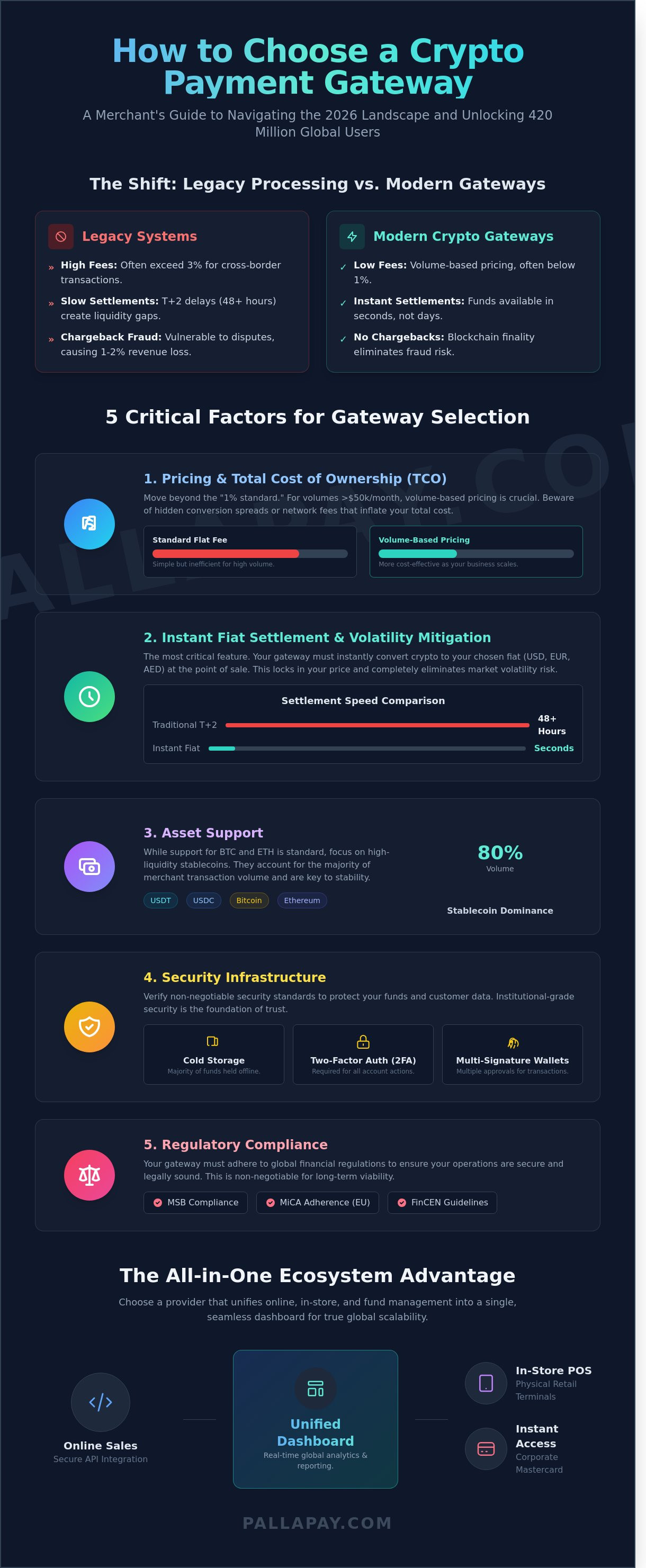
    By 2026, the distinction between traditional finance and blockchain has vanished, leaving merchants with a simple choice: adapt or lose access to the 420 million global users who now prefer digital assets. As you look to choose crypto payment gateway technology for your business, you’ve likely hesitated because you don’t want to gamble your profit margins on market volatility. It’s a valid concern when regulatory frameworks in 190 countries are constantly shifting.

    This guide provides the critical criteria for selecting infrastructure that bridges the gap between innovation and institutional reliability. You’ll learn how to secure your revenue through instant fiat settlements and automatic conversions to USD, EUR, or AED, ensuring that the price you charge is the exact amount you receive. We’ll examine the requirements for a seamless, all-in-one dashboard that manages your entire global transaction flow, proving that the future of payments is both sophisticated and effortless.

    Key Takeaways

    • Learn why moving beyond the “1% fee standard” to volume-based pricing and instant fiat settlements is crucial for maintaining your business’s liquidity.
    • Understand how to choose a crypto payment gateway that mitigates market volatility by offering direct, instant conversion from digital assets to your fiat bank account.
    • Discover the essential regulatory requirements, including MSB and MiCA compliance, needed to ensure your global operations remain secure and legally sound.
    • Explore how an all-in-one ecosystem bridges the gap between online transactions and physical retail through integrated crypto POS terminals.
    • Identify the strategic advantages of using a corporate Mastercard to gain instant access to your earned funds for immediate global scalability.

    Understanding the Role of a Crypto Payment Gateway in 2026

    A crypto payment gateway functions as a critical financial bridge. It connects decentralized blockchain transactions directly to traditional merchant bank accounts. To understand what is a crypto payment gateway in the current market, one must look at its evolution into an institutional-grade settlement tool. By 2026, over 15% of global e-commerce transactions involve stablecoins or Bitcoin. This growth stems from businesses needing to bypass the friction of legacy banking systems.

    Merchants often hesitate due to market fluctuations. Modern gateways solve this by providing real-time price locking. This feature ensures that the exact fiat value at the moment of purchase is what the merchant receives; it eliminates volatility risk entirely. As you look to choose crypto payment gateway providers for your business, this stability is a non-negotiable requirement. What was once a niche option has become a foundational pillar for e-commerce industries worldwide, making the decision to choose crypto payment gateway infrastructure a strategic priority for global growth.

    Why Traditional Processors are Falling Behind

    Legacy systems struggle with high cross-border fees, often exceeding 3% per transaction. Crypto settlements happen near-instantly, reducing wait times from days to seconds. Blockchain finality also eliminates chargeback fraud. This protection saves businesses an average of 1% to 2% in lost revenue annually. This technology allows brands to reach the 1.4 billion unbanked individuals and the growing demographic of tech-savvy global consumers who prioritize privacy and speed.

    Key Components of a Modern Gateway

    A sophisticated gateway relies on three core pillars to ensure operational reliability:

    • The API layer: This creates a secure, instant connection between your digital checkout and the blockchain network.
    • The Settlement engine: This core technology converts digital assets into local fiat currency without slippage or delay.
    • The Merchant Dashboard: This provides real-time reporting and analytics, giving you total visibility over global sales and liquidity.

    These components work in unison to transform complex cryptographic processes into a seamless checkout experience. It’s no longer about just accepting a new currency; it’s about optimizing your entire financial supply chain.

    5 Critical Factors to Evaluate When You Choose a Crypto Payment Gateway

    Selecting the right partner requires looking far beyond surface-level marketing. When you choose a crypto payment gateway, the underlying technical architecture determines your long-term profit margins. While a 1% flat fee is common, high-volume merchants should prioritize providers offering volume-based value. A fixed rate is rarely the most efficient choice for businesses processing over $50,000 monthly. Settlement speed is equally vital to your operations. Traditional T+2 cycles create liquidity gaps that hinder growth. Modern gateways now provide instant fiat availability, allowing you to access capital without the standard 48-hour delay.

    Asset support must balance variety with stability. While Bitcoin and Ethereum are essential, 80% of merchant volume often flows through high-liquidity stablecoins like USDT and USDC. Security infrastructure is the final pillar of trust. You must verify that your provider utilizes cold storage for the majority of funds, 2FA for all account actions, and multi-signature wallet protocols for transaction authorization. While navigating the regulatory landscape, ensure your partner adheres to established FinCEN guidelines to maintain institutional-grade compliance.

    Analyzing the Total Cost of Ownership (TCO)

    Don’t let a low processing fee mask high hidden costs. A 0.5% transaction fee becomes expensive if currency conversion spreads exceed 2%. Network gas fees on the Ethereum blockchain averaged $15 in early 2024, which can erode profits on smaller retail transactions. Compare subscription models against pay-as-you-go structures. Subscriptions often provide superior value for established enterprises, while pay-as-you-go models offer the flexibility needed by startups. Always account for withdrawal limits and potential “network fees” that aren’t included in the base processing rate.

    Integration: Speed to Market Matters

    Your technical team’s time is a direct business expense. Evaluate the quality of developer documentation before committing. A gateway should offer robust Payment APIs for custom checkout experiences, alongside pre-built modules for CMS platforms like Shopify, WooCommerce, and Magento. A well-structured API can reduce your development timeline by 60%. For businesses requiring immediate deployment, hosted checkout pages provide a secure, ready-made solution. For those seeking a cohesive brand identity, embedded solutions offer the professional finish your customers expect. You can explore how fiat settlement options further simplify this transition into the future of payments.

    How to Choose a Crypto Payment Gateway in 2026: A Merchant’s Guide

    Comparing Settlement Models: Instant Fiat vs. Crypto-Native

    When you choose crypto payment gateway infrastructure, the primary decision involves how you receive your funds. Most institutional merchants prefer the crypto-to-fiat model to eliminate exposure to market swings. This setup ensures that if a customer pays 1,000 USD in Bitcoin, the merchant receives exactly 1,000 USD in their corporate bank account. It’s a reliable method for maintaining predictable cash flow.

    Professional gateways utilize direct bank settlements to move capital efficiently. For high-volume merchants processing over 50,000 USD daily, fiat settlement services rely on internal OTC desks. These desks handle large liquidations without slipping the market price, providing a stable exit for digital assets. This process connects disruptive blockchain technology with institutional financial reliability. For businesses seeking to understand the complete infrastructure behind these conversions, exploring a comprehensive fiat to crypto payment gateway guide reveals the technical mechanisms that enable instant global settlements without traditional banking delays.

    • Crypto-Native: You hold the digital asset on your balance sheet, benefiting from potential appreciation but accepting 100% of the market risk.
    • Instant Fiat: The gateway converts the asset at the point of sale, protecting your margins from the 5% to 10% daily price swings common in the crypto market.

    Volatility Protection and Price Locking

    Volatility is a hurdle for 85% of traditional retailers entering the digital asset space. Top-tier gateways solve this by locking the exchange rate at the exact millisecond a customer clicks “Pay.” This Instant conversion removes accounting headaches because the transaction enters your ledger as a fixed fiat amount. According to a guide to crypto payments for businesses, managing this price risk is essential for maintaining consistent profit margins. When handling refunds, the system calculates the original fiat value. This ensures the merchant doesn’t lose capital if the token price has risen since the initial purchase.

    Global Liquidity and Multi-Currency Support

    Global expansion requires more than just Bitcoin support; it demands settlement in regional currencies like USD, EUR, or AED. For Dubai-based businesses, AED settlement is a critical utility that simplifies local tax compliance and operational costs. Success in these markets depends on deep liquidity pools. Large-scale transactions require a partner that can facilitate immediate exchanges without delays. Using Sell USDT in Dubai services serves as a benchmark for local liquidity, ensuring that even multi-million dollar liquidations remain seamless. This infrastructure represents the future of payments, where digital and traditional finance exist in one unified, high-speed ecosystem.

    Compliance and Security: Navigating the 2026 Regulatory Landscape

    Regulation is no longer a peripheral concern for digital commerce. By December 2024, the full implementation of the MiCA (Markets in Crypto-Assets) framework redefined how businesses operate within the European Economic Area. To effectively choose crypto payment gateway services, you must prioritize providers that hold active Money Services Business (MSB) registrations with FinCEN in the United States and FINTRAC in Canada. These licenses ensure that your provider operates under strict federal oversight, protecting your business from the legal fallout of processing illicit funds.

    A sophisticated provider handles the heavy lifting of Know Your Customer (KYC) and Anti-Money Laundering (AML) protocols. This automation reduces your operational compliance costs by approximately 40% by removing the need for an in-house verification team. Security isn’t a static achievement; it’s a continuous process. Demand to see SOC2 Type II compliance reports or evidence of third-party penetration testing conducted within the last 180 days. These audits prove that the gateway’s infrastructure can withstand evolving cyber threats.

    Why Regulated Gateways are the Only Choice for Enterprises

    Unregulated offshore processors present a terminal risk to your brand. Data from 2024 indicates that 15% of unlicensed payment entities faced sudden asset freezes or regulatory shutdowns, leaving merchants without access to their capital. Regulated gateways provide the institutional trust necessary to maintain relationships with traditional banking partners. This alignment ensures your fiat settlements remain predictable. Choosing a licensed partner provides the long-term stability required to scale without the fear of sudden infrastructure collapse.

    Data Privacy and Transaction Security

    Protecting sensitive customer data is a legal mandate under GDPR and evolving local privacy laws. Your gateway must implement 24/7 real-time monitoring to detect and flag suspicious transaction patterns before they finalize. The choice between custodial and non-custodial solutions is critical for your security architecture. While non-custodial setups offer direct control, custodial solutions often provide a more seamless experience for high-volume enterprises by managing private key security on your behalf. Every transaction should be shielded by end-to-end encryption to ensure the future of payments remains secure and private.

    Secure your business infrastructure with a partner that prioritizes regulatory excellence. Integrate a compliant crypto payment API to start accepting global payments today.

    Why Pallapay is the Preferred All-in-One Ecosystem for Global Merchants

    Pallapay transforms how businesses interact with the digital economy by offering an all-in-one ecosystem that eliminates the friction of traditional banking. When you choose crypto payment gateway services, the goal is often to capture new market segments; however, Pallapay goes further by integrating online processing with physical hardware. Merchants can deploy Crypto POS terminals in their brick-and-mortar locations, allowing customers to pay with digital assets as easily as they use a credit card. This physical presence is backed by the Pallapay Mastercard, which grants corporate users instant access to their earned funds. Instead of waiting days for bank transfers, you can spend your crypto revenue immediately for operational costs.

    The platform’s global footprint spans four key regulatory regions: the UAE, USA, Canada, and Singapore. This compliance ensures that your business operates within a secure, legal framework regardless of where your customers are located. As you choose crypto payment gateway partners, consider the value of a regulated, multi-jurisdictional provider. For specialized sectors, Pallapay offers tailored solutions. Hotels can manage high-value bookings without the risk of chargebacks, while Retail Stores benefit from rapid checkout speeds that keep lines moving. For businesses specifically operating in the UAE, implementing a crypto payment gateway Dubai solution ensures VARA compliance and instant AED settlements for local market success.

    A Unified Financial Ecosystem

    Efficiency is the core of The Future of Payments. Pallapay centralizes your entire financial operation into a single merchant dashboard, where you can monitor online transactions and in-store sales simultaneously. A major advantage is the in-house OTC desk, which handles large-scale fiat conversions without relying on third-party liquidity providers. This setup facilitates instant settlement, meaning your business cash flow remains fluid and predictable. You don’t have to worry about the volatility of the market because the conversion happens the moment the transaction is confirmed.

    Getting Started with Pallapay

    The transition to blockchain-based commerce shouldn’t be a technical burden. Pallapay has streamlined the onboarding process so global merchants can go live in a fraction of the time required by traditional processors. If you encounter any hurdles, the 24/7 dedicated support team is available to resolve technical or financial queries in real-time. It’s a professional partnership designed for growth. Empower your business with Pallapay’s payment gateway today and join the evolution of global finance.

    Future-Proof Your Global Revenue Strategy

    As the digital economy matures in 2026, the criteria you use to choose crypto payment gateway providers will define your competitive edge. Success requires more than just processing transactions; it demands a partner that guarantees institutional security and regulatory transparency. Your business needs a gateway that offers instant fiat settlement across 180+ countries to maintain liquidity without the volatility risks of previous market cycles. Compliance is the foundation of trust. Prioritize providers that hold MSB licenses in the USA and Canada to ensure long-term stability and operational continuity.

    Pallapay bridges the gap between traditional finance and blockchain efficiency. With an official presence in Dubai, Singapore, and Istanbul, we provide the physical and digital infrastructure necessary for rapid global expansion. You don’t have to navigate the complexities of international settlement alone. Our ecosystem handles the heavy lifting, ensuring your funds are secure and accessible whenever you need them. It’s the most efficient way to scale your operations while maintaining total control over your capital.

    Accept Crypto Payments Globally with Pallapay

    The future of payments is already here, and your business is ready to lead the way into this new era of global commerce.

    Frequently Asked Questions

    How do I choose the best crypto payment gateway for my specific business size?

    To choose crypto payment gateway infrastructure effectively, a startup should prioritize low monthly overhead and 0% setup fees, while an enterprise requires 24/7 OTC liquidity and high-volume API capabilities. Small businesses often benefit from plug-and-play plugins for Shopify or WooCommerce. Large corporations need custom integrations that handle 1,000+ transactions per second to maintain operational efficiency at scale.

    Is it safe to accept crypto payments online in 2026?

    Accepting cryptocurrency is safer than traditional methods in 2026 because blockchain technology eliminates the $100 billion annual cost of merchant chargeback fraud. Modern gateways utilize ISO 27001 certified security frameworks and real-time AML6 monitoring to flag suspicious activity instantly. This cryptographic verification ensures that every transaction is final and immutable, providing a level of security that legacy banking systems cannot match.

    What are the typical fees for a crypto payment gateway?

    Typical transaction fees for a professional crypto gateway range from 0.5% to 1.5% per transaction. This represents a 60% reduction compared to the 2.9% plus $0.30 standard fee charged by traditional credit card processors. Merchants also avoid hidden currency conversion markups and cross-border intermediary bank fees, which can often consume an additional 3% of total revenue in legacy finance.

    Can I receive payments in Bitcoin but get settled in my local currency (USD/AED)?

    You can receive payments in Bitcoin and get settled instantly in USD or AED to eliminate the risk of market volatility. Pallapay provides a fixed conversion rate at the exact moment of the customer’s checkout, ensuring the $1,000 you charge is the exact amount you receive in your bank account. This seamless bridge between digital assets and fiat currency allows your business to scale globally without holding volatile assets.

    How long does it take to integrate a crypto payment API into my website?

    Integration takes 30 minutes for standard CMS plugins, making it easy to choose crypto payment gateway tools that fit your existing digital workflow. Custom API integrations for complex platforms typically require 48 hours of development time, including sandbox testing and live deployment. Our streamlined onboarding process ensures your business is ready to process global payments within a single business day, reflecting the instant nature of modern commerce.

    What is an MSB registration and why should my payment provider have one?

    An MSB registration is a mandatory legal status for Money Services Businesses that ensures the provider complies with strict FinCEN or UAE Central Bank anti-money laundering regulations. Choosing a provider with this registration protects your business from 100% of the legal risks associated with unlicensed financial activity. It serves as a badge of institutional-grade reliability, proving the gateway operates under heavy regulatory oversight and maintains high liquidity standards.

    Can I use the same gateway for both my online store and my physical retail location?

    You can use a single unified gateway to manage payments for both your e-commerce store and your physical retail point-of-sale systems. This all-in-one approach consolidates your financial reporting into one dashboard for 360-degree visibility of your global revenue. Whether a customer pays at a terminal in Dubai or through a mobile app in New York, Pallapay delivers the future of payments through a synchronized, professional interface.

    What happens if a customer wants a refund for a crypto payment?

    Refunds are processed by returning the exact fiat value of the original purchase in cryptocurrency to the customer’s wallet address. The merchant initiates the refund through their administrative dashboard, and the system calculates the precise crypto amount based on the current market exchange rate. This professional workflow maintains accounting accuracy and ensures the customer receives the correct value despite fluctuations in the digital asset market.

    Disclaimer

    The information provided on this website and blog is for general informational and educational purposes only and does not constitute financial, investment, legal, tax, or other professional advice.
    Cryptocurrency and digital asset services may be subject to regulatory restrictions in certain jurisdictions. Users are solely responsible for ensuring compliance with applicable local laws and regulations before using any products or services mentioned on this website.
    PallaPay does not guarantee the accuracy, completeness, or timeliness of any information published and accepts no liability for any loss or damages arising from reliance on the content. Any opinions expressed are those of the respective authors and may change without notice.
    Certain services, features, or products referenced may be provided through third-party partners, licensed entities, or affiliated service providers subject to separate terms and regulatory approvals. Availability of services may vary by country or region.
    This website may contain references to digital assets, virtual currencies, or blockchain-related services that are not available to residents of certain jurisdictions, including where prohibited by law. Nothing on this website constitutes an offer, solicitation, or recommendation to buy or sell any financial instrument or virtual asset.