

Waiting three days for a bank wire to clear while the Gold market moves in seconds isn’t just an inconvenience; it’s a direct threat to your trading profitability. You’ve likely felt the frustration of missing a crucial entry in the XAU/USD market because your capital was trapped in transit between intermediary banks. The traditional financial system wasn’t built for the speed of modern CFD trading, where high fees and slow settlement times can erode your competitive edge. Implementing a regulated stablecoin payment gateway for merchants changes this dynamic by providing the instant liquidity needed to capitalize on market volatility in real time.
You’ll learn how these sophisticated payment solutions bridge the gap between disruptive technology and institutional reliability. This guide explores how the 2026 regulatory landscape, including the full implementation of MiCA and the GENIUS Act, has transformed stablecoins into the definitive tool for professional traders. We’ll examine the mechanics of reducing operational costs and accessing global USD CFD markets to fundamentally change your financial trajectory. We’re moving beyond simple transactions to a future where your capital moves as fast as the markets themselves.
Key Takeaways
- Real-time settlement through fiat-pegged digital assets removes the latency of traditional banking, ensuring capital is always available for rapid movements in the Gold CFD market.
- Integrating a stablecoin payment gateway for merchants simplifies global reach, allowing for frictionless deposits and withdrawals across international Forex and USD trading accounts.
- Modern API integrations and hosted checkout solutions enable businesses to offer secure, automated funding options that scale alongside their trading volume.
- Adherence to global regulatory standards like MiCA and MSB registration provides the institutional-grade reliability required to manage large-scale commodity and currency trades safely.
- An integrated ecosystem of OTC exchanges and off-ramp tools allows traders to instantly convert market gains into liquid assets for real-world use.
The Evolution of Digital Liquidity: Why Merchants are Accepting Stablecoin Payments
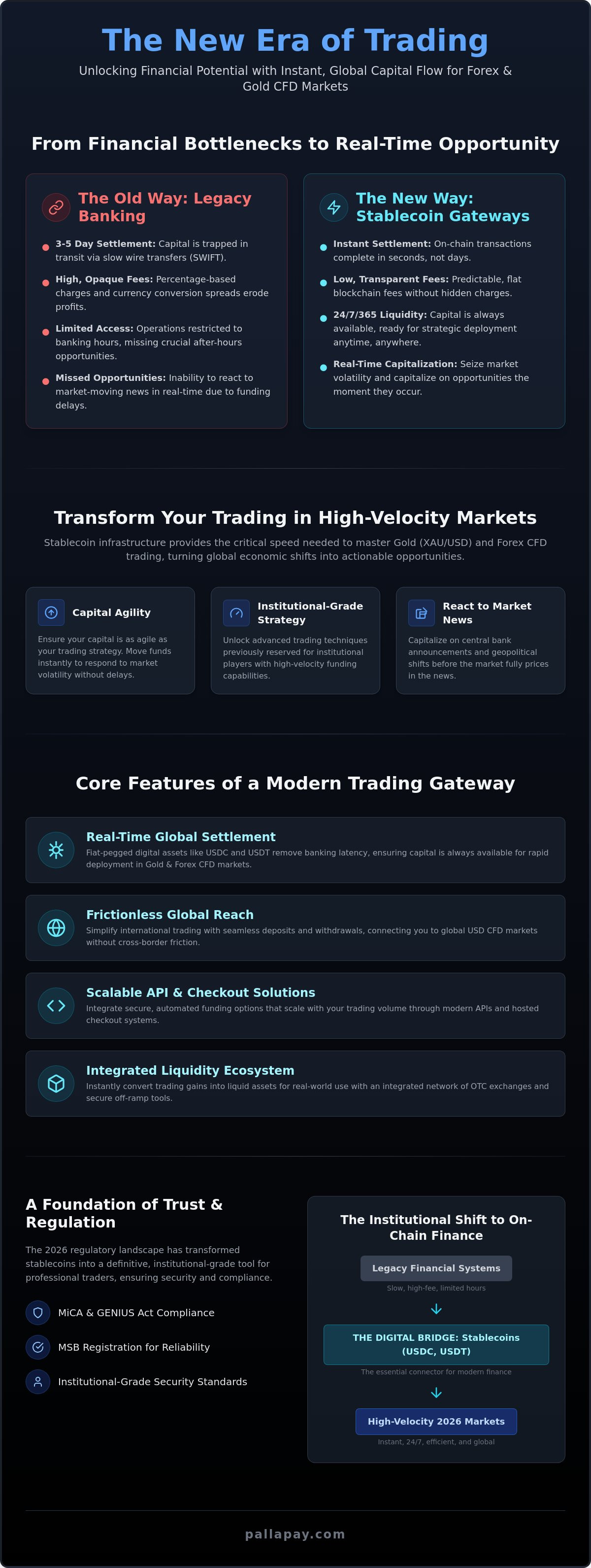
The global financial sector is undergoing a fundamental transition from legacy settlement systems to real-time digital liquidity. Central to this shift is a clear understanding of what a stablecoin is; it’s a digital asset designed to maintain a stable value by being pegged to a reserve asset like the US Dollar or gold. For years, digital assets were viewed primarily through the lens of speculation. However, the emergence of a robust stablecoin payment gateway for merchants has pivoted the conversation toward pure utility. By eliminating the price volatility associated with standard cryptocurrencies, these assets provide the predictability required for professional commerce while retaining the borderless speed of blockchain technology.
24/7 liquidity is no longer a luxury for those operating in the Forex and Gold CFD markets; it’s a requirement. Traditional markets sleep on weekends, but digital liquidity does not. This constant availability ensures that capital is never idle, allowing for strategic rebalancing at any hour of the day or night. By 2026, the reliance on a stablecoin payment gateway for merchants has become a standard operational procedure for firms seeking to optimize their treasury management and maintain a competitive edge in high-velocity trading environments.
Stablecoins vs. Traditional Fiat Transfers
Traditional wire transfers often feel like a relic of a slower era. A standard SWIFT transfer can take between three and five business days to settle, a delay that is unacceptable when trading XAU/USD or high-leverage Forex pairs. In contrast, on-chain settlements occur in seconds. The cost structure also favors the merchant. Instead of the opaque, percentage-based fees and currency conversion spreads charged by banks, digital settlements typically utilize transparent, flat blockchain fees. By removing intermediary correspondent banks from the global payment chain, businesses reclaim control over their capital and reduce the risk of funds being held in transit. Using a fiat settlement solution allows for the immediate conversion of these digital assets into traditional currency, closing the loop on the transaction with efficiency.
The Institutional Shift to On-Chain Finance
We are seeing a clear migration toward on-chain finance as major institutions integrate USDC and USDT into their core settlement layers. These assets serve as a digital dollar, providing global users with a stable unit of account that operates outside the constraints of local banking hours. This institutional adoption provides the security and depth of liquidity necessary for large-scale CFD trading. Stablecoins are the essential digital bridge connecting the legacy financial practices of the past with the high-velocity 2026 markets.
Transforming Financial Lives through Forex and Gold CFD Trading
The transition from holding assets to actively managing them represents a significant leap toward financial independence. For many, this journey begins with the realization that traditional banking speeds are the primary bottleneck to success. Integrating a stablecoin payment gateway for merchants removes these artificial barriers, granting immediate access to high-leverage Forex and commodity markets. This technology isn’t just a convenience; it’s the infrastructure that allows a trader to react to a central bank announcement or a geopolitical shift before the market prices in the news. By utilizing digital liquidity, you ensure that your capital is as agile as your strategy.
Financial transformation requires more than just market knowledge; it demands a reliable technical foundation. When you eliminate the friction of legacy settlement, you open the door to advanced trading techniques that were previously reserved for institutional players. A stablecoin payment gateway for merchants provides the high-velocity funding required to master these complex environments, turning global economic shifts into precise, actionable opportunities.
The Power of Gold (XAU/USD) CFD Trading
Gold remains the definitive hedge against inflation and currency devaluation. In 2026, the XAU/USD pair continues to be a cornerstone for those seeking to preserve and grow wealth during periods of economic transition. Contracts for Difference (CFDs) empower traders to profit from both bullish and bearish trends without the logistical burden of physical bullion. Success in this arena often hinges on margin management. When a market move requires an immediate capital injection to maintain a position, the latency of a bank wire can lead to forced liquidation. Utilizing a stablecoin-based funding model ensures that margin top-ups are processed in seconds, protecting your portfolio from unnecessary risk and ensuring you never miss a market reversal.
Forex Markets: Navigating Global Currency Fluctuations
The Forex market is the most liquid financial arena in the world. Navigating this space requires a unit of account that is as flexible as the pairs being traded. USD-pegged stablecoins like USDT and USDC provide a seamless transition point for moving between major pairs like EUR/USD or GBP/USD. By using these digital assets, traders eliminate the excessive currency conversion fees typically charged by retail brokers and banks. Understanding the global regulatory landscape ensures that your trading activities remain compliant with evolving international standards. This clarity is essential for long-term growth and stability. For a deeper dive into the technical requirements of these systems, you can consult The Ultimate Guide to Crypto Payment Gateways.
Mastering these markets can fundamentally change your financial life. It turns global economic volatility into a series of calculated opportunities for growth. To begin optimizing your capital flow, consider how a sophisticated payment API can integrate directly into your existing trading workflow, providing the speed and security your strategy demands.
Technical Architecture: Implementing a Stablecoin Payment Gateway
Implementing a stablecoin payment gateway for merchants requires a logical, step-by-step approach to ensure both security and operational efficiency. The transition from legacy systems to digital liquidity begins with business verification and account setup. Next, you configure your gateway to support specific assets such as USDT or USDC. The third step involves choosing your integration method, followed by rigorous testing in a sandbox environment; to assist with this stage, you can visit Crypto Chief to access Web3 developer tools. Finally, you transition to a live production state. This systematic progression minimizes technical friction and ensures that your trading platform is ready to handle high-volume transactions without delay.
Merchants must decide between a hosted checkout page and direct API integration. A hosted checkout is an efficient, low-code solution where the provider handles the payment interface. This is ideal for standard e-commerce or simple funding portals. For professional trading platforms, direct API integration is the superior choice. It allows for a completely custom user experience, keeping traders within your ecosystem while the gateway handles the complex cryptographic processes in the background.
Speed and cost are heavily influenced by the underlying blockchain network. Modern gateways must offer multi-network support, including Ethereum for its deep liquidity, along with Solana or Polygon for their high throughput and lower transaction costs. To mitigate the minor risk of a stablecoin losing its peg, instant fiat settlement is essential. Converting digital assets to traditional currency immediately upon receipt protects your treasury from market anomalies and ensures your capital remains stable.
Utilizing a Secure Payment API
Developers can seamlessly integrate a payment API directly into Forex or Gold trading platforms. The use of webhooks is a critical component of this architecture. These automated notifications provide real-time transaction confirmation, allowing user balances to reflect new deposits instantly. This immediacy is vital for traders who need to capitalize on sudden market volatility. Security remains the highest priority; advanced protocols such as AES-256 encryption and multi-signature wallets ensure that merchant and user data remain protected from unauthorized access.
In-Person and POS Solutions for Financial Desks
The utility of stablecoins extends beyond digital interfaces. Financial desks and retail offices can utilize a crypto POS machine to facilitate instant, in-person transactions. These devices support NFC and QR-code based payments, allowing for desk-side funding of trading accounts in seconds. A unified reporting system bridges the gap between online and physical payment streams, providing a comprehensive view of all capital inflows. This integrated approach ensures that whether a client is funding an account from their mobile device or a physical office, the experience is fast, secure, and professional.
Compliance and Security: Navigating the Global Regulatory Landscape
Accepting digital assets is often met with questions regarding legality and compliance. For a professional stablecoin payment gateway for merchants, the answer lies in strict adherence to international financial regulations. Legitimate providers operate as registered Money Services Businesses (MSB) in key jurisdictions. In the United States, this requires registration with FinCEN, while in Canada, providers must maintain status with FINTRAC. These designations are critical; they signify that the gateway operates with the same level of oversight as traditional financial institutions. By choosing a partner with these specific registrations, merchants mitigate the risk of regulatory friction and ensure their operations remain on solid legal ground.
Security is maintained through a combination of rigorous KYC (Know Your Customer) and AML (Anti-Money Laundering) protocols. These frameworks protect the merchant by screening for illicit activity before it enters the payment flow. Beyond identity verification, the technical protection of funds is achieved through institutional-grade storage solutions. Utilizing cold storage keeps the majority of merchant balances offline, away from potential network vulnerabilities. Multi-signature (multi-sig) wallets add an additional layer of safety, requiring multiple authorized approvals for any significant capital movement. This approach ensures that your capital remains secure while you focus on the high-leverage opportunities within the Forex and commodity markets.
The Role of Regulated Financial Technology Providers
Forex brokers and CFD platforms require a partner that understands the high-stakes nature of currency and commodity trading. Working with a regulated entity is non-negotiable because it ensures that every transaction is backed by a verifiable audit trail. Blockchain-based systems naturally record every movement, providing the transparency required for accurate tax reporting and internal compliance audits. This level of detail is essential when managing the significant capital flows associated with Gold and USD trading. For a comprehensive look at protecting your business, read our guide on Crypto Security in 2026.
Fiat Settlement and Off-Ramping
The ability to convert digital liquidity back into traditional currency is the final step in a successful trading cycle. A professional crypto off-ramp allows merchants to move funds from the digital ecosystem into global bank accounts with minimal friction. This process of fiat settlement is designed to maintain tax transparency, ensuring that all digital asset payments are documented and ready for reporting. This transition from on-chain liquidity to bankable capital is what allows traders to realize the transformative potential of their market activities.
To secure your financial future through professional-grade liquidity, register for a secure wallet and begin optimizing your capital flow today.
Pallapay: Your Strategic Partner for Stablecoin and Trading Success
Pallapay serves as the professional bridge connecting established financial practices with modern technological advancements. With a global operational reach spanning 180 countries, we provide the institutional reliability necessary for high-stakes trading. Our ecosystem is not merely a collection of isolated tools; it’s a comprehensive destination for those navigating the complex world of Forex and Gold CFD markets. By providing a robust stablecoin payment gateway for merchants, we enable the real-time movement of capital that defines successful financial strategies in 2026. We handle the complex background processes so you can focus on market execution.
Capital is never idle within our integrated framework. Our presence includes physical OTC desks that support large-scale transactions, ensuring that liquidity is always available when market conditions shift. This physical and digital synergy builds a level of trust that is often missing in purely digital environments. We position ourselves as a strategic partner, facilitating the high-volume settlements required for mastering the XAU/USD and USD CFD pairs. This holistic approach ensures that your business can scale without being hindered by the limitations of traditional finance.
Comprehensive Merchant Support
We provide customized solutions tailored to the specific needs of the ecommerce and retail sectors. These industries benefit from the same high-velocity infrastructure used by professional trading desks. For those managing significant capital flows, our dedicated OTC crypto exchange services offer the depth required for institutional-grade settlements. Integration with the Pallapay Mastercard further enhances this ecosystem, providing instant access to your trading profits for real-world use. This level of utility ensures that your digital assets remain liquid and functional at all times.
Start Your Financial Transformation Today
Beginning your journey toward financial independence starts with a secure foundation. Setting up a merchant account is a streamlined, step-by-step process designed to get you into the markets as quickly as possible. Once verified, you can begin using a stablecoin payment gateway for merchants to accept USDT and USDC. This provides the immediate capital required for aggressive XAU/USD and USD CFD trading strategies. Modern payment infrastructure is the essential component of your global evolution. Join the global leader in stablecoin payments and start optimizing your trading capital today.
Mastering the Future of Global Financial Settlement
Traditional settlement delays are the primary obstacle to mastering the high-velocity Gold and Forex markets. We’ve explored how instant digital liquidity and robust regulatory frameworks provide the essential foundation for modern CFD strategies. Adopting a regulated stablecoin payment gateway for merchants isn’t just a technical upgrade; it’s a strategic move to secure your capital’s agility in the XAU/USD and USD CFD markets. This infrastructure ensures that your financial life isn’t limited by banking hours or legacy protocols. It’s the definitive tool for those seeking to capitalize on global economic volatility.
Pallapay has served professional users in over 180 countries since 2018, maintaining MSB registration in both the USA and Canada to ensure institutional-grade reliability. Our physical OTC desks in Singapore, Istanbul, and other global hubs bridge the gap between digital efficiency and physical trust. This comprehensive ecosystem is designed to facilitate your growth and protect your assets. Empower your business with the Pallapay Stablecoin Gateway to eliminate transaction friction today. Your path to financial transformation through professional trading is now more accessible than ever.
Frequently Asked Questions
Is accepting stablecoin payments legal for my business?
Yes, accepting stablecoins is legal provided you use a regulated gateway that adheres to regional financial laws. In 2026, frameworks like MiCA in Europe and the GENIUS Act in the US have established clear compliance paths for businesses. Utilizing a stablecoin payment gateway for merchants that is registered as an MSB ensures that your operations meet strict anti-money laundering requirements. Always verify the specific licensing of your provider in your jurisdiction.
Which stablecoins are most commonly used for Forex and CFD trading?
USDT and USDC are the industry standards due to their deep liquidity and widespread broker support. These assets provide the stability of the US Dollar combined with blockchain speed, making them ideal for funding high-leverage trades. Some traders also utilize gold-pegged assets to maintain exposure to commodity prices while moving funds between platforms. Their high trading volume ensures minimal slippage during large-scale capital entries and exits.
How quickly can I convert stablecoin payments into fiat currency?
Conversions typically occur instantly within a professional gateway ecosystem. Once the digital asset is received, you can trigger an immediate swap to fiat and initiate an off-ramp to your bank account. While the on-chain swap is real-time, the final arrival in a traditional bank account depends on the settlement network used, such as SEPA or Faster Payments. This process is significantly faster than waiting for standard international wire transfers to clear.
Do I need a special bank account to accept stablecoin payments?
No, you don’t need a specialized crypto-bank account to receive funds from a gateway. The gateway acts as the professional intermediary, receiving the digital assets and settling the equivalent fiat value into your existing corporate bank account. This structure allows you to maintain your current banking relationships while benefiting from modern payment technology. It simplifies the accounting process by delivering standard fiat deposits that your finance team already understands.
What are the fees associated with stablecoin payment processing compared to credit cards?
Stablecoin processing fees are generally lower than the 2% to 4% typically charged by credit card networks. Most gateways utilize a flat fee or a small percentage model that avoids the complex interchange fees associated with traditional merchant services. By bypassing multiple intermediaries, you reduce the total cost of capital movement. This is particularly beneficial for high-volume traders where even small percentage savings can significantly impact your net profitability.
How do stablecoins help with Gold (XAU) trading specifically?
Stablecoins provide the instant margin funding required to protect Gold CFD positions during periods of high volatility. When the XAU/USD price moves rapidly, traders must be able to top up their accounts in seconds to avoid forced liquidation. A stablecoin payment gateway for merchants facilitates these rapid transfers, ensuring that your capital is never trapped in a multi-day banking delay. This speed allows for more aggressive and precise commodity trading strategies.
Can I use an API to automate stablecoin acceptance on my trading platform?
Yes, professional gateways provide sophisticated APIs designed for seamless integration into custom trading environments. These tools allow for automated deposit detection, real-time balance updates, and programmatic payouts through secure webhooks. Automation reduces manual overhead and ensures that your users can fund their accounts 24/7 without human intervention. This technical scalability is essential for platforms aiming to support a global user base across different time zones efficiently.
What happens if a stablecoin loses its peg to the US Dollar?
Professional gateways mitigate peg-risk through instant fiat settlement options. By converting stablecoins into traditional currency immediately upon receipt, you eliminate exposure to any potential fluctuations in the digital asset’s value. Regulated issuers are also required to maintain 1:1 reserves of high-quality liquid assets, which has historically stabilized the major tokens. Choosing a provider that supports multiple stablecoins allows you to diversify your holdings and further reduce any systemic risk.
Disclaimer
The information provided on this website and blog is for general informational and educational purposes only and does not constitute financial, investment, legal, tax, or other professional advice.
Cryptocurrency and digital asset services may be subject to regulatory restrictions in certain jurisdictions. Users are solely responsible for ensuring compliance with applicable local laws and regulations before using any products or services mentioned on this website.
PallaPay does not guarantee the accuracy, completeness, or timeliness of any information published and accepts no liability for any loss or damages arising from reliance on the content. Any opinions expressed are those of the respective authors and may change without notice.
Certain services, features, or products referenced may be provided through third-party partners, licensed entities, or affiliated service providers subject to separate terms and regulatory approvals. Availability of services may vary by country or region.
This website may contain references to digital assets, virtual currencies, or blockchain-related services that are not available to residents of certain jurisdictions, including where prohibited by law. Nothing on this website constitutes an offer, solicitation, or recommendation to buy or sell any financial instrument or virtual asset.
Leave a Reply