

The era of regulatory ambiguity has officially ended, transforming digital assets from speculative risks into high-velocity tools for institutional growth. With over $6 billion in fines issued for AML and KYC violations by the end of 2025, mastering us crypto regulations for businesses is no longer optional; it’s the foundation of modern corporate strategy. You likely feel the weight of conflicting jurisdictions between the SEC and CFTC. Many professionals worry about bridging the gap between traditional gold markets and the digital economy without triggering a compliance crisis.
It’s natural to feel cautious about the complexity of integrating stablecoins with traditional gold and USD trading. This guide provides a clear roadmap to master the 2026 landscape, focusing on the SEC’s new “Regulation Crypto Assets” and the requirements of the GENIUS Act. You’ll learn how to leverage regulated crypto infrastructure to unlock the transformative potential of XAU/USD CFD trading. This shift can fundamentally change your financial trajectory by turning market volatility into a structured advantage. If your firm requires a stable bridge between digital assets and traditional commerce, adopting a compliant payment gateway provides the necessary institutional-grade security. We’ll explore how to establish this infrastructure to accelerate your progress in an evolving global market.
Key Takeaways
- Define the 2026 SEC framework to accurately categorize digital assets as commodities or securities within your corporate strategy.
- Implement high-level KYB and AI-powered AML protocols to ensure your operations remain fully aligned with us crypto regulations for businesses.
- Master the mechanics of Gold (XAU) and USD CFD trading to harness market volatility and drive transformative financial growth.
- Deploy compliant payment gateways and physical POS infrastructure to facilitate seamless, real-time crypto-to-fiat conversions.
- Utilize an MSB-regulated OTC desk to execute high-volume trades with the security and reliability of a strategic institutional partner.
Navigating the SEC’s 2026 Crypto Asset Framework for Businesses
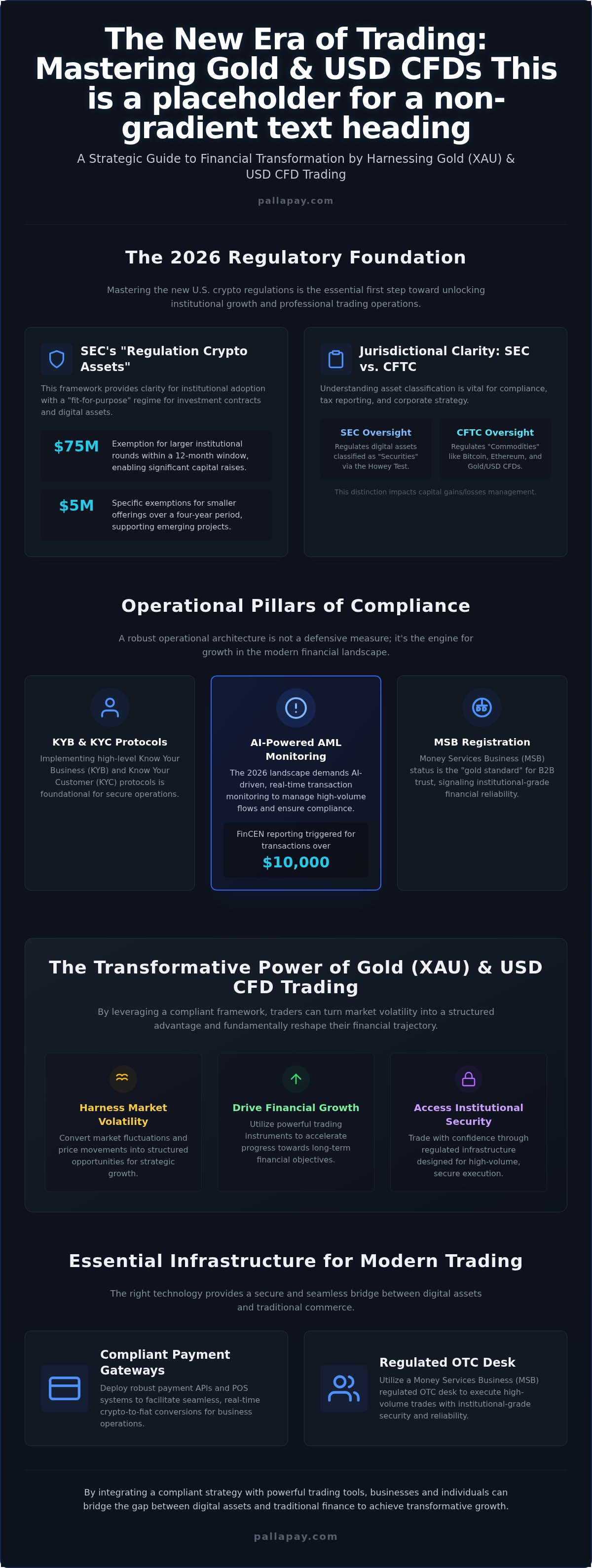
The regulatory environment for digital assets reached a definitive turning point on August 18, 2026, with the introduction of the SEC’s “Regulation Crypto Assets” proposal. This initiative represents the definitive pivot toward institutional adoption by establishing a “fit-for-purpose” framework for investment contracts. For any organization, understanding us crypto regulations for businesses is the first step toward moving beyond speculative trading and into professional financial operations. This new regime aims to provide a tailored securities offering regime, offering specific exemptions for smaller offerings up to $5 million over a four-year period and larger institutional rounds up to $75 million in a 12-month window. By codifying these rules, the SEC has provided the clarity necessary for corporate treasuries to integrate digital assets into their long-term growth strategies.
The Distinction Between Securities and Commodities
The SEC continues to utilize the Howey Test to classify specific tokens as investment contracts, which subjects them to rigorous registration and disclosure requirements. However, the 2026 framework provides clearer lanes for digital commodities. While many newer tokens are scrutinized as securities, assets like Bitcoin and Ethereum often fall under CFTC commodity guidelines due to their decentralized nature. The CFTC plays a critical role in regulating digital commodity trading for enterprises, ensuring that markets for assets like Gold and USD CFDs remain transparent and secure. This classification is vital for corporate tax reporting; securities and commodities are treated differently under the tax code, affecting how you manage capital gains and losses. Understanding Virtual currency law in the United States helps businesses determine if their holdings require SEC registration or if they fall under the CFTC’s oversight for commodity trading.
Federal vs. State-Level Crypto Regulations
Operational complexity often stems from the friction between state-level requirements, such as the New York BitLicense, and general federal guidelines. The 2026 unified framework attempts to bridge these state discrepancies, creating a more cohesive national standard for enterprises. Maintaining compliance across multiple US jurisdictions requires a partner that understands both federal reporting and state-specific mandates. By utilizing a regulated MSB partner, firms can streamline their payment API integrations while ensuring every transaction meets the evolving standards of the 2026 landscape. This strategic alignment allows businesses to focus on the transformative potential of CFD trading rather than getting bogged down in jurisdictional overlap. It’s about building a professional bridge between disruptive technology and institutional reliability that empowers your firm to move faster than the competition.
Operational Pillars: KYB and AML Compliance for Modern Enterprises
The transition from theory to practice requires a robust operational architecture. For any enterprise, us crypto regulations for businesses dictate that compliance is the primary engine of growth. It isn’t merely a defensive measure; it’s the professional bridge that connects your firm to the global liquidity needed for high-stakes Gold and USD CFD trading. Central to this architecture is Money Services Business (MSB) registration. This status serves as the “gold standard” for business-to-business trust, proving that your entity adheres to the same institutional financial reliability as a traditional bank.
Compliance starts with strict Anti-Money Laundering (AML) protocols. While manual checks were once standard, the 2026 landscape demands AI-driven monitoring to handle real-time transaction flows. This is particularly critical for reporting obligations. Any transaction exceeding $10,000 triggers specific FinCEN reporting requirements, while the IRS Form 1099-DA phasing in for the 2026 tax year adds another layer of cost-basis transparency. For enterprises navigating these complexities, Apex Income Tax & Multiservice LLC provides the professional guidance needed to ensure every filing is accurate and compliant. By automating these processes, you ensure that your path toward financial transformation through Forex trading remains clear of legal friction while adhering to us crypto regulations for businesses.
Establishing trust in a decentralized environment requires verifying Ultimate Beneficial Owners (UBO) with surgical precision. Know Your Business (KYB) workflows must be automated to maintain operational speed without compromising security. If your verification process is slow, your trading momentum stalls. You can secure your corporate digital assets by using infrastructure that integrates these checks directly into the user experience, allowing for immediate access to market opportunities.
The Travel Rule and Transaction Monitoring
The 2026 requirements for the Travel Rule demand that specific originator and beneficiary information accompany digital asset transfers. Transaction monitoring now identifies illicit patterns before they compromise your corporate treasury. This vigilance protects your capital while facilitating the rapid movement of funds required for professional leverage trading. For a deeper dive into safeguarding your operations, consult The 2026 Guide to Crypto Security. Adopting these pillars allows your business to move beyond survival and into a phase of strategic evolution. To streamline your transition into this regulated space, consider how an off-ramp solution can simplify your fiat conversions.
The Transformative Power of Gold and USD CFD Trading
Trading is the engine of institutional financial transformation. While the previous sections established the legal guardrails, the actual growth of a corporate treasury depends on how effectively it navigates the global markets. Contract for Difference (CFD) trading allows an enterprise to speculate on the price movements of assets like gold or currency pairs without the logistical burden of physical ownership. This mechanism provides a high level of capital efficiency, allowing firms to deploy crypto liquidity into traditional markets with precision. By mastering these mechanics, a business can shift its financial trajectory from passive asset holding to active wealth generation.
The synergy between digital assets and traditional Forex markets is more profound in 2026 than ever before. Professional entities now use stablecoins and other digital assets as the primary funding source for high-volume CFD entries. This integration is only possible because us crypto regulations for businesses have matured, providing the institutional-grade security required to move large blocks of capital between sectors. When you bridge the gap between crypto and the XAU/USD market, you’re not just trading; you’re building a resilient, multi-asset ecosystem that thrives on volatility rather than being victimized by it.
Strategic Diversification into Gold CFDs
Gold remains the bedrock of professional diversification because it acts as a permanent hedge against fiat volatility. In a crypto-centric world, corporate treasuries use Gold CFDs to offset the inherent risks of both traditional and digital currencies. The financial impact of leveraged gold trading is significant, as it allows a firm to control a large position with a relatively small capital outlay. Gold CFDs offer a unique opportunity for institutional stability by providing a high-liquidity hedge against the fluctuations of global fiat currencies. This strategic move ensures that your capital retains its purchasing power regardless of inflationary pressures.
Forex and USD CFD Mechanics
Analyzing XAU/USD trends is essential for any firm engaged in high-volume trading. The relationship between the US Dollar and Gold is the most watched pair in the financial world, offering deep liquidity and predictable technical patterns. To execute these trades at scale, businesses rely on regulated OTC desks that can handle significant volume without causing market slippage. Utilizing a professional partner ensures that your entries and exits are clean and compliant with us crypto regulations for businesses. For a comprehensive look at how to manage these large-scale operations, refer to our Institutional Guide to OTC Crypto Exchange. This approach allows you to leverage the speed of crypto with the reliability of the world’s most established commodity markets.
Compliant Payment Infrastructure: Gateways and POS Systems
Establishing a compliant payment infrastructure is the professional bridge between digital innovation and traditional commerce. Under us crypto regulations for businesses, integrating a crypto payment gateway requires strict adherence to Money Services Business (MSB) guidelines to avoid the risk of non-compliance. This infrastructure does more than just facilitate transactions; it provides the real-time liquidity necessary to engage in strategic Gold and USD CFD trading. By converting digital payments into fiat instantly and utilizing QuickBooks Online training for small business to manage your internal accounting, you eliminate the friction of market fluctuations while building a corporate treasury capable of driving transformative financial growth.
The hospitality and retail sectors are increasingly adopting physical hardware to meet the demands of a tech-savvy clientele. Physical Crypto POS machines make digital asset acceptance as simple as a standard credit card swipe, allowing businesses to process payments with the confidence of institutional-grade security. It’s a strategic evolution that turns a simple point-of-sale into a gateway for global commerce. You can explore specific Crypto solutions for the hotel industry or implement a Retail store crypto integration to modernize your brick-and-mortar operations. These systems ensure that every transaction is logged and compliant, providing a secure environment for both the merchant and the customer.
API Integration and Fiat Settlement
For e-commerce entities, API security is the backbone of a regulatory-compliant payment system. Developers leverage sophisticated tools to ensure that digital checkouts are fast, secure, and fully integrated with existing accounting software. High-performance APIs facilitate Automated Fiat Settlement for Merchants, which is essential for mitigating the volatility risks inherent in the digital asset market. By using a Payment API for Developers, your business can settle transactions in USD immediately, preserving the capital needed for high-volume Forex trading. This seamless flow of capital allows you to focus on the transformative potential of the markets rather than the mechanics of the transaction. To begin your integration, consider how a compliant crypto payment gateway can accelerate your progress today.
Securing Your Financial Future with Pallapay’s Regulated Ecosystem
Pallapay serves as the professional bridge between established financial practices and modern technological advancements. In a landscape defined by the complexities of us crypto regulations for businesses, having a partner with official MSB registration in the United States and Canada is a critical differentiator. It provides the institutional reliability required to manage corporate treasuries with absolute trust. This registration ensures that every transaction, from local payment processing to global settlement, adheres to the highest standards of financial oversight. By aligning your operations with a regulated entity, you transform regulatory compliance from a burden into a competitive advantage.
For enterprises focused on the transformative potential of trading, the global OTC desk provides a secure environment for high-volume execution. This service eliminates the friction often associated with large-scale digital asset conversions, allowing you to enter or exit XAU/USD CFD positions without causing market slippage. By providing a direct path to liquidity, Pallapay empowers your business to capitalize on market trends in real-time. This efficiency is mirrored in the secure off-ramp process, which facilitates the movement of digital assets back into traditional bank deposits without compromising security. It’s about maintaining institutional financial reliability at every stage of the transaction lifecycle.
The Pallapay Advantage: Compliance and Speed
Speed is a rhythmic anchor in the digital economy, and Pallapay delivers it through a comprehensive, integrated ecosystem. The platform bridges the gap between disruptive innovation and institutional reliability, offering direct access to Gold and Forex CFD markets through regulated channels. This synergy allows you to move capital with the confidence of a global industry leader. Utilizing Compliant Crypto Off-Ramp Services ensures that your gains are accessible and ready for reinvestment or corporate distribution. It’s a strategic evolution that positions your firm at the forefront of the global financial shift, ensuring you don’t fall behind as the market matures.
Next Steps for Your Business
The journey toward mastering us crypto regulations for businesses begins with choosing an infrastructure that prioritizes security and utility. Adopting a utility-focused crypto strategy isn’t just about following the law; it’s about building a foundation for long-term growth. The future of corporate finance includes tools like the Pallapay Mastercard, designed to integrate digital asset spending into standard business operations seamlessly. This card allows for the instant conversion of crypto to fiat for corporate travel, inventory, or operational costs. To accelerate your progress, consider consulting with a regulated MSB to audit your current trading infrastructure. You can begin this transition by setting up a business account to unlock the full potential of a regulated digital asset ecosystem.
Accelerating Your Corporate Financial Evolution
The shift toward a regulated digital economy isn’t a hurdle; it’s a strategic invitation to institutional growth. By mastering the 2026 landscape of us crypto regulations for businesses, you position your firm to harness the transformative power of Gold and USD CFD trading. This evolution turns market volatility into a structured engine for wealth generation. Relying on an official MSB registered in the United States and Canada ensures your operations maintain absolute stability. With secure fiat settlement infrastructure and a global OTC presence serving over 180 countries, the path to professional diversification is clear and efficient.
Your business can move beyond standard practices by adopting a utility-focused strategy that bridges the gap between tech and tradition. It’s time to secure your financial trajectory with a partner that handles complex background processes while you focus on expansion. Start your journey with a regulated partner—Explore Pallapay today. The future of commerce belongs to those who lead with compliance and speed.
Frequently Asked Questions
Is it legal for US businesses to trade cryptocurrency and CFDs in 2026?
Trading cryptocurrency and CFDs is entirely legal for US businesses in 2026, provided they operate within the frameworks established by the SEC and CFTC. Compliance with us crypto regulations for businesses requires using a registered Money Services Business (MSB) to facilitate these transactions. While crypto assets are widely used for corporate treasury, CFD trading on Gold and USD pairs remains a specialized field that demands high-level institutional oversight to ensure all leverage and margin requirements meet federal standards.
What is the difference between SEC and CFTC regulation for crypto businesses?
The SEC oversees digital assets classified as securities under the Howey Test, while the CFTC regulates digital commodities like Bitcoin and Ethereum. This distinction is critical for businesses engaged in Gold and USD CFD trading, as these instruments fall primarily under CFTC jurisdiction. The 2026 “Regulation Crypto Assets” proposal aims to clarify these boundaries, ensuring that investment contracts are properly registered while allowing commodity markets to operate with the liquidity necessary for institutional-scale trading.
How does MSB registration protect my business when buying crypto?
MSB registration acts as a seal of institutional financial reliability, ensuring that the provider adheres to the Bank Secrecy Act and federal AML protocols. When a business buys crypto through a registered MSB, it benefits from a transparent audit trail and rigorous identity verification. This status protects your entity from the legal risks associated with unlicensed exchanges, providing the secure infrastructure needed to integrate digital assets into a professional Forex or commodity trading strategy.
Can I use crypto to fund Gold and Forex CFD trading accounts?
You can fund Gold and Forex CFD trading accounts using cryptocurrency by utilizing a regulated payment gateway that facilitates instant fiat conversion. This process allows businesses to leverage their digital asset liquidity to enter traditional markets like XAU/USD. By converting crypto to USD or using it as collateral through a compliant facilitator, traders can unlock the transformative potential of the markets while remaining fully aligned with 2026 federal reporting standards.
What are the AML requirements for businesses accepting crypto payments?
Businesses accepting crypto must implement robust Know Your Customer (KYC) and Know Your Business (KYB) workflows to prevent money laundering. This includes monitoring for suspicious patterns and reporting any individual transactions exceeding $10,000 to FinCEN. Adherence to us crypto regulations for businesses ensures that your payment infrastructure is not used for illicit activity, protecting your corporate reputation and maintaining the integrity of your financial operations in the global market.
How does a crypto payment gateway handle US tax reporting?
A compliant crypto payment gateway automates the collection of transaction data required for IRS Form 1099-DA, which is being phased in for the 2026 tax year. These systems track the cost basis and fair market value of every transaction, simplifying the complex task of corporate tax reporting. By integrating these tools, businesses ensure that their crypto-to-fiat conversions for Gold or Forex trading are accurately documented, reducing the risk of audit-related penalties.
What is the SEC 2026 fit-for-purpose framework?
The SEC’s 2026 “Regulation Crypto Assets” is a “fit-for-purpose” framework designed to provide a tailored securities offering regime for digital assets. It includes specific exemptions for offerings up to $5 million over four years and up to $75 million in a 12-month period. This proposal represents a definitive pivot toward institutional adoption, allowing businesses to raise capital and issue tokens within a clear, legally recognized structure that balances innovation with investor protection.
Disclaimer
The information provided on this website and blog is for general informational and educational purposes only and does not constitute financial, investment, legal, tax, or other professional advice.
Cryptocurrency and digital asset services may be subject to regulatory restrictions in certain jurisdictions. Users are solely responsible for ensuring compliance with applicable local laws and regulations before using any products or services mentioned on this website.
PallaPay does not guarantee the accuracy, completeness, or timeliness of any information published and accepts no liability for any loss or damages arising from reliance on the content. Any opinions expressed are those of the respective authors and may change without notice.
Certain services, features, or products referenced may be provided through third-party partners, licensed entities, or affiliated service providers subject to separate terms and regulatory approvals. Availability of services may vary by country or region.
This website may contain references to digital assets, virtual currencies, or blockchain-related services that are not available to residents of certain jurisdictions, including where prohibited by law. Nothing on this website constitutes an offer, solicitation, or recommendation to buy or sell any financial instrument or virtual asset.
Leave a Reply