

Tag: SEC

  • US Crypto Regulations: 2026 Business Compliance Guide

    US Crypto Regulations: 2026 Business Compliance Guide

    The era of regulatory ambiguity has officially ended, transforming digital assets from speculative risks into high-velocity tools for institutional growth. With over $6 billion in fines issued for AML and KYC violations by the end of 2025, mastering us crypto regulations for businesses is no longer optional; it’s the foundation of modern corporate strategy. You likely feel the weight of conflicting jurisdictions between the SEC and CFTC. Many professionals worry about bridging the gap between traditional gold markets and the digital economy without triggering a compliance crisis.

    It’s natural to feel cautious about the complexity of integrating stablecoins with traditional gold and USD trading. This guide provides a clear roadmap to master the 2026 landscape, focusing on the SEC’s new “Regulation Crypto Assets” and the requirements of the GENIUS Act. You’ll learn how to leverage regulated crypto infrastructure to unlock the transformative potential of XAU/USD CFD trading. This shift can fundamentally change your financial trajectory by turning market volatility into a structured advantage. If your firm requires a stable bridge between digital assets and traditional commerce, adopting a compliant payment gateway provides the necessary institutional-grade security. We’ll explore how to establish this infrastructure to accelerate your progress in an evolving global market.

    Key Takeaways

    • Define the 2026 SEC framework to accurately categorize digital assets as commodities or securities within your corporate strategy.
    • Implement high-level KYB and AI-powered AML protocols to ensure your operations remain fully aligned with us crypto regulations for businesses.
    • Master the mechanics of Gold (XAU) and USD CFD trading to harness market volatility and drive transformative financial growth.
    • Deploy compliant payment gateways and physical POS infrastructure to facilitate seamless, real-time crypto-to-fiat conversions.
    • Utilize an MSB-regulated OTC desk to execute high-volume trades with the security and reliability of a strategic institutional partner.

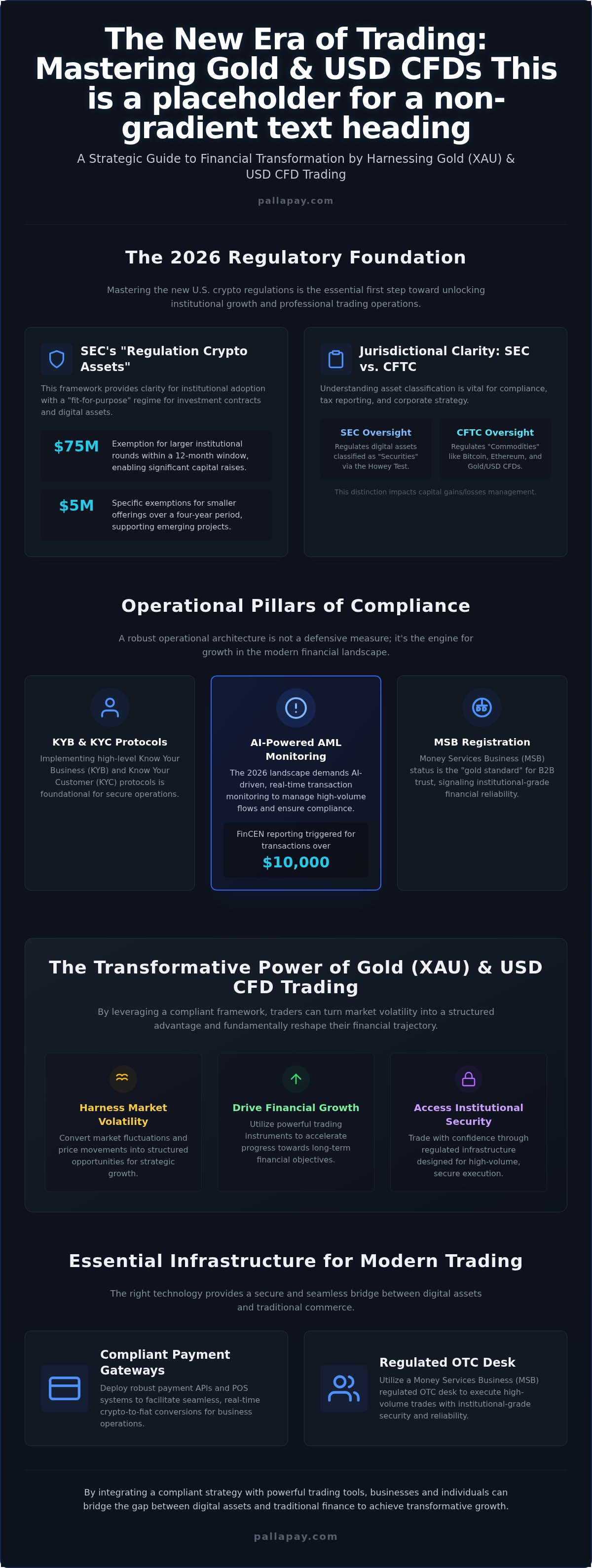
    The regulatory environment for digital assets reached a definitive turning point on August 18, 2026, with the introduction of the SEC’s “Regulation Crypto Assets” proposal. This initiative represents the definitive pivot toward institutional adoption by establishing a “fit-for-purpose” framework for investment contracts. For any organization, understanding us crypto regulations for businesses is the first step toward moving beyond speculative trading and into professional financial operations. This new regime aims to provide a tailored securities offering regime, offering specific exemptions for smaller offerings up to $5 million over a four-year period and larger institutional rounds up to $75 million in a 12-month window. By codifying these rules, the SEC has provided the clarity necessary for corporate treasuries to integrate digital assets into their long-term growth strategies.

    The Distinction Between Securities and Commodities

    The SEC continues to utilize the Howey Test to classify specific tokens as investment contracts, which subjects them to rigorous registration and disclosure requirements. However, the 2026 framework provides clearer lanes for digital commodities. While many newer tokens are scrutinized as securities, assets like Bitcoin and Ethereum often fall under CFTC commodity guidelines due to their decentralized nature. The CFTC plays a critical role in regulating digital commodity trading for enterprises, ensuring that markets for assets like Gold and USD CFDs remain transparent and secure. This classification is vital for corporate tax reporting; securities and commodities are treated differently under the tax code, affecting how you manage capital gains and losses. Understanding Virtual currency law in the United States helps businesses determine if their holdings require SEC registration or if they fall under the CFTC’s oversight for commodity trading.

    Federal vs. State-Level Crypto Regulations

    Operational complexity often stems from the friction between state-level requirements, such as the New York BitLicense, and general federal guidelines. The 2026 unified framework attempts to bridge these state discrepancies, creating a more cohesive national standard for enterprises. Maintaining compliance across multiple US jurisdictions requires a partner that understands both federal reporting and state-specific mandates. By utilizing a regulated MSB partner, firms can streamline their payment API integrations while ensuring every transaction meets the evolving standards of the 2026 landscape. This strategic alignment allows businesses to focus on the transformative potential of CFD trading rather than getting bogged down in jurisdictional overlap. It’s about building a professional bridge between disruptive technology and institutional reliability that empowers your firm to move faster than the competition.

    Operational Pillars: KYB and AML Compliance for Modern Enterprises

    The transition from theory to practice requires a robust operational architecture. For any enterprise, us crypto regulations for businesses dictate that compliance is the primary engine of growth. It isn’t merely a defensive measure; it’s the professional bridge that connects your firm to the global liquidity needed for high-stakes Gold and USD CFD trading. Central to this architecture is Money Services Business (MSB) registration. This status serves as the “gold standard” for business-to-business trust, proving that your entity adheres to the same institutional financial reliability as a traditional bank.

    Compliance starts with strict Anti-Money Laundering (AML) protocols. While manual checks were once standard, the 2026 landscape demands AI-driven monitoring to handle real-time transaction flows. This is particularly critical for reporting obligations. Any transaction exceeding $10,000 triggers specific FinCEN reporting requirements, while the IRS Form 1099-DA phasing in for the 2026 tax year adds another layer of cost-basis transparency. For enterprises navigating these complexities, Apex Income Tax & Multiservice LLC provides the professional guidance needed to ensure every filing is accurate and compliant. By automating these processes, you ensure that your path toward financial transformation through Forex trading remains clear of legal friction while adhering to us crypto regulations for businesses.

    Establishing trust in a decentralized environment requires verifying Ultimate Beneficial Owners (UBO) with surgical precision. Know Your Business (KYB) workflows must be automated to maintain operational speed without compromising security. If your verification process is slow, your trading momentum stalls. You can secure your corporate digital assets by using infrastructure that integrates these checks directly into the user experience, allowing for immediate access to market opportunities.

    The Travel Rule and Transaction Monitoring

    The 2026 requirements for the Travel Rule demand that specific originator and beneficiary information accompany digital asset transfers. Transaction monitoring now identifies illicit patterns before they compromise your corporate treasury. This vigilance protects your capital while facilitating the rapid movement of funds required for professional leverage trading. For a deeper dive into safeguarding your operations, consult The 2026 Guide to Crypto Security. Adopting these pillars allows your business to move beyond survival and into a phase of strategic evolution. To streamline your transition into this regulated space, consider how an off-ramp solution can simplify your fiat conversions.

    The Transformative Power of Gold and USD CFD Trading

    Trading is the engine of institutional financial transformation. While the previous sections established the legal guardrails, the actual growth of a corporate treasury depends on how effectively it navigates the global markets. Contract for Difference (CFD) trading allows an enterprise to speculate on the price movements of assets like gold or currency pairs without the logistical burden of physical ownership. This mechanism provides a high level of capital efficiency, allowing firms to deploy crypto liquidity into traditional markets with precision. By mastering these mechanics, a business can shift its financial trajectory from passive asset holding to active wealth generation.

    The synergy between digital assets and traditional Forex markets is more profound in 2026 than ever before. Professional entities now use stablecoins and other digital assets as the primary funding source for high-volume CFD entries. This integration is only possible because us crypto regulations for businesses have matured, providing the institutional-grade security required to move large blocks of capital between sectors. When you bridge the gap between crypto and the XAU/USD market, you’re not just trading; you’re building a resilient, multi-asset ecosystem that thrives on volatility rather than being victimized by it.

    Strategic Diversification into Gold CFDs

    Gold remains the bedrock of professional diversification because it acts as a permanent hedge against fiat volatility. In a crypto-centric world, corporate treasuries use Gold CFDs to offset the inherent risks of both traditional and digital currencies. The financial impact of leveraged gold trading is significant, as it allows a firm to control a large position with a relatively small capital outlay. Gold CFDs offer a unique opportunity for institutional stability by providing a high-liquidity hedge against the fluctuations of global fiat currencies. This strategic move ensures that your capital retains its purchasing power regardless of inflationary pressures.

    Forex and USD CFD Mechanics

    Analyzing XAU/USD trends is essential for any firm engaged in high-volume trading. The relationship between the US Dollar and Gold is the most watched pair in the financial world, offering deep liquidity and predictable technical patterns. To execute these trades at scale, businesses rely on regulated OTC desks that can handle significant volume without causing market slippage. Utilizing a professional partner ensures that your entries and exits are clean and compliant with us crypto regulations for businesses. For a comprehensive look at how to manage these large-scale operations, refer to our Institutional Guide to OTC Crypto Exchange. This approach allows you to leverage the speed of crypto with the reliability of the world’s most established commodity markets.
    US Crypto Regulations: 2026 Business Compliance Guide

    Compliant Payment Infrastructure: Gateways and POS Systems

    Establishing a compliant payment infrastructure is the professional bridge between digital innovation and traditional commerce. Under us crypto regulations for businesses, integrating a crypto payment gateway requires strict adherence to Money Services Business (MSB) guidelines to avoid the risk of non-compliance. This infrastructure does more than just facilitate transactions; it provides the real-time liquidity necessary to engage in strategic Gold and USD CFD trading. By converting digital payments into fiat instantly and utilizing QuickBooks Online training for small business to manage your internal accounting, you eliminate the friction of market fluctuations while building a corporate treasury capable of driving transformative financial growth.

    The hospitality and retail sectors are increasingly adopting physical hardware to meet the demands of a tech-savvy clientele. Physical Crypto POS machines make digital asset acceptance as simple as a standard credit card swipe, allowing businesses to process payments with the confidence of institutional-grade security. It’s a strategic evolution that turns a simple point-of-sale into a gateway for global commerce. You can explore specific Crypto solutions for the hotel industry or implement a Retail store crypto integration to modernize your brick-and-mortar operations. These systems ensure that every transaction is logged and compliant, providing a secure environment for both the merchant and the customer.

    API Integration and Fiat Settlement

    For e-commerce entities, API security is the backbone of a regulatory-compliant payment system. Developers leverage sophisticated tools to ensure that digital checkouts are fast, secure, and fully integrated with existing accounting software. High-performance APIs facilitate Automated Fiat Settlement for Merchants, which is essential for mitigating the volatility risks inherent in the digital asset market. By using a Payment API for Developers, your business can settle transactions in USD immediately, preserving the capital needed for high-volume Forex trading. This seamless flow of capital allows you to focus on the transformative potential of the markets rather than the mechanics of the transaction. To begin your integration, consider how a compliant crypto payment gateway can accelerate your progress today.

    Securing Your Financial Future with Pallapay’s Regulated Ecosystem

    Pallapay serves as the professional bridge between established financial practices and modern technological advancements. In a landscape defined by the complexities of us crypto regulations for businesses, having a partner with official MSB registration in the United States and Canada is a critical differentiator. It provides the institutional reliability required to manage corporate treasuries with absolute trust. This registration ensures that every transaction, from local payment processing to global settlement, adheres to the highest standards of financial oversight. By aligning your operations with a regulated entity, you transform regulatory compliance from a burden into a competitive advantage.

    For enterprises focused on the transformative potential of trading, the global OTC desk provides a secure environment for high-volume execution. This service eliminates the friction often associated with large-scale digital asset conversions, allowing you to enter or exit XAU/USD CFD positions without causing market slippage. By providing a direct path to liquidity, Pallapay empowers your business to capitalize on market trends in real-time. This efficiency is mirrored in the secure off-ramp process, which facilitates the movement of digital assets back into traditional bank deposits without compromising security. It’s about maintaining institutional financial reliability at every stage of the transaction lifecycle.

    The Pallapay Advantage: Compliance and Speed

    Speed is a rhythmic anchor in the digital economy, and Pallapay delivers it through a comprehensive, integrated ecosystem. The platform bridges the gap between disruptive innovation and institutional reliability, offering direct access to Gold and Forex CFD markets through regulated channels. This synergy allows you to move capital with the confidence of a global industry leader. Utilizing Compliant Crypto Off-Ramp Services ensures that your gains are accessible and ready for reinvestment or corporate distribution. It’s a strategic evolution that positions your firm at the forefront of the global financial shift, ensuring you don’t fall behind as the market matures.

    Next Steps for Your Business

    The journey toward mastering us crypto regulations for businesses begins with choosing an infrastructure that prioritizes security and utility. Adopting a utility-focused crypto strategy isn’t just about following the law; it’s about building a foundation for long-term growth. The future of corporate finance includes tools like the Pallapay Mastercard, designed to integrate digital asset spending into standard business operations seamlessly. This card allows for the instant conversion of crypto to fiat for corporate travel, inventory, or operational costs. To accelerate your progress, consider consulting with a regulated MSB to audit your current trading infrastructure. You can begin this transition by setting up a business account to unlock the full potential of a regulated digital asset ecosystem.

    Accelerating Your Corporate Financial Evolution

    The shift toward a regulated digital economy isn’t a hurdle; it’s a strategic invitation to institutional growth. By mastering the 2026 landscape of us crypto regulations for businesses, you position your firm to harness the transformative power of Gold and USD CFD trading. This evolution turns market volatility into a structured engine for wealth generation. Relying on an official MSB registered in the United States and Canada ensures your operations maintain absolute stability. With secure fiat settlement infrastructure and a global OTC presence serving over 180 countries, the path to professional diversification is clear and efficient.

    Your business can move beyond standard practices by adopting a utility-focused strategy that bridges the gap between tech and tradition. It’s time to secure your financial trajectory with a partner that handles complex background processes while you focus on expansion. Start your journey with a regulated partner—Explore Pallapay today. The future of commerce belongs to those who lead with compliance and speed.

    Frequently Asked Questions

    Is it legal for US businesses to trade cryptocurrency and CFDs in 2026?

    Trading cryptocurrency and CFDs is entirely legal for US businesses in 2026, provided they operate within the frameworks established by the SEC and CFTC. Compliance with us crypto regulations for businesses requires using a registered Money Services Business (MSB) to facilitate these transactions. While crypto assets are widely used for corporate treasury, CFD trading on Gold and USD pairs remains a specialized field that demands high-level institutional oversight to ensure all leverage and margin requirements meet federal standards.

    What is the difference between SEC and CFTC regulation for crypto businesses?

    The SEC oversees digital assets classified as securities under the Howey Test, while the CFTC regulates digital commodities like Bitcoin and Ethereum. This distinction is critical for businesses engaged in Gold and USD CFD trading, as these instruments fall primarily under CFTC jurisdiction. The 2026 “Regulation Crypto Assets” proposal aims to clarify these boundaries, ensuring that investment contracts are properly registered while allowing commodity markets to operate with the liquidity necessary for institutional-scale trading.

    How does MSB registration protect my business when buying crypto?

    MSB registration acts as a seal of institutional financial reliability, ensuring that the provider adheres to the Bank Secrecy Act and federal AML protocols. When a business buys crypto through a registered MSB, it benefits from a transparent audit trail and rigorous identity verification. This status protects your entity from the legal risks associated with unlicensed exchanges, providing the secure infrastructure needed to integrate digital assets into a professional Forex or commodity trading strategy.

    Can I use crypto to fund Gold and Forex CFD trading accounts?

    You can fund Gold and Forex CFD trading accounts using cryptocurrency by utilizing a regulated payment gateway that facilitates instant fiat conversion. This process allows businesses to leverage their digital asset liquidity to enter traditional markets like XAU/USD. By converting crypto to USD or using it as collateral through a compliant facilitator, traders can unlock the transformative potential of the markets while remaining fully aligned with 2026 federal reporting standards.

    What are the AML requirements for businesses accepting crypto payments?

    Businesses accepting crypto must implement robust Know Your Customer (KYC) and Know Your Business (KYB) workflows to prevent money laundering. This includes monitoring for suspicious patterns and reporting any individual transactions exceeding $10,000 to FinCEN. Adherence to us crypto regulations for businesses ensures that your payment infrastructure is not used for illicit activity, protecting your corporate reputation and maintaining the integrity of your financial operations in the global market.

    How does a crypto payment gateway handle US tax reporting?

    A compliant crypto payment gateway automates the collection of transaction data required for IRS Form 1099-DA, which is being phased in for the 2026 tax year. These systems track the cost basis and fair market value of every transaction, simplifying the complex task of corporate tax reporting. By integrating these tools, businesses ensure that their crypto-to-fiat conversions for Gold or Forex trading are accurately documented, reducing the risk of audit-related penalties.

    What is the SEC 2026 fit-for-purpose framework?

    The SEC’s 2026 “Regulation Crypto Assets” is a “fit-for-purpose” framework designed to provide a tailored securities offering regime for digital assets. It includes specific exemptions for offerings up to $5 million over four years and up to $75 million in a 12-month period. This proposal represents a definitive pivot toward institutional adoption, allowing businesses to raise capital and issue tokens within a clear, legally recognized structure that balances innovation with investor protection.

    Disclaimer

    The information provided on this website and blog is for general informational and educational purposes only and does not constitute financial, investment, legal, tax, or other professional advice.
    Cryptocurrency and digital asset services may be subject to regulatory restrictions in certain jurisdictions. Users are solely responsible for ensuring compliance with applicable local laws and regulations before using any products or services mentioned on this website.
    PallaPay does not guarantee the accuracy, completeness, or timeliness of any information published and accepts no liability for any loss or damages arising from reliance on the content. Any opinions expressed are those of the respective authors and may change without notice.
    Certain services, features, or products referenced may be provided through third-party partners, licensed entities, or affiliated service providers subject to separate terms and regulatory approvals. Availability of services may vary by country or region.
    This website may contain references to digital assets, virtual currencies, or blockchain-related services that are not available to residents of certain jurisdictions, including where prohibited by law. Nothing on this website constitutes an offer, solicitation, or recommendation to buy or sell any financial instrument or virtual asset.

  • Regulated Crypto Broker USA: Navigating Compliance and Security in 2026

    Regulated Crypto Broker USA: Navigating Compliance and Security in 2026

    Approximately 30% of American adults now own digital assets in 2026, yet many still operate without the security of a fully regulated crypto broker usa. Following the joint interpretation issued by the SEC and CFTC in March 2026, the distinction between a simple exchange and a compliant financial partner is finally clear. You likely recognize that in a landscape of tightening oversight, the fear of asset freezes and hidden fees is a legitimate barrier to your growth. We agree that professional commerce requires a bridge between disruptive innovation and institutional reliability.

    This guide promises to show you how to identify a partner that provides instant fiat settlement and transparent MSB registration with FinCEN. You’ll learn to manage the new Travel Rule thresholds for transactions over $3,000 while maintaining the liquidity your operations demand. We’ll preview the essential verification steps for 2026 and explain how a sophisticated OTC desk can transform complex crypto-fiat conversions into seamless, everyday business tasks. By the end, you’ll have the tools to secure your financial future in the evolving digital economy.

    Key Takeaways

    • Identify the legal benchmarks of a regulated crypto broker usa by confirming FinCEN MSB registration and Bank Secrecy Act compliance.
    • Gain institutional-grade security and faster settlement times through seamless integration with traditional US banking infrastructures.
    • Understand why physical headquarters in financial hubs offer a vital layer of accountability that digital-only platforms often lack.
    • Use our verification checklist to audit a company’s physical presence and registration status before initiating high-volume transactions.
    • Leverage an all-in-one ecosystem to access instant liquidity and OTC services that represent the future of payments.

    What Defines a Regulated Crypto Broker in the USA?

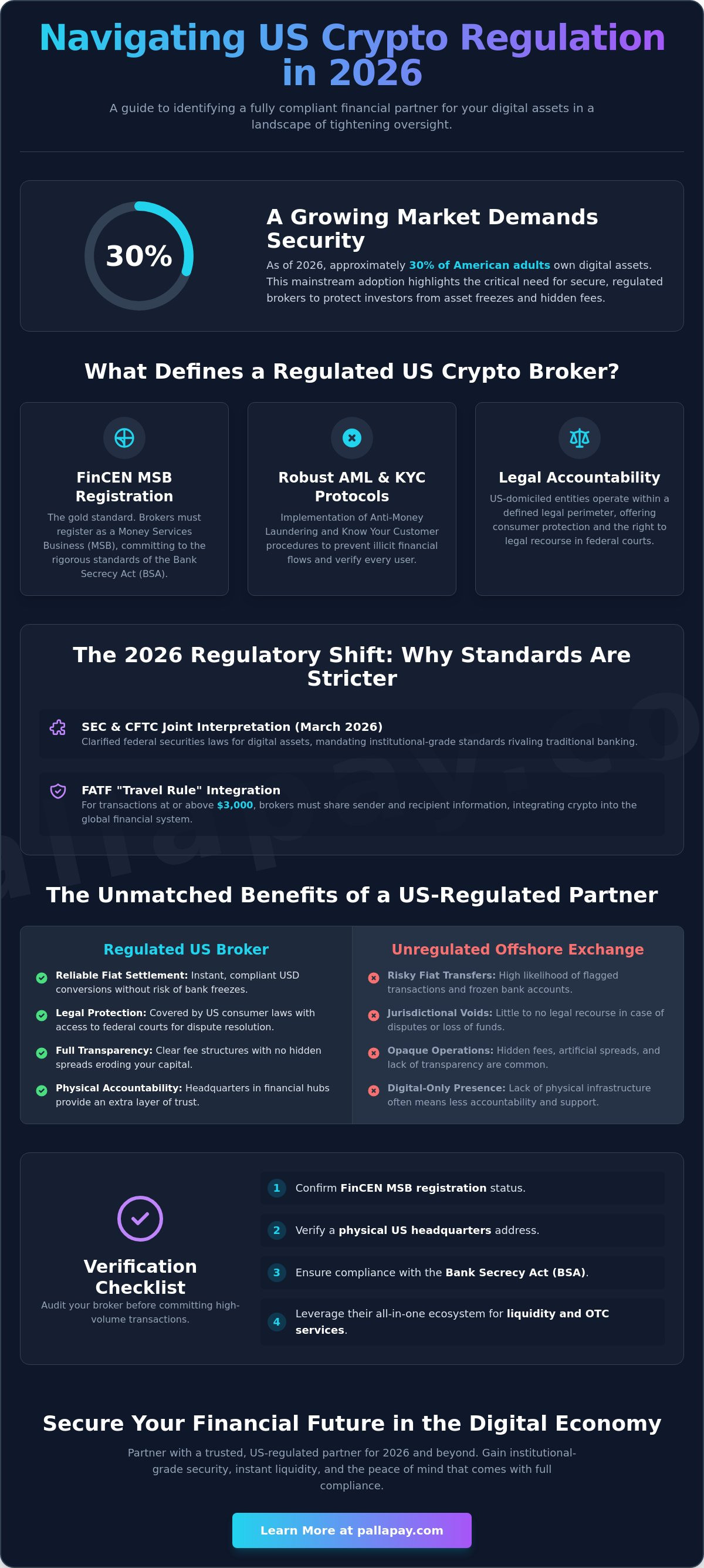
    A regulated crypto broker usa isn’t just a platform with a sleek interface; it’s a financial entity that operates under the strict supervision of the Financial Crimes Enforcement Network (FinCEN). By registering as a Money Services Business (MSB), these brokers commit to the rigorous standards of the Bank Secrecy Act (BSA). This framework serves as your primary defense against market volatility and fraud. Unlike unregulated offshore exchanges that often lack transparency, a US-domiciled broker must maintain detailed records and report suspicious activities to federal authorities. This oversight ensures that the bridge between your bank account and the blockchain remains secure and predictable.

    The Legal Framework: FinCEN and MSB Status

    Registration as an MSB is the gold standard for any provider offering a crypto offramp or on-ramp. This status requires the implementation of robust Anti-Money Laundering (AML) and Know Your Customer (KYC) protocols to prevent illicit financial flows. These measures ensure that every transaction is traceable and every user is verified. MSB registration is a mandatory requirement for any entity handling USD-to-crypto conversions within the United States. Compliance with US virtual currency law ensures that the broker operates within a defined legal perimeter, providing a level of accountability that offshore platforms simply cannot match. It transforms the complex world of digital assets into a standard, effortless business operation.

    Why 2026 Regulation Standards Are Stricter Than Ever

    The digital asset landscape shifted significantly in March 2026 when the SEC and CFTC issued their joint interpretation on federal securities laws. This was followed by the proposed rules for the Guiding and Establishing National Innovation for U.S. Stablecoins (GENIUS) Act, which treats stablecoin issuers as financial institutions under the Bank Secrecy Act. These developments mean that a regulated crypto broker usa must now adhere to institutional-grade standards that rival traditional banking. State-level licenses, such as the New York BitLicense, add an extra layer of oversight by mandating specific capital requirements and cybersecurity protections.

    The Financial Action Task Force (FATF) standards also play a critical role. The “Travel Rule” now requires brokers to share sender and recipient information for any transfer at or above $3,000. While some see this as a hurdle, it’s actually a safeguard that integrates crypto into the global financial system. Approximately 30% of American adults now own crypto, and this demographic relies on these stricter standards to ensure their funds aren’t caught in regulatory crackdowns. Choosing a regulated US partner means your assets are protected by a multi-jurisdictional infrastructure designed for long-term stability.

    The Benefits of Partnering with a US-Regulated Broker

    Choosing a regulated crypto broker usa provides more than just a platform for trading; it offers a foundation of legal certainty. When you partner with a domestic entity, you’re protected by US consumer laws and the right to legal recourse in federal courts. This is a critical advantage over offshore platforms where disputes often vanish into jurisdictional voids. These brokers must provide full transparency regarding their fee structures, ensuring that hidden spreads don’t erode your capital. Following the latest IRS guidance for crypto brokers, regulated partners handle the heavy lifting of tax reporting, which simplifies your annual filings and reduces audit risks. This professional oversight transforms the volatile world of digital assets into a stable environment for long-term growth.

    Reliable Fiat Settlement and Off-Ramping

    Moving large sums between digital wallets and traditional bank accounts shouldn’t be a source of anxiety. A professional crypto off-ramp ensures that your transactions remain compliant with stringent banking standards. By using a regulated partner, you minimize the risk of your bank flagging or freezing incoming wires because the source of funds is pre-verified. Instant USD settlement is a core feature that empowers businesses to maintain high levels of liquidity. This immediate conversion capability allows you to reinvest capital or cover operational costs without waiting for the standard three-to-five-day clearing cycles typical of legacy systems.

    Access to High-Volume OTC Trading

    For high-net-worth individuals and institutional players, public order books are often inefficient. Large trades on standard exchanges can trigger price slippage, significantly increasing the cost of your acquisition or exit. Regulated crypto brokers in the USA provide access to a private OTC desk where deep liquidity pools facilitate massive transfers at a fixed price. This personalized service ensures that your market moves remain confidential and efficient. Institutional clients benefit from dedicated account managers who handle the technical integration of fiat settlement processes, ensuring that high-volume operations feel like standard, effortless business. It’s this level of sophistication that defines the future of payments in a mature digital economy.

    Digital vs. Hybrid Brokers: Why Physical Infrastructure Matters

    App-only brokers prioritize scale over service. This model works for retail micro-trades but creates significant friction for high-net-worth individuals and corporate entities. If a high-volume wire is delayed or a compliance check stalls, a chatbot isn’t a viable solution. A regulated crypto broker usa that maintains a physical footprint in financial hubs like New York or regional centers like Kalispell provides a tangible layer of trust. In 2026, sophisticated investors value the ability to conduct face-to-face OTC consultations for major portfolio moves, ensuring their strategy is understood and executed with precision. This physical presence serves as a primary trust signal in an increasingly automated world.

    Bridging the Gap Between Cash and Crypto

    Hybrid brokers provide a unique utility by allowing clients to buy Bitcoin or USDT with cash in a secure, supervised environment. This physical infrastructure extends beyond trading desks to include POS machines that help retailers accept payments online and in-store seamlessly. Physical OTC desks offer a level of security for high-volume asset liquidation that digital-only platforms can’t match. It’s the difference between hoping an algorithm works and knowing a professional team is managing your liquidity. These locations act as the professional bridge that connects the old world of physical commerce with the new world of digital liquidity.

    Global Presence with Local US Compliance

    Operating across 180 countries requires a sophisticated balance of global reach and local accountability. By maintaining multi-hub presence in locations like Singapore, Istanbul, and North America, a broker can offer deep liquidity that isn’t restricted by local market hours. As detailed in this Guide to U.S. Crypto Policies, the legal landscape is complex, making a dedicated US MSB registration essential for domestic operations. Choosing a regulated crypto broker usa with international reach ensures you’re never isolated from global market movements. Global liquidity pools benefit US-based traders by providing tighter spreads and more competitive pricing on large-scale transfers. This “Global Enabler” model represents the future of payments, where blockchain speed meets institutional reliability and instant settlement becomes the standard business operation.

    Regulated Crypto Broker USA: Navigating Compliance and Security in 2026

    Verification Checklist: How to Audit Your US Crypto Broker

    Auditing a regulated crypto broker usa is a non-negotiable step for any entity managing significant digital assets. You can’t rely on marketing slogans; you need verifiable data that confirms a platform’s legal standing. Start by visiting the FinCEN MSB Registrant Search page. Enter the company name or their specific registration number. For instance, a compliant provider will have a clear, active record, such as MSB Registration Number 31000315326622. This check confirms the broker is authorized for money transmission and virtual currency activities under federal law.

    Next, verify the physical headquarters. A legitimate broker doesn’t hide behind a P.O. Box in a tax haven. They maintain operational offices in major financial centers or regional hubs. You should also scrutinize the fee schedule for hidden costs. Many exchanges claim “zero fees” but profit from wide spreads that eat into your liquidity. As of May 2026, standard maker-taker models range from 0.00% to 0.60%. If the math doesn’t add up, the platform is likely profiting from your lack of oversight.

    Before committing capital, test the responsiveness of the support team. A bot-only response is a failure in the institutional space. You need a dedicated account manager who understands the complexities of high-volume OTC trades. Finally, evaluate the technical infrastructure. Check for robust payment APIs and instant settlement options. A professional partner should provide a complete ecosystem that handles the heavy lifting of technology behind the scenes.

    Red Flags to Avoid in 2026

    Steer clear of any platform that lacks a detailed “About Us” section or a verifiable physical address. Transparency is the hallmark of a regulated crypto broker usa. You should be extremely wary of platforms offering “guaranteed returns” or “zero-fee” high-volume trades. In a market with a $2.5 trillion capitalization, no legitimate entity can guarantee profit. “Offshore-only” status is another significant risk for US residents. If a platform operates outside US jurisdiction, you’ll have zero legal recourse if your assets are frozen or lost during a regulatory crackdown.

    Reviewing Security and Custody Solutions

    Security is the bedrock of any regulated partnership. You must distinguish between hot and cold storage solutions. Regulated brokers keep the vast majority of assets in cold storage, disconnected from the internet, to prevent cyberattacks. Ask about insurance coverage for digital assets held in custody. A reliable partner will have comprehensive policies to protect against internal and external threats. This level of protection ensures that your crypto security is the foundation of your long-term financial operations, not an afterthought. It’s this commitment to safety that defines the future of payments.

    To ensure your business remains compliant and secure, audit your fiat settlement options with a trusted partner today.

    Pallapay: A Trusted US-Regulated Partner for 2026

    Pallapay stands as a definitive regulated crypto broker usa, bridging the gap between disruptive blockchain technology and institutional stability. Our commitment to transparency is solidified by our registration as a Money Services Business (MSB) with FinCEN, specifically under registration number 31000315326622. This regulatory foundation allows us to offer an all-in-one ecosystem where buying, selling, and spending digital assets is a standard, effortless operation. Our platform handles the heavy lifting of technology behind the scenes, ensuring your focus remains on growth. We provide the essential infrastructure for fiat settlement, enabling hotels and global e-commerce brands to access liquidity without the friction of traditional banking delays.

    Institutional and Business Solutions

    Speed defines the modern market. Our customized API integrations allow global e-commerce platforms to accept digital assets and receive USD or EUR instantly. For physical commerce, we support retail stores with advanced POS hardware that facilitates real-time crypto-to-fiat conversion at the point of sale. This integration ensures that businesses can scale globally while maintaining local compliance. Pallapay isn’t just a tool; it’s an essential component of the 2026 global financial evolution. We combine the utility of the Pallapay Mastercard with deep OTC liquidity to ensure your capital is always accessible and ready for deployment.

    Getting Started with a Regulated Account

    Onboarding with a regulated crypto broker usa should be efficient, not overwhelming. Our process is designed for both individual and corporate clients, moving quickly from verification to active trading. Once your account is active, you gain immediate access to our OTC crypto exchange for high-volume transactions. This desk provides the deep liquidity needed to prevent price slippage on major portfolio moves. We’ve built a bridge that connects the old world of finance with the new, ensuring every transaction is secure and compliant. The future of payments is here, and it’s built on trust and technological excellence.

    Open your regulated Pallapay account today and secure your place in the digital economy.

    Securing Your Position in the 2026 Digital Economy

    The transition toward institutional-grade standards in 2026 makes the selection of a regulated crypto broker usa the most vital step for your financial strategy. You’ve learned how MSB registration with FinCEN provides a necessary shield against market uncertainty. You also understand why physical infrastructure in hubs like New York and Kalispell offers a level of accountability that digital apps can’t replicate. By utilizing the verification checklist, you ensure your liquidity remains secure and your transactions stay compliant with federal laws.

    Pallapay bridges the gap between innovation and reliability by combining official MSB registration in both the United States and Canada with an award-winning global crypto payment gateway. Our physical presence and commitment to instant fiat settlement provide the stability required for institutional growth. We handle the technical complexities so you can focus on scaling your operations with absolute confidence. It’s time to move beyond the limitations of unregulated platforms and embrace the future of payments.

    Secure your financial future with a regulated US crypto partner; join Pallapay today.

    Frequently Asked Questions

    Is Pallapay a regulated crypto broker in the USA?

    Pallapay is a fully registered Money Services Business (MSB) with FinCEN, holding registration number 31000315326622. This status authorizes us to conduct virtual currency and money transmission activities across the United States. We also maintain active registration in Canada, ensuring a multi-jurisdictional compliance framework. This regulatory standing allows us to serve as a reliable regulated crypto broker usa for both retail and institutional clients seeking secure digital asset operations.

    What is the difference between a crypto exchange and a regulated broker?

    A regulated broker acts as a professional intermediary that provides personalized liquidity and compliance oversight, whereas an exchange is typically a public marketplace. Brokers offer dedicated account management and OTC services that prevent the price slippage often found on public order books. While exchanges prioritize high-volume retail trading, a regulated crypto broker usa focuses on secure, large-scale operations and seamless fiat-to-crypto integration for sophisticated investors.

    How do I verify a broker’s FinCEN MSB registration?

    You can verify any entity’s status by visiting the official FinCEN MSB Registrant Search page and entering the company’s legal name or registration number. For Pallapay, searching for number 31000315326622 will confirm our active status. It’s essential to check this database to ensure the firm is legally permitted to handle USD-to-crypto conversions. This verification step is your primary defense against unregulated offshore entities that lack federal oversight.

    Can I buy Bitcoin with cash at a regulated US broker?

    Yes, you can buy Bitcoin or USDT with cash through hybrid brokers that maintain physical office locations and POS infrastructure. This process occurs within a strictly regulated environment, requiring standard KYC verification to ensure compliance with the Bank Secrecy Act. Unlike faceless digital apps, this model provides a tangible bridge for users who prefer physical transactions. It ensures that cash-to-crypto conversions remain transparent, secure, and fully documented for regulatory purposes.

    What are the benefits of using an OTC desk for large crypto trades?

    OTC desks provide deep liquidity that allows for high-volume trades without triggering the price slippage common on public exchanges. This private execution ensures that large market moves don’t alert other traders, protecting your entry or exit price. You also receive personalized service from a dedicated manager who handles the technical settlement process. This institutional-grade approach is the preferred method for high-net-worth individuals making significant portfolio adjustments in 2026.

    How does a regulated broker handle fiat settlement for businesses?

    Regulated brokers facilitate instant fiat settlement by converting incoming crypto payments into USD or other major currencies in real time. This process is typically handled through a payment gateway or API for crypto payments that integrates directly with a business’s existing e-commerce platform. By bypassing the standard three-to-five-day bank clearing cycles, companies can maintain higher liquidity and reinvest capital immediately. This seamless transition from digital assets to bankable fiat defines the future of modern commerce.

    Are my assets insured when using a US-regulated crypto platform?

    Most US-regulated platforms secure assets through comprehensive private insurance policies that cover digital holdings kept in cold storage. While the FDIC doesn’t insure crypto assets, professional brokers partner with leading global insurers to protect against theft or internal fraud. You should always ask your broker for specific details regarding their coverage limits and the percentage of assets held offline. This multi-layered security approach ensures that institutional-grade protection remains the foundation of your partnership.

    What documents are required for KYC with a US crypto broker?

    Standard KYC requirements include a government-issued photo ID, proof of residence, and tax identification information. For corporate accounts, brokers will also request articles of incorporation and details regarding beneficial ownership. These protocols are mandatory under the Bank Secrecy Act to prevent money laundering and ensure the integrity of the financial system. The onboarding process is designed to be efficient, allowing verified users to access liquidity and OTC services quickly.

    Disclaimer

    The information provided on this website and blog is for general informational and educational purposes only and does not constitute financial, investment, legal, tax, or other professional advice.
    Cryptocurrency and digital asset services may be subject to regulatory restrictions in certain jurisdictions. Users are solely responsible for ensuring compliance with applicable local laws and regulations before using any products or services mentioned on this website.
    PallaPay does not guarantee the accuracy, completeness, or timeliness of any information published and accepts no liability for any loss or damages arising from reliance on the content. Any opinions expressed are those of the respective authors and may change without notice.
    Certain services, features, or products referenced may be provided through third-party partners, licensed entities, or affiliated service providers subject to separate terms and regulatory approvals. Availability of services may vary by country or region.
    This website may contain references to digital assets, virtual currencies, or blockchain-related services that are not available to residents of certain jurisdictions, including where prohibited by law. Nothing on this website constitutes an offer, solicitation, or recommendation to buy or sell any financial instrument or virtual asset.