

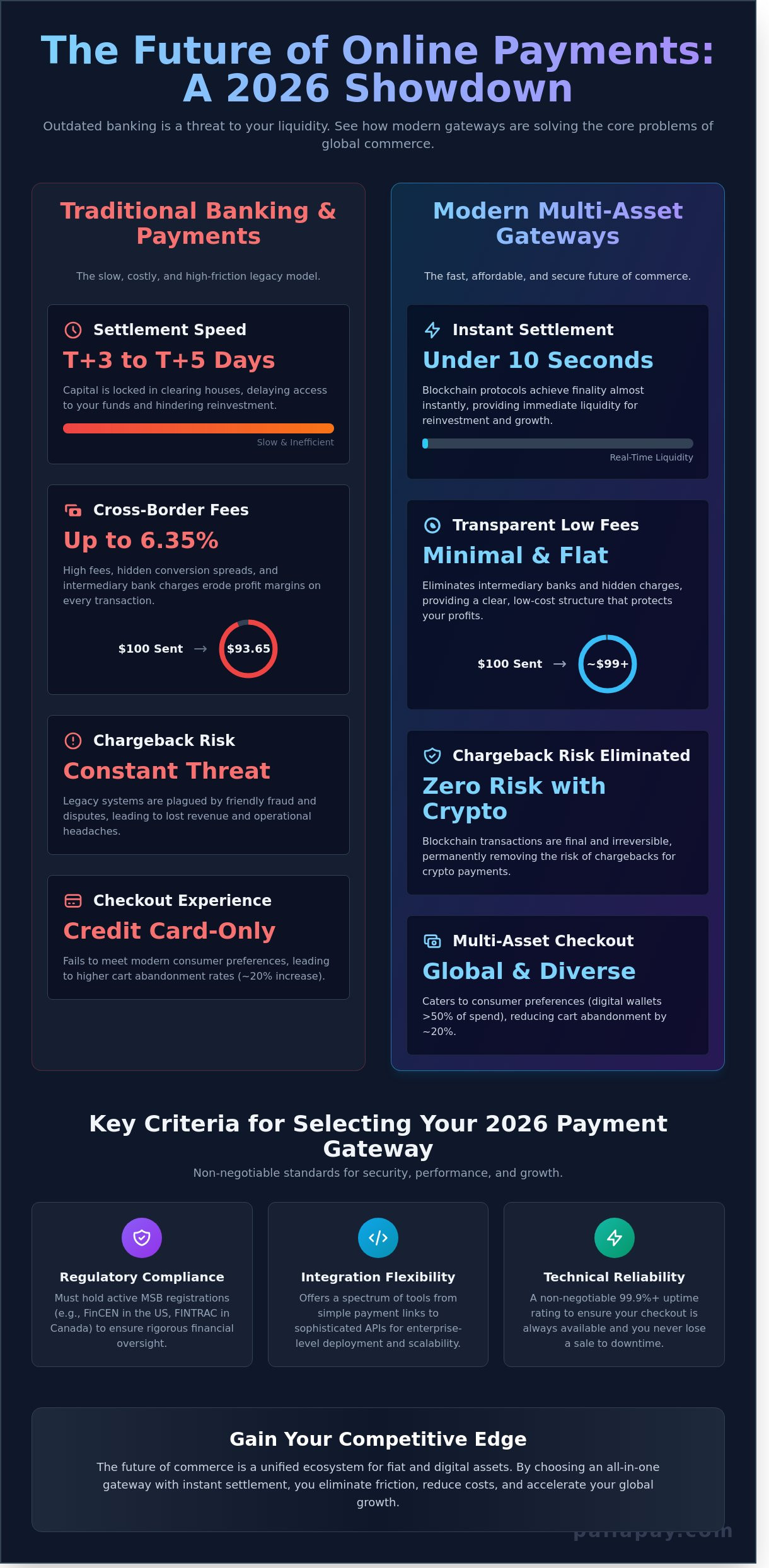
By 2026, relying on traditional T+3 settlement cycles isn’t just a slow process; it’s a direct threat to your business liquidity. You likely recognize that high cross-border fees, which often reach 6.35% according to World Bank data, are eroding your profit margins every single day. You want to accept payments online without the technical friction or the constant fear of chargebacks that plagues legacy systems. It’s time to stop letting outdated banking infrastructure dictate the speed of your commerce.
We understand that the transition to a borderless economy requires more than just a standard gateway. This guide will show you how to master the modern payment landscape by integrating seamless, global-ready solutions that bridge the gap between fiat and cryptocurrency. You’ll discover how to achieve instant settlement of funds and access lower processing fees than traditional banks provide. We’ll walk through how a unified dashboard provides instant visibility for all payment types, streamlining your operations to accelerate your global growth.
Key Takeaways
- Understand the evolution of multi-asset gateways and how to bridge the gap between traditional fiat and the digital-first expectations of 2026.
- Identify the non-negotiable security standards, such as MSB registration, required to protect your business from hidden costs and compliance risks.
- Discover how to accept payments online by leveraging blockchain technology to eliminate chargeback risks and reach tech-savvy global demographics.
- Master a five-step integration process that aligns your website’s checkout experience with the preferred payment assets of your core customer markets.
- Gain a competitive edge by utilizing an all-in-one ecosystem designed for instant settlement and seamless global commerce operations.
The Evolution of Online Payments: What to Expect in 2026
The modern payment gateway has transitioned from a simple transaction processor into a sophisticated multi-asset bridge. By 2026, the ability to accept payments online requires more than just a connection to a local bank; it demands a gateway that facilitates seamless movement between fiat currencies and digital assets. Traditional processing models often isolate capital in regional silos. Modern merchants now prioritize unified financial ecosystems that integrate global liquidity into a single dashboard. This shift eliminates the need for multiple intermediary banks, allowing businesses to operate with the agility of a tech startup and the reliability of an institutional powerhouse.
A professional payment service provider in 2026 acts as a visionary partner. They handle the complex technical integrations of blockchain and legacy banking behind the scenes. This ensures that the merchant experiences absolute stability while the underlying technology executes high-speed conversions. The goal is no longer just to move money. The goal is to maximize business growth by removing every possible point of friction in the transaction lifecycle.
The Death of High-Friction Cross-Border Fees
Traditional SWIFT and ACH systems, which have governed international trade for decades, are being outpaced by the efficiency of decentralized ledgers. Merchants in 2026 expect Instant Settlement. While legacy systems can take 3 to 5 business days to clear international funds, blockchain-based protocols achieve finality in under 10 seconds. This rapid liquidity allows businesses to reinvest their capital immediately rather than waiting for banking cycles to complete. Global e-commerce trends for 2026 indicate that 75% of cross-border merchants now prefer platforms that offer real-time settlement to avoid the volatility and hidden costs of traditional wire transfers.
Consumer Preference: From Credit Cards to Digital Wallets
Consumer behavior has shifted decisively away from physical plastic toward integrated digital environments. Data from 2025 shows that digital wallets now account for over 50% of global e-commerce spend. This trend is driven by the rise of stablecoins like USDT, which provide the stability of the US Dollar with the speed of the internet. When you accept payments online through a multi-option checkout, you directly influence your conversion rates. Offering diverse methods, including stablecoins and local digital wallets, reduces cart abandonment by approximately 20% compared to credit-card-only setups. It’s the definitive destination for modern commerce; providing the customer with their preferred payment method is the simplest way to secure a sale. This is the future of payments: a world where currency type never limits a transaction.
Key Criteria for Selecting Your Payment Gateway Provider
Choosing a partner to accept payments online requires a shift from viewing a gateway as a mere tool to seeing it as a strategic asset. Security remains the primary pillar. A provider must hold active Money Services Business (MSB) registrations in key jurisdictions. In the United States, this involves FinCEN registration; in Canada, it’s FINTRAC. These licenses aren’t just badges. They represent a commitment to rigorous financial oversight and consumer protection. When you accept payments online, your gateway is the first line of defense against systemic risk.
Transparency in pricing often separates institutional-grade providers from predatory ones. Many gateways lure merchants with low headline rates while hiding 1% to 2% spreads on currency conversions or adding unexpected network access fees. A professional partner provides a clear, flat-fee breakdown of every basis point. This clarity extends to settlement speed. While legacy systems still operate on T+3 or even T+5 cycles, modern commerce demands instant liquidity. Businesses shouldn’t have their capital locked in a clearing house for 72 hours when blockchain technology allows for immediate settlement and improved cash flow.
Integration flexibility determines how quickly a business can pivot. A visionary partner offers a spectrum of tools, from simple payment links for social commerce to a sophisticated payment API for enterprise-level deployments. This scalability ensures that as a business grows, the technology supporting it doesn’t become a bottleneck.
Technical Reliability and Uptime
A 99.9% uptime rating is the non-negotiable industry standard for ecommerce payment gateways. Even a 0.1% failure rate can result in thousands of dollars in lost revenue during high-traffic events. Reliability isn’t just about the server; it’s about the support. Global operations require 24/7 technical assistance to resolve API conflicts or dashboard discrepancies across different time zones. The merchant dashboard itself must offer a seamless UX, providing high-level liquidity overviews and granular transaction logs in a single, intuitive interface.
Compliance and Global Reach
Verifying a provider’s regulatory standing is a critical step in due diligence. Merchants should check public registries for MSB status in the US, Canada, and the UAE to ensure the partner operates within legal frameworks. Robust KYC (Know Your Customer) and AML (Anti-Money Laundering) protocols are essential. These processes filter out high-risk entities and protect your business from the reputational damage of fraudulent transactions.
Institutional trust is further solidified by a physical presence in global financial hubs. Having a physical office in cities like Dubai or Singapore demonstrates that a provider is a permanent fixture in the financial ecosystem, not a transient digital entity. This physical grounding, combined with digital agility, allows merchants to scale with the confidence that their financial partner is both regulated and reachable.
Why Integrating Crypto Payments is No Longer Optional
To effectively accept payments online in 2026, merchants must look beyond traditional credit cards. Global crypto ownership surpassed 560 million people in 2024, creating a massive pool of liquidity that operates outside legacy banking hours. Businesses that adopt these rails gain a significant competitive advantage by reaching the 1.4 billion unbanked adults worldwide who still possess internet access and mobile devices. This demographic isn’t just limited to emerging economies; it includes a growing number of tech-savvy Gen Z consumers who prioritize privacy and digital-first assets over conventional checking accounts.
Security remains a primary driver for this shift. Traditional payment systems are vulnerable to “friendly fraud” and chargeback abuse, which cost global merchants over $100 billion in 2023. Blockchain transactions are immutable. Once a payment is verified on the ledger, it cannot be reversed by a third party. This provides absolute finality for the merchant. By bypassing the 7 to 9 intermediaries typically involved in cross-border settlements, businesses also reduce processing overhead. Instead of losing 3% to 5% of every sale to various banking fees, crypto transactions often cost a fraction of that amount, allowing for healthier profit margins on every order.
In emerging markets, digital assets serve as a critical hedge. Countries facing high inflation, such as Turkey or Argentina, have seen local currency values drop by over 50% against the dollar in a single year. Accepting stablecoins like USDT allows local businesses to preserve their purchasing power while participating in the global economy without the friction of local currency fluctuations.
The Seamless Crypto-to-Fiat Settlement Process
Many merchants hesitate to accept digital assets because of price volatility. Pallapay eliminates this concern through fiat settlement. When a customer pays with Bitcoin or USDT, the system executes an instant conversion at the current market rate. You don’t have to manage private keys or worry about market dips. The funds are deposited directly into your bank account in your preferred local currency. For developers looking to integrate these features, our payment API provides the necessary technical framework to automate this entire workflow seamlessly.
Expanding into New Industries
The gaming industry has been a primary adopter, using digital assets to facilitate instant micro-transactions for in-game items. This eliminates the “wait time” associated with traditional clearing houses. We are also seeing a rapid rise in crypto usage within luxury hotels and high-end real estate. These sectors benefit from the ability to move millions of dollars across borders in minutes without the delays of the SWIFT network. It’s the most efficient way to accept payments online for high-ticket items. In 2026, cryptocurrency is not just an asset; it is the most efficient rail for global value transfer.
5 Steps to Seamlessly Accept Payments on Your Website
Modern commerce requires more than a simple checkout button. To accept payments online in 2026, merchants must align their infrastructure with global consumer habits. Recent industry reports suggest that 40% of tech-savvy shoppers now expect digital asset options at checkout. Following a structured implementation path ensures your business remains competitive and secure while providing the friction-free experience users demand.
- Identify Core Markets: Analyze where your traffic originates. If you serve international clients, prioritize a gateway that handles multi-currency conversions and localized payment methods instantly.
- Select a Hybrid Gateway: Choose a provider that processes both traditional credit cards and digital assets. This prevents fragmented reporting and simplifies your financial reconciliation.
- Configure the Connection: Integrate a professional payment API to maintain a consistent brand experience. This allows you to embed the checkout directly into your interface, reducing cart abandonment.
- Execute Sandbox Testing: Conduct at least 50 simulated transactions before going live. You should test for expired cards, insufficient funds, and network timeouts to ensure the system is resilient under stress.
- Monitor via Dashboard: Use real-time analytics to track conversion rates and settlement status. High-performing merchants use these insights to pivot their strategy based on which assets are most popular.
Choosing Your Integration Method
Selecting the right integration depends on your technical resources and brand strategy. Hosted payment pages offer the fastest route to market; they handle PCI compliance on external servers to minimize your liability. Direct API integration is the preferred choice for enterprises seeking a bespoke checkout flow that maximizes user trust. If you sell via social media or direct invoicing, simple payment links provide a professional way to accept payments online without a full website. Managing these diverse streams is more efficient when you sync online data with a physical crypto POS through a unified merchant portal.
Managing Your Liquidity
Pallapay: The All-in-One Gateway for Global Commerce
Pallapay stands as a regulated leader in the global fintech space, providing a unified ecosystem for businesses that need to accept payments online without the friction of traditional banking delays. The platform bridges the gap between digital assets and fiat liquidity, operating with a physical presence in strategic financial hubs like Dubai, Singapore, and Istanbul. This global footprint allows Pallapay to serve merchants in 180+ countries, ensuring that cross-border commerce is no longer a logistical hurdle but a competitive advantage. By maintaining local offices in key regions, the brand provides the institutional reliability that modern enterprises demand.
Speed defines the modern economy. Pallapay delivers an “Instant” advantage through real-time settlement and conversion, allowing businesses to move from transaction to liquidity without waiting for multi-day clearing cycles. Beyond digital gateways, the ecosystem integrates the physical world via the Pallapay Mastercard and advanced POS terminals. This dual approach ensures that whether a customer is paying on a smartphone or in a retail store, the merchant experience remains unified. The ability to settle funds immediately provides businesses with the cash flow agility necessary to scale in a fast-paced market.
Secure and Compliant Infrastructure
Trust is built on transparency and rigorous standards. Pallapay maintains official MSB registrations in the United States and Canada, adhering to strict regulatory frameworks that protect both the merchant and the end-user. Every transaction is backed by institutional-grade security protocols designed to prevent fraud and ensure data integrity. These high standards are why 50,000+ businesses rely on Pallapay as their preferred otc crypto exchange and payment gateway provider. The infrastructure is built to handle high-volume traffic while maintaining the highest levels of encryption.
Getting Started with Pallapay
Transitioning to a modern payment infrastructure is direct and efficient. The onboarding process is designed for speed, allowing merchants to bypass the bureaucratic delays typical of legacy providers. Developers can access comprehensive payment API documentation to integrate the gateway into existing stacks with minimal effort. This technical accessibility ensures that your business can accept payments online within hours rather than weeks. Efficiency is the core of the Pallapay experience.
Secure Your Competitive Edge in the 2026 Global Market
The landscape of digital commerce is shifting toward a unified model where traditional fiat and blockchain assets coexist seamlessly. Merchants who decide to accept payments online must prioritize infrastructure that offers instant settlement and global accessibility. Success in 2026 requires moving beyond basic credit card processing to include integrated crypto liquidity and cross-border functionality. You’ll need a partner that bridges the gap between legacy systems and modern financial innovation while maintaining absolute security.
Pallapay provides the institutional reliability your business needs to scale safely across borders. Our platform holds official MSB registration in both the United States and Canada, ensuring your operations remain compliant with rigorous international standards. We currently serve merchants in over 180 countries through our award-winning Crypto POS and gateway infrastructure. This all-in-one ecosystem handles the heavy lifting of technology, allowing you to focus on growth while we manage the complexities of global settlement and liquidity.
Empower your business with the future of payments and join Pallapay today. Your transition to a sophisticated, global payment ecosystem starts now. It’s time to lead your industry with confidence and provide the frictionless experience your customers expect.
Frequently Asked Questions
Is it safe to accept payments online using cryptocurrency in 2026?
It’s safe to accept payments online using cryptocurrency because blockchain technology provides an immutable ledger that prevents chargeback fraud. By 2026, over 95 percent of enterprise crypto gateways utilize AES-256 encryption standards to protect transaction data. Pallapay integrates these institutional-grade protocols to ensure every transfer is secure. This technology eliminates the traditional risks associated with credit card reversals and provides absolute peace of mind for global merchants.
What are the fees associated with an online payment gateway?
Typical gateway fees range from 1.5 percent to 3.5 percent per transaction according to 2025 industry benchmarks from Juniper Research. Merchants also face monthly service fees between 20 and 50 dollars depending on the specific provider and volume. Pallapay streamlines these costs by offering an all-in-one ecosystem that reduces the need for multiple third-party intermediaries. This approach helps businesses maintain higher profit margins while scaling their operations globally.
Can I receive payments in my local currency if a customer pays with USDT?
You can receive local fiat currency instantly even when customers pay with USDT or other stablecoins. Pallapay’s settlement system performs real-time conversion to ensure your business isn’t exposed to market volatility. This feature allows you to accept payments online and bridge the gap between digital assets and traditional bank accounts. It’s the future of payments for merchants who want global reach without managing complex crypto wallets.
How long does it take for online sales to reach my bank account?
Settlement times typically range from instant to 3 business days depending on the chosen payout method. While traditional banking networks often require a 48 hour clearing period, Pallapay offers instant internal settlements within its ecosystem. This speed provides immediate liquidity for your daily operations. Faster access to capital allows you to reinvest in inventory or marketing without the delays found in legacy financial systems.
What is the difference between a payment gateway and a payment processor?
A payment gateway acts as the secure digital bridge that captures customer data, whereas the processor executes the actual transfer of funds between banks. Think of the gateway as the virtual point of sale terminal and the processor as the behind the scenes communication network. Pallapay combines both functions into a single platform to help you accept payments online. This integration simplifies the technical requirements for modern businesses.
Do I need a separate merchant account to accept crypto payments?
You don’t need a separate traditional merchant account when you use an all-in-one crypto gateway like Pallapay. Our platform functions as your dedicated financial interface, handling both the receipt of digital assets and the conversion to fiat. This eliminates the need to manage multiple banking relationships or complex technical setups. It’s a simplified way to modernize your financial stack and prepare for the 2026 digital economy.
How does Pallapay protect my business from online payment fraud?
Pallapay protects your business using real-time AI monitoring and the inherent security of blockchain verification. Because crypto transactions are push-based, they eliminate the 100 percent risk of unauthorized pull charges that lead to costly disputes. Our system analyzes transaction patterns to flag suspicious activity before it impacts your bottom line. This proactive defense ensures your revenue remains protected against evolving cyber threats and sophisticated fraudulent schemes.
Can I use the same gateway for my online store and physical retail location?
You can use the same Pallapay gateway for your e-commerce site and your physical retail store. Our omnichannel solution synchronizes your sales data across all touchpoints, providing a unified view of your business performance. This allows you to manage inventory and revenue from a single, secure dashboard. It’s a versatile tool for merchants who operate in both digital and physical spaces and require a seamless financial partner.
Disclaimer
The information provided on this website and blog is for general informational and educational purposes only and does not constitute financial, investment, legal, tax, or other professional advice.
Cryptocurrency and digital asset services may be subject to regulatory restrictions in certain jurisdictions. Users are solely responsible for ensuring compliance with applicable local laws and regulations before using any products or services mentioned on this website.
PallaPay does not guarantee the accuracy, completeness, or timeliness of any information published and accepts no liability for any loss or damages arising from reliance on the content. Any opinions expressed are those of the respective authors and may change without notice.
Certain services, features, or products referenced may be provided through third-party partners, licensed entities, or affiliated service providers subject to separate terms and regulatory approvals. Availability of services may vary by country or region.
This website may contain references to digital assets, virtual currencies, or blockchain-related services that are not available to residents of certain jurisdictions, including where prohibited by law. Nothing on this website constitutes an offer, solicitation, or recommendation to buy or sell any financial instrument or virtual asset.
Leave a Reply