Tag: Chargeback Prevention

  • Overcoming Common Objections to Accepting Crypto Payments: A 2026 Merchant Guide

    Overcoming Common Objections to Accepting Crypto Payments: A 2026 Merchant Guide

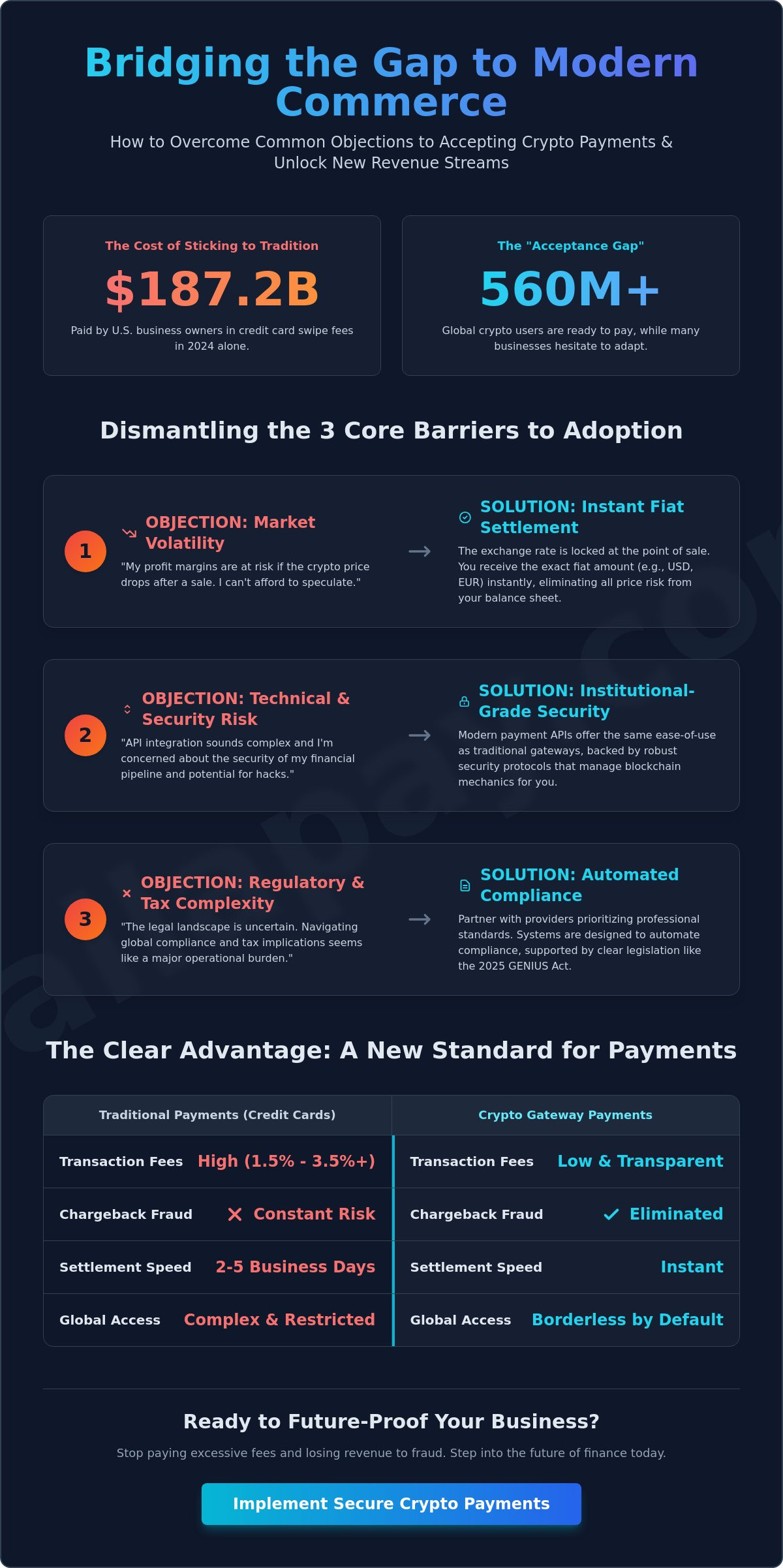
    U.S. business owners paid a staggering $187.2 billion in credit card swipe fees in 2024, yet many still hesitate to adopt more efficient digital alternatives. You likely feel that the traditional financial system is expensive; however, the common objections to accepting crypto payments, such as price volatility and regulatory uncertainty, often stall progress. It’s natural to prioritize the stability of your margins and the technical security of your operations above all else.

    This guide will demonstrate how modern financial technology has matured to dismantle these barriers, transforming previous risks into measurable competitive advantages. You’ll discover how to leverage a crypto payment gateway to receive fiat currency instantly, ensuring your bottom line remains protected from market fluctuations. We provide a clear framework for mitigating risks through institutional-grade security measures and explain how recent legislation, like the 2025 GENIUS Act, provides the regulatory clarity your business needs to grow. By the end of this article, you’ll understand how to bridge the gap between established commerce and the inevitable global evolution of finance.

    Key Takeaways

    • Eliminate price risk by utilizing instant fiat settlement, ensuring your profit margins are preserved regardless of market movement.
    • Address common objections to accepting crypto payments by understanding how modern API integrations provide the same ease of use as traditional credit card gateways.
    • Protect your revenue from fraudulent chargebacks by leveraging the inherent irreversibility of blockchain transactions to secure every sale.
    • Navigate global compliance with confidence by partnering with providers that prioritize professional regulatory standards and secure offramp procedures.
    • Discover how a comprehensive ecosystem allows you to convert crypto to USD or EUR instantly, bridging the gap between digital assets and traditional commerce.

    Why Businesses Still Hesitate to Adopt Cryptocurrency Payments

    The “Acceptance Gap” remains a visible friction point in modern commerce. While consumer interest in digital assets has surged to over 560 million global users, operational hesitation still prevents many enterprise leaders from fully integrating these systems. By 2026, cryptocurrency has transitioned from a speculative experiment into a standard asset class. However, a psychological barrier persists among traditional finance leaders who often view decentralized systems with caution. They fear a lack of institutional oversight or a loss of control over their financial pipelines.

    Modern financial technology acts as a supportive facilitator in this environment. It doesn’t ask businesses to abandon their established practices; instead, it provides a professional bridge that connects traditional reliability with modern efficiency. By 2026, roughly 19% of U.S. small businesses have already adopted these tools to lower costs and reach new demographics. The goal is to turn technical complexity into a background process that feels like a standard business operation.

    The Evolution of Merchant Crypto Adoption

    Merchant services have moved far beyond the early days of direct peer-to-peer transfers. In the past, “do-it-yourself” crypto acceptance required businesses to manage private keys and manual conversions, which led to many of today’s common objections to accepting crypto payments. Today, sophisticated gateway ecosystems have replaced those high-friction methods. Institutional-grade infrastructure now handles the underlying blockchain mechanics, allowing merchants to focus on their core growth while the technology manages the transaction flow in the background.

    Identifying the Core Categories of Resistance

    Resistance to adoption generally falls into three distinct categories that require specific technological answers. Understanding these risks is the first step toward mitigating them effectively:

    • Financial Risk: Concerns regarding market volatility and the immediate liquidity of digital assets.
    • Operational Risk: Anxiety over technical integration, security protocols, and the potential for hacking.
    • Compliance Risk: Navigating Regulatory Compliance and Tax Complexity across different jurisdictions.

    By utilizing a professional payment API, businesses can bypass these hurdles. These systems are designed to automate compliance and security, ensuring that your transition into digital finance is both secure and legally sound. When you implement a structured fiat settlement process, the perceived risks of the crypto market effectively disappear from your balance sheet.

    Objection 1: Market Volatility and Financial Stability Risks

    Market volatility is frequently cited as the most significant hurdle for merchants. The fear of losing profit margin between the moment of a transaction and the eventual bank deposit is understandable. This concern remains one of the most common objections to accepting crypto payments, but it’s based on an outdated understanding of how modern payment gateways function. By 2026, the technology has evolved to remove this risk entirely through automated background processes. Businesses no longer need to speculate on market prices to participate in the digital economy.

    Modern financial infrastructure acts as a protective shield for your margins. When a customer initiates a payment, the exchange rate is captured in real time. This ensures that the value you see at the point of sale is the value that arrives in your account. By removing the exposure to market swings, businesses can focus on growth rather than monitoring price charts. If you’re looking to stabilize your revenue, you can convert crypto to USD instantly to maintain your financial stability.

    How Fiat Settlement Eliminates Price Risk

    The primary solution to volatility is a robust fiat settlement system. This mechanism locks in the exchange rate at the exact moment a customer clicks “pay.” Even if the underlying asset’s value fluctuates seconds later, the merchant receives the precise fiat amount requested. This process transitions digital assets to fiat currency automatically, ensuring that businesses never have to ‘hold’ volatile assets on their balance sheet. It effectively treats a Bitcoin or Ethereum transaction with the same financial stability as a standard credit card payment.

    The Role of Stablecoins in 2026 Commerce

    Stablecoins like USDT have become a preferred settlement layer for international B2B transactions. These assets offer the speed of blockchain technology without the price fluctuations of traditional cryptocurrencies. While traditional banking cycles often take 3 to 5 business days for cross-border settlement, digital asset rails provide near-instant movement of value. This efficiency reduces cross-border transaction fees and improves cash flow management. For businesses requiring physical operational flexibility, services to sell crypto to bank accounts or exchange USDT for cash provide the liquidity needed to meet immediate obligations.

    Strategic partners now offer comprehensive ecosystems that handle these complex technical conversions. This allows you to accept a wide variety of assets while settling in the currency that best suits your operational needs. By utilizing these professional tools, you can turn a perceived financial risk into a distinct operational advantage.
    Overcoming Common Objections to Accepting Crypto Payments: A 2026 Merchant Guide

    Objection 2: Regulatory Compliance and Tax Complexity

    Regulatory uncertainty often manifests as a “Regulatory Ghost” in the boardroom. Finance directors frequently worry that adopting digital assets will lead to unintentional non-compliance with anti-money laundering (AML) protocols or complex tax audits. These fears represent significant common objections to accepting crypto payments. However, the regulatory landscape of 2026 is far more defined than in previous years. The enactment of the GENIUS Act in July 2025 provided a comprehensive framework for stablecoins, while the CLARITY Act of 2026 defined most digital assets as commodities. These legislative milestones have replaced ambiguity with a clear roadmap for institutional adoption.

    By choosing a partner with formal Money Services Business (MSB) registration, merchants effectively transfer the bulk of the compliance burden to the provider. This professional bridge ensures that every transaction is screened and recorded according to global standards. It’s a shift from a “do-it-yourself” compliance model to a managed service that scales with your business. This level of institutional financial reliability is essential for any merchant aiming to capture a share of the 560 million global crypto users safely.

    Partnering with Regulated MSB Entities

    MSB registration is the non-negotiable gold standard for merchant security in 2026. When you partner with a regulated entity in regions like the US or Canada, you gain access to institutional-grade financial reliability. The gateway handles the complex Know Your Customer (KYC) and AML checks automatically. This process protects your business from high-risk actors while maintaining a frictionless experience for legitimate customers. It’s a strategic move that transforms a potential legal liability into a secure, regulated operational flow. A regulated partner acts as a supportive facilitator, allowing your leadership team to focus on strategic growth rather than navigating the intricacies of federal laws.

    Automating Tax and Accounting Workflows

    Manual bookkeeping is no longer a requirement for digital asset commerce. Modern gateways generate automated, tax-ready reporting that simplifies the audit trail for your internal teams. These systems track capital gains at the moment of transaction, removing the need for manual ledger entries or complex year-end reconciliations. By utilizing specialized e-commerce industry solutions, you can integrate sales data directly into your existing accounting software. These automated reporting features are essential for maintaining a clean audit trail across 180+ countries. It ensures that your tax filings are accurate and defensible, regardless of the volume of international sales.

    Objection 3: Technical Integration and Security Concerns

    Technical complexity and perceived security vulnerabilities are often the final hurdles for merchants. Many business leaders believe that integrating blockchain technology requires a specialized internal team or a complete overhaul of their existing stack. These technical anxieties are among the most persistent common objections to accepting crypto payments. In reality, the 2026 integration landscape has achieved parity with traditional payment systems. Modern solutions are designed to be plug-and-play, ensuring that the underlying mechanics remain invisible to both the merchant and the end consumer.

    Security is no longer a matter of manual oversight but of institutional-grade automation. Protecting the digital perimeter involves multi-signature wallets and advanced encryption protocols that far exceed the security standards of traditional magnetic stripe or chip-and-pin systems. By utilizing a professional payment API, you can secure your transaction data without needing to understand the complexities of cryptographic hashing. This technology creates a secure environment where digital assets move with the same reliability as fiat currency, protecting your business from the erratic nature of the early crypto era.

    Seamless API and POS Integration

    Implementing these solutions follows a logical, step-by-step progression that mirrors standard payment setup. First, select a gateway with a robust API to handle the background logic and currency conversions. Second, configure your checkout experience to ensure zero-friction user journeys, allowing customers to pay with their preferred assets in seconds. For physical storefronts, deploying dedicated crypto POS machines allows for real-time processing in retail store environments. This hardware-software synergy ensures that whether your customer is online or in-person, the transaction is handled with absolute trust and speed. Modern API documentation is now so streamlined that integration times have dropped from weeks to just a few days of configuration.

    Turning Irreversibility into a Security Feature

    Traditional finance often highlights transaction irreversibility as a risk, yet for merchants, it’s a significant security upgrade. Credit card chargeback fraud remains a hidden cost that drains billions from global commerce annually. Crypto payments protect your revenue from “friendly fraud” because once a transaction is verified on the blockchain, it cannot be reversed by the customer. This transparency builds a different kind of trust. Every sale is final and verifiable, eliminating the anxiety of unauthorized reversals weeks after a product has shipped. By removing the threat of chargebacks, you can protect your margins and simplify your dispute management processes.

    If you’re ready to secure your revenue stream, you can integrate a professional payment API today to eliminate chargeback risks and streamline your global operations.

    Strategic Solutions: How Pallapay Eliminates Merchant Friction

    Pallapay serves as the professional bridge between traditional commerce and the digital future. While previous sections have dismantled the common objections to accepting crypto payments through technical and regulatory evidence, the practical execution requires a unified ecosystem. A fragmented approach often leads to operational friction; however, an integrated platform ensures that every transaction remains efficient and secure. Pallapay provides this stability by combining institutional financial reliability with accessibility-focused tools that simplify the user experience. By 2026, over 560 million global users are active in the digital asset space, and having a strategic partner allows you to capture this market without technical debt.

    Speed is a definitive competitive edge in modern finance. The ability to convert crypto to fiat instantly ensures that your business maintains the liquidity required for daily operations. Whether you need to settle in USD, EUR, GBP, or CNY, the infrastructure is designed to handle these conversions in real time. This global reach extends to over 180 countries, providing a secure perimeter for international expansion. You don’t need to be a blockchain expert to succeed; you simply need a facilitator that handles the background complexity while you focus on your core growth objectives.

    The Pallapay Ecosystem Advantage

    The Pallapay ecosystem is built for high-performance commerce. It combines advanced crypto security with high-volume OTC capabilities, allowing merchants to move significant assets without market slippage. Global desks provide professional support for complex transactions, ensuring that your financial operations remain grounded in practical commerce. A unique benefit of this ecosystem is the Pallapay Mastercard. This tool enables you to spend your crypto earnings instantly at any point of sale, bypassing the multi-day delays typical of traditional banking systems. It turns your digital revenue into a liquid resource for immediate reinvestment or operational expenses.

    Getting Started: The Path to Crypto Readiness

    Transitioning your business is a logical, step-by-step progression. You can begin by setting up a merchant account and selecting the integration that suits your business model, such as an online gateway for ecommerce or a physical POS machine for retail. For businesses that require traditional bank settlement, the crypto off-ramp provides a streamlined path for transfers to your corporate accounts. This ensures that you can always access your funds in the currency of your choice, including AED, INR, or EUR. The common objections to accepting crypto payments are solved through this comprehensive suite of services. Join the evolution of global commerce today by partnering with a trusted strategic facilitator and secure your place in the future of finance.

    Securing Your Competitive Advantage in the Global Economy

    The landscape of 2026 offers unparalleled opportunities for businesses to move beyond traditional payment limitations. By addressing the common objections to accepting crypto payments through instant fiat settlement and regulated compliance, you can protect your margins while expanding your global reach. You’ve seen how modern technology transforms perceived risks into operational strengths. Institutional-grade security and automated tax reporting are no longer optional extras; they’re essential tools for any growth-oriented enterprise.

    As a regulated MSB in the USA and Canada, Pallapay provides the 2026-ready secure POS and API infrastructure needed to serve customers in over 180 countries. This comprehensive ecosystem ensures that your transition is both efficient and legally sound. It’s time to scale your business with Pallapay’s secure crypto payment gateway. Embracing these advancements positions your company at the forefront of financial innovation. The transition to digital finance is a standard business operation that empowers your brand to lead in an evolving global market. Your progress starts today.

    Frequently Asked Questions

    Is it legal for my business to accept cryptocurrency payments in 2026?

    Yes, it’s legal in many major economies, including the United States and Canada. The GENIUS Act of 2025 and the CLARITY Act of 2026 have established a clear regulatory framework for digital assets and stablecoins. By using a regulated Money Services Business (MSB), you ensure that your operations comply with federal standards, effectively removing the legal ambiguity that once characterized the industry.

    How do I protect my business from Bitcoin price volatility?

    You can protect your margins by utilizing instant fiat settlement services. This technology captures the exchange rate at the exact moment of the transaction, ensuring the value you receive isn’t affected by subsequent market swings. Many businesses choose to convert crypto to USD or EUR immediately. This process eliminates the financial risk of holding volatile assets on your balance sheet while allowing you to enjoy the benefits of digital commerce.

    Do I need to be a tech expert to integrate a crypto payment gateway?

    You don’t need specialized technical expertise to implement a modern crypto payment solution. Current API integrations and physical POS machines are designed for seamless, plug-and-play operation within your existing infrastructure. These systems handle the complex background mechanics of the blockchain, allowing your team to focus on standard business operations. Most merchants can complete the setup process in just a few days by following a logical configuration guide.

    What are the tax implications of accepting digital assets for services?

    Modern gateways simplify tax compliance by generating automated, tax-ready reporting for every transaction. These systems track capital gains and losses at the point of sale, which removes the need for manual ledger entries or complex year-end reconciliations. By addressing these common objections to accepting crypto payments through automation, you maintain a clean audit trail. This ensures that your accounting workflows remain efficient and accurate across different jurisdictions.

    Can I convert crypto payments directly into my local bank account?

    Yes, you can transfer your earnings directly to your local bank account. Professional off-ramp services allow you to sell crypto to bank accounts in multiple currencies, including USD, EUR, and GBP. This bridge between digital assets and traditional finance ensures you have immediate access to liquidity for your operational needs. The process is fast and secure, providing the same reliability as a standard international wire transfer but with improved settlement speeds.

    How do crypto transaction fees compare to traditional credit card processors?

    Cryptocurrency transaction fees are typically significantly lower than traditional credit card processing costs. While credit card swipe fees often range from 1.5% to 3.5%, digital asset gateways generally charge between 0.5% and 2%. For example, U.S. business owners paid $187.2 billion in swipe fees in 2024. Adopting crypto payments can lead to substantial cost savings, directly improving your profit margins on every international and domestic sale.

    What happens if a customer sends the wrong amount of crypto?

    The payment gateway handles payment discrepancies through automated reconciliation protocols. If a customer sends an incorrect amount, the system flags the transaction and provides a clear path for a refund or a top-up payment. This prevents manual bookkeeping errors and ensures your records remain precise. These automated systems are designed to resolve common objections to accepting crypto payments by providing a predictable, professional experience for both the merchant and the consumer.

    Is there a risk of my merchant account being hacked?

    Institutional-grade security measures effectively mitigate the risk of unauthorized access. Regulated providers utilize advanced encryption, multi-signature wallets, and cold storage to protect your assets and data. These protocols are far more robust than the security standards used in many traditional financial systems. By choosing a partner with a proven track record in digital asset security, you ensure that your merchant account remains protected against modern cyber threats.

    Disclaimer

    The information provided on this website and blog is for general informational and educational purposes only and does not constitute financial, investment, legal, tax, or other professional advice.
    Cryptocurrency and digital asset services may be subject to regulatory restrictions in certain jurisdictions. Users are solely responsible for ensuring compliance with applicable local laws and regulations before using any products or services mentioned on this website.
    PallaPay does not guarantee the accuracy, completeness, or timeliness of any information published and accepts no liability for any loss or damages arising from reliance on the content. Any opinions expressed are those of the respective authors and may change without notice.
    Certain services, features, or products referenced may be provided through third-party partners, licensed entities, or affiliated service providers subject to separate terms and regulatory approvals. Availability of services may vary by country or region.
    This website may contain references to digital assets, virtual currencies, or blockchain-related services that are not available to residents of certain jurisdictions, including where prohibited by law. Nothing on this website constitutes an offer, solicitation, or recommendation to buy or sell any financial instrument or virtual asset.

  • How to Accept Payments Online: The Complete 2026 Merchant Guide

    How to Accept Payments Online: The Complete 2026 Merchant Guide

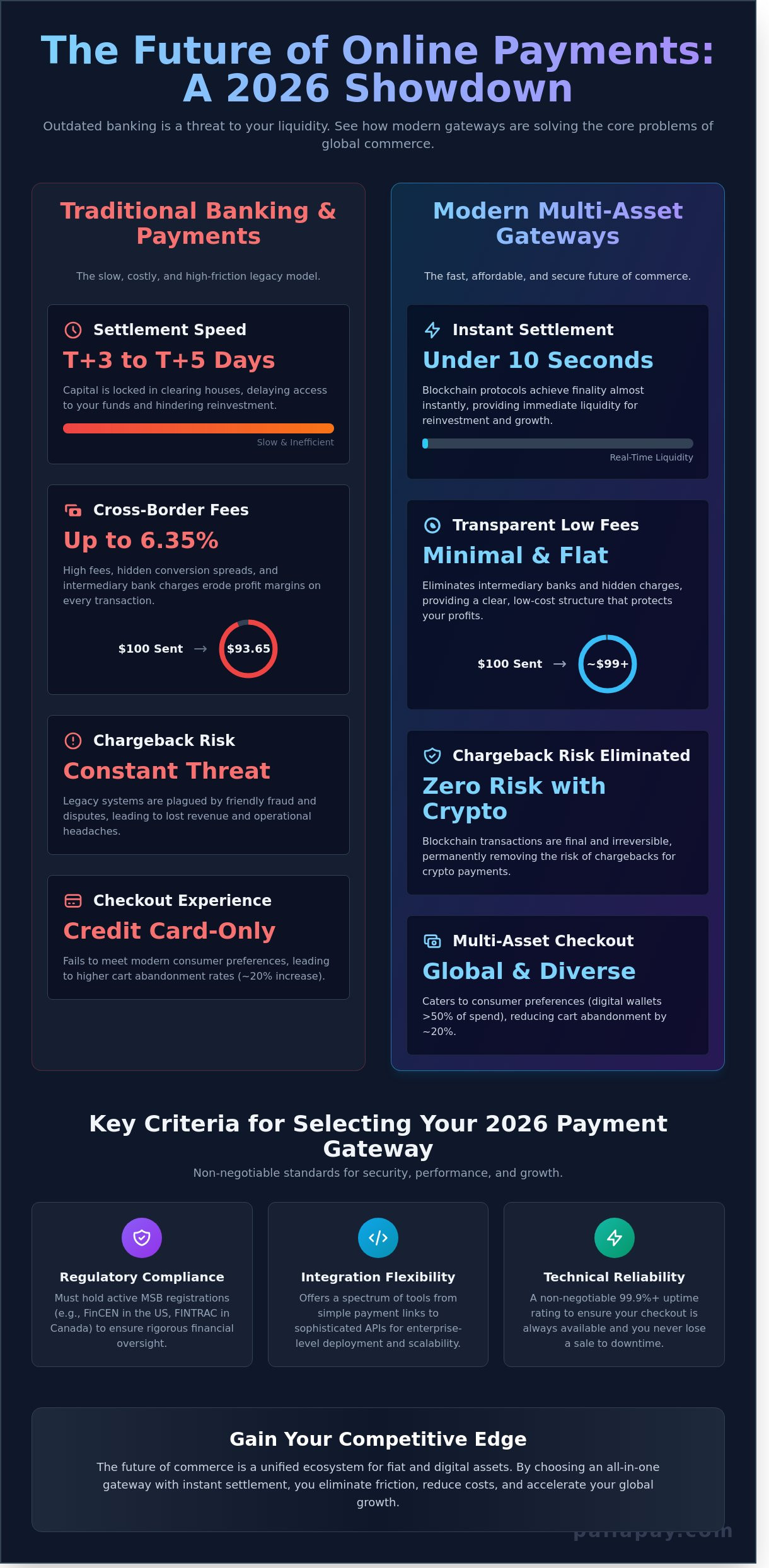
    By 2026, relying on traditional T+3 settlement cycles isn’t just a slow process; it’s a direct threat to your business liquidity. You likely recognize that high cross-border fees, which often reach 6.35% according to World Bank data, are eroding your profit margins every single day. You want to accept payments online without the technical friction or the constant fear of chargebacks that plagues legacy systems. It’s time to stop letting outdated banking infrastructure dictate the speed of your commerce.

    We understand that the transition to a borderless economy requires more than just a standard gateway. This guide will show you how to master the modern payment landscape by integrating seamless, global-ready solutions that bridge the gap between fiat and cryptocurrency. You’ll discover how to achieve instant settlement of funds and access lower processing fees than traditional banks provide. We’ll walk through how a unified dashboard provides instant visibility for all payment types, streamlining your operations to accelerate your global growth.

    Key Takeaways

    • Understand the evolution of multi-asset gateways and how to bridge the gap between traditional fiat and the digital-first expectations of 2026.
    • Identify the non-negotiable security standards, such as MSB registration, required to protect your business from hidden costs and compliance risks.
    • Discover how to accept payments online by leveraging blockchain technology to eliminate chargeback risks and reach tech-savvy global demographics.
    • Master a five-step integration process that aligns your website’s checkout experience with the preferred payment assets of your core customer markets.
    • Gain a competitive edge by utilizing an all-in-one ecosystem designed for instant settlement and seamless global commerce operations.

    The Evolution of Online Payments: What to Expect in 2026

    The modern payment gateway has transitioned from a simple transaction processor into a sophisticated multi-asset bridge. By 2026, the ability to accept payments online requires more than just a connection to a local bank; it demands a gateway that facilitates seamless movement between fiat currencies and digital assets. Traditional processing models often isolate capital in regional silos. Modern merchants now prioritize unified financial ecosystems that integrate global liquidity into a single dashboard. This shift eliminates the need for multiple intermediary banks, allowing businesses to operate with the agility of a tech startup and the reliability of an institutional powerhouse.

    A professional payment service provider in 2026 acts as a visionary partner. They handle the complex technical integrations of blockchain and legacy banking behind the scenes. This ensures that the merchant experiences absolute stability while the underlying technology executes high-speed conversions. The goal is no longer just to move money. The goal is to maximize business growth by removing every possible point of friction in the transaction lifecycle.

    The Death of High-Friction Cross-Border Fees

    Traditional SWIFT and ACH systems, which have governed international trade for decades, are being outpaced by the efficiency of decentralized ledgers. Merchants in 2026 expect Instant Settlement. While legacy systems can take 3 to 5 business days to clear international funds, blockchain-based protocols achieve finality in under 10 seconds. This rapid liquidity allows businesses to reinvest their capital immediately rather than waiting for banking cycles to complete. Global e-commerce trends for 2026 indicate that 75% of cross-border merchants now prefer platforms that offer real-time settlement to avoid the volatility and hidden costs of traditional wire transfers.

    Consumer Preference: From Credit Cards to Digital Wallets

    Consumer behavior has shifted decisively away from physical plastic toward integrated digital environments. Data from 2025 shows that digital wallets now account for over 50% of global e-commerce spend. This trend is driven by the rise of stablecoins like USDT, which provide the stability of the US Dollar with the speed of the internet. When you accept payments online through a multi-option checkout, you directly influence your conversion rates. Offering diverse methods, including stablecoins and local digital wallets, reduces cart abandonment by approximately 20% compared to credit-card-only setups. It’s the definitive destination for modern commerce; providing the customer with their preferred payment method is the simplest way to secure a sale. This is the future of payments: a world where currency type never limits a transaction.

    Key Criteria for Selecting Your Payment Gateway Provider

    Choosing a partner to accept payments online requires a shift from viewing a gateway as a mere tool to seeing it as a strategic asset. Security remains the primary pillar. A provider must hold active Money Services Business (MSB) registrations in key jurisdictions. In the United States, this involves FinCEN registration; in Canada, it’s FINTRAC. These licenses aren’t just badges. They represent a commitment to rigorous financial oversight and consumer protection. When you accept payments online, your gateway is the first line of defense against systemic risk.

    Transparency in pricing often separates institutional-grade providers from predatory ones. Many gateways lure merchants with low headline rates while hiding 1% to 2% spreads on currency conversions or adding unexpected network access fees. A professional partner provides a clear, flat-fee breakdown of every basis point. This clarity extends to settlement speed. While legacy systems still operate on T+3 or even T+5 cycles, modern commerce demands instant liquidity. Businesses shouldn’t have their capital locked in a clearing house for 72 hours when blockchain technology allows for immediate settlement and improved cash flow.

    Integration flexibility determines how quickly a business can pivot. A visionary partner offers a spectrum of tools, from simple payment links for social commerce to a sophisticated payment API for enterprise-level deployments. This scalability ensures that as a business grows, the technology supporting it doesn’t become a bottleneck.

    Technical Reliability and Uptime

    A 99.9% uptime rating is the non-negotiable industry standard for ecommerce payment gateways. Even a 0.1% failure rate can result in thousands of dollars in lost revenue during high-traffic events. Reliability isn’t just about the server; it’s about the support. Global operations require 24/7 technical assistance to resolve API conflicts or dashboard discrepancies across different time zones. The merchant dashboard itself must offer a seamless UX, providing high-level liquidity overviews and granular transaction logs in a single, intuitive interface.

    Compliance and Global Reach

    Verifying a provider’s regulatory standing is a critical step in due diligence. Merchants should check public registries for MSB status in the US, Canada, and the UAE to ensure the partner operates within legal frameworks. Robust KYC (Know Your Customer) and AML (Anti-Money Laundering) protocols are essential. These processes filter out high-risk entities and protect your business from the reputational damage of fraudulent transactions.

    Institutional trust is further solidified by a physical presence in global financial hubs. Having a physical office in cities like Dubai or Singapore demonstrates that a provider is a permanent fixture in the financial ecosystem, not a transient digital entity. This physical grounding, combined with digital agility, allows merchants to scale with the confidence that their financial partner is both regulated and reachable.

    How to Accept Payments Online: The Complete 2026 Merchant Guide

    Why Integrating Crypto Payments is No Longer Optional

    To effectively accept payments online in 2026, merchants must look beyond traditional credit cards. Global crypto ownership surpassed 560 million people in 2024, creating a massive pool of liquidity that operates outside legacy banking hours. Businesses that adopt these rails gain a significant competitive advantage by reaching the 1.4 billion unbanked adults worldwide who still possess internet access and mobile devices. This demographic isn’t just limited to emerging economies; it includes a growing number of tech-savvy Gen Z consumers who prioritize privacy and digital-first assets over conventional checking accounts.

    Security remains a primary driver for this shift. Traditional payment systems are vulnerable to “friendly fraud” and chargeback abuse, which cost global merchants over $100 billion in 2023. Blockchain transactions are immutable. Once a payment is verified on the ledger, it cannot be reversed by a third party. This provides absolute finality for the merchant. By bypassing the 7 to 9 intermediaries typically involved in cross-border settlements, businesses also reduce processing overhead. Instead of losing 3% to 5% of every sale to various banking fees, crypto transactions often cost a fraction of that amount, allowing for healthier profit margins on every order.

    In emerging markets, digital assets serve as a critical hedge. Countries facing high inflation, such as Turkey or Argentina, have seen local currency values drop by over 50% against the dollar in a single year. Accepting stablecoins like USDT allows local businesses to preserve their purchasing power while participating in the global economy without the friction of local currency fluctuations.

    The Seamless Crypto-to-Fiat Settlement Process

    Many merchants hesitate to accept digital assets because of price volatility. Pallapay eliminates this concern through fiat settlement. When a customer pays with Bitcoin or USDT, the system executes an instant conversion at the current market rate. You don’t have to manage private keys or worry about market dips. The funds are deposited directly into your bank account in your preferred local currency. For developers looking to integrate these features, our payment API provides the necessary technical framework to automate this entire workflow seamlessly.

    Expanding into New Industries

    The gaming industry has been a primary adopter, using digital assets to facilitate instant micro-transactions for in-game items. This eliminates the “wait time” associated with traditional clearing houses. We are also seeing a rapid rise in crypto usage within luxury hotels and high-end real estate. These sectors benefit from the ability to move millions of dollars across borders in minutes without the delays of the SWIFT network. It’s the most efficient way to accept payments online for high-ticket items. In 2026, cryptocurrency is not just an asset; it is the most efficient rail for global value transfer.

    5 Steps to Seamlessly Accept Payments on Your Website

    Modern commerce requires more than a simple checkout button. To accept payments online in 2026, merchants must align their infrastructure with global consumer habits. Recent industry reports suggest that 40% of tech-savvy shoppers now expect digital asset options at checkout. Following a structured implementation path ensures your business remains competitive and secure while providing the friction-free experience users demand.

    • Identify Core Markets: Analyze where your traffic originates. If you serve international clients, prioritize a gateway that handles multi-currency conversions and localized payment methods instantly.
    • Select a Hybrid Gateway: Choose a provider that processes both traditional credit cards and digital assets. This prevents fragmented reporting and simplifies your financial reconciliation.
    • Configure the Connection: Integrate a professional payment API to maintain a consistent brand experience. This allows you to embed the checkout directly into your interface, reducing cart abandonment.
    • Execute Sandbox Testing: Conduct at least 50 simulated transactions before going live. You should test for expired cards, insufficient funds, and network timeouts to ensure the system is resilient under stress.
    • Monitor via Dashboard: Use real-time analytics to track conversion rates and settlement status. High-performing merchants use these insights to pivot their strategy based on which assets are most popular.

    Choosing Your Integration Method

    Selecting the right integration depends on your technical resources and brand strategy. Hosted payment pages offer the fastest route to market; they handle PCI compliance on external servers to minimize your liability. Direct API integration is the preferred choice for enterprises seeking a bespoke checkout flow that maximizes user trust. If you sell via social media or direct invoicing, simple payment links provide a professional way to accept payments online without a full website. Managing these diverse streams is more efficient when you sync online data with a physical crypto POS through a unified merchant portal.

    Managing Your Liquidity

    Pallapay: The All-in-One Gateway for Global Commerce

    Pallapay stands as a regulated leader in the global fintech space, providing a unified ecosystem for businesses that need to accept payments online without the friction of traditional banking delays. The platform bridges the gap between digital assets and fiat liquidity, operating with a physical presence in strategic financial hubs like Dubai, Singapore, and Istanbul. This global footprint allows Pallapay to serve merchants in 180+ countries, ensuring that cross-border commerce is no longer a logistical hurdle but a competitive advantage. By maintaining local offices in key regions, the brand provides the institutional reliability that modern enterprises demand.

    Speed defines the modern economy. Pallapay delivers an “Instant” advantage through real-time settlement and conversion, allowing businesses to move from transaction to liquidity without waiting for multi-day clearing cycles. Beyond digital gateways, the ecosystem integrates the physical world via the Pallapay Mastercard and advanced POS terminals. This dual approach ensures that whether a customer is paying on a smartphone or in a retail store, the merchant experience remains unified. The ability to settle funds immediately provides businesses with the cash flow agility necessary to scale in a fast-paced market.

    Secure and Compliant Infrastructure

    Trust is built on transparency and rigorous standards. Pallapay maintains official MSB registrations in the United States and Canada, adhering to strict regulatory frameworks that protect both the merchant and the end-user. Every transaction is backed by institutional-grade security protocols designed to prevent fraud and ensure data integrity. These high standards are why 50,000+ businesses rely on Pallapay as their preferred otc crypto exchange and payment gateway provider. The infrastructure is built to handle high-volume traffic while maintaining the highest levels of encryption.

    Getting Started with Pallapay

    Transitioning to a modern payment infrastructure is direct and efficient. The onboarding process is designed for speed, allowing merchants to bypass the bureaucratic delays typical of legacy providers. Developers can access comprehensive payment API documentation to integrate the gateway into existing stacks with minimal effort. This technical accessibility ensures that your business can accept payments online within hours rather than weeks. Efficiency is the core of the Pallapay experience.

    Secure Your Competitive Edge in the 2026 Global Market

    The landscape of digital commerce is shifting toward a unified model where traditional fiat and blockchain assets coexist seamlessly. Merchants who decide to accept payments online must prioritize infrastructure that offers instant settlement and global accessibility. Success in 2026 requires moving beyond basic credit card processing to include integrated crypto liquidity and cross-border functionality. You’ll need a partner that bridges the gap between legacy systems and modern financial innovation while maintaining absolute security.

    Pallapay provides the institutional reliability your business needs to scale safely across borders. Our platform holds official MSB registration in both the United States and Canada, ensuring your operations remain compliant with rigorous international standards. We currently serve merchants in over 180 countries through our award-winning Crypto POS and gateway infrastructure. This all-in-one ecosystem handles the heavy lifting of technology, allowing you to focus on growth while we manage the complexities of global settlement and liquidity.

    Empower your business with the future of payments and join Pallapay today. Your transition to a sophisticated, global payment ecosystem starts now. It’s time to lead your industry with confidence and provide the frictionless experience your customers expect.

    Frequently Asked Questions

    Is it safe to accept payments online using cryptocurrency in 2026?

    It’s safe to accept payments online using cryptocurrency because blockchain technology provides an immutable ledger that prevents chargeback fraud. By 2026, over 95 percent of enterprise crypto gateways utilize AES-256 encryption standards to protect transaction data. Pallapay integrates these institutional-grade protocols to ensure every transfer is secure. This technology eliminates the traditional risks associated with credit card reversals and provides absolute peace of mind for global merchants.

    What are the fees associated with an online payment gateway?

    Typical gateway fees range from 1.5 percent to 3.5 percent per transaction according to 2025 industry benchmarks from Juniper Research. Merchants also face monthly service fees between 20 and 50 dollars depending on the specific provider and volume. Pallapay streamlines these costs by offering an all-in-one ecosystem that reduces the need for multiple third-party intermediaries. This approach helps businesses maintain higher profit margins while scaling their operations globally.

    Can I receive payments in my local currency if a customer pays with USDT?

    You can receive local fiat currency instantly even when customers pay with USDT or other stablecoins. Pallapay’s settlement system performs real-time conversion to ensure your business isn’t exposed to market volatility. This feature allows you to accept payments online and bridge the gap between digital assets and traditional bank accounts. It’s the future of payments for merchants who want global reach without managing complex crypto wallets.

    How long does it take for online sales to reach my bank account?

    Settlement times typically range from instant to 3 business days depending on the chosen payout method. While traditional banking networks often require a 48 hour clearing period, Pallapay offers instant internal settlements within its ecosystem. This speed provides immediate liquidity for your daily operations. Faster access to capital allows you to reinvest in inventory or marketing without the delays found in legacy financial systems.

    What is the difference between a payment gateway and a payment processor?

    A payment gateway acts as the secure digital bridge that captures customer data, whereas the processor executes the actual transfer of funds between banks. Think of the gateway as the virtual point of sale terminal and the processor as the behind the scenes communication network. Pallapay combines both functions into a single platform to help you accept payments online. This integration simplifies the technical requirements for modern businesses.

    Do I need a separate merchant account to accept crypto payments?

    You don’t need a separate traditional merchant account when you use an all-in-one crypto gateway like Pallapay. Our platform functions as your dedicated financial interface, handling both the receipt of digital assets and the conversion to fiat. This eliminates the need to manage multiple banking relationships or complex technical setups. It’s a simplified way to modernize your financial stack and prepare for the 2026 digital economy.

    How does Pallapay protect my business from online payment fraud?

    Pallapay protects your business using real-time AI monitoring and the inherent security of blockchain verification. Because crypto transactions are push-based, they eliminate the 100 percent risk of unauthorized pull charges that lead to costly disputes. Our system analyzes transaction patterns to flag suspicious activity before it impacts your bottom line. This proactive defense ensures your revenue remains protected against evolving cyber threats and sophisticated fraudulent schemes.

    Can I use the same gateway for my online store and physical retail location?

    You can use the same Pallapay gateway for your e-commerce site and your physical retail store. Our omnichannel solution synchronizes your sales data across all touchpoints, providing a unified view of your business performance. This allows you to manage inventory and revenue from a single, secure dashboard. It’s a versatile tool for merchants who operate in both digital and physical spaces and require a seamless financial partner.

    Disclaimer

    The information provided on this website and blog is for general informational and educational purposes only and does not constitute financial, investment, legal, tax, or other professional advice.
    Cryptocurrency and digital asset services may be subject to regulatory restrictions in certain jurisdictions. Users are solely responsible for ensuring compliance with applicable local laws and regulations before using any products or services mentioned on this website.
    PallaPay does not guarantee the accuracy, completeness, or timeliness of any information published and accepts no liability for any loss or damages arising from reliance on the content. Any opinions expressed are those of the respective authors and may change without notice.
    Certain services, features, or products referenced may be provided through third-party partners, licensed entities, or affiliated service providers subject to separate terms and regulatory approvals. Availability of services may vary by country or region.
    This website may contain references to digital assets, virtual currencies, or blockchain-related services that are not available to residents of certain jurisdictions, including where prohibited by law. Nothing on this website constitutes an offer, solicitation, or recommendation to buy or sell any financial instrument or virtual asset.

  • What Is a Fiat-to-Crypto Payment Gateway? The 2026 Merchant Guide

    What Is a Fiat-to-Crypto Payment Gateway? The 2026 Merchant Guide

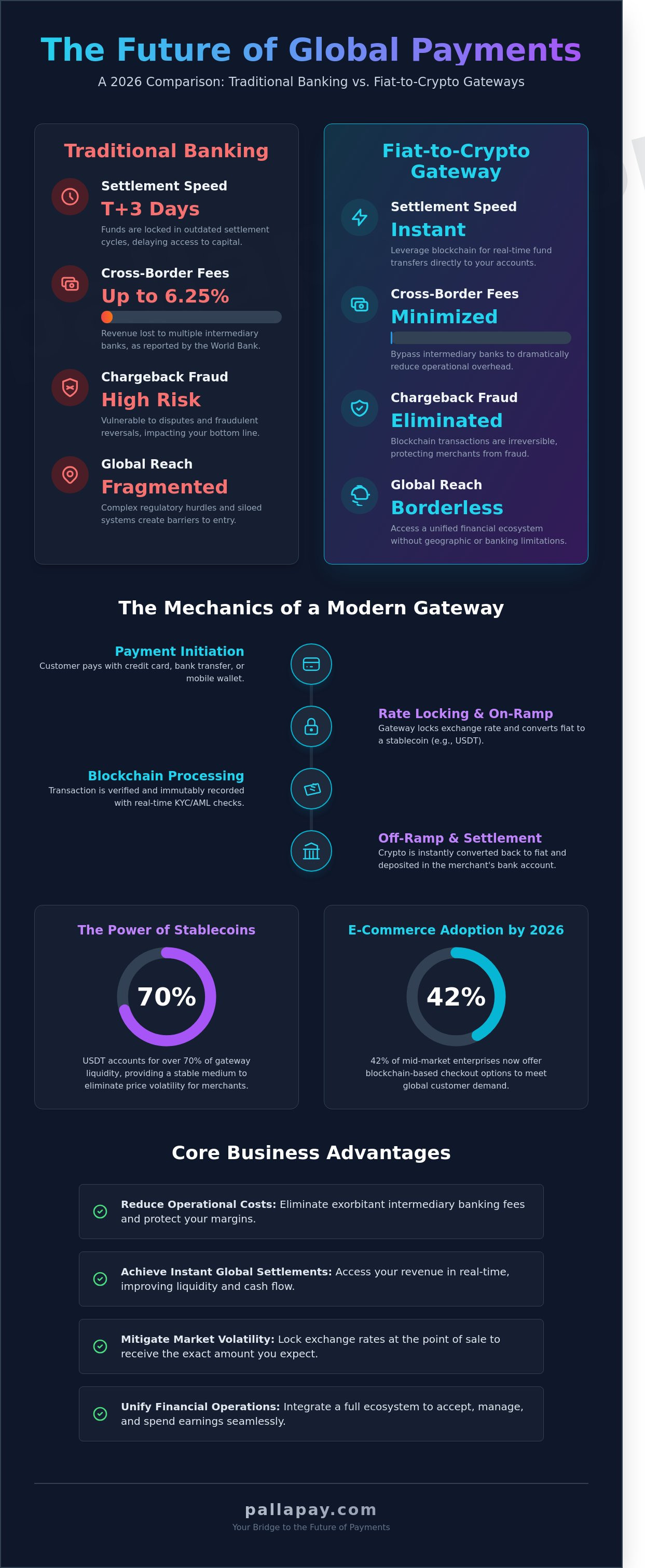
    The era of accepting a three day wait for international settlements ended the moment blockchain technology achieved institutional scale. While traditional banking systems still rely on outdated T+3 settlement cycles, a modern fiat to crypto payment gateway allows your business to bypass these legacy bottlenecks entirely. You’ve likely felt the frustration of watching up to 6.25% of your cross-border revenue vanish into intermediary bank fees, a figure the World Bank’s 2023 report highlights as a persistent drain on merchant liquidity.

    It’s clear that the friction of high transaction costs and complex regulatory hurdles shouldn’t dictate your growth potential. This 2026 guide provides the roadmap to bridge your existing bank accounts with the speed of decentralized finance. You’ll discover how to achieve instant global settlements, eliminate chargeback risks, and maintain a compliant bridge to the future of payments. We’ll examine the technical infrastructure of liquidity and the strategic shift toward a borderless financial ecosystem that prioritizes your bottom line.

    Key Takeaways

    • Understand how a fiat to crypto payment gateway serves as the essential bridge between traditional banking and blockchain networks to facilitate seamless global settlements.
    • Learn the technical process of locking exchange rates in real-time to protect your business from market volatility during the transaction cycle.
    • Discover how to significantly reduce operational costs by eliminating legacy banking fees and the risk of chargeback fraud through secure blockchain processing.
    • Identify the critical compliance standards and “all-in-one” features required to choose a secure, institutional-grade provider for your global business needs.
    • Explore how integrating a comprehensive ecosystem allows you to spend business earnings instantly via specialized Mastercard solutions, unifying your financial operations.

    What is a Fiat-to-Crypto Payment Gateway in 2026?

    A fiat to crypto payment gateway functions as the sophisticated bridge between traditional banking systems and decentralized blockchain networks. It allows businesses to accept digital assets while managing their books in local currencies like USD, EUR, or AED. This infrastructure isn’t just a simple converter anymore; it’s a comprehensive financial engine. By early 2026, these gateways have transitioned from niche experimental tools into essential components for global e-commerce, where 42% of mid-market enterprises now offer blockchain-based checkout options. Unlike the fragmented tools of the past, a modern fiat to crypto payment gateway operates as a unified financial engine that handles compliance, security, and settlement in real time.

    The core utility lies in its dual nature. It manages the complex “heavy lifting” of converting government-issued money into digital tokens and vice versa. While a simple “buy” widget might suffice for an individual user, a professional merchant processor provides a full-scale API. This integration ensures that a business can scale without worrying about the underlying volatility of the crypto market. It transforms a volatile asset into a stable, usable form of capital for the merchant.

    The Evolution of Digital Payment Bridges

    Standards in 2026 differ drastically from the high-friction converters used in 2021. Early systems often required 24 to 48 hours for verification and settlement. Today, the industry has shifted toward instant processing. Stablecoins, specifically USDT, play a pivotal role here. USDT accounts for over 70% of gateway liquidity, providing a stable medium that eliminates the price swings typically associated with Bitcoin or Ethereum. Businesses are moving away from “crypto-only” solutions because they don’t want to hold volatile assets on their balance sheets. Hybrid models are the new standard. These models allow a customer to pay in Bitcoin while the merchant receives an instant settlement in their local fiat currency, combining blockchain efficiency with institutional reliability.

    On-Ramp vs. Off-Ramp: Understanding the Flow

    The gateway operates through two distinct channels that ensure money moves seamlessly across the digital divide. The customer-facing on-ramp allows a buyer to use a debit card, credit card, or bank transfer to purchase the crypto needed for a transaction. This process happens behind the scenes in seconds. The merchant-facing off-ramp is where the business realizes its profit. It involves taking the received crypto and converting it back into fiat for bank deposit or operational use. Reliability in this flow depends on liquidity providers. By maintaining deep pools of capital, a gateway ensures that conversion rates remain locked the moment a customer clicks “pay.” This prevents slippage and ensures the merchant receives the exact amount expected.

    • On-Ramp: Converts fiat into digital assets to initiate a transaction.
    • Off-Ramp: Converts digital assets back into fiat for business settlement.
    • Liquidity: Ensures instant conversion without price drops.
    • Settlement: The final transfer of funds into a merchant’s traditional bank account.

    The Future of Payments is defined by this lack of friction. Merchants no longer need to be blockchain experts to benefit from global reach. They simply need a partner that provides the professional infrastructure to bridge the old world with the new.

    The Mechanics of Fiat-to-Crypto Processing

    A fiat to crypto payment gateway functions as a high-speed financial bridge; it translates traditional currency into digital assets within seconds. This process is a logical sequence designed to eliminate technical friction for the end-user while maintaining institutional-grade security for the merchant. By automating the conversion path, businesses can accept global payments without managing the underlying blockchain complexities themselves.

    • Step 1: Payment Initiation. The customer selects their preferred payment method, such as a credit card, instant bank transfer, or a mobile wallet. In 2026, mobile wallet adoption has reached over 60% of the global consumer base, making multi-channel support essential.
    • Step 2: Rate Locking. To prevent losses from market volatility, the gateway locks the exchange rate for a specific window. This ensures the merchant receives the exact value expected, regardless of price fluctuations during the transaction.
    • Step 3: Automated Verification. Integrated KYC and AML protocols scan the transaction in real-time. This compliance layer is essential for institutional reliability and protects the business from fraudulent activity.
    • Step 4: Instant Settlement. The gateway completes the conversion and routes the funds. The merchant receives the assets in their digital wallet or chooses to move them via fiat settlement services to their local bank.

    Integration Methods: API and Widgets

    Modern gateways offer flexible deployment options to suit different business scales. Small retail websites often opt for “no-code” widgets. These are plug-and-play solutions that require zero development time and provide a secure, hosted checkout page. For enterprise-level customization, a payment API provides the necessary flexibility. It allows businesses to build a bespoke checkout experience that mirrors their brand identity perfectly. Maintaining a seamless UI/UX is vital; a 2025 industry study showed that inconsistent checkout flows lead to a 32% increase in cart abandonment. Professional gateways handle the heavy lifting of backend logic while keeping the frontend interface clean and intuitive.

    Real-Time Liquidity and Exchange Rates

    Reliable gateways source liquidity from multiple institutional exchanges simultaneously to ensure the best possible rate. This multi-source approach minimizes “slippage,” which is the difference between the expected price and the executed price. Top-tier providers aim for slippage rates below 0.1% even for large volume orders. The term “Instant” serves as the anchor of modern commerce. It represents the shift from legacy T+3 settlement cycles to immediate global value transfer. By utilizing a robust fiat to crypto payment gateway, merchants can access the future of payments where capital moves at the speed of the internet. This efficiency allows businesses to reinvest their revenue faster, accelerating growth in a competitive global market.

    What Is a Fiat-to-Crypto Payment Gateway? The 2026 Merchant Guide

    Strategic Benefits of Moving Beyond Traditional Gateways

    Traditional payment rails are becoming a bottleneck for modern enterprises. By integrating a fiat to crypto payment gateway, merchants bypass the high costs and slow speeds of legacy banking. Legacy systems typically demand a 3% to 5% commission on every transaction. Blockchain alternatives often lower these fees to under 1%, which directly boosts profit margins for high-volume businesses. This shift isn’t just about saving money; it’s about reclaiming control over your revenue streams.

    Chargeback fraud caused $100 billion in losses for merchants globally in 2023. This is a primary pain point that traditional credit card processors fail to solve. Cryptocurrency transactions are cryptographically secured and irreversible. Once a customer completes a payment, the funds are final. There’s no middleman to reverse a transaction after you’ve shipped the product. This finality provides a level of financial certainty that credit cards simply cannot match.

    Expanding into new territories no longer requires the administrative burden of opening local bank accounts in every country. A single gateway allows you to accept payments from any customer with a digital wallet, regardless of their geographic location. This accessibility is one of the core strategic benefits of accepting cryptocurrency for long-term growth in the 2026 economy.

    Instant Global Settlements

    Banking cycles often operate on a T+3 basis, meaning your funds are locked for 72 hours or more. High-volume retail and gaming industries require faster liquidity to maintain operational momentum. Blockchain technology enables settlements in minutes rather than days. By utilizing fiat settlement options, businesses receive their local currency quickly while avoiding the price swings of the digital asset market. It’s the most efficient way to manage cash flow in a 24/7 global market.

    Security and Fraud Prevention

    Security is built into the protocol, not added as an afterthought. Every transaction is a final, verified event on a public ledger, making identity theft and payment spoofing nearly impossible. Gateways serve as a protective buffer, shielding merchant bank accounts from direct exposure to the crypto ecosystem. These platforms also integrate automated AML monitoring that satisfies 2026 financial regulators. You get the benefit of disruptive technology backed by institutional-grade compliance and safety protocols.

    • Reduced Overhead: Transaction costs drop by up to 80% compared to traditional processors.
    • Zero Chargebacks: Eliminates the risk of friendly fraud and forced reversals.
    • Borderless Trade: Sell to anyone, anywhere, without local banking infrastructure.
    • Enhanced Liquidity: Move from multi-day waiting periods to near-instant capital access.

    How to Choose a Compliant Gateway Provider

    Selecting a fiat to crypto payment gateway requires a rigorous evaluation of technical infrastructure and legal standing. You aren’t just choosing a software tool; you’re selecting a financial partner that bridges traditional banking with digital assets. Merchants should consult this guide on choosing a gateway to understand the specific criteria necessary for long-term scalability. A provider’s ability to handle high-volume liquidity while maintaining instant settlement is the hallmark of institutional-grade service. You need a partner that views compliance as a foundation, not an afterthought.

    Regulatory Compliance and MSB Status

    Trust begins with licensing. Prioritize providers that maintain official Money Services Business (MSB) registrations in major jurisdictions like the United States and Canada. This status ensures the provider adheres to strict anti-money laundering (AML) protocols. Regional expertise is equally vital. For example, a crypto payment gateway in Dubai must navigate specific VARA (Virtual Assets Regulatory Authority) frameworks to ensure local compliance. The right provider manages the complex KYC (Know Your Customer) requirements for your end-users, protecting your business from legal friction. They handle the heavy lifting of identity verification, so you focus on growth.

    Support and Reliability

    Global markets never close, and your infrastructure shouldn’t either. Your gateway must offer 24/7 technical support to address issues across different time zones. Reliability is measured by a 99.9% uptime guarantee and access to redundant liquidity sources. This redundancy prevents transaction failures during periods of high market volatility. A sophisticated merchant dashboard is non-negotiable for 2026. It must provide real-time reporting and automated tax reconciliation tools. This level of transparency eliminates hidden network or gas surcharges, ensuring the fee you see is the fee you pay. Efficiency drives profitability in the digital age.

    A truly all-in-one ecosystem supports every touchpoint of your business. Whether you need a crypto POS machine for physical retail or a robust API for ecommerce, the integration must be seamless. This versatility allows you to accept payments via web, mobile, or physical card without switching providers. It’s about creating a unified financial experience that scales with your ambition. By consolidating these services, you reduce technical debt and simplify your financial operations.

    This concept of a cohesive, all-in-one platform is a major trend in the broader payment processing industry. Providers like Strictly specialize in creating this kind of unified omni-channel experience, helping businesses manage web, mobile, and in-person sales seamlessly.

    Ready to integrate the future of payments into your business model? Explore our professional fiat settlement solutions today.

    Implementing the Pallapay Ecosystem for Your Business

    Pallapay functions as the Global Enabler for enterprises ready to master the digital economy. We offer a sophisticated bridge between traditional banking and blockchain innovation. By integrating our fiat to crypto payment gateway, your business secures a competitive edge in a market where a growing percentage of global consumers now prefer digital asset transactions. Our ecosystem transforms crypto-receipts into usable capital. The Pallapay Mastercard allows you to spend business earnings instantly at millions of global merchants. You don’t have to wait for traditional bank clearances to access your funds. This is the professional standard for liquidity in the modern era.

    Your physical and digital sales channels shouldn’t operate in silos. The Crypto POS machine unifies your revenue streams, allowing retail managers to accept digital payments as easily as credit cards. This hardware is designed for the modern storefront, providing a secure and regulated way to handle transactions. It’s about providing choice to your customers while maintaining the stability of your balance sheet. Whether you are operating a boutique or a multi-national retail chain, the integration is seamless. We handle the heavy lifting of the technology so your staff can focus on the customer experience.

    A Unified Merchant Dashboard

    Visibility creates confidence. Our dashboard provides a single point of truth for all cross-border sales, settlements, and card balances. You can generate instant reports for tax compliance or internal audits with a few clicks. This level of transparency is essential for maintaining institutional financial reliability. For organizations with complex structures, the platform supports multiple user permissions. This ensures your accounting team has the data they need while your security protocols remain intact. It is an all-in-one destination for your crypto-financial needs.

    From Integration to First Settlement

    Efficiency is our priority. The setup for the Pallapay API and Merchant account is streamlined to get you operational quickly. You select your settlement currency, such as USD, EUR, or AED, to ensure your liquidity remains predictable. For corporate clients moving significant volume, our global OTC desks offer deep liquidity and institutional-grade execution. We manage the underlying blockchain architecture, leaving you free to drive your business growth. Getting started with a secure, regulated account today means you are prepared for the future of payments. The process is direct, benefit-driven, and built for scale.

    • Instant Access: Spend earnings immediately via the Pallapay Mastercard.
    • Global Reach: Settle in major fiat currencies including USD, EUR, and AED.
    • Institutional Security: Operate within a regulated, secure financial environment.
    • Omnichannel Readiness: Connect online gateways with physical POS hardware.

    Pallapay represents more than just a tool; it is a visionary partner for your financial evolution. By bridging the gap between fiat and crypto, we provide the stability your business requires to thrive. Every transaction is a step toward a more efficient, borderless future.

    Master the Future of Global Commerce

    Integrating a fiat to crypto payment gateway isn’t just a technical upgrade; it’s a strategic move to capture a market of over 420 million digital currency users worldwide. By 2026, the ability to accept diverse payment forms will separate industry leaders from those left behind. Merchants today require more than just a processor. They need a partner that eliminates the standard 72 hour settlement wait times and provides instant access to capital. Moving your operations onto a blockchain-backed infrastructure allows you to bypass the inefficiencies of legacy banking while reaching customers in 180 countries.

    Pallapay provides this institutional-grade stability through our status as a regulated MSB in the USA and Canada. We’ve designed our ecosystem to handle the heavy lifting of compliance and technical integration so you can focus on expansion. You’ll benefit from a secure, all-in-one platform that turns the complexity of digital assets into a standard business operation. It’s time to bridge the gap between traditional finance and the decentralized economy with a visionary partner.

    Scale your business globally with Pallapay’s secure payment gateway and start your journey toward borderless growth today.

    Frequently Asked Questions

    What is the difference between a crypto gateway and a standard payment processor?

    Crypto gateways bridge the gap between blockchain networks and traditional banking, while standard processors handle fiat-only networks like Visa or Mastercard. Traditional systems rely on centralized bank ledgers that often take 3 to 5 days to clear. A fiat to crypto payment gateway utilizes decentralized ledgers to facilitate instant settlement and global accessibility. This removes the friction found in legacy systems and provides a more efficient financial infrastructure for modern commerce.

    Is it legal for my business to use a fiat-to-crypto payment gateway?

    Using a crypto gateway is legal in over 130 countries, provided the business complies with local AML and KYC regulations. In the United States, FinCEN classifies these service providers as Money Services Businesses. Merchants must verify that their chosen provider holds the necessary licenses for the specific jurisdictions where they operate. This ensures all financial activities remain within the bounds of international law and institutional standards, protecting the business from regulatory risk.

    How much are the typical transaction fees for fiat-to-crypto processing?

    Typical transaction fees for these services range from 0.5% to 2% per transaction, based on 2024 industry benchmarks. This is significantly lower than the 3% or 4% often charged by credit card networks for international sales. Businesses also avoid the hidden costs of currency conversion and traditional wire fees. These savings directly impact the bottom line by preserving higher profit margins on every global transaction processed through the gateway.

    Can I receive fiat currency in my bank account if the customer pays in crypto?

    Yes, you can receive fiat currency directly into your bank account through an instant conversion process. The gateway captures the crypto at the current market rate and settles the equivalent amount in USD, EUR, or AED. This eliminates the risk of price volatility for the merchant. It’s a seamless way to embrace the future of payments without the need to hold digital assets on your corporate balance sheet.

    What is MSB registration and why should I look for it in a provider?

    MSB stands for Money Services Business, which is a legal designation required by FinCEN for entities that transmit or convert currency. Providers with this registration adhere to strict anti-money laundering protocols and regular audits. Choosing an MSB-registered partner protects your business from legal risks and ensures institutional-grade security. It’s a hallmark of a reliable partner that prioritizes regulatory compliance and global trust in every transaction.

    How long does it take to integrate a crypto payment gateway into my website?

    Integration typically takes between 24 hours and 5 business days, depending on the complexity of your current digital infrastructure. Most modern providers offer plug-and-play extensions for platforms like Shopify or WooCommerce that can be activated in minutes. For custom enterprise solutions, developers use robust APIs to create a tailored checkout experience. This rapid deployment allows businesses to scale their global reach without facing extensive technical delays or downtime.

    Are crypto payments subject to chargebacks like credit cards?

    No, crypto transactions are final and immutable once they’re confirmed on the blockchain. This eliminates the risk of fraudulent chargebacks, which cost global merchants an estimated $100 billion in 2023. While you can still issue manual refunds to maintain customer satisfaction, the power to reverse a transaction doesn’t rest with a third-party bank. This provides merchants with absolute certainty and significantly improved cash flow management.

    Does the customer need to own crypto to use a fiat-to-crypto on-ramp?

    No, customers don’t need to own digital assets beforehand to use a fiat-to-crypto on-ramp. They can use their standard credit card or bank transfer to purchase the required amount of crypto at the point of sale. The gateway handles the conversion instantly, making the process as simple as a traditional online purchase. It’s an all-in-one solution that bridges the gap for users who are new to the digital economy.

    Disclaimer

    The information provided on this website and blog is for general informational and educational purposes only and does not constitute financial, investment, legal, tax, or other professional advice.
    Cryptocurrency and digital asset services may be subject to regulatory restrictions in certain jurisdictions. Users are solely responsible for ensuring compliance with applicable local laws and regulations before using any products or services mentioned on this website.
    PallaPay does not guarantee the accuracy, completeness, or timeliness of any information published and accepts no liability for any loss or damages arising from reliance on the content. Any opinions expressed are those of the respective authors and may change without notice.
    Certain services, features, or products referenced may be provided through third-party partners, licensed entities, or affiliated service providers subject to separate terms and regulatory approvals. Availability of services may vary by country or region.
    This website may contain references to digital assets, virtual currencies, or blockchain-related services that are not available to residents of certain jurisdictions, including where prohibited by law. Nothing on this website constitutes an offer, solicitation, or recommendation to buy or sell any financial instrument or virtual asset.