Tag: Merchant Services

  • Crypto to Fiat Settlement: The 2026 Strategic Guide for Global Merchants

    Crypto to Fiat Settlement: The 2026 Strategic Guide for Global Merchants

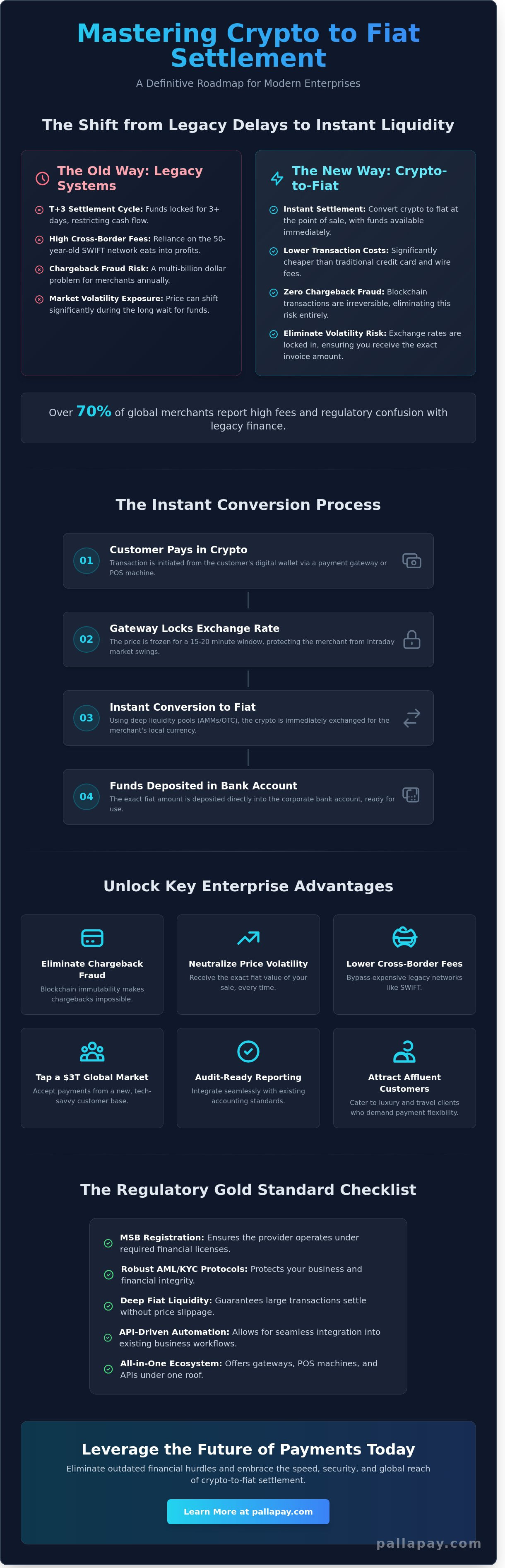
    A business operating on a T+3 settlement cycle in 2026 is essentially functioning in the past while its competitors move at the speed of light. You’ve likely felt the frustration of watching market prices shift during the long wait for funds to clear your traditional bank account. It’s a common struggle; over 70% of global merchants report that the bridge between digital innovation and legacy finance is often paved with high fees and confusing MSB regulations. This guide provides a definitive roadmap to mastering crypto to fiat settlement, transforming what was once a complex hurdle into a streamlined, instant advantage for your enterprise.

    We’ll show you exactly how to eliminate price volatility risks and secure lower transaction costs than standard credit card networks. You’ll gain a comprehensive understanding of how to implement audit-ready reporting and instant conversion technology that scales across borders. This breakdown prepares your business to leverage the future of payments with absolute confidence and institutional reliability.

    Key Takeaways

    • Understand how to transition from holding digital assets to utilizing them as high-speed payment rails for modern global commerce.
    • Learn how advanced payment gateways lock in real-time exchange rates to eliminate price volatility during the conversion process.
    • Master the strategic choice between instant and batch crypto to fiat settlement to optimize your business cash flow and minimize bank fees.
    • Identify the regulatory gold standards, including MSB registration and AML protocols, required to protect your institutional financial integrity.
    • Discover how to bridge the gap between digital and physical commerce using an all-in-one ecosystem of gateways and crypto POS machines.

    What is Crypto to Fiat Settlement and Why It Matters in 2026

    Crypto to fiat settlement is the automated process of converting digital assets from a customer transaction into traditional currency and depositing it directly into a corporate bank account. While early adopters historically focused on holding assets for long-term appreciation, 2026 represents a fundamental shift toward utility. Global commerce now utilizes blockchain as a high-speed payment rail rather than a speculative instrument. This transition allows enterprises to tap into a $3 trillion global market while maintaining their existing accounting standards and functional currency.

    Modern technology has effectively solved the price fluctuation problem that once deterred traditional retailers. By leveraging a professional Cryptocurrency Exchange infrastructure, payment gateways now offer Instant conversion at the point of sale. This ensures that the value of a transaction remains fixed from the moment the customer pays until the funds reach the merchant’s ledger. It’s a secure bridge that connects decentralized innovation with institutional financial reliability.

    The Evolution of Merchant Settlement

    The industry has matured from manual exchange transfers to automated, API-driven gateway settlements. Settlement latency is the time delay between a customer’s payment and the availability of funds in the merchant’s bank account, which can severely restrict operational liquidity if not managed through real-time conversion. Modern providers now handle the heavy lifting by absorbing volatility risk during the transaction window. This evolution ensures that a business receives the exact fiat amount listed on its invoice, regardless of market movements during the crypto to fiat settlement process.

    Key Benefits for Modern Enterprises

    Enterprises adopting a crypto to fiat settlement strategy gain immediate competitive advantages over those relying solely on legacy systems. One primary benefit is the total elimination of chargeback fraud, a problem that continues to cost global merchants billions annually in traditional credit card processing. Additionally, blockchain-based settlements significantly lower cross-border fees when compared to the 50-year-old SWIFT banking network. This efficiency is particularly attractive for businesses targeting high-net-worth individuals. Sectors like luxury real estate and international hotels are already using these tools to provide seamless experiences for a growing demographic of crypto-affluent travelers who demand modern payment flexibility.

    The Mechanics: How Crypto-to-Fiat Conversion Works

    The transition from a customer’s digital wallet to a merchant’s bank account involves a sophisticated backend process that removes technical friction. When a transaction initiates, the payment gateway captures the current market price and freezes it for a specific window, typically lasting 15 to 20 minutes. This ensures the crypto to fiat settlement remains consistent even if the market fluctuates seconds later. By locking these rates, businesses avoid the risk of receiving less value than the sticker price of their goods or services, effectively neutralizing the 10% to 15% intraday swings common in digital assets.

    Behind the scenes, the gateway communicates with deep liquidity pools to execute the exchange. This is essential for high-volume trades where a lack of depth could lead to price slippage. As highlighted by payment experts in the whitepaper Crypto Payments: From Virtuality to Real Use Case, the move toward practical merchant adoption relies on these robust settlement layers that bridge decentralized finance with traditional banking.

    The Gateway vs. The Liquidity Provider

    The gateway serves as the professional interface, while the liquidity provider acts as the financial engine. Automated market makers (AMMs) and over-the-counter (OTC) desks provide the necessary fiat depth to handle large-scale enterprise transactions without delay. These entities work in tandem to ensure that even a million-dollar transaction doesn’t disrupt the market price. In high-volume settlement, the spread between the buy and sell price is more important than the commission fee because it directly impacts the final net amount received.

    API Integration and Automated Workflows

    Modern businesses scale by removing manual steps from their financial operations. Using payment APIs allows companies to embed this technology directly into their existing infrastructure. For ecommerce platforms, this means crypto to fiat settlement happens automatically the moment a purchase is confirmed.

    Merchants can set “Auto-Settlement” rules to convert incoming assets into their preferred local currency instantly. All activity is tracked through a comprehensive merchant dashboard crypto, providing real-time reporting and financial clarity. This level of automation turns a complex technological hurdle into a standard business process. To see how this fits your business model, you can review the benefits of a dedicated fiat settlement solution.

    Comparing Settlement Methods: Instant vs. Batch vs. Stablecoin

    Selecting a settlement strategy is a critical decision for any enterprise integrating digital assets. The right choice balances speed against operational costs. A business’s ability to manage a crypto to fiat settlement determines its overall exposure to market shifts. Organizations typically choose between three primary models based on their liquidity needs and transaction volume.

    • Instant Settlement: This method converts digital assets at the exact point of sale. It eliminates price risk by locking in the exchange rate immediately. The merchant receives the precise fiat value displayed at checkout, regardless of market movements ten minutes later.
    • Batch Settlement: This approach consolidates daily transactions into a single transfer. It is a strategic choice for high-volume retail environments. By aggregating 500 individual sales into one daily settlement, businesses reduce recurring bank transfer fees by up to 90%.
    • Stablecoin Settlement: Many global firms choose USDT or USDC as their primary rail. This allows them to keep funds in a digital format that is pegged to the dollar, providing the speed of blockchain with the stability of fiat.
    • Direct to Bank Model: This handles the final mile of the process. It ensures that converted funds reach local bank accounts through established financial networks, bypassing the traditional 3 to 5 day wait associated with international wires.

    Same-Day Settlement vs. Traditional T+2

    Traditional banking systems rely on T+2 or T+3 settlement cycles. These legacy delays often trap capital for 48 to 72 hours. Modern fiat settlement products bypass these hurdles by utilizing blockchain’s 24/7/365 availability. While a traditional bank closes on Friday afternoon, blockchain rails continue to move value. This means weekend revenue is available for use on Monday morning rather than Wednesday. It’s a fundamental shift that provides businesses with superior cash flow management and immediate access to working capital.

    The Stablecoin Bridge Strategy

    High-volume entities often require rapid transitions between digital and physical liquidity. In major financial hubs, selling USDT for cash dubai has become a standard procedure for managing large-scale B2B payouts. This strategy is efficient for companies that need to pay international suppliers without waiting for slow SWIFT transfers. Stablecoins offer a level of transparency that traditional bank statements don’t provide. Every transaction is recorded on a public ledger, allowing for real-time audits. This transparency simplifies the crypto to fiat settlement process, as every dollar equivalent is accounted for on-chain before it ever hits a local bank account.

    By choosing the correct settlement rhythm, a business doesn’t just accept payments; it optimizes its entire financial operation. Pallapay acts as the professional bridge, ensuring these technical processes remain invisible to the end user while providing the merchant with absolute stability.

    Evaluating a Settlement Provider: Compliance and Security

    Selecting a partner for crypto to fiat settlement requires a rigorous audit of their legal standing and operational integrity. MSB (Money Services Business) registration represents the non-negotiable gold standard for institutional reliability. These licenses ensure the provider operates under strict financial oversight, which protects your capital from the inherent risks of unregulated markets. KYC (Know Your Customer) and AML (Anti-Money Laundering) protocols aren’t merely administrative hurdles; they’re essential defense mechanisms for your brand. By verifying every participant in the transaction chain, providers prevent illicit funds from entering your ecosystem, shielding your business from the 2024 surge in global regulatory enforcement actions.

    Fee transparency separates global fintech leaders from opaque startups. You’ll typically encounter two primary models: flat transaction fees and percentage spreads. A flat fee provides predictable costs for high-volume operations, whereas percentage spreads can often mask the true cost of liquidity. It’s vital to demand clear security disclosures regarding the conversion window. Top-tier providers use deep liquidity pools to lock in rates the moment a transaction initiates, ensuring that the price you see is the price you receive without slippage.

    • Regulatory Standing: Verify active MSB status in Tier-1 jurisdictions.
    • Risk Mitigation: Ensure robust AML screening is integrated into the API.
    • Cost Clarity: Compare the total cost of ownership between flat and spread-based models.
    • Fund Protection: Review the provider’s custody and insurance protocols during the settlement gap.

    Navigating Global Regulations

    US and Canadian MSB registrations serve as a hallmark of trust for global enterprises, ensuring compliance with the latest 2023 FATF standards. Businesses operating in retail stores must prioritize regulated partners to ensure long-term operational continuity and avoid bank account closures. Regulatory Arbitrage is the risky practice of selecting jurisdictions with weak oversight to bypass compliance; businesses should avoid it to prevent sudden asset freezes or legal liability. Professional providers bridge the gap between blockchain innovation and institutional finance.

    The Strategic Implementation Guide

    Consulting a crypto pos machine for business helps brick-and-mortar setups align their physical hardware with digital settlement speeds. Your chosen infrastructure must scale to handle peak volumes, such as the 40% increase in transaction density often recorded during global retail events. Reliable providers maintain a local presence in major financial hubs to offer real-time support and localized expertise. This ensures the future of payments remains a standard, effortless part of your daily operations.

    Secure your revenue stream and eliminate market risk by integrating our instant fiat settlement solution today.

    The Pallapay Advantage: An All-in-One Settlement Ecosystem

    Pallapay operates as a sophisticated bridge between disruptive blockchain technology and institutional financial reliability. The platform provides a unified environment where digital payment gateways link directly with physical crypto pos machines to ensure a frictionless experience for every stakeholder. By maintaining regulated operations in the USA, Canada, and the UAE, Pallapay offers a secure framework that supports global expansion without the compliance hurdles typically associated with digital assets. It’s a system built for scale and stability.

    Liquidity remains the most critical factor in any crypto to fiat settlement strategy. Pallapay addresses this through a hybrid network of automated online systems and physical OTC desks. This infrastructure ensures that whether a business is processing a small retail transaction or a multi-million dollar corporate transfer, the funds are available when needed. The ecosystem currently serves a diverse range of industries, providing specialized support for gaming platforms, high-end retail, and international hospitality groups.

    Bridging Physical and Digital Commerce

    Modern merchants need the ability to accept crypto in store without waiting days for bank clearances. Pallapay enables businesses to receive digital payments and complete a crypto to fiat settlement within the same hour. This rapid turnaround protects profit margins from market swings. For immediate access to capital, the Pallapay Mastercard allows merchants to spend their settled fiat funds at millions of locations worldwide. Large-scale corporate entities often require more personalized service, which is where the otc crypto exchange comes into play. These desks facilitate high-volume trades with deep liquidity, ensuring that institutional moves don’t suffer from price slippage or execution delays.

    The Future of Payments is Instant

    Pallapay removes the heavy lifting of complex technology for non-technical merchants. You don’t need to be a blockchain expert to modernize your payment stack. By consolidating the gateway, POS hardware, and fiat settlement into a single partnership, Pallapay eliminates the fragmentation that slows down business growth. This all-in-one approach provides a clear audit trail and a simplified user experience. It’s not just about adding a new payment method; it’s about evolving with the global economy. The future of payments is instant, secure, and professional. Optimize your business with Pallapay’s fiat settlement solutions today and secure your place in the new financial era.

    Future-Proof Your Global Commerce Strategy

    The financial landscape of 2026 demands a transition from traditional barriers to frictionless liquidity. High-growth merchants are moving away from legacy batch processing in favor of real-time efficiency to maintain a competitive edge. Mastering crypto to fiat settlement isn’t just a technical upgrade; it’s a strategic necessity for capturing global market share. Success requires a partner that bridges the gap between digital innovation and institutional reliability.

    Pallapay provides this bridge as a regulated MSB in both the USA and Canada. By leveraging an official MSB registration and a robust global OTC presence, businesses can access instant settlement across 180+ countries. This infrastructure eliminates the volatility risks typically associated with digital assets while ensuring full compliance with international standards. It’s time to integrate a solution that treats complex conversions as standard business operations.

    Scale your business with Pallapay’s professional fiat settlement solutions and secure your position in the future of payments. The tools for your global expansion are ready when you are.

    Frequently Asked Questions

    How long does crypto to fiat settlement take?

    Crypto to fiat settlement occurs instantly or within 24 hours depending on your chosen payout method. Pallapay processes these transactions in real-time to eliminate the risk of market fluctuations. While traditional bank transfers might take 1 to 3 business days, our internal ecosystem ensures liquidity is available immediately. This speed allows your business to maintain a steady cash flow without waiting for legacy banking cycles.

    Is crypto to fiat settlement taxable for my business?

    Tax obligations for your transactions depend on your specific jurisdiction and local tax laws. In regions like the UAE, corporate tax rates of 9% apply to businesses exceeding certain profit thresholds as of June 2023. You should consult with a certified financial advisor to ensure compliance with VAT and income reporting requirements. We provide detailed transaction logs to simplify your accounting and audit processes.

    Can I receive settlement in my local currency like AED, USD, or EUR?

    You can receive settlements in over 30 global currencies including AED, USD, and EUR. Our platform bridges the gap between digital assets and traditional finance by providing direct conversion into your preferred local tender. This flexibility ensures you avoid unnecessary exchange fees and can pay your local suppliers or employees without friction. It’s a key feature for businesses looking to scale internationally.

    What are the fees associated with crypto to fiat conversion?

    Fees for conversion are calculated based on your monthly transaction volume and the specific digital assets being processed. We prioritize transparency by displaying all costs before you finalize a transaction. This approach prevents hidden charges from impacting your profit margins. By using a professional gateway, you access institutional liquidity rates that are typically more favorable than standard retail exchanges.

    Do I need a special bank account to receive fiat settlements?

    You don’t need a specialized crypto bank account to receive your funds. Pallapay facilitates transfers directly to your existing corporate or personal bank account via standard SEPA or SWIFT protocols. This integration makes the transition from blockchain technology to traditional banking feel like a standard business operation. It ensures your current financial infrastructure remains compatible with the future of payments.

    Is it possible to settle payments in stablecoins instead of fiat?

    Businesses can choose to settle their transactions in stablecoins such as USDT or USDC to maintain digital liquidity. This option provides the stability of fiat currencies while retaining the speed and low cost of blockchain transfers. It’s an ideal solution for companies that operate globally and want to avoid the delays of the traditional banking system. You can switch between fiat and stablecoin settlements within your dashboard settings.

    How does a crypto payment gateway handle price volatility during a sale?

    Our gateway handles price volatility by locking the exchange rate at the exact moment of the transaction. This ensures the merchant receives the precise fiat amount regardless of market shifts that occur seconds later. By providing an instant crypto to fiat settlement, we remove the financial risk associated with digital asset price swings. This mechanism protects your revenue and provides the stability needed for predictable financial planning.

    What documents are required for a business to start using fiat settlement?

    Businesses must provide a valid trade license, proof of address, and identification for all beneficial owners to begin using the service. These requirements comply with global Anti-Money Laundering standards and the 2018 FATF recommendations for virtual asset service providers. Once your documentation is verified, your account is activated for full settlement capabilities. This rigorous onboarding process establishes the trust and security required for institutional financial operations.

  • How to Accept Payments Online: The Complete 2026 Merchant Guide

    How to Accept Payments Online: The Complete 2026 Merchant Guide

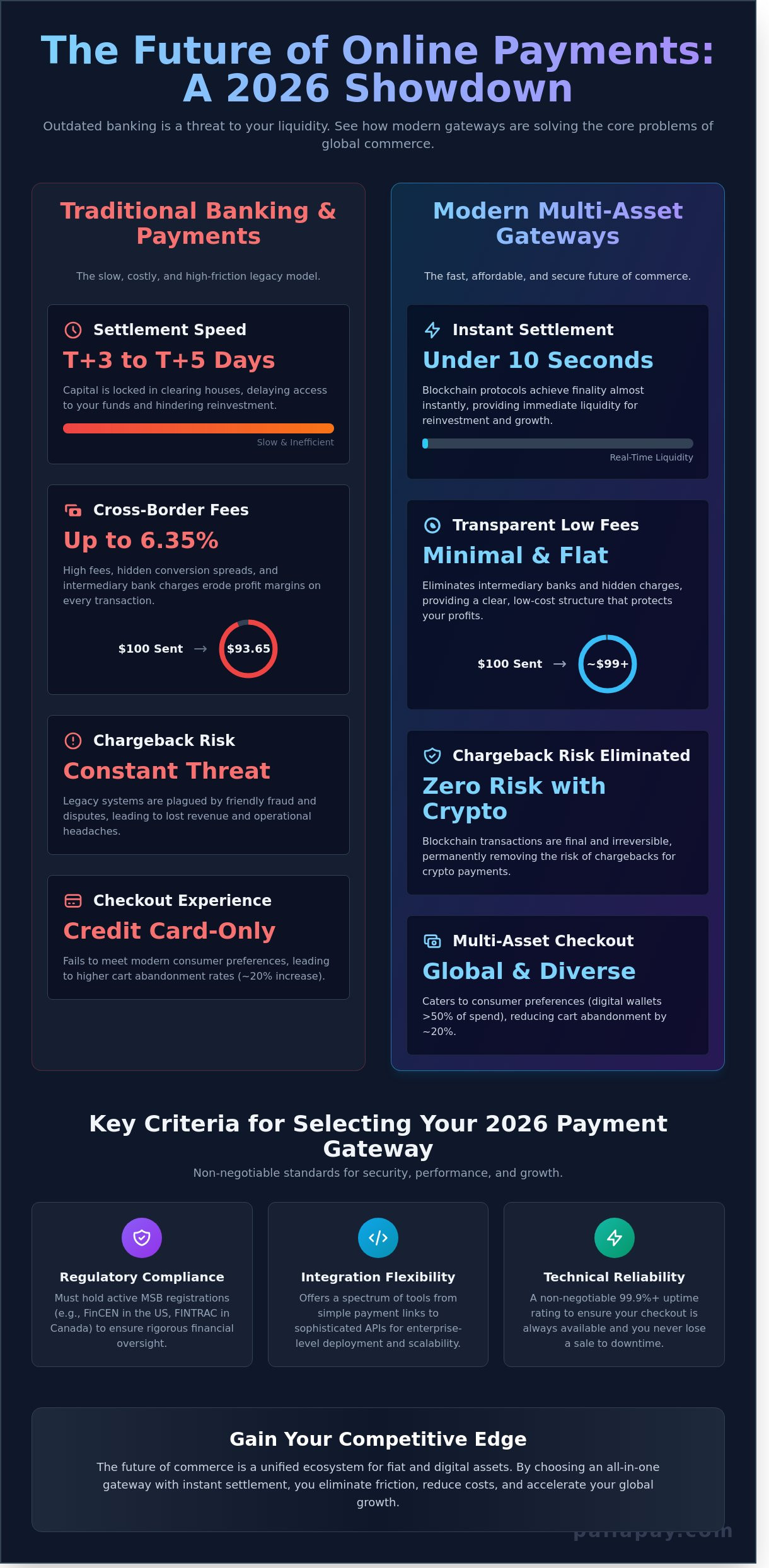
    By 2026, relying on traditional T+3 settlement cycles isn’t just a slow process; it’s a direct threat to your business liquidity. You likely recognize that high cross-border fees, which often reach 6.35% according to World Bank data, are eroding your profit margins every single day. You want to accept payments online without the technical friction or the constant fear of chargebacks that plagues legacy systems. It’s time to stop letting outdated banking infrastructure dictate the speed of your commerce.

    We understand that the transition to a borderless economy requires more than just a standard gateway. This guide will show you how to master the modern payment landscape by integrating seamless, global-ready solutions that bridge the gap between fiat and cryptocurrency. You’ll discover how to achieve instant settlement of funds and access lower processing fees than traditional banks provide. We’ll walk through how a unified dashboard provides instant visibility for all payment types, streamlining your operations to accelerate your global growth.

    Key Takeaways

    • Understand the evolution of multi-asset gateways and how to bridge the gap between traditional fiat and the digital-first expectations of 2026.
    • Identify the non-negotiable security standards, such as MSB registration, required to protect your business from hidden costs and compliance risks.
    • Discover how to accept payments online by leveraging blockchain technology to eliminate chargeback risks and reach tech-savvy global demographics.
    • Master a five-step integration process that aligns your website’s checkout experience with the preferred payment assets of your core customer markets.
    • Gain a competitive edge by utilizing an all-in-one ecosystem designed for instant settlement and seamless global commerce operations.

    The Evolution of Online Payments: What to Expect in 2026

    The modern payment gateway has transitioned from a simple transaction processor into a sophisticated multi-asset bridge. By 2026, the ability to accept payments online requires more than just a connection to a local bank; it demands a gateway that facilitates seamless movement between fiat currencies and digital assets. Traditional processing models often isolate capital in regional silos. Modern merchants now prioritize unified financial ecosystems that integrate global liquidity into a single dashboard. This shift eliminates the need for multiple intermediary banks, allowing businesses to operate with the agility of a tech startup and the reliability of an institutional powerhouse.

    A professional payment service provider in 2026 acts as a visionary partner. They handle the complex technical integrations of blockchain and legacy banking behind the scenes. This ensures that the merchant experiences absolute stability while the underlying technology executes high-speed conversions. The goal is no longer just to move money. The goal is to maximize business growth by removing every possible point of friction in the transaction lifecycle.

    The Death of High-Friction Cross-Border Fees

    Traditional SWIFT and ACH systems, which have governed international trade for decades, are being outpaced by the efficiency of decentralized ledgers. Merchants in 2026 expect Instant Settlement. While legacy systems can take 3 to 5 business days to clear international funds, blockchain-based protocols achieve finality in under 10 seconds. This rapid liquidity allows businesses to reinvest their capital immediately rather than waiting for banking cycles to complete. Global e-commerce trends for 2026 indicate that 75% of cross-border merchants now prefer platforms that offer real-time settlement to avoid the volatility and hidden costs of traditional wire transfers.

    Consumer Preference: From Credit Cards to Digital Wallets

    Consumer behavior has shifted decisively away from physical plastic toward integrated digital environments. Data from 2025 shows that digital wallets now account for over 50% of global e-commerce spend. This trend is driven by the rise of stablecoins like USDT, which provide the stability of the US Dollar with the speed of the internet. When you accept payments online through a multi-option checkout, you directly influence your conversion rates. Offering diverse methods, including stablecoins and local digital wallets, reduces cart abandonment by approximately 20% compared to credit-card-only setups. It’s the definitive destination for modern commerce; providing the customer with their preferred payment method is the simplest way to secure a sale. This is the future of payments: a world where currency type never limits a transaction.

    Key Criteria for Selecting Your Payment Gateway Provider

    Choosing a partner to accept payments online requires a shift from viewing a gateway as a mere tool to seeing it as a strategic asset. Security remains the primary pillar. A provider must hold active Money Services Business (MSB) registrations in key jurisdictions. In the United States, this involves FinCEN registration; in Canada, it’s FINTRAC. These licenses aren’t just badges. They represent a commitment to rigorous financial oversight and consumer protection. When you accept payments online, your gateway is the first line of defense against systemic risk.

    Transparency in pricing often separates institutional-grade providers from predatory ones. Many gateways lure merchants with low headline rates while hiding 1% to 2% spreads on currency conversions or adding unexpected network access fees. A professional partner provides a clear, flat-fee breakdown of every basis point. This clarity extends to settlement speed. While legacy systems still operate on T+3 or even T+5 cycles, modern commerce demands instant liquidity. Businesses shouldn’t have their capital locked in a clearing house for 72 hours when blockchain technology allows for immediate settlement and improved cash flow.

    Integration flexibility determines how quickly a business can pivot. A visionary partner offers a spectrum of tools, from simple payment links for social commerce to a sophisticated payment API for enterprise-level deployments. This scalability ensures that as a business grows, the technology supporting it doesn’t become a bottleneck.

    Technical Reliability and Uptime

    A 99.9% uptime rating is the non-negotiable industry standard for ecommerce payment gateways. Even a 0.1% failure rate can result in thousands of dollars in lost revenue during high-traffic events. Reliability isn’t just about the server; it’s about the support. Global operations require 24/7 technical assistance to resolve API conflicts or dashboard discrepancies across different time zones. The merchant dashboard itself must offer a seamless UX, providing high-level liquidity overviews and granular transaction logs in a single, intuitive interface.

    Compliance and Global Reach

    Verifying a provider’s regulatory standing is a critical step in due diligence. Merchants should check public registries for MSB status in the US, Canada, and the UAE to ensure the partner operates within legal frameworks. Robust KYC (Know Your Customer) and AML (Anti-Money Laundering) protocols are essential. These processes filter out high-risk entities and protect your business from the reputational damage of fraudulent transactions.

    Institutional trust is further solidified by a physical presence in global financial hubs. Having a physical office in cities like Dubai or Singapore demonstrates that a provider is a permanent fixture in the financial ecosystem, not a transient digital entity. This physical grounding, combined with digital agility, allows merchants to scale with the confidence that their financial partner is both regulated and reachable.

    Why Integrating Crypto Payments is No Longer Optional

    To effectively accept payments online in 2026, merchants must look beyond traditional credit cards. Global crypto ownership surpassed 560 million people in 2024, creating a massive pool of liquidity that operates outside legacy banking hours. Businesses that adopt these rails gain a significant competitive advantage by reaching the 1.4 billion unbanked adults worldwide who still possess internet access and mobile devices. This demographic isn’t just limited to emerging economies; it includes a growing number of tech-savvy Gen Z consumers who prioritize privacy and digital-first assets over conventional checking accounts.

    Security remains a primary driver for this shift. Traditional payment systems are vulnerable to “friendly fraud” and chargeback abuse, which cost global merchants over $100 billion in 2023. Blockchain transactions are immutable. Once a payment is verified on the ledger, it cannot be reversed by a third party. This provides absolute finality for the merchant. By bypassing the 7 to 9 intermediaries typically involved in cross-border settlements, businesses also reduce processing overhead. Instead of losing 3% to 5% of every sale to various banking fees, crypto transactions often cost a fraction of that amount, allowing for healthier profit margins on every order.

    In emerging markets, digital assets serve as a critical hedge. Countries facing high inflation, such as Turkey or Argentina, have seen local currency values drop by over 50% against the dollar in a single year. Accepting stablecoins like USDT allows local businesses to preserve their purchasing power while participating in the global economy without the friction of local currency fluctuations.

    The Seamless Crypto-to-Fiat Settlement Process

    Many merchants hesitate to accept digital assets because of price volatility. Pallapay eliminates this concern through fiat settlement. When a customer pays with Bitcoin or USDT, the system executes an instant conversion at the current market rate. You don’t have to manage private keys or worry about market dips. The funds are deposited directly into your bank account in your preferred local currency. For developers looking to integrate these features, our payment API provides the necessary technical framework to automate this entire workflow seamlessly.

    Expanding into New Industries

    The gaming industry has been a primary adopter, using digital assets to facilitate instant micro-transactions for in-game items. This eliminates the “wait time” associated with traditional clearing houses. We are also seeing a rapid rise in crypto usage within luxury hotels and high-end real estate. These sectors benefit from the ability to move millions of dollars across borders in minutes without the delays of the SWIFT network. It’s the most efficient way to accept payments online for high-ticket items. In 2026, cryptocurrency is not just an asset; it is the most efficient rail for global value transfer.

    5 Steps to Seamlessly Accept Payments on Your Website

    Modern commerce requires more than a simple checkout button. To accept payments online in 2026, merchants must align their infrastructure with global consumer habits. Recent industry reports suggest that 40% of tech-savvy shoppers now expect digital asset options at checkout. Following a structured implementation path ensures your business remains competitive and secure while providing the friction-free experience users demand.

    • Identify Core Markets: Analyze where your traffic originates. If you serve international clients, prioritize a gateway that handles multi-currency conversions and localized payment methods instantly.
    • Select a Hybrid Gateway: Choose a provider that processes both traditional credit cards and digital assets. This prevents fragmented reporting and simplifies your financial reconciliation.
    • Configure the Connection: Integrate a professional payment API to maintain a consistent brand experience. This allows you to embed the checkout directly into your interface, reducing cart abandonment.
    • Execute Sandbox Testing: Conduct at least 50 simulated transactions before going live. You should test for expired cards, insufficient funds, and network timeouts to ensure the system is resilient under stress.
    • Monitor via Dashboard: Use real-time analytics to track conversion rates and settlement status. High-performing merchants use these insights to pivot their strategy based on which assets are most popular.

    Choosing Your Integration Method

    Selecting the right integration depends on your technical resources and brand strategy. Hosted payment pages offer the fastest route to market; they handle PCI compliance on external servers to minimize your liability. Direct API integration is the preferred choice for enterprises seeking a bespoke checkout flow that maximizes user trust. If you sell via social media or direct invoicing, simple payment links provide a professional way to accept payments online without a full website. Managing these diverse streams is more efficient when you sync online data with a physical crypto POS through a unified merchant portal.

    Managing Your Liquidity

    Pallapay: The All-in-One Gateway for Global Commerce

    Pallapay stands as a regulated leader in the global fintech space, providing a unified ecosystem for businesses that need to accept payments online without the friction of traditional banking delays. The platform bridges the gap between digital assets and fiat liquidity, operating with a physical presence in strategic financial hubs like Dubai, Singapore, and Istanbul. This global footprint allows Pallapay to serve merchants in 180+ countries, ensuring that cross-border commerce is no longer a logistical hurdle but a competitive advantage. By maintaining local offices in key regions, the brand provides the institutional reliability that modern enterprises demand.

    Speed defines the modern economy. Pallapay delivers an “Instant” advantage through real-time settlement and conversion, allowing businesses to move from transaction to liquidity without waiting for multi-day clearing cycles. Beyond digital gateways, the ecosystem integrates the physical world via the Pallapay Mastercard and advanced POS terminals. This dual approach ensures that whether a customer is paying on a smartphone or in a retail store, the merchant experience remains unified. The ability to settle funds immediately provides businesses with the cash flow agility necessary to scale in a fast-paced market.

    Secure and Compliant Infrastructure

    Trust is built on transparency and rigorous standards. Pallapay maintains official MSB registrations in the United States and Canada, adhering to strict regulatory frameworks that protect both the merchant and the end-user. Every transaction is backed by institutional-grade security protocols designed to prevent fraud and ensure data integrity. These high standards are why 50,000+ businesses rely on Pallapay as their preferred otc crypto exchange and payment gateway provider. The infrastructure is built to handle high-volume traffic while maintaining the highest levels of encryption.

    Getting Started with Pallapay

    Transitioning to a modern payment infrastructure is direct and efficient. The onboarding process is designed for speed, allowing merchants to bypass the bureaucratic delays typical of legacy providers. Developers can access comprehensive payment API documentation to integrate the gateway into existing stacks with minimal effort. This technical accessibility ensures that your business can accept payments online within hours rather than weeks. Efficiency is the core of the Pallapay experience.

    Secure Your Competitive Edge in the 2026 Global Market

    The landscape of digital commerce is shifting toward a unified model where traditional fiat and blockchain assets coexist seamlessly. Merchants who decide to accept payments online must prioritize infrastructure that offers instant settlement and global accessibility. Success in 2026 requires moving beyond basic credit card processing to include integrated crypto liquidity and cross-border functionality. You’ll need a partner that bridges the gap between legacy systems and modern financial innovation while maintaining absolute security.

    Pallapay provides the institutional reliability your business needs to scale safely across borders. Our platform holds official MSB registration in both the United States and Canada, ensuring your operations remain compliant with rigorous international standards. We currently serve merchants in over 180 countries through our award-winning Crypto POS and gateway infrastructure. This all-in-one ecosystem handles the heavy lifting of technology, allowing you to focus on growth while we manage the complexities of global settlement and liquidity.

    Empower your business with the future of payments and join Pallapay today. Your transition to a sophisticated, global payment ecosystem starts now. It’s time to lead your industry with confidence and provide the frictionless experience your customers expect.

    Frequently Asked Questions

    Is it safe to accept payments online using cryptocurrency in 2026?

    It’s safe to accept payments online using cryptocurrency because blockchain technology provides an immutable ledger that prevents chargeback fraud. By 2026, over 95 percent of enterprise crypto gateways utilize AES-256 encryption standards to protect transaction data. Pallapay integrates these institutional-grade protocols to ensure every transfer is secure. This technology eliminates the traditional risks associated with credit card reversals and provides absolute peace of mind for global merchants.

    What are the fees associated with an online payment gateway?

    Typical gateway fees range from 1.5 percent to 3.5 percent per transaction according to 2025 industry benchmarks from Juniper Research. Merchants also face monthly service fees between 20 and 50 dollars depending on the specific provider and volume. Pallapay streamlines these costs by offering an all-in-one ecosystem that reduces the need for multiple third-party intermediaries. This approach helps businesses maintain higher profit margins while scaling their operations globally.

    Can I receive payments in my local currency if a customer pays with USDT?

    You can receive local fiat currency instantly even when customers pay with USDT or other stablecoins. Pallapay’s settlement system performs real-time conversion to ensure your business isn’t exposed to market volatility. This feature allows you to accept payments online and bridge the gap between digital assets and traditional bank accounts. It’s the future of payments for merchants who want global reach without managing complex crypto wallets.

    How long does it take for online sales to reach my bank account?

    Settlement times typically range from instant to 3 business days depending on the chosen payout method. While traditional banking networks often require a 48 hour clearing period, Pallapay offers instant internal settlements within its ecosystem. This speed provides immediate liquidity for your daily operations. Faster access to capital allows you to reinvest in inventory or marketing without the delays found in legacy financial systems.

    What is the difference between a payment gateway and a payment processor?

    A payment gateway acts as the secure digital bridge that captures customer data, whereas the processor executes the actual transfer of funds between banks. Think of the gateway as the virtual point of sale terminal and the processor as the behind the scenes communication network. Pallapay combines both functions into a single platform to help you accept payments online. This integration simplifies the technical requirements for modern businesses.

    Do I need a separate merchant account to accept crypto payments?

    You don’t need a separate traditional merchant account when you use an all-in-one crypto gateway like Pallapay. Our platform functions as your dedicated financial interface, handling both the receipt of digital assets and the conversion to fiat. This eliminates the need to manage multiple banking relationships or complex technical setups. It’s a simplified way to modernize your financial stack and prepare for the 2026 digital economy.

    How does Pallapay protect my business from online payment fraud?

    Pallapay protects your business using real-time AI monitoring and the inherent security of blockchain verification. Because crypto transactions are push-based, they eliminate the 100 percent risk of unauthorized pull charges that lead to costly disputes. Our system analyzes transaction patterns to flag suspicious activity before it impacts your bottom line. This proactive defense ensures your revenue remains protected against evolving cyber threats and sophisticated fraudulent schemes.

    Can I use the same gateway for my online store and physical retail location?

    You can use the same Pallapay gateway for your e-commerce site and your physical retail store. Our omnichannel solution synchronizes your sales data across all touchpoints, providing a unified view of your business performance. This allows you to manage inventory and revenue from a single, secure dashboard. It’s a versatile tool for merchants who operate in both digital and physical spaces and require a seamless financial partner.

  • What Is a Fiat-to-Crypto Payment Gateway? The 2026 Merchant Guide

    What Is a Fiat-to-Crypto Payment Gateway? The 2026 Merchant Guide

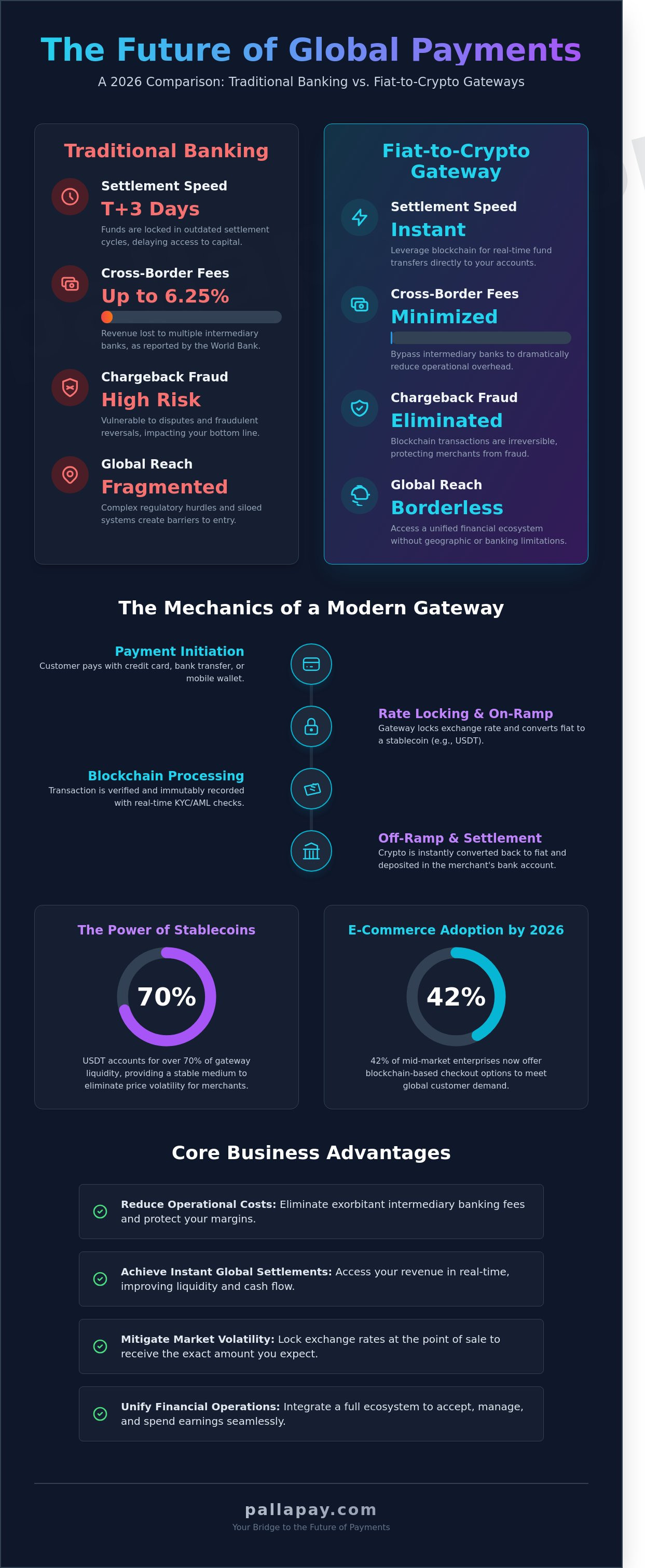
    The era of accepting a three day wait for international settlements ended the moment blockchain technology achieved institutional scale. While traditional banking systems still rely on outdated T+3 settlement cycles, a modern fiat to crypto payment gateway allows your business to bypass these legacy bottlenecks entirely. You’ve likely felt the frustration of watching up to 6.25% of your cross-border revenue vanish into intermediary bank fees, a figure the World Bank’s 2023 report highlights as a persistent drain on merchant liquidity.

    It’s clear that the friction of high transaction costs and complex regulatory hurdles shouldn’t dictate your growth potential. This 2026 guide provides the roadmap to bridge your existing bank accounts with the speed of decentralized finance. You’ll discover how to achieve instant global settlements, eliminate chargeback risks, and maintain a compliant bridge to the future of payments. We’ll examine the technical infrastructure of liquidity and the strategic shift toward a borderless financial ecosystem that prioritizes your bottom line.

    Key Takeaways

    • Understand how a fiat to crypto payment gateway serves as the essential bridge between traditional banking and blockchain networks to facilitate seamless global settlements.
    • Learn the technical process of locking exchange rates in real-time to protect your business from market volatility during the transaction cycle.
    • Discover how to significantly reduce operational costs by eliminating legacy banking fees and the risk of chargeback fraud through secure blockchain processing.
    • Identify the critical compliance standards and “all-in-one” features required to choose a secure, institutional-grade provider for your global business needs.
    • Explore how integrating a comprehensive ecosystem allows you to spend business earnings instantly via specialized Mastercard solutions, unifying your financial operations.

    What is a Fiat-to-Crypto Payment Gateway in 2026?

    A fiat to crypto payment gateway functions as the sophisticated bridge between traditional banking systems and decentralized blockchain networks. It allows businesses to accept digital assets while managing their books in local currencies like USD, EUR, or AED. This infrastructure isn’t just a simple converter anymore; it’s a comprehensive financial engine. By early 2026, these gateways have transitioned from niche experimental tools into essential components for global e-commerce, where 42% of mid-market enterprises now offer blockchain-based checkout options. Unlike the fragmented tools of the past, a modern fiat to crypto payment gateway operates as a unified financial engine that handles compliance, security, and settlement in real time.

    The core utility lies in its dual nature. It manages the complex “heavy lifting” of converting government-issued money into digital tokens and vice versa. While a simple “buy” widget might suffice for an individual user, a professional merchant processor provides a full-scale API. This integration ensures that a business can scale without worrying about the underlying volatility of the crypto market. It transforms a volatile asset into a stable, usable form of capital for the merchant.

    The Evolution of Digital Payment Bridges

    Standards in 2026 differ drastically from the high-friction converters used in 2021. Early systems often required 24 to 48 hours for verification and settlement. Today, the industry has shifted toward instant processing. Stablecoins, specifically USDT, play a pivotal role here. USDT accounts for over 70% of gateway liquidity, providing a stable medium that eliminates the price swings typically associated with Bitcoin or Ethereum. Businesses are moving away from “crypto-only” solutions because they don’t want to hold volatile assets on their balance sheets. Hybrid models are the new standard. These models allow a customer to pay in Bitcoin while the merchant receives an instant settlement in their local fiat currency, combining blockchain efficiency with institutional reliability.

    On-Ramp vs. Off-Ramp: Understanding the Flow

    The gateway operates through two distinct channels that ensure money moves seamlessly across the digital divide. The customer-facing on-ramp allows a buyer to use a debit card, credit card, or bank transfer to purchase the crypto needed for a transaction. This process happens behind the scenes in seconds. The merchant-facing off-ramp is where the business realizes its profit. It involves taking the received crypto and converting it back into fiat for bank deposit or operational use. Reliability in this flow depends on liquidity providers. By maintaining deep pools of capital, a gateway ensures that conversion rates remain locked the moment a customer clicks “pay.” This prevents slippage and ensures the merchant receives the exact amount expected.

    • On-Ramp: Converts fiat into digital assets to initiate a transaction.
    • Off-Ramp: Converts digital assets back into fiat for business settlement.
    • Liquidity: Ensures instant conversion without price drops.
    • Settlement: The final transfer of funds into a merchant’s traditional bank account.

    The Future of Payments is defined by this lack of friction. Merchants no longer need to be blockchain experts to benefit from global reach. They simply need a partner that provides the professional infrastructure to bridge the old world with the new.

    The Mechanics of Fiat-to-Crypto Processing

    A fiat to crypto payment gateway functions as a high-speed financial bridge; it translates traditional currency into digital assets within seconds. This process is a logical sequence designed to eliminate technical friction for the end-user while maintaining institutional-grade security for the merchant. By automating the conversion path, businesses can accept global payments without managing the underlying blockchain complexities themselves.

    • Step 1: Payment Initiation. The customer selects their preferred payment method, such as a credit card, instant bank transfer, or a mobile wallet. In 2026, mobile wallet adoption has reached over 60% of the global consumer base, making multi-channel support essential.
    • Step 2: Rate Locking. To prevent losses from market volatility, the gateway locks the exchange rate for a specific window. This ensures the merchant receives the exact value expected, regardless of price fluctuations during the transaction.
    • Step 3: Automated Verification. Integrated KYC and AML protocols scan the transaction in real-time. This compliance layer is essential for institutional reliability and protects the business from fraudulent activity.
    • Step 4: Instant Settlement. The gateway completes the conversion and routes the funds. The merchant receives the assets in their digital wallet or chooses to move them via fiat settlement services to their local bank.

    Integration Methods: API and Widgets

    Modern gateways offer flexible deployment options to suit different business scales. Small retail websites often opt for “no-code” widgets. These are plug-and-play solutions that require zero development time and provide a secure, hosted checkout page. For enterprise-level customization, a payment API provides the necessary flexibility. It allows businesses to build a bespoke checkout experience that mirrors their brand identity perfectly. Maintaining a seamless UI/UX is vital; a 2025 industry study showed that inconsistent checkout flows lead to a 32% increase in cart abandonment. Professional gateways handle the heavy lifting of backend logic while keeping the frontend interface clean and intuitive.

    Real-Time Liquidity and Exchange Rates

    Reliable gateways source liquidity from multiple institutional exchanges simultaneously to ensure the best possible rate. This multi-source approach minimizes “slippage,” which is the difference between the expected price and the executed price. Top-tier providers aim for slippage rates below 0.1% even for large volume orders. The term “Instant” serves as the anchor of modern commerce. It represents the shift from legacy T+3 settlement cycles to immediate global value transfer. By utilizing a robust fiat to crypto payment gateway, merchants can access the future of payments where capital moves at the speed of the internet. This efficiency allows businesses to reinvest their revenue faster, accelerating growth in a competitive global market.

    Strategic Benefits of Moving Beyond Traditional Gateways

    Traditional payment rails are becoming a bottleneck for modern enterprises. By integrating a fiat to crypto payment gateway, merchants bypass the high costs and slow speeds of legacy banking. Legacy systems typically demand a 3% to 5% commission on every transaction. Blockchain alternatives often lower these fees to under 1%, which directly boosts profit margins for high-volume businesses. This shift isn’t just about saving money; it’s about reclaiming control over your revenue streams.

    Chargeback fraud caused $100 billion in losses for merchants globally in 2023. This is a primary pain point that traditional credit card processors fail to solve. Cryptocurrency transactions are cryptographically secured and irreversible. Once a customer completes a payment, the funds are final. There’s no middleman to reverse a transaction after you’ve shipped the product. This finality provides a level of financial certainty that credit cards simply cannot match.

    Expanding into new territories no longer requires the administrative burden of opening local bank accounts in every country. A single gateway allows you to accept payments from any customer with a digital wallet, regardless of their geographic location. This accessibility is one of the core strategic benefits of accepting cryptocurrency for long-term growth in the 2026 economy.

    Instant Global Settlements

    Banking cycles often operate on a T+3 basis, meaning your funds are locked for 72 hours or more. High-volume retail and gaming industries require faster liquidity to maintain operational momentum. Blockchain technology enables settlements in minutes rather than days. By utilizing fiat settlement options, businesses receive their local currency quickly while avoiding the price swings of the digital asset market. It’s the most efficient way to manage cash flow in a 24/7 global market.

    Security and Fraud Prevention

    Security is built into the protocol, not added as an afterthought. Every transaction is a final, verified event on a public ledger, making identity theft and payment spoofing nearly impossible. Gateways serve as a protective buffer, shielding merchant bank accounts from direct exposure to the crypto ecosystem. These platforms also integrate automated AML monitoring that satisfies 2026 financial regulators. You get the benefit of disruptive technology backed by institutional-grade compliance and safety protocols.

    • Reduced Overhead: Transaction costs drop by up to 80% compared to traditional processors.
    • Zero Chargebacks: Eliminates the risk of friendly fraud and forced reversals.
    • Borderless Trade: Sell to anyone, anywhere, without local banking infrastructure.
    • Enhanced Liquidity: Move from multi-day waiting periods to near-instant capital access.

    How to Choose a Compliant Gateway Provider

    Selecting a fiat to crypto payment gateway requires a rigorous evaluation of technical infrastructure and legal standing. You aren’t just choosing a software tool; you’re selecting a financial partner that bridges traditional banking with digital assets. Merchants should consult this guide on choosing a gateway to understand the specific criteria necessary for long-term scalability. A provider’s ability to handle high-volume liquidity while maintaining instant settlement is the hallmark of institutional-grade service. You need a partner that views compliance as a foundation, not an afterthought.

    Regulatory Compliance and MSB Status

    Trust begins with licensing. Prioritize providers that maintain official Money Services Business (MSB) registrations in major jurisdictions like the United States and Canada. This status ensures the provider adheres to strict anti-money laundering (AML) protocols. Regional expertise is equally vital. For example, a crypto payment gateway in Dubai must navigate specific VARA (Virtual Assets Regulatory Authority) frameworks to ensure local compliance. The right provider manages the complex KYC (Know Your Customer) requirements for your end-users, protecting your business from legal friction. They handle the heavy lifting of identity verification, so you focus on growth.

    Support and Reliability

    Global markets never close, and your infrastructure shouldn’t either. Your gateway must offer 24/7 technical support to address issues across different time zones. Reliability is measured by a 99.9% uptime guarantee and access to redundant liquidity sources. This redundancy prevents transaction failures during periods of high market volatility. A sophisticated merchant dashboard is non-negotiable for 2026. It must provide real-time reporting and automated tax reconciliation tools. This level of transparency eliminates hidden network or gas surcharges, ensuring the fee you see is the fee you pay. Efficiency drives profitability in the digital age.

    A truly all-in-one ecosystem supports every touchpoint of your business. Whether you need a crypto POS machine for physical retail or a robust API for ecommerce, the integration must be seamless. This versatility allows you to accept payments via web, mobile, or physical card without switching providers. It’s about creating a unified financial experience that scales with your ambition. By consolidating these services, you reduce technical debt and simplify your financial operations.

    This concept of a cohesive, all-in-one platform is a major trend in the broader payment processing industry. Providers like Strictly specialize in creating this kind of unified omni-channel experience, helping businesses manage web, mobile, and in-person sales seamlessly.

    Ready to integrate the future of payments into your business model? Explore our professional fiat settlement solutions today.

    Implementing the Pallapay Ecosystem for Your Business

    Pallapay functions as the Global Enabler for enterprises ready to master the digital economy. We offer a sophisticated bridge between traditional banking and blockchain innovation. By integrating our fiat to crypto payment gateway, your business secures a competitive edge in a market where a growing percentage of global consumers now prefer digital asset transactions. Our ecosystem transforms crypto-receipts into usable capital. The Pallapay Mastercard allows you to spend business earnings instantly at millions of global merchants. You don’t have to wait for traditional bank clearances to access your funds. This is the professional standard for liquidity in the modern era.

    Your physical and digital sales channels shouldn’t operate in silos. The Crypto POS machine unifies your revenue streams, allowing retail managers to accept digital payments as easily as credit cards. This hardware is designed for the modern storefront, providing a secure and regulated way to handle transactions. It’s about providing choice to your customers while maintaining the stability of your balance sheet. Whether you are operating a boutique or a multi-national retail chain, the integration is seamless. We handle the heavy lifting of the technology so your staff can focus on the customer experience.

    A Unified Merchant Dashboard

    Visibility creates confidence. Our dashboard provides a single point of truth for all cross-border sales, settlements, and card balances. You can generate instant reports for tax compliance or internal audits with a few clicks. This level of transparency is essential for maintaining institutional financial reliability. For organizations with complex structures, the platform supports multiple user permissions. This ensures your accounting team has the data they need while your security protocols remain intact. It is an all-in-one destination for your crypto-financial needs.

    From Integration to First Settlement

    Efficiency is our priority. The setup for the Pallapay API and Merchant account is streamlined to get you operational quickly. You select your settlement currency, such as USD, EUR, or AED, to ensure your liquidity remains predictable. For corporate clients moving significant volume, our global OTC desks offer deep liquidity and institutional-grade execution. We manage the underlying blockchain architecture, leaving you free to drive your business growth. Getting started with a secure, regulated account today means you are prepared for the future of payments. The process is direct, benefit-driven, and built for scale.

    • Instant Access: Spend earnings immediately via the Pallapay Mastercard.
    • Global Reach: Settle in major fiat currencies including USD, EUR, and AED.
    • Institutional Security: Operate within a regulated, secure financial environment.
    • Omnichannel Readiness: Connect online gateways with physical POS hardware.

    Pallapay represents more than just a tool; it is a visionary partner for your financial evolution. By bridging the gap between fiat and crypto, we provide the stability your business requires to thrive. Every transaction is a step toward a more efficient, borderless future.

    Master the Future of Global Commerce

    Integrating a fiat to crypto payment gateway isn’t just a technical upgrade; it’s a strategic move to capture a market of over 420 million digital currency users worldwide. By 2026, the ability to accept diverse payment forms will separate industry leaders from those left behind. Merchants today require more than just a processor. They need a partner that eliminates the standard 72 hour settlement wait times and provides instant access to capital. Moving your operations onto a blockchain-backed infrastructure allows you to bypass the inefficiencies of legacy banking while reaching customers in 180 countries.

    Pallapay provides this institutional-grade stability through our status as a regulated MSB in the USA and Canada. We’ve designed our ecosystem to handle the heavy lifting of compliance and technical integration so you can focus on expansion. You’ll benefit from a secure, all-in-one platform that turns the complexity of digital assets into a standard business operation. It’s time to bridge the gap between traditional finance and the decentralized economy with a visionary partner.

    Scale your business globally with Pallapay’s secure payment gateway and start your journey toward borderless growth today.

    Frequently Asked Questions

    What is the difference between a crypto gateway and a standard payment processor?

    Crypto gateways bridge the gap between blockchain networks and traditional banking, while standard processors handle fiat-only networks like Visa or Mastercard. Traditional systems rely on centralized bank ledgers that often take 3 to 5 days to clear. A fiat to crypto payment gateway utilizes decentralized ledgers to facilitate instant settlement and global accessibility. This removes the friction found in legacy systems and provides a more efficient financial infrastructure for modern commerce.

    Is it legal for my business to use a fiat-to-crypto payment gateway?

    Using a crypto gateway is legal in over 130 countries, provided the business complies with local AML and KYC regulations. In the United States, FinCEN classifies these service providers as Money Services Businesses. Merchants must verify that their chosen provider holds the necessary licenses for the specific jurisdictions where they operate. This ensures all financial activities remain within the bounds of international law and institutional standards, protecting the business from regulatory risk.

    How much are the typical transaction fees for fiat-to-crypto processing?

    Typical transaction fees for these services range from 0.5% to 2% per transaction, based on 2024 industry benchmarks. This is significantly lower than the 3% or 4% often charged by credit card networks for international sales. Businesses also avoid the hidden costs of currency conversion and traditional wire fees. These savings directly impact the bottom line by preserving higher profit margins on every global transaction processed through the gateway.

    Can I receive fiat currency in my bank account if the customer pays in crypto?

    Yes, you can receive fiat currency directly into your bank account through an instant conversion process. The gateway captures the crypto at the current market rate and settles the equivalent amount in USD, EUR, or AED. This eliminates the risk of price volatility for the merchant. It’s a seamless way to embrace the future of payments without the need to hold digital assets on your corporate balance sheet.

    What is MSB registration and why should I look for it in a provider?

    MSB stands for Money Services Business, which is a legal designation required by FinCEN for entities that transmit or convert currency. Providers with this registration adhere to strict anti-money laundering protocols and regular audits. Choosing an MSB-registered partner protects your business from legal risks and ensures institutional-grade security. It’s a hallmark of a reliable partner that prioritizes regulatory compliance and global trust in every transaction.

    How long does it take to integrate a crypto payment gateway into my website?

    Integration typically takes between 24 hours and 5 business days, depending on the complexity of your current digital infrastructure. Most modern providers offer plug-and-play extensions for platforms like Shopify or WooCommerce that can be activated in minutes. For custom enterprise solutions, developers use robust APIs to create a tailored checkout experience. This rapid deployment allows businesses to scale their global reach without facing extensive technical delays or downtime.

    Are crypto payments subject to chargebacks like credit cards?

    No, crypto transactions are final and immutable once they’re confirmed on the blockchain. This eliminates the risk of fraudulent chargebacks, which cost global merchants an estimated $100 billion in 2023. While you can still issue manual refunds to maintain customer satisfaction, the power to reverse a transaction doesn’t rest with a third-party bank. This provides merchants with absolute certainty and significantly improved cash flow management.

    Does the customer need to own crypto to use a fiat-to-crypto on-ramp?

    No, customers don’t need to own digital assets beforehand to use a fiat-to-crypto on-ramp. They can use their standard credit card or bank transfer to purchase the required amount of crypto at the point of sale. The gateway handles the conversion instantly, making the process as simple as a traditional online purchase. It’s an all-in-one solution that bridges the gap for users who are new to the digital economy.

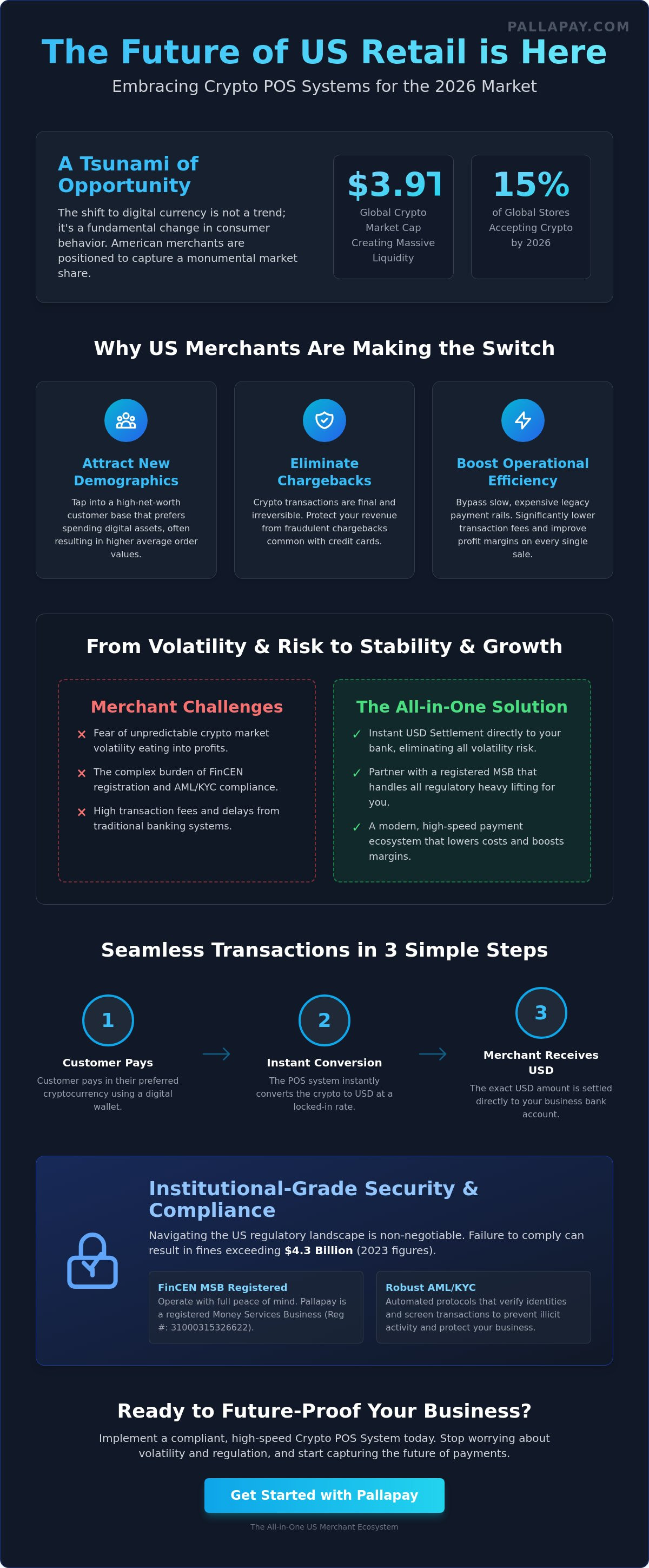
  • Crypto Payment Gateway Dubai: The 2026 Merchant Guide to Instant Settlements

    Crypto Payment Gateway Dubai: The 2026 Merchant Guide to Instant Settlements

    The traditional cash-only retail model in the UAE is facing a sharp decline in relevance as over 1,500 businesses in Dubai have already pivoted to digital asset adoption. You likely recognize that while the opportunity is vast, the complexity of VARA regulations and the threat of 15% market volatility can make integration feel like a risk you aren’t ready to take. It’s a common concern for merchants who want the benefits of the future without the instability of the present. Securely implementing a crypto payment gateway dubai requires a partner that understands both the disruptive nature of blockchain and the necessity of institutional reliability.

    This guide empowers you to master the modern payment landscape by deploying VARA-compliant systems that guarantee instant AED bank settlements. You’ll learn how to eliminate price risk through real-time conversion and provide a seamless experience across both your e-commerce platforms and physical storefronts. We’re providing the roadmap to move beyond simple transactions and embrace the future of payments with absolute confidence and technical ease.

    Key Takeaways

    • Navigate the evolution of Dubai’s 2026 VARA framework to transition your business from traditional finance to a high-utility crypto payment model.
    • Master the mechanics of real-time conversion to ensure every transaction results in instant AED bank settlements without exposure to market volatility.
    • Evaluate the essential security benchmarks and fee transparency needed when choosing a crypto payment gateway dubai to protect your bottom line.
    • Leverage cross-border payment efficiencies to capture international revenue streams and simplify global trade through a unified digital infrastructure.
    • Discover how an all-in-one ecosystem integrates online gateways with physical POS hardware to provide a seamless payment experience for every customer.

    The 2026 Dubai Crypto Landscape: Why Merchants are Switching

    Dubai’s transformation into a global crypto capital is no longer a forecast; it’s a realized economic shift. By January 2026, the city has successfully integrated blockchain into the fabric of its retail and service sectors. Merchants are moving away from traditional payment processors because the crypto payment gateway dubai infrastructure now provides stability that rivals legacy banking. This transition is driven by the 2026 Virtual Assets Regulatory Authority (VARA) framework, which has replaced market uncertainty with institutional clarity.

    The shift from viewing crypto as a speculative investment to a daily payment utility is evident across the Emirates. Businesses aren’t just “experimenting” with digital assets; they’re adopting them to solve fundamental inefficiencies in the traditional financial system. The economic incentives for Dubai merchants include:

    • Reduced Transaction Costs: Processing fees have dropped from a traditional credit card average of 2.8% to less than 1% via blockchain rails.
    • Elimination of Chargebacks: Crypto transactions are final and immutable, saving merchants approximately $15,000 for every $1 million in turnover by removing fraudulent reversals.
    • Instant Liquidity: A professional crypto payment gateway dubai acts as the essential bridge, converting volatile assets into stable AED or USD instantly, bypassing the T+3 settlement delays of legacy banks.

    VARA Compliance and the Legal Framework

    The 2026 VARA guidelines mandate strict operational standards for all virtual asset service providers. These regulations ensure that every transaction is backed by robust KYC and AML protocols, protecting businesses from illicit activity. By registering as a Virtual Asset Service Provider (VASP) or partnering with MSB-registered hubs, platforms provide a layer of institutional trust. This legal maturity allows merchants to maintain a compliant Dubai merchant account while accessing the global liquidity of the decentralized web.

    Market Demand: The Rise of the Crypto-Native Consumer

    The Middle East now hosts one of the highest concentrations of crypto-literate consumers globally. High-net-worth individuals (HNWIs) in Dubai’s luxury sector increasingly prefer settling invoices for real estate, yachts, and high-end retail using USDT or BTC. These users prioritize the privacy and speed that blockchain offers. Businesses that ignore this demographic risk losing market share to tech-forward competitors. You can explore more about the Strategic Benefits of Accepting Cryptocurrency for Businesses in 2026 to understand how this shift impacts long-term profitability and customer retention.

    Pallapay stands at the center of this evolution, offering the tools necessary to turn complex blockchain technology into a standard, effortless business operation. It’s about more than just accepting a new currency; it’s about joining the future of payments.

    How a Crypto Payment Gateway Works for Dubai Businesses

    A crypto payment gateway dubai businesses utilize acts as a sophisticated bridge between decentralized digital assets and traditional financial systems. It functions as a real-time translator, converting volatile cryptocurrencies into stable local currency the moment a transaction occurs. This process removes the technical barriers that previously kept merchants from tapping into the trillion-dollar crypto market. When a customer initiates a payment, the gateway locks the exchange rate for a specific window, protecting the merchant from price fluctuations that could occur during blockchain confirmation times.

    The journey of a single transaction follows a precise, automated path to ensure security and speed:

    • Initiation: The customer selects their preferred digital asset, such as USDT, BTC, or ETH, at the point of sale.
    • Rate Locking: The gateway pulls data from global liquidity providers to offer a competitive, real-time exchange rate.
    • Verification: The transaction is broadcast to the blockchain; the gateway monitors for confirmation.
    • Instant Conversion: Once verified, the system automatically swaps the crypto for fiat currency like AED or USD.
    • Settlement: The final amount is credited to the merchant’s business account, ready for withdrawal or reinvestment.

    Liquidity providers are the essential engine room of this operation. By maintaining deep reserves of both digital and traditional assets, they allow the gateway to facilitate “Instant” settlements. This infrastructure means businesses don’t have to wait for a buyer on a public exchange; the liquidity is already there, waiting to be deployed. This reliability transforms crypto from a speculative asset into a practical tool for daily commerce.

    Instant Fiat Settlement: From Crypto to AED

    The fiat settlement process is designed to mirror the speed of modern digital life. While traditional banking typically operates on T+2 or T+3 cycles, meaning you wait up to 72 hours for funds, this system enables settlements in under 5 minutes. Dubai-based merchants can convert assets like USDT into AED 24/7, including weekends and public holidays. This constant availability ensures that cash flow remains fluid, allowing you to pay suppliers or staff without the delays inherent in legacy banking. To manage these incoming flows effectively, many enterprises start by setting up a secure business wallet to oversee their digital treasury.

    Technical Integration Methods

    Adapting your business to accept crypto doesn’t require a total overhaul of your existing systems. For custom e-commerce platforms, a Payment API provides a robust framework to build a bespoke checkout experience. If you require a faster setup, no-code solutions allow you to generate payment links for social media sales or direct invoicing in seconds. These links function as “Instant” invoices that customers can pay from any global wallet. For a deeper dive into choosing the right setup, consult The Ultimate Guide to Crypto Payment Gateways to see which method aligns with your specific volume and technical capacity.

    Evaluating the Best Crypto Payment Gateway in Dubai

    Selecting a crypto payment gateway dubai requires more than a glance at a feature list; it demands a rigorous audit of regulatory compliance and technical architecture. In 2024, the Virtual Assets Regulatory Authority (VARA) established strict guidelines that every merchant must verify before integration. Security isn’t a luxury; it’s the foundation of institutional trust. If a provider lacks a transparent regulatory status in the UAE, they risk your capital and your business license. Merchants should prioritize partners that treat compliance as a core product feature rather than an afterthought.

    Security Features and Asset Protection

    The Future of Payments for Dubai enterprises relies on 100% secure processing. A professional gateway must utilize cold storage for at least 98% of digital assets, keeping them offline and away from potential breaches. Multi-signature (multi-sig) wallets add another layer of defense by requiring multiple authorized approvals before any significant movement of funds occurs. You should identify red flags immediately. If a provider operates solely from an offshore jurisdiction or lacks clear KYC (Know Your Customer) protocols, they pose a systemic risk to your liquidity. Reliable gateways provide institutional-grade protection that mirrors traditional banking security.

    Cost Analysis: Crypto vs. Traditional Gateways

    Profitability depends on understanding the gap between advertised rates and actual ROI. Traditional international credit card processors often charge between 3% and 5% per transaction, excluding currency conversion markups. A sophisticated crypto settlement solution typically reduces these costs to a range of 1% to 2%. This represents a 50% reduction in overhead for high-volume retailers. Beyond the base fee, merchants gain massive value by eliminating “friendly fraud” and chargeback disputes, which cost global businesses over $20 billion in 2023. Unlike credit cards, crypto transactions are final and immutable. For businesses seeking to bridge traditional banking with digital assets, implementing a fiat to crypto payment gateway provides the infrastructure to accept both traditional and digital currencies seamlessly.

    The Total Cost of Ownership for a crypto gateway encompasses the initial payment API integration effort, a standard 1% processing fee, and any applicable fiat settlement charges required to move funds to a corporate bank account.

    Liquidity and Localized Support

    Multi-currency support is a non-negotiable requirement for modern commerce. While Bitcoin and Ethereum are standard, stablecoins like USDT and USDC facilitate over 90% of commercial crypto volume due to their price stability. Your gateway must handle these assets with Instant precision to avoid volatility. Localized 24/7 assistance is equally critical for high-volume traders moving $500,000 or more daily. When a technical glitch occurs at 2:00 AM GST, you can’t wait for a support ticket response from a different time zone. A Dubai-based partner ensures that your operations never stall, providing the professional bridge between digital innovation and reliable retail execution.

    Industry Applications: Tailoring Payments for Dubai Sectors

    Dubai’s status as a premier global trade hub demands financial infrastructure that operates at the speed of its markets. Implementing a crypto payment gateway dubai allows businesses to capture international revenue without the 3 to 5 day delays typical of traditional SWIFT transfers. By 2026, over 25% of cross-border trade in the UAE is projected to involve some form of digital asset settlement. This shift isn’t just about speed; it’s about precision and compliance. Pallapay ensures every transaction adheres to the “Travel Rule” requirements set by VARA, providing the necessary data transparency while maintaining the privacy high-net-worth clients expect. We provide the professional bridge between traditional commerce and the future of payments.

    Luxury Hospitality and Real Estate

    The demand for digital asset integration is highest in the premium sectors. Leading hotels in Dubai are adopting crypto to attract a new demographic of global travelers who prefer decentralized liquidity. These guests often book high-value suites where instant confirmation is essential. For real estate firms, the ability to facilitate large-scale transactions for property rentals and sales using crypto removes the friction of currency conversion fees. A developer can receive a multi-million dirham payment via stablecoins and see settlement in their corporate account immediately, ensuring the property remains off the market for the shortest time possible.

    E-commerce and High-End Retail

    Digital storefronts are evolving. Integrating crypto into e-commerce platforms provides a borderless sales channel that eliminates chargeback fraud, a risk that cost retailers globally over $100 billion in 2023. Our Retail Store solutions bridge the gap between physical boutiques and digital wallets. Shoppers in the Dubai Mall can now use their mobile wallets for high-end purchases as easily as a credit card. Beyond direct sales, forward-thinking brands are tokenizing loyalty programs. By using gift cards powered by blockchain, retailers create a secure, transferable value system that keeps customers within their ecosystem. Using a crypto payment gateway dubai ensures these retailers stay ahead of the curve while maintaining institutional-grade security.

    Ready to modernize your revenue streams? Integrate our Payment API today to start accepting global payments instantly.

    Getting Started with Pallapay: Dubai’s Leading Gateway

    Pallapay serves as the visionary partner for enterprises looking to lead the Dubai market into 2026. As a premier crypto payment gateway dubai, the platform provides the essential infrastructure to bridge digital assets with institutional financial reliability. Merchants no longer need to juggle multiple vendors for their financial needs. Pallapay offers an all-in-one ecosystem that spans from high-speed online gateways to robust physical hardware. Efficiency is the core priority. Businesses can move from initial account creation to their first live transaction in under 24 hours. This rapid deployment allows companies to capture market share without the delays associated with legacy banking systems.

    Trust is anchored in a significant physical presence. While the technology is decentralized, the support is local and professional. Pallapay maintains dedicated OTC desks at the Binary Tower in Business Bay. This physical infrastructure provides a level of security and personal consultation that digital-only platforms cannot match. For corporate entities handling large-scale settlements, having a professional team available for face-to-face strategy ensures absolute stability and transparency in every transaction.

    The Pallapay POS Advantage

    Accepting digital currencies in a physical retail environment shouldn’t be complex. The Crypto POS Machine allows merchants to process transactions with the same familiarity as traditional card readers. These devices feature full NFC and QR code payment support, ensuring instant retail transactions at the point of sale. This technology eliminates wait times and provides customers with a seamless checkout experience. For a deeper understanding of hardware capabilities, merchants can consult our Crypto POS Machine: The Complete Guide for Merchants in 2026.

    Next Steps for Your Business

    Transitioning to a modern financial stack is a straightforward process. Corporate entities in the UAE need to provide standard onboarding requirements, including a valid trade license and shareholder identification, to begin. You can schedule a private consultation at our Dubai Binary Tower office to discuss custom liquidity requirements or complex API integrations. Our team handles the heavy lifting of technical setup so you can focus on scaling your operations. Join the Future of Payments with Pallapay today and secure your position in the evolving global economy.

    The Future of Payments is Already Here

    Dubai’s transition to a blockchain-powered economy isn’t a distant goal; it’s a 2026 reality that demands immediate merchant adaptation. By integrating a robust crypto payment gateway dubai, your business eliminates the 24-hour settlement delays typical of legacy banking. You gain the ability to accept global liquidity while receiving instant AED deposits directly into your local account. Security remains the cornerstone of this evolution. Pallapay provides this stability through its status as a regulated MSB in the US and Canada, backed by a dedicated physical headquarters in Dubai’s Business Bay.

    Success in this new landscape requires a partner that handles technical complexity so you can focus on growth. Whether you’re in luxury retail or real estate, the shift toward digital assets offers a clear competitive edge. It’s time to move beyond traditional limitations and embrace a system built for speed and absolute transparency. Empower your business with Dubai’s most secure crypto payment gateway and start settling your transactions in real-time. Your journey toward institutional-grade financial flexibility starts today.

    Frequently Asked Questions

    Is it legal to accept cryptocurrency payments for my business in Dubai?

    Yes, it’s fully legal to accept cryptocurrency payments in Dubai under the regulatory framework established by the Virtual Assets Regulatory Authority (VARA) in March 2022. Businesses can legally integrate a crypto payment gateway dubai to accept digital assets as long as they process transactions through a licensed provider like Pallapay. This structure ensures your operations remain compliant with UAE federal laws and global anti-money laundering standards.

    How long does it take to settle crypto payments into my UAE bank account?

    Pallapay provides instant settlements that ensure funds reach your UAE bank account within 24 hours of a transaction. While traditional cross-border transfers often take 3 to 5 business days, our infrastructure bypasses these delays through direct liquidity pools. You can choose to receive your settlements in AED, USD, or EUR, which helps your business maintain a consistent and predictable cash flow.

    What are the transaction fees for using a crypto payment gateway in Dubai?

    Transaction fees for using our crypto payment gateway dubai typically range from 0.5% to 1% per transaction. This is significantly more cost-effective than the 2.5% to 3.5% fees often charged by traditional credit card processors in the UAE. By reducing these overhead costs, you increase your profit margins on every sale while providing your customers with modern payment flexibility.

    Which cryptocurrencies can I accept through the Pallapay gateway?

    You can accept over 100 different cryptocurrencies including Bitcoin, Ethereum, and major stablecoins like USDT and USDC. Pallapay supports a diverse range of digital assets to ensure you don’t miss a sale from global customers. Our platform handles the conversion of these assets into your preferred fiat currency at the point of sale, making it a seamless experience for your accounting team.

    Do I need a special license to accept crypto payments in the UAE?

    Merchants don’t need a specific crypto license to accept payments if they partner with a licensed third-party processor. By using Pallapay, you leverage our existing VARA-compliant infrastructure and regulatory approvals. Your primary requirement is to maintain a valid UAE trade license for your specific business activity, while we manage the complex technical compliance and reporting behind the scenes.

    How does Pallapay protect my business from crypto price volatility?

    Pallapay eliminates volatility risk by locking the exchange rate at the exact moment of the transaction. If a customer pays 5,000 AED worth of Bitcoin, you receive exactly 5,000 AED regardless of market fluctuations that occur minutes later. This instant conversion mechanism ensures your revenue remains stable, allowing you to treat digital asset payments with the same financial certainty as a standard bank transfer.

    Can I use a crypto payment gateway for my physical retail store in Dubai?

    Yes, you can implement crypto payments in physical retail locations using our dedicated Point of Sale (POS) terminals or simple QR code displays. Customers scan the code with their mobile wallet to complete the purchase in seconds. This hardware integration represents the future of payments, bridging the gap between digital assets and physical commerce for luxury boutiques and service providers across the city.

    What is the difference between a crypto gateway and an OTC desk?

    A crypto gateway is an automated system for processing individual retail transactions at checkout, whereas an OTC desk is designed for high-volume trades exceeding 50,000 AED. Gateways provide a seamless experience for daily sales through websites or POS systems. In contrast, our OTC services offer personalized liquidity for institutional moves or large corporate treasury conversions that require specialized handling outside of public exchange order books.

  • Crypto POS Machine for Business: The 2026 Strategic Implementation Guide

    Crypto POS Machine for Business: The 2026 Strategic Implementation Guide

    By 2026, over 45% of global merchants will move beyond traditional card readers to capture a share of the $1.5 trillion digital asset market. If your current terminal doesn’t support blockchain transactions, you’re essentially closing your doors to a massive segment of high-net-worth international consumers. You’ve likely hesitated because of market volatility or the headache of manual accounting; that’s a valid concern for any professional operation. Integrating a crypto pos machine for business shouldn’t mean taking on financial risk or technical debt.

    This strategic guide provides the roadmap to accepting global digital payments with instant fiat settlement and institutional-grade security. You’ll discover how to achieve a seamless checkout experience that converts crypto to your local currency in under two seconds. We’ll examine the automated reporting tools that simplify tax compliance and the specific hardware configurations that sync directly with your existing accounting software. By the end of this article, you’ll have a clear plan to future-proof your revenue stream and embrace the future of payments.

    Key Takeaways

    • Master the transition to the future of payments by understanding why modern consumers are moving beyond traditional credit cards toward real-time digital asset processing.
    • Identify the critical technical requirements for your terminal, including the choice between dedicated hardware and NFC-enabled apps to ensure constant 5G and Wi-Fi connectivity.
    • Evaluate provider fee structures and settlement speeds to select the most efficient crypto pos machine for business that guarantees instant fiat conversion.
    • Learn to scale your operations by integrating your payment terminal into a global financial ecosystem that connects directly to high-volume OTC liquidity for seamless corporate growth.
    • Discover how to tailor the implementation of digital payment solutions to your specific sector, from luxury retail to high-volume hospitality environments.

    Beyond Credit Cards: Why Your Business Needs a Crypto POS Machine in 2026

    A crypto pos machine for business is no longer a niche tool for tech startups; it’s a vital gateway to a global economy. This hardware terminal enables real-time processing of digital assets with an instant conversion to fiat currency. By 2026, the demand for alternative payment methods has surged, with 83% of millennial consumers expressing a preference for brands that accept digital assets. These shoppers view these systems as The Future of Payments, moving away from the high fees and slow processing of traditional banking rails.

    Understanding how crypto payments work reveals the efficiency of this model. When a customer taps their phone or scans a QR code, the terminal communicates with the blockchain to verify funds and finalize the transfer. Modern systems remove the risk of market volatility by locking in exchange rates at the precise second of the sale. This ensures that if you charge $100, you receive exactly $100 in your settlement account, regardless of price fluctuations in the crypto market. It’s a seamless way to attract international tourists and high-net-worth clients without the friction of cross-border banking fees.

    The Competitive Edge of Accepting Digital Assets

    Adopting a crypto pos machine for business provides an immediate financial advantage. Transaction fees for premium credit cards often exceed 3.5%, while crypto processing typically costs less than 1.5% per transaction. Revenue protection is another critical benefit because blockchain transactions offer total finality. There is zero chargeback risk, which saves merchants the $25 to $100 fees associated with traditional payment disputes. This technology also opens doors to the 1.4 billion unbanked individuals globally who rely on digital wallets rather than traditional credit lines.

    Regulatory Compliance as a Business Foundation

    Trust is the cornerstone of any financial evolution. Partnering with an MSB-registered provider in the United States and Canada ensures your operations remain fully compliant with evolving financial laws. These regulated terminals handle all KYC and AML requirements automatically at the point of sale, protecting your business from legal exposure. MSB registration ensures institutional reliability for global merchants by providing a transparent, audited framework for every transaction processed through the ecosystem. This professional approach transforms complex blockchain interactions into a standard, effortless business operation for retail and service providers alike.

    The Technical Anatomy of a Modern Crypto POS Terminal

    Modern commerce requires more than just a standard card reader. A high-performance crypto pos machine for business functions as a sophisticated, dual-purpose gateway. Merchants can choose between dedicated hardware terminals that offer a tactile, professional experience or software-based solutions that transform NFC phones into payment hubs. These devices prioritize 24/7 uptime through a combination of 5G, Wi-Fi, and Ethernet fallback systems. Security remains the cornerstone of this technology. By implementing PCI DSS compliance and end-to-end encryption, these terminals ensure digital assets move with the same reliability as institutional fiat currency.

    While the underlying technology is advanced, the user interface mimics the familiarity of traditional banking. This allows staff to manage the transition without extensive training. Before deploying new hardware, many owners evaluate the pros and cons for businesses to ensure the infrastructure aligns with their long-term operational goals. The result is a seamless checkout flow that removes friction for both the merchant and the customer.

    NFC and QR Code Integration

    Speed defines the modern checkout experience. Modern terminals generate dynamic QR codes for every transaction, which eliminates the risk of manual wallet address entry errors. This process supports over 100 digital assets, including Bitcoin, Ethereum, and stablecoins like USDT, ensuring instant settlement. NFC integration allows customers to tap and pay, mirroring the convenience of mobile wallets. It’s a vital feature for high-traffic retail environments where transaction speed directly impacts total daily revenue.

    Integration with Existing ERP and Accounting

    A crypto pos machine for business isn’t an isolated tool; it’s a data-rich node in your financial network. Through a centralized merchant dashboard, sales reports are automated in real-time. API-led connectivity bridges the gap between the blockchain and your inventory management system. This transparency simplifies tax audits by providing a permanent, on-chain transaction history. Businesses using these integrated systems often see a 15% reduction in administrative overhead related to payment reconciliation. This level of integration proves that digital asset adoption is The Future of Payments. You can explore how this fits your scale by reviewing our crypto POS solutions today.

    Comparing Crypto POS Providers: Fees, Settlements, and Compliance

    Selecting the right crypto pos machine for business involves a deep dive into the financial mechanics that power the device. You aren’t just buying a terminal; you’re choosing a liquidity partner. Fee structures are the first point of comparison. Most institutional providers charge a percentage-based commission ranging from 0.5% to 1%. This is significantly more cost-effective than the 2% to 4% typically charged by legacy credit card networks. High-volume retailers often benefit from flat-fee models that provide predictable monthly overheads.

    Settlement speed has become the primary competitive battleground. While next-day cycles were acceptable in previous years, “Instant” settlement is the industry benchmark for 2026. This capability protects your working capital and removes the friction of waiting for blockchain confirmations. To maintain this speed, your provider must support the most liquid assets. Ensure your terminal accepts:

    • USDT and USDC: These stablecoins facilitate the majority of retail commerce.
    • Bitcoin and Ethereum: Essential for capturing the high-net-worth demographic.
    • Regional Tokens: Assets that hold high liquidity in your specific market.

    Technical reliability is non-negotiable in a retail environment. You need 24/7 global technical assistance to ensure that a software glitch doesn’t halt your sales during peak hours. The best providers offer a proactive monitoring service that identifies connectivity issues before they impact your storefront. This creates a sense of absolute trust for both the merchant and the customer.

    Fiat Settlement Models: Getting Paid in Local Currency

    Most businesses prefer to eliminate exposure to market volatility. Professional fiat settlement models allow you to accept Bitcoin while receiving USD or AED directly in your bank account. This process relies on robust liquidity providers who manage the exchange in the background to prevent slippage. You can choose between same-day settlement for immediate liquidity or T+1 cycles for consolidated reporting. For a comprehensive breakdown of how this process works across borders and currencies, our guide on crypto to fiat settlement provides the strategic framework global merchants need in 2026. This bridge makes crypto transactions feel like a standard, effortless business operation.

    Global Scalability and Multi-Region Support

    If you operate an international franchise, you must evaluate providers with a physical presence in major financial hubs like Dubai, Singapore, and New York. These locations serve as anchors for multi-currency checkouts, allowing you to price goods in local fiat while accepting global crypto. A provider’s physical global office presence correlates with faster local bank settlements because it enables direct integration with regional banking infrastructures. This infrastructure is the backbone of The Future of Payments, ensuring your crypto pos machine for business scales as you enter new markets.

    Industry-Specific Implementation: From Retail Stores to Luxury Hotels

    Adopting a crypto pos machine for business requires more than just hardware installation; it demands a strategic alignment with your specific sector’s operational flow. High-ticket industries like luxury real estate or automotive sales require rigorous security and instant verification, while high-volume retail environments prioritize transaction speed and ease of use. Pallapay provides the technological answer to these varying needs by offering a versatile ecosystem that handles the heavy lifting of liquidity and settlement behind the scenes.

    The impact on the bottom line is measurable and immediate. For example, a prominent retail store integrated Pallapay’s point-of-sale solution in Q1 2023 and recorded a 15% increase in foot traffic by the end of the second quarter. This growth is largely attributed to attracting a demographic of “crypto-affluent” consumers who prefer direct spending over traditional fiat conversions. Beyond simple transactions, merchants are now using crypto-native gift cards to drive customer loyalty, allowing users to load value onto digital cards that function seamlessly across both physical and digital storefronts.

    Crypto Payments in the Hospitality Sector

    International guests frequently encounter credit card limits or high foreign transaction fees when checking into luxury hotels. By implementing a professional crypto gateway, hotels can streamline check-ins for global travelers. The system manages deposits and incidental charges through secure crypto-fiat gateways, ensuring the hotel receives its preferred currency while the guest pays in digital assets. This setup eliminates the 3% to 7% currency conversion fees typically associated with international banking, making high-value bookings more attractive to the global elite.

    E-commerce and Brick-and-Mortar Synergy

    The modern merchant doesn’t operate in a silo. Creating a unified payment experience is essential for e-commerce brands that also host physical pop-up events or maintain flagship stores. By utilizing a single payment API, businesses can track every transaction across all channels in one dashboard. This integration ensures that a crypto pos machine for business stays synchronized with online inventory levels, providing a truly “all-in-one” financial solution. It’s the future of payments, where the distinction between online and offline commerce disappears through instant, global settlement.

    Ready to upgrade your payment infrastructure with the latest fintech innovation?

    Order your Pallapay Crypto POS Machine today

    Scaling with Pallapay: Integrating Your POS into a Global Financial Ecosystem

    Selecting a Pallapay crypto pos machine for business represents a strategic shift toward institutional-grade financial agility. This isn’t merely a point-of-sale device; it’s a gateway into a comprehensive ecosystem designed for the modern enterprise. Pallapay provides a unified platform where buying, selling, and accepting digital assets happens within a single secure environment. By linking your terminal to a high-volume OTC crypto exchange, your business gains the corporate liquidity required for high-stakes transactions. You can also distribute integrated corporate crypto cards to your team, allowing for the streamlined management of business travel and operational expenses. Our onboarding process is engineered for speed, moving you from application to your first live transaction in under 48 hours.

    The Power of an Integrated Merchant Dashboard

    The Pallapay dashboard serves as a centralized command center for your entire financial operation. It allows for the real-time monitoring of global sales across multiple POS locations, whether you operate in two cities or ten countries. Instant conversion is a standard feature here; you can move received cryptocurrency into USDT or fiat to settle payroll and overheads without delay. This functionality removes the risk of market volatility from your balance sheet. For accounting teams, the platform enables the export of audit-ready financial data with a single click, ensuring your records remain precise and compliant.

    Future-Proofing Your Business with Pallapay

    As blockchain technology advances, your hardware must remain capable of handling new demands. Pallapay delivers continuous firmware updates to every crypto pos machine for business, ensuring support for emerging blockchain protocols and enhanced security standards. We provide direct access to professional OTC desks for enterprises that need to perform large-scale USDT to cash conversions securely. This commitment to utility and growth positions Pallapay as a visionary partner in your digital transformation. Empower your business with a Pallapay Crypto POS today to secure your place in the future of payments.

    Secure Your Place in the Future of Payments

    By 2026, digital currency adoption won’t be a secondary option for competitive enterprises. Integrating a crypto pos machine for business transforms your checkout into a global gateway that attracts high-net-worth liquidity from every corner of the world. You’ll eliminate the traditional 3 to 5 day waiting period for funds because our system provides instant fiat settlement directly to your account. This ensures your cash flow remains stable with zero volatility risk, regardless of market shifts.

    Pallapay is a fully MSB Registered entity in both the USA and Canada. We provide the institutional security your finance department demands while maintaining a presence in 180+ countries. You’re not just installing hardware; you’re connecting to an all-in-one financial ecosystem designed for the next decade of commerce. The transition to modern payments is happening now. We’ve made it effortless for you to lead the way.

    Get Your Secure Crypto POS Machine from Pallapay

    Frequently Asked Questions

    Is it legal for my business to accept cryptocurrency via a POS machine?

    Accepting cryptocurrency is legal in over 130 countries, including major financial hubs like the UAE where the Virtual Assets Regulatory Authority (VARA) established clear guidelines in 2023. Your business must comply with local Anti-Money Laundering (AML) and Know Your Customer (KYC) protocols to remain compliant. By using a regulated crypto pos machine for business, you ensure every transaction meets these international standards while expanding your payment options.

    How much does a crypto POS machine for business typically cost?

    A professional crypto POS terminal typically requires an initial hardware investment between $250 and $550 depending on the specific model’s features. Beyond the hardware, transaction fees generally range from 0.5% to 1.5% per sale. This is significantly lower than the 2% to 4% fees often charged by traditional credit card processors, allowing merchants to retain more of their revenue.

    Do I need to understand blockchain technology to use a crypto POS terminal?

    You don’t need technical knowledge of blockchain mechanics to operate a modern payment terminal. The software functions like a standard credit card machine, handling the complex ledger entries and network confirmations in the background. Your staff simply enters the sale amount and the system generates a QR code for the customer to scan, making the process as intuitive as a traditional tap-to-pay transaction.

    What happens if the price of Bitcoin drops during a transaction?

    Most enterprise-grade systems lock the exchange rate for 15 to 20 minutes to eliminate volatility risks for the merchant. If Bitcoin’s price drops during that window, the payment processor absorbs the difference to ensure you receive the exact fiat value of your sale. This price guarantee protects your profit margins from the 5% to 10% daily fluctuations common in the digital asset market.

    Can I receive payments in my local currency (USD, EUR, AED) instead of crypto?

    You can choose to receive 100% of your settlements in local fiat currencies like USD, EUR, or AED. The system instantly converts the cryptocurrency at the moment of sale, bypassing the need for you to hold digital assets on your balance sheet. This feature allows you to tap into the $2 trillion crypto market while maintaining the stability of your traditional accounting practices.

    How long does it take to settle crypto payments into my business bank account?

    Payments are typically settled into your business bank account within 24 hours, often following a T+1 settlement schedule. Some premium providers offer instant settlement options where funds are available in your digital wallet within seconds of the transaction. This is a major improvement over the 3 to 5 business days required by legacy banking systems for international wire transfers.

    What are the main security risks associated with crypto POS systems?

    The primary risks involve private key management and phishing attempts, though hardware terminals mitigate these through end-to-end encryption and PCI-DSS compliance. Over 95% of security breaches in the industry occur through human error rather than technical failure. Using a dedicated crypto pos machine for business isolates the payment environment from your general network, providing a secure bridge for high-value transactions.

    Which cryptocurrencies should my business accept to maximize customer reach?

    To reach the widest customer base, your business should support Bitcoin, Ethereum, and major stablecoins like USDT and USDC. Bitcoin and Ethereum account for approximately 70% of the total market capitalization, while stablecoins provide a familiar experience for users who prefer price stability. Supporting these four assets ensures you’re accessible to the majority of the 420 million crypto users worldwide.

  • How Do Crypto POS Systems Work? The Complete Merchant Guide for 2026

    How Do Crypto POS Systems Work? The Complete Merchant Guide for 2026

    By 2026, global retail spending via digital assets is projected to reach $22.5 billion, marking a definitive shift toward the future of payments. To remain competitive in this evolving landscape, you must understand exactly how do crypto pos systems work to facilitate these high-speed exchanges. You’ve likely felt the hesitation that comes with blockchain technology; the fear that a sudden price drop will impact your revenue or that a slow network will cause a bottleneck at your checkout counter.

    We’ve designed this guide to bridge the gap between technical innovation and institutional reliability. You’ll discover how modern POS solutions provide instant liquidity and seamless conversion, allowing you to accept cryptocurrency while receiving stable fiat currency in your bank account. We will break down the essential hardware requirements, the four-step transaction lifecycle, and the settlement processes that keep your business secure and efficient in a global market.

    Key Takeaways

    • Understand exactly how do crypto pos systems work to facilitate seamless, direct interactions between blockchain networks and your retail terminal.
    • Master the four-step transaction lifecycle that ensures instant payment verification through dynamic QR codes and secure wallet signatures.
    • Discover how to eliminate volatility risks by utilizing instant fiat conversion for stable, predictable business settlements.
    • Identify critical multi-currency features and ERP integration capabilities necessary for scaling a modern global retail operation.
    • Learn to leverage MSB-regulated infrastructure to ensure institutional-grade security for every digital asset transaction.

    What is a Crypto POS System? Defining the Modern Terminal

    A Crypto POS (Point-of-Sale) system represents the professional evolution of retail hardware. It’s a sophisticated combination of secure hardware and cloud-based software that empowers merchants to accept digital assets like Bitcoin, Ethereum, or USDT. Unlike traditional terminals that rely on legacy banking rails and multi-day clearing cycles, these modern systems interact directly with decentralized blockchain networks or specialized payment gateways. A Crypto POS serves as the bridge between decentralized finance and traditional retail commerce.

    Understanding how crypto payments work is the first step toward modernizing a business’s financial infrastructure. These systems calculate real-time exchange rates at the exact moment of sale. This ensures the merchant receives the precise value of the transaction in their preferred currency, effectively neutralizing the risks associated with price volatility. By 2026, the global market for these terminals has expanded significantly as businesses seek faster settlement times and lower fees compared to traditional credit card processors. So, how do crypto pos systems work in a practical retail setting? They convert the requested fiat amount into its crypto equivalent instantly, generating a unique QR code or an NFC signal for the customer to authorize from their digital wallet.

    The system functions as an all-in-one ecosystem that handles the heavy lifting of blockchain verification. When a customer initiates a payment, the terminal communicates with a payment gateway to verify the availability of funds and the authenticity of the transaction. This process happens in seconds, providing an instant confirmation that mirrors the speed of a standard debit card swipe. Merchants don’t need to manage private keys or interact with complex exchange interfaces; the terminal provides a streamlined, professional interface that mirrors the tools they already use. These devices represent the future of payments, offering a global reach that traditional banks cannot match.

    Clearing the Confusion: POS vs. PoS

    It’s common to find overlapping results when searching for these terms, but they serve entirely different roles. POS refers to the Point-of-Sale terminal used at a checkout counter for retail transactions. In contrast, PoS stands for Proof-of-Stake, which is a consensus mechanism used by blockchains like Ethereum to secure their networks. You don’t need to understand the complexities of staking or network validation to operate a Point-of-Sale terminal. Confusion between these terms often leads business owners to believe crypto payments are technically inaccessible, but the reality is a user-friendly experience designed for efficiency.

    The Evolution of Retail Payments in 2026

    Crypto terminals have transitioned from niche experimental tech into mainstream retail necessities. The integration of NFC technology has made crypto payments as fast as tapping a traditional credit card, which is essential for high-traffic environments. Various sectors are leading this change, with hotels and luxury retailers adopting these systems to cater to a global, tech-savvy clientele. These industries recognize that offering diverse payment options is a standard for global commerce. By removing the friction of currency conversion, these terminals allow businesses to scale their operations internationally with ease.

    Behind the Scenes: The 4-Step Transaction Lifecycle

    Understanding how do crypto pos systems work requires looking past the sleek hardware to the sophisticated software stack that manages digital assets in real time. While a traditional credit card transaction relies on legacy banking rails that can take days to settle, a crypto POS terminal operates on a decentralized infrastructure designed for immediate finality. This process transforms a complex blockchain interaction into a familiar, user-friendly retail experience that mirrors the speed of a standard contactless payment.

    Step 1 & 2: Initiation and Wallet Communication

    The lifecycle begins when the merchant enters the fiat amount into the terminal interface. At this moment, the Payment API performs the heavy lifting by calculating the exact cryptocurrency equivalent. This isn’t a static conversion; the system queries multiple global liquidity providers to secure the most competitive exchange rate available in 2024. Once the rate is determined, the terminal generates a dynamic QR code. This code is more than just an image. It’s a secure data packet containing the merchant’s destination address, the precise amount, and a unique transaction ID.

    When the customer scans this code using their mobile wallet, the two devices establish a secure connection using encrypted protocols. The wallet then broadcasts a digitally signed transaction to the payment gateway. This signature acts as a cryptographic guarantee of ownership, ensuring that the funds cannot be redirected or altered. Because the communication is peer-to-peer, it bypasses the multiple intermediaries that typically slow down traditional financial transfers. Merchants often find that how do crypto pos systems work is actually more direct than the 5-step process involved in standard visa or mastercard processing.

    Step 3 & 4: Validation and Confirmation

    Once the payment gateway receives the signed transaction, it moves into the validation phase. To protect the merchant from price volatility, the gateway typically locks in the exchange rate for a window of 15 minutes. This prevents “slippage,” where the value of the crypto might change between the scan and the settlement. A critical distinction here is the difference between on-chain confirmation and instant gateway approval. While a base-layer Bitcoin transaction might take 10 minutes to confirm on the blockchain, modern gateways use Layer-2 solutions like the Lightning Network to achieve sub-second transaction times. These protocols allow for 0.5-second processing, making crypto viable for high-traffic environments like cafes or supermarkets.

    As noted by industry experts at Tech Times, understanding How a Crypto POS System Works is becoming vital for retailers who want to eliminate the 3% fees associated with traditional banks. After the gateway verifies the availability of funds, the terminal displays a green checkmark and prints a physical or digital receipt. In the backend, the merchant’s dashboard reflects the transaction immediately. The system automatically logs the data for tax compliance and inventory management, providing a seamless bridge between blockchain technology and daily business operations. If you’re ready to modernize your storefront, you can explore our professional terminal options to see these steps in action.

    The final step involves the actual settlement. Even though the receipt is printed instantly, the gateway handles the “settlement” by moving the funds into the merchant’s designated account. Depending on the merchant’s preference, these funds can remain as cryptocurrency or be automatically converted into fiat currency like USD or AED. This flexibility ensures that the business remains protected from market swings while still offering customers the freedom to pay with digital assets.

    Fiat vs. Crypto Settlements: How Your Business Gets Paid

    Understanding how do crypto pos systems work requires looking at the final destination of your revenue. Merchants don’t need to be blockchain experts to accept digital payments because the system handles the complex conversion layers. You have the executive power to decide whether your sales revenue stays in the digital ecosystem or arrives in your bank account as local currency. This flexibility bridges the gap between disruptive technology and the practical needs of daily business operations.

    The Instant Fiat Settlement Advantage

    Chief Financial Officers often prioritize stability and predictable cash flow over market speculation. By utilizing fiat settlement services, your business locks in the exact price of a sale the moment a customer completes the transaction. This process effectively eliminates the risk of price drops that might occur between the time of sale and the bank deposit. Recent research on cryptocurrency market behavior shows that while retail trading flows can be volatile, a professional gateway absorbs this volatility so your balance sheet doesn’t have to. You receive the precise fiat amount listed on your invoice, minus a transparent processing fee.

    Managing the administrative side of these transactions is equally streamlined. Your merchant dashboard provides the following benefits:

    • Automated Tax Reporting: Generate real-time reports that categorize every transaction for local tax compliance.
    • Accounting Integration: Export data directly to software like QuickBooks or Xero via secure API hooks.
    • Volatility Shielding: The gateway locks the exchange rate for a specific window, ensuring the customer pays the fair market value while you receive a fixed fiat sum.

    The settlement cycle is the engine that drives your liquidity. Once the blockchain confirms a payment, the gateway initiates the transfer to your linked accounts. Modern 2026 systems allow for same-day fiat settlement in over 180 countries. This speed is a significant upgrade from the legacy T+3 or T+5 cycles common in traditional credit card processing, where funds are often held for days before becoming accessible. For a comprehensive breakdown of how to optimize this process for your enterprise, our crypto to fiat settlement strategic guide for global merchants covers instant conversion technology and audit-ready reporting in detail.

    Direct Crypto Settlements for Digital Treasuries

    Some enterprises choose to bypass fiat conversion entirely to build a digital treasury. If your business pays global suppliers in stablecoins or wants to hold Bitcoin as a long-term asset, you can opt for direct crypto settlements. In this scenario, the revenue moves directly into secure crypto wallets managed by your company. This is a strategic choice for the 28% of global businesses now operating in cross-border markets where traditional banking remains slow or prohibitively expensive.

    When you choose to keep digital assets, you often benefit from lower overall fees. Since there’s no conversion from crypto to fiat, the “spread” or exchange fee is removed from the equation. This allows you to retain more of every dollar earned. It’s a pure peer-to-peer flow that highlights exactly how do crypto pos systems work to maximize profit margins. Whether you’re holding USDT for its dollar-pegged stability or BTC for its growth potential, the choice remains entirely in your hands, accessible through a single, professional interface.

    Key Features and Implementation for Global Retailers

    Modern commerce demands flexibility. A robust crypto POS terminal isn’t just a card reader; it’s a gateway to a global liquidity pool. Understanding how do crypto pos systems work requires looking at their core infrastructure, which bridges the gap between digital assets and traditional accounting. These systems handle the heavy lifting of real-time conversion, ensuring that a merchant receives their preferred currency without exposure to market volatility. By 2024, the ability to accept Bitcoin, Ethereum, and USDT on a single device has become a standard requirement for businesses aiming to capture the growing segment of 420 million crypto users worldwide.

    Security and compliance form the backbone of these operations. Every transaction utilizes end-to-end encryption and mandatory two-factor authentication (2FA) to protect both the merchant and the consumer. For legal operations, using a provider registered as a Money Services Business (MSB) is non-negotiable. This registration ensures the provider adheres to strict Anti-Money Laundering (AML) and Know Your Customer (KYC) protocols, shielding your business from regulatory risks. Integration isn’t a hurdle either. Modern terminals sync with existing ERP and inventory management software via secure APIs, maintaining a single source of truth for all financial data.

    • Multi-Currency Support: Accept over 100 digital assets with instant settlement options.
    • ERP Integration: Sync sales data directly with platforms like SAP, Oracle, or Microsoft Dynamics.
    • Anti-Fraud Monitoring: Real-time blockchain analysis flags suspicious wallet addresses before a transaction completes.
    • Regulatory Peace of Mind: MSB-registered providers handle all compliance reporting automatically.

    Hardware vs. Software-Only POS

    Dedicated physical terminals offer the highest level of customer trust in a retail store environment. These devices are built for durability and provide a familiar checkout experience. For mobile businesses or popup shops, “SoftPOS” technology turns any NFC-enabled Android phone into a terminal. While software-only solutions offer 100% portability, physical hardware remains the gold standard for high-volume brick-and-mortar locations due to its superior processing speed and professional appearance.

    Integrating with E-commerce and In-Store

    The goal for 2025 is a seamless omnichannel experience. By utilizing e-commerce gateways, you can track online and offline sales through a unified dashboard. This synchronization allows for better cash flow management and inventory accuracy. Training your team is equally efficient; most staff members can master the process of generating a QR code and verifying a transaction in under 5 minutes. It’s a simple, intuitive workflow that mirrors traditional credit card processing but with lower fees and faster settlement.

    Experience the future of payments today. Get started with Pallapay’s all-in-one crypto POS solution and scale your business globally.

    The Pallapay Advantage: Secure, Regulated POS Infrastructure

    Pallapay operates as a sophisticated bridge between decentralized finance and institutional retail commerce. We provide an all-in-one ecosystem that removes the technical barriers merchants often face when adopting new payment technologies. Our infrastructure is built on a foundation of institutional trust; we hold active Money Services Business (MSB) registrations with FinCEN in the United States and FINTRAC in Canada. These registrations aren’t just badges of honor; they represent a commitment to strict anti-money laundering (AML) protocols and financial transparency that protects your business from the volatility of unregulated markets.

    We maintain a physical presence in the world’s leading financial hubs, including Dubai, Singapore, and Istanbul. Having local offices means we provide boots-on-the-ground support that anonymous digital platforms cannot offer. When you analyze how do crypto pos systems work within a regulated framework, you realize that security is about more than just code; it’s about legal accountability and physical presence. This global footprint allows us to offer 24/7 localized support, ensuring that your payment gateway never experiences downtime during peak trading hours.

    The Pallapay ecosystem is designed to be a “Global Enabler” for merchants who want to tap into the $2 trillion cryptocurrency market without the traditional headaches of digital asset management. We handle the complex liquidity and settlement processes behind the scenes. This allows your staff to process a Bitcoin or USDT transaction as easily as they would a standard credit card payment. Our goal is to make the transition to digital currency feel like a standard, effortless business operation.

    Regulated Financial Technology

    Pallapay’s regulatory status protects your retail business from the legal and financial risks associated with “gray market” exchanges. We implement security protocols that exceed standard banking requirements, including end-to-end AES-256 encryption for all data transmissions. High-volume retail locations benefit from a dedicated account manager who oversees your specific integration and settlement needs. This human-centric approach ensures your liquidity remains stable. We manage the heavy lifting of compliance and KYC so you can focus on serving your customers. Our system provides instant conversion, meaning you never have to worry about the price of an asset changing between the time of sale and the time of settlement.

    Setting Up Your POS in 2026

    The onboarding process is designed for maximum efficiency, reflecting the fast-paced nature of modern commerce. You can complete your initial application in under 10 minutes, and our compliance team typically verifies accounts within 24 hours. Once the terminal arrives, it connects to your existing Wi-Fi or 5G network instantly. Merchants in the UAE enjoy unique flexibility; you can sell USDT for cash in Dubai at our physical branches or settle your daily sales directly to a local bank account in your preferred fiat currency. This flexibility is why 98% of our partner merchants report a seamless transition from traditional hardware to our crypto-ready terminals. Understanding how do crypto pos systems work is the first step toward future-proofing your revenue streams.

    The Future of Payments is not a distant concept; it’s a functional tool available right now. By integrating a Pallapay terminal, you’re positioning your brand at the forefront of a global financial evolution. Our technology ensures that every transaction is instant, secure, and fully compliant with international standards.

    Future-Proof Your Business with Seamless Crypto Integration

    The transition toward digital assets represents a fundamental shift in global liquidity. Merchants who master how do crypto pos systems work gain an immediate competitive advantage by accessing a borderless economy. These modern terminals handle the complex heavy lifting of blockchain verification and instant fiat conversion; this ensures your business receives local currency without the risks of market volatility. By adopting a regulated infrastructure, you’re not just accepting new payment methods, you’re positioning your brand as a visionary partner in the global marketplace.

    Pallapay delivers the institutional reliability necessary for high-volume retail. We’re MSB registered in the USA and Canada, currently serving merchants in over 180 countries. Our ecosystem provides instant fiat settlement in AED, USD, and EUR, which means your cash flow remains predictable and liquid. You don’t have to navigate the complexities of decentralized finance alone when you have a secure, professional gateway at your fingertips.

    For businesses looking to implement a comprehensive digital payment strategy, our crypto pos machine for business strategic implementation guide provides detailed insights into automated reporting tools and hardware configurations that sync directly with existing accounting software.

    Get started with the world’s most secure Crypto POS machine

    The future of payments is already here, and it’s built on speed, security, and global reach. We’re ready to help you lead the way.

    Frequently Asked Questions

    Is a crypto POS system faster than a credit card terminal?

    Yes, crypto POS systems offer instant transaction verification, often completing in under 5 seconds. Traditional card networks involve multiple intermediaries like issuing banks and clearinghouses that take 48 to 72 hours for final settlement. Pallapay terminals bypass these delays by providing real-time liquidity. This speed ensures your cash flow stays liquid and predictable. It’s the most efficient way to handle modern commerce.

    Do I need to have a crypto wallet to accept payments as a merchant?

    You don’t need a personal wallet because the terminal integrates an all-in-one merchant account. The system generates a unique QR code for each transaction, and the funds deposit directly into your secure business gateway. Understanding how do crypto pos systems work simplifies this; the terminal acts as the professional bridge between the customer’s digital assets and your bank account. We handle the heavy lifting of technology behind the scenes.

    What are the typical fees for using a crypto POS system?

    Transaction fees typically range from 0.5% to 1.5%, which is significantly lower than the 2.5% to 4% charged by legacy credit card processors. Merchants save up to 60% on processing costs by eliminating traditional interchange fees. Pallapay provides a transparent fee structure with no hidden charges. This cost efficiency allows businesses to reinvest their savings into scaling global operations and accelerating growth.

    What happens if the price of Bitcoin drops immediately after a customer pays?

    You aren’t affected by market volatility because the system locks in the exchange rate at the exact second of the transaction. If a customer pays 500 USD in Bitcoin, you receive 500 USD regardless of price swings. Our instant settlement technology converts the crypto to fiat immediately. This feature provides a secure financial environment where price fluctuations never impact your bottom line or financial stability.

    Is it legal to use a crypto POS machine in my country?

    Crypto payments are legal in over 130 countries as of October 2023, including the UAE, EU, and USA. You must comply with local AML and KYC regulations, which our terminal handles automatically during the initial onboarding process. Pallapay ensures your business operates within the legal framework of your specific region. We provide the professional bridge to the future of payments while maintaining strict institutional reliability.

    Can I accept multiple cryptocurrencies on one POS device?

    Yes, a single device supports over 50 major cryptocurrencies including Bitcoin, Ethereum, and USDT. This versatility allows you to cater to a global customer base without needing multiple hardware units. Learning how do crypto pos systems work reveals that the software manages various blockchain protocols through one seamless interface. It’s a visionary solution for modern merchants who want to offer their customers total payment flexibility.

    How do I withdraw the money I earn from crypto sales into my bank account?

    You withdraw funds via an automated OTC desk that settles directly into your bank account within 24 hours. The platform converts your digital assets into local fiat currency like AED, USD, or EUR. This process ensures your earnings are always accessible for operational expenses. Our all-in-one ecosystem makes the transition from crypto to cash feel like a standard, effortless business operation for any global merchant.

    Do I need a special internet connection for a crypto POS terminal?

    You only need a standard 4G, 5G, or Wi-Fi connection with a minimum speed of 2 Mbps. The terminal functions like a traditional mobile card reader and requires very little bandwidth to process encrypted blockchain data. This allows you to accept payments at a physical storefront or a mobile pop-up shop. It’s a highly portable tool designed for the efficiency-oriented business owner who values mobility.