

By 2026, the traditional wall between cold storage security and real-time liquidity has finally collapsed. While 2025 industry reports from Chainalysis highlighted that over $4.2 billion in assets were compromised through exchange vulnerabilities, the modern investor now utilizes a secure crypto wallet that bridges the gap between safety and speed. You likely understand the persistent anxiety of managing private keys or the frustration of waiting 72 hours for a cold-to-cash settlement. It’s a friction point that has hindered institutional growth for far too long, forcing a choice between absolute protection and functional utility.
This guide ensures you can deploy a storage strategy that utilizes the latest 2026 biometric standards while maintaining instant access to global fiat markets. We’ll show you how to achieve total peace of mind through MSB-compliant frameworks and institutional-grade encryption. You’ll learn about the specific multi-signature protocols, OTC settlement layers, and regulatory alignments that transform your digital vault into a high-performance financial engine. We’re moving beyond mere storage to a future where your capital remains both untouchable and immediately spendable.
Key Takeaways
- Learn why 2026 security standards demand Multi-Party Computation (MPC) to eliminate the single-point-of-failure risks inherent in traditional recovery phrases.
- Identify the ideal secure crypto wallet architecture that balances institutional-grade protection with the instant liquidity required for global commerce.
- Master a professional 5-step framework to evaluate providers based on regulatory status, physical presence, and specific utility requirements.
- Discover the strategic advantages of an integrated ecosystem that bridges the gap between secure storage and real-world spending through the Pallapay Mastercard.
- Explore how MSB-regulated security layers provide the absolute trust and stability needed to manage corporate and personal wealth in a digital landscape.
What Defines a Secure Crypto Wallet in 2026?
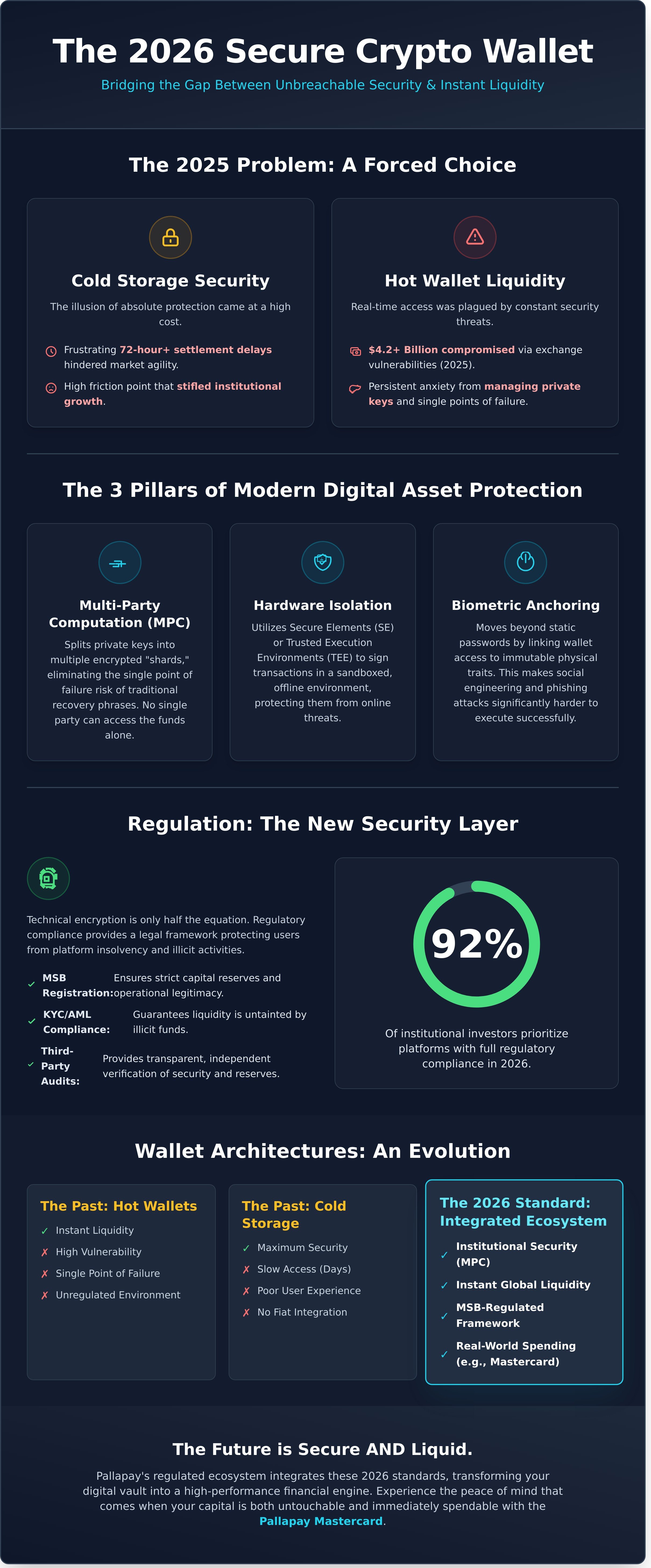
The digital asset landscape has shifted from experimental hobbyism to institutional necessity. By 2026, a Cryptocurrency wallet is no longer just a digital container for private keys; it’s a sophisticated financial gateway that must withstand both social engineering and advanced computational threats. While a 24-word recovery phrase was the gold standard in 2021, modern security requires multi-factor cryptographic signatures and hardware-level isolation to remain effective. Security is non-negotiable. As institutional adoption hit 85% among global hedge funds by the end of 2025, the infrastructure supporting these assets had to evolve. A secure crypto wallet today integrates biometric verification, multi-party computation (MPC), and real-time transaction screening to prevent unauthorized outflows.
Distinguishing between custodial and sovereign security is the first step for any serious participant. Custodial solutions provide ease of use by delegating key management to a provider, which is often preferred by high-volume merchants who require instant liquidity. Sovereign self-custody offers total independence but places the burden of protection entirely on the individual. Choosing the right path depends on your specific business needs and risk tolerance. Most professional users now opt for a hybrid approach, utilizing regulated gateways for daily operations while maintaining cold storage for long-term reserves.
The Core Pillars of Digital Asset Protection
Modern encryption has moved beyond the standard AES-256 protocols that dominated the last decade. With the finalization of the NIST Post-Quantum Cryptography (PQC) standards in 2024, a secure crypto wallet must now implement lattice-based signatures to protect against future quantum computing threats. Open-source architectures remain the industry preference because they allow for public auditing of the code. This transparency ensures no hidden backdoors exist within the software. Sovereign Security is the user’s absolute control over private keys without third-party interference. This pillar ensures that even if a service provider ceases to exist, your funds remain accessible and under your exclusive command.
- Multi-Party Computation (MPC): Splitting keys into multiple shards to eliminate a single point of failure.
- Hardware Isolation: Using Secure Elements (SE) or Trusted Execution Environments (TEE) to sign transactions offline.
- Biometric Anchoring: Linking wallet access to immutable physical traits rather than just static passwords.
Why Regulation is the New Security Layer
Technical encryption is only half of the safety equation. Regulatory compliance provides the legal framework that protects users from the platform insolvencies seen during the 2022 market volatility. Money Services Business (MSB) registration in the United States and Canada is now a critical indicator of a provider’s legitimacy. These registrations require firms to maintain strict capital reserves and undergo regular third-party audits. When a platform is regulated, it means your fiat-exit ramps are monitored and secure. It’s a fact that unregulated entities often lack the insurance and legal accountability necessary to protect users during a liquidity crisis. In 2026, 92% of institutional investors prioritize platforms with full KYC/AML compliance because it guarantees that the liquidity they interact with is untainted by illicit activity. This alignment with global financial standards makes the complex world of crypto-fiat conversion feel like a standard, effortless business operation.
The transition from “wild west” finance to a structured fintech ecosystem is complete. Choosing a wallet today means looking for a partner that balances cutting-edge cryptography with institutional-grade reliability. This ensures your growth is never hindered by technical or legal vulnerabilities.
Technical Security Standards: MPC, Multi-Sig, and Hardware
Traditional digital asset storage relied on a single private key. This created a dangerous single point of failure; if a thief accessed that key, the funds were gone. Modern institutional finance has moved toward distributed security models to ensure a truly secure crypto wallet environment. These standards don’t just protect against external hacks. They also mitigate internal risks like employee theft or accidental loss. By 2025, 85% of institutional-grade platforms have integrated these advanced cryptographic standards to manage high-volume liquidity and protect client assets.
MPC vs. Multi-Sig: Which is Right for You?
Multi-Party Computation (MPC) represents a shift toward “keyless” cryptography. Instead of a whole private key existing in one place, MPC splits the key into multiple “shards” distributed across different servers or devices. These shards compute a digital signature without ever revealing their individual parts to each other. This means there’s no physical seed phrase for a hacker to intercept. It’s a fluid system where shards can be refreshed regularly, making it nearly impossible for an attacker to gather enough pieces to compromise the wallet.
Multi-signature (Multi-sig) setups function differently by requiring multiple distinct signatures to authorize a single transaction. For a 3-of-5 setup, three separate individuals or devices must approve the spend before it hits the blockchain. This remains the preferred choice for corporate treasury management and family wealth. When evaluating technical security features, many businesses choose multi-sig because it creates a clear, on-chain audit trail of who authorized each movement of funds. While MPC offers better signing speed, Multi-sig provides a transparent governance structure that is vital for regulatory compliance.
Recovery workflows also distinguish these two technologies. MPC-based systems often use social recovery or cloud-based shard backups, which eliminates the stress of guarding a 24-word paper backup. Multi-sig usually requires each participant to manage their own traditional BIP-39 seed. This creates a more decentralized but operationally complex recovery process. If your priority is operational speed, MPC is the winner. If you need a rigid, transparent approval chain, Multi-sig is the superior option.
The Role of Physical Hardware in 2026
Hardware Security Modules (HSM) represent the pinnacle of protection for global fintech leaders. These aren’t consumer gadgets; they’re dedicated physical servers used by banks to handle cryptographic keys in a tamper-proof environment. While consumer hardware wallets are effective for individuals, they lack the massive throughput required for a high-volume secure crypto wallet used by merchants. Institutional platforms use HSMs to ensure that even if the software layer is breached, the physical hardware remains uncompromised.
- Air-Gapped Devices: These remain the gold standard for long-term “HODLing” because they never connect to the internet. They use QR codes or SD cards to sign transactions, creating a physical gap that remote hackers can’t bridge.
- NFC Secure Elements: New NFC-enabled chips allow you to tap-to-pay at retail locations while keeping your keys inside a hardened hardware environment. This combines cold-storage security with the speed of a credit card.
- Biometric Integration: Fingerprint and facial recognition now act as the final gatekeeper, ensuring that physical possession of a device isn’t enough to move funds.
Hardware security is only as strong as the supply chain that delivered the device. This is why professional entities only source equipment directly from certified manufacturers. To bridge the gap between these complex technical standards and your daily business needs, Pallapay provides a professional bridge that handles the heavy lifting of security behind the scenes. This allows you to focus on growth while the underlying technology maintains institutional-grade reliability.
Hot Wallets vs. Cold Storage vs. Integrated Ecosystems
Choosing a secure crypto wallet requires a calculated assessment of your transaction frequency. You’re balancing the immediate accessibility of funds against the absolute isolation of private keys. Security isn’t a binary state; it’s a spectrum. For most users, the risk isn’t just about hackers. It’s about the “liquidity trap” where assets are safe but inaccessible during urgent market moves. Institutional data from 2023 indicates that over $1.7 billion was lost to DeFi hacks, highlighting why professional-grade infrastructure is no longer optional for serious investors.
Deciding where to hold your assets depends on your 30-day liquidity requirements. You should keep funds on a reputable exchange only if you’re actively trading within a 24-hour window. For any asset held longer than a week, private custody is the mandatory standard. Fragmented applications often fail during high-volatility events, yet an all-in-one secure network maintains uptime. This consistency is why the industry is shifting toward integrated ecosystems that combine the safety of cold storage with the speed of modern fintech.
Hot Wallets: Speed at the Cost of Exposure?
Hot wallets exist as browser extensions or mobile applications. They offer the highest speed for decentralized finance interactions, but this convenience comes with a persistent internet connection. A 2022 cybersecurity audit found that 80% of mobile wallet vulnerabilities originated from improper data encryption within the device’s operating system. Treat these tools as digital “spending accounts” for pocket money rather than vaults for long-term wealth. This guide for investors explains the technical distinctions that every holder must understand before committing significant capital. To mitigate risks, always look for wallets that support mandatory Two-Factor Authentication (2FA), address whitelisting, and real-time transaction simulation to catch malicious smart contracts before they execute.
The Hybrid Approach: Integrated Fintech Ecosystems
Pallapay solves the traditional conflict between security and liquidity. Most private wallets leave users in a position where moving assets to spendable cash takes 48 to 72 hours. Our integrated ecosystem eliminates this friction entirely. By connecting a secure crypto wallet directly to the Pallapay Mastercard, you gain the ability to settle transactions instantly at over 60 million points of sale globally. It’s the professional answer to fragmented financial management. You don’t have to choose between keeping your keys and buying a coffee.
Institutional investors and high-net-worth individuals require more than just a software interface. They prefer platforms with physical infrastructure. Pallapay operates physical OTC desks in major financial hubs like Dubai, allowing for high-volume settlements exceeding $100,000 in a controlled environment. This setup provides the reliability of traditional banking with the efficiency of the blockchain. Having a secure wallet linked to a physical POS system ensures that your digital wealth remains a functional tool for business growth, not just a static entry on a ledger. We provide the bridge that makes the future of payments a present-day reality for global merchants.
5-Step Checklist for Choosing Your Secure Crypto Wallet
Selecting the right tool requires a methodical approach. You aren’t just choosing software; you’re selecting a financial partner for the digital age. If you’re managing corporate assets, the criteria shift from simple usability to institutional-grade oversight and regulatory alignment. Use this five-step framework to audit any secure crypto wallet before committing your capital.
- Define your primary utility: Identify if you need a solution for high-frequency daily spending, merchant settlement, or cold storage. A wallet optimized for 20 transactions per hour requires different latency standards than one designed to hold assets for five years.
- Verify jurisdictional compliance: Ensure the provider operates under established frameworks like Dubai’s VARA regulations, established in March 2022. A physical presence provides a layer of accountability that anonymous, decentralized apps cannot match.
- Audit the recovery protocol: Investigate the fail-safe mechanisms. If a device is destroyed, does the provider offer multi-signature recovery or a managed seed phrase service? Relying on a single piece of paper is a 100% risk of total loss.
- Confirm asset breadth: Your wallet must support the tokens that drive modern commerce. As of 2024, USDT and USDC account for over 90% of stablecoin transaction volume. If the wallet doesn’t support these on multiple chains like Ethereum and TRON, it limits your operational reach.
- Map the exit strategy: Evaluate the speed of moving from digital assets to local bank accounts. A platform that offers Instant conversion to fiat is essential for maintaining business liquidity during market volatility.
Evaluating the Provider’s Pedigree
Longevity is the ultimate indicator of security in the fintech sector. Research the founding date; for instance, Pallapay has operated since 2018, providing a six-year track record of stability. Check for independent security audits from firms like CertiK or Hacken, and ensure the provider maintains an active bug bounty program to patch vulnerabilities before they’re exploited. Apply the “Dubai Test” by verifying if the provider has a physical headquarters. Having a local office you can visit for high-level support transforms a digital service into a reliable financial institution.
Assessing Transactional Flexibility
A professional secure crypto wallet must function as more than a vault; it must act as a gateway. For merchants, this means having access to a robust API that handles automated reporting and real-time settlement. Efficiency is the priority here. If your business needs to pay a global supplier, you can’t wait 48 hours for a manual withdrawal process. A wallet without a clear exit strategy is a liquidity risk, regardless of its cryptographic strength. Look for platforms that facilitate Instant crypto-to-fiat transfers to ensure your capital remains productive. This connectivity defines The Future of Payments, where the boundary between digital and traditional finance disappears through seamless integration.
Ready to upgrade your financial infrastructure with a partner that prioritizes both security and speed? Explore our secure crypto wallet solutions to streamline your global transactions today.
Pallapay: The Future of Secure, Liquid Crypto Management
Pallapay serves as a sophisticated bridge between institutional reliability and blockchain innovation. It functions as an MSB-regulated ecosystem where security isn’t just a feature; it’s the foundation. Choosing a secure crypto wallet involves more than just looking at encryption. It requires a partner that manages the entire lifecycle of your assets. Since launching in 2018, Pallapay has focused on providing a utility-driven platform that removes the friction typically associated with digital finance. The “All-in-One” architecture allows you to move from deep cold storage to active spending without ever leaving the ecosystem.
High-volume traders and institutional clients often face liquidity hurdles on standard exchanges. Pallapay solves this through institutional-grade OTC desks in Dubai and Istanbul. These physical hubs handle trades starting at $50,000, providing a level of physical security and privacy that digital-only platforms can’t match. By offering face-to-face settlement, Pallapay eliminates the risks of middleman fraud. This physical presence ensures that high-value transactions are handled with the professional oversight required by modern compliance standards.
The Pallapay POS system extends this security to the retail sector. This hardware secures in-store transactions by utilizing encrypted protocols that confirm payments in under 3 seconds. It protects the merchant’s bottom line by locking in exchange rates at the moment of sale. This ensures that 100% of the transaction value is preserved against market swings. Merchants don’t have to worry about the volatility of the underlying asset; they receive the exact fiat value they expect, instantly.
Global Security with Local Reliability
Pallapay’s presence in 180+ countries ensures that your asset protection is truly borderless. The physical OTC desks provide a tangible safety net for high-value USDT-to-cash exchanges, which is a critical service for users who require immediate liquidity without the 3-to-5-day delays of traditional banks. The Merchant Dashboard complements this by offering 24/7 real-time oversight. Users can track every movement within their secure crypto wallet, ensuring total transparency across all global operations.
Seamless Integration of Spend and Store
The Pallapay Mastercard empowers you to spend your digital assets at over 40 million locations globally. It converts your crypto at the point of sale, making digital wealth as liquid as traditional cash. Additionally, the Crypto Payment Gateway secures the merchant-customer relationship by automating settlement and reducing the risk of chargebacks. This integration creates a closed-loop system where security and speed coexist. Secure your financial future with Pallapay’s all-in-one ecosystem.
Securing Your Digital Assets and Global Reach
Navigating the 2026 digital landscape requires more than just a secure crypto wallet; it demands a comprehensive ecosystem that bridges the gap between safety and utility. You’ve seen that modern protection relies on MPC technology and multi-signature protocols to eliminate single points of failure. Balancing cold storage with high-liquidity tools is no longer optional for those managing professional portfolios. Success in this space depends on choosing partners that prioritize regulatory compliance alongside technical innovation.
Pallapay stands at the center of this evolution. As a regulated MSB in the USA and Canada, we provide the institutional reliability your business requires. Our physical OTC desks in Dubai, Singapore, and Istanbul offer a tangible layer of trust that digital-only platforms can’t match. We currently empower merchants in 180+ countries to process instant payments without friction. You don’t have to choose between rigid security and global growth when the right infrastructure handles the heavy lifting for you.
Experience the Future of Payments with Pallapay
Your journey toward borderless, secure finance starts today.
Frequently Asked Questions
What is the most secure way to store crypto in 2026?
Cold storage hardware wallets remain the gold standard for a secure crypto wallet in 2026. These devices keep private keys offline, protecting them from 100% of remote digital attacks. By utilizing a multisig setup, users require two out of three unique keys for transaction approval. This method is the preferred choice for the 85% of institutional investors who prioritize long-term asset preservation over daily trading speed.
Can a secure crypto wallet be hacked?
No wallet is entirely immune to human error, though technical breaches of offline cold storage are statistically rare. Most losses occur through phishing; for example, 70% of crypto thefts in 2023 resulted from compromised seed phrases rather than software exploits. You’ve got to treat your physical recovery keys as the ultimate master key. If you don’t expose your phrase online, your digital assets remain virtually untouchable by hackers.
Is a hardware wallet better than a software wallet for high-volume traders?
High-volume traders benefit from a hybrid approach that prioritizes both speed and safety. While software wallets offer instant liquidity for daily trades, a hardware-based secure crypto wallet should hold 90% of long-term assets. This strategy limits exposure to the $3.8 billion in digital assets lost to exchange hacks and hot wallet exploits annually. It’s the most efficient way to balance active market participation with institutional-grade security.
What happens if I lose my secure crypto wallet device or seed phrase?
Losing your physical device is manageable if you have your 12 or 24-word recovery phrase. You’ll simply input these words into a new compatible device to restore your entire balance instantly. However, losing the seed phrase itself results in the permanent loss of funds, as there’s no “forgot password” feature in decentralized finance. Statistics show that roughly 20% of all existing Bitcoin is currently inaccessible due to lost recovery keys.
How do I securely convert crypto from my wallet to cash in Dubai?
You can securely convert crypto to cash at Pallapay’s physical branches located in Dubai’s major business hubs. Our OTC desks process transactions in under 15 minutes, allowing you to walk out with AED or USD immediately. This professional service eliminates the 3% to 5% slippage often found on unregulated peer-to-peer platforms. It’s a seamless bridge for users who need to move between digital assets and local fiat currency without delay.
Why is MSB registration important for a crypto wallet provider?
MSB registration ensures that a provider complies with the Bank Secrecy Act and undergoes regular audits by FinCEN. This regulatory oversight protects users from fraud by requiring the company to maintain a 1:1 reserve ratio for all customer deposits. It transforms a simple digital tool into a reliable financial partner for institutional-grade settlements. Working with a registered entity reduces your legal risk in 180 different jurisdictions globally.
Are stablecoins like USDT safer to store in a wallet than Bitcoin?
Stablecoins like USDT are safer regarding price volatility, but they carry the same technical storage risks as Bitcoin. While Bitcoin’s value fluctuated by 150% in 2023, USDT remained pegged to $1.00, making it ideal for immediate business liquidity. Both assets require the same high-level encryption protocols to prevent unauthorized access. Using a professional gateway ensures your stablecoin transactions are settled instantly without the typical market turbulence of unpegged assets.
How does Pallapay ensure the security of its payment gateway and POS machines?
Pallapay utilizes military-grade AES-256 encryption and PCI DSS Level 1 compliance to secure every transaction across our global network. Our POS machines process payments instantly while isolating sensitive data from the public internet. This architecture ensures that 100% of merchant settlements are protected against external interference and unauthorized data skimming. We’ve designed our ecosystem to handle the heavy lifting of security, allowing businesses to focus on growth and global expansion.
Leave a Reply