

What if the operational friction of reconciling crypto payments for merchants is the only thing preventing your firm from capturing the historic volatility of 2026’s gold markets? Many institutional leaders view digital assets as a compliance burden, struggling to align transparent blockchain data with legacy ERP systems under the weight of the GENIUS Act. It’s a common frustration to feel that your liquidity is trapped in a web of regulatory uncertainty and complex tax treatments.
We’ll show you how to transform this back-office challenge into a powerful engine for strategic growth. By adopting a fair value measurement approach in line with FASB ASU 2023-08, you’ll unlock the ability to pivot crypto revenue directly into high-yield CFD trading. This framework ensures your business moves beyond mere payment acceptance to master the mechanics of Gold and USD CFDs, where gold’s climb past $5,000 has redefined the potential for wealth preservation. You’re about to learn how to build a streamlined, compliant workflow that bridges the gap between disruptive innovation and institutional financial reliability. This article provides a logical, step by step progression through the technical integrations and procedural flows necessary to accelerate your progress in the modern commerce landscape.
Key Takeaways
- Establish a robust framework for reconciling crypto payments for merchants to ensure absolute data integrity between blockchain transactions and institutional ERP systems.
- Convert stagnant crypto liquidity into active market power by utilizing reconciled reserves for high-yield Gold and USD CFD trading.
- Implement sophisticated hedging strategies through XAU/USD CFDs to protect your corporate wealth from the erosion of traditional fiat currency value.
- Align your financial reporting with the latest FASB fair value standards to enhance institutional transparency and secure board-level confidence in your digital asset strategy.
- Streamline global operations by integrating advanced payment APIs and POS terminals that automate the complex background processes of digital asset conversion and settlement.
The Strategic Mandate: Why Crypto Reconciliation is Non-Negotiable in 2026
The process of reconciling crypto payments for merchants is no longer a niche accounting task. It’s the essential verification of every blockchain transaction against internal ledgers and ERP systems. This ensures that the digital trail matches your financial reality. In 2026, we’ve moved past the era of mere speculative holding. We are witnessing a “Global Evolution” where digital assets serve as functional utility tools. To understand this shift, a foundational overview of cryptocurrency reveals how decentralized technology has matured into an institutional-grade asset class that demands rigorous oversight.
Legacy banking systems often struggle with 24/7 liquidity. They operate on restricted hours and suffer from settlement delays. Blockchain technology eliminates these barriers. It provides real-time settlement that operates without pause, even on weekends. For modern merchants, USDT has emerged as the primary unit of account. It offers the stability needed for precise reconciliation while maintaining the speed of a digital native asset. Using fiat settlement services allows firms to anchor these digital gains in traditional value, creating a seamless bridge between two financial worlds.
From Speculation to Standard: The 2026 Market Context
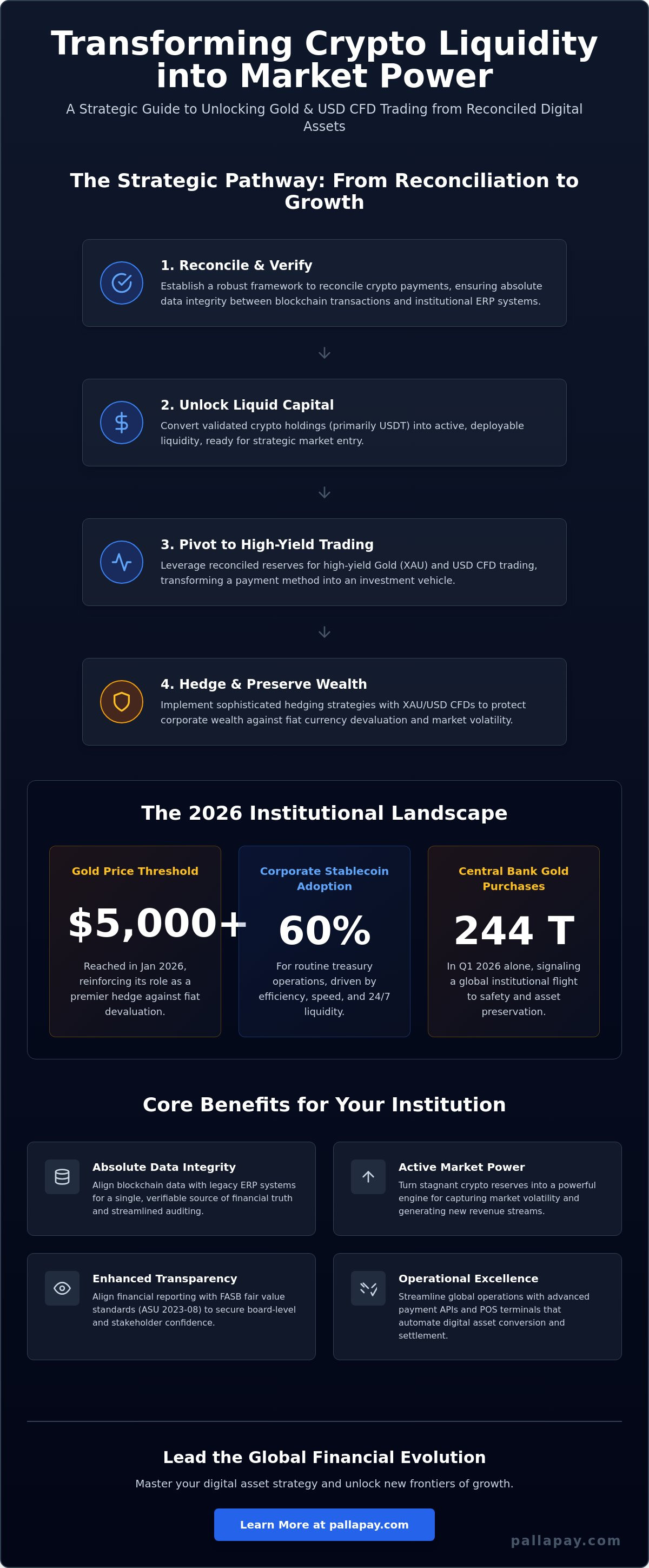
MSB-registered providers have successfully institutionalized digital asset rails, making them as reliable as traditional payment networks. The “Institutional Pivot” is now defined by the industry-wide shift toward 60% corporate adoption of stablecoins for routine treasury operations. This shift reflects a preference for efficiency. Blockchain settlements bypass the friction of cross-border intermediaries. They provide a direct path to liquidity that traditional systems simply can’t match. This speed is a competitive necessity.
Identifying the Strategic “Why” for Your Stakeholders
Adopting crypto isn’t just about following a trend. It’s about aligning your firm with innovation, speed, and absolute financial security. When you master the art of reconciling crypto payments for merchants, you create a foundation for attracting tech-savvy global consumers. These users demand efficiency, a standard often seen on platforms like CommercePal, where a wide range of products are delivered through a seamless digital experience. They expect the same real-time responsiveness from their financial partners that they get from every other digital service. You’re building trust through technical competence.
Ignoring this liquidity creates a significant competitive risk. In a globalized economy, the ability to settle instantly and pivot that capital into growth opportunities is a massive advantage. Proper reconciliation allows you to prove the ROI of these assets to your board. It transforms a perceived risk into a verifiable strategic asset. This clarity is what allows a business to move with confidence into advanced markets. It opens the door to high-impact opportunities like gold and USD CFD trading, where real-time capital deployment is the difference between stagnation and growth.
Expanding the Horizon: Unlocking Gold and USD CFD Trading
The successful practice of reconciling crypto payments for merchants produces more than just accurate books. It generates verified, real-time liquidity that serves as the engine for institutional growth. Instead of letting digital assets sit dormant, forward-thinking firms now leverage these reconciled reserves to enter high-yield CFD trading. This strategic move transforms a payment method into an active investment vehicle. Gold and USD CFDs allow businesses to capture market volatility and protect corporate wealth without the friction of physical delivery.
Gold CFD trading (XAU/USD) has become a vital component of modern treasury management. With gold prices surpassing the $5,000 threshold in January 2026, the commodity remains a premier hedge against fiat devaluation. Merchants who maintain precise ledgers can quickly pivot their USDT holdings into gold positions. This provides a layer of stability that traditional currency holdings often lack. Central banks purchased 244 tonnes of gold in the first quarter of 2026 alone, signaling a global flight to safety that merchants can mirror through sophisticated trading strategies.
The Power of XAU/USD: Hedging with Digital Gold
There’s a powerful synergy between holding USDT and trading gold CFDs. This combination offers portfolio stability in an era of currency fluctuation. A unified ecosystem allows a merchant to move from settlement to active commodity trading in minutes. This efficiency is critical for high-volume traders who need to capitalize on daily price ranges that now frequently reach $150. By leveraging digital assets, firms can execute large-scale gold trades with a level of speed that legacy systems can’t match.
Forex Trading: A New Frontier for Corporate Treasury
Forex trading through USD CFDs offers a new frontier for corporate growth. USD/crypto pairs provide superior liquidity compared to traditional banking channels, which often suffer from weekend gaps and settlement delays. Successful CFD strategies can have a life-changing financial impact on a business’s trajectory, turning operational revenue into significant capital gains. CFD leverage can amplify market exposure for sophisticated institutional traders, allowing them to control larger positions with a smaller initial capital outlay.
Navigating these markets requires a deep understanding of the legal landscape. Adhering to U.S. regulatory requirements for crypto businesses ensures that your trading activities remain compliant with global AML standards. For those ready to transition from simple acceptance to active growth, utilizing a professional fiat settlement solution is the first step toward institutional-grade capital management.
Addressing Stakeholder Concerns: Risk, Regulation, and FASB
The transition toward institutional digital asset adoption requires more than just market enthusiasm. It demands a rigorous accounting foundation. FASB ASU 2023-08 has fundamentally changed the landscape by requiring companies to measure crypto assets at fair value. This shift is a significant win for institutional transparency. It moves away from the old impairment-only model, where businesses could only report losses but not gains. Now, reconciling crypto payments for merchants aligns perfectly with standard financial reporting. This clarity allows CFOs to present a real-time view of corporate liquidity to the board, making digital assets as reportable and predictable as traditional cash reserves.
Stakeholders often raise the “Volatility Objection” when discussing digital assets. We solve this by integrating sophisticated fiat settlement protocols and the use of USDT. These tools allow a business to accept crypto while instantly locking in the value in a stable currency. This process ensures that the capital intended for gold and USD CFD trading isn’t eroded by intraday price swings. By using a bridge like USDT, you maintain the speed of the blockchain without the exposure to market fluctuations. It’s a pragmatic approach that prioritizes capital preservation.
Trust is further reinforced through strict regulatory adherence. Working with providers that maintain MSB registration in the US and Canada is essential for building long-term institutional confidence. These registrations signal a commitment to global AML and BSA standards, ensuring that every transaction is compliant. Secure custody is the final piece of this puzzle. Utilizing enterprise-grade Crypto Wallets and OTC desks mitigates the risk of asset loss, providing a secure environment for high-volume treasury operations.
Compliance as a Competitive Advantage
Working with a regulated partner simplifies the KYC/AML burden for your internal teams. It transforms compliance from a hurdle into a strategic asset. Instant fiat conversion removes balance sheet volatility, allowing for cleaner audits. When preparing for an audit, best practices include maintaining a detailed sub-ledger of all blockchain interactions. This level of disclosure builds immense trust with investors and stakeholders who value precision and foresight.
Institutional Security Architecture
Protecting enterprise-grade assets requires a multi-layered security protocol. This includes cold storage solutions, multi-signature authorization, and rigorous internal controls. Accountability is paramount; therefore, choosing partners with a global physical presence is a necessity. For a deeper dive into these protective measures, consult our guide on Crypto Security in 2026. These systems ensure that your path toward the “Global Evolution” of finance is grounded in absolute stability.
Operational Excellence: Integrating the Payment Infrastructure
Achieving institutional growth requires a shift from manual oversight to automated, real-time infrastructure. The foundation of this transition is the integration of a Payment API. This tool doesn’t just process transactions; it creates a direct data bridge between decentralized networks and your internal ledgers. By automating the flow of information, reconciling crypto payments for merchants becomes an effortless background process rather than a month-end burden. This efficiency is what allows capital to move quickly from a customer’s wallet into active trading positions.
Seamless API and POS Integration
Modern APIs connect blockchain data directly to existing ERP systems like NetSuite, ensuring every transaction is accounted for the moment it occurs. This connectivity is equally vital for physical locations where reconciling crypto payments for merchants must happen at the point of sale. For retail stores and the hotel industries, a dedicated Crypto POS machine provides a familiar interface for in-person payments while maintaining instant reconciliation. These devices handle the technical conversion in the background, allowing staff to focus on service while the treasury team receives verified data. For a deeper look at hardware implementation, consult our Crypto POS Machine: The Complete Guide.
High-Volume Liquidity via OTC Desks
Large-scale stakeholders require a personalized approach to execute major asset conversions without disrupting market equilibrium. Standard exchanges often suffer from slippage during high-volume trades, which can erode the profit margins of a successful merchant. OTC desks solve this by providing deep liquidity and fixed-rate execution. This allows you to receive settlements in fiat currency, maintaining standard accounting flows while preparing capital for the Forex market. You can explore these services in our OTC Crypto Exchange: Institutional Guide. This high-volume capability is the prerequisite for the transformative potential of gold and USD CFD trading discussed earlier.
The final step in this operational chain is the Off-Ramp process. It’s the mechanism that converts digital gains into traditional bank deposits with speed and security. In 2026, the efficiency of these transfers has become a benchmark for corporate agility. When your infrastructure is fully integrated, the movement from a crypto payment to a gold-backed trade feels like a single, fluid motion. It’s about removing the friction that once defined the digital asset space.
Ready to modernize your treasury? Integrate our Payment API today to automate your institutional reconciliation and unlock real-time liquidity.
The Transformative Conclusion: Leading the Global Financial Evolution
The era of viewing digital assets as a speculative trend has ended. In 2026, we recognize crypto as a foundational financial tool that drives institutional agility. By mastering the process of reconciling crypto payments for merchants, your organization moves beyond simple transaction processing to gain a definitive strategic advantage. This verified liquidity provides the immediate capital required to engage in integrated Forex and Gold CFD trading. These markets offer life-changing potential for corporate growth, allowing firms to pivot from passive holders to active market participants who can capitalize on global volatility in real time.
Pallapay serves as the professional bridge between established legacy systems and the modern frontier of finance. We provide the technological answers to your operational needs, ensuring that reconciling crypto payments for merchants feels like a standard, effortless business operation. Our ecosystem is designed to handle the complex background processes of blockchain verification and settlement so your executive team can focus on high-level treasury strategy. This partnership transforms digital assets from a compliance hurdle into a powerful engine for wealth preservation and capital expansion.
Empowering the Future of Commerce
An integrated ecosystem empowers executives to manage and spend crypto globally with the same ease as traditional fiat currency. We are moving toward a borderless financial system where gold, fiat, and digital assets coexist seamlessly within a single corporate treasury. This fluidity is essential for maintaining a competitive edge in a globalized economy. By adopting these tools today, you ensure that your business can move with the speed of the blockchain while maintaining the security of institutional-grade finance. Innovation is the only insurance against obsolescence in this rapidly accelerating landscape.
The synergy between digital payments and commodity trading creates a robust defense against inflation. When your reconciliation workflow is streamlined, you can move capital into XAU/USD positions the moment market conditions are favorable. This level of responsiveness is what defines a forward-thinking firm in 2026. You aren’t just accepting payments; you’re building a sophisticated financial architecture that spans across asset classes and jurisdictions.
Next Steps for Your Organization
The journey toward institutional integration begins with a clear, actionable strategy. We recommend scheduling a consultation with a Pallapay strategic partner to develop a tailored integration plan that meets your specific operational requirements. You can also review our e-commerce industry solutions to see how our API and reconciliation tools fit your current business model. We invite you to experience the speed and reliability of Pallapay’s global OTC network to accelerate your progress toward the global financial evolution.
Empowering Your Institutional Evolution
We’ve established that a robust framework for reconciling crypto payments for merchants isn’t just about compliance; it’s the gateway to active capital management. By aligning with FASB fair value standards and integrating automated APIs, you transform digital revenue into a high-impact asset. This liquidity allows your firm to seize opportunities in gold and USD CFD trading, turning every transaction into a strategic step toward long-term wealth preservation.
Pallapay provides the security and global reach necessary for this financial transition. As a partner MSB registered in the USA and Canada, with physical OTC offices in Singapore and Istanbul, we offer the accountability that institutional stakeholders demand. We’re already trusted by merchants in over 180 countries to handle the complex mechanics of the digital economy. It’s time to move beyond simple payment acceptance and embrace a comprehensive treasury strategy.
Partner with Pallapay to revolutionize your corporate finance and unlock global CFD markets today.
Your path to a borderless financial future is ready and waiting for your first move.
Frequently Asked Questions
How do I explain the tax implications of crypto payments to our CFO?
Under FASB ASU 2023-08, digital assets are now measured at fair value, which aligns crypto reporting with standard financial practices. This shift means that both gains and losses are recognized in the income statement, providing the transparency CFOs require for corporate audits. Proper reconciliation creates a verified trail that simplifies tax filings and proves the strategic value of digital assets. It’s a move toward institutional clarity that replaces speculative uncertainty with reliable financial data.
Is it possible to accept crypto payments without holding volatile assets on our balance sheet?
You can accept digital assets without exposure by utilizing fiat settlement services and stablecoins like USDT. These tools facilitate the immediate conversion of incoming crypto into stable currency the moment a transaction is confirmed. This process is a critical component of reconciling crypto payments for merchants who prioritize capital stability. It ensures your balance sheet remains protected from market swings while still capturing the efficiency and speed of blockchain-based commerce.
What are the specific benefits of trading Gold CFDs with crypto liquidity?
Utilizing reconciled crypto liquidity for Gold CFDs (XAU/USD) provides a sophisticated hedge against the devaluation of traditional fiat currencies. It allows your organization to pivot operational revenue into high-yield commodity markets where gold surpassed $5,000 in early 2026. This strategy transforms dormant capital into an active investment vehicle for wealth preservation. It offers the potential to enhance your corporate treasury’s performance without the logistical challenges associated with physical gold storage.
How does Pallapay ensure compliance with US and Canadian MSB regulations?
Pallapay maintains active MSB registrations in both the United States and Canada to ensure full adherence to global AML and BSA standards. We implement rigorous internal controls and customer due diligence protocols to protect the integrity of every transaction. This regulatory commitment provides institutional stakeholders with the absolute trust needed for large-scale financial operations. Our compliance framework serves as a professional bridge that connects modern technological advancements with established institutional reliability.
Can we use crypto payments to settle international invoices for our retail stores?
Crypto payments are an ideal solution for settling international invoices because they bypass the friction and delays of legacy banking systems. This real-time settlement capability allows retail stores to manage global supplier relationships with significantly greater agility. It eliminates high intermediary fees and ensures that capital reaches its destination in minutes rather than days. It’s a borderless financial tool that simplifies the complexities of modern commerce for forward-thinking retail organizations.
What is the difference between a standard crypto exchange and an institutional OTC desk?
Standard exchanges are built for retail volume and often suffer from significant slippage during large-scale transactions. An institutional OTC desk provides deep liquidity and personalized service to execute high-volume trades at fixed rates. This ensures that major asset conversions don’t disrupt market prices or erode your profit margins. OTC desks are the definitive destination for stakeholders who require secure, efficient background processes for managing substantial corporate treasury movements.
How long does it take to integrate a crypto payment API into our existing website?
Integrating a professional payment API typically takes between five to ten business days depending on your current technical infrastructure. Modern APIs are designed for rapid deployment and connect directly to existing ERP systems to automate data flows. This efficiency allows your business to quickly begin reconciling crypto payments for merchants without disrupting daily operations. Our technical integrations are focused on simplicity and growth, ensuring a frictionless transition into the digital asset ecosystem.
How does CFD trading on USD pairs help in managing currency risk?
CFD trading on USD pairs allows firms to hedge against currency fluctuations by taking strategic positions on market movements. This approach protects your organization’s purchasing power and maintains stable margins even during periods of fiat volatility. It provides a sophisticated layer of financial insurance for companies that operate across multiple international jurisdictions. By leveraging these trading tools, you can turn currency risk into a managed strategic component of your broader corporate finance framework.
Disclaimer
The information provided on this website and blog is for general informational and educational purposes only and does not constitute financial, investment, legal, tax, or other professional advice.
Cryptocurrency and digital asset services may be subject to regulatory restrictions in certain jurisdictions. Users are solely responsible for ensuring compliance with applicable local laws and regulations before using any products or services mentioned on this website.
PallaPay does not guarantee the accuracy, completeness, or timeliness of any information published and accepts no liability for any loss or damages arising from reliance on the content. Any opinions expressed are those of the respective authors and may change without notice.
Certain services, features, or products referenced may be provided through third-party partners, licensed entities, or affiliated service providers subject to separate terms and regulatory approvals. Availability of services may vary by country or region.
This website may contain references to digital assets, virtual currencies, or blockchain-related services that are not available to residents of certain jurisdictions, including where prohibited by law. Nothing on this website constitutes an offer, solicitation, or recommendation to buy or sell any financial instrument or virtual asset.
Leave a Reply