

In 2025, 15% of purely digital platforms experienced technical glitches during periods of high market volatility, leaving many investors stranded without access to their funds. You’ve likely felt the frustration of high conversion spreads or the persistent fear of a bank account freeze when trying to secure your hard earned profits. It’s a common challenge for those navigating the UAE’s $30 billion crypto investment landscape where speed and reliability are often at odds. Finding a trustworthy crypto to dirham exchange shouldn’t feel like a high stakes gamble with your personal or business capital.
This guide empowers you to master the most secure and compliant methods for converting digital assets into Emirati Dirhams within the 2026 financial framework. We’ll examine how the new federal Decision No. 4/R.M/2026 ensures your protection while highlighting strategies for instant AED liquidity with minimal slippage. You’ll gain a clear roadmap for utilizing professional OTC desks and transparent fee structures to achieve total regulatory peace of mind and immediate cash availability. We’re bridging the gap between blockchain innovation and institutional reliability to deliver the future of payments today.
Key Takeaways
- Navigate the 2026 UAE regulatory landscape to leverage the country’s status as a premier global hub for secure digital asset liquidity.
- Evaluate the trade-offs between online platforms and physical OTC desks to select a crypto to dirham exchange that prioritizes both speed and institutional-grade security.
- Implement a professional checklist for every transaction, ensuring wallet readiness and KYC compliance to achieve instant AED settlement without friction.
- Identify the strategic benefits of an all-in-one fintech ecosystem that bridges the gap between blockchain innovation and traditional Emirati commerce.
Understanding the Crypto to Dirham (AED) Exchange Landscape in 2026
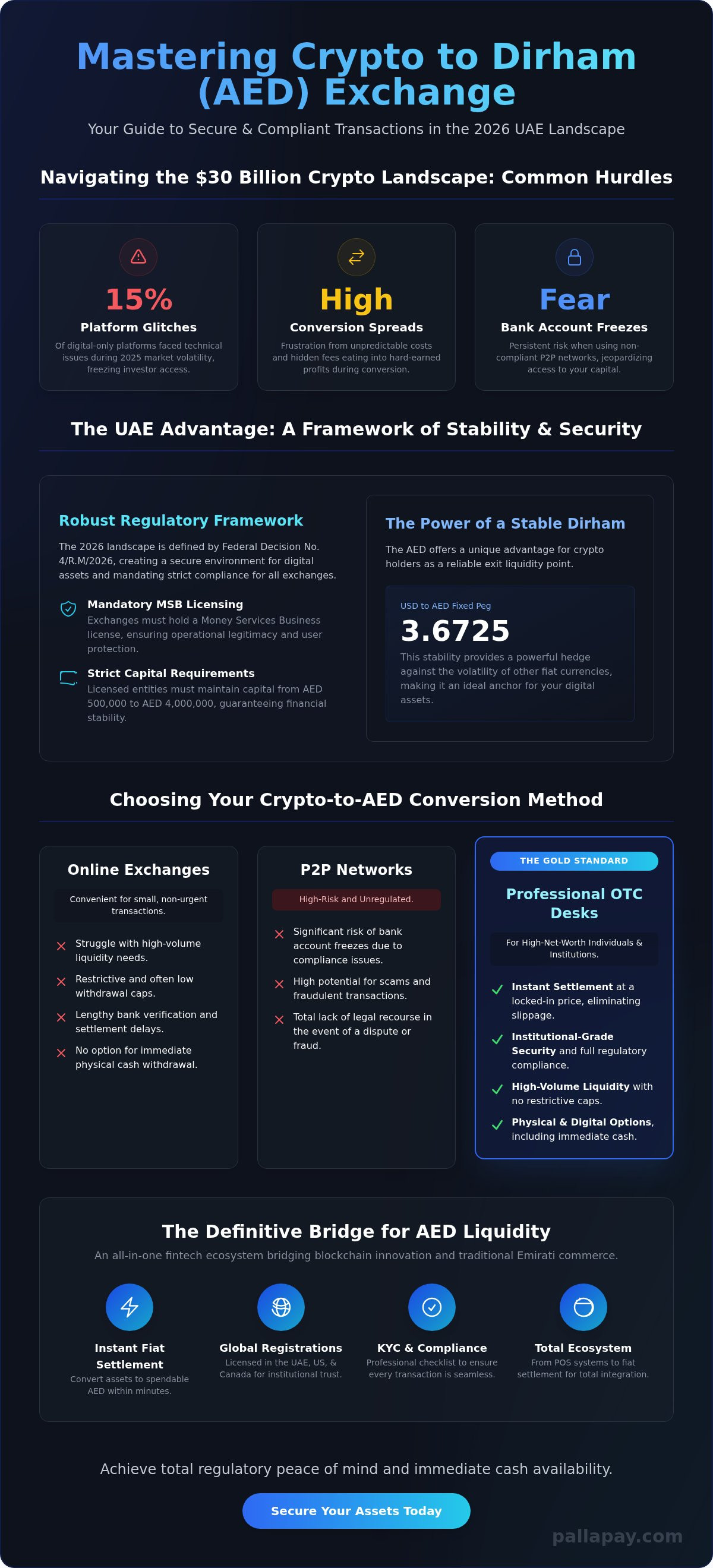
The UAE has solidified its position as a premier destination for digital asset integration, attracting over $30 billion in crypto-related investments between June 2023 and June 2024. In this sophisticated environment, a crypto to dirham exchange functions as the essential infrastructure that converts digital volatility into local stability. It’s the critical bridge that allows high net-worth individuals and institutional entities to move fluidly between the borderless world of blockchain and the tangible Emirati economy. By 2026, this process has evolved from a speculative luxury into a standard operational requirement for modern commerce.
Market maturation has fundamentally changed how users interact with their digital wealth. While 15% of purely digital platforms suffered from technical glitches during 2025’s market volatility, the UAE’s focus on robust physical and digital infrastructure has provided a safer alternative. Businesses now utilize these exchanges for practical fiat settlement and everyday utility rather than simple price exposure. This shift ensures that digital assets are no longer isolated in wallets but are active participants in the national GDP.
The Role of the Dirham in the Global Digital Economy
The UAE Dirham offers a unique advantage for crypto holders due to its fixed peg of 3.6725 to the US Dollar. This stability provides a reliable hedge against the fluctuations often found in other fiat currencies, making the AED an ideal exit liquidity point. As the country expands crypto payment systems into hospitality and luxury retail, the demand for immediate conversion has surged. AED liquidity is the ability to convert digital assets into spendable local currency within minutes to facilitate high-value transactions. This seamless integration allows investors to acquire real estate and premium goods with the same ease as using a traditional bank account.
Regulatory Compliance and MSB Registration in 2026
Security in the 2026 landscape is defined by strict adherence to federal law. The issuance of Decision No. 4/R.M/2026 by the Capital Markets Authority has created a clear framework for every crypto to dirham exchange operating within the federation. Legitimate providers must maintain Money Services Business (MSB) licensing, which mandates rigorous capital requirements ranging from AED 500,000 to AED 4,000,000. Understanding cryptocurrency legality in the UAE is vital for any user who values asset protection over short-term convenience.
Pallapay enhances this security layer by maintaining global registrations in jurisdictions like the US and Canada, instilling institutional trust that goes beyond local mandates. It’s a “problem-solution” dynamic: users need safety from account freezes, and regulated MSBs provide the technological and legal answer. Choosing a licensed partner isn’t just a legal formality; it’s a strategic move to ensure your capital remains accessible and your financial reputation stays untarnished in an increasingly scrutinized global market.
Primary Methods for Converting Digital Assets to Emirati Dirhams
Selecting the right crypto to dirham exchange requires a calculated evaluation of three primary pillars: online platforms, Peer-to-Peer (P2P) networks, and Over-the-Counter (OTC) desks. Each method presents a distinct balance between speed and cost. While online platforms offer convenience for small amounts, they often struggle with high-volume liquidity and restrictive withdrawal caps. P2P networks, despite their popularity, introduce significant risks including potential bank account freezes and a total lack of recourse in the event of fraud. For institutional entities and high-net-worth individuals, Instant Settlement has emerged as the gold standard, ensuring that digital assets are converted at a locked price without the uncertainty of market slippage.
Online Exchanges and App-Based Conversions
App-based conversions through international digital-only platforms provide a gateway for smaller transactions, but they’re frequently hampered by strict withdrawal limits and lengthy bank verification processes. These platforms often lack the ability to provide immediate physical cash, which remains a requirement for many local business operations. Users often find themselves waiting several business days for funds to clear into their local accounts. This delay can be costly in a fast-moving market where timing is everything. If you’re managing smaller retail amounts, these apps are functional, but they don’t offer the institutional reliability required for professional wealth management.
Over-the-Counter (OTC) Desks: The High-Volume Choice
When transactions exceed the 50,000 AED threshold, Over-the-Counter (OTC) desks become the professional choice. This method eliminates the price volatility found on public order books, allowing for a fixed rate on large blocks of capital. It’s the preferred route for those seeking personalized service and absolute privacy. For a deeper look at these professional structures, consult our OTC Crypto Exchange: The 2026 Institutional Guide. Within the UAE’s virtual asset regulatory framework, licensed OTC providers offer a secure environment that protects both the buyer and the seller from the irregularities of the retail market. This setup ensures that large-scale liquidity doesn’t disrupt market prices or expose your capital to unnecessary risk.
Merchant and Business Liquidity Solutions
Businesses across the federation are increasingly integrating crypto into their core operations, necessitating efficient ways to manage payroll and vendor payments. Utilizing fiat settlement services allows merchants to accept digital payments while receiving AED directly into their accounts, effectively removing volatility from the balance sheet. In retail environments, Crypto POS machines facilitate this transition by providing real-time AED liquidity at the point of sale. This infrastructure enables businesses to scale without the heavy lifting of manual conversions. If you’re looking to streamline your corporate liquidity, exploring a professional off-ramp solution can provide the necessary stability for your growth.
Online vs. Physical OTC: Finding the Best Crypto to Dirham Exchange
Choosing a crypto to dirham exchange often involves a fundamental decision between digital convenience and physical security. While mobile applications offer 24/7 access, they frequently lack the high-volume liquidity and human oversight required for substantial institutional settlements. For many investors, the choice isn’t just about the interface; it’s about the reliability of the settlement process itself. Physical presence bridges the gap between the abstract nature of blockchain and the concrete reality of local currency, providing a level of accountability that an automated algorithm cannot replicate in a high-stakes environment.
The psychological trust factor of visiting a professional office remains a primary driver for high-net-worth individuals and corporate entities. When you’re dealing with significant capital, seeing the provider and their operational infrastructure instills a sense of stability that a screen simply cannot provide. A hybrid model, where you secure a live rate through a digital portal and complete the transaction in a secure business district, offers the efficiency of modern technology with the peace of mind of a face-to-face interaction. This approach ensures that you aren’t just a ticket number in a support queue but a valued partner in a sophisticated financial ecosystem.
The Safety of Physical OTC Desks
Premium exchange locations in major financial hubs implement rigorous security protocols that digital-only apps struggle to match. These physical desks are immune to the technical glitches that affected 15% of purely digital exchanges during the market volatility of 2025. When you’re converting assets through an OTC desk, you’re operating within a controlled environment that prioritizes your privacy and physical safety. These establishments operate under the strict guidelines of the Virtual Assets Regulatory Authority (VARA), ensuring every transaction is logged and compliant with federal mandates. This oversight eliminates the uncertainty often found in P2P transfers where funds can be flagged by banks without warning.
Comparing Fees: What Are You Actually Paying?
Marketing in the fintech space often hides the actual cost of a transaction behind misleading “zero fee” claims. In reality, a “free” exchange might have a 3% spread hidden within the conversion rate, which significantly reduces the final amount of AED you receive. In contrast, a professional crypto to dirham exchange with a transparent fee structure is often the more cost-effective choice for serious traders. To calculate the True Cost of Exchange, you must subtract the final AED received from the total market value of the digital asset at the exact timestamp of settlement. A transparent commission is a hallmark of a visionary partner focused on long-term client growth rather than short-term gains. This clarity allows businesses to accurately forecast their off-ramp requirements without fearing hidden costs.
Step-by-Step: How to Securely Exchange Crypto for AED with Zero Friction
Achieving instant liquidity in the 2026 financial landscape requires a disciplined approach to security and compliance. A professional crypto to dirham exchange isn’t just a simple trade; it’s a precision execution of digital settlement. By following a structured protocol, you eliminate the risks of technical errors and ensure that your digital wealth transitions into spendable AED without the delays common in traditional banking. Precision at every stage is the hallmark of a sophisticated investor who values both time and capital integrity.
Preparing Your Digital Wallet for Exchange
Before initiating a transaction, you must ensure your assets reside on a network that balances speed with cost efficiency. As established earlier, utilizing the TRC20 network for stablecoins remains a preferred choice due to its optimized fee structure compared to legacy alternatives. Using the Pallapay Wallet provides a secure, institutional-grade staging area for your assets before they’re moved to the final exchange point. It’s vital to verify the destination address twice; in the immutable world of blockchain, a single character error results in permanent asset loss, making this double-check your most important security habit.
The Execution: From Crypto Transfer to Cash in Hand
The conversion process follows a logical, four-step progression designed for maximum efficiency. First, you book your rate online to lock in current market prices or visit a professional OTC desk for a face-to-face consultation. Second, you transfer the digital asset to the secure exchange wallet provided by the service. Third, you monitor the transaction on the blockchain; confirmation typically occurs within three to ten minutes depending on network congestion. Finally, you receive your AED via your preferred method, whether it’s physical cash, a direct bank transfer, or a card top-up. This streamlined flow handles the heavy lifting of technology behind the scenes, allowing you to access your capital instantly.
Managing Large Volume Transactions
Institutional clients and high-net-worth individuals require a higher tier of service for transactions exceeding AED 50,000. Dedicated account managers oversee these high-volume exchanges, providing a bespoke bridge between complex blockchain settlements and traditional financial systems. For a comprehensive breakdown of these professional services, consult our Sell USDT for Cash 2026 Guide. Managing these transactions requires meticulous receipt management and clear reporting to ensure long-term regulatory peace of mind. Every transaction should be documented to satisfy the latest 2026 tax and compliance mandates. If you’re looking to integrate these capabilities into your business, you can secure your liquidity today through our professional off-ramp solutions.
Why Pallapay is the Definitive Bridge for AED Crypto Liquidity
Pallapay functions as a Global Enabler, providing the sophisticated infrastructure required to connect digital wealth with the Emirati economy. It isn’t just a single service; it’s a comprehensive, all-in-one ecosystem that integrates a professional exchange, point-of-sale systems, and a global payment gateway. By positioning itself as a visionary partner, Pallapay handles the heavy lifting of technological integration, allowing users to focus on their own business growth. The competitive edge lies in the word “Instant,” which serves as the rhythmic anchor for every transaction facilitated across its network. Every feature is designed to make the complex world of crypto-fiat conversion feel like a standard, effortless business operation.
While local operations remain the priority, the brand’s global footprint in Singapore and Istanbul ensures that the underlying liquidity is supported by a robust, international framework. This scale allows for a more stable and efficient crypto to dirham exchange experience than what smaller, localized competitors can offer. By bridging the gap between disruptive blockchain innovation and institutional financial reliability, Pallapay ensures that your assets are always safe, accessible, and ready for use in the real world. This commitment to stability is what makes it the definitive destination for all crypto-financial needs in 2026.
The Pallapay Mastercard: AED Liquidity in Your Pocket
The Pallapay Mastercard represents a significant evolution in how digital assets are utilized within the federation. It enables the instant spending of holdings at millions of locations without the need for manual conversion or lengthy bank transfers. Users can access AED liquidity through ATM withdrawals across the UAE, making their digital assets as functional as traditional cash. For those looking to maximize the utility of their portfolio, our 2026 utility guide offers a deep dive into modern spending strategies. This tool effectively removes the friction between holding crypto and participating in the local economy.
Industry-Specific Solutions: Hotels, Retail, and Beyond
Pallapay delivers tailored solutions for diverse sectors, ensuring that businesses can stay ahead of the financial curve. In the hospitality sector, hotels utilize our gateway to accept guest payments in crypto while receiving settled AED to manage their overheads. Similarly, retail stores benefit from real-time settlement that protects their margins from market volatility. For businesses requiring high-level automation, the Payment API allows for seamless integration of conversions into existing accounting and operational software. The future of payments in the UAE is powered by this level of professional, institutional-grade reliability. By choosing a partner that understands the practicalities of modern commerce, you’re securing your place in the inevitable global financial evolution.
Securing Your Position in the Future of Payments
Mastering the 2026 financial landscape requires more than just technical knowledge; it demands a partnership with a reliable global enabler. You’ve learned how the new federal regulations provide a foundation for asset safety and why a transparent fee structure is essential for long-term growth. Trust is paramount. By utilizing a professional crypto to dirham exchange, you bridge the gap between digital innovation and institutional reliability. This strategic approach ensures your capital remains liquid and your business operations stay friction-free.
Pallapay stands as the visionary partner you need, backed by MSB registrations in the US and Canada. Voted the Best Crypto Payment Gateway from 2023 to 2025, we offer a secure ecosystem supported by physical OTC desks in Singapore and Istanbul. Whether you’re managing high-volume institutional trades or seeking everyday utility, our all-in-one platform delivers the stability you deserve. It’s time to accelerate your financial evolution with a partner that handles the heavy lifting for you.
Exchange your Crypto for AED Instantly with Pallapay
Your journey toward seamless AED liquidity starts today. We’re here to ensure every conversion is a standard, effortless part of your success.
Frequently Asked Questions
Is it legal to exchange crypto for Dirhams (AED) in the UAE?
Exchanging digital assets for AED is fully legal under the UAE’s federal regulatory framework. The Capital Markets Authority and the Central Bank govern these transactions to ensure a secure environment for all participants. You’re protected by laws like Decision No. 4/R.M/2026, which mandates that all service providers maintain high capital reserves. This creates a stable landscape where businesses and individuals can operate with absolute regulatory peace of mind.
How long does a crypto to Dirham bank transfer typically take?
A crypto to dirham exchange typically completes within minutes when utilizing instant settlement networks. While some traditional bank transfers might require up to 48 hours for full processing, professional platforms prioritize real-time liquidity to avoid unnecessary delays. This speed ensures that your capital is ready for immediate reinvestment or operational use without the friction of legacy banking. It’s the definitive way to maintain momentum in a fast paced market.
Can I sell USDT for cash without a local bank account?
You can sell USDT for physical cash at regulated OTC desks without the necessity of a local bank account. This service is designed for international investors and users who require immediate liquidity in a tangible format. It’s a standard, professional operation that allows you to receive AED in hand once the blockchain transaction is verified. This method bypasses the complexity of bank verifications and provides a direct path to spendable local currency.
What are the fees for exchanging Bitcoin to AED at an OTC desk?
Fees for Bitcoin to AED conversions at professional desks typically range from 0.5% to 3% based on the total volume and market conditions. Institutional clients often secure more competitive rates due to the scale of their transactions and the frequency of their trades. It’s vital to use a provider with a transparent fee structure to avoid the hidden spreads. Calculating the true cost of exchange is the first step toward maximizing your financial efficiency.
Do I need to provide KYC documents for a crypto to Dirham exchange?
KYC documentation is a mandatory requirement for any compliant crypto to dirham exchange operating in the federation. You’ll need to present a valid passport or national ID to satisfy federal Anti-Money Laundering (AML) mandates. This process ensures that all participants are verified, which maintains the high level of trust and stability expected in the national financial landscape. It’s a small but essential step that handles the heavy lifting of compliance behind the scenes.
What is the maximum amount of crypto I can exchange for AED in one day?
Maximum daily limits vary based on your specific account verification and the provider’s regulatory tier. While standard retail limits exist, institutional desks are capable of handling settlements exceeding AED 4,000,000 per day. These high-capacity channels are essential for large scale businesses that need to move significant capital without impacting market prices. This allows for the standard, effortless transfer of wealth that sophisticated partners require for their daily operations.
Can I use a crypto to Dirham exchange for my business payroll?
Businesses can definitely utilize crypto liquidity bridges to facilitate their local payroll and vendor settlements. By integrating a payment API, a company can automatically convert digital receipts into AED for immediate distribution. This technology allows a modern firm to embrace blockchain innovation while keeping its financial operations grounded in the stability of the local currency. It’s a visionary solution that helps businesses accelerate their own growth in the evolving global economy.
Is there a difference between selling USDT and Bitcoin for AED?
The main difference involves price volatility and the underlying network costs. USDT provides a stable conversion rate due to its peg, while Bitcoin requires careful timing to account for price shifts during the settlement window. Additionally, using USDT on the TRC20 network is often more cost effective than the higher transaction fees typically associated with the Bitcoin blockchain. Understanding these technical nuances helps you choose the most efficient path for your specific liquidity needs.
Disclaimer
The information provided on this website and blog is for general informational and educational purposes only and does not constitute financial, investment, legal, tax, or other professional advice.
Cryptocurrency and digital asset services may be subject to regulatory restrictions in certain jurisdictions. Users are solely responsible for ensuring compliance with applicable local laws and regulations before using any products or services mentioned on this website.
PallaPay does not guarantee the accuracy, completeness, or timeliness of any information published and accepts no liability for any loss or damages arising from reliance on the content. Any opinions expressed are those of the respective authors and may change without notice.
Certain services, features, or products referenced may be provided through third-party partners, licensed entities, or affiliated service providers subject to separate terms and regulatory approvals. Availability of services may vary by country or region.
This website may contain references to digital assets, virtual currencies, or blockchain-related services that are not available to residents of certain jurisdictions, including where prohibited by law. Nothing on this website constitutes an offer, solicitation, or recommendation to buy or sell any financial instrument or virtual asset.
Leave a Reply