

Why risk a lifetime of banking history for a single peer-to-peer transfer? Most investors realize that the line between a successful trade and a permanent bank account freeze is now thinner than ever, especially following the 2024 updates to the UAE’s Anti-Money Laundering standards. In an environment where the Central Bank of the UAE has intensified oversight on unverified transactions, finding a regulated crypto exchange uae is no longer a luxury; it’s a strategic necessity for your financial security.
You’ve likely experienced the confusion of distinguishing between VARA’s 2023 Virtual Asset Framework in Dubai and the ADGM’s FSRA regulations in Abu Dhabi. This 2026 guide eliminates that uncertainty. We’ll show you exactly how to navigate these complex regulatory landscapes to ensure your assets remain safe and your transfers stay instant. We’ll explore the most secure, licensed VASPs for crypto-to-fiat exchange and reveal how to execute high-volume OTC trades with zero slippage. You’ll also discover the precise steps to integrate crypto payments into your local business, turning digital innovation into a standard, effortless operation as we define the future of payments.
Key Takeaways
- Understand the evolving dual-jurisdiction model between VARA and ADGM to navigate the UAE’s sophisticated regulatory landscape with absolute confidence.
- Learn to identify a fully compliant regulated crypto exchange uae by verifying mandatory consumer protection standards and institutional data privacy protocols.
- Compare the fee structures and liquidity profiles of major market leaders to determine the most cost-effective platform for your specific trading or OTC needs.
- Follow a streamlined compliance checklist to ensure seamless onboarding and instant verification using required documentation like your Emirates ID and proof of address.
- Explore how Pallapay functions as a professional bridge, offering an all-in-one ecosystem that integrates high-volume OTC desks with the utility of a global Mastercard.
The Landscape of Crypto Regulation in the UAE (2026)
The United Arab Emirates has solidified its position as the definitive global capital for digital assets. By 2026, the nation’s proactive stance has transitioned from experimental frameworks to a robust, institutional-grade ecosystem. This evolution is driven by a dual-jurisdiction model that provides clear, specialized oversight. While Abu Dhabi Global Market (ADGM) focuses on high-level institutional finance through its Financial Services Regulatory Authority (FSRA), Dubai provides a dedicated path via the Virtual Assets Regulatory Authority (VARA). Choosing a regulated crypto exchange uae is no longer just a preference for traders. It’s a foundational requirement for any entity seeking long-term stability. This regulatory maturity aligns with the global legality of cryptocurrency, positioning the UAE as the gold standard for compliance.
2026 marks a pivotal turning point for institutional adoption. The UAE has successfully integrated blockchain technology into its core financial infrastructure. This shift ensures that every transaction is backed by rigorous safety protocols. Regulated exchanges act as the primary defense against financial crime. They implement sophisticated monitoring systems that protect user assets while maintaining the integrity of the national economy. The result is an environment where trust is built into the technology itself.
VARA: The World’s First Independent Virtual Asset Regulator
Dubai launched VARA in March 2022. It remains the only dedicated regulator of its kind globally. The Virtual Assets and Related Activities Regulations 2023, along with the 2026 policy refinements, provide a granular roadmap for all market participants. Any platform operating in this space must secure a Virtual Asset Service Provider (VASP) designation. This license confirms that the exchange adheres to strict capital requirements and cybersecurity mandates. It creates a transparent environment where institutional liquidity can flow without friction, ensuring that the regulated crypto exchange uae you choose meets the highest international standards.
Why Regulation Matters for Your Bank Account
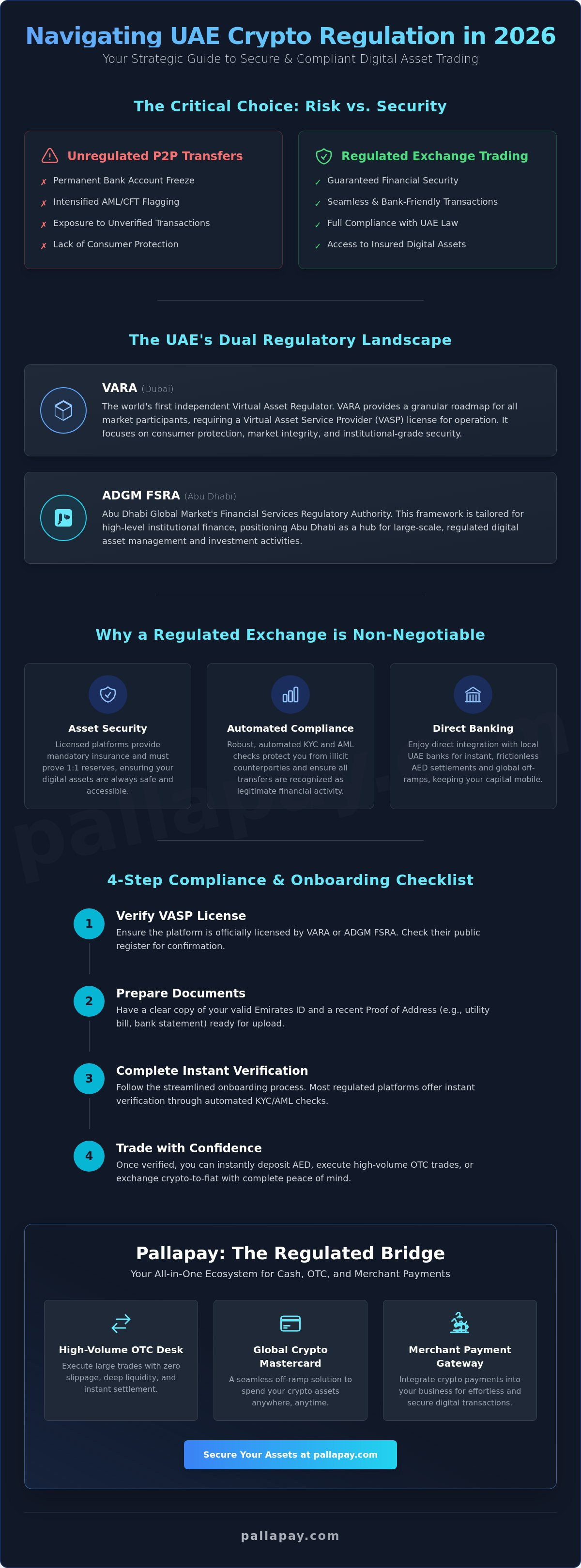
Regulatory compliance is the only way to maintain a healthy relationship with UAE commercial banks. Historically, unlinked crypto activity led to frequent account flagging or closures. In 2026, using a licensed platform ensures that your transactions are recognized as legitimate financial activity. Licensed platforms often hold Money Services Business (MSB) registrations. These registrations facilitate a seamless off-ramp process for global transfers. This professional bridge connects traditional finance with the Future of Payments. It handles the heavy lifting of compliance so you can focus on growth. Using an instant, secure gateway prevents AML complications and ensures your capital remains mobile and accessible.
- Security: Licensed platforms provide mandatory insurance for digital assets.
- Compliance: Automated KYC and AML checks protect you from illicit counterparties.
- Banking: Direct integration with local banks for instant AED settlements.
The VARA Framework: What a ‘Regulated Exchange’ Means for You
In 2026, the definition of a regulated crypto exchange uae has evolved into a benchmark for global finance. Operating under the jurisdiction of the Virtual Assets Regulatory Authority (VARA), established via Law No. 4 of 2022, licensed platforms must adhere to rigorous transparency mandates. These requirements ensure that every dirham or digital token is accounted for through mandatory 1:1 Proof of Reserves. This means the exchange cannot re-hypothecate your assets; they must remain liquid and accessible at all times. Financial transparency is no longer a suggestion but a structural necessity for any entity operating within Dubai’s borders.
Consumer protection standards in 2026 focus heavily on data sovereignty and market integrity. Regulators utilize advanced on-chain monitoring tools to detect market manipulation, wash trading, and insider activity in real-time. If a platform detects suspicious volatility, it must report it to authorities within minutes. Your personal data is shielded by the UAE Federal Decree-Law No. 45 of 2021, which provides a high-level framework for data privacy, ensuring that biometric and financial records remain secure from unauthorized access.
Licensing Tiers: From MVP to Full Market Product (FMP)
Dubai employs a structured, four-stage licensing process to filter out unstable operators. It begins with a Provisional Permit, followed by the Preparatory and Operating MVP licenses. The final stage is the Full Market Product (FMP) license, which allows for unlimited retail and institutional services. You should always cross-reference a platform’s license number on the VARA Public Register before depositing funds. Many top-tier providers also hold international registrations, such as MSB status in Canada or the US, which adds a secondary layer of institutional trust to their operations.
KYC and AML: The Pillars of Secure Exchange
Onboarding at a regulated crypto exchange uae is now a highly efficient experience. Modern platforms use AI-driven biometric tools to complete identity verification in under 120 seconds. For high-volume traders, Source of Wealth (SoW) and Source of Funds (SoF) checks are essential to maintain the UAE’s standing on the global financial stage. These protocols prevent illicit capital from entering the market, ensuring your trading environment remains clean. If you are looking for a professional off-ramp solution that respects these compliance standards, choosing a licensed partner is the only way to guarantee the safety of your settlement.
Top Regulated Crypto Platforms in the UAE: 2026 Comparison
The selection of a regulated crypto exchange uae requires a balance between technological speed and physical security. By January 2026, the market has matured into a two-tier system. Global platforms like Binance and OKX dominate the retail spot market, offering hundreds of trading pairs and complex futures instruments. These platforms are excellent for high-frequency traders who prioritize technical analysis tools. However, they often struggle with local fiat integration for large-scale transfers, leaving users to deal with 3 to 5 day bank delays or restrictive withdrawal limits.
Pallapay addresses these institutional pain points by providing a hybrid model that connects digital efficiency with physical reliability. Unlike purely digital competitors, Pallapay offers Instant fiat-to-crypto settlements. This capability is vital for businesses that need to move capital without waiting for standard banking cycles. The ecosystem acts as a professional bridge, ensuring that liquidity is always available when market opportunities arise. It’s a model that ensures the user never feels overwhelmed by the underlying technology.
- Binance/OKX: Best for retail spot trading and diverse altcoin access. High liquidity for small trades but complex fee tiers for institutions.
- Pallapay: Best for high-volume liquidity, physical security, and Instant AED settlement via off-ramp services.
Retail Trading Apps vs. Institutional OTC Desks
Standard mobile apps aren’t designed for moving millions. When an investor attempts to execute a large order on a retail exchange, they often face “slippage,” where the price moves against them during the trade. Institutional investors avoid this by using an OTC Crypto Exchange: The 2026 Institutional Guide. OTC desks provide a fixed price for the entire block, ensuring “Zero Slippage” execution. This method protects your capital from the volatility of public order books, making it the preferred choice for transactions exceeding 500,000 AED.
The Physical Advantage: Cash-to-Crypto in Dubai
Security for high-net-worth users often requires more than just two-factor authentication. Physical offices in Dubai hubs like Business Bay provide a layer of trust that digital-only platforms cannot replicate. These locations allow for direct, face-to-face transactions and Instant liquidity in AED, USD, or EUR. For those looking to liquidate assets securely, a Sell USDT for Cash in Dubai Guide explains how physical OTC desks facilitate high-value transfers without the risks of P2P scams. This physical presence is a cornerstone of The Future of Payments, where digital assets meet real-world accountability. Choosing a regulated crypto exchange uae with a physical footprint ensures that your Instant transactions are backed by a visible, professional entity.
Compliance Checklist: How to Onboard with a UAE Exchange
Selecting a regulated crypto exchange uae requires a methodical approach to ensure institutional security and legal adherence. By 2026, the UAE regulatory framework has matured into a global benchmark, making the onboarding process both rigorous and efficient. Professional traders and corporate entities shouldn’t overlook the technical nuances of compliance. A mistake during the verification phase can lead to frozen assets or delayed liquidity, which impacts your operational bottom line. Following a structured checklist ensures that your entry into the market is both secure and fully compliant with the latest VARA and ADGM mandates.
- Verify License Status: Cross-reference the provider’s credentials on the VARA Public Register or the ADGM Financial Services Regulatory Authority (FSRA) portal to confirm their active status for 2026.
- Prepare Documentation: Gather high-resolution digital copies of your Emirates ID, a valid passport, and a utility bill or bank statement from the last 90 days to satisfy proof of address requirements.
- Assess Security Protocols: Confirm the platform utilizes multi-signature cold storage and maintains a dedicated insurance fund; these features protect against the 12% increase in sophisticated cyber threats observed globally since 2024.
- Test Support Channels: Initiate a test query to evaluate response times. Institutional-grade service providers should offer a resolution or human response within 60 minutes for high-value accounts.
- Review Fiat Compatibility: Audit the fiat gateway to ensure it supports direct, low-latency transfers with major UAE banks like ENBD or FAB to avoid intermediary delays.
Setting Up Your Professional Wallet
Investors must decide between the convenience of exchange-hosted wallets and the security of self-custody. While hosted wallets offer instant liquidity, self-custody provides total control over private keys. For businesses, the ideal configuration often involves a hybrid model that utilizes Pallapay Wallet and Fiat Settlement for seamless transitions between digital assets and traditional bank accounts. Always store recovery phrases offline in physical form; digital backups remain vulnerable to 85% of standard phishing attempts. Reliable wallets in 2026 now feature biometric integration for enhanced mobile protection.
Executing Your First Regulated Trade
Converting AED to USDT is the foundational step for most UAE traders. Start by depositing fiat through a local bank transfer, which usually clears within 2 to 4 hours in the current banking environment. Once the balance reflects, place a limit order to minimize the impact of maker/taker fees, which typically range from 0.1% to 0.5% on major platforms. In 2026, automated reporting tools are standard. Ensure you download a monthly transaction ledger to simplify your financial filings and maintain compliance with local tax guidelines. This documentation is essential for corporate audits and verifying the source of funds.
Pallapay: The Regulated Bridge for Cash, OTC, and Merchant Payments
Pallapay serves as the definitive bridge between traditional finance and the digital asset economy. By combining global Money Services Business (MSB) registrations with a deep-rooted operational presence in Dubai, the platform provides the security that institutional and retail participants demand. It’s more than a simple gateway; it’s a comprehensive ecosystem designed to eliminate the friction typically associated with large-scale transactions and daily utility. As a premier regulated crypto exchange uae option, Pallapay facilitates high-volume OTC trades while simultaneously empowering users through its proprietary financial tools. This dual focus on institutional liquidity and individual utility has earned the trust of users across 180 countries, solidifying its status as a global enabler of crypto-to-fiat infrastructure.
The platform functions as an all-in-one destination where users can transition from an OTC desk to a physical payment card without leaving the ecosystem. This integration solves the liquidity trap that many face when trying to move between digital assets and local currencies. By handling the heavy lifting of technology behind the scenes, Pallapay ensures that every transaction is secure, instant, and fully compliant with international standards.
Merchant Solutions: Accepting Crypto in the UAE
Businesses no longer need to fear the volatility or technical complexity of digital assets. Pallapay provides the tools for companies in Retail and Hotels to accept payments without price risk. Through specialized hardware, merchants can deploy a Crypto POS Machine to process transactions at the point of sale. For digital storefronts, the Pallapay Payment API offers a seamless integration that handles blockchain verification automatically. This system ensures instant fiat settlement, allowing a business to receive local currency directly into their account, effectively bypassing the complexities of manual conversion and market fluctuations.
The Future of Utility: The Pallapay Mastercard
The Pallapay Mastercard represents The Future of Payments, transforming digital balances into real-world purchasing power. It allows users to spend their holdings at millions of global locations, effectively bridging the gap between a digital wallet and a merchant terminal. This card supports instant top-ups and ATM withdrawals, making it an essential tool for the modern digital nomad who requires liquidity on the go. For a deeper look at how to maximize these features, consult our How to Spend Cryptocurrency Utility Guide. By providing a direct path from the blockchain to the physical economy, Pallapay ensures that digital assets are no longer just speculative investments, but functional tools for daily life.
- Global Reach: Trusted infrastructure serving over 180 countries.
- Instant Settlement: Real-time fiat conversion for merchants to eliminate volatility.
- Institutional Grade: High-liquidity OTC desks for large-scale traders.
- Seamless Utility: Direct spending via Mastercard with global ATM access.
Secure Your Position in the Global Financial Evolution
Navigating the digital asset landscape in 2026 requires a partner that understands the intersection of global compliance and local accessibility. The UAE’s VARA framework has established a gold standard for security, ensuring every transaction meets rigorous regulatory benchmarks. Choosing a regulated crypto exchange uae ensures your capital remains protected within a legal structure that supports both instant liquidity and long-term stability. Compliance isn’t just a requirement; it’s the competitive advantage your business needs to scale safely in a digital-first economy.
Pallapay serves as this essential bridge, operating as a VARA-compliant ecosystem with active MSB registrations in the United States and Canada. We provide more than just digital interfaces. Our physical OTC desks in Dubai, Singapore, and Istanbul offer instant liquidity and the high-touch service professional traders require. It’s time to elevate your financial operations with a platform built for the Future of Payments. Experience secure, regulated crypto exchange with Pallapay. Your journey toward a more efficient and stable financial future begins today.
Frequently Asked Questions
Is cryptocurrency legal in the UAE in 2026?
Cryptocurrency is fully legal in the UAE in 2026, operating under the comprehensive Virtual Assets Law and oversight from the Securities and Commodities Authority (SCA). This legal framework ensures that every regulated crypto exchange uae operates within a secure, institutional-grade environment. Users can trade, hold, and spend digital assets with the confidence that the government provides 100% clear protections and strict oversight for all market participants.
How do I check if a crypto exchange is regulated in Dubai?
You can verify a platform’s status by visiting the Virtual Asset Regulatory Authority (VARA) Public Register on their official 2026 government portal. Every licensed entity receives a specific VASP license number that corresponds to its permitted activities, such as brokerage or exchange services. If an exchange isn’t listed on this updated database, it’s operating without the necessary legal permissions required to serve the Dubai market.
Can I buy Bitcoin with cash at a regulated exchange in the UAE?
You can buy Bitcoin with cash at a regulated crypto exchange uae that holds an over-the-counter (OTC) license. Licensed physical offices provide instant liquidity and allow you to convert AED cash into digital assets while adhering to strict Anti-Money Laundering (AML) protocols. This professional bridge ensures high-volume transactions occur with immediate settlement and institutional security, making it a preferred choice for high-net-worth investors.
What is the difference between VARA and ADGM regulations?
VARA regulates the virtual asset sector across the entire Emirate of Dubai, excluding the Dubai International Financial Centre (DIFC). The Abu Dhabi Global Market (ADGM) operates through its Financial Services Regulatory Authority (FSRA) specifically for entities within that 114-hectare international financial zone. Both frameworks provide high-level institutional stability, but they differ in geographical jurisdiction and the specific compliance requirements they set for virtual asset service providers.
How much are the fees for regulated crypto exchanges in Dubai?
Trading fees at regulated platforms in Dubai typically range from 0.1% to 0.5% for standard spot exchange transactions. Instant buy services or physical OTC desks may charge between 1% and 3% to cover the cost of immediate liquidity and personalized service. These costs are transparently disclosed before any transaction occurs, ensuring that users can manage their capital without encountering hidden expenses or unexpected charges in 2026.
What documents do I need for KYC at a UAE crypto exchange?
You need a valid Emirates ID, a passport copy, and a recent utility bill or bank statement as proof of residence to complete the KYC process. Regulated platforms also require a live facial recognition scan to prevent identity fraud. These 3 specific documents are mandatory under UAE federal law to ensure that all financial activities remain compliant with global anti-money laundering standards.
Is it safe to link my UAE bank account to a crypto exchange?
It’s safe to link your UAE bank account to an exchange that holds a valid license from VARA or the SCA. These regulated entities use encrypted gateways to facilitate seamless fiat-to-crypto transfers, protecting your financial data from unauthorized access. Since these platforms follow Central Bank of the UAE guidelines, they provide a reliable bridge for moving funds between traditional bank accounts and digital asset portfolios.
What happens if I use an unregulated exchange in the UAE?
Using an unregulated exchange exposes you to significant risks, including the total loss of funds and potential legal penalties under UAE Decree-Law No. 20 of 2018. Unlicensed platforms lack the institutional oversight that ensures your assets are segregated and secure. If a dispute arises or a platform collapses, you won’t have access to the legal recourse provided by the UAE’s regulatory authorities in 2026.
Leave a Reply