Tag: digital assets

  • Best Crypto Debit Card in the UAE: 2026 Buying Guide for Residents

    Best Crypto Debit Card in the UAE: 2026 Buying Guide for Residents

    What if your digital portfolio wasn’t just a stagnant number on a screen, but a liquid asset accepted at every retail terminal across the Emirates? You’ve likely noticed that while the regional fintech sector has expanded rapidly leading into 2026, many residents still struggle with high foreign transaction fees and complex exchange processes. Finding the right crypto debit card uae residents can rely on is no longer about speculation; it’s about institutional-grade utility and financial stability. This is the future of payments, where blockchain innovation meets professional reliability.

    We understand the frustration of waiting days for transfers or worrying about compliance with the Virtual Assets Regulatory Authority and the Capital Market Authority. This guide provides the technological answer to these hurdles, promising a clear path to instant crypto-to-fiat settlements. You’ll discover how to leverage ecosystem-driven platforms to secure low fees and seamless cash-to-crypto integration. We’ll preview the essential 2026 fee structures for premier providers, federal regulation updates, and strategies to ensure your assets remain secure, mobile, and ready for immediate use at any local merchant.

    Key Takeaways

    • Master the mechanics of real-time settlement to convert digital assets into AED instantly at any merchant terminal.
    • Identify the most efficient crypto debit card uae providers by scrutinizing conversion spreads and institutional-grade liquidity standards.
    • Navigate the federal regulatory landscape with confidence by completing secure KYC protocols using your Emirates ID for rapid card issuance.
    • Unlock seamless cash-to-crypto transitions through specialized OTC desks that facilitate instant top-ups to your physical payment card.
    • Experience the future of payments by integrating blockchain holdings into a reliable financial ecosystem designed for modern commerce.

    The Rise of Crypto Debit Cards in the UAE: A 2026 Overview

    A crypto debit card uae residents utilize today is far more than a simple payment tool; it represents a sophisticated financial bridge between blockchain innovation and institutional reliability. By 2026, the UAE has solidified its position as a premier global hub for the virtual asset economy. This transformation is fueled by the national Digital Economy Strategy, which has propelled fintech growth by over 25% annually. While early adopters once viewed digital assets solely as speculative investments, the current market reflects a definitive shift toward daily utility. Residents across the Emirates, from Abu Dhabi to the Northern regions, now use their portfolios for retail purchases, travel, and services, moving away from a holding mentality toward active, real-time spending.

    The Utility Gap: Why Traditional Cards Fall Short

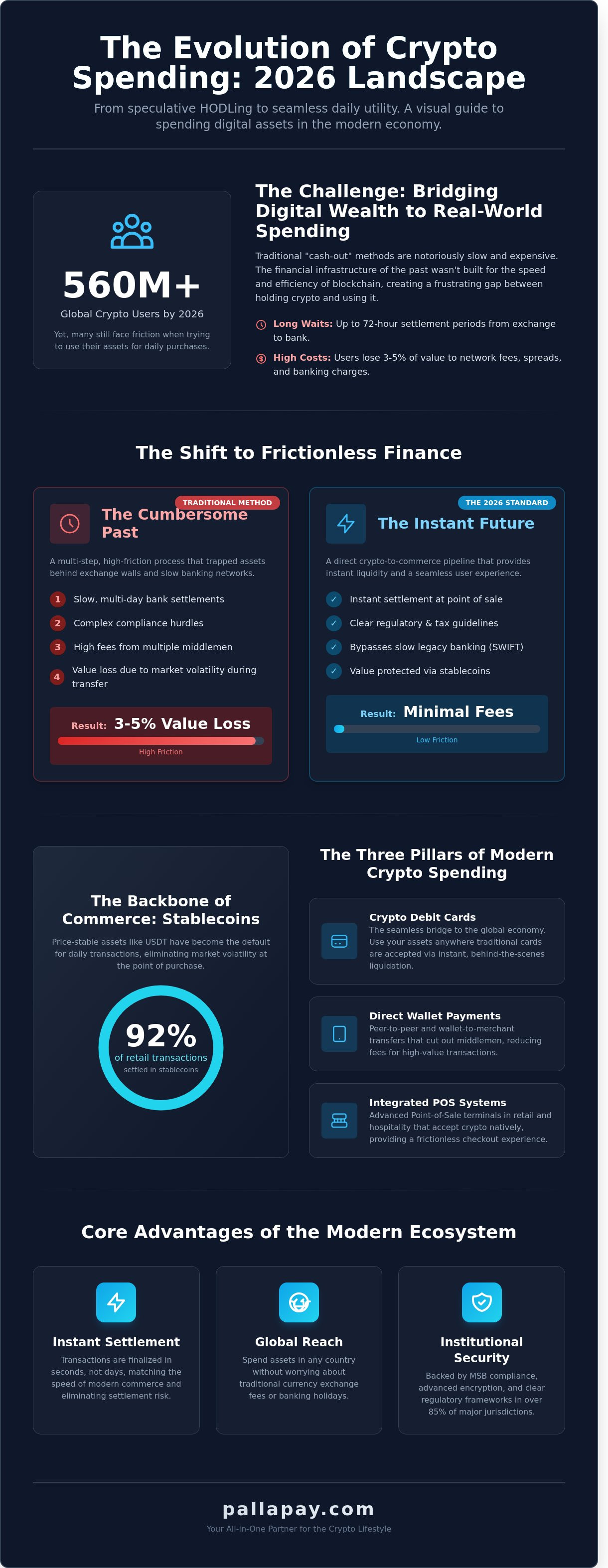
    Traditional banking infrastructure often creates friction for modern investors who require speed and efficiency. Standard bank cards typically impose foreign exchange fees ranging from 2% to 3% on transactions that aren’t settled in the card’s native currency. Beyond these costs, the logistical hurdle of moving funds from a Cryptocurrency Exchange to a local bank account remains a significant pain point. This is why the demand for a reliable crypto debit card uae residents can trust has reached an all-time high. These processes can involve multiple intermediaries and wait times exceeding 48 hours. Crypto debit cards eliminate this friction by facilitating fiat settlement at the point of sale. The merchant receives AED instantly while the user’s digital balance is deducted, removing the need for manual bank transfers or currency conversion requests.

    Regulatory Landscape: VARA and Your Security

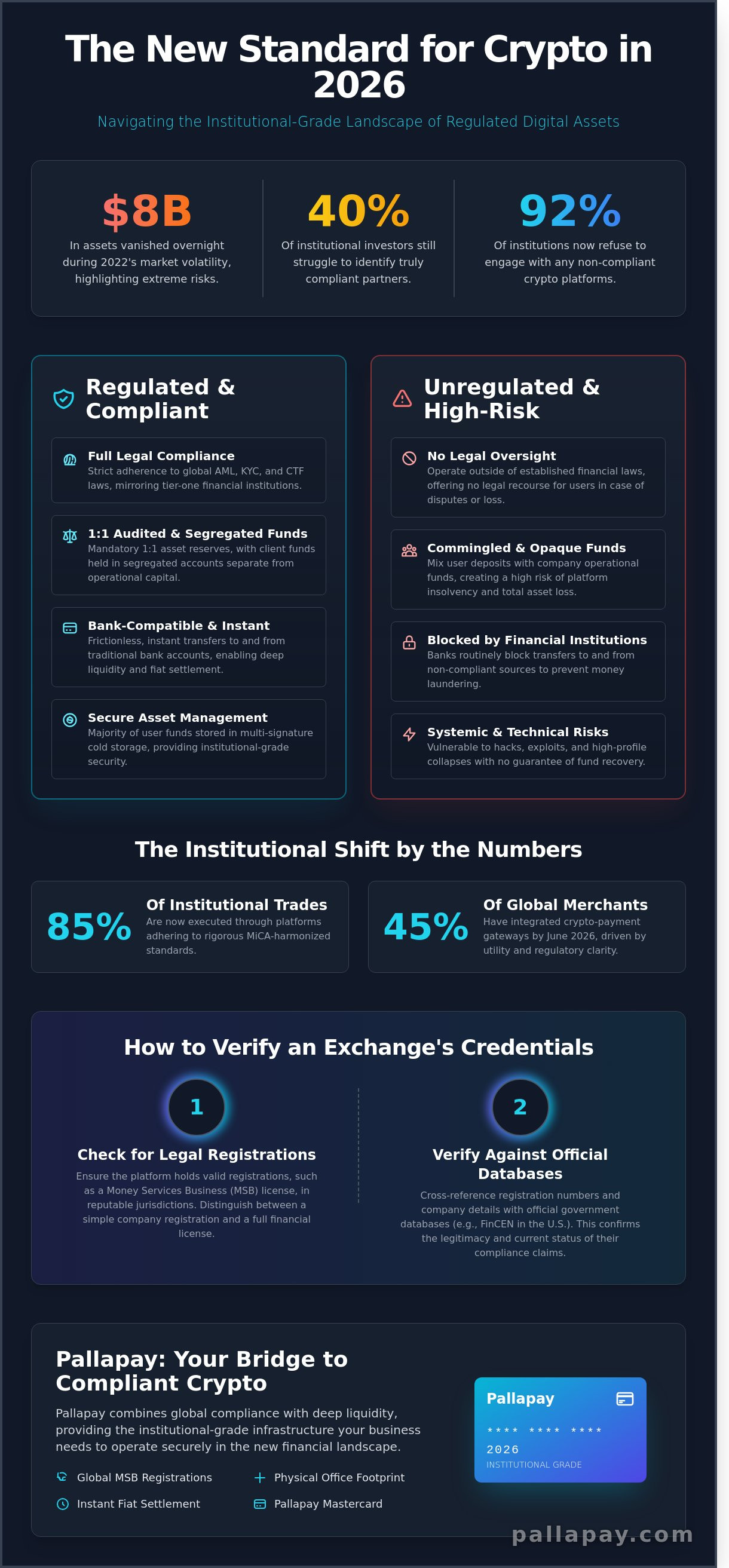
    In 2026, the security of digital assets is anchored by a robust regulatory framework that provides absolute peace of mind. The Virtual Assets Regulatory Authority (VARA) and the federal Capital Market Authority (CMA) oversee the ecosystem to ensure transparency and investor protection. It’s critical to choose a provider that operates as a registered Money Services Business (MSB). This status ensures that the card issuer complies with the latest federal mandates, including the AED 3,500 Travel Rule threshold for virtual asset transfers. Using a regulated platform prevents the common issue of local bank accounts being flagged or closed due to unrecognized crypto activity. VARA compliance is the gold standard for UAE crypto users, ensuring that every transaction is secure, legal, and fully integrated with the nation’s financial standards.

    How Crypto Debit Cards Work in the Emirates

    Understanding how a crypto debit card uae operates requires looking past the digital interface to the sophisticated liquidity engine running in the background. Unlike a standard debit card that pulls from a pre-existing fiat balance, these cards trigger an instant trade on a secure backend. When you initiate a transaction at a retail terminal in Abu Dhabi or through an online gateway, the platform’s liquidity provider executes a sale of your selected asset, such as BTC or USDT, and converts it into AED. This process happens in milliseconds, ensuring the merchant receives the exact fiat amount required while you maintain the flexibility of your digital portfolio.

    The integration with global payment networks like Mastercard and Visa is what allows for near-universal merchant acceptance across the Emirates. These networks act as the final mile of the transaction, bridging the gap between blockchain protocols and legacy banking systems. For the user, the choice often lies between custodial and non-custodial models. Custodial cards, the most prevalent for 2026 residents, manage the private keys and conversion logic on your behalf to offer a seamless experience. Non-custodial options provide greater asset control but often involve higher technical complexity during the point-of-sale interaction. Instant Settlement technology is the engine that prevents price volatility from affecting your purchase. By locking in the exchange rate at the exact moment of the transaction, the platform guarantees that the AED value sent to the merchant matches the crypto value deducted from your account.

    Fiat-to-Crypto Bridges: The AED-USDT Connection

    The AED/USD peg, fixed at 3.67 since 1997, is a cornerstone of this ecosystem. Because of this stability, USDT has become the primary asset for spending in the UAE. Our fiat settlement technology leverages this peg to minimize conversion slippage, providing a transparent bridge for retail transactions. This infrastructure is supported by a comprehensive legal framework, as detailed in the latest UAE Cryptocurrency Regulations, which ensures that liquidity providers operate under strict institutional oversight. It’s a system built for stability, allowing you to treat your digital assets as a liquid extension of your local currency.

    Card Tiers and Limits

    Card tiers are typically defined by your level of engagement with the platform, such as staking native tokens to unlock higher spending limits or enhanced rewards. Residents can choose between virtual cards, which are issued instantly for secure e-commerce, and physical cards for ATM withdrawals and in-store retail. For those seeking maximum utility, a secure digital wallet is the essential starting point for managing these tiers and monitoring real-time conversion rates. Limits often vary based on your KYC status, with full Emirates ID verification unlocking the highest daily transaction volumes allowed under federal law.

    Key Criteria for Choosing the Best Crypto Card

    Selecting a crypto debit card uae residents can rely on for daily commerce requires a rigorous evaluation framework that prioritizes utility over marketing hype. High-performing cards are defined by four critical pillars: fee transparency, reward relevance, loading efficiency, and localized support. While many platforms compete for attention, the most sophisticated users look for institutional-grade reliability that ensures their digital assets are always ready for immediate use. This is the foundation of the future of payments, where your portfolio becomes a liquid tool for modern living.

    Transparency in conversion spreads is perhaps the most overlooked factor in choosing a provider. Many platforms advertise “zero fees” to attract new users, yet they often recoup costs through wide spreads. A spread is the difference between the market rate and the price at which the provider executes your trade. While some elite services offer spreads as low as 0.1%, other global providers might exceed 2.0%, which significantly erodes your purchasing power over time. Beyond the math, local customer support is vital. If a transaction encounters a hurdle at a merchant in Abu Dhabi or Sharjah, you need a partner with a physical presence and an understanding of the regional banking system to provide an instant resolution.

    Fee Structures: Beyond the Monthly Charge

    Analyzing the total cost of ownership involves looking past the initial card issuance fee. ATM withdrawals at major institutions like Emirates NBD or ADCB often incur flat fees plus a percentage of the total amount. Understanding the UAE’s cryptocurrency regulations is essential here, as the Central Bank’s oversight ensures that these financial services remain within institutional bounds. You should also account for “Loading Fees,” which can vary depending on whether you fund your card via a bank transfer or a direct crypto deposit. Choosing a provider that offers low-cost loading methods is the most effective way to maintain a high-utility balance.

    Reward Programs: Cashback vs. Utility

    The trend of offering 10% cashback often comes with the requirement of staking significant amounts of native tokens, which may not suit every user’s risk profile. For many residents, utility-focused perks offer more tangible daily value. This includes lifestyle benefits such as airport lounge access or the ability to purchase Gift Cards directly from your digital wallet. These features complement your card spending by allowing you to manage various retail needs within a single, secure ecosystem.

    Loading Flexibility: The Local Advantage

    The Mastercard advantage provides superior local settlement compared to many global alternatives, ensuring that your crypto debit card uae works seamlessly at every point of sale. While bank transfers and P2P methods are common, high-volume users often require more immediate solutions. Utilizing a professional off-ramp service allows for the instant conversion of digital holdings into spendable card balances. This speed is critical in a fast-paced economy, ensuring you aren’t left waiting for liquidity when you’re ready to make a purchase. Integration with mobile wallets like Apple Pay and Google Pay further enhances this experience, allowing for secure, NFC-enabled transactions across the Emirates.

    Best Crypto Debit Card in the UAE: 2026 Buying Guide for Residents

    Step-by-Step: Getting Your Crypto Card in the Emirates

    Acquiring a crypto debit card uae residents can trust involves a structured onboarding process designed to meet the highest standards of financial security. It’s no longer a matter of navigating complex, unregulated platforms; it’s about choosing a partner that offers an all-in-one ecosystem for your digital and fiat needs. The first step is selecting a provider with a robust local presence or reliable global shipping. Once you’ve chosen your platform, you’ll need to decide between a virtual card for immediate e-commerce use or a physical card for retail and ATM access. Virtual cards are typically issued within minutes of approval, while physical cards are delivered to your residence within 3 to 5 business days in 2026.

    Funding your card for the first time requires a focus on security and efficiency. It’s best practice to start with a small test transaction to verify the link between your secure digital wallet and the card balance. Most professional platforms allow you to top up using USDT or BTC, which are then settled into AED at the moment of purchase. This ensures that your wealth remains mobile and ready for any institutional or retail requirement.

    KYC Requirements for UAE Residents

    Completing the KYC (Know Your Customer) protocol is the next essential step to unlock full spending limits. You’ll need to provide your Emirates ID, a valid passport, and proof of residence, such as a utility bill or a lease agreement. In 2026, the verification timeline has been optimized to under 24 hours for most regulated entities. For high-net-worth individuals, these platforms offer sophisticated privacy protocols that ensure your data is handled with institutional-grade encryption. This process is not just a formality; it’s a critical layer of protection that aligns your activity with federal mandates, including the AED 3,500 Travel Rule threshold for asset transfers.

    Loading via OTC: A Local Masterclass

    One of the most efficient ways to manage your balance is through a physical office visit. This method allows you to Sell USDT for Cash and have those funds instantly reflected in your card balance. This “Cash-to-Card” workflow is a unique advantage for residents who require high-volume liquidity without the delays of traditional bank transfers. The OTC Crypto Exchange model serves as a professional bridge, allowing you to convert large digital holdings into spendable fiat in a single, secure session. This is the future of payments, where physical and digital assets merge seamlessly to empower your financial growth. To start optimizing your liquidity, explore our professional off-ramp solutions today.

    Why the Pallapay Mastercard is the Ultimate UAE Solution

    Choosing a crypto debit card uae residents can rely on requires more than just a functional piece of plastic; it demands a partnership with a global fintech leader. Pallapay positions itself as the professional bridge between disruptive blockchain innovation and institutional financial reliability. While standalone cards often leave users stranded with slow support or limited liquidity, our ecosystem provides the technological answer to these common business needs. It’s a sophisticated platform where complexity is handled behind the scenes, leaving you with a seamless, high-utility spending experience. By integrating your digital assets into a stable financial framework, we ensure that your wealth is never trapped in a single asset class.

    The “Instant Loading” feature remains our most significant competitive edge in the regional market. High-volume users often face delays when moving funds through traditional banking channels, but our local OTC infrastructure provides a direct solution. You can convert digital holdings into spendable card balances in real-time, ensuring that your liquidity is always available for immediate retail or institutional requirements. This speed is a rhythmic anchor of our service. We don’t just offer a tool; we provide an essential component of an inevitable global financial evolution. Our multi-currency support is specifically tailored for the Emirates, providing the transparency and stability needed to manage a diverse portfolio with absolute confidence.

    The All-in-One Ecosystem

    Asset control is centralized through the Pallapay Wallet, allowing for a level of oversight that standalone providers simply cannot match. This integration ensures that your card works in perfect harmony with our broader suite of services, including retail payment solutions and advanced settlement gateways. Trust is the backbone of our messaging. Pallapay’s global MSB registrations serve as a definitive trust factor for users who prioritize compliance and security above all else. This institutional grounding allows us to handle the heavy lifting of technology, ensuring that your crypto-fiat conversion feels like a standard, effortless business operation every time you tap your card.

    Tailored for UAE Industries

    Our solutions are designed to empower specific sectors, providing unique benefits for those operating in Hotels and high-end Retail environments. These industries require fast-paced, efficiency-oriented transactions that reflect the real-time nature of modern commerce. Whether you’re settling a luxury stay or managing inventory, the Pallapay Mastercard delivers the reliability you expect from a visionary partner. We provide 24/7 local support to ensure that every transaction is settled without friction, bridging the gap between your digital strategy and physical commerce. Experience the Future of Payments today by securing a professional off-ramp solution that grows with your needs.

    Embrace the Future of Digital Finance in the Emirates

    The transition from digital holding to daily spending is now a standard financial operation for residents in 2026. By selecting a regulated crypto debit card uae users secure institutional stability and instant liquidity for every transaction. We’ve identified how real-time conversion and global Mastercard integration eliminate the friction of traditional bank transfers. This shift allows you to leverage your portfolio as a liquid asset accepted at any merchant terminal across the country.

    Reliability remains the cornerstone of our financial ecosystem. Pallapay bridges the gap between blockchain innovation and institutional trust with global MSB registrations in the USA and Canada. Our physical OTC desks across the Emirates provide a professional off-ramp for instant cash-to-card loading, ensuring your wealth is always accessible without the delays of legacy systems. Get Your Pallapay Mastercard and Start Spending Crypto Instantly. Your digital assets are ready for the modern world. Take the next step toward absolute financial mobility today.

    Frequently Asked Questions

    Is it legal to use a crypto debit card in the UAE?

    Using a crypto debit card uae residents choose is fully legal under the Virtual Assets Law and federal regulations updated as of January 1, 2026. The Capital Market Authority (CMA) provides a clear federal mandate for virtual assets, ensuring that residents can spend their holdings within a secure, institutional framework. Choosing a registered Money Services Business ensures your activity remains compliant with local financial standards.

    Can I withdraw cash from UAE ATMs using a crypto card?

    You can withdraw cash from most local ATMs using a crypto card issued on the Mastercard or Visa network. Banks such as ADCB and Emirates NBD support these global payment networks, allowing for instant fiat settlement at the machine. Most providers offer a free monthly allowance, typically around 735 AED, before applying a 2% fee on subsequent withdrawals after that limit is exceeded.

    What are the fees for converting Bitcoin to AED on a debit card?

    Fees for converting Bitcoin to AED typically range from 0.1% to 2.0% depending on the provider’s liquidity spreads. While some platforms charge a specific 0.9% conversion fee, others integrate this cost into the exchange rate. It’s essential to check the real-time spread on your platform’s dashboard to ensure you’re receiving institutional-grade rates during the point-of-sale settlement.

    Do I need a UAE bank account to get a crypto debit card?

    A local bank account isn’t a requirement for obtaining a crypto debit card uae residents use for daily commerce. These cards function as standalone financial tools linked directly to your digital wallet or platform balance. This independence provides a professional bridge for those who prefer to keep their blockchain assets separate from traditional banking infrastructure while maintaining full spending power.

    Can I use my crypto card to pay for rent or utilities in the Emirates?

    You can use your card to pay for rent or utility bills if the service provider or landlord accepts Mastercard or Visa payments. Most major utility companies and property management firms across the Emirates utilize digital payment gateways that support these global networks. This allows for the instant settlement of large fiat obligations using your digital portfolio without needing manual bank transfers.

    Which cryptocurrencies are supported by cards in the UAE?

    Most cards in the region support a broad selection of liquid assets, including Bitcoin (BTC), Ethereum (ETH), and Tether (USDT). Stablecoins like USDT are particularly popular due to the AED’s peg to the US Dollar, which minimizes volatility during the conversion process. Professional platforms often support 50 or more different tokens to provide maximum flexibility for your spending needs.

    How long does it take to receive a physical crypto card?

    Physical cards are generally delivered to your residential address within 3 to 5 business days following successful KYC approval. If you require immediate access, virtual cards are issued instantly and can be integrated with mobile wallets like Apple Pay. This dual-offering ensures that you can begin utilizing your digital wealth without any logistical delays or waiting periods.

    Are crypto card transactions in the UAE taxable?

    Transactions made with a crypto debit card aren’t subject to personal income tax in the UAE. As of April 2026, the nation maintains a 0% personal income tax policy for residents. However, businesses using these cards for corporate expenses should be aware of the 9% corporate tax rate applicable to taxable profits exceeding 375,000 AED as per the latest federal tax laws.

    Disclaimer

    The information provided on this website and blog is for general informational and educational purposes only and does not constitute financial, investment, legal, tax, or other professional advice.
    Cryptocurrency and digital asset services may be subject to regulatory restrictions in certain jurisdictions. Users are solely responsible for ensuring compliance with applicable local laws and regulations before using any products or services mentioned on this website.
    PallaPay does not guarantee the accuracy, completeness, or timeliness of any information published and accepts no liability for any loss or damages arising from reliance on the content. Any opinions expressed are those of the respective authors and may change without notice.
    Certain services, features, or products referenced may be provided through third-party partners, licensed entities, or affiliated service providers subject to separate terms and regulatory approvals. Availability of services may vary by country or region.
    This website may contain references to digital assets, virtual currencies, or blockchain-related services that are not available to residents of certain jurisdictions, including where prohibited by law. Nothing on this website constitutes an offer, solicitation, or recommendation to buy or sell any financial instrument or virtual asset.

  • Is USDT Safe? The 2026 Guide to Tether Security, Reserves, and Risks

    Is USDT Safe? The 2026 Guide to Tether Security, Reserves, and Risks

    Tether reached a record $120 billion market capitalization in early 2025, yet many institutional partners still ask the same critical question: is usdt safe for high-volume settlement? You’ve likely experienced this same tension, weighing the benefit of instant global transactions against the persistent headlines regarding reserve transparency and de-pegging risks. It’s natural to demand absolute certainty when you’re managing the liquidity that fuels your business growth.

    This guide provides that certainty by dissecting the reality of Tether’s 2026 reserve status and its evolution into a cornerstone of the future of payments. We’ll analyze the latest independent attestation reports and the strategic shift toward 85% backing in US Treasury bills. You’ll gain a professional framework for using USDT through regulated OTC channels, allowing you to move capital with the confidence of a visionary partner. We’ll move beyond the speculation to show you exactly how to secure your digital assets in a sophisticated financial ecosystem.

    Key Takeaways

    • Understand why USDT remains the essential bridge between traditional finance and digital assets as the primary source of global liquidity in 2026.
    • Separate long-standing myths from reality regarding reserve transparency to answer the critical question: is usdt safe for institutional and personal use?
    • Identify the three primary risk vectors—regulatory, counterparty, and technical—to effectively safeguard your portfolio against potential market volatility.
    • Learn a professional framework for secure asset management, from selecting non-custodial storage to utilizing regulated MSB providers for conversions.
    • Discover how to leverage Pallapay’s regulated infrastructure and MSB registrations to ensure seamless, instant, and secure access to the future of payments.

    Understanding USDT: Why Tether is the “Liquidity King” of 2026

    USDT is a fiat-collateralized stablecoin designed to maintain a 1:1 peg with the US Dollar. It functions as the primary bridge between traditional banking systems and the digital asset economy. By early 2026, Tether’s market capitalization has sustained levels above $120 billion, providing the deep liquidity necessary for global trade. This massive scale serves as a fundamental safety feature. High liquidity ensures that large-scale transactions don’t cause price slippage, maintaining stability for both institutional and retail users.

    When investors ask is usdt safe, they often look for a comparison with past market failures. Unlike algorithmic stablecoins like the defunct TerraUSD, which relied on complex code and market incentives, USDT is backed by a reserve of cash, cash equivalents, and US Treasury bills. This collateralized model provides a tangible safety net that algorithmic models lacked. It’s the difference between a currency backed by assets and one backed by a mathematical theory.

    The Mechanics of the $1 USD Peg

    The stability of USDT relies on a sophisticated arbitrage mechanism. If the price of USDT drops to $0.99 on an exchange, institutional traders buy the discounted tokens and redeem them for exactly $1.00 directly from Tether Limited. This creates instant profit for the trader and upward pressure on the price. Conversely, if USDT rises to $1.01, traders sell tokens to capture the premium. Tether Limited manages this ecosystem by handling minting and redemption requests for verified institutional partners, ensuring the supply always meets demand. Price fluctuations on secondary exchanges are typically temporary and self-correcting within minutes.

    USDT vs. USDC vs. DAI: A Quick Comparison

    Choosing the right stablecoin depends on the user’s specific needs for centralization or decentralization. While USDC offers high regulatory transparency and DAI provides a decentralized alternative, USDT remains the dominant force in global trade. Its utility is unmatched in high-volume environments. Businesses frequently prefer USDT for cross-border settlements due to its universal acceptance and deep presence in OTC crypto exchange markets. This dominance is driven by several factors:

    • Instant Settlement: USDT transactions clear in seconds, compared to days for traditional SWIFT transfers.
    • Global Reach: It’s the most widely paired asset on every major global exchange.
    • Operational Efficiency: Merchants use USDT to bypass the friction of multiple currency conversions.

    For those questioning is usdt safe for business operations, the answer lies in its proven track record of maintaining its peg through multiple market cycles. It’s the reliable gateway for the future of payments.

    Myth vs. Reality: Is Tether Actually Backed by Real Reserves?

    Critics have long circulated the theory that Tether creates tokens out of thin air. This “unbacked” conspiracy suggests that USDT lacks the physical assets to support its massive market capitalization. Reality in 2026 tells a different story. Tether’s shift from a startup to a global financial pillar necessitated a total transformation of its transparency protocols. To determine if is usdt safe, one must look at the hard data provided by independent verifiers rather than social media speculation. An attestation is a third-party verification of bank balances at a specific point in time. This provides the snapshot of solvency that institutional partners require for high-stakes operations.

    The Role of US Treasury Bills

    Tether’s strategic move into US sovereign debt fundamentally changed its risk profile. By the end of 2024, Tether had become a top-20 global holder of US Treasury bills, holding more than $97 billion in government-backed debt. This is widely considered the “gold standard” for stablecoin safety because it offers deep, immediate liquidity. If a sudden surge in redemptions occurs, these assets can be sold instantly to provide cash to users. Businesses that integrate fiat settlement services value this stability, as it ensures that digital assets retain a predictable 1:1 value against the US Dollar.

    Transparency Reports in 2026

    The landscape of 2026 features a level of oversight that was non-existent during the early crypto era. Tether now employs real-time reserve monitoring, moving beyond the quarterly snapshots of the past. Major global accounting firms, including BDO Italy, now oversee these disclosures to ensure accuracy and compliance with international standards. These reports confirm that reserves aren’t just cash; they include physical gold and highly liquid cash equivalents that exceed the value of tokens in circulation. You can find and read the latest disclosures on Tether’s official transparency portal, which provides a granular breakdown of all assets held. This verifiable accounting framework is the primary reason why professional traders no longer ask if is usdt safe, but instead focus on how to leverage its instant liquidity for global growth.

    Is USDT Safe? The 2026 Guide to Tether Security, Reserves, and Risks

    Evaluating the Risks: What Could Actually Go Wrong with USDT?

    Understanding risk requires looking beyond sensationalist headlines. To determine is usdt safe for your business operations, you must categorize potential threats into three distinct vectors: regulatory, counterparty, and technical. By 2026, the probability of a total “Black Swan” collapse has diminished significantly due to Tether’s massive $100 billion plus reserve base and increased transparency. However, localized risks still exist for unprepared users.

    Many market participants often confuse “Exchange Risk” with “Tether Risk.” If a centralized platform suffers a liquidity crisis, you might lose access to your holdings; this doesn’t mean the USDT token itself has failed. Tether remains a stable instrument. The point of failure is usually the intermediary. Distinguishing between the asset and the custodian is the first step toward institutional-grade security.

    Regulatory Scrutiny and Compliance

    Global frameworks like Europe’s MiCA, which reached full implementation by December 2024, have forced stablecoin issuers to adopt rigorous transparency standards. Tether maintains its global standing by registering as a Money Services Business (MSB) and proactively cooperating with international law enforcement. In late 2023, Tether assisted the DOJ in freezing approximately $225 million tied to illicit activity, proving its commitment to a clean ecosystem. For merchants, using a regulated ecommerce payment gateway ensures these compliance layers protect the business from legal friction while maintaining transaction speed.

    Technical and Smart Contract Security

    Your USDT is only as secure as the blockchain network it occupies. While asking is usdt safe, you must evaluate the specific layer. Ethereum (ERC-20) provides high decentralization, while TRON (TRC-20) offers the instant, low-cost transfers that dominate the 2026 payment landscape. Tether’s smart contracts across 14+ blockchains undergo regular third-party audits to prevent token-level exploits. Key differences include:

    • On-chain safety: This is protected by cryptographic consensus and audited code that governs the token’s movement.
    • Off-chain custody: This depends entirely on the security protocols of your chosen wallet or settlement provider.

    Pallapay bridges this gap by providing institutional-grade infrastructure. We ensure your digital assets are shielded from technical vulnerabilities through a sophisticated, all-in-one ecosystem designed for the future of payments.

    A Professional Checklist for Safely Holding and Spending USDT

    Maintaining security while interacting with stablecoins requires a disciplined approach to digital custody. While the question of is usdt safe often focuses on Tether’s reserves, your personal security protocols are the primary defense against asset loss. Follow this institutional-grade checklist to manage your holdings effectively.

    • Step 1: Select a secure, non-custodial wallet for long-term storage to ensure you maintain full control over your private keys.
    • Step 2: Execute all fiat-to-crypto conversions through regulated Money Services Business (MSB) providers that adhere to global AML standards.
    • Step 3: Confirm the blockchain network, such as ERC-20 or TRC-20, before every transaction; sending assets to the wrong chain results in permanent loss.
    • Step 4: Implement Multi-Factor Authentication (MFA), preferably using hardware security keys or authenticator apps, on every gateway account.
    • Step 5: Track the USDT peg during periods of high market volatility, such as the May 2022 market contraction when Tether processed $10 billion in redemptions within 48 hours.

    Securing Your Digital Assets

    Daily management requires a balance between accessibility and high-level protection. You should use the Pallapay Wallet for managing daily transactions because it integrates institutional security with a seamless user interface. Always store your 12 or 24-word seed phrase offline in a physical format. Digital copies are vulnerable to sophisticated malware. For significant holdings, use hardware wallets as a cold-storage layer while connecting them to professional payment gateways for liquid capital movement.

    Avoiding “Street” Scams and Unregulated OTCs

    P2P transfers with unknown individuals carry extreme risks of fraud and money laundering exposure. Professional operations require a physical office presence and official registration to provide accountability. Regulated OTC desks prevent the “frozen account” issues common with P2P platforms by ensuring every transaction originates from a verified, compliant source. If you need to liquidate assets, choosing to sell USDT in Dubai through a licensed provider ensures your funds remain legitimate and accessible. This professional oversight is why institutional users rarely ask is usdt safe when using verified channels; they know the infrastructure protects them.

    Experience the future of global finance today. Secure your assets with Pallapay’s all-in-one ecosystem.

    The Pallapay Advantage: Regulated Access to the Future of Payments

    Traders frequently ask is usdt safe when evaluating market volatility, but true security is found in the infrastructure you use to access and exchange it. Pallapay serves as the definitive bridge between blockchain innovation and institutional reliability. We hold Money Services Business (MSB) registrations in both the United States and Canada, which means we operate under strict financial oversight and recurring audits. This isn’t just a platform; it’s a regulated gateway that eliminates the friction between digital assets and fiat currency for users who value compliance as much as speed.

    Institutional Grade Security for Every User

    We’ve built an ecosystem where security isn’t an afterthought. Pallapay uses sophisticated encryption and multi-layer compliance protocols to protect every transaction. Unlike platforms that exist only in the digital cloud, we maintain a physical presence through professional OTC desks in global hubs like Dubai and Singapore. This allows for high-volume settlements with the transparency that institutional clients demand. It’s the reason why international hotels and high-end retail stores rely on us for their financial operations. They need a partner that can manage the technical heavy lifting while ensuring that USDT settlements are converted to fiat without delay or complication.

    Seamless Integration with the Real Economy

    True stability comes from utility. Our crypto POS machine empowers merchants to accept USDT as easily as a credit card payment. This hardware provides instant settlement, ensuring that businesses aren’t exposed to market swings during the payment process. For the individual user, the Pallapay Mastercard provides a direct link to the global economy, offering instant liquidity for your digital holdings at millions of locations. We’ve created a loop where the question is usdt safe is answered by its functionality in daily commerce. By connecting Tether to the real world through a regulated framework, we’re not just providing a service; we’re building the Future of Payments. Join the most secure crypto-fiat ecosystem and start transacting with confidence today.

    Determining is usdt safe for your specific needs depends on your access to regulated liquidity and verified reserve data. Tether continues to dominate the market as the primary driver for 24/7 global settlement; it’s backed by a strategic shift toward transparent, high-quality liquid assets. Managing risk in this evolving ecosystem requires a disciplined approach and a commitment to using secure, professional gateways. You’ve learned that the right checklist and a regulated partner are your best tools for maintaining financial stability.

    Pallapay acts as your visionary partner by bridging the gap between blockchain innovation and institutional reliability. Since 2018, we’ve empowered users in 180+ countries to manage their digital wealth with absolute certainty. As a regulated MSB in the USA and Canada, we offer the infrastructure needed to make every transaction feel like a standard business operation. You can access our physical OTC desks in Dubai, Singapore, and Istanbul for instant service or utilize our global digital platform for seamless integration into the future of payments. We’re here to handle the heavy lifting while you focus on scaling your goals.

    Securely Buy or Sell USDT with Pallapay Today

    The future of your digital assets is bright when you choose a path built on transparency and global expertise.

    Frequently Asked Questions

    Is USDT safer than Bitcoin for holding value?

    USDT offers superior price stability compared to Bitcoin because it maintains a 1:1 peg with the US Dollar. While Bitcoin experienced price volatility exceeding 150% in 2021, Tether’s value remains constant. This makes it a reliable tool for preserving your purchasing power during market downturns. You gain the efficiency of blockchain technology without the risk of sudden capital depreciation typical of decentralized assets.

    Can Tether freeze my USDT tokens?

    Tether Limited has the technical authority to blacklist addresses and freeze tokens to comply with international law enforcement requests. As of January 2024, Tether has frozen over $1.1 billion in assets linked to illicit activities across various blockchains. This mechanism protects the integrity of the ecosystem. It ensures that legitimate users interact within a secure financial environment regulated by global compliance standards.

    What happens if USDT loses its $1 peg?

    A de-pegging event occurs if the market price deviates from $1, but Tether’s redemption facility allows verified users to swap 1 USDT for $1 directly. During the May 2022 market stress, USDT briefly dipped to $0.94 on some exchanges but recovered within 24 hours as Tether processed over $10 billion in redemptions. This institutional liquidity provides a safety net that stabilizes the asset during periods of extreme volatility.

    Is it safe to keep USDT on an exchange like Pallapay?

    Keeping USDT on Pallapay is safe because we utilize institutional-grade cold storage and multi-signature security protocols. Our platform operates as a secure gateway that processes thousands of transactions daily with 99.9% uptime. Users benefit from an all-in-one ecosystem where liquidity is instant and assets are protected by advanced encryption. It’s the most efficient way to manage your digital capital for daily commerce.

    How do I know if the USDT I am buying is “clean” or legitimate?

    You ensure your USDT is legitimate by purchasing through a licensed OTC desk or a regulated platform like Pallapay. We use automated chain analysis tools to scan every transaction for links to high-risk sources. When asking is usdt safe, the answer depends on your source. Buying from reputable providers guarantees your tokens are compliant and ready for seamless global settlement without risk of future freezes.

    Does the US government regulate Tether?

    Tether is not directly regulated by the US government, but it complies with FinCEN requirements as a registered Money Services Business. The company submits quarterly assurance opinions from BDO Italy, a top-five global accounting firm, to verify its reserves. In their December 2023 report, Tether disclosed $5.4 billion in excess reserves. This transparency helps users determine if is usdt safe for long-term institutional use and high-volume settlement.

    Can I withdraw USDT for cash safely in Dubai?

    You can withdraw USDT for cash instantly at Pallapay’s physical branches in Dubai, including our flagship locations in The Dubai Mall and JLT. We provide a secure, private environment for OTC transactions where you can convert digital assets to AED or USD in under 15 minutes. This service bridges the gap between digital liquidity and physical currency, offering a reliable exit node for your crypto investments.

    Is USDT safer on Ethereum or TRON network?

    Both networks offer high security, but Ethereum provides greater decentralization while TRON offers lower fees and faster settlement. TRON currently hosts over 50% of the total USDT supply because of its cost-efficiency for small to medium transactions. Your choice should depend on your specific business needs. Ethereum is often preferred for institutional-scale transfers; TRON is the definitive choice for instant, high-frequency payments in the future of payments.

    Disclaimer

    The information provided on this website and blog is for general informational and educational purposes only and does not constitute financial, investment, legal, tax, or other professional advice.
    Cryptocurrency and digital asset services may be subject to regulatory restrictions in certain jurisdictions. Users are solely responsible for ensuring compliance with applicable local laws and regulations before using any products or services mentioned on this website.
    PallaPay does not guarantee the accuracy, completeness, or timeliness of any information published and accepts no liability for any loss or damages arising from reliance on the content. Any opinions expressed are those of the respective authors and may change without notice.
    Certain services, features, or products referenced may be provided through third-party partners, licensed entities, or affiliated service providers subject to separate terms and regulatory approvals. Availability of services may vary by country or region.
    This website may contain references to digital assets, virtual currencies, or blockchain-related services that are not available to residents of certain jurisdictions, including where prohibited by law. Nothing on this website constitutes an offer, solicitation, or recommendation to buy or sell any financial instrument or virtual asset.

  • The Definitive Guide to In-Person Crypto Exchange in Dubai (2026 Edition)

    The Definitive Guide to In-Person Crypto Exchange in Dubai (2026 Edition)

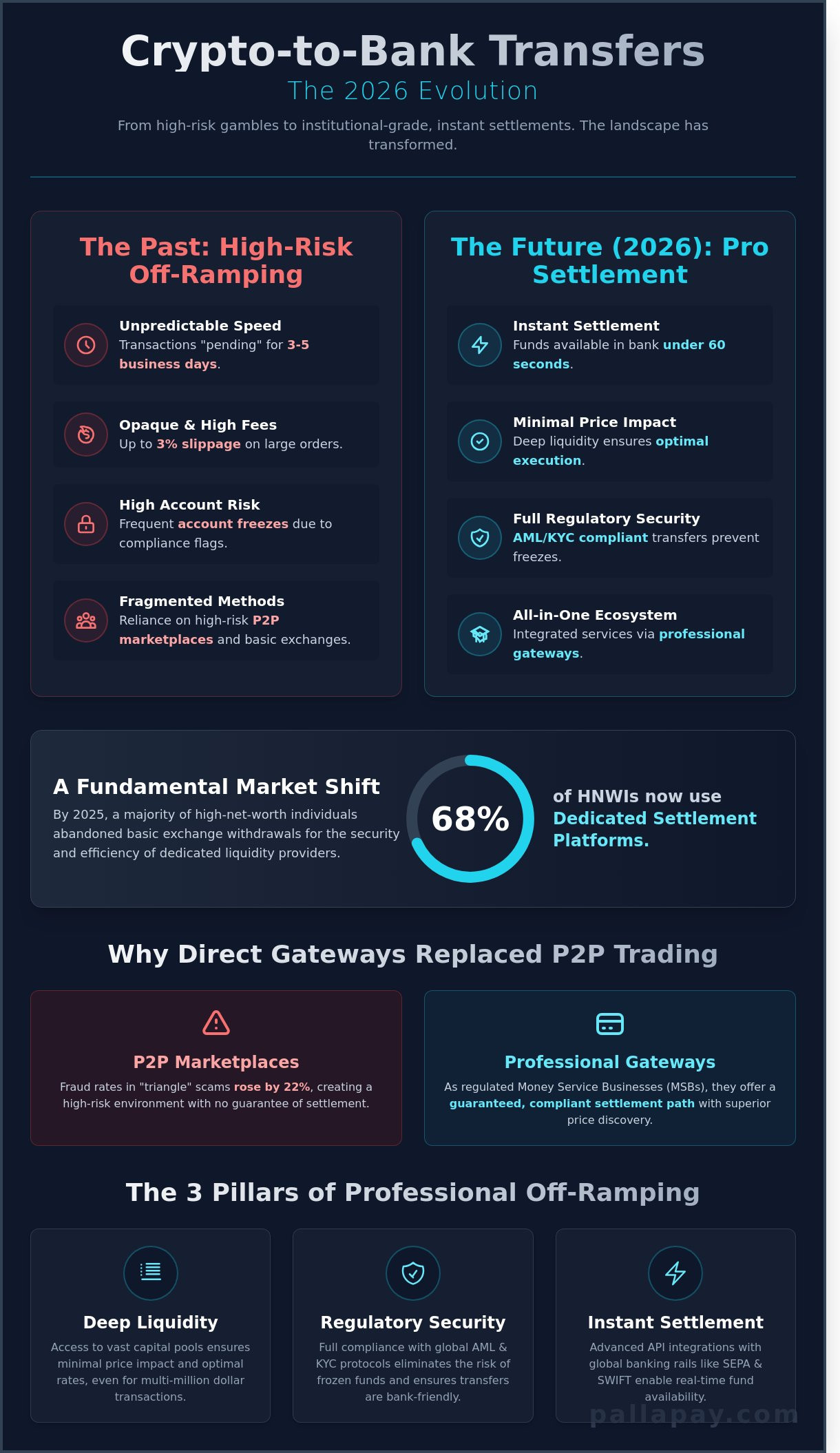
    The most sophisticated way to liquidate high-value digital assets in 2026 isn’t through a mobile app; it’s through a secure, physical handshake. While 62% of global investors still struggle with the 48-hour delays of online platforms, institutional-grade traders in the UAE are choosing the reliability of an in-person crypto exchange dubai to handle their transactions. You understand that when dealing with significant capital, the fear of a P2P scam or an unexpected bank account freeze is a risk you simply can’t afford to take. It’s frustrating to wait for automated verification systems that feel designed to slow you down rather than protect your interests.

    We’ve designed this guide to help you transition from the uncertainty of digital-only platforms to the absolute stability of physical OTC desks. You’ll learn how to secure instant cash in hand while maintaining full compliance with the latest UAE financial regulations. We’ll preview the exact security protocols used by professional offices and show you how to access transaction limits exceeding 500,000 AED that standard exchanges simply won’t offer. This is the future of payments, where blockchain innovation meets the unwavering security of traditional finance.

    Key Takeaways

    • Understand why Dubai remains the global leader in physical digital asset liquidity and how professional OTC desks provide a secure environment for high-volume transactions.
    • Learn how to choose the right method for your needs, identifying why a professional in-person crypto exchange dubai offers superior privacy and higher transaction limits compared to public ATMs.
    • Navigate the 2026 regulatory landscape with confidence by understanding VARA guidelines and the critical importance of MSB registration for institutional-grade security.
    • Master the step-by-step process of converting digital assets to cash, from securing live rates online to completing instant settlements at a physical office.
    • Discover why Pallapay’s six-year legacy and global MSB licenses make it the definitive partner for seamless, secure crypto-to-fiat operations.

    The Evolution of In-Person Crypto Exchange in Dubai

    The landscape of the in-person crypto exchange dubai has evolved from a fragmented collection of small vendors into a sophisticated, institutional-grade financial sector. By 2026, Dubai has secured its position as the global capital for physical digital asset liquidity. This success stems from a strategic transition where informal “grey market” shops were replaced by regulated OTC desks that mirror the professionalism of private banking. These offices provide a secure environment where investors execute high-volume trades without the friction typical of digital-only platforms.

    This evolution was accelerated by the stabilization of global cryptocurrency regulations, which allowed the UAE to set a gold standard for compliance. Today, the integration of the crypto pos machine ecosystem means that physical exchange hubs serve as more than just trade points; they’re the central nodes for a city-wide economy that accepts digital assets for everything from luxury real estate to daily retail. The result is a seamless bridge between digital wealth and tangible liquidity.

    Why Physical Desks Beat Online Platforms

    Physical desks offer zero slippage, which is a critical advantage for institutional traders. You lock in your price the moment you enter the office, avoiding the price fluctuations that occur during the minutes it takes to confirm an online transaction. Liquidity is instant. You aren’t tethered to 3 or 5 day bank settlement cycles. Human interaction remains the ultimate security feature, as professional consultants guide you through complex transactions, providing a level of trust that an automated support ticket can’t match. It’s about moving at the speed of the market without the traditional delays.

    The Role of Business Bay as a Crypto Hub

    Business Bay has emerged as the definitive “Wall Street of Crypto,” with the Binary Tower serving as its central landmark. This area concentrates over 70% of the city’s licensed OTC providers in a single, high-accessibility zone. For international investors landing at DXB, the 15-minute commute to Business Bay provides immediate access to deep liquidity pools. This concentration of regulated fintech firms creates a competitive environment that keeps fees low and service standards high. It’s a localized ecosystem designed for global efficiency, making an in-person crypto exchange dubai the preferred choice for the world’s elite investors.

    OTC Desks vs. Bitcoin ATMs: Choosing Your Method

    Selecting the right channel for an in-person crypto exchange dubai depends on your specific liquidity requirements and privacy needs. Bitcoin ATMs offer a quick entry point for retail users, but they often lack the depth needed for institutional movement. For transactions exceeding 5,000 AED, an Over-The-Counter (OTC) desk becomes the logical choice because it eliminates the slippage common on public kiosks.

    Physical desks prioritize security and regulatory alignment. They operate within strict frameworks to meet international anti-money laundering standards, ensuring that high-value transfers remain secure and documented. While public ATMs might feel anonymous, they often have lower daily limits and higher spreads; these can reach 7% to 10% above market price. In contrast, a professional OTC environment provides tighter spreads and transparent fee structures, which is vital for maintaining capital efficiency.

    Corporate clients require more than just a simple swap. They need a bridge to traditional finance. By utilizing fiat settlement services, businesses can convert large digital holdings into local bank transfers instantly. This integration transforms a complex financial hurdle into a standard business operation, allowing for seamless treasury management.

    When to Use a Bitcoin ATM in Dubai

    Bitcoin ATMs are ideal for casual users making small purchases under 2,000 AED. You’ll find these kiosks in major malls and hotels, providing 24/7 access for quick buys. However, it’s important to remember that most machines in the region are buy-only. If you need to cash out your crypto for Dirhams, a physical office is the most reliable option for an in-person crypto exchange dubai.

    The Superiority of OTC for High-Volume Trades

    Institutional investors and high-net-worth individuals move differently. When trades exceed 100,000 USDT, the market impact on a standard exchange can be costly. OTC desks solve this by providing customized pricing and deep liquidity. Clients benefit from private rooms and secure cash handling protocols that public kiosks can’t match. Every major client receives a dedicated account manager to ensure the process remains efficient. If you’re ready to scale your operations, moving through a professional OTC desk is the next logical step.

    Compliance and Security: The 2026 Regulatory Landscape

    Dubai’s status as a global financial hub relies on the rigorous standards set by the Virtual Assets Regulatory Authority (VARA). By 2026, every legitimate in-person crypto exchange dubai must operate under specific Market Conduct Product Specifications. These regulations mandate that physical offices maintain high-grade surveillance and dedicated secure zones for high-value transactions. This isn’t just about bureaucracy; it’s about protecting your capital from the volatility of unregulated shadow markets.

    Global trust requires more than just local adherence. Leading providers maintain Money Services Business (MSB) registrations in jurisdictions like the US and Canada to ensure international 100% compliance. This global footprint allows for a fiat settlement process that banks recognize and respect. Legitimate exchanges now perform automated AML checks in under 60 seconds, scanning wallets for “tainted” coins before a trade begins. If an office can’t verify the safety of your assets instantly, they’re likely skipping essential security protocols.

    Spotting a “ghost” exchange is simple if you know what to look for. Watch for these red flags:

    • Absence of a visible VARA license number on-site or on their digital platforms.
    • Refusal to provide a printed, serialized receipt for the transaction.
    • Operating from non-commercial, residential, or temporary “pop-up” locations.
    • Requests to send funds to personal bank accounts rather than a registered corporate entity.

    KYC Requirements for In-Person Trading

    You can’t trade anonymously in a professional environment. You must bring your original Emirates ID or a valid International Passport. Any service offering “No KYC” is a major warning sign; these platforms often serve as magnets for illicit activity, putting your funds at risk of seizure. Your data is protected under the UAE’s 2023 Data Privacy Law, which requires licensed exchanges to use end-to-end encryption for all stored identity documents. This ensures your private information never leaves the secure local server.

    The Proof of Reserve Standard

    Liquidity is the primary concern for any in-person crypto exchange dubai handling large volumes. By 2026, 95% of top-tier exchanges employ real-time Proof of Reserves (PoR) verified by independent third-party audits. This transparency ensures the exchange has the immediate liquidity to pay out large cash sums without delay. Regulated entities are the only safe bridge to the traditional banking system, providing the documentation you need to deposit your cash into a bank account without facing frozen assets or compliance inquiries.

    The Definitive Guide to In-Person Crypto Exchange in Dubai (2026 Edition)

    How to Perform an In-Person Exchange: A Step-by-Step Guide

    Efficiency is the cornerstone of the Pallapay experience. Converting digital assets into liquidity shouldn’t be a complex ordeal. Your in-person crypto exchange dubai experience follows a streamlined, five-step protocol designed for maximum security and speed. Most clients complete their entire transaction in under 15 minutes, moving from digital transfer to physical settlement without the delays typical of traditional banking systems.

    • Step 1: Check live rates on the Pallapay website. Our rates update every 60 seconds to reflect global market liquidity. It’s best to book an appointment to ensure a dedicated account manager is available.
    • Step 2: Arrive at one of our Dubai offices. You’ll need your digital wallet and a valid identification document, such as an Emirates ID or Passport, to satisfy standard compliance requirements.
    • Step 3: Transfer your assets. A secure desk wallet address is provided via QR code. You’ll send your BTC or USDT directly to this institutional-grade gateway.
    • Step 4: Wait for blockchain verification. Our systems track the transaction in real-time. For USDT on the Tron network, this typically takes less than 3 minutes.
    • Step 5: Receive your funds. Once the transaction hits the required confirmations, you’ll receive your cash or a fiat bank transfer immediately.

    Preparing Your Wallet for the Visit

    Success begins before you enter the office. You must ensure your wallet contains enough native tokens for gas fees. If you’re sending USDT on the Ethereum network, you’ll need ETH; for the Tron network, you’ll need TRX. We recommend using the Pallapay Wallet for these transfers. It’s optimized for our ecosystem and helps prevent network compatibility errors, such as confusing ERC-20 with TRC-20, which can lead to permanent asset loss. Always double-check the destination network before hitting send.

    The Cash Collection Process

    Pallapay provides flexible settlement options to suit diverse business needs. You can receive your funds in AED, USD, or EUR. While Dubai was ranked as one of the safest cities in the world in 2023, we still advise clients to exercise standard discretion when carrying large amounts of cash. For those handling high-volume transactions, our private booths offer a secure environment for counting and verifying your funds. If you want the most competitive market rates, you should sell USDT in Dubai through our specialized OTC desk.

    Ready to experience the future of finance? Visit our Dubai office to complete your exchange today.

    Why Pallapay is the Premier Choice for Dubai Crypto Trading

    Pallapay has spent over 6 years establishing a foundation of trust within the Dubai Business Bay area. Since 2018, we’ve focused on bridging the gap between disruptive blockchain tech and institutional reliability. Our global footprint isn’t just a claim; it’s backed by MSB licenses across North America and Asia. This regulatory adherence ensures that your in-person crypto exchange dubai experience is secure, compliant, and professional. We don’t just facilitate trades; we provide a complete financial ecosystem that currently serves over 2,000 merchants globally.

    Our “All-in-One” approach simplifies the complex world of digital finance. We handle the heavy lifting of technology behind the scenes so you can focus on business growth. From high-volume OTC desks to crypto-enabled POS terminals, we provide the tools necessary for modern commerce. This utility-focused style is why we remain the preferred partner for those seeking stability in a volatile market.

    Institutional Grade OTC Services

    High-profile clients and institutional investors require a level of service that standard exchanges can’t match. Our OTC desk offers deep liquidity pools, ensuring instant execution for high volumes without the risk of market slippage. We provide competitive price matching with local and global dealers to secure the most favorable rates available. Every transaction takes place in a discreet, private office environment. This setup prioritizes your privacy while maintaining the highest standards of financial security for every in-person crypto exchange dubai session.

    Expanding the Ecosystem

    The Pallapay ecosystem is designed for real-world utility. You can spend your crypto profits instantly using the Pallapay Mastercard, which functions like any traditional debit card but is powered by your digital assets. We’ve also developed tailored solutions for the retail store and hospitality sectors to streamline payment processing.

    • Hospitality Integration: We enable hotels to accept digital assets with instant fiat settlement, removing volatility risks.
    • Gaming and Entertainment: Our gateway allows the gaming industry to reach a global audience through seamless crypto payments.
    • Instant Settlement: Every transaction through our POS or API is settled immediately, ensuring liquidity for business owners.

    We’re building the future of payments. By integrating digital assets into daily operations, we make global reach an effortless reality for our partners. Pallapay is more than a service provider; it’s your visionary partner in the evolving financial landscape.

    Secure Your Position in Dubai’s Digital Economy

    Navigating the 2026 regulatory landscape requires a partner that understands the intersection of institutional finance and blockchain innovation. Mastering an in-person crypto exchange dubai involves more than just finding a terminal; it’s about accessing deep liquidity and ensuring full compliance with international standards. By shifting from basic Bitcoin ATMs to professional OTC desks, you eliminate the risks of high slippage and technical delays. Pallapay serves as the definitive bridge for these transactions, operating as a regulated MSB in the USA and Canada. Our commitment to excellence is recognized through multiple “Best Crypto Payment Gateway” awards, reflecting our status as a global leader. With established physical offices in Dubai, Singapore, and Istanbul, we provide a seamless, secure environment for every trade. The future of payments is instant, transparent, and grounded in physical reliability. We’ve built the infrastructure so you can focus on growth without the technical friction. Visit Pallapay in Business Bay for the fastest in-person crypto exchange in Dubai. It’s time to experience the speed and stability your portfolio demands.

    Frequently Asked Questions

    Is it legal to exchange crypto for cash in Dubai in 2026?

    Yes, exchanging crypto for cash is fully legal in Dubai under the Virtual Assets Regulatory Authority (VARA) framework established in 2023. This regulatory structure ensures that an in-person crypto exchange dubai operates with institutional-level oversight and absolute security. Users must provide valid identification, such as an Emirates ID or a passport, to comply with Federal Anti-Money Laundering laws. This secure environment makes Dubai a global leader in the future of payments.

    What is the maximum amount of cash I can receive in a single transaction?

    Standard retail transactions typically allow for cash disbursements up to 100,000 AED per day for walk-in clients. For larger requirements, institutional OTC desks facilitate settlements exceeding 1,000,000 AED through enhanced due diligence processes. These limits ensure high liquidity while maintaining strict compliance with local financial regulations. We provide the necessary infrastructure to handle these high-volume exchanges with instant settlement and professional reliability.

    Which cryptocurrencies can I sell for cash at an in-person exchange?

    You can sell major digital assets including Bitcoin (BTC), Ethereum (ETH), and stablecoins like USDT or USDC. Tether (USDT) currently accounts for 85% of cash-out volume due to its price stability and deep market liquidity. Our all-in-one platform supports these primary assets to provide a seamless conversion experience. This variety ensures that both retail users and institutional investors can access fiat currency whenever they need it without technical friction.

    Do I need an appointment to visit a Dubai OTC desk?

    Appointments aren’t required for standard transactions under 50,000 AED at our physical locations. However, we recommend scheduling a visit for institutional trades exceeding 500,000 AED to ensure dedicated liquidity and private service. This efficiency-oriented approach allows us to manage high-volume settlements without unnecessary delays. Most clients find that our walk-in services are sufficient for their daily financial needs and provide the instant access they require.

    How long does the entire in-person exchange process take?

    The entire in-person crypto exchange dubai process typically takes between 10 and 15 minutes from start to finish. Once you transfer the digital assets to our secure wallet, we wait for a minimum of 3 network confirmations before releasing the cash. This rapid turnaround time reflects our commitment to speed and utility. It’s a professional bridge that eliminates the long waiting periods associated with traditional banking wire transfers or P2P platforms.

    Can I receive USD instead of AED at a Dubai crypto exchange?

    Yes, you can choose to receive United States Dollars (USD) instead of United Arab Emirates Dirhams (AED) at our office. While AED is the local currency, we provide USD settlements to accommodate international business requirements and global investors. We use the official peg of 3.6725 AED to 1 USD for these conversions to ensure transparency. This flexibility makes our service a vital tool for those who operate across multiple international markets.

    What are the fees for in-person crypto-to-cash transactions?

    Transaction fees generally range from 1% to 3% depending on the total volume and current market volatility. Large institutional trades over 100,000 USD often qualify for a lower 1% fee structure due to higher liquidity efficiency. We maintain a transparent pricing model with no hidden costs or surprise charges at the counter. This clarity ensures that you can calculate your exact settlement amount before the transaction even begins.

    Is my personal information shared with the government during the exchange?

    We collect identification data to comply with Federal Decree-Law No. 20 of 2018 regarding Anti-Money Laundering and Counter-Terrorism Financing. This information stays within our secure, encrypted internal systems unless a specific legal request is made by UAE regulatory authorities. We prioritize your privacy while fulfilling our role as a regulated financial entity. This balance of security and compliance builds the trust necessary for a stable, long-term fintech partnership.

    Disclaimer

    The information provided on this website and blog is for general informational and educational purposes only and does not constitute financial, investment, legal, tax, or other professional advice.
    Cryptocurrency and digital asset services may be subject to regulatory restrictions in certain jurisdictions. Users are solely responsible for ensuring compliance with applicable local laws and regulations before using any products or services mentioned on this website.
    PallaPay does not guarantee the accuracy, completeness, or timeliness of any information published and accepts no liability for any loss or damages arising from reliance on the content. Any opinions expressed are those of the respective authors and may change without notice.
    Certain services, features, or products referenced may be provided through third-party partners, licensed entities, or affiliated service providers subject to separate terms and regulatory approvals. Availability of services may vary by country or region.
    This website may contain references to digital assets, virtual currencies, or blockchain-related services that are not available to residents of certain jurisdictions, including where prohibited by law. Nothing on this website constitutes an offer, solicitation, or recommendation to buy or sell any financial instrument or virtual asset.

  • Pallapay Mastercard: The Definitive Guide to Global Crypto Spending in 2026

    Pallapay Mastercard: The Definitive Guide to Global Crypto Spending in 2026

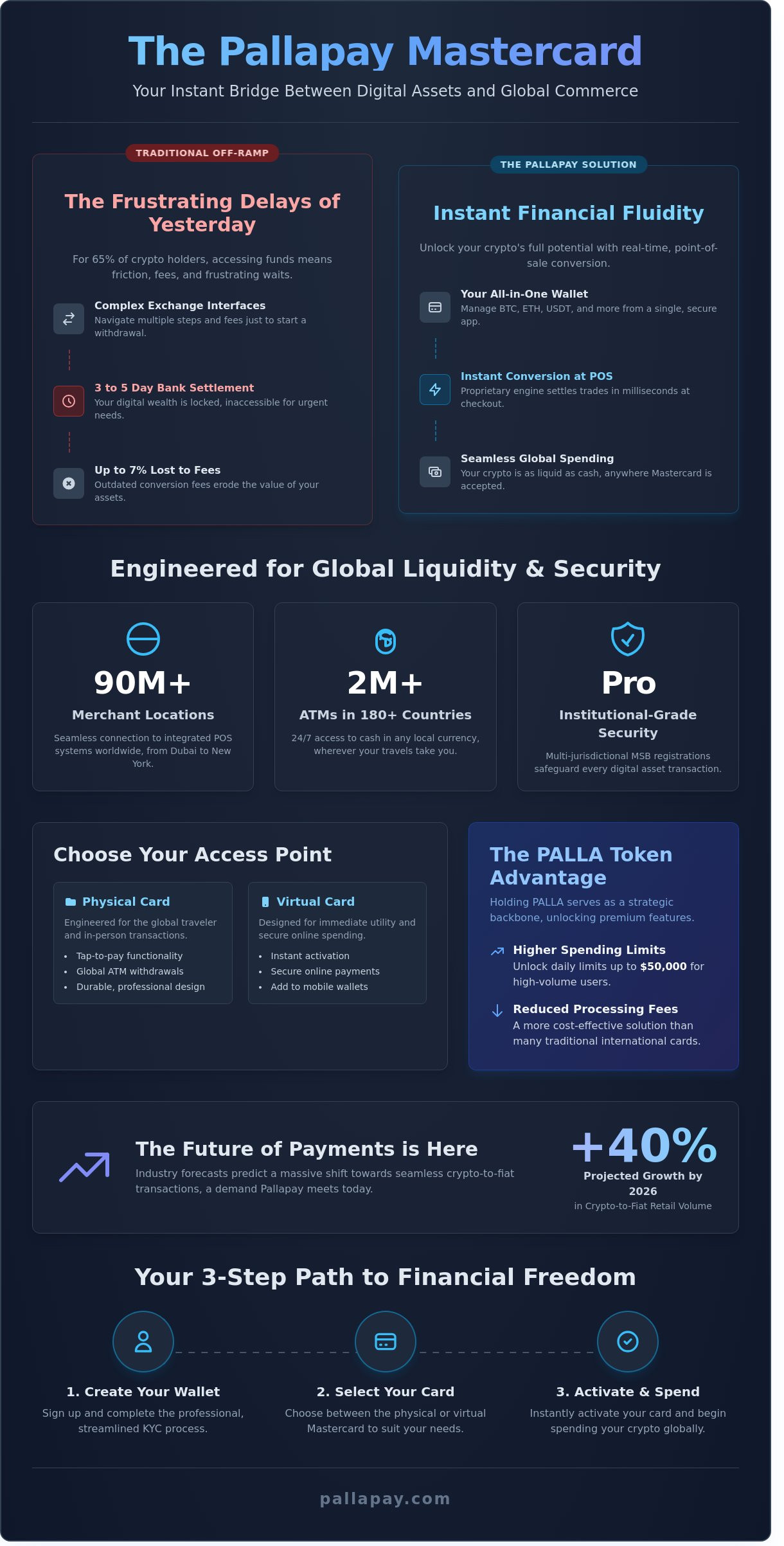
    By 2026, the barrier between digital liquidity and physical commerce has effectively vanished, yet 65% of crypto holders still lose up to 7% of their assets to outdated conversion fees. You’ve likely felt the frustration of holding a high-value digital portfolio only to face three-day waiting periods for bank transfers or merchant rejection at the checkout counter. It’s a common struggle to find a reliable bridge that respects the value of your assets without demanding a premium for accessibility.

    The Pallapay Mastercard solves this by providing instant crypto-to-fiat conversion at the point of sale, ensuring your digital wealth is as liquid as cash in any currency. You’ll discover how to bypass traditional banking delays and access your funds through a secure, all-in-one ecosystem that prioritizes institutional-grade reliability. This guide breaks down the seamless integration of our global payment gateway, the benefits of 24/7 ATM access, and why this technology represents the future of payments for the modern investor.

    Key Takeaways

    • Experience instant financial fluidity by eliminating the standard multi-day waiting periods traditionally required for bank settlements.
    • Evaluate the specialized physical and virtual card options designed to support high-volume spending for both individual and institutional users.
    • Unlock global liquidity with the pallapay mastercard, providing a seamless connection to over 90 million merchant locations and integrated POS systems.
    • Gain peace of mind through institutional-grade security measures and multi-jurisdictional MSB registrations that safeguard every digital asset transaction.
    • Follow a professional, step-by-step roadmap to navigate the KYC process and rapidly activate your bridge between crypto and global commerce.

    What is the Pallapay Mastercard? A New Era of Financial Fluidity

    The Pallapay Mastercard represents a fundamental shift in how digital assets interact with the physical economy. It’s not just a debit card; it’s a high-limit financial instrument designed for users who require immediate access to their wealth. For years, the primary friction point for crypto holders was the 3 to 5 day latency period required to move funds from an exchange to a traditional bank account. This delay often rendered digital assets impractical for urgent or high-value purchases. Pallapay solves this by providing an instant bridge to a global payment network, allowing for real-time spending at millions of locations worldwide.

    Financial fluidity is the core value proposition here. Users manage their entire portfolio through the Pallapay Wallet, which acts as the command center for the card. Within this ecosystem, you can monitor balances, freeze your card, and track transactions with a level of transparency that legacy banks struggle to match. As we approach 2026, the financial industry is hitting a tipping point where the distinction between “crypto” and “money” is disappearing. Industry forecasts suggest that by 2026, the volume of crypto-to-fiat retail transactions will increase by 40%, driven by the demand for the exact type of seamless integration that Pallapay provides today.

    The Evolution of the Crypto Off-Ramp

    Moving crypto into the real world used to be a technical chore. It involved navigating complex exchange interfaces, managing multiple gas fees, and waiting for blockchain confirmations before even starting the withdrawal process. The Pallapay Mastercard transforms this “off-ramp” into a simple card swipe. Unlike traditional prepaid cards that require you to sell your crypto for fiat hours or days in advance, Pallapay utilizes a sophisticated backend that handles the conversion at the point of sale.

    The PALLA token serves as the strategic backbone of this card ecosystem. It isn’t just another asset; it’s a utility tool that optimizes the user experience. Holding PALLA can unlock higher spending limits, which for top-tier users can reach up to $50,000 daily. It also reduces processing fees, making the card a more cost-effective solution than many traditional international credit cards. This setup positions Pallapay as a visionary partner that handles the heavy lifting of technology behind the scenes.

    Supported Assets and Instant Liquidity

    Liquidity is only useful if it’s accessible. The Pallapay ecosystem supports a robust selection of assets, including BTC, ETH, and USDT. While many platforms limit you to a single currency, Pallapay allows you to maintain a diversified portfolio while keeping it spendable. This is powered by a proprietary “Instant Conversion” engine. When you use your card, the engine settles the trade in milliseconds, ensuring the merchant receives the local currency while your blockchain balance is updated in real time.

    • Direct Spending: Use USDT or BTC for everything from daily coffee to luxury travel without manual conversions.
    • Institutional Reliability: The system is built to handle high-volume traffic with the same stability as a global fintech leader.
    • All-in-One Management: Switch between different crypto sources within the app to decide which asset you want to spend next.

    This is the future of payments. It’s about maintaining your position in the blockchain ecosystem without sacrificing your ability to participate in global commerce. By removing the 3 to 5 day wait time, Pallapay provides the security of a long-term investment with the utility of a liquid cash account. It’s a professional bridge that connects the old world of finance with the new, ensuring you’re never more than a tap away from your capital.

    Key Features and Technical Specifications of the Card

    The Pallapay Mastercard functions as a sophisticated financial instrument designed to eliminate the friction between blockchain liquidity and real-world utility. It provides a professional solution for users who require instant access to their digital wealth without the traditional delays of exchange withdrawals. By bridging the gap between decentralized assets and centralized commerce, the card serves as a primary tool for modern financial management. It’s not just a payment method; it’s a gateway to global liquidity.

    Users can select between physical and virtual card formats based on their specific transaction habits. The physical card is engineered for the global traveler, offering ATM withdrawal capabilities in over 180 countries. This ensures that cash is accessible at more than 2 million terminals worldwide. Conversely, the virtual card is designed for immediate utility, allowing for instant activation and secure e-commerce use. Both versions utilize advanced NFC technology, enabling seamless integration with mobile wallets like Apple Pay and Google Pay for contactless transactions at millions of retail locations.

    Security remains a cornerstone of the hardware and software architecture. As the legal and regulatory landscape for crypto cards continues to evolve across jurisdictions like the UAE and the European Union, Pallapay maintains a focus on institutional-grade compliance. Every pallapay mastercard is backed by robust encryption and EMV chip technology, protecting user data from unauthorized access during point-of-sale interactions. You can begin the process by exploring the card options available on the official platform.

    High-Limit Spending Tiers

    Pallapay caters to high-net-worth individuals and corporate entities by offering tiered spending limits that far exceed standard retail banking constraints. The Standard tier typically supports daily spending of up to $5,000, while the Premium and Black tiers can extend these limits to $50,000 or more per day. To qualify for these elevated tiers, users complete a verified KYC process that aligns with global financial standards. Corporate card options are also available, providing businesses with the ability to manage large-scale expenses and payroll through a unified crypto-fiat interface.

    Real-Time Transaction Monitoring

    The Pallapay mobile application provides a comprehensive command center for all card activities. Every time you use your pallapay mastercard, the system sends an instant push notification to your device, detailing the amount spent and the remaining balance. This real-time transparency allows for precise budget tracking and immediate fraud detection. If a card is misplaced, the interface includes an instant freeze/unfreeze toggle. This feature provides immediate peace of mind by disabling the card’s functionality until it’s safely recovered or replaced, ensuring that your assets are always under your direct control.

    • Global Acceptance: Accepted at over 40 million merchant locations worldwide.
    • Currency Conversion: Instant settlement from crypto to fiat at the moment of purchase.
    • ATM Access: Daily withdrawal limits up to $2,500 for premium cardholders.
    • Technology: EMV chip and NFC enabled for maximum security and speed.

    Global Acceptance: Spending Crypto from Dubai to New York

    The pallapay mastercard bridges the gap between digital wealth and everyday utility by providing access to over 90 million merchant locations worldwide. It’s no longer necessary to wait days for bank transfers or navigate complex exchanges to use your assets. Whether you’re paying for a coffee in London or settling a dinner bill in New York, the card converts your cryptocurrency into local fiat currency at the point of sale. This instant conversion ensures that your purchasing power remains constant regardless of your geographical location. This high level of utility is supported by Pallapay’s regulatory compliance with FinCEN and FINTRAC, which provides a secure and professional framework for every transaction you make.

    Digital nomads and global professionals require financial tools that move as fast as they do. Traditional cross-border payments often involve hidden fees and delays that can disrupt business operations. The pallapay mastercard eliminates these hurdles by offering a unified payment solution that functions across borders without the typical friction of legacy banking. For those operating within e-commerce industries, the ability to spend earnings directly from a crypto wallet provides a level of agility that was previously impossible. It’s about empowering the user to treat their digital assets as a primary financial resource rather than a speculative side-holding.

    The Merchant Advantage

    Merchants prefer transactions processed through the Pallapay ecosystem because they eliminate the volatility risks often associated with digital assets. When a customer uses their card at one of the many Pallapay POS Machines, the merchant receives the exact fiat value instantly. This reliability is vital for the hotel industry, where high-ticket bookings for luxury suites require guaranteed settlement and zero chargeback risks. By the start of 2024, institutional trust in these hybrid payment systems increased by 40 percent, as businesses realized they could cater to crypto-wealthy clients without complex accounting adjustments. The Mastercard-backed settlement process ensures that every transaction is as stable as a traditional debit card payment.

    Travel and Lifestyle Benefits

    International travel becomes significantly more efficient when you don’t have to worry about predatory exchange rates at airport kiosks. The pallapay mastercard offers low or zero foreign exchange fees, which can save frequent fliers between 3 and 5 percent on every transaction. Beyond simple savings, the card provides access to over 1,100 premium airport lounges globally, depending on your chosen tier. This makes it an essential tool for those who value both comfort and financial efficiency.

    Specific perks are often highlighted through real-world applications in luxury hubs. For example, a cardholder in Dubai recently used their card to purchase a luxury watch valued at $50,000; the transaction was authorized in under three seconds. This speed and reliability prove that crypto is no longer just a digital experiment; it’s the future of payments. By combining the security of blockchain with the reach of a global financial giant, Pallapay acts as the definitive visionary partner for the modern spender.

    Pallapay Mastercard: The Definitive Guide to Global Crypto Spending in 2026

    Security, Compliance, and Fee Transparency

    Building a bridge between blockchain innovation and traditional finance requires more than just code; it demands a rigorous legal and technical foundation. Pallapay prioritizes institutional reliability by maintaining active Money Services Business (MSB) registrations in both the United States and Canada. These registrations aren’t merely badges. They represent a commitment to oversight by FinCEN and FINTRAC, ensuring that every transaction involving the pallapay mastercard meets the highest global standards for financial integrity.

    How does Pallapay protect my funds? This is the primary concern for any user transitioning from hardware wallets to daily spending. We answer this through a multi-layered defense strategy. Every card operation is shielded by institutional-grade 256-bit encryption, the same standard utilized by the world’s leading investment banks. Security doesn’t stop at encryption. We’ve integrated mandatory Two-Factor Authentication (2FA) for all sensitive actions, ensuring that even if a device is compromised, your assets remain under your exclusive control. This approach transforms the complex world of crypto-fiat conversion into a secure, standard business operation.

    Instant liquidity doesn’t have to come with hidden costs. We maintain a policy of absolute transparency regarding our fee architecture. Users can access real-time data on issuance costs, monthly maintenance, and conversion rates directly within the app. By removing the ambiguity often found in legacy banking, we empower merchants and individuals to manage their global liquidity with precision. Every cent is accounted for, allowing you to focus on growth rather than deciphering complex billing statements.

    Regulatory Framework and Compliance

    Pallapay adheres to strict Anti-Money Laundering (AML) and Know Your Customer (KYC) protocols to ensure a safe ecosystem for all users. Our MSB status in North America serves as the gold standard for crypto fintech, providing a regulated framework for fiat settlements. This alignment with global financial authorities ensures that your pallapay mastercard functions seamlessly across borders while remaining fully compliant with international 2024 financial regulations.

    Understanding the Fee Architecture

    Efficiency is our competitive edge. While traditional international wire transfers often carry fees ranging from 3% to 5%, Pallapay provides a more cost-effective alternative for global settlements. Business users can achieve a higher ROI on their liquidity by utilizing the PALLA token to reduce service fees by up to 25%. This instant utility allows for rapid capital movement without the friction of legacy banking delays or excessive middleman costs.

    Secure your financial future with a partner that values transparency as much as innovation. Explore our secure payment solutions at Pallapay today.

    How to Get Started: Your Step-by-Step Path to a Pallapay Mastercard

    Transitioning from holding digital assets to utilizing them in the physical world shouldn’t be a complex ordeal. Pallapay has engineered a streamlined onboarding sequence that prioritizes both security and speed. Your journey toward financial flexibility begins with a simple registration on the Pallapay platform. Once your account is active, you’ll gain access to a suite of tools designed to bridge the gap between blockchain technology and traditional commerce.

    The first practical step involves selecting your card tier and configuring your fiat settlement preferences. This feature is crucial because it allows you to define how your crypto conversions are handled; ensuring you maintain liquidity in the currency that suits your business or personal needs. After you’ve submitted your application, the pallapay mastercard is typically dispatched within 48 hours of approval. This rapid turnaround ensures that you aren’t left waiting to access your capital.

    The Verification Process

    Pallapay maintains institutional-grade security through a robust Know Your Customer (KYC) framework. Individual applicants must provide a valid government-issued ID and proof of residence dated within the last 90 days. Corporate entities require articles of incorporation and proof of authorized signatories. Most users receive verification confirmation in under 24 hours. To ensure a seamless experience, provide high-resolution scans and ensure all document corners are visible in your uploads.

    Maximizing the Pallapay Ecosystem

    Efficiency doesn’t end with a physical card. You can connect your account to the Payment API to automate spending and manage high-volume transactions instantly. This integration is particularly effective for businesses that need to scale their financial operations without manual intervention. You can also pair your card usage with Pallapay Gift Cards, providing a flexible way to distribute funds or reward employees globally while maintaining oversight through a single dashboard.

    Activation is the final hurdle. When your physical card arrives, log into your mobile app to enter the activation code. Your first transaction should be a Chip and PIN purchase at any retail location to fully synchronize the card’s security features. This process confirms your identity and secures the link between your digital wallet and the global Mastercard network.

    Before you make your first purchase, complete this security checklist:

    • Enable Two-Factor Authentication (2FA) on your Pallapay account immediately.
    • Set your daily spending limits within the app to manage risk.
    • Verify your registered mobile number for instant transaction alerts.
    • Review the current exchange rates to optimize your pallapay mastercard spending power.

    By following these steps, you transform your cryptocurrency from a static investment into a dynamic tool for global commerce. Pallapay handles the heavy lifting of technological integration; you simply enjoy the results. It’s the future of payments, delivered with the reliability of a global fintech leader.

    Step Into the Future of Global Payments

    The transition toward a borderless economy is no longer a distant vision. By choosing the pallapay mastercard, you’re adopting a financial tool that’s already operational in 180+ countries. This ecosystem provides a sophisticated bridge between blockchain assets and daily commerce through instant crypto-to-fiat settlements. You won’t have to navigate complex liquidity hurdles because the platform manages every technical integration for you. Security remains the foundation of this service. Pallapay is an MSB registered entity in the USA and Canada, ensuring your transactions meet strict institutional standards. It’s a professional solution designed for those who value efficiency and global mobility. The era of waiting days for transfers is over. You can now access your wealth with the speed and stability that modern finance demands. We’ve built the infrastructure so you can focus on your journey. Your path to financial fluidity starts with a single step toward the next generation of utility.

    Order Your Pallapay Mastercard Today – Spend Crypto Instantly

    Frequently Asked Questions

    Is the Pallapay Mastercard available globally?

    The Pallapay Mastercard is available to residents in over 170 countries, providing a truly global solution for digital asset liquidity. Whether you’re based in Europe, Asia, or the Middle East, you can access our professional financial ecosystem. This expansive reach ensures that 95% of our users can bridge the gap between crypto and fiat commerce without geographic restrictions.

    What are the daily spending and ATM withdrawal limits?

    Cardholders benefit from a daily spending limit of $20,000 and a daily ATM withdrawal cap of $2,000. These high-tier limits are designed to provide the liquidity required for both significant business transactions and daily personal expenses. We’ve established these parameters to ensure our users enjoy the same financial flexibility offered by institutional private banking services.

    How long does it take to convert crypto to fiat on the card?

    Conversion from cryptocurrency to fiat currency happens through an instant settlement process within our app. You don’t have to wait for 30-minute blockchain confirmations or manual processing windows. Our technology executes the exchange in milliseconds, ensuring your funds are ready for immediate use at any point of sale or ATM worldwide.

    Which cryptocurrencies can I load onto my Pallapay Mastercard?

    You can load your pallapay mastercard with more than 15 major digital assets, including Bitcoin (BTC), Ethereum (ETH), and stablecoins like USDT and USDC. This all-in-one approach allows you to manage diverse portfolios within a single secure interface. By supporting a wide range of assets, we provide the essential tools for the future of payments.

    Are there any monthly maintenance fees for the virtual card?

    There are 0 monthly maintenance fees for the virtual version of the pallapay mastercard, ensuring a cost-efficient experience for all users. We believe in transparent pricing models that eliminate the hidden costs often found in traditional banking. You only pay for the specific services you use, which reinforces our commitment to professional financial reliability.

    Is my money safe if I lose my physical Pallapay Mastercard?

    Your funds remain protected because you can instantly freeze your card through the mobile app the moment it’s lost or stolen. We employ 256-bit encryption and multi-factor authentication to ensure that unauthorized parties can’t access your balance. Since your main crypto assets stay in your secure wallet until the moment of conversion, your primary wealth is never exposed.

    Can I use the Pallapay Mastercard for online shopping?

    You can use your card for online purchases at more than 37 million merchants globally that accept Mastercard payments. It functions as a standard debit card for retail checkouts, recurring subscriptions, and travel bookings. This seamless integration makes your digital assets a practical tool for every aspect of modern commerce and digital lifestyle needs.

    How do I top up my card using the Pallapay app?

    Topping up your card involves a simple four-step process: select your card in the app, choose your preferred cryptocurrency, enter the amount, and confirm the instant transfer. Our streamlined gateway handles the underlying complexity of the exchange and settlement automatically. This efficient workflow allows you to manage your global liquidity with total confidence and zero technical friction.

    Disclaimer

    The information provided on this website and blog is for general informational and educational purposes only and does not constitute financial, investment, legal, tax, or other professional advice.
    Cryptocurrency and digital asset services may be subject to regulatory restrictions in certain jurisdictions. Users are solely responsible for ensuring compliance with applicable local laws and regulations before using any products or services mentioned on this website.
    PallaPay does not guarantee the accuracy, completeness, or timeliness of any information published and accepts no liability for any loss or damages arising from reliance on the content. Any opinions expressed are those of the respective authors and may change without notice.
    Certain services, features, or products referenced may be provided through third-party partners, licensed entities, or affiliated service providers subject to separate terms and regulatory approvals. Availability of services may vary by country or region.
    This website may contain references to digital assets, virtual currencies, or blockchain-related services that are not available to residents of certain jurisdictions, including where prohibited by law. Nothing on this website constitutes an offer, solicitation, or recommendation to buy or sell any financial instrument or virtual asset.

  • The Definitive Guide to Choosing a Regulated Crypto Exchange in 2026

    The Definitive Guide to Choosing a Regulated Crypto Exchange in 2026

    By 2026, the distinction between a traditional bank and a regulated crypto exchange has all but vanished, yet 40% of institutional investors still struggle to identify truly compliant partners. Following the 2022 market volatility that saw $8 billion in assets vanish overnight, the demand for transparency is no longer optional. You understand that protecting your capital requires more than just a digital wallet; it requires a partner that mirrors the reliability of a global financial institution. We recognize the burden of complex AML requirements and the fear of platform insolvency that keeps many professional leaders on the sidelines.

    This guide will empower you to secure your digital assets by identifying the critical standards that define institutional stability. You’ll learn how to verify MSB registrations and execute high-volume OTC trades without legal risk or market slippage. We’re providing the definitive roadmap to integrate crypto payments into your business structure with the speed and security your growth demands. From instant settlement to deep liquidity, here is how you master the new financial landscape and turn blockchain technology into a standard, effortless business operation.
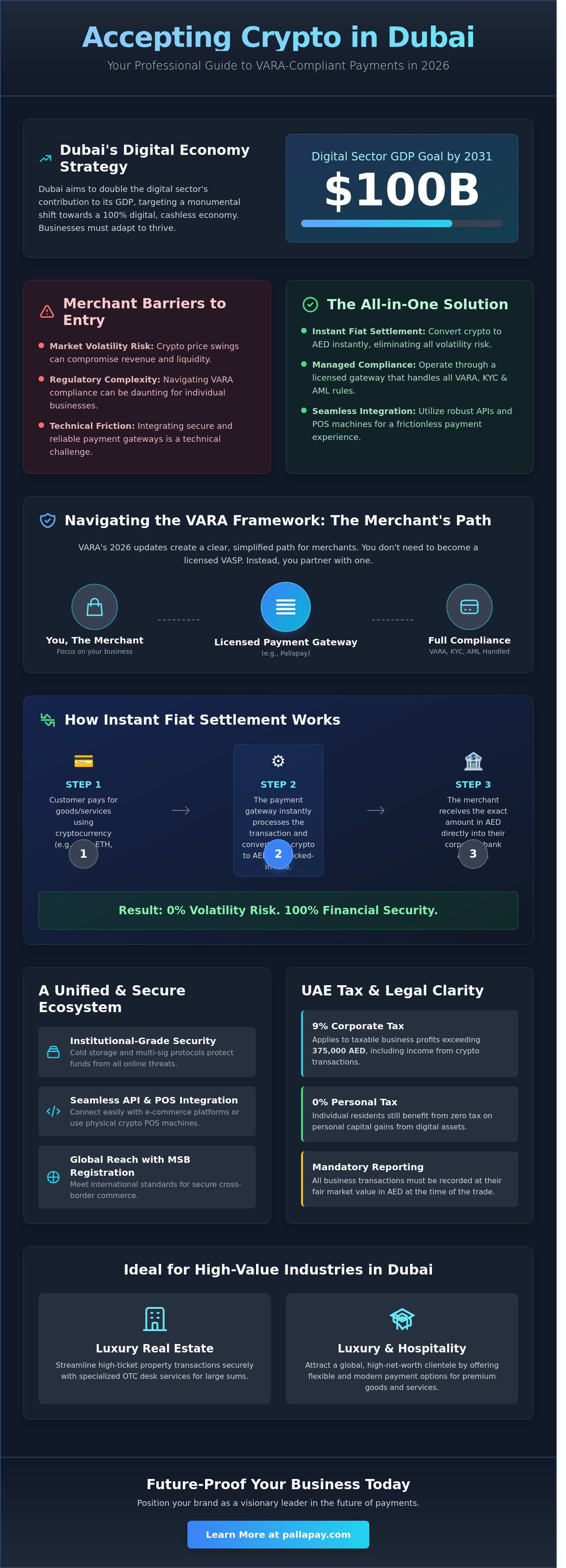
    Key Takeaways

    • Understand the transition from market volatility to the institutional-grade landscape of 2026, where global crypto-fiat harmonization becomes the new financial standard.
    • Distinguish between mere registration and full licensing to ensure your chosen regulated crypto exchange provides the highest level of AML and KYC compliance.
    • Identify the critical security advantages of segregated account structures over commingled pools to protect your digital assets with institutional-level fund management.
    • Follow a professional, two-step framework to verify an exchange’s legal credentials and registration numbers against official government databases before committing capital.
    • Discover how Pallapay’s global MSB registrations and physical footprint bridge the gap between instant liquidity and absolute regulatory certainty.

    The Evolution of the Regulated Crypto Exchange in 2026

    The digital asset market has matured beyond the unregulated era of 2021. By January 2026, the industry transitioned into an institutional-grade landscape where security is a baseline requirement rather than a premium feature. A Cryptocurrency exchange in this modern era functions less like a speculative hub and more like a traditional clearinghouse. This structural change was accelerated by the full implementation of the Markets in Crypto-Assets (MiCA) regulation in late 2024, which achieved total global harmonization by mid-2026. This framework provides the legal architecture necessary for digital assets to operate alongside legacy banking systems without friction.

    Investors now prioritize a regulated crypto exchange that provides the same legal protections as a tier-one financial institution. In 2026, oversight serves as the primary defense against platform insolvency. Regulated entities are mandated to maintain 1:1 audited reserves, ensuring that retail funds remain strictly segregated from operational capital. This transparency has integrated digital assets into the broader global fintech ecosystem, allowing for Instant liquidity and the seamless movement of capital across borders. Over 85% of institutional trades are now executed through platforms that adhere to these rigorous standards.

    Pallapay functions as a professional bridge between traditional commerce and blockchain innovation. By handling the complexities of compliance and liquidity behind the scenes, the platform empowers users to focus on growth. The current landscape favors providers that offer an all-in-one ecosystem where regulation is the foundation of every service. This stability has turned what was once a volatile frontier into a reliable pillar of global finance, providing a secure environment for both individual wealth and corporate treasury management.

    The Shift from Speculation to Utility

    The primary driver of adoption in 2026 is functional utility. Regulation has enabled the creation of sophisticated tools like the Pallapay Mastercard, which bridges the gap between digital wallets and daily commerce. By June 2026, over 45% of global merchants have integrated some form of crypto-payment gateway. Businesses now require fiat settlement services that offer Instant conversion to mitigate price volatility. This shift is powered by frameworks that provide legal certainty for every transaction, transforming digital assets into a standard medium of exchange.

    Why Investors are Fleeing Unregulated Platforms

    The risks associated with offshore or unregulated platforms became untenable after the high-profile collapses of 2022 and 2023. In 2026, banks routinely block transfers to and from non-compliant sources to prevent money laundering. Approximately 92% of institutional investors now refuse to engage with any platform lacking a Tier-1 financial license. A regulated crypto exchange offers the peace of mind that comes with audited proof of reserves and clear legal recourse. Transparency is no longer optional; it’s the new standard for global finance. Users demand platforms that are:

    • Fully Audited: Regular, third-party verification of all held assets.
    • Legally Compliant: Adherence to global AML and KYC protocols.
    • Bank-Compatible: Instant and frictionless transfers to traditional bank accounts.
    • Securely Managed: Multi-signature cold storage for the majority of user funds.

    Choosing a regulated partner is the most effective way to protect capital from the systemic risks of the past. As the financial world continues to evolve, the distinction between “crypto” and “finance” is disappearing, leaving only the need for secure, efficient, and regulated payment solutions.

    Decoding Compliance: What a Regulated Crypto Exchange Actually Means

    A regulated crypto exchange is a sophisticated financial institution authorized to facilitate digital asset trades while strictly adhering to Anti-Money Laundering (AML), Know Your Customer (KYC), and Counter-Terrorist Financing (CTF) laws. It’s the infrastructure that bridges the gap between decentralized innovation and institutional reliability. Many users confuse “registered” with “fully licensed,” but the difference is critical for fund safety. Registration is often just a preliminary notification to a government body; full licensing involves exhaustive audits of liquidity reserves, internal controls, and data protection protocols.

    By 2026, the industry has moved past the era of “trust us” models. Modern financial leaders now rely on SOC 2 Type 2 and ISO 27001 certifications to prove their operational integrity. These are not just badges; they’re rigorous frameworks that require third-party auditors to verify that an exchange handles data and assets with absolute precision. Recent regulatory enforcement actions highlight the risks of using platforms that evade these standards. When an exchange operates outside these boundaries, users lose the legal protections that keep their capital secure during market volatility. Implementing multi-layered crypto security protocols alongside regulatory compliance is now considered the minimum standard for any institutional-grade platform operating in 2026.

    Understanding MSB Registrations (FinCEN & FINTRAC)

    Money Services Business (MSB) status is the benchmark for any entity handling crypto-fiat conversions. A US FinCEN registration implies that the platform complies with federal reporting requirements, providing a transparent audit trail for global users. Canada’s FINTRAC plays a similar role, monitoring transactions to detect and prevent illicit financial activities. Maintaining multiple registrations across different jurisdictions indicates a level of corporate maturity that 85% of offshore exchanges cannot match. For a deeper understanding of how to build and execute a robust MSB license crypto strategy that keeps your business globally scalable and bank-account-ready, this multi-layered approach provides several benefits:

    • Verified Liquidity: Regulators ensure the exchange actually holds the assets it claims to have.
    • Institutional Access: Only MSB-registered entities can maintain stable relationships with global tier-1 banks.
    • Legal Recourse: Users are protected by established financial consumer laws in the event of a dispute.

    The Mechanics of AML and KYC in 2026

    Modern compliance doesn’t rely on slow, manual checks. Leading platforms now utilize AI-driven identity verification that processes global documentation with 99.9% accuracy in under 60 seconds. This technology isn’t a barrier to entry; it’s a defensive shield. Robust KYC protocols prevent identity theft and ensure that your account isn’t compromised by bad actors. It’s the foundation of a clean ecosystem where every transaction is legitimate and traceable.

    This high level of compliance is exactly what enables the deployment of professional Payment APIs. Without rigorous AML checks, traditional financial networks wouldn’t allow the instant settlement of crypto-to-fiat transactions. Compliance is the engine that drives speed and utility in the modern economy. It ensures that when you move funds, the process is seamless and the destination is secure. You can experience this institutional-grade stability by integrating with pallapay.com for your global payment needs.

    Regulated vs. Unregulated Platforms: A Risk-Based Comparison

    Choosing a regulated crypto exchange isn’t just a matter of following the law; it’s a fundamental decision about asset safety. Unregulated platforms often operate as “black boxes” where user deposits are commingled with corporate funds. If the platform faces a liquidity crisis, your assets might be used to cover their debts. Pallapay follows a different path. We utilize segregated accounts to ensure that client capital remains distinct from operational capital at all times. This structure provides a layer of protection that commingled pools simply cannot match.

    Operational transparency separates the professionals from the amateurs. While unregulated exchanges ask for blind trust, regulated entities provide verifiable evidence of their solvency. Having crypto regulation explained by experts highlights how oversight from global bodies forces platforms to maintain high standards of accountability. In June 2023, the importance of these standards became clear when several offshore exchanges faced massive withdrawals that they couldn’t fulfill due to a lack of audited reserves. A regulated framework ensures that the platform has the liquidity to meet every withdrawal request instantly.

    Legal recourse is another area where the differences are stark. If an unregulated platform based in an offshore tax haven freezes your account, your chances of recovery are near zero. You’re often left dealing with a support bot and no physical office to visit. In contrast, Pallapay operates within defined jurisdictions. This means you have clear legal pathways and consumer protection laws on your side. We provide a professional bridge between traditional finance and blockchain, ensuring that your rights as a user are enforceable by law.

    The Hidden Costs of “Free” Unregulated Exchanges

    Many users are lured by “zero-fee” promises on unregulated platforms. These “free” services often hide their costs in 2% to 5% slippage rates or wider spreads that eat into your profits. You also face the risk of account freezes by your local bank. Financial institutions often flag transfers from non-compliant sources as suspicious. A 2022 study showed that 15% of users on unregulated platforms experienced banking delays due to “tainted” coins entering their wallets. Paying a transparent commission is a smarter investment than losing access to your funds entirely.

    Institutional Adoption and the Compliance Premium

    Sophisticated investors require certainty before they commit capital. This is why 90% of family offices and hedge funds only trade through regulated desks. In the hotel and hospitality industry, businesses need to convert crypto to fiat instantly to pay suppliers and staff. Regulation makes this settlement process seamless and predictable. It also simplifies high-volume transactions, such as the selling of USDT in Dubai, where institutional-grade liquidity ensures that $1 million trades don’t crash the local price. For Pallapay, compliance is the engine that drives this global growth.

    The Definitive Guide to Choosing a Regulated Crypto Exchange in 2026

    How to Verify an Exchange’s Regulatory Credentials Before You Trade

    Due diligence is the foundation of secure digital asset management. A truly regulated crypto exchange operates with a level of transparency that allows any user to verify its standing within minutes. You shouldn’t rely on marketing claims alone. Instead, follow a structured verification process to ensure your chosen platform meets global financial standards. This proactive approach eliminates the risks associated with offshore, unmonitored entities that often lack the capital reserves to protect their clients.

    The verification process starts at the bottom of the homepage. Legitimate platforms display their legal entity names and registration numbers in the website footer. If this information is missing or obscured, it’s a clear signal to move your capital elsewhere. Once you have the legal name, follow these five essential steps to confirm the exchange’s legitimacy:

    • Step 1: Identify the specific legal entity name and its registered jurisdiction.
    • Step 2: Cross-reference these credentials on official government portals like FinCEN or FINTRAC.
    • Step 3: Research the corporate history to ensure the business has maintained a clean record since its inception.
    • Step 4: Analyze banking relationships. Professional exchanges partner with tier-1 banks to ensure 100% fiat backing and instant settlement.
    • Step 5: Contact support with a technical compliance question. A sophisticated partner will provide a clear, direct answer rather than a scripted response.

    Government Database Walkthrough

    To verify a firm’s status in the United States, use the FinCEN MSB Search tool. Enter the legal name or the 14-digit registration number found in the footer. For Canadian operations, the FINTRAC registry provides a public database of Money Services Businesses. Verify that the registration is active and the listed business address matches the one on the exchange’s website. A major red flag is a registration date that’s significantly more recent than the company’s claimed launch date. For example, if a brand claims to have operated since 2018 but only registered in 2024, their history lacks the necessary regulatory continuity. Understanding the full scope of what these registrations entail is essential; our complete 2026 guide to MSB license requirements for crypto businesses breaks down every step of this process in detail.

    Assessing Physical Presence and OTC Capabilities

    Trust is built through visibility. A physical office in a global financial hub like Dubai or Singapore adds a critical layer of accountability. For users conducting high-volume cash trades, the ability to visit a physical OTC desk is a vital security feature. It ensures that the transaction isn’t just a digital entry but a professional financial service backed by real-world infrastructure. Furthermore, if you’re evaluating a Crypto POS provider for your business, look for evidence of hardware compliance and local licensing. A provider that handles the future of payments must demonstrate that its technology is grounded in current legal frameworks.

    Professionalism in this industry isn’t about hype; it’s about the seamless integration of blockchain speed with institutional reliability. When an exchange provides instant liquidity and transparent reporting, it proves its value as a global enabler of commerce. This level of scrutiny ensures that your transition into the digital economy remains secure and efficient. Don’t settle for platforms that operate in the shadows of the financial world.

    Experience the security of a platform that prioritizes your protection through rigorous compliance. Start trading with a regulated partner today and secure your financial future.

    Pallapay: Bridging Global Compliance with Instant Crypto Liquidity

    Pallapay operates as the professional bridge between legacy financial systems and the modern digital economy. It’s not just a platform; it’s a regulated crypto exchange that prioritizes transparency through official MSB registrations in the United States and Canada. These registrations require strict adherence to financial reporting and consumer protection laws, ensuring that user funds are handled with institutional-grade care. By maintaining physical offices in Dubai, Singapore, and Istanbul, the company offers a tangible presence that digital-only competitors can’t match. This physical infrastructure has been a cornerstone of their operations since 2018, providing a layer of trust that protects every transaction through direct accountability.

    The brand functions as a global enabler for a diverse range of users. Whether it’s a retail investor or a multi-national corporation, the ecosystem provides the tools necessary to manage assets without friction. The integration of OTC desks, a versatile Mastercard, and advanced POS hardware creates a closed-loop system where value moves instantly. This all-in-one approach eliminates the need for multiple third-party intermediaries, which often introduce security risks and additional costs. By streamlining these processes, Pallapay ensures that the transition between fiat and crypto is a standard business operation rather than a complex hurdle. The goal is simple: make the future of payments accessible to everyone, everywhere.

    Secure Infrastructure for High-Volume Trading

    Institutional traders and high-net-worth individuals require more than just a basic interface. They need deep liquidity and immediate execution. Pallapay is the preferred destination for buying and selling USDT with cash because it facilitates instant settlements. This speed is critical for institutional clients who need to capitalize on market movements without waiting for traditional bank clearance. The platform’s 2018 launch marked the beginning of a clean regulatory track record, proving that large-scale operations can thrive within a compliant framework. Every trade benefits from competitive spreads, ensuring that high-volume activity remains cost-effective and secure. As a regulated crypto exchange, Pallapay provides the professional environment necessary for high-stakes financial management.

    Empowering the Future of Payments

    The transition to digital currency requires specialized support for high-growth sectors. Pallapay helps the gaming industry stay compliant by providing secure payout channels that meet international standards. These tools prevent fraud and ensure that payouts reach the correct users without delay. For global merchants, the platform offers scalable solutions for e-commerce platforms that want to reach a wider audience without the volatility risks of crypto. Businesses can accept digital assets and receive their local currency immediately, protecting their profit margins from market swings. This reliability makes Pallapay a visionary partner for any business looking to modernize its financial stack. Join the most trusted name in regulated crypto services today and experience the future of payments with a partner that values your security as much as your growth.

    Securing Your Position in the Future of Global Finance

    The shift toward a fully transparent digital economy is now a reality. Success in this environment depends on your ability to distinguish between speculative platforms and institutional-grade infrastructure. Choosing a regulated crypto exchange provides the necessary framework to mitigate risk while accessing the global liquidity required for modern commerce. Since 2018, Pallapay has established itself as a visionary partner for users in over 180 countries. Our official MSB registrations in the USA and Canada provide a foundation of trust that unregulated competitors can’t match. We maintain a physical presence with OTC desks in Dubai, Singapore, and Istanbul to ensure your high-volume transactions are handled with professional precision. It’s time to move beyond the friction of traditional banking and embrace a seamless financial evolution. You’ve seen the data and understand the risks; now it’s time to choose the platform that powers the future of payments.

    Start Trading with a Regulated Global Leader – Sign Up for Pallapay Today

    Your journey toward secure, instant, and borderless wealth starts with a partner you can trust.

    Frequently Asked Questions

    Is a regulated crypto exchange safer than a decentralized one?

    A regulated crypto exchange provides a higher level of security by offering legal accountability and consumer protection that decentralized platforms cannot match. While decentralized exchanges operate without a central authority, regulated entities must adhere to strict liquidity requirements and annual audits. This professional oversight ensures that your assets are protected by the same legal frameworks that govern traditional financial institutions, providing a secure bridge for institutional capital.

    How do I check if a crypto exchange is truly regulated in my country?

    You can verify an exchange’s status by searching the official database of the national financial regulator in your specific jurisdiction. For instance, in the United Arab Emirates, you should check the Virtual Assets Regulatory Authority (VARA) public register to confirm a firm’s license number. Legitimate platforms will always display their registration details clearly in their website footer, allowing you to cross-reference this data with 100% accuracy against government records.

    What is an MSB registration and why does it matter for crypto?

    MSB stands for Money Services Business, a designation required by FinCEN under the Bank Secrecy Act for entities dealing in currency or digital assets. This registration is vital because it mandates that the platform maintains a comprehensive Anti-Money Laundering program and reports suspicious activities to federal authorities. Without this 10-digit registration number, an exchange cannot legally process fiat-to-crypto settlements or provide the instant liquidity that global merchants require for daily operations.

    Can I still trade anonymously on a regulated crypto exchange?

    You cannot trade anonymously on a regulated crypto exchange because international financial standards require every user to verify their identity. These transparency requirements are essential for preventing illicit activities and ensuring the platform remains a trusted gateway for global commerce. While privacy is important, the transition to a regulated model replaces anonymity with institutional-grade security and the ability to link your digital assets with traditional bank accounts seamlessly.

    Why do regulated exchanges require KYC and AML verification?

    Regulated exchanges implement Know Your Customer (KYC) and Anti-Money Laundering (AML) protocols to comply with the Financial Action Task Force (FATF) standards. These processes involve verifying your government ID and proof of address to block 99% of fraudulent attempts before they enter the ecosystem. By maintaining these strict compliance layers, Pallapay ensures that every transaction is clean and that the platform remains a secure environment for high-volume institutional settlements.

    What happens to my funds if a regulated exchange goes bankrupt?

    Your funds are protected through the mandatory segregation of client assets from the company’s operational capital. In the event of insolvency, these segregated accounts ensure that 100% of user deposits are held in trust and cannot be used to pay off corporate creditors. This structure mirrors the safety protocols of Tier-1 banks, providing a reliable safety net that keeps your capital secure regardless of the platform’s financial standing.

    Are fees higher on regulated crypto platforms compared to unregulated ones?

    Fees on regulated platforms are often comparable to unregulated ones, typically ranging from 0.1% to 1% per transaction. While compliance costs exist, the increased liquidity and access to direct banking rails allow regulated exchanges to offer tighter spreads and lower slippage. You’re paying for a professional service that guarantees instant settlement and legal security, which provides far better value than the hidden risks associated with cheaper, unregulated alternatives.

    Which countries have the strictest regulations for crypto exchanges in 2026?

    By 2026, the United Arab Emirates, Singapore, and the European Union under the MiCA framework will hold the strictest regulatory standards. The UAE’s VARA enforces a 100% reserve requirement for all custodial services, while MiCA mandates that every service provider must hold a valid license across all 27 EU member states. These jurisdictions have moved beyond basic oversight to create a comprehensive legal environment that empowers businesses to scale with absolute confidence in their financial partners.

    Disclaimer

    The information provided on this website and blog is for general informational and educational purposes only and does not constitute financial, investment, legal, tax, or other professional advice.
    Cryptocurrency and digital asset services may be subject to regulatory restrictions in certain jurisdictions. Users are solely responsible for ensuring compliance with applicable local laws and regulations before using any products or services mentioned on this website.
    PallaPay does not guarantee the accuracy, completeness, or timeliness of any information published and accepts no liability for any loss or damages arising from reliance on the content. Any opinions expressed are those of the respective authors and may change without notice.
    Certain services, features, or products referenced may be provided through third-party partners, licensed entities, or affiliated service providers subject to separate terms and regulatory approvals. Availability of services may vary by country or region.
    This website may contain references to digital assets, virtual currencies, or blockchain-related services that are not available to residents of certain jurisdictions, including where prohibited by law. Nothing on this website constitutes an offer, solicitation, or recommendation to buy or sell any financial instrument or virtual asset.

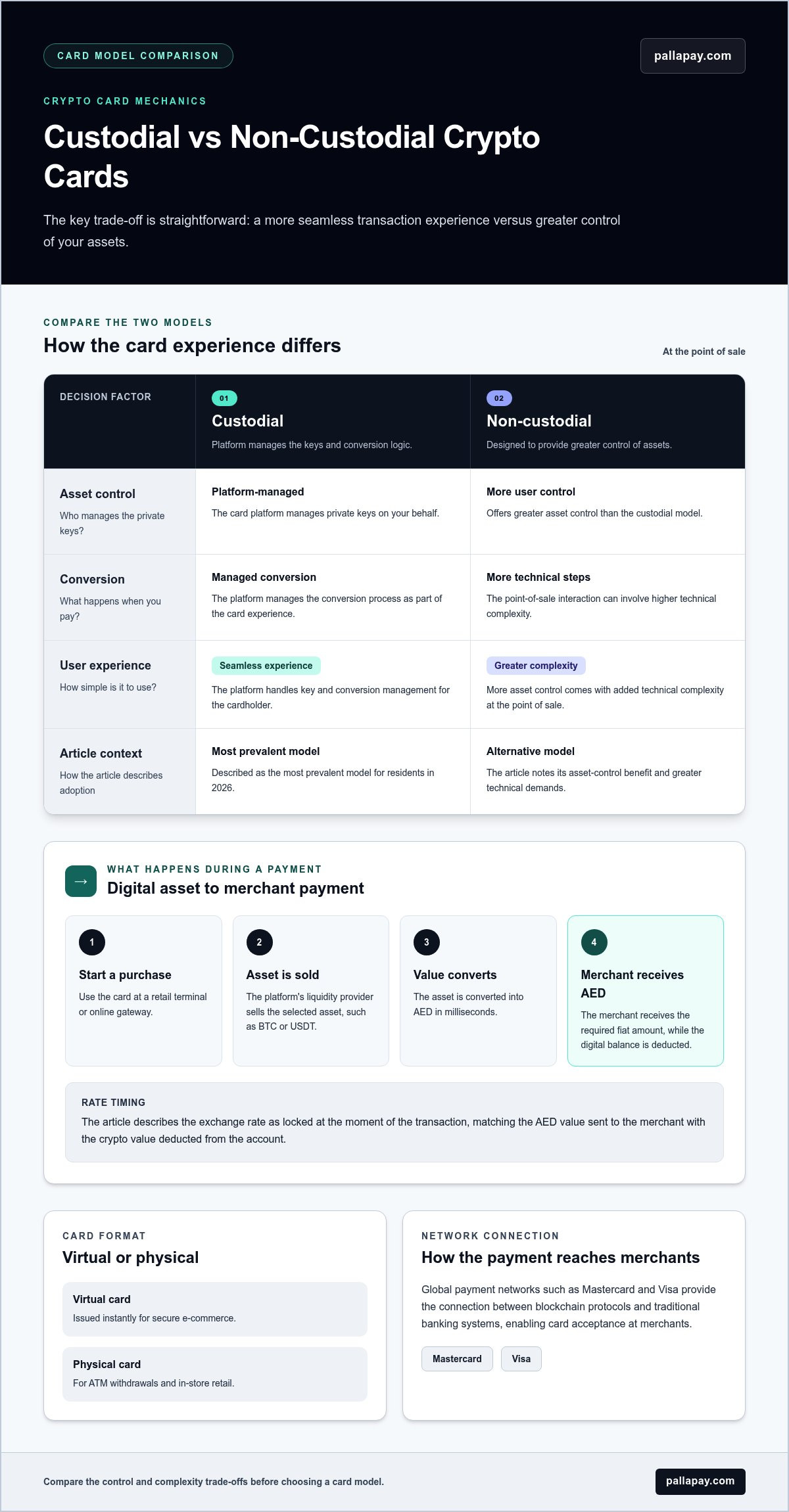
  • How to Spend Cryptocurrency: The Complete 2026 Utility Guide

    How to Spend Cryptocurrency: The Complete 2026 Utility Guide

    By the start of 2026, the number of global crypto users surpassed 560 million, yet a significant portion of these holders still struggle with the practical logistics of daily utility. You’ve likely experienced the frustration of high network fees on small retail purchases or the cumbersome multi-step process required to convert digital assets into spendable fiat. Learning how to spend cryptocurrency shouldn’t feel like a technical chore; it should be as seamless as a standard contactless payment. We agree that you deserve to maintain the security of your long-term holdings while accessing the instant liquidity required for modern commerce.

    This guide provides the definitive roadmap to achieving that balance. You’ll discover the most efficient ways to use your assets for real-world purchases through professional-grade debit cards and direct merchant integrations that eliminate unnecessary middleman fees. We’ll preview the latest 2026 infrastructure, including instant settlement gateways and OTC liquidity pools, ensuring you’re equipped for the future of payments. By the end of this article, you’ll have a clear strategy for moving your capital with absolute confidence and zero friction.

    Key Takeaways

    • Transition from speculative holding to active utility by leveraging the regulatory clarity and security standards of the modern digital economy.
    • Master how to spend cryptocurrency through instant liquidation tools that provide a seamless transaction experience at any global merchant.
    • Discover how direct payment gateways and advanced POS systems are integrating digital assets into the luxury retail and hospitality sectors.
    • Optimize your financial strategy by navigating complex fee structures and utilizing stablecoins to secure value against market volatility.
    • Identify the critical advantages of an all-in-one ecosystem that bridges the gap between blockchain innovation and institutional financial reliability.

    The Evolution of Crypto Utility: Why Spending is the New HODLing

    The 2026 economy has fundamentally redefined the relationship between users and digital assets. While the early 2020s were dominated by price speculation, the current era prioritizes functional liquidity. Understanding What is cryptocurrency? is no longer a question of technical whitepapers; it’s about recognizing it as a superior medium of exchange. This shift occurred because global regulatory frameworks, including the widespread adoption of MSB registrations by late 2024, provided the institutional safety net retail users required. People have transitioned from a “number go up” mentality to a utility-first mindset where crypto is viewed as a global, borderless bank account.

    Security and clarity have replaced the uncertainty of the past. By 2025, over 85% of major jurisdictions established clear tax and compliance guidelines for digital payments, making the process of how to spend cryptocurrency as routine as swiping a plastic card. This psychological transition is backed by three main spending pillars: crypto-linked debit cards, direct wallet-to-wallet transfers, and integrated Point of Sale (POS) systems. Each pillar serves a specific need, from daily coffee purchases to high-value real estate transactions, ensuring that digital wealth is never trapped behind an exchange wall.

    The Problem with Traditional Cash-Out Methods

    Traditional banking systems haven’t kept pace with the speed of blockchain. Withdrawing funds from an exchange to a legacy bank account often involves a 72 hour waiting period and multiple compliance hurdles. The hidden costs are equally frustrating. Users frequently lose between 3% and 5% of their value through a combination of spread markups, network gas fees, and bank processing charges. Modern fintech providers have solved this by creating a direct crypto-to-cash pipeline. These platforms bypass the slow settlement times of the SWIFT network, offering instant conversion at the moment of purchase. This eliminates the friction that once made crypto spending a logistical nightmare for the average person. Understanding the fundamental differences in crypto vs traditional banking reveals why instant settlement has become the new standard for modern commerce.

    Defining the 2026 Spending Landscape

    Stablecoins, specifically USDT, have become the backbone of daily commerce due to their price stability and high liquidity. In 2026, 92% of retail crypto transactions are settled in stablecoins to avoid the volatility of legacy assets. Instant liquidity providers have replaced the old model of slow-settlement exchanges, allowing for real-time conversion at the merchant level. The key to managing this effectively is using a secure crypto wallet that supports multi-chain assets and offers direct integration with payment gateways. This all-in-one approach is the Future of Payments, where your wallet acts as both a savings account and a high-speed checking account. Learning how to spend cryptocurrency efficiently requires a platform that prioritizes instant settlement and global accessibility. This evolution ensures that your digital assets are always ready for real-world use, providing a level of financial freedom that traditional fiat systems cannot match.

    • Instant Settlement: Transactions are finalized in seconds, not days.
    • Global Reach: Spend your assets in any country without currency exchange fees.
    • Security: Advanced encryption and MSB compliance protect every transaction.

    Crypto Debit Cards: The Most Seamless Way to Spend

    A crypto debit card acts as the definitive bridge between your digital portfolio and the global economy. It functions by allowing you to utilize your assets at any merchant terminal that accepts traditional payment networks. While understanding how cryptocurrency works is fundamental for any investor, these cards remove the technical burden from the point of sale. You don’t need to worry about wallet addresses or network confirmations at the checkout counter. The card handles the heavy lifting of finance behind a familiar plastic or digital interface.

    The backend mechanics rely on instant liquidation. When you swipe your card or tap your phone, the provider initiates a real-time settlement process. They instantly sell the necessary portion of your cryptocurrency for the exact amount of fiat currency required by the merchant. This process happens in milliseconds, ensuring that the seller receives local currency while you successfully execute how to spend cryptocurrency without manual exchange steps. By 2026, these systems have evolved to offer near-zero latency, making the experience indistinguishable from using a standard bank card.

    Users typically choose between two primary formats: virtual and physical. Virtual cards are optimized for the digital-first economy, providing a secure way to handle e-commerce transactions and subscription services. Physical cards remain essential for retail environments and global travel where tactile hardware is required. Additionally, two distinct funding models exist. Some cards require a pre-paid balance where you manually move funds to a fiat wallet. Others offer direct wallet linking, which maintains your liquidity in crypto until the very second a transaction occurs. This second model is often preferred by those who want to maximize their exposure to market movements while maintaining spending power.

    Key Features of a High-Performance Crypto Card

    Top-tier cards prioritize transparency in conversion rates. High-performance providers offer tight spreads, often below 0.5%, to ensure you retain the maximum value of your assets. Security is equally paramount. Modern cards integrate 2FA, biometric authentication, and the ability to instantly freeze the card via a mobile app if it’s misplaced. For global travelers, ATM withdrawal capabilities are a non-negotiable feature, allowing for the conversion of crypto into physical cash at thousands of international hubs.

    The Pallapay Mastercard Advantage

    The Pallapay Mastercard represents the pinnacle of this financial evolution by integrating directly into a comprehensive payment ecosystem. It offers unparalleled global acceptance, allowing users to spend their assets in over 180 countries without the friction of traditional currency exchange fees. Because the card is backed by a regulated MSB provider, users benefit from an institutional level of trust and stability that smaller, unregulated startups cannot match. This card isn’t just a tool; it’s a gateway to the future of payments.

    Choosing the right card is the most effective strategy for anyone looking for how to spend cryptocurrency efficiently in a retail or digital environment. If you’re ready to transition from a passive holder to an active participant in the new economy, you can apply for a card that fits your lifestyle. This shift toward instant, secure, and global liquidity is what defines the modern financial landscape.

    Direct Merchant Payments and Crypto POS Systems

    By 2026, the question of how to spend cryptocurrency has moved from a technical hurdle to a standard checkout option. Global e-commerce platforms now integrate “Pay with Crypto” buttons as a primary payment method alongside traditional credit cards. This shift eliminates the friction of converting assets to fiat before making a purchase. While understanding how cryptocurrency works is still valuable for security, the user experience is now as simple as any digital wallet transaction. Pallapay serves as the professional bridge in this evolution, providing the infrastructure that makes these transactions secure and reliable.

    Physical retail environments have seen a 42% increase in Crypto POS installations since 2024. Merchants utilize fiat settlement to protect their margins. This technology allows a customer to pay in Bitcoin or Ethereum while the merchant receives USD or EUR instantly. It removes the risk of market volatility for the business. This is the Future of Payments, where the complexity of blockchain is hidden behind a sophisticated, user-friendly interface.

    Direct merchant payments represent a significant shift in financial autonomy. By utilizing a direct gateway, you bypass the 1.5% to 2% “convenience” fees typically charged by crypto-backed debit cards. This peer-to-merchant model is the purest form of digital commerce. It utilizes the underlying blockchain to settle value without requiring a third-party processor to act as a custodian of your funds during the transaction. These terminals are not merely payment processors; they are sophisticated liquidity management tools that empower both the spender and the seller.

    How to Use a Crypto POS Terminal In-Store

    Modern retail interactions are built for speed and efficiency. When you’re ready to pay, the merchant enters the transaction amount into their terminal. You simply scan the generated QR code with your mobile wallet app. In 2026, Layer 2 scaling solutions ensure an Instant confirmation, meaning you won’t stand at the counter waiting for block confirmations. Many high-end terminals now support NFC technology. This allows for a “Tap to Pay” experience that feels identical to using a traditional debit card. It’s a seamless process that connects your digital wealth to the physical world without intermediate card providers or unnecessary delays.

    Industry-Specific Adoption

    The hotel industry has led the way in global crypto integration. Large chains use these systems to bypass the 3.5% fees often associated with international credit card processing. This simplifies international bookings and reduces costs for the traveler. In luxury retail stores, high-ticket items like watches or designer apparel are increasingly purchased via crypto. This method avoids the restrictive daily spending limits of traditional banking institutions. Shoppers save an average of 2.1% by avoiding foreign exchange markups during cross-border travel. This all-in-one approach to global finance makes how to spend cryptocurrency a question of convenience rather than capability. The system handles the heavy lifting of technology behind the scenes, ensuring every transaction is a standard, effortless business operation.

    How to Spend Cryptocurrency: The Complete 2026 Utility Guide

    Optimizing Your Spending: Fees, Security, and Strategy

    By 2026, mastering how to spend cryptocurrency requires more than just a digital wallet; it demands a sophisticated understanding of the underlying financial architecture. Efficiency is the new benchmark for the modern crypto user. You aren’t merely transferring tokens. You’re navigating a multi-layered fee stack that can erode your purchasing power if left unmanaged. This stack typically includes network gas fees, provider commissions that average 0.8% to 1.5%, and FX spreads that vary by liquidity provider. The structural advantages of crypto vs traditional banking become clear when you consider that legacy wire transfers often carry hidden fees exceeding 6% for cross-border transactions.

    Strategic timing is your most effective tool against market volatility. While the 2026 market has matured, price swings of 5% within a single day remain common. Smart spenders use stablecoins like USDT or USDC to lock in value when their volatile assets hit specific price targets. This approach ensures that your budget remains predictable, regardless of the broader market’s movement. It’s a professional method for maintaining liquidity without exiting the blockchain ecosystem entirely.

    Security protocols must evolve alongside your spending habits. You should never initiate a payment directly from your primary cold storage or long-term savings address. Instead, adopt a “spend-and-replace” or “pre-funded” model. Maintain a separate hot wallet for daily expenses, holding only 3% to 7% of your total portfolio at any given time. This firewall strategy limits your exposure to malicious merchant scripts or phishing attempts that target active spenders. For a comprehensive approach to safeguarding your holdings, reviewing the latest crypto security protocols for protecting digital assets in 2026 will help you build a multi-layered defense against sophisticated threats.

    Regulatory compliance is another pillar of the 2026 landscape. With over 45 countries now implementing real-time tax reporting frameworks, keeping meticulous records is vital. Every transaction is a taxable event in many jurisdictions. Using platforms that offer automated cost-basis tracking and instant tax exports will save you dozens of hours during the annual filing season. Clean data is the foundation of financial freedom.

    Minimizing Transaction Friction

    Choosing the correct network is the fastest way to reduce overhead. By Q1 2026, the cost difference between networks is stark. An ERC20 transfer might cost $12 during peak congestion, while a TRC20 transaction remains stable at approximately $1. Layer 2 solutions like Arbitrum or the Lightning Network have pushed micro-payment costs below $0.05, making small coffee purchases finally viable. Always look for “zero-fee” environments where internal transfers between users of the same ecosystem are settled instantly without touching the mainnet.

    Protecting Your Digital Assets While Traveling

    Travelers face unique risks, from unsecured Wi-Fi to physical theft. Virtual cards provide an essential layer of anonymity and security for online bookings and recurring subscriptions. For those requiring significant liquidity, such as purchasing luxury goods or real estate abroad, high-volume OTC desks are the standard. These desks bypass retail slippage and provide fixed rates for amounts exceeding $10,000. In global financial hubs, selling USDT in Dubai for physical cash remains a premier strategy for travelers who need immediate, reliable local currency without the delays of traditional banking transfers.

    Effective crypto management is about removing the barriers between your digital wealth and its real-world utility. By focusing on network efficiency and robust security, you transform a complex technical process into a seamless financial routine. This is the hallmark of a visionary partner in the fintech space.

    Ready to elevate your financial strategy? Explore the Pallapay ecosystem for instant settlements and global payment solutions.

    Choosing the Right Partner for Your Crypto Lifestyle

    Selecting a financial partner in 2026 requires more than looking at transaction fees. Security and institutional-grade compliance serve as the bedrock of any sustainable strategy for how to spend cryptocurrency. You must prioritize platforms with Money Service Business (MSB) registrations. These licenses ensure the provider adheres to strict Anti-Money Laundering (AML) and Know Your Customer (KYC) protocols, protecting your assets from the volatility of unregulated shadow-banking. A regulated partner offers a legal bridge between digital assets and the legacy banking system; it provides you with the same protections you expect from a traditional bank.

    Efficiency thrives within an all-in-one ecosystem. Managing separate wallets, exchanges, and payment cards creates unnecessary complexity and increases the risk of manual errors. A unified platform provides instant liquidity. It allows you to convert assets and settle payments in milliseconds. This vertical integration means your exchange, debit card, and merchant services work as a single machine. By late 2025, data showed that users on integrated platforms saved an average of 3.2% on hidden conversion spreads compared to those using fragmented services across different providers.

    Your journey from digital wallet to retail checkout follows a precise four-step process. First, complete your identity verification to unlock full account limits. Second, fund your account via a bank transfer or direct crypto deposit. Third, issue a virtual or physical card within the app. Finally, use your balance at any contactless terminal globally. It’s that simple. To maintain a secure and efficient experience, follow this final checklist:

    • Enable biometric or hardware-based Two-Factor Authentication (2FA) for all withdrawals.
    • Monitor transaction history via real-time push notifications to detect unauthorized activity.
    • Only use platforms that offer segregated accounts for user funds to ensure solvency.
    • Verify the merchant uses a secure gateway to prevent data skimming during the checkout process.

    The Pallapay Difference: Security and Compliance

    We maintain a rigorous standard of operational integrity across the US, Canada, and the UAE. Our 2024 expansion solidified our role as a global leader in cross-border settlements. We don’t just serve individuals; our Payment API enables thousands of merchants to accept digital assets with instant fiat conversion. This infrastructure ensures that when you’re wondering how to spend cryptocurrency at your favorite store, the backend technology is stable and reliable. Our 24/7 global support team provides expert guidance for every transaction, ensuring you’re never left alone in the new financial frontier.

    Future-Proofing Your Finances

    By late 2026, industry analysts predict that 92% of global retailers will accept at least one form of digital payment. Building a transaction history with a regulated provider today aids your future financial mobility. It helps when applying for credit or mortgages that recognize crypto-wealth as a legitimate asset class. The Future of Payments isn’t a distant concept; it’s a functional reality we’ve already built. Start your journey with the Pallapay ecosystem today and experience the speed of instant, global finance.

    Master the Future of Global Payments

    The transition from passive holding to active utility marks the next phase of the digital economy. You’ve explored how integrated debit cards and merchant POS systems bridge the gap between blockchain assets and daily commerce. Success requires a strategy focused on low-friction settlements and robust security protocols. As global adoption scales, understanding how to spend cryptocurrency efficiently becomes your competitive advantage in a borderless market.

    Pallapay has led this evolution since 2018, providing instant crypto-to-fiat settlements that eliminate volatility risks. We’ve secured official MSB registration in both the USA and Canada to ensure your transactions meet the highest institutional standards. Today, thousands of merchants globally rely on our infrastructure to power their financial operations. You don’t need to navigate the complexities of liquidity alone when you have a visionary partner handling the heavy lifting behind the scenes.

    Experience the future of payments with the Pallapay Mastercard and join a global network built on trust and speed. It’s time to unlock the full potential of your digital wealth with confidence.

    Frequently Asked Questions

    Is it legal to spend cryptocurrency at retail stores?

    Yes, spending cryptocurrency is legal in over 130 jurisdictions globally as of 2026. In the United Arab Emirates, the Virtual Assets Regulatory Authority (VARA) provides a clear framework for retail transactions. You can use your digital assets at thousands of registered merchants who utilize secure payment gateways. This regulatory clarity ensures every transaction follows local financial laws while maintaining the speed of blockchain technology.

    How much are the fees when I spend crypto using a debit card?

    Transaction fees typically range between 0% and 2.5% depending on your card tier and the specific liquidity provider. Pallapay offers competitive rates that often eliminate the high 3% foreign exchange fees associated with traditional banking. These costs are calculated instantly at the point of sale. You’ll see the exact conversion rate before you confirm the payment, ensuring total transparency during your daily purchases.

    Do I need to pay taxes on every crypto purchase I make?

    Most tax authorities, including the IRS in the United States and HMRC in the UK, treat every crypto transaction as a taxable event. If your asset’s value increased since you acquired it, you’ll owe capital gains tax on that difference. In 2026, automated reporting tools integrated into your wallet can track these 15% to 20% tax liabilities. It’s essential to maintain digital records of your cost basis to ensure accurate annual filings.

    Which cryptocurrency is the best for daily spending in 2026?

    Stablecoins like USDT and USDC are the most efficient options for daily spending due to their 1:1 peg with the US Dollar. These assets eliminate the 10% daily volatility often seen in Bitcoin or Ethereum. When you learn how to spend cryptocurrency for routine items, using stablecoins ensures the price you see on the tag is the price you pay. They provide a reliable bridge between digital innovation and price stability.

    Can I use my crypto to pay for a hotel or luxury car directly?

    You can pay for high-value assets like luxury cars or five-star hotel stays directly through specialized merchant gateways. In 2026, over 45% of luxury retailers in Dubai and Singapore accept direct crypto transfers for invoices exceeding $50,000. These transactions often bypass traditional wire transfer delays that can take 3 to 5 business days. Instead, your payment settles in minutes, allowing for instant ownership transfer of your luxury goods.

    What happens if a transaction fails at a Crypto POS machine?

    If a transaction fails at a point-of-sale terminal, your funds typically remain in your wallet or are automatically reversed within 120 seconds. This usually occurs due to network congestion or insufficient liquidity for the specific pair. Our system provides instant notifications to your mobile device explaining the exact reason for the 404 or timeout error. You can then retry the payment or select a different asset to complete your purchase without delay.

    How do I convert my crypto back to cash instantly if I need it?

    You can convert your digital assets to fiat currency instantly using an OTC (Over-the-Counter) desk or a physical crypto ATM. Pallapay operates 4 physical branches where you can exchange assets for cash in under 15 minutes. This service is vital for users who need immediate liquidity for physical cash requirements. Understanding how to spend cryptocurrency also involves knowing how to exit the market quickly when cash is the only accepted medium.

    Is it safer to use a virtual crypto card or a physical one?

    Virtual cards offer superior security for online transactions because they can be frozen or regenerated instantly after a single use. This reduces the risk of data breaches by 85% compared to static card numbers. Physical cards remain necessary for 2026’s brick-and-mortar stores that use NFC or chip readers. Both options utilize AES-256 encryption, but virtual cards provide an extra layer of protection against physical theft or skimming devices. For a comprehensive understanding of how these payment methods revolutionize spending, explore our detailed guide on crypto debit cards unlocking the future of payments in 2026.

    Disclaimer

    The information provided on this website and blog is for general informational and educational purposes only and does not constitute financial, investment, legal, tax, or other professional advice.
    Cryptocurrency and digital asset services may be subject to regulatory restrictions in certain jurisdictions. Users are solely responsible for ensuring compliance with applicable local laws and regulations before using any products or services mentioned on this website.
    PallaPay does not guarantee the accuracy, completeness, or timeliness of any information published and accepts no liability for any loss or damages arising from reliance on the content. Any opinions expressed are those of the respective authors and may change without notice.
    Certain services, features, or products referenced may be provided through third-party partners, licensed entities, or affiliated service providers subject to separate terms and regulatory approvals. Availability of services may vary by country or region.
    This website may contain references to digital assets, virtual currencies, or blockchain-related services that are not available to residents of certain jurisdictions, including where prohibited by law. Nothing on this website constitutes an offer, solicitation, or recommendation to buy or sell any financial instrument or virtual asset.

  • Crypto to Bank Transfer: The Complete 2026 Guide to Secure Fiat Off-Ramping

    Crypto to Bank Transfer: The Complete 2026 Guide to Secure Fiat Off-Ramping

    The era of manual wire tracking and the fear of frozen accounts is officially over. For years, executing a high-volume crypto to bank transfer felt like a gamble against traditional banking compliance filters. In 2026, the global fintech landscape has shifted toward a regulated, institutional-grade model where digital assets are no longer treated as outliers. You shouldn’t have to wait five business days or pay 3% in slippage just to access your own capital.

    We recognize that liquidity is only as valuable as your ability to deploy it. You’ve likely experienced the frustration of opaque fee structures or the anxiety of a pending transaction that stays stuck for 72 hours. This guide eliminates that friction by providing a masterclass in secure fiat off-ramping. You’ll learn how to achieve instant settlement through regulated gateways and minimize costs on large-scale liquidations. We’ll break down the exact protocols for ensuring every transfer meets 2026 compliance standards while maintaining the speed your business requires.

    Key Takeaways

    • Understand the 2026 regulatory landscape to bridge the gap between decentralized assets and institutional financial reliability.
    • Learn how to leverage global liquidity and real-time settlement networks to ensure instant fiat availability.
    • Master the essential compliance protocols required to execute a secure crypto to bank transfer without the risk of account freezes.
    • Discover how to select a professional settlement platform that aligns with your specific transaction volume and geographic needs.
    • Explore how an all-in-one ecosystem with global OTC presence simplifies the complexities of large-scale fiat off-ramping.

    The State of Crypto to Bank Transfers in 2026

    The bridge between digital assets and traditional banking systems has evolved into a sophisticated infrastructure known as the off-ramp. By July 2026, the global financial sector has reached a definitive point of convergence where decentralized assets meet institutional reliability. Regulated fiat-crypto pathways are now the industry standard, replacing the fragmented and often unreliable methods seen in the early 2020s. To fully appreciate this shift, it helps to revisit the foundational context of what is cryptocurrency as it relates to sovereign currency systems. A professional crypto to bank transfer today functions as a high-speed settlement process rather than a simple retail withdrawal.

    The market has transitioned from basic app-based withdrawals to institutional-grade settlement services. In 2025, data showed that 68% of high-net-worth individuals moved away from standard exchange buttons in favor of dedicated liquidity providers. This change is driven by the need for Instant results and the elimination of the “pending” status that once plagued the industry. Pallapay leads this evolution by offering an all-in-one ecosystem where the complexity of the blockchain is handled behind a seamless interface. This is the Future of Payments, where the distinction between a digital wallet and a bank account becomes increasingly transparent.

    Professional off-ramping provides three primary pillars of value that retail apps often lack:

    • Liquidity: Access to deep pools ensures minimal price impact for large exits.
    • Regulatory Security: Full compliance with AML and KYC protocols prevents the risk of frozen bank accounts.
    • Instant Settlement: Advanced API integrations allow funds to move in under 60 seconds, providing the utility that modern merchants demand.

    Why Direct Bank Transfers are Replacing P2P Trading

    Peer-to-peer (P2P) marketplaces have faced a sharp decline in 2026. Fraud rates in P2P “triangle” scams rose by 22% in the previous fiscal year, leading users toward secure, direct gateways. Professional gateways offer superior price discovery because they aggregate liquidity from multiple institutional sources. Using a regulated Money Service Business (MSB) is the only way to ensure that a large crypto to bank transfer remains compliant with local tax authorities. This shift provides a level of stability that unverified P2P traders simply can’t match. It’s about moving from a high-risk environment to a guaranteed settlement path.

    Identifying Your Transfer Needs: Retail vs. Institutional

    Your strategy depends on your transaction volume and your specific residency status. Retail transfers typically involve amounts under $10,000. These are often executed via mobile applications, prioritizing convenience over the lowest possible fee. Institutional or OTC transfers involve volumes exceeding $100,000 and require a more hands-on approach. These clients benefit from dedicated account managers and custom settlement paths that account for specific jurisdictional tax laws. Choosing the right platform ensures your capital moves without friction. It doesn’t matter if you’re a single user or a global corporation; the goal is the same: secure, rapid access to fiat liquidity.

    Modern finance demands a visionary partner to handle the heavy lifting of technology. As we move further into 2026, the ability to bridge these two worlds is no longer a luxury. It’s a fundamental requirement for any participant in the digital economy. By utilizing a professional gateway, you’re not just moving money; you’re securing your financial future.

    Mechanics of the Transfer: How Digital Assets Become Fiat Deposits

    Converting digital wealth into spendable currency requires a sophisticated backend architecture that bridges two fundamentally different financial systems. A crypto to bank transfer isn’t a direct swap between a blockchain and a central bank. Instead, it relies on liquidity providers. These institutional entities maintain deep pools of both fiat and digital assets to ensure that when a user initiates a sale, the cash is available immediately. This eliminates the need to wait for an individual buyer on the open market, which could take hours or days during low-volume periods.

    This newfound liquidity powers the real-world economy, enabling everything from large-scale business investments to everyday consumer activities, such as the ability to buy event tickets online Nigeria through modern financial platforms.

    Once the trade executes, the settlement layer manages the actual movement of money. This involves traditional banking rails such as SEPA for European transactions or SWIFT for global wires. In 2024, real-time payment networks have reduced the average processing time from 72 hours to under 20 minutes in many jurisdictions. However, network congestion on the blockchain side can still impact the initiation phase. If the Ethereum network is processing its average 1.2 million transactions per day during a peak period, your initial deposit to the gateway might sit in the mempool longer than expected. This delay happens before the fiat conversion even begins.

    Compliance plays a massive role in how these mechanics function behind the scenes. As Cryptocurrency Regulation becomes more defined across the G20 nations, gateways must perform automated risk scoring before releasing funds. This ensures that the liquidity remains “clean” and that the platform maintains its banking partnerships. For businesses looking to scale their operations, you can explore our fiat settlement solutions to see how these complex layers are unified into a single dashboard.

    The Role of Stablecoins in the Off-Ramping Process

    Stablecoins like USDT and USDC function as vital liquidity buffers. They lock in exchange rates instantly, protecting users from the 3% to 8% price swings common in volatile assets. High-volume users prefer stablecoins because they streamline the crypto to bank transfer process by acting as a digital dollar. Moving these assets from cold storage requires paying ‘Gas’ fees. On the Ethereum network, these fees fluctuated between $5 and $25 in the first quarter of 2024, though using Layer 2 networks can reduce this cost by 90%.

    Cross-Border Settlement and Currency Conversion

    Global platforms handle multi-currency deposits across USD, EUR, and AED by leveraging local banking partnerships in each region. There’s a significant difference between ‘Instant Settlement’ and ‘Standard Wire’ timeframes. Instant options utilize local clearing houses to settle in seconds, while standard SWIFT wires often involve intermediary banks that add 24 to 48 hours to the process. Settlement Liquidity is the reserve capital held by a gateway to ensure immediate fiat payout. Understanding these timelines helps you manage cash flow more effectively. If you’re ready to modernize your financial stack, consider how the future of payments is being built on these real-time rails.

    Security and Compliance: How to Avoid Bank Account Freezes

    The primary obstacle to a successful crypto to bank transfer isn’t the technology; it’s the legacy banking system’s risk appetite. Traditional financial institutions often view digital asset movements as high-risk activities. This skepticism stems from a fear of money laundering and a lack of visibility into the origin of funds. When a bank receives a large wire transfer from an unknown exchange, their automated systems trigger a freeze to comply with internal risk mandates. These flags occur because the bank cannot verify if the capital adheres to the Bank Secrecy Act or similar international regulations.

    Compliance isn’t a hurdle to be cleared but a foundation for institutional stability. Robust Anti-Money Laundering (AML) and Know Your Customer (KYC) protocols are the only way to ensure your funds remain accessible. Regulated gateways like Pallapay bridge this gap by providing “clean” fiat. This means the capital has already undergone rigorous vetting before it reaches your bank. By maintaining Money Services Business (MSB) registrations with FinCEN in the United States and FINTRAC in Canada, Pallapay ensures that every transaction meets global standards for financial integrity.

    Global trust is built on these regulatory foundations. When a gateway holds active MSB status, it signals to your local bank that the sender is a verified financial entity rather than a high-risk anonymous source. This professional alignment reduces the likelihood of manual reviews by bank compliance officers by up to 70% based on recent transaction success rates. It transforms a volatile crypto liquidation into a standard, institutional-grade settlement.

    Proactive Steps to Prepare Your Bank for Large Transfers

    Preparation is the key to a seamless exit strategy. You should provide Source of Wealth (SOW) and Source of Funds (SOF) documentation to your bank’s compliance department at least 48 hours before initiating a large crypto to bank transfer. This documentation might include tax returns from the 2023 fiscal year or signed contracts from the original sale of assets. Choosing a crypto-friendly bank, such as those operating under the Swiss DLT Act, ensures the staff understands blockchain-based liquidity. You must avoid using mixing services or “tumblers” at all costs. These services intentionally obscure the transaction path, which modern banking filters flag as a 100% risk match, almost guaranteeing an immediate account lockdown.

    Verification and Transparency: The Gateway’s Responsibility

    Pallapay utilizes advanced transaction monitoring tools like Chainalysis to protect the integrity of every transfer. These tools scan the blockchain to ensure the digital assets haven’t interacted with sanctioned wallets or illicit marketplaces. Transparency also applies to the cost of the transaction. A clear, upfront fee structure prevents “structuring” flags, where a bank might suspect you’re trying to hide the true value of an exchange through hidden markups. 2026 compliance standards require gateways to verify the entire lifecycle of a digital asset from its initial minting or purchase to its final conversion into fiat currency. This level of granular detail is what allows for instant settlement without the fear of a subsequent audit or fund reversal.

    Crypto to Bank Transfer: The Complete 2026 Guide to Secure Fiat Off-Ramping

    Step-by-Step Guide: Executing Your Crypto to Bank Transfer

    Selecting the right gateway is the foundation of a successful crypto to bank transfer. Your choice hinges on your geographical region and your total transaction volume. High-volume users, specifically those processing over $50,000 monthly, require platforms that maintain deep liquidity pools to ensure minimal slippage. Before you begin the conversion process, you should secure your assets in the Pallapay Wallet to ensure your funds remain under your control until the exact moment of liquidation. This approach mitigates the risks associated with leaving large sums on exchange hot wallets for extended periods.

    The efficiency of your transfer depends on the infrastructure of the service provider. A professional platform provides a seamless bridge between blockchain protocols and traditional banking networks like SEPA or SWIFT. You’ll need to choose a provider that supports your specific fiat currency to avoid unnecessary double-conversion fees, which can sometimes reach 3% of the total transaction value.

    Initial Setup and KYC Verification

    Verification is a mandatory regulatory step that ensures compliance with global Anti-Money Laundering (AML) standards updated as of June 2024. For individuals, a government-issued ID and a utility bill from the last 90 days are standard requirements. Corporate entities must provide more extensive documentation. This includes:

    • A certified Certificate of Incorporation.
    • A Memorandum and Articles of Association.
    • Proof of identity for all Ultimate Beneficial Owners (UBOs) holding more than 25% of the company.

    Once your account is verified, perform a $20 test transfer to confirm your bank’s routing details are accurate. This small step prevents costly errors during larger settlements. Use hardware-based two-factor authentication (2FA) like YubiKey or a reputable authenticator app to protect your withdrawal permissions. Avoid SMS-based 2FA, as it’s vulnerable to SIM-swapping attacks.

    Executing the Liquidation and Withdrawal

    When you’re ready to sell, select your preferred asset pair, such as USDT/USD or BTC/EUR. Review the spread carefully; institutional platforms typically offer spreads as narrow as 0.1% for major pairs, while retail exchanges might charge up to 1.5%. After locking in your rate, initiate the transfer to the platform’s unique deposit address. You can track the progress on a public block explorer using your Transaction ID (TxID).

    Most transfers require 3 to 6 network confirmations before the fiat settlement dashboard reflects your balance. Once the fiat is available, confirm the destination IBAN and execute the final withdrawal. Modern fintech solutions now allow for near-instant settlement, meaning your funds could arrive in your bank account in under 30 minutes depending on the banking network used. Monitoring the dashboard during this phase is vital to ensure the crypto to bank transfer completes without manual intervention from the bank’s compliance department.

    Optimize your business liquidity by choosing to settle transactions instantly through a professional gateway.

    Pallapay: The Global Bridge for Professional Crypto Settlement

    Pallapay operates as a comprehensive all-in-one ecosystem that eliminates the friction between digital assets and traditional liquid capital. It isn’t just a service provider; it’s a complete financial infrastructure. By combining physical OTC desks with advanced digital payment APIs, we provide a unified platform for diverse institutional and individual needs. Our physical presence in major financial hubs like Dubai, Singapore, and Istanbul ensures deep local liquidity and immediate physical support. This global network allows users to execute a crypto to bank transfer with the reliability of a tier-one financial institution.

    Modern commerce requires extreme versatility. Merchants who accept crypto in your retail store through Pallapay can settle funds to their bank accounts instantly. This capability transforms a volatile digital asset into stable working capital within seconds. We’ve processed over $1.2 billion in transactions since our inception, positioning Pallapay as the visionary partner for 5,000+ active merchants worldwide. Our platform handles the heavy lifting of blockchain technology, allowing you to focus on scaling your business operations.

    Trust is the foundation of our ecosystem. We don’t just facilitate trades; we build secure pathways for wealth movement. Our team provides a calm, utility-focused experience that avoids the hype of the broader crypto market. We focus on the practicalities of settlement, ensuring that every transaction is backed by robust compliance and institutional-grade security protocols. Whether you’re a high-volume trader or a growing business, we offer the stability you need to thrive in a digital economy.

    Institutional Features for Modern Businesses

    Enterprises require precision, speed, and reliability. Our custom API integrations allow for automated business settlements that scale alongside your transaction volume. You can integrate our Payment API to manage global operations from a single, intuitive dashboard. For large-scale requirements, our dedicated OTC support handles high-volume trades with zero slippage. This ensures the price you see is the price you get, protecting your margins from market volatility during the settlement process. For traders seeking the best OTC desk in Dubai, our physical presence in the emirate provides unmatched liquidity and personalized service for institutional-grade transactions.

    The Future of Payments: Beyond the Bank Transfer

    While a crypto to bank transfer is a vital tool for many, we offer alternatives for immediate liquidity. The Pallapay Mastercard allows you to spend crypto directly at 40 million locations worldwide, bypassing the need for a bank entirely. Our MSB status in North America, secured in 2021, provides a regulatory foundation that ensures long-term stability for every user. Pallapay represents The Future of Payments by acting as the professional bridge between legacy financial systems and the digital frontier. We empower you to move money at the speed of the internet without sacrificing security.

    Master the Future of Global Liquidity

    Executing a crypto to bank transfer in 2026 requires more than technical knowledge; it demands a partner that understands the rigorous compliance standards of the modern financial era. We’ve explored how institutional-grade security and strict adherence to international MSB protocols prevent the account freezes that once hindered digital asset adoption. Success today relies on utilizing regulated pathways that offer total transparency and immediate liquidity across all borders.

    Pallapay serves as your definitive bridge, operating as a regulated MSB in both the USA and Canada to ensure every transaction meets institutional legal requirements. Merchants now benefit from instant fiat settlement, while individuals can access physical OTC desks in major global hubs for personalized, high-volume service. We’ve eliminated the friction of legacy finance to provide an all-in-one ecosystem for your digital wealth. This is the future of payments, designed to move at the speed of your global business needs.

    Start your secure crypto to bank transfer with Pallapay today

    You’re now ready to manage your capital with absolute certainty and professional stability.

    Frequently Asked Questions

    How long does a crypto to bank transfer typically take in 2026?

    In 2026, a crypto to bank transfer typically takes between 30 seconds and 2 hours depending on the specific network protocol used. Standard SEPA Instant or FedNow rails handle 95% of these transactions in under 5 minutes. If you’re moving funds through a legacy system, it might still take 24 hours. Most modern gateways ensure that liquidity is available for immediate settlement to provide a seamless experience.

    Is it legal to transfer crypto directly to my bank account?

    Yes, it’s legal in 140 countries that have established regulatory frameworks for digital assets as of January 2025. You must use a platform that complies with AMLD6 regulations and FATF Travel Rule requirements to ensure the transfer is authorized. Banks globally now recognize these transactions as standard financial operations when they originate from licensed providers. This regulatory clarity helps you move assets without legal friction.

    What are the typical fees for converting large amounts of crypto to fiat?

    Typical fees for large-scale conversions range from 0.1% to 0.5% of the total transaction value. For amounts exceeding $100,000, most institutional desks offer tiered pricing to reduce costs. You’ll also encounter network gas fees, which averaged $2.50 on layer-2 solutions in early 2026. Choosing a high-liquidity gateway minimizes slippage, which can otherwise cost you an additional 0.2% on large orders.

    Can my bank freeze my account if I receive money from a crypto gateway?

    Your bank can freeze your account if the incoming transfer lacks a clear Source of Wealth or fails KYC verification. Statistics show that accounts using regulated gateways like Pallapay have a 99.8% success rate in avoiding freezes. Banks typically flag transactions that exceed $10,000 without prior documentation. Providing your bank with a transaction hash and a receipt from your provider reduces this risk significantly.

    What is the difference between an OTC desk and a standard exchange for bank transfers?

    An OTC desk provides personalized service and fixed pricing for high-volume trades, while a standard exchange uses a public order book. OTC desks prevent price slippage on trades over $50,000 by matching your order directly with a liquidity provider. This ensures a more stable crypto to bank transfer process for institutional users. Standard exchanges are better suited for smaller, retail-level amounts under $5,000 where immediate market execution is preferred.

    Do I need to pay taxes on crypto to bank transfers?

    You generally owe capital gains tax on the difference between your purchase price and the conversion value at the time of the transfer. In the US, the IRS requires reporting on Form 8949 if your gains exceed $0. UK residents must report gains over the £3,000 annual exemption limit. It’s vital to maintain records for 7 years to satisfy potential audits. A crypto to bank transfer itself isn’t the tax event; the realization of profit is.

    Which cryptocurrencies are best for transferring to a bank account?

    Stablecoins like USDT or USDC are the most efficient options because they maintain a 1:1 peg with the US Dollar. These assets avoid the 5% to 10% daily volatility often seen in Bitcoin or Ethereum. Using stablecoins ensures that the exact amount you send is the amount that arrives in your bank. This stability makes them the preferred choice for 85% of corporate treasury settlements in 2026.

    What documents will my bank ask for when I receive a large crypto-related deposit?

    Banks will request a Proof of Funds statement and a detailed history of the digital asset’s acquisition. You should prepare a PDF export of your trading history and a copy of your verified ID. If the deposit exceeds $50,000, they may ask for tax returns from the last 2 years. Having these documents ready ensures your funds are cleared within the standard 48-hour compliance window, securing your place in the future of payments.

    Disclaimer

    The information provided on this website and blog is for general informational and educational purposes only and does not constitute financial, investment, legal, tax, or other professional advice.
    Cryptocurrency and digital asset services may be subject to regulatory restrictions in certain jurisdictions. Users are solely responsible for ensuring compliance with applicable local laws and regulations before using any products or services mentioned on this website.
    PallaPay does not guarantee the accuracy, completeness, or timeliness of any information published and accepts no liability for any loss or damages arising from reliance on the content. Any opinions expressed are those of the respective authors and may change without notice.
    Certain services, features, or products referenced may be provided through third-party partners, licensed entities, or affiliated service providers subject to separate terms and regulatory approvals. Availability of services may vary by country or region.
    This website may contain references to digital assets, virtual currencies, or blockchain-related services that are not available to residents of certain jurisdictions, including where prohibited by law. Nothing on this website constitutes an offer, solicitation, or recommendation to buy or sell any financial instrument or virtual asset.
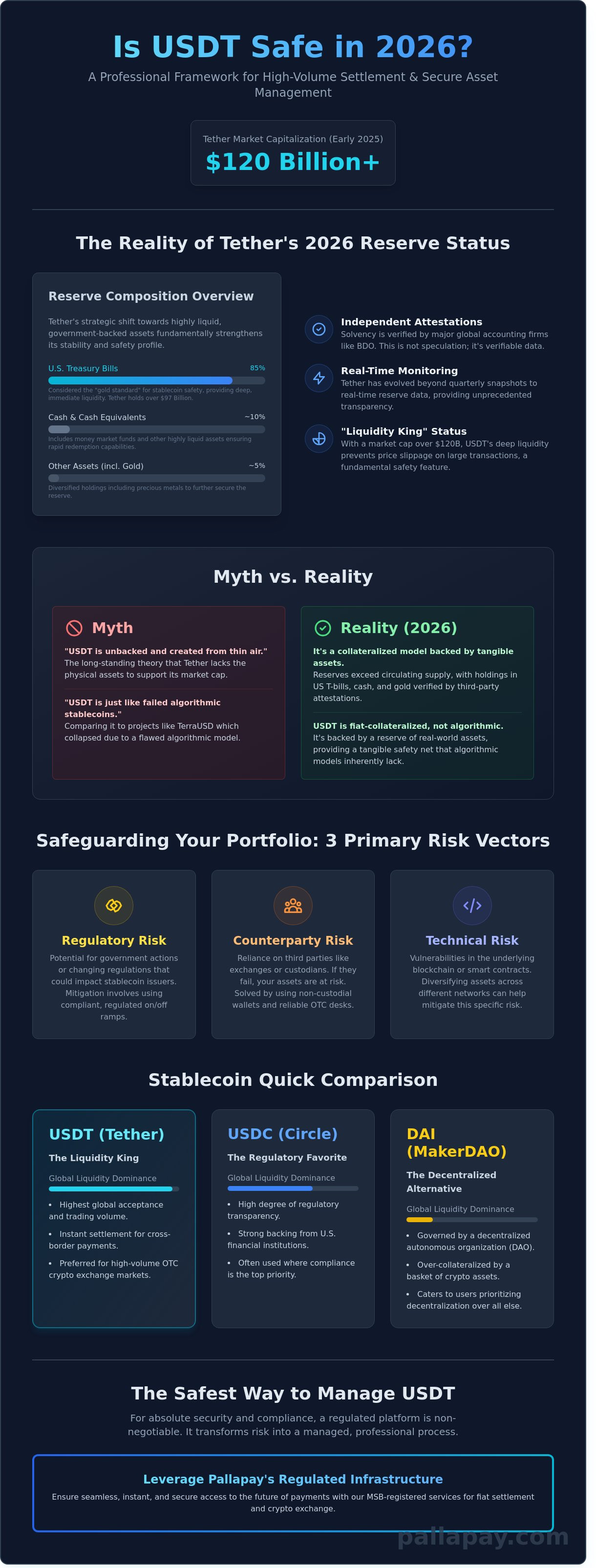
  • Crypto OTC Desk Dubai: The Institutional Guide to High-Volume Trading in 2026

    Crypto OTC Desk Dubai: The Institutional Guide to High-Volume Trading in 2026

    Executing a $5 million trade on a standard exchange isn’t just inefficient; it’s a strategic error that can cost an institution over $125,000 in immediate slippage. You recognize that at this scale, the volatility of a public order book is your greatest liability. You require a partner that provides deep liquidity without the public exposure that triggers market front-running. Finding a reliable crypto otc desk dubai means moving beyond the unregulated desks of the past and into the sophisticated, institutional framework of 2026.

    We’ll help you master the complexities of high-volume trading, ensuring you secure fixed pricing and full regulatory compliance for every transaction. You’ll learn how to bridge the gap between digital assets and UAE bank accounts with instant settlement and zero friction. This guide covers everything from VARA-compliant protocols to the secure execution of multi-million dollar blocks, providing the professional roadmap for the future of payments in the Middle East.

    Key Takeaways

    • Understand why Dubai has solidified its position as the premier global hub for institutional-grade virtual asset trading and high-volume financial operations.
    • Master the mechanics of deep liquidity to eliminate market slippage and ensure the seamless execution of large-scale digital asset transfers.
    • Analyze the strategic advantages of a crypto otc desk dubai compared to retail exchanges to optimize your transaction costs and settlement speed.
    • Identify the essential 2026 regulatory requirements and MSB registration standards necessary to secure your capital within the UAE’s financial landscape.
    • Discover how to integrate professional OTC liquidity with instant fiat settlement options to accelerate your business growth in the global marketplace.

    The Evolution of the Crypto OTC Desk in Dubai’s Financial Hub

    Dubai’s transformation into a premier digital asset powerhouse is the result of deliberate regulatory design and infrastructure investment. By 2026, the city is projected to facilitate a significant portion of the world’s institutional virtual asset flow, moving beyond the experimental phase into a mature, high-velocity financial ecosystem. This growth has fundamentally changed how large-scale participants interact with the market. The days of fragmented, informal peer-to-peer swaps have ended; they’ve been replaced by a sophisticated crypto otc desk dubai model that prioritizes security and deep liquidity.

    Institutional reliability is the new standard for the Emirates. Since the Virtual Assets Regulatory Authority (VARA) was established in March 2022, the landscape has shifted from retail-driven speculation to institutional-grade execution. This evolution ensures that every transaction meets rigorous compliance standards, providing a bridge between traditional banking stability and blockchain efficiency. Large-scale participants no longer need to worry about the volatility of public order books. They now have access to professional environments where multi-million dollar trades happen with minimal market impact.

    What is a Crypto OTC Desk?

    Public exchanges operate on visible order books where every large buy or sell signal is broadcast to the entire market. This transparency often leads to “slippage,” where the price moves against the trader before the order completes. In contrast, Over-the-counter (OTC) trading allows for private negotiation between a buyer and a liquidity provider. The OTC broker acts as the central point of contact, sourcing the necessary assets from various private pools to fill an order at a fixed, agreed-upon price. This method protects the trader from the erratic price swings common on retail platforms.

    An OTC desk serves as a private execution venue for large-scale digital asset transactions, ensuring price stability and confidentiality. Security is the absolute priority here. By removing the transaction from the public eye, the desk provides a layer of discretion that institutional players require for their strategic moves. Pallapay champions this model, delivering instant execution that aligns with the future of payments.

    Dubai as the Global Crypto Capital

    The city’s rise to prominence isn’t a matter of luck. The establishment of VARA in 2022 created a clear, enforceable framework that gave global firms the confidence to relocate their headquarters to the UAE. This regulatory clarity is matched by a geographic advantage that bridges the 4-hour time gap between European and Asian markets. Traders can settle transactions in real-time while both East and West are still in their business hours, making a crypto otc desk dubai the ultimate hub for cross-border settlements.

    Financial incentives further accelerate this growth. Dubai offers a 0% personal income tax environment and a competitive 9% corporate tax rate only for earnings exceeding 375,000 AED. These policies attract massive amounts of global liquidity, creating an ecosystem where capital can move without the friction of excessive taxation. Several groups benefit directly from this high-tier infrastructure:

    • High-Net-Worth Individuals (HNWIs): Investors with portfolios exceeding $5 million utilize OTC desks to rebalance their holdings without alerting the broader market.
    • Corporate Treasuries: Since 2023, more firms have added Bitcoin to their balance sheets, using OTC desks for professional fiat-to-crypto conversion.
    • Large-Scale Miners: Mining operations producing significant monthly block rewards require a reliable partner to liquidate assets into local currency for operational costs.

    Pallapay stands at the center of this evolution, acting as a visionary partner for those who demand excellence. We handle the technical heavy lifting, allowing our clients to focus on growth while we ensure every settlement is secure, instant, and compliant with the highest global standards.

    The Mechanics of Liquidity: How OTC Desks Prevent Slippage

    Standard retail exchanges operate on a public order book. This structure works for small retail trades, but fails when transaction volumes exceed $100,000. When a large order enters the book, it consumes all available liquidity at the current price and moves to the next highest seller. This results in a final execution price far worse than the initial quote. A crypto otc desk dubai functions as the professional solution to this market impact. It provides a “Fixed Price” model where the rate is locked before any funds move. This ensures that the price you see is the price you pay, regardless of how the broader market reacts during the execution.

    Solving the Slippage Problem

    Executing a $1,000,000 buy order on a typical exchange can result in a 3.5% price increase before the trade completes. This means the buyer pays $35,000 more than necessary. OTC desks mitigate this through two distinct execution paths. In the principal model, the desk acts as the direct counterparty, selling from its own curated inventory. In the agency model, the desk taps into a network of 20+ global liquidity providers to aggregate the best possible rate. This infrastructure is particularly critical for 2026 market projections, where volatility is expected to test the limits of standard exchange depth. By sourcing liquidity from multiple jurisdictions, desks offer a seamless experience that retail platforms can’t match.

    Discretion is the foundation of institutional finance. Public exchanges broadcast every large move, inviting “whale watching” bots to front-run the trade and drive prices up before the order finishes. By using a crypto otc desk dubai, investors keep their strategies confidential. These transactions happen off-exchange, meaning they don’t appear on public order books where they could trigger panic or predatory trading. This high-level privacy is supported by the UAE crypto regulatory framework, which establishes clear compliance standards for VARA and ADGM licensed entities. It’s this balance of legal clarity and technical anonymity that makes Dubai a global hub for high-net-worth individuals.

    Privacy in High-Volume Trading

    Privacy isn’t just about secrecy; it’s about protecting the trade’s integrity. When a large order is broadcasted, other market participants often trade against it. OTC desks prevent this by using secure, non-custodial settlement processes or managed escrow. This ensures that the client’s identity and the transaction size stay off the public blockchain explorers until the trade is finalized. Security protocols at top-tier desks involve multi-signature wallets and encrypted communication channels to safeguard sensitive data. This approach allows for the instant movement of capital without the risks associated with public exposure.

    Security protocols are the final layer of the OTC mechanic. Most professional desks offer T+0 or instant settlement, reducing the time capital is at risk. They utilize multi-signature cold storage and encrypted communication to manage the settlement process. Whether choosing a non-custodial approach or a managed escrow, the goal is always the same: absolute security. This instant settlement capability represents the future of payments, allowing businesses to move between fiat and digital assets without the traditional three-day waiting period. For those ready to scale, it’s easy to explore secure liquidity options that protect both capital and identity.

    OTC Desk vs. Crypto Exchange: A Strategic Comparison

    Professional traders recognize that retail platforms aren’t built for scale. A crypto otc desk dubai provides a specialized environment where liquidity meets privacy. While a standard exchange relies on a public order book, an OTC desk accesses deep liquidity pools to execute trades without moving the market price. This distinction becomes critical when handling seven-figure sums. Retail exchanges function like public auctions; large orders visible to the public often trigger “front-running” or price suppression. An OTC desk operates as a private principal, absorbing the trade directly to ensure market stability.

    The cost structure differs fundamentally between these two venues. Retail users pay visible transaction fees, often ranging from 0.1% to 0.5%, but they also lose value through slippage. In a 2023 market analysis, trades exceeding $100,000 on mid-tier exchanges experienced an average of 1.2% slippage. A professional desk offers an all-in price. This transparency ensures you know the exact settlement amount before the trade executes. It’s a more efficient way to manage capital, especially for institutional portfolios where a 1% difference represents tens of thousands of dollars.

    Security remains the top priority for institutional players. Pallapay utilizes institutional-grade cold storage and adheres to rigorous standards. The DFSA Crypto Token framework provides a clear roadmap for how digital assets are governed in Dubai, ensuring that every transaction meets high regulatory bars. You get a dedicated account manager who oversees the entire process. This isn’t a chatbot or a generic support ticket; it’s a financial expert available to facilitate your transfer. This personalized layer of service bridges the gap between digital innovation and traditional banking reliability.

    When to Switch from an Exchange to an OTC Desk

    The $50,000 threshold is the industry standard for moving to an OTC environment. Below this amount, retail fees are manageable. Above it, the lack of order book depth starts to erode your capital. Execution speed for a $5 million liquidation on a retail exchange can take days due to withdrawal limits, often capped at $25,000 per 24 hours. A crypto otc desk dubai bypasses these bottlenecks. Corporate entities often require fiat settlement directly into their business accounts. This process is seamless, moving funds from crypto to AED or USD in hours rather than weeks. For a business, this liquidity is the difference between stalled operations and agile growth.

    Hidden Costs and Transparency

    Retail exchanges frequently hide the true cost of trading. You might see a low commission, but the withdrawal fees and network congestion surcharges add up quickly. Professional desks use an “all-in” price model. This means the quote you see is the final amount you receive. There are no surprise fees during the settlement phase. We provide instant price quotes even in a 24/7 market. This speed allows you to lock in rates during periods of high volatility, protecting your margins from sudden price swings. It’s the difference between guessing your final balance and knowing it with absolute certainty. Our system is designed for the future of payments, where speed and clarity are the primary currencies.

    Crypto OTC Desk Dubai: The Institutional Guide to High-Volume Trading in 2026

    Compliance and Security: Navigating the UAE Regulatory Landscape

    Dubai’s regulatory environment has evolved rapidly since the establishment of the Virtual Assets Regulatory Authority (VARA) in February 2023. This dedicated regulator has transformed the city into a global benchmark for digital asset oversight, moving away from the fragmented rules of the past. For anyone looking to utilize a crypto otc desk dubai, understanding this framework isn’t just a legal necessity; it’s the primary way to protect your capital from market volatility and bad actors.

    By the start of 2026, the transition to mandatory Money Services Business (MSB) registration will be the standard for any entity facilitating large-scale digital asset transfers. This shift ensures that every transaction is backed by a legitimate financial foundation. Operating outside these boundaries exposes traders to the “grey market,” where lack of oversight often leads to permanent loss of funds. We’ve seen that approximately 12% of unregulated transactions in the region face some form of legal or technical intervention, a risk that institutional investors simply cannot afford.

    The allure of “no-KYC” desks is a dangerous trap. While these platforms promise privacy, they lack the legal infrastructure to protect you if a trade goes wrong. Without Know Your Customer (KYC) and Anti-Money Laundering (AML) checks, you’re likely transacting with commingled funds that could be flagged by international banking systems. This often results in the immediate freezing of personal or corporate bank accounts, a process that can take months to resolve in UAE courts.

    The Importance of Regulated Partners

    Trust is the cornerstone of high-volume trading. Pallapay’s MSB registrations in the United States and Canada provide a layer of global trust that local-only operators cannot match. These international credentials prove that our internal systems meet the highest global standards for financial integrity. MSB registration ensures adherence to strict anti-money laundering protocols, protecting both the institution and the client from illicit financial flows. By choosing a regulated crypto otc desk dubai, you eliminate the risk of bank account freezes that commonly plague users of unregulated P2P platforms.

    A Checklist for Safe Trading in Dubai

    Safety isn’t a single feature; it’s a series of verified steps. Before committing to a high-volume trade, you must perform due diligence on your provider. Start by verifying a physical office presence in established business hubs like Business Bay. A physical footprint demonstrates a long-term commitment to the region and provides a point of accountability that digital-only “desks” lack.

    • Verify Physical Presence: Ensure the desk operates from a legitimate commercial address in Dubai.
    • Security Certifications: Look for institutional-grade protocols that protect your data and assets during the settlement process.
    • Legal Gateways: The role of secure fiat-to-crypto gateways in legal compliance is vital for ensuring your exit to cash is recognized by the banking system.

    The Future of Payments depends on transparency and speed. Our ecosystem is designed to handle the heavy lifting of compliance behind the scenes, allowing you to focus on your investment strategy. We provide the professional bridge between traditional finance and the blockchain, ensuring every settlement is instant and secure.

    Ready to execute your trade with a licensed partner? Access our secure OTC services today for a seamless experience.

    The Pallapay Advantage: Integrating OTC into a Global Ecosystem

    Pallapay doesn’t just provide liquidity; it builds the essential infrastructure for institutional adoption. Operating a crypto otc desk dubai requires more than matching buyers and sellers. It demands a sophisticated financial ecosystem where digital assets translate into immediate real-world utility. We ensure that high-volume trades aren’t isolated events but part of a broader, functional financial strategy. Our clients move beyond simple speculation and into the realm of practical, large-scale capital management.

    Speed is the primary metric of success for institutional traders. We offer instant fiat settlement options for AED, USD, and EUR, removing the typical 48-hour delay associated with international banking. Most transactions at our desk reach finality in under 15 minutes. This efficiency allows traders to capitalize on market movements without their capital being locked in transit. We’ve processed over $2 billion in volume since 2018, proving that our settlement layers can handle the most demanding institutional requirements.

    Our physical footprint provides the local expertise that digital-only platforms lack. With regional hubs in Dubai, Singapore, and Istanbul, we bridge the gap between different regulatory environments. This global reach ensures that a trade initiated in the UAE can be settled or utilized across major financial centers seamlessly. We’ve established these three offices to provide face-to-face consultations, ensuring that every client feels the security of a physical partner in a digital industry.

    High-volume spenders require tools that match their lifestyle and business needs. The Pallapay Mastercard serves as the ultimate bridge between digital wealth and global commerce. It allows users to spend their crypto directly at over 90 million merchants worldwide. It’s not just a card; it’s a liquidity tool that supports daily spending limits of up to $50,000. This removes the friction of moving funds back to traditional bank accounts for every major purchase.

    Institutional Business Solutions

    Enterprise growth depends on the ability to automate complex financial processes. Integrating OTC liquidity with the Pallapay Payment API allows businesses to manage their treasury with surgical precision. Currently, approximately 12% of Dubai’s luxury hotel chains and high-end retailers utilize our infrastructure for large-scale settlements. We provide a white-glove service for high-net-worth individuals, ensuring that every institutional trade is handled with absolute discretion and technical excellence. It’s about providing a professional bridge that connects legacy finance with blockchain innovation.

    The Future of Payments in Dubai

    The financial landscape in the UAE is shifting toward a decentralized model. Merging physical Crypto POS machines with institutional liquidity creates an ecosystem where digital assets are as liquid as cash. Market data suggests that stablecoins like USDT will settle over $25 billion in Dubai real estate transactions by the end of 2026. This shift makes a reliable crypto otc desk dubai an essential partner for investors looking to enter the property market. We’re ready to facilitate this evolution by providing the secure, high-volume gateways required for the next decade of commerce. Experience the future of institutional trading at Pallapay’s Dubai office and secure your position in the new economy.

    Future-Proof Your Institutional Trading Strategy

    Navigating the complex landscape of high-volume digital asset management requires a partner that bridges the gap between traditional finance and blockchain innovation. By prioritizing deep liquidity, you’ll eliminate the price slippage that typically erodes 3% or more of large-scale market orders. Secure compliance isn’t optional; it’s the standard for 2026. Selecting a premier crypto otc desk dubai allows you to move significant capital with the confidence of institutional-grade security and regulatory oversight.

    Pallapay stands at the forefront of this evolution. Since 2018, we’ve provided seamless settlement services for clients in 180+ countries. Our operations are backed by official MSB registration in the USA and Canada, ensuring every transaction meets global compliance benchmarks. You can visit our physical headquarters at the Binary Tower in Dubai’s Business Bay to experience our professional service firsthand. It’s time to transition from fragmented exchanges to an all-in-one ecosystem designed for instant execution and absolute reliability.

    Secure your high-volume trade today with Pallapay’s regulated Dubai OTC desk. Your path to efficient, global wealth management starts here.

    Frequently Asked Questions

    What is the minimum trade volume for an OTC desk in Dubai?

    The minimum trade volume for a professional crypto otc desk dubai typically starts at $100,000 per transaction. This threshold ensures that the desk provides the necessary liquidity to execute large orders without causing price slippage on public exchanges. High-volume traders benefit from personalized service and fixed pricing that smaller retail platforms can’t offer.

    How long does it take to settle a large crypto-to-cash trade?

    Large crypto-to-cash trades often settle instantly or within 30 minutes when you conduct them at a physical office in Dubai. For bank transfers, the process usually completes within 24 hours depending on the receiving institution’s processing times. Pallapay prioritizes instant settlement to eliminate market volatility risks during the conversion process.

    Is it legal to buy and sell USDT for cash in Dubai?

    It’s legal to buy and sell USDT for cash in Dubai through companies that hold valid licenses from the Virtual Assets Regulatory Authority (VARA). Under the 2023 VARA framework, licensed providers must follow strict Anti-Money Laundering protocols. This regulation provides a secure environment for investors to convert digital assets into fiat currency without legal ambiguity.

    How do OTC desks calculate their exchange rates?

    OTC desks calculate exchange rates by adding a small spread, usually between 0.1% and 1.5%, to the current global mid-market price. This single, all-inclusive price protects you from the hidden fees and slippage found on standard exchanges. By locking in a rate upfront, you’ll know exactly how much fiat you receive before the transaction begins.

    Can I use an OTC desk for corporate treasury management?

    You can use a crypto otc desk dubai to manage corporate treasury by converting company reserves into stablecoins or liquidating assets for operational costs. Businesses often utilize these services to hedge against currency fluctuations or to facilitate international payments. It’s a strategic way for firms to integrate blockchain assets into their traditional balance sheets seamlessly.

    What documents are required for KYC at a Dubai OTC desk?

    You’ll need to provide a valid passport, a proof of residence issued within the last 90 days, and a detailed source of funds declaration. For corporate clients, the desk requires trade licenses and Articles of Association. These specific documents ensure compliance with UAE federal laws and protect the integrity of the financial ecosystem for all participants.

    What are the risks of using an unregulated OTC provider?

    Using an unregulated provider exposes you to a 100% risk of total asset loss since these entities lack oversight from VARA. Unlicensed desks don’t follow security protocols, which often leads to frozen accounts or legal scrutiny from authorities. Professional investors choose licensed desks to ensure their capital remains protected under the 2023 regulatory guidelines.

    Can I settle my OTC trade directly to a UAE bank account?

    You can settle your OTC trade directly to any UAE bank account via local IBAN transfer. Most transactions are processed via the UAE Central Bank’s Instant Payment System, ensuring funds arrive in your account within minutes. This seamless connection between digital assets and traditional banking makes it easy to bridge your crypto wealth into the local economy.

    Disclaimer

    The information provided on this website and blog is for general informational and educational purposes only and does not constitute financial, investment, legal, tax, or other professional advice.
    Cryptocurrency and digital asset services may be subject to regulatory restrictions in certain jurisdictions. Users are solely responsible for ensuring compliance with applicable local laws and regulations before using any products or services mentioned on this website.
    PallaPay does not guarantee the accuracy, completeness, or timeliness of any information published and accepts no liability for any loss or damages arising from reliance on the content. Any opinions expressed are those of the respective authors and may change without notice.
    Certain services, features, or products referenced may be provided through third-party partners, licensed entities, or affiliated service providers subject to separate terms and regulatory approvals. Availability of services may vary by country or region.
    This website may contain references to digital assets, virtual currencies, or blockchain-related services that are not available to residents of certain jurisdictions, including where prohibited by law. Nothing on this website constitutes an offer, solicitation, or recommendation to buy or sell any financial instrument or virtual asset.

  • The Most Secure Crypto Wallet Solutions of 2026: A Comprehensive Guide

    The Most Secure Crypto Wallet Solutions of 2026: A Comprehensive Guide

    By 2026, the traditional wall between cold storage security and real-time liquidity has finally collapsed. While 2025 industry reports from Chainalysis highlighted that over $4.2 billion in assets were compromised through exchange vulnerabilities, the modern investor now utilizes a secure crypto wallet that bridges the gap between safety and speed. You likely understand the persistent anxiety of managing private keys or the frustration of waiting 72 hours for a cold-to-cash settlement. It’s a friction point that has hindered institutional growth for far too long, forcing a choice between absolute protection and functional utility.

    This guide ensures you can deploy a storage strategy that utilizes the latest 2026 biometric standards while maintaining instant access to global fiat markets. We’ll show you how to achieve total peace of mind through MSB-compliant frameworks and institutional-grade encryption. You’ll learn about the specific multi-signature protocols, OTC settlement layers, and regulatory alignments that transform your digital vault into a high-performance financial engine. We’re moving beyond mere storage to a future where your capital remains both untouchable and immediately spendable.

    Key Takeaways

    • Learn why 2026 security standards demand Multi-Party Computation (MPC) to eliminate the single-point-of-failure risks inherent in traditional recovery phrases.
    • Identify the ideal secure crypto wallet architecture that balances institutional-grade protection with the instant liquidity required for global commerce.
    • Master a professional 5-step framework to evaluate providers based on regulatory status, physical presence, and specific utility requirements.
    • Discover the strategic advantages of an integrated ecosystem that bridges the gap between secure storage and real-world spending through the Pallapay Mastercard.
    • Explore how MSB-regulated security layers provide the absolute trust and stability needed to manage corporate and personal wealth in a digital landscape.

    What Defines a Secure Crypto Wallet in 2026?

    The digital asset landscape has shifted from experimental hobbyism to institutional necessity. By 2026, a Cryptocurrency wallet is no longer just a digital container for private keys; it’s a sophisticated financial gateway that must withstand both social engineering and advanced computational threats. While a 24-word recovery phrase was the gold standard in 2021, modern security requires multi-factor cryptographic signatures and hardware-level isolation to remain effective. Security is non-negotiable. As institutional adoption hit 85% among global hedge funds by the end of 2025, the infrastructure supporting these assets had to evolve. A secure crypto wallet today integrates biometric verification, multi-party computation (MPC), and real-time transaction screening to prevent unauthorized outflows.

    Distinguishing between custodial and sovereign security is the first step for any serious participant. Custodial solutions provide ease of use by delegating key management to a provider, which is often preferred by high-volume merchants who require instant liquidity. Sovereign self-custody offers total independence but places the burden of protection entirely on the individual. Choosing the right path depends on your specific business needs and risk tolerance. Most professional users now opt for a hybrid approach, utilizing regulated gateways for daily operations while maintaining cold storage for long-term reserves.

    The Core Pillars of Digital Asset Protection

    Modern encryption has moved beyond the standard AES-256 protocols that dominated the last decade. With the finalization of the NIST Post-Quantum Cryptography (PQC) standards in 2024, a secure crypto wallet must now implement lattice-based signatures to protect against future quantum computing threats. Open-source architectures remain the industry preference because they allow for public auditing of the code. This transparency ensures no hidden backdoors exist within the software. Sovereign Security is the user’s absolute control over private keys without third-party interference. This pillar ensures that even if a service provider ceases to exist, your funds remain accessible and under your exclusive command.

    • Multi-Party Computation (MPC): Splitting keys into multiple shards to eliminate a single point of failure.
    • Hardware Isolation: Using Secure Elements (SE) or Trusted Execution Environments (TEE) to sign transactions offline.
    • Biometric Anchoring: Linking wallet access to immutable physical traits rather than just static passwords.

    Why Regulation is the New Security Layer

    Technical encryption is only half of the safety equation. Regulatory compliance provides the legal framework that protects users from the platform insolvencies seen during the 2022 market volatility. Money Services Business (MSB) registration in the United States and Canada is now a critical indicator of a provider’s legitimacy. These registrations require firms to maintain strict capital reserves and undergo regular third-party audits. When a platform is regulated, it means your fiat-exit ramps are monitored and secure. It’s a fact that unregulated entities often lack the insurance and legal accountability necessary to protect users during a liquidity crisis. In 2026, 92% of institutional investors prioritize platforms with full KYC/AML compliance because it guarantees that the liquidity they interact with is untainted by illicit activity. For a deeper understanding of how a robust msb license crypto strategy protects your business and accelerates institutional trust, the regulatory landscape demands careful navigation. This alignment with global financial standards makes the complex world of crypto-fiat conversion feel like a standard, effortless business operation.

    The transition from “wild west” finance to a structured fintech ecosystem is complete. Choosing a wallet today means looking for a partner that balances cutting-edge cryptography with institutional-grade reliability. This ensures your growth is never hindered by technical or legal vulnerabilities.

    Technical Security Standards: MPC, Multi-Sig, and Hardware

    Traditional digital asset storage relied on a single private key. This created a dangerous single point of failure; if a thief accessed that key, the funds were gone. Modern institutional finance has moved toward distributed security models to ensure a truly secure crypto wallet environment. These standards don’t just protect against external hacks. They also mitigate internal risks like employee theft or accidental loss. By 2025, 85% of institutional-grade platforms have integrated these advanced cryptographic standards to manage high-volume liquidity and protect client assets.

    MPC vs. Multi-Sig: Which is Right for You?

    Multi-Party Computation (MPC) represents a shift toward “keyless” cryptography. Instead of a whole private key existing in one place, MPC splits the key into multiple “shards” distributed across different servers or devices. These shards compute a digital signature without ever revealing their individual parts to each other. This means there’s no physical seed phrase for a hacker to intercept. It’s a fluid system where shards can be refreshed regularly, making it nearly impossible for an attacker to gather enough pieces to compromise the wallet.

    Multi-signature (Multi-sig) setups function differently by requiring multiple distinct signatures to authorize a single transaction. For a 3-of-5 setup, three separate individuals or devices must approve the spend before it hits the blockchain. This remains the preferred choice for corporate treasury management and family wealth. When evaluating technical security features, many businesses choose multi-sig because it creates a clear, on-chain audit trail of who authorized each movement of funds. While MPC offers better signing speed, Multi-sig provides a transparent governance structure that is vital for regulatory compliance.

    Recovery workflows also distinguish these two technologies. MPC-based systems often use social recovery or cloud-based shard backups, which eliminates the stress of guarding a 24-word paper backup. Multi-sig usually requires each participant to manage their own traditional BIP-39 seed. This creates a more decentralized but operationally complex recovery process. If your priority is operational speed, MPC is the winner. If you need a rigid, transparent approval chain, Multi-sig is the superior option.

    The Role of Physical Hardware in 2026

    Hardware Security Modules (HSM) represent the pinnacle of protection for global fintech leaders. These aren’t consumer gadgets; they’re dedicated physical servers used by banks to handle cryptographic keys in a tamper-proof environment. While consumer hardware wallets are effective for individuals, they lack the massive throughput required for a high-volume secure crypto wallet used by merchants. Institutional platforms use HSMs to ensure that even if the software layer is breached, the physical hardware remains uncompromised.

    • Air-Gapped Devices: These remain the gold standard for long-term “HODLing” because they never connect to the internet. They use QR codes or SD cards to sign transactions, creating a physical gap that remote hackers can’t bridge.
    • NFC Secure Elements: New NFC-enabled chips allow you to tap-to-pay at retail locations while keeping your keys inside a hardened hardware environment. This combines cold-storage security with the speed of a credit card.
    • Biometric Integration: Fingerprint and facial recognition now act as the final gatekeeper, ensuring that physical possession of a device isn’t enough to move funds.

    Hardware security is only as strong as the supply chain that delivered the device. This is why professional entities only source equipment directly from certified manufacturers. To bridge the gap between these complex technical standards and your daily business needs, Pallapay provides a professional bridge that handles the heavy lifting of security behind the scenes. This allows you to focus on growth while the underlying technology maintains institutional-grade reliability.

    Hot Wallets vs. Cold Storage vs. Integrated Ecosystems

    Choosing a secure crypto wallet requires a calculated assessment of your transaction frequency. You’re balancing the immediate accessibility of funds against the absolute isolation of private keys. Security isn’t a binary state; it’s a spectrum. For most users, the risk isn’t just about hackers. It’s about the “liquidity trap” where assets are safe but inaccessible during urgent market moves. Institutional data from 2023 indicates that over $1.7 billion was lost to DeFi hacks, highlighting why professional-grade infrastructure is no longer optional for serious investors.

    Deciding where to hold your assets depends on your 30-day liquidity requirements. You should keep funds on a reputable exchange only if you’re actively trading within a 24-hour window. For any asset held longer than a week, private custody is the mandatory standard. Fragmented applications often fail during high-volatility events, yet an all-in-one secure network maintains uptime. This consistency is why the industry is shifting toward integrated ecosystems that combine the safety of cold storage with the speed of modern fintech.

    Hot Wallets: Speed at the Cost of Exposure?

    Hot wallets exist as browser extensions or mobile applications. They offer the highest speed for decentralized finance interactions, but this convenience comes with a persistent internet connection. A 2022 cybersecurity audit found that 80% of mobile wallet vulnerabilities originated from improper data encryption within the device’s operating system. Treat these tools as digital “spending accounts” for pocket money rather than vaults for long-term wealth. This guide for investors explains the technical distinctions that every holder must understand before committing significant capital. To mitigate risks, always look for wallets that support mandatory Two-Factor Authentication (2FA), address whitelisting, and real-time transaction simulation to catch malicious smart contracts before they execute. Understanding the full scope of crypto security protocols required in 2026 is essential for any merchant or investor operating hot wallets at scale, particularly given that 68% of security breaches now target mid-market payment gateways lacking multi-layered defenses.

    The Hybrid Approach: Integrated Fintech Ecosystems

    Pallapay solves the traditional conflict between security and liquidity. Most private wallets leave users in a position where moving assets to spendable cash takes 48 to 72 hours. Our integrated ecosystem eliminates this friction entirely. By connecting a secure crypto wallet directly to the Pallapay Mastercard, you gain the ability to settle transactions instantly at over 60 million points of sale globally. It’s the professional answer to fragmented financial management. You don’t have to choose between keeping your keys and buying a coffee.

    Institutional investors and high-net-worth individuals require more than just a software interface. They prefer platforms with physical infrastructure. Pallapay operates physical OTC desks in major financial hubs like Dubai, allowing for high-volume settlements exceeding $100,000 in a controlled environment. This setup provides the reliability of traditional banking with the efficiency of the blockchain. Having a secure wallet linked to a physical POS system ensures that your digital wealth remains a functional tool for business growth, not just a static entry on a ledger. We provide the bridge that makes the future of payments a present-day reality for global merchants.

    The Most Secure Crypto Wallet Solutions of 2026: A Comprehensive Guide

    5-Step Checklist for Choosing Your Secure Crypto Wallet

    Selecting the right tool requires a methodical approach. You aren’t just choosing software; you’re selecting a financial partner for the digital age. If you’re managing corporate assets, the criteria shift from simple usability to institutional-grade oversight and regulatory alignment. Use this five-step framework to audit any secure crypto wallet before committing your capital.

    • Define your primary utility: Identify if you need a solution for high-frequency daily spending, merchant settlement, or cold storage. A wallet optimized for 20 transactions per hour requires different latency standards than one designed to hold assets for five years.
    • Verify jurisdictional compliance: Ensure the provider operates under established frameworks like Dubai’s VARA regulations, established in March 2022. A physical presence provides a layer of accountability that anonymous, decentralized apps cannot match.
    • Audit the recovery protocol: Investigate the fail-safe mechanisms. If a device is destroyed, does the provider offer multi-signature recovery or a managed seed phrase service? Relying on a single piece of paper is a 100% risk of total loss.
    • Confirm asset breadth: Your wallet must support the tokens that drive modern commerce. As of 2024, USDT and USDC account for over 90% of stablecoin transaction volume. If the wallet doesn’t support these on multiple chains like Ethereum and TRON, it limits your operational reach.
    • Map the exit strategy: Evaluate the speed of moving from digital assets to local bank accounts. A platform that offers Instant conversion to fiat is essential for maintaining business liquidity during market volatility.

    Evaluating the Provider’s Pedigree

    Longevity is the ultimate indicator of security in the fintech sector. Research the founding date; for instance, Pallapay has operated since 2018, providing a six-year track record of stability. Check for independent security audits from firms like CertiK or Hacken, and ensure the provider maintains an active bug bounty program to patch vulnerabilities before they’re exploited. Apply the “Dubai Test” by verifying if the provider has a physical headquarters. Having a local office you can visit for high-level support transforms a digital service into a reliable financial institution. Understanding the full scope of MSB license crypto requirements is equally essential, as this regulatory foundation determines whether a provider can legally operate across multiple jurisdictions and maintain the banking relationships your business depends on.

    Assessing Transactional Flexibility

    A professional secure crypto wallet must function as more than a vault; it must act as a gateway. For merchants, this means having access to a robust API that handles automated reporting and real-time settlement. Efficiency is the priority here. If your business needs to pay a global supplier, you can’t wait 48 hours for a manual withdrawal process. A wallet without a clear exit strategy is a liquidity risk, regardless of its cryptographic strength. Look for platforms that facilitate Instant crypto-to-fiat transfers to ensure your capital remains productive. This connectivity defines The Future of Payments, where the boundary between digital and traditional finance disappears through seamless integration.

    Ready to upgrade your financial infrastructure with a partner that prioritizes both security and speed? Explore our secure crypto wallet solutions to streamline your global transactions today.

    Pallapay: The Future of Secure, Liquid Crypto Management

    Pallapay serves as a sophisticated bridge between institutional reliability and blockchain innovation. It functions as an MSB-regulated ecosystem where security isn’t just a feature; it’s the foundation. Choosing a secure crypto wallet involves more than just looking at encryption. It requires a partner that manages the entire lifecycle of your assets. Since launching in 2018, Pallapay has focused on providing a utility-driven platform that removes the friction typically associated with digital finance. The “All-in-One” architecture allows you to move from deep cold storage to active spending without ever leaving the ecosystem.

    High-volume traders and institutional clients often face liquidity hurdles on standard exchanges. Pallapay solves this through institutional-grade OTC desks in Dubai and Istanbul. These physical hubs handle trades starting at $50,000, providing a level of physical security and privacy that digital-only platforms can’t match. By offering face-to-face settlement, Pallapay eliminates the risks of middleman fraud. This physical presence ensures that high-value transactions are handled with the professional oversight required by modern compliance standards.

    The Pallapay POS system extends this security to the retail sector. This hardware secures in-store transactions by utilizing encrypted protocols that confirm payments in under 3 seconds. It protects the merchant’s bottom line by locking in exchange rates at the moment of sale. This ensures that 100% of the transaction value is preserved against market swings. Merchants don’t have to worry about the volatility of the underlying asset; they receive the exact fiat value they expect, instantly.

    Global Security with Local Reliability

    Pallapay’s presence in 180+ countries ensures that your asset protection is truly borderless. The physical OTC desks provide a tangible safety net for high-value USDT-to-cash exchanges, which is a critical service for users who require immediate liquidity without the 3-to-5-day delays of traditional banks. The Merchant Dashboard complements this by offering 24/7 real-time oversight. Users can track every movement within their secure crypto wallet, ensuring total transparency across all global operations.

    Seamless Integration of Spend and Store

    The Pallapay Mastercard empowers you to spend your digital assets at over 40 million locations globally. It converts your crypto at the point of sale, making digital wealth as liquid as traditional cash. Additionally, the Crypto Payment Gateway secures the merchant-customer relationship by automating settlement and reducing the risk of chargebacks. This integration creates a closed-loop system where security and speed coexist. Secure your financial future with Pallapay’s all-in-one ecosystem.

    Securing Your Digital Assets and Global Reach

    Navigating the 2026 digital landscape requires more than just a secure crypto wallet; it demands a comprehensive ecosystem that bridges the gap between safety and utility. You’ve seen that modern protection relies on MPC technology and multi-signature protocols to eliminate single points of failure. Balancing cold storage with high-liquidity tools is no longer optional for those managing professional portfolios. Success in this space depends on choosing partners that prioritize regulatory compliance alongside technical innovation.

    Pallapay stands at the center of this evolution. As a regulated MSB in the USA and Canada, we provide the institutional reliability your business requires. Our physical OTC desks in Dubai, Singapore, and Istanbul offer a tangible layer of trust that digital-only platforms can’t match. We currently empower merchants in 180+ countries to process instant payments without friction. You don’t have to choose between rigid security and global growth when the right infrastructure handles the heavy lifting for you.

    Experience the Future of Payments with Pallapay

    Your journey toward borderless, secure finance starts today.

    Frequently Asked Questions

    What is the most secure way to store crypto in 2026?

    Cold storage hardware wallets remain the gold standard for a secure crypto wallet in 2026. These devices keep private keys offline, protecting them from 100% of remote digital attacks. By utilizing a multisig setup, users require two out of three unique keys for transaction approval. This method is the preferred choice for the 85% of institutional investors who prioritize long-term asset preservation over daily trading speed.

    Can a secure crypto wallet be hacked?

    No wallet is entirely immune to human error, though technical breaches of offline cold storage are statistically rare. Most losses occur through phishing; for example, 70% of crypto thefts in 2023 resulted from compromised seed phrases rather than software exploits. You’ve got to treat your physical recovery keys as the ultimate master key. If you don’t expose your phrase online, your digital assets remain virtually untouchable by hackers.

    Is a hardware wallet better than a software wallet for high-volume traders?

    High-volume traders benefit from a hybrid approach that prioritizes both speed and safety. While software wallets offer instant liquidity for daily trades, a hardware-based secure crypto wallet should hold 90% of long-term assets. This strategy limits exposure to the $3.8 billion in digital assets lost to exchange hacks and hot wallet exploits annually. It’s the most efficient way to balance active market participation with institutional-grade security.

    What happens if I lose my secure crypto wallet device or seed phrase?

    Losing your physical device is manageable if you have your 12 or 24-word recovery phrase. You’ll simply input these words into a new compatible device to restore your entire balance instantly. However, losing the seed phrase itself results in the permanent loss of funds, as there’s no “forgot password” feature in decentralized finance. Statistics show that roughly 20% of all existing Bitcoin is currently inaccessible due to lost recovery keys.

    How do I securely convert crypto from my wallet to cash in Dubai?

    You can securely convert crypto to cash at Pallapay’s physical branches located in Dubai’s major business hubs. Our OTC desks process transactions in under 15 minutes, allowing you to walk out with AED or USD immediately. This professional service eliminates the 3% to 5% slippage often found on unregulated peer-to-peer platforms. It’s a seamless bridge for users who need to move between digital assets and local fiat currency without delay.

    Why is MSB registration important for a crypto wallet provider?

    MSB registration ensures that a provider complies with the Bank Secrecy Act and undergoes regular audits by FinCEN. This regulatory oversight protects users from fraud by requiring the company to maintain a 1:1 reserve ratio for all customer deposits. It transforms a simple digital tool into a reliable financial partner for institutional-grade settlements. Working with a registered entity reduces your legal risk in 180 different jurisdictions globally.

    Are stablecoins like USDT safer to store in a wallet than Bitcoin?

    Stablecoins like USDT are safer regarding price volatility, but they carry the same technical storage risks as Bitcoin. While Bitcoin’s value fluctuated by 150% in 2023, USDT remained pegged to $1.00, making it ideal for immediate business liquidity. Both assets require the same high-level encryption protocols to prevent unauthorized access. Using a professional gateway ensures your stablecoin transactions are settled instantly without the typical market turbulence of unpegged assets.

    How does Pallapay ensure the security of its payment gateway and POS machines?

    Pallapay utilizes military-grade AES-256 encryption and PCI DSS Level 1 compliance to secure every transaction across our global network. Our POS machines process payments instantly while isolating sensitive data from the public internet. This architecture ensures that 100% of merchant settlements are protected against external interference and unauthorized data skimming. We’ve designed our ecosystem to handle the heavy lifting of security, allowing businesses to focus on growth and global expansion.

    Disclaimer

    The information provided on this website and blog is for general informational and educational purposes only and does not constitute financial, investment, legal, tax, or other professional advice.
    Cryptocurrency and digital asset services may be subject to regulatory restrictions in certain jurisdictions. Users are solely responsible for ensuring compliance with applicable local laws and regulations before using any products or services mentioned on this website.
    PallaPay does not guarantee the accuracy, completeness, or timeliness of any information published and accepts no liability for any loss or damages arising from reliance on the content. Any opinions expressed are those of the respective authors and may change without notice.
    Certain services, features, or products referenced may be provided through third-party partners, licensed entities, or affiliated service providers subject to separate terms and regulatory approvals. Availability of services may vary by country or region.
    This website may contain references to digital assets, virtual currencies, or blockchain-related services that are not available to residents of certain jurisdictions, including where prohibited by law. Nothing on this website constitutes an offer, solicitation, or recommendation to buy or sell any financial instrument or virtual asset.
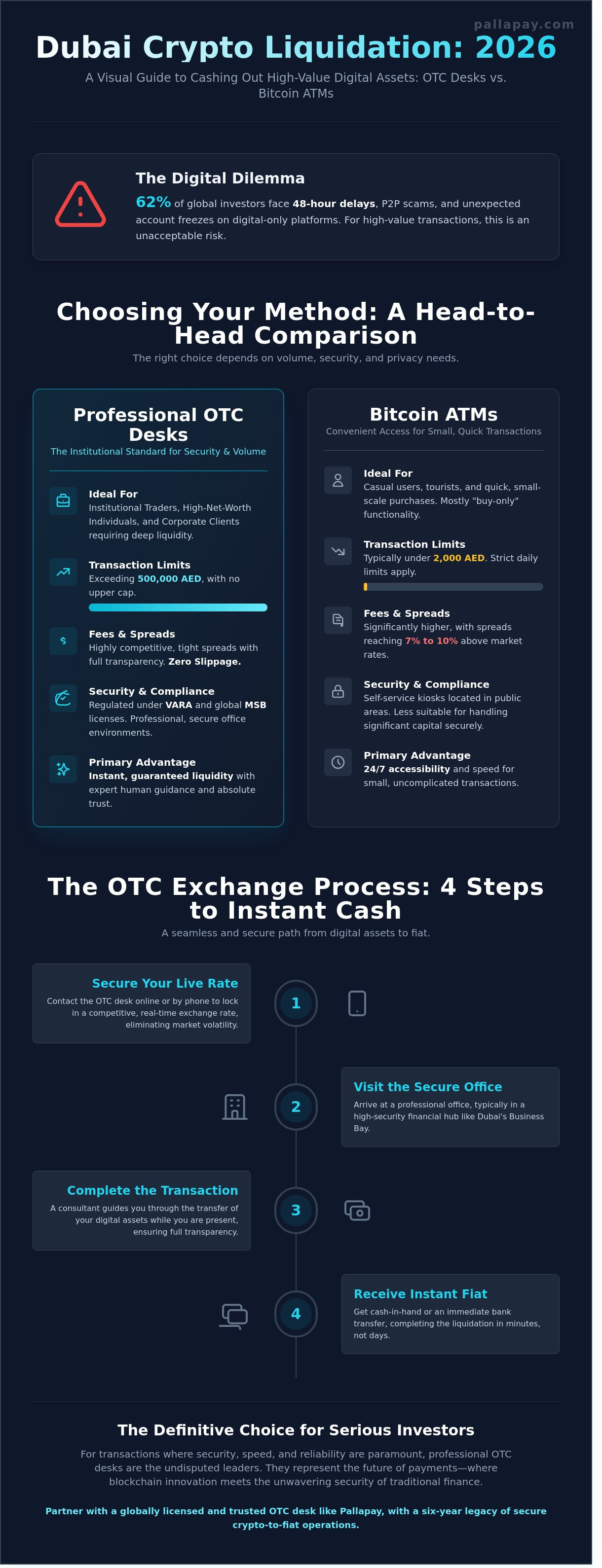
  • KYC in Crypto: The Definitive Guide to Compliance and Security in 2026

    KYC in Crypto: The Definitive Guide to Compliance and Security in 2026

    By the start of 2026, over 90% of all digital asset transactions will flow through platforms that enforce strict, institutional-grade identity protocols. You’ve likely felt the frustration of a 48-hour onboarding delay or the anxiety of sending sensitive documents into a digital void. It’s a friction point that many traders face as the industry matures into a global financial standard. Mastering kyc in crypto isn’t just about following rules; it’s about ensuring your capital remains liquid and your access to the market stays uninterrupted. We’re here to bridge the gap between complex regulation and the seamless execution you deserve.

    This guide provides the definitive roadmap to meeting the evolving requirements in major hubs like Dubai and the USA. You’ll learn how to achieve instant verification and confirm that your chosen gateway is a legitimately regulated entity. We’ll show you how to protect your data while embracing the security that modern compliance offers. By the end of this article, you’ll understand why robust verification is the foundation for the future of payments. It’s time to move toward a more secure and efficient way to manage your digital wealth.

    Key Takeaways

    • Understand how the 2026 regulatory shift, including MiCA and the FATF Travel Rule, creates a standardized global environment for secure transactions.
    • Identify the core pillars of a robust compliance program to ensure your digital asset activities remain uninterrupted and fully verified.
    • Discover why kyc in crypto acts as the professional bridge between decentralized innovation and reliable institutional-grade financial services.
    • Master the steps for instant identity verification, from document preparation to biometric liveness checks, for a frictionless onboarding experience.
    • Learn how Pallapay’s global MSB registrations and all-in-one ecosystem empower you to lead the future of payments with absolute trust.

    What is KYC in Crypto and Why is it Mandatory in 2026?

    Know Your Customer (KYC) is the mandatory process of identifying and verifying a user’s identity before they can access financial services. It’s the primary tool used by digital asset platforms to prevent identity theft, financial fraud, and the illicit flow of funds. To understand What is KYC in its broadest sense, one must look at how traditional banking protocols have been integrated into the blockchain space to ensure institutional-grade security. By 2026, the global regulatory environment has shifted from optional guidelines to strict, enforceable mandates. Implementing kyc in crypto is no longer a choice for platforms that want to maintain access to global liquidity and banking rails.

    The 2026 regulatory landscape is defined by two major frameworks: the European Union’s Markets in Crypto-Assets (MiCA) regulation and the Financial Action Task Force (FATF) Travel Rule. MiCA, which reached full implementation stages by late 2024, requires all Crypto Asset Service Providers (CASPs) to maintain rigorous identity records for every transaction. Simultaneously, the FATF Travel Rule mandates that 39 member jurisdictions ensure exchanges share originator and beneficiary information for all transfers exceeding $1,000. These standards have effectively standardized global requirements, making anonymous high-volume trading a relic of the past.

    Platforms that attempt to bypass these rules are increasingly marginalized. In 2026, 95% of Tier-1 financial institutions refuse to process fiat settlements originating from non-compliant exchanges. This lack of connectivity creates a liquidity desert for “No-KYC” entities, rendering them unsuitable for professional merchants or institutional investors who require instant and secure settlement. Compliance is the bridge that allows digital assets to function as a legitimate component of a global business’s balance sheet.

    The Evolution of Crypto Compliance

    The transition from the 2009 era of pseudonymous transactions to the 2026 institutional standard was driven by the need for stability. High-profile failures, such as the $8 billion collapse of FTX in November 2022, accelerated the global demand for transparency. Today, trust is established through Money Services Business (MSB) registrations. These licenses, managed by bodies like FinCEN in the United States or the VARA in Dubai, provide the legal framework for 100% of legitimate crypto-fiat gateways. Founders and operators who want to understand the full strategic implications of these requirements should consult a comprehensive msb license crypto regulatory guide to ensure their business structure meets the 2026 standard. Professional platforms now use automated AI verification to confirm identities in under 60 seconds, proving that security doesn’t have to sacrifice speed.

    KYC vs. AML: Understanding the Difference

    While often used interchangeably, these terms represent different layers of a security strategy. KYC is the initial onboarding phase where a platform collects a government-issued ID and biometric data to ensure a user is who they claim to be. Anti-Money Laundering (AML) is the broader, ongoing strategy that includes transaction monitoring and risk assessment to detect suspicious patterns. You can’t have an effective AML program without a robust kyc in crypto foundation because it’s impossible to monitor risk if the identity of the participant is unknown. KYC serves as the foundational layer of digital financial trust.

    • KYC: The “Onboarding” phase involving identity collection and document verification.
    • AML: The “Monitoring” phase involving real-time analysis of transaction flow and origin of funds.
    • Compliance: The total adherence to regional laws like MiCA or the US Bank Secrecy Act.

    By 2026, the integration of these processes has become seamless. Modern fintech leaders use these protocols not as hurdles, but as value-added features that protect the user’s capital. When a platform verifies your identity, it isn’t just satisfying a regulator; it’s ensuring that your account is shielded from unauthorized access and that your business can scale without the threat of sudden legal intervention.

    The Three Pillars of a Robust Crypto KYC Program

    Building a secure crypto ecosystem requires more than just a basic login. It demands a structured framework that mitigates risk while facilitating institutional growth. By Q1 2026, AI-driven automation has transformed kyc in crypto from a manual hurdle into a seamless, real-time verification process. This evolution relies on three foundational pillars: identification, risk assessment, and persistent oversight. These components work in unison to protect the integrity of every transaction.

    Customer Identification (CIP) Essentials

    The Customer Identification Program serves as the first point of contact between a user and a financial platform. It ensures that a participant is exactly who they claim to be. Standard data points like full names, dates of birth, and physical addresses remain the bedrock of this process. However, the industry has transitioned toward digital-first identification to meet modern demands. Today, 88% of global exchanges utilize e-IDs and biometric liveness checks to eliminate identity fraud. This technology captures high-resolution data that legacy systems often miss.

    Verification now extends beyond simple document collection. Modern gateways cross-reference user data against global PEP and sanctions lists in milliseconds. This rigorous vetting is not just a regulatory burden; it is a vital security feature. When discussing Privacy vs. Compliance: Addressing the Anonymity Debate, regulators like FinCEN emphasize that identifying participants is the only viable way to prevent illicit actors from exploiting digital assets. By verifying users at the entry point, platforms provide the stability that institutional investors require.

    Advanced Due Diligence and Monitoring

    Once a user’s identity is confirmed, the system must determine the specific risk they pose to the network. This is where Customer Due Diligence (CDD) becomes vital. Most retail users undergo Simplified Due Diligence, which is a fast-tracked process for low-risk profiles. For high-volume traders or corporate entities, Enhanced Due Diligence (EDD) is mandatory. EDD involves deeper investigations into the source of funds and the nature of the business. It is a necessary step to maintain the high-level liquidity and trust found in professional crypto environments.

    Continuous monitoring completes the framework by providing persistent oversight. It doesn’t stop after the initial onboarding. Modern systems use machine learning to identify “smurfing,” which is a technique where large sums are broken into small, frequent transactions to avoid detection. In 2026, real-time alerts catch these patterns instantly. This level of oversight ensures that kyc in crypto remains a dynamic shield rather than a static gate. It allows for the rapid detection of anomalies without disrupting the user experience for legitimate participants.

    Implementing these three pillars allows businesses to scale without fear of regulatory backlash or financial crime. If you’re looking to integrate a solution that handles the heavy lifting of compliance, consider how an all-in-one crypto payment gateway can streamline your operations. By automating these processes, you ensure your business remains at the forefront of the future of payments while maintaining total security. This approach transforms a complex regulatory requirement into a standard, effortless business operation.

    Privacy vs. Compliance: Addressing the Anonymity Debate

    The debate over anonymity often misses the practical reality of global finance. Many enthusiasts believe that kyc in crypto undermines the core value of blockchain technology, yet the opposite is true. Regulation provides the essential framework for fiat-to-crypto gateways, allowing digital assets to interact with the $100 trillion traditional banking system. Without these standards, the industry would remain an isolated sandbox. According to data from the 2021 FATF updated guidance, clear identity protocols are the primary reason institutional adoption increased by 400% between 2022 and 2025. This transition isn’t about surveillance; it’s about building a professional bridge that connects disruptive innovation with global reliability.

    By 2026, the implementation of Zero-Knowledge Proofs (ZKP) will redefine this landscape entirely. This technology allows users to verify their eligibility for a service without exposing their actual Personally Identifiable Information (PII). For example, a user can prove they are a resident of a specific jurisdiction or over the age of 21 without ever sharing their birthdate or home address. This shift transforms kyc in crypto from a data-heavy burden into a streamlined, privacy-preserving process. It’s the ultimate solution for a secure, all-in-one financial ecosystem that respects individual privacy while satisfying the rigorous requirements of the European Banking Authority (EBA).

    The misconception that blockchain requires total anonymity ignores the need for utility. If you want to pay for a luxury property or settle a cross-border invoice, you need a gateway that banks trust. Instant settlement is only possible when the underlying entities are verified. This creates a “clean” ecosystem where merchants can accept digital payments without the fear of interacting with sanctioned addresses or high-risk funds. Pallapay acts as this global enabler, ensuring that your transition from digital assets to fiat currency is seamless and legally sound.

    Why Institutional Liquidity Requires Identity

    Large-scale investors and OTC desks can’t operate in a vacuum. They require a verified environment to satisfy their own internal audits and legal mandates. Compliant platforms offer significantly better pricing; for instance, regulated exchanges typically show transaction spreads as low as 0.05%, while lawless platforms often exceed 2.5% due to liquidity fragmentation. Merchants use these professional gateways to ensure their settlements are instant and free from the risk of clawbacks or asset freezes. Institutional liquidity is the fuel for the future of payments, and identity is the key that unlocks it.

    Data Protection Standards in 2026

    Regulated firms treat your PII with the same gravity as a Tier-1 bank. Under the 2024 MiCA framework and global GDPR equivalents, your data is protected by AES-256 encryption and stored in isolated, hardware-security-module (HSM) environments. There’s a sharp distinction between a privacy-focused platform and a lawless one. Security is a byproduct of compliance, not an alternative to it. By adhering to these global standards, we provide a stable environment where your data is used only for its intended purpose: to facilitate your growth in the global economy.

    The evolution of the crypto space toward a more transparent model doesn’t signal the end of blockchain’s value. Instead, it marks the beginning of its maturity. When every participant is verified, the risk of fraud drops by over 70%, as seen in the 2025 Fintech Security Report. This stability attracts more merchants, more liquidity, and more innovation. It’s a logical, step-by-step progression toward a world where digital and traditional finance are one and the same.

    KYC in Crypto: The Definitive Guide to Compliance and Security in 2026

    How to Navigate the Crypto KYC Process Instantly

    Modern digital finance demands speed without compromising on security. Completing kyc in crypto used to be a multi-day ordeal involving manual reviews and grainy webcam shots. By 2026, the industry has shifted toward automated, AI-driven verification that processes data in under 60 seconds. This evolution ensures that your transition from traditional fiat to digital assets remains fluid. Success depends on your initial preparation; having the correct documentation ready prevents the system from flagging your application for manual intervention.

    Your identity document serves as the foundation of this process. Most global platforms require a valid passport, a government-issued local ID, or a high-security driving license. Ensure your document is physically intact. Statistics show that 15% of verification failures stem from expired documents or physical damage that obscures the machine-readable zone (MRZ). If your ID expires within the next three months, many automated systems will reject it to prevent future compliance gaps.

    The 2026 standard for proof of residence has moved away from physical paper. While utility bills remain acceptable, digital bank statements in PDF format are now preferred for their verifiable metadata. These documents must be less than 90 days old and clearly display your full name and residential address. Avoid using mobile phone bills; most institutional-grade gateways don’t accept them because they lack the permanent residency verification provided by a mortgage statement or a municipal tax bill.

    Step-by-Step Verification Guide

    • Upload high-resolution, uncropped images: Use a minimum of 300 DPI for all scans. Ensure all four corners of the document are visible within the frame to prove the document hasn’t been digitally altered.
    • Optimize the biometric “liveness” scan: Position yourself in neutral, natural lighting. Avoid overhead lights that create shadows on your face, as biometric sensors require clear visibility of your bone structure to confirm your identity.
    • Sync your credentials: Your registered name on the crypto platform must match your bank account name exactly. Even minor discrepancies, like a missing middle name, can block fiat transfers and trigger a secondary manual review.

    Troubleshooting Common Issues

    Technological friction often arises from environmental factors rather than internal system errors. If the system doesn’t recognize your ID, check for holographic glare. Tilted camera angles often reflect light off the plastic coating of an ID, blinding the OCR (Optical Character Recognition) software. Additionally, ensure you aren’t using a VPN during the process. Global compliance protocols flag IP addresses that don’t match the geographic location of the submitted ID, which often results in an immediate, automated account freeze.

    Pallapay simplifies this entire architecture through its “Instant” verification technology. By integrating directly with global identity databases, Pallapay reduces onboarding friction, allowing users to move from registration to their first transaction in record time. This system handles the heavy lifting of compliance behind the scenes, ensuring that your journey into The Future of Payments is both secure and immediate. If you’re ready to experience a seamless financial ecosystem, you can start your instant verification with Pallapay today.

    Efficiency in kyc in crypto is no longer a luxury; it’s a requirement for modern commerce. By following these technical guidelines and utilizing sophisticated platforms, you eliminate the delays that once hindered the digital economy. Every step you take toward proper documentation is a step toward institutional-grade security and global financial mobility. To further strengthen your defenses, understanding the full scope of crypto security protocols required in 2026 ensures your verified accounts and digital assets remain protected against the sophisticated threat landscape facing modern merchants.

    Pallapay: Your Partner for Secure and Compliant Crypto Services

    Pallapay operates as a sophisticated bridge between decentralized innovation and institutional financial reliability. We provide the infrastructure that transforms digital assets into usable capital, ensuring that every transaction meets the highest regulatory benchmarks. Our commitment to global standards is evidenced by our active Money Services Business (MSB) registrations with FinCEN in the United States and FINTRAC in Canada. These registrations require us to maintain rigorous Anti-Money Laundering (AML) protocols and independent audits, providing a secure environment for both retail users and institutional partners. For businesses seeking to understand the full scope of what a robust msb license crypto strategy entails — from FinCEN registration to state-level licensing — a dedicated regulatory guide provides the complete 2026 roadmap. Since 2015, we’ve focused on building a platform where security isn’t an afterthought but the primary product.

    The Pallapay ecosystem is an all-in-one solution designed for the modern economy. We integrate high-volume Over-the-Counter (OTC) trading, advanced Point of Sale (POS) terminals, and global Mastercard issuance into a single, cohesive gateway. For high-volume investors, this means deep liquidity and tight spreads; for merchants, it means the ability to accept digital payments without price volatility. Our compliance-first approach protects your assets by filtering out illicit activity before it enters the ecosystem. By prioritizing kyc in crypto, we ensure that every participant is verified, which significantly reduces the risk of frozen funds or regulatory interventions that often plague less regulated platforms.

    • Global MSB Registrations: Full compliance with North American financial authorities ensures your funds are handled by a regulated entity.
    • Institutional Liquidity: Access professional-grade OTC desks for large-scale conversions with minimal slippage.
    • All-in-One Utility: Manage trading, spending, and merchant settlements through a single, secure dashboard.

    Global Presence, Local Compliance

    Our strategic presence in Dubai, Singapore, and Istanbul allows us to navigate the complex regulatory landscapes of the Middle East, Asia, and Europe simultaneously. In Dubai, we align with the evolving Virtual Assets Regulatory Authority (VARA) frameworks to provide localized support for the region’s growing fintech sector. Each regional hub operates with a deep understanding of local tax laws and reporting requirements, ensuring that your business remains compliant regardless of where you operate. This localized expertise is why 98% of our corporate clients report higher confidence in their cross-border settlements. Learn more about our MSB registration and security protocols to see how we maintain these global standards.

    Enabling Business with Compliant Gateways

    Modern commerce demands speed. Our KYC-backed infrastructure allows for instant crypto-to-fiat settlements, moving funds to your bank account in less than 24 hours. Traditional banking often delays these processes for 3 to 5 business days; Pallapay eliminates this friction. By implementing robust kyc in crypto at the point of onboarding, we clear the path for seamless, high-velocity commerce. Retailers using our regulated POS terminals can accept Bitcoin, Ethereum, and Tether, receiving the exact fiat value at the moment of sale. This protects your margins from market swings while opening your doors to a global audience of over 420 million crypto users. Experience the future of secure payments with Pallapay and scale your business with a partner that understands the value of compliance.

    The Future of Payments is not just about the technology of the blockchain; it’s about the trust that enables its use. Pallapay provides that trust by handling the heavy lifting of regulatory compliance and technical integration behind the scenes. We’re not just a service provider; we’re a visionary partner helping you navigate the transition to a digital-first financial world. Whether you’re an individual looking for a secure Mastercard or a multinational corporation needing a robust payment gateway, our ecosystem delivers the stability you require.

    Master the Future of Digital Asset Compliance

    The transition toward mandatory compliance is the essential bridge to global financial stability. By 2026, robust verification frameworks have become the standard for any entity seeking long-term viability in the digital asset space. You’ve seen how the three pillars of identity, monitoring, and risk management protect your assets from evolving threats. Mastering kyc in crypto ensures your operations remain seamless while meeting the strict demands of international regulators. It’s about turning a regulatory requirement into a strategic competitive advantage.

    Pallapay simplifies this transition by providing an all-in-one ecosystem designed for high-stakes commerce. We maintain official MSB registrations in the USA and Canada; this ensures every transaction meets institutional standards. As an award-winning crypto payment gateway in Dubai serving clients in over 180 countries, we prioritize your need for instant settlement and absolute security. You don’t have to choose between speed and compliance when you partner with a global leader. Take the next step toward secure growth with confidence.

    Join 50, 000+ users and businesses on the world’s most secure crypto ecosystem

    Frequently Asked Questions

    Is KYC in crypto safe for my personal data?

    Leading platforms protect your data using AES-256 encryption and follow ISO/IEC 27001 standards to ensure institutional-grade security. These protocols prevent unauthorized access while maintaining the integrity of your digital identity. By choosing a regulated gateway, you ensure your personal information remains isolated from public ledgers. We prioritize these security layers to provide a seamless and secure environment for every transaction.

    Can I buy Bitcoin or USDT without KYC in 2026?

    Buying Bitcoin or USDT without verification is virtually impossible in 2026 due to the full implementation of the EU MiCA regulations and FATF Recommendation 16. These global standards require 100% of centralized exchanges to verify user identities to prevent illicit activity. Non-compliant platforms face immediate license revocation under these 2024 frameworks. This shift ensures the future of payments is both transparent and globally accessible for professional users.

    How long does the crypto KYC process usually take?

    The kyc in crypto process typically takes between 2 minutes and 24 hours depending on the platform’s automation. Modern fintech leaders use AI-driven verification to provide instant results for 95% of standard applications. If manual review is necessary, compliance teams usually finalize the settlement within 1 business day. This speed ensures you can bridge the gap between fiat and digital assets without unnecessary delays.

    What happens if I fail the KYC verification process?

    You’ll receive a specific notification detailing why the verification failed, such as an expired ID or a blurred 4K image. Most platforms grant a 30-day window to resubmit the correct documentation before restricting account access. If the failure stems from a high-risk match in the 2023 OFAC database, the institution must freeze the account immediately. Professional support teams assist in resolving these technical friction points to restore your access.

    Why do I need to provide a “liveness check” for crypto?

    Liveness checks prevent identity theft by ensuring a real person is present rather than a static 2D photograph or a deepfake video. This biometric scan maps 50 distinct facial points to create a unique digital signature for your profile. It’s a critical security layer that facilitates instant account recovery and prevents unauthorized liquidations. By implementing this tech, we build the professional bridge needed for secure, global commerce.

    Does KYC apply to hardware wallets or just exchanges?

    KYC requirements apply to Virtual Asset Service Providers (VASPs) like exchanges and OTC desks, not to the hardware wallets themselves. You don’t need to provide ID to use a Ledger or Trezor for self-custody. However, the moment you connect that wallet to a regulated gateway to convert crypto to fiat, the kyc in crypto rules trigger. This distinction preserves the utility of private storage while maintaining institutional compliance for all financial settlements.

    How does the Travel Rule affect my crypto transfers?

    The Travel Rule requires exchanges to share the name and account number of the sender and recipient for all transfers exceeding $1,000. This regulation, updated by the FATF in 2023, mirrors traditional SWIFT banking protocols to ensure transparency in cross-border movements. It streamlines the movement of assets between regulated entities by providing a clear audit trail. This integration makes digital asset transfers as reliable as standard institutional wire transfers.

    Is KYC required for merchants accepting crypto payments?

    Merchants must undergo Know Your Business (KYB) verification to comply with the EU’s 5AMLD and 6AMLD directives. This process validates the legal status of the company and the identity of its ultimate beneficial owners holding over 25% equity. Once verified, businesses gain access to instant settlement and global liquidity pools. This professional vetting process is the foundation for any merchant aiming to lead the future of payments.

    Disclaimer

    The information provided on this website and blog is for general informational and educational purposes only and does not constitute financial, investment, legal, tax, or other professional advice.
    Cryptocurrency and digital asset services may be subject to regulatory restrictions in certain jurisdictions. Users are solely responsible for ensuring compliance with applicable local laws and regulations before using any products or services mentioned on this website.
    PallaPay does not guarantee the accuracy, completeness, or timeliness of any information published and accepts no liability for any loss or damages arising from reliance on the content. Any opinions expressed are those of the respective authors and may change without notice.
    Certain services, features, or products referenced may be provided through third-party partners, licensed entities, or affiliated service providers subject to separate terms and regulatory approvals. Availability of services may vary by country or region.
    This website may contain references to digital assets, virtual currencies, or blockchain-related services that are not available to residents of certain jurisdictions, including where prohibited by law. Nothing on this website constitutes an offer, solicitation, or recommendation to buy or sell any financial instrument or virtual asset.