

Institutional investors account for over 65% of total crypto trading activity in 2026, with 40% of firms naming private execution as their preferred venue. As daily global volumes scale toward $60 billion, the immediate challenge isn’t simply accessing liquidity, but rather identifying how to trust a crypto otc desk to manage significant capital without exposure. You need a partner that offers more than a quote; you need a verifiable infrastructure that guarantees security and institutional reliability.
We understand that executing large orders on public exchanges often leads to predatory slippage and unnecessary market impact. It’s vital to secure a counterparty that balances disruptive technology with the stability of professional finance. This guide provides the exact framework for auditing OTC desks to ensure your high-volume transactions remain protected from counterparty default. You’ll learn the essential due diligence steps for 2026, including how to verify settlement speed, regulatory alignment with the latest SEC disclosure amendments, and the integrity of real-time fiat-to-crypto conversion flows.
Key Takeaways
- Understand why high-volume trades exceeding $100,000 require a private execution partner to eliminate slippage and protect your capital from market volatility.
- Learn how to trust a crypto otc desk by verifying non-negotiable MSB registrations in the United States and Canada to ensure institutional-grade legitimacy.
- Identify the mechanics of liquidity depth and price locks to ensure your quoted rate remains final during multi-million dollar transactions.
- Master a five-step framework for auditing counterparty integrity, ranging from cross-referencing licenses to confirming the existence of brick-and-mortar infrastructure.
- Discover how the Pallapay standard bridges the gap between digital innovation and physical reliability through global compliance and instant crypto-to-fiat conversion services.
Why Counterparty Trust is the Foundation of Large-Scale Crypto Trading
Executing a high-volume trade requires more than just a liquid market; it requires a reliable counterparty. A crypto OTC desk serves as a private execution partner, facilitating large-scale transactions away from the public eye of traditional exchanges. Unlike retail platforms where orders are visible to all participants, Over-the-counter (OTC) trading allows for direct negotiation between two parties. This privacy is essential for institutional investors and high-net-worth individuals who need to move significant capital without alerting the broader market.
Trust becomes the primary metric of success for any order exceeding $100,000. At this scale, the stakes are no longer just about price; they’re about settlement certainty. If you’re wondering how to trust a crypto otc desk, you must first evaluate the risks inherent in these private agreements. The most pressing concerns include counterparty default, where a desk fails to deliver funds after receiving your assets, and price manipulation, where a desk might use your trade intent to move the market against you. Additionally, the risk of regulatory seizure looms over unlicensed entities, making compliance a critical pillar of any partnership.
Market Impact vs. Confidentiality
Public exchange order books are inherently transparent, which is a disadvantage for large-scale traders. When a massive order appears, it triggers strategy leakage, causing other participants to adjust their prices and leading to significant slippage. Trusted OTC desks provide silent execution. They protect your entry and exit points by absorbing the trade internally or through a network of private liquidity providers. This confidentiality ensures your portfolio moves don’t become public data before the transaction is finalized.
The Evolution of OTC Trust in 2026
The industry has moved past the era of shadow banking. In 2026, the market demands a higher standard of transparency and institutional reliability. Professional traders no longer rely on reputation alone; they demand verifiable proof of solvency and regulatory alignment. The shift from unregulated operations to sophisticated fintech providers has redefined the industry. Today’s mantra is trust but verify. Selecting a partner that functions as a professional bridge between traditional finance and digital assets is the only way to ensure long-term stability and growth.
Decoding Regulatory Compliance: Licensing as a Non-Negotiable
In the 2026 financial environment, regulatory compliance isn’t a luxury; it’s the primary filter for professional traders. If you’re investigating how to trust a crypto otc desk, start with their legal standing. Unlicensed desks operate in a vacuum, offering zero recourse in the event of a dispute. Registered desks, however, must adhere to strict financial reporting and operational standards. This oversight ensures that your capital isn’t just another entry on a private ledger, but a protected asset within a recognized legal framework.
The Significance of MSB Registration
A Money Services Business (MSB) registration is more than a certificate. It signals that a desk has submitted to rigorous federal oversight. In regions like the United States and Canada, MSB status requires companies to implement comprehensive Anti-Money Laundering (AML) and Know Your Customer (KYC) protocols. These aren’t just bureaucratic hurdles. They protect the entire ecosystem from illicit activity and ensure that every dollar or token has a clean provenance. For corporate treasuries, this level of institutional-grade compliance is a prerequisite for any partnership. You can explore these requirements in detail through our OTC Crypto Exchange Institutional Guide.
Global vs. Local Licensing
Geographic footprint matters. A desk that maintains registrations in major financial hubs like Singapore or Istanbul demonstrates a commitment to global standards. Conversely, desks registered in opaque jurisdictions often lack the capital requirements and transparency needed for high-volume trading. Verifying these claims is straightforward. Most government portals allow you to cross-reference a company’s license number in real-time. This verification process is a critical step in understanding how to trust a crypto otc desk before committing significant capital to a transaction.
Recent SEC regulations and international frameworks have clarified the responsibilities of digital asset providers. While amendments like the SEC Rule 15c2-11 update in May 2026 have shifted some disclosure requirements, the core obligation to protect client funds remains. These rules ensure that desks maintain sufficient liquidity and follow strict data protection laws. If a dispute arises, a licensed desk is subject to the legal jurisdiction of its registered territory. This provides a clear path for mediation that simply doesn’t exist with offshore, unregulated entities.
Professional execution requires a partner that respects the law as much as it respects technology. If you’re ready to move into a secure environment, our crypto offramp solutions provide the regulatory peace of mind your business deserves.
Assessing Liquidity Depth and Settlement Finality
Liquidity depth is the true measure of a desk’s operational strength. It’s the difference between a desk that simply routes orders to other exchanges and one that acts as a principal. When executing a $5M trade, you shouldn’t face a re-quote or a delayed fill. A professional desk must possess the capital adequacy to absorb large orders instantly. Identifying how to trust a crypto otc desk often starts with testing their ability to maintain a tight spread on high-volume blocks without relying on public order books that cause slippage.
Price locks are a critical component of this trust. In a volatile market, a quote should be the final price you pay, not a starting point for negotiation. Many smaller desks operate on a “best effort” basis, which exposes you to market movements during the settlement window. You should prioritize partners that offer a guaranteed price at the moment of execution. This “Price Lock” mechanism ensures that the value you see is the value you receive, regardless of the time it takes to finalize the underlying blockchain confirmations.
Fiat-to-Crypto Settlement Rails
Speed is a utility, not just a convenience. In 2026, institutional requirements have shifted toward T+0 settlement, meaning funds should move the same day the trade is executed. This efficiency relies on direct bank-to-desk relationships that bypass the bottlenecks of traditional intermediary banking. Using a solution like Pallapay Fiat Settlement allows high-volume users to off-ramp assets into major currencies instantly. Without these dedicated rails, your capital remains at risk of being stalled in transit, which can disrupt your operational liquidity.
Proof of Reserve and Capital Adequacy
You must distinguish between “liquidity providers” who merely aggregate quotes and “principal desks” that hold the assets they sell. The danger of fractional desks, which do not maintain 1:1 reserves of the underlying assets, cannot be overstated. If a desk can’t provide evidence of its ability to fulfill large buy or sell orders, it isn’t a reliable partner. Professional desks often undergo third-party audits to prove their solvency and capital reserves. Following the FINRA regulatory guidance on crypto assets, many desks now adopt more transparent reporting standards. Determining how to trust a crypto otc desk requires you to verify these audits and ensure the desk has the physical and digital infrastructure to support its claims. This verification protects you from the risk of counterparty insolvency during periods of extreme market stress.
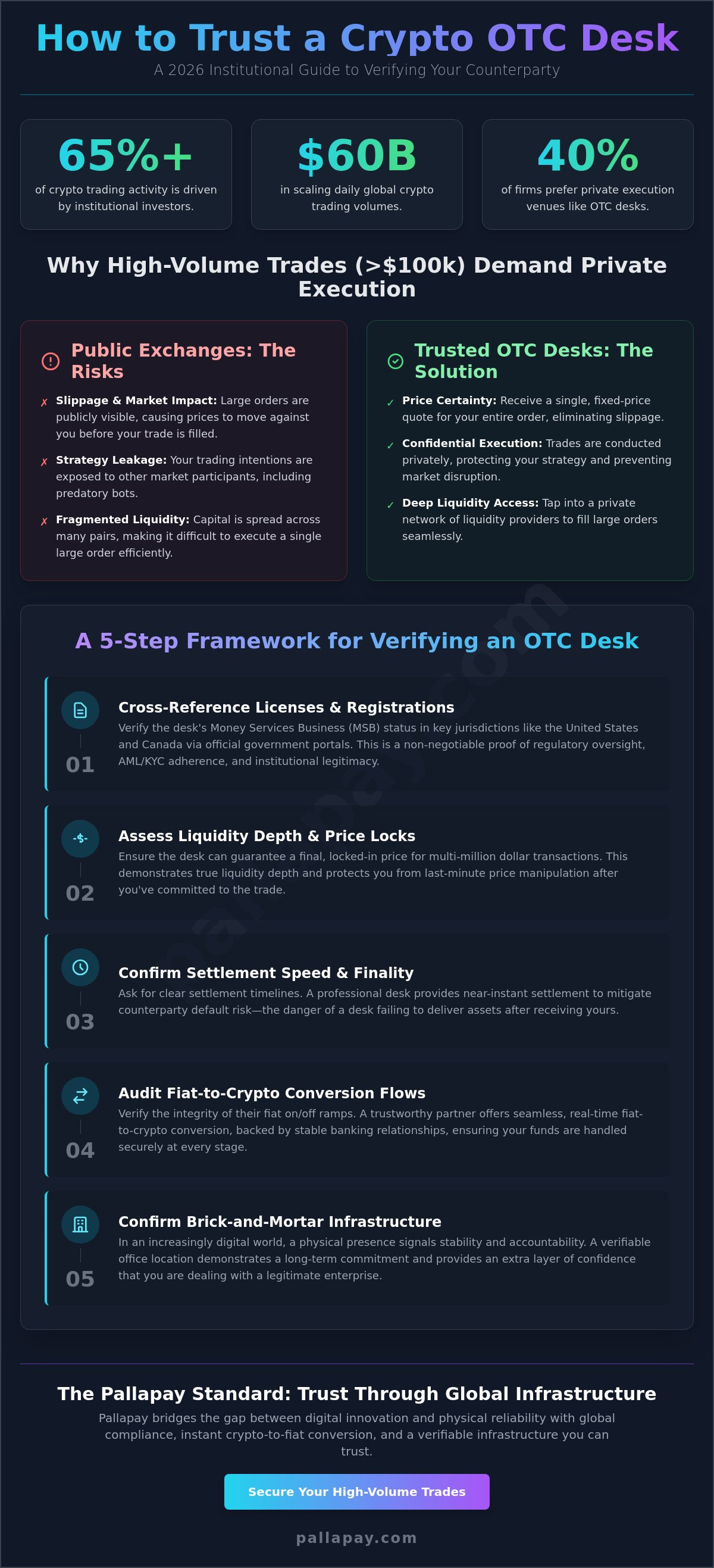
A 5-Step Framework for Verifying a Crypto OTC Desk
Moving from theoretical understanding to operational execution requires a systematic approach. While high-level liquidity and licensing are essential, the practicalities of how to trust a crypto otc desk involve a hands-on audit of their daily workflows. A reliable partner doesn’t just promise security; they demonstrate it through every touchpoint of the relationship. Follow this five-step framework to ensure your counterparty meets the rigorous standards of the 2026 market.
- Step 1: Verify Registration. Cross-reference the desk’s MSB status with local business licenses. A legitimate desk should be easily found on government portals in the jurisdictions where they claim to operate.
- Step 2: Audit Physical Presence. In a digital-first industry, a brick-and-mortar office remains a vital sign of stability. Confirm that the desk has a physical location where professional operations are conducted.
- Step 3: Test Communication. Evaluate the responsiveness of your dedicated account manager. Institutional trading moves fast, and you need a partner who answers queries with precision and speed.
- Step 4: Review Onboarding. Pay attention to the KYC and AML process. If onboarding feels “too easy,” it’s a major red flag. Robust compliance is the only way a desk protects itself and its clients from regulatory seizure.
- Step 5: Execute a Pilot Trade. Start with a smaller tranche before committing to a multi-million dollar transaction. Use this opportunity to test the settlement speed and verify that the quoted price matches the final execution.
Initial Documentation and Due Diligence
A professional desk should provide a standard set of documents upon request, including their Articles of Incorporation and a clear summary of their compliance policies. Review their Terms of Service (ToS) specifically for clauses regarding trade finality and error resolution. If the language is vague about when a price is “locked,” your capital is at risk. You should also perform a reputation check through industry networks to see how the desk has handled previous market stress events. Understanding how to trust a crypto otc desk involves looking beyond the marketing and into the fine print of their operational agreements.
Analyzing Execution Quality
Execution quality isn’t just about the “all-in” price; it’s about transparency. Some desks hide markups within the spread, making it difficult to calculate the true cost of your trade. Demand a clear breakdown of any fees and ensure the desk provides 24/7 coverage to handle global market shifts. This level of service is essential for institutional portfolios that need to react to news cycles in real-time. For a deeper look at protecting your holdings, consult our institutional settlement guide. If you’re looking for a partner that prioritizes transparency and speed, explore our crypto offramp solutions today.
The Pallapay Standard: Trust Through Global Infrastructure
Professional traders and institutional entities require a partner that balances disruptive technology with the stability of established finance. Pallapay serves as this essential bridge, providing a secure environment for high-volume transactions. When evaluating how to trust a crypto otc desk, the most reliable indicators are regulatory transparency and physical infrastructure. We maintain active MSB registrations in both the United States and Canada, ensuring our operations meet the highest global standards for compliance and financial reporting. This regulatory alignment provides a secure foundation for every trade we facilitate.
Our commitment to stability extends beyond digital platforms. We maintain a physical presence with offices in key financial hubs such as Singapore and Istanbul, facilitating operations across more than 180 countries. This global reach is supported by an integrated ecosystem that includes our OTC exchange, Crypto POS machines, and the Pallapay Mastercard. By unifying these services, we eliminate the friction typically associated with moving assets between digital and traditional commerce environments. It’s a comprehensive approach that positions our platform as the definitive destination for all your technical and liquidity needs.
Comprehensive Solutions for Institutional Clients
Established in 2018, we’ve navigated multiple market cycles, providing a level of reliability that newer, online-only brokers cannot replicate. Our physical desks offer a tangible layer of security, allowing clients to engage with a dedicated partner in a professional setting. For those requiring seamless fiat conversion, the Pallapay Off-Ramp provides the necessary rails to transition between crypto and major currencies instantly. This infrastructure ensures that your liquidity is always accessible and your settlement is finalized without delay. Since 2018, we’ve prioritized the utility of digital assets in modern commerce, making complex conversions feel like standard business operations.
Security Protocols and Asset Protection
Asset protection is the core of our technical framework. We employ advanced multi-sig custody and cold storage solutions to safeguard all digital holdings against unauthorized access. Merchants and high-net-worth individuals trust our Payment API for high-frequency operations, knowing that our security protocols are designed for institutional-grade resilience. Understanding how to trust a crypto otc desk comes down to the quality of their background processes. Every transaction is backed by a sophisticated architecture that prioritizes speed and safety. At Pallapay, we handle the complexities of security and compliance so you can focus on growth. To explore our tailored solutions for your business, book a consultation with a Pallapay OTC specialist today.
Securing Your Institutional Future in Digital Assets
Choosing a private execution partner is one of the most critical decisions an institutional trader makes. You’ve learned that understanding how to trust a crypto otc desk requires a rigorous audit of their licensing, liquidity, and physical presence. By prioritizing counterparties with verifiable MSB registrations and a commitment to price locks, you eliminate the risks of slippage and counterparty default. These metrics transform trust from a sentiment into a verifiable business standard.
Since 2018, Pallapay has bridged the gap between innovation and institutional reliability. We maintain MSB registrations in the United States and Canada, providing a secure foundation for every transaction. Our physical presence in Singapore and Istanbul ensures that our clients have access to a sophisticated partner that understands the practicalities of modern commerce. Secure your next high-volume trade with Pallapays regulated OTC desk and leverage our integrated ecosystem for your technical needs. Your path to stable, large-scale growth starts with a partner you can verify today.
Frequently Asked Questions
What is the difference between a crypto OTC desk and a standard exchange?
An OTC desk facilitates private transactions directly between two parties, bypassing the public order books of standard exchanges. This private execution is essential for high-volume traders who need to avoid market slippage and price volatility. While exchanges aggregate many small retail orders, an OTC desk provides a single, locked price for the entire block. This structure ensures that your trade doesn’t alert the broader market before completion.
How do I know if a crypto OTC desk is legally registered?
You can verify a desk’s legitimacy by cross-referencing their license numbers on official government portals. Legitimate providers will maintain active Money Services Business (MSB) registrations in major jurisdictions like the United States or Canada. Researching these public records is a fundamental part of learning how to trust a crypto otc desk. If a company cannot provide a verifiable registration number, they don’t meet the necessary compliance standards for 2026.
Why do large investors prefer OTC desks over public order books?
Large investors prioritize OTC desks to maintain confidentiality and minimize market impact. Executing a multi-million dollar trade on a public exchange often leads to strategy leakage; other participants see the order and move prices against you. OTC trading allows for silent execution, protecting your entry and exit points. This approach ensures that institutional portfolios can move significant capital without causing artificial price swings in the open market.
What documents are required to open an account with a reputable OTC desk?
Reputable desks require standard identity and corporate verification documents to satisfy global Anti-Money Laundering (AML) regulations. You’ll typically need to provide valid government identification, proof of residence, and detailed business registration papers for corporate accounts. A desk that skips these steps is a significant compliance risk. Professional desks use these documents to ensure that all funds have a clean provenance and that the transaction adheres to international legal frameworks.
Can I sell large amounts of USDT for cash at an OTC desk?
Yes, you can sell large volumes of USDT for cash at a professional OTC desk. This service provides an efficient off-ramp for traders who need immediate liquidity in physical currency. Desks like Pallapay specialize in these high-volume conversions, ensuring that the process is secure and transparent. It’s a standard business operation that bridges the gap between digital assets and the practical needs of modern commerce.
What are the typical fees associated with OTC crypto trading?
Fees in OTC trading are typically integrated into the quoted “all-in” price rather than charged as a separate commission. This spread represents the difference between the market rate and the execution price provided by the desk. Because OTC trades involve high capital amounts, this single-price model provides clarity and prevents hidden costs. You should always ask for a clear breakdown of the quote to ensure you’re receiving competitive institutional pricing.
How long does it take for a large OTC trade to settle in my bank account?
Settlement for large OTC trades usually occurs on a same-day basis. Professional desks utilize direct banking rails to ensure that funds move as soon as the blockchain confirmations are finalized. This speed is a core requirement for institutional liquidity management in 2026. While traditional bank transfers might take longer depending on intermediary banks, a top-tier desk works to minimize these delays through established financial partnerships.
Is it possible to visit a physical OTC desk for higher security?
Visiting a physical office is often possible and recommended for establishing a high-security partnership. Brick-and-mortar locations provide a level of accountability that online-only brokers can’t match. Seeing the operational infrastructure firsthand helps you understand how to trust a crypto otc desk before committing to a long-term relationship. Desks with physical hubs in major financial centers like Singapore or Istanbul offer a tangible layer of security for high-net-worth individuals and corporate entities.
Disclaimer
The information provided on this website and blog is for general informational and educational purposes only and does not constitute financial, investment, legal, tax, or other professional advice.
Cryptocurrency and digital asset services may be subject to regulatory restrictions in certain jurisdictions. Users are solely responsible for ensuring compliance with applicable local laws and regulations before using any products or services mentioned on this website.
PallaPay does not guarantee the accuracy, completeness, or timeliness of any information published and accepts no liability for any loss or damages arising from reliance on the content. Any opinions expressed are those of the respective authors and may change without notice.
Certain services, features, or products referenced may be provided through third-party partners, licensed entities, or affiliated service providers subject to separate terms and regulatory approvals. Availability of services may vary by country or region.
This website may contain references to digital assets, virtual currencies, or blockchain-related services that are not available to residents of certain jurisdictions, including where prohibited by law. Nothing on this website constitutes an offer, solicitation, or recommendation to buy or sell any financial instrument or virtual asset.
Leave a Reply