

By 2026, over 45% of global merchants are projected to move beyond traditional card readers to accept digital assets according to data from Pallapay. You likely recognize that staying competitive in this landscape requires more than just installing new software. It demands a team that understands how to train staff to accept crypto payments effectively to ensure every transaction is secure and friction-free. While it’s common to fear high error rates or technical confusion during early adoption, these hurdles are easily cleared with a structured approach to institutional reliability.
This guide provides a comprehensive framework to empower your team with absolute precision, ensuring your checkout process remains professional and reliable. We’ll explore practical protocols to eliminate network confusion and demonstrate how this technical proficiency serves as a gateway to more sophisticated financial strategies. By mastering digital transactions, your team gains the foundation needed to understand the transformative potential of Forex and gold CFD trading. This knowledge allows your business to move beyond simple transactions and embrace the financial impact of global markets, turning standard operations into a launchpad for long-term growth.
Key Takeaways
- Professionalize your point-of-sale experience by mastering the technical distinctions between dedicated Crypto POS machines and integrated digital payment gateways.
- Implement a standardized 5-step operational workflow on how to train staff to accept crypto payments, ensuring precise network verification for USDT, BTC, and Ethereum.
- Protect your business through advanced security protocols and MSB registration standards that mitigate volatility risks and prevent transaction scams.
- Bridge the gap between retail operations and institutional finance by educating your team on the mechanics of gold and USD CFD trading.
- Foster a culture of financial empowerment where staff utilize their knowledge of Forex and commodity markets to unlock new levels of professional growth.
Why Crypto and CFD Trading Knowledge is the New Staff Essential
The global economy is rapidly shedding the inefficiencies of traditional banking. Modern businesses are no longer just points of sale; they’re becoming active participants in a digital financial evolution. Understanding What is Cryptocurrency? is no longer optional. It’s the essential first step in a larger journey toward total market literacy. When you consider how to train staff to accept crypto payments, you aren’t just teaching them to scan a QR code. You’re equipping them with the vocabulary of modern finance and the technical confidence of a global industry leader.
There’s a direct, functional link between processing a USDT transaction and understanding the mechanics of CFD trading. Both rely on the same underlying principles of digital asset management, speed, and market valuation. By 2026, the most successful businesses will be those where staff can discuss the benefits of digital assets with the same ease they have with traditional currency. This transition creates a professional environment that prioritizes institutional reliability over the erratic language of emerging tech. Framing crypto acceptance as a career-advancing skill ensures your team sees themselves as facilitators of progress rather than just retail operators.
The Transformative Power of Modern Financial Markets
Forex and CFD trading offer a pathway to financial independence that traditional banking systems often fail to provide. For a staff member, learning the mechanics of trading Gold (XAU/USD) offers a practical education in how to hedge against inflation and build a second stream of potential income. This isn’t just about business growth. It’s about personal financial transformation. A team that understands how price fluctuations in the USD impact global trade is a team that can provide superior service to sophisticated clients. Digital assets serve as the entry point to this high-level market engagement, turning every transaction into a learning opportunity.
Bridging the Gap Between Innovation and Reliability
Pallapay acts as a strategic partner that handles complex background processes, allowing your business to focus on operational growth. We provide the professional bridge between established commerce and blockchain utility. For employees in retail store environments, this means having access to secure, utility-focused tools like the Crypto POS Machine. Our ecosystem is built on safety and speed, ensuring that every technical conversion feels like a standard, effortless operation. We support your staff’s learning journey by framing technical terms within the context of simplicity and long-term financial stability.
Mastering the Hardware: Training on Crypto POS and Gateways
Effective implementation starts with a clear distinction between physical infrastructure and digital interfaces. While online gateways facilitate ecommerce growth, the physical Crypto POS machine anchors the retail experience. When you’re determining how to train staff to accept crypto payments, the first priority is hardware proficiency. Modern terminals utilize NFC technology for rapid, touchless payments, while QR codes provide a universal standard for cross-wallet compatibility. Staff must understand that these tools aren’t just gadgets; they’re professional instruments designed for institutional financial reliability.
One of the primary concerns for retail teams is price volatility. You can eliminate this anxiety by training staff on the “Instant Conversion” feature. This tool automatically locks in the fiat value at the moment of transaction, ensuring the business receives the exact amount in USD regardless of market shifts. If a terminal loses connectivity, staff should know to check the local network status before attempting a reboot. This ensures a seamless customer journey without technical friction or unnecessary delays at the register.
Hands-on with the Crypto POS Machine
Initiating a sale on a physical terminal is as straightforward as traditional card processing. Staff select the desired cryptocurrency, such as USDT or Bitcoin, and the terminal generates a unique QR code for the customer to scan. It’s vital that employees can explain the difference between blockchain networks to prevent transaction errors. For instance, knowing when to use Ethereum’s ERC-20 versus Tron’s TRC-20 protects both the customer and the merchant. For a deeper look at hardware capabilities, review our Crypto POS Machine guide.
Managing the Merchant Dashboard
The merchant dashboard serves as the nerve center for your financial operations. Senior staff should be proficient in monitoring real-time sales and utilizing the fiat settlement feature to maintain liquidity. This dashboard also simplifies compliance with IRS crypto reporting requirements by generating detailed transaction logs. These reports are essential for accurate accounting and reconciliation. By mastering these background processes, your team ensures the business remains a stable partner in the global market. To streamline your back-office flow, consider integrating our payment API into your existing systems.
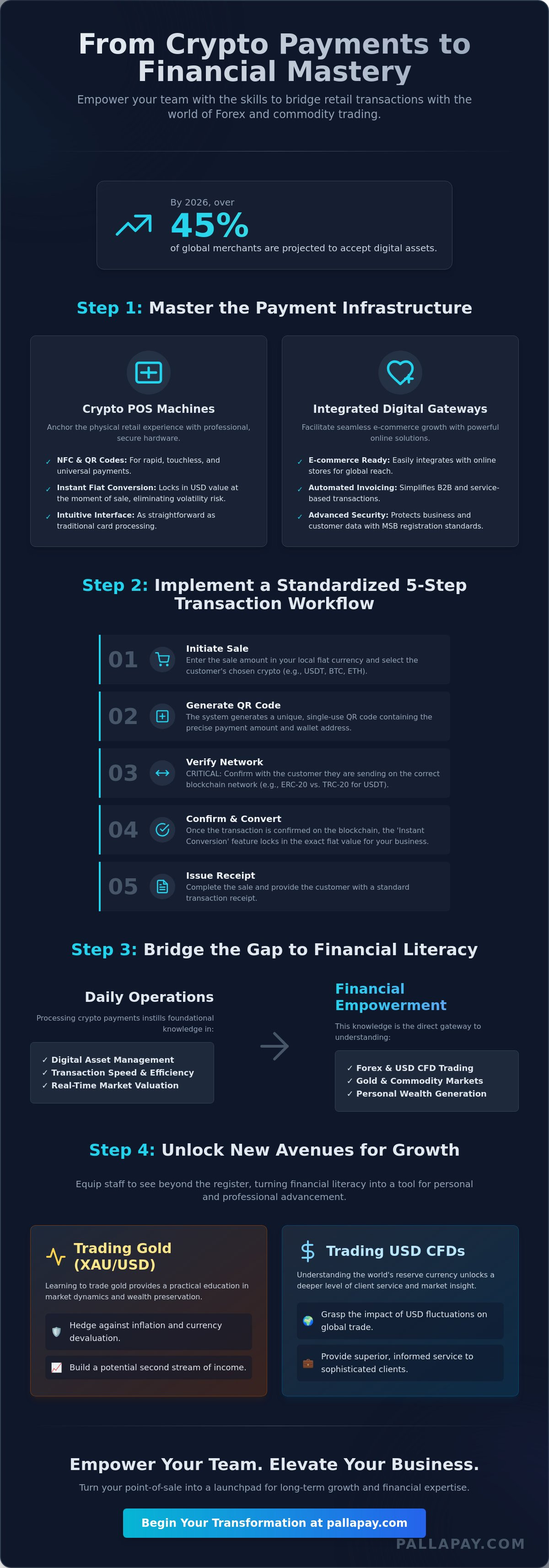
The 5-Step Workflow for Processing Crypto Transactions
Establishing a precise protocol is the most effective way to eliminate operational friction and ensure institutional reliability. Much like how a manufacturer might explore Valve Bag Fillers to automate and refine their packaging systems, a business owner must implement technical standards for their financial operations. When you develop a strategy on how to train staff to accept crypto payments, you must replace guesswork with a standardized, five-step checklist. This workflow ensures that every transaction is handled with the same level of security as a traditional bank wire while maintaining the speed of a digital asset transfer.
- Initiation: Staff must first confirm the customer’s preferred currency. Whether it is USDT, Bitcoin, or Ethereum, selecting the correct asset on the terminal is the foundation of a successful transaction.
- Verification: This is a critical step where many untrained teams fail. Staff must verify the blockchain network with the customer, distinguishing between ERC-20, TRC-20, or native networks to prevent funds from being sent to an incompatible address.
- Execution: The terminal generates a unique QR code or activates NFC for a touchless scan. This process should be presented to the customer with the confidence of a global industry leader.
- Confirmation: Unlike credit cards, blockchain transactions require network validation. Staff should be trained to explain the “pending” state professionally, reassuring the customer that the transaction is being secured by the ledger.
- Finalization: Once confirmed, the system issues a digital or physical receipt. At this stage, the merchant dashboard confirms the fiat settlement status, ensuring the business’s liquidity is maintained.
For more detailed compliance guidance, staff can refer to the virtual currency transaction FAQs to understand how these steps align with global reporting standards.
Handling Different Payment Scenarios
Operations in retail stores require a different pace than high-ticket service environments. In a retail setting, speed is the priority. For high-value transactions, such as gold or luxury assets, the focus shifts to rigorous verification. If a refund is required, staff must understand that crypto transactions are irreversible on the blockchain. Instead, the business processes the refund through the fiat settlement account, maintaining a clean audit trail. Explaining transaction fees should be handled with authoritative clarity, framing them as the cost of a secure, global financial network.
Using the Pallapay Mastercard for Business Expenses
The digital financial cycle isn’t complete until the received assets are put to work. Training your team on the off-ramp process is essential for operational efficiency. By using the Pallapay Mastercard, your business can convert received crypto into spendable fiat instantly to cover daily expenses. This demonstrates the lack of friction in the modern commerce cycle. This practical experience with digital liquidity serves as a bridge to more advanced financial strategies, such as managing a Forex account or engaging in gold CFD trading to maximize the business’s capital growth.
Security Protocols and Managing Volatility Objections
Security is the foundation of institutional financial reliability. When you evaluate how to train staff to accept crypto payments, your curriculum must prioritize the detection of sophisticated fraud. A common tactic in the digital asset space involves bad actors presenting fake transaction screenshots to simulate a successful transfer. Staff must be trained to never rely on a customer’s device for confirmation. Instead, they should only finalize a sale once the transaction appears as “confirmed” on the business’s own merchant dashboard or POS terminal. This simple protocol eliminates the risk of social engineering and ensures that every digital asset transfer is backed by verified blockchain data.
Volatility remains the primary objection from both staff and customers. You can resolve this by positioning stablecoins like USDT as the standard for retail commerce. Since stablecoins account for approximately 82% of crypto gateway volume in 2026, they provide a price-stable entry point that mirrors the reliability of the USD. If a customer asks, “What if the price drops while I am paying?” staff should confidently explain that the system locks in the conversion rate at the exact moment the QR code is scanned. This professional assurance transforms a potential barrier into a demonstration of the platform’s technical sophistication.
Security as a Sales Tool
Your team should be able to explain blockchain security without relying on confusing technical jargon. A Secure Gateway is a hardened digital interface that encrypts transaction data and verifies blockchain ledger entries in real-time to ensure irrevocable fund transfers. By framing security as a benefit, staff can reassure skeptical clients that digital transactions offer a level of transparency and safety that traditional systems often lack. For a more comprehensive technical breakdown, encourage your team to study our Crypto Security guide. This deeper understanding allows them to act as knowledgeable strategic partners for your customers.
Compliance and KYC Procedures
Trust is built through transparency and regulatory alignment. Staff must understand that identity verification and KYC (Know Your Customer) procedures are not hurdles, but essential components of a secure global financial evolution. High-net-worth clients, particularly those interested in gold and USD CFD trading, value the protection that comes with MSB (Money Services Business) registration. Being registered as an MSB in jurisdictions like the US and Canada signals that your business adheres to strict anti-money laundering standards. This compliance builds absolute trust and positions your brand as a supportive facilitator in the modern financial landscape. To ensure your business meets these global standards, secure your retail operations today with our fully compliant payment ecosystem.
Beyond the Register: Incentivizing Staff with Financial Literacy
Mastery of the payment terminal is only the first stage of a successful digital transformation. To ensure long-term adoption, you must move beyond the technical mechanics and foster a “trading-savvy” culture within your team. When you refine your strategy on how to train staff to accept crypto payments, you create a unique opportunity to align employee interests with the business’s financial evolution. Encouraging your team to follow the Gold and USD CFD markets transforms them from passive operators into informed participants in the global economy. This high-level market awareness allows them to speak with the confidence of a strategic partner when interacting with your most sophisticated clients.
Personal engagement is the strongest driver of professional proficiency. By introducing staff to the Pallapay Wallet as a personal finance tool, you allow them to experience the speed and safety of digital assets firsthand. This practical experience makes the transition from traditional systems feel effortless and standard. Furthermore, implementing reward programs for staff who successfully facilitate crypto transactions incentivizes the team to actively promote your modern payment options. This approach turns every checkout interaction into a moment of professional growth and financial empowerment.
Education as a Retention Strategy
Teaching the mechanics of CFD trading significantly increases employee loyalty and professional value. When staff understand how trading Gold (XAU/USD) acts as a hedge against market shifts, they gain a skill set that can change their personal financial life. Providing resources on the financial impact of commodity markets helps your team see the broader utility of the tools they use daily. This educational path allows an employee to transition from a standard cashier role to a specialized digital asset consultant. This professional elevation ensures your business retains top-tier talent that is deeply invested in the success of your digital financial ecosystem.
The Future of Global Commerce
2026 marks a pivotal moment for digital asset adoption, with regulatory frameworks like MiCA and the UK’s FCA rules providing the institutional reliability needed for global growth. Your staff should view themselves as essential components of this global evolution. By mastering how to train staff to accept crypto payments today, you are future-proofing your operations against the inevitable shift toward decentralized finance. This commitment to innovation positions your brand as a forward-thinking leader in modern commerce. To begin this journey and unlock the full potential of your team, empower your business with Pallapay Merchant Solutions and secure your place in the future of finance.
Leading the Digital Financial Evolution
Adopting digital assets is a core strategic requirement for global commerce. By establishing a standardized 5-step workflow and prioritizing hardware proficiency, you ensure your business operates with institutional financial reliability. Mastering how to train staff to accept crypto payments provides your team with more than just technical skills. It offers a gateway to understanding the transformative potential of gold and USD CFD trading. This knowledge allows your employees to grow alongside the modern market, turning retail operations into a hub for financial literacy.
Pallapay supports this transition with official MSB registrations in the US and Canada, serving partners across 180+ countries. Our ecosystem ensures secure fiat settlement for all transactions to remove the friction of volatility while maintaining the speed of the blockchain. As you empower your team with these tools, you aren’t just updating a register; you’re building a foundation for market leadership. Equip your team with the Pallapay Crypto POS and Merchant Gateway to begin your journey into the future of integrated finance. The evolution of global commerce is here, and your business is ready to lead it.
Frequently Asked Questions
How long does it take to train staff to accept crypto payments?
Technical proficiency in how to train staff to accept crypto payments typically requires only one to two hours of hands-on instruction. This timeframe allows your team to master the Crypto POS Machine interface and the merchant dashboard. Most employees achieve full operational confidence after completing five supervised test transactions to ensure they understand QR code generation and network verification protocols.
Do my employees need to understand blockchain technology to process payments?
No, your staff don’t need a deep technical understanding of blockchain architecture to facilitate daily commerce. Our ecosystem is designed for institutional financial reliability, making digital transactions feel like standard, effortless business operations. While a basic grasp of digital assets is beneficial, the primary training focus should remain on navigating the utility-focused interface of the merchant gateway.
What is the most common mistake staff make when accepting crypto?
The most frequent error is the selection of an incompatible blockchain network, such as confusing Ethereum’s ERC-20 with Tron’s TRC-20. This mistake can lead to lost funds if the sender and receiver aren’t aligned on the same network. Staff must be trained to verify the specific network with the customer during the initiation phase to maintain a secure and error-free checkout process.
How can I motivate my team to embrace cryptocurrency payments?
Motivation comes from connecting digital payments to broader financial empowerment and professional development. You can encourage your team by offering workshops on gold and USD CFD trading. When staff understand how these markets provide a second stream of potential income, they view the payment gateway not just as a tool, but as an essential component of their own financial life.
Is it safe for my staff to handle crypto transactions on their personal phones?
It’s not recommended for staff to use personal devices for professional business transactions. Dedicated hardware like the Crypto POS Machine provides a secure, hardened environment that protects the business’s digital assets. Using professional infrastructure ensures institutional reliability and prevents the security risks associated with unmanaged personal software or potential phishing attempts on private mobile devices.
What should staff do if a crypto transaction fails or stays pending?
Staff should wait for the required network confirmations rather than re-initiating the sale if a transaction stays pending. They can monitor the transaction status in real-time through the merchant dashboard to confirm validation. In the rare event of a failure, staff should verify the customer’s network selection and wallet balance before attempting a new transaction to ensure a professional resolution.
Can we accept crypto payments for high-ticket items like gold or Forex services?
Yes, digital assets are highly efficient for high-ticket transactions, particularly in the gold and Forex trading sectors. Many institutional clients prefer using USDT or Bitcoin to fund a Forex account or to engage in gold CFD trading. This integration allows your business to facilitate large-scale financial transfers with greater speed and significantly lower friction than traditional banking systems.
How do I explain crypto transaction fees to a customer?
Explain transaction fees as the necessary cost for blockchain network validation and absolute transaction security. You should clarify that these fees are paid to the decentralized network to ensure the transfer is irrevocable and secure. Framing this with authoritative clarity helps customers understand the value of the secure, global infrastructure they’re utilizing for their purchase.
Disclaimer
The information provided on this website and blog is for general informational and educational purposes only and does not constitute financial, investment, legal, tax, or other professional advice.
Cryptocurrency and digital asset services may be subject to regulatory restrictions in certain jurisdictions. Users are solely responsible for ensuring compliance with applicable local laws and regulations before using any products or services mentioned on this website.
PallaPay does not guarantee the accuracy, completeness, or timeliness of any information published and accepts no liability for any loss or damages arising from reliance on the content. Any opinions expressed are those of the respective authors and may change without notice.
Certain services, features, or products referenced may be provided through third-party partners, licensed entities, or affiliated service providers subject to separate terms and regulatory approvals. Availability of services may vary by country or region.
This website may contain references to digital assets, virtual currencies, or blockchain-related services that are not available to residents of certain jurisdictions, including where prohibited by law. Nothing on this website constitutes an offer, solicitation, or recommendation to buy or sell any financial instrument or virtual asset.
Leave a Reply