Tag: Payment Gateway

  • What Is a Fiat-to-Crypto Payment Gateway? The 2026 Merchant Guide

    What Is a Fiat-to-Crypto Payment Gateway? The 2026 Merchant Guide

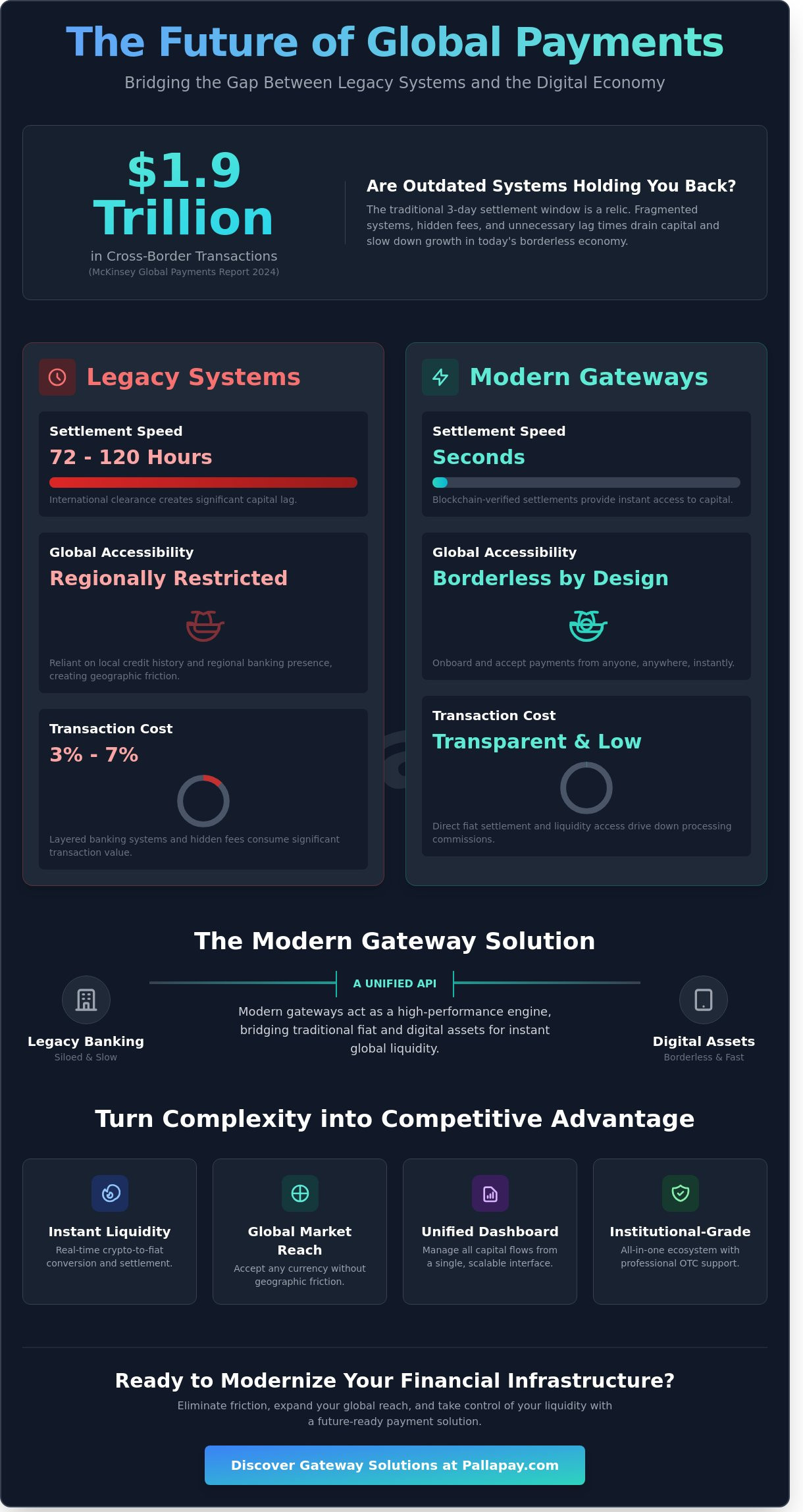
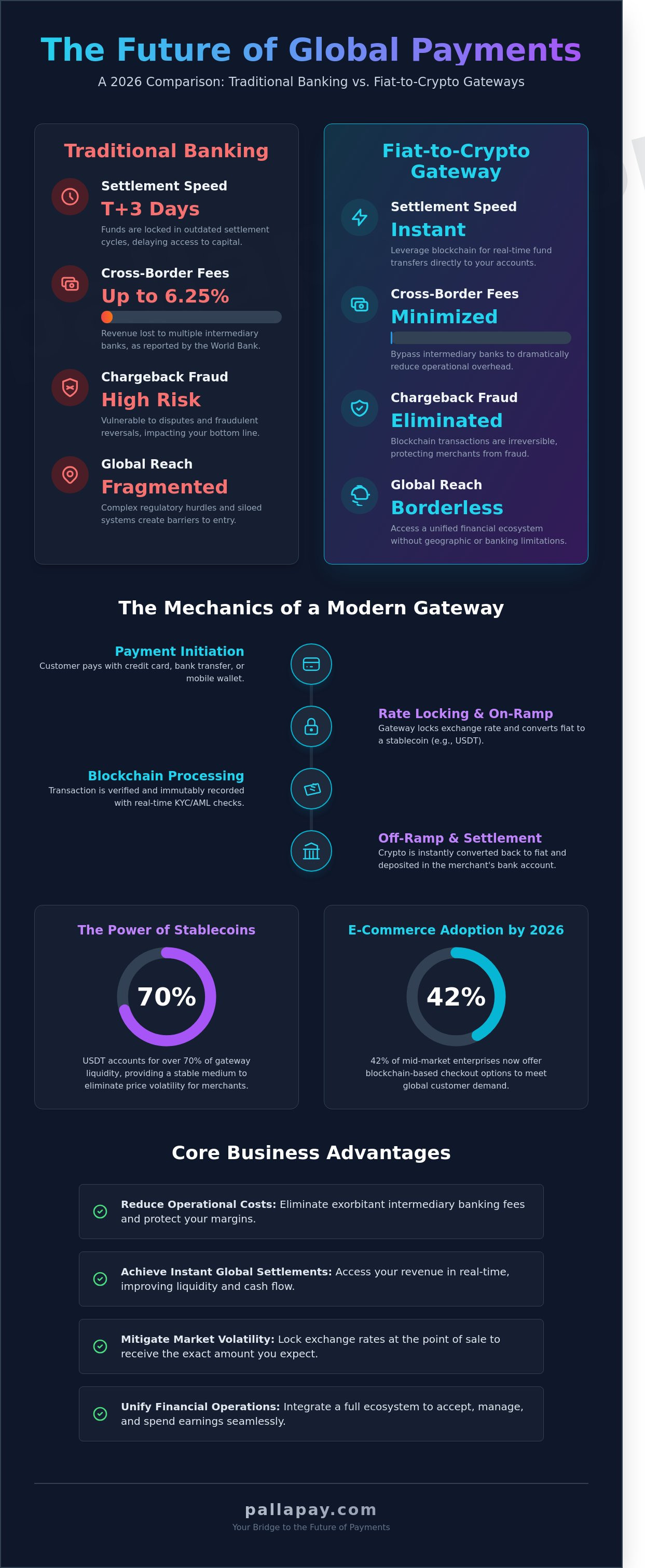
    The era of accepting a three day wait for international settlements ended the moment blockchain technology achieved institutional scale. While traditional banking systems still rely on outdated T+3 settlement cycles, a modern fiat to crypto payment gateway allows your business to bypass these legacy bottlenecks entirely. You’ve likely felt the frustration of watching up to 6.25% of your cross-border revenue vanish into intermediary bank fees, a figure the World Bank’s 2023 report highlights as a persistent drain on merchant liquidity.

    It’s clear that the friction of high transaction costs and complex regulatory hurdles shouldn’t dictate your growth potential. This 2026 guide provides the roadmap to bridge your existing bank accounts with the speed of decentralized finance. You’ll discover how to achieve instant global settlements, eliminate chargeback risks, and maintain a compliant bridge to the future of payments. We’ll examine the technical infrastructure of liquidity and the strategic shift toward a borderless financial ecosystem that prioritizes your bottom line.

    Key Takeaways

    • Understand how a fiat to crypto payment gateway serves as the essential bridge between traditional banking and blockchain networks to facilitate seamless global settlements.
    • Learn the technical process of locking exchange rates in real-time to protect your business from market volatility during the transaction cycle.
    • Discover how to significantly reduce operational costs by eliminating legacy banking fees and the risk of chargeback fraud through secure blockchain processing.
    • Identify the critical compliance standards and “all-in-one” features required to choose a secure, institutional-grade provider for your global business needs.
    • Explore how integrating a comprehensive ecosystem allows you to spend business earnings instantly via specialized Mastercard solutions, unifying your financial operations.

    What is a Fiat-to-Crypto Payment Gateway in 2026?

    A fiat to crypto payment gateway functions as the sophisticated bridge between traditional banking systems and decentralized blockchain networks. It allows businesses to accept digital assets while managing their books in local currencies like USD, EUR, or AED. This infrastructure isn’t just a simple converter anymore; it’s a comprehensive financial engine. By early 2026, these gateways have transitioned from niche experimental tools into essential components for global e-commerce, where 42% of mid-market enterprises now offer blockchain-based checkout options. Unlike the fragmented tools of the past, a modern fiat to crypto payment gateway operates as a unified financial engine that handles compliance, security, and settlement in real time.

    The core utility lies in its dual nature. It manages the complex “heavy lifting” of converting government-issued money into digital tokens and vice versa. While a simple “buy” widget might suffice for an individual user, a professional merchant processor provides a full-scale API. This integration ensures that a business can scale without worrying about the underlying volatility of the crypto market. It transforms a volatile asset into a stable, usable form of capital for the merchant.

    The Evolution of Digital Payment Bridges

    Standards in 2026 differ drastically from the high-friction converters used in 2021. Early systems often required 24 to 48 hours for verification and settlement. Today, the industry has shifted toward instant processing. Stablecoins, specifically USDT, play a pivotal role here. USDT accounts for over 70% of gateway liquidity, providing a stable medium that eliminates the price swings typically associated with Bitcoin or Ethereum. Businesses are moving away from “crypto-only” solutions because they don’t want to hold volatile assets on their balance sheets. Hybrid models are the new standard. These models allow a customer to pay in Bitcoin while the merchant receives an instant settlement in their local fiat currency, combining blockchain efficiency with institutional reliability.

    On-Ramp vs. Off-Ramp: Understanding the Flow

    The gateway operates through two distinct channels that ensure money moves seamlessly across the digital divide. The customer-facing on-ramp allows a buyer to use a debit card, credit card, or bank transfer to purchase the crypto needed for a transaction. This process happens behind the scenes in seconds. The merchant-facing off-ramp is where the business realizes its profit. It involves taking the received crypto and converting it back into fiat for bank deposit or operational use. Reliability in this flow depends on liquidity providers. By maintaining deep pools of capital, a gateway ensures that conversion rates remain locked the moment a customer clicks “pay.” This prevents slippage and ensures the merchant receives the exact amount expected.

    • On-Ramp: Converts fiat into digital assets to initiate a transaction.
    • Off-Ramp: Converts digital assets back into fiat for business settlement.
    • Liquidity: Ensures instant conversion without price drops.
    • Settlement: The final transfer of funds into a merchant’s traditional bank account.

    The Future of Payments is defined by this lack of friction. Merchants no longer need to be blockchain experts to benefit from global reach. They simply need a partner that provides the professional infrastructure to bridge the old world with the new.

    The Mechanics of Fiat-to-Crypto Processing

    A fiat to crypto payment gateway functions as a high-speed financial bridge; it translates traditional currency into digital assets within seconds. This process is a logical sequence designed to eliminate technical friction for the end-user while maintaining institutional-grade security for the merchant. By automating the conversion path, businesses can accept global payments without managing the underlying blockchain complexities themselves.

    • Step 1: Payment Initiation. The customer selects their preferred payment method, such as a credit card, instant bank transfer, or a mobile wallet. In 2026, mobile wallet adoption has reached over 60% of the global consumer base, making multi-channel support essential.
    • Step 2: Rate Locking. To prevent losses from market volatility, the gateway locks the exchange rate for a specific window. This ensures the merchant receives the exact value expected, regardless of price fluctuations during the transaction.
    • Step 3: Automated Verification. Integrated KYC and AML protocols scan the transaction in real-time. This compliance layer is essential for institutional reliability and protects the business from fraudulent activity.
    • Step 4: Instant Settlement. The gateway completes the conversion and routes the funds. The merchant receives the assets in their digital wallet or chooses to move them via fiat settlement services to their local bank.

    Integration Methods: API and Widgets

    Modern gateways offer flexible deployment options to suit different business scales. Small retail websites often opt for “no-code” widgets. These are plug-and-play solutions that require zero development time and provide a secure, hosted checkout page. For enterprise-level customization, a payment API provides the necessary flexibility. It allows businesses to build a bespoke checkout experience that mirrors their brand identity perfectly. Maintaining a seamless UI/UX is vital; a 2025 industry study showed that inconsistent checkout flows lead to a 32% increase in cart abandonment. Professional gateways handle the heavy lifting of backend logic while keeping the frontend interface clean and intuitive.

    Real-Time Liquidity and Exchange Rates

    Reliable gateways source liquidity from multiple institutional exchanges simultaneously to ensure the best possible rate. This multi-source approach minimizes “slippage,” which is the difference between the expected price and the executed price. Top-tier providers aim for slippage rates below 0.1% even for large volume orders. The term “Instant” serves as the anchor of modern commerce. It represents the shift from legacy T+3 settlement cycles to immediate global value transfer. By utilizing a robust fiat to crypto payment gateway, merchants can access the future of payments where capital moves at the speed of the internet. This efficiency allows businesses to reinvest their revenue faster, accelerating growth in a competitive global market.

    What Is a Fiat-to-Crypto Payment Gateway? The 2026 Merchant Guide

    Strategic Benefits of Moving Beyond Traditional Gateways

    Traditional payment rails are becoming a bottleneck for modern enterprises. By integrating a fiat to crypto payment gateway, merchants bypass the high costs and slow speeds of legacy banking. Legacy systems typically demand a 3% to 5% commission on every transaction. Blockchain alternatives often lower these fees to under 1%, which directly boosts profit margins for high-volume businesses. This shift isn’t just about saving money; it’s about reclaiming control over your revenue streams.

    Chargeback fraud caused $100 billion in losses for merchants globally in 2023. This is a primary pain point that traditional credit card processors fail to solve. Cryptocurrency transactions are cryptographically secured and irreversible. Once a customer completes a payment, the funds are final. There’s no middleman to reverse a transaction after you’ve shipped the product. This finality provides a level of financial certainty that credit cards simply cannot match.

    Expanding into new territories no longer requires the administrative burden of opening local bank accounts in every country. A single gateway allows you to accept payments from any customer with a digital wallet, regardless of their geographic location. This accessibility is one of the core strategic benefits of accepting cryptocurrency for long-term growth in the 2026 economy.

    Instant Global Settlements

    Banking cycles often operate on a T+3 basis, meaning your funds are locked for 72 hours or more. High-volume retail and gaming industries require faster liquidity to maintain operational momentum. Blockchain technology enables settlements in minutes rather than days. By utilizing fiat settlement options, businesses receive their local currency quickly while avoiding the price swings of the digital asset market. It’s the most efficient way to manage cash flow in a 24/7 global market.

    Security and Fraud Prevention

    Security is built into the protocol, not added as an afterthought. Every transaction is a final, verified event on a public ledger, making identity theft and payment spoofing nearly impossible. Gateways serve as a protective buffer, shielding merchant bank accounts from direct exposure to the crypto ecosystem. These platforms also integrate automated AML monitoring that satisfies 2026 financial regulators. You get the benefit of disruptive technology backed by institutional-grade compliance and safety protocols.

    • Reduced Overhead: Transaction costs drop by up to 80% compared to traditional processors.
    • Zero Chargebacks: Eliminates the risk of friendly fraud and forced reversals.
    • Borderless Trade: Sell to anyone, anywhere, without local banking infrastructure.
    • Enhanced Liquidity: Move from multi-day waiting periods to near-instant capital access.

    How to Choose a Compliant Gateway Provider

    Selecting a fiat to crypto payment gateway requires a rigorous evaluation of technical infrastructure and legal standing. You aren’t just choosing a software tool; you’re selecting a financial partner that bridges traditional banking with digital assets. Merchants should consult this guide on choosing a gateway to understand the specific criteria necessary for long-term scalability. A provider’s ability to handle high-volume liquidity while maintaining instant settlement is the hallmark of institutional-grade service. You need a partner that views compliance as a foundation, not an afterthought.

    Regulatory Compliance and MSB Status

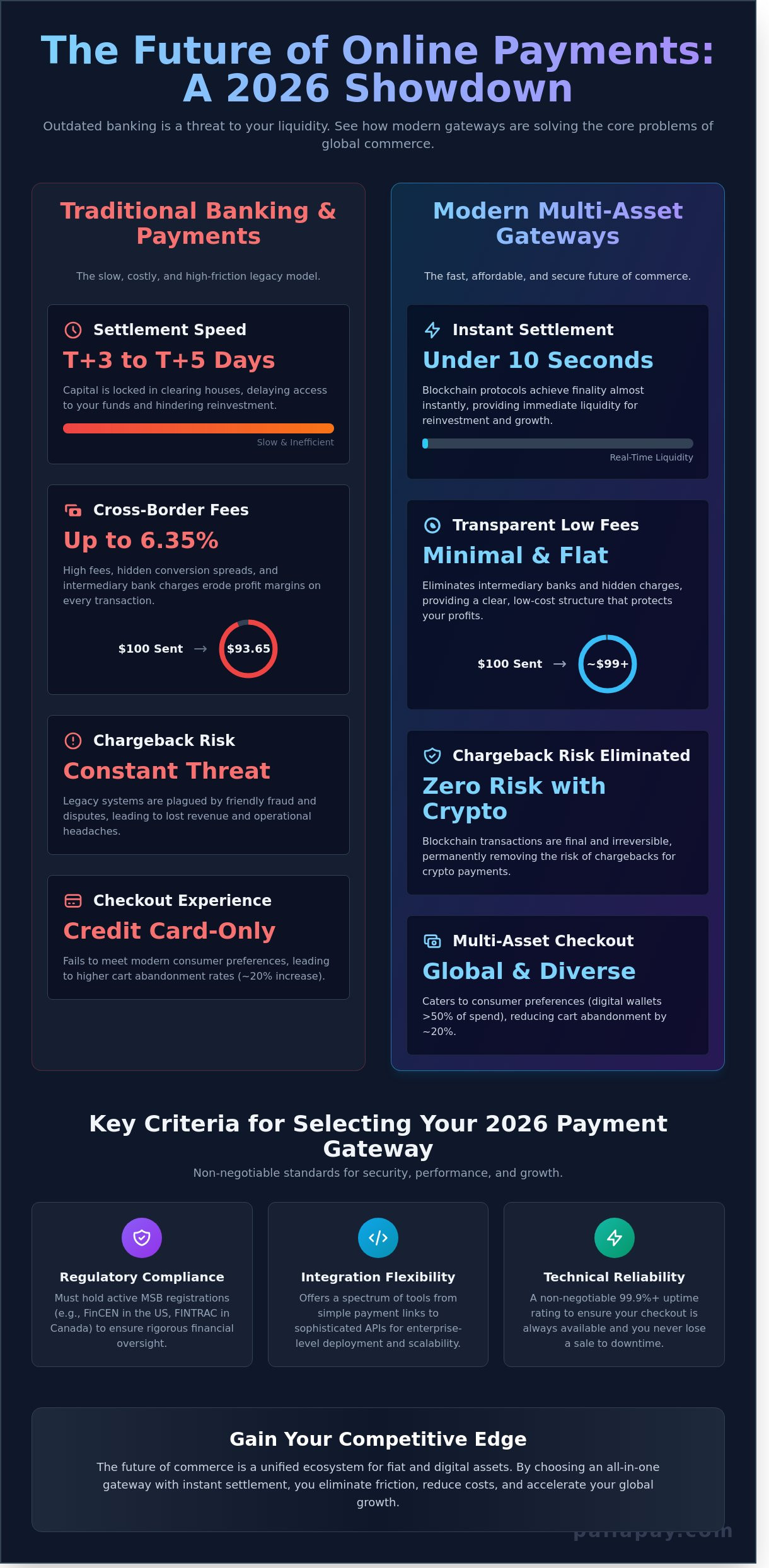
    Trust begins with licensing. Prioritize providers that maintain official Money Services Business (MSB) registrations in major jurisdictions like the United States and Canada. This status ensures the provider adheres to strict anti-money laundering (AML) protocols. Regional expertise is equally vital. For example, a crypto payment gateway in Dubai must navigate specific VARA (Virtual Assets Regulatory Authority) frameworks to ensure local compliance. The right provider manages the complex KYC (Know Your Customer) requirements for your end-users, protecting your business from legal friction. They handle the heavy lifting of identity verification, so you focus on growth.

    Support and Reliability

    Global markets never close, and your infrastructure shouldn’t either. Your gateway must offer 24/7 technical support to address issues across different time zones. Reliability is measured by a 99.9% uptime guarantee and access to redundant liquidity sources. This redundancy prevents transaction failures during periods of high market volatility. A sophisticated merchant dashboard is non-negotiable for 2026. It must provide real-time reporting and automated tax reconciliation tools. This level of transparency eliminates hidden network or gas surcharges, ensuring the fee you see is the fee you pay. Efficiency drives profitability in the digital age.

    A truly all-in-one ecosystem supports every touchpoint of your business. Whether you need a crypto POS machine for physical retail or a robust API for ecommerce, the integration must be seamless. This versatility allows you to accept payments via web, mobile, or physical card without switching providers. It’s about creating a unified financial experience that scales with your ambition. By consolidating these services, you reduce technical debt and simplify your financial operations.

    This concept of a cohesive, all-in-one platform is a major trend in the broader payment processing industry. Providers like Strictly specialize in creating this kind of unified omni-channel experience, helping businesses manage web, mobile, and in-person sales seamlessly.

    Ready to integrate the future of payments into your business model? Explore our professional fiat settlement solutions today.

    Implementing the Pallapay Ecosystem for Your Business

    Pallapay functions as the Global Enabler for enterprises ready to master the digital economy. We offer a sophisticated bridge between traditional banking and blockchain innovation. By integrating our fiat to crypto payment gateway, your business secures a competitive edge in a market where a growing percentage of global consumers now prefer digital asset transactions. Our ecosystem transforms crypto-receipts into usable capital. The Pallapay Mastercard allows you to spend business earnings instantly at millions of global merchants. You don’t have to wait for traditional bank clearances to access your funds. This is the professional standard for liquidity in the modern era.

    Your physical and digital sales channels shouldn’t operate in silos. The Crypto POS machine unifies your revenue streams, allowing retail managers to accept digital payments as easily as credit cards. This hardware is designed for the modern storefront, providing a secure and regulated way to handle transactions. It’s about providing choice to your customers while maintaining the stability of your balance sheet. Whether you are operating a boutique or a multi-national retail chain, the integration is seamless. We handle the heavy lifting of the technology so your staff can focus on the customer experience.

    A Unified Merchant Dashboard

    Visibility creates confidence. Our dashboard provides a single point of truth for all cross-border sales, settlements, and card balances. You can generate instant reports for tax compliance or internal audits with a few clicks. This level of transparency is essential for maintaining institutional financial reliability. For organizations with complex structures, the platform supports multiple user permissions. This ensures your accounting team has the data they need while your security protocols remain intact. It is an all-in-one destination for your crypto-financial needs.

    From Integration to First Settlement

    Efficiency is our priority. The setup for the Pallapay API and Merchant account is streamlined to get you operational quickly. You select your settlement currency, such as USD, EUR, or AED, to ensure your liquidity remains predictable. For corporate clients moving significant volume, our global OTC desks offer deep liquidity and institutional-grade execution. We manage the underlying blockchain architecture, leaving you free to drive your business growth. Getting started with a secure, regulated account today means you are prepared for the future of payments. The process is direct, benefit-driven, and built for scale.

    • Instant Access: Spend earnings immediately via the Pallapay Mastercard.
    • Global Reach: Settle in major fiat currencies including USD, EUR, and AED.
    • Institutional Security: Operate within a regulated, secure financial environment.
    • Omnichannel Readiness: Connect online gateways with physical POS hardware.

    Pallapay represents more than just a tool; it is a visionary partner for your financial evolution. By bridging the gap between fiat and crypto, we provide the stability your business requires to thrive. Every transaction is a step toward a more efficient, borderless future.

    Master the Future of Global Commerce

    Integrating a fiat to crypto payment gateway isn’t just a technical upgrade; it’s a strategic move to capture a market of over 420 million digital currency users worldwide. By 2026, the ability to accept diverse payment forms will separate industry leaders from those left behind. Merchants today require more than just a processor. They need a partner that eliminates the standard 72 hour settlement wait times and provides instant access to capital. Moving your operations onto a blockchain-backed infrastructure allows you to bypass the inefficiencies of legacy banking while reaching customers in 180 countries.

    Pallapay provides this institutional-grade stability through our status as a regulated MSB in the USA and Canada. We’ve designed our ecosystem to handle the heavy lifting of compliance and technical integration so you can focus on expansion. You’ll benefit from a secure, all-in-one platform that turns the complexity of digital assets into a standard business operation. It’s time to bridge the gap between traditional finance and the decentralized economy with a visionary partner.

    Scale your business globally with Pallapay’s secure payment gateway and start your journey toward borderless growth today.

    Frequently Asked Questions

    What is the difference between a crypto gateway and a standard payment processor?

    Crypto gateways bridge the gap between blockchain networks and traditional banking, while standard processors handle fiat-only networks like Visa or Mastercard. Traditional systems rely on centralized bank ledgers that often take 3 to 5 days to clear. A fiat to crypto payment gateway utilizes decentralized ledgers to facilitate instant settlement and global accessibility. This removes the friction found in legacy systems and provides a more efficient financial infrastructure for modern commerce.

    Is it legal for my business to use a fiat-to-crypto payment gateway?

    Using a crypto gateway is legal in over 130 countries, provided the business complies with local AML and KYC regulations. In the United States, FinCEN classifies these service providers as Money Services Businesses. Merchants must verify that their chosen provider holds the necessary licenses for the specific jurisdictions where they operate. This ensures all financial activities remain within the bounds of international law and institutional standards, protecting the business from regulatory risk.

    How much are the typical transaction fees for fiat-to-crypto processing?

    Typical transaction fees for these services range from 0.5% to 2% per transaction, based on 2024 industry benchmarks. This is significantly lower than the 3% or 4% often charged by credit card networks for international sales. Businesses also avoid the hidden costs of currency conversion and traditional wire fees. These savings directly impact the bottom line by preserving higher profit margins on every global transaction processed through the gateway.

    Can I receive fiat currency in my bank account if the customer pays in crypto?

    Yes, you can receive fiat currency directly into your bank account through an instant conversion process. The gateway captures the crypto at the current market rate and settles the equivalent amount in USD, EUR, or AED. This eliminates the risk of price volatility for the merchant. It’s a seamless way to embrace the future of payments without the need to hold digital assets on your corporate balance sheet.

    What is MSB registration and why should I look for it in a provider?

    MSB stands for Money Services Business, which is a legal designation required by FinCEN for entities that transmit or convert currency. Providers with this registration adhere to strict anti-money laundering protocols and regular audits. Choosing an MSB-registered partner protects your business from legal risks and ensures institutional-grade security. It’s a hallmark of a reliable partner that prioritizes regulatory compliance and global trust in every transaction.

    How long does it take to integrate a crypto payment gateway into my website?

    Integration typically takes between 24 hours and 5 business days, depending on the complexity of your current digital infrastructure. Most modern providers offer plug-and-play extensions for platforms like Shopify or WooCommerce that can be activated in minutes. For custom enterprise solutions, developers use robust APIs to create a tailored checkout experience. This rapid deployment allows businesses to scale their global reach without facing extensive technical delays or downtime.

    Are crypto payments subject to chargebacks like credit cards?

    No, crypto transactions are final and immutable once they’re confirmed on the blockchain. This eliminates the risk of fraudulent chargebacks, which cost global merchants an estimated $100 billion in 2023. While you can still issue manual refunds to maintain customer satisfaction, the power to reverse a transaction doesn’t rest with a third-party bank. This provides merchants with absolute certainty and significantly improved cash flow management.

    Does the customer need to own crypto to use a fiat-to-crypto on-ramp?

    No, customers don’t need to own digital assets beforehand to use a fiat-to-crypto on-ramp. They can use their standard credit card or bank transfer to purchase the required amount of crypto at the point of sale. The gateway handles the conversion instantly, making the process as simple as a traditional online purchase. It’s an all-in-one solution that bridges the gap for users who are new to the digital economy.

    Disclaimer

    The information provided on this website and blog is for general informational and educational purposes only and does not constitute financial, investment, legal, tax, or other professional advice.
    Cryptocurrency and digital asset services may be subject to regulatory restrictions in certain jurisdictions. Users are solely responsible for ensuring compliance with applicable local laws and regulations before using any products or services mentioned on this website.
    PallaPay does not guarantee the accuracy, completeness, or timeliness of any information published and accepts no liability for any loss or damages arising from reliance on the content. Any opinions expressed are those of the respective authors and may change without notice.
    Certain services, features, or products referenced may be provided through third-party partners, licensed entities, or affiliated service providers subject to separate terms and regulatory approvals. Availability of services may vary by country or region.
    This website may contain references to digital assets, virtual currencies, or blockchain-related services that are not available to residents of certain jurisdictions, including where prohibited by law. Nothing on this website constitutes an offer, solicitation, or recommendation to buy or sell any financial instrument or virtual asset.

  • Strategic Benefits of Accepting Cryptocurrency for Businesses in 2026

    Strategic Benefits of Accepting Cryptocurrency for Businesses in 2026

    Why is your enterprise still surrendering 5% of every transaction to legacy intermediaries while waiting 72 hours for cross-border settlement? By 2026, the traditional payment model will be viewed as a costly inefficiency rather than a standard requirement. You’ve likely felt the sting of rising interchange fees and the persistent threat of fraudulent chargebacks that erode your bottom line. Understanding the benefits of accepting cryptocurrency is no longer a speculative exercise; it’s a vital necessity for maintaining a competitive edge in a borderless economy.

    Discover how integrating cryptocurrency payments can reduce your operational costs, eliminate chargeback fraud, and unlock a global demographic of high-spending consumers. We’ll show you how to leverage an all-in-one gateway to achieve instant liquidity and secure, non-reversible payments. This guide explores how your business can transition to the future of payments by replacing slow, expensive cycles with seamless, real-time financial infrastructure that prioritizes your institutional growth. By the end of this article, you’ll have a clear roadmap for deploying a sophisticated payment strategy that scales with the global market.

    Key Takeaways

    • Maximize your profit margins by replacing legacy credit card fees with low-commission processing and instant settlements that eliminate intermediary delays.
    • Discover the strategic benefits of accepting cryptocurrency to unlock a global demographic of tech-savvy consumers with high average disposable income.
    • Protect your revenue by leveraging the technical impossibility of chargebacks on the blockchain, ensuring every transaction is final and secure.
    • Transition your business into a modern financial powerhouse by adopting an all-in-one ecosystem that treats digital assets as a high-utility transactional tool.
    • Learn how to seamlessly bridge the physical-digital divide using the Pallapay Merchant Dashboard and advanced Crypto POS machines.

    The Strategic Evolution: Why Businesses are Accepting Cryptocurrency in 2026

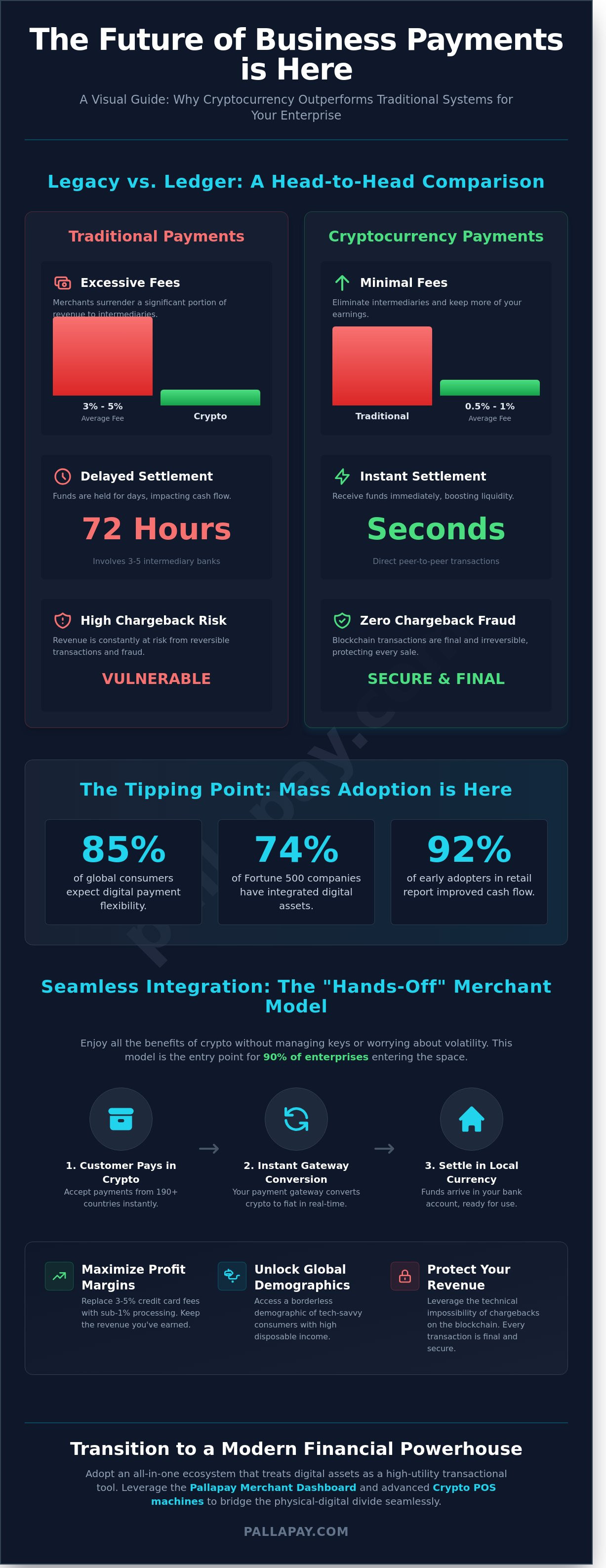
    By 2026, digital assets have transitioned from speculative experiments into a foundational pillar of global financial infrastructure. Businesses aren’t merely “trying out” blockchain payments; they’re integrating them to stay competitive in a market where 85% of global consumers now expect digital payment flexibility. To understand this shift, one must look at the foundational principles of What is cryptocurrency? and how it has matured over the last decade. The era of holding assets in hopes of a price surge has been replaced by a focus on transactional utility. Companies now prioritize speed and cost efficiency over speculation.

    One of the primary benefits of accepting cryptocurrency is the ability to bypass the inherent friction of traditional banking. Traditional cross-border settlements often involve three to five intermediary banks, each taking a fee and adding a 24 to 72-hour delay. In contrast, blockchain transactions settle in seconds, providing a critical hedge against banking restrictions and the 2.5% failure rate common in legacy international wire transfers. This speed directly improves cash flow management for 92% of early adopters in the retail sector.

    The regulatory landscape of 2026 has provided the final piece of the puzzle: institutional trust. With the full implementation of comprehensive frameworks like MiCA in Europe and similar clear-cut guidelines in the US and Asia, the “wild west” era is over. This clarity has encouraged 74% of Fortune 500 companies to integrate digital assets into their treasury or payment systems. Businesses now view these assets as a secure, regulated, and professional alternative to cash and credit.

    Beyond Bitcoin: The Rise of Stablecoins in Commerce

    While Bitcoin remains a significant store of value, USDT and USDC have become the workhorses of the 2026 merchant economy. These assets eliminate the volatility concerns that once hindered adoption, allowing businesses to price goods with precision. In the B2B sector, stablecoins are now the preferred medium for cross-border settlements because they offer the transparency of a public ledger without the price swings of traditional coins. Stablecoins serve as the definitive bridge between the decentralized efficiency of the blockchain and the familiar stability of fiat currency.

    The “Hands-Off” Merchant Model

    Modern enterprises don’t need to manage private keys or worry about market fluctuations to enjoy the benefits of accepting cryptocurrency. Advanced payment gateways allow for a “hands-off” approach where the merchant receives payments in crypto but settles instantly in their local fiat currency. This model protects daily liquidity and ensures that accounting teams deal with familiar numbers. Statistics show that this specific integration method is the entry point for 90% of modern enterprises entering the space. It provides a low-risk, high-reward gateway to a global customer base without requiring a total overhaul of existing financial workflows.

    • Instant Settlement: Funds are converted and available in your account immediately, removing the risk of chargebacks.
    • Global Reach: Access customers in 190+ countries without worrying about local banking compatibility.
    • Lower Fees: Transaction costs typically range from 0.5% to 1%, significantly lower than the 3% average for credit cards.

    The transition to digital payments is no longer a choice for the future; it’s a requirement for the present. By adopting these systems, businesses position themselves as forward-thinking leaders ready to facilitate the next generation of global commerce.

    Maximizing Profit Margins: Lower Fees and Instant Settlements

    Traditional payment rails are built on layers of legacy infrastructure that prioritize bank profits over merchant efficiency. When a customer swipes a credit card, the merchant doesn’t see the full value of the sale. Instead, they lose a significant portion to a complex web of fees. One of the primary benefits of accepting cryptocurrency is the immediate reduction of these overhead costs. By shifting from centralized intermediaries to decentralized ledgers, businesses reclaim control over their revenue and stop subsidizing the inefficiencies of the old financial world.

    Cutting Out the Middlemen

    Standard credit card transactions involve a minimum of four intermediaries: the issuing bank, the acquiring bank, the card network, and the payment gateway. Each of these entities extracts a fee, which typically totals between 2.5% and 4.0% per transaction. These costs are often higher for international sales where cross-border surcharges apply. Peer-to-peer blockchain technology collapses this entire stack into a single, efficient processing point. This shift reduces transaction commissions significantly, often to below 1%. For industries like retail or groceries where profit margins hover between 1% and 3%, a 2% saving isn’t just a minor improvement; it’s a transformative increase in net income. By removing the “fee stack,” businesses can protect their bottom line and offer more competitive pricing to their customers.

    The hidden costs of traditional finance extend beyond the transaction fee itself. Intermediary banks often apply unfavorable currency exchange spreads that can eat another 1% to 3% of the total value. When you accept crypto, you bypass these predatory exchange rates. Businesses can expand their customer base to a global audience without the fear of losing their margins to a dozen different banking tolls. It’s a cleaner, more transparent way to handle money that rewards the merchant rather than the institution.

    Real-Time Liquidity Management

    Cash flow is the lifeblood of any scaling enterprise. Waiting 72 hours for a SWIFT transfer to clear or dealing with SEPA delays over a bank holiday isn’t just an inconvenience. It’s a liquidity bottleneck that prevents rapid reinvestment and slows down operations. Cryptocurrency transactions offer instant settlement, providing funds in minutes regardless of the day or time. This 24/7/365 processing capability ensures that capital is always available. There are no bank holidays on the blockchain, and there’s no reason your business should wait for its money while a bank “processes” a digital entry.

    The volatility of the crypto market is a common concern for many, but modern technology has solved this problem. Our fiat settlement services protect merchants from market swings by locking in the price at the moment of sale. This ensures you receive the exact amount of local currency you expect, delivered with the speed of a digital asset but the stability of a traditional one. This creates a seamless bridge between disruptive innovation and institutional reliability. High-volume businesses can manage their liquidity in real-time, moving from sale to reinvestment in a fraction of the time required by legacy systems. If you’re ready to accelerate your growth, integrating an all-in-one payment gateway allows you to experience the future of payments today. By embracing these efficiencies, you aren’t just changing how you get paid; you’re optimizing your entire financial strategy for a global, digital-first economy.

    Unlocking Global Demographics and High-Net-Worth Consumers

    By 2026, the profile of the average digital asset user will be firmly established as younger, tech-savvy, and financially empowered. Current data from Triple-A indicates that over 560 million people globally own cryptocurrency as of 2024. This demographic isn’t just growing; it’s wealthy. Research shows that 36% of crypto owners have an annual income exceeding $100,000. For merchants, the benefits of accepting cryptocurrency extend beyond simple transaction processing. It serves as a powerful marketing tool and brand differentiator that signals a commitment to the Future of Payments. Businesses that integrate these systems often see a 40% increase in new customer acquisition because they’re reaching a segment that prioritizes financial sovereignty and modern utility.

    The borderless nature of blockchain technology removes the traditional friction of international commerce. You can now reach customers in 180+ countries without the need for local bank accounts or complex foreign entity structures. This global reach is a primary advantage among the benefits of accepting cryptocurrency. It levels the playing field for mid-sized enterprises. By offering these alternative payment methods, brands can directly address the 11% of consumers who abandon their shopping carts because their preferred payment option was missing. It’s about providing a seamless, Instant experience that matches the speed of modern life.

    Industry Spotlight: Luxury Retail and Hotels

    High-value sectors are experiencing a rapid shift in consumer behavior. The travel industry is currently leading this charge. Travelers often prefer digital assets for large transactions to avoid the 3% to 5% currency conversion fees charged by traditional banks. By implementing hotels and hospitality payment solutions, luxury providers can secure high-value bookings instantly. One European boutique hotel chain reported a 12% increase in average booking value after they began accepting Bitcoin and Ethereum for penthouse suites. These transfers happen securely, bypassing the limits often placed on traditional credit cards; this ensures that premium services remain accessible to a global elite.

    The Gaming and E-commerce Boom

    The synergy between digital assets and the gaming industry is undeniable. Gamers are naturally inclined toward digital-native currencies. They value the security and speed of blockchain settlements. Similarly, e-commerce platforms use crypto to bypass restrictive regional payment processors that often flag international transactions as high-risk. This technology also provides a vital link to the 1.4 billion “unbanked” or “underbanked” individuals identified by the World Bank. These people may lack a traditional credit score, but they possess mobile phones and digital wallets. Providing them with access to your goods and services isn’t just an ethical choice; it’s a strategic expansion into emerging markets that traditional finance has ignored for decades.

    Pallapay provides the all-in-one infrastructure needed to manage these diverse global streams. Our gateway ensures that every transaction is secure and settled with the professional reliability your business demands. You don’t have to worry about the technical complexities of different chains. We handle the heavy lifting. This allows you to focus on scaling your operations while we provide the bridge to a more inclusive financial ecosystem. We make the transition to digital assets feel like a standard, effortless business operation. Our goal is to ensure your business remains at the forefront of the global economy through Instant settlement and unwavering stability.

    Strategic Benefits of Accepting Cryptocurrency for Businesses in 2026

    Security, Compliance, and the End of Chargeback Fraud

    Traditional payment systems rely on an outdated “pull” mechanism that leaves merchants vulnerable to revenue theft. When a customer pays with a credit card, they grant the merchant permission to pull funds from their account. This legacy architecture allows for the reversal of transactions weeks or even months after a sale. One of the primary benefits of accepting cryptocurrency is the technical elimination of this risk. Blockchain transactions are final and irreversible. Once a block is confirmed, the digital assets belong to the merchant, providing a level of financial certainty that legacy banking cannot match.

    Security protocols in the crypto space have evolved beyond simple private keys. Modern enterprises now utilize multi-signature wallets and encrypted gateway APIs to protect their capital. These systems require multiple authorized parties to sign off on a transaction before it moves, effectively neutralizing the threat of internal theft or single-point-of-failure hacks. By 2026, global financial standards like ISO 20022 will be fully integrated into blockchain networks, making crypto payments significantly more secure than 1960s-era magnetic stripe technology. This transition represents the future of payments, where data integrity is hard-coded into every settlement.

    Eliminating Friendly Fraud

    Friendly fraud occurs when a consumer makes a legitimate purchase but later disputes the charge with their bank to get a refund while keeping the product. In 2023 alone, merchants lost an estimated $100 billion to this practice. Cryptocurrency solves this by utilizing “push” payments. In a push payment system, the customer must actively send the funds to the merchant, which prevents unauthorized reversals and ensures that the business maintains total control over its revenue. This shift from reactive to proactive security is one of the most immediate benefits of accepting cryptocurrency for high-volume retailers.

    Regulatory Peace of Mind

    Operating in the digital asset space requires a partner that understands the complexities of Money Services Business (MSB) regulations. High-tier gateways now handle the heavy lifting of Anti-Money Laundering (AML) and Know Your Customer (KYC) requirements automatically. This ensures that every transaction is screened against global sanctions lists in real time, maintaining your business’s institutional financial reliability. For businesses operating in the UAE, implementing a crypto payment gateway Dubai solution that complies with VARA regulations provides the security and stability needed for institutional growth. It’s essential to maintain a secure crypto wallet for business reserves that complies with these evolving standards.

    Pallapay acts as your visionary partner by bridging the gap between disruptive innovation and regulatory stability. Our infrastructure is designed to provide instant verification of funds while ensuring that your tax reporting remains accurate and effortless. We don’t just provide a gateway; we provide a professional bridge to a global market. By automating compliance, we allow your team to focus on growth rather than navigating complex legal frameworks. This seamless integration of security and utility is why 15% of global merchants are expected to adopt crypto-fiat settlement systems by the end of next year.

    Protect your revenue and secure your business’s financial future today. Experience the security of Pallapay’s instant payment gateway.

    Implementation: Integrating the Pallapay All-in-One Ecosystem

    Transitioning to a digital asset strategy shouldn’t feel like a technical burden. The Pallapay Merchant Dashboard simplifies global sales tracking by consolidating every transaction into a single, intuitive interface. You gain real-time visibility into your liquidity; this allows for instant decision-making based on live market data. By bridging the physical-digital divide with Crypto POS machines, Pallapay ensures that your brick-and-mortar locations operate with the same efficiency as your e-commerce storefront. Enterprise-level scalability is achieved through customizable API integrations, allowing your developers to build bespoke payment flows that match your brand identity perfectly.

    A unified platform for OTC, Gateway, and POS services provides a definitive business advantage. It eliminates the need for multiple third-party vendors and reduces operational overhead by up to 30%. When you consolidate your financial technology, you reduce the surface area for technical errors and security vulnerabilities. Pallapay acts as a global enabler, managing the underlying blockchain complexity so your team can focus on core operations. This streamlined approach is why institutional merchants favor an all-in-one ecosystem over fragmented service providers.

    In-Store vs. Online Integration

    Choosing the right interface depends on your specific business model. A physical terminal provides a tactile, familiar experience for customers, while a web-based payment API handles high-volume digital traffic with ease. To train staff in a retail store setting, focus on the three-step scan-and-pay process; it usually takes less than five minutes for an employee to master the interface. This simplicity ensures that checkout lines move quickly, maintaining the high-speed rhythm of modern commerce.

    Automated fiat payouts to local bank accounts remove volatility risks entirely. You can configure your account to convert crypto to local currency instantly, ensuring your bottom line remains stable regardless of market fluctuations. According to a 2023 Deloitte report, 75% of retailers plan to accept crypto payments within the next 24 months. By setting up these automated systems now, you secure the primary benefits of accepting cryptocurrency without exposing your business to the price swings of the open market. For businesses looking to bridge traditional banking with digital assets, implementing a fiat to crypto payment gateway provides the seamless conversion infrastructure needed for institutional growth.

    The Future of Business Payments

    The next phase of commerce involves deeper integration through blockchain-based loyalty programs and digital gift cards. These tools increase customer retention by 20% by offering verifiable, liquid rewards that shoppers actually value. Early adopters gain a significant competitive edge by capturing a global market of over 420 million crypto users. This demographic is typically younger, tech-savvy, and possesses higher-than-average disposable income, making them a high-value target for growing brands.

    Pallapay serves as your visionary partner, handling the heavy lifting of technology behind the scenes. We bridge the gap between traditional finance and the decentralized future, ensuring your business stays ahead of the curve. Unlocking the benefits of accepting cryptocurrency is no longer a speculative move; it’s a strategic necessity for global scalability. The future of payments is already here. Contact our team today for a professional consultation to begin your integration and secure your position in the digital economy.

    Secure Your Competitive Edge in the 2026 Financial Landscape

    The global shift toward digital assets is no longer a pilot program; it’s a fundamental requirement for institutional growth. By 2026, the benefits of accepting cryptocurrency include direct access to over 560 million global users and the total elimination of chargeback fraud. You’ll reduce transaction costs by up to 80% compared to legacy credit card networks while capturing immediate liquidity through instant settlements. This isn’t just about adding a payment method; it’s about optimizing your entire capital flow for a borderless economy.

    Pallapay serves as your visionary partner, bridging the gap between blockchain innovation and professional reliability. As a regulated MSB in the USA and Canada, we provide the security of physical OTC desks in Dubai, Singapore, and Istanbul. Our all-in-one ecosystem delivers instant fiat settlement in 180+ countries, allowing you to scale without the friction of traditional banking delays. You’ve built a successful enterprise, and we provide the tools to ensure it thrives in the next era of commerce.

    Start Accepting Crypto with Pallapay Today

    The future of payments is waiting for your brand to lead the way.

    Frequently Asked Questions

    Is it legal for my business to accept cryptocurrency in 2026?

    Yes, cryptocurrency is a legally recognized medium of exchange in over 130 countries as of 2026. Regional frameworks like the European Union’s MiCA regulations and the UAE’s VARA guidelines provide a stable, secure foundation for digital asset commerce. You must still comply with local KYC and AML standards, but the legal path for institutional adoption is now firmly established. This regulatory clarity allows businesses to operate with total confidence in the global marketplace.

    How do I protect my business from cryptocurrency price volatility?

    You eliminate volatility risks by using a payment gateway that provides instant fiat settlement. When a customer pays in Bitcoin, the system locks the exchange rate and converts the funds into your local currency in under 2 seconds. This ensures you receive the exact price of your product regardless of market shifts. Using stablecoins like USDT also offers a 1:1 peg to the US Dollar, maintaining absolute price stability throughout the transaction process.

    What are the tax implications of accepting Bitcoin or USDT?

    Tax authorities in 90% of developed economies classify cryptocurrency as property or a financial asset for tax purposes. You’ll report these transactions as business income based on the fair market value at the time of the sale. Since many jurisdictions apply a 15% to 20% capital gains tax on asset appreciation, keeping precise digital records is vital. Pallapay provides automated reporting tools that simplify your annual filings and ensure every transaction is documented for compliance.

    Do I need a special bank account to receive fiat settlements from crypto sales?

    You don’t need a specialized bank account to receive fiat settlements from your digital transactions. A standard corporate account capable of receiving SEPA or SWIFT transfers is sufficient for regular daily payouts. Our gateway handles the complex conversion and sends the funds directly to your existing financial institution. This seamless process bridges the gap between blockchain technology and traditional banking without requiring you to change your current financial infrastructure.

    Can I accept crypto payments in my physical retail store?

    Accepting crypto in a physical retail environment is easy through QR code technology and dedicated Point of Sale terminals. Customers scan a generated code on a tablet or mobile device to complete the transaction in roughly 3 seconds. This provides one of the key benefits of accepting cryptocurrency by reducing the hardware costs associated with traditional card readers. It’s a modern, contactless solution that appeals to the 420 million active crypto users worldwide.

    How long does it take to integrate a crypto payment gateway into my website?

    Most businesses can integrate a professional crypto payment gateway in under 24 hours. If you use platforms like Shopify or WooCommerce, the installation takes approximately 15 minutes using our pre-built plugins. For custom-built websites, our REST API allows your developers to complete a secure setup within a single business day. This rapid deployment ensures you can start reaching new global markets without facing significant technical delays or downtime.

    What happens if a customer wants a refund on a cryptocurrency payment?

    You can issue refunds by sending the equivalent fiat value or the original crypto amount back to the customer’s digital wallet. The system uses real-time exchange rates to ensure the refund is fair for both parties at the exact moment of the request. Every refund is tracked on the blockchain with a unique transaction ID, providing a transparent and permanent audit trail. This professional approach to reversals helps maintain customer trust while protecting your profit margins.

    Are crypto transaction fees always lower than credit card fees?

    Crypto transaction fees are consistently lower than credit card processing costs, typically ranging from 0.5% to 1% per transaction. Traditional credit card networks frequently charge between 2.5% and 4%, especially for international sales. Lowering these overheads is one of the major benefits of accepting cryptocurrency for high-volume merchants. By bypassing multiple financial intermediaries, you retain more of your revenue and eliminate the risk of expensive chargeback fees.

    Disclaimer

    The information provided on this website and blog is for general informational and educational purposes only and does not constitute financial, investment, legal, tax, or other professional advice.
    Cryptocurrency and digital asset services may be subject to regulatory restrictions in certain jurisdictions. Users are solely responsible for ensuring compliance with applicable local laws and regulations before using any products or services mentioned on this website.
    PallaPay does not guarantee the accuracy, completeness, or timeliness of any information published and accepts no liability for any loss or damages arising from reliance on the content. Any opinions expressed are those of the respective authors and may change without notice.
    Certain services, features, or products referenced may be provided through third-party partners, licensed entities, or affiliated service providers subject to separate terms and regulatory approvals. Availability of services may vary by country or region.
    This website may contain references to digital assets, virtual currencies, or blockchain-related services that are not available to residents of certain jurisdictions, including where prohibited by law. Nothing on this website constitutes an offer, solicitation, or recommendation to buy or sell any financial instrument or virtual asset.