Tag: MSB License

  • MSB Licensed Crypto Exchange in Canada: The 2026 Regulatory & Utility Guide

    MSB Licensed Crypto Exchange in Canada: The 2026 Regulatory & Utility Guide

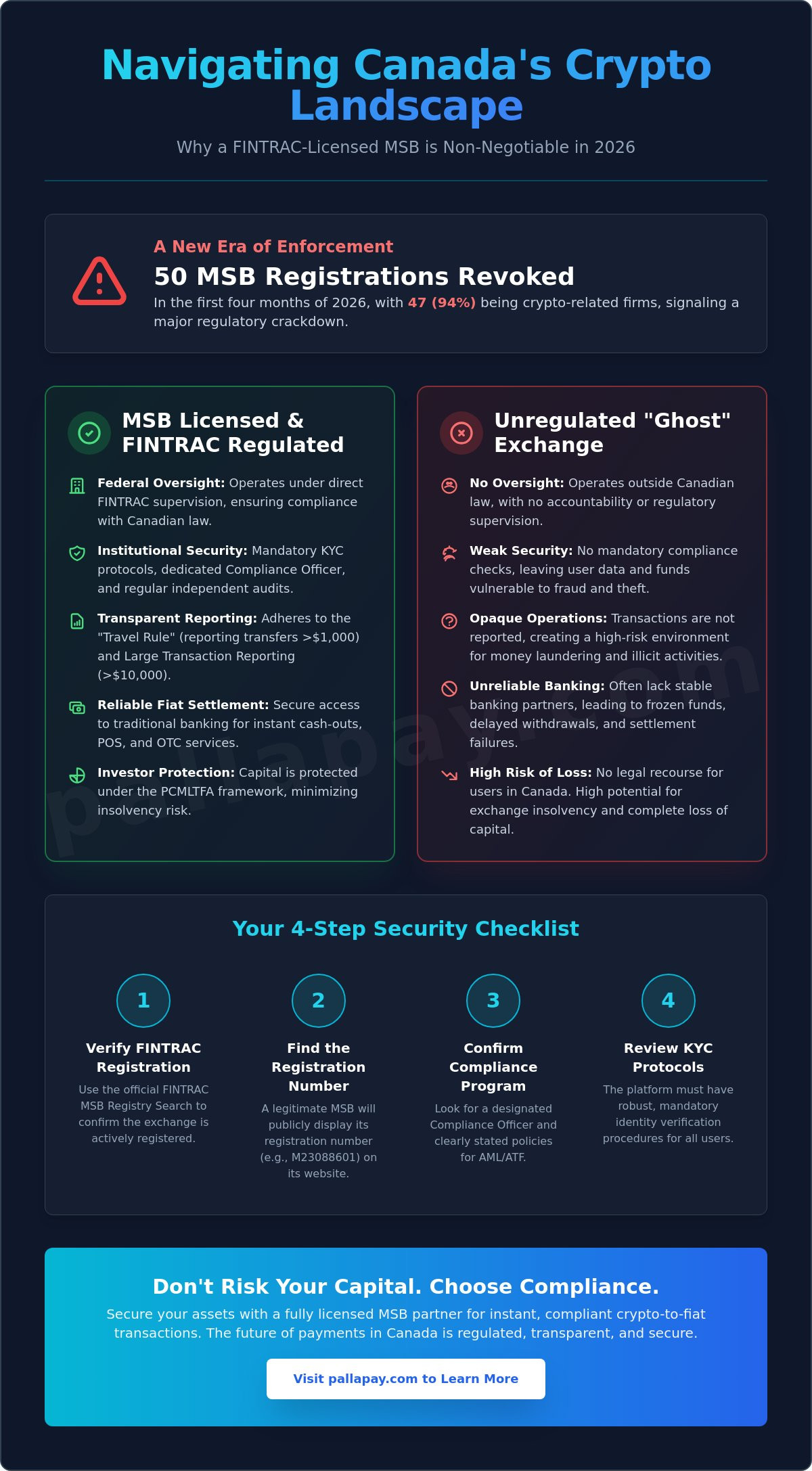
    In the first four months of 2026, FINTRAC revoked 50 MSB registrations, with 47 of those belonging to crypto-related firms. This surge in enforcement signals a new era where institutional-grade compliance is no longer optional for any msb licensed crypto exchange canada. You’re right to feel concerned about exchange insolvency. The legal terminology surrounding the March 2026 PCMLTFA amendments is often confusing. Finding a platform that balances strict regulatory adherence with fast, cash-to-crypto utility shouldn’t be this difficult.

    We provide the tools to identify and verify a secure platform to ensure your digital asset transactions are both compliant and instant. You’ll learn how to secure your capital against regulatory shifts using a checklist for verifying FINTRAC credentials like registration M23088601. Our guide covers the 2026 CARF reporting requirements, verification protocols for institutional security, and professional OTC methods for instant fiat settlement, defining the future of payments in Canada.

    Key Takeaways

    • Identify the core compliance markers of an msb licensed crypto exchange canada, including the vital role of FINTRAC supervision and mandatory KYC protocols.
    • Recognize the operational risks associated with unregulated “ghost” exchanges and why institutional partners prioritize licensed entities for secure fiat settlement.
    • Master the process of utilizing licensed POS terminals and OTC desks to convert digital assets into cash or bank transfers with instant liquidity.
    • Understand the specific responsibilities of a Compliance Officer in maintaining the integrity of your transactions under the latest 2026 regulatory framework.
    • Discover how a global fintech partner bridges the gap between traditional finance and blockchain innovation to provide a secure, all-in-one ecosystem.

    What is an MSB Licensed Crypto Exchange in Canada?

    A Money Services Business (MSB) in the Canadian financial sector is a legal designation for entities providing specialized services like virtual currency dealing, foreign exchange, and money transferring. Since the March 2026 amendments to the Proceeds of Crime (Money Laundering) and Terrorist Financing Act (PCMLTFA), the definition has expanded to include any platform that facilitates the exchange or transfer of digital assets. Any msb licensed crypto exchange canada must operate under the direct supervision of FINTRAC, the federal agency responsible for detecting and preventing financial crimes. This registration isn’t just a formality; it’s a rigorous commitment to institutional-grade security and transparency.

    While a standard exchange might offer basic trading tools, a licensed MSB provider acts as a professional bridge between disruptive blockchain technology and the traditional banking system. This distinction is vital for users who require high-volume liquidity and instant fiat settlement. By adhering to federal standards, these licensed entities provide a level of accountability that unregulated platforms cannot match, especially as Canadian regulators increase their focus on investor protection in 2026.

    The Legal Scope of MSB Services

    Understanding the Legality of cryptocurrency in Canada involves recognizing the three pillars of MSB operations. Virtual currency exchange allows for the conversion of fiat into digital assets like Bitcoin or USDT. Money transferring facilitates the movement of funds on behalf of a third party, while foreign exchange dealing manages multiple fiat currencies alongside digital holdings. These services ensure that a professional crypto off-ramp can function with the efficiency and speed required by modern commerce.

    Why MSB Status is Non-Negotiable for Security

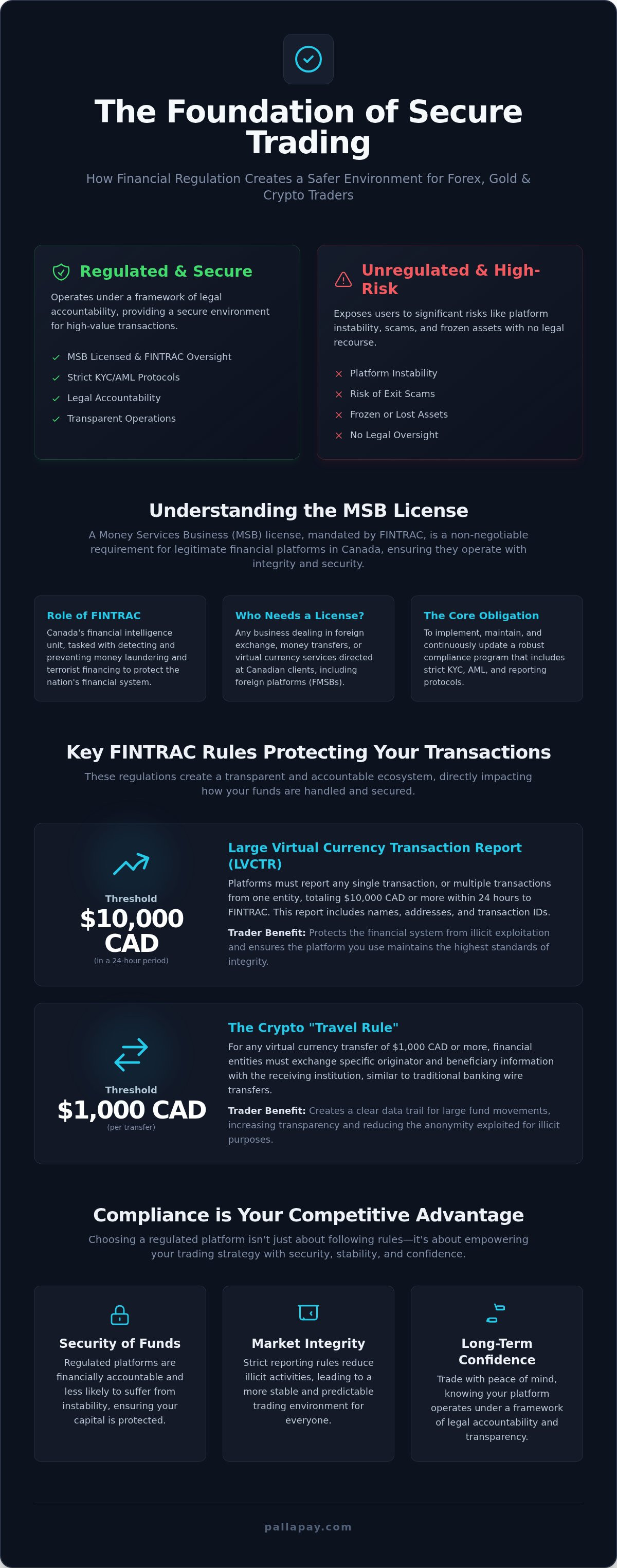
    Accountability is the foundation of trust in the digital asset space. MSB status mandates strict Know Your Customer (KYC) protocols and comprehensive record-keeping to prevent money laundering and terrorist financing. In 2026, the “Travel Rule” requires all transfers of $1,000 CAD or more to be reported, ensuring every transaction has a verifiable audit trail. These measures protect individual users and merchants from the risks associated with “ghost” exchanges that lack federal oversight. MSB licensing is the Canadian gold standard for crypto trust in 2026.

    By choosing a regulated partner, you gain access to a secure ecosystem where your capital is protected by federal law. This regulatory evolution represents the future of payments in Canada, transforming complex crypto-fiat conversions into standard business operations. Whether you’re a merchant looking to accept digital assets or an individual seeking instant liquidity, MSB registration is the essential marker of a visionary partner.

    The FINTRAC Framework: How Regulation Protects Canadian Investors

    Trust isn’t built on promises; it’s built on measurable standards. For any msb licensed crypto exchange canada, the regulatory framework provided by FINTRAC serves as a comprehensive safety net for every user. These regulations, strengthened by the March 2026 PCMLTFA amendments, ensure that every service provider maintains a rigorous compliance program. This program must include a dedicated Compliance Officer, detailed written policies, and ongoing training for all staff. It’s a structured environment where accountability is baked into every digital asset transaction.

    Adherence to FINTRAC’s requirements for MSBs also involves mandatory independent audits every two years. These audits verify that the exchange’s internal controls are actually working to prevent illicit activities. When a platform handles large virtual currency transactions exceeding $10,000 CAD, it must submit a report to federal authorities within five working days. This level of transparency makes it nearly impossible for bad actors to utilize regulated channels, which inherently protects your capital from systemic risks.

    KYC and Onboarding in 2026

    Onboarding has evolved into a high-speed, digital-first experience. Modern verification uses biometric data and encrypted document scanning to confirm your identity in minutes. We’ve optimized this process to be as friction-free as possible, allowing for instant account approval without compromising security. Users can choose tiered verification levels based on their specific needs. Lower tiers allow for quick entry, while higher tiers unlock institutional-grade liquidity for large-scale off-ramping. This approach ensures that security never comes at the expense of speed.

    Transaction Monitoring and Reporting

    Real-time monitoring is the silent guardian of the digital ecosystem. Automated systems analyze flow patterns to identify anomalies that might suggest fraud or market manipulation. If a transaction appears suspicious, the exchange must file a Suspicious Transaction Report (STR) without tipping off the user. This protocol maintains the integrity of the entire financial network. While these systems are complex, they operate in the background. You get the benefit of a secure environment while your daily operations remain seamless. By integrating these federal standards, we turn the future of payments into a reliable reality for every Canadian user.

    MSB Licensed Crypto Exchange in Canada: The 2026 Regulatory & Utility Guide

    Licensed vs. Unregulated Exchanges: A Risk Comparison

    Operating within a regulated framework is the only way to ensure institutional-grade financial reliability. Choosing an msb licensed crypto exchange canada protects your assets from the inherent volatility of “ghost” exchanges that operate without federal oversight. By April 2026, FINTRAC had already revoked 47 crypto-related MSB registrations due to significant compliance failures. This aggressive enforcement highlights the danger of platforms that bypass mandatory reporting. Without a license, an exchange lacks the accountability required for legal recourse. If your funds are frozen on an unregulated platform, your options for asset recovery are practically non-existent.

    Institutional trust is a major differentiator for businesses and high-volume traders. Tier-one banks and financial institutions strictly prefer licensed MSB partners for fiat settlements because these entities follow standardized AML protocols. Unregulated platforms often face sudden banking blocks, leading to delayed withdrawals or permanent loss of access to fiat rails. Beyond security, unregulated exchanges carry hidden costs. High slippage and a total lack of professional customer support can erode your margins, turning a seemingly low-fee trade into a costly mistake.

    How to Verify an MSB License

    Verification is a straightforward process that every user should perform before depositing capital. Don’t rely on website badges; use the official channels to confirm a platform’s standing. Follow these steps to ensure your provider is legitimate:

    • Visit the official FINTRAC MSB Registry search tool.
    • Enter the company name or registration number, such as M23088601.
    • Confirm the status is listed as “Active” rather than “Expired” or “Revoked.”
    • Verify the registered physical business address matches the company’s official corporate documentation.
    • Check the “Authorized Activities” section to ensure they’re permitted to deal in virtual currencies and money transferring.

    The Advantages of Domestic Regulation

    Domestic regulation offers a seamless experience that offshore platforms can’t replicate. A single federal license allows for nationwide service across all Canadian provinces, providing a consistent legal environment for your transactions. This centralized oversight grants you direct access to local fiat rails, facilitating faster CAD withdrawals and instant liquidity. For a deeper look at safeguarding your portfolio, consult our crypto security guide. By choosing a regulated partner, you aren’t just trading; you’re securing your place in the future of payments.

    Practical Utility: Using an MSB Licensed Exchange for Cash and POS

    Regulatory compliance serves as the foundation for practical, high-velocity financial operations. While earlier sections established the legal necessity of an msb licensed crypto exchange canada, the true value lies in the utility these platforms provide to the modern economy. With the Spring Economic Update 2026 proposing a nationwide ban on cryptocurrency ATMs, the role of licensed exchanges in bridging physical cash and digital assets has never been more critical. These regulated entities provide the only secure, professional alternative for users who require immediate liquidity without the risks associated with peer-to-peer transfers or unregulated machines.

    Merchants benefit from instant fiat settlement, a feature that eliminates the risk of market volatility. When a customer pays in Bitcoin or USDT through a Crypto POS Machine, the system converts the asset to CAD at the exact moment of the transaction. This ensures that the business receives the precise value of the sale, regardless of subsequent price fluctuations. Maintaining business liquidity requires a robust off-ramp solution that connects digital holdings directly to local bank rails. This integration transforms crypto into a standard, liquid asset for any Canadian enterprise.

    Buying and Selling Crypto with Cash

    High-volume transactions require more than just an app; they require a physical infrastructure. Locating a licensed OTC desk allows you to buy or sell Bitcoin, Ethereum, or USDT with cash in a secure, professional environment. The protocol involves a verified identity check and an instant wallet credit, ensuring that your capital is never left in limbo. This physical presence provides a level of security that digital-only platforms cannot match, especially in a market where Canadians reported over $704 million in fraud losses in 2025. Professional OTC infrastructure handles the heavy lifting of liquidity, allowing you to settle large amounts without affecting market prices.

    Merchant Integration and Compliance

    Scaling a business in 2026 requires automated, compliant checkout systems. Developers can use a payment API to integrate regulated crypto payments directly into existing ecommerce platforms. This automation simplifies tax reporting by providing clear audit trails for every transaction, satisfying CARF requirements effortlessly. Securing an msb licensed crypto exchange canada ensures that your merchant operations remain compliant with federal law while providing customers with the future of payments. For a detailed walkthrough on setting up these systems, consult our crypto payment gateway guide. You can empower your retail store today with institutional-grade payment tools.

    Pallapay: Your MSB Licensed Partner in Canada

    Trust in the digital asset space is earned through transparency and rigorous adherence to federal law. As an msb licensed crypto exchange canada, Pallapay Ltd. operates under FINTRAC registration M23088601, ensuring every transaction meets the highest standards of financial integrity. We don’t just provide a platform; we offer a professional bridge between blockchain innovation and institutional reliability. This commitment to compliance allows us to function as a “Global Enabler,” providing users with the security of Canadian regulation alongside a worldwide reach for digital payments. By grounding our technology in the practicalities of modern commerce, we make the complex world of crypto-fiat conversion feel like a standard, effortless operation.

    Our all-in-one ecosystem is designed to handle the heavy lifting of technology behind the scenes. From fiat settlement to physical POS infrastructure, we provide the tools necessary for modern commerce to thrive. This comprehensive approach ensures that whether you’re a merchant or an institutional trader, your experience remains seamless and secure. By choosing a partner focused on empowering the user, you gain access to instant liquidity and the efficiency required to accelerate your business growth. We position our platform as the definitive destination for all crypto-financial needs, framing our services as essential components of the future of payments.

    Why Institutions Choose Pallapay

    Institutional clients require more than just a trading interface; they need sophisticated risk management and secure infrastructure. We provide dedicated support for large-scale OTC trades and direct bank transfers, ensuring that high-volume transactions are executed with precision. Our Brampton office serves as the central hub for our Canadian operations, providing a local anchor for our global financial services. This physical presence, combined with our technical expertise, makes us a visionary partner for those seeking reliability in an evolving regulatory landscape. We handle the complexities of liquidity and settlement so you can focus on your core business objectives.

    Getting Started with Secure Canadian Exchange

    The transition to a regulated digital economy should be effortless. Our onboarding process is designed for speed, allowing new users and merchants to verify their identity and begin transacting within minutes. You can explore our full suite of retail store solutions to integrate crypto payments into your physical or digital storefront with ease. For those managing significant portfolios, our institutional OTC guide provides the trading strategies needed for high-volume success. It’s time to move beyond the hype and embrace a professional, compliant, and instant financial future with an msb licensed crypto exchange canada that understands your needs.

    Securing Your Financial Future in a Regulated Market

    The evolution of the Canadian digital asset landscape requires a shift from speculation to institutional reliability. Verifying a platform’s FINTRAC status is the only way to avoid the risks associated with the 47 crypto-related license revocations seen in early 2026. An msb licensed crypto exchange canada provides the necessary bridge between blockchain speed and federal accountability. By utilizing professional OTC desks and instant fiat settlement, businesses can eliminate volatility and ensure seamless liquidity for every transaction.

    Pallapay supports this transition with official MSB registrations in both Canada and the USA. Our physical presence in Brampton, Ontario, provides a local anchor for global financial operations. We handle the technical complexities of the 2026 CARF requirements so you can focus on scaling your business. The future of payments is defined by security, speed, and absolute compliance. Start your secure crypto journey with Pallapay’s licensed exchange services today. Embrace a new standard of financial stability and watch your digital operations excel.

    Frequently Asked Questions

    Is an MSB license the same as a crypto license in Canada?

    Yes, dealing in virtual currencies is a specific category under the Money Services Business (MSB) framework in Canada. Since June 2020, any entity providing exchange or transfer services for digital assets must register as an MSB with FINTRAC. This designation ensures the platform follows federal anti-money laundering protocols, making it the primary legal requirement for operating a digital asset business within the country.

    How do I check if a crypto exchange is registered with FINTRAC?

    You can verify a platform’s status by using the public MSB Registry on the FINTRAC website. Simply search for the company name or its specific registration number, such as M23088601, to confirm its standing. An active msb licensed crypto exchange canada will clearly list “Dealing in virtual currencies” under its authorized activities, providing you with the assurance of federal oversight.

    Can I buy Bitcoin with cash at an MSB licensed exchange?

    You can buy Bitcoin, Ethereum, or USDT with cash at licensed exchanges that operate physical OTC desks. This service provides a secure, regulated alternative to cryptocurrency ATMs, which the Canadian government proposed to ban in the Spring Economic Update 2026. Licensed providers ensure that cash-to-crypto transactions are documented and compliant with federal identity verification standards, offering instant wallet credit in a professional environment.

    What are the reporting requirements for crypto transactions in Canada?

    Exchanges are legally required to report all virtual currency transactions exceeding $10,000 CAD to FINTRAC. Additionally, the “Travel Rule” implemented in Canada requires reporting for any transfer of $1,000 CAD or more. These measures, along with the 2026 Crypto-Asset Reporting Framework (CARF), ensure that all high-value movements are transparent to the Canada Revenue Agency (CRA) to prevent financial crime.

    Why do licensed exchanges require KYC and ID verification?

    KYC protocols are mandatory under the Proceeds of Crime (Money Laundering) and Terrorist Financing Act (PCMLTFA). These identity checks prevent bad actors from using the financial system for illicit activities. By verifying every user, an msb licensed crypto exchange canada creates a secure ecosystem where your transactions are protected from fraud and systemic risks associated with anonymous, unregulated trading.

    Does an MSB license protect my funds from exchange bankruptcy?

    An MSB license is primarily focused on AML compliance rather than providing deposit insurance like traditional bank accounts. However, the strict record-keeping and independent audits required by FINTRAC ensure a high level of corporate accountability. While it doesn’t function as a guarantee against insolvency, the regulatory trail created by a licensed entity makes asset recovery significantly more feasible than on an unregulated platform.

    Are foreign crypto exchanges required to have a Canadian MSB license?

    Any foreign entity that directs services at the Canadian market or has Canadian clients must register as a Foreign MSB with FINTRAC. This requirement ensures that international platforms follow the same security and reporting standards as domestic firms. If a foreign exchange fails to register, it risks administrative monetary penalties or having its services blocked by Canadian financial institutions.

    What happens if I use an unlicensed crypto exchange in Canada?

    Using an unlicensed platform exposes your capital to extreme risks, including sudden account freezes and a total lack of legal recourse. In early 2026, FINTRAC revoked 50 MSB registrations, 47 of which were crypto-related, due to compliance failures. Without federal oversight, you don’t have the protection of standardized security protocols, and your local bank may block any CAD transfers coming from these unregulated sources.

    Disclaimer

    The information provided on this website and blog is for general informational and educational purposes only and does not constitute financial, investment, legal, tax, or other professional advice.
    Cryptocurrency and digital asset services may be subject to regulatory restrictions in certain jurisdictions. Users are solely responsible for ensuring compliance with applicable local laws and regulations before using any products or services mentioned on this website.
    PallaPay does not guarantee the accuracy, completeness, or timeliness of any information published and accepts no liability for any loss or damages arising from reliance on the content. Any opinions expressed are those of the respective authors and may change without notice.
    Certain services, features, or products referenced may be provided through third-party partners, licensed entities, or affiliated service providers subject to separate terms and regulatory approvals. Availability of services may vary by country or region.
    This website may contain references to digital assets, virtual currencies, or blockchain-related services that are not available to residents of certain jurisdictions, including where prohibited by law. Nothing on this website constitutes an offer, solicitation, or recommendation to buy or sell any financial instrument or virtual asset.

  • MSB License for Crypto: The Complete 2026 Regulatory and Strategic Guide

    MSB License for Crypto: The Complete 2026 Regulatory and Strategic Guide

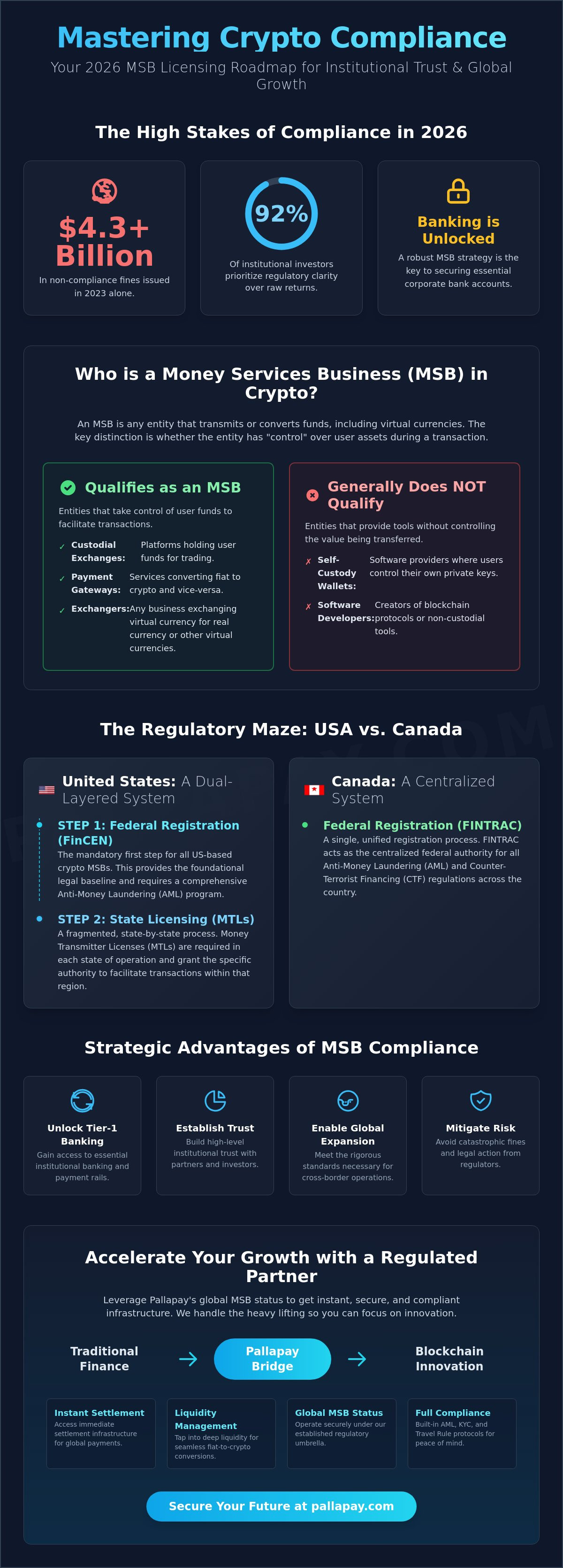
    By 2026, a simple federal registration is no longer a shield; it’s the bare minimum for survival in a market where 92% of institutional investors prioritize regulatory clarity over raw returns. You’ve likely felt the pressure of distinguishing between FinCEN registration and the fragmented landscape of state-level licensing. It’s a common frustration for founders who realize that without a robust msb license crypto strategy, securing a corporate bank account becomes nearly impossible. We agree that the threat of non-compliance fines, which totaled over $4.3 billion in 2023 alone, is a valid concern for any growing fintech entity.

    This guide empowers you to master these complexities to ensure your business remains secure and globally scalable. You’ll gain a clear roadmap for registration while discovering how a regulated status accelerates your growth. We’ll also examine how partnering with a visionary leader like Pallapay delivers the seamless, instant infrastructure required for the future of payments. From liquidity management to institutional settlement, we handle the heavy lifting so you can focus on building the next generation of financial utility.

    Key Takeaways

    • Navigate the evolving 2026 regulatory landscape by identifying the precise legal criteria that categorize digital asset platforms as Money Services Businesses.
    • Understand the critical operational differences between federal FinCEN registration, state-level Money Transmitter Licenses, and Canada’s FINTRAC requirements.
    • Learn how obtaining an msb license crypto serves as a strategic catalyst for securing Tier-1 banking access and establishing high-level institutional trust.
    • Implement industry-leading AML and KYC protocols to ensure your operations meet the rigorous compliance standards necessary for global cross-border expansion.
    • Discover how integrating with a regulated partner like Pallapay provides the instant settlement infrastructure needed to bridge traditional finance with blockchain innovation.

    What is an MSB License for Crypto? Defining Compliance in 2026

    An msb license crypto is no longer a peripheral requirement but the bedrock of institutional legitimacy for any digital asset platform. In the current 2026 landscape, a Money Services Business (MSB) is a financial entity that transmits or converts funds, including virtual currencies. A Money Services Business in the crypto sector is defined as any entity that facilitates the exchange or transmission of digital assets, primarily overseen by FinCEN in the United States and FINTRAC in Canada as the key regulatory bodies.

    Exchanges and payment gateways fall under this classification because they provide the critical infrastructure for converting fiat into digital assets. This role places them at the center of global financial flows. Since 2018, when many operators viewed federal registration as a voluntary badge of honor, the environment has shifted. The 2026 standards now demand real-time transaction monitoring and strict adherence to the Travel Rule, making the msb license crypto a mandatory tool for any business seeking to bridge the gap between blockchain and traditional finance.

    At the federal level, businesses “register” as an MSB. While registration sounds simpler than licensing, the terms are often used interchangeably because the process requires a comprehensive Anti-Money Laundering (AML) program and regular independent audits. This federal status is the first step toward achieving the stability required for global settlement and liquidity. It ensures that the “heavy lifting” of compliance is handled before a business attempts to scale across borders.

    Who Qualifies as a Money Services Business?

    Regulatory bodies distinguish between “Administrators” and “Exchangers.” An exchanger is a person or business engaged in the exchange of virtual currency for real currency, funds, or other virtual currency. Custodial exchanges that hold user funds are the primary targets of these rules. Conversely, self-custody wallet providers that only offer software without facilitating the transfer of value generally don’t meet the MSB criteria. The distinction relies on whether the entity has “control” over the assets during the transaction process.

    The Legal Necessity of MSB Status

    Operating without proper credentials carries extreme risk. Since 2023, the Department of Justice has intensified its focus on unlicensed money transmitters, with some enforcement actions resulting in fines exceeding $4 billion. MSB status acts as a mandatory prerequisite for regulated crypto exchanges to access institutional banking partners. As detailed in the Legality of cryptocurrency by country, while specific rules vary, the requirement for transparency is universal. The Bank Secrecy Act (BSA) mandates that every MSB maintains a written compliance program to ensure the future of payments remains secure, efficient, and fully integrated with the global economy.

    The Regulatory Framework: FinCEN Registration vs. State Money Transmitter Licences

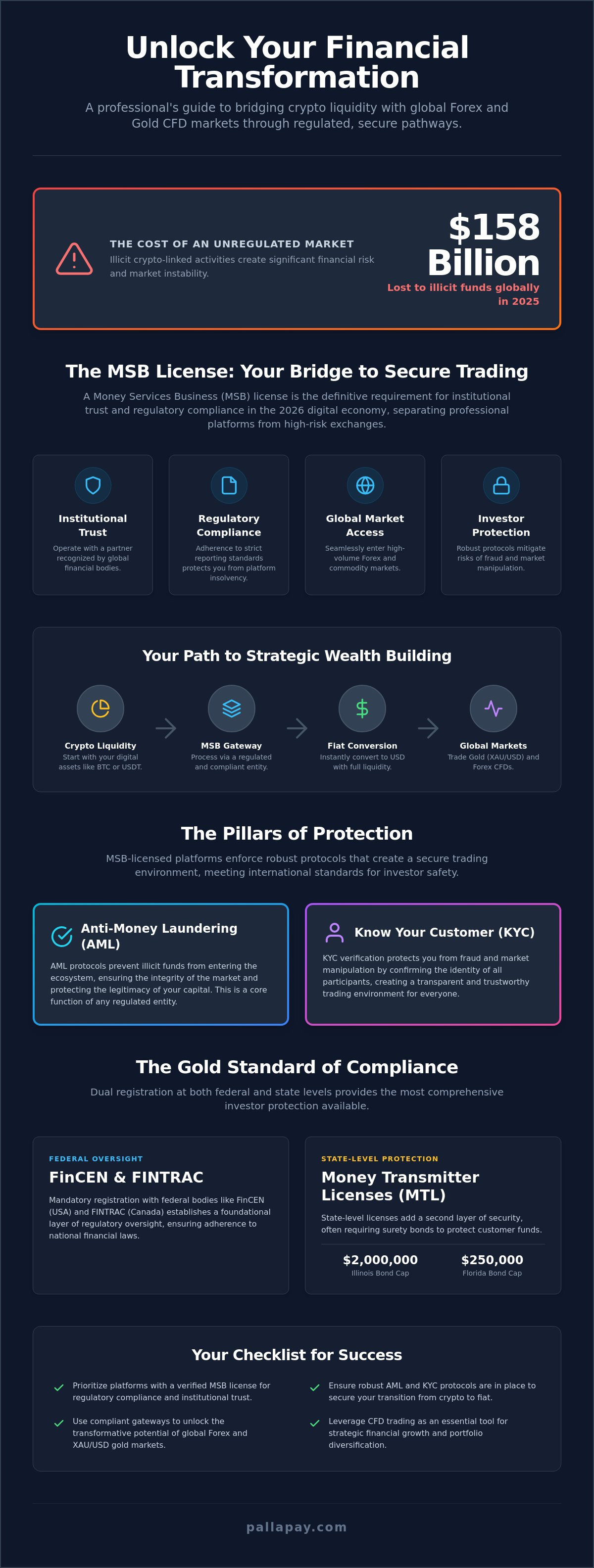
    Securing an msb license crypto framework begins with understanding the dual-layered nature of U.S. oversight. Federal registration provides the legal baseline, while state licenses grant the specific authority to facilitate transactions within regional borders. This distinction is vital for any entity aiming to provide institutional-grade financial services. Federal registration with FinCEN is the mandatory first step, acting as a prerequisite before a business can even apply for state-level Money Transmitter Licences (MTLs).

    The U.S. approach differs significantly from the Canadian model. In Canada, businesses register with FINTRAC, which operates as a centralized federal authority for Anti-Money Laundering (AML) and Counter-Terrorist Financing (CTF). The U.S. system is more fragmented. FinCEN sets the national standard for reporting, but states hold the power to regulate the actual movement of funds. To understand these obligations, businesses should consult FinCEN’s official guidance on virtual currencies, which defines which business models fall under federal MSB status.

    FinCEN Registration: The Federal Baseline

    New businesses must register with FinCEN within 180 days of beginning operations. This isn’t a long-term goal; it’s a strict legal deadline. The registration process requires detailed disclosures regarding business ownership, the physical footprint of the company, and the specific financial services offered. A critical component of this filing is the appointment of an “Agent for Service.” This individual or entity serves as the official point of contact for legal and regulatory inquiries. Without a registered agent, a business cannot maintain federal compliance, putting its entire operational future at risk. This federal layer ensures that the msb license crypto holder adheres to the Bank Secrecy Act (BSA) from day one.

    State Money Transmitter Licences (MTL)

    State-level compliance is where operational costs and complexity often diverge. New York’s BitLicense, established in 2015, remains the most demanding framework in the country. It requires significant capital reserves and exhaustive cybersecurity protocols. In contrast, Wyoming has positioned itself as a blockchain-friendly hub, passing over 20 laws since 2018 to streamline crypto-fiat integration. Many businesses adopt a tiered strategy, securing licenses in high-volume states first to manage resources effectively. For companies seeking to navigate these complexities, integrating a professional fiat settlement solution can simplify the heavy lifting of maintaining liquidity across different jurisdictions. The Future of Payments depends on this ability to bridge the gap between local state laws and global blockchain utility seamlessly.

    MSB License for Crypto: The Complete 2026 Regulatory and Strategic Guide

    Strategic Advantages: Why an MSB License is Essential for Crypto Businesses

    Securing an msb license crypto designation transforms a digital asset firm from a high-risk startup into a verified financial institution. It isn’t just about avoiding fines; it’s about unlocking the infrastructure required for institutional growth. For most crypto ventures, the biggest hurdle isn’t the technology, it’s the inability to move money between the digital and traditional worlds. An MSB registration solves this by providing the regulatory “green light” that Tier-1 banks demand before opening corporate accounts or providing liquidity lines.

    Bridging the Gap to Traditional Finance

    Traditional banks often refuse crypto clients due to perceived AML risks. Without an MSB status, your business remains locked out of the global banking system. This credential proves your firm follows strict compliance protocols, which is vital for securing fiat settlement for merchants. By operating under a regulated framework, businesses can reduce transaction reversals and fraud by up to 40% compared to unregulated entities. While federal registration is the first step, businesses must also navigate complex state money transmitter laws to ensure full operational coverage across different jurisdictions.

    An MSB license serves as a powerful marketing tool. It positions your brand as “Regulated and Secure,” building immediate trust with high-net-worth investors and institutional partners. When a merchant sees that a platform is a registered Money Services Business, the perceived risk of a regulatory shutdown vanishes. This trust is the foundation for facilitating cross-border payments for merchants, allowing them to accept crypto and receive local currency without friction. It’s the difference between being a temporary project and a permanent fixture in the future of payments.

    Global Scalability and Market Entry

    The msb license crypto status carries significant weight beyond North American borders. Credibility earned in regulated markets often fast-tracks entry into the Middle East and SE Asia. Pallapay leverages its extensive MSB registrations to serve clients in over 180 countries, providing a seamless bridge for global commerce. This regulatory foundation is particularly effective for OTC exchange operations, where large-scale liquidity and legal certainty are non-negotiable.

    By maintaining these standards, we ensure that every transaction happens within a secure and compliant ecosystem. Businesses that prioritize licensing early avoid the “compliance debt” that often sinks scaling startups. The result is a more resilient operation that can pivot quickly into new markets. Key benefits of this approach include:

    • Instant Credibility: Institutional partners view MSB status as a baseline requirement for collaboration.
    • Fraud Mitigation: Regulated oversight requires robust KYC/KYT tools that protect the business from illicit actors.
    • Market Access: A registered status allows for easier integration with payment gateways and credit card processors.

    Ultimately, the license isn’t a burden. It’s a strategic asset that allows a business to scale without the constant threat of banking de-risking or legal intervention.

    Maintaining Compliance: AML, KYC, and Operational Standards for MSBs

    Securing an msb license crypto represents a significant milestone, but the operational burden shifts immediately to rigorous maintenance. Regulators demand a dedicated Anti-Money Laundering (AML) Compliance Officer who possesses the internal authority to halt suspicious transactions. This individual oversees the filing of Currency Transaction Reports (CTRs) for any cash-in or cash-out events exceeding $10,000. They also manage Suspicious Activity Reports (SARs) when transactions appear to lack an obvious economic purpose or deviate from a user’s established profile. By January 2026, the threshold for enhanced scrutiny has tightened, making real-time oversight a core business necessity.

    Operational excellence requires more than just filing reports. It involves a commitment to transparency and periodic validation. Independent compliance audits must occur annually to confirm your MSB standing remains in good stead. These audits verify that your internal policies align with the Bank Secrecy Act and other local mandates. Failure to provide a clear audit trail results in heavy fines or the immediate revocation of your license.

    The Pillars of a Modern AML Program

    Effective compliance programs rely on rigorous internal controls that monitor for transaction layering and unusual volume spikes. Training your team is equally critical. Employees must be equipped to recognize the latest crypto scams that target decentralized gateways. Advanced MSBs now integrate automated blockchain forensics. These tools provide instant risk scores for every incoming wallet address, ensuring your platform never interacts with sanctioned entities or high-risk mixers. This proactive approach protects your liquidity and your reputation.

    KYC and Identity Verification

    The industry is moving away from slow, manual document reviews. Modern platforms utilize biometric and AI-driven kyc in crypto to verify identities in under 60 seconds. This technology scans government IDs and matches live facial data, reducing onboarding friction while satisfying strict MSB guidelines. Balancing user experience with data collection is a delicate task. You must collect enough information to satisfy “Know Your Business” (KYB) requirements for corporate clients without alienating individual users. Protecting this Personally Identifiable Information (PII) is a primary legal obligation. Secure, encrypted storage is the baseline for institutional trust.

    Organizations that prioritize these standards build a foundation for long-term growth and global expansion. Compliance isn’t a hurdle; it’s a competitive advantage that signals stability to your partners and clients.

    Optimize your business operations with secure fiat settlement solutions that meet global compliance standards.

    The Pallapay Ecosystem: Leveraging Global MSB Status for Secure Instant Payments

    Pallapay stands at the intersection of regulatory rigor and technological agility. By maintaining active MSB registrations in both the United States and Canada, the platform provides a verified foundation for businesses that prioritize compliance. This msb license crypto framework isn’t just a legal requirement; it’s a strategic asset that allows Pallapay to handle the heavy lifting of anti-money laundering (AML) and know-your-customer (KYC) protocols on behalf of its partners.

    Speed defines the modern economy. Pallapay integrates its regulated status with proprietary “Instant” technology to ensure that merchants don’t have to choose between security and velocity. When a business integrates the Payment API, they gain immediate access to a global crypto acceptance network that satisfies international standards. This allows for seamless cross-border settlements without the typical friction associated with legacy banking systems.

    Regulated Infrastructure for Global Merchants

    For retail businesses, the deployment of a crypto pos machine requires a partner that understands the nuances of local and international law. Pallapay ensures every transaction processed at a physical storefront remains compliant within the broader financial ecosystem. Using a gateway that is already MSB-registered eliminates the need for individual merchants to seek complex legal counsel for their crypto operations. Pallapay provides “The Future of Payments” through its regulated framework, allowing business owners to focus on growth while the platform manages the underlying technical and legal complexities.

    From Dubai to New York: A Unified Compliance Model

    The brand’s physical presence in major financial hubs like Dubai and Istanbul reinforces its commitment to high-touch service and institutional reliability. This global footprint is essential for supporting high-volume services, such as the ability to sell usdt for cash dubai, where liquidity and regulation must work in tandem. Having a unified compliance model means that whether a transaction originates in New York or the Middle East, the standards for security remain consistently high. This msb license crypto status facilitates deep liquidity pools and rapid OTC exchanges that smaller, unregulated entities can’t match.

    Choosing a payment partner is a decision that impacts long-term viability. By aligning with a regulated leader, businesses protect themselves from the volatility of shifting global mandates. Partner with a global leader in compliant crypto fintech to future-proof your operations today.

    Mastering the New Era of Regulated Finance

    The 2026 regulatory landscape demands a shift from simple innovation to institutional-grade reliability. It’s no longer enough to just offer digital assets; you must prove your platform’s stability through rigorous compliance. Securing an msb license crypto status is the definitive benchmark for businesses that prioritize long-term growth over short-term gains. This strategic alignment eliminates the friction of traditional banking hurdles and provides the legal bridge needed to access global liquidity pools.

    Pallapay simplifies this evolution by providing a seamless, all-in-one ecosystem grounded in official MSB registrations across the USA and Canada. With a physical presence in major financial hubs like Dubai, Singapore, and Istanbul, we bridge the gap between legacy systems and modern blockchain utility. We currently empower merchants in over 180 countries with instant settlement and secure gateway solutions, ensuring your capital moves as fast as your vision. Our infrastructure handles the heavy lifting of compliance so you’re free to focus on scaling your operations across borders. The future of payments is regulated, efficient, and waiting for you to lead the way.

    Experience the security of a fully regulated ecosystem with Pallapay

    Frequently Asked Questions

    What is the difference between an MSB registration and an MSB license?

    Registration is a federal requirement with FinCEN, while an MSB license is a state-specific authorization. Federal registration serves as a notification of your intent to operate; however, state licenses provide the legal authority to conduct business within specific jurisdictions. For example, 49 US states require individual money transmitter licenses to operate legally. This distinction ensures that a company meets both national transparency standards and local consumer protection laws.

    Does a crypto exchange need an MSB license in every state it operates?

    Most crypto exchanges must secure a license in every state where they have customers. While federal registration is universal, 49 states mandate individual Money Transmitter Licenses (MTL) for digital asset activities. Only Montana lacks a formal MTL requirement as of 2026, meaning you’ll need separate approvals for the other 49 jurisdictions to ensure total compliance. Operating without these state-level permits can lead to immediate cease-and-desist orders.

    How much does it cost to obtain and maintain an MSB license in 2026?

    Costs vary significantly by state, with application fees ranging from $375 in Florida to $5,000 for a New York BitLicense. You should also budget for surety bonds, which often require a minimum of $25,000 to $500,000 in coverage depending on transaction volume. Maintaining an msb license crypto operation involves annual renewal fees and independent AML audits that typically cost between $10,000 and $30,000 per year. These figures represent the baseline for institutional reliability.

    Can a foreign crypto company apply for a US MSB registration?

    Foreign companies must register as an MSB if they conduct more than $1,000 in daily business with US residents. The FinCEN 2011 Final Rule explicitly includes foreign entities that offer services to the US market, even without a physical presence. You’ll need to appoint a US resident as an agent for service of legal process to complete the registration. This ensures your global operation remains compliant with US anti-money laundering frameworks.

    What are the reporting requirements for a crypto MSB regarding SARs?

    MSBs must file a Suspicious Activity Report (SAR) for any transaction involving $2,000 or more that appears suspicious. Under 31 CFR 1022.320, you have a 30-day window to submit the report after detecting the activity. Failure to report can lead to civil penalties reaching $250,000 or criminal fines under the Bank Secrecy Act. These reporting requirements are vital for maintaining the integrity of the global financial network and preventing illicit flows.

    How long does the MSB registration process typically take with FinCEN?

    The actual online registration through the BSA E-Filing System is often instant once you submit the form. However, building the required AML program and internal controls usually takes 3 to 6 months of preparation. You must register within 180 days of beginning your msb license crypto operations to avoid immediate regulatory action. This timeline allows your business to integrate necessary compliance software before the federal deadline expires.

    Why is an MSB license necessary for a crypto payment gateway?

    A payment gateway acts as a money transmitter by facilitating the exchange of value between a customer and a merchant. FinCEN Guidance FIN-2013-G001 clarifies that entities accepting and transmitting convertible virtual currency fall under MSB regulations. This license ensures your gateway provides a secure, regulated bridge for instant global settlements without legal interruptions. It’s the professional foundation that allows a gateway to function as a reliable visionary partner for modern commerce.

    Does having an MSB license guarantee a corporate bank account?

    Holding an MSB license doesn’t guarantee a corporate bank account, but it’s a mandatory requirement for the application. Banks view crypto firms as high-risk entities and will perform deep due diligence on your AML policies. While the license proves you’re a legitimate financial player, you still need to demonstrate robust compliance to win trust from institutional banking partners. Most banks require at least two years of clean audit history before offering full services.

    Disclaimer

    The information provided on this website and blog is for general informational and educational purposes only and does not constitute financial, investment, legal, tax, or other professional advice.
    Cryptocurrency and digital asset services may be subject to regulatory restrictions in certain jurisdictions. Users are solely responsible for ensuring compliance with applicable local laws and regulations before using any products or services mentioned on this website.
    PallaPay does not guarantee the accuracy, completeness, or timeliness of any information published and accepts no liability for any loss or damages arising from reliance on the content. Any opinions expressed are those of the respective authors and may change without notice.
    Certain services, features, or products referenced may be provided through third-party partners, licensed entities, or affiliated service providers subject to separate terms and regulatory approvals. Availability of services may vary by country or region.
    This website may contain references to digital assets, virtual currencies, or blockchain-related services that are not available to residents of certain jurisdictions, including where prohibited by law. Nothing on this website constitutes an offer, solicitation, or recommendation to buy or sell any financial instrument or virtual asset.