Tag: fintech

  • How to Spend Cryptocurrency: The Complete 2026 Utility Guide

    How to Spend Cryptocurrency: The Complete 2026 Utility Guide

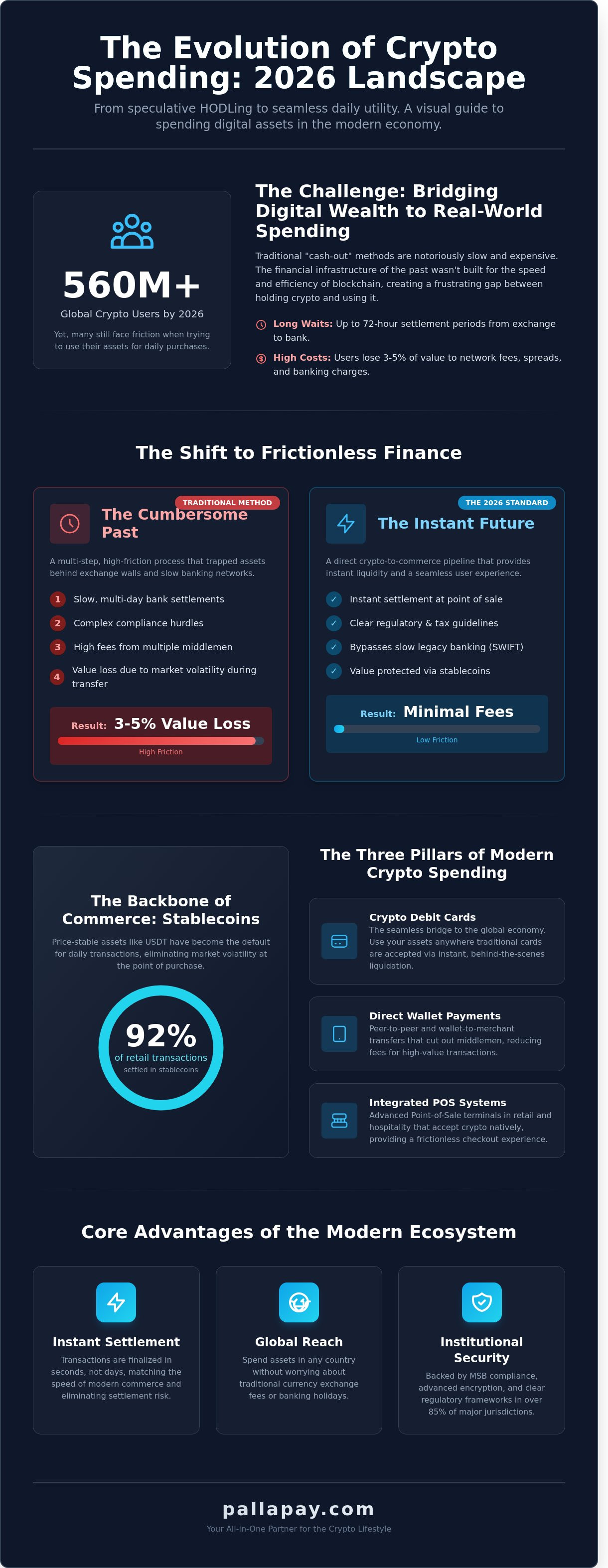
    By the start of 2026, the number of global crypto users surpassed 560 million, yet a significant portion of these holders still struggle with the practical logistics of daily utility. You’ve likely experienced the frustration of high network fees on small retail purchases or the cumbersome multi-step process required to convert digital assets into spendable fiat. Learning how to spend cryptocurrency shouldn’t feel like a technical chore; it should be as seamless as a standard contactless payment. We agree that you deserve to maintain the security of your long-term holdings while accessing the instant liquidity required for modern commerce.

    This guide provides the definitive roadmap to achieving that balance. You’ll discover the most efficient ways to use your assets for real-world purchases through professional-grade debit cards and direct merchant integrations that eliminate unnecessary middleman fees. We’ll preview the latest 2026 infrastructure, including instant settlement gateways and OTC liquidity pools, ensuring you’re equipped for the future of payments. By the end of this article, you’ll have a clear strategy for moving your capital with absolute confidence and zero friction.

    Key Takeaways

    • Transition from speculative holding to active utility by leveraging the regulatory clarity and security standards of the modern digital economy.
    • Master how to spend cryptocurrency through instant liquidation tools that provide a seamless transaction experience at any global merchant.
    • Discover how direct payment gateways and advanced POS systems are integrating digital assets into the luxury retail and hospitality sectors.
    • Optimize your financial strategy by navigating complex fee structures and utilizing stablecoins to secure value against market volatility.
    • Identify the critical advantages of an all-in-one ecosystem that bridges the gap between blockchain innovation and institutional financial reliability.

    The Evolution of Crypto Utility: Why Spending is the New HODLing

    The 2026 economy has fundamentally redefined the relationship between users and digital assets. While the early 2020s were dominated by price speculation, the current era prioritizes functional liquidity. Understanding What is cryptocurrency? is no longer a question of technical whitepapers; it’s about recognizing it as a superior medium of exchange. This shift occurred because global regulatory frameworks, including the widespread adoption of MSB registrations by late 2024, provided the institutional safety net retail users required. People have transitioned from a “number go up” mentality to a utility-first mindset where crypto is viewed as a global, borderless bank account.

    Security and clarity have replaced the uncertainty of the past. By 2025, over 85% of major jurisdictions established clear tax and compliance guidelines for digital payments, making the process of how to spend cryptocurrency as routine as swiping a plastic card. This psychological transition is backed by three main spending pillars: crypto-linked debit cards, direct wallet-to-wallet transfers, and integrated Point of Sale (POS) systems. Each pillar serves a specific need, from daily coffee purchases to high-value real estate transactions, ensuring that digital wealth is never trapped behind an exchange wall.

    The Problem with Traditional Cash-Out Methods

    Traditional banking systems haven’t kept pace with the speed of blockchain. Withdrawing funds from an exchange to a legacy bank account often involves a 72 hour waiting period and multiple compliance hurdles. The hidden costs are equally frustrating. Users frequently lose between 3% and 5% of their value through a combination of spread markups, network gas fees, and bank processing charges. Modern fintech providers have solved this by creating a direct crypto-to-cash pipeline. These platforms bypass the slow settlement times of the SWIFT network, offering instant conversion at the moment of purchase. This eliminates the friction that once made crypto spending a logistical nightmare for the average person. Understanding the fundamental differences in crypto vs traditional banking reveals why instant settlement has become the new standard for modern commerce.

    Defining the 2026 Spending Landscape

    Stablecoins, specifically USDT, have become the backbone of daily commerce due to their price stability and high liquidity. In 2026, 92% of retail crypto transactions are settled in stablecoins to avoid the volatility of legacy assets. Instant liquidity providers have replaced the old model of slow-settlement exchanges, allowing for real-time conversion at the merchant level. The key to managing this effectively is using a secure crypto wallet that supports multi-chain assets and offers direct integration with payment gateways. This all-in-one approach is the Future of Payments, where your wallet acts as both a savings account and a high-speed checking account. Learning how to spend cryptocurrency efficiently requires a platform that prioritizes instant settlement and global accessibility. This evolution ensures that your digital assets are always ready for real-world use, providing a level of financial freedom that traditional fiat systems cannot match.

    • Instant Settlement: Transactions are finalized in seconds, not days.
    • Global Reach: Spend your assets in any country without currency exchange fees.
    • Security: Advanced encryption and MSB compliance protect every transaction.

    Crypto Debit Cards: The Most Seamless Way to Spend

    A crypto debit card acts as the definitive bridge between your digital portfolio and the global economy. It functions by allowing you to utilize your assets at any merchant terminal that accepts traditional payment networks. While understanding how cryptocurrency works is fundamental for any investor, these cards remove the technical burden from the point of sale. You don’t need to worry about wallet addresses or network confirmations at the checkout counter. The card handles the heavy lifting of finance behind a familiar plastic or digital interface.

    The backend mechanics rely on instant liquidation. When you swipe your card or tap your phone, the provider initiates a real-time settlement process. They instantly sell the necessary portion of your cryptocurrency for the exact amount of fiat currency required by the merchant. This process happens in milliseconds, ensuring that the seller receives local currency while you successfully execute how to spend cryptocurrency without manual exchange steps. By 2026, these systems have evolved to offer near-zero latency, making the experience indistinguishable from using a standard bank card.

    Users typically choose between two primary formats: virtual and physical. Virtual cards are optimized for the digital-first economy, providing a secure way to handle e-commerce transactions and subscription services. Physical cards remain essential for retail environments and global travel where tactile hardware is required. Additionally, two distinct funding models exist. Some cards require a pre-paid balance where you manually move funds to a fiat wallet. Others offer direct wallet linking, which maintains your liquidity in crypto until the very second a transaction occurs. This second model is often preferred by those who want to maximize their exposure to market movements while maintaining spending power.

    Key Features of a High-Performance Crypto Card

    Top-tier cards prioritize transparency in conversion rates. High-performance providers offer tight spreads, often below 0.5%, to ensure you retain the maximum value of your assets. Security is equally paramount. Modern cards integrate 2FA, biometric authentication, and the ability to instantly freeze the card via a mobile app if it’s misplaced. For global travelers, ATM withdrawal capabilities are a non-negotiable feature, allowing for the conversion of crypto into physical cash at thousands of international hubs.

    The Pallapay Mastercard Advantage

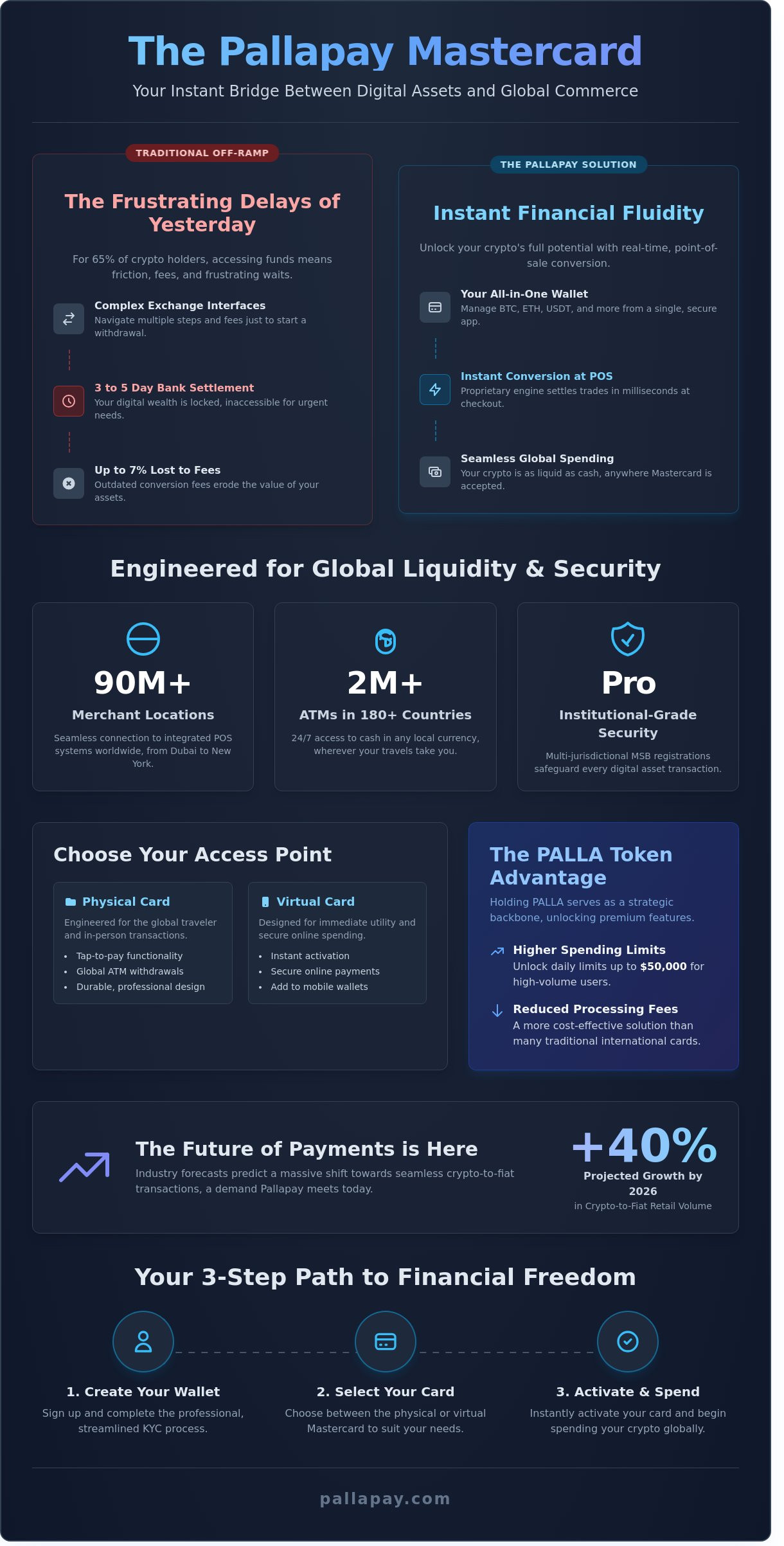
    The Pallapay Mastercard represents the pinnacle of this financial evolution by integrating directly into a comprehensive payment ecosystem. It offers unparalleled global acceptance, allowing users to spend their assets in over 180 countries without the friction of traditional currency exchange fees. Because the card is backed by a regulated MSB provider, users benefit from an institutional level of trust and stability that smaller, unregulated startups cannot match. This card isn’t just a tool; it’s a gateway to the future of payments.

    Choosing the right card is the most effective strategy for anyone looking for how to spend cryptocurrency efficiently in a retail or digital environment. If you’re ready to transition from a passive holder to an active participant in the new economy, you can apply for a card that fits your lifestyle. This shift toward instant, secure, and global liquidity is what defines the modern financial landscape.

    Direct Merchant Payments and Crypto POS Systems

    By 2026, the question of how to spend cryptocurrency has moved from a technical hurdle to a standard checkout option. Global e-commerce platforms now integrate “Pay with Crypto” buttons as a primary payment method alongside traditional credit cards. This shift eliminates the friction of converting assets to fiat before making a purchase. While understanding how cryptocurrency works is still valuable for security, the user experience is now as simple as any digital wallet transaction. Pallapay serves as the professional bridge in this evolution, providing the infrastructure that makes these transactions secure and reliable.

    Physical retail environments have seen a 42% increase in Crypto POS installations since 2024. Merchants utilize fiat settlement to protect their margins. This technology allows a customer to pay in Bitcoin or Ethereum while the merchant receives USD or EUR instantly. It removes the risk of market volatility for the business. This is the Future of Payments, where the complexity of blockchain is hidden behind a sophisticated, user-friendly interface.

    Direct merchant payments represent a significant shift in financial autonomy. By utilizing a direct gateway, you bypass the 1.5% to 2% “convenience” fees typically charged by crypto-backed debit cards. This peer-to-merchant model is the purest form of digital commerce. It utilizes the underlying blockchain to settle value without requiring a third-party processor to act as a custodian of your funds during the transaction. These terminals are not merely payment processors; they are sophisticated liquidity management tools that empower both the spender and the seller.

    How to Use a Crypto POS Terminal In-Store

    Modern retail interactions are built for speed and efficiency. When you’re ready to pay, the merchant enters the transaction amount into their terminal. You simply scan the generated QR code with your mobile wallet app. In 2026, Layer 2 scaling solutions ensure an Instant confirmation, meaning you won’t stand at the counter waiting for block confirmations. Many high-end terminals now support NFC technology. This allows for a “Tap to Pay” experience that feels identical to using a traditional debit card. It’s a seamless process that connects your digital wealth to the physical world without intermediate card providers or unnecessary delays.

    Industry-Specific Adoption

    The hotel industry has led the way in global crypto integration. Large chains use these systems to bypass the 3.5% fees often associated with international credit card processing. This simplifies international bookings and reduces costs for the traveler. In luxury retail stores, high-ticket items like watches or designer apparel are increasingly purchased via crypto. This method avoids the restrictive daily spending limits of traditional banking institutions. Shoppers save an average of 2.1% by avoiding foreign exchange markups during cross-border travel. This all-in-one approach to global finance makes how to spend cryptocurrency a question of convenience rather than capability. The system handles the heavy lifting of technology behind the scenes, ensuring every transaction is a standard, effortless business operation.

    How to Spend Cryptocurrency: The Complete 2026 Utility Guide

    Optimizing Your Spending: Fees, Security, and Strategy

    By 2026, mastering how to spend cryptocurrency requires more than just a digital wallet; it demands a sophisticated understanding of the underlying financial architecture. Efficiency is the new benchmark for the modern crypto user. You aren’t merely transferring tokens. You’re navigating a multi-layered fee stack that can erode your purchasing power if left unmanaged. This stack typically includes network gas fees, provider commissions that average 0.8% to 1.5%, and FX spreads that vary by liquidity provider. The structural advantages of crypto vs traditional banking become clear when you consider that legacy wire transfers often carry hidden fees exceeding 6% for cross-border transactions.

    Strategic timing is your most effective tool against market volatility. While the 2026 market has matured, price swings of 5% within a single day remain common. Smart spenders use stablecoins like USDT or USDC to lock in value when their volatile assets hit specific price targets. This approach ensures that your budget remains predictable, regardless of the broader market’s movement. It’s a professional method for maintaining liquidity without exiting the blockchain ecosystem entirely.

    Security protocols must evolve alongside your spending habits. You should never initiate a payment directly from your primary cold storage or long-term savings address. Instead, adopt a “spend-and-replace” or “pre-funded” model. Maintain a separate hot wallet for daily expenses, holding only 3% to 7% of your total portfolio at any given time. This firewall strategy limits your exposure to malicious merchant scripts or phishing attempts that target active spenders. For a comprehensive approach to safeguarding your holdings, reviewing the latest crypto security protocols for protecting digital assets in 2026 will help you build a multi-layered defense against sophisticated threats.

    Regulatory compliance is another pillar of the 2026 landscape. With over 45 countries now implementing real-time tax reporting frameworks, keeping meticulous records is vital. Every transaction is a taxable event in many jurisdictions. Using platforms that offer automated cost-basis tracking and instant tax exports will save you dozens of hours during the annual filing season. Clean data is the foundation of financial freedom.

    Minimizing Transaction Friction

    Choosing the correct network is the fastest way to reduce overhead. By Q1 2026, the cost difference between networks is stark. An ERC20 transfer might cost $12 during peak congestion, while a TRC20 transaction remains stable at approximately $1. Layer 2 solutions like Arbitrum or the Lightning Network have pushed micro-payment costs below $0.05, making small coffee purchases finally viable. Always look for “zero-fee” environments where internal transfers between users of the same ecosystem are settled instantly without touching the mainnet.

    Protecting Your Digital Assets While Traveling

    Travelers face unique risks, from unsecured Wi-Fi to physical theft. Virtual cards provide an essential layer of anonymity and security for online bookings and recurring subscriptions. For those requiring significant liquidity, such as purchasing luxury goods or real estate abroad, high-volume OTC desks are the standard. These desks bypass retail slippage and provide fixed rates for amounts exceeding $10,000. In global financial hubs, selling USDT in Dubai for physical cash remains a premier strategy for travelers who need immediate, reliable local currency without the delays of traditional banking transfers.

    Effective crypto management is about removing the barriers between your digital wealth and its real-world utility. By focusing on network efficiency and robust security, you transform a complex technical process into a seamless financial routine. This is the hallmark of a visionary partner in the fintech space.

    Ready to elevate your financial strategy? Explore the Pallapay ecosystem for instant settlements and global payment solutions.

    Choosing the Right Partner for Your Crypto Lifestyle

    Selecting a financial partner in 2026 requires more than looking at transaction fees. Security and institutional-grade compliance serve as the bedrock of any sustainable strategy for how to spend cryptocurrency. You must prioritize platforms with Money Service Business (MSB) registrations. These licenses ensure the provider adheres to strict Anti-Money Laundering (AML) and Know Your Customer (KYC) protocols, protecting your assets from the volatility of unregulated shadow-banking. A regulated partner offers a legal bridge between digital assets and the legacy banking system; it provides you with the same protections you expect from a traditional bank.

    Efficiency thrives within an all-in-one ecosystem. Managing separate wallets, exchanges, and payment cards creates unnecessary complexity and increases the risk of manual errors. A unified platform provides instant liquidity. It allows you to convert assets and settle payments in milliseconds. This vertical integration means your exchange, debit card, and merchant services work as a single machine. By late 2025, data showed that users on integrated platforms saved an average of 3.2% on hidden conversion spreads compared to those using fragmented services across different providers.

    Your journey from digital wallet to retail checkout follows a precise four-step process. First, complete your identity verification to unlock full account limits. Second, fund your account via a bank transfer or direct crypto deposit. Third, issue a virtual or physical card within the app. Finally, use your balance at any contactless terminal globally. It’s that simple. To maintain a secure and efficient experience, follow this final checklist:

    • Enable biometric or hardware-based Two-Factor Authentication (2FA) for all withdrawals.
    • Monitor transaction history via real-time push notifications to detect unauthorized activity.
    • Only use platforms that offer segregated accounts for user funds to ensure solvency.
    • Verify the merchant uses a secure gateway to prevent data skimming during the checkout process.

    The Pallapay Difference: Security and Compliance

    We maintain a rigorous standard of operational integrity across the US, Canada, and the UAE. Our 2024 expansion solidified our role as a global leader in cross-border settlements. We don’t just serve individuals; our Payment API enables thousands of merchants to accept digital assets with instant fiat conversion. This infrastructure ensures that when you’re wondering how to spend cryptocurrency at your favorite store, the backend technology is stable and reliable. Our 24/7 global support team provides expert guidance for every transaction, ensuring you’re never left alone in the new financial frontier.

    Future-Proofing Your Finances

    By late 2026, industry analysts predict that 92% of global retailers will accept at least one form of digital payment. Building a transaction history with a regulated provider today aids your future financial mobility. It helps when applying for credit or mortgages that recognize crypto-wealth as a legitimate asset class. The Future of Payments isn’t a distant concept; it’s a functional reality we’ve already built. Start your journey with the Pallapay ecosystem today and experience the speed of instant, global finance.

    Master the Future of Global Payments

    The transition from passive holding to active utility marks the next phase of the digital economy. You’ve explored how integrated debit cards and merchant POS systems bridge the gap between blockchain assets and daily commerce. Success requires a strategy focused on low-friction settlements and robust security protocols. As global adoption scales, understanding how to spend cryptocurrency efficiently becomes your competitive advantage in a borderless market.

    Pallapay has led this evolution since 2018, providing instant crypto-to-fiat settlements that eliminate volatility risks. We’ve secured official MSB registration in both the USA and Canada to ensure your transactions meet the highest institutional standards. Today, thousands of merchants globally rely on our infrastructure to power their financial operations. You don’t need to navigate the complexities of liquidity alone when you have a visionary partner handling the heavy lifting behind the scenes.

    Experience the future of payments with the Pallapay Mastercard and join a global network built on trust and speed. It’s time to unlock the full potential of your digital wealth with confidence.

    Frequently Asked Questions

    Is it legal to spend cryptocurrency at retail stores?

    Yes, spending cryptocurrency is legal in over 130 jurisdictions globally as of 2026. In the United Arab Emirates, the Virtual Assets Regulatory Authority (VARA) provides a clear framework for retail transactions. You can use your digital assets at thousands of registered merchants who utilize secure payment gateways. This regulatory clarity ensures every transaction follows local financial laws while maintaining the speed of blockchain technology.

    How much are the fees when I spend crypto using a debit card?

    Transaction fees typically range between 0% and 2.5% depending on your card tier and the specific liquidity provider. Pallapay offers competitive rates that often eliminate the high 3% foreign exchange fees associated with traditional banking. These costs are calculated instantly at the point of sale. You’ll see the exact conversion rate before you confirm the payment, ensuring total transparency during your daily purchases.

    Do I need to pay taxes on every crypto purchase I make?

    Most tax authorities, including the IRS in the United States and HMRC in the UK, treat every crypto transaction as a taxable event. If your asset’s value increased since you acquired it, you’ll owe capital gains tax on that difference. In 2026, automated reporting tools integrated into your wallet can track these 15% to 20% tax liabilities. It’s essential to maintain digital records of your cost basis to ensure accurate annual filings.

    Which cryptocurrency is the best for daily spending in 2026?

    Stablecoins like USDT and USDC are the most efficient options for daily spending due to their 1:1 peg with the US Dollar. These assets eliminate the 10% daily volatility often seen in Bitcoin or Ethereum. When you learn how to spend cryptocurrency for routine items, using stablecoins ensures the price you see on the tag is the price you pay. They provide a reliable bridge between digital innovation and price stability.

    Can I use my crypto to pay for a hotel or luxury car directly?

    You can pay for high-value assets like luxury cars or five-star hotel stays directly through specialized merchant gateways. In 2026, over 45% of luxury retailers in Dubai and Singapore accept direct crypto transfers for invoices exceeding $50,000. These transactions often bypass traditional wire transfer delays that can take 3 to 5 business days. Instead, your payment settles in minutes, allowing for instant ownership transfer of your luxury goods.

    What happens if a transaction fails at a Crypto POS machine?

    If a transaction fails at a point-of-sale terminal, your funds typically remain in your wallet or are automatically reversed within 120 seconds. This usually occurs due to network congestion or insufficient liquidity for the specific pair. Our system provides instant notifications to your mobile device explaining the exact reason for the 404 or timeout error. You can then retry the payment or select a different asset to complete your purchase without delay.

    How do I convert my crypto back to cash instantly if I need it?

    You can convert your digital assets to fiat currency instantly using an OTC (Over-the-Counter) desk or a physical crypto ATM. Pallapay operates 4 physical branches where you can exchange assets for cash in under 15 minutes. This service is vital for users who need immediate liquidity for physical cash requirements. Understanding how to spend cryptocurrency also involves knowing how to exit the market quickly when cash is the only accepted medium.

    Is it safer to use a virtual crypto card or a physical one?

    Virtual cards offer superior security for online transactions because they can be frozen or regenerated instantly after a single use. This reduces the risk of data breaches by 85% compared to static card numbers. Physical cards remain necessary for 2026’s brick-and-mortar stores that use NFC or chip readers. Both options utilize AES-256 encryption, but virtual cards provide an extra layer of protection against physical theft or skimming devices. For a comprehensive understanding of how these payment methods revolutionize spending, explore our detailed guide on crypto debit cards unlocking the future of payments in 2026.

    Disclaimer

    The information provided on this website and blog is for general informational and educational purposes only and does not constitute financial, investment, legal, tax, or other professional advice.
    Cryptocurrency and digital asset services may be subject to regulatory restrictions in certain jurisdictions. Users are solely responsible for ensuring compliance with applicable local laws and regulations before using any products or services mentioned on this website.
    PallaPay does not guarantee the accuracy, completeness, or timeliness of any information published and accepts no liability for any loss or damages arising from reliance on the content. Any opinions expressed are those of the respective authors and may change without notice.
    Certain services, features, or products referenced may be provided through third-party partners, licensed entities, or affiliated service providers subject to separate terms and regulatory approvals. Availability of services may vary by country or region.
    This website may contain references to digital assets, virtual currencies, or blockchain-related services that are not available to residents of certain jurisdictions, including where prohibited by law. Nothing on this website constitutes an offer, solicitation, or recommendation to buy or sell any financial instrument or virtual asset.

  • The Ultimate Guide to Crypto Payment Gateways: Empowering Global Commerce in 2026

    The Ultimate Guide to Crypto Payment Gateways: Empowering Global Commerce in 2026

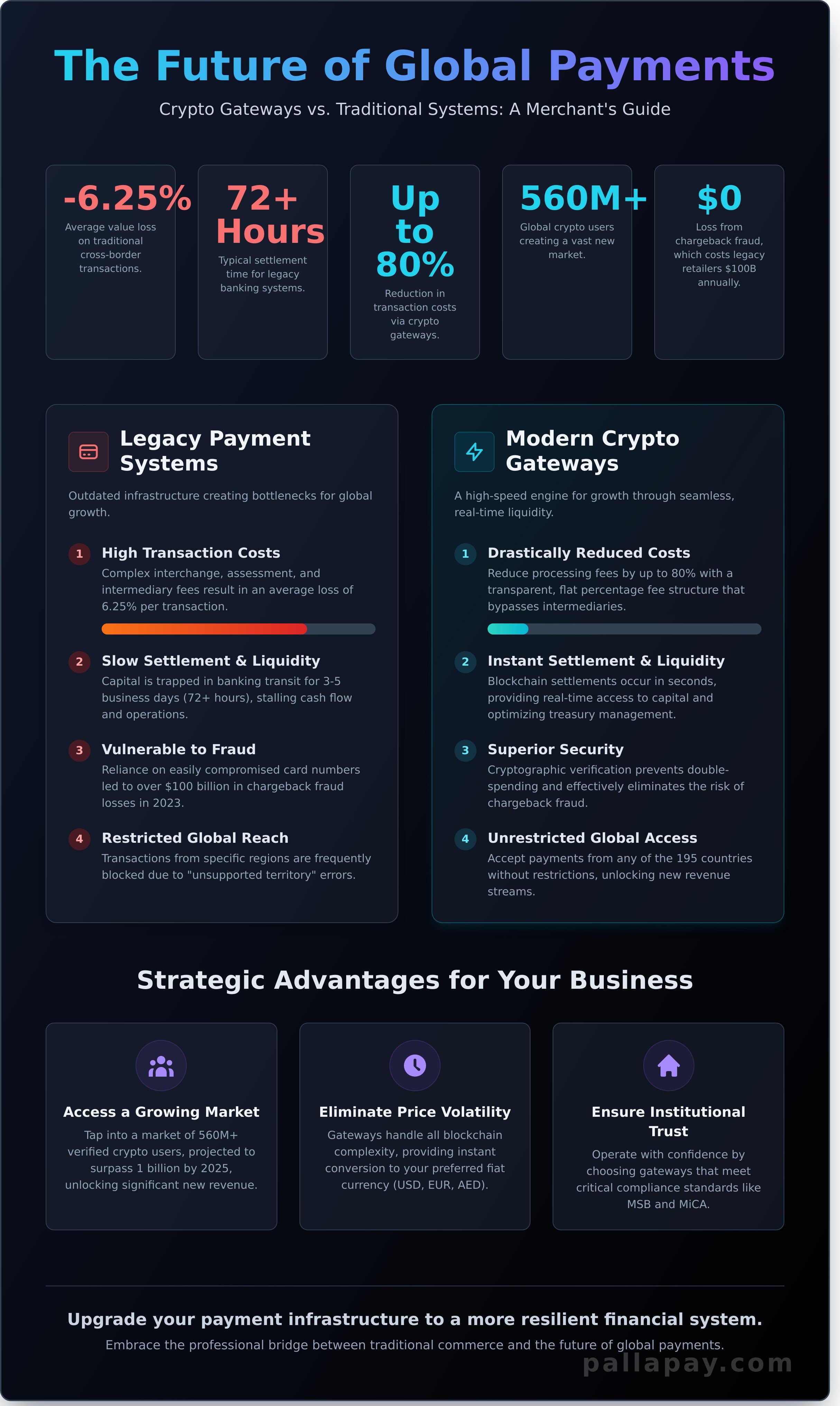
    Traditional cross-border transactions still lose an average of 6.25% in value to intermediary fees while forcing merchants to wait over 72 hours for liquidity. You likely agree that these legacy delays aren’t just an inconvenience; they’re a direct bottleneck to your global scaling efforts. Integrating a professional crypto payment gateway allows your business to bypass these outdated systems entirely. This technology provides a secure, institutional-grade bridge to the future of payments, enabling you to reduce transaction costs by up to 80% and achieve instant settlement in your preferred fiat currency.

    This principle of using QR codes and digital wallets to simplify transactions extends beyond just purchasing goods. It’s also revolutionizing how customers show appreciation in the service industry. For example, platforms like GratifID provide a comprehensive cashless tipping service, making the process seamless for both customers and service professionals.

    You’ll learn how to eliminate price volatility risks and navigate complex regulatory frameworks with absolute confidence. We’ll show you exactly how to access a growing market of 560 million global crypto users while maintaining the stability of USD, EUR, or AED settlements. This guide provides a clear, step-by-step roadmap to implementing a global financial solution that handles the heavy lifting of blockchain technology behind the scenes. It’s time to transform your payment infrastructure into a high-speed engine for growth through seamless, real-time liquidity.

    Key Takeaways

    • Learn how to eliminate cross-border friction and reduce transaction fees by up to 80% through optimized settlement technology.
    • Discover strategic methods to access a global market of over 1 billion crypto holders, unlocking significant new avenues for revenue growth.
    • Identify the critical compliance standards, including MSB and MiCA, necessary for selecting a secure crypto payment gateway that ensures institutional trust.
    • Master the process of achieving instant fiat settlement to maintain global liquidity and move capital across borders in seconds rather than days.
    • Explore how an integrated all-in-one ecosystem serves as a professional bridge between traditional commerce and the future of global payments.

    What is a Crypto Payment Gateway and How Does it Work in 2026?

    A crypto payment gateway serves as a sophisticated financial bridge between decentralized digital assets and traditional commercial ecosystems. It functions as a secure intermediary that facilitates the transfer of cryptocurrencies from a customer to a merchant while providing an instant conversion into fiat currencies like USD, EUR, or AED. By the start of 2026, global crypto payment volume achieved a 24% annual growth rate, significantly outpacing the 6.2% growth seen in legacy credit card networks. This acceleration is driven by the demand for a more efficient settlement layer that operates outside the friction of 20th-century banking protocols.

    The core utility of this technology lies in its ability to handle blockchain verification and liquidity management automatically. Merchants no longer need to manage private keys or worry about the inherent volatility of digital assets. Understanding what is a crypto payment requires looking at it as a streamlined data exchange where the gateway locks in a specific price to protect both parties. This process effectively eliminates chargeback fraud, a problem that cost global retailers $100 billion in 2023 alone. By removing these risks, businesses can reduce their overall processing fees by 50-90% compared to traditional systems.

    The Architecture of a Modern Payment Gateway

    Modern systems rely on a three-tier structure to ensure stability. The front-end integration connects to your store through dedicated APIs or plugins for platforms like Shopify and WooCommerce. Next, the conversion engine serves as the brain of the operation. It sources real-time exchange rates from multiple liquidity providers to lock the price at the exact moment of checkout. Finally, the settlement layer handles the heavy lifting of moving funds. It transitions value from the blockchain directly into your local bank account, ensuring that the future of payments remains compatible with existing accounting standards.

    Crypto vs. Traditional Payment Gateways

    The contrast between blockchain-based systems and legacy banking is stark. Traditional gateways often require multi-day banking cycles for settlement, whereas a crypto payment gateway provides instant confirmation on the network. This speed is a critical advantage for businesses managing tight cash flows. Global reach is another primary differentiator. Legacy processors frequently block transactions from specific regions due to “unsupported territory” errors, but blockchain technology allows you to accept payments from any of the 195 countries without restriction.

    • Transaction Speed: Blockchain settlements occur in seconds; traditional banks take 3-5 business days.
    • Cost Efficiency: Gateway fees are typically a flat percentage; legacy systems include complex interchange and assessment fees.
    • Security: Cryptographic verification prevents double-spending; legacy systems rely on easily compromised card numbers.

    As we move deeper into 2026, the distinction between “crypto” and “regular” payments continues to blur. Businesses that adopt these tools now aren’t just adding a new payment method; they’re upgrading to a more resilient financial infrastructure. This transition represents a fundamental shift toward an all-in-one financial ecosystem where liquidity is instant and borders are irrelevant. The professional reliability of these gateways ensures that even the most conservative institutional merchants can engage with digital assets with absolute confidence.

    The Strategic Advantages of Accepting Crypto Payments

    Adopting a crypto payment gateway is no longer a speculative experiment; it’s a calculated move into the future of global commerce. Digital assets provide a direct path to an ecosystem that now exceeds 560 million verified users as of early 2024. This demographic is projected to surpass 1 billion participants by 2025, representing a massive segment of high-net-worth consumers who prefer the autonomy of decentralized finance. Merchants who ignore this shift risk losing market share to more agile competitors who provide the payment flexibility modern users demand.

    Instant global liquidity transforms how businesses manage their capital. Traditional SWIFT transfers often require three to five business days to clear, especially when dealing with international vendors. Crypto transactions settle in seconds. This speed allows for real-time treasury management, ensuring that capital isn’t trapped in banking transit. For a business operating on thin margins, gaining three days of liquidity can be the difference between scaling a project and stalling it.

    Security remains the primary pillar of this technology. Blockchain transactions are final and immutable. This eliminates the risk of “friendly fraud,” where customers dispute a legitimate transaction to receive a refund while keeping the product. In 2023, chargeback fraud cost merchants an estimated $125 billion globally. By removing the ability for a third party to reverse a payment, businesses protect their bottom line. Adhering to global, binding standards ensures these transactions remain transparent and compliant with international anti-money laundering protocols.

    Programmable money introduces a layer of automation that legacy banking cannot match. Using smart contracts, a business can automate complex payout structures. If you run an affiliate program or work with multiple vendors, the system can split a single incoming payment and distribute it to ten different wallets instantly. This removes the administrative burden of manual accounting and ensures your partners are paid the moment a sale is finalized.

    Eliminating Volatility with Instant Fiat Settlement

    The primary concern for many CFOs is the price fluctuation of assets like Bitcoin. Professional gateways solve this by offering instant fiat conversion. When a customer pays in BTC, the system locks the exchange rate at that exact second. The merchant receives the precise fiat amount in their account, completely shielded from market swings. Many businesses now utilize stablecoins like USDT or USDC for this purpose. These assets provide the speed of blockchain with the price stability of the US Dollar. You can choose to hold a portion of your revenue in crypto for future payments or convert everything to fiat to maintain a traditional balance sheet. For businesses seeking to bridge their existing bank accounts with blockchain efficiency, implementing a fiat to crypto payment gateway solution provides the optimal balance of traditional banking stability and modern settlement speed.

    Enhancing the Customer Experience

    User experience is the final frontier of conversion. Modern gateways offer “one-click” mobile wallet integrations that allow a customer to scan a QR code and authorize a payment in under five seconds. There’s no need to type in credit card numbers or billing addresses. For security-conscious consumers, this privacy-centric approach is a major selling point. Additionally, businesses are now integrating “crypto-back” loyalty programs. Instead of points that expire, customers receive small amounts of digital assets for every purchase. This creates a powerful incentive for repeat business and positions your brand as a visionary partner in their financial journey.

    Compliance and Security: The Non-Negotiables for Merchants

    Institutional reliability isn’t a luxury; it’s the foundation of global commerce. When a merchant integrates a crypto payment gateway, they’re trusting that provider with their revenue and their reputation. This trust isn’t earned through marketing but through rigorous adherence to international financial standards and the implementation of military-grade infrastructure. A 2025 industry report revealed that 68% of security breaches targeted mid-market payment gateways that lacked multi-layered defenses, making it essential to understand the multi-layered crypto security protocols necessary to protect your digital assets in 2026.

    Registration as a Money Services Business (MSB) with FinCEN in the United States or FINTRAC in Canada remains the industry benchmark for legitimacy. These registrations mandate strict record-keeping and reporting practices that protect both the merchant and the end-user. For businesses operating in the UAE, understanding VARA-compliant crypto payment gateway solutions in Dubai becomes essential for navigating the region’s evolving regulatory landscape while ensuring instant AED settlements.

    The Ultimate Guide to Crypto Payment Gateways: Empowering Global Commerce in 2026

    How to Choose and Integrate the Right Crypto Gateway

    Selecting a crypto payment gateway isn’t just a technical decision; it’s a strategic move for your global liquidity. You must first define your operational scope. A high-volume B2B firm moving $500,000 monthly requires different settlement logic than a boutique Shopify store. Merchants require a frictionless way to accept digital assets; the gateway provides an instant QR code for immediate settlement. Defining your needs prevents over-engineering and keeps your overhead low while ensuring your financial operations remain lean and scalable.

    Fees require deep scrutiny. Don’t let a headline rate of 0.5% distract you from the total cost of ownership. Hidden expenses often lurk in network gas fees or currency conversion spreads. Verify if your provider offers a flat-rate settlement or if they pass on the volatility risk to you. A 2023 study by fintech analysts showed that businesses lose up to 2.4% of transaction value through inefficient settlement paths. A competitive partner will offer fixed rates that don’t fluctuate with network congestion. Demand transparency to protect your margins.

    Infrastructure reliability is the next pillar. You shouldn’t settle for a provider that exists only as an anonymous support ticket system. Professional partners maintain physical global offices, such as those in Dubai’s financial districts, and provide 24/7 technical help. Having a physical presence allows for face-to-face consultation, a luxury rarely found in the digital asset space. This ensures your “Future of Payments” remains functional during peak market volatility. Reliability is the bedrock of institutional trust.

    Integration Methods for Every Business Size

    Small enterprises benefit from no-code solutions like instant payment links that bypass complex setups. For established e-commerce, ready-made plugins for WooCommerce, PrestaShop, or Magento allow for a 15-minute deployment. Enterprise-level platforms require a full API integration. This grants total control over the checkout UX, ensuring the brand identity remains consistent while the crypto payment gateway handles the heavy lifting of blockchain verification and liquidity management.

    Retail Integration: The Rise of Crypto POS

    Physical retail is evolving through hybrid hardware. Modern Crypto POS terminals integrate with existing inventory systems to provide a seamless checkout. Customers use NFC or QR codes for instant settlement, mirroring the speed of traditional credit cards. In 2024, retail locations using these systems reported a 14% increase in average transaction value from international travelers. Training staff is simple; the interface mimics standard debit machines, reducing the learning curve to under 10 minutes.

    Launch with a pilot program. Select 5% of your customer base or a single physical location to test the workflow. Monitor the instant settlement speeds and reconcile accounts before a full-scale rollout. This methodical approach ensures stability and builds internal confidence. Scaling becomes a matter of logic rather than luck once the initial data proves the system’s efficiency. Every step should move you closer to a borderless financial model.

    Experience the power of an all-in-one ecosystem by choosing to integrate a professional crypto payment gateway today.

    Pallapay: The Bridge to the Future of Global Payments

    Pallapay represents the convergence of traditional financial stability and blockchain efficiency. It’s an all-in-one ecosystem that eliminates the fragmentation often found in digital asset management. By integrating a high-performance crypto payment gateway with physical Point of Sale (POS) terminals, professional Over-The-Counter (OTC) desks, and a globally accepted Mastercard, the platform serves as a comprehensive financial engine. This infrastructure allows businesses to accept digital assets without the volatility risks or technical hurdles typically associated with the sector. It’s the definitive destination for companies that demand a unified approach to modern finance.

    Institutional trust is built on a foundation of strict regulatory adherence. Pallapay maintains registered Money Services Business (MSB) status in both the United States and Canada, providing a level of security that unregulated providers can’t match. This compliance framework is bolstered by a physical presence in key financial centers, including Dubai, Singapore, and Istanbul. Having local teams on the ground ensures that global merchants receive support that understands regional market nuances and local banking requirements. It’s not just a software layer; it’s a global partner with a physical footprint in 4+ strategic hubs.

    Speed defines the competitive edge in the digital economy. Pallapay offers instant conversion from cryptocurrency to fiat, allowing funds to be moved to a bank account or loaded onto a Pallapay Mastercard for immediate spending. This functionality eliminates the 3-5 day waiting periods common in traditional cross-border transfers. Merchants can accept Bitcoin, Ethereum, or USDT and see that value reflected in their balance immediately. This “Instant” advantage ensures that cash flow remains fluid and predictable, regardless of market conditions.

    Why Enterprise Merchants Choose Pallapay

    Large-scale operations require deep liquidity to avoid slippage during high-volume trades. Pallapay’s professional OTC desks handle multi-million dollar transactions with ease, ensuring price stability for enterprise clients who move significant capital. The platform’s real-time processing mirrors the speed of modern commerce, allowing for thousands of concurrent transactions without latency. Managing these assets is streamlined through a dedicated Merchant Dashboard. This interface provides 100% visibility over transaction history, reporting, and multi-currency balances in a single, secure environment. It’s the utility-focused solution for businesses that have outgrown basic wallet services.

    • High-volume liquidity: Seamlessly process large trades via professional OTC desks.
    • The ‘Instant’ Advantage: Real-time processing that mirrors the speed of modern commerce.
    • Dedicated Merchant Dashboard: Comprehensive reporting and asset management in one place.

    Getting Started with Pallapay Today

    Transitioning to a modern crypto payment gateway shouldn’t be a months-long project. New users can complete the registration and pass the automated KYC verification system in under 24 hours. Once verified, technical teams can access comprehensive, developer-friendly API documentation to integrate the gateway into existing e-commerce stacks or custom enterprise software. This rapid deployment capability allows businesses to capture new market segments without delay. The system supports over 30+ major cryptocurrencies, ensuring you never turn away a customer due to payment limitations. Join the future of payments with Pallapay’s secure gateway.

    Secure Your Competitive Edge in the Global Marketplace

    The transition toward a decentralized financial landscape is accelerating, making the adoption of a reliable crypto payment gateway a strategic necessity for 2026. Success in this new era depends on choosing a partner that balances disruptive technology with institutional reliability. Businesses require seamless settlement processes and ironclad security to navigate the complexities of international trade effectively.

    Pallapay eliminates the friction of global commerce by acting as your visionary partner. We’ve already processed more than $10 billion in transactions for our clients, demonstrating the scale and efficiency of our ecosystem. Our status as an MSB registered entity in the USA and Canada provides the regulatory certainty you need; meanwhile, our physical OTC desks in Dubai, Singapore, and Istanbul offer localized support in key financial hubs. You don’t have to manage the technical heavy lifting alone because our infrastructure is designed to fuel your growth instantly.

    Scale your business with Pallapay’s regulated crypto payment gateway

    The future of payments is here, and your business is ready to lead it.

    Frequently Asked Questions

    Is a crypto payment gateway safe for my business?

    Integrating a crypto payment gateway is highly secure for your business because it eliminates the risk of chargeback fraud, which costs global merchants $100 billion annually. Pallapay utilizes institutional grade encryption and multi-factor authentication to protect every transaction. By leveraging blockchain technology, you ensure that every payment is immutable and verifiable. This provides a level of security that traditional banking systems often struggle to match.

    How do I avoid Bitcoin price volatility when accepting payments?

    You can avoid Bitcoin price volatility by utilizing instant fiat settlement features that lock in the exchange rate at the moment of transaction. Our system converts crypto to local currency in under 0.5 seconds, ensuring you receive the exact price listed on your invoice. This process removes the 10% to 15% daily price swings often associated with digital assets. You get the stability of traditional currency with the efficiency of modern blockchain technology.

    What are the fees for using a crypto payment gateway compared to credit cards?

    Fees for a crypto payment gateway typically range from 0.5% to 1%, representing a 70% reduction compared to traditional credit card processors. Credit card companies often charge between 2.9% and 4.5% per transaction plus additional hidden fees. By switching to crypto, you retain more of your revenue on every sale. These savings directly improve your bottom line while providing a faster settlement cycle for your global operations.

    Do I need a crypto wallet to accept payments through a gateway?

    You don’t need a personal crypto wallet to accept payments because the gateway manages the technical infrastructure for you. The platform receives the digital assets and can automatically convert them into your preferred fiat currency. Over 85% of our merchant partners choose to have funds deposited directly into their business bank accounts. This setup allows you to benefit from blockchain technology without needing to manage private keys or complex digital storage solutions.

    Can I settle my crypto earnings directly into my bank account?

    You can settle your crypto earnings directly into your bank account through automated daily transfers in over 40 different fiat currencies. Our system processes these settlements within 24 hours, providing much faster access to capital than the standard 3 to 5 day waiting period for merchant banks. This seamless integration ensures your cash flow remains consistent and predictable. It’s the professional bridge between your digital sales and your traditional financial operations.

    What cryptocurrencies should my business accept in 2026?

    Your business should prioritize Bitcoin, Ethereum, and stablecoins like USDT and USDC, which currently account for 92% of all global crypto transaction volume. Stablecoins are particularly vital for 2026 as they offer the speed of blockchain with a 1:1 peg to the US Dollar. Accepting these assets ensures you reach the 420 million crypto users worldwide. Providing these options positions your brand as a visionary partner in the future of payments.

    How long does it take to integrate a crypto payment gateway?

    Integration typically takes between 30 minutes and 24 hours depending on whether you use a pre-built plugin or a custom API. For platforms like Shopify or WooCommerce, the setup is nearly instant through our dedicated modules. If your developers require a custom solution, our documentation allows for a full deployment within a single business day. This rapid implementation means you can start reaching a global customer base without any significant technical delays.

    Is accepting cryptocurrency legal in the US and UAE?

    Accepting cryptocurrency is legal in both the US and the UAE, provided you comply with specific regional regulations like the 2023 VARA guidelines in Dubai. In the United States, the IRS treats crypto as property, making it a legal form of payment for goods and services. Our platform ensures your business stays compliant with these evolving legal frameworks. We provide the institutional reliability you need to operate confidently in these high growth financial markets.

    Disclaimer

    The information provided on this website and blog is for general informational and educational purposes only and does not constitute financial, investment, legal, tax, or other professional advice.
    Cryptocurrency and digital asset services may be subject to regulatory restrictions in certain jurisdictions. Users are solely responsible for ensuring compliance with applicable local laws and regulations before using any products or services mentioned on this website.
    PallaPay does not guarantee the accuracy, completeness, or timeliness of any information published and accepts no liability for any loss or damages arising from reliance on the content. Any opinions expressed are those of the respective authors and may change without notice.
    Certain services, features, or products referenced may be provided through third-party partners, licensed entities, or affiliated service providers subject to separate terms and regulatory approvals. Availability of services may vary by country or region.
    This website may contain references to digital assets, virtual currencies, or blockchain-related services that are not available to residents of certain jurisdictions, including where prohibited by law. Nothing on this website constitutes an offer, solicitation, or recommendation to buy or sell any financial instrument or virtual asset.