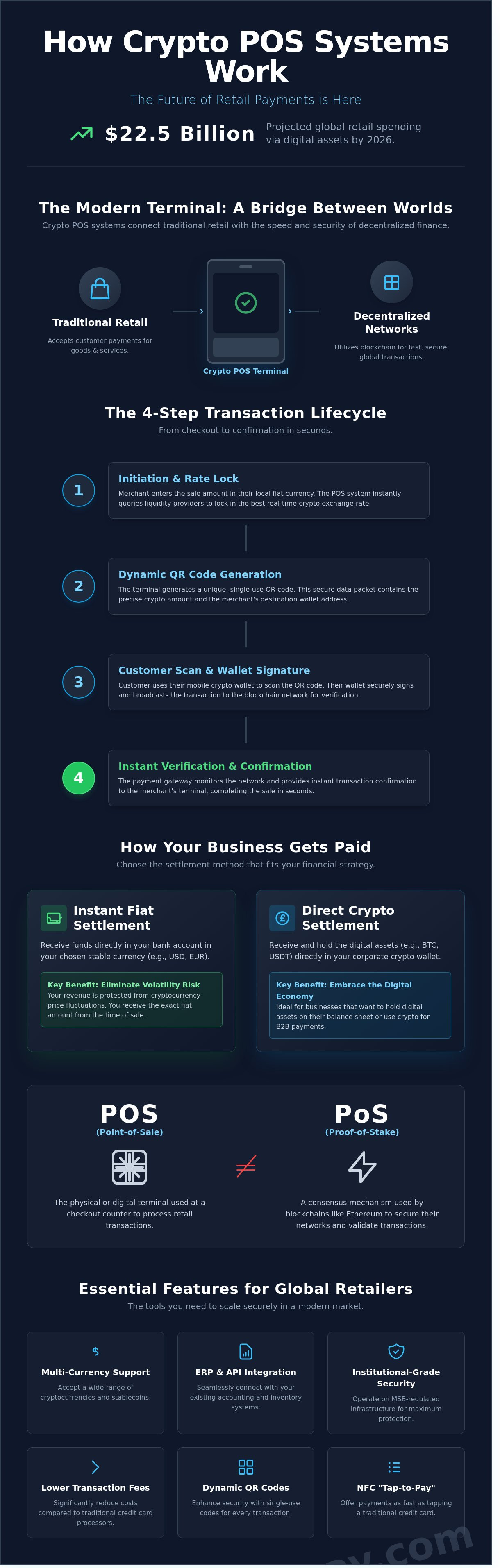
Tag: Fiat Conversion

  • The Business Case for Accepting Crypto Payments in 2026: A Strategic Guide

    The Business Case for Accepting Crypto Payments in 2026: A Strategic Guide

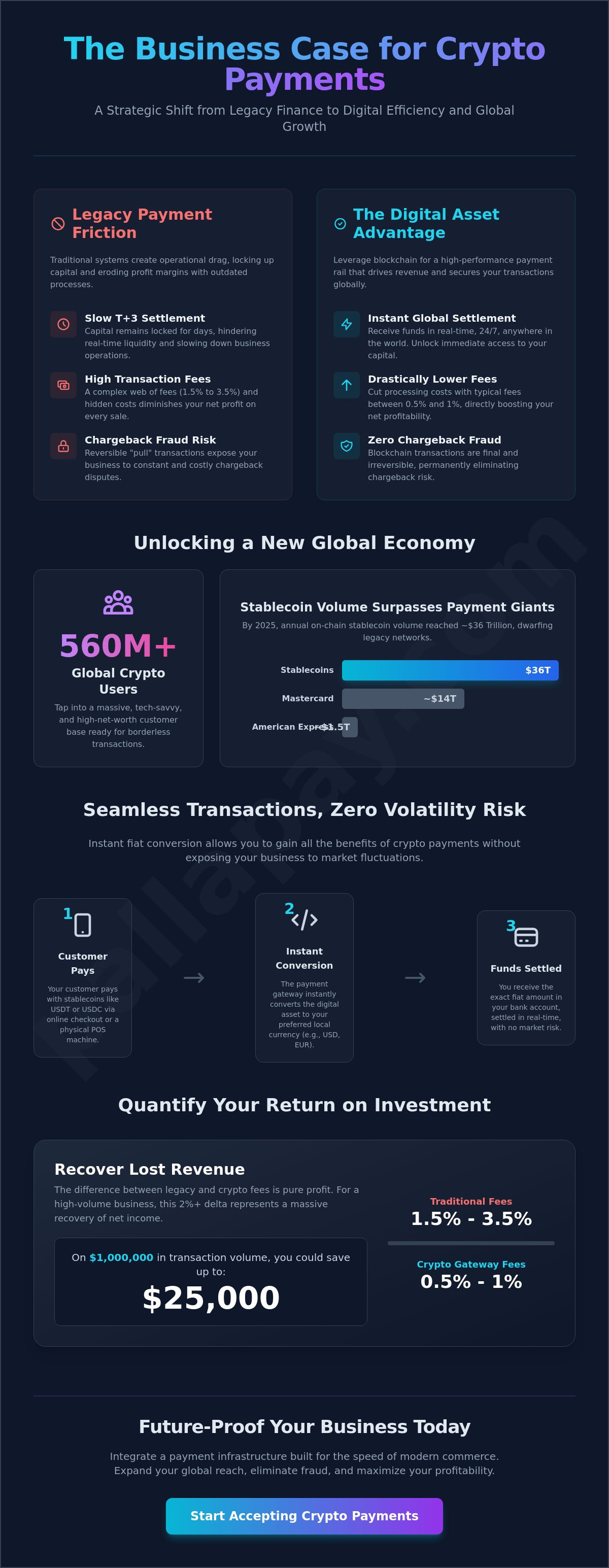
    Did you know that stablecoin on-chain transfer volumes reached approximately $36 trillion by 2025, surpassing the total transaction volumes of legacy giants like Mastercard and American Express? You’ve likely felt the daily friction of traditional banking, where high cross-border fees and the persistent threat of chargeback fraud eat into your margins. Building a robust business case for accepting crypto payments is no longer about following a trend. It’s about securing a strategic advantage in a globalized economy that demands speed and absolute security.

    You deserve a financial infrastructure that works as fast as your business does. We’ll show you how integrating cryptocurrency payments drives revenue, eliminates chargeback fraud, and opens your doors to a high-net-worth audience of over 560 million global users. This guide provides a clear look at how modern payment gateways allow you to bypass slow settlement times and access global markets without currency hurdles. We’ll examine the operational shift toward instant fiat conversion and the regulatory frameworks that have turned digital assets into a reliable, institutional-grade tool for growth.

    Key Takeaways

    • Understand why legacy T+3 settlement cycles are no longer competitive and how to transition your operations toward real-time financial liquidity.
    • Build a compelling business case for accepting crypto payments by comparing standard credit card fees against the efficiency of high-performance blockchain rails.
    • Expand your reach into emerging global markets and connect with a high-net-worth customer base that values borderless, friction-free transactions.
    • Master the strategies for mitigating market volatility through instant fiat conversion and navigating the evolving 2026 regulatory landscape.
    • Explore the technical integration of sophisticated payment APIs and physical POS machines to unify your digital and in-person sales channels effortlessly.

    The Strategic Shift: Why Businesses Are Prioritizing Crypto in 2026

    By 2026, the global financial landscape has matured beyond the era of speculative volatility. Digital assets have transitioned from experimental novelties into essential utility-driven tools for modern commerce. This shift is driven by a fundamental breakdown in legacy banking infrastructure. Traditional T+3 settlement cycles, which keep merchant capital locked for days, are no longer viable in a high-velocity market. Businesses now demand real-time liquidity to maintain their competitive edge. In this environment, the borderless merchant has emerged, using decentralized technology to bypass the geographic and operational silos of traditional finance.

    Digital assets now serve as a sophisticated bridge between disparate fiat systems. Instead of navigating a web of intermediary banks and high cross-border fees, companies use blockchain rails to move value instantly across continents. To understand what is cryptocurrency in a 2026 context, one must look past the code and see a high-performance payment rail. It provides a standardized layer for value exchange that operates independently of local banking hours or clearinghouse delays.

    The Death of the “Wait-and-See” Approach

    Institutional adoption is no longer a future prediction; it’s a current reality. With global crypto users exceeding 560 million, the demographic of digital asset holders is too large to ignore. A 2026 market analysis shows that 85% of merchants now view these payments as a primary vehicle for reaching tech-savvy, high-net-worth customers. Staying on the sidelines creates a measurable competitive disadvantage. If your rivals offer the speed of blockchain confirmation while you remain tethered to legacy systems, you risk losing market share to more agile competitors. The business case for accepting crypto payments is fundamentally a transition from viewing payments as a cost-center to leveraging them as a strategic profit-driver.

    Stablecoins as the New Global Standard

    The primary driver of merchant adoption in 2026 isn’t Bitcoin’s price action but the utility of stablecoins. Assets like USDT and USDC have become the preferred choice for commercial transactions because they combine the stability of fiat with the technical advantages of blockchain. In 2025, stablecoins supported an annual on-chain transfer volume of approximately $36 trillion. This massive liquidity pool allows businesses to price goods in familiar denominations while benefiting from instant, irreversible transactions.

    Modern treasury management now relies on the ability to move in and out of positions without friction. By utilizing fiat settlement, companies can accept digital assets and receive their local currency almost immediately. This setup effectively eliminates the volatility argument. Merchants can enjoy the benefits of a global, 24-hour payment network without exposing their balance sheets to market fluctuations. It’s a secure, efficient, and highly scalable way to manage international revenue streams.

    Quantifying the ROI: Transaction Efficiency and Cost Reduction

    Measuring the financial impact of new technology requires a move beyond surface-level excitement. A strong business case for accepting crypto payments rests on the immediate reduction of operational overhead. Traditional merchant accounts often come with a complex web of fees that can range from 1.5% to 3.5% per transaction. In contrast, typical crypto payment gateways in 2026 operate with fees between 0.5% and 1%. For high-volume enterprises, this 2% delta represents a significant recovery of net profit that would otherwise be lost to legacy processing networks.

    The savings extend into the removal of hidden costs associated with traditional banking. Intermediary banks, currency conversion spreads, and mandatory holding periods often drain resources before funds ever reach a merchant’s account. By adopting digital asset rails, businesses can expand into international markets without the need for local entities or regional bank accounts. This borderless approach allows a company to capture global demand while maintaining a centralized, efficient treasury.

    The End of Chargeback Risk

    One of the most immediate benefits of blockchain technology is the elimination of chargeback fraud. Credit card systems are built on “pull” mechanics, where a customer or bank can reverse a transaction weeks after a service is rendered. This creates a massive financial liability, especially for e-commerce and high-ticket retail. Cryptocurrency operates on a “push” model. Once a transaction is confirmed on the ledger, it’s permanent. This immutability protects merchants from “friendly fraud” and allows firms to redirect their fraud prevention budgets toward active growth initiatives. It’s a fundamental shift that places financial control back into the hands of the business owner.

    Accelerating Cash Flow with Instant Settlement

    Liquidity is the lifeblood of any scaling operation. Legacy banking systems often operate on a T+3 settlement cycle, meaning funds are locked for three business days or more. In a fast-paced economy, this delay is a significant bottleneck. Real-time payment rails provide T+0 settlement, providing almost instant access to capital. By utilizing efficient crypto to bank transfers, businesses can move their digital revenue into traditional accounts without the multi-day delays typical of the SWIFT network.

    This speed enables rapid reinvestment into inventory, marketing, or payroll. Reconciliation also becomes more streamlined. Automated blockchain ledgers provide an immutable, transparent record of every transaction, reducing the administrative burden on accounting departments. For merchants looking to optimize their checkout flow, integrating a sophisticated payment API is the first step toward reclaiming lost margins and achieving true financial agility.

    The Business Case for Accepting Crypto Payments in 2026: A Strategic Guide

    Capturing New Markets: Borderless Commerce and Consumer Demand

    Accepting digital assets isn’t just a defensive move against transaction fees; it’s an offensive strategy to capture a share of the $3 trillion global crypto market cap. This capital represents a massive pool of liquid wealth that is increasingly seeking utility in the real-world economy. A central pillar of the business case for accepting crypto payments is the ability to reach unbanked and underbanked populations in emerging markets. These individuals may lack access to traditional credit cards or institutional banking, yet they often possess significant digital assets. By providing a gateway for these users, you open your business to entirely new demographics that were previously unreachable due to systemic financial barriers.

    The B2B sector is also witnessing a major transformation through large-scale international supplier payments. Instead of waiting days for a SWIFT transfer to clear, businesses are using stablecoins to settle high-value invoices in minutes. This speed reduces the counterparty risk inherent in long settlement windows and allows for more aggressive inventory management. To build deeper engagement, sophisticated brands are launching gift card and reward programs. These initiatives allow customers to convert their digital holdings into brand-specific credit, creating a closed-loop ecosystem that encourages repeat business and enhances customer retention.

    The Crypto-Native Consumer Profile

    By 2026, the profile of the crypto-native consumer has evolved into a high-net-worth segment with a distinct preference for efficiency. These users typically exhibit higher average order values (AOV) compared to traditional credit card users, often due to the lack of arbitrary spending limits on blockchain transactions. For the e-commerce sector, the priority is creating a frictionless checkout experience. This involves integrating payment flows that recognize the user’s wallet instantly, allowing for a secure, one-click confirmation. When you remove the friction of manual data entry and multi-step verification, conversion rates naturally climb.

    Global Expansion Without Geographic Friction

    The broader business case for accepting crypto payments extends into your ability to expand operations into 180+ countries without a complex web of local bank accounts. Cryptocurrency acts as a universal financial layer, allowing you to accept payments from anywhere in the world without suffering from currency conversion loss or regional banking delays. This is a strategic advantage for the hotel industry and luxury retail, where international guests often encounter issues with credit card authorizations or high foreign transaction fees. By offering a digital payment option, you provide a premium, white-glove experience that simplifies the “last mile” of the customer journey, ensuring that your global expansion remains unhindered by geographic borders.
    Mitigating Risk: Compliance, Security, and Volatility

    The most common objection to digital assets is market volatility, yet this concern is largely obsolete for the modern merchant. By 2026, the business case for accepting crypto payments is reinforced by the widespread availability of instant fiat conversion. This technological bridge ensures that the merchant receives the exact fiat amount at the moment of sale, regardless of subsequent market movements. By using a sophisticated fiat settlement process, businesses can lock in exchange rates immediately, effectively removing the “volatility myth” from their operational risk profile.

    Compliance is the second pillar of risk mitigation in the current landscape. Regulatory frameworks like MiCA in the European Union and the FSMA in the United Kingdom have established clear, enforceable rules for digital asset service providers. Working with a partner that adheres to these standards is essential for maintaining institutional financial reliability. Integrated gateway solutions now handle the heavy lifting of AML/KYC requirements, acting as a filter that protects the business from illicit actors while ensuring that every transaction meets global anti-money laundering standards.

    Institutional-Grade Security Standards

    Modern gateways handle private key management with institutional-grade rigor, removing the burden of technical custody from the merchant. This setup allows your team to focus on core operations while the underlying technology secures the assets. Multi-signature wallets have become the standard for corporate governance, requiring multiple authorizations for high-value transfers to prevent unauthorized access. Implementing crypto security best practices ensures that your digital treasury remains as secure as any traditional bank vault, providing a calm and stable environment for growth.

    Regulatory Peace of Mind

    Working with a regulated Money Services Business (MSB) in the US and Canada is non-negotiable for businesses that prioritize long-term stability. These entities provide the necessary oversight to ensure that your payment rails remain open and functional. Automated reporting tools now simplify the complexities of tax and compliance audits by providing a transparent, immutable record of every transaction. A crypto payment gateway serves as a compliance shield, protecting your operations from the shifting sands of global regulation and ensuring you remain on the right side of financial evolution. To secure your revenue streams and ensure absolute regulatory alignment, consider integrating a regulated settlement solution today.

    Implementation: Future-Proofing with the Pallapay Ecosystem

    Deploying a digital asset strategy requires a platform that bridges the gap between technical complexity and operational simplicity. The final pillar of the business case for accepting crypto payments is the ease of execution within a unified ecosystem. By using a sophisticated Payment API, you can connect your existing e-commerce storefront to global liquidity pools in a single integration. This setup allows your business to maintain its current checkout flow while adding a high-performance payment rail that settles in the currency of your choice.

    Managing global operations becomes effortless through a centralized merchant dashboard. This interface provides real-time visibility into every transaction, from the initial wallet confirmation to the final fiat deposit. The transition from registration to your first crypto-to-fiat settlement is designed to be a streamlined procedural flow. Once your account is verified, you can immediately begin accepting assets like USDT or Bitcoin, with the system handling all background conversions to ensure your balance sheet remains stable and predictable.

    The Omnichannel Advantage

    Modern commerce isn’t limited to a single screen. To achieve true market penetration, businesses must integrate digital payments into their physical retail stores. By deploying specialized hardware like Crypto POS machines, you can accept in-person payments with the same speed and security as your online sales. This hybrid approach enables mobile payments for field services and pop-up commerce, ensuring you never miss a revenue opportunity. Synchronizing online and offline digital asset accounting within one platform eliminates the administrative burden of manual reconciliation, allowing your finance team to focus on higher-value growth initiatives.

    Scaling with Professional OTC Services

    As your volume grows, your infrastructure must scale accordingly. Enterprise-level merchants often require specialized handling for high-value transactions to avoid market slippage and ensure deep liquidity. Utilizing a professional OTC crypto exchange provides the necessary environment for large-scale settlements without disrupting the broader market. This service allows for customized settlement schedules that match your specific business liquidity needs, whether you require daily transfers or weekly consolidations. By partnering with a strategic facilitator that offers dedicated global support, you ensure that your transition to modern financial rails is both secure and highly efficient.

    Securing Your Position in the Future of Global Commerce

    The evolution of digital finance has transformed payments from a background utility into a powerful driver of organizational growth. By eliminating the friction of legacy banking and capturing the demand of over 560 million global users, you’re not just adding a payment method; you’re future-proofing your entire operational model. The business case for accepting crypto payments is built on the pillars of instant liquidity, zero chargeback fraud, and seamless cross-border expansion. These strategic advantages allow you to reclaim lost margins and scale without the geographic constraints of traditional financial systems.

    Transitioning to these high-performance rails requires a partner that balances innovation with institutional reliability. As a regulated MSB in the USA and Canada, Pallapay provides the security and compliance necessary for enterprise-scale operations. We serve merchants in 180+ countries, offering instant fiat settlement in USD, EUR, and other major currencies to ensure your cash flow remains uninterrupted. Empower your business with Pallapay’s secure crypto gateway and start leveraging the efficiency of real-time commerce. Your journey toward a more agile, borderless financial future begins today.

    Frequently Asked Questions

    Is it legal for my business to accept cryptocurrency payments in 2026?

    Accepting digital assets is legal in most major global economies, provided you comply with local financial regulations. In 2026, frameworks like the EU’s Markets in Crypto-Assets (MiCA) and the UK’s Financial Services and Markets Act provide clear guidelines for commercial use. To ensure absolute compliance, businesses should partner with a regulated Money Services Business (MSB) that is registered with authorities like FinCEN in the United States or FINTRAC in Canada.

    How do I avoid the risk of Bitcoin price volatility when selling products?

    You can eliminate market risk entirely by utilizing instant fiat conversion at the point of sale. Modern payment gateways lock in the exchange rate the moment a customer completes their checkout. This ensures your business receives the exact fiat amount in your preferred currency, such as USD or EUR. By converting digital assets to fiat instantly, you bypass the volatility of the underlying asset while still offering a modern payment experience.

    What are the tax implications of accepting crypto for my business?

    Tax authorities generally treat cryptocurrency as property or a financial asset, meaning transactions are subject to standard corporate tax and capital gains rules. It’s essential to maintain accurate records for every sale. A professional gateway simplifies this process by providing automated reporting tools and immutable ledgers for tax audits. You should always consult with a qualified tax professional to ensure your reporting aligns with current regional requirements.

    Do I need a special bank account to receive fiat settlements from crypto sales?

    No, you don’t need a specialized bank account to receive your funds. You can continue using your existing corporate bank account to accept fiat settlements. The gateway acts as the technical bridge, converting the customer’s digital payment into your local currency. Once the conversion is complete, the funds are transferred to your bank via standard rails, making the entire process feel like a traditional merchant settlement.

    How much are the transaction fees compared to traditional credit cards?

    Transaction fees for digital assets are significantly lower, typically ranging from 0.5% to 1%. Traditional credit card processing often costs merchants between 1.5% and 3.5% per transaction. Reducing these overheads is a central part of the business case for accepting crypto payments. By switching to blockchain rails, you can recover significant margins that were previously lost to intermediaries and legacy network fees.

    What happens if a customer wants a refund for a crypto payment?

    Refunds are handled by initiating a new “push” transaction from your merchant dashboard to the customer’s wallet address. Because blockchain transactions are irreversible, you have total control over the refund process. Most businesses calculate the refund amount based on the fiat value at the time of the original purchase. This ensures the customer receives the correct value while protecting your business from fluctuations in the asset’s market price.

    Can I accept multiple cryptocurrencies like USDT, Ethereum, and Bitcoin simultaneously?

    Yes, a sophisticated payment gateway allows you to accept a diverse range of assets through a single integration. You can simultaneously offer stablecoins like USDT for price stability and high-market-cap assets like Bitcoin or Ethereum for tech-savvy consumers. This flexibility ensures you don’t alienate potential customers. It also allows you to tap into the $3 trillion global market cap without managing multiple technical setups or separate wallet infrastructures.

    How long does it take for the funds to reach my bank account?

    While the blockchain confirmation is nearly instant, the final transfer to your bank account typically takes 24 hours. This T+1 settlement is a vast improvement over the T+3 cycles common in traditional finance. By accelerating your cash flow, you gain immediate access to capital for reinvestment. The speed of these operations mirrors the real-time nature of modern commerce, giving your business a distinct edge in liquidity management.

    Disclaimer

    The information provided on this website and blog is for general informational and educational purposes only and does not constitute financial, investment, legal, tax, or other professional advice.
    Cryptocurrency and digital asset services may be subject to regulatory restrictions in certain jurisdictions. Users are solely responsible for ensuring compliance with applicable local laws and regulations before using any products or services mentioned on this website.
    PallaPay does not guarantee the accuracy, completeness, or timeliness of any information published and accepts no liability for any loss or damages arising from reliance on the content. Any opinions expressed are those of the respective authors and may change without notice.
    Certain services, features, or products referenced may be provided through third-party partners, licensed entities, or affiliated service providers subject to separate terms and regulatory approvals. Availability of services may vary by country or region.
    This website may contain references to digital assets, virtual currencies, or blockchain-related services that are not available to residents of certain jurisdictions, including where prohibited by law. Nothing on this website constitutes an offer, solicitation, or recommendation to buy or sell any financial instrument or virtual asset.

  • Protecting Business From Crypto Volatility: The 2026 Strategic Guide

    Protecting Business From Crypto Volatility: The 2026 Strategic Guide

    In 2026, market price swings are no longer an acceptable excuse for stagnant business growth. While Bitcoin fluctuates between $77,000 and $80,000, many leaders remain hesitant because they fear a sudden crash could erase their operational margins. You’re right to be cautious; manual exchange processes are slow and regulatory deadlines like the July 1 MiCA cutoff in the EU add layers of complexity. However, protecting business from crypto volatility has evolved from a complex hedging strategy into a standard, automated utility.

    You don’t have to be a market speculator to benefit from the $4 trillion digital asset economy. This article explains how to accept payments and scale your operations without ever being exposed to market price fluctuations. We’ll explore the transition to a set and forget payment system that utilizes instant conversion to local currency and regulated settlement routes. By the end of this guide, you’ll understand how to integrate a crypto payment gateway that handles the technical background processes, ensuring every transaction settles as stable fiat in your account.

    Key Takeaways

    • Identify and close the settlement gap by neutralizing the time delay between customer payment and fiat receipt.
    • Utilize automated fiat conversion to lock in real-time exchange rates, ensuring your profit margins remain unaffected by sudden market shifts.
    • Deploy stablecoins like USDT and USDC as strategic buffers to facilitate secure and predictable international B2B settlements.
    • Build a resilient infrastructure for protecting business from crypto volatility by integrating regulated payment APIs with official MSB registrations.
    • Scale your operations with institutional-grade OTC support and crypto-to-bank transfer routes designed for compliant, high-volume shielding.

    What is Crypto Volatility and Why Does it Challenge Modern Business?

    Crypto volatility represents the rapid, often unpredictable price fluctuations of digital assets over condensed timeframes. For a trader, these swings are an opportunity for profit; for a business owner, they represent an operational threat. To understand What is Cryptocurrency and its inherent behavior, one must recognize that price action is driven by market sentiment and liquidity rather than traditional quarterly earnings. While a 5% daily move is standard in digital markets, it can be catastrophic for a company operating on thin margins.

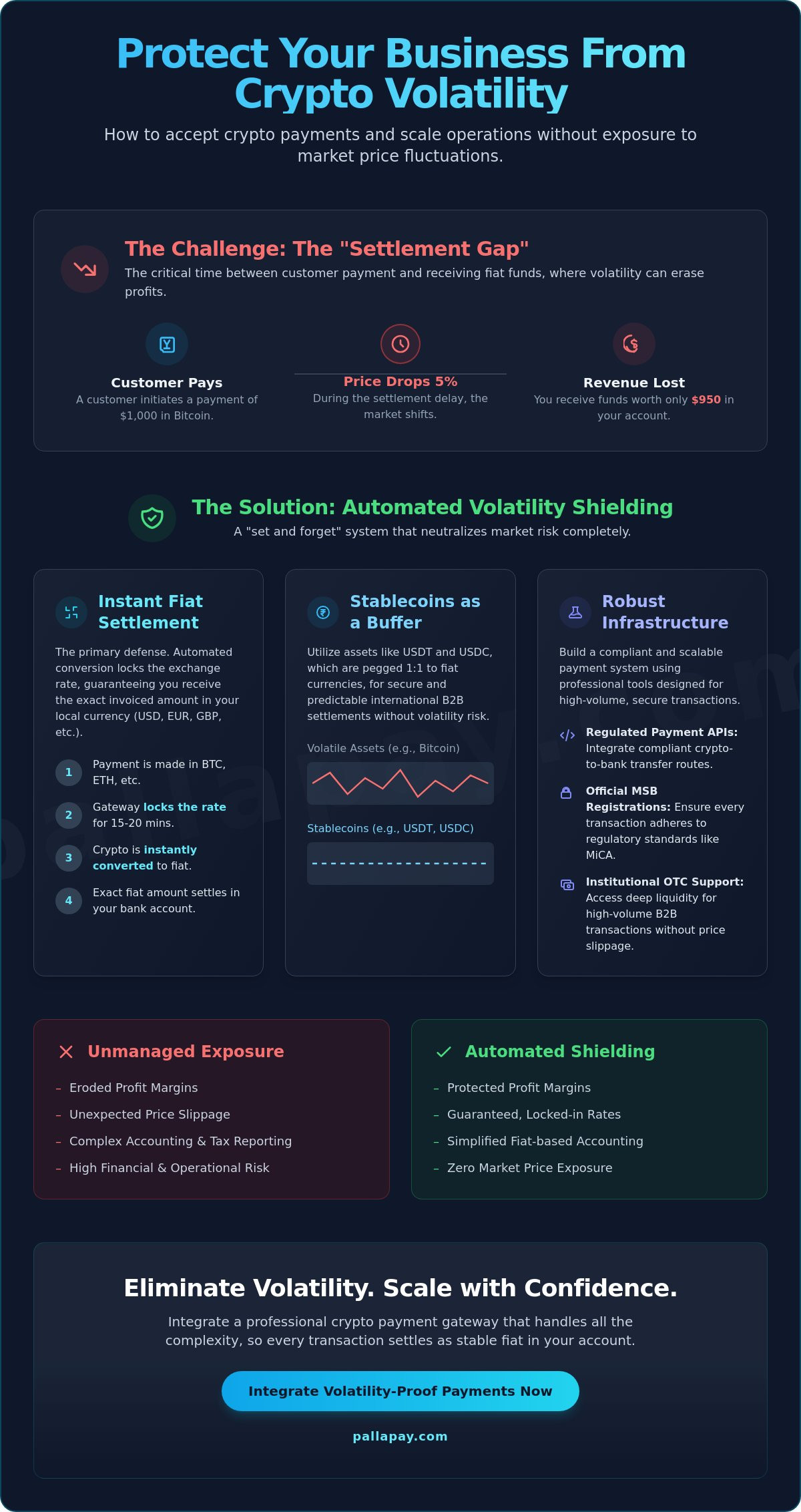
    The primary challenge for merchants lies in the “Settlement Gap.” This is the critical window between the moment a customer initiates a payment and the moment the business receives usable funds in their bank account. If the asset value drops during this interval, the merchant effectively loses revenue before the transaction even clears. Protecting business from crypto volatility requires closing this gap through automated fiat settlement systems that provide an immediate hedge against market movement.

    The Hidden Costs of Unmanaged Fluctuations

    Unmanaged exposure erodes profit margins, especially during high-velocity sell-offs where prices can drop faster than manual exchange processes can clear. Beyond direct losses, accounting teams face significant complexities when the value of an asset shifts between the time an invoice is issued and the final audit. Price slippage occurs when the final execution price of a trade differs from the requested price due to market movement or insufficient liquidity, often resulting in unexpected costs for high-ticket B2B transactions. These friction points turn a modern payment method into a financial liability without the right shielding tools.

    Why 2026 Market Dynamics Require a Proactive Stance

    By mid-2026, the landscape has shifted due to massive institutional participation and maturing regulatory frameworks. With Bitcoin trading between $77,000 and $80,000 as of May 2026, and the scheduled launch of CME Group’s Bitcoin Volatility futures on June 1, price movements have become more sophisticated and faster. Liquidity now plays a dual role; deep liquidity can stabilize prices, yet global economic shifts can trigger rapid business-day swings that catch unprepared merchants off guard. Protecting business from crypto volatility is no longer about avoiding digital assets, but about using professional infrastructure to neutralize their erratic nature. Modern commerce demands a proactive stance where volatility is managed as a technical variable rather than a financial risk.

    The Mechanics of Instant Fiat Settlement: Your Primary Defense

    Relying on manual trading to manage digital assets is a high-stakes gamble that few corporations can afford. Protecting business from crypto volatility becomes a seamless background process through the implementation of instant fiat settlement. A professional gateway functions as a sophisticated buffer; it locks the exchange rate for a specific transaction window, typically between 15 and 20 minutes. This lock-in ensures that the amount of local currency you expect is exactly what arrives in your treasury, regardless of market movements during the confirmation process.

    The technological engine behind this is fiat settlement, which facilitates the automated conversion of assets like Bitcoin or Ethereum into USD, EUR, GBP, or CNY. This process removes the need for your company to hold volatile assets on its balance sheet. By choosing instant settlement over batch processing, you maintain superior cash flow and avoid the risk of overnight price drops that frequently plague unshielded accounts. It’s the difference between managing a currency and managing a risk.

    Eliminating Exchange Rate Risk at the Point of Sale

    Gateways calculate real-time spreads by connecting to institutional liquidity providers. These providers guarantee the locked price, absorbing the market risk so your business doesn’t have to. This automated workflow eliminates the human error and delay associated with manual trading. It’s a strategic shift from speculative uncertainty to operational stability. Businesses looking to automate this transition often integrate a crypto payment API to synchronize sales with financial records in real-time.

    Streamlining Accounting and Tax Compliance

    Receiving fiat directly simplifies VAT and corporate tax reporting significantly. It establishes a clear 1:1 ratio between the invoice amount and the settled bank deposit, which is essential for audit transparency. When you settle directly to bank accounts, you bypass the friction of digital asset custody.

    • Direct fiat settlement removes the need for complex capital gains calculations on every individual sale.
    • It allows for seamless integration with standard ERP systems, ensuring your books remain balanced without manual intervention.
    • Financial teams can treat these transactions as standard bank transfers rather than digital asset movements, reducing the training required for staff.

    This approach turns a disruptive technology into a standard, effortless business operation. By removing the volatility variable, you focus on growth while the gateway handles the underlying mechanics of currency conversion.

    Protecting Business From Crypto Volatility: The 2026 Strategic Guide

    Stablecoins: Using USDT and USDC as a Strategic Buffer

    While instant fiat conversion is the premier defense for retail transactions, many B2B operations require a more flexible medium for holding digital value. Stablecoins are digital assets pegged 1:1 to traditional currencies like the US Dollar, combining the borderless efficiency of blockchain with the price predictability of fiat. By utilizing these assets, you create a strategic layer for protecting business from crypto volatility without needing to exit the digital ecosystem entirely. As of March 2026, USDT maintains its position as a primary liquidity tool with a market capitalization of approximately $183.6 billion, while USDC has grown to $75.3 billion, largely due to its alignment with the GENIUS Act in the United States and MiCA regulations in Europe.

    The operational utility of stablecoins relies on a reliable transition between digital and traditional finance. Converting these assets into bank transfers or physical cash is handled through professional off-ramp services, which act as a vital bridge for global liquidity. This infrastructure allows a business to accept USDT from an international client and move it into a corporate bank account with the same speed and security as a local wire transfer. It’s a sophisticated method for protecting business from crypto volatility while maintaining the ability to deploy capital whenever it’s needed.

    Cross-Border Payments Without the Swing

    Traditional SWIFT transfers are often slow and burdened by high intermediary fees. Stablecoins bypass these legacy bottlenecks, allowing businesses to pay global suppliers instantly at any hour. This is particularly advantageous during “weekend” market gaps when traditional banks are closed but digital markets remain active. By settling in USDT or USDC, you ensure that the value sent on Friday is the same value received on Saturday, regardless of how Bitcoin or Ethereum might perform over the weekend. It’s an essential tool for maintaining price consistency across complex supply chains.

    Managing Liquidity with Digital Wallets

    A secure crypto wallet serves as more than just storage; it’s a command center for holding operational reserves. Professional teams use these wallets to balance fiat holdings with stablecoin liquidity, allowing for rapid re-investment or settlement without waiting for traditional banking cycles. In 2026, audited and fiat-backed stablecoins operate within a mature regulatory framework, providing a transparent and secure foundation for corporate treasury management. This integrated approach ensures that your business remains agile and liquid, regardless of broader market fluctuations.

    Building a Volatility-Resistant Infrastructure for Retail and Web

    Establishing a robust infrastructure requires a multi-layered approach that bridges digital and physical sales channels. Protecting business from crypto volatility is most effective when the protection is baked into the hardware and software used daily. First, prioritize a regulated provider with official MSB registrations in credible jurisdictions like the US and Canada to ensure compliance and institutional trust. Second, integrate a crypto payment API to automate web checkouts and eliminate manual conversion delays. Third, for physical locations, deploy Crypto POS machines that lock in rates at the moment of sale. Fourth, configure auto-withdraw settings to move funds to your bank account daily. Finally, train your finance team to view these assets as a high-speed payment rail rather than a speculative investment.

    This systematic deployment turns a complex financial challenge into a standard operational workflow. By automating the conversion and withdrawal process, you ensure that your treasury remains liquid and denominated in the currency you use to pay your bills. Protecting business from crypto volatility isn’t about predicting the market; it’s about building a system that doesn’t care what the market does.

    Unified Protection for Omni-channel Commerce

    Managing online and offline sales through a single dashboard provides a comprehensive view of global liquidity and transaction history. For retail stores, this setup allows staff to process transactions without needing to manage private keys or understand blockchain mechanics. Hardware-level encryption in POS terminals ensures that every swipe or scan is secure, providing institutional-grade safety at the point of sale. This unified approach eliminates the data silos that often lead to accounting errors in multi-channel businesses.

    Future-Proofing with Advanced Payment APIs

    Advanced APIs allow you to display prices in local fiat while accepting digital assets, ensuring that your customers see familiar figures while you avoid market risk. This is crucial for e-commerce platforms scaling to a global audience with multi-currency support. Managing refunds and chargebacks becomes a standard accounting task when the system automatically calculates the fiat-equivalent value at the time of the transaction. This level of automation allows you to scale from local sales to global distribution without increasing your financial risk profile.

    Ready to secure your revenue streams? Integrate a professional payment API to automate your volatility protection and streamline your global checkouts.

    Why Pallapay is the Professional Choice for Volatility Management

    Pallapay stands as a definitive destination for corporations seeking to bridge the gap between disruptive innovation and institutional financial reliability. By maintaining official MSB registrations in the United States and Canada, the platform provides a foundation of trust that many unregulated entities cannot match. This regulatory standing is essential for protecting business from crypto volatility, as it ensures that every conversion and settlement follows strict compliance protocols. Businesses gain access to a comprehensive, integrated ecosystem that includes a robust crypto payment gateway, physical POS machines, and the Pallapay Mastercard. This suite of tools allows you to manage digital assets as easily as traditional fiat, creating a seamless environment for modern commerce without the friction of multiple third-party providers.

    The brand functions as a professional bridge that connects established practices with modern advancements. By providing a single destination for all technical needs, it removes the complexity of managing disparate systems. This personality is reliable, efficient, and highly focused on empowering the user. It projects an image of a sophisticated partner that handles complex background processes, allowing you to focus on your core business growth while the infrastructure handles the market dynamics.

    Institutional Security and Compliance

    Adhering to rigorous crypto security standards is a core requirement for safeguarding merchant funds in 2026. Working with a regulated entity significantly reduces the risk of exposure to “dirty” cryptocurrency, which can lead to frozen accounts and legal complications. Pallapay acts as a professional facilitator, ensuring that all digital assets entering your treasury are vetted and compliant with international anti-money laundering standards. This level of institutional-grade oversight is a powerful tool for business expansion into over 180 countries. It gives your finance team the confidence to accept payments from diverse markets while knowing that the underlying technical background processes are handled by a sophisticated strategic partner.

    High-Volume Shielding with OTC Services

    Large-scale enterprises often require specialized handling for high-value transactions that exceed standard gateway limits. Through OTC crypto exchanges, businesses can move millions of dollars in assets without triggering market price slippage. This private, high-volume shielding is supported by a global network of physical offices that provide personalized corporate settlement assistance. These locations serve as a professional bridge, allowing for direct cash-to-crypto or crypto-to-bank transfers in a secure environment. It’s an efficient way to manage large-scale liquidity while protecting business from crypto volatility at every step of the conversion process, ensuring that institutional users maintain absolute stability.

    Strategic stability is the hallmark of a successful 2026 enterprise. By integrating these tools, you transform digital assets into a reliable utility for growth. Protect your business from volatility with Pallapay today and join a global network of professionals who prioritize security and speed.

    Secure Your Global Revenue Strategy

    The evolution of digital finance in 2026 has transformed market swings from a merchant’s nightmare into a manageable technical variable. By implementing instant fiat settlement and leveraging regulated stablecoin buffers, you’ve seen that liquidity and stability can coexist within a single ecosystem. Protecting business from crypto volatility is no longer a matter of timing the market; it’s about selecting the right institutional-grade infrastructure to automate your treasury flows. This proactive approach ensures your profit margins remain intact while you tap into a maturing $4 trillion global economy.

    Pallapay provides this essential bridge, offering MSB-registered security in the USA and Canada while serving professional clients across 180+ countries. You can now accept digital assets with the absolute confidence of instant fiat settlement in USD, EUR, and other major currencies. Secure your business margins with Pallapay’s regulated payment gateway and turn disruptive innovation into a standard, effortless business operation. Your enterprise is ready to lead in a borderless market. Take the next step toward a stable, high-growth future today.

    Frequently Asked Questions

    How can a business accept Bitcoin without being exposed to its volatility?

    You can accept Bitcoin safely by using a crypto payment gateway that facilitates instant fiat conversion at the point of sale. This system locks the exchange rate for the duration of the transaction window, ensuring you receive the exact local currency amount. By converting the asset immediately, your business avoids the risk of holding a digital asset that might decrease in value before you can manually exchange it.

    Is it better to settle in fiat currency or keep stablecoins in 2026?

    The decision depends on your treasury needs; fiat settlement provides immediate stability for local expenses while stablecoins offer high-speed liquidity for international B2B settlements. Many corporations choose fiat for retail operations to simplify accounting and tax reporting. Stablecoins like USDT or USDC are often reserved for paying global suppliers or maintaining digital reserves that don’t require traditional banking hours to move.

    What is the difference between a crypto exchange and a merchant payment gateway?

    A merchant payment gateway is a specialized tool for commercial transactions that prioritizes rate locks and automated settlement, whereas an exchange is built for trading and speculation. Gateways provide the essential infrastructure for protecting business from crypto volatility by removing the need for manual trading. They integrate directly with your sales platform to ensure that every transaction settles into your bank account as a standard currency deposit.

    Can I set my own exchange rates when accepting crypto payments?

    Merchants typically don’t set their own rates because the gateway provides a real-time institutional rate at the moment of checkout. This rate is pulled from deep liquidity providers to ensure it remains competitive and accurate for the customer. Attempting to set manual rates would likely lead to significant price slippage or lost sales due to uncompetitive pricing compared to the global market average.

    How do I handle taxes if the crypto price changes before I sell it?

    You should consult a qualified tax professional to understand the specific reporting requirements in your region. Using a gateway that converts crypto to fiat instantly simplifies this task by establishing a clear cost basis at the exact moment of the sale. This creates a transparent, 1:1 record between your invoice and your bank deposit, which is vital for maintaining compliant records during a corporate audit.

    What are the fees for protecting a business from crypto volatility?

    Fees for volatility protection are generally integrated into the transaction spread or charged as a small percentage of the total volume processed through the gateway. You should review the specific service agreement of your provider to understand the costs associated with POS machines or API integrations. The cost of protecting business from crypto volatility is usually far lower than the potential revenue loss from a single market crash.

    Is a Crypto POS machine safer than a standard wallet for my store?

    A Crypto POS machine is much safer for retail environments because it uses hardware-level encryption and prevents staff from accessing private keys. Standard wallets are designed for individual custody and lack the multi-user permissions and reporting features required for a commercial setting. POS systems are purpose-built to handle high-velocity sales and facilitate instant settlement into your corporate accounts without manual intervention.

    How long does it take to convert crypto to a bank transfer?

    The conversion from crypto to fiat is often instant through a professional gateway, while the transfer to your bank account depends on standard banking network speeds. Most off-ramp services facilitate these transfers within the same business day or the next, depending on the destination currency and bank. Automated withdrawal settings can be configured to ensure your funds move from the gateway to your bank account on a recurring daily schedule.

    Disclaimer

    The information provided on this website and blog is for general informational and educational purposes only and does not constitute financial, investment, legal, tax, or other professional advice.
    Cryptocurrency and digital asset services may be subject to regulatory restrictions in certain jurisdictions. Users are solely responsible for ensuring compliance with applicable local laws and regulations before using any products or services mentioned on this website.
    PallaPay does not guarantee the accuracy, completeness, or timeliness of any information published and accepts no liability for any loss or damages arising from reliance on the content. Any opinions expressed are those of the respective authors and may change without notice.
    Certain services, features, or products referenced may be provided through third-party partners, licensed entities, or affiliated service providers subject to separate terms and regulatory approvals. Availability of services may vary by country or region.
    This website may contain references to digital assets, virtual currencies, or blockchain-related services that are not available to residents of certain jurisdictions, including where prohibited by law. Nothing on this website constitutes an offer, solicitation, or recommendation to buy or sell any financial instrument or virtual asset.

  • The Essential Benefits of Using a Regulated Crypto Exchange in 2026

    The Essential Benefits of Using a Regulated Crypto Exchange in 2026

    By mid-2026, the era of the “wild west” crypto market hasn’t just faded; it’s been replaced by a global financial framework that demands absolute transparency. With over 560 million people now participating in the digital economy, the focus has shifted from speculative hype to institutional-grade security. You’ve likely felt the lingering anxiety of past exchange collapses or the frustration of trying to move your assets into a bank account without triggering a compliance nightmare. Understanding the core benefits of using a regulated crypto exchange is now the only way to ensure your capital remains both protected and liquid.

    We’ll show you how new standards like the SEC joint interpretations and the GENIUS Act of 2026 have transformed digital assets into secure tools for global commerce. This guide explores how regulatory oversight guarantees asset safety while providing the seamless fiat conversion necessary for modern business. You’ll discover how to leverage institutional transparency to turn crypto into a stable, high-speed component of your financial strategy.

    Key Takeaways

    • Learn how regulatory mandates protect your capital by requiring the strict segregation of client assets from operational company funds.
    • It’s vital to understand the core benefits of using a regulated crypto exchange to ensure institutional-grade transparency through mandatory proof-of-reserves.
    • Identify the security protocols that allow for the safe conversion of crypto to fiat currencies like USD, EUR, and GBP without legal friction.
    • Understand how to bridge the gap between digital assets and traditional finance with seamless, instant crypto to bank transfers.
    • Explore how a licensed ecosystem, featuring OTC desks and crypto POS machines, transforms digital assets into practical tools for global commerce.

    What Defines a Regulated Crypto Exchange in 2026?

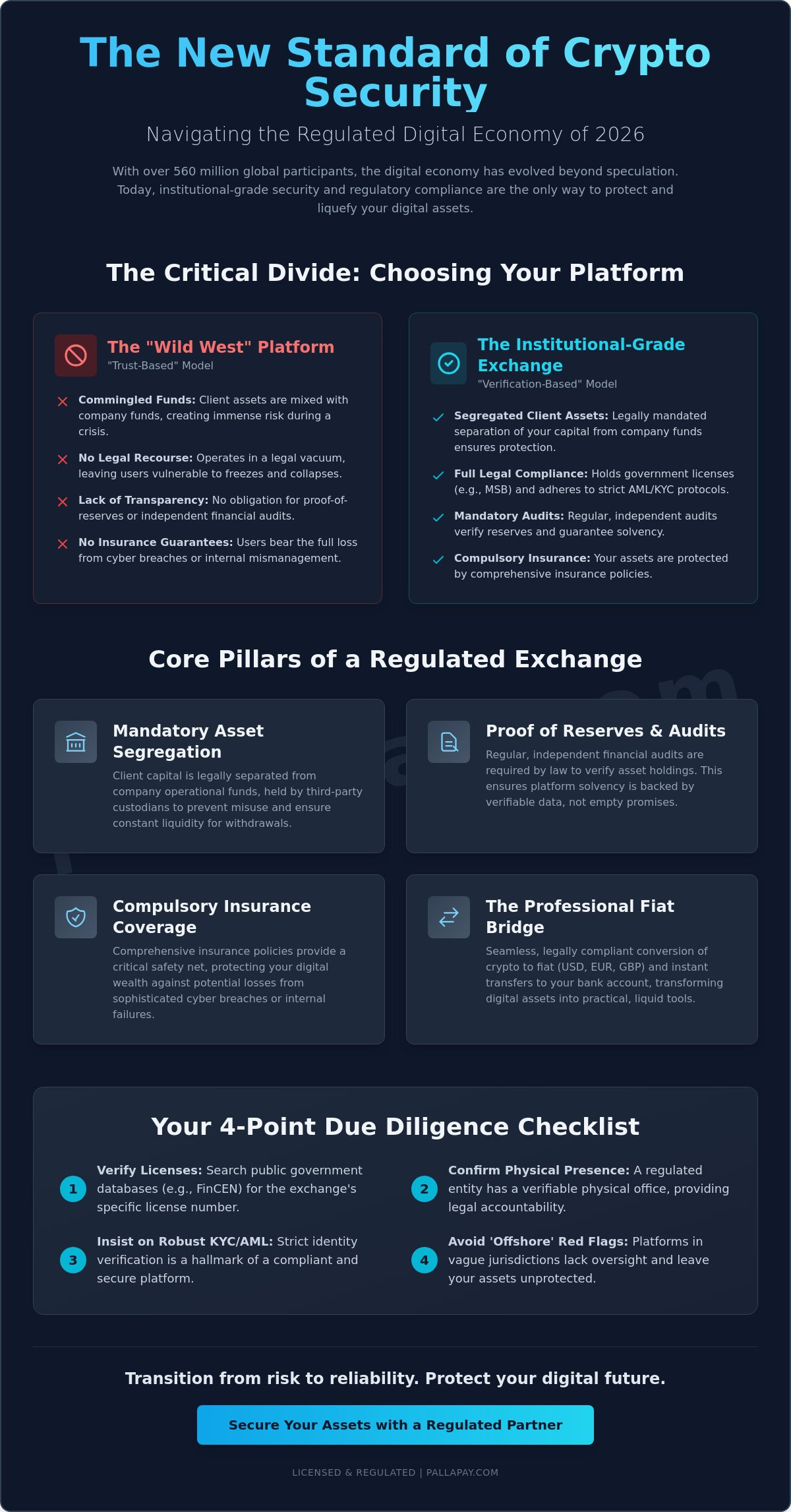
    In the current financial landscape, the distinction between a simple trading platform and a regulated financial institution has never been more critical. By 2026, the global Regulation of cryptocurrency has evolved from a fragmented set of guidelines into a rigorous legal mandate. Regulatory oversight isn’t just a badge of honor; it’s a structural requirement for operational transparency. It ensures that every transaction is monitored, every asset is accounted for, and every user is protected by the same standards governing traditional finance. One of the primary benefits of using a regulated crypto exchange is the transition from a “trust-based” model to a “verification-based” model where legal compliance is the ultimate security feature.

    Modern standards require more than just a basic business registration. While many platforms claim to be “registered,” a truly regulated exchange holds specific government-issued licenses that authorize digital asset transactions. These licenses, such as the Money Services Business (MSB) designation, subject the provider to strict audits and capital requirements. This institutional-grade framework is what allows professional users to execute high-volume trades and manage crypto offramp operations with absolute confidence. Without these authorizations, an exchange operates in a legal vacuum, leaving users vulnerable to sudden freezes or liquidity crises.

    The Legal Framework of Modern Digital Assets

    The journey from the unregulated markets of 2018 to the sophisticated environment of 2026 has been defined by the rise of “hyper-compliance.” Key regulatory bodies like FinCEN in the United States and FINTRAC in Canada now set the global pace for digital asset safety. These agencies require exchanges to implement robust Anti-Money Laundering (AML) and Know Your Customer (KYC) protocols that mirror traditional banking standards. Today, an MSB registration is the gold standard for global compliance, signaling that an exchange has the procedural depth to handle complex technical conversions as standard business operations. This evolution ensures that your digital wealth is recognized as a legitimate financial tool by global commerce entities.

    Verifying Compliance: A Checklist for Users

    Identifying a secure partner requires active due diligence rather than relying on marketing claims. You should always verify an exchange’s credentials by searching public government databases for their specific license numbers. A legitimate provider will maintain a physical office presence in regulated jurisdictions, providing a clear point of legal accountability. Watch for red flags such as “offshore” platforms that lack a verifiable physical address or those that offer high-speed fiat conversions without requiring identity verification. In 2026, the benefits of using a regulated crypto exchange are most apparent when you can easily confirm that your provider is integrated into the formal financial system, ensuring your assets remain accessible and legally compliant.

    Superior Security Protocols and Asset Protection

    Security in the digital asset space has evolved from a technical preference into a strict legal obligation. One of the primary benefits of using a regulated crypto exchange is the mandatory segregation of client assets from the platform’s operational funds. This legal requirement ensures that your capital isn’t used for company expenses or high-risk lending practices. When an exchange operates under institutional-grade oversight, third-party custodians often hold the assets, providing a layer of protection that unregulated platforms simply cannot match. This structural separation is a cornerstone of this guide to cryptocurrency regulation, which highlights how legal frameworks prioritize investor safety.

    Compulsory insurance requirements further bolster this security. In 2026, regulated entities must maintain comprehensive insurance policies to cover potential losses from cyber breaches or internal mismanagement. This transition from “trust-based” security to “guaranteed” protection means that your digital wealth is backed by the same level of financial accountability found in traditional banking. Regular independent financial audits verify these reserves, ensuring that the platform’s claims of solvency are backed by verifiable data rather than empty promises.

    Custodial Safety and Segregated Accounts

    Segregated accounts are the most effective defense against the “bank runs” that historically crippled the crypto market. By keeping user deposits separate, regulated exchanges ensure that liquidity is always available for immediate withdrawal. This system is supported by multi-signature cold storage protocols, where multiple authorized parties must approve any movement of funds from offline wallets. You can explore more about these technical safeguards in our detailed look at Crypto Security. These protocols eliminate single points of failure, protecting your assets from both external hackers and internal fraud. For those seeking the highest level of personal control within this secure framework, utilizing a secure digital wallet provides an integrated way to manage your holdings.

    AML and KYC: Protecting the Ecosystem

    Robust identity verification through Anti-Money Laundering (AML) and Know Your Customer (KYC) protocols isn’t just a hurdle; it’s a protective shield for the entire ecosystem. These processes prevent illicit actors from using the exchange, which in turn ensures “clean” liquidity for high-volume institutional traders. When you trade on a regulated platform, you aren’t just protecting your own assets; you’re participating in a market that is recognized by global regulators. This high level of compliance significantly reduces the risk of government-led asset freezes that often plague unregulated, offshore platforms. By adhering to these standards, a regulated exchange provides a stable environment where your transactions are processed with speed and legal certainty.

    The Essential Benefits of Using a Regulated Crypto Exchange in 2026

    Market Integrity and Operational Transparency

    One of the primary benefits of using a regulated crypto exchange is the elimination of the “black box” operational style that once characterized the early digital asset market. In 2026, market integrity isn’t a voluntary choice; it’s a structural requirement enforced by rigorous surveillance and reporting standards. Regulated platforms must implement sophisticated monitoring systems designed to detect and prevent wash trading, spoofing, and other forms of market manipulation. This oversight ensures that the prices you see on the order book reflect genuine supply and demand rather than artificial volume generated by bots. When you trade in an environment governed by the CLARITY Act or similar global standards, you’re participating in a fair market where every participant plays by the same rules.

    Transparency also extends to the cost of doing business. Unlike unregulated platforms that often hide their profit margins within opaque “spreads,” regulated entities are legally bound to provide clear, upfront fee structures. This clarity allows professional users to calculate their exact overhead when they sell crypto to bank accounts or execute high-volume conversions. Reporting requirements ensure that users receive fair market prices, with every transaction backed by a verifiable audit trail that satisfies both internal compliance officers and external tax authorities.

    Preventing Market Manipulation

    Regulated exchanges use institutional-grade surveillance tools to maintain a healthy trading ecosystem. These systems flag suspicious patterns in real-time, preventing bad actors from abusing the order book to the detriment of honest traders. This level of scrutiny leads to more accurate price discovery, which is essential for businesses that rely on stable valuations for their operations. For those conducting large-scale transactions through an OTC crypto exchange, fair execution is guaranteed by these anti-manipulation protocols. You don’t have to worry about “slippage” caused by artificial price spikes, as the exchange’s regulatory status mandates a commitment to execution quality.

    The Power of Audited Reserves

    There’s a fundamental difference between a “self-reported” proof-of-reserves and a certified regulatory audit. While many platforms might offer a snapshot of their holdings, a regulated exchange undergoes regular, independent financial audits that verify its solvency and asset backing. This transparency builds the confidence needed for massive institutional adoption, which has already pushed the global crypto market cap to approximately $2.5 trillion as of March 2026. Pallapay’s ecosystem is built on this foundation of verified stability. By maintaining global MSB registrations, the platform ensures that every technical conversion, from a crypto wallet deposit to a Mastercard payment, is supported by a robust and legally recognized financial framework.

    The Professional Bridge: Seamless Fiat Integration

    Bridging the gap between disruptive digital assets and traditional financial infrastructure requires more than just code; it requires a recognized legal standing. One of the most practical benefits of using a regulated crypto exchange is the high level of trust it establishes with global banking partners. Banks are historically risk-averse and often hesitate to process transfers from platforms that lack clear oversight. When an exchange operates under a recognized license, it provides the “clean” audit trail that financial institutions demand. This transparency ensures that your funds aren’t flagged or delayed, allowing for a fluid movement of capital between the digital and traditional worlds.

    The ability to convert crypto to fiat instantly is a game-changer for both individual professionals and global enterprises. By 2026, regulated platforms have streamlined this process to feel like a standard banking operation. You can move from Bitcoin or USDT to major currencies like USD, EUR, or GBP without the legal friction typically associated with offshore entities. This connectivity allows users to maintain liquidity and react to market changes in real-time. Beyond simple transfers, regulation enables the use of sophisticated tools like the Pallapay Mastercard, which allows you to spend your digital holdings at millions of locations worldwide just as easily as traditional cash.

    Reliable Fiat Off-Ramping

    Accessing your capital shouldn’t be a source of anxiety. A secure off-ramp is essential for maintaining the utility of your digital assets. Unregulated platforms frequently face “banking blackouts,” where sudden regulatory shifts or lack of compliance lead to frozen transfers and lost access to fiat gateways. In contrast, a regulated status ensures consistent bank connectivity by adhering to the same reporting standards as the banks themselves. This alignment means your transfers are recognized as legitimate commercial activity, providing a reliable path for those who need to sell crypto to bank accounts quickly and securely.

    Merchant Utility and Global Settlements

    For businesses, the benefits of using a regulated crypto exchange extend into daily operations and customer interactions. Utilizing a regulated payment API allows merchants to accept various cryptocurrencies while settling in their local currency, effectively neutralizing the risks of price volatility. This technology is particularly transformative for the hotel industry and high-end retail, where international clients often prefer the speed of digital payments. Compliant POS systems and payment gateways provide a professional experience for the customer while ensuring the business remains fully aligned with local tax and legal requirements. Start your journey toward financial flexibility and convert crypto to fiat instantly through our secure, regulated ecosystem.

    Choosing the Right Partner: The Pallapay Standard

    Selecting a financial partner in the digital asset space requires a focus on verifiable credentials and institutional reliability. One of the most significant benefits of using a regulated crypto exchange is the assurance that your provider operates under the direct supervision of major financial authorities. Pallapay LLC maintains registration with FinCEN as a Money Services Business in the United States, while Pallapay Ltd is registered with FINTRAC in Canada. These registrations aren’t mere formalities; they’re active commitments to the highest global standards of financial conduct and asset protection. By operating within these recognized frameworks, the platform ensures that every technical conversion is backed by a legally compliant infrastructure.

    In an increasingly digital world, the importance of a physical office presence and local accountability cannot be overstated. While many platforms operate from anonymous offshore locations, a regulated partner provides a clear point of legal contact and a physical footprint in the jurisdictions they serve. This transparency builds the absolute trust required for professional and individual users to manage high-value transactions. This infrastructure empowers users across 180+ countries to engage in global commerce with the confidence that their assets are handled by a sophisticated financial partner. Trust is the currency of 2026.

    A Global Ecosystem of Compliance

    Efficiency in modern commerce stems from having a comprehensive, integrated ecosystem that handles everything from exchange to settlement. Pallapay provides a single destination for all relevant technical needs, offering a seamless transition between various digital assets and local currencies. High-volume traders can leverage the specialized services of an OTC Crypto Exchange to execute large orders without disrupting market prices. Having a single partner for your exchange, payment, and crypto offramp needs reduces the complexity of managing multiple accounts and ensures that your compliance trail remains clean and consolidated.

    The Future of Regulated Finance

    The global move toward “hyper-compliance” positions licensed providers as the essential components of an inevitable global evolution. As digital assets become a standard part of the financial toolkit, the ability to spend those assets with ease becomes a primary operational need. The Pallapay Mastercard bridges this gap, allowing you to utilize your holdings for daily business and personal expenses at millions of locations. By aligning with a partner that understands the benefits of using a regulated crypto exchange, you eliminate the operational risks associated with offshore, unlicensed platforms. Prioritize your security by choosing a partner that handles complex background processes with the professionalism your capital deserves.

    Securing Your Position in the Global Digital Economy

    The transition toward a regulated cryptocurrency landscape in 2026 has redefined how professionals and institutions interact with digital wealth. You now have the power to move beyond speculative uncertainty by choosing platforms that prioritize legal accountability and asset segregation. By prioritizing these standards, you unlock the full benefits of using a regulated crypto exchange while insulating your capital from the risks of the unregulated market. This strategic choice ensures that your holdings are recognized as legitimate financial tools within the global economy.

    Success in this evolving sector requires a partner with a proven track record of compliance and a comprehensive ecosystem. With official MSB registrations in the United States and Canada, and a presence spanning 180+ countries, Pallapay provides the institutional-grade stability your operations require. You can manage everything from high-volume OTC trades to instant fiat settlements within a single, secure environment. It’s time to elevate your financial strategy with a partner that bridges the gap between innovation and reliability. Experience the security of a fully regulated exchange; join Pallapay today.

    Frequently Asked Questions

    Why is a regulated crypto exchange safer than a decentralized one?

    Regulated exchanges provide a layer of legal accountability that decentralized platforms lack. They are mandated to follow strict asset segregation and insurance protocols. This structure ensures that user funds are protected from internal mismanagement or platform failure. By operating within a recognized legal framework, these exchanges offer a level of security that decentralized protocols cannot guarantee.

    What does MSB registration mean for a crypto platform?

    MSB registration stands for Money Services Business, a designation issued by authorities like FinCEN in the US or FINTRAC in Canada. It confirms the platform adheres to rigorous Anti-Money Laundering (AML) and Know Your Customer (KYC) standards. This status is one of the primary benefits of using a regulated crypto exchange, as it verifies the entity’s commitment to global financial transparency and institutional reliability.

    Will using a regulated exchange affect my transaction speed?

    Transaction speeds on regulated platforms are typically comparable to or faster than unregulated ones, especially for fiat integrations. Since these exchanges maintain direct relationships with global banking networks, processes like a crypto to bank transfer are executed with institutional efficiency. Compliance protocols are integrated into the background to ensure that speed isn’t sacrificed for security.

    How do regulated exchanges protect my personal data during KYC?

    Regulated exchanges must comply with international data protection laws, ensuring your personal information is encrypted and stored securely. Unlike offshore platforms, these entities are legally liable for any data breaches. They use sophisticated cybersecurity frameworks to manage KYC documents, preventing unauthorized access while maintaining the clean liquidity required for professional commerce and global settlements.

    Can I still withdraw cash from a regulated exchange?

    You can certainly convert your digital holdings into physical currency through authorized channels. Regulated providers allow users to sell Bitcoin for cash or sell USDT for cash at physical locations. These operations are conducted within a secure framework that ensures every cash transaction is compliant with local regulations and reporting requirements.

    What happens to my assets if a regulated exchange faces legal issues?

    Segregated account mandates ensure that user assets remain separate from the exchange’s operational capital. If a platform faces legal or financial difficulties, these funds are protected from being used to satisfy company debts. This legal firewall is a core component of institutional reliability, providing a safety net that is nonexistent on unregulated or decentralized platforms.

    Are fees higher on regulated crypto platforms?

    Fees on regulated platforms are characterized by transparency rather than just cost. While some unregulated exchanges hide their margins in wide spreads, regulated entities provide clear, upfront pricing for services like an OTC crypto exchange. This clarity allows businesses to accurately forecast their operational costs without worrying about hidden expenses or artificial price manipulation.

    How do I check if a crypto exchange is actually licensed in 2026?

    You can verify an exchange’s status by searching official government registries using their unique license number. In the US, you would search the FinCEN MSB database, while in Canada, you would check the FINTRAC registry. A legitimate provider will clearly display these credentials and maintain physical offices in their registered jurisdictions to ensure absolute accountability and professional service.

    Disclaimer

    The information provided on this website and blog is for general informational and educational purposes only and does not constitute financial, investment, legal, tax, or other professional advice.
    Cryptocurrency and digital asset services may be subject to regulatory restrictions in certain jurisdictions. Users are solely responsible for ensuring compliance with applicable local laws and regulations before using any products or services mentioned on this website.
    PallaPay does not guarantee the accuracy, completeness, or timeliness of any information published and accepts no liability for any loss or damages arising from reliance on the content. Any opinions expressed are those of the respective authors and may change without notice.
    Certain services, features, or products referenced may be provided through third-party partners, licensed entities, or affiliated service providers subject to separate terms and regulatory approvals. Availability of services may vary by country or region.
    This website may contain references to digital assets, virtual currencies, or blockchain-related services that are not available to residents of certain jurisdictions, including where prohibited by law. Nothing on this website constitutes an offer, solicitation, or recommendation to buy or sell any financial instrument or virtual asset.
  • How Do Crypto POS Systems Work? The Complete Merchant Guide for 2026

    How Do Crypto POS Systems Work? The Complete Merchant Guide for 2026

    By 2026, global retail spending via digital assets is projected to reach $22.5 billion, marking a definitive shift toward the future of payments. To remain competitive in this evolving landscape, you must understand exactly how do crypto pos systems work to facilitate these high-speed exchanges. You’ve likely felt the hesitation that comes with blockchain technology; the fear that a sudden price drop will impact your revenue or that a slow network will cause a bottleneck at your checkout counter.

    We’ve designed this guide to bridge the gap between technical innovation and institutional reliability. You’ll discover how modern POS solutions provide instant liquidity and seamless conversion, allowing you to accept cryptocurrency while receiving stable fiat currency in your bank account. We will break down the essential hardware requirements, the four-step transaction lifecycle, and the settlement processes that keep your business secure and efficient in a global market.

    Key Takeaways

    • Understand exactly how do crypto pos systems work to facilitate seamless, direct interactions between blockchain networks and your retail terminal.
    • Master the four-step transaction lifecycle that ensures instant payment verification through dynamic QR codes and secure wallet signatures.
    • Discover how to eliminate volatility risks by utilizing instant fiat conversion for stable, predictable business settlements.
    • Identify critical multi-currency features and ERP integration capabilities necessary for scaling a modern global retail operation.
    • Learn to leverage MSB-regulated infrastructure to ensure institutional-grade security for every digital asset transaction.

    What is a Crypto POS System? Defining the Modern Terminal

    A Crypto POS (Point-of-Sale) system represents the professional evolution of retail hardware. It’s a sophisticated combination of secure hardware and cloud-based software that empowers merchants to accept digital assets like Bitcoin, Ethereum, or USDT. Unlike traditional terminals that rely on legacy banking rails and multi-day clearing cycles, these modern systems interact directly with decentralized blockchain networks or specialized payment gateways. A Crypto POS serves as the bridge between decentralized finance and traditional retail commerce.

    Understanding how crypto payments work is the first step toward modernizing a business’s financial infrastructure. These systems calculate real-time exchange rates at the exact moment of sale. This ensures the merchant receives the precise value of the transaction in their preferred currency, effectively neutralizing the risks associated with price volatility. By 2026, the global market for these terminals has expanded significantly as businesses seek faster settlement times and lower fees compared to traditional credit card processors. So, how do crypto pos systems work in a practical retail setting? They convert the requested fiat amount into its crypto equivalent instantly, generating a unique QR code or an NFC signal for the customer to authorize from their digital wallet.

    The system functions as an all-in-one ecosystem that handles the heavy lifting of blockchain verification. When a customer initiates a payment, the terminal communicates with a payment gateway to verify the availability of funds and the authenticity of the transaction. This process happens in seconds, providing an instant confirmation that mirrors the speed of a standard debit card swipe. Merchants don’t need to manage private keys or interact with complex exchange interfaces; the terminal provides a streamlined, professional interface that mirrors the tools they already use. These devices represent the future of payments, offering a global reach that traditional banks cannot match.

    Clearing the Confusion: POS vs. PoS

    It’s common to find overlapping results when searching for these terms, but they serve entirely different roles. POS refers to the Point-of-Sale terminal used at a checkout counter for retail transactions. In contrast, PoS stands for Proof-of-Stake, which is a consensus mechanism used by blockchains like Ethereum to secure their networks. You don’t need to understand the complexities of staking or network validation to operate a Point-of-Sale terminal. Confusion between these terms often leads business owners to believe crypto payments are technically inaccessible, but the reality is a user-friendly experience designed for efficiency.

    The Evolution of Retail Payments in 2026

    Crypto terminals have transitioned from niche experimental tech into mainstream retail necessities. The integration of NFC technology has made crypto payments as fast as tapping a traditional credit card, which is essential for high-traffic environments. Various sectors are leading this change, with hotels and luxury retailers adopting these systems to cater to a global, tech-savvy clientele. These industries recognize that offering diverse payment options is a standard for global commerce. By removing the friction of currency conversion, these terminals allow businesses to scale their operations internationally with ease.

    Behind the Scenes: The 4-Step Transaction Lifecycle

    Understanding how do crypto pos systems work requires looking past the sleek hardware to the sophisticated software stack that manages digital assets in real time. While a traditional credit card transaction relies on legacy banking rails that can take days to settle, a crypto POS terminal operates on a decentralized infrastructure designed for immediate finality. This process transforms a complex blockchain interaction into a familiar, user-friendly retail experience that mirrors the speed of a standard contactless payment.

    Step 1 & 2: Initiation and Wallet Communication

    The lifecycle begins when the merchant enters the fiat amount into the terminal interface. At this moment, the Payment API performs the heavy lifting by calculating the exact cryptocurrency equivalent. This isn’t a static conversion; the system queries multiple global liquidity providers to secure the most competitive exchange rate available in 2024. Once the rate is determined, the terminal generates a dynamic QR code. This code is more than just an image. It’s a secure data packet containing the merchant’s destination address, the precise amount, and a unique transaction ID.

    When the customer scans this code using their mobile wallet, the two devices establish a secure connection using encrypted protocols. The wallet then broadcasts a digitally signed transaction to the payment gateway. This signature acts as a cryptographic guarantee of ownership, ensuring that the funds cannot be redirected or altered. Because the communication is peer-to-peer, it bypasses the multiple intermediaries that typically slow down traditional financial transfers. Merchants often find that how do crypto pos systems work is actually more direct than the 5-step process involved in standard visa or mastercard processing.

    Step 3 & 4: Validation and Confirmation

    Once the payment gateway receives the signed transaction, it moves into the validation phase. To protect the merchant from price volatility, the gateway typically locks in the exchange rate for a window of 15 minutes. This prevents “slippage,” where the value of the crypto might change between the scan and the settlement. A critical distinction here is the difference between on-chain confirmation and instant gateway approval. While a base-layer Bitcoin transaction might take 10 minutes to confirm on the blockchain, modern gateways use Layer-2 solutions like the Lightning Network to achieve sub-second transaction times. These protocols allow for 0.5-second processing, making crypto viable for high-traffic environments like cafes or supermarkets.

    As noted by industry experts at Tech Times, understanding How a Crypto POS System Works is becoming vital for retailers who want to eliminate the 3% fees associated with traditional banks. After the gateway verifies the availability of funds, the terminal displays a green checkmark and prints a physical or digital receipt. In the backend, the merchant’s dashboard reflects the transaction immediately. The system automatically logs the data for tax compliance and inventory management, providing a seamless bridge between blockchain technology and daily business operations. If you’re ready to modernize your storefront, you can explore our professional terminal options to see these steps in action.

    The final step involves the actual settlement. Even though the receipt is printed instantly, the gateway handles the “settlement” by moving the funds into the merchant’s designated account. Depending on the merchant’s preference, these funds can remain as cryptocurrency or be automatically converted into fiat currency like USD or AED. This flexibility ensures that the business remains protected from market swings while still offering customers the freedom to pay with digital assets.

    How Do Crypto POS Systems Work? The Complete Merchant Guide for 2026

    Fiat vs. Crypto Settlements: How Your Business Gets Paid

    Understanding how do crypto pos systems work requires looking at the final destination of your revenue. Merchants don’t need to be blockchain experts to accept digital payments because the system handles the complex conversion layers. You have the executive power to decide whether your sales revenue stays in the digital ecosystem or arrives in your bank account as local currency. This flexibility bridges the gap between disruptive technology and the practical needs of daily business operations.

    The Instant Fiat Settlement Advantage

    Chief Financial Officers often prioritize stability and predictable cash flow over market speculation. By utilizing fiat settlement services, your business locks in the exact price of a sale the moment a customer completes the transaction. This process effectively eliminates the risk of price drops that might occur between the time of sale and the bank deposit. Recent research on cryptocurrency market behavior shows that while retail trading flows can be volatile, a professional gateway absorbs this volatility so your balance sheet doesn’t have to. You receive the precise fiat amount listed on your invoice, minus a transparent processing fee.

    Managing the administrative side of these transactions is equally streamlined. Your merchant dashboard provides the following benefits:

    • Automated Tax Reporting: Generate real-time reports that categorize every transaction for local tax compliance.
    • Accounting Integration: Export data directly to software like QuickBooks or Xero via secure API hooks.
    • Volatility Shielding: The gateway locks the exchange rate for a specific window, ensuring the customer pays the fair market value while you receive a fixed fiat sum.

    The settlement cycle is the engine that drives your liquidity. Once the blockchain confirms a payment, the gateway initiates the transfer to your linked accounts. Modern 2026 systems allow for same-day fiat settlement in over 180 countries. This speed is a significant upgrade from the legacy T+3 or T+5 cycles common in traditional credit card processing, where funds are often held for days before becoming accessible. For a comprehensive breakdown of how to optimize this process for your enterprise, our crypto to fiat settlement strategic guide for global merchants covers instant conversion technology and audit-ready reporting in detail.

    Direct Crypto Settlements for Digital Treasuries

    Some enterprises choose to bypass fiat conversion entirely to build a digital treasury. If your business pays global suppliers in stablecoins or wants to hold Bitcoin as a long-term asset, you can opt for direct crypto settlements. In this scenario, the revenue moves directly into secure crypto wallets managed by your company. This is a strategic choice for the 28% of global businesses now operating in cross-border markets where traditional banking remains slow or prohibitively expensive.

    When you choose to keep digital assets, you often benefit from lower overall fees. Since there’s no conversion from crypto to fiat, the “spread” or exchange fee is removed from the equation. This allows you to retain more of every dollar earned. It’s a pure peer-to-peer flow that highlights exactly how do crypto pos systems work to maximize profit margins. Whether you’re holding USDT for its dollar-pegged stability or BTC for its growth potential, the choice remains entirely in your hands, accessible through a single, professional interface.

    Key Features and Implementation for Global Retailers

    Modern commerce demands flexibility. A robust crypto POS terminal isn’t just a card reader; it’s a gateway to a global liquidity pool. Understanding how do crypto pos systems work requires looking at their core infrastructure, which bridges the gap between digital assets and traditional accounting. These systems handle the heavy lifting of real-time conversion, ensuring that a merchant receives their preferred currency without exposure to market volatility. By 2024, the ability to accept Bitcoin, Ethereum, and USDT on a single device has become a standard requirement for businesses aiming to capture the growing segment of 420 million crypto users worldwide.

    Security and compliance form the backbone of these operations. Every transaction utilizes end-to-end encryption and mandatory two-factor authentication (2FA) to protect both the merchant and the consumer. For legal operations, using a provider registered as a Money Services Business (MSB) is non-negotiable. This registration ensures the provider adheres to strict Anti-Money Laundering (AML) and Know Your Customer (KYC) protocols, shielding your business from regulatory risks. Integration isn’t a hurdle either. Modern terminals sync with existing ERP and inventory management software via secure APIs, maintaining a single source of truth for all financial data.

    • Multi-Currency Support: Accept over 100 digital assets with instant settlement options.
    • ERP Integration: Sync sales data directly with platforms like SAP, Oracle, or Microsoft Dynamics.
    • Anti-Fraud Monitoring: Real-time blockchain analysis flags suspicious wallet addresses before a transaction completes.
    • Regulatory Peace of Mind: MSB-registered providers handle all compliance reporting automatically.

    Hardware vs. Software-Only POS

    Dedicated physical terminals offer the highest level of customer trust in a retail store environment. These devices are built for durability and provide a familiar checkout experience. For mobile businesses or popup shops, “SoftPOS” technology turns any NFC-enabled Android phone into a terminal. While software-only solutions offer 100% portability, physical hardware remains the gold standard for high-volume brick-and-mortar locations due to its superior processing speed and professional appearance.

    Integrating with E-commerce and In-Store

    The goal for 2025 is a seamless omnichannel experience. By utilizing e-commerce gateways, you can track online and offline sales through a unified dashboard. This synchronization allows for better cash flow management and inventory accuracy. Training your team is equally efficient; most staff members can master the process of generating a QR code and verifying a transaction in under 5 minutes. It’s a simple, intuitive workflow that mirrors traditional credit card processing but with lower fees and faster settlement.

    Experience the future of payments today. Get started with Pallapay’s all-in-one crypto POS solution and scale your business globally.

    The Pallapay Advantage: Secure, Regulated POS Infrastructure

    Pallapay operates as a sophisticated bridge between decentralized finance and institutional retail commerce. We provide an all-in-one ecosystem that removes the technical barriers merchants often face when adopting new payment technologies. Our infrastructure is built on a foundation of institutional trust; we hold active Money Services Business (MSB) registrations with FinCEN in the United States and FINTRAC in Canada. These registrations aren’t just badges of honor; they represent a commitment to strict anti-money laundering (AML) protocols and financial transparency that protects your business from the volatility of unregulated markets.

    We maintain a physical presence in the world’s leading financial hubs, including Dubai, Singapore, and Istanbul. Having local offices means we provide boots-on-the-ground support that anonymous digital platforms cannot offer. When you analyze how do crypto pos systems work within a regulated framework, you realize that security is about more than just code; it’s about legal accountability and physical presence. This global footprint allows us to offer 24/7 localized support, ensuring that your payment gateway never experiences downtime during peak trading hours.

    The Pallapay ecosystem is designed to be a “Global Enabler” for merchants who want to tap into the $2 trillion cryptocurrency market without the traditional headaches of digital asset management. We handle the complex liquidity and settlement processes behind the scenes. This allows your staff to process a Bitcoin or USDT transaction as easily as they would a standard credit card payment. Our goal is to make the transition to digital currency feel like a standard, effortless business operation.

    Regulated Financial Technology

    Pallapay’s regulatory status protects your retail business from the legal and financial risks associated with “gray market” exchanges. We implement security protocols that exceed standard banking requirements, including end-to-end AES-256 encryption for all data transmissions. High-volume retail locations benefit from a dedicated account manager who oversees your specific integration and settlement needs. This human-centric approach ensures your liquidity remains stable. We manage the heavy lifting of compliance and KYC so you can focus on serving your customers. Our system provides instant conversion, meaning you never have to worry about the price of an asset changing between the time of sale and the time of settlement.

    Setting Up Your POS in 2026

    The onboarding process is designed for maximum efficiency, reflecting the fast-paced nature of modern commerce. You can complete your initial application in under 10 minutes, and our compliance team typically verifies accounts within 24 hours. Once the terminal arrives, it connects to your existing Wi-Fi or 5G network instantly. Merchants in the UAE enjoy unique flexibility; you can sell USDT for cash in Dubai at our physical branches or settle your daily sales directly to a local bank account in your preferred fiat currency. This flexibility is why 98% of our partner merchants report a seamless transition from traditional hardware to our crypto-ready terminals. Understanding how do crypto pos systems work is the first step toward future-proofing your revenue streams.

    The Future of Payments is not a distant concept; it’s a functional tool available right now. By integrating a Pallapay terminal, you’re positioning your brand at the forefront of a global financial evolution. Our technology ensures that every transaction is instant, secure, and fully compliant with international standards.

    Future-Proof Your Business with Seamless Crypto Integration

    The transition toward digital assets represents a fundamental shift in global liquidity. Merchants who master how do crypto pos systems work gain an immediate competitive advantage by accessing a borderless economy. These modern terminals handle the complex heavy lifting of blockchain verification and instant fiat conversion; this ensures your business receives local currency without the risks of market volatility. By adopting a regulated infrastructure, you’re not just accepting new payment methods, you’re positioning your brand as a visionary partner in the global marketplace.

    Pallapay delivers the institutional reliability necessary for high-volume retail. We’re MSB registered in the USA and Canada, currently serving merchants in over 180 countries. Our ecosystem provides instant fiat settlement in AED, USD, and EUR, which means your cash flow remains predictable and liquid. You don’t have to navigate the complexities of decentralized finance alone when you have a secure, professional gateway at your fingertips.

    For businesses looking to implement a comprehensive digital payment strategy, our crypto pos machine for business strategic implementation guide provides detailed insights into automated reporting tools and hardware configurations that sync directly with existing accounting software.

    Get started with the world’s most secure Crypto POS machine

    The future of payments is already here, and it’s built on speed, security, and global reach. We’re ready to help you lead the way.

    Frequently Asked Questions

    Is a crypto POS system faster than a credit card terminal?

    Yes, crypto POS systems offer instant transaction verification, often completing in under 5 seconds. Traditional card networks involve multiple intermediaries like issuing banks and clearinghouses that take 48 to 72 hours for final settlement. Pallapay terminals bypass these delays by providing real-time liquidity. This speed ensures your cash flow stays liquid and predictable. It’s the most efficient way to handle modern commerce.

    Do I need to have a crypto wallet to accept payments as a merchant?

    You don’t need a personal wallet because the terminal integrates an all-in-one merchant account. The system generates a unique QR code for each transaction, and the funds deposit directly into your secure business gateway. Understanding how do crypto pos systems work simplifies this; the terminal acts as the professional bridge between the customer’s digital assets and your bank account. We handle the heavy lifting of technology behind the scenes.

    What are the typical fees for using a crypto POS system?

    Transaction fees typically range from 0.5% to 1.5%, which is significantly lower than the 2.5% to 4% charged by legacy credit card processors. Merchants save up to 60% on processing costs by eliminating traditional interchange fees. Pallapay provides a transparent fee structure with no hidden charges. This cost efficiency allows businesses to reinvest their savings into scaling global operations and accelerating growth.

    What happens if the price of Bitcoin drops immediately after a customer pays?

    You aren’t affected by market volatility because the system locks in the exchange rate at the exact second of the transaction. If a customer pays 500 USD in Bitcoin, you receive 500 USD regardless of price swings. Our instant settlement technology converts the crypto to fiat immediately. This feature provides a secure financial environment where price fluctuations never impact your bottom line or financial stability.

    Is it legal to use a crypto POS machine in my country?

    Crypto payments are legal in over 130 countries as of October 2023, including the UAE, EU, and USA. You must comply with local AML and KYC regulations, which our terminal handles automatically during the initial onboarding process. Pallapay ensures your business operates within the legal framework of your specific region. We provide the professional bridge to the future of payments while maintaining strict institutional reliability.

    Can I accept multiple cryptocurrencies on one POS device?

    Yes, a single device supports over 50 major cryptocurrencies including Bitcoin, Ethereum, and USDT. This versatility allows you to cater to a global customer base without needing multiple hardware units. Learning how do crypto pos systems work reveals that the software manages various blockchain protocols through one seamless interface. It’s a visionary solution for modern merchants who want to offer their customers total payment flexibility.

    How do I withdraw the money I earn from crypto sales into my bank account?

    You withdraw funds via an automated OTC desk that settles directly into your bank account within 24 hours. The platform converts your digital assets into local fiat currency like AED, USD, or EUR. This process ensures your earnings are always accessible for operational expenses. Our all-in-one ecosystem makes the transition from crypto to cash feel like a standard, effortless business operation for any global merchant.

    Do I need a special internet connection for a crypto POS terminal?

    You only need a standard 4G, 5G, or Wi-Fi connection with a minimum speed of 2 Mbps. The terminal functions like a traditional mobile card reader and requires very little bandwidth to process encrypted blockchain data. This allows you to accept payments at a physical storefront or a mobile pop-up shop. It’s a highly portable tool designed for the efficiency-oriented business owner who values mobility.

    Disclaimer

    The information provided on this website and blog is for general informational and educational purposes only and does not constitute financial, investment, legal, tax, or other professional advice.
    Cryptocurrency and digital asset services may be subject to regulatory restrictions in certain jurisdictions. Users are solely responsible for ensuring compliance with applicable local laws and regulations before using any products or services mentioned on this website.
    PallaPay does not guarantee the accuracy, completeness, or timeliness of any information published and accepts no liability for any loss or damages arising from reliance on the content. Any opinions expressed are those of the respective authors and may change without notice.
    Certain services, features, or products referenced may be provided through third-party partners, licensed entities, or affiliated service providers subject to separate terms and regulatory approvals. Availability of services may vary by country or region.
    This website may contain references to digital assets, virtual currencies, or blockchain-related services that are not available to residents of certain jurisdictions, including where prohibited by law. Nothing on this website constitutes an offer, solicitation, or recommendation to buy or sell any financial instrument or virtual asset.