Tag: Digital Dollar

  • What is USDT? A 2026 Guide to the Stablecoin Powering Global Trading

    What is USDT? A 2026 Guide to the Stablecoin Powering Global Trading

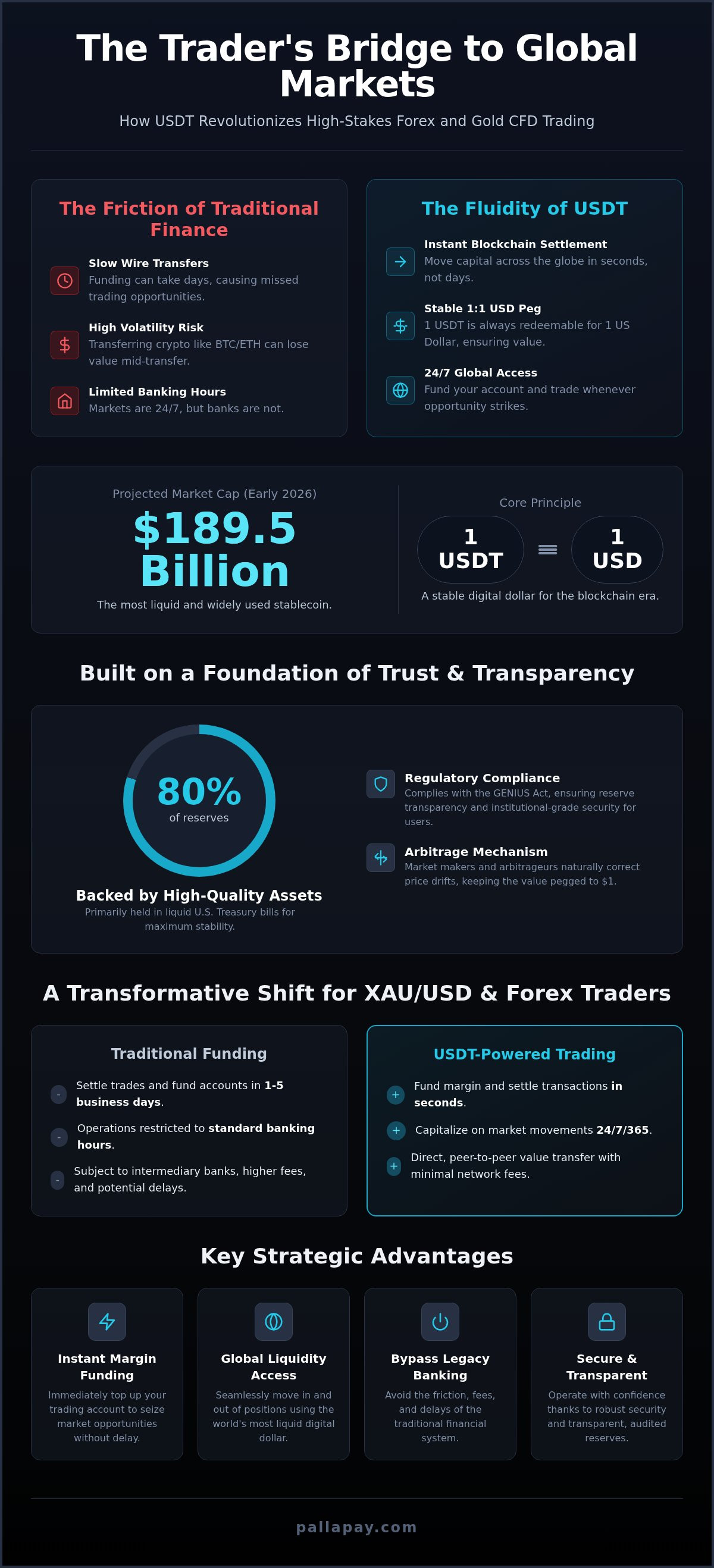
    What if you could bypass the friction of traditional banking to capitalize on a Gold price surge in seconds? For many traders, the reality of slow wire transfers and high volatility creates a frustrating barrier to entry. Understanding what is usdt is the first step toward removing these obstacles; it functions as a digital dollar that maintains a stable value while moving at the speed of the blockchain. With a market capitalization reaching approximately $189.5 billion by early 2026, it has become the definitive liquidity tool for institutional and individual traders who demand efficiency.

    You likely recognize that the traditional financial system wasn’t built for the 24/7 pace of modern global commerce. This article promises to show you how USDT acts as the vital bridge between your digital portfolio and high-stakes markets like Forex and XAU/USD CFDs. We’ll break down the technical mechanics of stablecoins; we will also explore the impact of the 2026 GENIUS Act on reserve transparency. Most importantly, we’ll demonstrate how mastering this bridge can change your financial life by providing instant access to global liquidity. You’ll find a clear path to using USDT through regulated providers to accelerate your progress in the CFD markets.

    Key Takeaways

    • Understand what is usdt and how its 1:1 US Dollar peg provides the essential stability needed to navigate the digital asset ecosystem.
    • Discover the transformative potential of using USDT for instant margin funding in high-stakes Forex and Gold (XAUUSD) CFD trading.
    • Learn how to bypass the delays of traditional banking by utilizing blockchain-based settlements for real-time global financial movements.
    • Explore the 2026 regulatory environment, specifically how the GENIUS Act ensures reserve transparency and institutional-grade security for stablecoin users.
    • Find out how to securely bridge digital assets and fiat through regulated exchange partners and integrated payment tools like the Pallapay Mastercard.

    Understanding USDT: The Digital Dollar of the Blockchain Era

    To navigate the complexities of modern finance, one must first grasp the core utility of Tether. Simply put, USDT is a stablecoin pegged 1:1 to the US Dollar, designed to provide the institutional stability of traditional currency with the frictionless speed of blockchain technology. While assets like Bitcoin or Ethereum are defined by their price fluctuations, USDT maintains a consistent value. This characteristic makes it the primary vehicle for traders moving between digital markets and traditional assets. By early 2026, USDT reached a market capitalization of approximately $189.5 billion. This figure solidifies its status as the most liquid and widely used stablecoin in the global ecosystem, serving as the definitive bridge for those asking what is usdt in the context of professional trading.

    The Concept of a Stablecoin

    Price stability is the cornerstone of any functional commercial transaction. Without it, the timing risk inherent in traditional cryptocurrency transfers becomes a significant liability. If you’re transferring funds to capitalize on a sudden move in Gold CFDs or the Forex market, a sharp swing in your transfer asset’s value could erase your margin before the trade even opens. USDT solves this problem by ensuring that one token sent is always one dollar received. This reliability allows for precise capital allocation across the broader digital asset ecosystem, especially for those utilizing a secure USDT wallet to manage their trading liquidity without the fear of intraday devaluation.

    A Brief History of Tether

    The journey of this asset began with its evolution from a project originally known as Realcoin. It quickly transitioned into the global standard for liquidity that we see today. Over the last decade, Tether has moved from a niche tool for crypto enthusiasts to a pillar of institutional finance. You can find a detailed breakdown of its technical evolution and market milestones on the Tether (USDT) Wikipedia page. This growth was driven by a consistent demand for a reliable path that connects digital exchanges to the legacy banking world. For traders looking to exit positions and realize gains from XAU/USD movements, using a professional USDT off-ramp has become a standard operational procedure. USDT is the foundational asset for modern digital liquidity.

    How USDT Works: Reserves, Networks, and Stability

    Understanding what is usdt requires a look at the underlying architecture that supports its value. Unlike algorithmic tokens that rely on code-driven incentives, USDT uses a collateralized model where every token is backed by a reserve of high-quality assets. By early 2026, Tether’s attestations revealed that approximately 80% of these reserves are held in US Treasury bills, providing a liquid foundation that complies with the Guiding and Establishing National Innovation for U.S. Stablecoins (GENIUS) Act. This transition toward institutional-grade transparency was catalyzed by historical scrutiny, including the New York Attorney General investigation into Tether. Today, that regulatory pressure has resulted in a more robust ecosystem where audits and attestations are standard, giving Forex traders the confidence to move large volumes of capital without fear of a de-pegging event.

    The Mechanics of the 1:1 Peg

    The stability of USDT isn’t accidental; it’s maintained through a sophisticated issuance and redemption cycle. When demand for the token rises, Tether Limited issues new tokens in exchange for fiat currency from institutional partners. If the market price drifts slightly above or below one dollar, arbitrageurs step in to buy or sell the difference, effectively pinning the price back to its target. This mechanism is vital for those trading Gold CFDs. It ensures that your collateral value remains static while you focus on the price action of XAU/USD. Institutional liquidity providers act as the primary stabilizers, ensuring that even during periods of extreme crypto market volatility, the 1:1 peg remains a reliable anchor for your financial operations.

    Choosing the Right Network

    Efficiency in trading often comes down to selecting the correct blockchain network for your transfers. While USDT exists on multiple chains, the costs and speeds vary significantly. In 2026, the Ethereum (ERC-20) network remains a high-security option, yet transaction fees typically range from $2 to $10. In contrast, the Tron (TRC-20) network has become the dominant choice for high-volume transfers, handling over 42% of on-chain volume with fees often between $1.60 and $2.20. For those seeking maximum efficiency, Solana offers fees under $0.001. Ensuring network compatibility between your exchange and your destination is critical to prevent the loss of funds. You can secure your USDT in the Pallapay Wallet to manage these multi-chain assets with professional ease. When you’re ready to realize your trading profits, using a USDT off-ramp provides a direct path from digital liquidity back into your bank account.

    USDT in Forex and CFD Trading: A Transformative Shift

    The integration of stablecoins into the professional trading arena has dismantled the barriers that once limited market participation. For years, traders were tethered to the operational hours of traditional banks; today, blockchain execution allows for real-time capital deployment. This shift is not just about speed; it’s about the democratization of liquidity. When exploring what is usdt, professional traders view it as a high-velocity settlement layer that replaces the typical 3-5 day wait for traditional wire transfers. By using a secure USDT off-ramp, successful traders can move from a closed position to liquid fiat with unprecedented efficiency. This capability ensures that market opportunities are never missed due to administrative delays.

    Trading Gold (XAU/USD) with USDT

    Gold remains the ultimate hedge against economic uncertainty, yet accessing it through traditional channels often involves complex currency conversion and high brokerage fees. Using USDT as collateral for gold CFD trading streamlines this process by providing a direct, USD-pegged entry point. This method offers 24/7 access to precious metal markets, allowing you to react to geopolitical events the moment they occur. By eliminating the friction of converting local fiat into trading capital, you retain more of your margin. This efficiency is particularly beneficial for those executing high-frequency strategies on XAU/USD pairs, where every pip counts toward your bottom line. The ability to fund and withdraw in a stable digital asset provides a level of agility that traditional gold markets simply cannot match.

    The Power of USD CFD Trading

    Leveraging USDT for sophisticated USD-based contract for difference (CFD) strategies can fundamentally change an individual’s financial trajectory. Unlike traditional asset ownership, CFD trading allows you to capitalize on both rising and falling markets. When you use USDT to fund your professional trading wallet, you gain the ability to manage risk with surgical precision. The transformative potential lies in capital efficiency; leverage allows you to control larger positions with a smaller initial deposit. In a digital-first environment, this means your capital works harder and moves faster. Mastering these mechanics isn’t just about understanding what is usdt; it’s about harnessing a technological evolution to achieve professional financial independence. This digital-first approach empowers you to build a diversified portfolio that is resilient to the inefficiencies of legacy banking systems.
    What is USDT? A 2026 Guide to the Stablecoin Powering Global Trading

    Strategic Advantages of Using USDT for Global Finance

    The strategic advantage of Tether lies in its ability to solve the liquidity bottlenecks of the legacy financial system. While traditional SWIFT transfers often require a 3-5 day waiting period, USDT settlements occur in minutes. This speed is indispensable for traders who need to move capital between global markets during high-volatility events in the Gold or Forex sectors. By removing the constraints of banking holidays and weekend closures, you gain a 24/7 window for capital deployment. Understanding what is usdt in this professional context means recognizing it as a tool for real-time treasury management. It provides a level of agility that was previously reserved for only the largest institutional players.

    Efficiency in Cross-Border Payments

    Modern businesses are increasingly adopting stablecoins to settle international invoices. This shift allows companies to optimize your business with Fiat Settlement solutions that bypass the layers of intermediary bank fees associated with traditional commerce. In 2026, the use of USDT for B2B transactions has become a standard method for reducing operational overhead. By settling in a digital dollar, you eliminate the currency fluctuation risks that often plague international trade while ensuring that your partners receive funds with institutional-grade security. This efficiency is a catalyst for growth, allowing capital to be reinvested into the business rather than being lost to banking fees.

    Liquidating Gains: The Off-Ramp Advantage

    The true power of any trading strategy is measured by the ease with which gains can be accessed. Moving from a successful USD CFD position back into the real world requires a reliable infrastructure. You can explore Pallapay Off-Ramp solutions to convert your digital assets into fiat instantly. For those who require immediate liquidity, the Pallapay Mastercard provides a bridge for real-world spending, allowing you to utilize your trading profits at millions of global locations. This ecosystem ensures that your financial growth is never trapped behind a technical wall. By mastering these off-ramps, you can fundamentally change your financial life, turning digital market success into tangible lifestyle improvements. Regulated MSB providers in the USA and Canada offer the compliance framework necessary to build long-term trust. These entities ensure that every transaction meets strict AML and KYC requirements, providing the privacy and security that professional traders demand. If you are ready to revolutionize your approach to global trading, you can convert crypto to fiat instantly with Pallapay.

    Getting Started: How to Securely Buy and Use USDT

    Transitioning from theoretical knowledge to active market engagement requires a secure, regulated entry point. For those identifying what is usdt for the first time, it’s best understood as the digital fuel for a global trading portfolio. The process begins with selecting a compliant exchange partner that prioritizes institutional-grade security. Completing the KYC and AML onboarding is a critical requirement; these steps build the foundation of trust necessary for high-volume operations. Once your account is active, you can execute your first purchase through several professional methods, such as choosing to buy USDT with cash at a secure location or initiating a bank transfer. This capital can then be instantly integrated into your active Forex or CFD trading account to begin capitalizing on USD CFD strategies and Gold price movements.

    Security Best Practices for USDT

    Security is not a one-time setup but a continuous practice. Utilizing hardware wallets or highly secure custodial services is essential for protecting significant trading margins from external threats. Verifying network addresses before every transaction is a non-negotiable step to prevent the irreversible loss of funds. You can find more comprehensive strategies in our guide on Crypto Security in 2026: The Definitive Guide. These practices ensure that your financial trajectory remains on an upward path, free from technical setbacks. By maintaining rigorous standards, you ensure that your focus stays on market analysis rather than operational vulnerabilities.

    The Pallapay Advantage

    The Pallapay ecosystem provides a sophisticated bridge for traders who demand reliability and speed. Our status as a regulated MSB in the USA and Canada ensures that your trading capital is handled with the highest level of professional care. We specialize in facilitating high-volume OTC trades, providing the deep liquidity necessary for professional Forex and XAU/USD CFD operations. Beyond simple transactions, our integrated tools like the secure digital wallet and instant off-ramp options allow you to manage your wealth with total autonomy. This professional infrastructure is designed to empower your progress in the global markets by handling complex background processes with efficiency. Start your financial transformation with Pallapay today.

    Mastering Global Liquidity in the Digital Era

    Mastering what is usdt empowers you to navigate the complexities of modern finance with institutional-grade speed and precision. By utilizing a reserve-backed stablecoin, you eliminate the friction of legacy banking and gain instant access to the transformative potential of Gold and Forex CFD markets. This shift toward real-time blockchain execution ensures that your capital is always positioned where the opportunity is greatest. Whether you’re hedging against inflation with XAU/USD or executing sophisticated USD-based strategies, the digital dollar is your most effective tool for capital efficiency.

    As a regulated MSB in the USA and Canada, Pallapay provides the secure infrastructure required for high-volume OTC operations and seamless fiat-to-crypto integration. Our global ecosystem is designed to handle complex background processes so you can focus on building a resilient, diversified portfolio. The evolution of global trading is already here; adopting these professional solutions is the key to accelerating your progress and achieving long-term financial independence. Take the next step in your professional journey today and embrace the future of finance.

    Join Pallapay and access the world of USDT-powered trading

    Frequently Asked Questions

    Is USDT the same as a US Dollar?

    When identifying what is usdt, it’s important to recognize that it is a digital token pegged 1:1 to the US Dollar, whereas the dollar is a sovereign fiat currency. While they share a value, USDT exists on blockchains like Ethereum and Tron. It provides the utility of the dollar within the digital asset ecosystem, allowing for instant global transfers without the restrictions of traditional banking hours or weekend closures.

    Can I use USDT to trade Forex and Gold CFDs?

    Yes, it is a primary collateral asset for these markets. USDT has revolutionized access to the Forex and Gold markets by acting as a high-velocity settlement layer. Many brokers and platforms allow you to use USDT as margin for XAU/USD and USD CFD trades. This provides 24/7 liquidity and eliminates the 3-5 day wait time typical of bank-based funding, ensuring your capital is always ready for deployment.

    What are the main differences between ERC-20 and TRC-20 USDT?

    The main differences are transaction speed and network fees. ERC-20 USDT operates on the Ethereum network, which offers high security but typically higher fees, ranging from $2 to $10 in 2026. TRC-20 USDT uses the Tron network, which is the preferred choice for high-volume traders due to its lower costs, often under $2.20 per transaction. Selecting the correct network is vital for ensuring your funds arrive safely and efficiently.

    How does USDT maintain its 1:1 value with the dollar?

    Tether maintains its value through a collateralized reserve model and institutional arbitrage. Tether maintains reserves consisting of cash and cash equivalents, with approximately 80% held in US Treasury bills as of early 2026. When the market price deviates from $1, institutional arbitrageurs buy or sell the token to bring it back to its peg. This mechanism ensures that understanding what is usdt includes recognizing its role as a stable anchor for your trading capital.

    Is USDT legal and regulated for business use?

    Yes, USDT is legal and regulated when used through compliant frameworks like the GENIUS Act. In the United States and Canada, businesses use USDT via regulated Money Services Businesses like Pallapay. The 2025 GENIUS Act established a federal framework for stablecoins, requiring issuers to maintain 1:1 reserves and follow strict AML/KYC protocols. Using a regulated provider ensures your business settlements and trading operations remain fully compliant with current international laws.

    What happens if I send USDT to the wrong network address?

    The funds are generally unrecoverable if sent to the wrong network address. Sending TRC-20 USDT to an ERC-20 address, or vice versa, usually results in a permanent loss of assets because the blockchains are not natively compatible. Always perform a small test transaction first. Professional tools like the Pallapay Wallet help mitigate this risk by providing clear network selection interfaces, ensuring your capital remains secure during every cross-border movement.

    How can I convert my USDT trading profits into cash?

    Professional traders prefer USDT because it eliminates the volatility risk inherent in Bitcoin collateral. Bitcoin’s price can fluctuate significantly within minutes, which might trigger an unexpected margin call even if your trade is profitable. USDT provides a stable value, ensuring that your collateral remains constant while you focus on XAU/USD price action. Traders prioritize this stability to manage risk effectively and maintain precise control over their leverage in CFD markets.

    Disclaimer

    The information provided on this website and blog is for general informational and educational purposes only and does not constitute financial, investment, legal, tax, or other professional advice.
    Cryptocurrency and digital asset services may be subject to regulatory restrictions in certain jurisdictions. Users are solely responsible for ensuring compliance with applicable local laws and regulations before using any products or services mentioned on this website.
    PallaPay does not guarantee the accuracy, completeness, or timeliness of any information published and accepts no liability for any loss or damages arising from reliance on the content. Any opinions expressed are those of the respective authors and may change without notice.
    Certain services, features, or products referenced may be provided through third-party partners, licensed entities, or affiliated service providers subject to separate terms and regulatory approvals. Availability of services may vary by country or region.
    This website may contain references to digital assets, virtual currencies, or blockchain-related services that are not available to residents of certain jurisdictions, including where prohibited by law. Nothing on this website constitutes an offer, solicitation, or recommendation to buy or sell any financial instrument or virtual asset.

  • What is USDT? The Essential 2026 Guide to the World’s Leading Stablecoin

    What is USDT? The Essential 2026 Guide to the World’s Leading Stablecoin

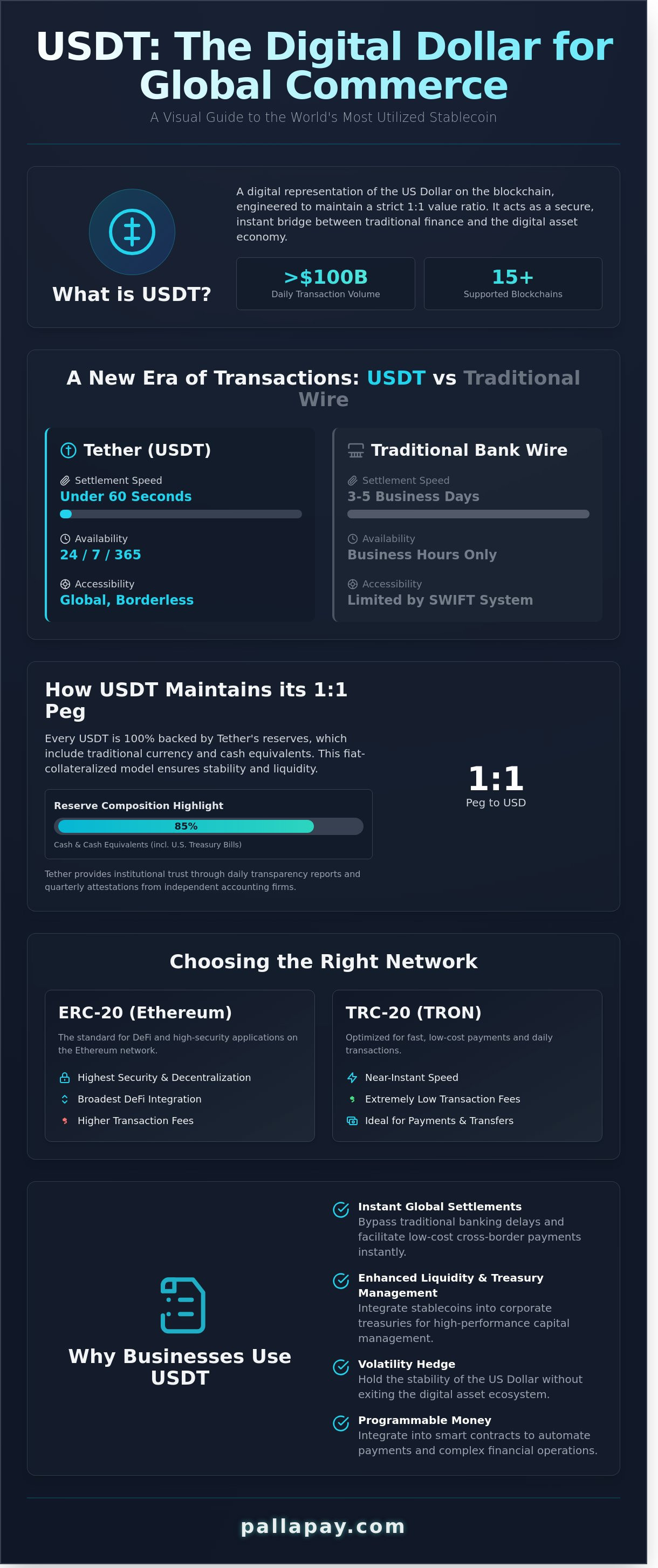
    By January 2026, Tether (USDT) has solidified its position as the world’s most utilized digital asset, facilitating over $100 billion in daily transaction volume across more than 15 distinct blockchain networks. Understanding what is usdt is no longer optional for professionals; it’s the fundamental requirement for participating in the modern global economy. You’ve likely felt the hesitation that comes with cryptocurrency volatility or the frustration of waiting 3 to 5 business days for a standard bank wire to clear.

    You’ll discover how USDT functions as a secure, instant bridge between traditional fiat and the blockchain, providing the absolute stability your capital requires. This guide breaks down the 1:1 peg mechanism, clarifies the technical differences between network protocols like TRC-20, and outlines the precise steps to integrate stablecoins into your corporate treasury for enhanced liquidity. We’ll provide the clarity needed to execute high-value transactions globally without the friction or delays of legacy financial systems.

    Key Takeaways

    • Master the fundamentals of what is usdt and how this digital dollar provides a secure, 1:1 fiat-backed bridge between traditional finance and the blockchain.
    • Explore the technical infrastructure of USDT reserves to understand how institutional-grade transparency and liquid assets ensure long-term stability in 2026.
    • Identify how global businesses utilize stablecoins to bypass traditional banking delays and facilitate instant, low-cost cross-border settlements.
    • Learn to protect your digital capital by implementing professional-grade storage solutions and selecting the optimal crypto wallet for your specific business requirements.
    • Discover the most efficient methods for converting high-volume USDT into physical cash through specialized OTC desks and integrated fintech gateways.

    What is USDT? Defining the ‘Digital Dollar’ for 2026

    USDT, commonly known as Tether, represents the first and most successful bridge between traditional fiat currencies and decentralized blockchain technology. To understand what is usdt, one must view it as a digital representation of the US Dollar, specifically engineered to maintain a strict 1:1 value ratio. By 2026, it has solidified its position as the world’s most utilized stablecoin, consistently leading the market with a daily trading volume that frequently exceeds $70 billion. USDT serves as the primary medium for crypto-to-fiat liquidity in global markets.

    This asset acts as a high-performance fiat-on-blockchain tool. It allows users to hold the price stability of the dollar while benefiting from the technological advantages of various networks like Ethereum, Tron, and Solana. Tether (USDT) provides the essential infrastructure for global value transfer without the friction of legacy banking systems. When businesses ask what is usdt in a commercial context, they’re looking at a tool that eliminates the volatility typically associated with digital assets.

    The Concept of Pegging and Stability

    Tether Limited maintains the 1:1 peg through a robust framework of collateralized reserves. Every token in circulation is backed by cash equivalents, US Treasuries, and other liquid assets held in secure custody. This structure explains why USDT remains stable while assets like Bitcoin or Ethereum experience price swings of 5% to 10% in a single day. Tether Limited acts as the central issuer, managing the supply through a transparent process of minting and burning tokens. This ensures that the circulating supply always aligns with the underlying reserve holdings, providing a reliable digital wallet experience for millions of users worldwide.

    USDT vs. Traditional USD: Key Differences

    While both represent the same economic value, USDT offers functional advantages that traditional banking cannot match. It’s programmable. This means businesses can integrate USDT into smart contracts to automate a fiat settlement once specific contractual conditions are met. Traditional USD relies on manual verification and legacy software that doesn’t talk to blockchain ledgers.

    • Availability: Legacy banks close on weekends and observe national holidays. USDT is available 24/7/365, allowing for global capital movement at any hour.
    • Settlement Speed: Traditional finance operates on a T+2 settlement cycle, meaning funds take 48 hours to clear. USDT moves with near-instant finality, often completing transactions in under 60 seconds.
    • Accessibility: USDT removes the geographic barriers inherent in the SWIFT system, enabling a seamless flow of value across borders without intermediary bank delays.

    These features transform the dollar from a static currency into a dynamic, tech-ready asset. It’s the future of payments, providing a sophisticated partner for businesses that need to move at the speed of the modern internet.

    How USDT Works: Reserves, Blockchains, and Technology

    Understanding what is usdt requires a close look at its underlying architecture. Tether operates on a fiat-collateralized model, meaning every token in circulation is backed by a reserve of liquid assets. By 2024, Tether reported that approximately 85% of its reserves are held in cash and cash equivalents, primarily U.S. Treasury bills. This backing ensures that the 1:1 peg to the dollar remains stable even during periods of high market volatility. To maintain institutional trust, Tether publishes daily transparency reports and quarterly attestations from independent accounting firms, providing a clear view of the assets securing the network.

    Security remains a cornerstone of Tether’s infrastructure. The company has evolved its protocols to meet rigorous institutional standards, focusing heavily on preventing financial crime through advanced monitoring tools. This commitment to compliance makes USDT a reliable choice for global settlement. Businesses can verify the integrity of the system by tracking the total supply against the reserve balances listed on the official transparency page. It’s a system designed to bridge the gap between traditional finance and blockchain efficiency.

    ERC-20 vs. TRC-20: Choosing the Right Network

    USDT isn’t tied to a single blockchain; it exists as a multi-chain asset to maximize utility across the ecosystem. The ERC-20 standard on Ethereum is the industry benchmark for institutional security and complex smart contract integration, though it often carries higher gas fees. In contrast, the TRC-20 standard on the Tron network has become the global leader for retail transfers, accounting for over 50% of all USDT transactions due to its sub-dollar fees and near-instant settlement. By 2026, Layer 2 scaling solutions like Arbitrum and high-throughput chains like Solana have further diversified the landscape, offering users more ways to move capital without friction.

    The Minting and Redemption Process

    The lifecycle of USDT begins with authorized participants, typically large-scale financial institutions, who deposit fiat currency into Tether’s reserves. Once the fiat is confirmed, Tether mints an equivalent amount of USDT and sends it to the participant’s wallet. For most users, liquidity is accessed through OTC crypto exchanges, which facilitate large-volume trades without causing price slippage. This deep liquidity ensures that whether you’re a merchant or an investor, you can sell USDT in Dubai or any global hub with absolute confidence. Every transaction generates a unique hash, allowing anyone to verify the movement of funds on public explorers like Etherscan or Tronscan for total transparency.

    Why Businesses Use USDT: Global Commerce in 2026

    By 2026, USDT has transitioned from a niche trading asset into the primary engine for international business. Global commerce demands a speed that legacy banking systems simply cannot provide. When CFOs evaluate what is usdt, they see a tool for instant liquidity rather than just a digital currency. It’s the bridge that allows a company in Dubai to settle an invoice with a supplier in Tokyo in seconds, bypassing the traditional SWIFT network which often takes 3 to 5 business days.

    The operational advantages of using stablecoins for corporate treasury and operations are measurable. Businesses utilizing USDT benefit from several key efficiencies:

    • Cross-border payments: Companies eliminate intermediary bank fees that can consume up to 7% of the total transaction value.
    • Merchant settlement: Retailers accept various cryptocurrencies through crypto payment gateways but hold the value in USDT to avoid market volatility.
    • Payroll and remittances: Global teams receive salaries instantly, avoiding the 4% average loss typically seen in currency conversion.
    • Instant Liquidity: USDT provides a 24/7 settlement layer, ensuring that capital isn’t trapped in “pending” states over weekends or bank holidays.

    An authoritative explanation of USDT confirms its role as a stable medium of exchange, backed by reserves that ensure it stays pegged to the US Dollar. This reliability makes it the preferred choice for the future of payments.

    USDT for High-Growth Industries

    Specific sectors have seen rapid transformation through stablecoin adoption. The hotel industry now uses USDT to secure international bookings, eliminating the risk of credit card chargebacks and high foreign exchange markups. In e-commerce, instant settlement allows brands to restock inventory faster, as they don’t have to wait 14 days for payment processor payouts. The gaming sector also relies on USDT for transparent player payouts, which has increased user retention by 25% for platforms that offer instant withdrawals.

    Regulatory Compliance and MSB Standards

    Institutional trust in USDT is built on a foundation of rigorous compliance. By 2026, global regulations like MiCA have clarified the legal status of stablecoins, making them a standard part of corporate accounting. Professional firms prioritize working with MSB-registered providers to ensure every transaction meets strict anti-money laundering standards. Understanding what is usdt in a regulated context is now a prerequisite for any firm looking to scale globally. Risk management strategies have shifted away from unbacked algorithmic alternatives, with 88% of enterprises now choosing USDT due to its proven liquidity and transparent reserve reporting. This professional bridge connects traditional finance with blockchain efficiency, handling the heavy lifting of technology behind the scenes.

    What is USDT? The Essential 2026 Guide to the World’s Leading Stablecoin

    Security and Storage: How to Handle USDT Safely

    Securing assets starts with choosing a professional-grade crypto wallet that balances accessibility with deep-cold storage. For businesses, the choice between custodial and non-custodial storage is a strategic decision that impacts both liability and operational speed. Custodial solutions provide managed security and recovery options, while non-custodial wallets give you total control over your private keys. Understanding what is usdt in a technical sense means recognizing that the token exists on multiple blockchains, each requiring different security protocols.

    Pallapay functions as a global enabler by providing an all-in-one ecosystem where security and utility coexist. This professional bridge allows merchants to transition from legacy systems to blockchain-based settlements without the typical risks associated with digital assets. By utilizing institutional-grade protocols, businesses can treat USDT as a standard, effortless component of their daily operations. Security isn’t just a feature; it’s the foundation of the future of payments.

    Best practices for maintaining a secure USDT environment include:

    • Conducting monthly audits of connected dApps and revoking unnecessary permissions.
    • Using dedicated hardware for high-value corporate transactions to isolate keys from internet-facing threats.
    • Implementing strict employee protocols for verifying payment requests to prevent social engineering.

    Phishing attacks remain the primary threat; a 2024 report showed that 91% of successful crypto thefts originated from social engineering. Always audit smart contract permissions to ensure you aren’t granting unlimited spend access to unverified decentralized applications. Multi-factor authentication via hardware keys and biometric 2FA are mandatory requirements for any holder who values asset integrity.

    Understanding USDT Addresses

    A TRC-20 address typically begins with a “T,” while an ERC-20 address starts with “0x.” Mistaking these results in permanent loss. QR codes eliminate manual entry errors, making in-store payments instant and accurate. Always verify the first and last four digits of a recipient’s address before confirming high-value transfers. This manual check prevents “address poisoning” scams that target transaction histories.

    Institutional Security Features

    Corporate treasury management requires more than a single password. Multi-signature wallets require 2-of-3 approvals before any USDT leaves the account, preventing internal fraud. Whitelisting ensures funds only move to pre-approved partners, neutralizing unauthorized outflows. Integrating Payment APIs automates this secure collection process, removing human error. These tools ensure security is baked into the infrastructure.

    Secure your digital assets with our professional-grade wallet today.

    How to Buy and Sell USDT for Cash: The Pallapay Advantage

    Understanding what is usdt involves more than just looking at blockchain charts; it requires a practical way to move between digital assets and physical currency. Pallapay serves as the professional bridge for this transition. By providing deep liquidity pools, we ensure that high-volume traders and institutional clients don’t face the slippage common on public exchanges. Our Over-the-Counter (OTC) desk facilitates large-scale transactions with a focus on stability and security. For businesses, our fiat settlement services convert USDT into local bank deposits instantly, removing the volatility risks associated with holding crypto assets overnight.

    Retailers can now accept stablecoin payments directly at the counter. By integrating Crypto POS machines, merchants in sectors like retail and hospitality can process USDT transactions as easily as traditional credit cards. This technology allows for 100% settlement in fiat, ensuring that the business receives the exact value of the sale without exposure to market fluctuations. It’s a system designed for efficiency, where the complexity of the blockchain is hidden behind a familiar payment interface.

    • Instant Liquidity: Convert digital balances to cash without waiting for multi-day bank clearances.
    • Institutional Grade: Secure OTC services for transactions exceeding $100,000 with personalized support.
    • Retail Integration: Direct USDT-to-fiat conversion at the point of sale for global businesses.

    Selling USDT for Cash in Dubai

    Dubai has established itself as the 2026 global capital for digital finance, thanks to its clear regulatory framework and advanced infrastructure. Users looking to sell USDT for cash in Dubai can visit Pallapay’s physical offices for a secure, face-to-face experience. This process typically takes less than 15 minutes. It offers a level of privacy and speed that online platforms struggle to match. Our professional staff handles the technical heavy lifting, providing a seamless conversion from a digital wallet to physical Dirhams or Dollars. This physical presence builds a foundation of trust that digital-only platforms cannot replicate.

    Spending USDT in the Real World

    The utility of USDT extends beyond trading. With the Pallapay Mastercard, users spend their balance at over 60 million merchants worldwide. If you prefer shopping at specific brands, you can convert USDT into Gift Cards for major retailers. This ecosystem transforms a digital stablecoin into a versatile tool for daily life. As we move toward the future of payments, the distinction between digital and physical money continues to fade. We aren’t just explaining what is usdt; we’re making it a fundamental part of the global economy through instant, secure, and reliable financial tools.

    Secure Your Digital Dollar Strategy for 2026

    USDT remains the definitive bridge between traditional fiat and the digital economy. It provides the essential liquidity required for instant global settlements without the volatility often associated with other crypto assets. As you navigate the complexities of modern finance, understanding what is usdt gives you a significant advantage in managing cross-border transactions and maintaining stable capital reserves. Security remains paramount; choosing a regulated partner is the only way to ensure your assets stay protected at every stage of the process.

    Pallapay has served users in 180+ countries since 2018, providing a secure gateway for institutional and individual liquidity. We maintain full MSB registration in the USA and Canada, alongside physical OTC desks in global hubs like Dubai, Singapore, and Istanbul. This infrastructure ensures your transition from digital assets to physical cash is seamless and professional. For those looking to acquire stablecoins through institutional-grade platforms, our comprehensive guide on USDT buy online strategies provides the blueprint for secure acquisition through regulated channels. Ready to secure your USDT liquidity? Sell USDT for cash instantly with Pallapay’s regulated OTC desk. The future of payments is already here, and it’s time to leverage these tools for your continued growth.

    Frequently Asked Questions

    Is USDT the same as a US Dollar?

    USDT is a digital asset pegged to the US Dollar, not the physical currency itself. While 1 USDT aims to maintain a 1:1 value with the USD, it exists on blockchain ledgers rather than in a traditional bank account. Tether Limited manages the reserves, which include cash and cash equivalents, to ensure liquidity. As of January 2026, Tether maintains a reserve backing of 104% to guarantee every token is redeemable for its fiat counterpart. Understanding what is usdt is the first step toward modern liquidity management.

    Can I lose money holding USDT?

    You can lose value if the token de-pegs or if you lose access to your private keys. While USDT is designed for stability, market volatility or liquidity crises can cause the price to drop below $1.00 temporarily, as seen in minor fluctuations of 0.1% during high-stress periods. Understanding what is usdt requires recognizing that its safety depends on the security of your chosen wallet and the transparency of Tether’s monthly attestation reports.

    Which blockchain network should I use for USDT?

    Use the TRON (TRC-20) network for low-cost transfers or Ethereum (ERC-20) for institutional-grade security. TRC-20 transactions typically cost less than $1.00 and settle in under 2 minutes. In contrast, Ethereum gas fees can exceed $15.00 during peak congestion. By 2026, Layer 2 solutions like Arbitrum and Polygon have captured 42% of USDT volume due to their sub-cent transaction costs and instant finality. This choice impacts your operational efficiency directly.

    Is USDT legal for business transactions in 2026?

    USDT is legal for commercial use in over 150 countries, provided businesses comply with local AML and KYC regulations. The 2024 MiCA regulation in Europe and similar 2025 frameworks in the Middle East have standardized how stablecoins are used for cross-border settlement. Merchants use these digital assets to bypass the 3 day delay of SWIFT transfers. This ensures an instant flow of capital across global markets and simplifies corporate treasury management.

    How do I convert USDT back to physical cash?

    You can convert USDT to physical cash instantly through professional OTC desks or global crypto-fiat gateways. Platforms like Pallapay allow users to withdraw fiat currency at physical branches in cities like Dubai or through direct bank transfers. These services provide the liquidity needed to turn digital balances into spendable paper currency. Most transactions complete in under 30 minutes, offering a professional bridge between blockchain assets and traditional finance.

    What is the difference between USDT and USDC?

    The primary difference lies in the issuing entities and their regulatory approaches. Tether Limited issues USDT, while Circle issues USDC. While both maintain a $1.00 peg, USDT often shows higher daily trading volumes, frequently exceeding $50 billion. USDC focuses on strict US-based compliance. Choosing between them depends on your need for liquidity versus specific regulatory alignment. Both serve as essential pillars for the future of payments.

    Do I need a bank account to use USDT?

    You don’t need a traditional bank account to receive, store, or send USDT. All you need is a non-custodial digital wallet or a registered account on a secure gateway. This accessibility allows the 1.4 billion unbanked individuals worldwide to participate in the global economy. Users can manage their wealth independently of legacy banking systems. It’s a seamless way to achieve financial inclusion through blockchain technology and modern fintech tools.

    How does Tether stay at exactly one dollar?

    Tether maintains its peg through a combination of 100% reserve backing and active market arbitrage. If the price drops to $0.999, large-scale traders buy the token to redeem it for exactly $1.00 from Tether, pocketing the difference. This mechanism keeps the price stable. By 2026, Tether’s transparency has improved with real-time reserve audits. This ensures that every token in circulation is matched by an equivalent value in liquid assets.

    Disclaimer

    The information provided on this website and blog is for general informational and educational purposes only and does not constitute financial, investment, legal, tax, or other professional advice.
    Cryptocurrency and digital asset services may be subject to regulatory restrictions in certain jurisdictions. Users are solely responsible for ensuring compliance with applicable local laws and regulations before using any products or services mentioned on this website.
    PallaPay does not guarantee the accuracy, completeness, or timeliness of any information published and accepts no liability for any loss or damages arising from reliance on the content. Any opinions expressed are those of the respective authors and may change without notice.
    Certain services, features, or products referenced may be provided through third-party partners, licensed entities, or affiliated service providers subject to separate terms and regulatory approvals. Availability of services may vary by country or region.
    This website may contain references to digital assets, virtual currencies, or blockchain-related services that are not available to residents of certain jurisdictions, including where prohibited by law. Nothing on this website constitutes an offer, solicitation, or recommendation to buy or sell any financial instrument or virtual asset.

  • USDT Use Cases: 10 Practical Ways to Leverage Tether in 2026

    USDT Use Cases: 10 Practical Ways to Leverage Tether in 2026

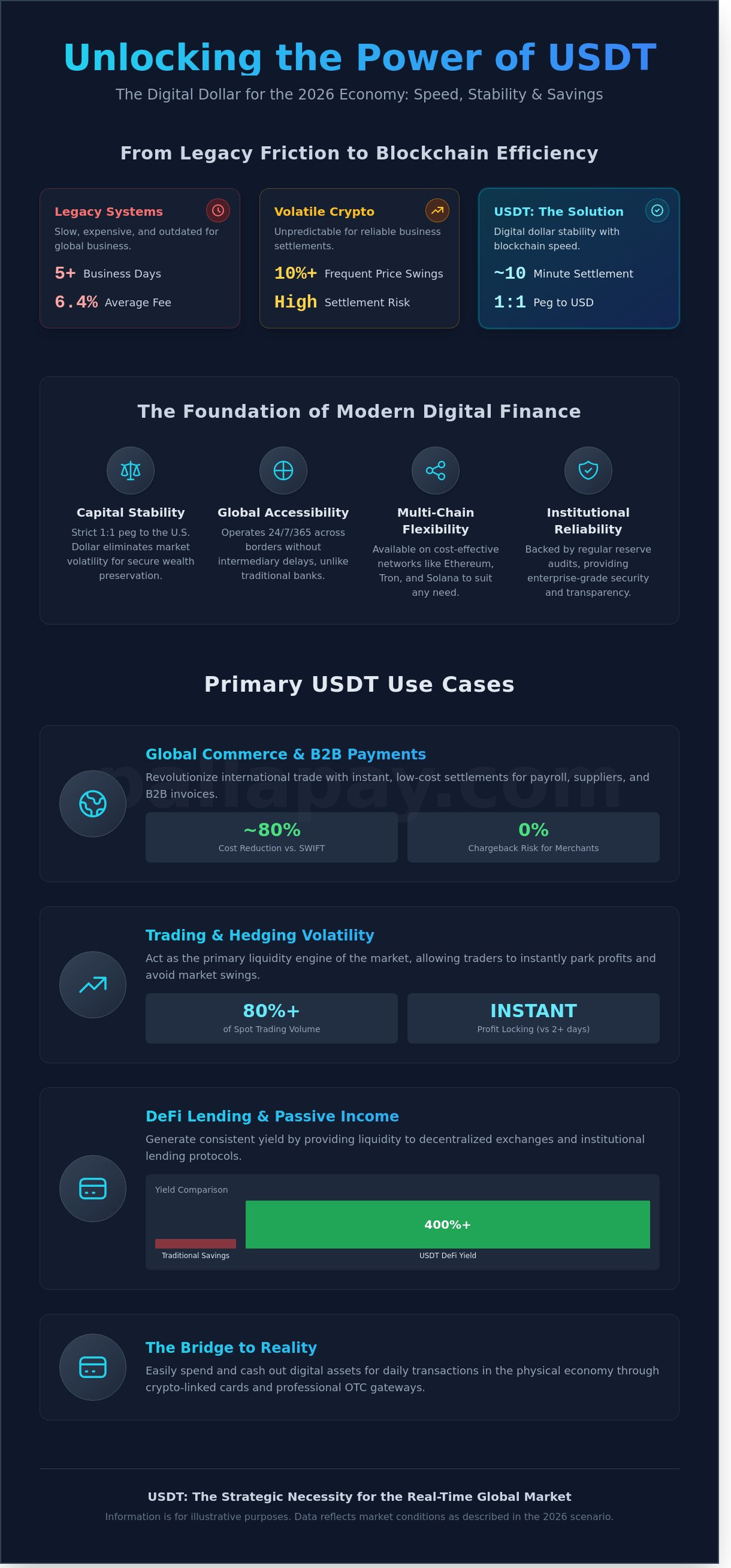
    Traditional cross-border wire transfers still take up to 5 business days and cost an average of 6.4% in fees per transaction. In 2026, relying on these legacy systems isn’t just slow; it’s a measurable drain on your company’s bottom line. You’ve likely found that while Bitcoin captures headlines, its frequent 10% price swings make it nearly impossible to use for predictable business settlements. You need the efficiency of the blockchain without the anxiety of market volatility.

    Understanding the most impactful usdt use cases allows you to facilitate global commerce, execute instant remittances, and maintain secure wealth preservation within a stable ecosystem. This guide provides a clear roadmap to the future of payments, showing you how to leverage Tether to reduce transaction costs by as much as 80% compared to legacy banking. We’ll explore 10 practical strategies to manage liquidity and spend or cash out your digital assets through professional OTC gateways.

    Key Takeaways

    • Understand how USDT serves as a stable digital dollar, providing a secure 1:1 peg that eliminates market volatility for reliable wealth preservation.
    • Learn to optimize your digital strategy by providing liquidity to DeFi protocols to generate consistent yield in a secure financial ecosystem.
    • Explore diverse usdt use cases for modern commerce, including how merchants can eliminate chargeback risks and capture the growing market of global consumers.
    • Transition from the inefficiencies of traditional SWIFT transfers to instant, 10-minute global settlements for international payroll and supplier payments.
    • Master the process of bridging digital assets to the physical economy by utilizing crypto-linked cards for seamless daily transactions.

    What is USDT? The Digital Dollar for the 2026 Economy

    USDT is a fiat-collateralized stablecoin engineered to maintain a strict 1:1 peg with the U.S. Dollar. In the 2026 economy, it functions as the critical infrastructure for digital value transfer. While traditional cryptocurrencies often face daily price swings of 10% or more, USDT offers a “Stability Factor” that preserves capital value. It’s the primary liquidity source for the digital asset market; it facilitates trillions in annual transaction volume. By utilizing Tether (USDT), users access a dollar-equivalent asset that moves with the speed of the internet. The token is available across multiple blockchains, including Ethereum, Tron, and Solana, which gives businesses the flexibility to choose the most cost-effective network for their specific needs.

    The Evolution of Stablecoins

    The industry has moved past the era where stablecoins were only used to park funds between trades. Today, they’re active utility assets. USDT holds its position as the market leader in 2026 because of its deep integration into global trade. Its dominance is supported by a commitment to transparency and regular reserve audits, which provide the institutional-grade security that modern enterprises demand. These developments have significantly widened the scope of usdt use cases, moving the asset from exchange wallets into the hands of everyday consumers and corporate treasuries. The shift represents a fundamental change in how the world perceives digital collateral.

    Why USDT is the “Base Asset” of Modern Finance

    Traditional banking systems operate on a legacy schedule, often closing on weekends and holidays. USDT operates 24/7, offering a borderless alternative that never sleeps. While a standard SWIFT transfer might require 72 hours to clear, blockchain-based settlements are instant. This efficiency allows a business to manage its fiat settlement needs without the friction of traditional wait times. USDT is also a programmable currency. It can be embedded into smart contracts to automate payments once specific conditions are met. This capability transforms it from a simple medium of exchange into a sophisticated financial tool.

    For companies looking to scale, adopting USDT is no longer a niche choice; it’s a strategic necessity for competing in a real-time global market. These usdt use cases demonstrate why the asset is now considered the definitive base asset of the modern financial ecosystem. Key benefits include:

    • Instant Settlement: Transactions clear in seconds, not days.
    • Global Accessibility: Send and receive value across any border without intermediary delays.
    • Programmability: Use USDT within decentralized applications to automate complex business logic.
    • Institutional Reliability: Backed by audited reserves to ensure 1:1 redeemability.

    This combination of speed and stability makes USDT the preferred choice for merchants and individuals who require the reliability of the dollar with the efficiency of the blockchain.

    Trading and Investment Use Cases for USDT

    USDT serves as the primary liquidity engine for the global digital economy. By mid-2026, Tether remains the dominant trading pair, accounting for over 80% of all spot trading volume on major exchanges. Its role extends beyond simple transactions; it acts as the functional bridge between volatile crypto assets and institutional-grade stability. Professional traders and retail investors utilize these usdt use cases to maintain capital efficiency in a market that never sleeps.

    Hedging Against Market Volatility

    Market cycles in 2026 move with unprecedented speed. Traders often encounter 15% price fluctuations within a single hour. USDT provides a secure mechanism to park profits instantly, allowing users to lock in gains without exiting the blockchain ecosystem. This strategy eliminates the 24-hour to 48-hour delay typically associated with traditional bank settlements. It offers a psychological anchor; having a stable unit of account helps investors make rational decisions during periods of extreme fear or greed. When the market stabilizes, they can move back into Bitcoin or Ethereum in seconds.

    Passive Income through Staking and Lending

    The 2026 DeFi landscape relies on deep liquidity pools to support complex financial products. Users generate consistent yield by lending their USDT to institutional borrowers or providing liquidity to decentralized exchanges. While smart contract risks remain a factor, the rewards for providing USDT liquidity often exceed traditional savings rates by 400% or more. Managing these positions requires a professional interface. Many users rely on the Pallapay Wallet to store their assets securely while exploring diverse yield-generating opportunities across multiple chains.

    Beyond passive yield, USDT is the preferred tool for high-frequency trading (HFT) and cross-exchange arbitrage. Arbitrageurs exploit price gaps between global platforms, using USDT’s instant settlement to capture small margins that disappear in milliseconds. This constant movement of capital ensures price parity across the global market.

    For users in emerging economies, USDT functions as a critical store of value. In regions where local currency inflation exceeds 40% annually, holding Tether provides a digital dollar equivalent that is easily accessible via a smartphone. It bypasses the restrictive capital controls often found in traditional banking systems, offering a lifeline for wealth preservation. These diverse usdt use cases demonstrate why Tether has evolved from a simple trading tool into a foundational pillar of modern finance.

    Effective wealth management starts with the right infrastructure. Consider how a secure digital asset gateway can simplify your daily trading operations and long-term investment strategy.

    Business and Retail: Accepting USDT as a Merchant

    Consumer behavior has shifted dramatically. By 2026, the number of digital asset users is projected to surpass 1 billion globally, creating a massive demographic of crypto-native shoppers. These individuals seek direct, frictionless payment options that bypass traditional banking delays. For merchants, adopting usdt use cases in retail isn’t just about innovation; it’s about protecting the bottom line. One of the most significant advantages is the total elimination of chargeback fraud. Traditional credit card disputes cost businesses over $100 billion annually. Since Tether transactions are final and immutable on the blockchain, merchants are protected from the “friendly fraud” that plagues standard payment gateways. This security provides a level of institutional reliability that traditional finance struggles to match.

    In-Store Payments and Crypto POS Systems

    Physical storefronts are rapidly adopting the Crypto POS Machine to bridge the gap between digital wealth and high-street commerce. This hardware functions with the same familiarity as a standard terminal but displays a dynamic QR code for the customer to scan. For Retail Stores and Hotels, the process is seamless and professional. The customer pays in USDT, while the merchant receives an instant settlement in their preferred fiat currency. This setup removes the volatility risk entirely, ensuring that the business receives the exact price listed on the tag without delay. It’s a sophisticated solution for the modern merchant who demands both speed and stability in every transaction.

    E-commerce and Global API Integration

    Online brands are finding a competitive advantage through a Payment API that automates the entire checkout flow. In the E-commerce sector, traditional processors often take a 3% to 5% cut of every transaction. USDT checkouts reduce these overheads significantly, often costing less than 1%. Because these usdt use cases facilitate instant global transfers, businesses no longer wait 3 to 7 days for international funds to clear. This liquidity allows for faster restocking and more aggressive growth. It transforms the checkout from a hurdle into a streamlined gateway for a global customer base. Pallapay handles the heavy lifting of the technology, ensuring that the future of payments is accessible to every digital brand today. By removing the friction of cross-border currency conversion, merchants can enter new markets with zero local banking infrastructure.

    The transition to stablecoin payments represents a fundamental evolution in how value moves. Merchants who integrate these systems now are positioning themselves as leaders in a digital-first economy. They gain access to a global pool of liquidity while benefiting from the security of blockchain technology. This isn’t just a trend; it’s the new standard for global commerce.

    USDT Use Cases: 10 Practical Ways to Leverage Tether in 2026

    Global Remittances and B2B Cross-Border Payments

    Traditional banking relies on the SWIFT network, which frequently imposes 3 to 5 day delays on international transfers. These delays often come with hidden intermediary bank fees that can erode up to 7% of the total transaction value. In contrast, USDT provides a 10 minute settlement window that operates 24/7. This speed is critical for businesses managing global supply chains. By utilizing Tether, companies eliminate the volatility of local currencies while ensuring that suppliers receive funds exactly when needed. One of the most impactful usdt use cases in 2026 involves this shift from slow, expensive legacy rails to instant digital liquidity.

    The social impact of this technology extends to the individual level. The World Bank reported that the average cost of sending $200 globally reached 6.2% in 2023. USDT reduces these costs to a fraction of a percent. It allows migrant workers to send money home without losing a significant portion of their earnings to predatory fees. This democratization of finance turns a complex international transfer into a simple, secure transaction that happens in real time.

    Revolutionizing International Payroll

    Remote companies now pay global talent instantly using USDT to bypass the friction of traditional wire transfers. This approach ensures that a developer in Europe or an artist in Asia receives their full salary without the standard 48 hour waiting period. Using regulated gateways helps these businesses maintain tax compliance and provides a clear audit trail on the blockchain. Corporate transfers become transparent and verifiable; this reduces the administrative burden on accounting departments. It’s a system built for the modern, borderless workforce.

    Instant Fiat Settlement for Global Trade

    High-volume trade requires precision and speed. The Fiat Settlement process allows enterprises to handle large B2B invoices by converting USDT into local bank deposits without the risk of price slippage. For institutional players, accessing an OTC Crypto Exchange is vital for securing deep liquidity during massive transactions. This infrastructure bridges the gap between digital assets and traditional bank accounts. It makes global trade feel as effortless as a domestic transaction.

    Ready to accelerate your business operations with the future of payments? Experience instant fiat settlement today.

    The Bridge to Reality: Cashing Out and Spending USDT

    The ultimate measure of a stablecoin’s value lies in its ability to transition from a digital ledger to the physical world. While early usdt use cases focused primarily on exchange liquidity, the landscape in 2026 centers on direct spending power. Converting Tether into cash or daily goods shouldn’t be a technical hurdle. It’s a standard financial requirement that Pallapay facilitates through a sophisticated suite of tools designed for both speed and reliability. This transition represents the final step of utility, turning digital assets into tangible spending power for everything from corporate investments to personal lifestyle needs.

    Selling USDT for Cash in Global Hubs

    Professional investors often require immediate access to fiat currency for real estate acquisitions or large-scale business expenses. Traditional banking systems often impose restrictive limits on international transfers, but Pallapay addresses this by offering a secure OTC gateway for high-volume liquidity. In financial centers like the UAE, the ability to Sell USDT in Dubai through physical offices provides a level of trust that digital-only platforms cannot match. These offices handle high-volume settlements in under 10 minutes, offering a secure environment for face-to-face transactions. This model eliminates the uncertainty of peer-to-peer transfers. By providing instant cash liquidity, Pallapay acts as a global enabler for those who need to move between the blockchain and the physical economy without the standard 48-hour banking delays.

    The Pallapay Mastercard and Lifestyle Integration

    Managing a crypto-centric lifestyle requires tools that feel familiar and efficient. The Pallapay Mastercard bridges this gap by allowing users to spend USDT at any merchant that accepts Mastercard, covering everything from morning coffee to fuel and international flights. This integration removes the friction of manual currency conversion. For those seeking alternative spending routes, the ecosystem includes Gift Cards for major retail, gaming, and travel brands. This provides a versatile, non-banking method to utilize digital assets for everyday needs. Pallapay delivers an all-in-one solution that handles the heavy lifting of technology behind the scenes, ensuring every transaction is seamless and secure. This isn’t just a utility; it’s The Future of Payments, where digital assets and physical reality exist in a single, unified ecosystem.

    Mastering the 2026 Global Digital Dollar

    The transition toward a digital-first economy is a present-day reality for businesses operating across 180 countries. These usdt use cases demonstrate that Tether has evolved into a critical bridge between traditional fiat and decentralized efficiency. Whether you’re settling B2B invoices with instant finality or managing high-volume liquidity via physical OTC desks in Dubai, Singapore, and Istanbul, the focus remains on frictionless growth. By utilizing a regulated MSB in the USA and Canada, your enterprise gains the security of institutional-grade compliance while bypassing the 5-day settlement delays often found in legacy banking systems.

    Success in this landscape requires a partner that handles the technical heavy lifting while you focus on scaling. Pallapay provides the all-in-one ecosystem necessary to transition from speculation to real-world utility. It’s time to embrace the future of payments with a platform built for speed and absolute reliability. You don’t have to navigate this evolution alone when a sophisticated bridge to the new economy is already operational and ready to facilitate your next transaction.

    Start your journey with the most secure USDT ecosystem at Pallapay

    The global financial landscape is changing fast, and your business is perfectly positioned to thrive in it.

    Frequently Asked Questions

    What are the most common USDT use cases for individuals in 2026?

    Individuals primarily use USDT for cross-border remittances and wealth preservation against local currency devaluation. Data from 2025 indicates that 45% of users in emerging markets leverage Tether to hedge against inflation exceeding 10% annually. These usdt use cases also include instant peer-to-peer transfers that bypass traditional banking holidays. It’s a reliable method to maintain purchasing power while accessing the global digital economy.

    Can I pay for my hotel or retail shopping with USDT?

    You can pay for travel and retail goods at over 15,000 global merchants that integrated crypto gateways by early 2026. Major booking platforms and luxury retailers now accept Tether through instant POS systems. Pallapay facilitates these transactions by providing a seamless bridge between your digital wallet and the merchant’s settlement account. It’s as simple as scanning a QR code for an instant checkout experience.

    Is it legal for businesses to accept USDT payments?

    Accepting USDT is legal in over 120 jurisdictions that established clear Virtual Asset Service Provider (VASP) frameworks by 2026. Businesses must comply with local AML and KYC regulations, such as the EU’s MiCA framework which became fully enforceable in late 2024. Using a regulated gateway ensures your business remains compliant while tapping into the $120 billion Tether liquidity pool. It’s a professional way to modernize your financial operations.

    How much are the fees for sending USDT across borders compared to banks?

    Sending USDT across borders costs between $0.50 and $2.00 on scalable networks like Tron or Polygon, which represents a 95% saving compared to legacy systems. Traditional banks typically charge a flat $35 fee plus a 3% currency conversion spread. Tether transactions settle in under 60 seconds. International bank wires often take 3 to 5 business days to clear, making USDT the superior choice for efficiency.

    How can I convert my USDT into physical cash safely?

    You can convert USDT to physical cash through licensed OTC desks or specialized crypto ATMs. Pallapay operates secure physical branches where users exchange digital assets for fiat currency in under 15 minutes. This process requires a valid government ID to meet 2026 global regulatory standards. It’s the most reliable method to access liquidity without waiting for the standard 48-hour banking processing windows.

    What happens if the USDT peg breaks during a transaction?

    If the USDT peg fluctuates by more than 0.5% during a transaction, professional gateways pause the settlement to protect the buyer and seller. Tether maintained its $1.00 peg with 99.9% consistency throughout 2025 due to its audited reserve backing. Modern smart contracts utilize real-time oracle price feeds to ensure the transaction value reflects current market rates. This mechanism prevents financial loss during rare periods of high market volatility.

    Do I need a bank account to use USDT for global payments?

    You don’t need a traditional bank account to send or receive global payments using Tether. This is one of the most transformative usdt use cases, as it provides financial tools to the 1.4 billion unbanked adults worldwide. A digital wallet and an internet connection are the only requirements for participation. This setup represents the future of payments, allowing users to manage global capital without institutional gatekeepers.

    Can I use USDT for high-volume B2B transactions?

    USDT is an ideal instrument for high-volume B2B transactions because it offers instant settlement and eliminates the risk of credit card chargebacks. Corporate entities use Tether to move $1 million or more across borders for a fraction of the cost of traditional letters of credit. By using a professional gateway, businesses automate their supply chain payments and improve their cash flow. It’s a sophisticated solution for modern enterprise liquidity management.

    Disclaimer

    The information provided on this website and blog is for general informational and educational purposes only and does not constitute financial, investment, legal, tax, or other professional advice.
    Cryptocurrency and digital asset services may be subject to regulatory restrictions in certain jurisdictions. Users are solely responsible for ensuring compliance with applicable local laws and regulations before using any products or services mentioned on this website.
    PallaPay does not guarantee the accuracy, completeness, or timeliness of any information published and accepts no liability for any loss or damages arising from reliance on the content. Any opinions expressed are those of the respective authors and may change without notice.
    Certain services, features, or products referenced may be provided through third-party partners, licensed entities, or affiliated service providers subject to separate terms and regulatory approvals. Availability of services may vary by country or region.
    This website may contain references to digital assets, virtual currencies, or blockchain-related services that are not available to residents of certain jurisdictions, including where prohibited by law. Nothing on this website constitutes an offer, solicitation, or recommendation to buy or sell any financial instrument or virtual asset.