Tag: Crypto Fees

  • USDT Transaction Fees Explained: The 2026 Guide to Maximizing Trading Profitability

    USDT Transaction Fees Explained: The 2026 Guide to Maximizing Trading Profitability

    With the Tron network alone processing over $28 trillion in USDT transaction volume during the first quarter of 2026, it’s clear that stablecoins have become the primary engine for global liquidity. However, for many traders, these gains are often diluted by unpredictable gas spikes on the Ethereum network and the complexity of choosing between TRC-20, ERC-20, or various Layer 2 solutions. Having usdt transaction fees explained is no longer just a technical necessity; it’s a strategic requirement for anyone serious about high-volume trading and capital efficiency.

    You likely understand that every cent lost to a network fee is a cent taken directly from your potential ROI. We’ll show you how to master these mechanics to minimize overhead and accelerate your financial transformation in the global Forex and Gold CFD markets. This guide provides a definitive framework for selecting the cheapest networks, understanding the impact of fees on XAU/USD profitability, and utilizing a reliable off-ramp solution to bridge the gap between digital assets and traditional commerce. By the end of this article, you’ll possess the knowledge to transform these operational costs into a distinct competitive advantage.

    Key Takeaways

    • Gain a strategic advantage by having usdt transaction fees explained through a professional lens, ensuring your capital remains focused on growth rather than overhead.
    • Learn to distinguish between network gas and platform service fees to select the most efficient transport layers for your specific trading volume.
    • Unlock the transformative potential of Gold and USD CFD trading by using USDT as a high-speed bridge to traditional financial markets.
    • Implement advanced cost-saving techniques, such as timing transfers during low-congestion windows, to maintain institutional-grade efficiency in your operations.
    • Secure your financial future by integrating with a regulated MSB ecosystem that provides a reliable off-ramp from digital assets to fiat currency.

    Understanding the Friction: What Are USDT Transaction Fees?

    Transaction fees represent the digital friction of moving capital across decentralized networks. To have usdt transaction fees explained, you must view them as the mandatory cost of processing data on a blockchain. Unlike traditional wire transfers that rely on centralized bank ledgers, every USDT movement requires computational work from a global network of validators. These entities verify your transaction and record it permanently on the ledger. As the most widely adopted stablecoin, Tether (USDT) functions as a smart contract interaction rather than a simple balance transfer. This complexity often results in higher costs compared to native tokens like Bitcoin or Ethereum.

    The “Gas” mechanic serves as an incentive system for these network validators. When you initiate a transfer, you’re essentially bidding for space in the next block. During periods of high network congestion, which we’ve seen escalate in 2026 as Tron processed over $28 trillion in USDT volume, these bids can skyrocket. Validators naturally prioritize transactions with higher gas fees, meaning your capital can become trapped in a queue if you don’t understand the real-time pricing dynamics of the network you’ve chosen.

    The Components of a Transaction Cost

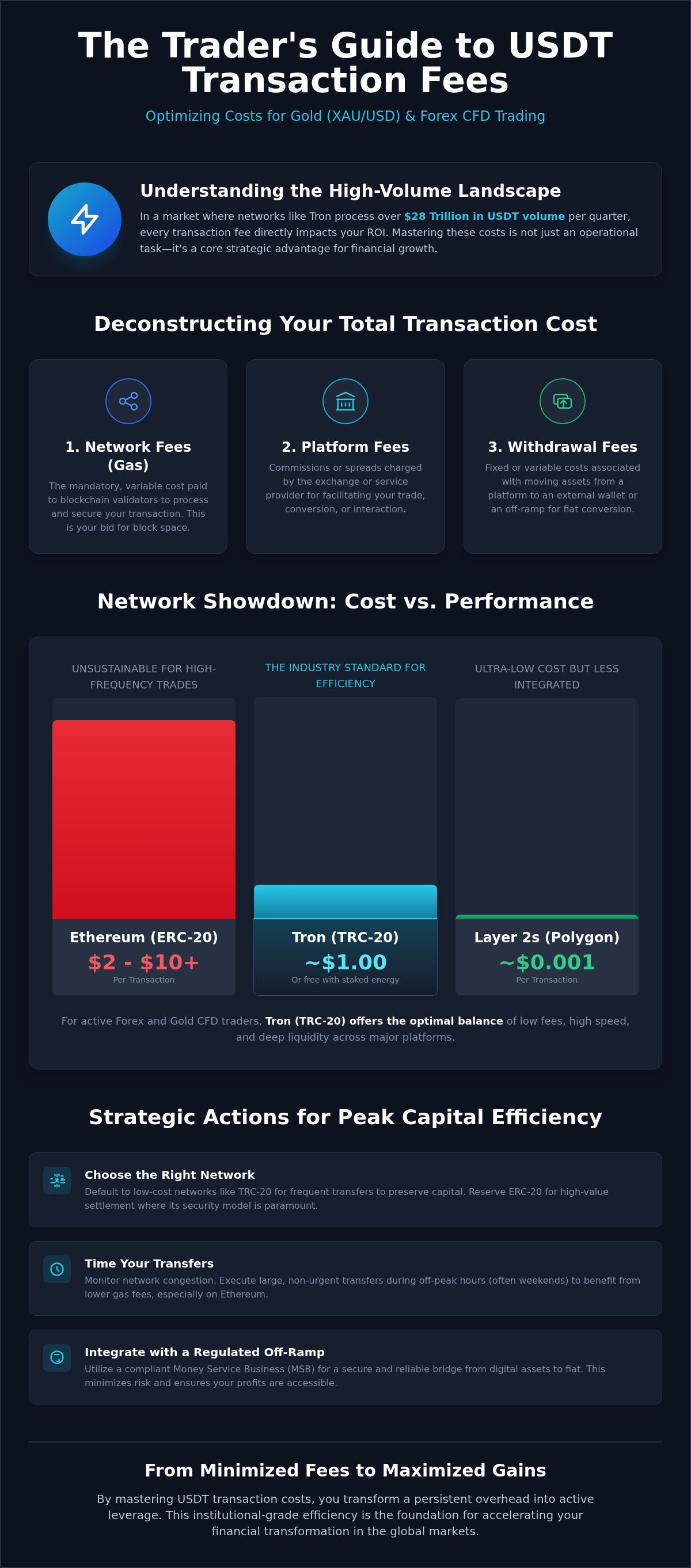
    Total overhead is rarely a single number. It’s a combination of three distinct layers that every professional trader must monitor. Network or Gas fees are the non-negotiable costs paid to the blockchain itself. Exchange or service fees are the commissions charged by platforms for facilitating your trade or conversion. Finally, withdrawal fees are the fixed costs associated with moving assets to external wallets or utilizing a crypto offramp to secure your profits in fiat currency. Managing these three layers is the difference between a profitable quarter and an operational deficit.

    Why Fees Matter for Financial Transformation

    In the high-stakes world of Gold (XAUUSD) and USD CFD trading, micro-fees act as a slow leak in your capital bucket. While a few dollars might seem negligible for a single trade, these costs accumulate over hundreds of positions, eroding your long-term trading capital. Successful traders have shifted their psychology from viewing these as “spending” to seeing them as “optimizing” overhead. By operating in low-fee environments, you increase your trading frequency and agility. This allows you to capitalize on minor market fluctuations in the Forex market that would otherwise be unprofitable. Mastering usdt transaction fees explained in this context is the first step toward institutional-grade efficiency, turning saved overhead into active leverage for your next big position.

    Network vs. Service Fees: A Technical Breakdown

    Understanding the financial impact of stablecoins requires a precise distinction between network-level gas and platform-level service charges. When you have usdt transaction fees explained through this lens, you realize that your choice of transport layer is the most significant variable in your trading ROI. As highlighted in the U.S. Treasury report on stablecoins, the infrastructure supporting these assets is critical for market integrity. Professional traders don’t just look at the total cost; they dissect it to find the most efficient path for their capital. Every transaction involves a smart contract interaction, which is inherently more complex and costly than moving a native token like Ethereum or Bitcoin.

    USDT on Ethereum (ERC-20) vs. Tron (TRC-20)

    In 2026, the Ethereum network remains a pillar of security, yet its ERC-20 fees often range from $2 to $10 per transfer. For high-frequency Forex traders, these costs are often unsustainable. Conversely, the Tron network (TRC-20) has solidified its position as the industry workhorse, processing over $28 trillion in volume during early 2026. With fees typically hovering around $1, or reaching zero for users with staked resources, it provides the speed necessary for rapid capital reallocation. For those trading XAU/USD CFDs, where timing is everything, the TRC-20 layer offers a superior balance of liquidity and cost-efficiency. Layer 2 solutions like Polygon and Solana have also matured, offering costs as low as $0.001, though they may lack the deep exchange integration found on the Tron network.

    Service Fees and Exchange Spreads

    Beyond the blockchain, service fees represent the operational margins of the platforms you use. Many retail exchanges claim “zero fees” but actually hide their costs within the exchange spread. This is a subtle tax on your financial transformation. If the market price for USDT is 1.00 but your platform sells it at 1.02, you’ve effectively paid a 2% fee before even entering a trade. Professional OTC desks and regulated providers like Pallapay offer a more transparent alternative by simplifying fee structures for high-volume traders. By utilizing a professional off-ramp, you can avoid these hidden spreads and ensure your capital remains intact for your next position. Choosing a partner that functions as a strategic bridge between digital innovation and institutional reliability is essential for maintaining a competitive edge in the global CFD markets.

    Beyond the Fee: USDT in Forex and Gold CFD Trading

    While previous sections detailed the technical costs, the true value emerges when we view these numbers in the context of active market participation. Having usdt transaction fees explained as a strategic variable rather than a fixed cost empowers traders to optimize their entry and exit points in the XAU/USD market. Using USDT as a base currency for CFD trading transforms the financial landscape by allowing for near-instant capital reallocation. This agility is essential for those seeking a total financial transformation through the global markets, where a delay of even a few minutes can result in missed opportunities during high-impact news events.

    Traditional SWIFT transfers often act as a barrier to entry, requiring days to settle and incurring significant intermediary bank charges. By utilizing USDT, you bypass these legacy delays. This creates a “dry powder” reserve that remains ready for instant deployment. Whether you’re waiting for a specific gold setup or a major USD currency pair move, having your liquidity in a stable, digital format ensures you aren’t sidelined by banking hours or geographic restrictions. Global regulatory bodies, following the Financial Stability Board recommendations, are increasingly recognizing stablecoins as essential infrastructure for modern financial markets, reinforcing the long-term viability of this strategy.

    Maximizing ROI in Gold CFD Trading

    In the volatile Gold (XAUUSD) market, transaction friction directly impacts your risk management strategy. Lowering your operational costs allows for tighter stop-losses and more precise position sizing. Because the cost of entry is minimized, you can scale into positions with greater frequency without the overhead eroding your margins. Furthermore, USDT serves as an effective hedge against local currency volatility. You can hold your trading capital in a dollar-pegged asset while waiting for the perfect technical setup in the gold market, ensuring your purchasing power remains stable throughout the process.

    Forex Trading and Financial Independence

    The path to financial independence is built on efficiency and access to global liquidity. Trading USD CFDs settled in USDT removes the friction typically associated with cross-border currency conversions. USDT eliminates the standard 48-to-72-hour settlement lag inherent in traditional Forex markets, enabling near-instant capital rotation. This speed advantage allows you to move profits from a successful trade back into your off-ramp solution or into a new position without waiting for the legacy banking system to catch up. By integrating these modern tools, you transition from a participant in the market to a strategic operator with institutional-grade capabilities.
    USDT Transaction Fees Explained: The 2026 Guide to Maximizing Trading Profitability

    Strategic Fee Management: How to Minimize Costs

    Efficiency in capital movement is the hallmark of a professional trader. While having usdt transaction fees explained provides the necessary technical foundation, implementing a strategic management plan is what actually preserves your margins. High-volume operations in the Gold and USD CFD markets require more than just choosing a network; they demand a disciplined approach to timing and execution. By treating transaction costs as a manageable overhead rather than a fixed tax, you can significantly improve your net ROI. This transition from passive spending to active optimization is a critical step in your journey toward total financial transformation.

    Batching transactions is one of the most effective ways to reduce high-cost network interactions. Instead of moving small amounts of capital multiple times, group your transfers into a single, larger operation. This strategy is particularly effective for those utilizing the Ethereum network, where gas fees are flat regardless of the transaction size. Additionally, timing the market by using gas trackers allows you to execute transfers during low-activity windows. Even on high-speed networks, avoiding peak congestion can save substantial amounts over a fiscal year. For large-scale movements, utilizing a regulated OTC desk is essential. These platforms help you avoid the slippage and tiered fee structures often found on retail exchanges, ensuring your entry into a major Forex position remains as cost-effective as possible.

    A Step-by-Step Optimization Checklist

    • Monitor Congestion: Use real-time analytics to check network load before initiating any high-value transfer.
    • Verify Compatibility: Ensure the destination wallet or broker account fully supports your chosen USDT transport layer to avoid lost funds.
    • Calculate Net Impact: Compare the total cost of the move against the potential profit of the trade you’re entering.

    Advanced Techniques for High-Volume Traders

    Precision is vital when managing significant liquidity. Whitelisting your primary trading addresses reduces the risk of manual entry errors and the associated costs of “test” transactions. To streamline your workflow, you can use Pallapay’s Fiat Settlement to lock in your trading profits without the need for multiple intermediary hops. This direct path from digital asset to fiat currency minimizes the number of taxable and fee-bearing events in your cycle. For those running automated strategies, institutional-grade API integration allows for programmatic fee management. This ensures your systems always select the most efficient path for capital reallocation in real-time. To begin optimizing your high-volume movements with a regulated partner, explore our OTC exchange solutions today.

    The Pallapay Advantage: Seamless Integration for Global Traders

    Pallapay functions as the definitive professional bridge between the disruptive potential of digital assets and the institutional reliability required by serious market participants. While earlier sections have provided the technical foundation for having usdt transaction fees explained, the final step in your financial transformation is selecting a partner that eliminates operational friction. By operating as a regulated MSB in the United States and Canada, Pallapay offers a secure environment for high-volume capital movements that retail platforms simply cannot match. This regulatory standing ensures that your path from digital liquidity to traditional markets is both stable and compliant.

    One of the primary advantages of utilizing a professional OTC desk is the ability to bypass the unpredictable nature of standard network congestion. While retail traders are often at the mercy of fluctuating gas prices, institutional-grade providers facilitate large-scale movements with transparent, utility-focused service models. This stability is essential when managing the substantial liquidity required for Gold (XAUUSD) and major Forex CFD positions. By removing the complexity of tiered fee structures, we allow you to focus entirely on market strategy and profit maximization.

    Integrated Solutions for Modern Commerce

    Capital efficiency is only useful if it’s accessible and secure. Using the Pallapay Wallet provides a secure, low-friction storage solution that integrates directly with our global liquidity ecosystem. When you’re ready to realize the gains from your USD CFD trades, our infrastructure allows for instant off-ramping to fiat currency for reinvestment or real-world spending. This isn’t just about moving numbers on a screen; it’s about tangible financial growth. With the Pallapay Mastercard, you can spend your trading profits globally, bridging the gap between your digital success and your daily financial operations.

    Empowering Your Trading Future

    Professional traders choose Pallapay because we understand the requirements of high-volume OTC operations. Our systems are built to handle significant capital rotations without the slippage or delays that often plague decentralized bridges. The speed and safety of the Pallapay Off-Ramp ensure that your CFD profits are never trapped in a cycle of multiple network hops or excessive withdrawal fees. You’ve mastered the mechanics of fee optimization; now it’s time to deploy that knowledge within a comprehensive financial ecosystem. Explore the Pallapay ecosystem today to secure your position in the inevitable evolution of global commerce.

    Mastering Your Financial Evolution

    You now possess the technical foundation required for institutional-grade capital movement. By having usdt transaction fees explained through the lens of operational efficiency, you can transition from reactive spending to strategic optimization. Selecting the optimal transport layer and timing your transfers aren’t just technical choices; they’re essential components of your financial transformation in the global Gold and USD CFD markets. Efficiency is the ultimate competitive advantage for modern traders, and it’s your most reliable tool for long-term growth.

    Pallapay provides the professional bridge you need to scale with confidence. As a regulated MSB in the USA and Canada, we offer secure OTC desks for high-volume trades and instant crypto-to-fiat off-ramping. This ensures your hard-earned profits move seamlessly from digital liquidity to real-world utility without the friction of traditional systems. Start your financial transformation with Pallapay today and take control of your trading ROI. The global marketplace is evolving quickly, and you’re now equipped to lead that change.

    Frequently Asked Questions

    Why are USDT transaction fees higher on Ethereum than on Tron?

    Ethereum (ERC-20) fees are higher because the network uses a competitive bidding system for limited block space, and USDT transfers are complex smart contract interactions. Tron (TRC-20) uses a different resource model that prioritizes high-throughput stablecoin movements, resulting in significantly lower overhead. This technical distinction is why Tron processed over $28 trillion in USDT volume in early 2026. Choosing the right network is the first step toward optimizing your trading ROI.

    Can I send USDT from an ERC-20 wallet to a TRC-20 address?

    No, you cannot send USDT directly between these networks because they utilize incompatible blockchain protocols. Sending assets from an ERC-20 wallet to a TRC-20 address will result in the permanent loss of your capital. To move funds between layers, you must use a bridge or an exchange that supports both. Having usdt transaction fees explained correctly is vital to avoid these costly procedural errors and protect your trading liquidity.

    How much are the typical fees for a USDT to bank transfer in 2026?

    Typical costs involve a combination of blockchain network fees and the service provider’s conversion commission. While specific amounts vary, using a professional off-ramp solution helps minimize these expenses through efficient fiat settlement. Professional traders should prioritize regulated providers that offer transparent pricing rather than hidden spreads. This ensures that more of your Gold CFD profits are successfully transferred to your bank account, supporting your overall journey toward financial transformation.

    What is the cheapest way to buy USDT for Forex trading?

    Buying USDT with cash through a regulated OTC exchange is often the most efficient method for high-volume traders. This approach avoids the steep processing fees associated with traditional credit cards and provides access to institutional-grade liquidity. For those focused on Forex trading, minimizing the initial acquisition cost ensures that more capital is available for margin and leverage. This strategic entry is key to maximizing profitability in the global currency markets.

    Do transaction fees apply when I spend USDT with a crypto card?

    Yes, transaction fees generally apply in the form of conversion spreads or service charges when digital assets are swapped for fiat at the merchant. There may also be recurring maintenance or ATM fees depending on the specific card issuer. Despite these costs, the ability to spend trading profits instantly provides a level of financial agility that traditional banking cannot match. It allows you to utilize your market gains for real-world expenses without settlement delays.

    How do network fees impact the profitability of Gold CFD trading?

    Every dollar spent on network fees is a dollar removed from your active trading margin. In the XAU/USD market, high transaction costs can erode the profitability of frequent, smaller trades and limit your ability to manage risk effectively. By reducing this friction, you can execute more precise entries and exits, which is essential for scaling your portfolio. Lowering overhead is a fundamental requirement for anyone seeking a total financial transformation through trading.

    What happens if I set my gas fee too low for a USDT transaction?

    Setting a gas fee too low will cause your transaction to stall in the network queue, potentially for hours or days. This lack of speed can be devastating if you’re trying to capitalize on a sudden move in the Gold or Forex markets. While some wallets allow you to “speed up” a transaction by paying more, the initial delay can still result in missed opportunities. Always check current congestion levels before initiating a high-priority transfer.

    Why does Pallapay require MSB registration for its services?

    MSB registration in the United States and Canada ensures that the platform operates within a rigorous legal framework designed to protect the global financial system. This compliance provides institutional-grade security for users, particularly during high-volume OTC operations and bank settlements. It demonstrates a commitment to stability and transparency, which is why professional traders choose regulated partners. This oversight is a critical component of bridging the gap between digital innovation and traditional financial reliability.

    Disclaimer

    The information provided on this website and blog is for general informational and educational purposes only and does not constitute financial, investment, legal, tax, or other professional advice.
    Cryptocurrency and digital asset services may be subject to regulatory restrictions in certain jurisdictions. Users are solely responsible for ensuring compliance with applicable local laws and regulations before using any products or services mentioned on this website.
    PallaPay does not guarantee the accuracy, completeness, or timeliness of any information published and accepts no liability for any loss or damages arising from reliance on the content. Any opinions expressed are those of the respective authors and may change without notice.
    Certain services, features, or products referenced may be provided through third-party partners, licensed entities, or affiliated service providers subject to separate terms and regulatory approvals. Availability of services may vary by country or region.
    This website may contain references to digital assets, virtual currencies, or blockchain-related services that are not available to residents of certain jurisdictions, including where prohibited by law. Nothing on this website constitutes an offer, solicitation, or recommendation to buy or sell any financial instrument or virtual asset.

  • USDT TRC20 vs ERC20: The Definitive 2026 Comparison for Global Traders

    USDT TRC20 vs ERC20: The Definitive 2026 Comparison for Global Traders

    Choosing the most established network for your capital might actually be the fastest way to erode your trading margins. You’ve likely felt the frustration of high gas fees during a volatile market swing or waited for a confirmation while a prime gold price entry slipped away. It’s a common struggle for traders who need agility but find themselves tethered to congested infrastructure. Understanding the nuances of USDT TRC20 vs ERC20 is no longer just a technical requirement; it’s a strategic necessity for anyone serious about maximizing capital efficiency.

    This comparison provides the clarity you need to optimize your transaction overhead and ensure absolute security for high-value transfers. You’ll learn how to leverage the Tron network’s low fees for rapid moves or utilize Ethereum’s deep liquidity for institutional-grade stability. We examine the 2026 landscape of settlement speeds and security audits to help you integrate these networks into a transformative trading strategy that can redefine your financial future. This guide prepares you to navigate Forex and XAU/USD CFD markets with the precision and confidence of a global industry leader.

    Key Takeaways

    • Identify the optimal balance between Ethereum’s institutional liquidity and Tron’s cost-efficiency by mastering the technical nuances of USDT TRC20 vs ERC20.
    • Reduce operational friction and preserve your trading margin by utilizing TRC20’s sub-minute confirmation speeds for high-frequency Gold and Forex CFD positions.
    • Ensure absolute security for large-scale capital movements by leveraging ERC20’s deep ecosystem compatibility and Tether’s verified 2026 reserve transparency.
    • Transform your financial agility in the XAU/USD and currency markets by strategically selecting network rails that minimize transaction overhead.
    • Streamline your trading lifecycle with Pallapay’s regulated infrastructure, bridging the gap between digital liquidity and institutional-grade financial utility.

    What is USDT? Understanding the Multi-Chain Stablecoin

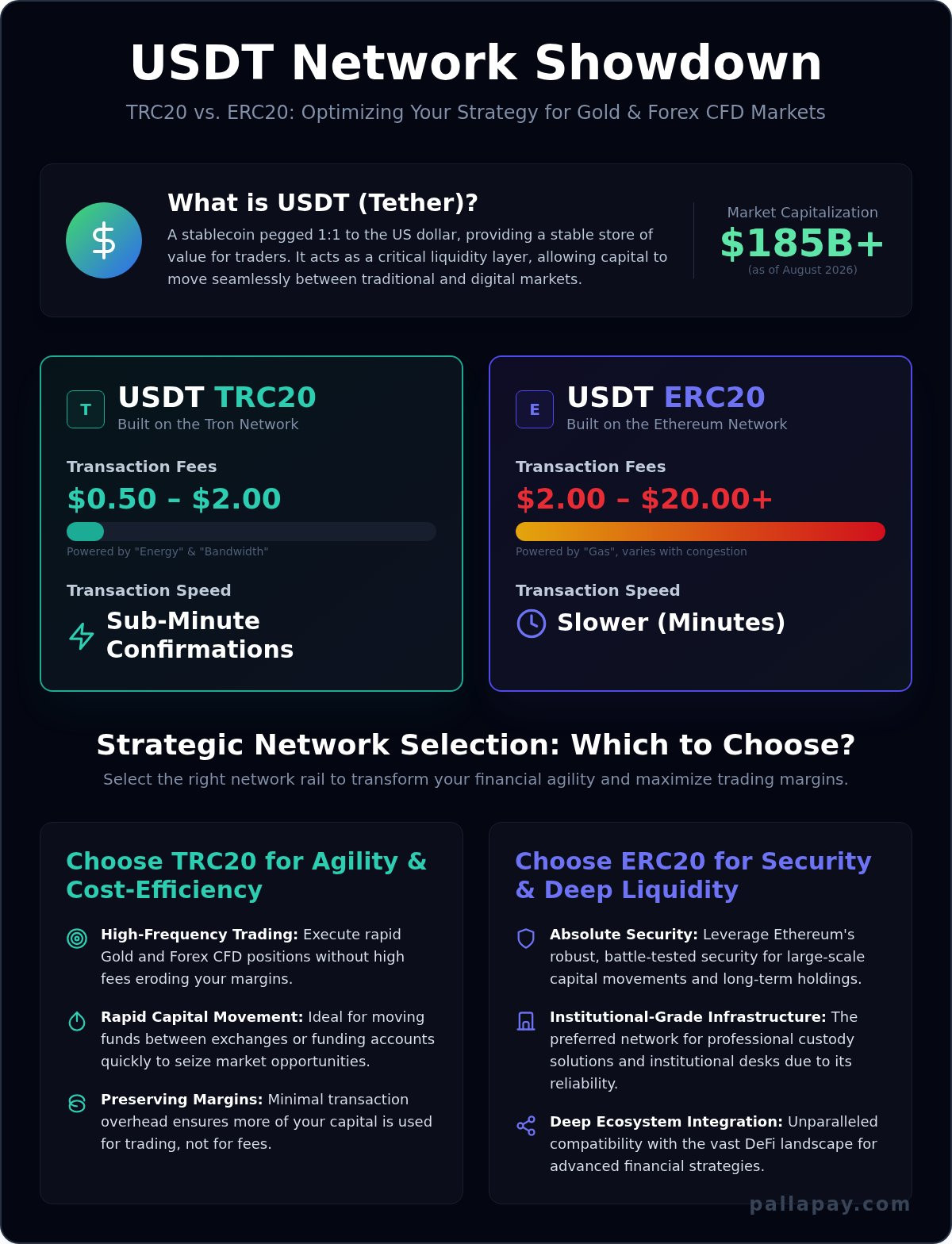
    USDT is the foundational asset of the modern digital economy. It functions as a Tether stablecoin, maintaining a 1:1 peg with the US dollar to provide a reliable store of value amidst market volatility. For traders engaging in high-stakes environments like Gold and Forex CFD trading, this stability is essential. USDT acts as a cross-chain liquidity layer for global finance, allowing capital to move between traditional markets and digital ecosystems without the friction of constant fiat conversion. As of August 2026, Tether’s market capitalization has reached approximately $185 billion, solidifying its position as a primary settlement instrument for professional investors.

    The distinction between versions of the asset lies in the underlying blockchain protocol, often called the “rail.” When discussing USDT TRC20 vs ERC20, we’re comparing the technical infrastructure used to settle transactions. While the value of the token remains constant, the choice of network determines your operational speed, cost, and security profile. This decision can be the difference between a profitable trade and a missed opportunity when price action accelerates in the currency markets. The choice typically falls between two dominant standards:

    • ERC20: The Ethereum-based protocol known for its institutional-grade security and deep ecosystem integration.
    • TRC20: The Tron-based protocol optimized for rapid settlement and minimal transaction overhead.

    The Role of ERC20 in the Ethereum Ecosystem

    Launched in 2017, the ERC20 standard was the first major protocol to host USDT. It leverages Ethereum’s massive decentralized finance infrastructure, offering unparalleled depth and security. It’s often considered the gold standard for institutional players and large-scale holdings. If you’re managing significant capital for long-term USD CFD positions, the ERC20 network provides a level of trust and integration that’s difficult to match. Its security architecture ensures that high-value transfers are handled with the robustness required by professional financial standards. Many institutional desks prefer this rail because of its deep integration with professional custody solutions and its long history of reliability.

    The Rise of TRC20 for High-Frequency Transfers

    The TRC20 standard emerged as a direct response to Ethereum’s scalability challenges. Built on the Tron blockchain, it prioritizes speed and minimal overhead. For active participants in the Forex market, every second counts. TRC20 allows for sub-minute confirmations, making it the preferred choice for high-frequency transfers and exchange deposits. It’s become the dominant rail for retail commerce and P2P payments because it eliminates the prohibitive costs often associated with network congestion. By choosing the TRC20 rail, traders can move their USDT with the agility needed to capitalize on sudden shifts in XAU/USD pricing. This efficiency ensures that transaction fees don’t eat into margins, transforming how individuals manage their financial lives through strategic market participation.

    USDT TRC20 vs ERC20: Key Technical Differences

    The operational efficiency of a global trader often hinges on the underlying mechanics of their chosen settlement layer. When comparing USDT TRC20 vs ERC20, the primary technical divergence lies in the consensus mechanisms and resource allocation of their respective blockchains. Ethereum utilizes a Proof of Stake model that prioritizes decentralization, while Tron employs Delegated Proof of Stake to facilitate higher transaction volumes. For those managing high-value XAU/USD CFD positions, these technicalities dictate the speed at which margin can be deployed and the cost of maintaining liquidity. Strategic selection of these rails can fundamentally alter a trader’s financial trajectory by preserving capital for market opportunities rather than losing it to network overhead.

    Transaction fees in 2026 reflect this architectural split. ERC20 transfers rely on “Gas,” which fluctuates based on Ethereum network congestion. Research indicates these costs typically range from $2 to over $20 for a single transaction. In contrast, the TRC20 network utilizes a system of “Energy” and “Bandwidth,” keeping costs predictably low, generally between $0.50 and $2. While Ethereum offers the most robust security profile for institutional capital, Tron’s sub-minute confirmation speeds provide the agility required for rapid Forex market entries. Professional traders must weigh the absolute security of Ethereum against the near-instant finality of Tron to optimize their trading outcomes and ensure their capital is always where the growth is.

    Address Formats: How to Identify Your Network

    Identifying the correct network is the first step in safeguarding your capital against permanent loss. ERC20 addresses are hexadecimal and always begin with “0x,” appearing as 0x71C… and similar strings. TRC20 addresses are alphanumeric and always start with a capital “T,” such as TXnL… . Sending TRC20 tokens to an ERC20 address, or vice versa, typically results in a total loss of funds because these networks aren’t natively interoperable. Using a secure multichain wallet is essential to ensure you’re interacting with the correct protocol before confirming any transfer. This simple visual check is a critical component of institutional-grade security for individual traders.

    Fee Structures and Gas Costs in 2026

    The 2026 landscape has seen TRC20 become the dominant rail for micro-transactions and retail-level trading. Its low overhead allows traders to move smaller amounts of capital without fees consuming their potential profit. While Ethereum’s Layer 2 solutions have improved scalability, the base layer ERC20 remains the preferred choice for large-scale institutional transfers where deep liquidity is paramount. As U.S. stablecoin regulation continues to evolve, the transparency and auditability of these networks provide a secure foundation for transformative financial growth. Choosing the right rail isn’t just about saving money; it’s about aligning your technical infrastructure with your long-term wealth creation goals in the USD CFD and commodity markets.

    Strategic Network Selection: Which Should You Choose?

    Liquidity remains a primary consideration for global traders. Before initiating a transfer, you must verify the preferences of your counterparties. While the Tron network handles the majority of retail transaction volume in 2026, many institutional liquidity providers still prioritize the Ethereum ecosystem for its unparalleled decentralization. Choosing the wrong rail can result in significant delays or the total loss of funds. Professional traders often maintain a diversified presence across both networks to ensure they can capitalize on opportunities in the USD CFD markets regardless of which infrastructure a specific broker or exchange requires. This agility is what separates successful market participants from those who are sidelined by technical friction.

    Managing Institutional Liquidity

    High-net-worth individuals and institutional desks often default to ERC20 for its established reputation and broad integration with professional custody solutions. Managing these multi-chain assets requires a partner that understands the complexities of global liquidity. Utilizing Pallapay’s OTC exchange allows traders to handle high-volume transfers with the precision required for transformative financial growth. While Ethereum provides a robust framework, staying informed about stablecoin security risks is essential for anyone managing significant capital. A multi-network approach provides the operational flexibility needed to navigate volatile market shifts without being hindered by a single point of technical failure.

    Avoiding Common Transfer Pitfalls

    The most sophisticated trading strategy can be derailed by a simple administrative error. Implementing a ‘test transaction’ strategy by sending a single USDT before moving larger sums is a vital safeguard that can save thousands in lost capital. It’s also critical to verify network support on both the sending and receiving ends before clicking confirm. Using secure crypto wallets that provide clear network identification helps prevent cross-network errors that lead to irreversible fund loss. These small, disciplined steps ensure that your focus remains on the transformative potential of the Gold and Forex markets rather than on rectifying avoidable technical mistakes. Consistency in these procedures builds the foundation for long-term financial stability.

    USDT TRC20 vs ERC20: The Definitive 2026 Comparison for Global Traders

    Beyond the Transfer: Fueling Transformative Gold and Forex CFD Trading

    USDT is more than a stable digital asset; it serves as the primary engine for accessing global liquidity in the XAU/USD and currency markets. Mastering the choice between USDT TRC20 vs ERC20 allows traders to move capital with institutional precision, directly impacting available margin and trading agility. In the fast-moving 2026 market environment, where Gold and USD pairs remain the most strategic assets for wealth preservation, the speed of funding a position often determines the final outcome. Efficient network transfers ensure that capital is never idle when market volatility creates a high-conviction entry point.

    The transformative potential of professional trading lies in its ability to change an individual’s financial life through disciplined market access. By utilizing USDT as a bridge, you bypass the traditional banking friction that often stalls global capital flows. This digital-first approach provides the flexibility to pivot between asset classes with ease. Whether you are hedging against inflation with Gold or capitalizing on currency fluctuations, the technical rail you choose for your USDT is the foundation of your operational success. It’s a strategic tool designed to fuel long-term financial growth.

    The Power of CFD Trading with USDT

    Traditional banking systems frequently introduce delays that are incompatible with the real-time nature of Forex markets. Leveraging USDT allows you to bypass this friction, providing immediate exposure to price movements through CFD trading without the need for complex remittance procedures. The TRC20 network is particularly effective for this purpose. Its sub-minute confirmation times allow for rapid capital deployment when Gold (XAU) prices shift unexpectedly. Using USDT as your base currency ensures that your trading account remains liquid, allowing you to capture gains from USD pairs with the speed required by modern financial standards. This efficiency is essential for maintaining a competitive edge in high-leverage environments.

    Achieving Financial Evolution Through Professional Trading

    Moving from passive holding to active, strategic wealth generation is a significant step in any financial evolution. High-leverage CFD markets provide the exposure necessary to accelerate this progress, but they require a reliable infrastructure to succeed. A sophisticated partner is required to manage the underlying crypto-to-fiat flows, ensuring that your trading gains are accessible and secure. By integrating professional-grade tools into your strategy, you can focus on the market decisions that drive your financial independence. This level of control over your capital is what enables a truly transformative trading experience. To maximize your efficiency, you can convert crypto to fiat instantly and bridge the gap between digital success and real-world utility.

    Seamless USDT Management with Pallapay’s Institutional Ecosystem

    Navigating the technical landscape of USDT TRC20 vs ERC20 requires a strategic partner that bridges the gap between digital innovation and institutional reliability. Pallapay serves as this essential facilitator, providing a regulated environment for traders to manage their stablecoin liquidity with absolute confidence. With MSB registrations in the United States and Canada, the platform ensures that every transaction meets rigorous compliance standards. This institutional-grade framework allows you to focus on the transformative potential of the markets while the underlying technical complexities are handled with professional precision. Whether you’re moving capital between global exchanges or securing profits from a successful gold trade, the integrated ecosystem provides the stability you need to grow.

    Efficiency is the cornerstone of modern trading. When you need to move from digital success to real-world utility, Pallapay’s off-ramp provides the technological answer to immediate liquidity needs. It enables traders to convert their USDT holdings into fiat instantly, ensuring that capital is always accessible for both reinvestment and personal requirements. This seamless transition is vital for those participating in the fast-paced USD CFD markets, where the ability to realize gains quickly can define a trader’s financial trajectory. By eliminating the friction typically found in traditional banking channels, you gain a competitive edge in capital management.

    High-Volume OTC and Cash Exchange

    Institutional traders and high-net-worth individuals require more than just a standard retail interface; they need deep liquidity and professional-grade spreads. Pallapay’s OTC desks facilitate the ability to buy and sell USDT for cash instantly, supporting volumes that standard exchanges often struggle to process. This service is particularly beneficial for those managing large-scale Forex positions where slippage can significantly impact margins. Additionally, the integration of fiat settlement services empowers businesses to scale their operations by bridging the gap between crypto-assets and traditional financial systems. It’s a comprehensive solution designed for the demands of 2026 global commerce.

    The Pallapay Mastercard: Real-World Utility

    Transforming trading profits into daily lifestyle utility is the final step in achieving financial evolution. The Pallapay Mastercard allows you to spend your USDT, whether held as TRC20 or ERC20, directly in the global economy. This integration removes the final barrier between your digital portfolio and your real-world expenses, providing a secure and effortless way to utilize your market gains. It represents a sophisticated tool for the modern financial pioneer, ensuring that your success in Gold and Forex CFD trading translates into tangible personal growth. By centralizing your financial life within one secure ecosystem, you accelerate your progress toward long-term independence.

    Mastering the Future of Global Settlement

    The strategic distinction between USDT TRC20 vs ERC20 represents more than a technical preference; it’s a decision that defines your agility in the global markets. By aligning your network selection with your operational needs, you ensure that high-value transfers remain secure while maintaining the speed required for XAU/USD and currency trading. Success in the 2026 landscape depends on a sophisticated infrastructure that preserves your margin and facilitates immediate capital deployment. It’s the foundation of a truly transformative financial journey.

    Pallapay serves as the professional bridge for this evolution, offering institutional-grade OTC desks and secure operations as a regulated MSB in the US and Canada. With a presence serving over 180 countries, the ecosystem provides the stability and global reach necessary for modern traders. You can now move between digital liquidity and real-world utility with the confidence of an industry leader. Start your financial transformation with Pallapay’s secure USDT off-ramp and unlock the full potential of your trading strategy today.

    Frequently Asked Questions

    How do I know if my USDT is ERC20 or TRC20?

    You can identify the network by examining the receiving address format. ERC20 addresses always begin with “0x,” while TRC20 addresses start with a capital “T.” Understanding the technical nuances of USDT TRC20 vs ERC20 is essential for maintaining fund safety. Most wallets and exchanges also display the network standard next to your balance. It’s vital to confirm this before initiating any transfer to ensure your capital remains secure.

    Can I send USDT from an ERC20 wallet to a TRC20 address?

    You cannot send USDT directly between these two networks because they operate on different blockchain protocols. Attempting to send ERC20 tokens to a TRC20 address usually results in a total loss of funds. To move assets between them, you must use a bridge or an exchange that supports both standards. This technical boundary is a critical safety feature that requires constant vigilance from professional market participants.

    Which network has the lowest fees for USDT transfers in 2026?

    The TRC20 network consistently offers the lowest transaction fees for stablecoin transfers. In 2026, TRC20 fees typically range from $0.50 to $2, whereas ERC20 costs can fluctuate between $2 and $20 depending on Ethereum network congestion. For traders managing active Forex or Gold CFD positions, the lower overhead of TRC20 helps preserve profit margins and allows for more frequent capital adjustments and entries.

    Is ERC20 more secure than TRC20 for large crypto transfers?

    ERC20 is often preferred for large-scale institutional transfers due to Ethereum’s superior decentralization and security architecture. While TRC20 is faster and more cost-effective for daily retail use, the ERC20 standard provides a more robust framework for long-term storage of significant capital. Professional traders often weigh these factors against the specific liquidity needs of their USD CFD trading strategies to determine the safest fit for their wealth.

    How long does it take to confirm a USDT TRC20 transaction?

    A USDT TRC20 transaction typically confirms within 3 to 5 seconds, though most exchanges require a few additional confirmations for finality. This usually results in a total processing time of less than one minute. This speed is a primary advantage for market participants who need to move capital quickly to capitalize on sudden price shifts in the XAU/USD or global currency markets without delay.

    What happens if I send USDT to the wrong network?

    Sending USDT to the wrong network usually results in an irreversible loss of capital. Because the Ethereum and Tron blockchains aren’t natively interoperable, tokens sent to an incompatible address are effectively removed from circulation. You should always perform a small test transaction before moving substantial amounts to ensure both the sending and receiving platforms are aligned on the chosen network standard to prevent permanent errors.

    Can I use USDT to trade Forex and Gold CFDs?

    You can certainly use USDT to access Gold and Forex CFD markets through modern trading platforms. It serves as an efficient bridge, allowing you to bypass traditional banking friction and deploy capital into high-leverage positions quickly. This access can be transformative for your financial life, providing the agility to trade global price movements in XAU/USD and major currency pairs with institutional precision and speed.

    How do I withdraw USDT TRC20 to my bank account?

    To withdraw USDT TRC20 to your bank account, you must utilize a regulated off-ramp service. You can send your tokens to a provider like Pallapay, convert the digital assets into fiat currency, and then initiate a bank transfer. This process bridges the gap between your trading profits and real-world utility, ensuring your market success translates into tangible financial growth and stability for your daily lifestyle expenses.

    Disclaimer

    The information provided on this website and blog is for general informational and educational purposes only and does not constitute financial, investment, legal, tax, or other professional advice.
    Cryptocurrency and digital asset services may be subject to regulatory restrictions in certain jurisdictions. Users are solely responsible for ensuring compliance with applicable local laws and regulations before using any products or services mentioned on this website.
    PallaPay does not guarantee the accuracy, completeness, or timeliness of any information published and accepts no liability for any loss or damages arising from reliance on the content. Any opinions expressed are those of the respective authors and may change without notice.
    Certain services, features, or products referenced may be provided through third-party partners, licensed entities, or affiliated service providers subject to separate terms and regulatory approvals. Availability of services may vary by country or region.
    This website may contain references to digital assets, virtual currencies, or blockchain-related services that are not available to residents of certain jurisdictions, including where prohibited by law. Nothing on this website constitutes an offer, solicitation, or recommendation to buy or sell any financial instrument or virtual asset.
  • Where to Buy USDT at Low Price: The 2026 Investor Guide to Minimizing Fees

    Where to Buy USDT at Low Price: The 2026 Investor Guide to Minimizing Fees

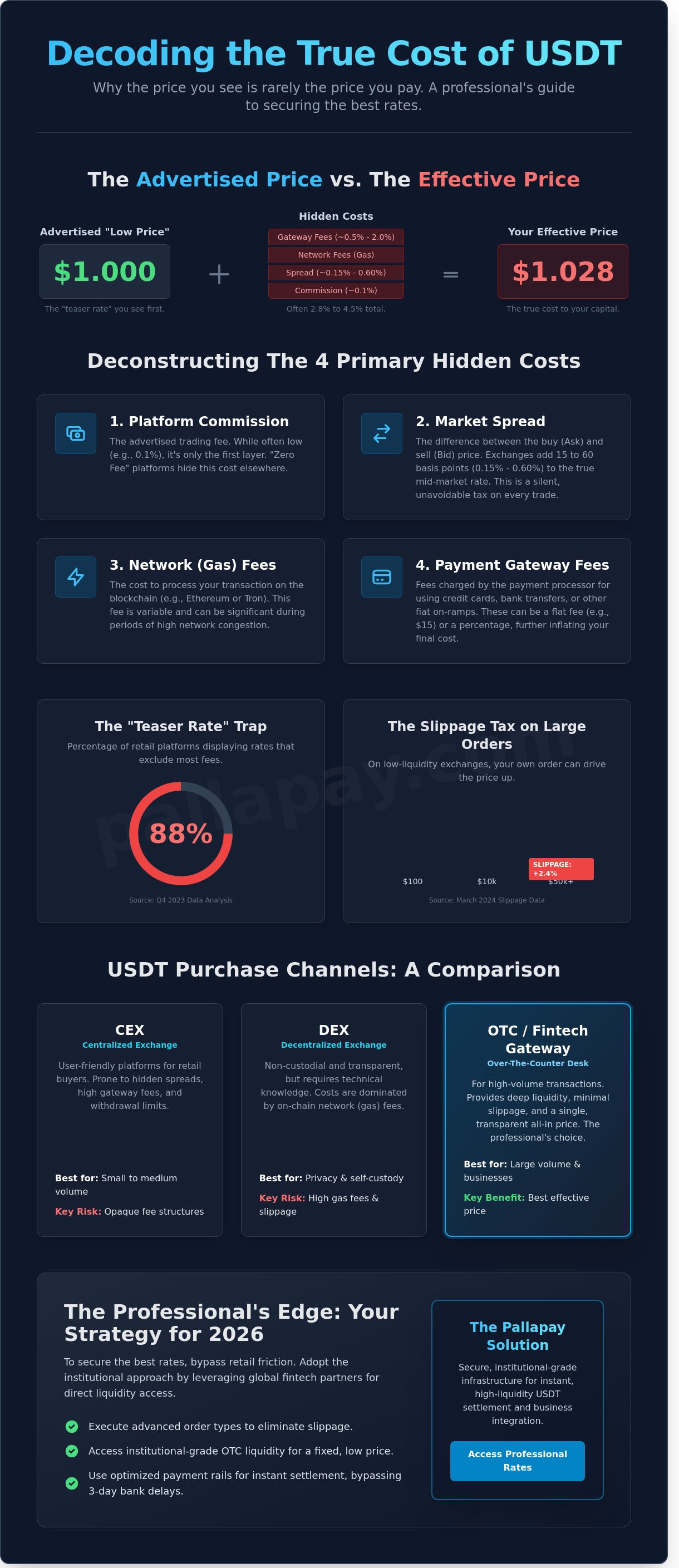
    What if the USDT price displayed on your exchange screen is 2.8% higher than the actual market rate? For many, the search for where to buy usdt at low price ends at a basic retail interface, yet professional investors know that hidden spreads often erode capital before a trade even settles. You likely recognize that opaque fee structures and sudden spikes in volatility can make a simple purchase feel like an expensive gamble. It’s frustrating to watch a 0.1% commission balloon into a 4.5% total cost once payment rail fees and exchange markups are finally calculated.

    This guide provides a transparent framework to calculate your effective entry price and access institutional-grade liquidity. You’ll learn how to leverage instant settlement gateways and OTC desks to bypass the three-day delays typical of traditional banking. We’ll examine the specific payment methods that offer a seamless, low-friction experience in 2026, ensuring your capital moves at the speed of the market rather than the pace of a legacy financial institution. By the end of this article, you’ll have the professional strategies required to secure the best rates available in the global ecosystem.

    Key Takeaways

    • Master the distinction between advertised exchange rates and the “Effective Price” to ensure your capital is deployed with maximum efficiency.
    • Uncover the professional methodology for identifying where to buy usdt at low price by deconstructing the four primary cost layers: commission, spread, network, and gateway fees.
    • Compare the utility of CEX, DEX, and OTC channels to determine which platform aligns best with your specific transaction volume and privacy requirements.
    • Learn to execute advanced order types and optimize payment rails to eliminate unnecessary friction and minimize total acquisition costs.
    • Explore how leveraging a global fintech partner like Pallapay provides the secure, institutional-grade infrastructure needed for instant, high-liquidity USDT settlement.

    The Reality of USDT Pricing: Why “Low Price” is Often a Myth

    Every buyer starts their search by looking for where to buy usdt at low price, yet the mathematical reality of stablecoins makes this a complex pursuit. The Tether (USDT) stablecoin is engineered to maintain a 1:1 parity with the US Dollar, acting as the primary liquidity bridge in the digital asset economy. While this peg is the standard, market volatility causes temporary fluctuations. During the liquidity crunch of May 2022, USDT briefly dipped to $0.95 on secondary markets, while high demand periods in late 2023 saw it trade at a $1.02 premium. These deviations aren’t discounts in the traditional sense; they’re signals of underlying market stress or extreme demand that can actually increase your total acquisition cost.

    The advertised exchange rate you see on a landing page is rarely the price you pay. Data from Q4 2023 shows that 88% of retail platforms display a “teaser rate” that excludes network gas fees, processing commissions, and regional surcharges. This creates a psychological trap where the user believes they’ve found a bargain, only to realize the final cost is 3% higher at the checkout screen. A professional approach requires focusing on the final settlement value rather than the initial quote. This ensures your capital remains preserved during the conversion process.

    Looking ahead, 2026 market liquidity cycles will likely redefine how users access stable assets. Projections suggest institutional settlement volumes will increase by 42%, concentrating liquidity within high-tier OTC desks and sophisticated fintech gateways. This shift means that retail buyers using unverified or low-volume platforms will face wider price gaps. Finding where to buy usdt at low price in this evolving environment will depend entirely on your ability to access direct liquidity pools that bypass multiple intermediaries.

    Many platforms use “Zero Fee” marketing to attract volume, but this is a strategic illusion. These entities don’t operate for free; they hide their revenue in the spread. If the global mid-market rate is $1.00 and a platform offers you USDT at $1.015 with “no fees,” you’re still paying a 1.5% premium. This hidden cost is often more expensive than a transparent platform that charges a flat, visible commission of 0.5%. Transparency is the only way to ensure institutional-grade pricing.

    Understanding Mid-Market Rates vs. Exchange Spreads

    The mid-market rate represents the true, real-time value of USDT, calculated as the exact midpoint between the global buy and sell orders. Exchanges widen the “Ask” price to create a buffer, often adding 15 to 60 basis points to the transaction. This spread is a silent tax on your investment. Effective price is the total fiat spent divided by USDT received.

    The Role of Liquidity in Price Slippage

    Buying $100 of USDT is a standard retail transaction, but acquiring $100,000 requires specialized infrastructure. Low-liquidity exchanges suffer from slippage, where your order exhausts the available supply and forces the price upward during the execution. In March 2024, slippage on minor exchanges reached as high as 2.4% for orders exceeding $50,000. High-volume buyers must prioritize “Depth of Market” to ensure instant, stable pricing across the entire order block.

    Decoding the Hidden Costs: What You Actually Pay for USDT

    Identifying the true acquisition cost of Tether requires looking far beyond the primary exchange rate. Most traders searching for where to buy usdt at low price focus solely on the ticker, yet they often overlook the four distinct layers of friction that erode capital. These layers include the platform commission, the market spread, network gas fees, and gateway surcharges. A standard commission of 0.1% might seem negligible, but when paired with a 0.5% spread and a $15 flat gateway fee, the effective price per token rises significantly. Sophisticated investors prioritize platforms that provide transparent settlement structures to avoid these silent drains on liquidity.

    Withdrawal fees represent another often hidden “exit tax” that exchanges levy when you move assets to a private wallet. While some platforms claim zero commission on trades, they frequently offset this by charging 10 to 20 USDT for a single transfer. This fixed cost disproportionately affects smaller transactions, making it nearly impossible to maintain a low entry price for modest purchases. Understanding these mechanics is essential for maintaining institutional-grade efficiency in your digital asset portfolio.

    Payment Rail Surcharges: Card vs. Wire vs. Cash

    Payment rails dictate the initial speed and cost of your entry into the market. Credit card purchases typically carry a convenience premium of 3.5% to 5%, which immediately puts your investment at a disadvantage. While the transaction is instant, the cost is the highest in the industry. Bank wires offer a more professional alternative with fees often below 1%, though they introduce a significant opportunity cost. A wire transfer can take 48 to 72 hours to clear, during which market volatility might shift the price unfavorably. For those seeking where to buy usdt at low price without the digital overhead, regulated OTC desks remain the gold standard. These desks allow for the efficiency of cash-to-USDT conversions, often providing better liquidity for large volume trades than standard retail gateways.

    Network Fees (Gas) and Stablecoin Standards

    Blockchain architecture introduces a variable cost layer known as gas. Choosing the wrong network can lead to transaction costs that exceed the value of the transfer itself. USDT-ERC20, running on Ethereum, remains the most secure but also the most expensive option. Projections for 2026 suggest that Ethereum and TRON network congestion will continue to fluctuate, with Ethereum gas fees potentially spiking to $25 during high-traffic windows. In contrast, USDT-TRC20 and USDT-POL (Polygon) offer a more streamlined experience, with fees typically staying under $1.50. This technical choice is a critical component of a Report on Stablecoins issued by the U.S. Treasury, which examines how payment system disruptions and network costs impact the broader financial ecosystem.

    Timing your transactions can also yield measurable savings. Data from 2024 shows that network activity is generally lowest between 21:00 and 01:00 UTC on weekends, leading to a 30% reduction in gas prices compared to mid-week peaks. To achieve a truly frictionless experience, users should leverage an all-in-one payment gateway that optimizes network selection automatically. This ensures that every settlement is handled with the speed and cost-effectiveness required in a global economy. By choosing the right standard and the right partner, you transform a complex technical hurdle into a routine business operation.

    USDT Purchase Channels: CEX vs. DEX vs. OTC

    Selecting the right channel determines your final acquisition cost and the security of your capital. Centralized Exchanges (CEX) on major platforms remain the standard for retail users making frequent, smaller purchases. These platforms offer high execution speeds, often settling trades in under 200 milliseconds. While they provide a user-friendly interface, they operate under strict regulatory frameworks. This ensures a high level of safety but requires extensive KYC (Know Your Customer) documentation that may take 24 to 48 hours to verify.

    Decentralized Exchanges (DEX) such as various peer-to-peer platforms cater to users prioritizing privacy and self-custody. These platforms don’t require accounts, but they demand existing crypto assets to trade for USDT. The primary drawback here is the “gas fee” on networks like Ethereum. During peak congestion in 2024, a single swap can cost between $15 and $65, making it an inefficient choice for anyone researching where to buy usdt at low price for small amounts. Over-the-Counter (OTC) desks represent the institutional tier of the market, providing the bridge between traditional fiat and the future of payments.

    • Centralized Exchanges: Best for retail trades under $10,000 where immediate liquidity is available.
    • Decentralized Exchanges: Ideal for privacy-focused users who already hold ETH or other collateral.
    • OTC Desks: The definitive choice for high-volume traders seeking to avoid slippage and market volatility.

    Why OTC Desks Offer Superior Pricing for Large Volumes

    OTC desks operate outside the public order books found on standard exchanges. This is a critical distinction for large-scale transactions. If you attempt to execute a $250,000 buy order on a standard CEX, you’ll likely face “price slippage” of 1.5% to 3% as your order eats through the available liquidity. OTC providers offer direct liquidity access, meaning your trade doesn’t move the public market price. They provide a “locked-in” rate, ensuring the price you see is the price you pay, regardless of market fluctuations during the settlement process.

    Professional services provide a seamless experience for those who need to buy or sell USDT in Dubai via established OTC offices. These physical and digital hubs allow for instant settlements that bypass the multi-day delays often associated with international wire transfers. By using a global enabler with deep local liquidity, users often secure rates that are 0.8% to 1.2% better than standard retail platforms.

    The Convenience Tax of Instant-Buy Apps

    Certain instant-buy applications offer an instant gateway to crypto using credit cards. While the user experience is fast, it comes with a significant “convenience tax.” Markups on these apps frequently range from 3.5% to 7% above the actual spot price. If you’re looking for where to buy usdt at low price, these apps are rarely the answer for significant investments. The U.S. Treasury report on stablecoin risks highlights the complexities of payment system integrations, which explains why these third-party processors charge such high premiums to cover their own operational risks.

    Smart investors must also watch for “hidden” conversion fees in multi-currency wallets. Many wallets claim to offer “zero-fee” swaps but actually use a spread that is 2% wider than the mid-market rate. Always compare the final USDT output against the global spot price before confirming any instant transaction. For professional growth and stability, moving toward OTC or direct exchange limit orders is the only way to ensure you aren’t overpaying for your digital assets.

    Where to Buy USDT at Low Price: The 2026 Investor Guide to Minimizing Fees

    Actionable Strategies to Secure the Best USDT Rates in 2026

    Securing the most competitive rates for Tether requires a shift from retail browsing to institutional-grade execution. It’s not merely about finding a platform; it’s about managing the friction points that erode your capital. In 2026, the spread between a standard purchase and an optimized one often exceeds 3.5%. Efficiency is the difference between growth and stagnation.

    Step 1: Calculate Total Acquisition Cost
    Before you hit the buy button, you must account for every layer of the transaction. This includes the base exchange rate, the trading fee (typically 0.1% to 0.5%), and the withdrawal fee. On the Ethereum network, gas fees can fluctuate by 300% within a single hour. Always check the current Gwei levels and compare them against TRC-20 or alternative network withdrawal costs to ensure your net receipt is maximized.

    Step 2: Prioritize Limit Orders over Market Orders
    Market orders are convenient but expensive. They’re filled at the “ask” price, which includes a premium. By using limit orders on centralized exchanges, you set the price you’re willing to pay. This strategy eliminates slippage, which cost retail traders an estimated $1.2 billion in 2024 alone. It’s the most reliable way to control exactly where to buy usdt at low price without overpaying for instant gratification.

    Step 3: Utilize Regulated OTC Desks for High-Volume Trades
    If your transaction exceeds $10,000, public order books are your enemy. Large buys create “price impact,” pushing the market price up as your order fills. Regulated Over-the-Counter (OTC) desks provide a fixed, single-price quote for the entire block. This professional approach bypasses public volatility and ensures your large-scale liquidity needs don’t trigger a price spike against your own interests.

    Step 4: Capitalize on De-pegging Events
    While rare, stablecoin de-pegging events offer unique entry points. During the banking turbulence of March 2023, some stablecoins traded at a 5% to 8% discount. By maintaining a “buy-the-dip” fund in a different asset class, you can capture USDT at sub-dollar prices. This requires a calm, analytical perspective and the ability to distinguish between temporary liquidity crunches and systemic failure.

    Step 5: Consolidate Your Purchase Frequency
    Fixed network fees are the silent killers of ROI. If you buy $500 worth of USDT ten times, you pay ten withdrawal fees. If you buy $5,000 once, you pay one. Consolidating your purchases can reduce your total transaction overhead by 15% to 20% annually. It’s a simple mathematical adjustment that yields immediate financial benefits.

    Optimizing Your Fiat-to-Crypto Gateway

    The gateway you choose dictates your initial margin. You should prioritize providers that offer direct fiat settlement to eliminate the “intermediary hop” fees charged by third-party processors. Using MSB-registered providers ensures your funds are handled within a legal framework, preventing costly freezes. Always decline dynamic currency conversion (DCC) on international cards; these “convenience” features often hide a 3% to 5% markup on the exchange rate.

    Timing Your Entry: Liquidity and Volatility

    Market crashes often make USDT more expensive because everyone is rushing into the safety of stablecoins. This surge in demand creates a “premium” where USDT trades above $1.00. Monitor stablecoin dominance charts, such as USDT.D, to identify when the market is over-leveraged. If you need to move quickly, the advantage of “Instant” settlement cannot be overstated. It allows you to lock in a rate before the market shifts, providing a secure bridge between your fiat holdings and your crypto objectives. This is why knowing where to buy usdt at low price involves understanding the pulse of global liquidity.

    Ready to experience institutional-grade efficiency for your next transaction? Explore our secure OTC services today.

    Pallapay: Professional USDT Acquisition and Business Integration

    Pallapay functions as a sophisticated bridge between legacy financial systems and the digital economy. It provides institutional-grade liquidity to every client, regardless of their transaction volume. For users searching for where to buy usdt at low price, Pallapay eliminates the spread-heavy middleman. By operating as a direct liquidity provider across 180 countries, the platform ensures that the price you see reflects real-time market depth. This Global Enabler model relies on MSB registrations in the United States and Canada, ensuring every transaction meets strict regulatory standards while maintaining efficiency.

    The platform excels at bridging physical and digital finance through its global network of OTC desks. Clients can convert physical cash into USDT instantly, bypassing the three to five day delays common with traditional wire transfers. This physical presence provides a layer of tangible trust that purely digital exchanges lack. Businesses use this infrastructure to maintain liquid reserves without exposing themselves to the volatility of smaller, unregulated platforms. It’s a professional ecosystem designed for those who value speed as much as they value cost-effectiveness.

    USDT for Merchants: Beyond the Purchase

    Scaling a global business requires a settlement layer that operates 24/7. Merchants can integrate the Crypto POS Machine to accept USDT at a fraction of the cost of traditional credit card processors. While standard merchant accounts often charge 3% or more per transaction, Pallapay users often see overhead reduced by 60%. This hardware solution brings blockchain utility to the storefront, allowing for seamless customer interactions in the real world.

    The system allows for instant settlement into local fiat currencies. This feature is vital for protecting profit margins against market shifts. By using the Pallapay Payment API, developers can automate these flows within their own applications. Over 500 enterprise clients currently use this API to manage high-volume cross-border payments. It simplifies the complexity of global commerce into a single, efficient dashboard that handles the heavy lifting of currency conversion and transmission.

    The Security of Regulated Exchange

    Trust is the primary currency in the fintech world. Pallapay maintains its position as a leader through rigorous compliance, holding MSB registrations with FinCEN in the USA and FINTRAC in Canada. These certifications aren’t just badges; they represent a commitment to secure custody and transparent operations. The platform uses multi-signature cold storage to protect assets, ensuring that your USDT holdings remain safe for the long term. This level of security is standard for every user, from retail buyers to institutional partners.

    Whether you’re an individual investor or a corporate treasurer, the platform provides the tools necessary for modern financial management. It’s the definitive answer for those deciding where to buy usdt at low price while demanding institutional security. The combination of low fees, regulatory oversight, and advanced hardware makes it a visionary partner for the future of payments. Start buying USDT at competitive rates with Pallapay today.

    Master Your USDT Acquisition Strategy for 2026

    Navigating the 2026 digital asset landscape requires a shift from chasing “cheap” rates to identifying true value through fee transparency and deep liquidity. You’ve seen how hidden spreads can erode up to 3% of your capital on standard retail exchanges. Professional investors now prioritize platforms that offer direct fiat-to-crypto settlements to bypass intermediate conversion costs. When you’re determining where to buy usdt at low price, the answer lies in professional infrastructure rather than retail gimmicks. It’s about finding a bridge that connects traditional finance with blockchain efficiency without sacrificing security.

    Pallapay serves as your visionary partner in this financial evolution. We provide the institutional reliability you need through our MSB registration in the USA and Canada. Our global network includes physical OTC desks in the financial hubs of Dubai, Singapore, and Istanbul, ensuring you have local access to premier liquidity. We eliminate the friction of traditional banking with instant settlements that keep your capital moving at the speed of the market. It’s time to elevate your financial operations with a partner that handles the technical heavy lifting behind the scenes.

    Secure Your USDT at the Best Rates with Pallapay

    Your journey toward optimized digital asset management starts with a single, secure transaction today.

    Frequently Asked Questions

    Where is the absolute cheapest place to buy USDT?

    Over-the-counter (OTC) desks like Pallapay provide the lowest rates because they bypass the 0.1% to 0.5% taker fees common on retail exchanges. While platforms like Binance offer competitive spot rates, they often include hidden spreads that increase the total cost. For those seeking where to buy usdt at low price, high-liquidity OTC services provide direct access to institutional rates that remain closer to the 1:1 USD peg.

    Why is the USDT price different on every exchange?

    Price discrepancies occur because each platform maintains its own independent liquidity pool and order book. On November 15, 2023, data showed price variations of $0.002 between major global exchanges. These gaps exist due to regional demand, local banking fees, and the specific cost of settlement on different blockchains. Institutional gateways stabilize these fluctuations by aggregating liquidity from multiple global sources to ensure price consistency.

    Is it cheaper to buy USDT with cash or bank transfer?

    Bank transfers via SEPA or SWIFT are typically 2% to 3% cheaper than cash transactions due to lower manual processing requirements. Cash purchases often incur a 5% premium at physical kiosks to cover security, transport, and hardware maintenance. Using a professional gateway for bank settlements ensures you receive an instant conversion rate without the high overhead costs associated with physical currency handling.

    What are the hidden fees when buying USDT with a credit card?

    Credit card purchases typically carry a 3.5% processing fee plus a hidden spread of 1% to 2% above the market rate. Most banks also categorize these transactions as cash advances, which triggers an immediate 24.99% APR interest charge and a flat $10 fee. You’ll avoid these 5% total losses by opting for direct bank deposits or professional OTC settlement services that prioritize transparent fee structures.

    How do I avoid high gas fees when moving my USDT?

    You can reduce network costs by 90% if you choose the TRON (TRC-20) or Polygon networks instead of Ethereum (ERC-20). In early 2024, Ethereum gas fees averaged $15 per transaction, while TRON transfers remained consistent at approximately $1. Selecting a high-speed, multi-chain gateway allows you to move assets across the global financial ecosystem without losing your capital to network congestion.

    Does buying USDT in large volumes reduce the price?

    Yes, institutional buyers receive better pricing through bulk discounts and reduced slippage on large orders. When you purchase over $50,000, specialized OTC desks offer a fixed price that avoids the market impact seen on retail exchanges. This is a primary reason why high-net-worth individuals look for where to buy usdt at low price through professional settlement partners rather than standard mobile apps.

    Can I buy USDT directly from Tether?

    You can buy directly from Tether Limited, but the platform requires a minimum deposit of $100,000 and charges a 0.1% verification fee. This process involves a rigorous KYC procedure that can take 5 to 7 business days to complete. Most users find it more efficient to use a licensed liquidity provider that offers the same institutional security with faster onboarding and lower entry thresholds.

    How do I know if an OTC desk is giving me a fair price?

    Compare the quoted price against the real-time mid-market rate on platforms like Bloomberg or Reuters. A fair OTC quote should stay within 0.1% to 0.3% of the actual USD value for large transactions. Professional desks provide transparent fee structures and instant execution; this ensures you don’t lose value to market volatility during the settlement process. Always verify that the desk has a physical presence and a valid financial license.

    Disclaimer

    The information provided on this website and blog is for general informational and educational purposes only and does not constitute financial, investment, legal, tax, or other professional advice.
    Cryptocurrency and digital asset services may be subject to regulatory restrictions in certain jurisdictions. Users are solely responsible for ensuring compliance with applicable local laws and regulations before using any products or services mentioned on this website.
    PallaPay does not guarantee the accuracy, completeness, or timeliness of any information published and accepts no liability for any loss or damages arising from reliance on the content. Any opinions expressed are those of the respective authors and may change without notice.
    Certain services, features, or products referenced may be provided through third-party partners, licensed entities, or affiliated service providers subject to separate terms and regulatory approvals. Availability of services may vary by country or region.
    This website may contain references to digital assets, virtual currencies, or blockchain-related services that are not available to residents of certain jurisdictions, including where prohibited by law. Nothing on this website constitutes an offer, solicitation, or recommendation to buy or sell any financial instrument or virtual asset.