

Tag: Business Strategy

  • The Business Case for Accepting Crypto Payments in 2026: A Strategic Guide

    The Business Case for Accepting Crypto Payments in 2026: A Strategic Guide

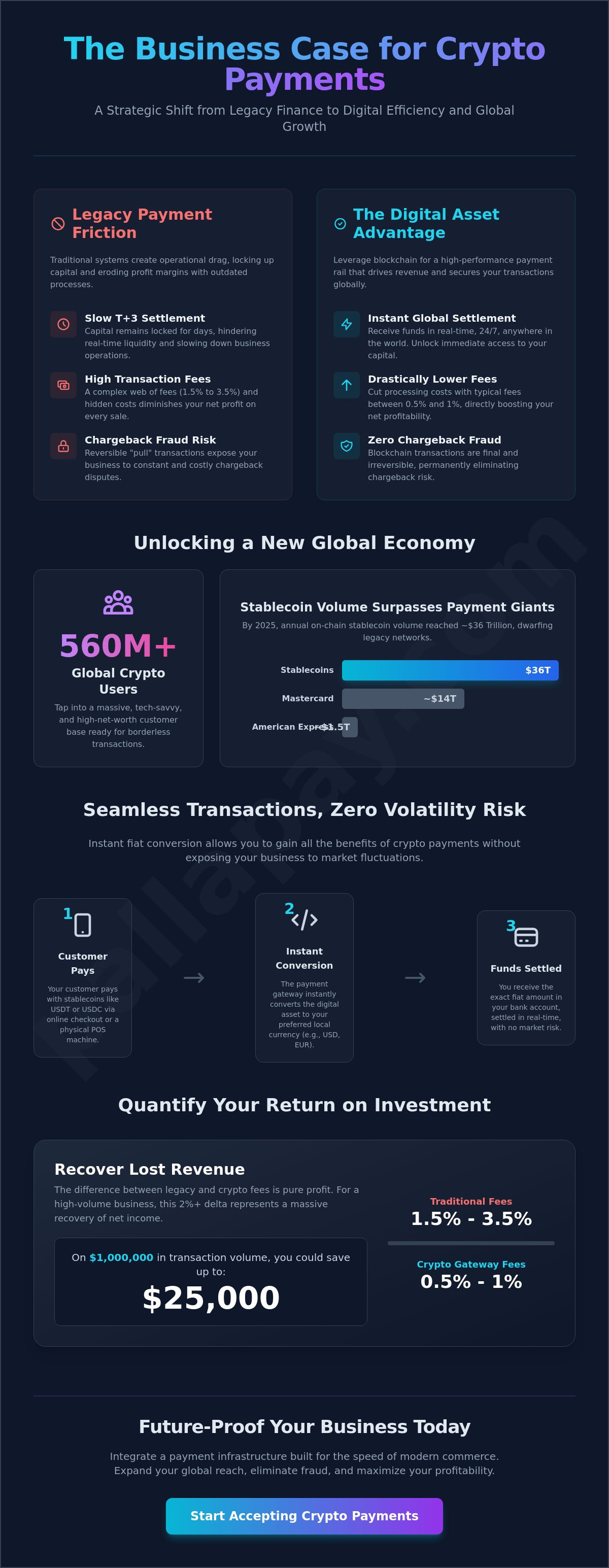
    Did you know that stablecoin on-chain transfer volumes reached approximately $36 trillion by 2025, surpassing the total transaction volumes of legacy giants like Mastercard and American Express? You’ve likely felt the daily friction of traditional banking, where high cross-border fees and the persistent threat of chargeback fraud eat into your margins. Building a robust business case for accepting crypto payments is no longer about following a trend. It’s about securing a strategic advantage in a globalized economy that demands speed and absolute security.

    You deserve a financial infrastructure that works as fast as your business does. We’ll show you how integrating cryptocurrency payments drives revenue, eliminates chargeback fraud, and opens your doors to a high-net-worth audience of over 560 million global users. This guide provides a clear look at how modern payment gateways allow you to bypass slow settlement times and access global markets without currency hurdles. We’ll examine the operational shift toward instant fiat conversion and the regulatory frameworks that have turned digital assets into a reliable, institutional-grade tool for growth.

    Key Takeaways

    • Understand why legacy T+3 settlement cycles are no longer competitive and how to transition your operations toward real-time financial liquidity.
    • Build a compelling business case for accepting crypto payments by comparing standard credit card fees against the efficiency of high-performance blockchain rails.
    • Expand your reach into emerging global markets and connect with a high-net-worth customer base that values borderless, friction-free transactions.
    • Master the strategies for mitigating market volatility through instant fiat conversion and navigating the evolving 2026 regulatory landscape.
    • Explore the technical integration of sophisticated payment APIs and physical POS machines to unify your digital and in-person sales channels effortlessly.

    The Strategic Shift: Why Businesses Are Prioritizing Crypto in 2026

    By 2026, the global financial landscape has matured beyond the era of speculative volatility. Digital assets have transitioned from experimental novelties into essential utility-driven tools for modern commerce. This shift is driven by a fundamental breakdown in legacy banking infrastructure. Traditional T+3 settlement cycles, which keep merchant capital locked for days, are no longer viable in a high-velocity market. Businesses now demand real-time liquidity to maintain their competitive edge. In this environment, the borderless merchant has emerged, using decentralized technology to bypass the geographic and operational silos of traditional finance.

    Digital assets now serve as a sophisticated bridge between disparate fiat systems. Instead of navigating a web of intermediary banks and high cross-border fees, companies use blockchain rails to move value instantly across continents. To understand what is cryptocurrency in a 2026 context, one must look past the code and see a high-performance payment rail. It provides a standardized layer for value exchange that operates independently of local banking hours or clearinghouse delays.

    The Death of the “Wait-and-See” Approach

    Institutional adoption is no longer a future prediction; it’s a current reality. With global crypto users exceeding 560 million, the demographic of digital asset holders is too large to ignore. A 2026 market analysis shows that 85% of merchants now view these payments as a primary vehicle for reaching tech-savvy, high-net-worth customers. Staying on the sidelines creates a measurable competitive disadvantage. If your rivals offer the speed of blockchain confirmation while you remain tethered to legacy systems, you risk losing market share to more agile competitors. The business case for accepting crypto payments is fundamentally a transition from viewing payments as a cost-center to leveraging them as a strategic profit-driver.

    Stablecoins as the New Global Standard

    The primary driver of merchant adoption in 2026 isn’t Bitcoin’s price action but the utility of stablecoins. Assets like USDT and USDC have become the preferred choice for commercial transactions because they combine the stability of fiat with the technical advantages of blockchain. In 2025, stablecoins supported an annual on-chain transfer volume of approximately $36 trillion. This massive liquidity pool allows businesses to price goods in familiar denominations while benefiting from instant, irreversible transactions.

    Modern treasury management now relies on the ability to move in and out of positions without friction. By utilizing fiat settlement, companies can accept digital assets and receive their local currency almost immediately. This setup effectively eliminates the volatility argument. Merchants can enjoy the benefits of a global, 24-hour payment network without exposing their balance sheets to market fluctuations. It’s a secure, efficient, and highly scalable way to manage international revenue streams.

    Quantifying the ROI: Transaction Efficiency and Cost Reduction

    Measuring the financial impact of new technology requires a move beyond surface-level excitement. A strong business case for accepting crypto payments rests on the immediate reduction of operational overhead. Traditional merchant accounts often come with a complex web of fees that can range from 1.5% to 3.5% per transaction. In contrast, typical crypto payment gateways in 2026 operate with fees between 0.5% and 1%. For high-volume enterprises, this 2% delta represents a significant recovery of net profit that would otherwise be lost to legacy processing networks.

    The savings extend into the removal of hidden costs associated with traditional banking. Intermediary banks, currency conversion spreads, and mandatory holding periods often drain resources before funds ever reach a merchant’s account. By adopting digital asset rails, businesses can expand into international markets without the need for local entities or regional bank accounts. This borderless approach allows a company to capture global demand while maintaining a centralized, efficient treasury.

    The End of Chargeback Risk

    One of the most immediate benefits of blockchain technology is the elimination of chargeback fraud. Credit card systems are built on “pull” mechanics, where a customer or bank can reverse a transaction weeks after a service is rendered. This creates a massive financial liability, especially for e-commerce and high-ticket retail. Cryptocurrency operates on a “push” model. Once a transaction is confirmed on the ledger, it’s permanent. This immutability protects merchants from “friendly fraud” and allows firms to redirect their fraud prevention budgets toward active growth initiatives. It’s a fundamental shift that places financial control back into the hands of the business owner.

    Accelerating Cash Flow with Instant Settlement

    Liquidity is the lifeblood of any scaling operation. Legacy banking systems often operate on a T+3 settlement cycle, meaning funds are locked for three business days or more. In a fast-paced economy, this delay is a significant bottleneck. Real-time payment rails provide T+0 settlement, providing almost instant access to capital. By utilizing efficient crypto to bank transfers, businesses can move their digital revenue into traditional accounts without the multi-day delays typical of the SWIFT network.

    This speed enables rapid reinvestment into inventory, marketing, or payroll. Reconciliation also becomes more streamlined. Automated blockchain ledgers provide an immutable, transparent record of every transaction, reducing the administrative burden on accounting departments. For merchants looking to optimize their checkout flow, integrating a sophisticated payment API is the first step toward reclaiming lost margins and achieving true financial agility.

    The Business Case for Accepting Crypto Payments in 2026: A Strategic Guide

    Capturing New Markets: Borderless Commerce and Consumer Demand

    Accepting digital assets isn’t just a defensive move against transaction fees; it’s an offensive strategy to capture a share of the $3 trillion global crypto market cap. This capital represents a massive pool of liquid wealth that is increasingly seeking utility in the real-world economy. A central pillar of the business case for accepting crypto payments is the ability to reach unbanked and underbanked populations in emerging markets. These individuals may lack access to traditional credit cards or institutional banking, yet they often possess significant digital assets. By providing a gateway for these users, you open your business to entirely new demographics that were previously unreachable due to systemic financial barriers.

    The B2B sector is also witnessing a major transformation through large-scale international supplier payments. Instead of waiting days for a SWIFT transfer to clear, businesses are using stablecoins to settle high-value invoices in minutes. This speed reduces the counterparty risk inherent in long settlement windows and allows for more aggressive inventory management. To build deeper engagement, sophisticated brands are launching gift card and reward programs. These initiatives allow customers to convert their digital holdings into brand-specific credit, creating a closed-loop ecosystem that encourages repeat business and enhances customer retention.

    The Crypto-Native Consumer Profile

    By 2026, the profile of the crypto-native consumer has evolved into a high-net-worth segment with a distinct preference for efficiency. These users typically exhibit higher average order values (AOV) compared to traditional credit card users, often due to the lack of arbitrary spending limits on blockchain transactions. For the e-commerce sector, the priority is creating a frictionless checkout experience. This involves integrating payment flows that recognize the user’s wallet instantly, allowing for a secure, one-click confirmation. When you remove the friction of manual data entry and multi-step verification, conversion rates naturally climb.

    Global Expansion Without Geographic Friction

    The broader business case for accepting crypto payments extends into your ability to expand operations into 180+ countries without a complex web of local bank accounts. Cryptocurrency acts as a universal financial layer, allowing you to accept payments from anywhere in the world without suffering from currency conversion loss or regional banking delays. This is a strategic advantage for the hotel industry and luxury retail, where international guests often encounter issues with credit card authorizations or high foreign transaction fees. By offering a digital payment option, you provide a premium, white-glove experience that simplifies the “last mile” of the customer journey, ensuring that your global expansion remains unhindered by geographic borders.
    Mitigating Risk: Compliance, Security, and Volatility

    The most common objection to digital assets is market volatility, yet this concern is largely obsolete for the modern merchant. By 2026, the business case for accepting crypto payments is reinforced by the widespread availability of instant fiat conversion. This technological bridge ensures that the merchant receives the exact fiat amount at the moment of sale, regardless of subsequent market movements. By using a sophisticated fiat settlement process, businesses can lock in exchange rates immediately, effectively removing the “volatility myth” from their operational risk profile.

    Compliance is the second pillar of risk mitigation in the current landscape. Regulatory frameworks like MiCA in the European Union and the FSMA in the United Kingdom have established clear, enforceable rules for digital asset service providers. Working with a partner that adheres to these standards is essential for maintaining institutional financial reliability. Integrated gateway solutions now handle the heavy lifting of AML/KYC requirements, acting as a filter that protects the business from illicit actors while ensuring that every transaction meets global anti-money laundering standards.

    Institutional-Grade Security Standards

    Modern gateways handle private key management with institutional-grade rigor, removing the burden of technical custody from the merchant. This setup allows your team to focus on core operations while the underlying technology secures the assets. Multi-signature wallets have become the standard for corporate governance, requiring multiple authorizations for high-value transfers to prevent unauthorized access. Implementing crypto security best practices ensures that your digital treasury remains as secure as any traditional bank vault, providing a calm and stable environment for growth.

    Regulatory Peace of Mind

    Working with a regulated Money Services Business (MSB) in the US and Canada is non-negotiable for businesses that prioritize long-term stability. These entities provide the necessary oversight to ensure that your payment rails remain open and functional. Automated reporting tools now simplify the complexities of tax and compliance audits by providing a transparent, immutable record of every transaction. A crypto payment gateway serves as a compliance shield, protecting your operations from the shifting sands of global regulation and ensuring you remain on the right side of financial evolution. To secure your revenue streams and ensure absolute regulatory alignment, consider integrating a regulated settlement solution today.

    Implementation: Future-Proofing with the Pallapay Ecosystem

    Deploying a digital asset strategy requires a platform that bridges the gap between technical complexity and operational simplicity. The final pillar of the business case for accepting crypto payments is the ease of execution within a unified ecosystem. By using a sophisticated Payment API, you can connect your existing e-commerce storefront to global liquidity pools in a single integration. This setup allows your business to maintain its current checkout flow while adding a high-performance payment rail that settles in the currency of your choice.

    Managing global operations becomes effortless through a centralized merchant dashboard. This interface provides real-time visibility into every transaction, from the initial wallet confirmation to the final fiat deposit. The transition from registration to your first crypto-to-fiat settlement is designed to be a streamlined procedural flow. Once your account is verified, you can immediately begin accepting assets like USDT or Bitcoin, with the system handling all background conversions to ensure your balance sheet remains stable and predictable.

    The Omnichannel Advantage

    Modern commerce isn’t limited to a single screen. To achieve true market penetration, businesses must integrate digital payments into their physical retail stores. By deploying specialized hardware like Crypto POS machines, you can accept in-person payments with the same speed and security as your online sales. This hybrid approach enables mobile payments for field services and pop-up commerce, ensuring you never miss a revenue opportunity. Synchronizing online and offline digital asset accounting within one platform eliminates the administrative burden of manual reconciliation, allowing your finance team to focus on higher-value growth initiatives.

    Scaling with Professional OTC Services

    As your volume grows, your infrastructure must scale accordingly. Enterprise-level merchants often require specialized handling for high-value transactions to avoid market slippage and ensure deep liquidity. Utilizing a professional OTC crypto exchange provides the necessary environment for large-scale settlements without disrupting the broader market. This service allows for customized settlement schedules that match your specific business liquidity needs, whether you require daily transfers or weekly consolidations. By partnering with a strategic facilitator that offers dedicated global support, you ensure that your transition to modern financial rails is both secure and highly efficient.

    Securing Your Position in the Future of Global Commerce

    The evolution of digital finance has transformed payments from a background utility into a powerful driver of organizational growth. By eliminating the friction of legacy banking and capturing the demand of over 560 million global users, you’re not just adding a payment method; you’re future-proofing your entire operational model. The business case for accepting crypto payments is built on the pillars of instant liquidity, zero chargeback fraud, and seamless cross-border expansion. These strategic advantages allow you to reclaim lost margins and scale without the geographic constraints of traditional financial systems.

    Transitioning to these high-performance rails requires a partner that balances innovation with institutional reliability. As a regulated MSB in the USA and Canada, Pallapay provides the security and compliance necessary for enterprise-scale operations. We serve merchants in 180+ countries, offering instant fiat settlement in USD, EUR, and other major currencies to ensure your cash flow remains uninterrupted. Empower your business with Pallapay’s secure crypto gateway and start leveraging the efficiency of real-time commerce. Your journey toward a more agile, borderless financial future begins today.

    Frequently Asked Questions

    Is it legal for my business to accept cryptocurrency payments in 2026?

    Accepting digital assets is legal in most major global economies, provided you comply with local financial regulations. In 2026, frameworks like the EU’s Markets in Crypto-Assets (MiCA) and the UK’s Financial Services and Markets Act provide clear guidelines for commercial use. To ensure absolute compliance, businesses should partner with a regulated Money Services Business (MSB) that is registered with authorities like FinCEN in the United States or FINTRAC in Canada.

    How do I avoid the risk of Bitcoin price volatility when selling products?

    You can eliminate market risk entirely by utilizing instant fiat conversion at the point of sale. Modern payment gateways lock in the exchange rate the moment a customer completes their checkout. This ensures your business receives the exact fiat amount in your preferred currency, such as USD or EUR. By converting digital assets to fiat instantly, you bypass the volatility of the underlying asset while still offering a modern payment experience.

    What are the tax implications of accepting crypto for my business?

    Tax authorities generally treat cryptocurrency as property or a financial asset, meaning transactions are subject to standard corporate tax and capital gains rules. It’s essential to maintain accurate records for every sale. A professional gateway simplifies this process by providing automated reporting tools and immutable ledgers for tax audits. You should always consult with a qualified tax professional to ensure your reporting aligns with current regional requirements.

    Do I need a special bank account to receive fiat settlements from crypto sales?

    No, you don’t need a specialized bank account to receive your funds. You can continue using your existing corporate bank account to accept fiat settlements. The gateway acts as the technical bridge, converting the customer’s digital payment into your local currency. Once the conversion is complete, the funds are transferred to your bank via standard rails, making the entire process feel like a traditional merchant settlement.

    How much are the transaction fees compared to traditional credit cards?

    Transaction fees for digital assets are significantly lower, typically ranging from 0.5% to 1%. Traditional credit card processing often costs merchants between 1.5% and 3.5% per transaction. Reducing these overheads is a central part of the business case for accepting crypto payments. By switching to blockchain rails, you can recover significant margins that were previously lost to intermediaries and legacy network fees.

    What happens if a customer wants a refund for a crypto payment?

    Refunds are handled by initiating a new “push” transaction from your merchant dashboard to the customer’s wallet address. Because blockchain transactions are irreversible, you have total control over the refund process. Most businesses calculate the refund amount based on the fiat value at the time of the original purchase. This ensures the customer receives the correct value while protecting your business from fluctuations in the asset’s market price.

    Can I accept multiple cryptocurrencies like USDT, Ethereum, and Bitcoin simultaneously?

    Yes, a sophisticated payment gateway allows you to accept a diverse range of assets through a single integration. You can simultaneously offer stablecoins like USDT for price stability and high-market-cap assets like Bitcoin or Ethereum for tech-savvy consumers. This flexibility ensures you don’t alienate potential customers. It also allows you to tap into the $3 trillion global market cap without managing multiple technical setups or separate wallet infrastructures.

    How long does it take for the funds to reach my bank account?

    While the blockchain confirmation is nearly instant, the final transfer to your bank account typically takes 24 hours. This T+1 settlement is a vast improvement over the T+3 cycles common in traditional finance. By accelerating your cash flow, you gain immediate access to capital for reinvestment. The speed of these operations mirrors the real-time nature of modern commerce, giving your business a distinct edge in liquidity management.

    Disclaimer

    The information provided on this website and blog is for general informational and educational purposes only and does not constitute financial, investment, legal, tax, or other professional advice.
    Cryptocurrency and digital asset services may be subject to regulatory restrictions in certain jurisdictions. Users are solely responsible for ensuring compliance with applicable local laws and regulations before using any products or services mentioned on this website.
    PallaPay does not guarantee the accuracy, completeness, or timeliness of any information published and accepts no liability for any loss or damages arising from reliance on the content. Any opinions expressed are those of the respective authors and may change without notice.
    Certain services, features, or products referenced may be provided through third-party partners, licensed entities, or affiliated service providers subject to separate terms and regulatory approvals. Availability of services may vary by country or region.
    This website may contain references to digital assets, virtual currencies, or blockchain-related services that are not available to residents of certain jurisdictions, including where prohibited by law. Nothing on this website constitutes an offer, solicitation, or recommendation to buy or sell any financial instrument or virtual asset.

  • Strategic Benefits of Accepting Cryptocurrency for Businesses in 2026

    Strategic Benefits of Accepting Cryptocurrency for Businesses in 2026

    Why is your enterprise still surrendering 5% of every transaction to legacy intermediaries while waiting 72 hours for cross-border settlement? By 2026, the traditional payment model will be viewed as a costly inefficiency rather than a standard requirement. You’ve likely felt the sting of rising interchange fees and the persistent threat of fraudulent chargebacks that erode your bottom line. Understanding the benefits of accepting cryptocurrency is no longer a speculative exercise; it’s a vital necessity for maintaining a competitive edge in a borderless economy.

    Discover how integrating cryptocurrency payments can reduce your operational costs, eliminate chargeback fraud, and unlock a global demographic of high-spending consumers. We’ll show you how to leverage an all-in-one gateway to achieve instant liquidity and secure, non-reversible payments. This guide explores how your business can transition to the future of payments by replacing slow, expensive cycles with seamless, real-time financial infrastructure that prioritizes your institutional growth. By the end of this article, you’ll have a clear roadmap for deploying a sophisticated payment strategy that scales with the global market.

    Key Takeaways

    • Maximize your profit margins by replacing legacy credit card fees with low-commission processing and instant settlements that eliminate intermediary delays.
    • Discover the strategic benefits of accepting cryptocurrency to unlock a global demographic of tech-savvy consumers with high average disposable income.
    • Protect your revenue by leveraging the technical impossibility of chargebacks on the blockchain, ensuring every transaction is final and secure.
    • Transition your business into a modern financial powerhouse by adopting an all-in-one ecosystem that treats digital assets as a high-utility transactional tool.
    • Learn how to seamlessly bridge the physical-digital divide using the Pallapay Merchant Dashboard and advanced Crypto POS machines.

    The Strategic Evolution: Why Businesses are Accepting Cryptocurrency in 2026

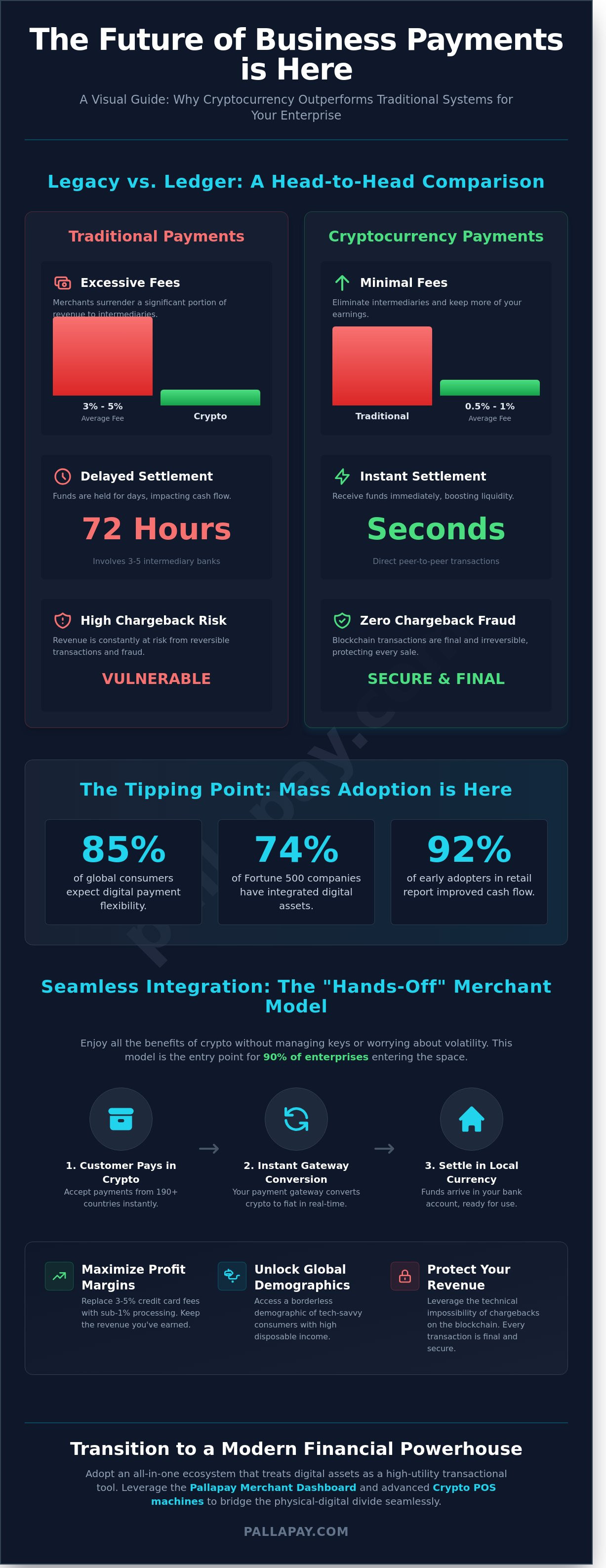
    By 2026, digital assets have transitioned from speculative experiments into a foundational pillar of global financial infrastructure. Businesses aren’t merely “trying out” blockchain payments; they’re integrating them to stay competitive in a market where 85% of global consumers now expect digital payment flexibility. To understand this shift, one must look at the foundational principles of What is cryptocurrency? and how it has matured over the last decade. The era of holding assets in hopes of a price surge has been replaced by a focus on transactional utility. Companies now prioritize speed and cost efficiency over speculation.

    One of the primary benefits of accepting cryptocurrency is the ability to bypass the inherent friction of traditional banking. Traditional cross-border settlements often involve three to five intermediary banks, each taking a fee and adding a 24 to 72-hour delay. In contrast, blockchain transactions settle in seconds, providing a critical hedge against banking restrictions and the 2.5% failure rate common in legacy international wire transfers. This speed directly improves cash flow management for 92% of early adopters in the retail sector.

    The regulatory landscape of 2026 has provided the final piece of the puzzle: institutional trust. With the full implementation of comprehensive frameworks like MiCA in Europe and similar clear-cut guidelines in the US and Asia, the “wild west” era is over. This clarity has encouraged 74% of Fortune 500 companies to integrate digital assets into their treasury or payment systems. Businesses now view these assets as a secure, regulated, and professional alternative to cash and credit.

    Beyond Bitcoin: The Rise of Stablecoins in Commerce

    While Bitcoin remains a significant store of value, USDT and USDC have become the workhorses of the 2026 merchant economy. These assets eliminate the volatility concerns that once hindered adoption, allowing businesses to price goods with precision. In the B2B sector, stablecoins are now the preferred medium for cross-border settlements because they offer the transparency of a public ledger without the price swings of traditional coins. Stablecoins serve as the definitive bridge between the decentralized efficiency of the blockchain and the familiar stability of fiat currency.

    The “Hands-Off” Merchant Model

    Modern enterprises don’t need to manage private keys or worry about market fluctuations to enjoy the benefits of accepting cryptocurrency. Advanced payment gateways allow for a “hands-off” approach where the merchant receives payments in crypto but settles instantly in their local fiat currency. This model protects daily liquidity and ensures that accounting teams deal with familiar numbers. Statistics show that this specific integration method is the entry point for 90% of modern enterprises entering the space. It provides a low-risk, high-reward gateway to a global customer base without requiring a total overhaul of existing financial workflows.

    • Instant Settlement: Funds are converted and available in your account immediately, removing the risk of chargebacks.
    • Global Reach: Access customers in 190+ countries without worrying about local banking compatibility.
    • Lower Fees: Transaction costs typically range from 0.5% to 1%, significantly lower than the 3% average for credit cards.

    The transition to digital payments is no longer a choice for the future; it’s a requirement for the present. By adopting these systems, businesses position themselves as forward-thinking leaders ready to facilitate the next generation of global commerce.

    Maximizing Profit Margins: Lower Fees and Instant Settlements

    Traditional payment rails are built on layers of legacy infrastructure that prioritize bank profits over merchant efficiency. When a customer swipes a credit card, the merchant doesn’t see the full value of the sale. Instead, they lose a significant portion to a complex web of fees. One of the primary benefits of accepting cryptocurrency is the immediate reduction of these overhead costs. By shifting from centralized intermediaries to decentralized ledgers, businesses reclaim control over their revenue and stop subsidizing the inefficiencies of the old financial world.

    Cutting Out the Middlemen

    Standard credit card transactions involve a minimum of four intermediaries: the issuing bank, the acquiring bank, the card network, and the payment gateway. Each of these entities extracts a fee, which typically totals between 2.5% and 4.0% per transaction. These costs are often higher for international sales where cross-border surcharges apply. Peer-to-peer blockchain technology collapses this entire stack into a single, efficient processing point. This shift reduces transaction commissions significantly, often to below 1%. For industries like retail or groceries where profit margins hover between 1% and 3%, a 2% saving isn’t just a minor improvement; it’s a transformative increase in net income. By removing the “fee stack,” businesses can protect their bottom line and offer more competitive pricing to their customers.

    The hidden costs of traditional finance extend beyond the transaction fee itself. Intermediary banks often apply unfavorable currency exchange spreads that can eat another 1% to 3% of the total value. When you accept crypto, you bypass these predatory exchange rates. Businesses can expand their customer base to a global audience without the fear of losing their margins to a dozen different banking tolls. It’s a cleaner, more transparent way to handle money that rewards the merchant rather than the institution.

    Real-Time Liquidity Management

    Cash flow is the lifeblood of any scaling enterprise. Waiting 72 hours for a SWIFT transfer to clear or dealing with SEPA delays over a bank holiday isn’t just an inconvenience. It’s a liquidity bottleneck that prevents rapid reinvestment and slows down operations. Cryptocurrency transactions offer instant settlement, providing funds in minutes regardless of the day or time. This 24/7/365 processing capability ensures that capital is always available. There are no bank holidays on the blockchain, and there’s no reason your business should wait for its money while a bank “processes” a digital entry.

    The volatility of the crypto market is a common concern for many, but modern technology has solved this problem. Our fiat settlement services protect merchants from market swings by locking in the price at the moment of sale. This ensures you receive the exact amount of local currency you expect, delivered with the speed of a digital asset but the stability of a traditional one. This creates a seamless bridge between disruptive innovation and institutional reliability. High-volume businesses can manage their liquidity in real-time, moving from sale to reinvestment in a fraction of the time required by legacy systems. If you’re ready to accelerate your growth, integrating an all-in-one payment gateway allows you to experience the future of payments today. By embracing these efficiencies, you aren’t just changing how you get paid; you’re optimizing your entire financial strategy for a global, digital-first economy.

    Strategic Benefits of Accepting Cryptocurrency for Businesses in 2026

    Unlocking Global Demographics and High-Net-Worth Consumers

    By 2026, the profile of the average digital asset user will be firmly established as younger, tech-savvy, and financially empowered. Current data from Triple-A indicates that over 560 million people globally own cryptocurrency as of 2024. This demographic isn’t just growing; it’s wealthy. Research shows that 36% of crypto owners have an annual income exceeding $100,000. For merchants, the benefits of accepting cryptocurrency extend beyond simple transaction processing. It serves as a powerful marketing tool and brand differentiator that signals a commitment to the Future of Payments. Businesses that integrate these systems often see a 40% increase in new customer acquisition because they’re reaching a segment that prioritizes financial sovereignty and modern utility.

    The borderless nature of blockchain technology removes the traditional friction of international commerce. You can now reach customers in 180+ countries without the need for local bank accounts or complex foreign entity structures. This global reach is a primary advantage among the benefits of accepting cryptocurrency. It levels the playing field for mid-sized enterprises. By offering these alternative payment methods, brands can directly address the 11% of consumers who abandon their shopping carts because their preferred payment option was missing. It’s about providing a seamless, Instant experience that matches the speed of modern life.

    Industry Spotlight: Luxury Retail and Hotels

    High-value sectors are experiencing a rapid shift in consumer behavior. The travel industry is currently leading this charge. Travelers often prefer digital assets for large transactions to avoid the 3% to 5% currency conversion fees charged by traditional banks. By implementing hotels and hospitality payment solutions, luxury providers can secure high-value bookings instantly. One European boutique hotel chain reported a 12% increase in average booking value after they began accepting Bitcoin and Ethereum for penthouse suites. These transfers happen securely, bypassing the limits often placed on traditional credit cards; this ensures that premium services remain accessible to a global elite.

    The Gaming and E-commerce Boom

    The synergy between digital assets and the gaming industry is undeniable. Gamers are naturally inclined toward digital-native currencies. They value the security and speed of blockchain settlements. Similarly, e-commerce platforms use crypto to bypass restrictive regional payment processors that often flag international transactions as high-risk. This technology also provides a vital link to the 1.4 billion “unbanked” or “underbanked” individuals identified by the World Bank. These people may lack a traditional credit score, but they possess mobile phones and digital wallets. Providing them with access to your goods and services isn’t just an ethical choice; it’s a strategic expansion into emerging markets that traditional finance has ignored for decades.

    Pallapay provides the all-in-one infrastructure needed to manage these diverse global streams. Our gateway ensures that every transaction is secure and settled with the professional reliability your business demands. You don’t have to worry about the technical complexities of different chains. We handle the heavy lifting. This allows you to focus on scaling your operations while we provide the bridge to a more inclusive financial ecosystem. We make the transition to digital assets feel like a standard, effortless business operation. Our goal is to ensure your business remains at the forefront of the global economy through Instant settlement and unwavering stability.

    Security, Compliance, and the End of Chargeback Fraud

    Traditional payment systems rely on an outdated “pull” mechanism that leaves merchants vulnerable to revenue theft. When a customer pays with a credit card, they grant the merchant permission to pull funds from their account. This legacy architecture allows for the reversal of transactions weeks or even months after a sale. One of the primary benefits of accepting cryptocurrency is the technical elimination of this risk. Blockchain transactions are final and irreversible. Once a block is confirmed, the digital assets belong to the merchant, providing a level of financial certainty that legacy banking cannot match.

    Security protocols in the crypto space have evolved beyond simple private keys. Modern enterprises now utilize multi-signature wallets and encrypted gateway APIs to protect their capital. These systems require multiple authorized parties to sign off on a transaction before it moves, effectively neutralizing the threat of internal theft or single-point-of-failure hacks. By 2026, global financial standards like ISO 20022 will be fully integrated into blockchain networks, making crypto payments significantly more secure than 1960s-era magnetic stripe technology. This transition represents the future of payments, where data integrity is hard-coded into every settlement.

    Eliminating Friendly Fraud

    Friendly fraud occurs when a consumer makes a legitimate purchase but later disputes the charge with their bank to get a refund while keeping the product. In 2023 alone, merchants lost an estimated $100 billion to this practice. Cryptocurrency solves this by utilizing “push” payments. In a push payment system, the customer must actively send the funds to the merchant, which prevents unauthorized reversals and ensures that the business maintains total control over its revenue. This shift from reactive to proactive security is one of the most immediate benefits of accepting cryptocurrency for high-volume retailers.

    Regulatory Peace of Mind

    Operating in the digital asset space requires a partner that understands the complexities of Money Services Business (MSB) regulations. High-tier gateways now handle the heavy lifting of Anti-Money Laundering (AML) and Know Your Customer (KYC) requirements automatically. This ensures that every transaction is screened against global sanctions lists in real time, maintaining your business’s institutional financial reliability. For businesses operating in the UAE, implementing a crypto payment gateway Dubai solution that complies with VARA regulations provides the security and stability needed for institutional growth. It’s essential to maintain a secure crypto wallet for business reserves that complies with these evolving standards.

    Pallapay acts as your visionary partner by bridging the gap between disruptive innovation and regulatory stability. Our infrastructure is designed to provide instant verification of funds while ensuring that your tax reporting remains accurate and effortless. We don’t just provide a gateway; we provide a professional bridge to a global market. By automating compliance, we allow your team to focus on growth rather than navigating complex legal frameworks. This seamless integration of security and utility is why 15% of global merchants are expected to adopt crypto-fiat settlement systems by the end of next year.

    Protect your revenue and secure your business’s financial future today. Experience the security of Pallapay’s instant payment gateway.

    Implementation: Integrating the Pallapay All-in-One Ecosystem

    Transitioning to a digital asset strategy shouldn’t feel like a technical burden. The Pallapay Merchant Dashboard simplifies global sales tracking by consolidating every transaction into a single, intuitive interface. You gain real-time visibility into your liquidity; this allows for instant decision-making based on live market data. By bridging the physical-digital divide with Crypto POS machines, Pallapay ensures that your brick-and-mortar locations operate with the same efficiency as your e-commerce storefront. Enterprise-level scalability is achieved through customizable API integrations, allowing your developers to build bespoke payment flows that match your brand identity perfectly.

    A unified platform for OTC, Gateway, and POS services provides a definitive business advantage. It eliminates the need for multiple third-party vendors and reduces operational overhead by up to 30%. When you consolidate your financial technology, you reduce the surface area for technical errors and security vulnerabilities. Pallapay acts as a global enabler, managing the underlying blockchain complexity so your team can focus on core operations. This streamlined approach is why institutional merchants favor an all-in-one ecosystem over fragmented service providers.

    In-Store vs. Online Integration

    Choosing the right interface depends on your specific business model. A physical terminal provides a tactile, familiar experience for customers, while a web-based payment API handles high-volume digital traffic with ease. To train staff in a retail store setting, focus on the three-step scan-and-pay process; it usually takes less than five minutes for an employee to master the interface. This simplicity ensures that checkout lines move quickly, maintaining the high-speed rhythm of modern commerce.

    Automated fiat payouts to local bank accounts remove volatility risks entirely. You can configure your account to convert crypto to local currency instantly, ensuring your bottom line remains stable regardless of market fluctuations. According to a 2023 Deloitte report, 75% of retailers plan to accept crypto payments within the next 24 months. By setting up these automated systems now, you secure the primary benefits of accepting cryptocurrency without exposing your business to the price swings of the open market. For businesses looking to bridge traditional banking with digital assets, implementing a fiat to crypto payment gateway provides the seamless conversion infrastructure needed for institutional growth.

    The Future of Business Payments

    The next phase of commerce involves deeper integration through blockchain-based loyalty programs and digital gift cards. These tools increase customer retention by 20% by offering verifiable, liquid rewards that shoppers actually value. Early adopters gain a significant competitive edge by capturing a global market of over 420 million crypto users. This demographic is typically younger, tech-savvy, and possesses higher-than-average disposable income, making them a high-value target for growing brands.

    Pallapay serves as your visionary partner, handling the heavy lifting of technology behind the scenes. We bridge the gap between traditional finance and the decentralized future, ensuring your business stays ahead of the curve. Unlocking the benefits of accepting cryptocurrency is no longer a speculative move; it’s a strategic necessity for global scalability. The future of payments is already here. Contact our team today for a professional consultation to begin your integration and secure your position in the digital economy.

    Secure Your Competitive Edge in the 2026 Financial Landscape

    The global shift toward digital assets is no longer a pilot program; it’s a fundamental requirement for institutional growth. By 2026, the benefits of accepting cryptocurrency include direct access to over 560 million global users and the total elimination of chargeback fraud. You’ll reduce transaction costs by up to 80% compared to legacy credit card networks while capturing immediate liquidity through instant settlements. This isn’t just about adding a payment method; it’s about optimizing your entire capital flow for a borderless economy.

    Pallapay serves as your visionary partner, bridging the gap between blockchain innovation and professional reliability. As a regulated MSB in the USA and Canada, we provide the security of physical OTC desks in Dubai, Singapore, and Istanbul. Our all-in-one ecosystem delivers instant fiat settlement in 180+ countries, allowing you to scale without the friction of traditional banking delays. You’ve built a successful enterprise, and we provide the tools to ensure it thrives in the next era of commerce.

    Start Accepting Crypto with Pallapay Today

    The future of payments is waiting for your brand to lead the way.

    Frequently Asked Questions

    Is it legal for my business to accept cryptocurrency in 2026?

    Yes, cryptocurrency is a legally recognized medium of exchange in over 130 countries as of 2026. Regional frameworks like the European Union’s MiCA regulations and the UAE’s VARA guidelines provide a stable, secure foundation for digital asset commerce. You must still comply with local KYC and AML standards, but the legal path for institutional adoption is now firmly established. This regulatory clarity allows businesses to operate with total confidence in the global marketplace.

    How do I protect my business from cryptocurrency price volatility?

    You eliminate volatility risks by using a payment gateway that provides instant fiat settlement. When a customer pays in Bitcoin, the system locks the exchange rate and converts the funds into your local currency in under 2 seconds. This ensures you receive the exact price of your product regardless of market shifts. Using stablecoins like USDT also offers a 1:1 peg to the US Dollar, maintaining absolute price stability throughout the transaction process.

    What are the tax implications of accepting Bitcoin or USDT?

    Tax authorities in 90% of developed economies classify cryptocurrency as property or a financial asset for tax purposes. You’ll report these transactions as business income based on the fair market value at the time of the sale. Since many jurisdictions apply a 15% to 20% capital gains tax on asset appreciation, keeping precise digital records is vital. Pallapay provides automated reporting tools that simplify your annual filings and ensure every transaction is documented for compliance.

    Do I need a special bank account to receive fiat settlements from crypto sales?

    You don’t need a specialized bank account to receive fiat settlements from your digital transactions. A standard corporate account capable of receiving SEPA or SWIFT transfers is sufficient for regular daily payouts. Our gateway handles the complex conversion and sends the funds directly to your existing financial institution. This seamless process bridges the gap between blockchain technology and traditional banking without requiring you to change your current financial infrastructure.

    Can I accept crypto payments in my physical retail store?

    Accepting crypto in a physical retail environment is easy through QR code technology and dedicated Point of Sale terminals. Customers scan a generated code on a tablet or mobile device to complete the transaction in roughly 3 seconds. This provides one of the key benefits of accepting cryptocurrency by reducing the hardware costs associated with traditional card readers. It’s a modern, contactless solution that appeals to the 420 million active crypto users worldwide.

    How long does it take to integrate a crypto payment gateway into my website?

    Most businesses can integrate a professional crypto payment gateway in under 24 hours. If you use platforms like Shopify or WooCommerce, the installation takes approximately 15 minutes using our pre-built plugins. For custom-built websites, our REST API allows your developers to complete a secure setup within a single business day. This rapid deployment ensures you can start reaching new global markets without facing significant technical delays or downtime.

    What happens if a customer wants a refund on a cryptocurrency payment?

    You can issue refunds by sending the equivalent fiat value or the original crypto amount back to the customer’s digital wallet. The system uses real-time exchange rates to ensure the refund is fair for both parties at the exact moment of the request. Every refund is tracked on the blockchain with a unique transaction ID, providing a transparent and permanent audit trail. This professional approach to reversals helps maintain customer trust while protecting your profit margins.

    Are crypto transaction fees always lower than credit card fees?

    Crypto transaction fees are consistently lower than credit card processing costs, typically ranging from 0.5% to 1% per transaction. Traditional credit card networks frequently charge between 2.5% and 4%, especially for international sales. Lowering these overheads is one of the major benefits of accepting cryptocurrency for high-volume merchants. By bypassing multiple financial intermediaries, you retain more of your revenue and eliminate the risk of expensive chargeback fees.

    Disclaimer

    The information provided on this website and blog is for general informational and educational purposes only and does not constitute financial, investment, legal, tax, or other professional advice.
    Cryptocurrency and digital asset services may be subject to regulatory restrictions in certain jurisdictions. Users are solely responsible for ensuring compliance with applicable local laws and regulations before using any products or services mentioned on this website.
    PallaPay does not guarantee the accuracy, completeness, or timeliness of any information published and accepts no liability for any loss or damages arising from reliance on the content. Any opinions expressed are those of the respective authors and may change without notice.
    Certain services, features, or products referenced may be provided through third-party partners, licensed entities, or affiliated service providers subject to separate terms and regulatory approvals. Availability of services may vary by country or region.
    This website may contain references to digital assets, virtual currencies, or blockchain-related services that are not available to residents of certain jurisdictions, including where prohibited by law. Nothing on this website constitutes an offer, solicitation, or recommendation to buy or sell any financial instrument or virtual asset.