

Tag: B2B Payments

  • Protecting Business From Crypto Volatility: The 2026 Strategic Guide

    Protecting Business From Crypto Volatility: The 2026 Strategic Guide

    In 2026, market price swings are no longer an acceptable excuse for stagnant business growth. While Bitcoin fluctuates between $77,000 and $80,000, many leaders remain hesitant because they fear a sudden crash could erase their operational margins. You’re right to be cautious; manual exchange processes are slow and regulatory deadlines like the July 1 MiCA cutoff in the EU add layers of complexity. However, protecting business from crypto volatility has evolved from a complex hedging strategy into a standard, automated utility.

    You don’t have to be a market speculator to benefit from the $4 trillion digital asset economy. This article explains how to accept payments and scale your operations without ever being exposed to market price fluctuations. We’ll explore the transition to a set and forget payment system that utilizes instant conversion to local currency and regulated settlement routes. By the end of this guide, you’ll understand how to integrate a crypto payment gateway that handles the technical background processes, ensuring every transaction settles as stable fiat in your account.

    Key Takeaways

    • Identify and close the settlement gap by neutralizing the time delay between customer payment and fiat receipt.
    • Utilize automated fiat conversion to lock in real-time exchange rates, ensuring your profit margins remain unaffected by sudden market shifts.
    • Deploy stablecoins like USDT and USDC as strategic buffers to facilitate secure and predictable international B2B settlements.
    • Build a resilient infrastructure for protecting business from crypto volatility by integrating regulated payment APIs with official MSB registrations.
    • Scale your operations with institutional-grade OTC support and crypto-to-bank transfer routes designed for compliant, high-volume shielding.

    What is Crypto Volatility and Why Does it Challenge Modern Business?

    Crypto volatility represents the rapid, often unpredictable price fluctuations of digital assets over condensed timeframes. For a trader, these swings are an opportunity for profit; for a business owner, they represent an operational threat. To understand What is Cryptocurrency and its inherent behavior, one must recognize that price action is driven by market sentiment and liquidity rather than traditional quarterly earnings. While a 5% daily move is standard in digital markets, it can be catastrophic for a company operating on thin margins.

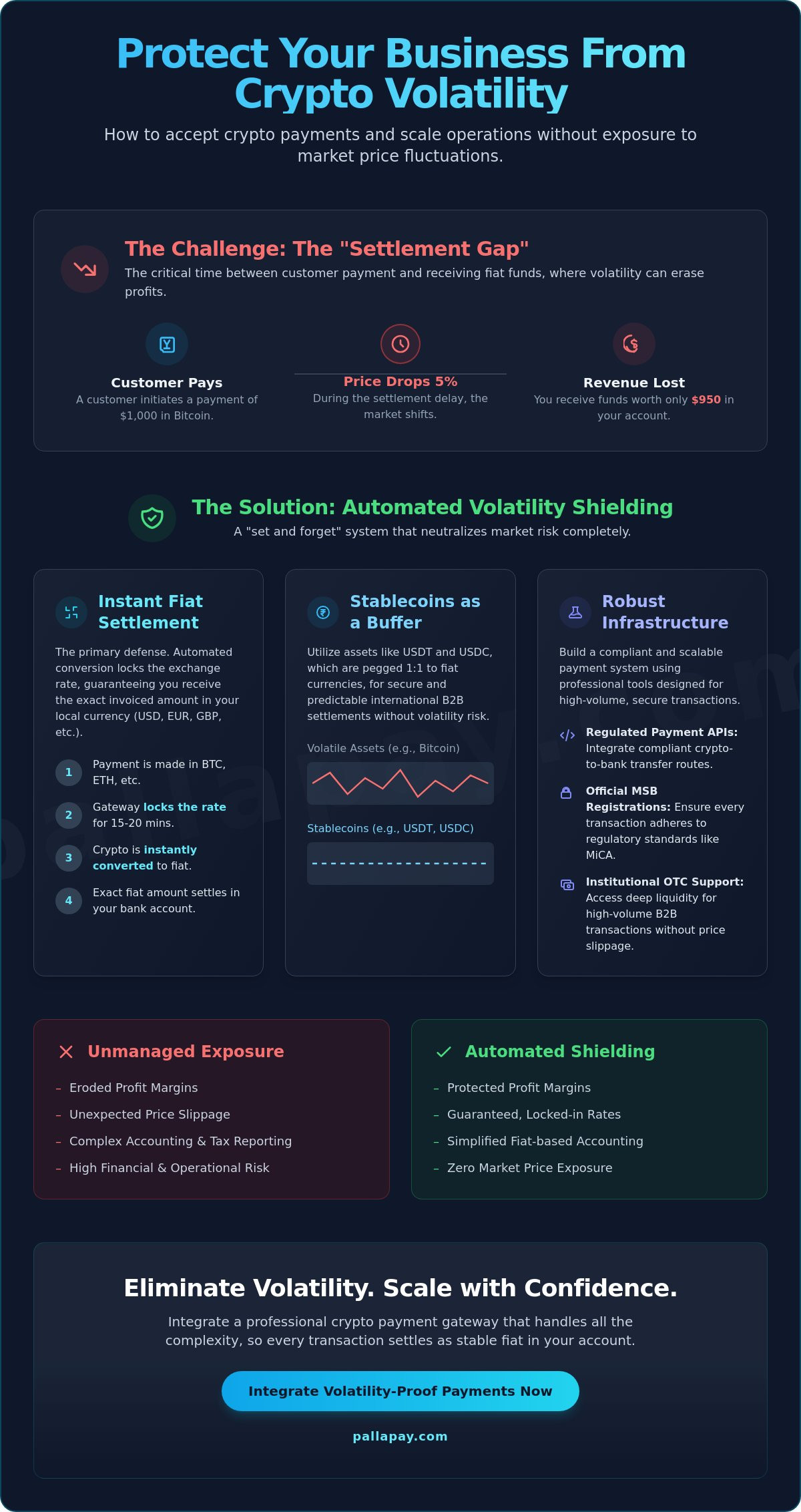
    The primary challenge for merchants lies in the “Settlement Gap.” This is the critical window between the moment a customer initiates a payment and the moment the business receives usable funds in their bank account. If the asset value drops during this interval, the merchant effectively loses revenue before the transaction even clears. Protecting business from crypto volatility requires closing this gap through automated fiat settlement systems that provide an immediate hedge against market movement.

    The Hidden Costs of Unmanaged Fluctuations

    Unmanaged exposure erodes profit margins, especially during high-velocity sell-offs where prices can drop faster than manual exchange processes can clear. Beyond direct losses, accounting teams face significant complexities when the value of an asset shifts between the time an invoice is issued and the final audit. Price slippage occurs when the final execution price of a trade differs from the requested price due to market movement or insufficient liquidity, often resulting in unexpected costs for high-ticket B2B transactions. These friction points turn a modern payment method into a financial liability without the right shielding tools.

    Why 2026 Market Dynamics Require a Proactive Stance

    By mid-2026, the landscape has shifted due to massive institutional participation and maturing regulatory frameworks. With Bitcoin trading between $77,000 and $80,000 as of May 2026, and the scheduled launch of CME Group’s Bitcoin Volatility futures on June 1, price movements have become more sophisticated and faster. Liquidity now plays a dual role; deep liquidity can stabilize prices, yet global economic shifts can trigger rapid business-day swings that catch unprepared merchants off guard. Protecting business from crypto volatility is no longer about avoiding digital assets, but about using professional infrastructure to neutralize their erratic nature. Modern commerce demands a proactive stance where volatility is managed as a technical variable rather than a financial risk.

    The Mechanics of Instant Fiat Settlement: Your Primary Defense

    Relying on manual trading to manage digital assets is a high-stakes gamble that few corporations can afford. Protecting business from crypto volatility becomes a seamless background process through the implementation of instant fiat settlement. A professional gateway functions as a sophisticated buffer; it locks the exchange rate for a specific transaction window, typically between 15 and 20 minutes. This lock-in ensures that the amount of local currency you expect is exactly what arrives in your treasury, regardless of market movements during the confirmation process.

    The technological engine behind this is fiat settlement, which facilitates the automated conversion of assets like Bitcoin or Ethereum into USD, EUR, GBP, or CNY. This process removes the need for your company to hold volatile assets on its balance sheet. By choosing instant settlement over batch processing, you maintain superior cash flow and avoid the risk of overnight price drops that frequently plague unshielded accounts. It’s the difference between managing a currency and managing a risk.

    Eliminating Exchange Rate Risk at the Point of Sale

    Gateways calculate real-time spreads by connecting to institutional liquidity providers. These providers guarantee the locked price, absorbing the market risk so your business doesn’t have to. This automated workflow eliminates the human error and delay associated with manual trading. It’s a strategic shift from speculative uncertainty to operational stability. Businesses looking to automate this transition often integrate a crypto payment API to synchronize sales with financial records in real-time.

    Streamlining Accounting and Tax Compliance

    Receiving fiat directly simplifies VAT and corporate tax reporting significantly. It establishes a clear 1:1 ratio between the invoice amount and the settled bank deposit, which is essential for audit transparency. When you settle directly to bank accounts, you bypass the friction of digital asset custody.

    • Direct fiat settlement removes the need for complex capital gains calculations on every individual sale.
    • It allows for seamless integration with standard ERP systems, ensuring your books remain balanced without manual intervention.
    • Financial teams can treat these transactions as standard bank transfers rather than digital asset movements, reducing the training required for staff.

    This approach turns a disruptive technology into a standard, effortless business operation. By removing the volatility variable, you focus on growth while the gateway handles the underlying mechanics of currency conversion.

    Protecting Business From Crypto Volatility: The 2026 Strategic Guide

    Stablecoins: Using USDT and USDC as a Strategic Buffer

    While instant fiat conversion is the premier defense for retail transactions, many B2B operations require a more flexible medium for holding digital value. Stablecoins are digital assets pegged 1:1 to traditional currencies like the US Dollar, combining the borderless efficiency of blockchain with the price predictability of fiat. By utilizing these assets, you create a strategic layer for protecting business from crypto volatility without needing to exit the digital ecosystem entirely. As of March 2026, USDT maintains its position as a primary liquidity tool with a market capitalization of approximately $183.6 billion, while USDC has grown to $75.3 billion, largely due to its alignment with the GENIUS Act in the United States and MiCA regulations in Europe.

    The operational utility of stablecoins relies on a reliable transition between digital and traditional finance. Converting these assets into bank transfers or physical cash is handled through professional off-ramp services, which act as a vital bridge for global liquidity. This infrastructure allows a business to accept USDT from an international client and move it into a corporate bank account with the same speed and security as a local wire transfer. It’s a sophisticated method for protecting business from crypto volatility while maintaining the ability to deploy capital whenever it’s needed.

    Cross-Border Payments Without the Swing

    Traditional SWIFT transfers are often slow and burdened by high intermediary fees. Stablecoins bypass these legacy bottlenecks, allowing businesses to pay global suppliers instantly at any hour. This is particularly advantageous during “weekend” market gaps when traditional banks are closed but digital markets remain active. By settling in USDT or USDC, you ensure that the value sent on Friday is the same value received on Saturday, regardless of how Bitcoin or Ethereum might perform over the weekend. It’s an essential tool for maintaining price consistency across complex supply chains.

    Managing Liquidity with Digital Wallets

    A secure crypto wallet serves as more than just storage; it’s a command center for holding operational reserves. Professional teams use these wallets to balance fiat holdings with stablecoin liquidity, allowing for rapid re-investment or settlement without waiting for traditional banking cycles. In 2026, audited and fiat-backed stablecoins operate within a mature regulatory framework, providing a transparent and secure foundation for corporate treasury management. This integrated approach ensures that your business remains agile and liquid, regardless of broader market fluctuations.
    Building a Volatility-Resistant Infrastructure for Retail and Web

    Establishing a robust infrastructure requires a multi-layered approach that bridges digital and physical sales channels. Protecting business from crypto volatility is most effective when the protection is baked into the hardware and software used daily. First, prioritize a regulated provider with official MSB registrations in credible jurisdictions like the US and Canada to ensure compliance and institutional trust. Second, integrate a crypto payment API to automate web checkouts and eliminate manual conversion delays. Third, for physical locations, deploy Crypto POS machines that lock in rates at the moment of sale. Fourth, configure auto-withdraw settings to move funds to your bank account daily. Finally, train your finance team to view these assets as a high-speed payment rail rather than a speculative investment.

    This systematic deployment turns a complex financial challenge into a standard operational workflow. By automating the conversion and withdrawal process, you ensure that your treasury remains liquid and denominated in the currency you use to pay your bills. Protecting business from crypto volatility isn’t about predicting the market; it’s about building a system that doesn’t care what the market does.

    Unified Protection for Omni-channel Commerce

    Managing online and offline sales through a single dashboard provides a comprehensive view of global liquidity and transaction history. For retail stores, this setup allows staff to process transactions without needing to manage private keys or understand blockchain mechanics. Hardware-level encryption in POS terminals ensures that every swipe or scan is secure, providing institutional-grade safety at the point of sale. This unified approach eliminates the data silos that often lead to accounting errors in multi-channel businesses.

    Future-Proofing with Advanced Payment APIs

    Advanced APIs allow you to display prices in local fiat while accepting digital assets, ensuring that your customers see familiar figures while you avoid market risk. This is crucial for e-commerce platforms scaling to a global audience with multi-currency support. Managing refunds and chargebacks becomes a standard accounting task when the system automatically calculates the fiat-equivalent value at the time of the transaction. This level of automation allows you to scale from local sales to global distribution without increasing your financial risk profile.

    Ready to secure your revenue streams? Integrate a professional payment API to automate your volatility protection and streamline your global checkouts.

    Why Pallapay is the Professional Choice for Volatility Management

    Pallapay stands as a definitive destination for corporations seeking to bridge the gap between disruptive innovation and institutional financial reliability. By maintaining official MSB registrations in the United States and Canada, the platform provides a foundation of trust that many unregulated entities cannot match. This regulatory standing is essential for protecting business from crypto volatility, as it ensures that every conversion and settlement follows strict compliance protocols. Businesses gain access to a comprehensive, integrated ecosystem that includes a robust crypto payment gateway, physical POS machines, and the Pallapay Mastercard. This suite of tools allows you to manage digital assets as easily as traditional fiat, creating a seamless environment for modern commerce without the friction of multiple third-party providers.

    The brand functions as a professional bridge that connects established practices with modern advancements. By providing a single destination for all technical needs, it removes the complexity of managing disparate systems. This personality is reliable, efficient, and highly focused on empowering the user. It projects an image of a sophisticated partner that handles complex background processes, allowing you to focus on your core business growth while the infrastructure handles the market dynamics.

    Institutional Security and Compliance

    Adhering to rigorous crypto security standards is a core requirement for safeguarding merchant funds in 2026. Working with a regulated entity significantly reduces the risk of exposure to “dirty” cryptocurrency, which can lead to frozen accounts and legal complications. Pallapay acts as a professional facilitator, ensuring that all digital assets entering your treasury are vetted and compliant with international anti-money laundering standards. This level of institutional-grade oversight is a powerful tool for business expansion into over 180 countries. It gives your finance team the confidence to accept payments from diverse markets while knowing that the underlying technical background processes are handled by a sophisticated strategic partner.

    High-Volume Shielding with OTC Services

    Large-scale enterprises often require specialized handling for high-value transactions that exceed standard gateway limits. Through OTC crypto exchanges, businesses can move millions of dollars in assets without triggering market price slippage. This private, high-volume shielding is supported by a global network of physical offices that provide personalized corporate settlement assistance. These locations serve as a professional bridge, allowing for direct cash-to-crypto or crypto-to-bank transfers in a secure environment. It’s an efficient way to manage large-scale liquidity while protecting business from crypto volatility at every step of the conversion process, ensuring that institutional users maintain absolute stability.

    Strategic stability is the hallmark of a successful 2026 enterprise. By integrating these tools, you transform digital assets into a reliable utility for growth. Protect your business from volatility with Pallapay today and join a global network of professionals who prioritize security and speed.

    Secure Your Global Revenue Strategy

    The evolution of digital finance in 2026 has transformed market swings from a merchant’s nightmare into a manageable technical variable. By implementing instant fiat settlement and leveraging regulated stablecoin buffers, you’ve seen that liquidity and stability can coexist within a single ecosystem. Protecting business from crypto volatility is no longer a matter of timing the market; it’s about selecting the right institutional-grade infrastructure to automate your treasury flows. This proactive approach ensures your profit margins remain intact while you tap into a maturing $4 trillion global economy.

    Pallapay provides this essential bridge, offering MSB-registered security in the USA and Canada while serving professional clients across 180+ countries. You can now accept digital assets with the absolute confidence of instant fiat settlement in USD, EUR, and other major currencies. Secure your business margins with Pallapay’s regulated payment gateway and turn disruptive innovation into a standard, effortless business operation. Your enterprise is ready to lead in a borderless market. Take the next step toward a stable, high-growth future today.

    Frequently Asked Questions

    How can a business accept Bitcoin without being exposed to its volatility?

    You can accept Bitcoin safely by using a crypto payment gateway that facilitates instant fiat conversion at the point of sale. This system locks the exchange rate for the duration of the transaction window, ensuring you receive the exact local currency amount. By converting the asset immediately, your business avoids the risk of holding a digital asset that might decrease in value before you can manually exchange it.

    Is it better to settle in fiat currency or keep stablecoins in 2026?

    The decision depends on your treasury needs; fiat settlement provides immediate stability for local expenses while stablecoins offer high-speed liquidity for international B2B settlements. Many corporations choose fiat for retail operations to simplify accounting and tax reporting. Stablecoins like USDT or USDC are often reserved for paying global suppliers or maintaining digital reserves that don’t require traditional banking hours to move.

    What is the difference between a crypto exchange and a merchant payment gateway?

    A merchant payment gateway is a specialized tool for commercial transactions that prioritizes rate locks and automated settlement, whereas an exchange is built for trading and speculation. Gateways provide the essential infrastructure for protecting business from crypto volatility by removing the need for manual trading. They integrate directly with your sales platform to ensure that every transaction settles into your bank account as a standard currency deposit.

    Can I set my own exchange rates when accepting crypto payments?

    Merchants typically don’t set their own rates because the gateway provides a real-time institutional rate at the moment of checkout. This rate is pulled from deep liquidity providers to ensure it remains competitive and accurate for the customer. Attempting to set manual rates would likely lead to significant price slippage or lost sales due to uncompetitive pricing compared to the global market average.

    How do I handle taxes if the crypto price changes before I sell it?

    You should consult a qualified tax professional to understand the specific reporting requirements in your region. Using a gateway that converts crypto to fiat instantly simplifies this task by establishing a clear cost basis at the exact moment of the sale. This creates a transparent, 1:1 record between your invoice and your bank deposit, which is vital for maintaining compliant records during a corporate audit.

    What are the fees for protecting a business from crypto volatility?

    Fees for volatility protection are generally integrated into the transaction spread or charged as a small percentage of the total volume processed through the gateway. You should review the specific service agreement of your provider to understand the costs associated with POS machines or API integrations. The cost of protecting business from crypto volatility is usually far lower than the potential revenue loss from a single market crash.

    Is a Crypto POS machine safer than a standard wallet for my store?

    A Crypto POS machine is much safer for retail environments because it uses hardware-level encryption and prevents staff from accessing private keys. Standard wallets are designed for individual custody and lack the multi-user permissions and reporting features required for a commercial setting. POS systems are purpose-built to handle high-velocity sales and facilitate instant settlement into your corporate accounts without manual intervention.

    How long does it take to convert crypto to a bank transfer?

    The conversion from crypto to fiat is often instant through a professional gateway, while the transfer to your bank account depends on standard banking network speeds. Most off-ramp services facilitate these transfers within the same business day or the next, depending on the destination currency and bank. Automated withdrawal settings can be configured to ensure your funds move from the gateway to your bank account on a recurring daily schedule.

    Disclaimer

    The information provided on this website and blog is for general informational and educational purposes only and does not constitute financial, investment, legal, tax, or other professional advice.
    Cryptocurrency and digital asset services may be subject to regulatory restrictions in certain jurisdictions. Users are solely responsible for ensuring compliance with applicable local laws and regulations before using any products or services mentioned on this website.
    PallaPay does not guarantee the accuracy, completeness, or timeliness of any information published and accepts no liability for any loss or damages arising from reliance on the content. Any opinions expressed are those of the respective authors and may change without notice.
    Certain services, features, or products referenced may be provided through third-party partners, licensed entities, or affiliated service providers subject to separate terms and regulatory approvals. Availability of services may vary by country or region.
    This website may contain references to digital assets, virtual currencies, or blockchain-related services that are not available to residents of certain jurisdictions, including where prohibited by law. Nothing on this website constitutes an offer, solicitation, or recommendation to buy or sell any financial instrument or virtual asset.

  • UAE Startup Funding News 2026: The Comprehensive Investment & Trends Report

    UAE Startup Funding News 2026: The Comprehensive Investment & Trends Report

    By the close of Q1 2026, venture capital inflows into the UAE reached a record $1.8 billion, marking a 22% increase compared to the same period in 2025. You likely feel that tracking reliable uae startup funding news shouldn’t involve sifting through fragmented reports or distinguishing between fleeting hype and institutional stability. It’s clear that as a professional, you require a transparent view of the capital cycles and regulatory shifts that define this region’s growth.

    This report delivers that precision by analyzing the latest capital flows, high-growth sectors, and the specific 2026 legislative changes shaping the ecosystem. We’ll explore how the transition from speculative seed rounds to mature Series C expansions is creating a new standard for global fintech reliability. You’ll gain an instant understanding of the strategic partnerships and liquidity gateways that are currently defining the future of payments in the Emirates. We move quickly from raw data to functional evidence, ensuring you have the tools to identify high-growth opportunities within this all-in-one financial landscape.

    Key Takeaways

    • Analyze the UAE’s maturing investment landscape to understand how the nation maintains its dominant share of venture capital across the MENA region.
    • Gain a competitive edge by analyzing the latest uae startup funding news to see why institutional capital is pivoting toward B2B payments and AI integration.
    • Explore how regulatory shifts, including the Central Bank’s FIT program and the 2026 CBDC rollout, are opening new doors for financial innovation.
    • Identify the five critical attributes investors prioritize in 2026 to refine your pitch and successfully navigate the evolving venture capital ecosystem.
    • Discover how professional financial infrastructure and instant settlement solutions empower startups to bridge the gap between digital assets and institutional reliability.

    The 2026 UAE Startup Funding Landscape: A Year of Maturity

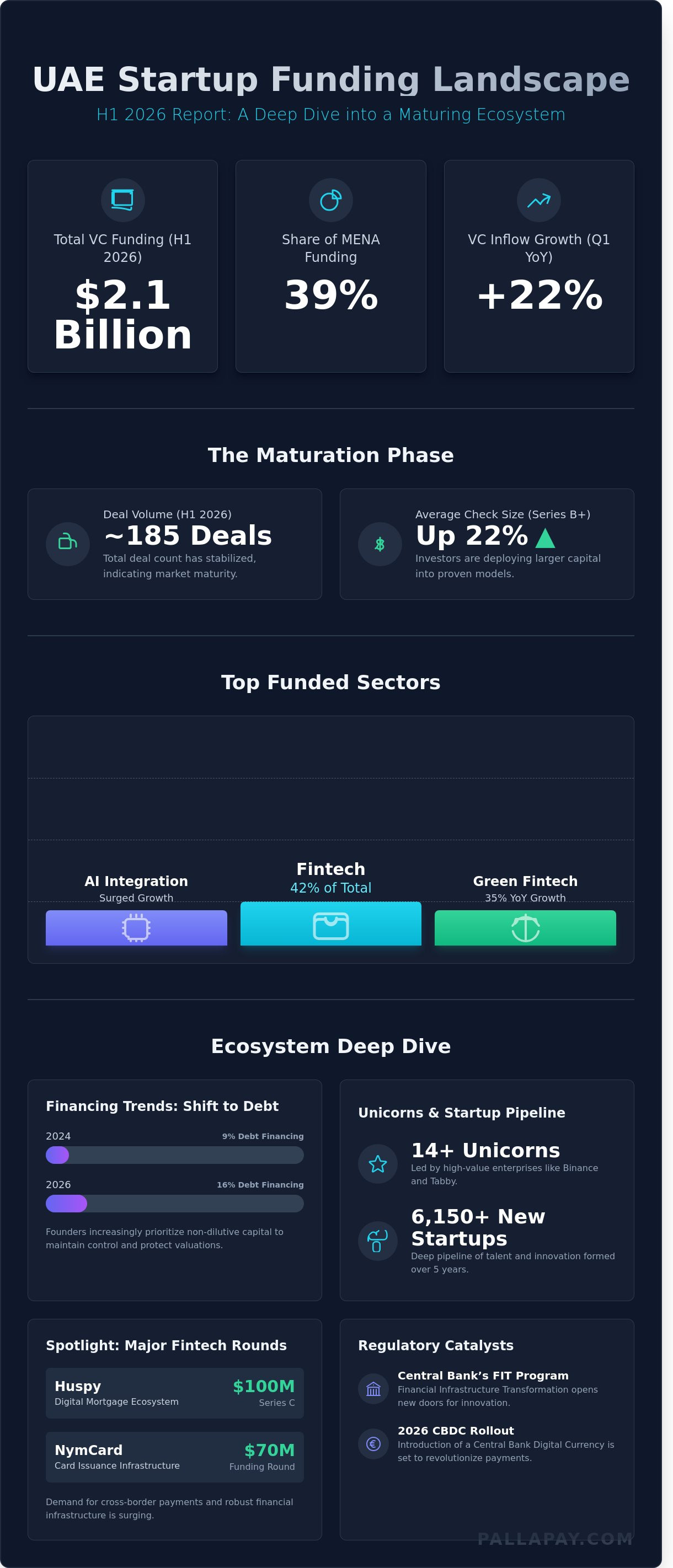
    The uae startup funding news for the first half of 2026 confirms a pivotal shift in the region’s financial trajectory. Total venture capital deployed reached $2.1 billion during H1 2026, a figure that underscores the nation’s role as the primary engine for Middle Eastern innovation. By securing a 39% share of all MENA funding, the UAE has effectively distanced itself from regional competitors. This growth is deeply rooted in the strategic diversification of the Economy of the United Arab Emirates, which provides the stability required for long-term institutional commitment.

    We’re now witnessing the “Maturation Phase” of the ecosystem. While the total number of deals has stabilized at approximately 185 for the half-year period, the average check size for Series B rounds and beyond has increased by 22% compared to 2025. Dubai and Abu Dhabi remain the central magnets for this capital. These hubs provide a secure, regulated environment where global investors feel confident deploying larger tranches of liquidity into proven business models. Staying updated on uae startup funding news is now essential for global partners who recognize that the region has moved past speculative growth into a period of sustainable, utility-driven expansion.

    Key Metrics and Unicorn Watch

    The UAE now hosts more than 14 unicorns, with Tabby and other high-value enterprises leading a cohort that defines the region’s tech prowess. This success isn’t restricted to the top tier. Data shows that 6,150 new startups have formed over the last five years, creating a deep pipeline of talent and innovation. Investor diversity has also reached a new peak. Sovereign wealth funds (SWFs), including Mubadala and ADIA, are no longer just looking at late-stage exits; they’re increasingly participating in early-stage rounds to secure a stake in the next generation of “all-in-one” digital platforms.

    Equity vs. Debt Financing Trends

    In 2026, 16% of all capital is being deployed as debt financing, a significant rise from the 9% seen in early 2024. Founders are increasingly prioritizing non-dilutive capital to maintain control while navigating a high-interest environment. This shift is particularly evident in the fintech sector, where companies require instant liquidity to scale operations without sacrificing equity. It’s a calculated move that protects valuations for late-stage fintechs, ensuring they remain attractive for eventual public listings. This evolution in capital structure reflects a sophisticated market that values financial efficiency over rapid, unchecked expansion.

    Top Funded Sectors: Where the Smart Money is Flowing

    Fintech continues to command the largest share of capital in the region. In the first half of 2026, venture capital flows into the UAE startup ecosystem reached new heights, with 42% of all investment directed toward financial technology. Investors have pivoted from consumer apps to the foundational “plumbing” of finance. This includes embedded finance and sophisticated B2B payment solutions that allow non-financial companies to offer banking services directly to their clients. This shift ensures that liquidity remains accessible and transactions stay seamless across all sectors of the economy.

    Artificial Intelligence has evolved from a speculative buzzword into a core operational requirement. Funding for startups integrating AI into banking and real estate has surged, as these tools now handle everything from automated credit scoring to predictive property valuations. Sustainability is another primary driver. Green Fintech grew by 35% year-on-year following the UAE’s decision to extend the Year of Sustainability. These startups focus on carbon credit trading and transparent ESG reporting. Much of this growth is supported by government initiatives like the Mohammed Bin Rashid Innovation Fund, which provides critical financing to businesses solving large-scale industrial and environmental challenges.

    The Fintech Powerhouses of 2026

    Major investment rounds define the current uae startup funding news cycle. Huspy secured a $100 million Series C to expand its digital mortgage ecosystem, while NymCard closed a $70 million round to strengthen its regional card issuance infrastructure. There is an urgent demand for cross-border payments for merchants as UAE-based businesses scale into European and Asian markets. We’re also seeing a strategic shift in consumer credit; “Buy Now, Pay Later” (BNPL) is being replaced by “Save Now, Buy Later” (SNBL). This model promotes financial health by rewarding users for hitting savings targets before making a purchase. It’s a key part of what many call The Future of Payments.

    Proptech and Real Estate Innovation

    Real estate remains the backbone of the UAE economy, and technology is making it more accessible. Fractional ownership platforms have successfully attracted retail investment by allowing individuals to purchase shares in premium assets for as little as 5,000 AED. These platforms are digitizing the DIFC and Business Bay markets, providing instant liquidity to an traditionally illiquid asset class. Startups are now using blockchain for instant title deed transfers, which removes the need for lengthy manual processing. Businesses looking to capitalize on these high-speed transactions can gain a competitive edge by using a secure payment API to automate their financial workflows.

    Web3 funding has also matured. The focus has shifted away from speculative token projects toward infrastructure-level startups. These companies build the secure gateways and settlement layers required for institutional adoption. By providing stable and reliable tech stacks, they ensure that the transition to a decentralized economy is both safe and efficient for global enterprises.

    UAE Startup Funding News 2026: The Comprehensive Investment & Trends Report

    Regulatory Catalysts: DFSA, ADGM, and the FIT Program

    The UAE has transitioned from a regional hub to a global benchmark for financial regulation. The Central Bank of the UAE (CBUAE) initiated the Financial Infrastructure Transformation (FIT) program in 2023 to accelerate digital excellence across the board. By 2026, the full-scale rollout of the Central Bank Digital Currency (CBDC), known as the Digital Dirham, has redefined liquidity for the private sector. This shift is a primary driver in recent uae startup funding news, as investors prioritize regions where capital moves without friction. The Digital Dirham facilitates domestic and cross-border payments, reducing costs for startups and improving balance sheet efficiency.

    Regulatory sandboxes provided by the Dubai International Financial Centre (DIFC) and Abu Dhabi Global Market (ADGM) allow founders to test blockchain and AI solutions under “light-touch” licenses. These environments provide a safety net where startups can iterate in a live market without the immediate burden of full-scale capital requirements. This proactive approach attracted over $1.3 billion in fintech-specific investment during the first half of 2025 alone. It’s a system designed to foster innovation while maintaining the institutional reliability that global investors demand.

    Open Banking and Open Finance mandates have further leveled the playing field. UAE financial institutions are now required to share data through secure APIs, allowing third-party developers to build personalized wealth management and credit scoring tools. This data-sharing mandate ensures that the “Future of Payments” is built on transparency and interoperability, making the UAE an irresistible destination for fintech founders.

    The Impact of the FIT Program on Fintech

    The FIT program’s focus on instant payment platforms has eliminated the traditional three-day wait for fund settlements. Startups can now manage cash flow in real-time, which is vital for early-stage survival. Additionally, the national eKYC (Electronic Know Your Customer) initiative has streamlined user onboarding, allowing digital platforms to verify identities in seconds. Pallapay’s payment API aligns perfectly with these national goals. It provides merchants with a secure, instant bridge between digital assets and fiat, ensuring that technical integration never becomes a bottleneck for business growth.

    Global Compliance Standards

    Security is the foundation of the UAE’s investment appeal. The Virtual Assets Regulatory Authority (VARA) provides a clear framework for crypto-native firms, while MSB (Money Services Business) registration ensures rigorous anti-money laundering standards. Since the UAE’s removal from the FATF grey list in February 2024, the nation has solidified its “White-List” status. This reputation for high-level compliance attracts 40% more European and US-based founders than in previous cycles. Regulated gateways give venture capitalists the confidence to deploy capital, knowing the ecosystem is protected by world-class oversight.

    Founder Strategy: Navigating the 2026 Investment Ecosystem

    The landscape for uae startup funding news in 2026 reflects a decisive shift toward fiscal discipline. Investors no longer reward “growth hacking” that prioritizes user acquisition over profitability. Instead, the current climate demands a focus on unit economics. Startups must demonstrate a clear path to breakeven within 18 to 24 months to secure Series A or B rounds. This transition ensures that ventures are built on stable foundations rather than temporary market hype.

    To succeed in this environment, founders are focusing on five key attributes that UAE investors prioritize in 2026 pitches:

    • Capital Efficiency: Maintaining a low burn rate relative to revenue growth.
    • Regulatory Alignment: Full compliance with VARA and Central Bank of the UAE frameworks.
    • Technological Moat: Proprietary AI or blockchain applications that offer a distinct competitive advantage.

    Leveraging specialized accelerators is a critical component of a successful strategy. Hub71 in Abu Dhabi and the DIFC Launchpad provide more than just capital; they offer direct access to corporate partners and sandbox environments. For modern e-commerce ventures, integrating a fiat-to-crypto payment gateway is no longer optional. It’s a necessity for capturing the 25% of global digital commerce transactions now settled in stablecoins.

    Pitching to UAE VCs

    Investors in Dubai and Abu Dhabi prioritize the “Local-to-Global” narrative. They look for startups that use the UAE as a launchpad to solve global problems while maintaining a strong regional footprint. To effectively scale this narrative and reach international audiences, you can check out EmirAds for specialized performance marketing support. Hiring local talent is also essential, as firms that meet Nafis targets often receive preferential consideration for government-linked contracts. A founder’s credibility in the UAE depends on their ability to synthesize deep industry expertise with an acute understanding of the region’s unique regulatory and cultural nuances.

    Scaling Operations Post-Funding

    Managing a high-growth company in a high-cost hub like Dubai requires meticulous financial infrastructure. Startups are increasingly moving away from traditional slow-moving banking rails for their international needs. Many firms now utilize crypto to bank transfers to facilitate instant payments to global vendors and remote developers. This approach reduces transaction fees by up to 80% compared to legacy SWIFT transfers. By choosing the right operational partners, founders can focus on product innovation while the backend handles the complexities of liquidity and settlement.

    Optimize your business liquidity and scale faster with our instant fiat settlement solutions designed for the modern enterprise.

    Pallapay: Empowering the Next Wave of UAE Startups

    The latest uae startup funding news highlights a record-breaking surge in capital inflow during the first quarter of 2026, yet capital alone doesn’t guarantee operational success. High-growth startups require a robust financial skeleton to support rapid expansion. Pallapay provides this essential financial plumbing, offering the infrastructure that allows founders to bridge the gap between disruptive blockchain technology and institutional financial reliability. By offering instant fiat settlement for crypto-native businesses, we ensure that operational capital is always available for immediate reinvestment. The Pallapay Mastercard serves as a global tool for founders to manage corporate expenses, providing a secure way to handle international payments without the delays typical of traditional banking. Our commitment to the retail and e-commerce sectors is evident in our advanced gateway solutions, which are designed to scale alongside the most ambitious 2026 startup cohorts. For an example of a specialized e-commerce platform thriving in the region, learn more about Shift 2 Fresh and how they connect international suppliers with UAE consumers.

    Seamless Infrastructure for Scalable Growth

    Scalability depends on a foundation that operates without friction. Integrating the Pallapay POS machine provides physical retail startups with a professional edge in an increasingly digital market. This technology facilitates instant transactions, allowing merchants to accept digital assets with the same ease as credit cards. Our fiat settlement services directly address the liquidity challenges that often surface in uae startup funding news reports, where rapid growth can outpace cash flow. We provide the visionary partnership needed to navigate the “Future of Payments,” ensuring that every transaction is secure and compliant. Our all-in-one ecosystem handles the technical complexities of the blockchain, so founders can focus on their core product vision.

    Get Started with the UAE’s Leading Fintech Ecosystem

    Success in the Dubai fintech space requires a partner that understands institutional liquidity and global standards. You can join the 500+ merchants who already trust Pallapay to manage their daily financial operations as of January 2026. We offer specialized solutions for high-volume OTC trading, providing the deep liquidity required for institutional-grade ventures. Our platform is designed for speed, ensuring that your business stays ahead of market shifts with instant processing capabilities. This efficiency-oriented approach mirrors the real-time nature of the modern global economy.

    • Access instant liquidity for large-scale corporate transactions.
    • Deploy advanced payment gateways for seamless e-commerce checkout.
    • Manage global team expenses with integrated corporate card solutions.
    • Utilize secure API integrations for custom fintech applications.

    Ready to scale your startup’s financial capabilities into a competitive advantage? Partner with Pallapay today and secure your place in the next wave of UAE innovation.

    Securing Your Position in the 2026 Economy

    The 2026 landscape represents a definitive shift toward institutional stability. Regulatory frameworks led by the DFSA and ADGM have transformed the region into a global benchmark for financial security. Founders are no longer just chasing capital; they’re aligning with the FIT Program’s strategic mandates to ensure long-term viability. As you monitor the latest uae startup funding news, it’s clear that operational efficiency is the new prerequisite for investment.

    Success in this mature market requires a partner that bridges the gap between digital innovation and traditional reliability. Pallapay provides this bridge through its all-in-one ecosystem, offering a secure crypto gateway, POS solutions, and instant fiat settlement. With official MSB registrations in the USA and Canada, alongside a global presence via OTC desks in Dubai, Singapore, and Istanbul, we handle the technical heavy lifting. It’s time to integrate the future of payments into your business model to accelerate your growth trajectory.

    Empower your startup with Pallapay’s global payment infrastructure and lead the next wave of regional innovation.

    Frequently Asked Questions

    Which sector in the UAE received the most startup funding in 2026?

    Fintech remains the dominant sector, securing 42% of all capital according to the latest uae startup funding news reports. This dominance is driven by the rapid adoption of digital wallets and cross-border settlement solutions. Investors prioritize platforms that offer instant liquidity and secure transaction processing. By the end of Q3 2026, fintech startups raised $1.8 billion, outpacing e-commerce and healthtech by a wide margin.

    Is venture capital funding in the UAE increasing or decreasing?

    Venture capital funding is increasing, showing a 12% rise in total deal value during the first half of 2026. Data from MAGNiTT indicates that total investment reached $2.4 billion across 180 deals. This growth reflects the UAE’s position as a secure gateway for global capital. Institutional investors are shifting focus toward late-stage Series B and C rounds to support established scale-ups that demonstrate clear profitability.

    What is the Central Bank of the UAE’s FIT program?

    The Financial Infrastructure Transformation (FIT) program is a strategic initiative by the Central Bank of the UAE to accelerate digital finance. It consists of nine key pillars, including the implementation of a domestic card scheme and an instant payments platform. By 2026, the program has successfully integrated 25 commercial banks into its CBDC framework. This infrastructure ensures the UAE remains at the forefront of the future of payments.

    How can a startup apply for a fintech license in Dubai?

    Startups apply for a fintech license by submitting a formal application to the Dubai Financial Services Authority (DFSA) or the Financial Services Regulatory Authority (FSRA). The process requires a detailed regulatory business plan, a robust compliance manual, and proof of minimum capital requirements. Most applicants start with the Innovation Testing License, which provides a restricted environment to test products. Approval timelines typically range from 3 to 6 months.

    What are the top 5 most funded startups in the UAE currently?

    The top 5 most funded startups in 2026 include Tabby, Tamara, Astra Tech, Kitopi, and PureHealth. These companies have collectively raised over $3.5 billion to expand their regional operations. Tabby and Tamara lead the fintech space, while Astra Tech focuses on creating an all-in-one “ultra app” for the Middle East. Their success highlights the market’s demand for seamless, integrated digital services that handle the heavy lifting of modern commerce.

    Can startups in the UAE accept cryptocurrency payments legally?

    Startups can legally accept cryptocurrency payments by partnering with entities licensed by the Virtual Assets Regulatory Authority (VARA). This regulatory framework provides a secure bridge between digital assets and traditional fiat currency. By utilizing a regulated gateway, businesses can offer instant settlement and avoid the volatility risks associated with unmanaged crypto holdings. This legal clarity has made the UAE a global leader in blockchain adoption for daily business operations.

    What is the role of DIFC in the UAE startup ecosystem?

    The Dubai International Financial Centre (DIFC) serves as the primary gateway for startups seeking global institutional backing. It provides an independent legal system based on English Common Law and a dedicated fintech hive accelerator. Currently, DIFC hosts more than 900 active fintech and innovation firms. Its ecosystem offers a 0% corporate tax rate for 50 years, making it the definitive destination for financial technology and global business growth.

    How do sovereign wealth funds influence startup funding in the Middle East?

    Sovereign wealth funds like Mubadala and ADQ influence the market by providing massive liquidity and long-term stability. These funds have committed $1.5 billion to local venture capital initiatives through programs like Hub71. By acting as anchor investors, they de-risk the ecosystem for private international firms. Their involvement ensures that uae startup funding news remains focused on high-impact sectors like AI and renewable energy, positioning the region as a visionary partner.

    Disclaimer

    The information provided on this website and blog is for general informational and educational purposes only and does not constitute financial, investment, legal, tax, or other professional advice.
    Cryptocurrency and digital asset services may be subject to regulatory restrictions in certain jurisdictions. Users are solely responsible for ensuring compliance with applicable local laws and regulations before using any products or services mentioned on this website.
    PallaPay does not guarantee the accuracy, completeness, or timeliness of any information published and accepts no liability for any loss or damages arising from reliance on the content. Any opinions expressed are those of the respective authors and may change without notice.
    Certain services, features, or products referenced may be provided through third-party partners, licensed entities, or affiliated service providers subject to separate terms and regulatory approvals. Availability of services may vary by country or region.
    This website may contain references to digital assets, virtual currencies, or blockchain-related services that are not available to residents of certain jurisdictions, including where prohibited by law. Nothing on this website constitutes an offer, solicitation, or recommendation to buy or sell any financial instrument or virtual asset.