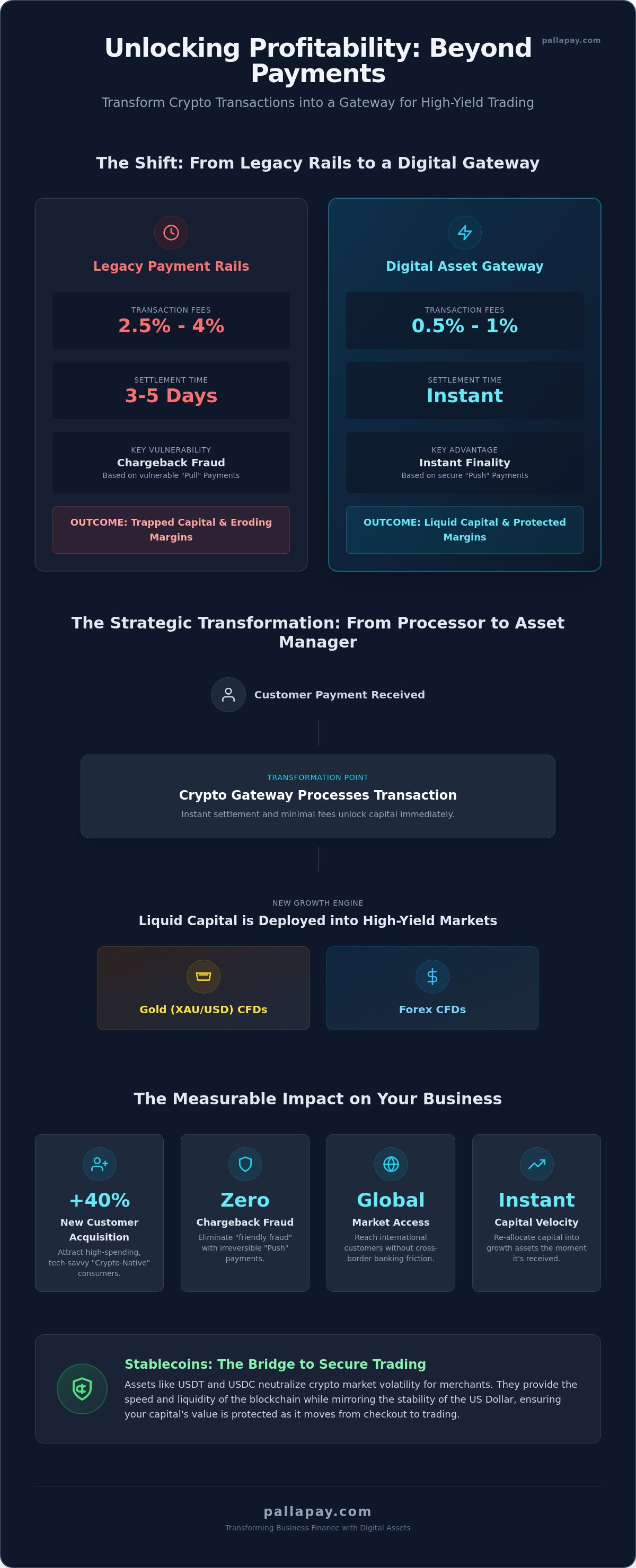
Most businesses view digital assets as a mere payment alternative, but the most successful firms recognize them as a sophisticated engine for capital growth. One of the primary benefits of accepting cryptocurrency is the immediate access it provides to high-velocity liquidity. You’re likely frustrated by traditional banking systems that stifle your momentum with exorbitant transaction fees and settlement times that feel outdated in a 24/7 economy. It’s difficult to scale when your capital is locked in cross-border transit or restricted by limited access to global commodity markets like gold.
We understand that you’re looking for more than just a checkout option; you want a strategic partner to help you navigate modern finance. This article demonstrates how accepting cryptocurrency payments serves as a transformative bridge to high-performance Forex and Gold CFD trading markets. We’ll explore the mechanics of converting digital receipts into active trading positions, specifically focusing on how XAU/USD and major currency pairs can revitalize your portfolio. We’ll preview the operational steps required to transition from merchant settlements to strategic asset management, illustrating how this path can drive a complete financial life transformation.
Key Takeaways
- Learn how to bypass traditional banking delays by converting merchant revenue into instant liquidity for immediate reinvestment in global markets.
- Understand the strategic benefits of accepting cryptocurrency as a gateway to high-performance trading environments that were previously inaccessible through legacy finance.
- Discover how to leverage digital asset receipts to enter Gold (XAU) and USD CFD trading, turning standard business income into a vehicle for financial transformation.
- Explore the role of Gold CFDs as a critical hedge against currency volatility and as a cornerstone for long-term wealth preservation in a digital economy.
- Identify the essential steps for integrating a regulated MSB payment gateway and API to ensure secure, compliant, and efficient global operations.
Beyond Transactions: Why Accepting Cryptocurrency is a Strategic Business Evolution
Traditional finance often traps capital in slow-moving settlement chains, creating a barrier between revenue generation and wealth expansion. One of the core benefits of accepting cryptocurrency is the immediate transition from stagnant fiat to high-velocity digital liquidity. For a forward-thinking enterprise, this shift isn’t just about offering more options at checkout; it is a fundamental move toward institutional financial reliability. By dismantling the friction of cross-border payments, businesses can expand their reach across 180+ countries without the traditional delays of legacy banking. Accepting cryptocurrency serves as a sophisticated liquidity bridge that seamlessly connects day-to-day business revenue to institutional-grade trading platforms.
The Liquidity Advantage of Digital Payments
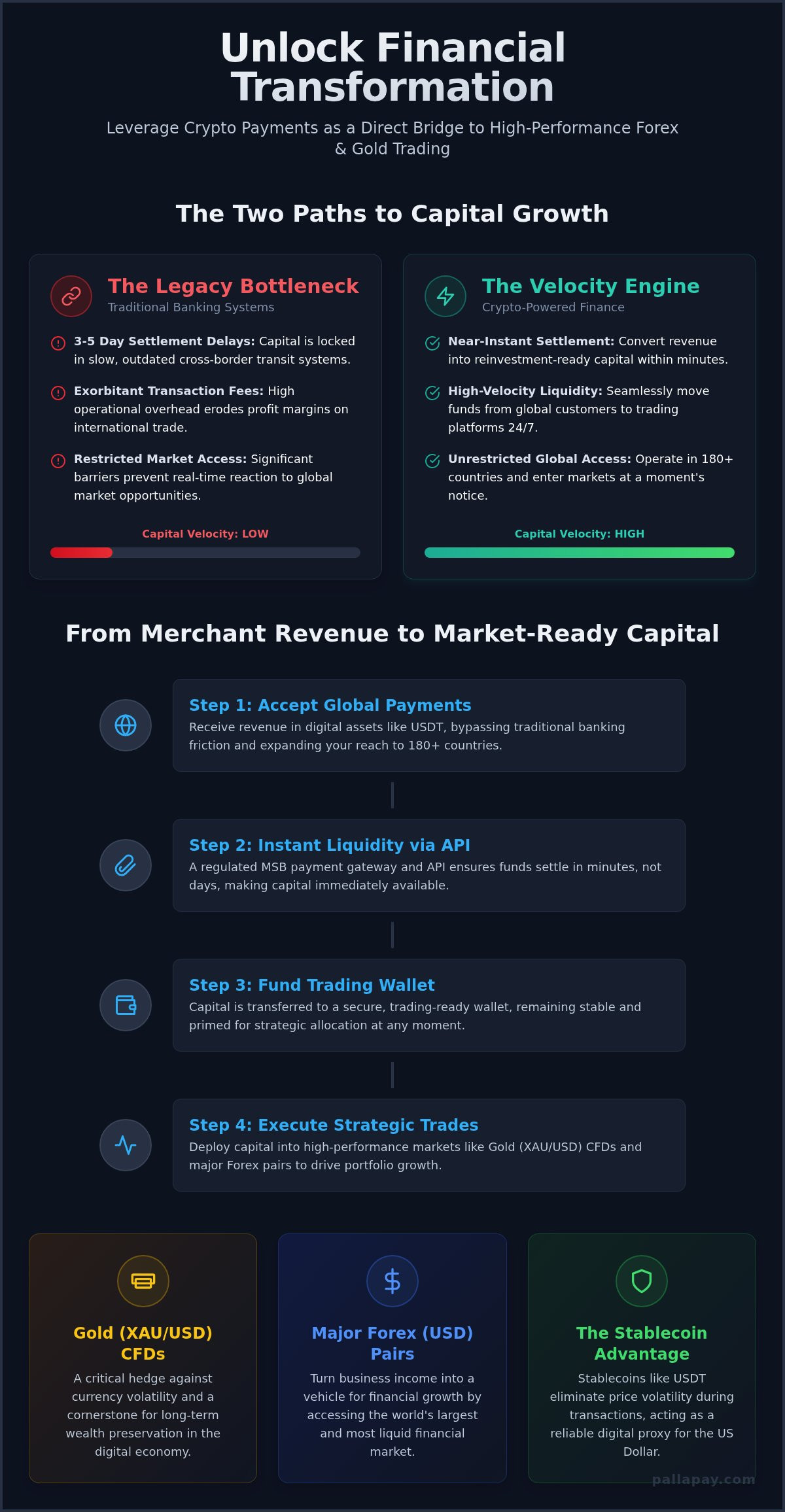
Legacy banking systems typically require a 3-5 day waiting period for international settlements to clear. This delay is a significant operational bottleneck that prevents businesses from reacting to market opportunities in real time. In contrast, blockchain technology facilitates near-instant settlement. This speed allows for rapid capital deployment, meaning funds received from a global customer base are available for reinvestment within minutes. By utilizing a robust Cryptocurrency Exchange Infrastructure, firms can drastically reduce the overhead associated with international trade while maximizing their cash flow efficiency. This efficiency is the cornerstone of a modern financial strategy, transforming passive income into an active asset base.
Stablecoins as a Hedge Against Volatility
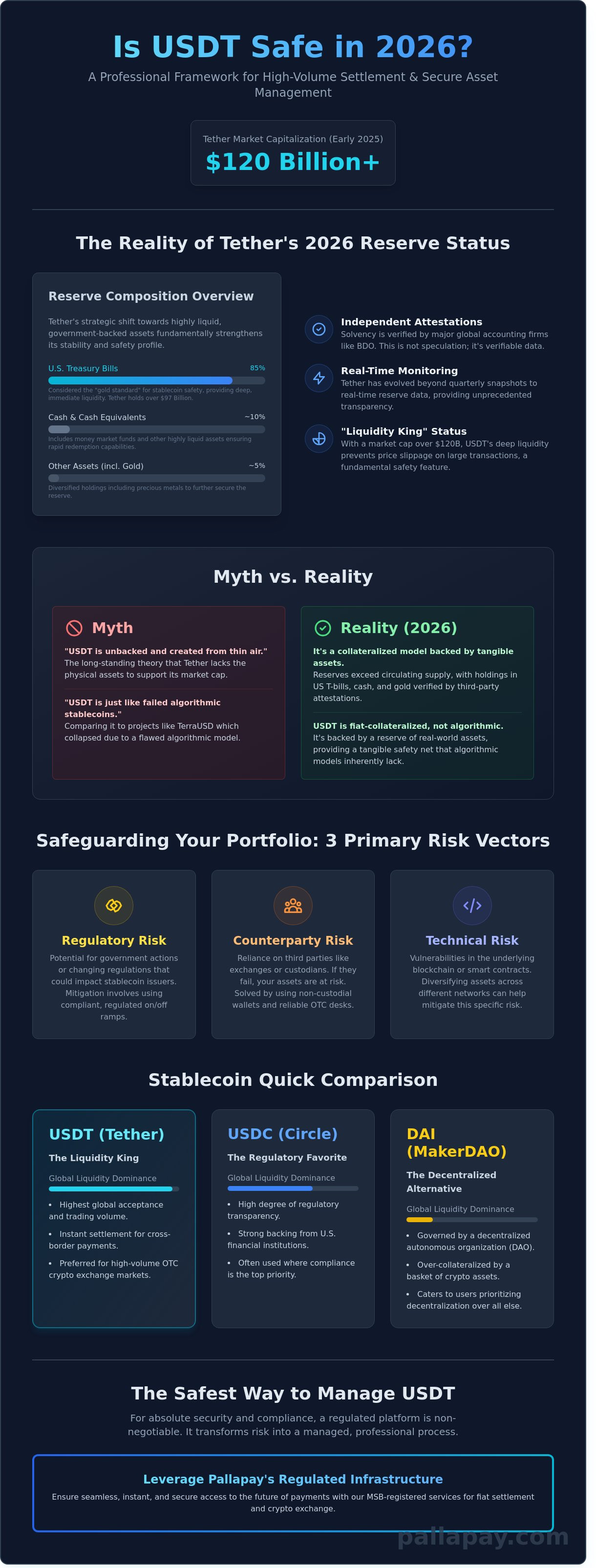
While market fluctuations are a common concern in the digital asset space, the use of stablecoins like USDT provides a reliable solution for business price stability. USDT acts as a digital proxy for the US Dollar, allowing merchants to maintain their purchasing power while benefiting from the speed of crypto rails. It has become the preferred medium for professional business-to-business settlements because it eliminates the risk of price swings during the transaction process. When a company uses a payment API to collect USDT, they’re building a reserve that links directly to professional trading accounts. This integration ensures that capital remains stable and ready for strategic allocation into Forex or Gold CFD markets at a moment’s notice.
Financial Transformation: Using Crypto Liquidity for Forex and Gold CFD Trading
Generating revenue is only the first step toward long-term prosperity. True wealth creation requires moving capital from a stagnant account into active, high-performance markets. One of the most significant benefits of accepting cryptocurrency is the ability to bridge this gap without the friction of traditional financial intermediaries. By converting customer payments into digital liquidity, you’re not just collecting money; you’re creating a streamlined entry point into global currency and commodity markets. This strategic business evolution with crypto allows a merchant to pivot from passive income to active asset management, unlocking a level of financial life transformation that legacy banking simply doesn’t support.
Crypto as the Ultimate Funding Mechanism
Traditional wire transfers are notoriously slow, often taking up to five business days to fund a brokerage account. This delay represents a massive opportunity cost, especially when market conditions for Gold or USD pairings are ideal. Digital assets solve this by providing near-instantaneous transfers. Regulated crypto payment gateways utilize automated API triggers to settle merchant receipts directly into trading-ready wallets, bypassing the multi-day verification cycles typical of international clearinghouses. This speed ensures that your capital is always working for you. When you’re ready to realize your gains, using professional off-ramp services ensures that your trading profits are converted back to fiat with institutional efficiency and security.
The Power of CFD Leverage in Modern Markets
Contracts for Difference (CFDs) offer a sophisticated way to gain market exposure without needing to own the underlying asset. For a business owner, this means you can use a fraction of your crypto-derived capital to control a much larger position in the Forex or Gold markets. This leverage is a powerful tool for scaling your financial reach. While a merchant mindset focuses on the narrow margins of a single sale, a strategic investor mindset looks at how those sales can fund USD-paired CFD positions that profit from global economic shifts. Focusing on XAU/USD (Gold/USD) provides a unique advantage, as it combines the stability of a physical commodity with the volatility of the world’s primary reserve currency. If you’re looking to accelerate this transition, opening a professional Forex account is the first step toward managing your business liquidity with institutional precision.
This shift in perspective is what separates a standard retail operation from a forward-thinking financial entity. By leveraging the speed of blockchain and the depth of the CFD markets, you’re building a resilient ecosystem that thrives on global price movements rather than just local consumer demand. It’s about making every transaction a building block for a more robust financial future.
The Economic Edge: Mastering Gold and USD CFD Trading
Building a resilient business requires looking far beyond the immediate sale. While early adopters often focus on technical novelty, the real benefits of accepting cryptocurrency lie in the strategic access to stable commodities and global currencies. By integrating digital assets into your daily workflow, you create a direct pipeline to Gold (XAU) and USD markets. This positioning allows you to hedge against the very inflation that erodes traditional cash reserves. Gold CFDs represent a primary tool for business wealth preservation by allowing merchants to lock in value without the logistical burdens of physical asset management.
Gold CFDs: Protecting Business Capital
Gold has historically served as the ultimate hedge in a digital economy. When fiat currencies fluctuate due to central bank policies, gold maintains its intrinsic value over the long term. Trading Gold CFDs offers distinct advantages over holding physical bullion, as it eliminates the costs of secure storage and insurance. By utilizing the XAU/USD pair, you can execute a consistent market strategy that protects your capital from broader market uncertainty. This approach ensures your business remains solvent and profitable even during periods of extreme economic volatility. It’s a calculated move that transforms your revenue from a vulnerable cash pile into a shielded asset class.
Forex Strategies for the Global Merchant
The modern merchant must navigate a world of shifting currency values. By utilizing a secure digital wallet for your receipts, you gain the necessary USD liquidity to engage in active Forex trading without waiting for traditional banking conversions. You can capitalize on the volatility of major USD pairs by using your crypto receipts as collateral for CFD positions. This active management allows you to offset currency risk effectively. If your local currency weakens against the dollar, your USD-paired CFD positions can provide a counter-balance that stabilizes your overall balance sheet. It turns currency fluctuations from a business risk into a growth opportunity.
Developing a disciplined approach to these markets is essential for long-term wealth. It isn’t about speculative gambling; it’s about using the tools of modern finance to ensure your business capital grows faster than the rate of inflation. Strategic market exposure through CFDs changes your financial life by turning passive savings into an active, productive asset. Integrating a fiat settlement solution ensures you can move between these markets with institutional speed. This level of control is the definitive advantage of the crypto-to-CFD bridge.
Implementation: Integrating a Crypto Ecosystem for Wealth Generation
Executing a high-performance market strategy requires a solid operational foundation. While the benefits of accepting cryptocurrency often start with cost reduction, the true value lies in the infrastructure that supports wealth generation. Moving from a standard retail operation to a strategic financial entity requires selecting a partner that bridges the gap between digital innovation and institutional reliability. A regulated Money Services Business (MSB) with registrations in the US and Canada provides the security needed to handle large-scale volume and high-frequency settlements across 180+ countries.
Technical Integration for E-commerce
Standardizing the checkout process for assets like BTC, ETH, and USDT is the first technical hurdle. A sophisticated Payment API for Developers automates this process, allowing for a frictionless user experience. These systems integrate automated KYC and AML protocols to ensure every transaction meets global compliance standards. This automation removes the administrative burden from your team, letting you focus on strategic asset allocation rather than manual verification. It’s a plug and play solution that scales with your business growth.
Retail Infrastructure and POS Solutions
Retailers with physical locations can extend these capabilities to the storefront. Implementing a dedicated Crypto POS Machine allows for real-time transactions at the counter. For a high-volume merchant, the ability to convert crypto to fiat instantly is vital for maintaining healthy cash flow. By utilizing Retail Store Solutions, you can ensure that your physical revenue is just as liquid as your online receipts. This hardware ensures that digital assets are treated with the same ease as traditional card payments, providing a professional experience for both the merchant and the customer.
The final step in this strategic evolution is establishing a seamless flow from your payment gateway to your trading account. Modern ecosystems allow you to direct settle funds into environments optimized for Forex and Gold CFD trading. This integration ensures that the capital you earn today is ready to be leveraged in the XAU/USD market by tomorrow. It’s an efficient, closed loop system that turns every customer payment into a potential trading position. If you’re ready to modernize your payment infrastructure, get started with instant fiat settlement today to accelerate your capital deployment.
Pallapay: The Professional Bridge to Crypto Payments and CFD Trading
Choosing the right infrastructure is the final step in moving from a standard business model to a wealth-generating engine. Pallapay functions as a sophisticated facilitator, bridging the gap between disruptive blockchain technology and the institutional reliability required for global commerce. One of the primary benefits of accepting cryptocurrency through a dedicated platform is the seamless transition it creates between daily merchant operations and active participation in the Forex and Gold CFD markets. By providing a comprehensive ecosystem that includes everything from retail POS machines to high-volume OTC exchanges, we ensure that your capital is never stagnant but always positioned for growth.
Security and Compliance at a Global Scale
In a market where trust is the most valuable currency, Pallapay prioritizes institutional-grade security and regulatory transparency. Our status as a registered Money Services Business (MSB) in both the United States and Canada provides a foundation of stability that traditional banks often fail to match in the digital space. This regulatory oversight ensures that your business remains compliant while operating across 180+ countries. Protecting your digital assets requires more than just encryption; it demands a partner that understands the nuances of global financial laws. For a deeper look at how these systems protect your revenue, explore The Ultimate Guide to Crypto Payment Gateways, which details the standards for empowering global commerce in 2026.
Empowering Your Financial Evolution
The Pallapay dashboard is designed to be your central command center for financial life transformation. It allows you to monitor merchant sales in real time while simultaneously managing the liquidity required for strategic CFD trading. This integration democratizes access to high-performance markets like XAU/USD, which were once the exclusive domain of large financial institutions. By utilizing our payment API, you can automate the flow of funds from your e-commerce checkout directly into a professional trading account. For those handling significant volume, our OTC Crypto Exchange Institutional Guide offers a roadmap for managing large-scale liquidity without market slippage.
The transition from a merchant to a strategic investor is the definitive path to long-term prosperity. By leveraging a regulated gateway and a high-performance trading ecosystem, you’re not just surviving in the modern economy; you’re actively mastering it. It’s time to move beyond the limitations of legacy finance and embrace a system built for speed, safety, and scale. Contact our team today to integrate a solution that turns every customer transaction into a gateway for financial evolution.
Accelerate Your Financial Evolution Through Strategic Liquidity
The transition from a traditional merchant to a sophisticated global trader is no longer a complex hurdle. One of the core benefits of accepting cryptocurrency is the immediate creation of a high-velocity capital pool that flows directly into the world’s most liquid markets. By bridging the gap between digital receipts and Forex or Gold CFD trading, you’re not just processing payments; you’re actively building a resilient financial future. Traditional systems often trap capital in slow settlement cycles, but modern digital infrastructure provides the immediate liquidity needed for market entry.
This transformation is anchored by the security of a regulated MSB partner with registrations in the US and Canada. With an all-in-one ecosystem trusted by businesses in 180+ countries, you have the tools to hedge against inflation and capitalize on currency fluctuations in real time. It’s time to leverage your business revenue for institutional-grade growth in XAU/USD and major currency pairs. Start Your Financial Transformation with Pallapay and secure your place in the inevitable global evolution of commerce. The path to a complete financial life transformation is now accessible, secure, and ready for your immediate implementation.
Frequently Asked Questions
What are the main benefits of accepting cryptocurrency for my business?
The primary benefits of accepting cryptocurrency include lower transaction costs, immediate settlement, and access to a global customer base in over 180 countries. By removing the friction of traditional banking intermediaries, you can convert merchant revenue into liquid capital much faster. This efficiency allows you to reinvest your profits into high-performance markets like Gold and Forex, turning a standard payment method into a strategic vehicle for wealth generation and financial life transformation.
Is it possible to accept crypto and receive fiat currency in my bank account?
Yes, you can accept digital assets and receive instant fiat settlement in your bank account through a regulated gateway. A professional off-ramp service converts assets like USDT, BTC, or ETH into currencies such as USD, EUR, or TRY in real time. This ensures your business maintains consistent cash flow without exposure to market volatility. It makes the transition from crypto receipts to standard fiat operations feel like a standard, effortless business process.
How does accepting crypto help me start Forex and Gold CFD trading?
Accepting crypto provides the immediate liquidity needed to fund a trading account without the multi-day delays of traditional wire transfers. By using a comprehensive ecosystem, you can direct your merchant receipts into CFD positions for Gold (XAU) and USD currency pairs. This bridge allows you to leverage your existing business revenue to profit from global price movements, effectively transforming your merchant identity into that of a strategic institutional investor.
Are crypto transactions secure for high-volume businesses?
Crypto transactions are highly secure when handled by a regulated Money Services Business (MSB) with registrations in the US and Canada. These platforms utilize institutional-grade security protocols and automated compliance checks to protect high-volume settlements. Because blockchain transactions are immutable, you eliminate the risk of fraudulent chargebacks that often plague traditional credit card payments. This stability is essential for businesses looking to scale their operations with absolute trust and financial reliability.
Do I need special hardware to accept crypto in my retail store?
While you can accept payments via QR codes on mobile devices, a dedicated Crypto POS Machine provides a more professional retail experience. This hardware integrates directly with your payment gateway to facilitate in-store transactions for Bitcoin, Ethereum, and USDT. It functions similarly to a traditional card terminal but offers the added benefit of instant fiat settlement. This ensures your physical storefront can participate in the digital asset economy without complex technical overhead.
What are the tax implications of accepting digital assets?
Tax implications vary by jurisdiction, but most authorities treat cryptocurrency as property or a capital asset. When you accept crypto for goods or services, you generally need to record the fair market value of the asset in your local currency at the time of the transaction. You should consult with a qualified tax professional to ensure compliance with local regulations. Using an MSB-registered gateway helps by providing clear, automated transaction records for your accounting needs.
How can CFD trading change my financial life compared to traditional investing?
CFD trading offers the potential for financial life transformation by allowing you to use leverage to control larger market positions with less capital. Unlike traditional investing, where you must own the physical asset, CFDs allow you to profit from both rising and falling prices in the Gold and Forex markets. This flexibility, combined with the 24/7 nature of crypto liquidity, enables a more aggressive and responsive wealth management strategy than legacy stock portfolios.
Which cryptocurrencies are best for business settlements?
Stablecoins like USDT are generally the best choice for business settlements because they maintain a one-to-one peg with the US Dollar. One of the strategic benefits of accepting cryptocurrency in the form of stablecoins is the elimination of price volatility during the transaction process. USDT provides the technological speed of blockchain while ensuring the price reliability required for institutional-grade commercial transactions, serving as ideal collateral for Gold and Forex trading.
Disclaimer
The information provided on this website and blog is for general informational and educational purposes only and does not constitute financial, investment, legal, tax, or other professional advice.
Cryptocurrency and digital asset services may be subject to regulatory restrictions in certain jurisdictions. Users are solely responsible for ensuring compliance with applicable local laws and regulations before using any products or services mentioned on this website.
PallaPay does not guarantee the accuracy, completeness, or timeliness of any information published and accepts no liability for any loss or damages arising from reliance on the content. Any opinions expressed are those of the respective authors and may change without notice.
Certain services, features, or products referenced may be provided through third-party partners, licensed entities, or affiliated service providers subject to separate terms and regulatory approvals. Availability of services may vary by country or region.
This website may contain references to digital assets, virtual currencies, or blockchain-related services that are not available to residents of certain jurisdictions, including where prohibited by law. Nothing on this website constitutes an offer, solicitation, or recommendation to buy or sell any financial instrument or virtual asset.