Tag: AML

  • Crypto Compliance for Businesses: The 2026 Strategic Guide to Regulatory Excellence

    Crypto Compliance for Businesses: The 2026 Strategic Guide to Regulatory Excellence

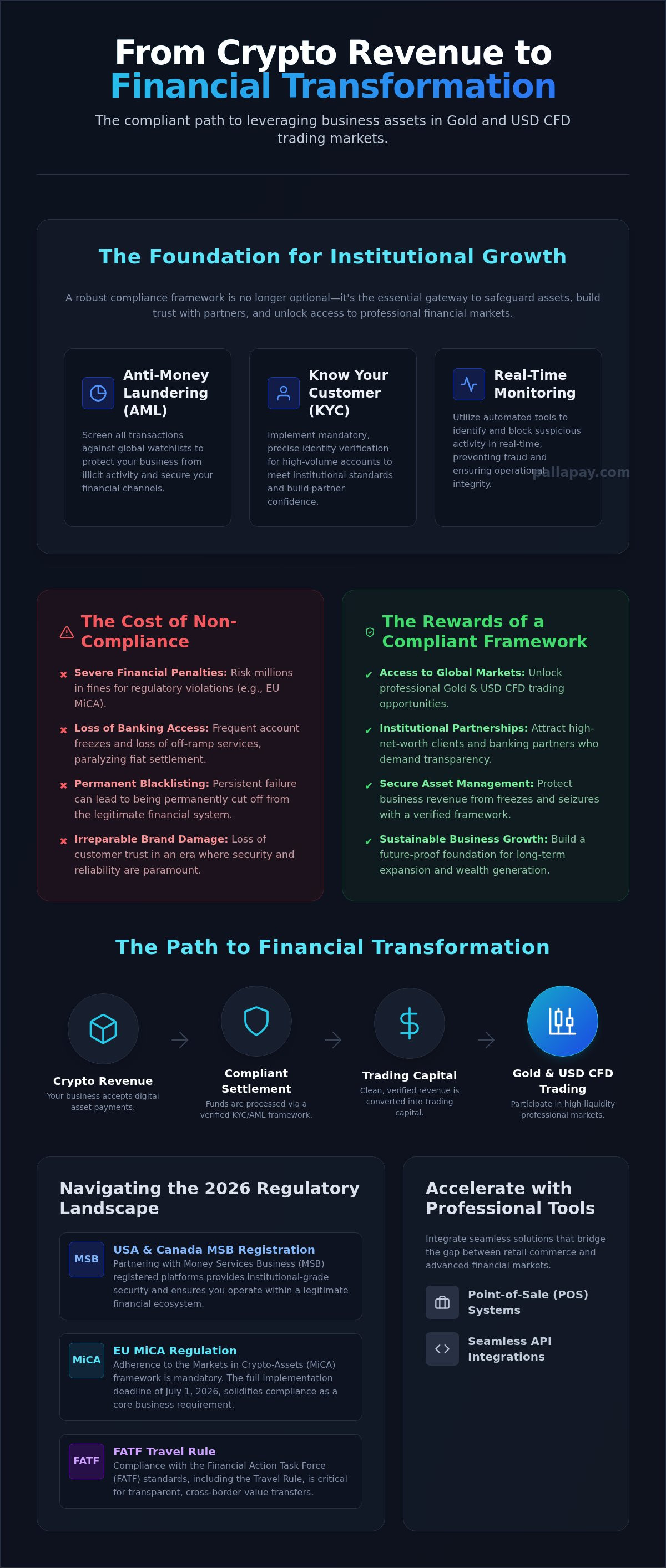
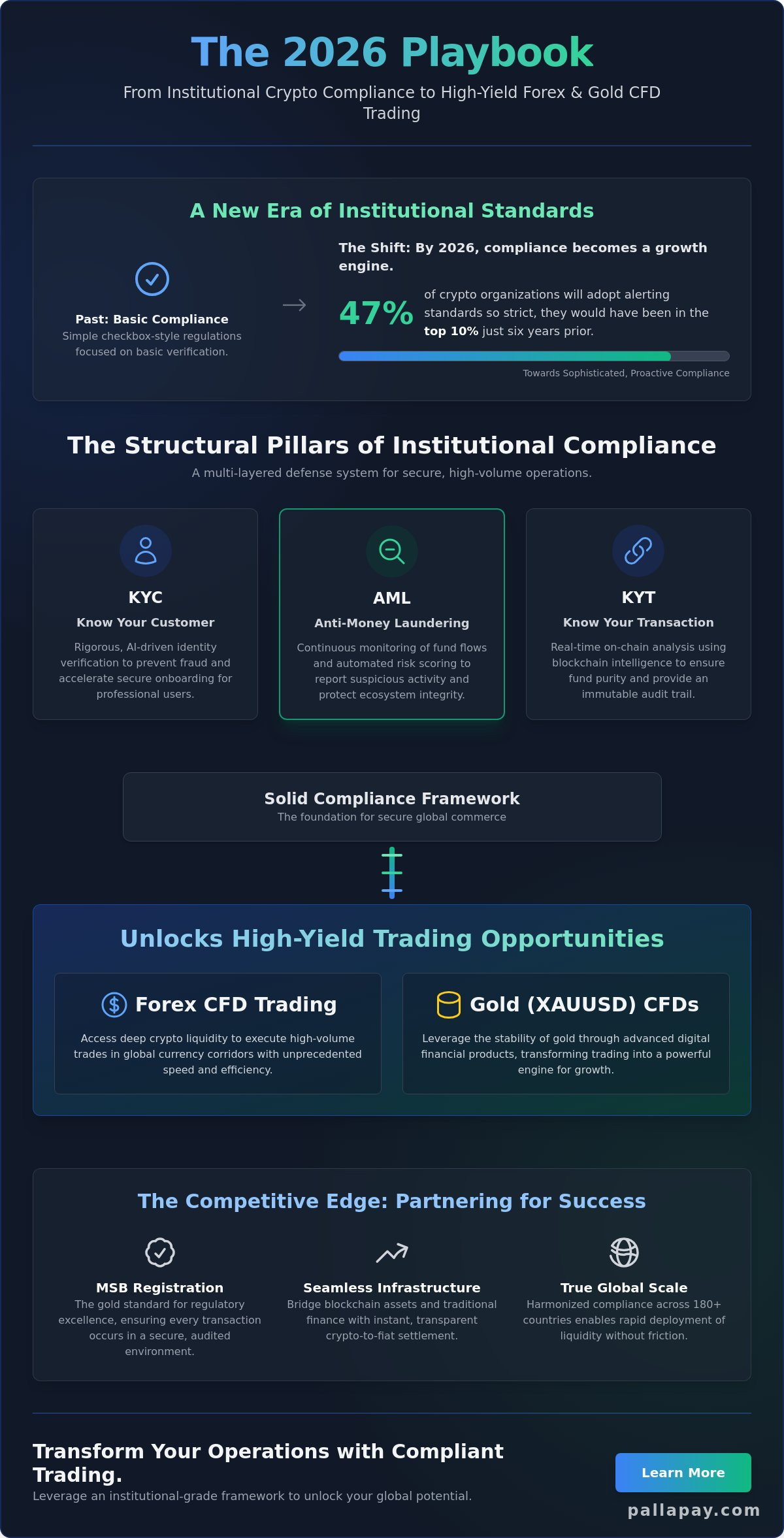
    Approximately 47% of crypto organizations onboarded in 2026 now use alerting standards that would have placed them in the top 10% for strictness just six years ago. This shift proves that crypto compliance for businesses has evolved from a simple checkbox into a sophisticated engine for institutional growth. You’ve likely felt the pressure of the MiCA grandfathering period ending on July 1, 2026, or the complexity of fragmented global standards. It’s a daunting environment when you’re trying to find reliable settlement partners while avoiding regulatory fines.

    We’ll show you how to master these complexities to unlock high-yield opportunities in Forex and Gold CFD trading with total confidence. This guide provides a clear roadmap for regulatory success, enabling the seamless integration of crypto and fiat systems. You’ll discover how to leverage XAUUSD CFDs and other advanced financial products to transform your commercial operations. We’re moving beyond simple survival to show you how a professional compliance framework acts as an essential component of your global evolution.

    Key Takeaways

    • Understand how the 2026 regulatory landscape transforms digital assets into a stable, institutional-grade foundation for global commercial operations.
    • Master the essential pillars of crypto compliance for businesses to manage KYC and AML protocols with absolute confidence and precision.
    • Discover the strategic synergy between deep crypto liquidity and high-yield opportunities in the XAUUSD and Forex CFD markets.
    • Learn how to implement seamless infrastructure that bridges blockchain assets with traditional systems through instant crypto-to-fiat conversion.
    • Identify the competitive advantages of partnering with an MSB-registered facilitator to secure long-term growth and operational reliability.

    The year 2026 marks a definitive end to the speculative era of digital assets. Professional entities now operate within a framework where institutional-grade digital finance is the baseline requirement. Crypto compliance for businesses has matured into a comprehensive operational strategy that encompasses tax reporting, real-time transaction monitoring, and verifiable proof of reserves. It’s no longer about simple box-ticking; it’s about building a resilient bridge between blockchain innovation and the rigorous demands of global commerce.

    Companies that prioritize these standards gain access to sophisticated financial vehicles like XAUUSD and Forex CFD trading. By maintaining Money Services Business (MSB) registration, an organization signals its commitment to the highest level of regulatory excellence. This status is the gold standard for global operations, ensuring that every fiat-to-crypto conversion and high-yield trade occurs within a secure, audited environment. Blockchain transparency facilitates this by providing a permanent, immutable ledger that simplifies modern regulatory audits and eliminates the ambiguity often found in traditional systems.

    The Evolution of Global Digital Asset Standards

    Unified regulatory frameworks have fundamentally changed how cross-border payments function. These 2026 standards prioritize consumer protection while enabling the speed and efficiency that modern markets demand. According to the current status of Global Cryptocurrency Regulations, authorities expect businesses to maintain compliance across 180+ countries to achieve true global scale. This harmonization allows for the rapid deployment of liquidity across diverse currency corridors without the friction of outdated legacy protocols. It’s a system designed for growth, not just restriction.

    Why Institutional Reliability Matters More Than Ever

    Moving from retail-focused tools to sophisticated business ecosystems is essential for firms seeking high-volume institutional partnerships. Compliance builds the absolute trust required to manage significant capital flows in the gold and USD CFD markets. In 2026, MSB registration is a mandatory requirement for any provider operating a crypto-fiat gateway, serving as a critical verification of their operational integrity. By utilizing a professional crypto offramp, businesses ensure their digital assets are converted into liquid fiat currency with total transparency and speed. This reliability transforms trading from a speculative activity into a powerful engine for financial growth.

    The Structural Pillars of Institutional Crypto Compliance

    Institutional excellence relies on a multi-layered defense system. Crypto compliance for businesses begins with the rigorous verification of identity and the continuous monitoring of fund flows. By 2026, the standard for professional entities has moved beyond basic checks into a proactive strategy that ensures every asset entering the ecosystem is clean and verifiable. This structural integrity is what allows firms to engage in high-volume Forex trading and gold CFD positions with absolute certainty.

    KYC protocols verify the identity of participants to prevent fraud and illicit activity. AML systems implement robust monitoring to report suspicious flows before they can compromise the integrity of the firm. These pillars create a secure environment where institutional financial reliability is the norm rather than the exception. KYT (Know Your Transaction) provides real-time on-chain analysis to ensure fund purity. It’s a technical safeguard that balances the need for total transparency with global data protection laws. This ensures that while the business satisfies regulatory audits, it also protects the privacy of its legitimate users.

    Implementing Automated KYC and AML Workflows

    AI-driven identity verification significantly reduces friction for professional users by accelerating the onboarding process. Modern systems set up automated risk scoring for incoming digital asset payments, allowing for immediate decision-making. Integrating secure crypto payment gateways into existing compliance stacks ensures that crypto compliance for businesses occurs in the background, maintaining a smooth user experience. This automation is essential for scaling operations without increasing manual overhead.

    Blockchain Intelligence and Transaction Monitoring

    Using KYT allows a business to identify the source of funds before they hit a corporate wallet. The necessity of crypto security is paramount in maintaining a clean audit trail that regulators can trust. Real-time monitoring tools provide an immediate shield by screening every incoming transaction against global watchlists to prevent any exposure to sanctioned addresses. This level of precision is the key to unlocking the transformative potential of the markets. When you operate with a compliant crypto offramp, you bridge the gap between digital innovation and fiat stability. It empowers you to focus on the financial impact of your trades, knowing the underlying mechanics are handled by a strategic partner.

    Crypto Compliance for Businesses: The 2026 Strategic Guide to Regulatory Excellence

    How Compliance Unlocks High-Yield Forex and Gold CFD Trading

    Compliance is often perceived as a restrictive burden, yet in the high-stakes world of institutional finance, it serves as the ultimate facilitator. To access the depth of the global Forex and Gold CFD markets, a firm must demonstrate an uncompromising commitment to regulatory standards. By mastering crypto compliance for businesses, you remove the friction that prevents institutional brokers from offering the high-yield leverage required for serious capital growth. This isn’t just about avoiding penalties; it’s about qualifying for the most sophisticated financial instruments available.

    The synergy between digital asset liquidity and traditional currency markets represents a significant evolution in wealth management. When a business integrates compliant protocols, it creates a secure channel to deploy crypto capital into the $7.5 trillion-a-day Forex market. This bridge allows for a dynamic allocation strategy where digital assets fund active trading positions in major currency pairs and commodities, maximizing the utility of every unit of capital. It’s a professional evolution that turns compliance into a powerful engine for profit.

    The Transformative Potential of CFD Trading

    CFD trading acts as a powerful catalyst for financial transformation, offering the ability to generate significant returns on both rising and falling markets. For an individual or a business, mastering these markets can fundamentally alter a financial trajectory by providing exposure to global price movements without the need for physical asset ownership. The mechanics are efficient: you use digital assets to fund high-speed trading accounts, allowing for rapid execution and real-time response to market shifts. A compliant infrastructure ensures that once your strategy yields results, you can execute a seamless profit withdrawal to fiat, maintaining the liquidity necessary for ongoing operations.

    Strategic Hedging with Gold and USD Pairs

    Navigating the XAU/USD market remains a cornerstone of professional portfolio management because gold continues to serve as the definitive anchor of global finance. During periods of fiat volatility, trading gold CFDs provides a robust mechanism for wealth preservation and capital appreciation, effectively shielding a portfolio from inflationary erosion. Managing these gains requires a reliable system for fiat settlement, ensuring that trading profits are moved from the brokerage environment into the corporate ecosystem without delay. This integrated approach to crypto compliance for businesses ensures that your hedging strategies are supported by a foundation of institutional reliability and technical precision.

    Implementing Compliant Infrastructure: From APIs to Fiat Settlement

    Building a high-performance financial engine requires more than just a strategy. It demands a technical architecture that bridges the gap between decentralized assets and institutional banking. Crypto compliance for businesses is most effective when it’s invisible to the end-user but rigorous in its background execution. By automating the verification and documentation process, a business can maintain the speed necessary for global commerce while satisfying the strictest regulatory audits.

    Instant crypto-to-fiat conversion is not just a convenience; it’s a requirement for operational liquidity. In the fast-moving world of XAUUSD and Forex CFD trading, capital must be mobile. Automated settlement systems reduce the friction of cross-border transactions, allowing profits to move from a digital wallet to a corporate bank account with total transparency. This infrastructure ensures that every transaction is pre-vetted, creating a permanent audit trail that reinforces your standing as a reliable institutional partner.

    Leveraging APIs for Seamless Compliance

    Integrating a payment API allows your business to handle complex background compliance checks without manual intervention. This automation saves significant time, shifting the focus from administrative hurdles to strategic growth. Whether you are scaling an e-commerce platform or managing high-volume institutional trades, an API-driven approach ensures that your operations remain compliant at every scale. It provides the technological answer to fragmented global standards, ensuring consistency across all currency corridors.

    The Power of Efficient Off-Ramping

    Ensuring your crypto off-ramp meets global MSB standards is the final piece of the regulatory puzzle. Moving trading profits securely from digital environments to traditional financial systems requires a partner that understands the nuances of crypto compliance for businesses. Instant settlement is the lifeblood of high-frequency Forex operations, where the ability to realize gains in fiat currency determines your capacity for the next high-yield position. This seamless flow of capital transforms the potential of Gold CFD trading into tangible financial success.

    Accelerate your institutional growth and secure your trading profits by integrating a professional crypto off-ramp today.

    Pallapay: Your Strategic Partner in Compliant Digital Asset Growth

    Pallapay serves as the professional bridge between disruptive blockchain technology and institutional financial systems. By providing a comprehensive ecosystem that prioritizes crypto compliance for businesses, we enable firms to navigate the complexities of global regulation with ease. Our status as a registered Money Services Business (MSB) in both the United States and Canada offers a level of security that software-only vendors cannot match. We don’t just provide tools; we facilitate a complete financial evolution for our partners.

    Our infrastructure supports a wide range of operational needs, from high-volume OTC crypto exchange services to on-the-ground retail POS solutions. This versatility ensures that whether you are settling international invoices or funding a high-leverage Forex account, the process is seamless and secure. We handle the technical conversions so you can focus on the strategic impact of your capital in the gold and USD CFD markets. It is a system designed to empower growth through reliability.

    Institutional Reliability Meets Technological Innovation

    Global leaders choose Pallapay because we handle the intricate background mechanics of compliance across 180+ countries. This global reach ensures that your business can scale without being hindered by fragmented local standards. Our systems provide absolute trust, allowing you to manage significant digital asset flows with the confidence of an industry leader. By integrating our solutions, you adopt a forward-thinking partner that is deeply grounded in the practicalities of modern commerce. We ensure your operations remain efficient, safe, and ready for institutional-grade expansion.

    Next Steps: Accelerating Your Financial Progress

    Starting your journey toward regulatory excellence is straightforward. By setting up a Pallapay wallet and accessing our merchant dashboard, you gain immediate control over your digital and fiat liquidity. This foundation is essential for anyone looking to unlock the transformative potential of Gold and Forex trading. The ability to trade XAUUSD CFDs with institutional-grade support can fundamentally change your financial trajectory, providing the growth and stability required in a digital-first economy. We invite you to join the inevitable global evolution of finance by partnering with Pallapay to secure your future in the world’s most liquid markets.

    Mastering the New Standard of Global Financial Excellence

    The shift toward institutional-grade digital finance is complete. By prioritizing crypto compliance for businesses, you’ve moved beyond regulatory survival to a position of market leadership. You now possess the tools to navigate the XAUUSD and Forex markets with the speed and precision required for significant financial transformation. This strategic foundation ensures that your capital remains liquid, your transactions stay transparent, and your growth remains unhindered by legacy barriers. It’s the professional gateway to a more efficient and profitable commercial future.

    Success in 2026 requires a partner that combines technical innovation with institutional reliability. Pallapay provides this bridge through official MSB registration in the USA and Canada; a global presence spanning 180+ countries; and secure OTC desks for high-volume institutional trades. It is time to leverage these professional advantages to accelerate your commercial momentum. Secure your business future with Pallapay’s compliant crypto ecosystem and lead the inevitable evolution of global commerce. Your path to sustainable, high-yield trading starts with a foundation of absolute trust and technical excellence.

    Frequently Asked Questions

    What is crypto compliance for businesses in 2026?

    Crypto compliance for businesses in 2026 is a multi-layered strategic framework that ensures every digital asset operation meets global institutional standards. It goes beyond basic identity checks to include real-time transaction monitoring and automated tax reporting. This evolution allows firms to bridge the gap between disruptive technology and financial reliability. By adopting these standards, an organization secures its position within the formal economy and gains access to high-yield investment vehicles like Forex and gold CFDs.

    How does MSB registration impact a crypto company’s credibility?

    MSB registration establishes a company as a verified participant in the global financial system by proving adherence to strict AML and KYC protocols. It instills absolute trust in institutional partners who require a secure bridge between digital assets and traditional banking. This registration, particularly in jurisdictions like the USA and Canada, ensures that a provider is monitored by federal authorities. It transforms a tech-centric entity into a reliable strategic partner for high-volume commercial operations.

    Can I trade Gold CFDs using my business cryptocurrency holdings?

    You can trade gold CFDs using business crypto holdings by leveraging a compliant payment gateway to fund your brokerage account. This process allows you to convert digital liquidity into the necessary collateral for XAUUSD positions. Using a professional facilitator ensures that the transfer of funds is documented and meets all necessary crypto compliance for businesses standards. It provides a seamless path to diversifying your corporate treasury into the world’s most stable commodity markets.

    What are the main risks of non-compliance in the crypto industry?

    Non-compliance carries severe risks including multi-million dollar regulatory fines, immediate suspension of operational licenses, and permanent exclusion from the traditional banking system. In a digital-first economy, failing to meet standards like the FATF Travel Rule can result in your business being blacklisted by institutional liquidity providers. These consequences don’t just stall growth; they can lead to the total collapse of an organization’s financial infrastructure. Maintaining excellence is a requirement for long-term commercial survival.

    How does a crypto-to-fiat payment API simplify regulatory reporting?

    A payment API simplifies regulatory reporting by automating the collection and documentation of every transaction flow in real time. It eliminates hundreds of hours of manual labor by generating pre-vetted reports that satisfy modern audit requirements. This technical integration ensures that every crypto-to-fiat conversion is recorded with precise metadata. It provides a clean audit trail that demonstrates your commitment to institutional reliability while maintaining the speed your operations demand for global scale.

    What is the difference between KYC and KYT in blockchain finance?

    KYC focuses on verifying the identity of the individual or entity, while KYT provides real-time monitoring of the underlying blockchain transactions. KYC prevents fraud at the point of entry, but KYT ensures the ongoing purity of funds by detecting suspicious on-chain behavior. Both are essential pillars of a robust compliance stack. Together, they create a secure environment where businesses can engage in high-volume Forex trading without exposure to sanctioned or illicit addresses.

    How can I securely settle trading profits into my corporate bank account?

    Securely settling trading profits requires a professional off-ramp service that offers instant conversion to fiat and direct bank transfers. This system ensures that your gains from gold or USD CFD trades are moved from the digital environment into your corporate bank account with total transparency. Using an MSB-registered provider guarantees that the settlement process adheres to international financial standards. It provides the liquidity necessary to fund ongoing operations and capitalize on new market opportunities.

    Why is gold (XAU/USD) a popular choice for crypto-funded trading?

    Gold remains the anchor of global finance because it provides a definitive hedge against fiat currency volatility and inflationary pressures. For firms using digital assets, the XAUUSD pair offers a way to preserve wealth while participating in the transformative potential of the markets. Trading gold CFDs allows for significant capital growth without the logistical burdens of physical ownership. It is a strategic choice for businesses seeking to stabilize their portfolios while maintaining high-yield exposure.

    Disclaimer

    The information provided on this website and blog is for general informational and educational purposes only and does not constitute financial, investment, legal, tax, or other professional advice.
    Cryptocurrency and digital asset services may be subject to regulatory restrictions in certain jurisdictions. Users are solely responsible for ensuring compliance with applicable local laws and regulations before using any products or services mentioned on this website.
    PallaPay does not guarantee the accuracy, completeness, or timeliness of any information published and accepts no liability for any loss or damages arising from reliance on the content. Any opinions expressed are those of the respective authors and may change without notice.
    Certain services, features, or products referenced may be provided through third-party partners, licensed entities, or affiliated service providers subject to separate terms and regulatory approvals. Availability of services may vary by country or region.
    This website may contain references to digital assets, virtual currencies, or blockchain-related services that are not available to residents of certain jurisdictions, including where prohibited by law. Nothing on this website constitutes an offer, solicitation, or recommendation to buy or sell any financial instrument or virtual asset.

  • What Are the Risks of P2P Crypto Trading? A Comprehensive 2026 Guide

    What Are the Risks of P2P Crypto Trading? A Comprehensive 2026 Guide

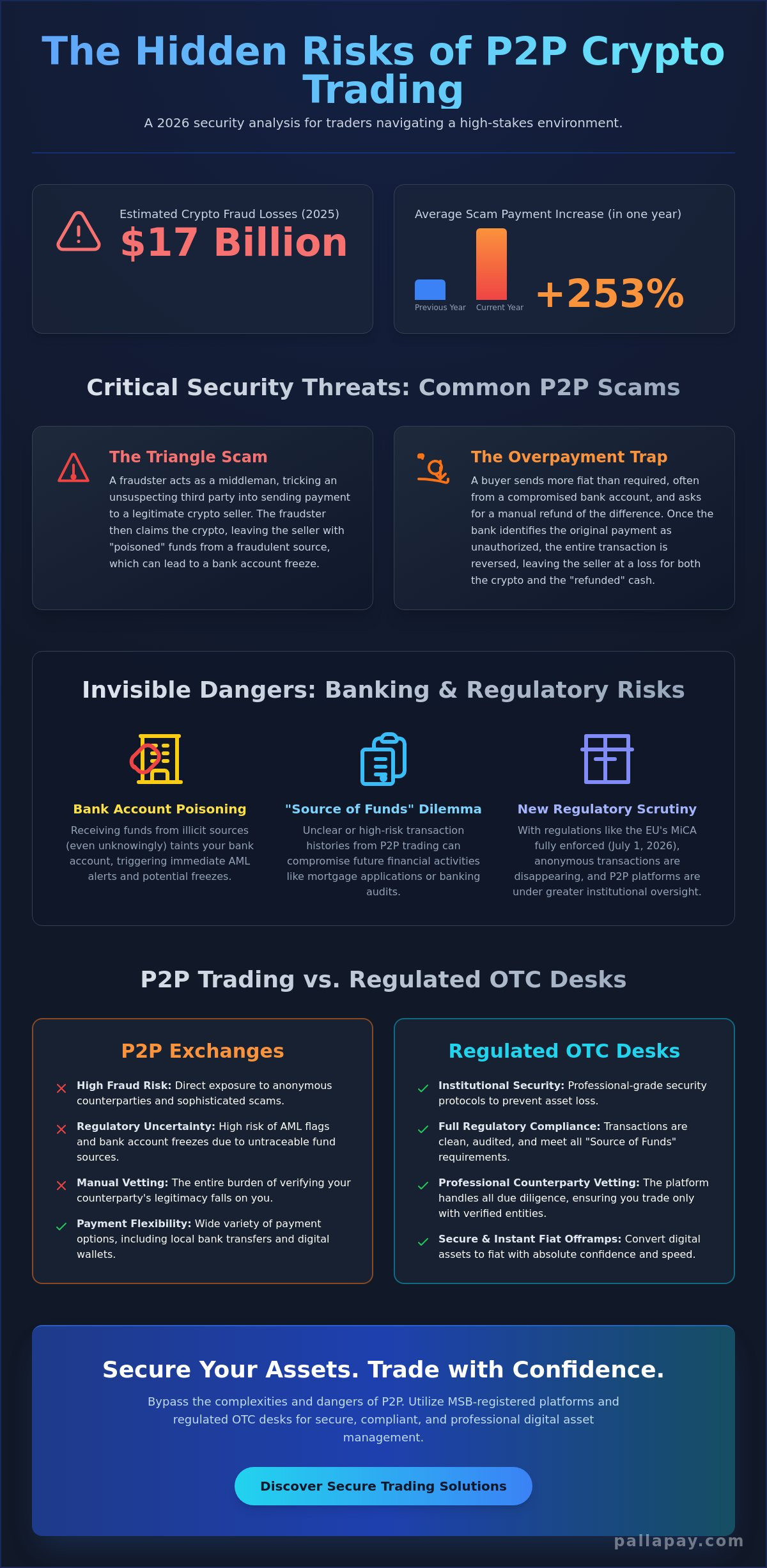
    Did you know that crypto fraud losses reached an estimated $17 billion in 2025, with the average scam payment increasing by 253% in just one year? As you evaluate your liquidity options, understanding what are the risks of p2p crypto trading is no longer optional; it’s a critical requirement for financial security. You likely value the flexibility of peer-to-peer exchanges, yet the persistent fear of anonymous counterparties and the threat of bank account freezes can make every transaction feel like a high-stakes gamble.

    We understand that institutional reliability is the only acceptable standard for your capital. This comprehensive 2026 guide promises to identify the specific security and regulatory vulnerabilities inherent in P2P systems while providing actionable steps to protect your assets from AML red flags. We’ll analyze the mechanics of sophisticated scams and explore how the full implementation of the EU’s MiCA regulations on July 1, 2026, impacts your liquidity. Finally, you’ll discover how regulated OTC desks and instant fiat conversion tools provide a secure, professional bridge to the modern financial ecosystem.

    Key Takeaways

    • Identify the mechanics of “Triangle Scams” and sophisticated proof-of-payment fraud to prevent irreversible asset loss during direct exchanges.
    • Understand what are the risks of p2p crypto trading regarding bank account poisoning and why anonymous funds often trigger immediate AML alerts.
    • Evaluate the “Source of Funds” dilemma to ensure your digital asset activities do not compromise future banking audits or mortgage applications.
    • Discover why institutional traders are shifting toward regulated OTC crypto exchange services to bypass the complexities of manual counterparty vetting.
    • Learn how to utilize secure offramps and MSB-registered platforms to convert digital assets into fiat with absolute regulatory confidence.

    Understanding Peer-to-Peer (P2P) Crypto Trading in 2026

    Peer-to-peer (P2P) trading functions as a direct marketplace where individuals exchange digital assets without a centralized intermediary managing the order book. Unlike traditional platforms where the exchange acts as the counterparty, P2P services facilitate a direct connection between a “maker” who posts an advertisement and a “taker” who responds to it. While these platforms provide an escrow service to hold the assets during the trade, the actual transfer of fiat currency happens outside the platform’s direct control. In 2026, understanding what are the risks of p2p crypto trading is vital because the landscape has shifted from a niche alternative to a heavily scrutinized financial activity.

    The 2026 landscape is defined by a significant divergence between user autonomy and institutional oversight. With the full enforcement of the EU’s Markets in Crypto-Assets (MiCA) regulation as of July 1, 2026, the perceived anonymity of these exchanges has largely vanished. The “Travel Rule” now requires identifying data for most transfers, yet P2P remains popular for those seeking localized payment flexibility. The fundamental trade-off remains constant. You gain control over your payment methods and pricing, but you sacrifice the institutional-grade security and fraud protection found in regulated environments. This autonomy often comes at the cost of operational safety, placing the entire burden of counterparty verification on the individual trader.

    The Mechanics of Modern P2P Exchanges

    Smart contracts now power most escrow services, acting as a digital neutral party. When a trade begins, the seller’s cryptocurrency is locked in the contract. It’s only released when the buyer provides proof of payment and the seller confirms receipt in their bank account or digital wallet. However, this process isn’t infallible. Before you engage with these platforms, having a firm grasp on how to spend cryptocurrency safely is essential. You must understand how to verify transactions on the blockchain rather than relying solely on platform notifications. Scammers often exploit the gap between the digital asset release and the fiat payment confirmation, making technical literacy your first line of defense.

    Why Traders Accept the Risks

    The primary draw of P2P is the sheer variety of settlement options. Users can settle trades via local bank transfers, digital wallets, or even cash-in-person, which many decentralized exchanges and centralized platforms cannot support directly. This flexibility is a lifeline in regions where traditional banking infrastructure is restrictive or where users wish to set their own price spreads to maximize profit. Despite the utility, the question of what are the risks of p2p crypto trading persists because these custom payment flows are exactly where fraudsters find their openings. Traders often prioritize this immediate accessibility and the ability to avoid standard platform fees, even if it means navigating a market where impersonation scams grew by 1,400% in 2025 alone.

    Critical Security Threats: Common P2P Fraud Schemes

    Fraudsters in the peer-to-peer ecosystem don’t just steal assets; they engineer complex financial traps that exploit the gap between blockchain finality and banking reversals. When evaluating what are the risks of p2p crypto trading, you must recognize that your counterparty might be a professional syndicate using sophisticated social engineering. The “Triangle Scam” remains a primary threat. In this scenario, a fraudster acts as a middleman between a legitimate seller and an unsuspecting third party. The third party sends fiat to the seller, but the fraudster convinces the platform to release the crypto to their own wallet. This leaves the seller with “poisoned” fiat that is eventually flagged as fraudulent, often leading to a total bank account freeze.

    The “Overpayment Trap” is another high-level red flag that many professional traders overlook. If a buyer sends more fiat than the trade requires and requests a manual refund for the difference, they’re likely using a compromised account. Once the bank identifies the original transfer as unauthorized, the entire amount is reversed, leaving you at a loss for both the crypto and the “refunded” cash. With AI-enabled scams becoming 4.5 times more profitable than traditional methods in 2025, the speed and accuracy of these deceptive tactics have reached institutional levels of complexity.

    Chargeback and Payment Reversal Tactics

    The irreversible nature of blockchain transactions is a weakness when paired with reversible fiat payment methods. Scammers often use “Friendly Fraud” chargebacks, claiming unauthorized access to their digital wallets or credit cards after the crypto has been released from escrow. This creates a systemic vulnerability where the seller has no recourse. Maintaining rigorous crypto security means more than just protecting your private keys; it requires selecting payment channels that do not allow for easy reversals. Transitioning to a regulated crypto offramp can mitigate these reversal risks by utilizing secure, bank-grade settlement protocols.

    Identity Theft and Phishing

    Sharing sensitive KYC documents with unverified P2P counterparties opens the door to identity theft. Fraudsters often pose as platform support staff during a trade dispute, using deepfake technology to gain your trust and steal account credentials. These sophisticated impersonation scams grew by 1,400% in 2025, highlighting the danger of direct peer interaction. You can find more detailed guidance from the Canadian Investment Regulatory Organization on crypto asset risks, which emphasizes the dangers of unregulated trading environments. To avoid these pitfalls, professional traders are increasingly moving toward institutional platforms that handle all counterparty vetting internally, ensuring that your personal data never reaches a third party.

    What Are the Risks of P2P Crypto Trading? A Comprehensive 2026 Guide

    The Invisible Dangers: Regulatory and Banking Implications

    Beyond the immediate loss of assets, the most enduring damage often occurs within your traditional banking relationships. One of the most severe consequences of what are the risks of p2p crypto trading is bank account poisoning. This happens when you receive funds from a counterparty whose account is already flagged for suspicious activity. Your bank’s automated Anti-Money Laundering (AML) systems don’t distinguish between an innocent trader and a criminal accomplice; they simply freeze every account in the transaction chain. This often leads to a permanent blacklisting, effectively cutting you off from the global financial system without any clear path for appeal.

    Traditional lenders have also evolved their auditing processes for 2026. Many institutions won’t accept P2P transaction history as a valid “Source of Funds” during high-value applications like mortgages or business loans. Because the counterparty is anonymous, the bank can’t verify that the money didn’t originate from a high-risk source. This lack of transparency creates a legal vacuum. If a transaction goes wrong across international borders, you have zero legal recourse against an anonymous individual, leaving your capital and your reputation at significant risk.

    AML Compliance and the ‘Dirty Money’ Trail

    The role of blockchain forensics has grown exponentially, allowing banks to map the flow of digital assets directly to fiat transfers. If your P2P activity intersects with common P2P fraud schemes, the trail is permanent and public. Unverified P2P sellers often use these platforms to layer illicit funds, which puts you at direct legal risk for money laundering. Utilizing professional fiat settlement channels ensures that every transaction is documented and compliant, preserving your standing with legacy financial institutions and preventing the “dirty money” trail from touching your personal accounts.

    MSB Registration: Why Trading with Unregulated Entities Is Dangerous

    Unregulated P2P platforms often operate without Money Services Business (MSB) registrations, meaning they lack the consumer protection frameworks required by agencies like FinCEN in the US or FINTRAC in Canada. These platforms evade the strict capital requirements and insurance mandates that protect users in the event of a breach. There’s a fundamental difference between a “platform” that merely matches users and a “regulated provider” that takes legal responsibility for the trade. By choosing a regulated entity, you’re operating within a protected framework that prioritizes institutional financial reliability over the chaotic anonymity of the P2P market.

    Risk Mitigation Strategies vs. Professional OTC Desks

    While retail traders often rely on platform feedback scores to judge safety, these metrics are increasingly susceptible to manipulation by organized syndicates. Understanding what are the risks of p2p crypto trading requires a shift from reactive mitigation to proactive institutional security. Traditional P2P platforms place the entire burden of counterparty vetting on you, creating a high-friction environment where a single oversight can lead to total asset loss. In contrast, transitioning to a professional otc crypto exchange service removes the volatility of anonymous interaction by replacing unverified individuals with a regulated institutional counterparty.

    Professional mediation eliminates the threat of payment reversals because the desk acts as the definitive clearinghouse for both the digital asset and the fiat currency. This model provides the privacy you require without the legal exposure associated with anonymous transfers. By utilizing an established partner, you ensure that every transaction remains compliant with evolving global standards while benefiting from the speed and reliability of a dedicated financial infrastructure.

    Best Practices for Individual P2P Traders

    If you choose to operate within peer-to-peer markets, you must implement rigorous verification protocols that go beyond basic platform requirements. The inherent unpredictability of what are the risks of p2p crypto trading makes manual vetting an inefficient but necessary hurdle for those not yet using institutional desks. Follow these strict operational rules:

    • Identity Synchronization: Never accept payments from a bank account that doesn’t exactly match the name on the trader’s P2P profile.
    • Video Verification: Request a real-time video confirmation or a specific “proof of life” photo to ensure you aren’t communicating with a bot or a compromised account.
    • Exposure Management: Set strict daily transaction limits to minimize your financial vulnerability to any single counterparty or potential bank flag.

    Transitioning to Institutional-Grade Trading

    For high-volume investors and corporate entities, the friction of manual P2P vetting is no longer a viable business strategy. Professional desks provide fixed pricing and deep liquidity, eliminating the slippage and “taker” fees common on retail boards. You gain the support of a dedicated account manager who handles complex procedural flows, ensuring that your capital moves without the risk of being trapped in a platform dispute. Integrated crypto payment gateways offer a far more stable liquidity bridge than fragmented P2P markets. To secure your exit strategy with institutional-grade reliability, explore our secure crypto offramp solutions and experience the efficiency of regulated fiat settlement.

    Secure Digital Asset Management with Pallapay

    The systemic vulnerabilities of peer-to-peer markets require a more robust, institutional approach to liquidity. Pallapay provides a comprehensive ecosystem designed to eliminate the uncertainty of anonymous counterparty interaction. By operating as a regulated intermediary, we address the core question of what are the risks of p2p crypto trading by assuming the responsibility for security and compliance. Our platform functions as a professional bridge, ensuring that your capital remains protected within a framework built on institutional financial reliability.

    Reliability is grounded in regulatory transparency. Pallapay is registered with FinCEN in the United States and FINTRAC in Canada, providing a level of oversight that retail P2P platforms simply cannot match. This regulatory standing ensures that every transaction adheres to strict international standards, protecting you from the legal and financial fallout of unverified trading. We don’t just facilitate trades; we provide a secure environment where digital innovation meets established commerce.

    Compliance and Security as a Standard

    Our rigorous KYC and AML protocols serve as a definitive barrier against “poisoned” funds. By vetting every participant in our ecosystem, we prevent the illicit capital flows that often lead to bank account freezes in the P2P market. For high-value transactions, our physical OTC desks offer a secure environment for cash-to-crypto exchanges, providing the tactile security that digital-only platforms lack. You can manage these assets with absolute confidence using the Pallapay Wallet, which integrates seamlessly with our broader liquidity network to provide a unified financial experience.

    Efficient Off-Ramping for Global Users

    Converting digital wealth into usable fiat shouldn’t be a risk-laden process. Our dedicated off-ramp service allows you to convert crypto to fiat instantly, supporting major currencies including USD, EUR, GBP, and AED. This direct conversion path eliminates the need for untrusted third parties and ensures your bank receives funds from a verified, regulated source. Whether you need to sell Bitcoin for cash or convert USDT to USD, our system prioritizes speed and safety. Take the next step in securing your financial future by booking an OTC consultation to discuss high-volume asset exchange with our professional team.

    Securing Your Financial Path in the Digital Evolution

    The transition from fragmented peer-to-peer markets to institutional-grade liquidity is an essential step for any serious participant in the digital economy. We’ve explored how anonymous counterparties and banking “poisoning” can jeopardize your standing with traditional financial systems. While P2P offers flexibility, it lacks the structural safeguards necessary to protect high-value capital from sophisticated fraud. Fully understanding what are the risks of p2p crypto trading is the first step toward safeguarding your financial future. By choosing a partner that prioritizes regulatory transparency, you eliminate the operational friction that stalls progress.

    Pallapay stands as a definitive destination for those who demand stability. As an MSB registered entity in both the USA and Canada, we serve users across 180+ countries through a secure, integrated ecosystem. Our physical OTC desks in major international hubs provide the tactile reliability that anonymous platforms cannot replicate. Secure your large-scale trades with Pallapay’s regulated OTC desk to experience the efficiency of professional fiat settlement. Your journey toward secure, frictionless asset management starts with a partner you can trust. We’re here to empower your growth every step of the way.

    Frequently Asked Questions

    Is P2P crypto trading legal in most countries in 2026?

    Yes, P2P trading remains legal in most jurisdictions, but it is now subject to rigorous regulatory frameworks. In the European Union, the MiCA regulation requires service providers to hold specific authorizations, while the US and Canada mandate MSB registration. You should always verify your local laws, as some regions have restricted P2P activity to licensed institutional entities to prevent illicit financial flows.

    What should I do if my bank account is frozen after a P2P trade?

    Contact your bank’s compliance department immediately to request a formal reason for the administrative hold. You’ll need to provide comprehensive documentation, including trade receipts, platform communication logs, and proof of the digital asset’s origin. If the freeze is related to an AML flag from a counterparty, professional legal counsel specializing in digital finance is often necessary to resolve the inquiry.

    How can I tell if a P2P seller is using a fake identity?

    Ensure the name on the incoming bank transfer matches the platform’s verified profile name without any discrepancies. Be cautious of sellers who avoid video verification or operate high-volume accounts that were created very recently. Professional fraudsters often utilize “money mule” accounts, so a seller’s refusal to provide secondary business verification is a definitive red flag for identity fraud.

    Why is an OTC desk safer than a P2P platform for large transactions?

    An OTC desk replaces the uncertainty of an anonymous individual with the stability of a regulated institutional counterparty. This shift eliminates the core concerns of what are the risks of p2p crypto trading by providing fixed pricing and deep liquidity within a controlled environment. You aren’t hunting for a buyer; you’re engaging in a professional contract with an entity that assumes full operational responsibility.

    Can I reverse a crypto transaction if I get scammed on a P2P exchange?

    No, blockchain transactions are final and technically irreversible once they’re confirmed on the network. Neither the exchange nor a bank can “pull back” digital assets once they’ve been released from an escrow smart contract. This permanent nature is why vetting your counterparty through an institutional provider is the only reliable method to protect your capital from irreversible loss.

    What is the ‘Triangle Scam’ and how can I avoid it?

    This scheme involves a fraudster posing as a seller to one person and a buyer to you, effectively using a victim’s money to pay for your crypto. To avoid this, you must reject any payment that originates from a third-party bank account. Always insist that the fiat sender’s identity is identical to the person you’re communicating with on the trading platform to break the scam’s logic.

    Do I need to pay taxes on P2P crypto trades?

    Yes, most tax authorities treat the exchange of cryptocurrency for fiat as a taxable event that triggers capital gains or income tax obligations. You’re responsible for maintaining precise records of your acquisition costs and the final sale value for every trade. Failure to report these transactions can lead to significant penalties, especially as tax agencies now use advanced blockchain forensic tools for auditing.

    How does Pallapay ensure the safety of my cash-to-crypto transactions?

    Pallapay mitigates what are the risks of p2p crypto trading by acting as your direct, regulated counterparty rather than a mere matching service. We utilize institutional-grade KYC protocols and MSB registrations to ensure every transaction is compliant and secure. Our physical OTC desks provide a professional, monitored environment for high-value exchanges, ensuring that your cash-to-crypto transitions are handled with absolute financial reliability.

    Disclaimer

    The information provided on this website and blog is for general informational and educational purposes only and does not constitute financial, investment, legal, tax, or other professional advice.
    Cryptocurrency and digital asset services may be subject to regulatory restrictions in certain jurisdictions. Users are solely responsible for ensuring compliance with applicable local laws and regulations before using any products or services mentioned on this website.
    PallaPay does not guarantee the accuracy, completeness, or timeliness of any information published and accepts no liability for any loss or damages arising from reliance on the content. Any opinions expressed are those of the respective authors and may change without notice.
    Certain services, features, or products referenced may be provided through third-party partners, licensed entities, or affiliated service providers subject to separate terms and regulatory approvals. Availability of services may vary by country or region.
    This website may contain references to digital assets, virtual currencies, or blockchain-related services that are not available to residents of certain jurisdictions, including where prohibited by law. Nothing on this website constitutes an offer, solicitation, or recommendation to buy or sell any financial instrument or virtual asset.

  • KYC and AML in Crypto Exchanges: The 2026 Compliance Standard

    KYC and AML in Crypto Exchanges: The 2026 Compliance Standard

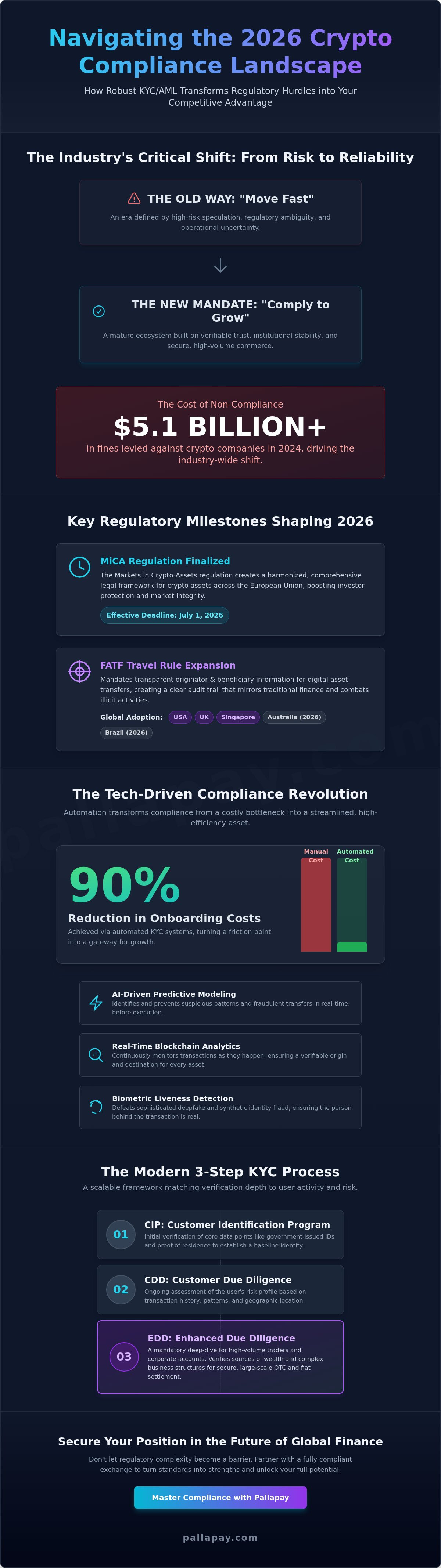
    With over $5.1 billion in fines levied against crypto companies in 2024, the industry has shifted from a “move fast” mentality to a “comply to grow” mandate. It’s understandable if you’re frustrated by slow verification processes or the constant worry that a regional policy change might freeze your operational capital. You deserve a partner that turns these regulatory hurdles into competitive advantages. This guide ensures you master the evolving requirements of a modern kyc aml crypto exchange, proving that robust compliance is the essential infrastructure for accessing deep, institutional-grade liquidity.

    By reading on, you’ll gain clarity on the July 1, 2026, MiCA deadline and the global expansion of the FATF Travel Rule across major jurisdictions. We’ll explore how automated systems now reduce onboarding costs by up to 90%, transforming what used to be a friction point into a streamlined gateway for growth. From OTC desks to instant fiat conversions, you’ll see how regulated platforms provide the absolute stability your high-volume transactions demand in a mature financial ecosystem. This is your roadmap to navigating the 2026 standards with confidence and precision.

    Key Takeaways

    • Understand the global impact of the July 2026 MiCA deadline and the expanded FATF Travel Rule on international digital asset transfers.
    • Discover why selecting a fully regulated kyc aml crypto exchange is the only secure path to protect your capital from account freezes and regulatory seizure.
    • Learn how institutional-grade exchanges utilize advanced encryption to safeguard your data while maintaining rigorous legal transparency.
    • Master the specific documentation protocols required to verify high-limit corporate accounts for seamless, large-scale OTC transactions.
    • Leverage MSB-registered platforms and physical OTC desks to convert crypto to fiat with institutional-grade reliability.

    The Evolution of KYC and AML in the 2026 Crypto Landscape

    The digital asset market has reached a definitive stage of maturity. By mid-2026, the transition from experimental speculation to institutional stability is complete, driven largely by the final implementation of the Markets in Crypto-Assets (MiCA) regulation on July 1, 2026. Global regulators no longer view compliance as an optional feature. They see it as the fundamental requirement for any kyc aml crypto exchange seeking to operate within the legitimate financial system. This shift ensures that every participant is verified, creating a secure environment for high-volume commerce.

    The Financial Action Task Force (FATF) has successfully harmonized expectations across major jurisdictions. The Travel Rule is now standard in the US, UK, and Singapore, with Australia and Brazil following suit in 2026. This consistency eliminates the regulatory arbitrage that previously plagued the industry. Global transparency isn’t just a legal hurdle; it’s the catalyst for mass adoption. It provides the security that professional investors require before committing significant capital to the market. Trust is the new currency of the digital age.

    Why Regulation is the Bridge to Institutional Finance

    Institutional liquidity requires a clear connection to established financial networks. When a kyc aml crypto exchange adheres to global anti-money laundering standards, it removes the friction between digital assets and traditional banking. This integration reduces market volatility by inviting long-term holders rather than short-term speculators. Regulated financial technology has replaced the unverified platforms of the past. This evolution ensures that assets are safe and every transaction is verifiable. For businesses, this means having a reliable crypto off-ramp that traditional banks will accept without hesitation or suspicion.

    2026 Regulatory Trends: AI and Real-Time Reporting

    Compliance is now proactive rather than reactive. Modern systems use blockchain analytics to monitor transactions as they happen. In 2025, automated KYC systems reduced onboarding costs by 90%, making high-level security both accessible and fast. AI-driven predictive modeling now identifies suspicious patterns before they execute. This technology doesn’t just flag illicit activity; it protects users by preventing fraudulent transfers in real-time. The result is a cleaner, more efficient ecosystem where speed and safety coexist perfectly. By adopting these standards, exchanges move faster while maintaining absolute institutional integrity.

    Compliance serves as the silent engine of institutional trust. It ensures that every asset moving through the digital network has a verifiable origin and a clear destination. A high-performance kyc aml crypto exchange does not simply collect documents; it orchestrates a multi-layered defense strategy designed to mitigate risk in real-time. This structural integrity allows professional traders to move large volumes with confidence, knowing their capital is protected by rigorous legal standards.

    The FATF Travel Rule is a central component of this modern framework. It mandates that essential originator and beneficiary information travels with every digital asset transfer, creating a transparent audit trail that mirrors traditional wire transfers. This transparency is reinforced by automated sanctions screening, which prevents any interaction with restricted entities or high-risk jurisdictions. By 2026, the focus has shifted to counter synthetic identity fraud. Sophisticated platforms now use biometric liveness detection to defeat deepfake technology. This ensures that the person behind the transaction is a real, living individual, not a synthetic reconstruction designed to bypass security.

    KYC: The Three-Step Identity Verification Process

    Identity verification is a progressive process that scales with the user’s activity. It begins with the Customer Identification Program (CIP), where core data points like government-issued IDs and residential proof are verified. Once the identity is established, Customer Due Diligence (CDD) assesses the user’s risk profile based on their transaction history and geographic location. For high-volume traders or corporate entities, Enhanced Due Diligence (EDD) becomes mandatory. This deeper analysis verifies sources of wealth and complex business structures, providing the security required for premium services such as fiat settlement.

    AML and the Fight Against Financial Crime

    Anti-money laundering protocols function as a continuous monitoring layer that never sleeps. Systems analyze transaction frequency and volume to detect anomalies that deviate from a user’s established behavioral profile. This logic is heavily informed by FinCEN’s advisory on illicit virtual currency activity, which provides the red flag indicators used to identify potential money laundering. If suspicious patterns are detected, exchanges are legally bound to file Suspicious Activity Reports (SARs) with the appropriate authorities. These efforts are part of a broader commitment to Combating the Financing of Terrorism (CFT). By maintaining these high standards, a platform ensures it remains a safe harbor for legitimate global commerce.

    If you are managing high-value assets, you should partner with an OTC crypto exchange that integrates these comprehensive security pillars into every transaction.

    Privacy vs. Compliance: Addressing the #1 Trader Objection

    The tension between personal privacy and regulatory oversight is often framed as a zero-sum game. In the 2026 financial environment, this perspective is outdated. A premier kyc aml crypto exchange doesn’t view privacy as an obstacle. It views it as a data security challenge that requires institutional-grade solutions. While some traders still seek out unverified platforms to avoid documentation, they often realize too late that anonymity comes at a steep price. Without a transparent audit trail, your wealth remains disconnected from the global economy.

    Institutional liquidity requires accountability. Large-scale market makers and corporate entities don’t interact with unverified pools because the risk of “tainted” assets is too high. If you acquire digital assets through an unregulated source, those funds are frequently flagged by blockchain analytics tools. When you eventually attempt to move these assets to a compliant crypto off-ramp, you risk permanent account freezes. Transparency is the only way to ensure your liquidity remains portable and legitimate across all borders.

    The Dangers of Unregulated ‘No-KYC’ Platforms

    Choosing an unverified platform exposes you to significant operational vulnerabilities. These exchanges often possess inferior security infrastructure, making them prime targets for hackers. If your funds are stolen from an unregulated entity, there’s no regulatory body to facilitate recovery. The lack of oversight means “No-KYC” often translates to “No-Recourse” when an exit scam occurs. This gap makes it impossible to prove the legal source of your funds to traditional financial institutions, effectively trapping your wealth in a digital silo.

    Institutional Standards for Data Protection

    A compliant exchange protects your identity with the same rigor it uses to protect your assets. Leading platforms utilize Zero-Knowledge Proofs (ZKPs) to verify user eligibility without storing or transmitting sensitive raw data. This technology allows for “private-yet-compliant” interactions where the system confirms you’re a verified user without exposing your specific details to the network. All documentation is held in encrypted, offline environments that meet the strictest GDPR and regional data protection requirements. You can learn more about protecting your assets with secure crypto practices through our dedicated security resources. By choosing a regulated partner, you aren’t sacrificing privacy; you’re securing it through professional accountability.

    KYC and AML in Crypto Exchanges: The 2026 Compliance Standard

    How to Navigate Verification for High-Volume OTC Trades

    High-volume OTC (Over-the-Counter) trading demands a level of scrutiny that standard retail accounts never encounter. For institutional players, a robust kyc aml crypto exchange is the only way to move significant capital without triggering systemic red flags. This process is designed to protect both the user and the platform by ensuring that every large-scale trade is backed by legitimate, verifiable assets. By 2026, the industry has standardized these high-limit verifications to ensure that moving seven or eight-figure sums is as legally sound as a traditional bank wire.

    Trust is the foundation of any high-value transaction. When you operate through a regulated entity, you aren’t just following rules; you’re securing your path to exit. Unverified trades often lead to liquidity traps where funds are frozen by intermediary banks. By contrast, a compliant exchange provides a clear audit trail that satisfies global financial standards, ensuring your wealth remains mobile and accessible.

    Onboarding for OTC and Institutional Clients

    Institutional onboarding moves beyond simple identity checks. You’ll need to provide comprehensive Proof of Funds (PoF) and Source of Wealth (SoW) documentation. This ensures that the capital entering the ecosystem is clean and legally obtained. For corporate entities, Know Your Business (KYB) protocols require identifying the Ultimate Beneficial Owners (UBOs) to prevent anonymous shell companies from accessing deep liquidity. Automated document parsing now allows for rapid KYB checks, even for complex multi-jurisdictional corporate structures. Establishing a relationship with an exchange that maintains a physical presence in global financial hubs like Istanbul or Singapore adds a layer of trust and accountability that purely digital platforms lack.

    Streamlining the Off-Ramp Process

    Efficiency is the primary goal for high-volume traders. When your account is pre-verified to institutional standards, you bypass the manual reviews that often delay fiat settlements for unverified users. This is particularly critical for large-scale USDT to cash conversions, where market timing is everything. A verified status ensures that converting crypto to bank transfers becomes a routine operational task rather than a stressful event. You can find more detailed strategies in our Institutional Guide to OTC Crypto Trading. Pre-verification allows you to schedule high-limit withdrawals with minimal notice, ensuring your business maintains the agility needed in volatile markets.

    If you’re ready to secure high-volume liquidity with a regulated partner, explore our OTC crypto exchange solutions today.

    Pallapay: Setting the Standard for Secure, Regulated Exchange

    Pallapay serves as the definitive bridge between disruptive digital innovation and institutional financial reliability. As a premier kyc aml crypto exchange, we prioritize official MSB registration in both the United States and Canada to ensure our partners operate within a framework of absolute legal certainty. By July 1, 2026, the global crypto market will have fully transitioned into its most regulated era. Pallapay is already operating at this peak standard, providing the infrastructure necessary for high-volume commerce to thrive without the risk of regulatory interruption.

    Our commitment to security extends beyond digital protocols to include a comprehensive, integrated ecosystem. From sophisticated payment APIs to physical POS terminals, we handle the complex background processes of compliance so you don’t have to. This utility-focused approach allows professional and individual users alike to convert assets with total confidence. We don’t just follow the 2026 standards; we define them by aligning our technological speed with established financial practices.

    Global Presence, Local Compliance

    Operating in over 180 countries requires a deep understanding of regional requirements and a commitment to institutional stability. Our physical branches in Singapore and Istanbul matter because they provide a tangible layer of security for high-value transactions that purely digital platforms cannot match. Working with a regulated MSB gives you the peace of mind that your assets are protected by the same rigor found in traditional finance. This global reach ensures that whether you are executing a corporate off-ramp or a high-limit OTC trade, your liquidity remains secure and your documentation remains private under the strictest encryption standards.

    The Pallapay Advantage for Businesses

    Businesses in e-commerce and hotels require more than just a gateway; they need a strategic partner that eliminates market volatility. Our platform facilitates instant fiat settlements, allowing you to accept digital assets while receiving the exact currency your operations demand. This eliminates the friction often associated with technical conversions, turning complex crypto operations into standard business procedures. We provide 24/7 support to ensure that high-volume traders and corporate partners always have the assistance they need to navigate the evolving kyc aml crypto exchange landscape. By adopting our solutions, your business gains the momentum needed to lead in an inevitable global evolution.

    Securing Your Position in the Future of Global Finance

    The transition toward a fully regulated ecosystem is a strategic evolution that protects your capital and ensures long-term operational growth. By adopting these standards, you move away from the vulnerabilities of unverified platforms and enter a space defined by institutional trust. Choosing a kyc aml crypto exchange that prioritizes transparency allows you to access deep liquidity while maintaining the highest levels of data security. This infrastructure is essential for anyone looking to navigate the complexities of modern commerce with precision.

    Pallapay is a registered MSB in the USA and Canada, currently serving professional and individual users across 180+ countries. Our physical OTC desks in major financial hubs provide the tangible reliability that digital-only platforms lack. We handle the complex background processes of compliance so you can focus on accelerating your own progress. It’s time to secure your assets with a partner that bridges the gap between disruptive technology and institutional stability.

    Start your secure, compliant crypto journey with Pallapay today. Your path to reliable, high-volume liquidity begins with a commitment to excellence.

    Frequently Asked Questions

    Can I trade cryptocurrency without KYC verification in 2026?

    Trading without verification is no longer a viable option on any reputable kyc aml crypto exchange due to the 2026 global regulatory mandate. While some unverified platforms still operate in high-risk zones, they lack any form of legal protection and frequently face sudden seizure by international authorities. Choosing a regulated path is the only way to ensure your capital remains mobile and connected to the broader financial system.

    What documents are typically required for crypto exchange KYC?

    Standard documentation includes a valid passport or national ID, a recent utility bill for residential proof, and a real-time biometric scan to prevent identity theft. For high-limit institutional accounts, you’ll also need to provide audited financial statements or bank records to establish your source of wealth. These extra steps are essential for unlocking premium liquidity and ensuring your high-volume trades proceed without technical friction.

    How long does the AML screening process take for large trades?

    AML screening is typically instantaneous for standard transactions thanks to advanced blockchain analytics that monitor the network in real-time. For institutional-grade volume, the process remains highly efficient; it usually finishes within one business day as dedicated compliance teams verify the legitimacy of the transfer. This speed ensures that your business maintains its momentum while adhering to the highest global standards of financial integrity.

    What is the ‘Travel Rule’ and why does it affect my crypto transfers?

    The Travel Rule mandates that crypto service providers share originator and beneficiary information for every asset transfer between exchanges. This requirement aligns digital assets with international financial standards used by traditional banks, ensuring that large transfers are transparent and less susceptible to regulatory blocks. It’s a fundamental part of the 2026 compliance landscape that allows for the safe, global movement of digital wealth.

    Is my personal data safe with a regulated crypto exchange?

    Regulated platforms prioritize data security through AES-256 encryption and secure, offline storage protocols for all sensitive documentation. By following strict GDPR guidelines and regional data protection acts, a kyc aml crypto exchange ensures your personal information is used only for legal verification. This professional approach protects your identity from unauthorized access while maintaining the transparency required by modern financial regulators.

    What happens if a transaction is flagged for AML review?

    A flagged transaction triggers an internal review where the platform analyzes the transfer’s origin and destination against known risk patterns. You’ll receive a direct request for additional context or supporting documentation to clarify the nature of the activity. Once the compliance team verifies the legitimacy of the transaction, the funds are promptly released to their destination, ensuring your account remains in good standing.

    Do I need KYC to buy Bitcoin with cash at an OTC desk?

    Yes, verifying your identity is mandatory when purchasing Bitcoin with cash at a professional OTC desk to comply with global anti-money laundering laws. This requirement ensures that the cash used in the transaction is legitimate and has a clear source. By completing this step, you protect yourself from inadvertently participating in illicit activity and ensure your assets are recognized as clean by other financial institutions.

    What is the difference between KYC and KYB in the crypto industry?

    KYC focuses on verifying the identity of an individual user through personal documentation like government IDs and biometric data. KYB, or Know Your Business, involves a deeper investigation into corporate structures to identify the ultimate beneficial owners and verify the company’s legal status. Both processes are critical for maintaining the integrity of the crypto ecosystem and facilitating secure, high-volume transactions for corporate partners.

    Disclaimer

    The information provided on this website and blog is for general informational and educational purposes only and does not constitute financial, investment, legal, tax, or other professional advice.
    Cryptocurrency and digital asset services may be subject to regulatory restrictions in certain jurisdictions. Users are solely responsible for ensuring compliance with applicable local laws and regulations before using any products or services mentioned on this website.
    PallaPay does not guarantee the accuracy, completeness, or timeliness of any information published and accepts no liability for any loss or damages arising from reliance on the content. Any opinions expressed are those of the respective authors and may change without notice.
    Certain services, features, or products referenced may be provided through third-party partners, licensed entities, or affiliated service providers subject to separate terms and regulatory approvals. Availability of services may vary by country or region.
    This website may contain references to digital assets, virtual currencies, or blockchain-related services that are not available to residents of certain jurisdictions, including where prohibited by law. Nothing on this website constitutes an offer, solicitation, or recommendation to buy or sell any financial instrument or virtual asset.
  • MSB License for Crypto: The Complete 2026 Regulatory and Strategic Guide

    MSB License for Crypto: The Complete 2026 Regulatory and Strategic Guide

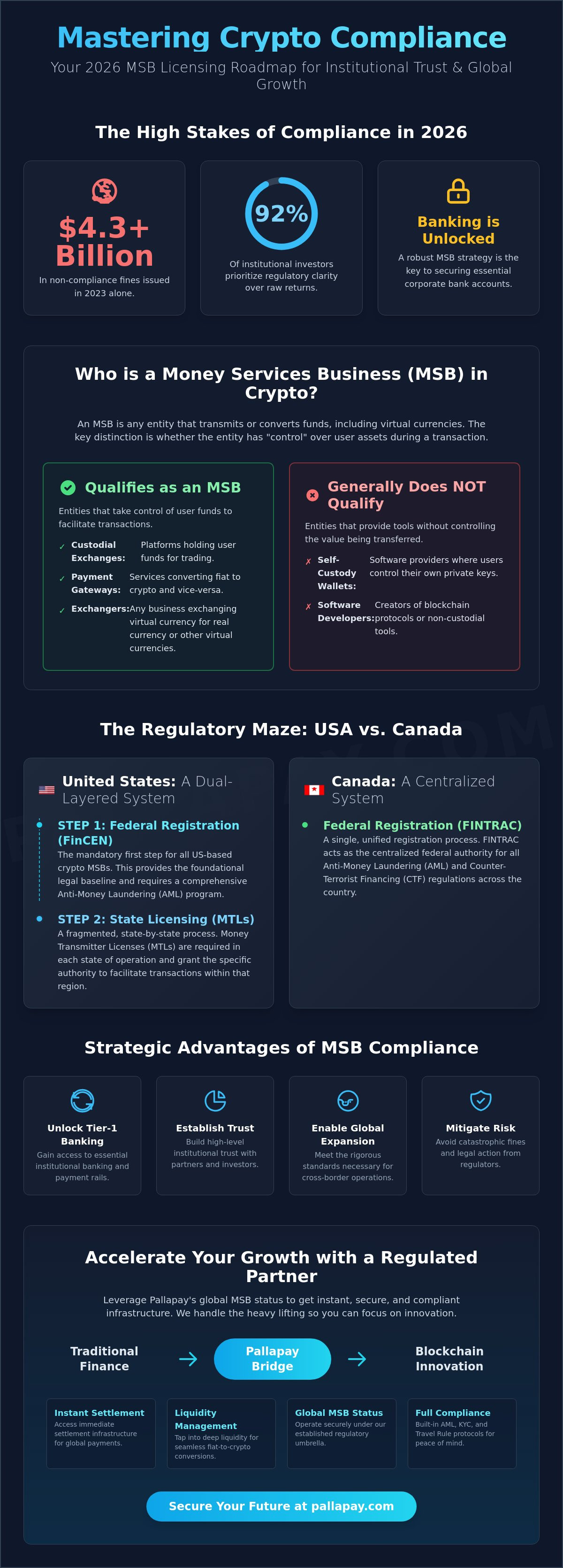
    By 2026, a simple federal registration is no longer a shield; it’s the bare minimum for survival in a market where 92% of institutional investors prioritize regulatory clarity over raw returns. You’ve likely felt the pressure of distinguishing between FinCEN registration and the fragmented landscape of state-level licensing. It’s a common frustration for founders who realize that without a robust msb license crypto strategy, securing a corporate bank account becomes nearly impossible. We agree that the threat of non-compliance fines, which totaled over $4.3 billion in 2023 alone, is a valid concern for any growing fintech entity.

    This guide empowers you to master these complexities to ensure your business remains secure and globally scalable. You’ll gain a clear roadmap for registration while discovering how a regulated status accelerates your growth. We’ll also examine how partnering with a visionary leader like Pallapay delivers the seamless, instant infrastructure required for the future of payments. From liquidity management to institutional settlement, we handle the heavy lifting so you can focus on building the next generation of financial utility.

    Key Takeaways

    • Navigate the evolving 2026 regulatory landscape by identifying the precise legal criteria that categorize digital asset platforms as Money Services Businesses.
    • Understand the critical operational differences between federal FinCEN registration, state-level Money Transmitter Licenses, and Canada’s FINTRAC requirements.
    • Learn how obtaining an msb license crypto serves as a strategic catalyst for securing Tier-1 banking access and establishing high-level institutional trust.
    • Implement industry-leading AML and KYC protocols to ensure your operations meet the rigorous compliance standards necessary for global cross-border expansion.
    • Discover how integrating with a regulated partner like Pallapay provides the instant settlement infrastructure needed to bridge traditional finance with blockchain innovation.

    What is an MSB License for Crypto? Defining Compliance in 2026

    An msb license crypto is no longer a peripheral requirement but the bedrock of institutional legitimacy for any digital asset platform. In the current 2026 landscape, a Money Services Business (MSB) is a financial entity that transmits or converts funds, including virtual currencies. A Money Services Business in the crypto sector is defined as any entity that facilitates the exchange or transmission of digital assets, primarily overseen by FinCEN in the United States and FINTRAC in Canada as the key regulatory bodies.

    Exchanges and payment gateways fall under this classification because they provide the critical infrastructure for converting fiat into digital assets. This role places them at the center of global financial flows. Since 2018, when many operators viewed federal registration as a voluntary badge of honor, the environment has shifted. The 2026 standards now demand real-time transaction monitoring and strict adherence to the Travel Rule, making the msb license crypto a mandatory tool for any business seeking to bridge the gap between blockchain and traditional finance.

    At the federal level, businesses “register” as an MSB. While registration sounds simpler than licensing, the terms are often used interchangeably because the process requires a comprehensive Anti-Money Laundering (AML) program and regular independent audits. This federal status is the first step toward achieving the stability required for global settlement and liquidity. It ensures that the “heavy lifting” of compliance is handled before a business attempts to scale across borders.

    Who Qualifies as a Money Services Business?

    Regulatory bodies distinguish between “Administrators” and “Exchangers.” An exchanger is a person or business engaged in the exchange of virtual currency for real currency, funds, or other virtual currency. Custodial exchanges that hold user funds are the primary targets of these rules. Conversely, self-custody wallet providers that only offer software without facilitating the transfer of value generally don’t meet the MSB criteria. The distinction relies on whether the entity has “control” over the assets during the transaction process.

    The Legal Necessity of MSB Status

    Operating without proper credentials carries extreme risk. Since 2023, the Department of Justice has intensified its focus on unlicensed money transmitters, with some enforcement actions resulting in fines exceeding $4 billion. MSB status acts as a mandatory prerequisite for regulated crypto exchanges to access institutional banking partners. As detailed in the Legality of cryptocurrency by country, while specific rules vary, the requirement for transparency is universal. The Bank Secrecy Act (BSA) mandates that every MSB maintains a written compliance program to ensure the future of payments remains secure, efficient, and fully integrated with the global economy.

    The Regulatory Framework: FinCEN Registration vs. State Money Transmitter Licences

    Securing an msb license crypto framework begins with understanding the dual-layered nature of U.S. oversight. Federal registration provides the legal baseline, while state licenses grant the specific authority to facilitate transactions within regional borders. This distinction is vital for any entity aiming to provide institutional-grade financial services. Federal registration with FinCEN is the mandatory first step, acting as a prerequisite before a business can even apply for state-level Money Transmitter Licences (MTLs).

    The U.S. approach differs significantly from the Canadian model. In Canada, businesses register with FINTRAC, which operates as a centralized federal authority for Anti-Money Laundering (AML) and Counter-Terrorist Financing (CTF). The U.S. system is more fragmented. FinCEN sets the national standard for reporting, but states hold the power to regulate the actual movement of funds. To understand these obligations, businesses should consult FinCEN’s official guidance on virtual currencies, which defines which business models fall under federal MSB status.

    FinCEN Registration: The Federal Baseline

    New businesses must register with FinCEN within 180 days of beginning operations. This isn’t a long-term goal; it’s a strict legal deadline. The registration process requires detailed disclosures regarding business ownership, the physical footprint of the company, and the specific financial services offered. A critical component of this filing is the appointment of an “Agent for Service.” This individual or entity serves as the official point of contact for legal and regulatory inquiries. Without a registered agent, a business cannot maintain federal compliance, putting its entire operational future at risk. This federal layer ensures that the msb license crypto holder adheres to the Bank Secrecy Act (BSA) from day one.

    State Money Transmitter Licences (MTL)

    State-level compliance is where operational costs and complexity often diverge. New York’s BitLicense, established in 2015, remains the most demanding framework in the country. It requires significant capital reserves and exhaustive cybersecurity protocols. In contrast, Wyoming has positioned itself as a blockchain-friendly hub, passing over 20 laws since 2018 to streamline crypto-fiat integration. Many businesses adopt a tiered strategy, securing licenses in high-volume states first to manage resources effectively. For companies seeking to navigate these complexities, integrating a professional fiat settlement solution can simplify the heavy lifting of maintaining liquidity across different jurisdictions. The Future of Payments depends on this ability to bridge the gap between local state laws and global blockchain utility seamlessly.

    MSB License for Crypto: The Complete 2026 Regulatory and Strategic Guide

    Strategic Advantages: Why an MSB License is Essential for Crypto Businesses

    Securing an msb license crypto designation transforms a digital asset firm from a high-risk startup into a verified financial institution. It isn’t just about avoiding fines; it’s about unlocking the infrastructure required for institutional growth. For most crypto ventures, the biggest hurdle isn’t the technology, it’s the inability to move money between the digital and traditional worlds. An MSB registration solves this by providing the regulatory “green light” that Tier-1 banks demand before opening corporate accounts or providing liquidity lines.

    Bridging the Gap to Traditional Finance

    Traditional banks often refuse crypto clients due to perceived AML risks. Without an MSB status, your business remains locked out of the global banking system. This credential proves your firm follows strict compliance protocols, which is vital for securing fiat settlement for merchants. By operating under a regulated framework, businesses can reduce transaction reversals and fraud by up to 40% compared to unregulated entities. While federal registration is the first step, businesses must also navigate complex state money transmitter laws to ensure full operational coverage across different jurisdictions.

    An MSB license serves as a powerful marketing tool. It positions your brand as “Regulated and Secure,” building immediate trust with high-net-worth investors and institutional partners. When a merchant sees that a platform is a registered Money Services Business, the perceived risk of a regulatory shutdown vanishes. This trust is the foundation for facilitating cross-border payments for merchants, allowing them to accept crypto and receive local currency without friction. It’s the difference between being a temporary project and a permanent fixture in the future of payments.

    Global Scalability and Market Entry

    The msb license crypto status carries significant weight beyond North American borders. Credibility earned in regulated markets often fast-tracks entry into the Middle East and SE Asia. Pallapay leverages its extensive MSB registrations to serve clients in over 180 countries, providing a seamless bridge for global commerce. This regulatory foundation is particularly effective for OTC exchange operations, where large-scale liquidity and legal certainty are non-negotiable.

    By maintaining these standards, we ensure that every transaction happens within a secure and compliant ecosystem. Businesses that prioritize licensing early avoid the “compliance debt” that often sinks scaling startups. The result is a more resilient operation that can pivot quickly into new markets. Key benefits of this approach include:

    • Instant Credibility: Institutional partners view MSB status as a baseline requirement for collaboration.
    • Fraud Mitigation: Regulated oversight requires robust KYC/KYT tools that protect the business from illicit actors.
    • Market Access: A registered status allows for easier integration with payment gateways and credit card processors.

    Ultimately, the license isn’t a burden. It’s a strategic asset that allows a business to scale without the constant threat of banking de-risking or legal intervention.

    Maintaining Compliance: AML, KYC, and Operational Standards for MSBs

    Securing an msb license crypto represents a significant milestone, but the operational burden shifts immediately to rigorous maintenance. Regulators demand a dedicated Anti-Money Laundering (AML) Compliance Officer who possesses the internal authority to halt suspicious transactions. This individual oversees the filing of Currency Transaction Reports (CTRs) for any cash-in or cash-out events exceeding $10,000. They also manage Suspicious Activity Reports (SARs) when transactions appear to lack an obvious economic purpose or deviate from a user’s established profile. By January 2026, the threshold for enhanced scrutiny has tightened, making real-time oversight a core business necessity.

    Operational excellence requires more than just filing reports. It involves a commitment to transparency and periodic validation. Independent compliance audits must occur annually to confirm your MSB standing remains in good stead. These audits verify that your internal policies align with the Bank Secrecy Act and other local mandates. Failure to provide a clear audit trail results in heavy fines or the immediate revocation of your license.

    The Pillars of a Modern AML Program

    Effective compliance programs rely on rigorous internal controls that monitor for transaction layering and unusual volume spikes. Training your team is equally critical. Employees must be equipped to recognize the latest crypto scams that target decentralized gateways. Advanced MSBs now integrate automated blockchain forensics. These tools provide instant risk scores for every incoming wallet address, ensuring your platform never interacts with sanctioned entities or high-risk mixers. This proactive approach protects your liquidity and your reputation.

    KYC and Identity Verification

    The industry is moving away from slow, manual document reviews. Modern platforms utilize biometric and AI-driven kyc in crypto to verify identities in under 60 seconds. This technology scans government IDs and matches live facial data, reducing onboarding friction while satisfying strict MSB guidelines. Balancing user experience with data collection is a delicate task. You must collect enough information to satisfy “Know Your Business” (KYB) requirements for corporate clients without alienating individual users. Protecting this Personally Identifiable Information (PII) is a primary legal obligation. Secure, encrypted storage is the baseline for institutional trust.

    Organizations that prioritize these standards build a foundation for long-term growth and global expansion. Compliance isn’t a hurdle; it’s a competitive advantage that signals stability to your partners and clients.

    Optimize your business operations with secure fiat settlement solutions that meet global compliance standards.

    The Pallapay Ecosystem: Leveraging Global MSB Status for Secure Instant Payments

    Pallapay stands at the intersection of regulatory rigor and technological agility. By maintaining active MSB registrations in both the United States and Canada, the platform provides a verified foundation for businesses that prioritize compliance. This msb license crypto framework isn’t just a legal requirement; it’s a strategic asset that allows Pallapay to handle the heavy lifting of anti-money laundering (AML) and know-your-customer (KYC) protocols on behalf of its partners.

    Speed defines the modern economy. Pallapay integrates its regulated status with proprietary “Instant” technology to ensure that merchants don’t have to choose between security and velocity. When a business integrates the Payment API, they gain immediate access to a global crypto acceptance network that satisfies international standards. This allows for seamless cross-border settlements without the typical friction associated with legacy banking systems.

    Regulated Infrastructure for Global Merchants

    For retail businesses, the deployment of a crypto pos machine requires a partner that understands the nuances of local and international law. Pallapay ensures every transaction processed at a physical storefront remains compliant within the broader financial ecosystem. Using a gateway that is already MSB-registered eliminates the need for individual merchants to seek complex legal counsel for their crypto operations. Pallapay provides “The Future of Payments” through its regulated framework, allowing business owners to focus on growth while the platform manages the underlying technical and legal complexities.

    From Dubai to New York: A Unified Compliance Model

    The brand’s physical presence in major financial hubs like Dubai and Istanbul reinforces its commitment to high-touch service and institutional reliability. This global footprint is essential for supporting high-volume services, such as the ability to sell usdt for cash dubai, where liquidity and regulation must work in tandem. Having a unified compliance model means that whether a transaction originates in New York or the Middle East, the standards for security remain consistently high. This msb license crypto status facilitates deep liquidity pools and rapid OTC exchanges that smaller, unregulated entities can’t match.

    Choosing a payment partner is a decision that impacts long-term viability. By aligning with a regulated leader, businesses protect themselves from the volatility of shifting global mandates. Partner with a global leader in compliant crypto fintech to future-proof your operations today.

    Mastering the New Era of Regulated Finance

    The 2026 regulatory landscape demands a shift from simple innovation to institutional-grade reliability. It’s no longer enough to just offer digital assets; you must prove your platform’s stability through rigorous compliance. Securing an msb license crypto status is the definitive benchmark for businesses that prioritize long-term growth over short-term gains. This strategic alignment eliminates the friction of traditional banking hurdles and provides the legal bridge needed to access global liquidity pools.

    Pallapay simplifies this evolution by providing a seamless, all-in-one ecosystem grounded in official MSB registrations across the USA and Canada. With a physical presence in major financial hubs like Dubai, Singapore, and Istanbul, we bridge the gap between legacy systems and modern blockchain utility. We currently empower merchants in over 180 countries with instant settlement and secure gateway solutions, ensuring your capital moves as fast as your vision. Our infrastructure handles the heavy lifting of compliance so you’re free to focus on scaling your operations across borders. The future of payments is regulated, efficient, and waiting for you to lead the way.

    Experience the security of a fully regulated ecosystem with Pallapay

    Frequently Asked Questions

    What is the difference between an MSB registration and an MSB license?

    Registration is a federal requirement with FinCEN, while an MSB license is a state-specific authorization. Federal registration serves as a notification of your intent to operate; however, state licenses provide the legal authority to conduct business within specific jurisdictions. For example, 49 US states require individual money transmitter licenses to operate legally. This distinction ensures that a company meets both national transparency standards and local consumer protection laws.

    Does a crypto exchange need an MSB license in every state it operates?

    Most crypto exchanges must secure a license in every state where they have customers. While federal registration is universal, 49 states mandate individual Money Transmitter Licenses (MTL) for digital asset activities. Only Montana lacks a formal MTL requirement as of 2026, meaning you’ll need separate approvals for the other 49 jurisdictions to ensure total compliance. Operating without these state-level permits can lead to immediate cease-and-desist orders.

    How much does it cost to obtain and maintain an MSB license in 2026?

    Costs vary significantly by state, with application fees ranging from $375 in Florida to $5,000 for a New York BitLicense. You should also budget for surety bonds, which often require a minimum of $25,000 to $500,000 in coverage depending on transaction volume. Maintaining an msb license crypto operation involves annual renewal fees and independent AML audits that typically cost between $10,000 and $30,000 per year. These figures represent the baseline for institutional reliability.

    Can a foreign crypto company apply for a US MSB registration?

    Foreign companies must register as an MSB if they conduct more than $1,000 in daily business with US residents. The FinCEN 2011 Final Rule explicitly includes foreign entities that offer services to the US market, even without a physical presence. You’ll need to appoint a US resident as an agent for service of legal process to complete the registration. This ensures your global operation remains compliant with US anti-money laundering frameworks.

    What are the reporting requirements for a crypto MSB regarding SARs?

    MSBs must file a Suspicious Activity Report (SAR) for any transaction involving $2,000 or more that appears suspicious. Under 31 CFR 1022.320, you have a 30-day window to submit the report after detecting the activity. Failure to report can lead to civil penalties reaching $250,000 or criminal fines under the Bank Secrecy Act. These reporting requirements are vital for maintaining the integrity of the global financial network and preventing illicit flows.

    How long does the MSB registration process typically take with FinCEN?

    The actual online registration through the BSA E-Filing System is often instant once you submit the form. However, building the required AML program and internal controls usually takes 3 to 6 months of preparation. You must register within 180 days of beginning your msb license crypto operations to avoid immediate regulatory action. This timeline allows your business to integrate necessary compliance software before the federal deadline expires.

    Why is an MSB license necessary for a crypto payment gateway?

    A payment gateway acts as a money transmitter by facilitating the exchange of value between a customer and a merchant. FinCEN Guidance FIN-2013-G001 clarifies that entities accepting and transmitting convertible virtual currency fall under MSB regulations. This license ensures your gateway provides a secure, regulated bridge for instant global settlements without legal interruptions. It’s the professional foundation that allows a gateway to function as a reliable visionary partner for modern commerce.

    Does having an MSB license guarantee a corporate bank account?

    Holding an MSB license doesn’t guarantee a corporate bank account, but it’s a mandatory requirement for the application. Banks view crypto firms as high-risk entities and will perform deep due diligence on your AML policies. While the license proves you’re a legitimate financial player, you still need to demonstrate robust compliance to win trust from institutional banking partners. Most banks require at least two years of clean audit history before offering full services.

    Disclaimer

    The information provided on this website and blog is for general informational and educational purposes only and does not constitute financial, investment, legal, tax, or other professional advice.
    Cryptocurrency and digital asset services may be subject to regulatory restrictions in certain jurisdictions. Users are solely responsible for ensuring compliance with applicable local laws and regulations before using any products or services mentioned on this website.
    PallaPay does not guarantee the accuracy, completeness, or timeliness of any information published and accepts no liability for any loss or damages arising from reliance on the content. Any opinions expressed are those of the respective authors and may change without notice.
    Certain services, features, or products referenced may be provided through third-party partners, licensed entities, or affiliated service providers subject to separate terms and regulatory approvals. Availability of services may vary by country or region.
    This website may contain references to digital assets, virtual currencies, or blockchain-related services that are not available to residents of certain jurisdictions, including where prohibited by law. Nothing on this website constitutes an offer, solicitation, or recommendation to buy or sell any financial instrument or virtual asset.