

A card advertised as “zero fee” can still cost more once conversion, foreign exchange, or cash withdrawal charges enter the transaction. A useful crypto debit card fees comparison follows the full payment path, from funding the card to completing a purchase or withdrawing cash.
The headline monthly or issuance fee is only one part of the decision. Costs can also depend on your currency, transaction type, crypto conversion method, and network fees when you transfer assets. Cashback rewards may offset some charges, but they don’t automatically make a card cheaper overall.
This guide breaks down the fee categories to compare, explains how card spending charges differ from crypto transfer and withdrawal fees, and shows how to assess rewards against your actual use. It also explains how to compare virtual and physical cards, including Pallapay Crypto Card options on Visa and Mastercard networks. With a consistent comparison, you can focus on the charges that apply to your spending rather than relying on a single promotional claim.
Key Takeaways
- Use a consistent crypto debit card fees comparison to assess costs across your own funding, spending, currency, and cash withdrawal needs.
- Separate blockchain withdrawal charges from card purchase fees so each cost is assigned to the right step.
- Distinguish debit cards from prepaid and credit cards before comparing how spending is funded.
- Estimate your costs by mapping planned transactions to the issuer’s published terms, rather than relying on a headline fee claim or rewards rate.
- Compare card type, Visa or Mastercard network, supported assets, and everyday features. Pallapay offers virtual and physical card options with contactless and Chip & PIN payments.
Crypto debit card fees comparison: what costs belong in the calculation?
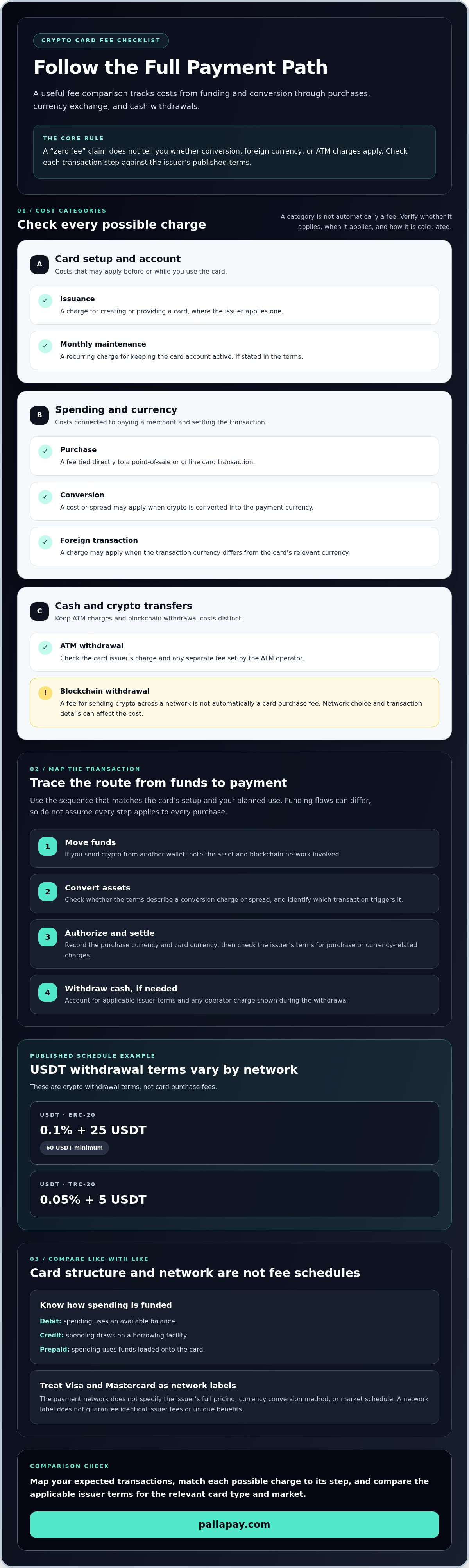
Compare costs tied to funding, conversion, purchases, currency exchange, and cash withdrawals. A clear crypto debit card fees comparison separates each charge by transaction step, then includes only fees that apply under the issuer’s published terms. A “zero monthly fee” claim, for example, says nothing by itself about conversion, foreign currency, or ATM charges.
A crypto debit card lets you spend against a crypto or fiat balance, with the issuer handling any required conversion during the payment process. It isn’t the same as a credit card, which provides a borrowing facility, or a prepaid card, which draws on money loaded onto the card in advance. Issuers may use similar network rails, but that doesn’t make their card types, fee schedules, or market terms interchangeable.
Which crypto debit card fees should you compare?
Build your comparison around the charges that could arise in your own use:
- Issuance: A charge for creating or providing a card, where the issuer applies one.
- Monthly maintenance: A recurring charge for keeping the card account active, if stated in the terms.
- Purchase: A fee tied directly to a point-of-sale or online card transaction.
- Conversion: A cost or spread applied when crypto is converted into the currency used for payment.
- Foreign transaction: A charge that may apply when the transaction currency differs from the card’s relevant currency.
- ATM: A charge associated with withdrawing cash using the card.
Don’t treat a category as an automatic fee. Check whether the issuer applies it, when it applies, and how it is calculated. At an ATM, separate any card issuer charge from a fee set by the ATM operator. The operator’s charge may appear during the withdrawal process and is distinct from the issuer’s schedule.
A card purchase fee is a charge applied to a payment made with the card. A blockchain withdrawal fee is a charge for sending crypto across a network, and it isn’t automatically a card purchase fee. Network choice and transaction details can affect a crypto withdrawal, so keep that cost separate from card spending. For example, a withdrawal schedule can list different terms for USDT sent over ERC-20 and TRC-20. Those terms describe withdrawals, not purchases at a merchant.
Why card type and market change the comparison
Debit spending uses an available balance. Credit spending draws on a borrowing facility, while prepaid spending uses funds loaded onto the card. Compare like with like, and note whether the product’s structure changes how purchases are funded or converted.
Market availability and issuer terms can also change which fees apply. Visa or Mastercard acceptance identifies the payment network, not the issuer’s full pricing, currency conversion method, or market schedule. Neither network label guarantees identical issuer fees or unique benefits. Since requirements and financial rules vary across jurisdictions, the Regulation of cryptocurrency overview offers broader context, but it doesn’t replace the card’s applicable terms. Gift cards are another stored-value format, with separate product terms; see crypto gift card options as a distinct payment choice.
How crypto debit card fees arise from funding through spending
Trace the payment path to see where charges may arise. Depending on the card’s setup, you might move crypto into an account, convert an asset, authorize a purchase, and settle that payment in a currency. A later cash withdrawal adds another transaction. Map the steps for the specific card and market you’re assessing, because funding flows can differ.
Use this sequence to organize the possible costs:
- Move funds: Identify whether your plan requires sending crypto from another wallet, and note the asset and blockchain network involved.
- Convert assets: Check whether the card’s terms describe a conversion charge or spread, and which transaction causes it.
- Authorize and settle: Record the purchase currency and card currency, then review the issuer’s terms for any purchase or currency-related charge.
- Withdraw cash: If you expect to use an ATM, account for applicable issuer terms and any operator charge shown during the withdrawal.
This map connects each cost to the relevant step instead of treating all charges as one card fee. A payment made directly from an existing balance may follow a different path from one that requires a transfer or asset conversion first. For a crypto debit card fees comparison, use the transaction sequence you actually expect, and don’t assume a funding charge applies to every purchase.
Where conversion, currency, and transaction fees may apply
Conversion and foreign transaction fees can be triggered by different events. A conversion term may relate to exchanging one asset or currency for another, while a foreign transaction term may depend on the purchase currency or market. The issuer’s current published terms determine whether either applies. Compare the schedule for the relevant market and card type, and don’t apply a rate from one region or tier to another.
Crypto withdrawal fees are not card purchase fees
Pallapay’s published schedule provides a specific example of network-dependent crypto withdrawal terms. A USDT ERC-20 withdrawal is listed at 0.1% plus 25 USDT, with a 60 USDT minimum. A USDT TRC-20 withdrawal is listed at 0.05% plus 5 USDT, with a 40 USDT minimum. These figures apply to crypto withdrawals on those networks, not Pallapay card purchases. Keep them in the transfer part of your cost record, separate from card transaction terms.
For a comparison, label each entry with the asset, network, and action it covers. This makes it easier to distinguish costs that apply before spending from terms tied to card use, without counting the same step twice. If your planned journey includes a separate crypto-to-fiat conversion, consider the crypto off-ramp process as its own transaction stage.
Compare crypto debit card fees in a table, not by headline claims
A useful crypto debit card fees comparison puts the same fee categories side by side, then filters them through your market and spending pattern. The table below reflects published terms summarized as of October 2026. A fee marked “not stated here” is omitted, not zero, and each card’s official schedule can change by market, tier, or transaction type.
| Provider | Card type and network | Fee categories | Published terms and market |
|---|---|---|---|
| Pallapay | Virtual and physical crypto cards on Visa or Mastercard | Issuance, monthly service, and ATM withdrawal charges | Compare the applicable card pricing with the purchase and conversion terms for your intended transactions. Confirmed features include online purchases, contactless and Chip & PIN payments, and supported-ATM withdrawals. |
| Coinbase | Visa debit | Trading spread may apply when spending crypto other than USD or USDC; third-party ATM charges may apply | As of October 2026, published terms report no annual or monthly fee, no Coinbase purchase fee for USD or USDC spending, and no Coinbase FX fee. Markets: United States (excluding Hawaii), UK, and EEA. |
| Alternative Provider | US product: credit card; other regions: prepaid card. Visa | Tier-dependent FX, top-up, subscription, or inactivity charges | As of October 2026, terms vary by market and tier. The US schedule includes top-up fees, while European card FX terms differ by transaction location. Don’t treat one market’s schedule as universal. |
| Binance | Mastercard | Crypto conversion, regional FX, and possible ATM fees | As of October 2026, reported conversion terms are generally 0.9%, with different terms for USDC in some countries. Regional FX terms vary. Physical card availability is market-dependent. |
| Nexo | Mastercard, with debit and credit modes | Conversion, FX, and ATM fees | As of October 2026, reported FX and conversion terms vary by location and mode. Availability cited in published terms: EEA and UK. |
Build a fair crypto card fees comparison table
Use one row per product and market, and compare the same actions: funding, a domestic purchase, a foreign-currency purchase, and an ATM withdrawal. Keep percentage charges distinct from flat amounts, and record the trigger beside each fee. Use current issuer-published terms for the relevant market. Don’t fill missing figures with zero or compare a card’s ATM limit with a blockchain withdrawal minimum.
Compare Visa and Mastercard without assuming issuer terms
Visa and Mastercard identify the payment network, while the issuer sets the card’s applicable charges and terms. Acceptance depends on the merchant and market, so a network logo isn’t a promise of universal acceptance. Pallapay offers card options on either network, but the network label alone doesn’t establish a fee advantage. A zero annual fee also doesn’t establish zero purchase, conversion, FX, or ATM costs. Compare each charge’s trigger against your expected use, then assess the total instead of ranking cards by one headline figure.
How to estimate your real crypto debit card costs
Estimate card costs against the transactions you expect to make, not a generic spending profile. A useful crypto debit card fees comparison starts with your monthly routine, then applies each issuer’s current terms only to the actions that could trigger a charge. Keep card spending separate from transfers or conversions that happen before a purchase.
- Define your monthly usage. Note how often you expect to pay in person, shop online, withdraw cash, buy in another currency, or move crypto between wallets.
- List the relevant transactions. Separate a local purchase from a foreign-currency payment, an ATM withdrawal, and an asset transfer. Each may follow a different fee rule.
- Collect the issuer’s current terms. Use the schedule for the card type, market, tier, and transaction you plan to use. Record the fee, its trigger, and whether it is a percentage, fixed charge, or both.
- Compare the totals. Add only the charges that match your planned activity. Keep possible rewards separate until you’ve calculated fees, then account for any issuer-stated eligibility conditions.
Match fee categories to your spending pattern
Consider an illustrative month with contactless purchases, online payments, one cash withdrawal, and a purchase priced in another currency. Apply purchase terms to eligible card transactions, ATM terms to the withdrawal, and any foreign transaction term to the cross-currency payment. Count an asset transfer only if your plan includes one. Don’t add rewards as guaranteed savings unless you meet the issuer’s stated conditions.
Asset selection can matter before a card is used. The crypto you hold and the network used to move it may affect transfer costs, while an issuer’s conversion terms may apply at a separate point. Review your intended balances and supported assets in the Pallapay Wallet as part of mapping that funding path.
Check the full crypto-to-fiat journey
Trace each step from the source asset to the final payment. A wallet transfer may have network terms; a conversion or crypto-to-fiat bank transfer may have its own terms; and card spending follows the card’s fee schedule. Don’t count one step’s charge as another step’s cost. For bank transfer scenarios, assess the applicable fiat settlement terms separately from card purchases.
Run the same transaction list against every card under consideration. If one option is used mostly for local purchases and another for frequent ATM withdrawals or foreign-currency spending, the totals may differ even when one advertises no annual fee. Update the estimate when your usage, market, or issuer terms change. This method turns a headline comparison into a practical estimate based on your actual payment path.
Choose a crypto debit card with transparent terms
Choose a card by matching its published terms to the way you plan to spend. Compare applicable charges, card type, network, supported assets, and intended use. A “low-fee” description alone doesn’t establish what a specific purchase, transfer, or withdrawal will cost, so base your decision on the issuer’s schedule for your market and card.
- Fees: Identify the charges that could apply to the transactions you expect, and note each fee’s trigger.
- Network and market: Check the network and the terms for the market where you plan to use the card.
- Card type: Confirm whether spending draws from an available balance, uses a credit facility, or depends on a prepaid balance.
- Assets and use: Make sure the supported assets align with your funding plan and intended payment needs.
What Pallapay confirms about its crypto card
Pallapay describes its Crypto Card pricing as low-fee and transparent. Its card is available as a virtual or physical card on the Visa or Mastercard network. Features include online payments, contactless Tap-to-Pay, Chip & PIN, ATM cash withdrawals at supported ATMs, real-time transaction notifications, and in-app card control. Eligible cards also support Apple Pay, Google Pay, and Samsung Pay.
Assess the applicable published terms for your transactions rather than treating a low-fee description as a specific fee amount or a promise that every transaction is free. Keep any crypto transfer schedule separate from the card’s purchase terms when reviewing your overall payment path.
Take the next step with Pallapay
Before choosing, write down the transactions you expect and compare each card’s terms against that list. Focus on the costs relevant to your routine and avoid relying on a headline claim that may not reflect your usage. Revisit the comparison if your spending pattern or the applicable issuer terms change.
Explore the Pallapay Crypto Card to review its features and applicable terms. A considered comparison helps you choose with clarity and confidence.
Make your next card choice with confidence
Your best payment setup should fit the way you actually use digital assets, not an idealized spending pattern. Before choosing, turn your expected purchases and cash needs into a simple reference point, then revisit it if your habits or the issuer’s published terms change. That keeps your decision grounded in current use rather than a headline offer or a reward that may not match your priorities.
A clear crypto debit card fees comparison is most useful when it shows which terms matter to you and which costs don’t apply to your routine. Use that practical approach to evaluate Pallapay’s virtual and physical card options, Visa or Mastercard network, and payment features.
Explore the Pallapay Crypto Card and compare its applicable terms with your expected spending. Use a crypto debit card fees comparison based on your payment habits to make an informed choice.
Frequently Asked Questions
Which fees should I compare before choosing a crypto debit card?
Compare the charges that match your planned use, including issuance, account maintenance, purchases, conversion, foreign currency payments, and ATM withdrawals. For a fair crypto debit card fees comparison, note the card’s market and type alongside each term. If you rarely withdraw cash, an ATM charge may matter less than purchase conversion costs. Track flat charges separately from percentage-based fees so you can assess their effect on your own transactions.
Do crypto debit cards charge foreign transaction fees?
Some cards may charge a foreign transaction fee, but the answer depends on the issuer’s terms, the card’s market, and the transaction currency. A purchase while traveling or an online order priced in a different currency could trigger terms that don’t apply to a domestic-currency payment. Check how the issuer defines a foreign transaction and which currency it uses for the card account before estimating the charge.
Are crypto withdrawal fees the same as crypto debit card fees?
No. A crypto withdrawal fee applies when crypto moves from one address or service to another over a blockchain network. A card fee relates to a card service or transaction, such as issuance, maintenance, or an ATM withdrawal, according to its terms. If you transfer assets before spending, record the transfer separately from the later card payment. This makes it easier to identify which action produced each charge.
Can a crypto debit card have no annual fee but still charge other fees?
Yes. An annual fee covers only one possible charge, so its absence doesn’t establish that other services are free. A card’s terms may separately address monthly maintenance, card issuance, currency conversion, purchases, or ATM use. Consider a card with no annual fee that you use for an overseas purchase: any applicable currency-related charge would depend on the issuer’s terms, not the annual-fee label.
Does Visa or Mastercard determine the fees on a crypto debit card?
No. Visa or Mastercard identifies the payment network, but the issuer’s terms set the card’s applicable fees. The card network and the issuing provider are separate parts of the payment arrangement, so don’t infer a fee schedule from the logo. Compare issuer-published terms for the card type and market you’ll use, and separately consider whether the relevant network is accepted by merchants where you plan to pay.
How do I compare crypto debit card fees for ATM withdrawals?
Check the issuer’s ATM fee, any stated withdrawal limits, and whether the card supports the ATM service you plan to use. Also look for a separate operator surcharge, which may be displayed by the ATM before you complete a withdrawal. Don’t confuse a cash withdrawal limit with a crypto network’s minimum withdrawal amount; they apply to different actions and should be recorded separately in your comparison.
What fees apply when using a Pallapay Crypto Card?
Pallapay’s card pricing includes issuance, monthly service, and ATM withdrawal charges. Compare the applicable card terms with the transactions you plan to make, and keep any crypto withdrawal costs separate. Pallapay’s published crypto withdrawal schedule covers transfers of digital assets, not card purchases.
Disclaimer
The information provided on this website and blog is for general informational and educational purposes only and does not constitute financial, investment, legal, tax, or other professional advice.
Cryptocurrency and digital asset services may be subject to regulatory restrictions in certain jurisdictions. Users are solely responsible for ensuring compliance with applicable local laws and regulations before using any products or services mentioned on this website.
PallaPay does not guarantee the accuracy, completeness, or timeliness of any information published and accepts no liability for any loss or damages arising from reliance on the content. Any opinions expressed are those of the respective authors and may change without notice.
Certain services, features, or products referenced may be provided through third-party partners, licensed entities, or affiliated service providers subject to separate terms and regulatory approvals. Availability of services may vary by country or region.
This website may contain references to digital assets, virtual currencies, or blockchain-related services that are not available to residents of certain jurisdictions, including where prohibited by law. Nothing on this website constitutes an offer, solicitation, or recommendation to buy or sell any financial instrument or virtual asset.