

Nearly 40% of U.S. merchants now accept cryptocurrency at checkout, yet many corporate boards still view digital assets through a lens of outdated volatility. You probably feel the friction between your company’s traditional financial practices and the clear shift toward a digital economy. Understanding how to make a business case for crypto payments is no longer about chasing a trend; it’s about securing a strategic advantage in a market where 84% of merchants expect these transactions to be standard by the end of the decade.
We’ll show you how to present a professional framework that addresses every executive concern, from regulatory compliance under the July 2026 MiCA standards to the technical bridge between crypto and fiat. You’ll gain a clear roadmap to launch a successful payment pilot and learn how diversifying into Gold and USD CFDs can transform your corporate treasury into a resilient, high-performance engine. This guide provides the institutional logic you need to move beyond theory and secure executive approval. By the end of this article, you’ll have the tools to turn internal resistance into institutional buy-in for a modern financial future.
Key Takeaways
- Understand the transition from digital asset experimentation to institutional necessity, positioning your firm for the professional financial landscape of 2026.
- Discover the transformative potential of diversifying corporate treasury into Gold (XAU/USD) and Forex CFDs to hedge against inflation and fiat devaluation.
- Learn how to mitigate executive concerns regarding volatility and security by utilizing regulated MSB providers and MiCA-compliant frameworks.
- Master a professional 4-step framework on how to make a business case for crypto payments that reframes technical hurdles as strategic operational advantages.
- Identify how a global, integrated ecosystem facilitates instant crypto-to-fiat conversions and streamlines international commercial operations without friction.
The Evolution of Corporate Finance: Why 2026 is the Year for Digital Assets
The financial year 2026 marks a definitive boundary between the era of digital asset experimentation and the era of institutional necessity. For executives, the conversation has moved from speculative interest to operational integration. Corporate finance teams are increasingly recognizing that blockchain technology is no longer a peripheral trend but a core infrastructure requirement for global trade. When you are learning how to make a business case for crypto payments, the strongest argument lies in the transition toward a frictionless, 24/7 global economy.
Traditional systems rely on fragmented banking networks that adhere to restrictive operating hours and multi-day settlement cycles. These legacy inefficiencies create significant capital drag and limit a company’s ability to respond to market shifts. Digital assets eliminate these bottlenecks by enabling instant value transfer across borders. Regulated fintech partners now act as the professional bridge, allowing companies to interact with these modern protocols while maintaining the safety of institutional financial standards. Effectively navigating the regulatory landscape is the first step in proving that these tools are ready for corporate use.
Understanding the Corporate Digital Shift
Corporate Digital Asset Integration is the 2026 standard for global competitiveness. This shift is driven by the demand for real-time settlement and the total elimination of “banking hours” in international commerce. Organizations that delay adoption until 2027 risk a permanent competitive disadvantage. They will struggle with higher operational costs and slower liquidity cycles compared to peers using an automated API for crypto payments. The ability to move capital instantly provides a level of agility that traditional wire transfers cannot match.
The Institutional Advantage of Stablecoins
For risk-averse leadership, USDT serves as the ideal entry point into the digital ecosystem. It offers the speed and transparency of blockchain technology without the price swings associated with earlier crypto assets. By utilizing stablecoins, businesses maintain 100% efficiency while anchoring value to the US Dollar. This provides a high-speed liquidity tool for immediate operational needs, such as vendor payments or cross-border settlements. Stablecoins allow a firm to optimize its treasury without exposing the balance sheet to market volatility. This stability makes it much easier to secure board approval for an initial pilot program.
Unlocking New Revenue Streams: The Power of Forex and Gold CFD Trading
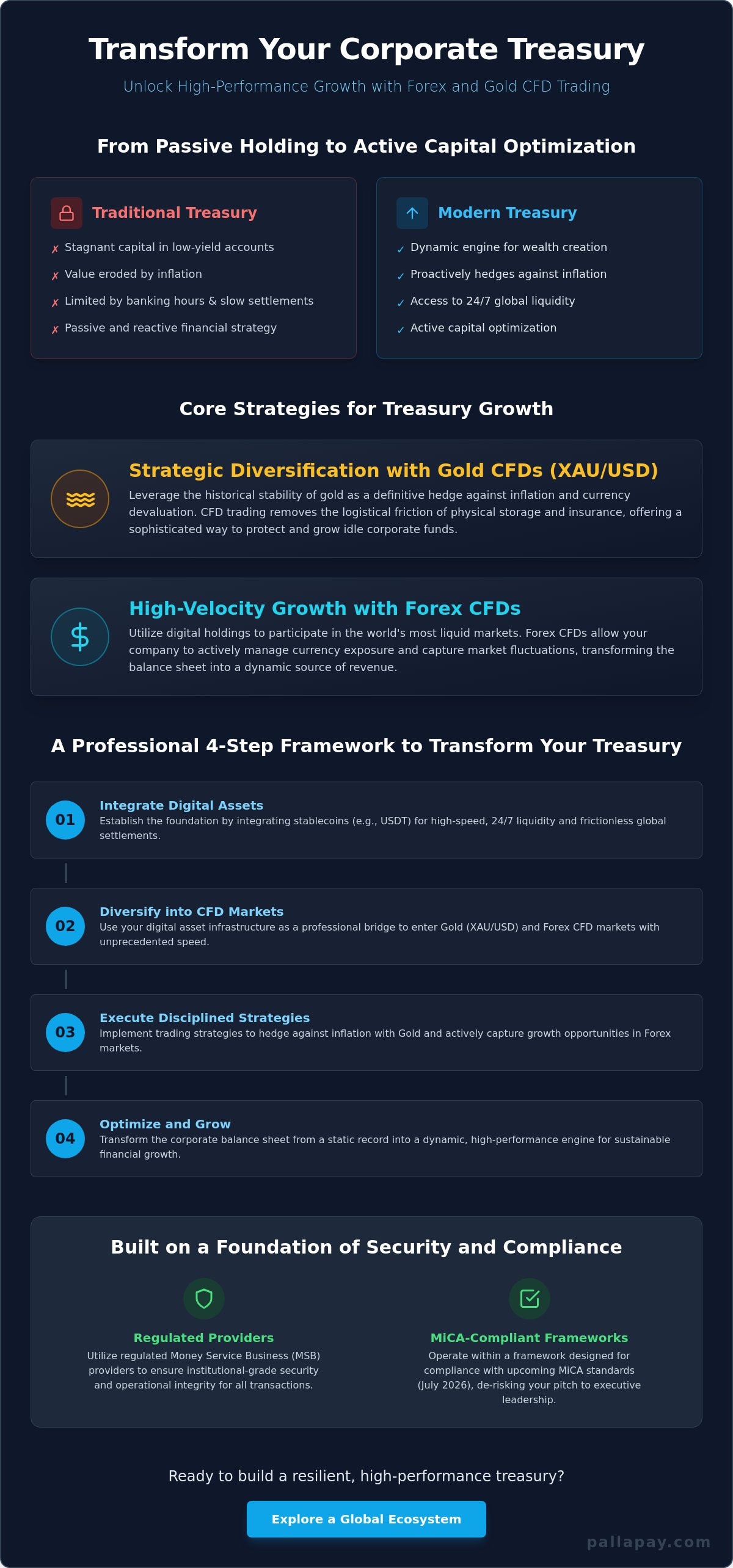
Corporate treasury management is undergoing a fundamental shift from passive holding to active capital optimization. While many organizations view digital assets merely as a payment method, forward-thinking leadership teams treat them as a gateway to global liquidity. When you’re evaluating how to make a business case for crypto payments, it’s vital to highlight that these assets aren’t just for settlement. They are high-velocity tools that allow a company to enter Forex and commodity markets with unprecedented speed. This proactive approach allows a firm to capture market fluctuations and build wealth through disciplined execution, transforming the balance sheet from a static record into a dynamic engine of growth.
Traditional treasury models often leave capital stagnant in low-yield accounts where inflation erodes value. Digital asset infrastructure changes this by providing a professional bridge to CFD trading. By moving beyond simple currency exchange, a company can utilize its digital holdings to participate in the world’s most liquid markets. Presenting a clear roadmap on how to make a business case for crypto payments involves demonstrating how these assets serve as the essential foundation for these broader, more sophisticated financial strategies.
Strategic Diversification with Gold CFDs
Gold has long served as the definitive hedge against inflation and currency devaluation. By leveraging XAU/USD CFDs, a corporation can access the historical stability of gold while benefiting from the speed of modern trading platforms. This removes the logistical friction of physical storage and insurance. It’s a sophisticated way to protect idle corporate funds, ensuring that the company’s purchasing power remains intact even during periods of fiat volatility. CFOs often appreciate this “flight to quality” when it’s presented as a regulated, liquid strategy that maintains high operational mobility.
Forex Trading: A Global Financial Life-Changer
Active participation in the Forex market can fundamentally change a company’s financial trajectory. By trading major currency pairs, a business moves from being a victim of exchange rate volatility to being a strategic participant in global market shifts. This creates a secondary revenue stream that can bolster cash flow during seasonal dips in core business operations. Strategic forex positioning is about using global market mechanics to secure a competitive edge. To understand how these gains transition back into operational capital, consider the efficiency of institutional fiat settlement solutions.
De-risking the Pitch: Addressing Security, Compliance, and Volatility
Internal resistance to digital assets often stems from a perceived “black box” of technical complexity and regulatory uncertainty. Executives naturally prioritize capital preservation, and any proposal involving cryptocurrency must address these core fears with institutional-grade solutions. When you’re determining how to make a business case for crypto payments, you must shift the focus from the assets themselves to the regulated infrastructure that manages them. By identifying security and compliance as the primary pillars of your strategy, you transform a perceived risk into a controlled corporate evolution.
The most effective way to build trust is to emphasize partnerships with MSB-registered providers in the US and Canada. These registrations aren’t just bureaucratic markers; they represent a commitment to anti-money laundering (AML) and know-your-customer (KYC) standards that mirror traditional banking. This legal alignment ensures your organization has clear recourse and oversight. You can debunk the myth of “irreversible mistakes” by highlighting that professional merchant dashboards provide the same level of transaction control and auditability found in legacy financial software.
The Safety of Regulated Ecosystems
Modern corporate digital asset adoption relies on institutional-grade security protocols that meet the most rigorous audit standards. Leadership needs to know that private keys and transaction data are protected by multi-signature authorization and cold-storage solutions. As crypto security has evolved, it has integrated seamlessly into corporate governance frameworks. By utilizing fiat settlement, your firm can accept digital payments while immediately converting them into stable currency, effectively removing the “volatility” argument from the boardroom discussion entirely.
Managing Volatility with Professional Tools
Market fluctuations don’t have to impact your bottom line if you use the right technological answers. Instant off-ramp services allow your treasury team to lock in exchange rates at the exact millisecond a transaction occurs. This eliminates exposure to price swings between the moment of sale and the moment of deposit. “Regulation is the foundation upon which institutional crypto trust is built.” This strategic clarity is supported by real-time reporting and API-driven accounting, ensuring that every digital cent is tracked, recorded, and ready for tax season. By providing this level of transparency, you prove that how to make a business case for crypto payments is ultimately about enhancing financial precision, not abandoning it.
The 4-Step Framework to Convince Your Boss
Pitching a new financial paradigm requires more than enthusiasm; it requires a structured, data-backed approach. Your leadership team needs to see a logical progression from current operational pain points to a future-proofed solution. This is how to make a business case for crypto payments that resonates with decision-makers who prioritize stability and growth. By following a professional framework, you move the conversation from “why” to “how,” positioning the company for a global economy that never sleeps.
Step 1 involves presenting the problem: the capital drag caused by high fees and slow settlements. Step 2 proposes the solution through a regulated crypto payment gateway and a robust trading infrastructure. In Step 3, you show the ROI by contrasting legacy costs with the potential gains from active Forex and Gold CFD positioning. Finally, Step 4 demonstrates the ease of implementation, proving that the technical bridge to modern finance is already built and ready for deployment.
Building the Quantitative Business Case
Quantifying the cost of traditional friction is the most persuasive tool in your arsenal. When you consider that 84% of merchants believe crypto payments will be common by 2031, the marketing value of “Accepting Crypto” becomes a clear differentiator for brand positioning. This alignment with modern commerce isn’t just about today’s savings. It’s about connecting the company’s long-term innovation goals to a global ecosystem that facilitates real-time liquidity and proactive wealth-building. It transforms the treasury department from a cost center into a strategic contributor to the firm’s financial trajectory.
The Technical Implementation Roadmap
Technical fear is often the final hurdle to executive approval. You can lower this barrier by explaining how a professional payment API integrates directly with existing ERP systems. For physical retail locations, setting up a crypto POS machine is as intuitive as installing a traditional card reader. This transition is supported by institutional assistance, ensuring that the shift to digital assets feels like a standard, effortless business operation. To begin your integration, explore the capabilities of our comprehensive payment API today.
Implementation: Utilizing the Pallapay Global Ecosystem
Integrating digital assets into a corporate structure requires a partner that understands both the speed of innovation and the necessity of institutional reliability. Pallapay provides the comprehensive infrastructure needed to bridge this gap. By operating regulated OTC desks in over 180 countries, we ensure your organization has global reach without the friction of traditional cross-border banking. When you’re refining how to make a business case for crypto payments, pointing to a single, established ecosystem that handles everything from retail store POS terminals to large-scale institutional trading is a powerful argument for operational simplicity. This unified approach eliminates the need for multiple vendors, reducing both technical debt and compliance overhead.
The transition begins with the deployment of a secure corporate wallet and the activation of instant fiat settlement. These tools allow your business to interact with the blockchain while keeping the balance sheet anchored in stable currency. It’s a professional solution that respects the practicalities of modern commerce while embracing the efficiencies of the future.
A Unified Solution for Payments and Trading
Efficiency is maximized when your organization uses a single platform for both its gateway and otc crypto exchange requirements. This integration allows for high-volume liquidity moves that bypass the multi-day delays typical of standard wire transfers. By having immediate access to deep liquidity pools, treasury teams can quickly pivot capital into XAU/USD CFDs or major forex pairs. This agility ensures that your business doesn’t just hold assets but actively manages them to capture market opportunities. The transformative potential of trading is fully realized when the bridge between payment collection and market execution is seamless and immediate.
Ready for the Future of Commerce
The transition to a digital-first treasury is supported by professional tools designed for executive oversight. We invite your leadership to a demo of the Pallapay dashboard, where real-time reporting and API-driven accounting provide total transparency. For day-to-day operations, the Pallapay Mastercard offers a streamlined way to manage corporate expenses using digital balances. Consider these advantages for your pitch:
- Global reach through a compliant, multi-jurisdictional platform.
- Access to high-volume liquidity for corporate treasury moves without banking delays.
- Simplified reporting that aligns with standard corporate audit requirements.
This level of utility proves that how to make a business case for crypto payments is a move toward a more efficient, high-performance financial life. Digital asset adoption is an inevitable global evolution. Choosing the right strategic partner ensures your company leads that evolution rather than following it. By moving today, you secure a competitive edge that will define your organization’s success in the coming decade.
Securing Your Corporate Financial Future
The transition to a digital economy is no longer a speculative choice; it’s a strategic necessity for global competitiveness. By mastering how to make a business case for crypto payments, you position your organization to benefit from real-time settlements and sophisticated treasury growth through Gold and Forex CFDs. We’ve established that the perceived risks of volatility and compliance are effectively managed through regulated gateways and instant fiat settlement tools. The technical bridge is already built.
Pallapay provides the institutional reliability your leadership team requires to move forward with confidence. We’re MSB Registered in the USA and Canada, serving over 180 countries globally with a comprehensive suite of regulated OTC desks and POS infrastructure. Our ecosystem handles the complex mechanics of digital assets so you can focus on accelerating your company’s progress. The goal is simple: efficiency without friction.
Empower your business with Pallapay’s secure crypto ecosystem today and lead your industry into the next era of commerce. Your path to a more agile, high-performance financial life is ready for deployment. We’re here to facilitate your success every step of the way.
Frequently Asked Questions
Is it legal for our company to accept cryptocurrency and trade CFDs in 2026?
Accepting digital assets is legal in most major jurisdictions under established regulatory frameworks. In the European Union, the Markets in Crypto-Assets (MiCA) regulation became fully enforceable on July 1, 2026, providing a clear legal structure for service providers. In North America, businesses operate through MSB-registered entities to ensure compliance with federal anti-money laundering laws. Trading CFDs is a standard institutional practice that allows firms to manage currency risk with professional oversight.
How do we handle the tax implications and reporting of crypto payments?
Digital asset transactions are typically treated as property for tax purposes and require detailed record-keeping. For the 2026 fiscal year, long-term capital gains are taxed at rates up to 20%, while short-term gains are treated as ordinary income. Professional gateways provide automated reporting tools and API integrations that export transaction data directly to your accounting software. This simplifies how to make a business case for crypto payments by removing administrative complexity for your finance team.
Can we convert crypto to bank transfers instantly to avoid market volatility?
Instant conversion to fiat currency is a standard feature of institutional-grade payment solutions. When a customer completes a transaction, the system locks in the current exchange rate and converts the digital assets to your preferred currency immediately. These funds are then settled to your corporate bank account via an automated off-ramp service. This process ensures that your revenue remains stable and protected from the price fluctuations of the broader crypto market.
What are the transaction fees compared to traditional credit card processors?
Digital asset transaction fees are generally more efficient than the costs associated with legacy credit card networks. Traditional processors often include multiple intermediaries, each taking a percentage of the sale. Blockchain transactions move directly between parties, which significantly reduces the total cost of acceptance. Understanding these overhead reductions is a key part of how to make a business case for crypto payments, as it directly improves the company’s net profit margins.
Do we need specialized hardware to accept crypto in our physical retail stores?
You don’t necessarily need new hardware, but dedicated crypto POS machines offer the most efficient experience for retail environments. These terminals generate dynamic QR codes that customers scan with their mobile wallets to complete a purchase. Many businesses also use secure web-based dashboards on existing tablets or smartphones to manage transactions. Both options provide real-time confirmation and integrate seamlessly with your existing inventory and reporting systems.
How does gold CFD trading differ from buying physical gold for the company treasury?
Gold CFD trading provides exposure to XAU/USD price movements without the logistical burdens of physical ownership. Buying bullion requires secure storage, insurance, and physical transport, which creates ongoing operational costs. CFDs are liquid digital contracts that allow your treasury team to enter or exit a position instantly. This agility is essential for protecting capital against sudden fiat devaluation or capturing market trends without the friction of handling physical commodities.
What happens if a customer wants a refund on a cryptocurrency transaction?
Refunds are managed through your merchant dashboard in a process similar to traditional currency returns. While blockchain payments are irreversible once sent, you can initiate a refund by sending the equivalent value back to the customer’s digital wallet address. Most professional systems calculate the refund amount based on the original fiat price of the item. This ensures the customer receives the correct value while protecting your company from any market shifts that occurred after the sale.
Is our company’s financial data and fund security protected when using a gateway?
Institutional gateways use advanced encryption and multi-signature authorization to ensure your corporate funds remain secure. Financial data is handled according to rigorous global security standards, and private keys are typically kept in cold-storage environments. By partnering with a regulated provider, you benefit from the same level of security found in traditional banking. This professional infrastructure ensures that your digital assets are protected by multiple layers of technical and procedural safeguards.
Disclaimer
The information provided on this website and blog is for general informational and educational purposes only and does not constitute financial, investment, legal, tax, or other professional advice.
Cryptocurrency and digital asset services may be subject to regulatory restrictions in certain jurisdictions. Users are solely responsible for ensuring compliance with applicable local laws and regulations before using any products or services mentioned on this website.
PallaPay does not guarantee the accuracy, completeness, or timeliness of any information published and accepts no liability for any loss or damages arising from reliance on the content. Any opinions expressed are those of the respective authors and may change without notice.
Certain services, features, or products referenced may be provided through third-party partners, licensed entities, or affiliated service providers subject to separate terms and regulatory approvals. Availability of services may vary by country or region.
This website may contain references to digital assets, virtual currencies, or blockchain-related services that are not available to residents of certain jurisdictions, including where prohibited by law. Nothing on this website constitutes an offer, solicitation, or recommendation to buy or sell any financial instrument or virtual asset.