

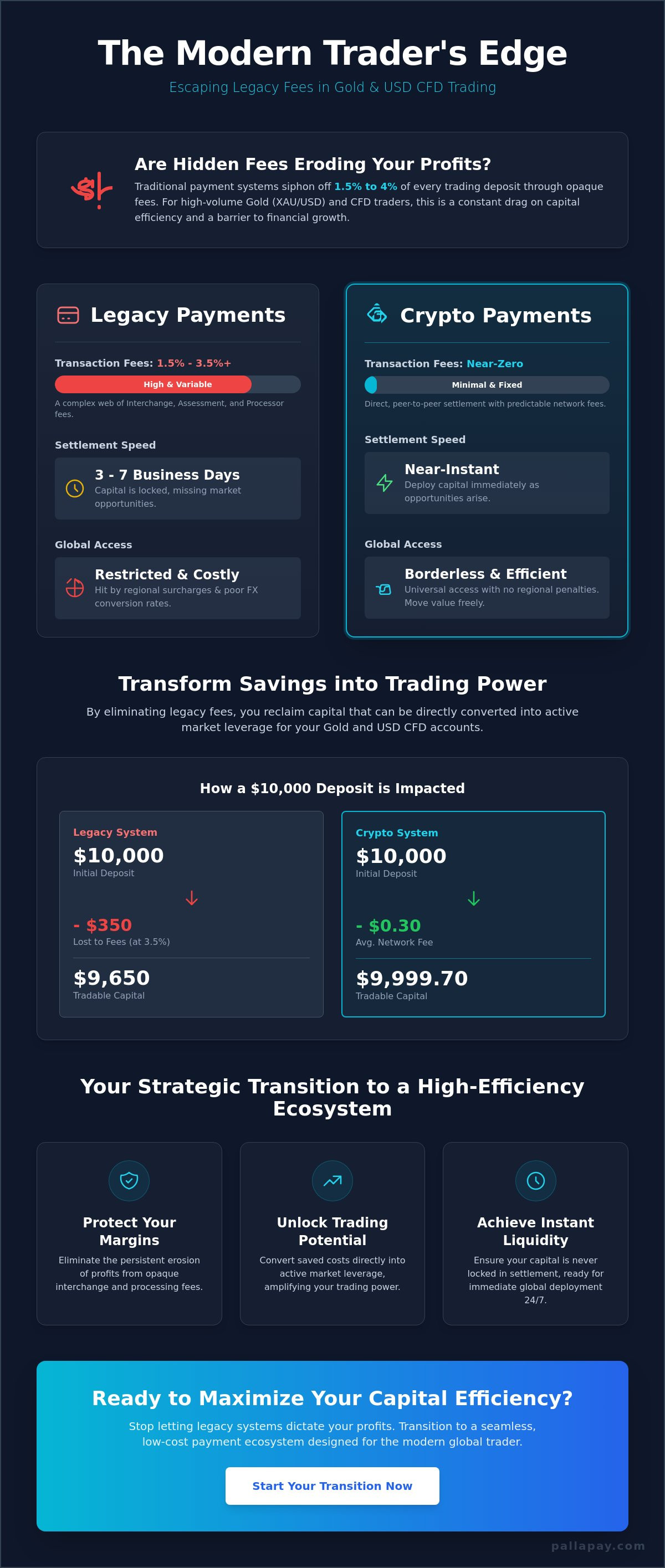
What if you could reclaim 4% of every trading deposit currently lost to the legacy banking system? In 2026, the debate over crypto payments vs credit card fees has moved beyond novelty to a core strategy for institutional and professional traders. While standard credit card processing fees still range from 1.5% to 3.5% per transaction, average Bitcoin fees have stabilized near $0.30. For high-volume gold and USD CFD traders, these opaque interchange costs act as a persistent tax on your margins, slowing the very momentum your strategy works to build.
You’ve likely felt the frustration of waiting days for bank settlements while a prime XAU/USD entry point slips away. We understand that in the fast-paced world of Forex, capital lock-up is more than an inconvenience; it’s a missed opportunity. This article will show you how to leverage crypto payment gateways to protect your margins and accelerate your financial growth. We’ll explore the shift from legacy fees to instant global settlement, providing a roadmap to maximize your capital efficiency in the modern trading markets.
Key Takeaways
- Identify the hidden costs of legacy systems to protect your trading margins from the persistent erosion of opaque interchange fees.
- Compare the strategic benefits of crypto payments vs credit card fees to understand how direct settlement removes costly financial middlemen.
- Unlock the transformative potential of Forex trading by converting saved transaction costs into active market leverage for gold and USD CFD accounts.
- Implement a strategic transition to a crypto-integrated ecosystem that ensures your capital remains liquid and ready for immediate global deployment.
- Master the mechanics of professional off-ramp services to achieve instant liquidity and maintain seamless financial mobility in high-growth markets.
The Hidden Erosion: Deconstructing Legacy Credit Card Fees in 2026
The traditional financial system operates on a layer of legacy infrastructure that remains surprisingly opaque in 2026. When we analyze the cost of capital in high-stakes environments like gold trading or USD CFD markets, the friction of traditional payments becomes a significant barrier. Every digital transaction triggers a complex sequence of deductions that can erode your margins before you even enter a trade. This comparison of crypto payments vs credit card fees reveals a stark reality: the legacy model is built on a series of nested costs designed to sustain institutional middlemen rather than the individual trader.
A standard transaction isn’t just one fee; it’s an anatomy of three distinct layers. First, the processor markup covers the service provider’s overhead. Second, assessment fees are paid directly to the card networks. Finally, the merchant pays the Interchange fee, which is the most substantial and volatile portion of the total cost. For those seeking a transformative financial life through disciplined trading, these fees represent a leak in the bucket that must be plugged to achieve true capital efficiency.
Interchange vs. Assessment Fees
The interchange fee is what the merchant’s bank pays to the card-issuing bank. It’s not a flat rate. Premium rewards cards, often favored by high-net-worth individuals in the Forex space, carry significantly higher interchange rates to fund those very rewards. When these are paired with network assessment fees, the total cost for high-volume, low-margin business models becomes a heavy burden. Every basis point lost here is a basis point that isn’t working for you in the XAU/USD markets.
The Regional Surcharge Trap
Global trading requires a global mindset, yet traditional banking rails remain stubbornly regional. When you move funds across borders to capitalize on USD CFD fluctuations, you often hit the regional surcharge trap. International transaction fees can effectively double your overhead. Beyond the stated percentage, currency conversion spreads act as a silent profit killer. These spreads often deviate from mid-market rates, meaning you lose value on both the fee and the exchange itself. Traditional rails are simply ill-equipped for the 2026 digital economy, where speed and precision are paramount.
Beyond the immediate fees, the “Chargeback Tax” and settlement delays create a hidden opportunity cost. Merchants are frequently forced into higher-risk tiers, driving up standard rates. Even more damaging is the capital lock-up. Waiting three to seven days for bank settlements prevents you from reacting to real-time market shifts. In the world of CFD trading, where timing is everything, this lack of instant liquidity is an unacceptable trade-off. Transitioning to a high-efficiency model like an off-ramp service allows for faster capital rotation, ensuring your funds are always where the growth is.
The Crypto Advantage: Redefining the Cost of Value Transfer
The shift from traditional rails to blockchain technology represents a fundamental restructuring of how value moves globally. While we previously explored the layers of friction in legacy banking, the crypto alternative offers a direct, peer-to-peer settlement model. By removing the issuing bank, the card network, and the acquiring bank, traders bypass the cumulative toll of the legacy system. This is the core of the crypto payments vs credit card fees debate: choosing between a system of intermediaries and a system of mathematical certainty. Programmable money through smart contracts further automates compliance, reducing the operational overhead that typically plagues international commerce.
Stablecoins like USDT serve as the primary bridge for this transition. They allow you to maintain USD value within a digital environment, avoiding the volatility often associated with emerging assets. With the implementation of the GENIUS Act in June 2025, stablecoins now operate under a clear regulatory framework, providing the institutional reliability required for professional Forex and gold trading. This stability is essential when funding USD CFD accounts, as it ensures that your capital isn’t eroded by currency conversion spreads or regional surcharges before it ever reaches the market. You’ve now gained universal access, accepting or sending payments across any border without the burden of regional surcharges.
Network Fees vs. Gateway Spreads
One common misconception is that crypto transaction costs are unpredictable. In reality, network fees, often called “gas,” are independent of the transaction size. Whether you’re moving $100 or $100,000 to fund a gold trading position, the network fee remains the same. As of June 19, 2026, the average Bitcoin transaction fee is approximately $0.2992, while Ethereum fees sit near $0.171. Compare this to a 3% credit card fee on a $10,000 deposit, which would cost you $300. By integrating a sophisticated payment API, businesses can provide a predictable fee structure that significantly lowers the total cost of ownership compared to traditional merchant accounts.
The End of Chargeback Fraud
Blockchain transactions provide mathematical finality. Once a transaction is confirmed, it cannot be reversed by a third party. This eliminates the “Chargeback Tax” and the administrative burden of disputed legacy payments. For brokers and high-growth trading platforms, removing chargeback risk allows for more aggressive scaling. You don’t need to reserve large portions of your capital to cover potential fraud or “friendly fraud” claims. Instead, every dollar saved from the friction of crypto payments vs credit card fees can be redirected into market leverage, accelerating your path to financial growth in the global commodity markets.
Strategic Capital: How Low Fees Fuel Gold and USD CFD Trading
Capital efficiency is the heartbeat of professional trading. In the high-stakes environment of gold and USD CFD trading, every basis point counts toward your bottom line. The comparison between crypto payments vs credit card fees isn’t just an exercise in accounting; it’s about weaponizing your capital for maximum market impact. When you eliminate the 3% to 4% drain associated with legacy card processing, you aren’t just saving cash. You’re preserving the “potential energy” of your trading account.
Consider the compounding effect of these savings within a leveraged environment. If a trader loses 3% of a deposit to credit card fees, they’ve effectively reduced their market exposure by a factor of their leverage. In a 1:100 leverage scenario, a $1,000 fee doesn’t just represent $1,000 in lost profit. It represents $100,000 in lost buying power. By utilizing crypto as the ultimate funding vehicle, traders ensure that 100% of their intended capital reaches the brokerage, providing a significantly larger buffer against market volatility and margin calls.
Maximizing Margins in Gold CFD Trading
Gold (XAU/USD) is a liquidity-driven market where price breakouts can happen in seconds. High-efficiency funding through fiat settlement systems that bridge crypto and cash ensures you can capitalize on these movements instantly. Legacy bank fees and settlement delays are often the biggest hurdles to retail trading success. They force a state of “capital inertia” where your funds are stuck in transit while gold prices move. Crypto payments solve this by offering near-instant liquidity, allowing you to fund accounts and rotate capital at the speed of the market.
Forex and USD CFD Market Agility
Executing USD-based strategies requires a level of precision that traditional currency exchange friction often destroys. When transaction costs are optimized, risk management becomes more precise. You don’t have to “over-trade” simply to cover the high cost of your initial deposit. This agility is particularly vital when navigating the fluctuations of USD CFD pairs. CFD trading changes financial lives through leveraged market access. By choosing a lower-cost funding route, you’re choosing to prioritize your own growth over the maintenance of legacy banking systems. The result is a leaner, more responsive trading operation that can weather global economic shifts with professional ease.
Transitioning to a High-Efficiency Payment Ecosystem
Transitioning to a modern financial infrastructure begins with a rigorous audit of your existing overhead. Many businesses operate under the assumption that traditional processing costs are fixed, yet a detailed analysis of crypto payments vs credit card fees often reveals significant capital leakage. As of 2026, nearly 39% of U.S. merchants have already integrated digital asset acceptance to capture more efficient margins. For those in the high-volume Forex and gold trading sectors, this shift isn’t merely an upgrade; it’s a strategic necessity to maintain a competitive edge in global markets.
API and POS Integration for Modern Merchants
Modern commerce requires a presence that spans both digital and physical environments. High-growth entities can use a payment API to automate global sales and synchronize transaction data in real time. For businesses with a physical footprint, bringing crypto to the storefront is made possible through Crypto POS machines. These devices streamline the user experience to match the convenience of credit cards, ensuring that the underlying technical complexity never overwhelms the end user. It’s about providing professional tools that facilitate growth without adding operational friction.
Compliance and Security Standards
Security remains the cornerstone of institutional financial reliability. MSB registration is the gold standard for service providers, ensuring that all operations meet strict regulatory benchmarks. Protecting your digital assets requires advanced security protocols that guard against emerging threats while maintaining accessibility. As the regulatory landscape matures with frameworks like the GENIUS Act, staying ahead of compliance requirements ensures your business remains a trusted partner in the global economy. Professional-grade security isn’t just a feature; it’s the foundation of every successful transaction.
Optimize your operational flow and protect your margins by integrating a professional API for crypto payments today.
The Pallapay Solution: Global Infrastructure for Financial Life
The gap between digital markets and real-world utility is bridged through professional off-ramp services. For a trader specialized in gold or USD CFDs, the ability to convert market gains into liquid cash is a critical component of a successful financial life. Moving from a successful trade to a usable bank balance shouldn’t involve the 3-7 day delays typical of legacy banking. By utilizing a high-performance ecosystem, you ensure that your capital remains dynamic, ready to be reinvested or spent as your strategy dictates.
Real-Time Fiat Settlement
Volatility risk is a primary concern for any business adopting digital assets. Integrated fiat settlement solutions remove this risk by locking in the value of a transaction at the moment of payment. This ensures that the savings gained from choosing crypto payments vs credit card fees aren’t lost to market fluctuations. Achieving same-day liquidity for global transactions becomes the new standard. For high-volume institutional transfers, an OTC crypto exchange provides the depth and precision required to move large blocks of capital without slippage, ensuring that institutional reliability is maintained at every scale.
A Comprehensive Ecosystem for Growth
A truly integrated financial journey requires a suite of tools that work in harmony. From the Pallapay wallet for secure asset management to global POS infrastructure for retail operations, every component is designed to support the long-term journey of a CFD trader. The Pallapay Mastercard offers a direct link between your trading account and the real world, allowing you to spend profits at millions of locations globally. This seamless flow from a leveraged XAU/USD position to a retail purchase represents the ultimate expression of financial mobility. It’s time to move beyond the limitations of legacy systems and adopt a professional infrastructure built for the speed of modern commerce. Start optimizing your capital flow today and experience the transformative potential of a high-efficiency payment ecosystem.
Securing Your Competitive Edge in the Global Trading Evolution
The persistent erosion caused by legacy banking costs directly limits your ability to scale in high-stakes gold and USD CFD markets. By reclaiming the capital typically lost to interchange fees, you unlock the transformative potential of your trading strategy. The strategic choice between crypto payments vs credit card fees is now a fundamental pillar of institutional-grade financial management. It ensures that every dollar of your intended deposit reaches the market where it can work for you. This transition allows you to move from defensive cost management to active capital deployment.
Transitioning to a high-efficiency ecosystem provides the speed and stability required for modern commerce. With official MSB registration in the US and Canada, our platform offers a regulated environment that serves 180+ countries globally. You can rely on institutional-grade security to protect your assets while maintaining seamless liquidity across borders. It’s time to move beyond the friction of traditional rails and embrace a system designed for the future of value transfer. Join the future of finance with Pallapay’s secure payment gateway and accelerate your journey toward financial growth. Your path to a more efficient financial life starts with a single, strategic shift.
Frequently Asked Questions
Is it cheaper to accept Bitcoin or credit cards for my business?
Accepting Bitcoin is significantly more cost-effective than traditional credit cards for most business models. While credit card processing fees typically range from 1.5% to 3.5% per transaction, Bitcoin network fees have remained sub-dollar for much of 2026. In the ongoing analysis of crypto payments vs credit card fees, businesses find they can eliminate the cumulative toll of interchange and assessment charges, allowing for direct value transfer without middleman markups.
How do crypto payment gateways protect against market volatility?
Professional gateways use instant fiat settlement to mitigate the risks of price fluctuations during a transaction. When a payment is initiated, the system locks in the current exchange rate and converts the digital asset into a stable currency like USD immediately. This automated process ensures that merchants receive the exact value intended, providing the institutional stability required for high-growth trading and global commerce.
Can I fund my Forex or Gold CFD trading account using cryptocurrency?
Yes, many professional brokers now support cryptocurrency as a primary funding vehicle for Forex and Gold CFD accounts. Using digital assets like USDT allows for instant account top-ups, which is vital for maintaining margin in volatile XAU/USD markets. This method bypasses the multi-day delays of traditional bank wires, ensuring your capital is ready for immediate market execution when opportunities arise.
What are the hidden costs of using a crypto payment gateway?
The primary costs beyond the base transaction fee include network gas fees and potential exchange spreads during conversion. While these are almost always lower than legacy credit card surcharges, they can vary based on network congestion. Professional gateways provide transparent, predictable fee structures to help you audit your capital flow effectively. Understanding these mechanics is essential for maximizing your overall capital efficiency in 2026.
How long does it take to settle crypto payments into my bank account?
Settlement can occur within the same business day depending on the provider and the specific off-ramp service used. Unlike credit card settlements that often take three to seven days, professional crypto infrastructure facilitates rapid liquidity. This speed allows traders and merchants to rotate their capital quickly, which is a significant competitive advantage when reacting to real-time shifts in USD CFD markets.
Do I need a special bank account to accept crypto payments?
No, you don’t need a specialized bank account to receive the fiat proceeds from crypto payments. A crypto payment gateway handles the technical conversion and then transfers the settled fiat currency directly to your existing corporate or personal bank account. This seamless integration ensures that adopting modern payment technology doesn’t require overhauling your established financial relationships or opening new institutional accounts.
Are crypto transactions as secure as traditional credit card payments?
Crypto transactions offer a superior level of security through blockchain finality and the elimination of sensitive data sharing. Because these payments are peer-to-peer and mathematically verified, they remove the risk of chargeback fraud and “friendly fraud” claims. This provides a secure environment for high-value transactions in the Forex space, where absolute trust and transaction permanence are required for institutional-grade reliability.
How does switching to crypto payments improve my trading margins?
Switching improves margins by reclaiming the 3% to 4% of capital typically lost to the friction of crypto payments vs credit card fees. In leveraged CFD trading, every dollar saved on deposit fees represents significantly more in market buying power. By preserving your initial capital, you create a larger buffer for your gold and currency strategies, directly accelerating your potential for financial growth.
Disclaimer
The information provided on this website and blog is for general informational and educational purposes only and does not constitute financial, investment, legal, tax, or other professional advice.
Cryptocurrency and digital asset services may be subject to regulatory restrictions in certain jurisdictions. Users are solely responsible for ensuring compliance with applicable local laws and regulations before using any products or services mentioned on this website.
PallaPay does not guarantee the accuracy, completeness, or timeliness of any information published and accepts no liability for any loss or damages arising from reliance on the content. Any opinions expressed are those of the respective authors and may change without notice.
Certain services, features, or products referenced may be provided through third-party partners, licensed entities, or affiliated service providers subject to separate terms and regulatory approvals. Availability of services may vary by country or region.
This website may contain references to digital assets, virtual currencies, or blockchain-related services that are not available to residents of certain jurisdictions, including where prohibited by law. Nothing on this website constitutes an offer, solicitation, or recommendation to buy or sell any financial instrument or virtual asset.