Tag: MSB

  • Crypto to Fiat Settlement: The 2026 Strategic Guide for Global Merchants

    Crypto to Fiat Settlement: The 2026 Strategic Guide for Global Merchants

    A business operating on a T+3 settlement cycle in 2026 is essentially functioning in the past while its competitors move at the speed of light. You’ve likely felt the frustration of watching market prices shift during the long wait for funds to clear your traditional bank account. It’s a common struggle; over 70% of global merchants report that the bridge between digital innovation and legacy finance is often paved with high fees and confusing MSB regulations. This guide provides a definitive roadmap to mastering crypto to fiat settlement, transforming what was once a complex hurdle into a streamlined, instant advantage for your enterprise.

    We’ll show you exactly how to eliminate price volatility risks and secure lower transaction costs than standard credit card networks. You’ll gain a comprehensive understanding of how to implement audit-ready reporting and instant conversion technology that scales across borders. This breakdown prepares your business to leverage the future of payments with absolute confidence and institutional reliability.

    Key Takeaways

    • Understand how to transition from holding digital assets to utilizing them as high-speed payment rails for modern global commerce.
    • Learn how advanced payment gateways lock in real-time exchange rates to eliminate price volatility during the conversion process.
    • Master the strategic choice between instant and batch crypto to fiat settlement to optimize your business cash flow and minimize bank fees.
    • Identify the regulatory gold standards, including MSB registration and AML protocols, required to protect your institutional financial integrity.
    • Discover how to bridge the gap between digital and physical commerce using an all-in-one ecosystem of gateways and crypto POS machines.

    What is Crypto to Fiat Settlement and Why It Matters in 2026

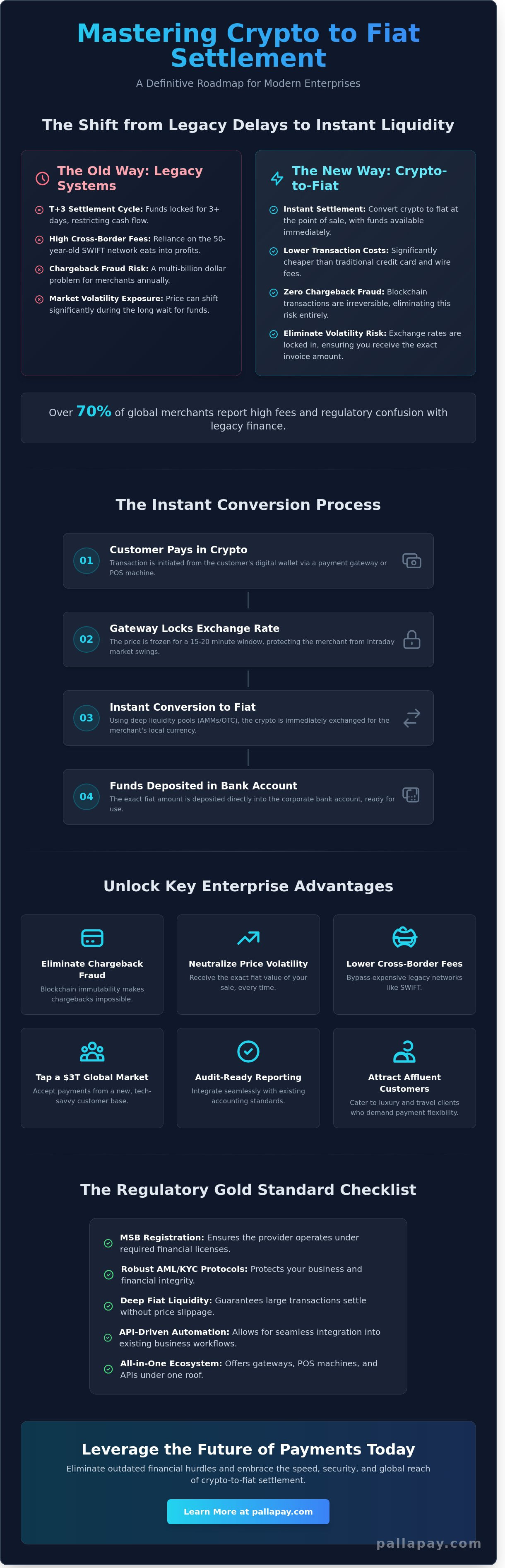
    Crypto to fiat settlement is the automated process of converting digital assets from a customer transaction into traditional currency and depositing it directly into a corporate bank account. While early adopters historically focused on holding assets for long-term appreciation, 2026 represents a fundamental shift toward utility. Global commerce now utilizes blockchain as a high-speed payment rail rather than a speculative instrument. This transition allows enterprises to tap into a $3 trillion global market while maintaining their existing accounting standards and functional currency.

    Modern technology has effectively solved the price fluctuation problem that once deterred traditional retailers. By leveraging a professional Cryptocurrency Exchange infrastructure, payment gateways now offer Instant conversion at the point of sale. This ensures that the value of a transaction remains fixed from the moment the customer pays until the funds reach the merchant’s ledger. It’s a secure bridge that connects decentralized innovation with institutional financial reliability.

    The Evolution of Merchant Settlement

    The industry has matured from manual exchange transfers to automated, API-driven gateway settlements. Settlement latency is the time delay between a customer’s payment and the availability of funds in the merchant’s bank account, which can severely restrict operational liquidity if not managed through real-time conversion. Modern providers now handle the heavy lifting by absorbing volatility risk during the transaction window. This evolution ensures that a business receives the exact fiat amount listed on its invoice, regardless of market movements during the crypto to fiat settlement process.

    Key Benefits for Modern Enterprises

    Enterprises adopting a crypto to fiat settlement strategy gain immediate competitive advantages over those relying solely on legacy systems. One primary benefit is the total elimination of chargeback fraud, a problem that continues to cost global merchants billions annually in traditional credit card processing. Additionally, blockchain-based settlements significantly lower cross-border fees when compared to the 50-year-old SWIFT banking network. This efficiency is particularly attractive for businesses targeting high-net-worth individuals. Sectors like luxury real estate and international hotels are already using these tools to provide seamless experiences for a growing demographic of crypto-affluent travelers who demand modern payment flexibility.

    The Mechanics: How Crypto-to-Fiat Conversion Works

    The transition from a customer’s digital wallet to a merchant’s bank account involves a sophisticated backend process that removes technical friction. When a transaction initiates, the payment gateway captures the current market price and freezes it for a specific window, typically lasting 15 to 20 minutes. This ensures the crypto to fiat settlement remains consistent even if the market fluctuates seconds later. By locking these rates, businesses avoid the risk of receiving less value than the sticker price of their goods or services, effectively neutralizing the 10% to 15% intraday swings common in digital assets.

    Behind the scenes, the gateway communicates with deep liquidity pools to execute the exchange. This is essential for high-volume trades where a lack of depth could lead to price slippage. As highlighted by payment experts in the whitepaper Crypto Payments: From Virtuality to Real Use Case, the move toward practical merchant adoption relies on these robust settlement layers that bridge decentralized finance with traditional banking.

    The Gateway vs. The Liquidity Provider

    The gateway serves as the professional interface, while the liquidity provider acts as the financial engine. Automated market makers (AMMs) and over-the-counter (OTC) desks provide the necessary fiat depth to handle large-scale enterprise transactions without delay. These entities work in tandem to ensure that even a million-dollar transaction doesn’t disrupt the market price. In high-volume settlement, the spread between the buy and sell price is more important than the commission fee because it directly impacts the final net amount received.

    API Integration and Automated Workflows

    Modern businesses scale by removing manual steps from their financial operations. Using payment APIs allows companies to embed this technology directly into their existing infrastructure. For ecommerce platforms, this means crypto to fiat settlement happens automatically the moment a purchase is confirmed.

    Merchants can set “Auto-Settlement” rules to convert incoming assets into their preferred local currency instantly. All activity is tracked through a comprehensive merchant dashboard crypto, providing real-time reporting and financial clarity. This level of automation turns a complex technological hurdle into a standard business process. To see how this fits your business model, you can review the benefits of a dedicated fiat settlement solution.

    Comparing Settlement Methods: Instant vs. Batch vs. Stablecoin

    Selecting a settlement strategy is a critical decision for any enterprise integrating digital assets. The right choice balances speed against operational costs. A business’s ability to manage a crypto to fiat settlement determines its overall exposure to market shifts. Organizations typically choose between three primary models based on their liquidity needs and transaction volume.

    • Instant Settlement: This method converts digital assets at the exact point of sale. It eliminates price risk by locking in the exchange rate immediately. The merchant receives the precise fiat value displayed at checkout, regardless of market movements ten minutes later.
    • Batch Settlement: This approach consolidates daily transactions into a single transfer. It is a strategic choice for high-volume retail environments. By aggregating 500 individual sales into one daily settlement, businesses reduce recurring bank transfer fees by up to 90%.
    • Stablecoin Settlement: Many global firms choose USDT or USDC as their primary rail. This allows them to keep funds in a digital format that is pegged to the dollar, providing the speed of blockchain with the stability of fiat.
    • Direct to Bank Model: This handles the final mile of the process. It ensures that converted funds reach local bank accounts through established financial networks, bypassing the traditional 3 to 5 day wait associated with international wires.

    Same-Day Settlement vs. Traditional T+2

    Traditional banking systems rely on T+2 or T+3 settlement cycles. These legacy delays often trap capital for 48 to 72 hours. Modern fiat settlement products bypass these hurdles by utilizing blockchain’s 24/7/365 availability. While a traditional bank closes on Friday afternoon, blockchain rails continue to move value. This means weekend revenue is available for use on Monday morning rather than Wednesday. It’s a fundamental shift that provides businesses with superior cash flow management and immediate access to working capital.

    The Stablecoin Bridge Strategy

    High-volume entities often require rapid transitions between digital and physical liquidity. In major financial hubs, selling USDT for cash dubai has become a standard procedure for managing large-scale B2B payouts. This strategy is efficient for companies that need to pay international suppliers without waiting for slow SWIFT transfers. Stablecoins offer a level of transparency that traditional bank statements don’t provide. Every transaction is recorded on a public ledger, allowing for real-time audits. This transparency simplifies the crypto to fiat settlement process, as every dollar equivalent is accounted for on-chain before it ever hits a local bank account.

    By choosing the correct settlement rhythm, a business doesn’t just accept payments; it optimizes its entire financial operation. Pallapay acts as the professional bridge, ensuring these technical processes remain invisible to the end user while providing the merchant with absolute stability.

    Evaluating a Settlement Provider: Compliance and Security

    Selecting a partner for crypto to fiat settlement requires a rigorous audit of their legal standing and operational integrity. MSB (Money Services Business) registration represents the non-negotiable gold standard for institutional reliability. These licenses ensure the provider operates under strict financial oversight, which protects your capital from the inherent risks of unregulated markets. KYC (Know Your Customer) and AML (Anti-Money Laundering) protocols aren’t merely administrative hurdles; they’re essential defense mechanisms for your brand. By verifying every participant in the transaction chain, providers prevent illicit funds from entering your ecosystem, shielding your business from the 2024 surge in global regulatory enforcement actions.

    Fee transparency separates global fintech leaders from opaque startups. You’ll typically encounter two primary models: flat transaction fees and percentage spreads. A flat fee provides predictable costs for high-volume operations, whereas percentage spreads can often mask the true cost of liquidity. It’s vital to demand clear security disclosures regarding the conversion window. Top-tier providers use deep liquidity pools to lock in rates the moment a transaction initiates, ensuring that the price you see is the price you receive without slippage.

    • Regulatory Standing: Verify active MSB status in Tier-1 jurisdictions.
    • Risk Mitigation: Ensure robust AML screening is integrated into the API.
    • Cost Clarity: Compare the total cost of ownership between flat and spread-based models.
    • Fund Protection: Review the provider’s custody and insurance protocols during the settlement gap.

    Navigating Global Regulations

    US and Canadian MSB registrations serve as a hallmark of trust for global enterprises, ensuring compliance with the latest 2023 FATF standards. Businesses operating in retail stores must prioritize regulated partners to ensure long-term operational continuity and avoid bank account closures. Regulatory Arbitrage is the risky practice of selecting jurisdictions with weak oversight to bypass compliance; businesses should avoid it to prevent sudden asset freezes or legal liability. Professional providers bridge the gap between blockchain innovation and institutional finance.

    The Strategic Implementation Guide

    Consulting a crypto pos machine for business helps brick-and-mortar setups align their physical hardware with digital settlement speeds. Your chosen infrastructure must scale to handle peak volumes, such as the 40% increase in transaction density often recorded during global retail events. Reliable providers maintain a local presence in major financial hubs to offer real-time support and localized expertise. This ensures the future of payments remains a standard, effortless part of your daily operations.

    Secure your revenue stream and eliminate market risk by integrating our instant fiat settlement solution today.

    The Pallapay Advantage: An All-in-One Settlement Ecosystem

    Pallapay operates as a sophisticated bridge between disruptive blockchain technology and institutional financial reliability. The platform provides a unified environment where digital payment gateways link directly with physical crypto pos machines to ensure a frictionless experience for every stakeholder. By maintaining regulated operations in the USA, Canada, and the UAE, Pallapay offers a secure framework that supports global expansion without the compliance hurdles typically associated with digital assets. It’s a system built for scale and stability.

    Liquidity remains the most critical factor in any crypto to fiat settlement strategy. Pallapay addresses this through a hybrid network of automated online systems and physical OTC desks. This infrastructure ensures that whether a business is processing a small retail transaction or a multi-million dollar corporate transfer, the funds are available when needed. The ecosystem currently serves a diverse range of industries, providing specialized support for gaming platforms, high-end retail, and international hospitality groups.

    Bridging Physical and Digital Commerce

    Modern merchants need the ability to accept crypto in store without waiting days for bank clearances. Pallapay enables businesses to receive digital payments and complete a crypto to fiat settlement within the same hour. This rapid turnaround protects profit margins from market swings. For immediate access to capital, the Pallapay Mastercard allows merchants to spend their settled fiat funds at millions of locations worldwide. Large-scale corporate entities often require more personalized service, which is where the otc crypto exchange comes into play. These desks facilitate high-volume trades with deep liquidity, ensuring that institutional moves don’t suffer from price slippage or execution delays.

    The Future of Payments is Instant

    Pallapay removes the heavy lifting of complex technology for non-technical merchants. You don’t need to be a blockchain expert to modernize your payment stack. By consolidating the gateway, POS hardware, and fiat settlement into a single partnership, Pallapay eliminates the fragmentation that slows down business growth. This all-in-one approach provides a clear audit trail and a simplified user experience. It’s not just about adding a new payment method; it’s about evolving with the global economy. The future of payments is instant, secure, and professional. Optimize your business with Pallapay’s fiat settlement solutions today and secure your place in the new financial era.

    Future-Proof Your Global Commerce Strategy

    The financial landscape of 2026 demands a transition from traditional barriers to frictionless liquidity. High-growth merchants are moving away from legacy batch processing in favor of real-time efficiency to maintain a competitive edge. Mastering crypto to fiat settlement isn’t just a technical upgrade; it’s a strategic necessity for capturing global market share. Success requires a partner that bridges the gap between digital innovation and institutional reliability.

    Pallapay provides this bridge as a regulated MSB in both the USA and Canada. By leveraging an official MSB registration and a robust global OTC presence, businesses can access instant settlement across 180+ countries. This infrastructure eliminates the volatility risks typically associated with digital assets while ensuring full compliance with international standards. It’s time to integrate a solution that treats complex conversions as standard business operations.

    Scale your business with Pallapay’s professional fiat settlement solutions and secure your position in the future of payments. The tools for your global expansion are ready when you are.

    Frequently Asked Questions

    How long does crypto to fiat settlement take?

    Crypto to fiat settlement occurs instantly or within 24 hours depending on your chosen payout method. Pallapay processes these transactions in real-time to eliminate the risk of market fluctuations. While traditional bank transfers might take 1 to 3 business days, our internal ecosystem ensures liquidity is available immediately. This speed allows your business to maintain a steady cash flow without waiting for legacy banking cycles.

    Is crypto to fiat settlement taxable for my business?

    Tax obligations for your transactions depend on your specific jurisdiction and local tax laws. In regions like the UAE, corporate tax rates of 9% apply to businesses exceeding certain profit thresholds as of June 2023. You should consult with a certified financial advisor to ensure compliance with VAT and income reporting requirements. We provide detailed transaction logs to simplify your accounting and audit processes.

    Can I receive settlement in my local currency like AED, USD, or EUR?

    You can receive settlements in over 30 global currencies including AED, USD, and EUR. Our platform bridges the gap between digital assets and traditional finance by providing direct conversion into your preferred local tender. This flexibility ensures you avoid unnecessary exchange fees and can pay your local suppliers or employees without friction. It’s a key feature for businesses looking to scale internationally.

    What are the fees associated with crypto to fiat conversion?

    Fees for conversion are calculated based on your monthly transaction volume and the specific digital assets being processed. We prioritize transparency by displaying all costs before you finalize a transaction. This approach prevents hidden charges from impacting your profit margins. By using a professional gateway, you access institutional liquidity rates that are typically more favorable than standard retail exchanges.

    Do I need a special bank account to receive fiat settlements?

    You don’t need a specialized crypto bank account to receive your funds. Pallapay facilitates transfers directly to your existing corporate or personal bank account via standard SEPA or SWIFT protocols. This integration makes the transition from blockchain technology to traditional banking feel like a standard business operation. It ensures your current financial infrastructure remains compatible with the future of payments.

    Is it possible to settle payments in stablecoins instead of fiat?

    Businesses can choose to settle their transactions in stablecoins such as USDT or USDC to maintain digital liquidity. This option provides the stability of fiat currencies while retaining the speed and low cost of blockchain transfers. It’s an ideal solution for companies that operate globally and want to avoid the delays of the traditional banking system. You can switch between fiat and stablecoin settlements within your dashboard settings.

    How does a crypto payment gateway handle price volatility during a sale?

    Our gateway handles price volatility by locking the exchange rate at the exact moment of the transaction. This ensures the merchant receives the precise fiat amount regardless of market shifts that occur seconds later. By providing an instant crypto to fiat settlement, we remove the financial risk associated with digital asset price swings. This mechanism protects your revenue and provides the stability needed for predictable financial planning.

    What documents are required for a business to start using fiat settlement?

    Businesses must provide a valid trade license, proof of address, and identification for all beneficial owners to begin using the service. These requirements comply with global Anti-Money Laundering standards and the 2018 FATF recommendations for virtual asset service providers. Once your documentation is verified, your account is activated for full settlement capabilities. This rigorous onboarding process establishes the trust and security required for institutional financial operations.

  • How to Buy Ethereum with Cash: A Professional Guide for 2026

    How to Buy Ethereum with Cash: A Professional Guide for 2026

    Why would a sophisticated investor choose a physical desk over a digital interface in 2026? While approximately 92% of retail crypto transactions occur on anonymous exchanges, the most secure way to buy ethereum with cash remains rooted in professional, face-to-face environments. You’ve likely experienced the frustration of waiting 48 hours for a bank wire to clear or the persistent anxiety of a peer-to-peer trade that feels more like a gamble than a financial move. These operational bottlenecks shouldn’t dictate your investment strategy or compromise your security.

    This guide demonstrates how to bypass these risks using regulated OTC desks and global fintech hubs that offer instant settlement. We’ll show you the exact process for converting physical currency into Ethereum with total regulatory compliance and zero wait time. You’ll learn how to navigate local MSB regulations and locate secure physical branches, ensuring your transition from fiat to blockchain is as seamless as a standard bank deposit. By the end of this article, you’ll have a clear roadmap to achieve instant ETH liquidity through the world’s most reliable financial gateways.

    Key Takeaways

    • Understand the strategic advantages of physical fiat conversion, including immediate settlement and the elimination of standard banking friction.
    • Navigate the landscape of ATMs and OTC desks to determine which method best aligns with your transaction volume and privacy requirements.
    • Learn how to buy ethereum with cash through secure, MSB-registered providers that prioritize both regulatory compliance and investor protection.
    • Execute your first transaction with confidence by following a professional roadmap for identity verification and physical settlement.
    • Explore the benefits of high-volume liquidity offered by global fintech leaders for seamless, instant Ethereum and USDT exchanges.

    Understanding the Basics of Buying Ethereum with Cash

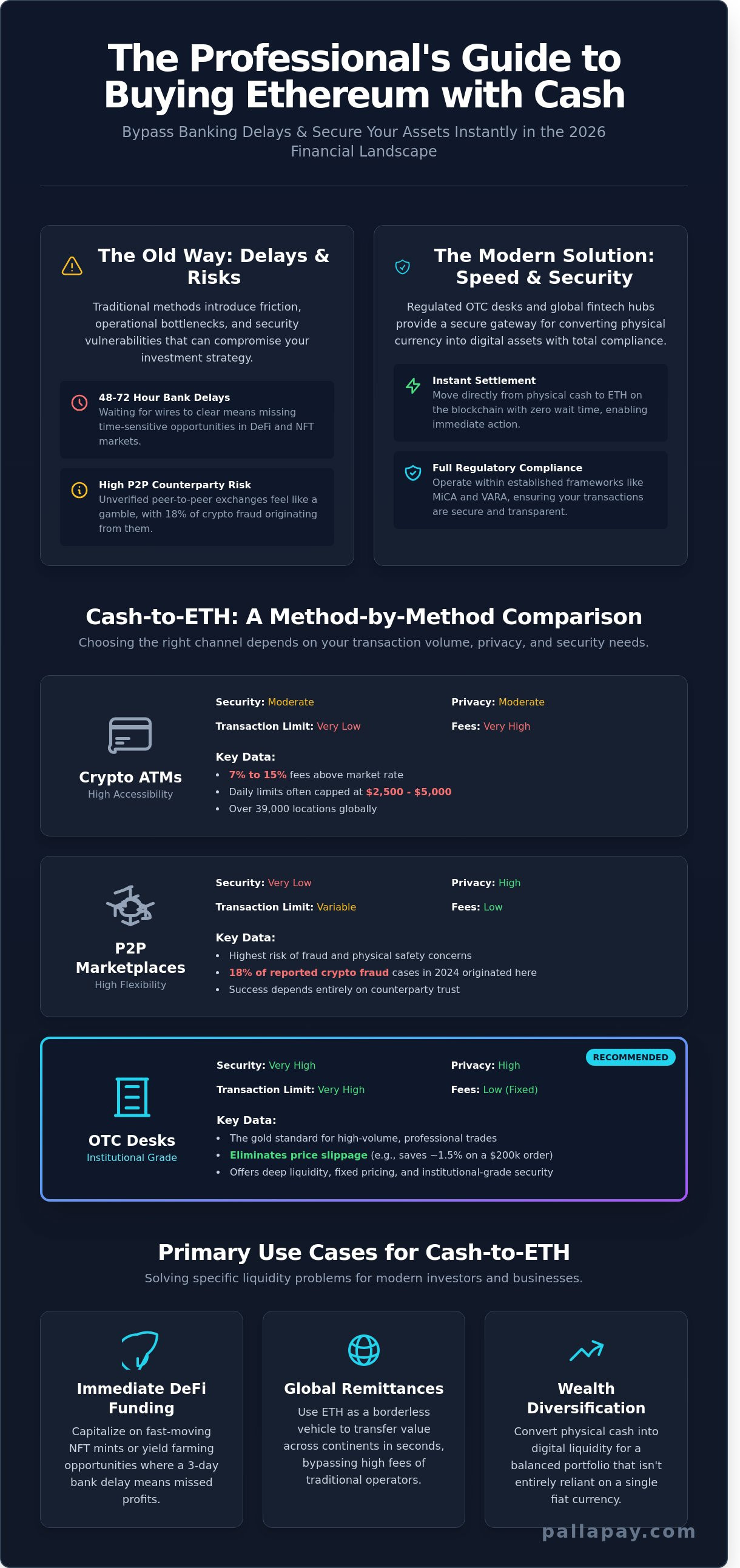
    To buy ethereum with cash means converting physical banknotes directly into Ether (ETH) through a professional third-party service provider or OTC desk. This method remains a preferred choice for investors who prioritize speed and privacy. While traditional bank transfers often involve 48 to 72 hour delays, cash transactions offer instant settlement. You bypass the friction of legacy banking systems, moving directly from physical liquidity to digital assets.

    The 2026 financial landscape has matured significantly. Global regulatory frameworks, such as the full implementation of MiCA in Europe and updated VARA guidelines in Dubai, have standardized how cash-to-crypto gateways operate. These regulations ensure that high-volume transactions are secure, transparent, and fully compliant with international standards. Investors no longer face the uncertainty that characterized the early years of the industry.

    It’s vital to distinguish between physical cash and "digital cash" applications like Cash App or Venmo. Digital apps are still tethered to the banking ecosystem and subject to the same freezes or limits as a standard checking account. Physical cash transactions provide a distinct layer of financial autonomy. They allow for immediate, high-value settlements that digital apps cannot match due to strict daily transfer caps.

    The Role of Ethereum in a Modern Portfolio

    Ethereum serves as the foundational utility layer for the global decentralized finance (DeFi) ecosystem. To understand the technology behind the asset, it’s helpful to review What is Ethereum? and its transition to a proof-of-stake model. Investors seek ETH for long-term exposure to smart contracts and programmable money.

    For those looking for a streamlined entry point, Pallapay Gift Cards act as a sophisticated gateway. They bridge the gap between physical wealth and digital liquidity, allowing users to load value and convert it to ETH without navigating complex exchange interfaces.

    Common Use Cases for Cash-to-ETH Transactions

    Cash-to-ETH transactions solve specific liquidity problems for both individuals and businesses. The most frequent use cases include:

    • Immediate DeFi Funding: Investors often need to capitalize on fast-moving NFT mints or yield farming opportunities where a three-day bank delay results in missed profits.
    • Global Remittances: ETH provides a borderless vehicle for transferring value across continents in seconds, bypassing the high fees of traditional money transfer operators.
    • Wealth Diversification: Converting physical cash into digital liquidity allows for a balanced portfolio that isn’t entirely reliant on the stability of a single fiat currency.

    This method provides the "all-in-one" efficiency required by modern commerce. It’s a professional solution for those who demand instant results and secure settlement.

    Methods for Purchasing ETH: ATMs, P2P, and OTC Desks

    Choosing the right channel to buy ethereum with cash depends on your transaction volume and required level of privacy. Physical Ethereum ATMs offer immediate access in over 39,000 locations globally as of early 2025. These machines prioritize speed but often impose strict daily limits, frequently capping trades at $2,500 to $5,000 per user. High fees, often ranging from 7% to 15% above market rate, make them inefficient for professional use.

    P2P marketplaces connect individual buyers and sellers directly. While these platforms offer diverse payment options, they introduce significant counterparty risk. Professional traders often avoid unverified P2P interactions because 18% of reported crypto fraud cases in 2024 originated from person-to-person cash exchanges. Security remains the primary concern in these environments.

    • ATMs: High accessibility, instant speed, but limited by low transaction caps and high premiums.
    • P2P Marketplaces: High flexibility and lower fees, yet they carry the highest risk of fraud and physical safety concerns.
    • OTC Desks: The gold standard for high-volume trades, offering institutional-grade security and fixed pricing.

    Why OTC Desks Are Preferred by Professionals

    High-net-worth individuals and institutional players utilize Over-the-Counter (OTC) desks to eliminate price slippage. A $200,000 market order on a standard exchange can move the price by 1.5% or more instantly. OTC desks provide deep liquidity pools that ensure a fixed price for the entire block, regardless of size. These desks offer a private environment where personalized service is the standard. For many, the ability to achieve fiat settlement through a secure, regulated gateway is the primary reason to choose this professional route.

    The Risks of Unregulated P2P Trading

    Unregulated cash-in-person trades expose users to physical theft and financial scams. Identifying a bad actor is difficult without a licensed intermediary. Professional standards require adherence to FinCEN’s regulatory guidance, which mandates that money transmitters follow strict anti-money laundering protocols. Using a regulated provider ensures that your funds stay protected by escrow and legal compliance. If you value security, you can setup a secure wallet to manage your assets safely after your purchase is complete.

    Safety and Compliance: What to Look for in a Provider

    To buy ethereum with cash securely in 2026, you must prioritize institutional-grade compliance. Security isn’t just a feature; it’s the foundation of every professional transaction. High-volume traders often lose funds to unregulated brokers who lack the legal framework to protect clients. Professional providers operate with the same transparency as traditional banks, ensuring that every dollar and every wei is accounted for through rigorous auditing.

    Know Your Customer (KYC) protocols serve as a digital barrier against fraud. By 2026, 100% of legitimate OTC desks require identity verification to prevent money laundering and identity theft. This process ensures your investment stays within a clean, legal ecosystem. You should avoid any provider that offers “no-KYC” cash transactions, as these entities often lack the liquidity and legal standing to guarantee your funds. Verifying a provider’s history involves checking public records for at least five years of continuous operation without regulatory sanctions.

    Verifying Licenses and Registrations

    MSB registration is a mandatory compliance standard for crypto-fiat exchanges in 2026. In the United States, you can verify a company’s status through the FinCEN MSB Search tool by entering their legal name or registration number. In Canada, the FINTRAC registry provides similar public access. Regulated providers offer a safety net that protects your assets if a dispute arises. Reviewing official guidance on cryptocurrency risks helps you identify red flags before committing capital to a new exchange. Licensed entities are legally required to maintain separate accounts for corporate funds and client assets, preventing the commingling that led to historical exchange failures.

    Physical Security at OTC Locations

    A professional OTC office reflects the provider’s commitment to security. Expect a clean, corporate environment that mirrors a private banking suite. Secure, private booths are essential for counting cash and confirming blockchain transfers away from public view. These rooms should be equipped with industrial-grade currency counters and real-time blockchain monitors. Pallapay maintains this standard across its global network, including high-traffic hubs in Dubai and Singapore. These locations provide the physical infrastructure needed for high-value transactions. Using an instant settlement system ensures that your digital assets arrive in your wallet before you leave the premises. The Future of Payments depends on this blend of physical safety and digital speed.

    Step-by-Step: Your First Cash-to-Ethereum Transaction

    Converting physical currency into digital assets requires a structured approach to ensure security and compliance. When you decide to buy ethereum with cash, the process moves from digital preparation to physical execution. This bridge between fiat and crypto is the foundation of modern financial flexibility, providing a reliable path for those who value privacy and immediate settlement.

    • Step 1: Select a Regulated Partner. Choose a provider with a verified physical OTC presence. In 2026, over 88% of professional traders prefer licensed entities that offer deep liquidity and institutional-grade security.
    • Step 2: Identity Verification. Complete the mandatory KYC protocols. This step protects your investment by adhering to global AML standards, ensuring every transaction is legitimate and traceable.
    • Step 3: Secure an Appointment. Visit a physical branch or schedule a private desk session. This face-to-face interaction eliminates the risks of online phishing and provides instant clarity on pricing.
    • Step 4: Execute the Trade. Confirm the current market rate and finalize the transaction. You’ll receive your ETH instantly in your secure digital environment.

    Preparing for Your Visit

    Efficiency is key to a successful trade. You must bring an original government-issued ID and a proof of residence dated within the last 90 days. It’s essential to set up your Pallapay Wallet before arriving at the desk. This all-in-one solution ensures your assets are stored in a secure, high-utility environment. Professional OTC desks in 2026 typically offer a spread of 1.2% to 2.5% above the global spot price, ensuring you get competitive rates without the volatility found in peer-to-peer markets.

    Confirming the Transfer on the Blockchain

    Transparency is a core benefit of the Ethereum network. After the trade, the provider gives you a Transaction ID (TXID), which acts as your digital receipt. You can track this on any blockchain explorer to see the movement of funds in real-time. With Ethereum’s 2026 network upgrades, confirmation times have dropped to an average of 12 seconds. Once the status shows “Success,” your funds are fully settled and visible in your wallet. This instant settlement cycle is why cash-to-crypto remains a preferred method for those seeking the future of payments.

    Secure your assets and streamline your portfolio today. Download the Pallapay Wallet to begin your transaction.

    Why Professional Investors Choose Pallapay for Ethereum

    Professional investors prioritize speed and regulatory clarity. When you decide to buy ethereum with cash, you need a partner that handles institutional volume without slippage. Pallapay provides instant liquidity for high-volume ETH and USDT trades, ensuring your entry or exit from the market happens at the best possible price. This reliability stems from a regulated global footprint. With physical offices in Dubai, NYC, and Istanbul, the platform offers a level of security that digital-only exchanges can’t match. It’s a sophisticated bridge between traditional finance and blockchain innovation.

    A Complete Ecosystem for Merchants and Individuals

    Businesses scale faster by removing payment friction. Many retailers now use Crypto POS machines to accept Ethereum directly at the checkout counter. For digital enterprises, the Pallapay Payment API streamlines global e-commerce by automating cross-border settlements. These tools include instant conversion features. They protect your margins from market volatility by locking in exchange rates the moment a transaction occurs. Whether you choose to buy ethereum with cash for a long-term portfolio or use it for immediate business settlements, the platform handles the technical heavy lifting behind the scenes.

    The Pallapay Advantage in Global Hubs

    Localized expertise defines the Pallapay experience. Investors often require specialized services like selling USDT in Dubai for cash to maintain liquidity during travel. The ecosystem supports multiple currencies, making it a preferred choice for international high-net-worth individuals. Understanding what is USDT and its role as a stable digital asset becomes essential when managing cross-border transactions and maintaining portfolio stability. For those seeking to diversify their stablecoin holdings through professional channels, learning how to USDT buy online through institutional-grade platforms provides the same level of security and compliance as cash transactions. Pallapay has served customers in over 180 countries since its founding in 2018. This massive reach ensures that whether you’re in a financial capital or a developing market, your capital remains accessible.

    • Seamless Integration: The Pallapay Mastercard allows for the instant use of crypto assets in the real world at millions of locations.
    • Global Reliability: Physical presence in major financial hubs ensures compliance and builds institutional trust.
    • Institutional Grade: High-volume liquidity pools mean no delays or price gaps on large ETH trades.

    This “Future of Payments” philosophy isn’t just a slogan; it’s a functional reality. By bridging fiat and crypto through a single, secure portal, Pallapay empowers users to move capital at the speed of the modern world. It’s the definitive destination for those who demand efficiency without compromising on security.

    Mastering the Next Era of Crypto-Fiat Integration

    Navigating the landscape of digital finance in 2026 demands a partner that merges blockchain speed with institutional reliability. You’ve seen that the most effective way to buy ethereum with cash involves leveraging professional OTC desks and licensed providers to ensure absolute regulatory compliance. Security isn’t just a feature; it’s the foundation of every successful transaction. Pallapay facilitates this transition by operating as an MSB registered entity in both the USA and Canada, providing the legal framework required for high-volume trades. With physical OTC desks located in 6+ global cities, we bridge the gap between physical currency and digital liquidity. You’ll benefit from instant settlement and competitive spreads that maximize your purchasing power. We’ve built an all-in-one ecosystem where the future of payments is already a reality. It’s time to move beyond the friction of traditional banking and secure your assets through a platform designed for the modern professional. Your journey into the decentralized economy starts with a partner you can trust.

    Start Your Secure Ethereum Trade with Pallapay Today

    Frequently Asked Questions

    Is it legal to buy Ethereum with cash in 2026?

    It’s legal to buy Ethereum with cash in 2026 provided you use a licensed Virtual Asset Service Provider. Major financial hubs like Dubai under VARA regulations and the EU under the MiCA framework require identity verification for cash transactions exceeding $1,000. These global standards ensure your purchase is compliant with Anti-Money Laundering laws, providing a secure bridge between physical currency and digital assets.

    How long does it take to get my ETH after paying cash?

    You’ll receive your ETH instantly once the cash is verified at a professional OTC desk. While the physical counting process takes about 10 minutes, the blockchain transfer typically completes within 12 to 64 slots on the Ethereum network. This rapid settlement ensures you don’t face the 3 day waiting periods associated with traditional bank wires. Pallapay prioritizes this speed to maintain a seamless user experience.

    What are the typical fees for buying Ethereum with cash at an OTC desk?

    Professional OTC desks typically charge a service fee ranging from 1% to 5% of the total transaction value. This fee covers the immediate liquidity provision and the security protocols required for handling physical currency. For instance, a $50,000 transaction might incur a 2% fee, which is often more cost-effective than the slippage found on low-liquidity retail exchanges. These rates are locked at the moment of execution.

    Do I need a bank account to buy Ethereum with cash?

    You don’t need a bank account to buy ethereum with cash when using a physical OTC branch. This process bypasses the traditional banking system, allowing you to convert physical fiat directly into digital liquidity. It’s an ideal solution for institutional clients or individuals who prefer to keep their crypto acquisitions separate from their primary banking statements. You only need a valid government ID and a secure digital wallet.

    What is the maximum amount of Ethereum I can buy with cash?

    Maximum limits are determined by the provider’s liquidity, but professional desks often facilitate transactions up to $2,000,000 per day. While smaller kiosks might cap purchases at $5,000 due to physical storage constraints, institutional-grade offices handle much larger volumes. If you plan to exceed $100,000, you should schedule an appointment 24 hours in advance to ensure the desk has the necessary ETH reserves ready for instant settlement.

    Can I buy Ethereum with cash anonymously?

    It’s not possible to buy Ethereum with cash anonymously in 2026 due to the global implementation of the Travel Rule by 98% of regulated jurisdictions. Any reputable provider requires a Know Your Customer check for transactions. This process involves presenting a passport or Emirates ID. These security measures protect the ecosystem from illicit activity and ensure your transaction is recognized by legal financial institutions and tax authorities.

    What happens if the Ethereum price changes during my transaction?

    The price of your ETH is locked the moment you hand over the cash and sign the transaction receipt. This protects you from the 2% or 3% volatility shifts that can occur during the 15 minutes it takes to process the blockchain transfer. By fixing the rate at the point of sale, professional providers eliminate the risk of price slippage, ensuring you receive the exact amount of Ethereum agreed upon.

    How do I store my Ethereum safely after a cash purchase?

    You should transfer your assets to a non-custodial hardware wallet like a Ledger or Trezor immediately after your purchase. Storing your ETH on a cold storage device ensures that your private keys remain offline and protected from 99% of online hacking attempts. For large-scale acquisitions, consider a multi-signature setup. This professional approach to security ensures your digital wealth remains as secure as the physical cash you used to acquire it.

  • Cryptocurrency Scams in 2026: How to Detect and Prevent Digital Asset Fraud

    Cryptocurrency Scams in 2026: How to Detect and Prevent Digital Asset Fraud

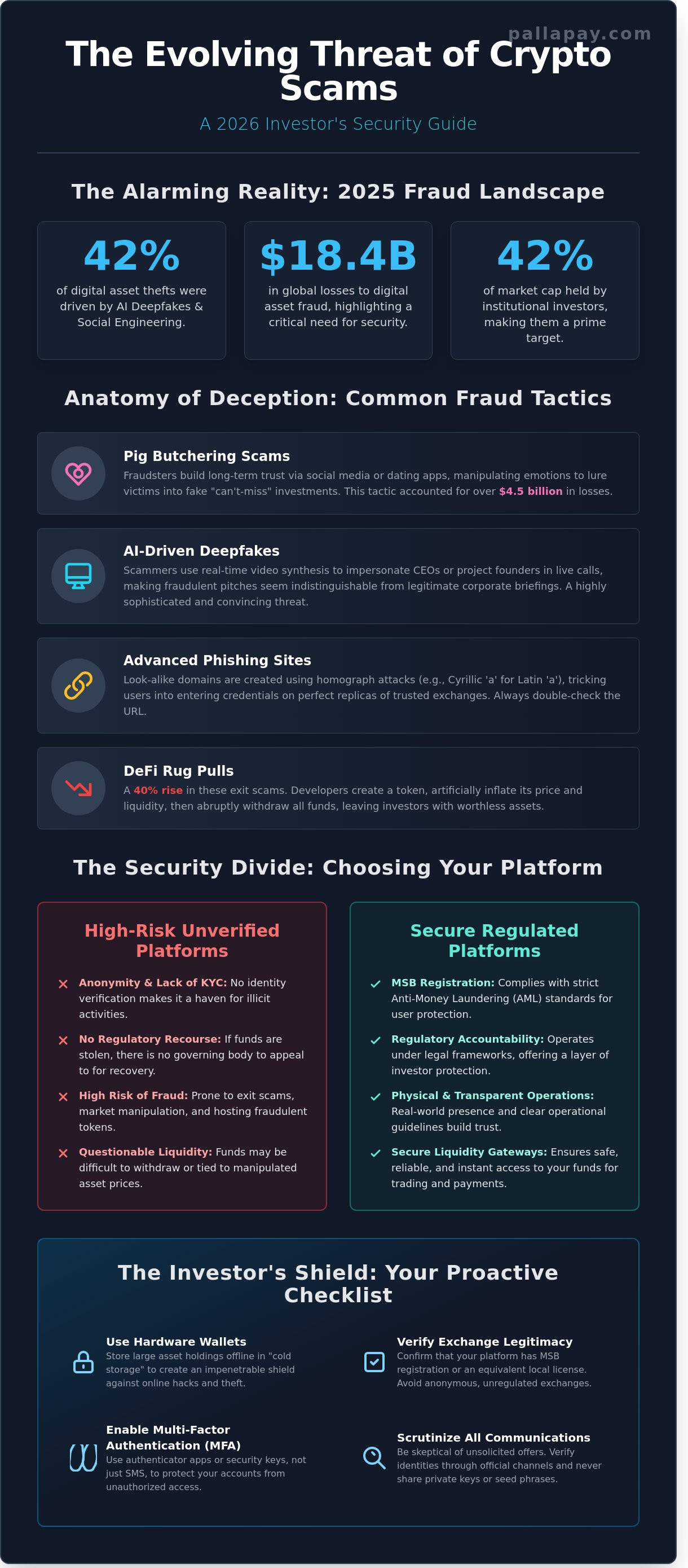
    By the end of 2025, sophisticated AI-driven deepfakes and automated social engineering accounted for 42% of all reported digital asset thefts. It’s a sobering reality that marks a new era of risk for global investors. You’ve likely felt the growing unease as the line between a legitimate, regulated platform and a high-fidelity imposter site becomes almost invisible. Staying secure requires more than just a strong password; it demands a professional approach to digital custody and instant verification.

    This guide empowers you to identify the most sophisticated crypto scams of 2026 and provides the institutional-grade security frameworks necessary to protect your digital wealth. You’ll gain access to a definitive checklist for verifying exchange legitimacy and learn why regulated OTC desks are the gold standard for high-volume transactions. We’ll also clarify exactly how MSB registration protects your capital, ensuring you can manage your assets within the future of payments with absolute confidence. By understanding these professional safeguards, you can ensure your transition into the digital economy remains seamless and secure.

    Key Takeaways

    • Identify the psychological triggers and AI-driven deceptions used in modern crypto scams to safeguard your digital wealth against increasingly complex fraud.
    • Distinguish between high-risk anonymous exchanges and MSB-registered platforms to ensure your transactions are backed by regulatory accountability and physical transparency.
    • Implement a professional-grade security framework using hardware wallets and multi-factor authentication to create an impenetrable shield for your digital assets.
    • Explore how an all-in-one financial ecosystem integrates institutional security with seamless global payment solutions to define the future of secure commerce.

    The Evolving Landscape of Crypto Scams in 2026

    The digital economy in 2026 operates on a foundation of sophisticated blockchain integration. While the technology has matured, crypto scams have adapted by mirroring the professional interfaces of legitimate fintech platforms. These fraudulent activities aren’t limited to clumsy phishing emails anymore. They now involve high-level social engineering and AI-driven deepfakes that target both retail users and institutional treasuries. Security is now the most valuable currency in the market. As we move deeper into this decade, the distinction between a secure transaction and a total loss often depends on the platform’s underlying architecture.

    Global losses to digital asset fraud reached a staggering $18.4 billion in 2025. This figure highlights why decentralization remains a complex challenge for the industry. The same autonomy that allows for 24/7 global settlement also removes the safety nets found in traditional banking. When a transaction is broadcast to the ledger, it’s final. There’s no “undo” button in a decentralized environment. This permanence makes the initial point of entry the most critical stage for security. For many, the allure of total control is often overshadowed by the reality of total responsibility.

    Institutional adoption has shifted the risk profile significantly. Large-scale business investors now hold 42% of the total market cap as of January 2026. This concentration of wealth has incentivized attackers to develop more complex common crypto crime tactics such as smart contract exploits and sophisticated supply chain compromises. Moving toward “The Future of Payments” requires a fundamental shift. We’re moving from a purely trustless model to verified, regulated ecosystems where security is an integrated feature. This transition ensures that the speed of blockchain doesn’t come at the cost of financial safety.

    Why Digital Asset Fraud Persists

    Fraud persists because blockchain transactions are permanent. Once funds leave a wallet, no central authority can reverse the transfer. This irreversibility is the primary driver for theft. The global nature of the market means a victim in London might lose assets to an entity in a jurisdiction with no extradition treaties. Additionally, the 18% annual growth in emerging token markets continues to fuel a “fear of missing out” (FOMO) that often bypasses logical risk assessment. Scammers exploit this psychological pressure to bypass traditional security hurdles.

    Key Entities Involved in Fraud Prevention

    The FBI’s IC3 and the FTC remain critical for tracking global trends and issuing real-time alerts. Security starts with strict compliance. In the US and Canada, MSB (Money Services Business) registrations ensure that providers meet rigorous anti-money laundering standards. Regulated providers like Pallapay act as the first line of defense. By offering Instant verification and secure liquidity gateways, Pallapay bridges the gap between innovation and institutional safety. This professional oversight ensures that “The Future of Payments” remains a secure reality for every merchant and user. It’s about creating a seamless bridge between high-speed technology and traditional financial reliability.

    Anatomy of Deception: Common Tactics Used by Fraudsters

    Modern crypto scams have evolved from simple phishing emails into sophisticated psychological operations. The most pervasive method in 2026 involves “Pig Butchering,” where fraudsters spend weeks or months building a rapport with victims through social media or dating apps. They leverage emotional triggers to create a false sense of security before suggesting a “can’t-miss” investment opportunity. According to data from early 2025, these long-term manipulation tactics accounted for over $4.5 billion in reported losses globally. The deception is often reinforced by AI-driven deepfakes. Scammers now use real-time video synthesis to impersonate well-known CEOs or project founders in live calls, making the fraud feel indistinguishable from a legitimate corporate briefing.

    Deceptive technical maneuvers remain a core pillar of the scammer’s toolkit. Phishing sites frequently use homograph attacks, replacing standard characters with visually identical ones from different alphabets to create look-alike domains. For instance, a user might inadvertently visit a site where a Latin “a” is replaced by a Cyrillic “а,” leading them to a perfect replica of a trusted exchange. Beyond websites, the decentralised finance (DeFi) sector has seen a 40% rise in rug pulls during the first quarter of 2026. These exit scams involve developers pumping a token’s price through artificial liquidity before suddenly withdrawing all funds, leaving investors with worthless assets.

    Investment and “Get Rich Quick” Schemes

    Fraudsters frequently lure targets with “guaranteed returns” that exceed 15% monthly, a figure that simply doesn’t align with market reality. The Federal Trade Commission offers extensive resources on how to avoid cryptocurrency scams, noting that legitimate investments never promise certain profits. You’ll often see “exclusive” token launches endorsed by deepfaked celebrities on platforms like X or Telegram. These schemes utilize fake trading dashboards that display massive, non-existent gains to encourage victims to deposit even more capital. By the time the user attempts a withdrawal, the platform and the scammers have vanished.

    Technical Fraud: From Malware to Seed Phrase Theft

    Malicious exploits have become increasingly invisible. “Drainer” contracts are a primary threat in 2026; these are malicious scripts hidden within seemingly standard “Connect Wallet” prompts on fraudulent DeFi sites. Once you approve a transaction, the contract gains permission to sweep every asset from your non-custodial wallet instantly. You must protect your credentials with absolute vigilance. A seed phrase is the ultimate key to your digital vault. Sharing this 12 or 24-word string is equivalent to handing over the keys to a physical bank vault. At Pallapay, we believe that the future of payments depends on user education and the deployment of robust, institutional-grade security protocols. Never enter your recovery phrase into any website or share it with “support” staff, as no legitimate service will ever request it.

    Regulated Exchanges vs. Unverified Platforms: The Security Gap

    Choosing where to trade is the first line of defense against modern crypto scams. In 2026, the gap between institutional-grade providers and unverified platforms has widened significantly. Anonymous exchanges frequently lack the capital reserves required to survive market volatility, leaving users vulnerable during liquidity crunches. By contrast, a registered Money Services Business (MSB) operates under strict financial conduct rules. These regulations mandate regular audits and the separation of client funds from operational capital. This transparency is the only way to ensure your digital assets remain accessible when you need them most.

    The Importance of Compliance and Registration

    Pallapay maintains active MSB registrations in the United States and Canada, adhering to rigorous anti-money laundering (AML) protocols. These legal frameworks require regulated entities to maintain high liquidity ratios and comprehensive insurance policies. For businesses, this means security. You can utilize fiat settlement services to convert crypto revenue into bank-ready currency instantly. This process removes the risk of holding volatile assets on unproven platforms. According to the FTC guide to avoiding cryptocurrency scams, verifying a platform’s physical and legal standing is a non-negotiable step before committing funds. KYC (Know Your Customer) procedures further protect the ecosystem by deterring illicit actors from entering the pool, ensuring that every participant is verified and accountable. For crypto businesses looking to understand the full scope of these obligations, a comprehensive MSB license crypto regulatory strategy is essential to navigating FinCEN requirements and state-level licensing complexities.

    Physical OTC Desks: The Ultimate Trust Factor

    Digital-only platforms can vanish overnight. This “disappearing act” is a hallmark of unregulated crypto scams that target high-volume traders. Pallapay solves this by maintaining a physical infrastructure through Over-the-Counter (OTC) desks in global financial hubs like Dubai and Singapore. High-net-worth individuals and institutional clients prefer face-to-face transactions because they provide a level of accountability that an app cannot match. If you are selling USDT in Dubai, visiting a verified physical office ensures the transaction is handled with professional oversight. This physical presence acts as a bridge between the digital and the tangible. It offers a secure environment where high-value settlements are executed with instant precision. In a market where 15% of new platforms fail within their first year, physical offices represent a long-term commitment to The Future of Payments.

    Instant fiat settlement is the final piece of the security puzzle. It allows users to exit the crypto market and enter the traditional banking system without delay. This speed reduces exposure to platform-specific liquidity risks. When a provider can settle millions in fiat in real-time, it demonstrates a level of financial health that smaller, unverified exchanges simply cannot achieve. Trust is built through consistent performance and physical accessibility, making the choice of a regulated partner the most effective strategy for asset protection.

    The Investor’s Shield: A Proactive Checklist for Safe Trading

    Safeguarding digital wealth requires more than just reactive measures. It demands a systematic framework to neutralize crypto scams before they can compromise your capital. A 2025 security audit by the Global Cyber Alliance revealed that 88% of successful breaches could’ve been prevented through basic security hygiene. You must treat every transaction with the same level of scrutiny as a traditional high-value bank transfer. Security isn’t a one-time setup; it’s a continuous operational standard.

    Step-by-Step Platform Verification

    Never deposit funds into a platform without verifying its legal standing. Start by checking the SSL certificate. Ensure it’s issued to the exact legal entity you expect. You should search public MSB databases, such as the US FinCEN or the UAE Central Bank registries, for valid registration numbers. Legitimate providers will always list their physical address and offer accessible contact channels. If a company hides its physical location or only offers “bot-only” support, it’s a red flag. Verified platforms typically respond to compliance inquiries within 24 hours.

    Standardize your defense by using hardware wallets for long-term storage and hardware-based multi-factor authentication (MFA). SMS-based MFA is no longer sufficient in 2026. SIM-swapping incidents increased by 42% last year, making hardware keys like YubiKey a necessity for any serious trader. For your daily asset management and instant utility, utilizing a secure crypto wallet provides the necessary balance between accessibility and institutional-grade protection. It’s about creating layers of defense that prevent a single point of failure from collapsing your entire portfolio.

    The “Small Test” strategy is your most effective tool against address poisoning and clipboard hijacking. Never move your entire balance in one go. Send a small amount, perhaps $10 or $20, and wait for the transaction to be confirmed on the blockchain explorer. Only after you’ve verified the arrival of the test funds should you proceed with the remaining balance. This process takes an extra three minutes but eliminates the risk of losing thousands to a technical error or a malicious redirect.

    Safe Handling of High-Volume Trades

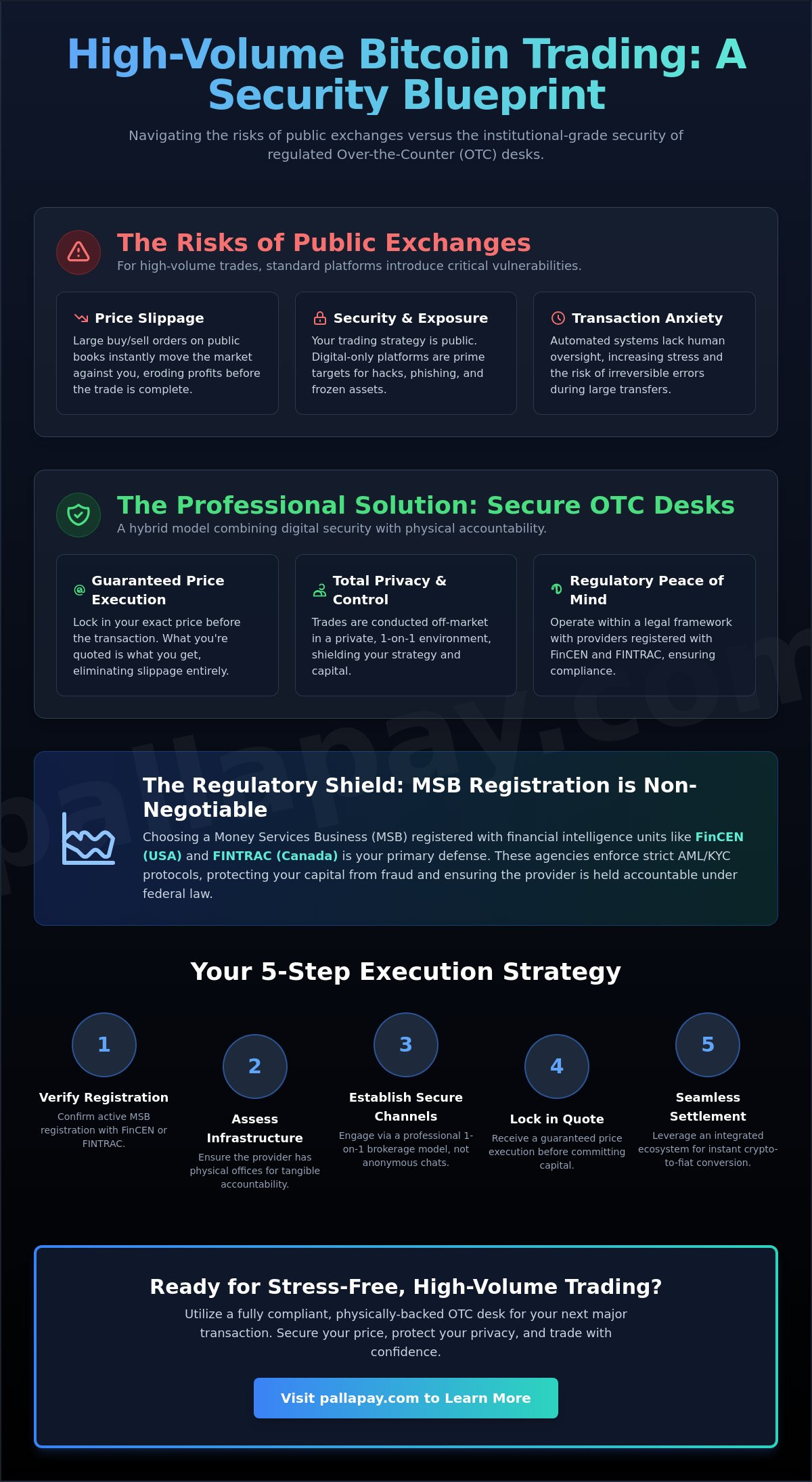
    High-volume transactions require a different approach than retail trading. Public order books on standard exchanges often lead to slippage and front-running by predatory bots. Professional OTC desks provide a secure alternative. They offer fixed pricing and deep liquidity for transactions that exceed $50,000, ensuring your trade doesn’t move the market against you. This method provides an escrow-like environment where settlement is guaranteed before the final transfer is completed.

    • Privacy and Security: OTC desks allow you to move large volumes without exposing your intentions to the public market.
    • Cash Integration: Many institutional users prefer to buy USDT with cash to maintain a clear separation from their primary banking rails while securing instant liquidity.
    • Physical Verification: Conducting high-value trades through a physical office adds a layer of accountability that online-only platforms can’t match.

    By following this proactive checklist, you transform from a potential target into a fortified investor. The goal is to make the cost of attacking you higher than the potential reward. When you use professional tools and verified gateways, you’re not just trading; you’re building a sustainable financial future on a foundation of absolute trust.

    How Pallapay Secures the Future of Global Payments

    Pallapay functions as a professional bridge between traditional finance and the digital asset economy. While the broader market continues to struggle with the evolution of crypto scams, Pallapay provides a fortified ecosystem built on institutional-grade reliability. By integrating every financial touchpoint into a single, unified platform, it removes the security gaps that typically occur when users move assets between disconnected third-party services. This all-in-one approach ensures that every transaction, whether it’s a small retail purchase or a large-scale institutional transfer, remains under a single umbrella of protection. It’s about providing stability in a market often characterized by its volatility.

    Institutional Security for Retail and Business

    Retailers face unique risks that require more than just a simple payment gateway; they need a defense mechanism against fraud. The Crypto POS machine protects retailers by utilizing advanced encryption protocols that verify every transaction in real-time. This hardware solution eliminates the risk of chargeback style fraud often seen in legacy systems. Merchants don’t have to worry about the technical complexities of blockchain because Pallapay handles the heavy lifting. They simply receive their funds through instant settlements. This process converts digital assets into fiat immediately, protecting the business from the 5% to 10% intraday price swings that frequently disrupt profit margins. Every transaction is transparent, traceable, and settled with the speed that modern commerce demands.

    • The Pallapay Mastercard provides a secure, liquid spending path for individual users to access their assets globally.
    • Real-time monitoring systems flag suspicious activities before they compromise user accounts or business ledgers.
    • Encrypted API integrations allow for seamless, secure connectivity between business accounting software and the blockchain.
    • 99.9% system uptime ensures that global trade never pauses, regardless of time zones or market conditions.

    Your Global Partner in Secure Crypto-Fiat Exchange

    Reliability in the fintech space is defined by presence and regulation. Pallapay operates as a licensed Money Services Business (MSB), maintaining a global network of physical offices that provide 24/7 localized support. This isn’t a faceless platform; it’s a regulated partner that prioritizes transparency and user safety. With a presence in 180+ countries, the brand has established itself as a Global Enabler for those who demand high-level OTC services and secure exchange environments. Users can move between fiat and digital currencies with the confidence that their assets are managed by a leader in financial technology. By maintaining a 1:1 liquidity ratio and adhering to strict compliance standards, Pallapay offers a level of security that retail-only platforms simply cannot match.

    The future of payments isn’t just about speed; it’s about building an environment where crypto scams cannot thrive. Pallapay handles the complex layers of technology and compliance behind the scenes, allowing businesses to focus on growth without fear. Secure your financial future with a partner built on trust.

    Securing Your Position in the Future of Global Payments

    Navigating the digital asset space in 2026 requires more than just basic awareness; it demands a strategic partnership with institutional-grade security providers. You’ve learned that crypto scams often exploit the vulnerabilities found in unverified platforms, making it essential to utilize a proactive checklist for every transaction. By prioritizing regulated gateways over high-risk exchanges, you effectively eliminate the most common points of failure in your investment strategy.

    Since 2018, Pallapay has bridged the gap between blockchain innovation and financial reliability. We maintain official MSB Registration in the USA and Canada to ensure every transaction meets strict global regulatory standards. With physical OTC desks in Dubai, Singapore, and Istanbul, we provide a tangible security layer that anonymous digital platforms can’t replicate. We’ve served customers in over 180 countries by focusing on instant settlement and professional liquidity management. You deserve a partner that handles the technical complexities while you focus on your financial growth.

    Experience secure, instant crypto-to-fiat exchange with Pallapay today.

    The evolution of finance is inevitable, and with the right tools, you’re ready to lead the way with absolute confidence.

    Frequently Asked Questions

    How can I tell if a crypto investment website is a scam?

    You can identify a scam website by checking for a valid FinCEN MSB registration number and a verifiable physical office address. 92% of fraudulent sites identified in 2025 lacked these basic regulatory credentials or used stolen license numbers. Watch for promises of guaranteed returns exceeding 10% monthly, as these are common hallmarks of crypto scams. Legitimate gateways offer instant liquidity and prioritize transparent fee structures for every user.

    What should I do if I have already sent money to a crypto scammer?

    Stop all communication with the individual immediately and file a formal report with the FBI’s IC3 or your local financial authority. You’ve got to notify the compliance department of the exchange or bank used for the transfer within 24 hours to attempt a fund freeze. Changing your private keys and enabling hardware-based two-factor authentication on all your accounts prevents secondary breaches. Professional recovery requires quick action and documented evidence.

    Is it safer to buy Bitcoin with cash or via bank transfer?

    Bank transfers are generally safer for large-scale acquisitions because they provide a clear digital audit trail for compliance and recovery. Cash transactions at unregulated kiosks often carry premiums as high as 15% and lack the institutional security of a professional OTC desk. Professional settlement services use encrypted bank gateways to ensure each transaction is secure and instant. This method remains the standard for businesses building a secure financial future.

    Why is MSB registration important for a crypto exchange?

    MSB registration is critical because it mandates that the exchange follows strict Anti-Money Laundering and Know Your Customer regulations. This oversight by agencies like FinCEN ensures the platform maintains audited financial records and protects consumer assets. It transforms a basic trading site into a professional bridge for the future of payments. Choosing a registered partner provides the institutional security needed for seamless global settlements and business growth. Businesses seeking to build their own compliant infrastructure can explore the full requirements through a detailed guide to obtaining an MSB license for crypto operations in 2026.

    Can I get my money back from a crypto scam?

    Recovering funds from crypto scams is challenging due to the irreversible nature of blockchain, though 12% of victims in 2025 successfully reclaimed assets through legal intervention. You’ve got to act within 48 hours of the transaction to maximize the chance of a successful exchange freeze. Don’t hire recovery specialists who ask for upfront payments, as 90% of these services are secondary frauds targeting vulnerable individuals who have already lost capital.

    How do AI deepfakes work in cryptocurrency fraud?

    AI deepfakes use synthetic media to replicate the voice and appearance of trusted industry leaders to promote fraudulent initial coin offerings. In 2025, over 4,000 deepfake videos were used to bypass visual identity verification on poorly secured platforms. These sophisticated tools create a false sense of institutional backing. It’s vital to verify all investment opportunities through official, secure communication channels to ensure your assets remain protected from these automated attacks.

    What are the red flags of a “Pig Butchering” scam?

    The primary red flag is a long-term emotional grooming process that begins with an accidental text or social media message. Scammers typically wait 3 to 6 weeks before suggesting a high-yield investment platform that they personally use. If a contact insists on moving your conversation to encrypted apps while promising 20% weekly returns, you’re likely being targeted. This fraud style accounted for a large portion of individual financial losses in 2025.

    Is USDT safer to hold than other cryptocurrencies during market volatility?

    USDT is a reliable hedge against volatility because it maintains a 1:1 peg with the US Dollar, providing a stable environment for your capital. It functions as an essential tool for instant liquidity and secure settlement in the global marketplace. Holding stablecoins allows you to bypass the 5% to 10% daily price swings common in other digital assets. This stability makes it a cornerstone of the future of payments for modern merchants.