

You’ve identified the perfect entry point for a market surge, but your screen suddenly displays a transaction declined notification followed by a vague security alert from your bank. This frustrating moment has become a standard experience for many modern investors, leaving you searching for a solution to the question: bank blocked my crypto transaction what to do? It’s a significant friction point where traditional banking systems often struggle to keep pace with a digital asset market that recently reached a $4 trillion valuation.
We recognize that a sudden account freeze or a missed opportunity due to institutional delays feels like a major setback in your financial journey. This guide provides the clarity you need to resolve these immediate hurdles while transitioning your portfolio into more stable, institutional-friendly environments like Gold and Forex CFDs. You’ll learn how to utilize regulated bridges between fiat and digital assets, allowing you to trade XAU/USD at its June 2026 levels of approximately $4,156.26 without the constant fear of transaction flags. We’ll explore the mechanics of CFD trading as a sophisticated alternative that can fundamentally transform your financial trajectory and provide the professional reliability you deserve.
Key Takeaways
- Resolve immediate friction by learning exactly how to navigate compliance inquiries when a bank blocked my crypto transaction what to do and how to present a verifiable transaction trail.
- Identify the specific triggers such as unusual volume and high-frequency transfers that cause institutional banks to flag digital asset movements in the current regulatory environment.
- Transition from the volatility of spot markets to the professional reliability of CFD trading to access global markets without the operational burdens of complex wallet management.
- Leverage the safe-haven status of Gold (XAU/USD) to build a resilient financial strategy that bridges the gap between disruptive innovation and traditional stability.
- Accelerate your progress by utilizing high-volume OTC desks and multi-asset platforms designed to handle complex background processes with institutional speed and security.
Why Banks Block Crypto Transactions: The Regulatory Reality of 2026
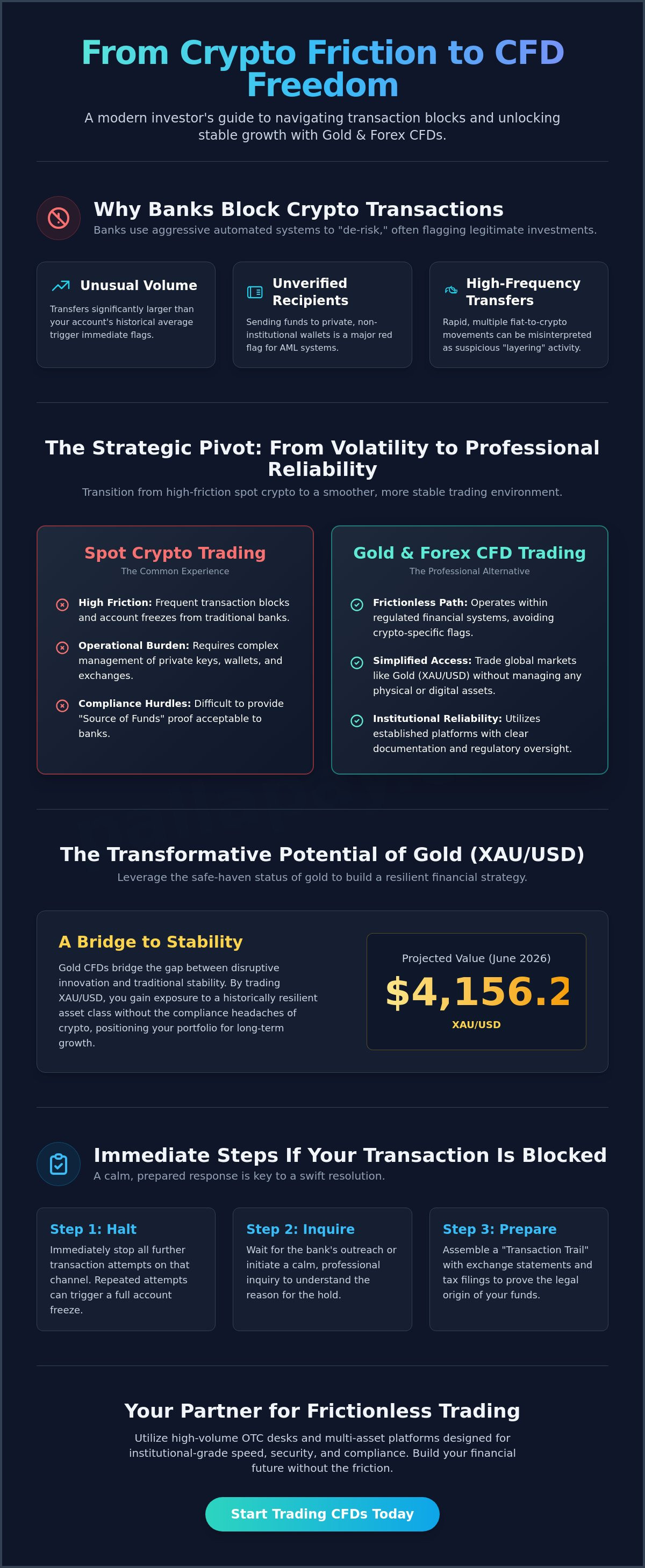
The global financial environment has reached a point where traditional institutions often view retail digital asset activity as a liability rather than an opportunity. This friction stems from “de-risking,” a strategic process where banks terminate or restrict services to specific sectors to minimize their own regulatory compliance costs. If you’ve ever faced a frozen account and wondered, “bank blocked my crypto transaction what to do,” it’s essential to recognize that these actions are rarely personal. Bank de-risking is a systemic shift toward institutional-only crypto exposure, designed to shield banks from the complexities of decentralized finance.
Current Anti-Money Laundering (AML) algorithms are programmed to flag specific behaviors that deviate from standard consumer patterns. These automated systems prioritize safety over speed, often leading to immediate transaction halts. The three most common triggers in 2026 include:
- Unusual Volume: Transfers that significantly exceed your historical account average without prior notification.
- Unverified Recipients: Direct transfers to private, decentralized wallet addresses that lack a verified institutional identity.
- High-Frequency Transfers: Multiple rapid movements between fiat and digital assets, which systems often interpret as “layering” or suspicious structuring.
The tightening of global cryptocurrency regulations has forced retail banks to deploy aggressive automated screening. These tools often struggle to distinguish between a legitimate investment and a security threat, leading to the “security risk” explanations that many users find so frustrating.
The Role of Source of Funds (SoF) Verification
Banks now demand exhaustive proof regarding the origin of your investment capital. While you see a transparent ledger on a block explorer, traditional auditors often view “on-chain” wealth as unverifiable. Proving the legitimacy of assets held in private wallets is a significant hurdle for most retail users. Regulated Money Service Businesses (MSBs) act as a necessary bridge here, providing the documentation and compliance oversight that traditional banks require to accept funds. Utilizing a professional crypto off-ramp can often preempt these verification failures by ensuring your funds arrive through a recognized, compliant channel.
Security Flags vs. Policy Bans
It’s vital to distinguish between a temporary fraud alert and a permanent policy ban. A security flag might occur because you’re using a new exchange or an international platform, which triggers a standard protective hold. However, some institutions have moved toward a total ban on crypto-related transfers to avoid the high costs of monitoring these transactions. Rapid fiat-to-crypto cycles are a major red flag for these systems. Additionally, virtual cards and digital-only accounts often trigger more frequent alerts than their physical counterparts, as they are statistically associated with higher rates of unauthorized activity.
What to Do Immediately if Your Transaction Is Blocked
When you encounter a declined notification, your immediate priority is de-escalation. If you’re currently wondering bank blocked my crypto transaction what to do, the most effective response is to halt all further attempts on that specific channel. Repeatedly pushing a flagged transaction often triggers an automated total account freeze, as banking algorithms interpret this as a potential account takeover or high-risk structuring. Instead, wait for the bank’s outreach or initiate a calm, professional inquiry to resolve the hold.
Preparation is the foundation of a successful resolution. You must assemble a comprehensive “Transaction Trail” to satisfy standard Anti-Money Laundering inquiries. This documentation should include your latest exchange statements and relevant tax filings to prove the legal origin of your capital. Banks are under significant pressure to monitor these movements, often citing the FinCEN advisory on illicit finance risks as a primary reason for their heightened scrutiny. Providing clear, institutional-grade documentation moves your case from a “suspicious activity” category to a standard verified investment.
Methodology matters as much as documentation. Using physical cards or direct bank transfers typically carries a higher trust score than virtual payment methods. Virtual cards are frequently associated with rapid, anonymous cycles that trigger fraud alerts. If a bank blocked my crypto transaction what to do becomes a recurring issue, it’s a clear signal that your current payment rail lacks the institutional recognition required for modern digital asset management.
Professional Communication with Bank Compliance
When speaking with a bank agent, your choice of language determines the speed of your resolution. Avoid using jargon like “P2P transfer” or “decentralized arbitrage,” as these terms often trigger additional internal flags. Instead, frame the transaction as being for “long-term investment purposes” or “portfolio diversification.” This terminology aligns with traditional financial practices that bank staff are trained to recognize. Have your exchange statements ready to share immediately via secure email to demonstrate total transparency. If you need a more reliable way to manage these movements, exploring a professional fiat settlement service can provide the institutional bridge your bank requires.
Utilizing Regulated Off-Ramps
The most effective way to bypass recurring friction is to use a regulated off-ramp that operates as a registered Money Services Business (MSB). These providers handle the heavy lifting of compliance and AML screening before the funds ever reach your traditional bank account. By using an MSB-registered provider for large-scale transfers, you ensure that the incoming fiat arrives with a clean, verified audit trail. This approach reduces friction significantly because banks recognize the settlement from another regulated entity, rather than a direct, unverified transfer from a crypto exchange. Adopting this institutional-grade bridge allows you to focus on market opportunities rather than administrative hurdles.
Pivoting Strategy: Why CFD Trading Offers a Smoother Path
Recurring friction with traditional institutions often signals that it’s time to evolve your investment approach. If you’re constantly asking yourself bank blocked my crypto transaction what to do, the answer might lie in shifting from spot assets to Contracts for Difference (CFDs). Unlike spot crypto, where you must manage private keys and navigate unverified exchanges, CFD trading allows you to gain exposure to price movements without the burden of physical custody. This distinction is critical because banks view derivatives through a lens of institutional acceptance rather than the high-risk “de-risking” lens applied to direct crypto transfers.
Choosing CFDs provides a professional bridge between disruptive technology and traditional financial reliability. You access the same market volatility and growth potential, but within a framework that banking algorithms recognize as legitimate trading activity. This strategic pivot eliminates the “security risk” flags associated with decentralized wallets while offering superior liquidity in established markets like Gold and major currency pairs. By adopting this model, you move away from the erratic hurdles of retail banking and into a streamlined, utility-focused environment.
Forex vs. Spot Crypto: The Compliance Advantage
Banks view Forex trading as a standard, legitimate business activity with decades of regulatory history. While an altcoin transfer might trigger an immediate freeze, a deposit into a regulated Forex account is typically processed with institutional efficiency. Trading major pairs like USD/EUR offers a level of stability and deep liquidity that spot crypto markets often lack. Additionally, the use of leverage in Forex allows you to amplify your market position and maximize capital efficiency without the “wallet security” headache. This shift can fundamentally change your financial life, turning a stressful administrative battle into a professional trading operation built on absolute trust.
The Security of Regulated Trading Platforms
Capital protection starts with choosing a partner that prioritizes regulatory transparency. Institutional-grade platforms that maintain MSB registration in the US and Canada face significantly fewer blocks than retail exchanges because they adhere to rigorous AML standards. By utilizing secure wallet infrastructure, you ensure that your assets are protected by the same technological safeguards used by global financial leaders. These platforms handle the complex background processes of compliance, allowing you to focus on executing your strategy. Transitioning to a regulated bridge ensures that your progress is never stalled by outdated banking protocols.
The Transformative Potential of Gold (XAU/USD) and CFD Trading
The transition from high-risk digital assets to the XAU/USD market marks a significant evolution in your professional journey. If you’ve spent weeks wondering bank blocked my crypto transaction what to do, it’s likely you’re ready for a more stable and institutionally recognized environment. Mastering the gold market provides a level of absolute financial trust that few other assets can match. As of June 21, 2026, the price of gold has reached approximately $4,156.26 per troy ounce, reflecting its enduring role as a global anchor during periods of economic recalibration.
A psychological shift occurs when you move from the erratic speculation of altcoins to the strategic trading of the gold market. With the U.S. Producer Price Index (PPI) accelerating to 6.5% year-on-year in May 2026, the highest level since late 2022, the need for a stable haven is more pronounced than ever. Strategic trading in XAU/USD allows you to leverage these macroeconomic trends rather than being victimized by them. Gold-backed trading acts as an essential hedge against the systemic devaluation of global fiat currencies.
Gold as the Ultimate Financial Anchor
Sophisticated investors seek XAU/USD as the preferred pair for building life-changing wealth due to its deep liquidity and historical reliability. Unlike the erratic nature of digital assets that can lose significant value in hours, gold maintains a consistent relationship with global inflation and interest rate cycles. As futures markets price in a 77% chance of a U.S. Federal Reserve rate hike for October 2026, gold remains the definitive destination for capital preservation. Integrating gold into a diversified 2026 portfolio ensures that your capital is anchored by a tangible, globally recognized asset that traditional banks respect and support.
Achieving Financial Evolution through CFDs
The flexibility of CFD trading offers a transformative path that traditional “buy and hold” strategies cannot match. By utilizing Contracts for Difference, you can profit in both rising and falling markets, turning volatility into a consistent utility. This agility is what allows high-volume trading to eventually replace traditional income streams, providing the financial autonomy many seek but few achieve. If a bank blocked my crypto transaction what to do was your entry point into this discussion, the resolution is found in this professional pivot. You can accelerate your journey toward financial independence by utilizing a professional fiat settlement bridge to fund your high-yield trading activities with absolute confidence.
Pallapay: Your Global Partner for Frictionless Trading
Pallapay stands as the definitive destination for investors who require a seamless integration between disruptive digital assets and institutional financial reliability. If you’ve navigated the frustration of a bank blocked my crypto transaction what to do, you’ve likely realized that standard retail banking isn’t designed for high-velocity global markets. We serve as the professional bridge, offering a robust ecosystem across 180 countries that handles the complex background processes of modern commerce. Whether you’re moving between Bitcoin and fiat or entering the XAU/USD market, our infrastructure ensures that your progress is never stalled by outdated institutional barriers.
Our global reach is supported by physical desks that facilitate cash-to-crypto needs, providing a level of tangible security that digital-only platforms cannot match. When you realize that a bank blocked my crypto transaction what to do is actually a signal to upgrade your financial infrastructure, Pallapay becomes the logical choice for your next move. We act as a forward-thinking strategic partner, offering a dual presence that allows for secure, real-time operations. By centralizing your activities within a single, utility-focused environment, you eliminate the friction of managing multiple unverified intermediaries. Pallapay is not just a tool; it’s an essential component of an inevitable global evolution where finance moves at the speed of innovation.
The Integrated Trading Ecosystem
Efficiency is the core of our service delivery. You can utilize the Pallapay Mastercard to spend your trading profits instantly, bypassing the delays of traditional bank settlements. For those managing business-level operations, integrating our Payment APIs provides a scalable solution for automated financial flows. Having a single partner for crypto, Forex, and Gold trading creates a balanced rhythm in your portfolio, ensuring that you can pivot between asset classes with absolute confidence. This comprehensive approach allows you to accelerate your progress without being tethered to the limitations of legacy systems.
Unlocking Institutional-Grade OTC Services
High-net-worth individuals and corporate entities often require more than standard retail limits can provide. This is why sophisticated users prefer our OTC crypto exchange for large-scale movements. Our physical OTC locations in global financial hubs offer a secure, private environment for high-volume transactions, ensuring that your capital remains protected by the highest standards of compliance. This institutional-grade service allows you to bypass the restrictive “de-risking” policies of traditional banks while maintaining total transparency. Start your financial transformation with Pallapay today and experience the absolute trust of a global industry leader.
Secure Your Financial Future Through Institutional-Grade Trading
Experiencing a situation where a bank blocked my crypto transaction what to do is often the catalyst for a necessary strategic evolution. You’ve discovered that institutional de-risking is a systemic reality, yet it doesn’t have to define your financial trajectory. By shifting your focus toward the deep liquidity of the Forex market and the historical stability of Gold CFDs, you move from erratic speculation to a professional trading model. This pivot resolves immediate friction while opening the door to a transformative financial life built on absolute trust.
Pallapay facilitates this transition by serving as your reliable strategic partner. As an MSB registered entity in the USA and Canada, we provide the regulatory transparency that traditional systems require. With access to global OTC desks in over 180 countries and a secure Mastercard for instant profit spending, you can finally operate with institutional speed. Don’t let outdated banking hurdles stall your progress; adopt a strategy built for the modern era.
Start Trading Gold and Forex CFDs with Pallapay
Frequently Asked Questions
Is it legal for my bank to block my crypto transaction?
Yes, banks possess the legal authority to halt transactions they categorize as high-risk under their internal compliance policies. This practice is typically justified by Anti-Money Laundering (AML) and Know Your Customer (KYC) regulations. Most banking agreements include specific clauses that allow the institution to restrict payments to protect the account or minimize their own exposure to perceived regulatory threats during the de-risking process.
How long does a bank-enforced crypto block usually last?
A standard security hold typically lasts between 24 and 48 hours while the bank’s fraud department conducts a preliminary review. However, if the transaction triggers a deeper compliance investigation or a “Source of Funds” inquiry, the block can extend for several weeks. You should initiate contact with your bank immediately to provide the required documentation and prevent the situation from escalating into a permanent account freeze.
Can I use a credit card to buy crypto if my debit card is blocked?
Using a credit card is technically possible but frequently results in failure because many major issuers have implemented blanket bans on digital asset purchases. These transactions are often categorized as “cash advances,” which incur significantly higher fees and immediate interest charges. If your debit card was flagged, attempting to use a credit card from the same institution will likely trigger an immediate secondary security alert.
Why is trading Gold CFDs considered more “bank-friendly” than buying Bitcoin?
Trading Gold CFDs is viewed as a traditional investment activity that fits within established institutional frameworks. Unlike spot Bitcoin, which often involves transfers to unverified decentralized wallets, CFDs are derivative products settled in fiat currency through regulated brokers. This professional structure aligns with standard banking compliance protocols, which significantly reduces the likelihood of a transaction being flagged as a security risk by automated algorithms.
What is the fastest way to unblock my account after a failed crypto purchase?
The most efficient resolution is to call the bank’s dedicated compliance or fraud department directly to verify your identity. Be prepared to explain the transaction as a planned investment and provide exchange statements if the agent requests them. If you’re still wondering bank blocked my crypto transaction what to do, the key is to remain transparent and avoid making repeated, rapid attempts to force the payment through.
How does Pallapay help me avoid bank blocks for large transactions?
Pallapay operates as a regulated Money Services Business (MSB) that provides an institutional bridge for your capital. By utilizing our OTC crypto exchange, you ensure your funds are processed through a verified channel that traditional banks recognize and trust. This professional off-ramp ensures that large settlements arrive in your account with a clear, compliant audit trail, effectively bypassing the automated triggers that lead to retail account freezes.
Can I trade Gold and Forex on the same platform as my crypto?
Yes, our integrated ecosystem allows you to manage digital assets, Gold, and Forex within a single, utility-focused environment. This unified approach provides the flexibility to pivot your strategy as market conditions change, such as trading XAU/USD when gold is priced at $4,156.26 per ounce. Centralizing your operations in one destination reduces administrative friction and allows you to focus on the transformative potential of your high-yield trading activities.
What documents do I need for OTC crypto trading at Pallapay?
You generally need a valid government-issued ID and proof of residence to satisfy standard KYC requirements for our services. For high-volume OTC transactions, we may also request “Source of Wealth” or “Source of Funds” documentation to maintain total regulatory transparency. If you have been searching for a definitive solution when a bank blocked my crypto transaction what to do, having these documents ready ensures a fast and secure settlement process.
Disclaimer
The information provided on this website and blog is for general informational and educational purposes only and does not constitute financial, investment, legal, tax, or other professional advice.
Cryptocurrency and digital asset services may be subject to regulatory restrictions in certain jurisdictions. Users are solely responsible for ensuring compliance with applicable local laws and regulations before using any products or services mentioned on this website.
PallaPay does not guarantee the accuracy, completeness, or timeliness of any information published and accepts no liability for any loss or damages arising from reliance on the content. Any opinions expressed are those of the respective authors and may change without notice.
Certain services, features, or products referenced may be provided through third-party partners, licensed entities, or affiliated service providers subject to separate terms and regulatory approvals. Availability of services may vary by country or region.
This website may contain references to digital assets, virtual currencies, or blockchain-related services that are not available to residents of certain jurisdictions, including where prohibited by law. Nothing on this website constitutes an offer, solicitation, or recommendation to buy or sell any financial instrument or virtual asset.