Tag: ecommerce

  • Magento Crypto Payment Gateway: The 2026 Merchant Integration Guide

    Magento Crypto Payment Gateway: The 2026 Merchant Integration Guide

    With the global cryptocurrency market reaching a $4 trillion valuation, failing to optimize your magento crypto payment gateway means treating your digital storefront as a strictly local operation. You likely recognize that traditional payment processors often hinder your expansion with high transaction fees and sluggish settlement cycles. It’s frustrating to manage complex technical integrations only to face the constant risk of price volatility or shifting international regulatory requirements like the GENIUS Act or the EU Transfer of Funds Regulation.

    This guide demonstrates how to bridge the gap between disruptive innovation and institutional reliability. You’ll learn how to seamlessly integrate a secure, regulated solution into your Magento 2.4.9 store to accept global payments while securing instant fiat settlements. We will walk through the essential steps to convert crypto to USD, EUR, or other major currencies automatically, ensuring your business remains protected from market fluctuations while tapping into a borderless economy. By the end of this manual, you will have a clear roadmap for transforming your checkout process into a high-speed engine for global liquidity.

    Key Takeaways

    • Discover how decentralized payment options capture international market share by significantly reducing cart abandonment for cross-border transactions.
    • Identify the essential compliance standards and KYC documentation required to integrate a regulated magento crypto payment gateway with institutional-grade security.
    • Follow a streamlined technical workflow to install and configure official plugins for Magento 2.4.9, ensuring a secure and efficient transaction flow.
    • Master high-volume off-ramping procedures to convert crypto to bank transfers or fiat currency instantly, effectively eliminating market volatility risks.
    • Leverage a comprehensive ecosystem of integrated POS terminals and Mastercard solutions to bridge the gap between digital assets and daily business operations.

    Expanding Global Reach with a Magento Crypto Payment Gateway

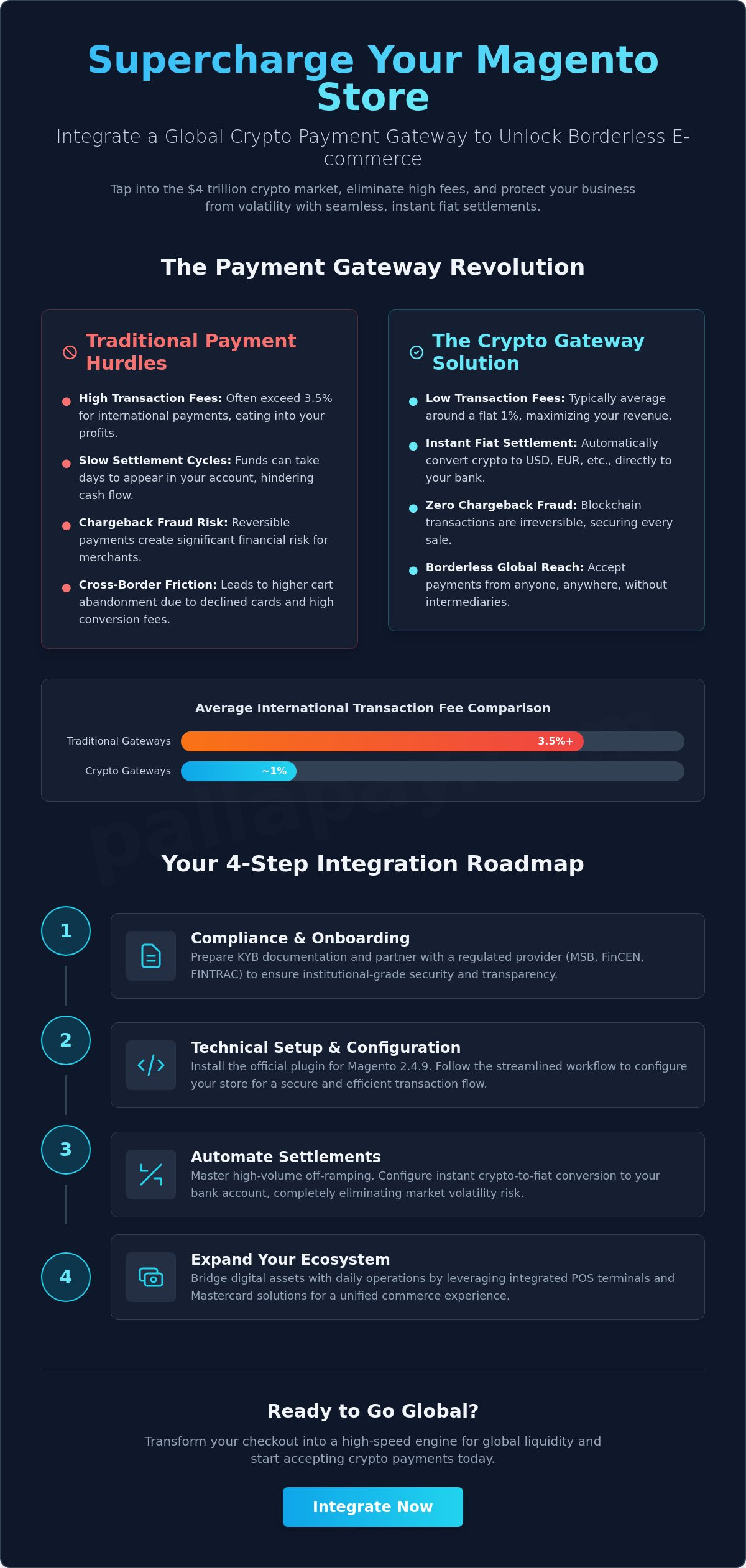
    By 2026, the global cryptocurrency market has exceeded $4 trillion, signaling a permanent shift in how consumers interact with value. Integrating a magento crypto payment gateway is no longer an experimental venture for niche retailers; it’s a strategic necessity for any brand targeting a borderless audience. This technology allows you to bypass the friction inherent in legacy banking systems, offering a direct path to liquidity that traditional processors simply cannot match. It’s about meeting your customers where they are, using the tools they prefer.

    High-ticket retail and luxury sectors have led this transition, recognizing that affluent, crypto-native shoppers demand privacy and speed. When you provide decentralized payment options, you directly address the primary causes of cart abandonment among international customers, such as declined foreign credit cards or excessive currency conversion fees. Because blockchain transactions are irreversible, you effectively eliminate the risk of chargeback fraud. This security feature provides peace of mind for merchants handling significant transaction volumes, as a completed payment is final and settled.

    To understand why this shift is occurring, it helps to look at what is cryptocurrency in the context of modern finance. It’s a digital asset class that operates independently of central authorities, making it the perfect medium for cross-border e-commerce. By removing the middleman, you gain control over your revenue streams and reduce the time it takes for funds to reach your account.

    The Strategic Advantage for Global E-commerce

    Adopting these solutions allows you to capture a massive segment of digitally-wealthy consumers who may be underserved by traditional banking. By positioning your brand as a forward-thinking leader in the ecommerce space, you build trust with a demographic that values technological autonomy. This isn’t just about adding a button at checkout; it’s about signaling that your business is ready for the next evolution of global trade. You gain a competitive edge by offering a payment experience that is as fast and global as the internet itself.

    Lowering Operational Costs with Blockchain

    Operational efficiency is where the utility of blockchain becomes undeniable. While traditional gateways often charge upwards of 3.5% for international transactions, crypto-native solutions typically hover around a 1% average fee. You also remove the hidden costs of intermediary bank fees that usually plague cross-border settlements. For businesses managing a physical retail store alongside an online presence, a unified payment ecosystem ensures that your financial data remains clean and consolidated. This streamlined approach allows you to focus on growth rather than managing a fragmented web of payment providers.

    Pre-Integration Checklist: Preparing Your Magento Store

    Before deploying a magento crypto payment gateway, your first priority is establishing a robust regulatory and operational foundation. Successful integration isn’t merely a technical task; it’s a strategic alignment with institutional financial standards. Choosing a provider that holds Money Services Business (MSB) registrations in major jurisdictions, such as FinCEN in the United States or FINTRAC in Canada, is essential. This ensures your transactions are processed through a transparent, compliant ecosystem that adheres to the latest global anti-money laundering requirements. It protects your business from the scrutiny that often follows the use of unregulated or offshore payment processors.

    You must also define your settlement strategy early in the process. While some merchants choose to hold digital assets, many prefer to convert crypto to fiat instantly to protect their margins from market volatility. This decision dictates how you configure your gateway and which banking details you’ll need to provide during the onboarding phase. Defining this strategy now prevents operational friction once the gateway begins processing live customer orders.

    Establishing Your Merchant Credentials

    The onboarding process for a professional merchant account is thorough and designed to instill trust. You’ll need to gather standard Know Your Business (KYB) documentation, including your company’s articles of incorporation, proof of operational address, and identification for all beneficial owners. Once these documents are submitted to the portal, the verification process begins. This step is vital because it links your corporate identity to the blockchain, allowing for seamless transfers to your linked bank account. If you’re ready to begin, you can create your professional wallet to start the verification process.

    Technical Environment Audit

    Your Magento store must be technically prepared to handle secure API communications. Start by verifying that your SSL certificate is current and uses modern encryption protocols to protect sensitive customer data. It’s also critical to ensure your environment meets the latest crypto security standards to prevent unauthorized access to your payment hooks. Security isn’t just a feature; it’s the backbone of your customers’ trust.

    Before going live, verify that your store is running a compatible version of Magento, such as the 2.4.9 release. We recommend setting up a dedicated staging environment. This allows your development team to test transaction flows, webhook responses, and settlement triggers without impacting your production store. Testing in a sandbox environment ensures that the transition to accepting digital payments is frictionless for your global customers.

    How to Install and Configure the Pallapay Magento Plugin

    Integrating a sophisticated magento crypto payment gateway requires a precise technical execution to ensure the security of your financial data. While the initial setup involves several technical layers, the process is designed to be efficient for developers familiar with the Magento 2 ecosystem. You can access the official Pallapay module through the primary repository or the Magento Marketplace. It’s essential to verify that your installation matches the requirements of Magento 2.4.9 to maintain the highest security standards and framework compatibility.

    Step-by-Step Module Installation

    The most reliable method for deployment is via Composer, as it handles dependencies automatically. Alternatively, you can upload the module files directly to the app/code/Pallapay/Payment directory. Once the files are in place, you must execute a series of standard Magento CLI commands to register the new functionality. This includes running bin/magento setup:upgrade to update the database schema and bin/magento setup:di:compile to generate the necessary code. Finally, deploy the static content and clear the application cache to reveal the configuration options within your admin panel. This systematic approach ensures that the plugin is correctly registered within the Magento framework.

    API Integration and Webhook Setup

    After the module is active, you must synchronize your store with the blockchain by configuring the payment API. Navigate to your merchant dashboard to generate your unique Public and Private API keys. These credentials act as the secure bridge between your Magento storefront and the global liquidity network, facilitating the real-time transfer of value. It’s a direct, benefit-driven connection that empowers your store to handle complex digital assets with the same ease as traditional currency.

    Real-time order status updates are managed through webhooks. You must configure your callback URLs within the dashboard to ensure that when a customer completes a transaction, your store receives an Instant Payment Notification (IPN). This automation eliminates the need for manual order verification. Your fulfillment team can proceed immediately once the blockchain confirms the transfer. This creates a high-speed workflow that mirrors the real-time nature of the operations it facilitates.

    Technical stability is only half the equation. You should also customize the checkout aesthetic to align with your brand’s institutional identity. The plugin allows you to adjust the visibility of specific coins and the layout of the payment modal. By ensuring a cohesive visual flow, you instill a sense of absolute trust in your users. This makes the transition from cart to completed transaction feel like a standard, effortless business operation. A well-designed interface reduces friction and reinforces your position as a forward-thinking strategic partner in the global market.
    Magento Crypto Payment Gateway: The 2026 Merchant Integration Guide

    Managing Settlements and High-Volume Off-Ramping

    High-volume merchants require a sophisticated liquidity engine that goes beyond a simple checkout interface. When your magento crypto payment gateway processes significant transaction volumes, your primary concern shifts from technical integration to capital efficiency. You need a reliable method to convert received cryptocurrency into USD, EUR, or other local currencies instantly. This process ensures that your revenue remains stable despite the dynamic nature of digital asset markets, allowing you to maintain the financial predictability required for institutional growth.

    For enterprise-level operations, the Pallapay off-ramp provides the necessary infrastructure to handle large-scale volume. Unlike basic consumer-grade processors, this system is built to accommodate institutional needs and professional OTC requirements. It allows you to manage your digital assets through the secure Pallapay wallet, which serves as a centralized hub for your store’s global liquidity. This integrated approach ensures that your digital revenue is always accessible and ready for conversion into traditional capital.

    Automated Fiat Settlement

    Protecting your profit margins requires an active approach to volatility management. By setting up ‘Auto-Convert’ features, you can trigger an immediate fiat settlement the moment a transaction is confirmed on the blockchain. This eliminates the risk of price fluctuations during the settlement cycle. Understanding your bank transfer timelines is essential for maintaining consistent business cash flow. You can optimize your withdrawal schedules to align with your corporate accounting cycles, ensuring that funds are available exactly when needed for operational expenses.

    Enterprise Reporting and Analytics

    Transparency is the cornerstone of institutional trust. The merchant dashboard provides comprehensive analytics, allowing you to track sales performance across various coins and regions. You can export this transaction data directly for seamless integration with your existing ERP systems; this simplifies the reconciliation process for your finance team. This level of detail is critical for generating tax-compliant reports that satisfy modern regulatory standards. Pallapay provides real-time audit trails for every transaction to ensure absolute transparency for your accounting department.

    If you’re ready to scale your international operations, explore our high-volume off-ramping solutions to secure your global revenue.

    Why Pallapay is the Definitive Magento Partner in 2026

    Selecting a magento crypto payment gateway is a decision that defines your storefront’s long-term operational stability. In an era where digital assets are central to global commerce, your business requires more than just a technical plugin; it needs a strategic partner that bridges the gap between disruptive innovation and institutional reliability. Pallapay stands as this bridge, providing a secure, utility-focused ecosystem designed to scale alongside your growth. By choosing a provider with a physical presence and a proven track record, you ensure that your payment infrastructure remains a robust asset rather than a technical liability.

    Future-proofing your enterprise means aligning with a partner that anticipates the trajectory of global financial evolution. As regulations become more stringent, having a gateway that is already integrated into the regulated financial landscape is a significant competitive advantage. This partnership allows you to focus on your core business objectives while the complex background processes of blockchain synchronization and liquidity management are handled with professional precision. It’s about building a foundation that supports high-volume transactions without compromising on security or speed.

    Regulatory Trust and Global Compliance

    Compliance is the cornerstone of institutional trust in 2026. Pallapay’s status as a registered Money Services Business (MSB) with FinCEN in the United States and FINTRAC in Canada provides a level of security that unregulated processors cannot match. This compliant infrastructure significantly reduces the risk of account freezes or legal hurdles that often plague merchants using offshore services. For businesses requiring deep liquidity for large-scale corporate moves, leveraging our otc crypto exchange ensures that you can move significant capital with absolute transparency and efficiency. This regulatory alignment protects your brand’s reputation and ensures uninterrupted access to your funds.

    A Unified Financial Ecosystem

    The true power of this partnership lies in the comprehensive nature of the ecosystem. Beyond digital crypto payment gateways, you gain access to a suite of tools that unify your online and offline operations. You can integrate your Magento sales with physical crypto POS machines to create a seamless omnichannel experience for your customers. This integration allows you to expand into specialized sectors such as hotels and luxury travel, where bespoke payment flows are essential. Additionally, you can enhance customer loyalty by rewarding shoppers with digital gift cards, creating a circular economy within your brand that encourages repeat engagement. This unified approach ensures that your business is ready for every facet of the modern digital economy.

    Accelerating Your Global Commerce Strategy

    Integrating a magento crypto payment gateway is the definitive step toward capturing the borderless liquidity of the modern economy. Throughout this guide, we’ve established that technical integration is merely the first phase. Long-term success depends on aligning with a partner that prioritizes institutional reliability and regulatory transparency. By leveraging instant fiat settlements, you effectively eliminate the risks of market volatility while offering your international customers the decentralized payment options they demand.

    Pallapay provides the sophisticated infrastructure needed to manage these complex background processes with effortless precision. As a regulated MSB in both the United States and Canada, we offer a secure bridge between disruptive technology and established financial practices. Our network spans 180+ countries, ensuring that your Magento 2 store is equipped to handle high-volume global trade without the friction of traditional banking. It’s time to transition from experimental adoption to strategic leadership.

    Scale your Magento store today with Pallapay’s secure crypto gateway. Your business is ready for the next evolution of global finance; we’re here to ensure you lead it with confidence.

    Frequently Asked Questions

    Is it safe to accept crypto on my Magento 2 store?

    Accepting crypto on your Magento 2 store is safe when using a regulated provider that adheres to global financial standards. Pallapay operates as a registered Money Services Business in the United States and Canada, ensuring all transactions follow strict AML protocols. Your store remains protected through secure API communication and encrypted webhooks, which prevent unauthorized access and ensure that every payment is verified on the blockchain before order fulfillment begins. This high level of security instills absolute trust.

    Which cryptocurrencies can I accept with the Pallapay Magento plugin?

    The Pallapay Magento plugin allows you to accept major cryptocurrencies including Bitcoin, Ethereum, and USDT. These options allow you to reach a global audience using the most liquid and widely adopted digital assets in the market. The system handles the underlying technical complexities of each blockchain network, providing your customers with a consistent and professional checkout experience regardless of the specific asset they choose. This ensures your global reach remains unfettered by local currency restrictions.

    How do I convert the crypto I receive into fiat currency?

    You can convert received cryptocurrency into fiat instantly by enabling the auto-convert feature in your merchant dashboard. This tool allows you to settle funds in currencies like USD, EUR, or GBP immediately upon transaction confirmation. By using the integrated off-ramp, you can then initiate a crypto to bank transfer, ensuring your revenue is moved into your corporate account without exposure to market price fluctuations. This process provides the financial stability needed for consistent institutional growth.

    Does Pallapay support Magento 2.4 and newer versions?

    The Pallapay plugin fully supports Magento 2.4 and its subsequent releases, including the latest 2.4.9 version. Maintaining compatibility with the latest Magento framework is a priority to ensure that merchants can access the newest security patches and performance improvements. You should always verify your specific environment in a staging area before deploying the module to your production storefront. This ensures a seamless transition and maintains the integrity of your checkout process without disrupting the user experience during payment.

    What are the transaction fees for using a Magento crypto gateway?

    Fees for using a magento crypto payment gateway consist of transaction processing and specific withdrawal costs. While deposit fees are often not charged, you should review the specific withdrawal fee structure for different assets like Bitcoin or USDT. These costs are generally much lower than the 3.5% average charged by traditional credit card processors, allowing you to retain more of your international revenue. This makes blockchain payments a highly cost-effective solution for modern global e-commerce.

    Do I need to have prior knowledge of blockchain to use this plugin?

    Prior knowledge of blockchain technology is not required to use the Pallapay Magento plugin effectively. The interface is designed to make complex technical conversions feel like standard business operations. The system handles the background mechanics of wallet management and blockchain synchronization, allowing your team to focus on order fulfillment and customer service. If you’re familiar with the standard Magento admin panel, you’ll find the configuration process intuitive. This accessibility allows your business to adopt modern advancements easily.

    How long does it take for funds to reach my bank account?

    Fund arrival times vary based on the settlement method and your bank’s specific processing cycles. While fiat conversion happens instantly within the Pallapay ecosystem, external bank transfers follow standard international banking protocols. You can optimize your cash flow by scheduling withdrawals that align with your operational needs, ensuring that your capital is available when required. This flexibility is essential for managing high-volume business operations across different time zones without facing unnecessary and frustrating liquidity delays.

    Can I use the same account for my online store and my physical retail location?

    You can use a single unified account to manage payments for both your Magento e-commerce store and your physical retail locations. This integrated approach allows you to consolidate your financial data and track sales performance across all channels from one dashboard. By pairing your online magento crypto payment gateway with a physical crypto POS machine, you create a cohesive payment ecosystem that simplifies accounting. This provides a consistent experience for your customers whether they shop online or in-person.

    Disclaimer

    The information provided on this website and blog is for general informational and educational purposes only and does not constitute financial, investment, legal, tax, or other professional advice.
    Cryptocurrency and digital asset services may be subject to regulatory restrictions in certain jurisdictions. Users are solely responsible for ensuring compliance with applicable local laws and regulations before using any products or services mentioned on this website.
    PallaPay does not guarantee the accuracy, completeness, or timeliness of any information published and accepts no liability for any loss or damages arising from reliance on the content. Any opinions expressed are those of the respective authors and may change without notice.
    Certain services, features, or products referenced may be provided through third-party partners, licensed entities, or affiliated service providers subject to separate terms and regulatory approvals. Availability of services may vary by country or region.
    This website may contain references to digital assets, virtual currencies, or blockchain-related services that are not available to residents of certain jurisdictions, including where prohibited by law. Nothing on this website constitutes an offer, solicitation, or recommendation to buy or sell any financial instrument or virtual asset.

  • Designing a Crypto Checkout Flow: The 2026 Merchant Integration Guide

    Designing a Crypto Checkout Flow: The 2026 Merchant Integration Guide

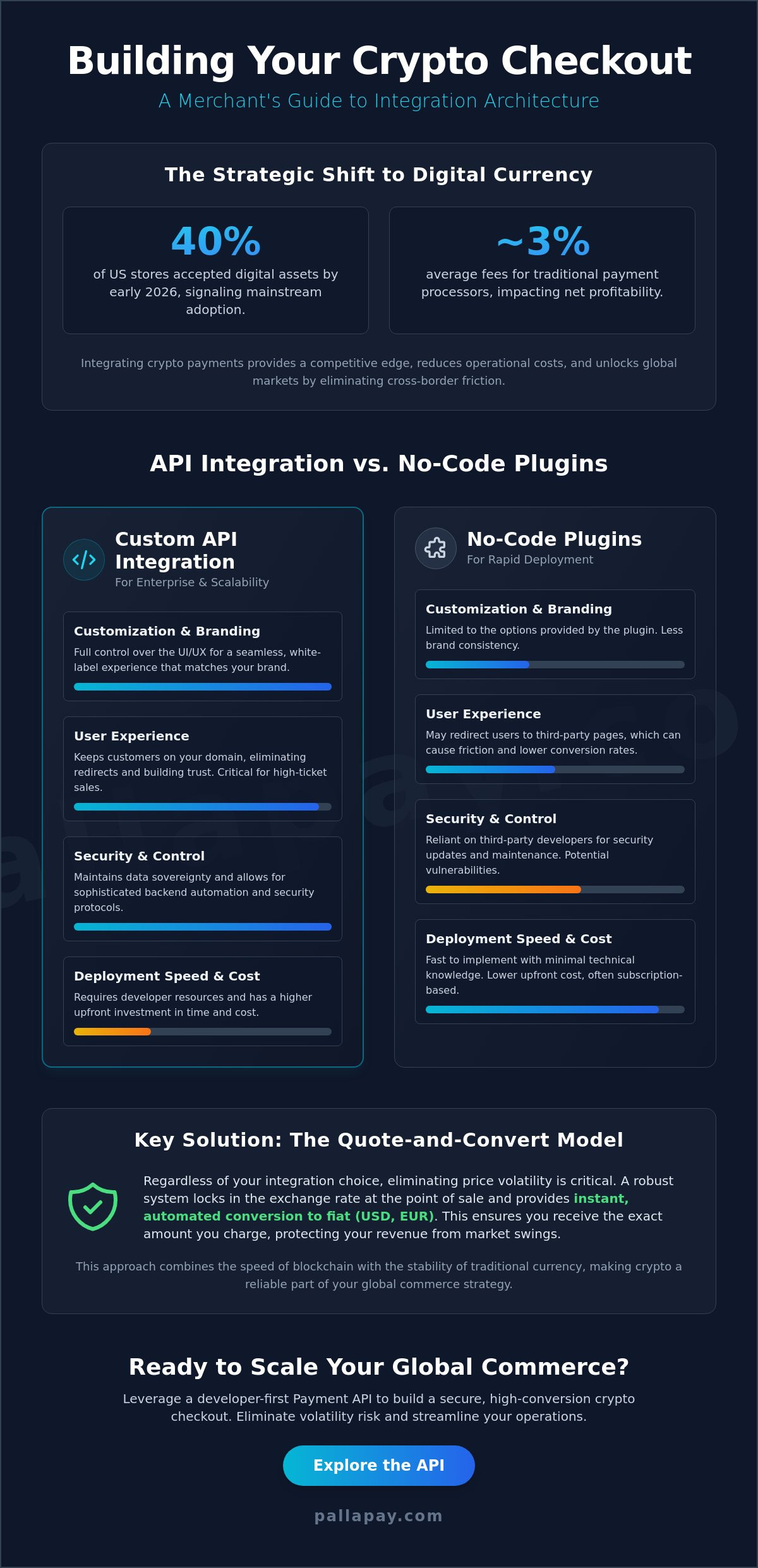
    With 40% of stores in the US now accepting digital assets according to market research from early 2026, the competitive landscape has shifted toward merchants who can offer the most efficient payment experience. You likely recognize that while customers demand flexibility, the technical hurdles of designing a crypto checkout flow often lead to revenue loss through friction or price volatility. It’s frustrating to watch a transaction stall because of slow confirmation times or complex wallet connections. We understand that your priority is a system that feels as reliable as a traditional credit card processor but operates with the speed of the blockchain.

    This guide provides the technical and strategic framework to build a secure, high-converting checkout that eliminates price risk through instant fiat conversion. You’ll learn how to implement a quote-and-convert model that locks in rates, ensuring you receive the exact USD or EUR amount regardless of market swings. We’ll also cover how to integrate an API for crypto payments that simplifies accounting and maintains compliance with the 2025 GENIUS Act and FATF Travel Rule requirements. By the end of this article, you’ll have a clear roadmap for turning crypto into a standard, effortless part of your global commerce operations.

    Key Takeaways

    • Understand the shift toward mainstream crypto adoption and how to capture global demand from tech-savvy demographics and unbanked populations.
    • Master the core principles of designing a crypto checkout flow to reduce friction using QR codes, automated network selection, and WalletConnect integrations.
    • Evaluate the technical trade-offs between bespoke API integrations and streamlined no-code plugins for major CMS platforms like Shopify and Magento.
    • Eliminate volatility risk by implementing automated fiat settlement that locks in exchange rates at the point of sale for instant conversion.
    • Scale your operations by connecting online gateways with physical crypto POS machines and high-volume OTC settlement services for a unified commerce experience.

    The Strategic Shift: Why Your Website Needs a Crypto Checkout in 2026

    The landscape of global commerce has fundamentally altered as digital assets move from speculative holdings to functional currency. Merchants now view understanding digital currencies as a core competency for maintaining a competitive edge in a digital-first economy. When you are designing a crypto checkout flow, you are effectively installing a high-speed liquidity bridge that bypasses the friction of legacy financial systems. This shift is driven by a consumer base that increasingly values the privacy, security, and autonomy inherent in blockchain-based transactions.

    Operational costs remain a primary driver for this transition. Traditional payment processors often levy merchant fees that average 3%, which significantly impacts the net profitability of high-volume businesses. In contrast, optimized crypto gateways offer a much leaner cost structure, allowing organizations to retain a larger portion of their revenue. Industry data from early 2026 indicates that nearly 90% of sellers have received direct requests for crypto options, signaling that consumer preference has reached a critical tipping point for mainstream adoption.

    Global Market Reach and the New Consumer

    Integrating crypto payments allows e-commerce brands to engage with a global audience without the traditional barriers of cross-border banking. This includes high-net-worth individuals who prefer spending their digital assets directly to maintain financial fluidity. By offering these options, you provide a frictionless experience for international customers who would otherwise face high currency exchange fees or transaction declines. It is a strategic expansion into a borderless market that operates beyond the limitations of traditional geography.

    Operational Efficiency: Speed and Security

    The speed of blockchain finality offers a distinct advantage over the multi-day settlement cycles of traditional banking. Once a transaction is confirmed on the ledger, the funds are secure and the risk of chargeback fraud is effectively eliminated. This is particularly critical for high-ticket retail where fraudulent disputes can cause significant financial disruption. Designing a crypto checkout flow also provides a reliable contingency against traditional processor outages, ensuring your storefront remains operational at all times. It is a professional bridge to a more resilient financial future.

    Choosing Your Integration Architecture: API vs. No-Code Plugins

    Decisions regarding technical architecture determine the long-term scalability of your digital storefront. When you’re designing a crypto checkout flow, the primary conflict often lies between the speed of deployment and the depth of customization. Small to mid-sized retailers frequently opt for ready-made solutions to minimize upfront development costs. Conversely, enterprise-level organizations require bespoke integrations to maintain brand consistency and data sovereignty. This choice dictates how your business will handle future volume increases and network upgrades.

    E-commerce Plugins for Rapid Deployment

    CMS plugins for platforms like WordPress, Shopify, and Magento provide a streamlined path to market. These third-party scripts handle the heavy lifting of wallet connectivity and transaction monitoring. However, security remains a paramount concern. It’s essential to ensure your checkout environment is isolated from core customer data to prevent cross-site scripting vulnerabilities. While plugins offer ease of use, they require regular maintenance to remain compatible with evolving blockchain network updates. If a plugin fails to update alongside a major wallet provider, your conversion rates will suffer.

    Custom API Integration for Enterprise Scalability

    For businesses that demand full control over the user journey, a developer-first approach is the definitive choice. Leveraging a Payment API allows you to build a white-label checkout that keeps the customer entirely on your domain. This eliminates the psychological friction caused by redirecting users to external payment pages. You can design every pixel of the interface to align with your brand’s aesthetic, which is a critical factor for building trust in the high-ticket retail sector.

    Custom integrations also allow for sophisticated backend automation through webhooks. These tools provide real-time order status updates, enabling your system to trigger automated fulfillment the moment a transaction reaches the required number of network confirmations. This level of technical maturity ensures that your operations scale without increasing manual overhead. If you’re ready to build a tailored solution, exploring the API for Crypto Payments can provide the robust infrastructure needed for high-volume commerce.

    Hosted payment pages represent a practical middle ground for many growing businesses. They offer a no-code approach where the service provider manages the entire UI, significantly reducing your internal technical and regulatory burden. This is an excellent choice for rapid market entry or for testing crypto demand within a specific product line before committing to a full-scale custom build. Ultimately, the right architecture depends on your internal developer resources and your long-term vision for the customer experience. Selecting the right path early prevents costly migrations later.

    Designing a High-Conversion Crypto Checkout Flow (UX/UI Principles)

    Designing a crypto checkout flow requires a departure from the static input fields of traditional finance toward an interactive, real-time handshake between digital environments. The primary goal is to minimize cognitive load while ensuring absolute precision. By integrating a ‘WalletConnect’ button alongside a high-resolution QR code, you provide a seamless transition for both mobile and desktop users. This dual-path approach facilitates an immediate connection that feels as intuitive as a standard digital wallet payment. It works because it respects the user’s existing habits.

    Transparency is the bedrock of conversion. Your interface must display real-time exchange rates with a clear price-lock countdown, typically lasting 15 to 20 minutes. This prevents the anxiety associated with market volatility during the transaction window. For mobile users, a one-tap payment experience is essential. By deep-linking directly to a secure crypto wallet, you remove the need for manual copying and pasting, which is often where user errors occur. Efficiency in design leads directly to efficiency in settlement.

    Handling Wallet Connectivity and User Errors

    Effective checkout design prioritizes error prevention through smart address validation and clear network labeling. If a user attempts to send Bitcoin to an Ethereum address, the system should flag the incompatibility immediately. Best practices include using dynamic QR codes that embed both the destination address and the exact payment amount to prevent manual entry mistakes. You should also provide brief explanations of network costs to ensure users include enough for the transaction to confirm. These small details reduce support tickets and protect your revenue.

    Optimizing for Trust and Transparency

    Because blockchain transactions aren’t always instantaneous, maintaining a feedback loop is vital for customer retention. A live status bar showing confirmation progress, such as ‘1 of 3 confirmations received,’ keeps the user engaged and reduces the urge to refresh the page. Once the transaction is finalized, an automated email receipt should follow. This receipt must contain the transaction hash for the customer’s records. This level of technical detail provides peace of mind and establishes your brand as a professional entity. Finally, ensure your refund policy is explicitly stated. Clarify how returns are calculated in fiat terms to avoid disputes over price fluctuations. Clear communication builds long-term loyalty.

    Designing a Crypto Checkout Flow: The 2026 Merchant Integration Guide

    Institutional reliability in the digital asset space depends on two critical factors: price stability and regulatory adherence. When you are designing a crypto checkout flow, the primary objective is to convert digital volatility into predictable fiat revenue. This process ensures that the amount your customer pays in Bitcoin or USDT matches the exact value you receive in your business account. By removing the need for merchants to hold volatile assets, the system functions as a professional bridge between innovative payment rails and traditional financial reporting.

    Regulatory clarity has reached a new peak following the 2025 GENIUS Act, which brought payment stablecoins under the Bank Secrecy Act (BSA). As of 2026, 85 out of 117 jurisdictions have implemented the FATF Travel Rule, requiring the sharing of sender and recipient information for transactions. Utilizing a provider with MSB registration in the USA and Canada ensures your operations remain compliant with these evolving standards. This infrastructure provides the “regulatory peace of mind” required for enterprise-level commerce.

    Fiat Settlement: Protecting Your Profit Margins

    Automated fiat settlement is the technological answer to market volatility. The system locks in the exchange rate at the moment of sale, ensuring that a market crash during the transaction confirmation window does not erode your margins. Merchants can choose between threshold-based payouts or scheduled daily and weekly settlements. This flexibility allows for precise cash flow management across multiple currency accounts, including USD, EUR, and GBP. If you need to cover international operational costs, using a crypto off-ramp enables you to move funds directly to your corporate bank account with minimal friction.

    Accounting and Reporting for Digital Revenue

    Modern commerce requires unified reporting that syncs effortlessly with existing ERP systems. Your checkout flow should generate tax-compliant reports that treat crypto sales with the same rigor as credit card transactions. This includes capturing the transaction hash and the fiat value at the time of execution. Handling refunds is a common operational hurdle; the standard practice is to refund the original fiat value rather than the crypto amount. This protects your business from paying back more than was originally received if the asset’s price has increased. High-volume accounts must also maintain strict KYC and AML protocols to satisfy global banking partners. If you are ready to stabilize your digital revenue, you can convert crypto to fiat instantly through our automated settlement engine.

    Scaling with the Pallapay Ecosystem: Beyond the Website

    While designing a crypto checkout flow is the definitive first step toward digital transformation, true operational efficiency comes from integrating these digital rails into a broader, unified ecosystem. A siloed web checkout limits your growth potential by creating data fragmentation between different sales channels. Scalable businesses require a comprehensive architecture that connects online revenue with physical retail operations and corporate spending. This holistic approach ensures that your digital assets are not just a payment option, but a core component of your global financial strategy.

    Unified Commerce: Connecting Web and Retail

    Modern merchants shouldn’t have to manage separate reporting systems for their website and their retail store. By connecting your online gateway with physical Crypto POS machines, you synchronize sales data across all touchpoints in real-time. This centralized approach ensures that inventory levels and revenue tracking remain accurate; it doesn’t matter whether the customer pays via a mobile browser or at a physical counter. You provide a consistent brand experience that builds trust with your global audience while simplifying your internal accounting processes. This level of synchronization is the technological answer to the complexity of omnichannel commerce.

    Advanced Liquidity and Corporate Spending

    High-volume merchants often face liquidity challenges when they need to convert large digital asset holdings into fiat for operational needs. Utilizing an OTC crypto exchange provides the deep liquidity required for enterprise-level settlements without impacting market prices. This infrastructure is essential for businesses that use digital assets for B2B settlements or employee payroll. The journey from your first API call to a fiat withdrawal is designed to be a streamlined, professional progression:

    • Integration: Implement the API for crypto payments to start accepting digital assets on your domain.
    • Settlement: Configure automated fiat settlement to lock in exchange rates and eliminate volatility.
    • Consolidation: View unified revenue data from both web gateways and physical POS terminals.
    • Utilization: Withdraw funds to your corporate bank account or use the Pallapay Mastercard for immediate corporate spending.

    Technical complexity shouldn’t be a barrier to global expansion. Professional merchants in over 180 countries have access to dedicated technical assistance to ensure their systems remain operational. By designing a crypto checkout flow that sits at the center of a wider ecosystem, you bridge the gap between disruptive innovation and institutional reliability. This isn’t just about accepting a new form of payment; it’s about adopting a forward-thinking strategic partner that handles complex background processes so you can focus on growth.

    Future-Proofing Your Global Commerce Strategy

    Adopting digital asset payments is no longer a speculative choice; it’s a strategic necessity for merchants seeking to capture a global, tech-savvy market. By prioritizing a friction-free user experience and implementing automated fiat settlement, you eliminate the traditional barriers of price volatility and technical complexity. Designing a crypto checkout flow is the essential first step in building this professional bridge between innovative financial technology and institutional reliability. You’ve seen how a unified architecture ensures that your online data remains synchronized with your physical retail operations, creating a truly omnichannel business model.

    Pallapay provides the robust infrastructure needed to facilitate this evolution. As a regulated MSB in the USA and Canada, we offer the security and compliance required for large-scale operations. Our ecosystem supports global settlements in over 180 countries and includes a Red Dot Award-winning POS system for your physical storefronts. This comprehensive approach allows you to focus on your core business while we handle the background mechanics of secure, real-time conversions. Integrate the Pallapay Payment API today to secure your place in the inevitable global evolution of commerce. Your business is ready for the next level of financial efficiency.

    Frequently Asked Questions

    How long does it take to integrate crypto payments on a website?

    Integration time varies from minutes to days based on your specific technical approach. No-code plugins offer immediate activation for standard e-commerce stores; however, designing a crypto checkout flow with a custom API provides the scalability required for enterprise operations. This flexibility allows you to choose the implementation speed that matches your current resource availability. Most merchants find they can go live with basic functionality in under an hour.

    Do I need to hold cryptocurrency on my balance sheet to accept it?

    You don’t need to hold cryptocurrency on your balance sheet to accept it as a payment method. Most professional gateways offer automated fiat settlement that converts digital assets into USD, EUR, or other local currencies immediately at the point of sale. This approach eliminates balance sheet volatility and simplifies your tax reporting by treating the transaction like a standard fiat sale. It’s an efficient way to modernize your payment stack.

    What are the transaction fees for crypto payments compared to credit cards?

    Crypto transaction fees are typically lower than the 3% average associated with traditional credit card processing. By reducing the reliance on legacy banking intermediaries and complex settlement networks, digital payments provide a more cost-effective alternative for global commerce. This reduction in overhead helps merchants preserve their profit margins on every international sale. Lower fees mean your business retains more revenue without sacrificing the speed of transaction confirmation.

    Is it safe to accept Bitcoin and USDT on an e-commerce store?

    Accepting Bitcoin and USDT is safe when using a gateway that prioritizes institutional-grade security and regulatory compliance. The permanent nature of blockchain records removes the threat of chargeback fraud; this is a significant advantage over traditional credit card systems. Designing a crypto checkout flow through a regulated provider ensures your business stays aligned with the latest global financial standards. It provides a secure environment for both your store and your customers.

    Can I automatically convert crypto payments to USD or EUR?

    You can automatically convert digital payments to major fiat currencies like USD, EUR, or GBP using an instant settlement feature. This tool locks in the exchange rate the moment the customer completes the transaction at your checkout. It ensures you receive the exact fiat amount regardless of any subsequent market fluctuations or price swings. This functionality provides the stability needed to manage a predictable and reliable business cash flow.

    How do I handle customer refunds for crypto transactions?

    Refunds are typically processed based on the original fiat value of the transaction rather than the specific amount of crypto sent. This practice protects your business from asset price increases that might occur after the purchase was finalized. Most professional gateways provide a dedicated merchant dashboard to manage these payouts efficiently and transparently. Clear communication with your customers about this policy helps maintain trust and prevents disputes during the return process.

    Which cryptocurrencies should my business accept in 2026?

    Your business should prioritize high-liquidity assets like Bitcoin, Ethereum, and stablecoins such as USDT in 2026. Stablecoins are particularly effective for everyday commerce because they mirror the value of traditional fiat currencies and minimize price risk. Offering a mix of these assets ensures you reach the widest possible demographic of digital wallet holders globally. This variety allows your customers to choose the asset that best fits their personal financial preferences.

    Do I need a special bank account to receive fiat settlements from crypto sales?

    You don’t need a special bank account to receive fiat settlements from your crypto sales. Standard business bank accounts are fully compatible with the fiat transfers initiated by your payment gateway provider. The gateway acts as the professional bridge; it converts the crypto and sends the resulting fiat via standard bank transfer rails. This ensures that your digital revenue integrates seamlessly with your existing financial infrastructure without requiring new banking relationships.

    Disclaimer

    The information provided on this website and blog is for general informational and educational purposes only and does not constitute financial, investment, legal, tax, or other professional advice.
    Cryptocurrency and digital asset services may be subject to regulatory restrictions in certain jurisdictions. Users are solely responsible for ensuring compliance with applicable local laws and regulations before using any products or services mentioned on this website.
    PallaPay does not guarantee the accuracy, completeness, or timeliness of any information published and accepts no liability for any loss or damages arising from reliance on the content. Any opinions expressed are those of the respective authors and may change without notice.
    Certain services, features, or products referenced may be provided through third-party partners, licensed entities, or affiliated service providers subject to separate terms and regulatory approvals. Availability of services may vary by country or region.
    This website may contain references to digital assets, virtual currencies, or blockchain-related services that are not available to residents of certain jurisdictions, including where prohibited by law. Nothing on this website constitutes an offer, solicitation, or recommendation to buy or sell any financial instrument or virtual asset.

  • ROI of Crypto Payment Gateway: The 2026 Guide to Merchant Profitability

    ROI of Crypto Payment Gateway: The 2026 Guide to Merchant Profitability

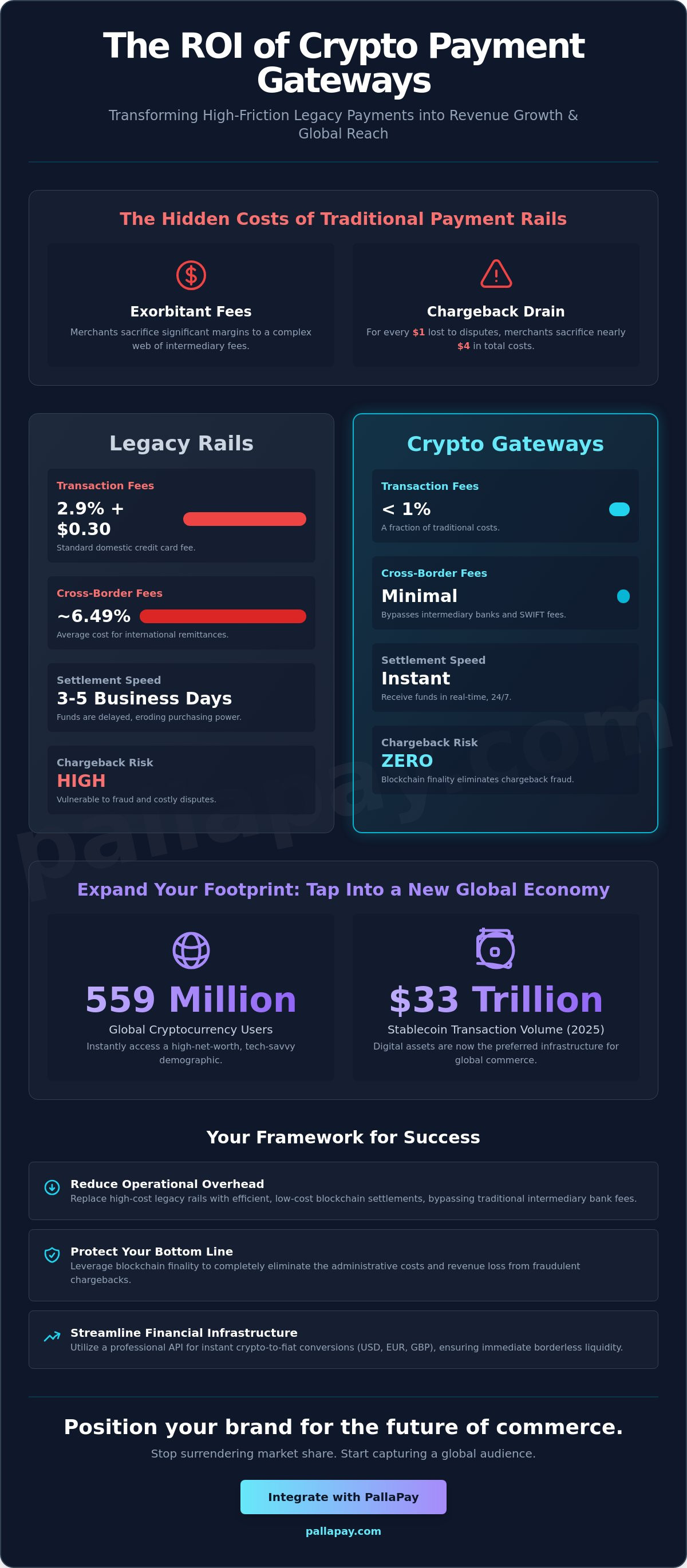
    While over 70 million Americans now hold digital assets, the average merchant continues to sacrifice nearly four dollars for every single dollar lost to legacy chargeback disputes. You likely recognize that high transaction fees and slow settlements are a significant drain on your bottom line. Understanding the roi of crypto payment gateway integration is the first step toward reclaiming these lost margins and securing institutional-grade financial stability.

    This guide demonstrates how a professional crypto payment gateway transforms operational costs into revenue growth through a detailed ROI framework. You’ll learn how to replace high-friction legacy rails with efficient blockchain settlements that effectively eliminate chargeback fraud. This strategic transition provides immediate access to a global market of 559 million high-net-worth users who prioritize speed and security.

    We’ll analyze the mechanics of instant crypto-to-fiat conversion and explain why stablecoins are now the backbone of global commerce. By adopting a professional API for crypto payments, your business can accelerate its progress toward borderless liquidity. This evolution ensures your financial operations are as fast and secure as the digital economy requires, positioning your brand as a forward-thinking partner in the inevitable global evolution of money.

    Key Takeaways

    • Reduce operational overhead by replacing high-friction legacy rails with low-cost blockchain settlements that bypass traditional intermediary bank fees.
    • Protect your bottom line by leveraging blockchain finality to eliminate the administrative costs and revenue loss associated with fraudulent chargebacks.
    • Utilize our 2026 merchant framework to quantify the total roi of crypto payment gateway adoption, factoring in both direct savings and indirect competitive advantages.
    • Expand your global footprint instantly by tapping into a high-average-order-value demographic that prefers the speed and security of digital asset transactions.
    • Streamline your financial infrastructure with an API for crypto payments that enables instant conversion to fiat currencies like USD, EUR, and GBP.

    The Fundamentals of Crypto Payment Gateway ROI

    Calculating the true roi of crypto payment gateway adoption requires a perspective that extends beyond simple line-item transaction fees. While traditional processors often extract significant margins through a complex web of interchange and assessment fees, digital asset rails offer a streamlined alternative. Modern merchants view this transition as a strategic pivot toward global liquidity. Pallapay facilitates this shift by providing an integrated API for crypto payments, ensuring that digital asset inflows are converted into usable fiat capital with minimal friction.

    The primary drivers of this return include direct fee reduction, accelerated settlement speed, and the acquisition of a previously unreachable customer base. Traditional systems rely on aging infrastructure that introduces latency and cost at every hop. In contrast, blockchain technology enables a direct relationship between the merchant and the consumer, removing the intermediaries that traditionally erode profitability.

    Direct vs. Indirect ROI: A Dual Framework

    Direct ROI is easily quantified through immediate cost reductions. When you bypass the 2.9% plus $0.30 standard credit card fee, the savings accumulate rapidly across high-volume operations. These direct gains are further amplified in cross-border commerce, where traditional remittance costs average 6.49%, whereas crypto gateways typically operate at a fraction of that cost. Indirect ROI is found in the reduction of administrative overhead. By utilizing a cryptocurrency payment ecosystem, businesses eliminate the time-intensive labor of managing chargeback disputes and reconciling delayed settlements. In high-inflation environments, the value of instant settlement is vital; receiving funds in real-time protects purchasing power that would otherwise erode during a standard three-to-five-day banking delay.

    The Opportunity Cost of Traditional-Only Payments

    The year 2026 marks a definitive tipping point for global commerce. With approximately 559 million people, nearly 10% of the global population, now owning cryptocurrency, failing to provide these payment options is no longer a neutral stance; it’s a deliberate surrender of market share. Stablecoin transaction volumes reached $33 trillion in 2025, signaling that digital assets are no longer speculative tools but are instead the preferred infrastructure for retail and B2B settlements.

    For global e-commerce merchants, the opportunity cost is the measurable loss of high-intent, high-net-worth customers who abandon carts when their preferred borderless payment method is unavailable. By integrating a crypto payment gateway for ecommerce, you transform your checkout from a local bottleneck into a global revenue engine. Understanding the roi of crypto payment gateway metrics allows you to see that the cost of integration is dwarfed by the value of capturing this expanding market of 559 million users.

    Maximizing Margins: Reducing Transaction and Cross-Border Costs

    Every basis point counts in high-volume commerce. Traditional payment processing typically drains 2.9% plus a $0.30 flat fee from every transaction. When you factor in the additional layers of cross-border commerce, these costs escalate quickly. Traditional international remittances average 6.49% according to industry data. This multi-layered fee structure is a primary reason why the roi of crypto payment gateway implementation is so high for modern merchants. By moving from legacy rails to blockchain infrastructure, you directly reclaim these lost margins and protect your operational capital.

    Legacy Rails vs. Blockchain Infrastructure

    Legacy payment systems are inherently inefficient. They rely on a chain of three to five separate parties, including issuing banks, acquiring banks, and card networks, each taking a cut. This fragmentation causes settlement delays and hidden costs that are often difficult to track. Pallapay streamlines this value chain by facilitating peer-to-peer transfers that remove unnecessary middlemen. While a standard SWIFT transfer often incurs multiple flat fees and percentage-based intermediary costs, blockchain gas costs are typically a fraction of that amount, regardless of the transaction’s geographic destination. This directness doesn’t just save money; it creates a more transparent financial environment for your treasury team.

    Optimizing Global Liquidity with Fiat Payouts

    Volatility is a common concern for merchants entering the digital asset space. You can eliminate this risk through fiat settlement solutions that lock in rates at the moment of transaction. This ensures that the value you receive remains stable and predictable. By utilizing a professional crypto off-ramp, you can convert digital assets into USD, EUR, or GBP instantly. This capability allows for more efficient management of global payroll and vendor payments with significantly lower overhead than traditional bank transfers. It’s a practical way to manage liquidity without being exposed to market fluctuations.

    For businesses operating in the e-commerce industry, speed is a competitive advantage. The roi of crypto payment gateway adoption is most visible in the transition to T+0 settlement. Instead of waiting days for funds to clear through the traditional banking system, you gain immediate access to your capital. This rapid cycle improves your working capital efficiency, allowing you to reinvest in inventory or marketing without the friction of traditional waiting periods. If you’re looking to enhance your cash flow, exploring an efficient crypto off-ramp can provide the liquidity your business needs to scale effectively.

    Risk Mitigation: The ROI of Zero Chargebacks

    Standard credit card processing relies on a “pull” mechanism that exposes your business to significant revenue loss. Chargebacks are projected to cost e-commerce entities $41.69 billion by 2028, with U.S. merchants losing up to $4.61 in total costs for every dollar disputed. The roi of crypto payment gateway adoption becomes evident when you eliminate this inherent vulnerability. By switching to blockchain-based rails, you effectively stop the financial bleed caused by friendly fraud and the associated fees that traditional processors levy regardless of the dispute outcome.

    Digital asset transactions use a “push” architecture where the customer must authorize and initiate the transfer. Once the network confirms the transaction, it’s final and irreversible. This finality is a core driver of the roi of crypto payment gateway success, as it removes the administrative burden of dispute management. Your accounting team can stop fighting fraudulent claims and start focusing on scaling your core operations. This shift transforms a defensive department into a growth-oriented asset by reclaiming hundreds of hours of labor every year.

    The Finality of Blockchain Transactions

    Transaction finality provides a critical layer of protection for high-ticket retail and luxury hotels. In these sectors, a single fraudulent reversal can wipe out the profit margins of dozens of legitimate sales. Traditional banking disputes often tie up capital for months, creating uncertainty that hampers reinvestment. Blockchain finality offers the psychological ROI of absolute certainty; you know the funds are secure the moment the network confirms the block. This predictability is vital for maintaining healthy cash flow in high-stakes environments where liquidity is the primary engine of progress.

    Security and Compliance as Financial Assets

    Security isn’t just a technical requirement; it’s a measurable financial asset that safeguards your bottom line. Implementing institutional-grade crypto security ensures that your capital remains shielded from external threats and internal errors. Partnering with a provider that maintains MSB registration also reduces the risk of regulatory friction or sudden account freezes. A major fraud event can paralyze your business for weeks and permanently damage your standing with financial partners. The preventative nature of blockchain technology acts as a permanent hedge against these operational catastrophes, reinforcing your long-term profitability.

    ROI of Crypto Payment Gateway: The 2026 Guide to Merchant Profitability

    Revenue Expansion: Tapping into New Global Markets

    While cost reduction provides a stable foundation, the most compelling roi of crypto payment gateway integration is the immediate expansion of your addressable market. By 2026, approximately 559 million people globally own digital assets, representing nearly 10% of the world’s population. This demographic is not just large; it’s exceptionally liquid. For merchants, this means accessing a “crypto-rich” customer base that traditional credit card rails often fail to reach effectively. Capturing this market allows you to convert operational readiness into sustained revenue growth.

    Attracting High-Net-Worth Digital Asset Holders

    Data indicates that cryptocurrency users frequently demonstrate higher average order values (AOV) compared to traditional consumers. This trend is particularly visible in retail stores where high-ticket items are common. These customers prioritize the utility of their digital wealth, often spending more per transaction when they can avoid the friction of converting to fiat first. The marketing ROI is equally significant. By positioning your brand as a supportive partner in the digital economy, you build institutional trust and loyalty among a demographic that values technological forward-thinking.

    Frictionless Global Commerce

    A sophisticated crypto payment gateway functions as a bridge to over 180 countries instantly. It eliminates the “country risk” often associated with traditional payment processors that might flag or block transactions from specific emerging economies. This accessibility is vital for reducing cart abandonment. International customers who lack access to traditional credit cards can use digital assets as their primary medium of exchange. To further enhance this ecosystem, integrating gift card solutions allows you to build a circular economy of loyalty and repeat business.

    The transition to global commerce is most efficient when technical barriers are removed. The roi of crypto payment gateway adoption is ultimately measured by the speed at which you can enter these new markets. Leveraging high-performance payment APIs ensures that your checkout process remains fast and secure. This integration allows your business to scale without the need for complex local banking relationships in every territory. To start capturing this global demand, you can integrate our advanced payment API to streamline your international transaction flow today.

    The 2026 Merchant ROI Framework: Measuring Success

    Quantifying the roi of crypto payment gateway adoption requires a shift from qualitative expectations to a rigorous, data-driven framework. You can’t manage what you don’t measure. To build an accurate projection, start by auditing your current legacy processing overhead, including interchange fees, monthly minimums, and the hidden costs of delayed settlements. By comparing these figures against the streamlined fee structures of digital asset rails, you establish a baseline for your expected yield. Pallapay optimizes the total cost of ownership by removing the complexity of multi-provider setups, offering an integrated ecosystem that handles everything from the initial transaction to fiat settlement.

    Your framework should also account for the reclaimed capital currently lost to the traditional “pull” payment model. Since U.S. merchants incur between $3.75 and $4.61 for every dollar lost to chargebacks, the elimination of these disputes provides a massive boost to net profitability. When you factor in the 9.9% global crypto adoption rate, the roi of crypto payment gateway integration becomes a calculation of both immediate savings and captured market share that your competitors are likely ignoring.

    KPIs for Crypto Payment Success

    To track the performance of your integration, focus on three primary Key Performance Indicators. First, monitor your Transaction Cost Savings (TCS) by calculating the delta between legacy card fees and your current gateway costs. Second, measure your New Customer Acquisition Rate (NCAR) by identifying the percentage of transactions initiated by users who utilize digital assets exclusively. Finally, evaluate your Chargeback Reduction Value (CRV). This isn’t just the dollar value of the transactions saved, but also the total administrative hours your team no longer spends on manual dispute resolution. These metrics provide a clear picture of how digital assets are strengthening your balance sheet.

    Implementation and Scaling with Pallapay

    Finding the ROI sweet spot often depends on your technical approach. For businesses seeking a rapid market entry, low-code solutions offer a fast path to liquidity with minimal upfront investment. However, larger enterprises often prefer a custom integration via a robust payment API to maintain full control over the user experience and data flow. As your digital asset volume grows, you can scale these operations from online checkouts to physical environments using a crypto POS machine, creating a unified omnichannel presence. This flexibility ensures that your infrastructure evolves alongside consumer preferences without requiring a complete system overhaul.

    A typical merchant can expect to see a full return on their integration costs within the first four months of operation, with the 12-month outlook showing a compounded increase in net margins as global adoption continues its inevitable upward trajectory.

    Securing Your Competitive Advantage in the Digital Economy

    The transition from legacy payment rails to blockchain-based infrastructure is a strategic necessity for the modern merchant. By eliminating the multi-billion dollar chargeback problem and bypassing the high costs of traditional cross-border intermediaries, you protect your capital and accelerate your growth. It’s clear that the total roi of crypto payment gateway adoption is realized through a combination of immediate fee reductions and the acquisition of a liquid, global customer base.

    Pallapay provides the stability you need as an MSB registered entity in the USA and Canada. Our institutional-grade security infrastructure ensures your digital assets remain protected while enabling instant fiat settlement in over 20 currencies. This integrated approach removes the friction of modern commerce, allowing you to focus on scaling your operations with absolute confidence. It’s time to bridge the gap between traditional practices and modern advancements.

    Calculate your merchant ROI with Pallapay’s secure gateway and start transforming your operational costs into a strategic asset today. Your business is ready for the next stage of global evolution.

    Frequently Asked Questions

    What is the average ROI timeline for a crypto payment gateway?

    Most merchants achieve a full return on their integration costs within approximately four months of operation. This timeline is driven by the immediate reduction in transaction fees and the elimination of chargeback administrative costs. As global adoption continues to rise, the long-term yield compounds through increased access to high-net-worth digital asset holders who demonstrate higher average order values.

    How do crypto transaction fees compare to traditional credit card fees in 2026?

    Crypto transaction fees are substantially lower than the standard 2.9% plus $0.30 typically charged by legacy credit card processors. While traditional rails involve multiple intermediaries who each extract a margin, blockchain technology facilitates direct peer-to-peer transfers. This efficiency allows businesses to reclaim a larger portion of their revenue on every sale, particularly in high-volume retail environments.

    Can a crypto payment gateway actually eliminate chargebacks?

    A crypto payment gateway effectively eliminates the risk of fraudulent chargebacks through the use of irreversible “push” payments. Unlike traditional “pull” systems where a processor can reverse a transaction, blockchain finality ensures that once a transfer is confirmed, the funds cannot be withdrawn by the consumer. This protection is a primary driver of the roi of crypto payment gateway adoption for online merchants.

    What are the hidden costs of implementing a crypto payment system?

    Potential hidden costs include network gas fees and exchange spreads during the conversion process. Merchants should also account for the initial labor required for API integration or POS hardware setup. These one-time or variable expenses are typically offset by the long-term savings gained from bypassing international remittance fees and the administrative burden of traditional banking delays.

    How does instant fiat settlement protect my ROI from market volatility?

    Instant fiat settlement protects your margins by locking in the exchange rate at the exact moment of the transaction. This process ensures that the volatility of digital assets doesn’t affect your final payout in currencies like USD, EUR, or GBP. By converting crypto to fiat instantly, your business maintains predictable cash flow while still catering to the expanding global market of digital asset holders.

    Is a crypto payment gateway secure enough for institutional use?

    Modern gateways provide institutional-grade security infrastructure designed to meet the rigorous standards of global financial entities. Professional providers maintain MSB registration in jurisdictions like the USA and Canada to ensure full regulatory compliance. These systems utilize advanced encryption and multi-signature protocols to protect digital liquidity from unauthorized access, providing a stable bridge between traditional finance and modern innovation.

    Do I need technical expertise to see a positive ROI from crypto payments?

    You don’t need deep technical expertise to achieve a positive roi of crypto payment gateway implementation. Many providers offer low-code solutions or plug-and-play modules for major e-commerce platforms that allow for rapid deployment. While a custom API integration offers more control for large enterprises, simple interfaces enable any business to start accepting digital assets and reaping the financial benefits with minimal training.

    How does accepting crypto improve customer acquisition costs (CAC)?

    Accepting crypto improves customer acquisition costs by positioning your brand as a preferred destination for the 559 million global digital asset owners. This demographic often seeks out merchants that support their preferred payment methods, reducing the need for expensive traditional advertising to reach high-intent shoppers. By offering a borderless payment method, you attract international customers who would otherwise be excluded by local banking limitations.

    Disclaimer

    The information provided on this website and blog is for general informational and educational purposes only and does not constitute financial, investment, legal, tax, or other professional advice.
    Cryptocurrency and digital asset services may be subject to regulatory restrictions in certain jurisdictions. Users are solely responsible for ensuring compliance with applicable local laws and regulations before using any products or services mentioned on this website.
    PallaPay does not guarantee the accuracy, completeness, or timeliness of any information published and accepts no liability for any loss or damages arising from reliance on the content. Any opinions expressed are those of the respective authors and may change without notice.
    Certain services, features, or products referenced may be provided through third-party partners, licensed entities, or affiliated service providers subject to separate terms and regulatory approvals. Availability of services may vary by country or region.
    This website may contain references to digital assets, virtual currencies, or blockchain-related services that are not available to residents of certain jurisdictions, including where prohibited by law. Nothing on this website constitutes an offer, solicitation, or recommendation to buy or sell any financial instrument or virtual asset.