

In 2026, market price swings are no longer an acceptable excuse for stagnant business growth. While Bitcoin fluctuates between $77,000 and $80,000, many leaders remain hesitant because they fear a sudden crash could erase their operational margins. You’re right to be cautious; manual exchange processes are slow and regulatory deadlines like the July 1 MiCA cutoff in the EU add layers of complexity. However, protecting business from crypto volatility has evolved from a complex hedging strategy into a standard, automated utility.
You don’t have to be a market speculator to benefit from the $4 trillion digital asset economy. This article explains how to accept payments and scale your operations without ever being exposed to market price fluctuations. We’ll explore the transition to a set and forget payment system that utilizes instant conversion to local currency and regulated settlement routes. By the end of this guide, you’ll understand how to integrate a crypto payment gateway that handles the technical background processes, ensuring every transaction settles as stable fiat in your account.
Key Takeaways
- Identify and close the settlement gap by neutralizing the time delay between customer payment and fiat receipt.
- Utilize automated fiat conversion to lock in real-time exchange rates, ensuring your profit margins remain unaffected by sudden market shifts.
- Deploy stablecoins like USDT and USDC as strategic buffers to facilitate secure and predictable international B2B settlements.
- Build a resilient infrastructure for protecting business from crypto volatility by integrating regulated payment APIs with official MSB registrations.
- Scale your operations with institutional-grade OTC support and crypto-to-bank transfer routes designed for compliant, high-volume shielding.
What is Crypto Volatility and Why Does it Challenge Modern Business?
Crypto volatility represents the rapid, often unpredictable price fluctuations of digital assets over condensed timeframes. For a trader, these swings are an opportunity for profit; for a business owner, they represent an operational threat. To understand What is Cryptocurrency and its inherent behavior, one must recognize that price action is driven by market sentiment and liquidity rather than traditional quarterly earnings. While a 5% daily move is standard in digital markets, it can be catastrophic for a company operating on thin margins.
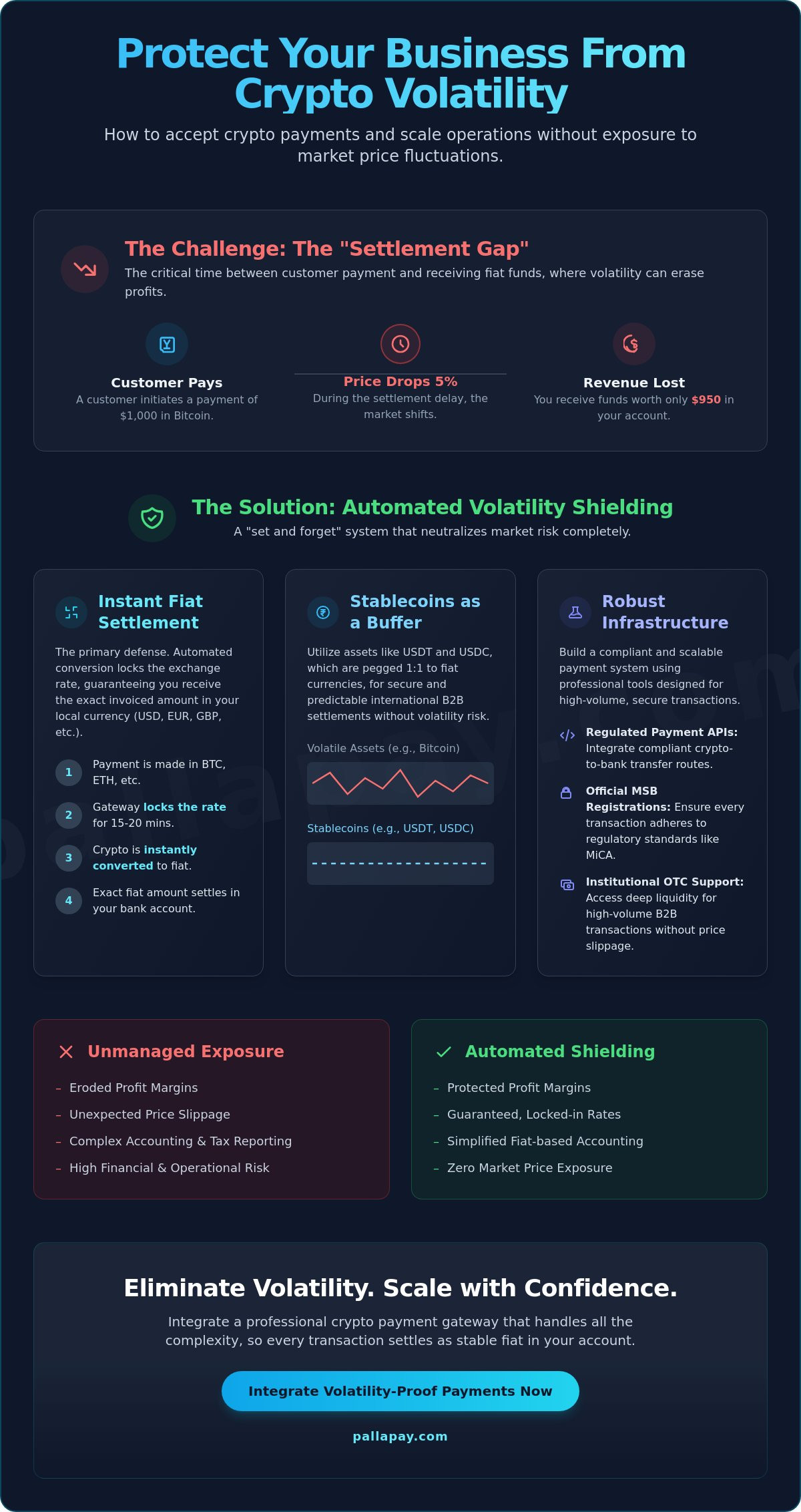
The primary challenge for merchants lies in the “Settlement Gap.” This is the critical window between the moment a customer initiates a payment and the moment the business receives usable funds in their bank account. If the asset value drops during this interval, the merchant effectively loses revenue before the transaction even clears. Protecting business from crypto volatility requires closing this gap through automated fiat settlement systems that provide an immediate hedge against market movement.
The Hidden Costs of Unmanaged Fluctuations
Unmanaged exposure erodes profit margins, especially during high-velocity sell-offs where prices can drop faster than manual exchange processes can clear. Beyond direct losses, accounting teams face significant complexities when the value of an asset shifts between the time an invoice is issued and the final audit. Price slippage occurs when the final execution price of a trade differs from the requested price due to market movement or insufficient liquidity, often resulting in unexpected costs for high-ticket B2B transactions. These friction points turn a modern payment method into a financial liability without the right shielding tools.
Why 2026 Market Dynamics Require a Proactive Stance
By mid-2026, the landscape has shifted due to massive institutional participation and maturing regulatory frameworks. With Bitcoin trading between $77,000 and $80,000 as of May 2026, and the scheduled launch of CME Group’s Bitcoin Volatility futures on June 1, price movements have become more sophisticated and faster. Liquidity now plays a dual role; deep liquidity can stabilize prices, yet global economic shifts can trigger rapid business-day swings that catch unprepared merchants off guard. Protecting business from crypto volatility is no longer about avoiding digital assets, but about using professional infrastructure to neutralize their erratic nature. Modern commerce demands a proactive stance where volatility is managed as a technical variable rather than a financial risk.
The Mechanics of Instant Fiat Settlement: Your Primary Defense
Relying on manual trading to manage digital assets is a high-stakes gamble that few corporations can afford. Protecting business from crypto volatility becomes a seamless background process through the implementation of instant fiat settlement. A professional gateway functions as a sophisticated buffer; it locks the exchange rate for a specific transaction window, typically between 15 and 20 minutes. This lock-in ensures that the amount of local currency you expect is exactly what arrives in your treasury, regardless of market movements during the confirmation process.
The technological engine behind this is fiat settlement, which facilitates the automated conversion of assets like Bitcoin or Ethereum into USD, EUR, GBP, or CNY. This process removes the need for your company to hold volatile assets on its balance sheet. By choosing instant settlement over batch processing, you maintain superior cash flow and avoid the risk of overnight price drops that frequently plague unshielded accounts. It’s the difference between managing a currency and managing a risk.
Eliminating Exchange Rate Risk at the Point of Sale
Gateways calculate real-time spreads by connecting to institutional liquidity providers. These providers guarantee the locked price, absorbing the market risk so your business doesn’t have to. This automated workflow eliminates the human error and delay associated with manual trading. It’s a strategic shift from speculative uncertainty to operational stability. Businesses looking to automate this transition often integrate a crypto payment API to synchronize sales with financial records in real-time.
Streamlining Accounting and Tax Compliance
Receiving fiat directly simplifies VAT and corporate tax reporting significantly. It establishes a clear 1:1 ratio between the invoice amount and the settled bank deposit, which is essential for audit transparency. When you settle directly to bank accounts, you bypass the friction of digital asset custody.
- Direct fiat settlement removes the need for complex capital gains calculations on every individual sale.
- It allows for seamless integration with standard ERP systems, ensuring your books remain balanced without manual intervention.
- Financial teams can treat these transactions as standard bank transfers rather than digital asset movements, reducing the training required for staff.
This approach turns a disruptive technology into a standard, effortless business operation. By removing the volatility variable, you focus on growth while the gateway handles the underlying mechanics of currency conversion.
Stablecoins: Using USDT and USDC as a Strategic Buffer
While instant fiat conversion is the premier defense for retail transactions, many B2B operations require a more flexible medium for holding digital value. Stablecoins are digital assets pegged 1:1 to traditional currencies like the US Dollar, combining the borderless efficiency of blockchain with the price predictability of fiat. By utilizing these assets, you create a strategic layer for protecting business from crypto volatility without needing to exit the digital ecosystem entirely. As of March 2026, USDT maintains its position as a primary liquidity tool with a market capitalization of approximately $183.6 billion, while USDC has grown to $75.3 billion, largely due to its alignment with the GENIUS Act in the United States and MiCA regulations in Europe.
The operational utility of stablecoins relies on a reliable transition between digital and traditional finance. Converting these assets into bank transfers or physical cash is handled through professional off-ramp services, which act as a vital bridge for global liquidity. This infrastructure allows a business to accept USDT from an international client and move it into a corporate bank account with the same speed and security as a local wire transfer. It’s a sophisticated method for protecting business from crypto volatility while maintaining the ability to deploy capital whenever it’s needed.
Cross-Border Payments Without the Swing
Traditional SWIFT transfers are often slow and burdened by high intermediary fees. Stablecoins bypass these legacy bottlenecks, allowing businesses to pay global suppliers instantly at any hour. This is particularly advantageous during “weekend” market gaps when traditional banks are closed but digital markets remain active. By settling in USDT or USDC, you ensure that the value sent on Friday is the same value received on Saturday, regardless of how Bitcoin or Ethereum might perform over the weekend. It’s an essential tool for maintaining price consistency across complex supply chains.
Managing Liquidity with Digital Wallets
A secure crypto wallet serves as more than just storage; it’s a command center for holding operational reserves. Professional teams use these wallets to balance fiat holdings with stablecoin liquidity, allowing for rapid re-investment or settlement without waiting for traditional banking cycles. In 2026, audited and fiat-backed stablecoins operate within a mature regulatory framework, providing a transparent and secure foundation for corporate treasury management. This integrated approach ensures that your business remains agile and liquid, regardless of broader market fluctuations.
Building a Volatility-Resistant Infrastructure for Retail and Web
Establishing a robust infrastructure requires a multi-layered approach that bridges digital and physical sales channels. Protecting business from crypto volatility is most effective when the protection is baked into the hardware and software used daily. First, prioritize a regulated provider with official MSB registrations in credible jurisdictions like the US and Canada to ensure compliance and institutional trust. Second, integrate a crypto payment API to automate web checkouts and eliminate manual conversion delays. Third, for physical locations, deploy Crypto POS machines that lock in rates at the moment of sale. Fourth, configure auto-withdraw settings to move funds to your bank account daily. Finally, train your finance team to view these assets as a high-speed payment rail rather than a speculative investment.
This systematic deployment turns a complex financial challenge into a standard operational workflow. By automating the conversion and withdrawal process, you ensure that your treasury remains liquid and denominated in the currency you use to pay your bills. Protecting business from crypto volatility isn’t about predicting the market; it’s about building a system that doesn’t care what the market does.
Unified Protection for Omni-channel Commerce
Managing online and offline sales through a single dashboard provides a comprehensive view of global liquidity and transaction history. For retail stores, this setup allows staff to process transactions without needing to manage private keys or understand blockchain mechanics. Hardware-level encryption in POS terminals ensures that every swipe or scan is secure, providing institutional-grade safety at the point of sale. This unified approach eliminates the data silos that often lead to accounting errors in multi-channel businesses.
Future-Proofing with Advanced Payment APIs
Advanced APIs allow you to display prices in local fiat while accepting digital assets, ensuring that your customers see familiar figures while you avoid market risk. This is crucial for e-commerce platforms scaling to a global audience with multi-currency support. Managing refunds and chargebacks becomes a standard accounting task when the system automatically calculates the fiat-equivalent value at the time of the transaction. This level of automation allows you to scale from local sales to global distribution without increasing your financial risk profile.
Ready to secure your revenue streams? Integrate a professional payment API to automate your volatility protection and streamline your global checkouts.
Why Pallapay is the Professional Choice for Volatility Management
Pallapay stands as a definitive destination for corporations seeking to bridge the gap between disruptive innovation and institutional financial reliability. By maintaining official MSB registrations in the United States and Canada, the platform provides a foundation of trust that many unregulated entities cannot match. This regulatory standing is essential for protecting business from crypto volatility, as it ensures that every conversion and settlement follows strict compliance protocols. Businesses gain access to a comprehensive, integrated ecosystem that includes a robust crypto payment gateway, physical POS machines, and the Pallapay Mastercard. This suite of tools allows you to manage digital assets as easily as traditional fiat, creating a seamless environment for modern commerce without the friction of multiple third-party providers.
The brand functions as a professional bridge that connects established practices with modern advancements. By providing a single destination for all technical needs, it removes the complexity of managing disparate systems. This personality is reliable, efficient, and highly focused on empowering the user. It projects an image of a sophisticated partner that handles complex background processes, allowing you to focus on your core business growth while the infrastructure handles the market dynamics.
Institutional Security and Compliance
Adhering to rigorous crypto security standards is a core requirement for safeguarding merchant funds in 2026. Working with a regulated entity significantly reduces the risk of exposure to “dirty” cryptocurrency, which can lead to frozen accounts and legal complications. Pallapay acts as a professional facilitator, ensuring that all digital assets entering your treasury are vetted and compliant with international anti-money laundering standards. This level of institutional-grade oversight is a powerful tool for business expansion into over 180 countries. It gives your finance team the confidence to accept payments from diverse markets while knowing that the underlying technical background processes are handled by a sophisticated strategic partner.
High-Volume Shielding with OTC Services
Large-scale enterprises often require specialized handling for high-value transactions that exceed standard gateway limits. Through OTC crypto exchanges, businesses can move millions of dollars in assets without triggering market price slippage. This private, high-volume shielding is supported by a global network of physical offices that provide personalized corporate settlement assistance. These locations serve as a professional bridge, allowing for direct cash-to-crypto or crypto-to-bank transfers in a secure environment. It’s an efficient way to manage large-scale liquidity while protecting business from crypto volatility at every step of the conversion process, ensuring that institutional users maintain absolute stability.
Strategic stability is the hallmark of a successful 2026 enterprise. By integrating these tools, you transform digital assets into a reliable utility for growth. Protect your business from volatility with Pallapay today and join a global network of professionals who prioritize security and speed.
Secure Your Global Revenue Strategy
The evolution of digital finance in 2026 has transformed market swings from a merchant’s nightmare into a manageable technical variable. By implementing instant fiat settlement and leveraging regulated stablecoin buffers, you’ve seen that liquidity and stability can coexist within a single ecosystem. Protecting business from crypto volatility is no longer a matter of timing the market; it’s about selecting the right institutional-grade infrastructure to automate your treasury flows. This proactive approach ensures your profit margins remain intact while you tap into a maturing $4 trillion global economy.
Pallapay provides this essential bridge, offering MSB-registered security in the USA and Canada while serving professional clients across 180+ countries. You can now accept digital assets with the absolute confidence of instant fiat settlement in USD, EUR, and other major currencies. Secure your business margins with Pallapay’s regulated payment gateway and turn disruptive innovation into a standard, effortless business operation. Your enterprise is ready to lead in a borderless market. Take the next step toward a stable, high-growth future today.
Frequently Asked Questions
How can a business accept Bitcoin without being exposed to its volatility?
You can accept Bitcoin safely by using a crypto payment gateway that facilitates instant fiat conversion at the point of sale. This system locks the exchange rate for the duration of the transaction window, ensuring you receive the exact local currency amount. By converting the asset immediately, your business avoids the risk of holding a digital asset that might decrease in value before you can manually exchange it.
Is it better to settle in fiat currency or keep stablecoins in 2026?
The decision depends on your treasury needs; fiat settlement provides immediate stability for local expenses while stablecoins offer high-speed liquidity for international B2B settlements. Many corporations choose fiat for retail operations to simplify accounting and tax reporting. Stablecoins like USDT or USDC are often reserved for paying global suppliers or maintaining digital reserves that don’t require traditional banking hours to move.
What is the difference between a crypto exchange and a merchant payment gateway?
A merchant payment gateway is a specialized tool for commercial transactions that prioritizes rate locks and automated settlement, whereas an exchange is built for trading and speculation. Gateways provide the essential infrastructure for protecting business from crypto volatility by removing the need for manual trading. They integrate directly with your sales platform to ensure that every transaction settles into your bank account as a standard currency deposit.
Can I set my own exchange rates when accepting crypto payments?
Merchants typically don’t set their own rates because the gateway provides a real-time institutional rate at the moment of checkout. This rate is pulled from deep liquidity providers to ensure it remains competitive and accurate for the customer. Attempting to set manual rates would likely lead to significant price slippage or lost sales due to uncompetitive pricing compared to the global market average.
How do I handle taxes if the crypto price changes before I sell it?
You should consult a qualified tax professional to understand the specific reporting requirements in your region. Using a gateway that converts crypto to fiat instantly simplifies this task by establishing a clear cost basis at the exact moment of the sale. This creates a transparent, 1:1 record between your invoice and your bank deposit, which is vital for maintaining compliant records during a corporate audit.
What are the fees for protecting a business from crypto volatility?
Fees for volatility protection are generally integrated into the transaction spread or charged as a small percentage of the total volume processed through the gateway. You should review the specific service agreement of your provider to understand the costs associated with POS machines or API integrations. The cost of protecting business from crypto volatility is usually far lower than the potential revenue loss from a single market crash.
Is a Crypto POS machine safer than a standard wallet for my store?
A Crypto POS machine is much safer for retail environments because it uses hardware-level encryption and prevents staff from accessing private keys. Standard wallets are designed for individual custody and lack the multi-user permissions and reporting features required for a commercial setting. POS systems are purpose-built to handle high-velocity sales and facilitate instant settlement into your corporate accounts without manual intervention.
How long does it take to convert crypto to a bank transfer?
The conversion from crypto to fiat is often instant through a professional gateway, while the transfer to your bank account depends on standard banking network speeds. Most off-ramp services facilitate these transfers within the same business day or the next, depending on the destination currency and bank. Automated withdrawal settings can be configured to ensure your funds move from the gateway to your bank account on a recurring daily schedule.
Disclaimer
The information provided on this website and blog is for general informational and educational purposes only and does not constitute financial, investment, legal, tax, or other professional advice.
Cryptocurrency and digital asset services may be subject to regulatory restrictions in certain jurisdictions. Users are solely responsible for ensuring compliance with applicable local laws and regulations before using any products or services mentioned on this website.
PallaPay does not guarantee the accuracy, completeness, or timeliness of any information published and accepts no liability for any loss or damages arising from reliance on the content. Any opinions expressed are those of the respective authors and may change without notice.
Certain services, features, or products referenced may be provided through third-party partners, licensed entities, or affiliated service providers subject to separate terms and regulatory approvals. Availability of services may vary by country or region.
This website may contain references to digital assets, virtual currencies, or blockchain-related services that are not available to residents of certain jurisdictions, including where prohibited by law. Nothing on this website constitutes an offer, solicitation, or recommendation to buy or sell any financial instrument or virtual asset.