
What if the most powerful way to spend your cryptocurrency has nothing to do with buying coffee or booking flights? Most people holding digital assets are thinking too small, and the market knows it. The question of how to spend cryptocurrency has evolved far beyond retail convenience, and in 2026, the real opportunity sits in the world’s most liquid and dynamic financial markets: Forex and Gold.
You already sense that your digital capital deserves more than a transaction. That frustration with low utility, the feeling that your assets are sitting idle while global markets move billions daily, is entirely valid. The volatility you’ve been watching from the sidelines is not a threat; it’s an invitation. Gold CFD trading and USD-based Forex positions offer a structured, high-potential arena where deployed crypto capital can work with real strategic purpose.
This article maps a clear path from digital asset holder to informed market participant. You’ll understand how CFD instruments like XAU/USD work, why Forex markets offer unique advantages for crypto-native traders, and how a regulated, secure platform can serve as your professional gateway into these markets without the complexity that typically holds people back.
Key Takeaways
- The most effective way to understand how to spend cryptocurrency in 2026 goes far beyond retail purchases — deploying digital capital into Forex and Gold CFD markets unlocks significantly higher financial potential.
- CFD trading on instruments like XAU/USD allows crypto holders to gain leveraged exposure to Gold price movements without the logistical burden of owning physical bullion.
- USD-based Forex pairs offer crypto-native traders a structured, highly liquid environment where capital can be actively positioned rather than passively held.
- The mindset shift from “spending” to “building” is the critical first step toward using trading as a genuine income-replacement strategy rather than a speculative side activity.
- A regulated, professional-grade platform is the non-negotiable foundation for safely converting and deploying crypto capital into live trading markets with confidence.
Beyond Retail: Redefining How to Spend Cryptocurrency in 2026
Crypto utility has undergone a quiet but fundamental transformation. What began as a peer-to-peer payment experiment has matured into a global capital system, and the holders who recognize this shift earliest are the ones positioned to benefit most. The conversation around how to spend cryptocurrency is no longer just about where your digital assets are accepted; it’s about what those assets can do when deployed with genuine strategic intent.
The Opportunity Cost of Traditional Spending
Every time a crypto holder converts Bitcoin or Ethereum to purchase consumer goods, they’re making a financial decision with a hidden cost. That cost isn’t just the transaction fee. It’s the foregone upside of capital that could have been actively working in a high-liquidity market.
Consider the contrast in practical terms:
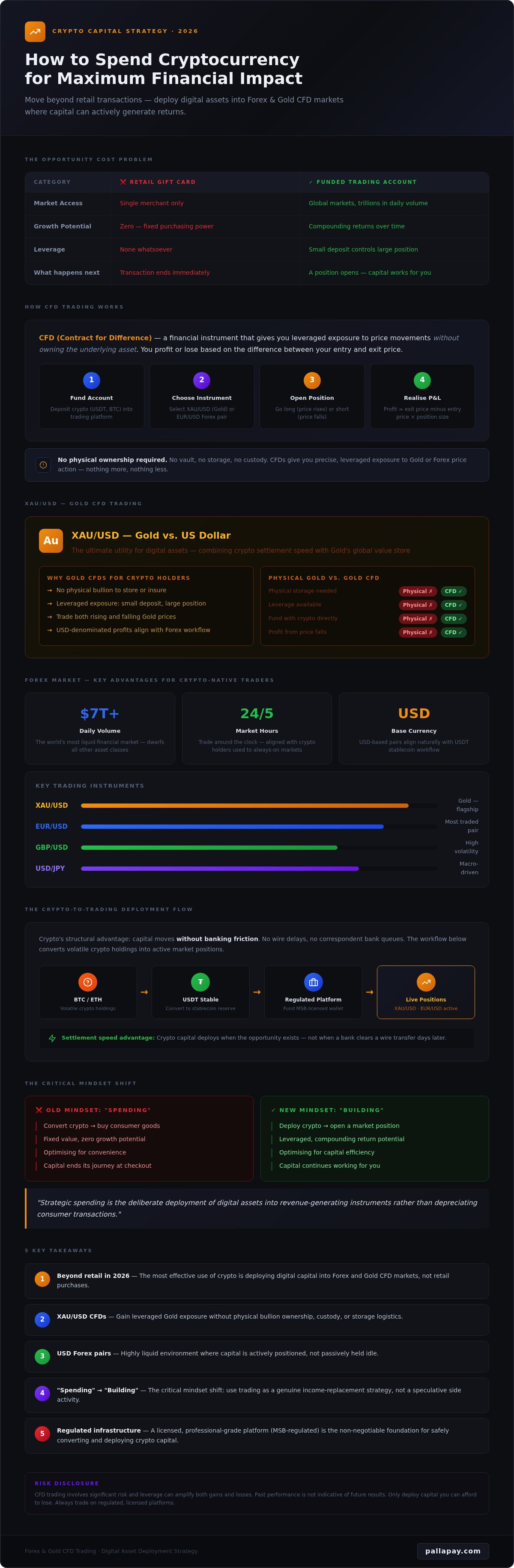
- A retail gift card gives you fixed purchasing power against a single merchant, with zero potential for growth and no financial leverage whatsoever.
- A funded Forex or CFD trading account gives you access to markets moving trillions in daily volume, where disciplined positioning on instruments like XAU/USD can generate returns that compound over time.
The difference isn’t subtle. One transaction ends the moment you swipe; the other opens a position. Strategic spending is the deliberate deployment of digital assets into revenue-generating instruments rather than depreciating consumer transactions.
Platforms that list coffee shops and electronics retailers as the primary answer to crypto utility are solving the wrong problem. They’re optimizing for convenience when the real question is capital efficiency.
Crypto as a Global Liquidity Tool
Digital assets have an underappreciated structural advantage: they move across borders without the friction that traditional banking systems impose. Wire transfers have cut-off times, correspondent bank delays, and compliance layers that slow capital deployment by days. Crypto doesn’t.
This speed advantage is precisely why serious traders are increasingly using digital assets to fund Forex and CFD accounts directly. The capital moves when the opportunity exists, not when a bank clears the transfer.
Stablecoins like USDT sit at the center of this workflow. They preserve dollar-denominated value while retaining crypto’s settlement speed, making them the practical bridge between the digital asset world and live trading markets. Converting volatile holdings into USDT first creates a stable, deployable reserve that’s ready to move the moment a trading account needs funding.
The Pallapay Wallet functions as exactly this kind of deployment hub. As a regulated MSB operating across major financial jurisdictions, Pallapay provides the secure infrastructure needed to hold, convert, and move digital capital toward professional trading environments without the operational complexity that typically creates friction at this stage. It’s the point where digital asset management meets institutional-grade financial utility, and it’s where the question of how to spend cryptocurrency gets its most sophisticated answer.
Spending Crypto on Forex: The Mechanics of CFD Trading
CFD trading, or Contract for Difference trading, is the mechanism that transforms a static digital asset holding into an active market position. Rather than purchasing an underlying asset outright, a CFD allows you to take a position on the price movement of that asset, whether it’s a currency pair like EUR/USD or a commodity like Gold. You profit or lose based on the difference between the entry and exit price of the contract. No physical ownership. No custody logistics. Just precise, leveraged exposure to global price action.
For crypto holders thinking seriously about how to spend cryptocurrency with genuine financial intent, this structure is the answer. Capital converted from USDT or Bitcoin into a funded trading account doesn’t sit idle. It’s deployed into markets processing trillions in daily volume, where disciplined positioning can generate returns that no retail transaction can replicate.
Leverage is the mechanic that makes small allocations consequential. A modest crypto-derived deposit can control a position many times its nominal value. A 1:100 leverage ratio, for example, means a $500 deposit controls a $50,000 market position. The amplification works in both directions, which is precisely why understanding it matters before deploying capital.
Forex Basics for the Crypto Native
Crypto traders already understand volatility. That instinct transfers directly into Forex, where price swings in pairs like EUR/USD or GBP/USD are driven by macroeconomic forces: interest rate decisions, inflation data, geopolitical shifts. The Dollar sits at the center of this system, making USD-based pairs the highest-liquidity instruments available and the most logical starting point for crypto-native traders entering Forex markets.
CFDs add a critical structural advantage: you can profit in both rising and falling markets. Going long means you’re positioned for price appreciation. Going short means you profit when prices decline. This bidirectional flexibility is something most retail crypto holders never access, and it fundamentally changes how capital can be deployed across different market conditions.
Forex markets operate five days a week across overlapping global sessions, covering Asian, European, and American trading hours. That near-continuous availability aligns naturally with the always-on mindset of crypto-native participants.
Managing Risk in High-Stakes Environments
Leverage without discipline is not a strategy; it’s exposure. The traders who build sustainable performance from crypto-derived capital share one common practice: they define their risk before they enter a position, not after.
A professional risk framework rests on three non-negotiable habits:
- Stop-loss orders: Pre-set exit points that automatically close a position if the market moves against you beyond a defined threshold. They remove emotion from the exit decision entirely.
- Position sizing: Never allocating more than a fixed percentage of total capital to a single trade. Risking 1-2% per position preserves the account through inevitable losing streaks.
- Trade journaling: Recording every entry, exit, and rationale builds a data set that reveals patterns in your own decision-making, separating repeatable edges from lucky outcomes.
The shift from speculative gambler to strategic trader isn’t philosophical. It’s procedural. When you treat each trade as a business decision governed by pre-defined parameters, the question of how to spend cryptocurrency stops being about transactions and starts being about capital management at a professional level.
Getting your capital into a position to execute these strategies starts with a reliable, secure off-ramp. The Pallapay off-ramp provides the structured crypto-to-fiat conversion that ensures your trading capital arrives in your account cleanly, quickly, and without the operational friction that delays market entry when timing matters most.
Trading Gold (XAU/USD): The Ultimate Utility for Digital Assets
Bitcoin and Gold share a philosophical foundation that most financial commentators still underestimate. Both assets exist outside the direct control of central banks. Both have fixed or constrained supply schedules. Both attract capital when confidence in fiat monetary systems erodes. This isn’t coincidence; it’s a structural alignment that makes Gold the most natural market destination for crypto-native capital looking to extend its hard money logic into a different asset class.
The question of how to spend cryptocurrency finds one of its most compelling answers here. XAU/USD, the Gold-to-Dollar pair, represents one of the most liquid and strategically meaningful instruments available to retail traders. It moves on inflation data, central bank policy, geopolitical tension, and dollar strength, all forces that crypto holders already track instinctively. That existing market awareness translates directly into an edge when reading Gold price action.
Physical Gold vs. Gold CFDs
Buying physical bullion is the answer that most traditional finance sources give to crypto holders interested in Gold. It’s also the least efficient answer available. Storage fees, insurance costs, dealer premiums, and the sheer illiquidity of converting a gold bar back into deployable capital make physical ownership a poor fit for anyone who values speed and flexibility.
Gold CFDs solve every one of those friction points simultaneously.
| Criteria | Physical Gold Purchase | Gold CFD Trading (XAU/USD) |
|---|---|---|
| Entry Speed | Days to weeks (sourcing, delivery, verification) | Instant execution at live market price |
| Ongoing Costs | Storage fees, insurance, dealer premiums | Spread and overnight financing only |
| Liquidity | Low; requires a buyer and physical transfer | High; positions close in seconds at market price |
| Directional Flexibility | Long only; profit only when price rises | Long and short; profit in both rising and falling markets |
For digital asset holders, the CFD structure isn’t just more convenient; it’s a fundamentally different category of financial instrument. You’re not warehousing a commodity. You’re taking a precise, leveraged position on its price movement, with the ability to exit that position the moment your analysis changes.
Gold as a Safe Haven in Volatile Times
Crypto market cycles have a documented relationship with Gold price behavior. During periods of broad risk-off sentiment, when crypto markets correct sharply and liquidity contracts, Gold has historically absorbed capital flows from investors seeking stability. That pattern creates a specific strategic window for crypto traders: rotating gains from high-volatility digital assets into XAU/USD positions during peak euphoria phases can preserve capital and capture a counter-cyclical move simultaneously.
XAU/USD acts as a stabilizer for a digital-first portfolio by providing a fundamentally different volatility profile, one driven by macroeconomic forces rather than sentiment cycles, which creates a natural counterweight when crypto markets overheat.
The practical execution of this strategy depends entirely on how quickly capital can move from digital holdings into a funded trading position. Delays at the conversion stage mean missed entries. The Pallapay off-ramp addresses this directly, providing a structured, regulated pathway from crypto to trading-ready fiat that eliminates the operational lag between market insight and market action. When Gold is signaling a move, your capital needs to be positioned before the move completes, not after the transfer clears.
This is precisely why understanding how to spend cryptocurrency through instruments like XAU/USD represents a generational upgrade over any retail transaction. The asset isn’t consumed; it’s deployed, actively working against one of the world’s most historically reliable stores of value.
Financial Transformation: Changing Your Life Through Trading
The most consequential shift in a trader’s journey isn’t technical. It’s conceptual. The moment you stop asking how to spend cryptocurrency and start asking how to build with it, the entire financial landscape reorganizes itself around a different set of possibilities. Spending terminates capital. Building compounds it. That single reorientation separates the traders who generate consistent returns from those who cycle through cycles of speculation and regret.
Forex and Gold CFD trading aren’t get-rich-quick mechanisms. They’re professional disciplines with learnable structures, measurable edges, and genuine income-replacement potential for those who approach them with the same seriousness they’d apply to any skilled vocation. The Reddit narrative that trading is “just luck” survives only because most people enter without a framework. The framework is the difference.
Real-world examples of this transformation follow a recognizable pattern. A trader starts with a modest funded account, applies disciplined position sizing across USD-based pairs, and builds a performance record over six to twelve months. That record becomes the foundation for scaling. Larger position sizes, compounding returns, and eventually a monthly income stream that operates independently of any employer. The progression isn’t mythological; it’s procedural.
The Path to Professional Trading
Professional-level performance requires three sequential investments: education, practice, and infrastructure. Education means understanding how macroeconomic events drive price action in instruments like XAU/USD. Practice means executing on a demo account until your strategy is proven before real capital is at risk. Infrastructure means operating on a platform that provides institutional-grade execution, reliable leverage tools, and clean capital pathways.
Consistent strategies built around defined entry signals, fixed risk parameters, and disciplined exit rules outperform “moonshot” crypto bets over any meaningful time horizon. Volatility without structure is just noise. Volatility with a tested system is an income source.
2026 represents a specific inflection point for this transition. Crypto-to-Forex integration has matured to the point where the operational barriers that once separated digital asset holders from professional trading environments have been largely eliminated. The infrastructure now exists to move capital from a crypto wallet into a live trading account with a speed and reliability that simply wasn’t available three years ago.
Achieving True Financial Sovereignty
Location-independent wealth generation is the practical outcome of trading mastery. A funded Forex account doesn’t care where you’re physically located. It executes your positions against global markets regardless of timezone or geography. That structural freedom is qualitatively different from any employment arrangement, and it’s accessible to anyone willing to build the competency required to sustain it.
Reducing reliance on traditional employment doesn’t happen overnight, but it does happen through deliberate, staged capital deployment. The Pallapay ecosystem supports this long-term trajectory by providing the regulated, integrated infrastructure needed at every stage: from securing and converting digital assets through the Pallapay off-ramp, to managing deployment capital with the stability and compliance that serious traders require. It’s not a single transaction tool; it’s a financial architecture designed for the kind of sustained, professional-grade activity that genuine independence demands.
Start building that architecture today by exploring how Pallapay’s regulated ecosystem can serve as the operational foundation for your trading journey.
Getting Started: How to Spend Your Crypto on Trading Today
Knowledge without execution is just theory. The four steps below translate everything covered in this article into a concrete operational sequence, taking you from digital asset holder to funded, active trader with a clear plan in place.
Step 1: Secure your assets in a professional-grade wallet. Before any capital moves toward a trading account, it needs a stable, regulated home. The Pallapay Wallet provides exactly that: a compliant, MSB-regulated environment where you can hold, convert, and stage your digital assets without the custodial risks associated with unregulated alternatives. Convert volatile holdings into USDT here first. Stability at this stage protects your deployment capital from crypto price swings before it ever reaches a broker.
Step 2: Select a high-performance Forex and CFD broker. Your broker is your market access point, and the selection criteria are non-negotiable. Regulatory status comes first. Instrument availability comes second; confirm the broker supports XAU/USD and major USD-based Forex pairs before committing capital. Execution speed, leverage options, and platform reliability round out the evaluation. A broker that doesn’t offer Gold CFDs is the wrong broker for this strategy.
Step 3: Use a secure off-ramp to fund your account. This is where speed and compliance intersect. The Pallapay off-ramp converts your crypto into trading-ready fiat cleanly and quickly, eliminating the delays that cost traders entry points. When Gold signals a move, you need capital already positioned, not clearing a bank transfer.
Step 4: Execute your first trade with a plan, not a hope. Define your entry signal, set your stop-loss before you open the position, and size the trade within your pre-set risk parameters. Your first trade isn’t about profit; it’s about process. Execute the framework correctly, and the results follow over time.
Selecting Your Gateway and Broker
A regulated bridge like Pallapay earns its place in this workflow through compliance credibility, conversion speed, and integration capability. For traders who need programmatic or high-volume funding flows, the Pallapay Payment API supports seamless, automated capital movement between your crypto holdings and your broker account. That infrastructure removes the manual friction from a process that needs to be repeatable and reliable at scale.
Your First 90 Days as a Strategic Trader
Set one goal for your first 90 days: protect capital while building process. Realistic targets mean accepting small, consistent positions over aggressive sizing. Keep a trading journal from day one; it’s the only tool that converts experience into a repeatable edge. Avoid the two most common beginner errors: overleveraging early and abandoning a strategy after a single losing trade.
Understanding how to spend cryptocurrency with genuine strategic intent is a learnable discipline, not a talent. For a broader framework covering the full spectrum of crypto utility in 2026, the How to Spend Cryptocurrency: The Complete 2026 Utility Guide provides the comprehensive context that makes every step above more effective. The infrastructure is ready. The markets are open. The only remaining variable is your decision to start.
Your Capital Deserves More Than a Transaction
The answer to how to spend cryptocurrency in 2026 isn’t found in merchant directories or gift card exchanges. It’s found in the disciplined deployment of digital capital into markets where Gold CFDs, USD-based Forex pairs, and leveraged positions create genuine financial momentum. That’s the core shift this article has mapped: from consumption to construction, from passive holding to active positioning.
Three things matter most as you move forward. First, capital efficiency beats convenience every time. Second, structured risk management is what separates sustainable traders from one-cycle speculators. Third, the infrastructure you use to move and convert your assets is just as important as the strategy you trade with.
Pallapay provides that infrastructure as a regulated financial technology provider operating across 180+ countries, with secure POS and gateway solutions built for serious participants. The ecosystem is designed to support every stage of your trading journey, from initial conversion to active deployment.
The markets are open. Your capital is ready. Start your financial transformation with Pallapay today and put your digital assets to work with the professional foundation they deserve.
Frequently Asked Questions
How do I spend my cryptocurrency on Forex trading without high fees?
The most effective approach is converting your crypto to USDT first, then using a regulated off-ramp to transfer trading-ready fiat to your broker account. USDT conversions typically carry tighter spreads than direct Bitcoin-to-fiat conversions, which reduces your total cost before a single trade is placed. Choosing a broker with competitive spreads on USD-based pairs further minimizes the fee drag on your capital.
Avoid platforms that charge layered fees at every conversion stage. A streamlined pathway, from crypto wallet to off-ramp to funded broker account, keeps your capital intact and your entry costs predictable from the start.
Can I trade Gold (XAU/USD) directly with Bitcoin or USDT?
Most regulated Forex and CFD brokers require fiat-denominated account funding, so you can’t open an XAU/USD position directly from a crypto wallet. The practical workflow is converting USDT or Bitcoin into fiat through a regulated off-ramp, depositing that fiat into your trading account, and then executing your Gold CFD position. The conversion step is fast when the right infrastructure is in place, and it doesn’t meaningfully delay your market entry.
USDT is the preferred starting point because its dollar-pegged value means your capital doesn’t fluctuate during the conversion window, unlike Bitcoin or Ethereum, which can move significantly between the moment you initiate a transfer and the moment it clears.
What is the best way to convert crypto to fiat for trading purposes?
Speed and compliance are the two criteria that matter most for trading-oriented conversions. A regulated off-ramp that converts crypto to fiat cleanly, without multi-day bank delays, is the practical answer to how to spend cryptocurrency with genuine market intent. The Pallapay off-ramp is built specifically for this use case, providing a structured, MSB-regulated conversion pathway that gets your capital into a broker-ready state quickly.
Converting to a stablecoin like USDT before initiating the off-ramp adds an extra layer of protection. It locks in your dollar value while the transfer processes, ensuring the amount that arrives in your trading account matches what you intended to deploy.
Is CFD trading more profitable than just holding cryptocurrency?
Passive holding generates returns only when prices rise, and it requires you to time both entry and exit correctly across a single direction. CFD trading, by contrast, allows you to profit in both rising and falling markets, and leverage amplifies returns on smaller capital allocations. A disciplined trader with a tested system operating on instruments like XAU/USD can generate returns across multiple market conditions that a static hold position simply can’t replicate.
That said, profitability in CFD trading is directly tied to process quality. Traders who apply consistent risk parameters and defined entry signals outperform those who treat positions as speculative bets. The instrument is more capable; the outcome depends entirely on the discipline applied to it.
What are the risks of using leverage when trading Forex with crypto?
Leverage amplifies both gains and losses proportionally. A 1:100 leverage ratio means a 1% adverse move against your position results in a 100% loss of your deposited margin for that trade. Without stop-loss orders and disciplined position sizing, a single overleveraged trade can eliminate a substantial portion of your account. This is the most common way underprepared traders lose capital quickly.
The practical safeguard is never risking more than 1-2% of your total account on any single position, regardless of how confident you feel about the setup. Leverage is a precision tool, not a shortcut. Used within a structured risk framework, it’s what makes modest crypto-derived deposits capable of controlling meaningful market positions.
How does Pallapay ensure the security of my funds during the off-ramp process?
Pallapay operates as a regulated Money Services Business in the US and Canada, which means the off-ramp process is subject to formal compliance requirements rather than discretionary policies. That regulatory framework governs how funds are handled, verified, and transferred, providing a layer of institutional accountability that unregulated conversion services can’t offer.
For traders moving capital toward active market positions, that compliance credibility matters as much as conversion speed. Your funds aren’t just moving quickly; they’re moving through a structure designed to meet formal financial oversight standards, which reduces counterparty risk at the most critical stage of the funding workflow.
Do I need a traditional bank account to spend my crypto on trading?
Not necessarily, though your broker’s funding requirements will determine the specifics. Many regulated Forex and CFD brokers accept fiat transfers from non-bank financial service providers, and some accept crypto deposits directly. The key variable is how your chosen broker handles account funding. Confirming their accepted deposit methods before committing capital saves time and avoids operational friction mid-process.
Pallapay’s crypto-to-bank transfer capability provides a practical bridge for traders who do need fiat in a bank-linked account before broker funding. It converts your digital assets and routes the fiat to the appropriate destination without requiring a traditional banking relationship at the crypto management stage.
What is the difference between spending crypto on gift cards vs. trading accounts?
A gift card converts your crypto into fixed purchasing power against a single merchant, with a defined ceiling and zero potential for growth. Once spent, the capital is gone. Funding a trading account converts your crypto into an active financial position, where disciplined execution on instruments like XAU/USD or major Forex pairs can generate returns that exceed the original deposit over time.
The structural difference is terminal vs. generative. Gift card spending ends a capital cycle; trading account funding starts one. For anyone serious about understanding how to spend cryptocurrency with lasting financial impact, the comparison isn’t close. One is a transaction; the other is the beginning of a compounding process.
Disclaimer
The information provided on this website and blog is for general informational and educational purposes only and does not constitute financial, investment, legal, tax, or other professional advice.
Cryptocurrency and digital asset services may be subject to regulatory restrictions in certain jurisdictions. Users are solely responsible for ensuring compliance with applicable local laws and regulations before using any products or services mentioned on this website.
PallaPay does not guarantee the accuracy, completeness, or timeliness of any information published and accepts no liability for any loss or damages arising from reliance on the content. Any opinions expressed are those of the respective authors and may change without notice.
Certain services, features, or products referenced may be provided through third-party partners, licensed entities, or affiliated service providers subject to separate terms and regulatory approvals. Availability of services may vary by country or region.
This website may contain references to digital assets, virtual currencies, or blockchain-related services that are not available to residents of certain jurisdictions, including where prohibited by law. Nothing on this website constitutes an offer, solicitation, or recommendation to buy or sell any financial instrument or virtual asset.