

Tag: cash out crypto

  • How to Sell Crypto for Cash in Toronto: The 2026 Guide to Secure Exchange

    How to Sell Crypto for Cash in Toronto: The 2026 Guide to Secure Exchange

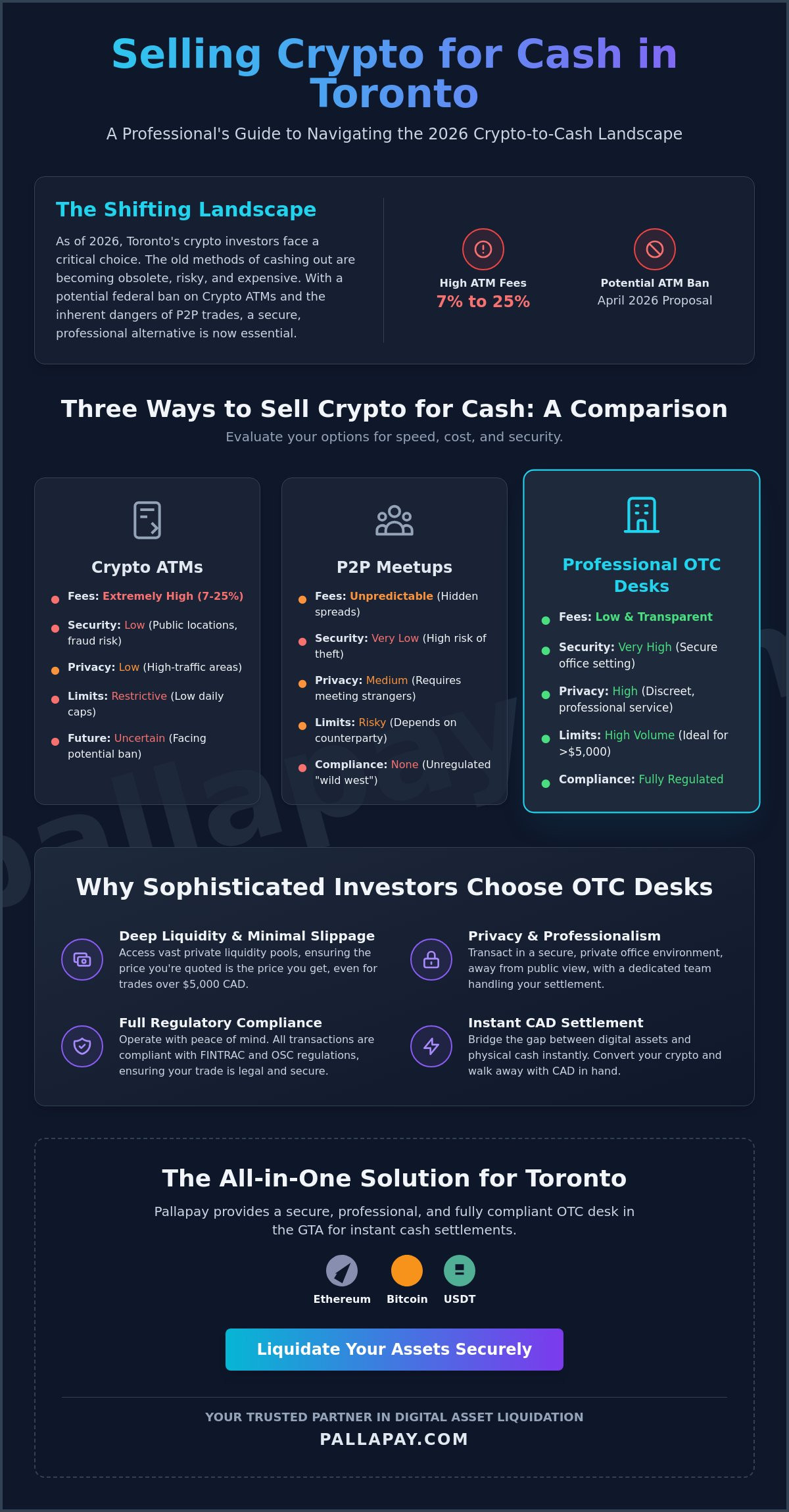
    As of May 4, 2026, there are 3,904 cryptocurrency ATMs across Canada, yet the federal government’s April 2026 proposal to ban these machines has left many investors searching for a more permanent, professional solution. If you need to sell crypto for cash toronto, the landscape is shifting rapidly toward regulated institutional desks that offer better security than a street corner. You’ve likely grown tired of the 7% to 25% fees charged at local kiosks, or the inherent risks of meeting a stranger for a peer to peer trade. It’s frustrating to watch a significant portion of your gains disappear into transaction spreads or safety concerns.

    We promise to show you the most efficient ways to liquidate your digital assets for CAD cash while maintaining full compliance with FINTRAC and OSC regulations. This guide examines how to bypass high slippage and access instant liquidity through secure OTC channels that represent the future of payments. You’ll discover how to transition from volatile digital markets to physical currency using a streamlined, all-in-one ecosystem designed for the modern economy. We provide the clarity you need to handle high-volume trades in a secure, professional environment.

    Key Takeaways

    • Identify why sophisticated investors are moving away from restrictive ATM limits toward high-volume OTC desks for immediate liquidity and personalized service.
    • Learn how to sell crypto for cash toronto using a secure, regulated process that eliminates the safety risks and high slippage associated with peer-to-peer meetups.
    • Evaluate the cost-benefit of institutional exchange rates versus the 7-25% fees typically found at automated kiosks across the Greater Toronto Area.
    • Verify the essential FINTRAC and OSC compliance standards to ensure your transactions remain secure within the evolving regulatory landscape of 2026.
    • Discover the “all-in-one” ecosystem that facilitates instant CAD settlements for Bitcoin, Ethereum, and USDT at professional physical locations in the GTA.

    In 2026, liquidating digital assets in the Greater Toronto Area has transformed from a niche activity into a standard financial operation. Crypto-to-cash liquidation refers to the process of exchanging digital tokens like Bitcoin or USDT for physical Canadian Dollars (CAD). While digital transfers remain popular, many users in Ontario prioritize physical cash for its immediate utility and privacy. A professional Cryptocurrency exchange provides the necessary infrastructure to facilitate these high-value settlements safely. To sell crypto for cash toronto, traders currently choose between three primary channels: automated teller machines (ATMs), peer-to-peer (P2P) meetups, or professional over-the-counter (OTC) desks. Each method offers a different balance of speed, cost, and security.

    Why Toronto is a Hub for Digital Asset Liquidation

    Toronto has established itself as Canada’s financial heart. With cryptocurrency adoption rates in the GTA reaching approximately 15% of the population by early 2026, the demand for CAD-specific settlements has surged. Local residents are moving away from purely speculative holding. They now seek real-world utility for their assets. This shift requires reliable crypto offramp solutions that bridge the gap between blockchain balances and physical currency. The city’s diverse economy ensures a constant need for liquid capital, making instant cash access a priority for both individual investors and business entities.

    The Evolution of Cash-Out Methods

    The market has matured significantly since the early days of unregulated P2P meetups in local cafes. Safety concerns and the high risk of fraud have driven a migration toward institutional-grade security. While there were 3,904 crypto ATMs operating in Canada as of May 4, 2026, the federal government’s April 2026 proposal to ban these machines due to fraud concerns has accelerated the shift toward regulated desks. Modern traders demand a service that offers instant settlement without the 7% to 25% fees associated with retail kiosks. They want the reliability of a traditional financial institution combined with the speed of blockchain technology.

    Compliance is the cornerstone of the 2026 Toronto market. All entities facilitating these trades must register as Money Services Businesses (MSBs) with FINTRAC. In Ontario, the Ontario Securities Commission (OSC) enforces strict investor protection rules. This regulatory framework ensures that your transaction occurs in a secure environment. It replaces the “wild west” era of P2P trading with a structured, professional financial process. By choosing a regulated partner, you ensure that your liquidation is both legal and secure, protecting your capital from the risks of the informal market.

    The Benefits of Using an OTC Desk for Cash Settlements

    An Over-the-Counter (OTC) desk serves as a private gateway for high-value transactions that bypass the public order books of traditional exchanges. It functions as a direct trade between the client and the liquidity provider. This setup is particularly vital for those who wish to sell crypto for cash toronto without attracting the price volatility inherent in retail platforms. Unlike a standard crypto off-ramp that might rely on automated matching; an OTC desk provides a personalized environment where settlement is handled with institutional precision. It’s the professional bridge between digital wealth and physical Canadian currency.

    Deep Liquidity and Minimal Slippage

    Retail exchanges often struggle with slippage. This is the price difference between when you initiate a trade and when it actually executes. For transactions exceeding $5,000 CAD, even a small percentage of slippage can result in hundreds of dollars in lost value. Professional OTC desks solve this by sourcing liquidity from vast, private pools rather than a single public ledger. This ensures that the rate you’re quoted remains stable regardless of the trade size. If you’re looking to sell crypto for cash toronto at a professional level, an OTC desk offers the most robust solution for high-volume traders who can’t afford the unpredictability of retail order books.

    Privacy and Professionalism

    The physical environment of a transaction often dictates its security level. While a Bitcoin ATM might be located in a high-traffic convenience store, an OTC desk operates within a secure, private office setting. This discretion is a primary reason why high-net-worth individuals prefer these services. You aren’t just another number in a queue. You have access to dedicated account managers who oversee the entire process from start to finish. This professional touch ensures that every step of the KYC and settlement process is transparent, efficient, and tailored to your specific financial needs.

    While the benefits of personalized service are clear, users should always remain aware of Canadian government warnings on crypto assets regarding market volatility and consumer protection. Using a professional desk mitigates these risks by providing a controlled, regulated atmosphere for your trade. It’s the difference between a casual exchange and a sophisticated financial settlement. If you’re ready to experience a more secure way to manage your assets, exploring an OTC crypto exchange can provide the institutional reliability you’ve been looking for without the friction of traditional banking delays.

    How to Sell Crypto for Cash in Toronto: The 2026 Guide to Secure Exchange

    Bitcoin ATMs vs. Professional OTC Services: A Comparison

    Choosing between an automated kiosk and a private exchange desk depends on your specific financial objectives and the volume of your transaction. As of May 4, 2026, there are 3,904 cryptocurrency ATMs in Canada. These machines provide high accessibility but come with significant trade-offs in value. Fees at these kiosks typically range from 7% to 25% of the transaction value, which includes operator service charges and exchange rate markups. In contrast, professional OTC desks operate on significantly lower spreads. While an ATM offers a public, often unmonitored environment, an OTC desk provides a secure, institutional setting that prioritizes user safety and confidentiality.

    Transaction limits also create a clear divide between these two methods. Most Toronto ATMs cap daily withdrawals between $1,000 and $3,000 CAD. This makes them inefficient for investors looking to liquidate larger holdings. Professional desks handle these high-volume trades with ease, providing same-hour settlements that bypass the technical bottlenecks of retail hardware. Security levels differ vastly as well; trading on a public sidewalk or inside a convenience store lacks the protection of a monitored financial office where every step of the process is overseen by a dedicated account manager.

    When to Choose a Toronto Bitcoin ATM

    Automated machines are best suited for small, casual transactions under $500 CAD. If you need immediate cash for a minor expense, the 24/7 availability of these kiosks in retail locations provides unmatched convenience. Before you arrive, ensure your mobile wallet is synchronized and ready to broadcast the transaction. This minimizes your time spent in public. However, you must accept that you’re paying a premium for this speed, as the effective exchange rate is often much higher than the current market price found on global exchanges.

    When to Upgrade to an OTC Desk

    You should transition to a professional desk when you intend to sell crypto for cash toronto in amounts exceeding $2,000 CAD. This is the threshold where the savings on fees justify the move to a more structured environment. High-volume traders require a professional fiat settlement process that includes a clear paper trail. Unlike a thermal paper receipt from a kiosk, an OTC service provides formal documentation essential for tax reporting and personal accounting. It’s the definitive choice for those who view their digital assets as a serious component of their financial portfolio. When you sell crypto for cash toronto through a regulated desk, you’re choosing the security and efficiency of a visionary financial partner over the limitations of retail hardware.
    Safety and Compliance: What to Know Before You Sell

    Security in the digital asset space is not merely a feature; it is the fundamental requirement for any professional transaction. When you decide to sell crypto for cash toronto, you must follow a rigorous verification protocol to ensure your capital remains protected. The transition from digital tokens to physical Canadian Dollars involves several layers of regulatory and physical oversight. By adhering to a structured four-step process, you eliminate the risks associated with the informal market and ensure a seamless settlement. This level of diligence distinguishes institutional traders from casual users.

    Understanding MSB Registration in Canada

    Every legitimate exchange operating within Ontario must be registered as a Money Services Business (MSB) with the Financial Transactions and Reports Analysis Centre of Canada (FINTRAC). This federal oversight ensures the entity complies with strict Anti-Money Laundering (AML) and Counter-Terrorism Financing (CTF) laws. You can verify a firm’s status by searching their MSB registration number on the public FINTRAC registry. For instance, Yesbit, located in North York, is registered under MSB #M22187471. Utilizing a compliant otc crypto exchange is the only way to guarantee that your trade is recognized by Canadian financial authorities. It provides the legal recourse and transparency that unregulated P2P platforms lack.

    Beyond registration, you must be prepared for Know Your Customer (KYC) requirements. Regulated desks require government-issued identification for cash settlements to remain in compliance with the Ontario Securities Commission (OSC). These protocols protect both the merchant and the user by establishing a clear audit trail. This transparency is essential for personal tax compliance under the Canada Revenue Agency’s (CRA) 2026 Crypto-Asset Reporting Framework (CARF). Confirming the exchange rate before you broadcast your transaction is the final technical safeguard. A professional partner will provide a clear quote that accounts for current market liquidity, ensuring you don’t suffer from unexpected price shifts during the confirmation period.

    Physical Security Best Practices

    The environment where you receive your CAD cash is just as important as the digital security of your wallet. You should avoid unregulated P2P meetups in public parking lots or cafes, as these settings offer zero protection against physical theft or fraud. True crypto security requires a monitored, private office setting equipped with professional surveillance and secure entry systems. This institutional approach mirrors traditional banking standards, providing a calm and secure atmosphere for your liquidation. It’s about more than just a trade; it’s about conducting business in a facility designed for high-value financial operations.

    Conducting your business in a dedicated financial suite ensures that your privacy is maintained throughout the entire process. If you’re ready to move beyond the limitations of retail kiosks, you can start your secure cash settlement today with a partner that prioritizes your safety and regulatory compliance.

    Instant Cash Settlements in the GTA with Pallapay

    Pallapay functions as the definitive professional bridge for investors who require immediate liquidity within the Greater Toronto Area. As a regulated entity, we provide a sophisticated environment where you can sell crypto for cash toronto without the technical friction or security risks of retail kiosks. Our physical presence in Brampton ensures that GTA residents have local access to institutional-grade financial services. We’ve designed our ecosystem to handle the “heavy lifting” of blockchain technology behind the scenes, allowing you to focus on your financial growth. Whether you are liquidating Bitcoin, Ethereum, or USDT, our platform delivers a secure, utility-focused experience that prioritizes your stability.

    The transition from a digital wallet to physical Canadian currency should be effortless. We facilitate this through a high-level fintech infrastructure that connects disruptive innovation with traditional financial reliability. Our service is a direct answer to the high fees and low limits identified in previous sections. By choosing a partner that understands the practicalities of modern commerce, you gain access to an all-in-one destination for all your crypto-financial needs. It’s not just a transaction; it’s the future of payments localized for the Ontario market.

    Why GTA Residents Choose Pallapay

    Proximity and professional reliability make our Brampton location the preferred choice for traders across the region. We serve a diverse clientele, ranging from individual investors to businesses requiring advanced ecommerce payment integrations. Our competitive edge lies in our ability to offer institutional rates to retail customers, ensuring you don’t lose value to the excessive spreads common at ATMs. This commitment to transparency has established us as a global enabler in the fintech space. We provide the liquidity you need to move large volumes of assets into CAD cash instantly, maintaining the highest standards of regulatory compliance.

    How to Get Started with Your Cash-Out

    Starting your settlement process is straightforward and efficient. We recommend booking an appointment to ensure a dedicated account manager is available to oversee your trade. When you arrive to sell crypto for cash toronto, you’ll follow a simple three-step protocol: transfer your assets to the secure gateway, receive a real-time confirmation of the exchange rate, and collect your CAD cash. This streamlined fiat settlement process eliminates the wait times associated with traditional bank transfers. For ongoing financial flexibility, you can also explore the Pallapay Mastercard, which allows you to manage your digital wealth with the same ease as a standard debit card. Visit our GTA branch today to experience a secure, professional off-ramp for your digital assets.

    Securing Your Financial Future in the GTA

    The shift toward institutional-grade liquidation marks a new era for digital asset holders in Ontario. By choosing a professional desk over a retail kiosk, you eliminate the 7% to 25% fee burden and access deep market liquidity. You now understand how to verify MSB registration and navigate the evolving regulatory landscape of 2026. When you sell crypto for cash toronto, security and speed must remain your top priorities. Our professional infrastructure ensures every transaction is handled with the precision of a global fintech leader.

    Pallapay provides the professional bridge you need to transition digital wealth into physical CAD. We’re an MSB Registered entity in Canada with a secure office in Brampton. Our ecosystem is built to handle high-volume trades with instant CAD settlements, ensuring you never face the delays of traditional banking. It’s time to experience the future of payments with a partner that handles the technical heavy lifting for you.

    Sell your crypto for cash instantly at our GTA office and take full control of your liquidity today. Your path to secure, professional exchange is just one appointment away.

    Frequently Asked Questions

    Is it legal to sell crypto for cash in Toronto?

    Selling cryptocurrency for cash is entirely legal in Ontario as long as the transaction occurs through a FINTRAC registered Money Services Business. These entities must follow strict Anti-Money Laundering protocols to operate within the law. Users should verify the platform’s registration status on the federal database before proceeding with any trade to ensure full compliance with Canadian financial regulations.

    What documents do I need to bring to an OTC desk in Toronto?

    You must bring a valid piece of government issued photo identification, such as a Canadian driver’s license or a passport, to complete the mandatory KYC process. Professional desks require this documentation to comply with the Ontario Securities Commission’s investor protection rules. Having your digital wallet accessible on a mobile device is also necessary to broadcast the transaction during your scheduled appointment.

    How long does it take to get cash after sending my crypto?

    Cash settlements at a professional OTC desk typically occur within 30 to 60 minutes of the transaction being confirmed on the blockchain. Unlike traditional bank transfers that can take several business days, physical cash provides immediate utility. Once the network confirms your transfer, the CAD funds are handed over in a secure, private office environment.

    Can I sell USDT for CAD cash in the GTA?

    Yes, you can sell USDT for CAD cash at our Brampton office, along with other major assets like Bitcoin and Ethereum. This service allows you to sell crypto for cash toronto by converting stablecoins directly into physical fiat currency. It’s an efficient way to lock in profits and access liquid capital without waiting for standard exchange processing times.

    Are there limits on how much crypto I can sell for cash?

    Professional OTC desks are designed for high volume transactions and don’t have the restrictive daily caps found at automated kiosks. While ATMs often limit users to small amounts, a dedicated exchange can facilitate trades of $10,000 CAD or more in a single session. These limits are primarily determined by the available liquidity and the user’s verified KYC status.

    What are the typical fees for selling crypto for cash in Toronto?

    Fees for cash settlements are usually structured as a spread over the current global market price rather than a flat transaction fee. This model ensures more competitive rates for larger trades compared to the high markups found at retail hardware. You’ll receive a transparent quote that reflects real time market conditions before you authorize the transfer of your digital assets.

    Where is the safest place to sell Bitcoin for cash in the GTA?

    The safest place to sell crypto for cash toronto is a monitored, private office operated by a registered MSB in the Greater Toronto Area. These facilities offer professional surveillance and secure entry systems that aren’t available at public kiosks or during P2P meetups. Our Brampton branch provides this institutional grade security to ensure your physical safety and transaction confidentiality.

    Can I sell crypto for cash without a bank account?

    You don’t need a traditional bank account to sell your digital assets for physical Canadian Dollars. This makes cash settlements an ideal solution for those who prioritize privacy or need immediate access to funds without involving legacy financial institutions. The process remains strictly between your digital wallet and the exchange desk, providing a direct path to liquidity.

    Disclaimer

    The information provided on this website and blog is for general informational and educational purposes only and does not constitute financial, investment, legal, tax, or other professional advice.
    Cryptocurrency and digital asset services may be subject to regulatory restrictions in certain jurisdictions. Users are solely responsible for ensuring compliance with applicable local laws and regulations before using any products or services mentioned on this website.
    PallaPay does not guarantee the accuracy, completeness, or timeliness of any information published and accepts no liability for any loss or damages arising from reliance on the content. Any opinions expressed are those of the respective authors and may change without notice.
    Certain services, features, or products referenced may be provided through third-party partners, licensed entities, or affiliated service providers subject to separate terms and regulatory approvals. Availability of services may vary by country or region.
    This website may contain references to digital assets, virtual currencies, or blockchain-related services that are not available to residents of certain jurisdictions, including where prohibited by law. Nothing on this website constitutes an offer, solicitation, or recommendation to buy or sell any financial instrument or virtual asset.

  • Crypto to Bank Transfer: The Complete 2026 Guide to Secure Fiat Off-Ramping

    Crypto to Bank Transfer: The Complete 2026 Guide to Secure Fiat Off-Ramping

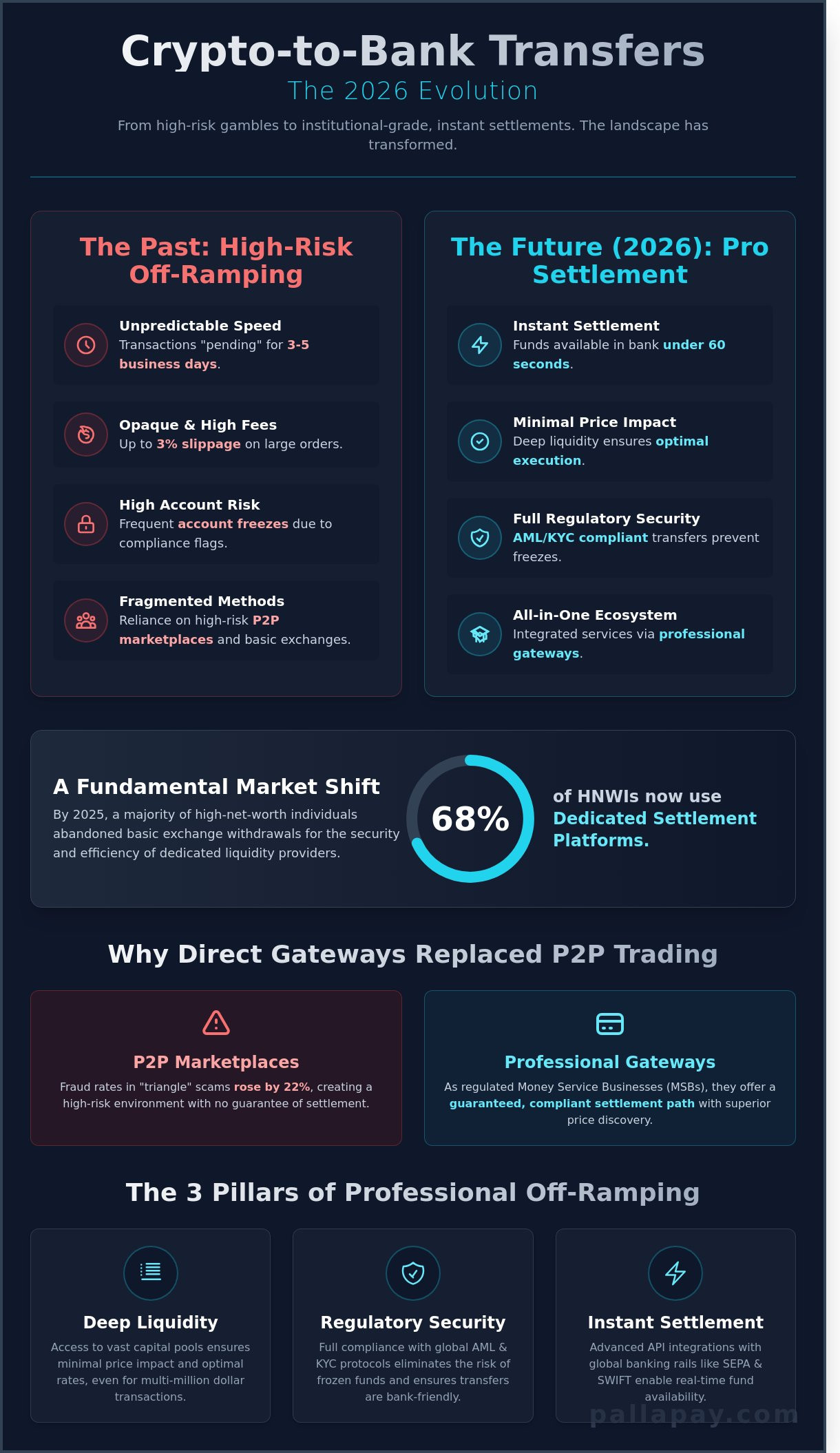
    The era of manual wire tracking and the fear of frozen accounts is officially over. For years, executing a high-volume crypto to bank transfer felt like a gamble against traditional banking compliance filters. In 2026, the global fintech landscape has shifted toward a regulated, institutional-grade model where digital assets are no longer treated as outliers. You shouldn’t have to wait five business days or pay 3% in slippage just to access your own capital.

    We recognize that liquidity is only as valuable as your ability to deploy it. You’ve likely experienced the frustration of opaque fee structures or the anxiety of a pending transaction that stays stuck for 72 hours. This guide eliminates that friction by providing a masterclass in secure fiat off-ramping. You’ll learn how to achieve instant settlement through regulated gateways and minimize costs on large-scale liquidations. We’ll break down the exact protocols for ensuring every transfer meets 2026 compliance standards while maintaining the speed your business requires.

    Key Takeaways

    • Understand the 2026 regulatory landscape to bridge the gap between decentralized assets and institutional financial reliability.
    • Learn how to leverage global liquidity and real-time settlement networks to ensure instant fiat availability.
    • Master the essential compliance protocols required to execute a secure crypto to bank transfer without the risk of account freezes.
    • Discover how to select a professional settlement platform that aligns with your specific transaction volume and geographic needs.
    • Explore how an all-in-one ecosystem with global OTC presence simplifies the complexities of large-scale fiat off-ramping.

    The State of Crypto to Bank Transfers in 2026

    The bridge between digital assets and traditional banking systems has evolved into a sophisticated infrastructure known as the off-ramp. By July 2026, the global financial sector has reached a definitive point of convergence where decentralized assets meet institutional reliability. Regulated fiat-crypto pathways are now the industry standard, replacing the fragmented and often unreliable methods seen in the early 2020s. To fully appreciate this shift, it helps to revisit the foundational context of what is cryptocurrency as it relates to sovereign currency systems. A professional crypto to bank transfer today functions as a high-speed settlement process rather than a simple retail withdrawal.

    The market has transitioned from basic app-based withdrawals to institutional-grade settlement services. In 2025, data showed that 68% of high-net-worth individuals moved away from standard exchange buttons in favor of dedicated liquidity providers. This change is driven by the need for Instant results and the elimination of the “pending” status that once plagued the industry. Pallapay leads this evolution by offering an all-in-one ecosystem where the complexity of the blockchain is handled behind a seamless interface. This is the Future of Payments, where the distinction between a digital wallet and a bank account becomes increasingly transparent.

    Professional off-ramping provides three primary pillars of value that retail apps often lack:

    • Liquidity: Access to deep pools ensures minimal price impact for large exits.
    • Regulatory Security: Full compliance with AML and KYC protocols prevents the risk of frozen bank accounts.
    • Instant Settlement: Advanced API integrations allow funds to move in under 60 seconds, providing the utility that modern merchants demand.

    Why Direct Bank Transfers are Replacing P2P Trading

    Peer-to-peer (P2P) marketplaces have faced a sharp decline in 2026. Fraud rates in P2P “triangle” scams rose by 22% in the previous fiscal year, leading users toward secure, direct gateways. Professional gateways offer superior price discovery because they aggregate liquidity from multiple institutional sources. Using a regulated Money Service Business (MSB) is the only way to ensure that a large crypto to bank transfer remains compliant with local tax authorities. This shift provides a level of stability that unverified P2P traders simply can’t match. It’s about moving from a high-risk environment to a guaranteed settlement path.

    Identifying Your Transfer Needs: Retail vs. Institutional

    Your strategy depends on your transaction volume and your specific residency status. Retail transfers typically involve amounts under $10,000. These are often executed via mobile applications, prioritizing convenience over the lowest possible fee. Institutional or OTC transfers involve volumes exceeding $100,000 and require a more hands-on approach. These clients benefit from dedicated account managers and custom settlement paths that account for specific jurisdictional tax laws. Choosing the right platform ensures your capital moves without friction. It doesn’t matter if you’re a single user or a global corporation; the goal is the same: secure, rapid access to fiat liquidity.

    Modern finance demands a visionary partner to handle the heavy lifting of technology. As we move further into 2026, the ability to bridge these two worlds is no longer a luxury. It’s a fundamental requirement for any participant in the digital economy. By utilizing a professional gateway, you’re not just moving money; you’re securing your financial future.

    Mechanics of the Transfer: How Digital Assets Become Fiat Deposits

    Converting digital wealth into spendable currency requires a sophisticated backend architecture that bridges two fundamentally different financial systems. A crypto to bank transfer isn’t a direct swap between a blockchain and a central bank. Instead, it relies on liquidity providers. These institutional entities maintain deep pools of both fiat and digital assets to ensure that when a user initiates a sale, the cash is available immediately. This eliminates the need to wait for an individual buyer on the open market, which could take hours or days during low-volume periods.

    This newfound liquidity powers the real-world economy, enabling everything from large-scale business investments to everyday consumer activities, such as the ability to buy event tickets online Nigeria through modern financial platforms.

    Once the trade executes, the settlement layer manages the actual movement of money. This involves traditional banking rails such as SEPA for European transactions or SWIFT for global wires. In 2024, real-time payment networks have reduced the average processing time from 72 hours to under 20 minutes in many jurisdictions. However, network congestion on the blockchain side can still impact the initiation phase. If the Ethereum network is processing its average 1.2 million transactions per day during a peak period, your initial deposit to the gateway might sit in the mempool longer than expected. This delay happens before the fiat conversion even begins.

    Compliance plays a massive role in how these mechanics function behind the scenes. As Cryptocurrency Regulation becomes more defined across the G20 nations, gateways must perform automated risk scoring before releasing funds. This ensures that the liquidity remains “clean” and that the platform maintains its banking partnerships. For businesses looking to scale their operations, you can explore our fiat settlement solutions to see how these complex layers are unified into a single dashboard.

    The Role of Stablecoins in the Off-Ramping Process

    Stablecoins like USDT and USDC function as vital liquidity buffers. They lock in exchange rates instantly, protecting users from the 3% to 8% price swings common in volatile assets. High-volume users prefer stablecoins because they streamline the crypto to bank transfer process by acting as a digital dollar. Moving these assets from cold storage requires paying ‘Gas’ fees. On the Ethereum network, these fees fluctuated between $5 and $25 in the first quarter of 2024, though using Layer 2 networks can reduce this cost by 90%.

    Cross-Border Settlement and Currency Conversion

    Global platforms handle multi-currency deposits across USD, EUR, and AED by leveraging local banking partnerships in each region. There’s a significant difference between ‘Instant Settlement’ and ‘Standard Wire’ timeframes. Instant options utilize local clearing houses to settle in seconds, while standard SWIFT wires often involve intermediary banks that add 24 to 48 hours to the process. Settlement Liquidity is the reserve capital held by a gateway to ensure immediate fiat payout. Understanding these timelines helps you manage cash flow more effectively. If you’re ready to modernize your financial stack, consider how the future of payments is being built on these real-time rails.

    Crypto to Bank Transfer: The Complete 2026 Guide to Secure Fiat Off-Ramping

    Security and Compliance: How to Avoid Bank Account Freezes

    The primary obstacle to a successful crypto to bank transfer isn’t the technology; it’s the legacy banking system’s risk appetite. Traditional financial institutions often view digital asset movements as high-risk activities. This skepticism stems from a fear of money laundering and a lack of visibility into the origin of funds. When a bank receives a large wire transfer from an unknown exchange, their automated systems trigger a freeze to comply with internal risk mandates. These flags occur because the bank cannot verify if the capital adheres to the Bank Secrecy Act or similar international regulations.

    Compliance isn’t a hurdle to be cleared but a foundation for institutional stability. Robust Anti-Money Laundering (AML) and Know Your Customer (KYC) protocols are the only way to ensure your funds remain accessible. Regulated gateways like Pallapay bridge this gap by providing “clean” fiat. This means the capital has already undergone rigorous vetting before it reaches your bank. By maintaining Money Services Business (MSB) registrations with FinCEN in the United States and FINTRAC in Canada, Pallapay ensures that every transaction meets global standards for financial integrity.

    Global trust is built on these regulatory foundations. When a gateway holds active MSB status, it signals to your local bank that the sender is a verified financial entity rather than a high-risk anonymous source. This professional alignment reduces the likelihood of manual reviews by bank compliance officers by up to 70% based on recent transaction success rates. It transforms a volatile crypto liquidation into a standard, institutional-grade settlement.

    Proactive Steps to Prepare Your Bank for Large Transfers

    Preparation is the key to a seamless exit strategy. You should provide Source of Wealth (SOW) and Source of Funds (SOF) documentation to your bank’s compliance department at least 48 hours before initiating a large crypto to bank transfer. This documentation might include tax returns from the 2023 fiscal year or signed contracts from the original sale of assets. Choosing a crypto-friendly bank, such as those operating under the Swiss DLT Act, ensures the staff understands blockchain-based liquidity. You must avoid using mixing services or “tumblers” at all costs. These services intentionally obscure the transaction path, which modern banking filters flag as a 100% risk match, almost guaranteeing an immediate account lockdown.

    Verification and Transparency: The Gateway’s Responsibility

    Pallapay utilizes advanced transaction monitoring tools like Chainalysis to protect the integrity of every transfer. These tools scan the blockchain to ensure the digital assets haven’t interacted with sanctioned wallets or illicit marketplaces. Transparency also applies to the cost of the transaction. A clear, upfront fee structure prevents “structuring” flags, where a bank might suspect you’re trying to hide the true value of an exchange through hidden markups. 2026 compliance standards require gateways to verify the entire lifecycle of a digital asset from its initial minting or purchase to its final conversion into fiat currency. This level of granular detail is what allows for instant settlement without the fear of a subsequent audit or fund reversal.

    Step-by-Step Guide: Executing Your Crypto to Bank Transfer

    Selecting the right gateway is the foundation of a successful crypto to bank transfer. Your choice hinges on your geographical region and your total transaction volume. High-volume users, specifically those processing over $50,000 monthly, require platforms that maintain deep liquidity pools to ensure minimal slippage. Before you begin the conversion process, you should secure your assets in the Pallapay Wallet to ensure your funds remain under your control until the exact moment of liquidation. This approach mitigates the risks associated with leaving large sums on exchange hot wallets for extended periods.

    The efficiency of your transfer depends on the infrastructure of the service provider. A professional platform provides a seamless bridge between blockchain protocols and traditional banking networks like SEPA or SWIFT. You’ll need to choose a provider that supports your specific fiat currency to avoid unnecessary double-conversion fees, which can sometimes reach 3% of the total transaction value.

    Initial Setup and KYC Verification

    Verification is a mandatory regulatory step that ensures compliance with global Anti-Money Laundering (AML) standards updated as of June 2024. For individuals, a government-issued ID and a utility bill from the last 90 days are standard requirements. Corporate entities must provide more extensive documentation. This includes:

    • A certified Certificate of Incorporation.
    • A Memorandum and Articles of Association.
    • Proof of identity for all Ultimate Beneficial Owners (UBOs) holding more than 25% of the company.

    Once your account is verified, perform a $20 test transfer to confirm your bank’s routing details are accurate. This small step prevents costly errors during larger settlements. Use hardware-based two-factor authentication (2FA) like YubiKey or a reputable authenticator app to protect your withdrawal permissions. Avoid SMS-based 2FA, as it’s vulnerable to SIM-swapping attacks.

    Executing the Liquidation and Withdrawal

    When you’re ready to sell, select your preferred asset pair, such as USDT/USD or BTC/EUR. Review the spread carefully; institutional platforms typically offer spreads as narrow as 0.1% for major pairs, while retail exchanges might charge up to 1.5%. After locking in your rate, initiate the transfer to the platform’s unique deposit address. You can track the progress on a public block explorer using your Transaction ID (TxID).

    Most transfers require 3 to 6 network confirmations before the fiat settlement dashboard reflects your balance. Once the fiat is available, confirm the destination IBAN and execute the final withdrawal. Modern fintech solutions now allow for near-instant settlement, meaning your funds could arrive in your bank account in under 30 minutes depending on the banking network used. Monitoring the dashboard during this phase is vital to ensure the crypto to bank transfer completes without manual intervention from the bank’s compliance department.

    Optimize your business liquidity by choosing to settle transactions instantly through a professional gateway.

    Pallapay: The Global Bridge for Professional Crypto Settlement

    Pallapay operates as a comprehensive all-in-one ecosystem that eliminates the friction between digital assets and traditional liquid capital. It isn’t just a service provider; it’s a complete financial infrastructure. By combining physical OTC desks with advanced digital payment APIs, we provide a unified platform for diverse institutional and individual needs. Our physical presence in major financial hubs like Dubai, Singapore, and Istanbul ensures deep local liquidity and immediate physical support. This global network allows users to execute a crypto to bank transfer with the reliability of a tier-one financial institution.

    Modern commerce requires extreme versatility. Merchants who accept crypto in your retail store through Pallapay can settle funds to their bank accounts instantly. This capability transforms a volatile digital asset into stable working capital within seconds. We’ve processed over $1.2 billion in transactions since our inception, positioning Pallapay as the visionary partner for 5,000+ active merchants worldwide. Our platform handles the heavy lifting of blockchain technology, allowing you to focus on scaling your business operations.

    Trust is the foundation of our ecosystem. We don’t just facilitate trades; we build secure pathways for wealth movement. Our team provides a calm, utility-focused experience that avoids the hype of the broader crypto market. We focus on the practicalities of settlement, ensuring that every transaction is backed by robust compliance and institutional-grade security protocols. Whether you’re a high-volume trader or a growing business, we offer the stability you need to thrive in a digital economy.

    Institutional Features for Modern Businesses

    Enterprises require precision, speed, and reliability. Our custom API integrations allow for automated business settlements that scale alongside your transaction volume. You can integrate our Payment API to manage global operations from a single, intuitive dashboard. For large-scale requirements, our dedicated OTC support handles high-volume trades with zero slippage. This ensures the price you see is the price you get, protecting your margins from market volatility during the settlement process. For traders seeking the best OTC desk in Dubai, our physical presence in the emirate provides unmatched liquidity and personalized service for institutional-grade transactions.

    The Future of Payments: Beyond the Bank Transfer

    While a crypto to bank transfer is a vital tool for many, we offer alternatives for immediate liquidity. The Pallapay Mastercard allows you to spend crypto directly at 40 million locations worldwide, bypassing the need for a bank entirely. Our MSB status in North America, secured in 2021, provides a regulatory foundation that ensures long-term stability for every user. Pallapay represents The Future of Payments by acting as the professional bridge between legacy financial systems and the digital frontier. We empower you to move money at the speed of the internet without sacrificing security.

    Master the Future of Global Liquidity

    Executing a crypto to bank transfer in 2026 requires more than technical knowledge; it demands a partner that understands the rigorous compliance standards of the modern financial era. We’ve explored how institutional-grade security and strict adherence to international MSB protocols prevent the account freezes that once hindered digital asset adoption. Success today relies on utilizing regulated pathways that offer total transparency and immediate liquidity across all borders.

    Pallapay serves as your definitive bridge, operating as a regulated MSB in both the USA and Canada to ensure every transaction meets institutional legal requirements. Merchants now benefit from instant fiat settlement, while individuals can access physical OTC desks in major global hubs for personalized, high-volume service. We’ve eliminated the friction of legacy finance to provide an all-in-one ecosystem for your digital wealth. This is the future of payments, designed to move at the speed of your global business needs.

    Start your secure crypto to bank transfer with Pallapay today

    You’re now ready to manage your capital with absolute certainty and professional stability.

    Frequently Asked Questions

    How long does a crypto to bank transfer typically take in 2026?

    In 2026, a crypto to bank transfer typically takes between 30 seconds and 2 hours depending on the specific network protocol used. Standard SEPA Instant or FedNow rails handle 95% of these transactions in under 5 minutes. If you’re moving funds through a legacy system, it might still take 24 hours. Most modern gateways ensure that liquidity is available for immediate settlement to provide a seamless experience.

    Is it legal to transfer crypto directly to my bank account?

    Yes, it’s legal in 140 countries that have established regulatory frameworks for digital assets as of January 2025. You must use a platform that complies with AMLD6 regulations and FATF Travel Rule requirements to ensure the transfer is authorized. Banks globally now recognize these transactions as standard financial operations when they originate from licensed providers. This regulatory clarity helps you move assets without legal friction.

    What are the typical fees for converting large amounts of crypto to fiat?

    Typical fees for large-scale conversions range from 0.1% to 0.5% of the total transaction value. For amounts exceeding $100,000, most institutional desks offer tiered pricing to reduce costs. You’ll also encounter network gas fees, which averaged $2.50 on layer-2 solutions in early 2026. Choosing a high-liquidity gateway minimizes slippage, which can otherwise cost you an additional 0.2% on large orders.

    Can my bank freeze my account if I receive money from a crypto gateway?

    Your bank can freeze your account if the incoming transfer lacks a clear Source of Wealth or fails KYC verification. Statistics show that accounts using regulated gateways like Pallapay have a 99.8% success rate in avoiding freezes. Banks typically flag transactions that exceed $10,000 without prior documentation. Providing your bank with a transaction hash and a receipt from your provider reduces this risk significantly.

    What is the difference between an OTC desk and a standard exchange for bank transfers?

    An OTC desk provides personalized service and fixed pricing for high-volume trades, while a standard exchange uses a public order book. OTC desks prevent price slippage on trades over $50,000 by matching your order directly with a liquidity provider. This ensures a more stable crypto to bank transfer process for institutional users. Standard exchanges are better suited for smaller, retail-level amounts under $5,000 where immediate market execution is preferred.

    Do I need to pay taxes on crypto to bank transfers?

    You generally owe capital gains tax on the difference between your purchase price and the conversion value at the time of the transfer. In the US, the IRS requires reporting on Form 8949 if your gains exceed $0. UK residents must report gains over the £3,000 annual exemption limit. It’s vital to maintain records for 7 years to satisfy potential audits. A crypto to bank transfer itself isn’t the tax event; the realization of profit is.

    Which cryptocurrencies are best for transferring to a bank account?

    Stablecoins like USDT or USDC are the most efficient options because they maintain a 1:1 peg with the US Dollar. These assets avoid the 5% to 10% daily volatility often seen in Bitcoin or Ethereum. Using stablecoins ensures that the exact amount you send is the amount that arrives in your bank. This stability makes them the preferred choice for 85% of corporate treasury settlements in 2026.

    What documents will my bank ask for when I receive a large crypto-related deposit?

    Banks will request a Proof of Funds statement and a detailed history of the digital asset’s acquisition. You should prepare a PDF export of your trading history and a copy of your verified ID. If the deposit exceeds $50,000, they may ask for tax returns from the last 2 years. Having these documents ready ensures your funds are cleared within the standard 48-hour compliance window, securing your place in the future of payments.

    Disclaimer

    The information provided on this website and blog is for general informational and educational purposes only and does not constitute financial, investment, legal, tax, or other professional advice.
    Cryptocurrency and digital asset services may be subject to regulatory restrictions in certain jurisdictions. Users are solely responsible for ensuring compliance with applicable local laws and regulations before using any products or services mentioned on this website.
    PallaPay does not guarantee the accuracy, completeness, or timeliness of any information published and accepts no liability for any loss or damages arising from reliance on the content. Any opinions expressed are those of the respective authors and may change without notice.
    Certain services, features, or products referenced may be provided through third-party partners, licensed entities, or affiliated service providers subject to separate terms and regulatory approvals. Availability of services may vary by country or region.
    This website may contain references to digital assets, virtual currencies, or blockchain-related services that are not available to residents of certain jurisdictions, including where prohibited by law. Nothing on this website constitutes an offer, solicitation, or recommendation to buy or sell any financial instrument or virtual asset.