Tag: Capital Management

  • Mastering the Crypto Merchant Dashboard: A 2026 Tutorial for Global Growth

    Mastering the Crypto Merchant Dashboard: A 2026 Tutorial for Global Growth

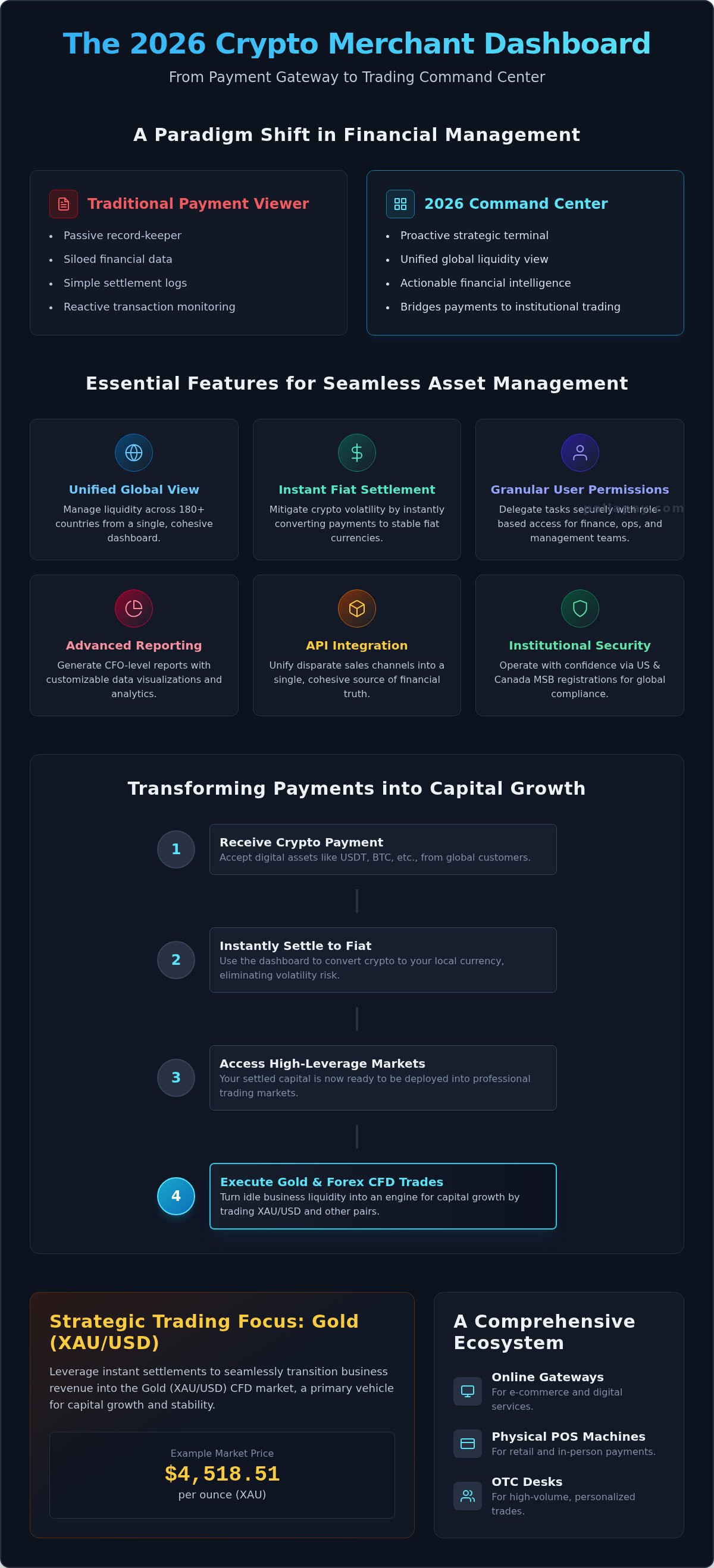
    In 2026, a professional interface serves as more than a ledger; it functions as a sophisticated bridge between digital commerce and global financial markets. You likely recognize the frustration of managing multi-currency settlements while fearing that interface lag might cause you to miss pivotal market movements. This crypto merchant dashboard tutorial is designed to eliminate that friction, providing a clear path to integrate your payment flow with high-growth assets.

    Transitioning from simple payment acceptance to active capital management is the most effective way to secure long-term stability. It’s vital to establish a streamlined workflow that offers total visibility on fiat settlements and the ability to diversify instantly into Gold (XAU/USD) and USD CFDs. This guide explores how to navigate your dashboard to unlock these transformative trading opportunities, moving your business from basic operations to strategic financial expansion through Forex and commodity markets.

    Key Takeaways

    • Establish a secure foundation for digital asset management by configuring your dashboard for maximum efficiency and real-time visibility.
    • Master the step-by-step transaction workflow within this crypto merchant dashboard tutorial to generate payment requests via virtual terminals or dynamic QR codes.
    • Optimize business liquidity by leveraging seamless fiat settlements and utilizing USDT reserves to hedge against currency fluctuations.
    • Unlock transformative growth by integrating Gold (XAUUSD) and USD CFD trading to diversify capital into traditional commodity and currency markets.
    • Scale your enterprise operations through a regulated ecosystem that combines digital payment gateways with physical POS infrastructure for global reach.

    Setting Up Your Crypto Merchant Dashboard for Maximum Efficiency

    Establishing a secure foundation is the first step in this crypto merchant dashboard tutorial. When you first log in, you aren’t just opening a software tool; you’re accessing a professional gateway to global liquidity and institutional-grade financial markets. Security configuration starts with robust two-factor authentication (2FA) to protect merchant capital from unauthorized access. This isn’t optional for serious enterprises. You should also review MSB compliance requirements within your settings to ensure your operations align with US FinCEN or Canadian FINTRAC standards, depending on your specific registration status.

    The main interface provides immediate visibility into key performance indicators. You can track total settled volume, pending transaction statuses, and current fiat balances at a glance. Understanding how payment processors work in a decentralized context helps you manage the transition from digital assets to local currency more effectively. For growing teams, configuring multi-user access is vital. You can grant specific permissions to accounting for settlement reports while giving sales teams the ability to generate payment links without accessing sensitive wallet settings. Customizing notification triggers ensures you stay informed on instant payment confirmations, which is essential for high-volume environments.

    Security Protocols and 2FA Integration

    Protecting your assets requires more than just a strong password. Implementing IP whitelisting for API-driven environments adds a layer of defense by restricting dashboard access to verified business locations. This level of security is standard for institutional-grade financial operations. By securing your dashboard early, you create a stable environment where you can eventually transition business capital into more active markets like Gold and Forex CFDs without worrying about the safety of your underlying liquidity.

    Tailoring the Dashboard to Your Industry

    Every business has unique operational needs that the interface must reflect. For hotels and high-ticket hospitality, the dashboard allows for manual entry or virtual terminal requests for large deposits. If you operate retail stores, you can optimize the interface for high transaction volumes, ensuring that staff can process payments quickly at the point of sale. For those integrating with e-commerce platforms, the focus shifts to automated checkouts and webhook notifications that trigger order fulfillment the moment a transaction is confirmed. This level of customization ensures that the dashboard serves your specific growth strategy rather than being a generic tool.

    Managing Payments: A Step-by-Step Tutorial on Transaction Workflows

    Efficiency in payment processing defines modern commerce. Your dashboard streamlines this through a logical progression from initiation to settlement. In this crypto merchant dashboard tutorial, we focus on the mechanics of the transaction lifecycle to ensure you maintain total control over your capital. Generating a new payment request is a simple matter of choosing between a virtual terminal for manual entry or a dynamic QR code for customer-facing interactions. Both methods prioritize speed and accuracy, ensuring that conversion rates are locked in at the moment of the request.

    Tracking the status of every transaction is essential for maintaining a clean ledger. The interface categorizes payments into three distinct stages. “Pending” indicates the transaction is detected on the blockchain but awaits verification. “Confirmed” means the network has validated the transfer. “Settled” signifies the funds are fully available in your account. As businesses scale, they often require sophisticated multi-asset crypto management to handle the influx of diverse digital tokens. This clarity prevents the common pain point of missing market volatility due to slow interface updates.

    Professional protocols for refunds and partial payments are built directly into the workflow. If a customer sends an incorrect amount, the dashboard allows you to issue a precise refund or request the remaining balance without restarting the entire process. For tax compliance and internal audits, you can export comprehensive financial reports in multiple formats. These documents provide the visibility needed to justify fiat settlements and prepare your business for the next stage of growth, such as exploring the full merchant ecosystem to leverage your capital in global markets.

    The Virtual Terminal for In-Person Sales

    The virtual terminal is designed for speed in physical environments. You simply input the fiat amount, and the system generates real-time crypto conversion rates. Selecting the optimal blockchain network, such as a low-fee Layer 2 or a stablecoin-native chain, ensures both you and your customer save on overhead. Always verify the “Confirmed” status on your screen before handing over high-value goods or services to ensure the transfer is irreversible.

    Automating Online Checkouts via API

    For digital enterprises, leveraging the payment API allows for seamless web integration that reduces cart abandonment. Testing webhooks is a critical step; it ensures that your website receives real-time updates to trigger inventory changes or digital deliveries. This automation transforms your checkout process into a high-performance engine, allowing you to focus on strategic goals like diversifying your revenue into USD and Gold CFDs.

    Optimizing Business Growth via Multi-Asset Management

    Strategic growth requires a shift from passive payment acceptance to active capital optimization. While the previous section of this crypto merchant dashboard tutorial focused on the mechanics of transaction workflows, this phase examines how to leverage those funds for long-term enterprise value. A sophisticated dashboard acts as a command center where you can manage diverse digital assets and transition them into traditional financial structures. By mastering the fiat settlement process, you ensure that your digital revenue is converted into local bank deposits with precision, providing the liquidity needed for daily operations or large-scale investments.

    Managing stablecoin reserves, particularly USDT, provides a vital hedge against the inherent volatility of the broader crypto market. You don’t always need to exit to fiat immediately; instead, holding USDT allows you to maintain a digital “cash” position that is ready for instant redeployment. This flexibility is enhanced by integrating an off-ramp solution, which offers liquidity on demand. Whether you’re paying global suppliers or preparing to enter the Forex market, having a streamlined path from your dashboard to your bank account is essential for maintaining a competitive edge.

    Data-driven decision-making is another pillar of business growth. Your dashboard provides historical data that allows you to analyze customer payment trends and forecast seasonal growth. If you notice an uptick in Bitcoin payments during specific quarters, you can adjust your settlement strategy to capitalize on market strength. This foresight transforms your dashboard from a simple ledger into a predictive tool, helping you build a financial cushion that supports your eventual expansion into Gold and USD CFD trading.

    Fiat Settlement vs. Crypto Retention

    Deciding when to hold digital assets and when to convert to fiat is a balance of risk and utility. Strategic timing can help you minimize conversion spreads. The following table outlines typical settlement windows for major currencies within a professional dashboard environment:

    Currency Pair Settlement Speed Strategic Use Case
    Crypto to USD Instant to 24 Hours Collateral for CFD and Forex trading
    Crypto to EUR Same Business Day Settling European supply chain costs
    Crypto to USDT Real-Time Hedged reserve for market volatility

    Real-Time Market Monitoring

    Precision is everything in global finance. Use your interface to monitor major pairs like BTC/USD and ETH/USD in real time. Setting price alerts allows you to optimize your settlement windows, ensuring you convert assets only when market conditions are favorable. This proactive approach ensures you’re never forced to settle during a dip, preserving the value of your hard-earned revenue as you prepare to diversify into more traditional assets like Gold (XAUUSD).

    Mastering the Crypto Merchant Dashboard: A 2026 Tutorial for Global Growth

    Transformative Financial Growth: Integrating Gold and USD CFD Trading

    Moving beyond the operational basics covered in this crypto merchant dashboard tutorial, we enter the phase of active capital appreciation. A professional merchant interface shouldn’t just function as a digital ledger; it serves as a launchpad for transformative financial growth. By integrating Contracts for Difference (CFD) trading, you gain the ability to access global markets without the logistical burden of owning the underlying physical assets. This allows you to speculate on price movements in real time, turning market volatility from a risk into a strategic advantage for your enterprise.

    The mechanics of CFD trading are built for speed and efficiency. When you trade CFDs, you enter an agreement to exchange the difference in the value of an asset from the time a contract is opened to when it is closed. This model is particularly beneficial for merchants who already manage digital liquidity. Instead of allowing settled funds to remain stagnant, you can transition that liquidity into the Forex market to seek capital appreciation. This strategic participation has the potential to change your financial trajectory, moving your business from a state of simple revenue collection to one of sophisticated wealth generation.

    To begin your journey toward market-driven growth, you can access our professional trading tools and integrate your merchant capital with global liquidity today.

    Gold (XAUUSD) as a Strategic Asset

    Gold remains the ultimate hedge for modern merchants seeking to protect their purchasing power. While digital assets offer high growth potential, they often correlate with broader market sentiment. Gold (XAUUSD) typically moves independently of crypto volatility, providing a stabilizing force for your business reserves. XAUUSD CFDs represent a high-leverage tool for diversifying merchant revenue by allowing businesses to hedge against currency devaluation through gold market exposure. Using USD-based CFDs further allows you to capitalize on global currency fluctuations, ensuring your capital remains productive regardless of regional economic shifts.

    Forex Trading for Business Diversification

    Scaling from a local merchant to a global investor requires a fundamental psychological shift. You must move from the daily habit of “earning” to the institutional strategy of “compounding” business profits. Understanding leverage and risk management in USD currency pairs is the key to this transition. By using the same dashboard that handles your payments, you can monitor Forex signals and execute trades that diversify your holdings. This integrated approach ensures that your business doesn’t just survive market cycles but thrives by capturing value across multiple asset classes, from traditional commodities to the world’s primary reserve currencies.

    Scaling Your Enterprise with the Pallapay Integrated Ecosystem

    Scaling a global enterprise requires more than a functional interface; it demands a comprehensive financial ecosystem that bridges the gap between digital innovation and institutional reliability. This final stage of our crypto merchant dashboard tutorial focuses on integrating your operational success with professional-grade tools designed for expansion. A regulated ecosystem provides the security and compliance necessary for long-term stability, ensuring that your business remains resilient as you move into high-volume markets. By unifying your revenue streams, you create a foundation for the transformative financial growth that comes from strategic market participation.

    Efficiency is maximized when you combine a digital crypto payment gateway with physical infrastructure. This 360-degree approach allows you to capture value across all customer touchpoints, whether they occur online or in person. For high-volume needs, expanding into an institutional-grade OTC crypto exchange provides the deep liquidity required for large-scale settlements. This capability is essential for merchants who wish to fund significant positions in the Forex or Gold markets without the friction of traditional banking delays. Future-proofing your business involves preparing for an evolution where digital payments and traditional asset trading exist within a single, seamless workflow.

    Global Compliance and MSB Registration

    Stability is the cornerstone of global commerce. Working with a fintech provider registered as a Money Services Business (MSB) with FinCEN in the United States and FINTRAC in Canada ensures your operations meet rigorous international standards. This regulatory framework supports businesses in over 180 countries, providing a secure environment for cross-border settlements. It eliminates the fear of regulatory uncertainty, allowing you to focus on compounding your profits through USD and Gold CFD trading rather than managing compliance risks.

    Next Steps: Activating Your Growth Strategy

    The path to global expansion begins with a clear implementation plan. Your first step is to apply for a professional merchant account to gain full access to the dashboard features discussed throughout this guide. For physical locations, integrating hardware solutions like a crypto POS machine ensures your retail operations are as modern as your digital ones. If your business requires a custom setup, contacting support for personalized integration assistance can help align our technology with your specific goals. Adopting these tools is an investment in your financial future, turning daily transactions into a engine for wealth generation in the global Forex and commodity markets.

    Driving the Evolution of Global Merchant Finance

    Mastering the tools outlined in this crypto merchant dashboard tutorial transforms your business from a simple payment processor into a strategic financial entity. By establishing secure workflows and leveraging real-time visibility, you’ve built the foundation for institutional-grade growth. The transition from digital settlements to the high-performance worlds of Gold (XAUUSD) and Forex CFD trading represents a significant shift in how you manage enterprise capital. This strategic pivot allows you to move beyond daily operations and into the realm of compounding wealth.

    Scaling with a partner that operates as a regulated MSB in the United States and Canada provides the stability required for global expansion. With a presence in over 180 countries and physical OTC desks in major global hubs, the infrastructure supports your move into diverse asset classes. It’s time to embrace a comprehensive ecosystem that facilitates both commerce and capital appreciation. Empower your business growth with the Pallapay Merchant Dashboard today. Your path to transformative financial success starts with a single, integrated platform designed for the modern global economy.

    Frequently Asked Questions

    What is a crypto merchant dashboard and how does it work?

    A crypto merchant dashboard is a centralized command center that facilitates the acceptance, tracking, and settlement of digital asset transactions. It works by bridging decentralized blockchain networks with your business’s financial infrastructure. This interface allows you to monitor incoming payments in real time, manage liquidity, and initiate fiat settlements. It serves as the primary tool for reconciling digital sales with traditional accounting practices.

    How can I integrate the dashboard with my existing e-commerce site?

    Integration is achieved through a secure developer API or specialized plugins for major e-commerce platforms. The dashboard provides the necessary API credentials and documentation to link your digital storefront to the payment gateway. This process enables automated checkout flows where customers pay in crypto while you receive real-time confirmations. Testing via webhooks ensures that inventory and order statuses update instantly upon network verification.

    Is it possible to receive payments in crypto but settle in fiat currency?

    You can certainly accept cryptocurrency and receive settlements in your local fiat currency. The dashboard allows you to configure automatic conversion settings to mitigate exposure to price volatility. This feature ensures that the exact fiat value of your sale is preserved and transferred to your linked bank account. It’s a critical component of this crypto merchant dashboard tutorial for businesses seeking traditional financial stability.

    How does Gold CFD trading benefit my business financial strategy?

    Gold CFD trading offers a sophisticated way to hedge your business capital against currency devaluation and market shifts. By trading XAUUSD CFDs, you gain exposure to gold’s price movements without the logistical challenges of physical ownership. This strategy helps diversify your reserves, turning static business profits into active, compounding assets. It provides a reliable counterweight to the faster-moving digital asset market.

    What are the fees associated with using a merchant dashboard for crypto?

    Transaction fees for crypto merchant services are generally lower than the 2.9% plus $0.30 often charged by credit card processors. Most digital gateways range between 0.5% and 2%, though specific withdrawal and network fees vary by asset. You’ll find a detailed breakdown of processing costs and potential discounts for holding native platform tokens within your account settings. This cost-efficiency significantly improves annual profit margins for high-volume enterprises.

    How secure is my data and capital on the Pallapay dashboard?

    Capital and data security are maintained through institutional-grade encryption and mandatory two-factor authentication. The dashboard includes advanced features like IP whitelisting and multi-user permission levels to prevent unauthorized access. Because the platform is a registered Money Services Business in both the US and Canada, it adheres to strict global compliance standards. These protocols ensure that your business liquidity remains protected against external threats.

    Can I manage multiple retail locations from a single dashboard account?

    Managing multiple retail locations from a single dashboard account is a standard feature for scaling enterprises. You can assign unique identifiers to different physical branches or POS machines to track individual performance. This centralized visibility allows you to monitor global sales volume and manage staff access levels from one login. It’s an essential tool for maintaining operational consistency across a growing international footprint.

    What is the difference between a crypto gateway and a standard payment processor?

    A crypto gateway facilitates direct blockchain transfers, while standard processors rely on traditional banking rails and intermediary clearinghouses. This difference results in faster settlement times and the total elimination of fraudulent chargebacks. This crypto merchant dashboard tutorial highlights how gateways bypass the high fees and delays of legacy systems. They provide a more efficient path for global commerce by connecting merchants directly to the digital economy.

    Disclaimer

    The information provided on this website and blog is for general informational and educational purposes only and does not constitute financial, investment, legal, tax, or other professional advice.
    Cryptocurrency and digital asset services may be subject to regulatory restrictions in certain jurisdictions. Users are solely responsible for ensuring compliance with applicable local laws and regulations before using any products or services mentioned on this website.
    PallaPay does not guarantee the accuracy, completeness, or timeliness of any information published and accepts no liability for any loss or damages arising from reliance on the content. Any opinions expressed are those of the respective authors and may change without notice.
    Certain services, features, or products referenced may be provided through third-party partners, licensed entities, or affiliated service providers subject to separate terms and regulatory approvals. Availability of services may vary by country or region.
    This website may contain references to digital assets, virtual currencies, or blockchain-related services that are not available to residents of certain jurisdictions, including where prohibited by law. Nothing on this website constitutes an offer, solicitation, or recommendation to buy or sell any financial instrument or virtual asset.


  • Crypto POS Machine for Small Business: A 2026 Buying Guide to Financial Liquidity

    What if your daily retail sales didn’t just sit in a stagnant bank account but served as the immediate fuel for institutional-grade gold and currency markets? You likely feel the sting of traditional processors that take over 3.5% of your revenue and delay settlements for days. Integrating a crypto pos machine for small business in 2026 solves this by providing instant fiat conversion and eliminating the risk of costly chargebacks. With over 45% of global merchants now accepting digital assets, the shift toward blockchain-based payments is no longer a trend; it’s a standard for professional growth.

    This guide explains how to select a terminal that transforms your storefront into a gateway for XAU/USD and USD CFD trading. You’ll discover how the GENIUS Act of 2025 has stabilized the market, allowing you to move capital from a customer’s wallet to a forex account with zero friction. We’ll explore the latest hardware options, regulatory requirements like the proposed PARITY Act, and the specific technical flows that turn your overhead into a strategic trading advantage. It’s time to stop paying for outdated infrastructure and start leveraging your revenue for transformative financial impact.

    Key Takeaways

    • Learn how a crypto pos machine for small business functions as a professional bridge, transitioning your operations from basic payment processing to active capital management.
    • Identify essential terminal features like instant QR code generation and multi-currency support that ensure a frictionless checkout experience for your global clientele.
    • Discover how to leverage retail revenue for XAU/USD and USD CFD trading, turning standard transactions into strategic assets for long-term financial growth.
    • Master the criteria for evaluating providers, focusing on transparent fee models and the necessity of MSB registration to maintain institutional-grade security.
    • Explore the advantages of an integrated ecosystem that links your physical point of sale to liquid markets through dedicated crypto cards and OTC services.

    The Strategic Evolution: Why Small Businesses Need a Crypto POS Machine

    A Point of Sale (POS) was once a static terminal designed for simple commerce, but it’s now evolving into a sophisticated financial bridge. For the modern entrepreneur, a crypto pos machine for small business is a professional gateway into a digital economy where liquidity is immediate and capital is globally mobile. This technology moves beyond the basic act of accepting payments. It allows you to manage liquid capital with the precision of an institutional trader, ensuring your revenue is always working for you.

    The transition from legacy systems to blockchain-integrated hardware removes the friction inherent in traditional banking. You’re no longer at the mercy of slow settlement times that hinder reinvestment. Instead, your retail revenue becomes a launchpad for high-impact gold and USD CFD trading. By establishing direct blockchain-to-fiat pipelines, you gain near real-time access to funds. This level of agility is what defines a truly modern enterprise, allowing you to pivot that liquidity into the forex market and capture XAU/USD movements while your competitors are still waiting for their bank to clear yesterday’s transactions.

    The Death of Traditional Merchant Fees

    Legacy credit card processors typically extract between 3% and 5% from your hard-earned revenue. Crypto processing operates with lean efficiency, drastically reducing these overhead costs by cutting out the intermediaries. Additionally, the immutable nature of blockchain transactions eliminates the risk of chargeback fraud, which costs merchants billions annually. For a retail operation generating $1,000,000 in annual sales, transitioning to crypto-based settlement can reclaim a substantial portion of profit that would otherwise be lost to intermediary fees and disputed payments.

    Capturing the High-Net-Worth Consumer

    High-net-worth, crypto-native consumers actively seek out merchants who respect their digital-first lifestyle. They prefer brands that offer the security and speed they’ve come to expect from blockchain technology. Being a “crypto-ready” destination provides a clear marketing advantage, positioning your brand as a tech-savvy leader in a competitive market. Implementing these retail store solutions allows you to capture a share of the $1.5 trillion digital asset market while ensuring your business is prepared for the inevitable global financial evolution.

    Essential Features of a High-Performance Crypto POS Terminal

    High-performance hardware is the operational heart of a modern storefront. A crypto pos machine for small business must do more than just process transactions; it must integrate seamlessly with global liquidity pools. Multi-currency support is a non-negotiable requirement for professional growth. While Bitcoin remains a primary asset, stablecoins like USDT and USDC provide the price certainty required for retail inventory management. According to the U.S. Chamber of Commerce technology report, small businesses are increasingly leveraging digital tools to stay competitive, and crypto-readiness is a significant part of that evolution.

    Instant QR code generation ensures a frictionless checkout experience where customers scan, confirm, and pay in seconds. This speed is matched by robust security protocols, including end-to-end encryption and MSB-compliant processing. These features protect your enterprise from external threats while ensuring every transaction meets global regulatory standards. Staff shouldn’t need a degree in computer science to manage these systems. Modern interfaces use visual cues and simplified workflows to ensure that a crypto payment is as easy to handle as a standard debit card tap.

    Real-Time Fiat Settlement Mechanics

    Volatility is the primary concern for most merchants, yet high-performance terminals solve this through instant conversion. When a customer pays in a digital asset, the system settles it into fiat immediately. This process fuels your daily cash flow and provides the ready capital needed for high-impact gold and USD CFD trading. Accessing fiat settlement products allows you to lock in value at the moment of sale, effectively turning your retail revenue into a stable investment fund.

    Connectivity and Hardware Durability

    Choosing the right crypto pos machine for small business depends on your specific retail environment. Standalone handheld terminals offer mobility and built-in thermal printing for physical receipts, making them ideal for restaurants and boutiques. These units require robust battery life and 5G or dual-band Wi-Fi connectivity to prevent downtime during peak hours. Conversely, integrated tablet-based software provides larger interfaces for complex inventory management. Both options should support digital receipts to align with modern consumer preferences. If you’re looking to streamline your operations further, integrating a professional payment API can bridge the gap between your physical store and your digital accounting systems.

    From Retail Revenue to Financial Freedom: Leveraging CFDs and Gold

    While a crypto pos machine for small business simplifies daily transactions, its true value lies in its role as a liquidity engine. Most business owners view sales as the end of a process. Professional entrepreneurs see them as the beginning of a wealth-building cycle. By converting retail sales into digital assets, you bypass the sluggishness of legacy finance. This transition allows for a psychological shift from a traditional shopkeeper to a strategic financial investor. You’re no longer just managing inventory; you’re managing a portfolio of liquid capital that can be deployed into global markets at a moment’s notice.

    This strategic evolution is about more than just modernizing your checkout counter. It’s about securing your financial future by moving capital into assets that outpace inflation. When your daily revenue is settled in digital form, the path to diversified wealth becomes direct. You can transition from a successful retail day to an active position in the world’s most liquid markets without waiting for external approvals or clearing houses.

    The Power of Gold and USD CFD Trading

    Gold trading (XAU/USD) has long been the standard for hedging against economic volatility. In the context of 2026, where state-level cryptocurrency legislation is becoming more defined, the ability to move from crypto to commodities is a powerful advantage. Contracts for Difference (CFDs) enable you to profit from the price fluctuations of gold or the US dollar without the logistical burden of physical ownership. This flexibility is essential for those seeking significant financial life changes through market participation. CFDs allow for leveraged exposure to global markets, meaning you can control a larger position with a smaller amount of initial capital. This leverage accelerates the transformative potential of your retail revenue when managed with professional discipline.

    Liquidity: The Bridge Between Sales and Strategy

    Speed is the most critical factor in successful trading. Traditional settlement delays often mean missing high-yield opportunities in the forex market. When you utilize a crypto pos machine for small business, your revenue is settled instantly into stable digital assets. This provides the immediate liquidity needed to fund a trading account at the exact moment a market signal appears. Utilizing professional crypto off-ramp services ensures that your capital moves at the speed of the internet. You can transition from a retail sale to an XAU/USD position in minutes. This seamless flow eliminates the barriers that once kept small business owners out of institutional-grade trading environments, allowing your business to act as its own investment fund.

    Buying Guide: How to Evaluate Crypto POS Providers for Your Small Business

    Selecting a crypto pos machine for small business is a decision that dictates your future financial agility. You shouldn’t view this as a simple hardware purchase; it’s an investment in a professional partnership. Evaluate fee structures with a focus on long-term scalability. While some providers offer monthly subscription models, others favor transaction-based fees. Your choice should align with your volume, especially if you intend to use that revenue for high-impact USD CFD trading. Compliance is equally critical. Ensure your provider holds Money Services Business (MSB) registration. This ensures your capital is handled with institutional-grade security, particularly as the GENIUS Act of July 2025 and the July 18, 2026, regulatory deadlines bring tighter federal frameworks to digital assets.

    Integration capabilities are the difference between a siloed tool and a growth engine. Your terminal must communicate with your existing accounting software to prevent manual errors and streamline tax reporting under the 2026 PARITY Act. If you manage multiple locations, a centralized dashboard is essential for maintaining a bird’s-eye view of your global liquidity. This level of control allows you to monitor sales trends and move capital into your forex account without friction. Professional growth requires a system that supports your evolution from a local merchant to a global market participant, ensuring you can capitalize on XAU/USD movements as they happen.

    Hardware vs. Software-Only Solutions

    While mobile apps offer a low barrier to entry, a physical terminal remains superior for building customer trust and operational speed. Dedicated hardware facilitates faster transaction processing and provides a more professional checkout experience that customers expect in a retail environment. In 2026, Near Field Communication (NFC) is a standard requirement, allowing for tap-to-pay functionality that mimics traditional card payments. This ease of use is a core component of the crypto POS machine: the complete guide, which details how hardware durability and specialized scanners impact your daily revenue cycles.

    Customer Support and Maintenance

    Technical assistance is mission-critical when your hardware is the gateway to your revenue. Look for providers that offer comprehensive support and regular software update cycles to ensure your system remains secure. This future-proofs your business against new blockchain protocols and emerging security threats. Avoid providers with hidden setup costs or complex hardware configurations that delay your launch. A reliable partner handles the background mechanics so you can focus on strategic gold trading and wealth preservation. If you’re ready to upgrade your infrastructure, you can explore our retail store solutions designed for high-performance commerce.

    The Pallapay Advantage: Your Partner in Global Financial Growth

    Pallapay serves as the definitive destination for merchants who demand more than basic payment processing. By deploying a crypto pos machine for small business through our ecosystem, you aren’t just adopting a tool; you’re securing a strategic partnership. We bridge the gap between disruptive retail innovation and institutional financial reliability. Our platform ensures that every transaction contributes to your broader financial evolution, providing the high-speed liquidity required to excel in Gold and USD CFD markets. While competitors focus solely on transaction volume, we focus on the utility of your capital.

    The integrated ecosystem is built for maximum efficiency. Your retail revenue flows seamlessly into an environment where capital can be redeployed through the Pallapay Mastercard or managed via our OTC crypto exchange. This connectivity is what allows a business owner to transition from managing a storefront to executing high-impact trades in the XAU/USD pair. We handle the complex background processes, from instant fiat conversion to regulatory alignment, so you can focus on the transformative potential of the global market. Our infrastructure is designed to make complex technical conversions feel like standard, effortless business operations.

    Total Ecosystem Integration

    Managing your financial life shouldn’t involve juggling multiple platforms. The Pallapay dashboard offers a comprehensive view of your assets, from retail sales to trading balances, providing a single source of truth for your liquidity. For businesses looking to scale, our payment API provides a robust framework for global expansion and custom technical flows. This level of technical integration is underpinned by our commitment to crypto security in 2026, ensuring your data and funds remain protected against emerging threats. You gain the stability of an established financial partner while leveraging the speed of modern blockchain technology.

    Next Steps: Transform Your Business Today

    Transitioning to a digital-first financial model is a straightforward process. You can apply for a professional POS terminal by following three simple steps on our platform, moving quickly from application to implementation. Our team is available to discuss how our crypto wallet and liquidity management services can support your specific growth goals. Don’t let legacy banking delays limit your potential for wealth creation or market entry. Contact our specialists today to secure your hardware and begin leveraging your retail revenue for a more prosperous financial future.

    Secure Your Financial Future with Modern Liquidity

    Adopting a crypto pos machine for small business represents more than a technological upgrade. It marks your entry into a global financial ecosystem where retail revenue is instantly converted into the liquid capital required for strategic growth. We’ve explored how instant fiat settlement removes the barriers to high-impact gold and USD CFD trading. This transition allows you to capture market movements in real-time, effectively turning your daily sales into a launchpad for long-term wealth creation. Professional growth depends on the speed of your capital; blockchain technology ensures that speed is absolute.

    Pallapay provides the institutional-grade reliability your enterprise deserves. With official MSB registration in the US and Canada, our award-winning infrastructure serves merchants across 180+ countries. You don’t have to wait for legacy bank clearances to act on a forex signal. Instead, you can leverage seamless fiat settlement to fund your trading account and secure your financial life. This integrated approach turns every customer transaction into a strategic advantage.

    Equip your business with the Pallapay Crypto POS and unlock global financial markets today.

    The evolution of global commerce is inevitable. By choosing a partner that prioritizes speed, security, and compliance, you’re positioning your enterprise at the forefront of this transformation. Start your journey toward financial freedom today.

    Frequently Asked Questions

    How does a crypto POS machine actually settle in fiat currency?

    A crypto POS terminal settles in fiat by executing an immediate exchange at the exact moment of a transaction. When a customer pays with a digital asset, the payment gateway locks the current market rate and converts the funds into your preferred currency, such as USD. This automated process eliminates exposure to price volatility, ensuring the exact retail value of your sale is preserved for immediate operational use.

    Is it legal for my small business to accept cryptocurrency payments?

    Accepting digital assets is legal in most global jurisdictions, provided you comply with local financial regulations. In the United States, the GENIUS Act of 2025 and the subsequent 2026 regulatory framework established clear guidelines for stablecoin transactions. Professional merchants should ensure their provider is an officially registered Money Services Business (MSB) to maintain full compliance with state and federal reporting requirements while protecting their commercial interests.

    What are the transaction fees compared to traditional credit cards?

    Processing digital assets typically incurs significantly lower costs than legacy credit card networks. While traditional processors often charge between 3% and 5% per transaction, crypto processing fees generally range from 0.4% to 2%. This reduction in overhead allows small businesses to retain a larger portion of their revenue, which can be strategically redeployed into high-impact investments like gold or currency markets.

    Can I use the funds from my crypto POS to trade Gold or Forex CFDs?

    You can directly leverage your retail revenue for market participation through integrated liquidity bridges. Using a crypto pos machine for small business allows you to settle funds into stable digital assets that are compatible with professional trading accounts. This seamless pipeline enables you to move from a retail sale to an active position in XAU/USD or USD CFDs without the delays associated with traditional banking systems.

    Do I need a special bank account to use a crypto POS terminal?

    You don’t necessarily need a specialized bank account to begin accepting crypto payments through a professional terminal. Most systems settle funds into a digital wallet or a dedicated merchant account within the provider’s ecosystem. From there, you can choose to transfer funds to a standard bank account via a crypto off-ramp or use an integrated Mastercard for direct access to your liquid capital.

    What happens if a customer wants a refund on a crypto payment?

    Refunds are typically processed by issuing the digital asset equivalent of the original fiat purchase price at the current market rate. The merchant initiates the refund through their dashboard, and the system calculates the necessary amount of cryptocurrency to return to the customer’s wallet. This process ensures the customer receives the correct value while the merchant avoids losses due to asset price fluctuations since the original sale.

    How long does it take to set up a Pallapay POS machine for my store?

    Setting up a Pallapay POS terminal is a streamlined process designed for rapid deployment. Once your application is reviewed and your account is verified, the hardware is configured and shipped to your location. Most merchants can begin accepting digital payments within a few business days of receiving their terminal. The intuitive interface ensures that your retail staff can manage transactions immediately with minimal technical training.

    Which cryptocurrencies are most commonly used for in-store payments in 2026?

    In 2026, regulated stablecoins like USDT and USDC are the most common assets used for retail commerce due to their price stability. These are often preferred by merchants following the full implementation of the GENIUS Act. However, Bitcoin and Ethereum remain staple options for high-net-worth consumers. A professional terminal supports a multi-currency environment, allowing you to cater to diverse customer preferences while maintaining secure, instant settlement.

    Disclaimer

    The information provided on this website and blog is for general informational and educational purposes only and does not constitute financial, investment, legal, tax, or other professional advice.
    Cryptocurrency and digital asset services may be subject to regulatory restrictions in certain jurisdictions. Users are solely responsible for ensuring compliance with applicable local laws and regulations before using any products or services mentioned on this website.
    PallaPay does not guarantee the accuracy, completeness, or timeliness of any information published and accepts no liability for any loss or damages arising from reliance on the content. Any opinions expressed are those of the respective authors and may change without notice.
    Certain services, features, or products referenced may be provided through third-party partners, licensed entities, or affiliated service providers subject to separate terms and regulatory approvals. Availability of services may vary by country or region.
    This website may contain references to digital assets, virtual currencies, or blockchain-related services that are not available to residents of certain jurisdictions, including where prohibited by law. Nothing on this website constitutes an offer, solicitation, or recommendation to buy or sell any financial instrument or virtual asset.