Tag: API Integration

  • Designing a Crypto Checkout Flow: The 2026 Merchant Integration Guide

    Designing a Crypto Checkout Flow: The 2026 Merchant Integration Guide

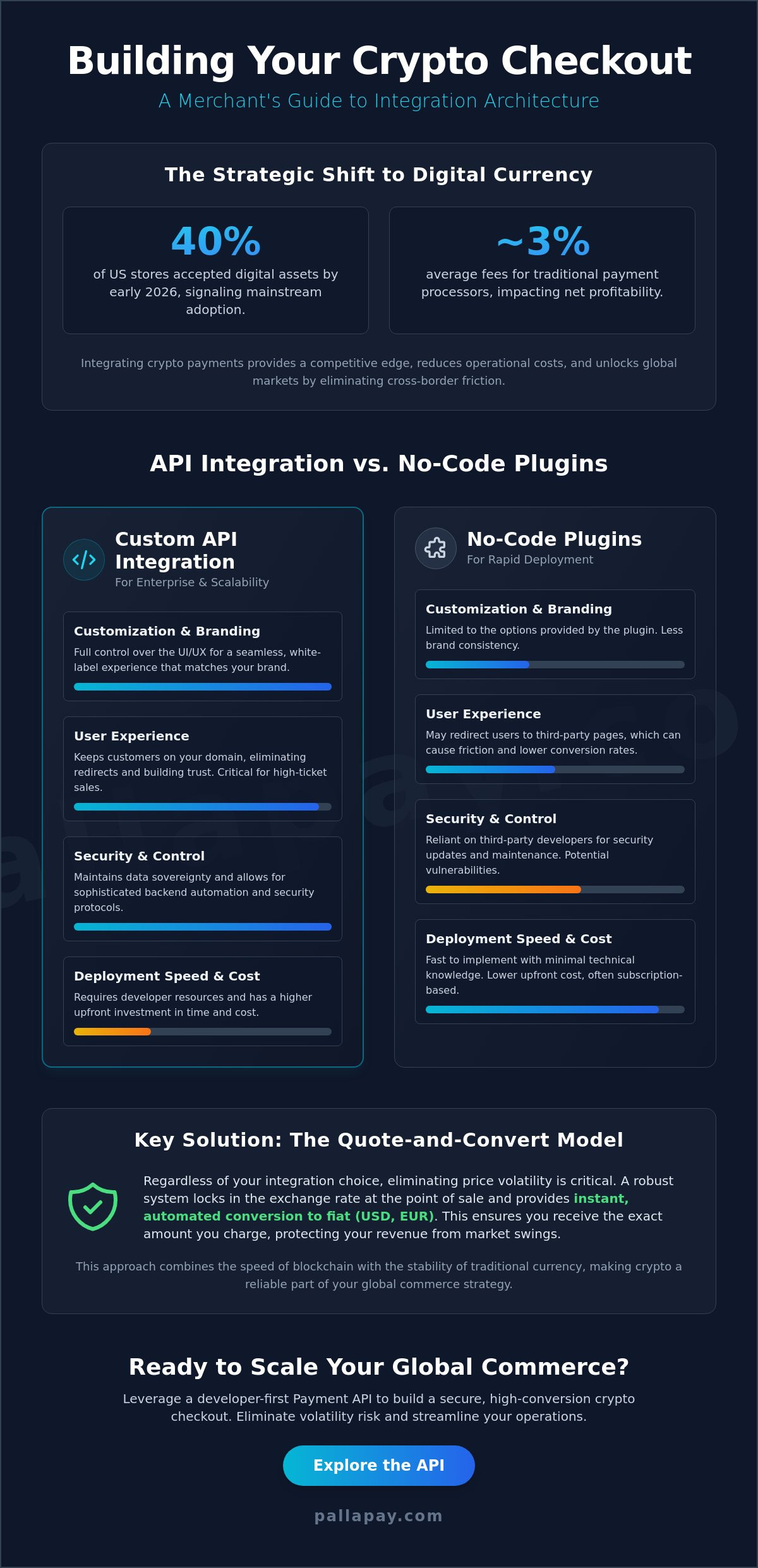
    With 40% of stores in the US now accepting digital assets according to market research from early 2026, the competitive landscape has shifted toward merchants who can offer the most efficient payment experience. You likely recognize that while customers demand flexibility, the technical hurdles of designing a crypto checkout flow often lead to revenue loss through friction or price volatility. It’s frustrating to watch a transaction stall because of slow confirmation times or complex wallet connections. We understand that your priority is a system that feels as reliable as a traditional credit card processor but operates with the speed of the blockchain.

    This guide provides the technical and strategic framework to build a secure, high-converting checkout that eliminates price risk through instant fiat conversion. You’ll learn how to implement a quote-and-convert model that locks in rates, ensuring you receive the exact USD or EUR amount regardless of market swings. We’ll also cover how to integrate an API for crypto payments that simplifies accounting and maintains compliance with the 2025 GENIUS Act and FATF Travel Rule requirements. By the end of this article, you’ll have a clear roadmap for turning crypto into a standard, effortless part of your global commerce operations.

    Key Takeaways

    • Understand the shift toward mainstream crypto adoption and how to capture global demand from tech-savvy demographics and unbanked populations.
    • Master the core principles of designing a crypto checkout flow to reduce friction using QR codes, automated network selection, and WalletConnect integrations.
    • Evaluate the technical trade-offs between bespoke API integrations and streamlined no-code plugins for major CMS platforms like Shopify and Magento.
    • Eliminate volatility risk by implementing automated fiat settlement that locks in exchange rates at the point of sale for instant conversion.
    • Scale your operations by connecting online gateways with physical crypto POS machines and high-volume OTC settlement services for a unified commerce experience.

    The Strategic Shift: Why Your Website Needs a Crypto Checkout in 2026

    The landscape of global commerce has fundamentally altered as digital assets move from speculative holdings to functional currency. Merchants now view understanding digital currencies as a core competency for maintaining a competitive edge in a digital-first economy. When you are designing a crypto checkout flow, you are effectively installing a high-speed liquidity bridge that bypasses the friction of legacy financial systems. This shift is driven by a consumer base that increasingly values the privacy, security, and autonomy inherent in blockchain-based transactions.

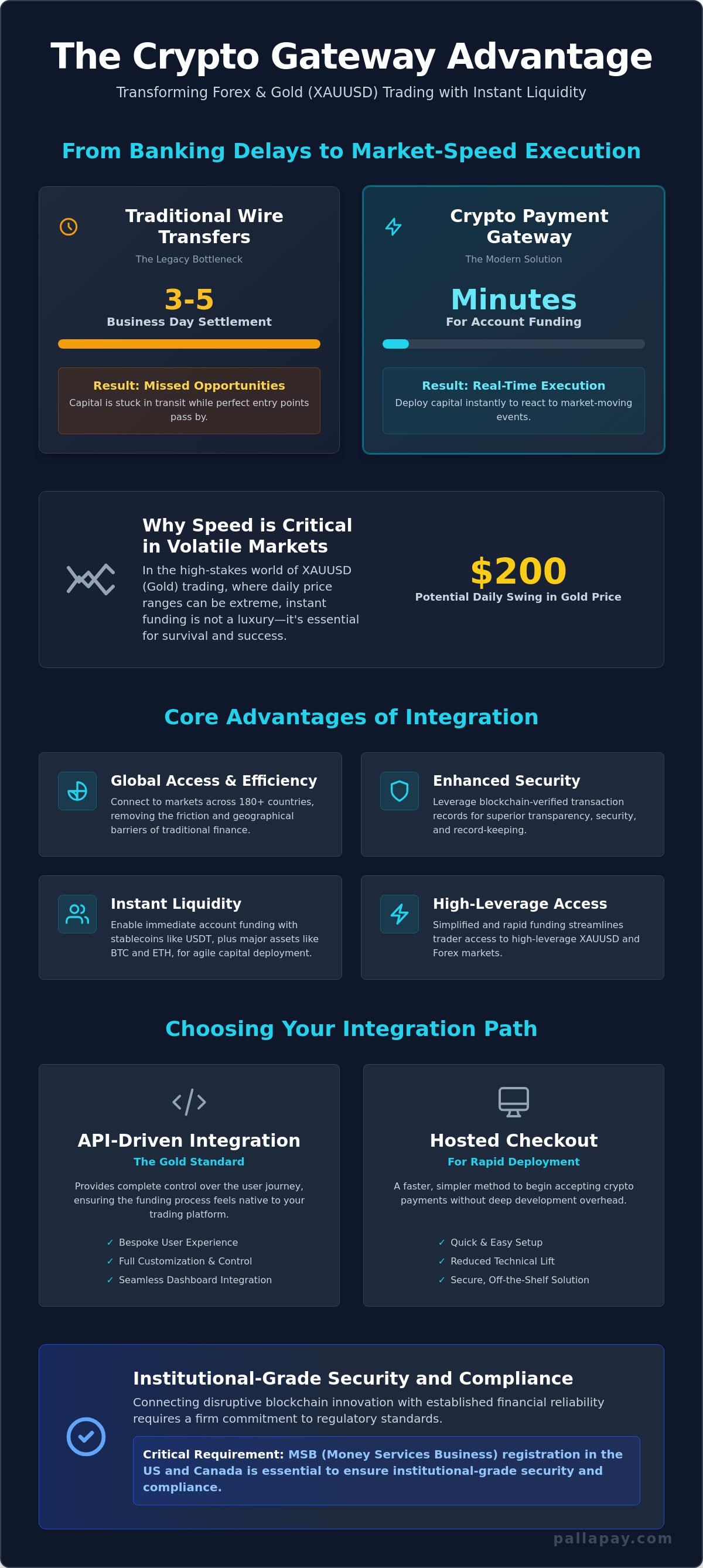
    Operational costs remain a primary driver for this transition. Traditional payment processors often levy merchant fees that average 3%, which significantly impacts the net profitability of high-volume businesses. In contrast, optimized crypto gateways offer a much leaner cost structure, allowing organizations to retain a larger portion of their revenue. Industry data from early 2026 indicates that nearly 90% of sellers have received direct requests for crypto options, signaling that consumer preference has reached a critical tipping point for mainstream adoption.

    Global Market Reach and the New Consumer

    Integrating crypto payments allows e-commerce brands to engage with a global audience without the traditional barriers of cross-border banking. This includes high-net-worth individuals who prefer spending their digital assets directly to maintain financial fluidity. By offering these options, you provide a frictionless experience for international customers who would otherwise face high currency exchange fees or transaction declines. It is a strategic expansion into a borderless market that operates beyond the limitations of traditional geography.

    Operational Efficiency: Speed and Security

    The speed of blockchain finality offers a distinct advantage over the multi-day settlement cycles of traditional banking. Once a transaction is confirmed on the ledger, the funds are secure and the risk of chargeback fraud is effectively eliminated. This is particularly critical for high-ticket retail where fraudulent disputes can cause significant financial disruption. Designing a crypto checkout flow also provides a reliable contingency against traditional processor outages, ensuring your storefront remains operational at all times. It is a professional bridge to a more resilient financial future.

    Choosing Your Integration Architecture: API vs. No-Code Plugins

    Decisions regarding technical architecture determine the long-term scalability of your digital storefront. When you’re designing a crypto checkout flow, the primary conflict often lies between the speed of deployment and the depth of customization. Small to mid-sized retailers frequently opt for ready-made solutions to minimize upfront development costs. Conversely, enterprise-level organizations require bespoke integrations to maintain brand consistency and data sovereignty. This choice dictates how your business will handle future volume increases and network upgrades.

    E-commerce Plugins for Rapid Deployment

    CMS plugins for platforms like WordPress, Shopify, and Magento provide a streamlined path to market. These third-party scripts handle the heavy lifting of wallet connectivity and transaction monitoring. However, security remains a paramount concern. It’s essential to ensure your checkout environment is isolated from core customer data to prevent cross-site scripting vulnerabilities. While plugins offer ease of use, they require regular maintenance to remain compatible with evolving blockchain network updates. If a plugin fails to update alongside a major wallet provider, your conversion rates will suffer.

    Custom API Integration for Enterprise Scalability

    For businesses that demand full control over the user journey, a developer-first approach is the definitive choice. Leveraging a Payment API allows you to build a white-label checkout that keeps the customer entirely on your domain. This eliminates the psychological friction caused by redirecting users to external payment pages. You can design every pixel of the interface to align with your brand’s aesthetic, which is a critical factor for building trust in the high-ticket retail sector.

    Custom integrations also allow for sophisticated backend automation through webhooks. These tools provide real-time order status updates, enabling your system to trigger automated fulfillment the moment a transaction reaches the required number of network confirmations. This level of technical maturity ensures that your operations scale without increasing manual overhead. If you’re ready to build a tailored solution, exploring the API for Crypto Payments can provide the robust infrastructure needed for high-volume commerce.

    Hosted payment pages represent a practical middle ground for many growing businesses. They offer a no-code approach where the service provider manages the entire UI, significantly reducing your internal technical and regulatory burden. This is an excellent choice for rapid market entry or for testing crypto demand within a specific product line before committing to a full-scale custom build. Ultimately, the right architecture depends on your internal developer resources and your long-term vision for the customer experience. Selecting the right path early prevents costly migrations later.

    Designing a High-Conversion Crypto Checkout Flow (UX/UI Principles)

    Designing a crypto checkout flow requires a departure from the static input fields of traditional finance toward an interactive, real-time handshake between digital environments. The primary goal is to minimize cognitive load while ensuring absolute precision. By integrating a ‘WalletConnect’ button alongside a high-resolution QR code, you provide a seamless transition for both mobile and desktop users. This dual-path approach facilitates an immediate connection that feels as intuitive as a standard digital wallet payment. It works because it respects the user’s existing habits.

    Transparency is the bedrock of conversion. Your interface must display real-time exchange rates with a clear price-lock countdown, typically lasting 15 to 20 minutes. This prevents the anxiety associated with market volatility during the transaction window. For mobile users, a one-tap payment experience is essential. By deep-linking directly to a secure crypto wallet, you remove the need for manual copying and pasting, which is often where user errors occur. Efficiency in design leads directly to efficiency in settlement.

    Handling Wallet Connectivity and User Errors

    Effective checkout design prioritizes error prevention through smart address validation and clear network labeling. If a user attempts to send Bitcoin to an Ethereum address, the system should flag the incompatibility immediately. Best practices include using dynamic QR codes that embed both the destination address and the exact payment amount to prevent manual entry mistakes. You should also provide brief explanations of network costs to ensure users include enough for the transaction to confirm. These small details reduce support tickets and protect your revenue.

    Optimizing for Trust and Transparency

    Because blockchain transactions aren’t always instantaneous, maintaining a feedback loop is vital for customer retention. A live status bar showing confirmation progress, such as ‘1 of 3 confirmations received,’ keeps the user engaged and reduces the urge to refresh the page. Once the transaction is finalized, an automated email receipt should follow. This receipt must contain the transaction hash for the customer’s records. This level of technical detail provides peace of mind and establishes your brand as a professional entity. Finally, ensure your refund policy is explicitly stated. Clarify how returns are calculated in fiat terms to avoid disputes over price fluctuations. Clear communication builds long-term loyalty.

    Designing a Crypto Checkout Flow: The 2026 Merchant Integration Guide

    Institutional reliability in the digital asset space depends on two critical factors: price stability and regulatory adherence. When you are designing a crypto checkout flow, the primary objective is to convert digital volatility into predictable fiat revenue. This process ensures that the amount your customer pays in Bitcoin or USDT matches the exact value you receive in your business account. By removing the need for merchants to hold volatile assets, the system functions as a professional bridge between innovative payment rails and traditional financial reporting.

    Regulatory clarity has reached a new peak following the 2025 GENIUS Act, which brought payment stablecoins under the Bank Secrecy Act (BSA). As of 2026, 85 out of 117 jurisdictions have implemented the FATF Travel Rule, requiring the sharing of sender and recipient information for transactions. Utilizing a provider with MSB registration in the USA and Canada ensures your operations remain compliant with these evolving standards. This infrastructure provides the “regulatory peace of mind” required for enterprise-level commerce.

    Fiat Settlement: Protecting Your Profit Margins

    Automated fiat settlement is the technological answer to market volatility. The system locks in the exchange rate at the moment of sale, ensuring that a market crash during the transaction confirmation window does not erode your margins. Merchants can choose between threshold-based payouts or scheduled daily and weekly settlements. This flexibility allows for precise cash flow management across multiple currency accounts, including USD, EUR, and GBP. If you need to cover international operational costs, using a crypto off-ramp enables you to move funds directly to your corporate bank account with minimal friction.

    Accounting and Reporting for Digital Revenue

    Modern commerce requires unified reporting that syncs effortlessly with existing ERP systems. Your checkout flow should generate tax-compliant reports that treat crypto sales with the same rigor as credit card transactions. This includes capturing the transaction hash and the fiat value at the time of execution. Handling refunds is a common operational hurdle; the standard practice is to refund the original fiat value rather than the crypto amount. This protects your business from paying back more than was originally received if the asset’s price has increased. High-volume accounts must also maintain strict KYC and AML protocols to satisfy global banking partners. If you are ready to stabilize your digital revenue, you can convert crypto to fiat instantly through our automated settlement engine.

    Scaling with the Pallapay Ecosystem: Beyond the Website

    While designing a crypto checkout flow is the definitive first step toward digital transformation, true operational efficiency comes from integrating these digital rails into a broader, unified ecosystem. A siloed web checkout limits your growth potential by creating data fragmentation between different sales channels. Scalable businesses require a comprehensive architecture that connects online revenue with physical retail operations and corporate spending. This holistic approach ensures that your digital assets are not just a payment option, but a core component of your global financial strategy.

    Unified Commerce: Connecting Web and Retail

    Modern merchants shouldn’t have to manage separate reporting systems for their website and their retail store. By connecting your online gateway with physical Crypto POS machines, you synchronize sales data across all touchpoints in real-time. This centralized approach ensures that inventory levels and revenue tracking remain accurate; it doesn’t matter whether the customer pays via a mobile browser or at a physical counter. You provide a consistent brand experience that builds trust with your global audience while simplifying your internal accounting processes. This level of synchronization is the technological answer to the complexity of omnichannel commerce.

    Advanced Liquidity and Corporate Spending

    High-volume merchants often face liquidity challenges when they need to convert large digital asset holdings into fiat for operational needs. Utilizing an OTC crypto exchange provides the deep liquidity required for enterprise-level settlements without impacting market prices. This infrastructure is essential for businesses that use digital assets for B2B settlements or employee payroll. The journey from your first API call to a fiat withdrawal is designed to be a streamlined, professional progression:

    • Integration: Implement the API for crypto payments to start accepting digital assets on your domain.
    • Settlement: Configure automated fiat settlement to lock in exchange rates and eliminate volatility.
    • Consolidation: View unified revenue data from both web gateways and physical POS terminals.
    • Utilization: Withdraw funds to your corporate bank account or use the Pallapay Mastercard for immediate corporate spending.

    Technical complexity shouldn’t be a barrier to global expansion. Professional merchants in over 180 countries have access to dedicated technical assistance to ensure their systems remain operational. By designing a crypto checkout flow that sits at the center of a wider ecosystem, you bridge the gap between disruptive innovation and institutional reliability. This isn’t just about accepting a new form of payment; it’s about adopting a forward-thinking strategic partner that handles complex background processes so you can focus on growth.

    Future-Proofing Your Global Commerce Strategy

    Adopting digital asset payments is no longer a speculative choice; it’s a strategic necessity for merchants seeking to capture a global, tech-savvy market. By prioritizing a friction-free user experience and implementing automated fiat settlement, you eliminate the traditional barriers of price volatility and technical complexity. Designing a crypto checkout flow is the essential first step in building this professional bridge between innovative financial technology and institutional reliability. You’ve seen how a unified architecture ensures that your online data remains synchronized with your physical retail operations, creating a truly omnichannel business model.

    Pallapay provides the robust infrastructure needed to facilitate this evolution. As a regulated MSB in the USA and Canada, we offer the security and compliance required for large-scale operations. Our ecosystem supports global settlements in over 180 countries and includes a Red Dot Award-winning POS system for your physical storefronts. This comprehensive approach allows you to focus on your core business while we handle the background mechanics of secure, real-time conversions. Integrate the Pallapay Payment API today to secure your place in the inevitable global evolution of commerce. Your business is ready for the next level of financial efficiency.

    Frequently Asked Questions

    How long does it take to integrate crypto payments on a website?

    Integration time varies from minutes to days based on your specific technical approach. No-code plugins offer immediate activation for standard e-commerce stores; however, designing a crypto checkout flow with a custom API provides the scalability required for enterprise operations. This flexibility allows you to choose the implementation speed that matches your current resource availability. Most merchants find they can go live with basic functionality in under an hour.

    Do I need to hold cryptocurrency on my balance sheet to accept it?

    You don’t need to hold cryptocurrency on your balance sheet to accept it as a payment method. Most professional gateways offer automated fiat settlement that converts digital assets into USD, EUR, or other local currencies immediately at the point of sale. This approach eliminates balance sheet volatility and simplifies your tax reporting by treating the transaction like a standard fiat sale. It’s an efficient way to modernize your payment stack.

    What are the transaction fees for crypto payments compared to credit cards?

    Crypto transaction fees are typically lower than the 3% average associated with traditional credit card processing. By reducing the reliance on legacy banking intermediaries and complex settlement networks, digital payments provide a more cost-effective alternative for global commerce. This reduction in overhead helps merchants preserve their profit margins on every international sale. Lower fees mean your business retains more revenue without sacrificing the speed of transaction confirmation.

    Is it safe to accept Bitcoin and USDT on an e-commerce store?

    Accepting Bitcoin and USDT is safe when using a gateway that prioritizes institutional-grade security and regulatory compliance. The permanent nature of blockchain records removes the threat of chargeback fraud; this is a significant advantage over traditional credit card systems. Designing a crypto checkout flow through a regulated provider ensures your business stays aligned with the latest global financial standards. It provides a secure environment for both your store and your customers.

    Can I automatically convert crypto payments to USD or EUR?

    You can automatically convert digital payments to major fiat currencies like USD, EUR, or GBP using an instant settlement feature. This tool locks in the exchange rate the moment the customer completes the transaction at your checkout. It ensures you receive the exact fiat amount regardless of any subsequent market fluctuations or price swings. This functionality provides the stability needed to manage a predictable and reliable business cash flow.

    How do I handle customer refunds for crypto transactions?

    Refunds are typically processed based on the original fiat value of the transaction rather than the specific amount of crypto sent. This practice protects your business from asset price increases that might occur after the purchase was finalized. Most professional gateways provide a dedicated merchant dashboard to manage these payouts efficiently and transparently. Clear communication with your customers about this policy helps maintain trust and prevents disputes during the return process.

    Which cryptocurrencies should my business accept in 2026?

    Your business should prioritize high-liquidity assets like Bitcoin, Ethereum, and stablecoins such as USDT in 2026. Stablecoins are particularly effective for everyday commerce because they mirror the value of traditional fiat currencies and minimize price risk. Offering a mix of these assets ensures you reach the widest possible demographic of digital wallet holders globally. This variety allows your customers to choose the asset that best fits their personal financial preferences.

    Do I need a special bank account to receive fiat settlements from crypto sales?

    You don’t need a special bank account to receive fiat settlements from your crypto sales. Standard business bank accounts are fully compatible with the fiat transfers initiated by your payment gateway provider. The gateway acts as the professional bridge; it converts the crypto and sends the resulting fiat via standard bank transfer rails. This ensures that your digital revenue integrates seamlessly with your existing financial infrastructure without requiring new banking relationships.

    Disclaimer

    The information provided on this website and blog is for general informational and educational purposes only and does not constitute financial, investment, legal, tax, or other professional advice.
    Cryptocurrency and digital asset services may be subject to regulatory restrictions in certain jurisdictions. Users are solely responsible for ensuring compliance with applicable local laws and regulations before using any products or services mentioned on this website.
    PallaPay does not guarantee the accuracy, completeness, or timeliness of any information published and accepts no liability for any loss or damages arising from reliance on the content. Any opinions expressed are those of the respective authors and may change without notice.
    Certain services, features, or products referenced may be provided through third-party partners, licensed entities, or affiliated service providers subject to separate terms and regulatory approvals. Availability of services may vary by country or region.
    This website may contain references to digital assets, virtual currencies, or blockchain-related services that are not available to residents of certain jurisdictions, including where prohibited by law. Nothing on this website constitutes an offer, solicitation, or recommendation to buy or sell any financial instrument or virtual asset.

  • The Definitive Guide to API for Crypto Payments: Scaling Global Commerce in 2026

    The Definitive Guide to API for Crypto Payments: Scaling Global Commerce in 2026

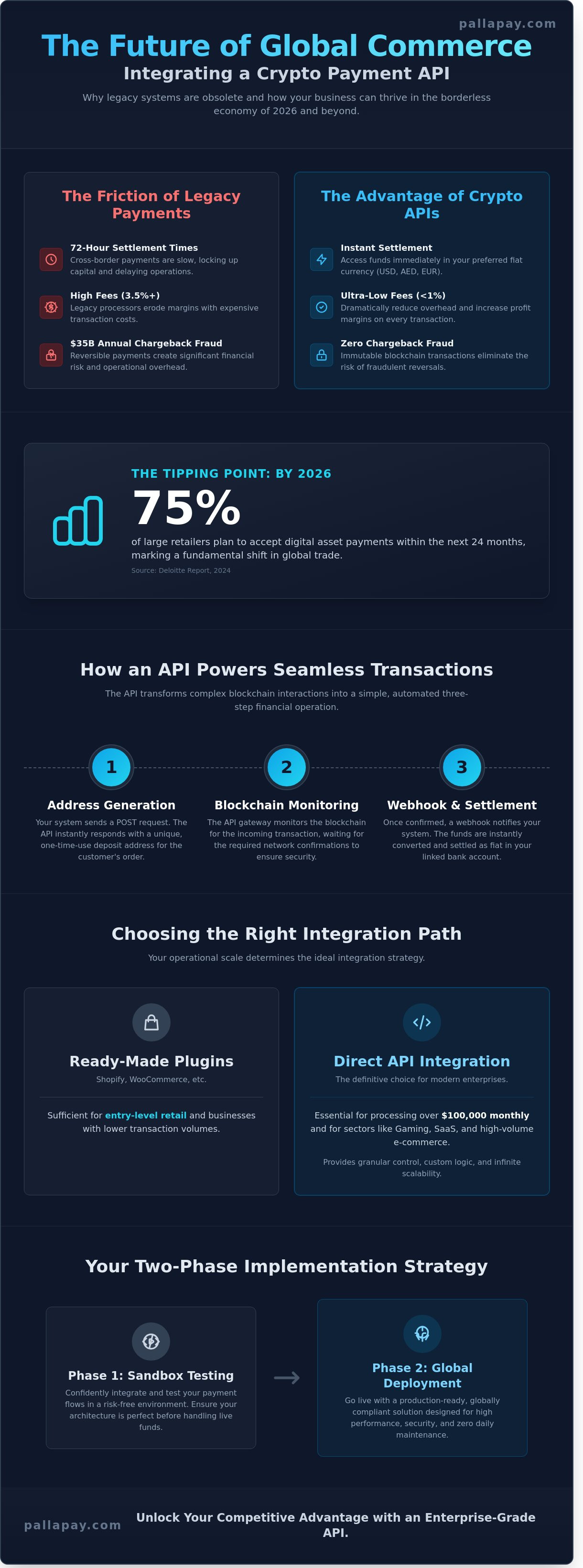
    By 2026, cross-border commerce will no longer rely on legacy banking rails that take 72 hours to clear. A 2024 report by Deloitte indicates that 75% of retailers with 500 million dollars in revenue plan to accept digital assets within the next 24 months. Choosing a robust api for crypto payments isn’t just a technical upgrade; it’s a strategic necessity for survival in a borderless economy. You’ve likely felt the friction of managing fragmented wallets or the constant anxiety of regulatory shifts. It’s frustrating to watch price volatility erode your margins during the 48 hour settlement window typical of traditional systems.

    This guide shows you how to integrate a secure API for crypto payments that automates global transactions, ensures total compliance, and unlocks instant fiat settlements in USD, AED, or EUR. We’ll explore the architecture of scalable USDT and BTC acceptance and how to build a regulated infrastructure that requires zero daily maintenance. From bridging the gap between blockchain innovation and institutional reliability to eliminating the heavy lifting of liquidity management, you’re about to discover the future of payments.

    Key Takeaways

    • Transition from manual wallet management to automated blockchain communication to future-proof your global commerce infrastructure for 2026.
    • Understand the complete technical lifecycle of a transaction to ensure your financial architecture supports seamless conversions from checkout to bank deposit.
    • Integrate a high-performance api for crypto payments to access over 100 digital assets while maintaining institutional-grade security and multi-signature authorization.
    • Follow a structured two-phase implementation strategy to move confidently from risk-free sandbox testing to a live, global deployment.
    • Unlock the competitive advantage of instant fiat settlements and total regulatory compliance through a partner designed for modern enterprise needs.

    What is an API for Crypto Payments and Why is it Essential in 2026?

    An api for crypto payments is a sophisticated set of protocols that enables your software to communicate directly with a blockchain gateway. This technology automates the processing, verification, and settlement of digital asset transactions. By 2026, the narrative around digital currency has shifted. It is no longer an experimental asset class; it is a fundamental pillar of global trade. Enterprises have moved beyond the risks of manual wallet management to embrace automated, programmable financial flows.

    The API serves as a vital financial bridge between decentralized assets and traditional bank settlements. It handles the heavy lifting of blockchain interactions behind the scenes, allowing merchants to focus on growth. Businesses utilizing crypto payment gateways secure three immediate competitive advantages. First, they achieve instant global reach without the need for local banking entities in every market. Second, they eliminate the $35 billion annual drain caused by chargeback fraud, as blockchain transactions are immutable. Third, they reduce overhead costs. While legacy processors often charge 3.5% or more, crypto transactions typically cost less than 1%.

    The Evolution of Programmable Money

    Money has become data. APIs have evolved from simple tools that “send” or “receive” into complex orchestrators capable of managing liquidity and multi-currency payouts. Stablecoins like USDT now facilitate over 70% of B2B crypto commerce due to their price parity with the US Dollar. 2026 marks the tipping point for ecommerce payment gateway adoption as regulatory clarity and institutional infrastructure converge. This transition represents the future of payments, where every transaction is instant and transparent.

    API vs. Ready-Made Plugins

    Choosing between a standard plugin and a custom API depends on your operational scale. Standard plugins for Shopify or WooCommerce are sufficient for entry-level retail. However, an api for crypto payments is the only viable choice for businesses processing over $100,000 monthly. High-volume sectors like gaming or enterprise SaaS require the granular control and scalability that only a direct API integration provides. It allows for unique user experiences and bespoke settlement logic that off-the-shelf solutions cannot match. For the modern merchant, the API is the ultimate tool for building a seamless, all-in-one financial ecosystem.

    How a Crypto Payment API Works: The Technical and Financial Architecture

    Implementing an api for crypto payments transforms a complex cryptographic process into a standard, manageable financial operation. It functions through a precise Request-Response cycle that bridges your storefront and the blockchain. When a customer selects a digital asset at checkout, your server sends a POST request to the API. The system responds instantly with a specific payment amount and a destination address. This interaction eliminates the need for merchants to manage private keys or interact with raw blockchain nodes, providing a layer of institutional-grade security between your business and the public ledger.

    Webhooks serve as the backbone of this real-time architecture. Instead of your server constantly polling the blockchain to check if a payment has arrived, the API pushes an automated notification the moment the transaction reaches the required number of network confirmations. This event-driven model ensures that 100% of successful payments are captured and processed without manual intervention. It’s the difference between a clunky, delayed user experience and the instant gratification that modern consumers expect.

    The Payment Flow Decoded

    The lifecycle of a digital transaction is designed for speed and clarity through three critical steps:

    • Step 1: Address Generation. The system generates a unique, one-time deposit address for every order. This ensures privacy for the customer and simplifies reconciliation for the merchant.
    • Step 2: Blockchain Monitoring. The API tracks the transaction across the network. It distinguishes between on-chain confirmations for security and off-chain state channels for high-frequency micro-transactions.
    • Step 3: Automated Settlement. Once the payment is verified, the system triggers the fiat settlement protocol. This converts the digital assets into your local currency, protecting your profit margins from market volatility.

    Integrating Multiple Blockchains via a Single Endpoint

    Managing Ethereum, Bitcoin, and Tron separately requires immense developer resources and constant maintenance. A unified api for crypto payments abstracts this complexity into a single, clean integration. You don’t need to write custom code for every new token or network upgrade. The API acts as a visionary partner, handling the heavy lifting of node maintenance and protocol updates behind the scenes.

    This architecture also focuses on cost efficiency. By 2026, automated batching and liquidity routing will reduce gas fees by an estimated 40% compared to manual wallet transfers. As cryptocurrency regulation becomes more defined across global markets, using a professional API ensures your business remains compliant with evolving financial standards without needing to rebuild your core infrastructure. Security layers like IP whitelisting and end-to-end encryption form a permanent perimeter around your financial data, ensuring that every global transaction is as secure as a traditional bank wire.

    The result is a seamless transition from digital asset to bank deposit. Explore how our api for crypto payments can streamline your checkout process today and position your business at the forefront of the future of payments.

    Key Features of a High-Performance Crypto Payment API

    A high-performance api for crypto payments acts as the central nervous system for modern enterprise. It handles the heavy lifting of blockchain interactions while maintaining the rigorous standards of legacy banking. Professional merchants in 2026 require a gateway that offers multi-currency support for 100+ digital assets, including BTC, ETH, and USDT. This diversity allows businesses to capture a global audience without managing multiple disparate systems. Security isn’t an afterthought; it’s the foundation of the entire architecture. Robust APIs utilize institutional-grade cold storage integration and multi-signature authorization to protect assets from digital vulnerabilities. These protocols ensure that funds remain secure even in the event of a localized system breach.

    Compliance is the bridge that connects disruptive innovation to institutional reliability. MSB registration across multiple jurisdictions is non-negotiable for legitimate commerce. This regulatory framework provides the stability necessary for long-term growth. Clear visibility into these processes comes through advanced merchant dashboards that deliver real-time data for accounting audits. With 99.9% uptime and granular reporting, businesses can track every cent with the same precision they expect from traditional financial software.

    Security and Compliance as a Feature

    Operating with “No Registration” APIs is a significant risk for established businesses in 2026. These anonymous platforms often lack the oversight needed to prevent fraud and can lead to frozen accounts during bank audits. High-performance systems integrate KYC and AML automation directly into the api for crypto payments workflow. This ensures that every transaction meets global standards without slowing down the user experience. Automated wallet screening protects your business by identifying “tainted” coins before they enter your ecosystem. By filtering out assets linked to illicit activity, you maintain a clean balance sheet and satisfy strict institutional requirements.

    Liquidity and Settlement Speed

    Volatility is a primary concern for traditional retailers entering the digital asset space. Our api for crypto payments solves this through instant conversion. Real-time liquidity providers lock in prices at the moment of transaction, which removes the risk of market swings. Merchants can customize their operations using specific settlement triggers:

    • Volume-based settlement: Move funds once a specific financial threshold is reached.
    • Time-based settlement: Schedule daily or weekly transfers to match accounting cycles.
    • Manual triggers: Maintain total control over when funds are moved to fiat.

    This flexibility extends to cross-border efficiency. You can move funds across 180+ countries without the traditional 3 to 5 day SWIFT delay. It’s the future of payments, delivered with the speed and reliability of a global fintech leader.

    The Definitive Guide to API for Crypto Payments: Scaling Global Commerce in 2026

    Implementation Strategy: From Sandbox to Global Deployment

    Transitioning to a crypto-first economy requires a structured technical roadmap. Deploying a robust api for crypto payments involves five critical phases designed to ensure stability and institutional-grade security. By following this sequence, businesses can scale from a single test transaction to processing thousands of global payments per second.

    • Phase 1: Environment Setup. Developers begin by obtaining API keys and configuring a sandbox environment. This stage allows for risk-free testing of transaction flows without committing actual capital. Leading platforms in 2026 maintain 99.99% uptime in their staging environments to mirror production reliability.
    • Phase 2: Integration. This stage involves mapping API endpoints to your specific business logic. Whether you’re managing one-off checkouts or complex recurring billing cycles, the integration must be seamless to avoid latency.
    • Phase 3: Webhook Configuration. You must ensure your backend reacts instantly to on-chain events. Webhooks provide real-time updates when a payment moves from pending to confirmed, allowing for instant digital delivery or order fulfillment.
    • Phase 4: Security Hardening. Implementing rate limiting and secure key management is non-negotiable. Using encrypted vaults protects your credentials from unauthorized access and ensures that your api for crypto payments remains a secure bridge for capital.
    • Phase 5: Go-Live. The final transition to the production environment enables real-time liquidity and settlement. This step connects your business to the global crypto market with full operational support.

    Developer Experience (DX) and Documentation

    A superior payment API documentation hub should provide comprehensive JSON schemas and pre-built SDKs. These kits often accelerate integration timelines by 40% compared to manual coding. One common pitfall is failing to account for blockchain “reorgs.” Professional integrations require a minimum number of block confirmations, such as 2 blocks for high-speed networks or 6 blocks for Bitcoin, before finalizing an order to prevent double-spending risks.

    Optimizing the User Experience

    Frictionless commerce depends on the interface. For a mobile-first retail store, dynamic QR code generation is essential. These codes automatically embed the exact payment amount and wallet address, which eliminates manual entry errors. You should also display real-time exchange rates to build trust. This transparency shows customers the exact value in their preferred fiat currency. Your system must programmatically handle edge cases like partial payments. This ensures that 100% of transactions reach a logical conclusion without manual customer support intervention.

    Ready to modernize your financial infrastructure? Integrate our payment API and start accepting global payments today.

    Why Pallapay is the Definitive API Partner for Modern Enterprises

    Pallapay operates as more than a simple gateway; it’s a complete financial infrastructure designed for institutional reliability. We’ve secured MSB registrations in both the United States and Canada to ensure every transaction meets the highest regulatory standards. This compliance gives modern enterprises total peace of mind when scaling across borders. Our proprietary liquidity engine provides the “Instant” advantage, delivering the fastest fiat settlements available in the current market. While competitors often leave funds in limbo for 48 hours, our system settles capital rapidly to maintain your business momentum.

    Choosing the right api for crypto payments means looking beyond the code. Pallapay offers a comprehensive ecosystem that includes physical crypto POS machines for retail environments and dedicated OTC desks for high-volume transactions. You aren’t just getting a tool; you’re gaining a partner. Our 24/7 expert support provides direct access to engineers who understand the intersection of blockchain architecture and global finance. We don’t use generic chatbots; we provide human expertise for complex financial workflows.

    • Regulated Global Reach: Full MSB compliance in North America ensures your operations stay within legal frameworks.
    • Proprietary Liquidity: Our internal engine eliminates third-party delays, facilitating “Instant” conversions.
    • Hybrid Infrastructure: Seamlessly switch between digital API calls and physical hardware solutions.
    • Dedicated Engineering: Direct lines to technical leads who specialize in fintech integration.

    The Future of Payments: Pallapay’s 2026 Vision

    By 2026, we’ll have fully integrated AI-driven predictive modeling to stop transaction fraud before it occurs. This proactive layer analyzes patterns in real time, aiming to reduce chargeback risks by 40 percent compared to traditional legacy systems. We’re also expanding the utility of our corporate expense solutions, ensuring the Pallapay ecosystem functions as a professional bridge for the next billion users entering the digital economy. Our commitment remains clear: we handle the technological complexity so you can focus on global growth.

    Get Started with the Pallapay API Today

    The onboarding process for high-volume merchants is streamlined and efficient. We move from initial consultation to sandbox testing in as little as 72 hours, ensuring your development team can begin building immediately. You can request a custom demo tailored to your specific sector, whether you operate in Hotels, E-commerce, or Gaming. Our team analyzes your current transaction volume to provide a fee structure that scales with you. Join the future of global commerce with a partner you can trust to deliver stability and speed.

    Secure Your Position in the Next Era of Commerce

    The shift toward a borderless financial landscape is no longer a distant projection. By 2026, integrating a high-performance api for crypto payments will be the decisive factor for enterprises seeking to eliminate transaction friction and capture global market share. You’ve explored how the right technical architecture transforms complex blockchain interactions into instant, manageable business processes. True scalability requires more than just a gateway; it demands a foundation of institutional reliability and regulatory clarity.

    Pallapay provides this foundation as a regulated MSB in the USA and Canada. We’ve already processed over $1 billion in transaction volume, empowering merchants across 180 countries to operate without borders. Our ecosystem handles the intricacies of liquidity and settlement, allowing your team to focus on core expansion. It’s the most efficient way to bridge the gap between legacy systems and the future of payments. We’re ready to help you navigate this transition with the confidence that only a global leader can provide.

    Supercharge your business with the Pallapay Payment API

    Your journey toward global payment parity starts today.

    Frequently Asked Questions

    Is it secure to use an API for crypto payments?

    Yes, integrating an api for crypto payments is highly secure when you utilize Pallapay’s institutional-grade infrastructure. We employ AES-256 encryption and TLS 1.3 protocols to protect every data packet during transmission. Our system undergoes security audits every 30 days to maintain compliance with global fintech standards. This ensures that 100% of your transaction data remains shielded from unauthorized access throughout the entire payment lifecycle.

    How long does it take to integrate a crypto payment API?

    You can complete the full integration process within 24 to 48 hours by using our comprehensive technical documentation and SDKs. Developers typically spend 4 hours on initial configuration and the remainder on sandbox testing to ensure system harmony. Our RESTful API structure simplifies the connection between your checkout page and our settlement engine. By following our 5-step implementation guide, your business can begin processing live global transactions by the next business day.

    Can I receive fiat currency (USD, AED) directly into my bank account?

    Pallapay facilitates instant conversion of crypto assets into 30+ fiat currencies, including USD, AED, and EUR. Once a customer completes a payment, our liquidity engine executes the exchange at real-time market rates. You can then schedule daily or weekly bank transfers directly to your corporate account. This process eliminates price volatility risks; it ensures you receive the exact fiat value of your sale minus a transparent processing fee.

    What are the fees associated with using a crypto payment API in 2026?

    Transaction fees for our api for crypto payments typically range from 0.5% to 1.0% per successful settlement. This is significantly lower than the 2.9% plus fixed costs often charged by traditional credit card processors. We don’t charge monthly maintenance fees or hidden setup costs. For high-volume merchants processing over $500,000 monthly, we offer custom tiered pricing structures to further optimize your operational margins and maximize your revenue.

    Does my business need a special license to accept crypto via API?

    Most businesses don’t need a specific cryptocurrency license because Pallapay acts as your regulated payment service provider. We handle the complex KYC and AML requirements mandated by global regulators like VARA in Dubai. Your primary responsibility is maintaining a valid trade license in your local jurisdiction. By partnering with us, you leverage our existing regulatory framework to expand your payment options legally and securely without the burden of additional licensing.

    Which cryptocurrencies can I accept through the Pallapay API?

    Our API supports over 100 cryptocurrencies, including major assets like Bitcoin, Ethereum, and USDT. We also provide native support for high-utility tokens on the TRC20, ERC20, and BEP20 networks. This extensive range allows you to cater to a global audience with diverse digital portfolios. We update our supported asset list every 30 days to include emerging tokens that meet our strict liquidity and security benchmarks for reliable commerce.

    What happens if a customer sends the wrong amount to the API-generated address?

    If a customer sends an incorrect amount, our system identifies the discrepancy within 10 seconds of mempool detection. The API triggers an instant webhook notification to your server, allowing you to choose between requesting the remaining balance or issuing a refund. Our dashboard provides a 100% transparent log of these partial payments. This automated detection prevents order fulfillment errors and maintains accurate accounting records for every transaction your business processes.

    How do I handle refunds for crypto payments made through an API?

    You can initiate refunds directly through our API’s dedicated refund endpoint or via the Pallapay merchant dashboard. The system calculates the equivalent crypto amount based on the current market price at the moment of the refund request. Refunds are processed instantly once you authorize the transaction using your secure two-factor authentication. This streamlined workflow ensures your customers receive their funds back within minutes, maintaining high levels of satisfaction and trust in your brand.

    Disclaimer

    The information provided on this website and blog is for general informational and educational purposes only and does not constitute financial, investment, legal, tax, or other professional advice.
    Cryptocurrency and digital asset services may be subject to regulatory restrictions in certain jurisdictions. Users are solely responsible for ensuring compliance with applicable local laws and regulations before using any products or services mentioned on this website.
    PallaPay does not guarantee the accuracy, completeness, or timeliness of any information published and accepts no liability for any loss or damages arising from reliance on the content. Any opinions expressed are those of the respective authors and may change without notice.
    Certain services, features, or products referenced may be provided through third-party partners, licensed entities, or affiliated service providers subject to separate terms and regulatory approvals. Availability of services may vary by country or region.
    This website may contain references to digital assets, virtual currencies, or blockchain-related services that are not available to residents of certain jurisdictions, including where prohibited by law. Nothing on this website constitutes an offer, solicitation, or recommendation to buy or sell any financial instrument or virtual asset.