

Tag: API for Crypto Payments

  • API for Crypto Payments: Powering the Future of Forex and CFD Trading in 2026

    API for Crypto Payments: Powering the Future of Forex and CFD Trading in 2026

    The era of waiting three business days for a Forex deposit to clear is officially over. Institutional reliability now meets decentralized efficiency, allowing brokers to bypass the friction that has historically slowed global capital movement. If you’ve struggled with high cross-border fees or the complexity of managing multiple blockchain protocols, you know that traditional settlement methods are no longer sufficient for the high-speed demands of XAU/USD markets. Integrating a professional api for crypto payments is the strategic answer to these operational hurdles, providing a secure bridge between digital assets and traditional CFD trading.

    You likely recognize that your traders demand instant access to liquidity to capitalize on market volatility. A robust payment infrastructure doesn’t just simplify transactions; it transforms the entire trading experience by enabling immediate deposits and withdrawals. This article will show you how a regulated crypto payment API can empower your platform to offer seamless Gold and USD CFD trading with instant global liquidity. We’ll explore the mechanics of stablecoin-based settlements and how this scalable technology provides the essential foundation for wealth creation in the 2026 financial landscape.

    Key Takeaways

    • Understand how a programmatic gateway functions as a professional liquidity engine, shifting from a simple checkout tool to a core component of institutional financial infrastructure.
    • Learn why low-latency execution and scalable endpoints are essential for managing high-volume Forex and USD CFD trading environments in 2026.
    • Discover the strategic advantage of using digital assets to fund precious metal trades, positioning Gold (XAU/USD) as a powerful hedge against traditional market volatility.
    • Identify the critical integration steps for developers, including the necessity of selecting a provider with global MSB status when implementing an api for crypto payments.
    • Explore how an integrated crypto-fiat ecosystem can accelerate your platform’s growth and provide traders with the tools needed for total financial independence.

    What is a Crypto Payment API and Why Does It Matter for Trading?

    A crypto payment API is a sophisticated set of protocols that allows financial platforms to interact directly with blockchain networks. Unlike a standard payment gateway designed for retail checkouts, a professional api for crypto payments functions as a high-speed liquidity engine. It enables the programmatic movement of digital assets, allowing brokers to automate deposits, withdrawals, and internal transfers without manual intervention. In 2026, the industry has shifted away from simple “pay with crypto” buttons. The focus is now on institutional-grade infrastructure that can handle the rigorous demands of global trading.

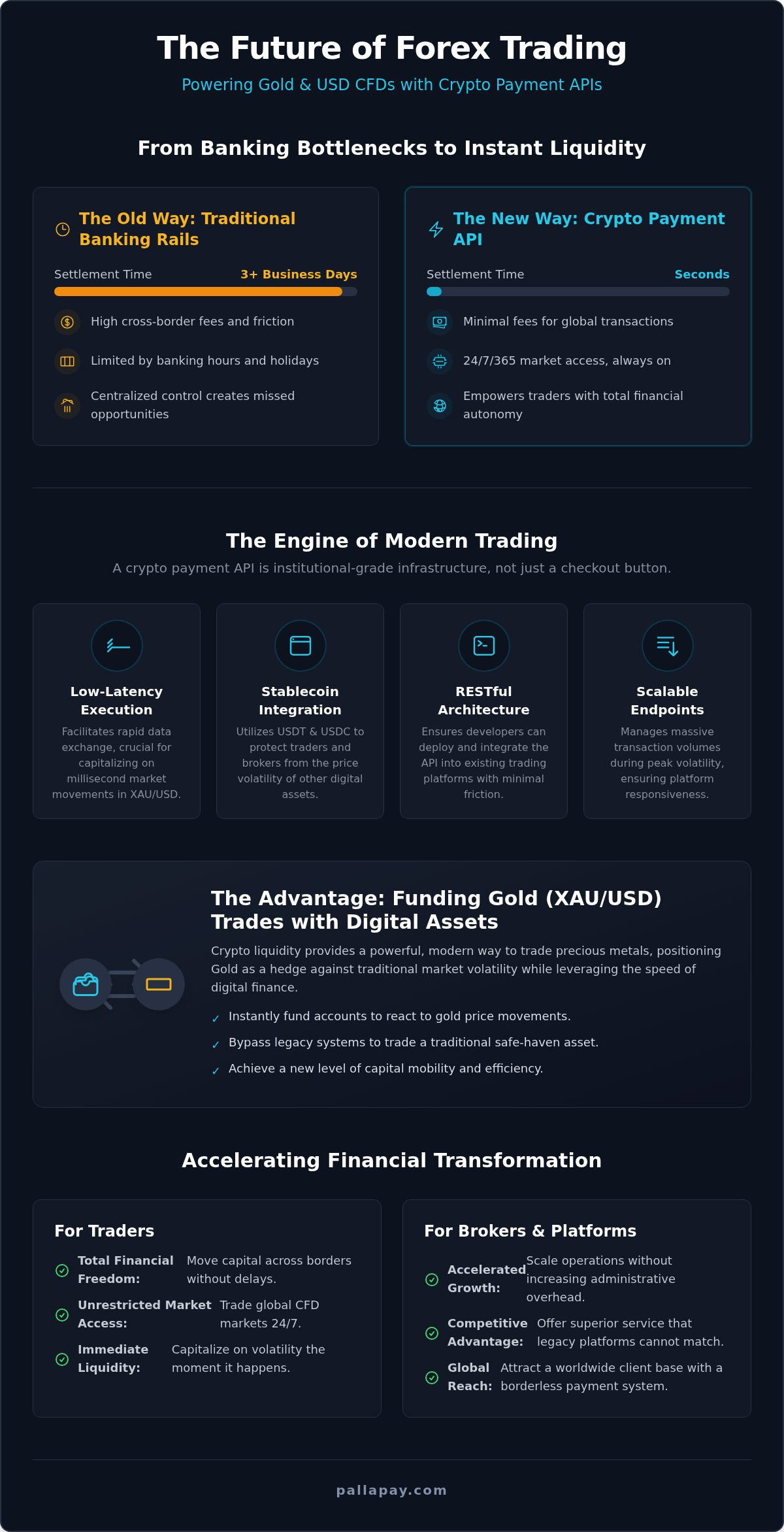
    Traditional banking rails have become the primary bottleneck for modern Forex traders. While the markets for Gold and USD CFDs move in milliseconds, legacy wire transfers often take days to settle. This lag creates missed opportunities and trapped capital. An API removes these temporal barriers, facilitating 24/7 market access regardless of bank holidays or local business hours. Implementing a dedicated api for crypto payments allows brokers to offer their clients a level of service that was previously reserved for institutional giants, ensuring that liquidity is always available where it is needed most.

    Breaking Down the Technical Infrastructure

    The technical core of a trading API relies on RESTful architecture, which ensures that developers can deploy these tools into existing trading apps with minimal friction. This infrastructure acts as a professional bridge, translating complex cryptographic proofs into standard financial data that a broker’s existing ledger can understand. These systems communicate with blockchain nodes to verify transactions and update merchant records in real time. For a CFD platform, this means instant account funding. Real-time callback mechanisms, or webhooks, provide immediate confirmation, so a trader can move from a USDT deposit to an active XAU/USD position in seconds.

    The Transformative Potential of Borderless Trading

    Democratizing access to global CFD markets is the ultimate goal of this technology. It isn’t just about technical efficiency; it’s about individual financial freedom. When a trader can move capital across borders without excessive fees or delays, they gain a level of autonomy that traditional systems simply cannot provide. This mobility is essential for those trading volatile assets like Gold or managing high-leverage USD CFD positions. By removing the centralized middleman, crypto APIs place the power of global finance directly into the hands of the individual trader.

    Core Mechanics of a Crypto API for High-Volume CFD Platforms

    In the fast-paced world of CFD trading, milliseconds determine the difference between a profitable exit and a margin call. A professional api for crypto payments is engineered to meet these extreme latency requirements. It facilitates rapid data exchange between the trader’s terminal and the blockchain network. By utilizing scalable endpoints, platforms can manage massive transaction volumes during periods of peak market volatility, such as a major XAU/USD price breakout. This technical agility ensures that a platform remains responsive even when thousands of users attempt to fund their accounts simultaneously.

    Stability is equally critical for institutional-grade operations. Most high-volume platforms rely on stablecoin integrations like USDT or USDC to maintain consistent trading margins. This approach protects both the broker and the trader from the price swings of more volatile digital assets. Automating the off-ramp process through an API ensures that when a trader decides to take profits, the withdrawal is processed with the same efficiency as the initial deposit. It’s this level of automation that allows a modern brokerage to scale without increasing its administrative overhead.

    Liquidity Management and Instant Settlements

    Bridging the gap between digital asset deposits and fiat-based trading accounts requires sophisticated liquidity management. Brokers need a system that converts crypto to usable capital instantly. Utilizing a specialized fiat settlement solution allows platforms to maintain deep liquidity pools without holding excess exposure to market fluctuations. This efficiency is what allows individual traders to pivot between USD CFD positions and Gold hedges as market conditions shift, potentially transforming their financial trajectory through precise execution. The API manages dynamic exchange rates in real time, protecting platform spreads while ensuring the trader receives the exact value intended for their XAU/USD positions.

    Security Protocols for Institutional Trading

    Security is the foundation of institutional trust. Modern APIs trigger advanced protocols like multi-signature wallets and cold storage transfers to protect funds at rest. Adhering to U.S. and global cryptocurrency regulation isn’t just a best practice; it’s a requirement for operational longevity. Pallapay maintains active registrations as a Money Services Business (MSB), including registration 31000315326622 with FinCEN in the US and M23088601 with FINTRAC in Canada. This level of compliance ensures that your API operations meet the rigorous standards expected by global financial authorities. For a deeper look at protecting these systems, you can explore our guide on crypto security in 2026.

    If you’re ready to upgrade your infrastructure, implementing a robust api for crypto payments is the most efficient path to institutional-grade performance.

    Maximizing Returns: Gold and USD CFD Trading via Crypto Liquidity

    Gold has long served as the definitive hedge against currency devaluation. In 2026, the synergy between precious metals and digital assets has reached a new level of sophistication. By integrating a professional api for crypto payments, brokers can now offer their clients the ability to fund high-leverage CFD trades using digital liquidity. This integration removes the friction of traditional banking, allowing for a more responsive approach to XAU/USD market movements. When global markets shift, the ability to move capital instantly from a digital wallet to a Gold CFD position can be the difference between protecting wealth and witnessing its erosion.

    The relationship between USDT and USD-denominated Forex pairs provides a stable foundation for this ecosystem. Since stablecoins mirror the value of the dollar, they act as a perfect bridge for traders looking to enter the USD CFD market without the delays associated with fiat clearinghouses. This efficiency is particularly valuable for those managing smaller, more frequent trades in the Gold market. Digital asset APIs allow for granular capital allocation, enabling individuals to build positions incrementally rather than waiting to accumulate large sums for a single entry. This democratization of access is a core driver of individual financial transformation.

    Trading Gold (XAU) with Digital Precision

    Fractional crypto funding has significantly lowered the barrier to entry for precious metals trading. Individuals no longer need to purchase physical bullion or deal with the logistics of secure storage. Instead, they can use digital assets to fund accounts and trade XAU/USD CFDs, which allow them to profit from gold price movements without the burden of physical ownership. This represents a major psychological shift from passive saving in fiat to active commodity trading. Maintaining a platform that supports these trades requires a deep understanding of State-level cryptocurrency legislation, ensuring that operations remain compliant while empowering the user’s financial journey.

    Forex Market Evolution in 2026

    The rise of ‘Crypto-to-Forex’ brokers is a defining trend of the current financial era. These platforms use an integrated api for crypto payments to offer instant funding, a feature that’s become a baseline expectation for professional traders. When market volatility spikes, the ability to react in real time is paramount. Traders who utilize these modern bridges can capitalize on price fluctuations in the USD and Gold markets with a speed that traditional brokers simply can’t match. This technological evolution isn’t just about convenience; it’s about providing the tools necessary for strategic wealth management in a borderless economy. By adopting these solutions, brokers position themselves as essential partners in their clients’ journey toward financial independence.
    API for Crypto Payments: Powering the Future of Forex and CFD Trading in 2026

    Integration Strategy: A Developer’s Checklist for 2026

    Implementing a professional api for crypto payments requires a methodical approach to ensure both technical efficiency and regulatory compliance. For platforms facilitating Gold and USD CFD trading, the integration process is the foundation of user trust. A systematic checklist ensures that your infrastructure can handle the demands of a high-frequency trading environment while maintaining institutional-grade security. Following these steps allows brokers to bridge the gap between digital liquidity and traditional market execution.

    • Step 1: Select a Regulated Provider. Prioritize partners with global MSB status. Pallapay is registered with FinCEN in the US (31000315326622) and FINTRAC in Canada (M23088601), providing the necessary legal framework for high-volume operations.
    • Step 2: Configure Webhooks. Real-time order status updates are critical for managing account balances. Accurate webhooks ensure that a trader’s capital is available for XAU/USD positions the moment a transaction is confirmed on the blockchain.
    • Step 3: Implement KYC/AML Modules. Compliance should be a seamless part of the API flow. Integrating automated identity verification helps maintain the integrity of your platform without slowing down the user experience.
    • Step 4: Sandbox Testing. Run simulated high-load scenarios. It’s essential to verify that your API endpoints can process massive transaction volumes during periods of peak market volatility.
    • Step 5: Launch with Fiat Off-Ramps. Enabling users to convert profits back to bank-settled capital builds long-term confidence. A clear path to liquidity is often the deciding factor for professional traders.

    Optimizing the User Checkout Experience

    Reducing friction is the primary goal for any trading platform developer. One-click crypto deposits allow traders to fund their accounts instantly, ensuring they don’t miss critical entry points in the Gold market. Designing responsive payment interfaces is particularly important for mobile-first traders who manage their portfolios on the go. For a deeper look at maximizing these tools, consult The Ultimate Guide to Crypto Payment Gateways to understand how these systems empower global commerce.

    Advanced API Features for Trading Platforms

    Beyond simple deposits, a robust api for crypto payments offers sophisticated tools for business growth. Automated payouts and batch processing simplify the management of affiliate commissions, allowing you to reward partners without manual overhead. Integrating the Pallapay Off-Ramp provides your users with seamless bank transfers, completing the financial circle. Customizable ledger reporting further assists with tax and regulatory compliance, ensuring that every transaction is documented and ready for audit. This level of technical integration transforms a simple broker into a comprehensive financial partner.

    Ready to enhance your platform’s liquidity? Integrate the Pallapay Payment API to secure your competitive edge in the 2026 trading landscape.

    Financial Transformation: Why Your Business Needs the Pallapay API

    The competitive advantage of a 100% integrated ecosystem cannot be overstated. Traditional brokers often struggle with fragmented payment systems that delay capital movement and increase operational costs. Pallapay solves this by providing a unified infrastructure that connects digital liquidity directly to fiat settlements. By adopting our api for crypto payments, a local startup can transform into a global powerhouse, offering services in over 180 countries. This scalability is supported by our unique bridge between the physical and digital worlds. The synergy of the Pallapay Mastercard and our Crypto POS Machine allows traders to access their profits instantly, moving from a successful XAU/USD trade to real-world spending without the typical hurdles of legacy banking.

    Global financial independence is the ultimate vision behind this technology. Our infrastructure is designed to remove the friction that has historically limited the potential of individual traders. When a platform integrates a professional api for crypto payments, it isn’t just adding a feature; it’s adopting a strategic engine for growth. This system ensures that liquidity is always available, allowing for rapid reactions to market volatility in Gold and USD CFD markets. The result is a more resilient business model that empowers both the broker and the end-user.

    The Pallapay Advantage for Forex Brokers

    Forex brokers require deep liquidity to manage high-leverage trades effectively. Pallapay provides access to institutional-grade OTC desks, ensuring that large-scale transactions are executed with minimal slippage and maximum security. Secure asset management is handled through the Pallapay Wallet, which integrates directly with our API for effortless oversight of digital holdings. Trust is the primary currency in the trading world. Our regulated status as an MSB registered entity in both the US and Canada provides the absolute stability that professional trading clients demand. This compliance-first approach ensures that your platform is viewed as a reliable partner in the global financial market.

    Your Path to Financial Evolution

    Adopting a crypto-first strategy is about more than just modernizing payments; it’s about embracing a new era of commerce. The ability to settle in stablecoins like USDT protects your margins while providing the speed necessary for high-frequency Gold and USD CFD trading. This evolution empowers individuals to take control of their financial destiny by providing them with the tools needed for borderless capital movement. The right API choice today dictates the financial success of tomorrow’s traders.

    Integrate the Pallapay API Today to begin your platform’s transformation.

    Securing Your Edge in the 2026 Trading Landscape

    The global financial landscape is evolving, and the integration of digital liquidity into traditional Forex markets isn’t just an advantage; it’s a necessity for growth. We’ve explored how a professional api for crypto payments serves as the essential engine for high-volume platforms, enabling instant access to Gold and USD CFD markets. By removing the bottlenecks of legacy banking, you empower your traders to react to global volatility in real time, turning rapid market shifts into genuine opportunities for financial transformation.

    Success in 2026 requires a strategic partner that bridges the gap between disruptive technology and institutional reliability. Pallapay provides this bridge through official MSB registrations in the US and Canada, ensuring your operations remain compliant while benefiting from instant fiat settlement and 24/7 global OTC support. This infrastructure doesn’t just process transactions; it builds the foundation for long-term wealth creation and professional stability. Now is the time to modernize your infrastructure and provide your clients with the borderless liquidity they deserve. Scale Your Trading Platform with the Pallapay API and lead the evolution of global commerce. Your journey toward a more efficient and inclusive financial future starts today.

    Frequently Asked Questions

    What is a crypto payment API and how does it work for businesses?

    A crypto payment API is a set of programmatic protocols that enables businesses to automate the acceptance, conversion, and settlement of digital assets. It functions by establishing a secure link between a merchant’s internal ledger and various blockchain networks. By using a professional api for crypto payments, businesses can eliminate manual processing and provide customers with real-time transaction confirmations. This infrastructure is essential for modern platforms that require high-speed liquidity and automated record-keeping.

    Can I use a crypto API to accept payments for Forex trading?

    Integrating a crypto API is one of the most efficient ways to accept deposits for Forex trading platforms. It allows brokers to bypass traditional banking delays and offer traders instant account funding. This technology is particularly beneficial for those managing high-leverage positions, as it ensures capital is available exactly when market opportunities arise. By adopting this system, brokers can support a global user base while maintaining institutional-grade reliability and transaction speed.

    Is it possible to settle crypto payments directly into a bank account?

    Instant fiat settlement is a core feature of the Pallapay ecosystem, allowing you to convert digital assets into local currency automatically. Once a transaction is confirmed via the api for crypto payments, the funds can be settled directly into your linked bank account. This process removes the volatility risk associated with holding digital assets and provides the liquidity needed for daily business operations. It’s an ideal solution for CFD platforms requiring consistent USD-denominated capital.

    How do I integrate a crypto payment API into my existing website or app?

    Integration typically involves connecting to RESTful endpoints and configuring webhooks to receive real-time status updates. Developers start by using a sandbox environment to test transaction flows and high-load scenarios without risking actual capital. After verifying the security of the KYC and AML modules, the API is deployed to the live production environment. This methodical approach ensures that the payment interface is responsive and secure for mobile-first traders managing their portfolios on the go.

    Which cryptocurrencies are supported by a professional payment API?

    Professional APIs support a wide range of digital assets, including Bitcoin, Ethereum, and high-liquidity stablecoins like USDT and USDC. For trading platforms, stablecoins are often the preferred choice because they maintain a consistent value relative to the US Dollar. This stability is crucial for calculating trading margins and protecting spreads in volatile markets. Accessing these varied assets through a single gateway simplifies treasury management and provides traders with multiple options for account funding.

    What are the security benefits of using a regulated crypto API provider?

    Regulated providers offer enhanced security through official MSB registrations and adherence to global anti-money laundering standards. Using a provider like Pallapay, which is registered with FinCEN in the US and FINTRAC in Canada, ensures your operations meet strict legal requirements. These providers also implement institutional-grade protocols, such as multi-signature wallets and cold storage triggers. This combination of legal compliance and technical safeguards builds absolute trust with your professional and individual trading clients.

    How does a crypto API help with Gold (XAU/USD) CFD trading?

    A crypto API facilitates seamless Gold (XAU/USD) CFD trading by providing the instant liquidity needed to capitalize on price movements. It allows for fractional funding, which lowers the barrier to entry for individual traders looking to hedge against currency devaluation. Because the system operates 24/7, traders can move capital into precious metals positions even when traditional banks are closed. This constant access is vital for strategic wealth management in the fast-paced commodity markets.

    Are there transaction limits for high-volume trading platforms?

    While professional APIs are designed to handle massive transaction volumes, specific limits often depend on the platform’s verification level and account status. High-volume CFD platforms can leverage scalable endpoints to process thousands of simultaneous requests during peak market volatility. Regulated providers offer tiered structures that accommodate the needs of both local startups and global powerhouses. This ensures that as your trading volume grows, your payment infrastructure remains a supportive facilitator rather than a bottleneck.

    Disclaimer

    The information provided on this website and blog is for general informational and educational purposes only and does not constitute financial, investment, legal, tax, or other professional advice.
    Cryptocurrency and digital asset services may be subject to regulatory restrictions in certain jurisdictions. Users are solely responsible for ensuring compliance with applicable local laws and regulations before using any products or services mentioned on this website.
    PallaPay does not guarantee the accuracy, completeness, or timeliness of any information published and accepts no liability for any loss or damages arising from reliance on the content. Any opinions expressed are those of the respective authors and may change without notice.
    Certain services, features, or products referenced may be provided through third-party partners, licensed entities, or affiliated service providers subject to separate terms and regulatory approvals. Availability of services may vary by country or region.
    This website may contain references to digital assets, virtual currencies, or blockchain-related services that are not available to residents of certain jurisdictions, including where prohibited by law. Nothing on this website constitutes an offer, solicitation, or recommendation to buy or sell any financial instrument or virtual asset.

  • The Definitive Guide to API for Crypto Payments: Scaling Global Commerce in 2026

    The Definitive Guide to API for Crypto Payments: Scaling Global Commerce in 2026

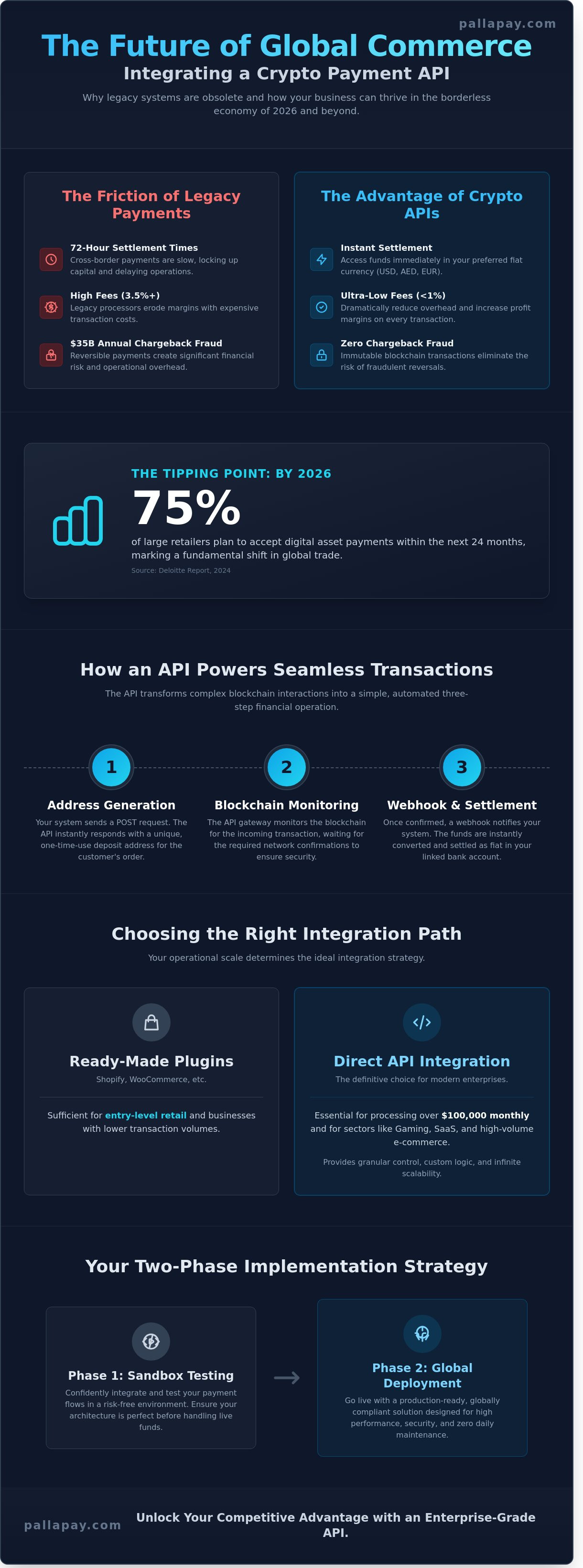
    By 2026, cross-border commerce will no longer rely on legacy banking rails that take 72 hours to clear. A 2024 report by Deloitte indicates that 75% of retailers with 500 million dollars in revenue plan to accept digital assets within the next 24 months. Choosing a robust api for crypto payments isn’t just a technical upgrade; it’s a strategic necessity for survival in a borderless economy. You’ve likely felt the friction of managing fragmented wallets or the constant anxiety of regulatory shifts. It’s frustrating to watch price volatility erode your margins during the 48 hour settlement window typical of traditional systems.

    This guide shows you how to integrate a secure API for crypto payments that automates global transactions, ensures total compliance, and unlocks instant fiat settlements in USD, AED, or EUR. We’ll explore the architecture of scalable USDT and BTC acceptance and how to build a regulated infrastructure that requires zero daily maintenance. From bridging the gap between blockchain innovation and institutional reliability to eliminating the heavy lifting of liquidity management, you’re about to discover the future of payments.

    Key Takeaways

    • Transition from manual wallet management to automated blockchain communication to future-proof your global commerce infrastructure for 2026.
    • Understand the complete technical lifecycle of a transaction to ensure your financial architecture supports seamless conversions from checkout to bank deposit.
    • Integrate a high-performance api for crypto payments to access over 100 digital assets while maintaining institutional-grade security and multi-signature authorization.
    • Follow a structured two-phase implementation strategy to move confidently from risk-free sandbox testing to a live, global deployment.
    • Unlock the competitive advantage of instant fiat settlements and total regulatory compliance through a partner designed for modern enterprise needs.

    What is an API for Crypto Payments and Why is it Essential in 2026?

    An api for crypto payments is a sophisticated set of protocols that enables your software to communicate directly with a blockchain gateway. This technology automates the processing, verification, and settlement of digital asset transactions. By 2026, the narrative around digital currency has shifted. It is no longer an experimental asset class; it is a fundamental pillar of global trade. Enterprises have moved beyond the risks of manual wallet management to embrace automated, programmable financial flows.

    The API serves as a vital financial bridge between decentralized assets and traditional bank settlements. It handles the heavy lifting of blockchain interactions behind the scenes, allowing merchants to focus on growth. Businesses utilizing crypto payment gateways secure three immediate competitive advantages. First, they achieve instant global reach without the need for local banking entities in every market. Second, they eliminate the $35 billion annual drain caused by chargeback fraud, as blockchain transactions are immutable. Third, they reduce overhead costs. While legacy processors often charge 3.5% or more, crypto transactions typically cost less than 1%.

    The Evolution of Programmable Money

    Money has become data. APIs have evolved from simple tools that “send” or “receive” into complex orchestrators capable of managing liquidity and multi-currency payouts. Stablecoins like USDT now facilitate over 70% of B2B crypto commerce due to their price parity with the US Dollar. 2026 marks the tipping point for ecommerce payment gateway adoption as regulatory clarity and institutional infrastructure converge. This transition represents the future of payments, where every transaction is instant and transparent.

    API vs. Ready-Made Plugins

    Choosing between a standard plugin and a custom API depends on your operational scale. Standard plugins for Shopify or WooCommerce are sufficient for entry-level retail. However, an api for crypto payments is the only viable choice for businesses processing over $100,000 monthly. High-volume sectors like gaming or enterprise SaaS require the granular control and scalability that only a direct API integration provides. It allows for unique user experiences and bespoke settlement logic that off-the-shelf solutions cannot match. For the modern merchant, the API is the ultimate tool for building a seamless, all-in-one financial ecosystem.

    How a Crypto Payment API Works: The Technical and Financial Architecture

    Implementing an api for crypto payments transforms a complex cryptographic process into a standard, manageable financial operation. It functions through a precise Request-Response cycle that bridges your storefront and the blockchain. When a customer selects a digital asset at checkout, your server sends a POST request to the API. The system responds instantly with a specific payment amount and a destination address. This interaction eliminates the need for merchants to manage private keys or interact with raw blockchain nodes, providing a layer of institutional-grade security between your business and the public ledger.

    Webhooks serve as the backbone of this real-time architecture. Instead of your server constantly polling the blockchain to check if a payment has arrived, the API pushes an automated notification the moment the transaction reaches the required number of network confirmations. This event-driven model ensures that 100% of successful payments are captured and processed without manual intervention. It’s the difference between a clunky, delayed user experience and the instant gratification that modern consumers expect.

    The Payment Flow Decoded

    The lifecycle of a digital transaction is designed for speed and clarity through three critical steps:

    • Step 1: Address Generation. The system generates a unique, one-time deposit address for every order. This ensures privacy for the customer and simplifies reconciliation for the merchant.
    • Step 2: Blockchain Monitoring. The API tracks the transaction across the network. It distinguishes between on-chain confirmations for security and off-chain state channels for high-frequency micro-transactions.
    • Step 3: Automated Settlement. Once the payment is verified, the system triggers the fiat settlement protocol. This converts the digital assets into your local currency, protecting your profit margins from market volatility.

    Integrating Multiple Blockchains via a Single Endpoint

    Managing Ethereum, Bitcoin, and Tron separately requires immense developer resources and constant maintenance. A unified api for crypto payments abstracts this complexity into a single, clean integration. You don’t need to write custom code for every new token or network upgrade. The API acts as a visionary partner, handling the heavy lifting of node maintenance and protocol updates behind the scenes.

    This architecture also focuses on cost efficiency. By 2026, automated batching and liquidity routing will reduce gas fees by an estimated 40% compared to manual wallet transfers. As cryptocurrency regulation becomes more defined across global markets, using a professional API ensures your business remains compliant with evolving financial standards without needing to rebuild your core infrastructure. Security layers like IP whitelisting and end-to-end encryption form a permanent perimeter around your financial data, ensuring that every global transaction is as secure as a traditional bank wire.

    The result is a seamless transition from digital asset to bank deposit. Explore how our api for crypto payments can streamline your checkout process today and position your business at the forefront of the future of payments.

    Key Features of a High-Performance Crypto Payment API

    A high-performance api for crypto payments acts as the central nervous system for modern enterprise. It handles the heavy lifting of blockchain interactions while maintaining the rigorous standards of legacy banking. Professional merchants in 2026 require a gateway that offers multi-currency support for 100+ digital assets, including BTC, ETH, and USDT. This diversity allows businesses to capture a global audience without managing multiple disparate systems. Security isn’t an afterthought; it’s the foundation of the entire architecture. Robust APIs utilize institutional-grade cold storage integration and multi-signature authorization to protect assets from digital vulnerabilities. These protocols ensure that funds remain secure even in the event of a localized system breach.

    Compliance is the bridge that connects disruptive innovation to institutional reliability. MSB registration across multiple jurisdictions is non-negotiable for legitimate commerce. This regulatory framework provides the stability necessary for long-term growth. Clear visibility into these processes comes through advanced merchant dashboards that deliver real-time data for accounting audits. With 99.9% uptime and granular reporting, businesses can track every cent with the same precision they expect from traditional financial software.

    Security and Compliance as a Feature

    Operating with “No Registration” APIs is a significant risk for established businesses in 2026. These anonymous platforms often lack the oversight needed to prevent fraud and can lead to frozen accounts during bank audits. High-performance systems integrate KYC and AML automation directly into the api for crypto payments workflow. This ensures that every transaction meets global standards without slowing down the user experience. Automated wallet screening protects your business by identifying “tainted” coins before they enter your ecosystem. By filtering out assets linked to illicit activity, you maintain a clean balance sheet and satisfy strict institutional requirements.

    Liquidity and Settlement Speed

    Volatility is a primary concern for traditional retailers entering the digital asset space. Our api for crypto payments solves this through instant conversion. Real-time liquidity providers lock in prices at the moment of transaction, which removes the risk of market swings. Merchants can customize their operations using specific settlement triggers:

    • Volume-based settlement: Move funds once a specific financial threshold is reached.
    • Time-based settlement: Schedule daily or weekly transfers to match accounting cycles.
    • Manual triggers: Maintain total control over when funds are moved to fiat.

    This flexibility extends to cross-border efficiency. You can move funds across 180+ countries without the traditional 3 to 5 day SWIFT delay. It’s the future of payments, delivered with the speed and reliability of a global fintech leader.

    The Definitive Guide to API for Crypto Payments: Scaling Global Commerce in 2026

    Implementation Strategy: From Sandbox to Global Deployment

    Transitioning to a crypto-first economy requires a structured technical roadmap. Deploying a robust api for crypto payments involves five critical phases designed to ensure stability and institutional-grade security. By following this sequence, businesses can scale from a single test transaction to processing thousands of global payments per second.

    • Phase 1: Environment Setup. Developers begin by obtaining API keys and configuring a sandbox environment. This stage allows for risk-free testing of transaction flows without committing actual capital. Leading platforms in 2026 maintain 99.99% uptime in their staging environments to mirror production reliability.
    • Phase 2: Integration. This stage involves mapping API endpoints to your specific business logic. Whether you’re managing one-off checkouts or complex recurring billing cycles, the integration must be seamless to avoid latency.
    • Phase 3: Webhook Configuration. You must ensure your backend reacts instantly to on-chain events. Webhooks provide real-time updates when a payment moves from pending to confirmed, allowing for instant digital delivery or order fulfillment.
    • Phase 4: Security Hardening. Implementing rate limiting and secure key management is non-negotiable. Using encrypted vaults protects your credentials from unauthorized access and ensures that your api for crypto payments remains a secure bridge for capital.
    • Phase 5: Go-Live. The final transition to the production environment enables real-time liquidity and settlement. This step connects your business to the global crypto market with full operational support.

    Developer Experience (DX) and Documentation

    A superior payment API documentation hub should provide comprehensive JSON schemas and pre-built SDKs. These kits often accelerate integration timelines by 40% compared to manual coding. One common pitfall is failing to account for blockchain “reorgs.” Professional integrations require a minimum number of block confirmations, such as 2 blocks for high-speed networks or 6 blocks for Bitcoin, before finalizing an order to prevent double-spending risks.

    Optimizing the User Experience

    Frictionless commerce depends on the interface. For a mobile-first retail store, dynamic QR code generation is essential. These codes automatically embed the exact payment amount and wallet address, which eliminates manual entry errors. You should also display real-time exchange rates to build trust. This transparency shows customers the exact value in their preferred fiat currency. Your system must programmatically handle edge cases like partial payments. This ensures that 100% of transactions reach a logical conclusion without manual customer support intervention.

    Ready to modernize your financial infrastructure? Integrate our payment API and start accepting global payments today.

    Why Pallapay is the Definitive API Partner for Modern Enterprises

    Pallapay operates as more than a simple gateway; it’s a complete financial infrastructure designed for institutional reliability. We’ve secured MSB registrations in both the United States and Canada to ensure every transaction meets the highest regulatory standards. This compliance gives modern enterprises total peace of mind when scaling across borders. Our proprietary liquidity engine provides the “Instant” advantage, delivering the fastest fiat settlements available in the current market. While competitors often leave funds in limbo for 48 hours, our system settles capital rapidly to maintain your business momentum.

    Choosing the right api for crypto payments means looking beyond the code. Pallapay offers a comprehensive ecosystem that includes physical crypto POS machines for retail environments and dedicated OTC desks for high-volume transactions. You aren’t just getting a tool; you’re gaining a partner. Our 24/7 expert support provides direct access to engineers who understand the intersection of blockchain architecture and global finance. We don’t use generic chatbots; we provide human expertise for complex financial workflows.

    • Regulated Global Reach: Full MSB compliance in North America ensures your operations stay within legal frameworks.
    • Proprietary Liquidity: Our internal engine eliminates third-party delays, facilitating “Instant” conversions.
    • Hybrid Infrastructure: Seamlessly switch between digital API calls and physical hardware solutions.
    • Dedicated Engineering: Direct lines to technical leads who specialize in fintech integration.

    The Future of Payments: Pallapay’s 2026 Vision

    By 2026, we’ll have fully integrated AI-driven predictive modeling to stop transaction fraud before it occurs. This proactive layer analyzes patterns in real time, aiming to reduce chargeback risks by 40 percent compared to traditional legacy systems. We’re also expanding the utility of our corporate expense solutions, ensuring the Pallapay ecosystem functions as a professional bridge for the next billion users entering the digital economy. Our commitment remains clear: we handle the technological complexity so you can focus on global growth.

    Get Started with the Pallapay API Today

    The onboarding process for high-volume merchants is streamlined and efficient. We move from initial consultation to sandbox testing in as little as 72 hours, ensuring your development team can begin building immediately. You can request a custom demo tailored to your specific sector, whether you operate in Hotels, E-commerce, or Gaming. Our team analyzes your current transaction volume to provide a fee structure that scales with you. Join the future of global commerce with a partner you can trust to deliver stability and speed.

    Secure Your Position in the Next Era of Commerce

    The shift toward a borderless financial landscape is no longer a distant projection. By 2026, integrating a high-performance api for crypto payments will be the decisive factor for enterprises seeking to eliminate transaction friction and capture global market share. You’ve explored how the right technical architecture transforms complex blockchain interactions into instant, manageable business processes. True scalability requires more than just a gateway; it demands a foundation of institutional reliability and regulatory clarity.

    Pallapay provides this foundation as a regulated MSB in the USA and Canada. We’ve already processed over $1 billion in transaction volume, empowering merchants across 180 countries to operate without borders. Our ecosystem handles the intricacies of liquidity and settlement, allowing your team to focus on core expansion. It’s the most efficient way to bridge the gap between legacy systems and the future of payments. We’re ready to help you navigate this transition with the confidence that only a global leader can provide.

    Supercharge your business with the Pallapay Payment API

    Your journey toward global payment parity starts today.

    Frequently Asked Questions

    Is it secure to use an API for crypto payments?

    Yes, integrating an api for crypto payments is highly secure when you utilize Pallapay’s institutional-grade infrastructure. We employ AES-256 encryption and TLS 1.3 protocols to protect every data packet during transmission. Our system undergoes security audits every 30 days to maintain compliance with global fintech standards. This ensures that 100% of your transaction data remains shielded from unauthorized access throughout the entire payment lifecycle.

    How long does it take to integrate a crypto payment API?

    You can complete the full integration process within 24 to 48 hours by using our comprehensive technical documentation and SDKs. Developers typically spend 4 hours on initial configuration and the remainder on sandbox testing to ensure system harmony. Our RESTful API structure simplifies the connection between your checkout page and our settlement engine. By following our 5-step implementation guide, your business can begin processing live global transactions by the next business day.

    Can I receive fiat currency (USD, AED) directly into my bank account?

    Pallapay facilitates instant conversion of crypto assets into 30+ fiat currencies, including USD, AED, and EUR. Once a customer completes a payment, our liquidity engine executes the exchange at real-time market rates. You can then schedule daily or weekly bank transfers directly to your corporate account. This process eliminates price volatility risks; it ensures you receive the exact fiat value of your sale minus a transparent processing fee.

    What are the fees associated with using a crypto payment API in 2026?

    Transaction fees for our api for crypto payments typically range from 0.5% to 1.0% per successful settlement. This is significantly lower than the 2.9% plus fixed costs often charged by traditional credit card processors. We don’t charge monthly maintenance fees or hidden setup costs. For high-volume merchants processing over $500,000 monthly, we offer custom tiered pricing structures to further optimize your operational margins and maximize your revenue.

    Does my business need a special license to accept crypto via API?

    Most businesses don’t need a specific cryptocurrency license because Pallapay acts as your regulated payment service provider. We handle the complex KYC and AML requirements mandated by global regulators like VARA in Dubai. Your primary responsibility is maintaining a valid trade license in your local jurisdiction. By partnering with us, you leverage our existing regulatory framework to expand your payment options legally and securely without the burden of additional licensing.

    Which cryptocurrencies can I accept through the Pallapay API?

    Our API supports over 100 cryptocurrencies, including major assets like Bitcoin, Ethereum, and USDT. We also provide native support for high-utility tokens on the TRC20, ERC20, and BEP20 networks. This extensive range allows you to cater to a global audience with diverse digital portfolios. We update our supported asset list every 30 days to include emerging tokens that meet our strict liquidity and security benchmarks for reliable commerce.

    What happens if a customer sends the wrong amount to the API-generated address?

    If a customer sends an incorrect amount, our system identifies the discrepancy within 10 seconds of mempool detection. The API triggers an instant webhook notification to your server, allowing you to choose between requesting the remaining balance or issuing a refund. Our dashboard provides a 100% transparent log of these partial payments. This automated detection prevents order fulfillment errors and maintains accurate accounting records for every transaction your business processes.

    How do I handle refunds for crypto payments made through an API?

    You can initiate refunds directly through our API’s dedicated refund endpoint or via the Pallapay merchant dashboard. The system calculates the equivalent crypto amount based on the current market price at the moment of the refund request. Refunds are processed instantly once you authorize the transaction using your secure two-factor authentication. This streamlined workflow ensures your customers receive their funds back within minutes, maintaining high levels of satisfaction and trust in your brand.

    Disclaimer

    The information provided on this website and blog is for general informational and educational purposes only and does not constitute financial, investment, legal, tax, or other professional advice.
    Cryptocurrency and digital asset services may be subject to regulatory restrictions in certain jurisdictions. Users are solely responsible for ensuring compliance with applicable local laws and regulations before using any products or services mentioned on this website.
    PallaPay does not guarantee the accuracy, completeness, or timeliness of any information published and accepts no liability for any loss or damages arising from reliance on the content. Any opinions expressed are those of the respective authors and may change without notice.
    Certain services, features, or products referenced may be provided through third-party partners, licensed entities, or affiliated service providers subject to separate terms and regulatory approvals. Availability of services may vary by country or region.
    This website may contain references to digital assets, virtual currencies, or blockchain-related services that are not available to residents of certain jurisdictions, including where prohibited by law. Nothing on this website constitutes an offer, solicitation, or recommendation to buy or sell any financial instrument or virtual asset.