

ASIC research found that at least 68% of retail investors lost money trading CFDs in 2023-24. If your search began with “best crypto pos hardware 2026,” note that payment hardware and gold or USD CFD trading are separate topics. Neither CFDs nor any other trading product offer guaranteed income. Before considering a position, understand how much market exposure you would take on.
It’s reasonable to want a clear explanation before risking capital, especially when leverage, margin, and potential losses can be difficult to assess. A CFD lets you speculate on price movements without owning the underlying asset. With gold and USD exposure, that means understanding how changes in the XAU/USD price or a currency pair may affect your position, and how leverage can magnify both gains and losses.
This guide explains how these CFDs work, what can move their value, and why a small market shift can have a larger effect on a leveraged position. You’ll also learn what disciplined preparation involves, from sizing exposure to planning for losses. The aim is informed decision-making, not promises of financial transformation.
Key Takeaways
- A gold or currency CFD gives you exposure to price movements without owning the underlying asset. Identify exactly what your position tracks before trading.
- Gold and currency markets respond to different forces. Research relevant market drivers without assuming they predict a particular outcome.
- Leverage increases exposure and can magnify losses as well as gains. Decide what loss you could tolerate before considering a position.
- A disciplined plan starts with learning the contract, researching the market, setting clear boundaries, and reviewing decisions over time.
- Pallapay offers cryptocurrency services, including buying, selling, and exchanging digital assets. Those services are separate from CFD trading, and access to any financial product does not guarantee a positive result.
What Are Gold and USD CFDs, and What Does a Trader Actually Trade?
A contract for difference gives you exposure to an asset’s price movement, not ownership of the asset itself. With a gold or currency CFD, a trader takes a position based on whether they expect the quoted price to rise or fall. The result depends on the direction and scale of the price change between opening and closing the position. A Contract for Difference (CFD) is a financial contract, not a purchase of bullion or banknotes.
How does a CFD position work?
A trader opens a position at a quoted price, then closes it later. If the market moves in the anticipated direction, the position may produce a gain; if it moves against the position, it may produce a loss. The size of the result depends on the price movement and the position’s exposure. A correct market view doesn’t guarantee a profit, since prices can move unpredictably.
For example, someone who expects gold to rise might open a buy position on a gold CFD. If the quoted price rises before they close it, the movement may work in their favor. If it falls instead, the position may lose value. The trader hasn’t bought or taken delivery of gold in either case.
What do gold and USD exposure mean in practice?
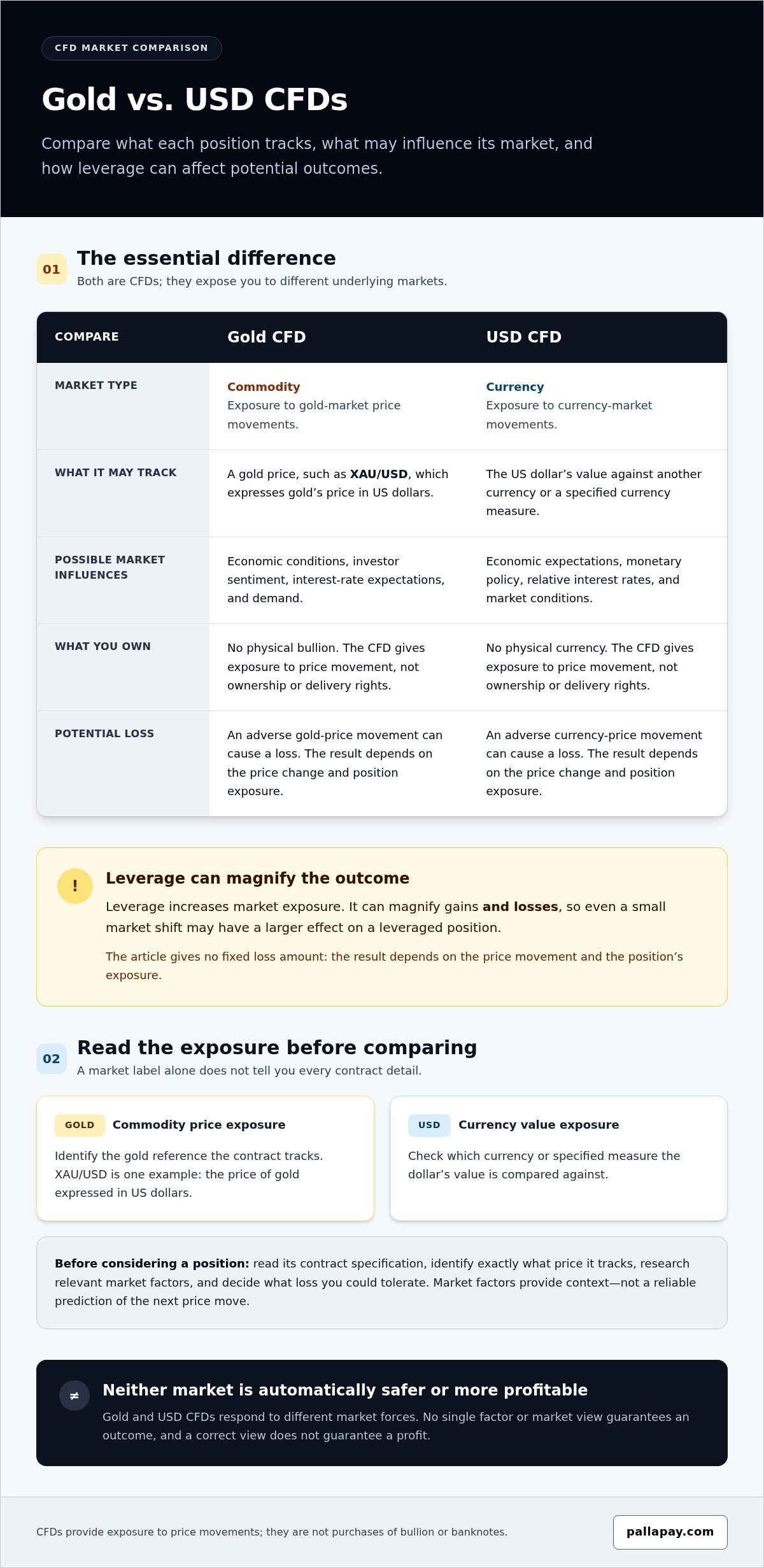
Gold exposure relates to a commodity-market price. XAU/USD, for instance, expresses the price of gold in US dollars. USD exposure relates to currency-market movements, typically the dollar’s value against another currency or a specified currency measure. The precise reference and terms depend on the CFD’s contract specification, so a label alone doesn’t establish exactly what price the position tracks.
That distinction matters: a gold CFD isn’t physical bullion, and a USD CFD isn’t a holding of physical currency. A CFD position doesn’t itself provide ownership or delivery rights to the underlying asset. Before considering either instrument, identify its underlying reference and read the contract specification to understand the exposure. The contract describes the instrument; it can’t predict the market outcome.
How Gold and USD CFD Prices Move, and Why the Markets Differ
Gold and USD CFDs track different markets, so their prices can respond to different information. Gold is a commodity, while USD exposure relates to currency values, often measured against another currency. Economic data and market sentiment may influence both, but they’re context for analysis, not reliable signals of what prices will do next. As How CFD trading works explains, CFDs provide exposure to market movements, which makes understanding the underlying market important.
What can influence gold CFD prices?
Gold prices may respond to shifts in broad market sentiment, economic conditions, interest-rate expectations, and demand from investors or central banks. Geopolitical concerns can also affect how market participants view gold. These factors interact, and their influence can change. A relationship observed in one period isn’t a rule that determines the next move.
What can influence USD CFD prices?
Currency values may reflect expectations about economic growth, monetary policy, and interest rates relative to those of other economies. Market conditions can change how traders weigh each factor. For example, stronger-than-expected economic data might support a currency in one context, while changing interest-rate expectations or broader sentiment may complicate that response. It’s an illustration, not a forecast.
The same event can affect gold and the USD differently, because each market reflects its own mix of expectations, demand, and sentiment.
| Market | Possible factors | What they don’t guarantee |
|---|---|---|
| Gold | Economic conditions, investor sentiment, interest-rate expectations, and demand | A predictable rise or fall in gold prices |
| USD | Economic expectations, monetary policy, relative interest rates, and market conditions | A fixed currency response to any single data release |
Use the distinction to frame your research: identify what the CFD tracks, note the relevant market factors, and consider how uncertainty could affect your position. Don’t treat a headline or economic release as a standalone trading signal. Market expectations may already reflect available information, and the price reaction can differ from what a simple explanation suggests.
The phrase “best crypto pos hardware 2026” relates to payment technology, not the market forces that move gold or currency prices. Keep those subjects separate when deciding what exposure you’re researching.
Gold vs. USD CFDs: Compare Exposure, Leverage, and Potential Loss
Gold and USD CFDs expose a trader to different markets, but neither is automatically safer or more profitable. Gold positions relate to commodity-market prices; USD positions relate to currency movements, often against another currency. Each can react to changing expectations and market conditions. The useful comparison is not which one is “best,” but which market you can research and what level of loss you could tolerate.
| Consideration | Gold CFD | USD CFD |
|---|---|---|
| Market type | Commodity | Currency |
| Research focus | Gold-market conditions and relevant macroeconomic factors | Currency values, economic expectations, and relative market conditions |
| Key uncertainty | Factors can interact differently over time | A currency’s response depends on its counterpart and market context |
Leverage increases market exposure relative to the funds committed as margin. That can magnify a favorable price movement, but it can also magnify an adverse one. A small initial amount therefore doesn’t automatically make a position low-risk: the potential loss is linked to the exposure and price movement, not just the amount used to open the trade. Margin supports a leveraged position, but exact requirements and consequences depend on the contract terms.
How can leverage change a CFD outcome?
Imagine a trader opens a leveraged gold CFD position expecting the price to rise. If the price moves upward, the exposure can magnify the effect on the position compared with an unleveraged one. If gold moves downward instead, the same amplification works against the trader, increasing the loss. This hypothetical example has no specific leverage or price figures, and it doesn’t suggest that leverage is a shortcut to financial improvement.
Before opening any position, read the contract specification and understand how margin, exposure, and potential losses are described. Don’t assume the initial amount represents the maximum possible loss unless the applicable terms clearly establish that.
Which exposure may suit a trader’s research focus?
Gold exposure may align with research focused on commodity markets and factors affecting gold. USD exposure may better match research into currency markets, exchange rates, and economic expectations. Familiarity with either subject can help organize analysis, but it doesn’t remove volatility or uncertainty. Neither instrument is universally suitable; the choice depends on the market being assessed, the trader’s plan, and the loss they can withstand.
How to Build a Responsible Gold or USD CFD Trading Plan
A trading plan is a decision framework, not a forecast or promise of income. It helps you define why you’re considering exposure, what could change your view, and how much loss you could tolerate before risking capital. Risk planning can guide decisions, but it can’t eliminate market uncertainty.
Use this preparation sequence before considering a gold or USD CFD:
- Learn the contract. Read its specification to understand the underlying reference, how exposure is structured, and how margin and potential losses are described. Don’t rely on an instrument label alone.
- Research the market. Set out the reason you’re considering the position and the information that could change your view. Separate evidence from assumptions, and remember that economic developments don’t guarantee a particular price response.
- Define your boundaries. Decide in advance what financial loss you could tolerate without affecting essential expenses or other commitments. Consider whether the exposure and uncertainty fit those limits. If you can’t identify a tolerable loss, pause rather than proceeding by default.
- Review your decisions. Record the rationale for a position and later compare what happened with your original plan. Use the review to learn, not to justify taking greater exposure.
What should a trader understand before opening a position?
Be able to explain what the CFD tracks, why the market is under consideration, and what would invalidate your reasoning. Check the contract information for its specific terms. If any part of the exposure or potential loss remains unclear, delay the decision and take time to understand it first.
How can a trader review decisions without chasing losses?
Keep a brief record of the market rationale, the intended boundaries, and the factors that would prompt a reassessment. Review the decision against those notes rather than reacting to a loss with an impulsive attempt to recover it. Changing the plan under pressure can lead to larger or less considered exposure. If a trade crosses your financial or emotional limits, pause; protecting your boundaries matters more than forcing another decision.
For readers whose financial needs are better served by cryptocurrency services, Pallapay offers ways to buy, sell, and exchange digital assets. Explore Pallapay’s services to learn about its cryptocurrency offerings. These services are distinct from CFD trading, and access to them does not guarantee a positive financial result.
Exploring Gold and USD CFD Trading Through Pallapay
After learning how CFD exposure works and setting personal risk boundaries, it’s worth keeping the type of service in view. Pallapay is a financial technology provider offering cryptocurrency services, including buying, selling, and exchanging digital assets. Those services are distinct from gold and USD CFD trading, and they don’t promise any particular financial result.
What should readers understand before exploring a trading service?
Keep the central questions in view: what market does the instrument track, how is your exposure structured, and how could leverage affect both gains and losses? Before making a decision, read the relevant contract information and consider whether the possible loss fits within your financial boundaries. Don’t commit funds needed for essential expenses, and don’t treat a trading plan as a forecast of income or a route to guaranteed financial change.
The details that matter are specific to the relevant instrument and its contract terms. Understand the terms that apply to the product you’re considering, including its costs, leverage, execution, and account features. This article offers general education, not individualized financial advice. If the mechanics or potential downside aren’t clear to you, take time to build your understanding before deciding whether to proceed.
Where can readers take their next step?
Readers interested in Pallapay can explore its cryptocurrency services, including buying, selling, and exchanging digital assets. Reviewing those services is separate from deciding whether to trade a gold or USD CFD. The next step needn’t be placing a trade; further research and a review of your own risk limits can also be considered decisions.
The phrase “best crypto pos hardware 2026” refers to payment hardware, a separate subject from gold and USD CFD exposure. Keeping that distinction clear helps focus a trading decision on the instrument, the contract terms, and the financial risk involved. Access to financial services doesn’t guarantee a positive result, and no service can remove market uncertainty. Explore Pallapay’s cryptocurrency services if they match what you’re looking for, and approach any trading decision with a clear understanding of the exposure and potential loss.
Make Your Next Trading Decision With Clarity
Gold and USD CFDs offer exposure to price movements, not ownership of bullion or currency. Their markets can react to different economic forces, and no headline or indicator guarantees a particular outcome. Leverage can magnify losses as well as gains, so understanding the contract and deciding what loss you can tolerate are essential parts of preparation.
A disciplined plan won’t remove uncertainty or promise financial transformation. It can help you research with purpose, set personal boundaries, and review decisions without chasing losses. The phrase “best crypto pos hardware 2026” relates to payment hardware, a separate topic from gold and USD CFD trading.
Pallapay provides cryptocurrency services, including buying, selling, and exchanging digital assets. If you’re interested in those services, explore Pallapay’s cryptocurrency offerings. Make any trading decision thoughtfully, with a clear understanding of the exposure and potential downside.
Frequently Asked Questions
What is a CFD in gold or USD trading?
A CFD is a contract that gives you exposure to an asset’s price movement without owning the asset. A gold CFD tracks a gold-related price, while a USD CFD relates to currency-market movements, often against another currency. You open and later close a position, and its result depends on how the quoted price changes. The contract specification explains what the instrument tracks and its terms.
Can gold and USD CFDs cause losses?
Yes. If the market moves against your position, a CFD can lose value. The potential loss depends on the price movement and the position’s exposure; leverage can amplify the effect. Depending on the contract terms and applicable protections, losses may exceed the amount initially committed. Before trading, understand the instrument and consider whether you could tolerate the potential loss without affecting essential financial needs.
How does leverage affect gold and USD CFD trading?
Leverage increases market exposure relative to the funds committed as margin. This can magnify the impact of a favorable price move, but it also magnifies the impact of an adverse move. A small initial amount doesn’t make a position low-risk. Review the contract’s leverage and margin terms, understand how losses may develop, and never treat leverage as a shortcut to financial improvement.
Is trading a gold CFD the same as buying physical gold?
No. A gold CFD gives you exposure to price changes under a contract; it doesn’t mean you own bullion or have a right to take delivery of it. Buying physical gold is a separate transaction involving the asset itself. If your goal is to understand a CFD position, check what price it tracks and read its contract specification rather than assuming it represents ownership.
What can affect the USD market?
USD values may respond to economic expectations, monetary policy, interest-rate differences, and broader market conditions. These factors can interact, and the same announcement may produce different responses depending on what traders expected beforehand and how other markets are moving. A data release or headline is not a dependable signal on its own. Treat market drivers as context for research, not as a guarantee of direction.
Can CFD trading change someone’s financial life?
Trading can affect a person’s finances, but it can’t promise improvement or a lasting transformation. A CFD position may gain or lose value, and leverage can increase the financial impact of market moves. Approach trading as a risky activity, not guaranteed income. Consider your financial circumstances, define an affordable loss in advance, and avoid using money needed for essential expenses or existing commitments.
What should I learn before trading a gold or USD CFD?
Learn what the instrument tracks, how its exposure and margin work, and how leverage may affect both gains and losses. Read the contract terms, research the relevant commodity or currency market, and identify what could change your view. Decide what loss you could tolerate before considering a position. “Best crypto pos hardware 2026” relates to payment equipment, not CFD trading, so keep those topics distinct.
Disclaimer
The information provided on this website and blog is for general informational and educational purposes only and does not constitute financial, investment, legal, tax, or other professional advice.
Cryptocurrency and digital asset services may be subject to regulatory restrictions in certain jurisdictions. Users are solely responsible for ensuring compliance with applicable local laws and regulations before using any products or services mentioned on this website.
PallaPay does not guarantee the accuracy, completeness, or timeliness of any information published and accepts no liability for any loss or damages arising from reliance on the content. Any opinions expressed are those of the respective authors and may change without notice.
Certain services, features, or products referenced may be provided through third-party partners, licensed entities, or affiliated service providers subject to separate terms and regulatory approvals. Availability of services may vary by country or region.
This website may contain references to digital assets, virtual currencies, or blockchain-related services that are not available to residents of certain jurisdictions, including where prohibited by law. Nothing on this website constitutes an offer, solicitation, or recommendation to buy or sell any financial instrument or virtual asset.