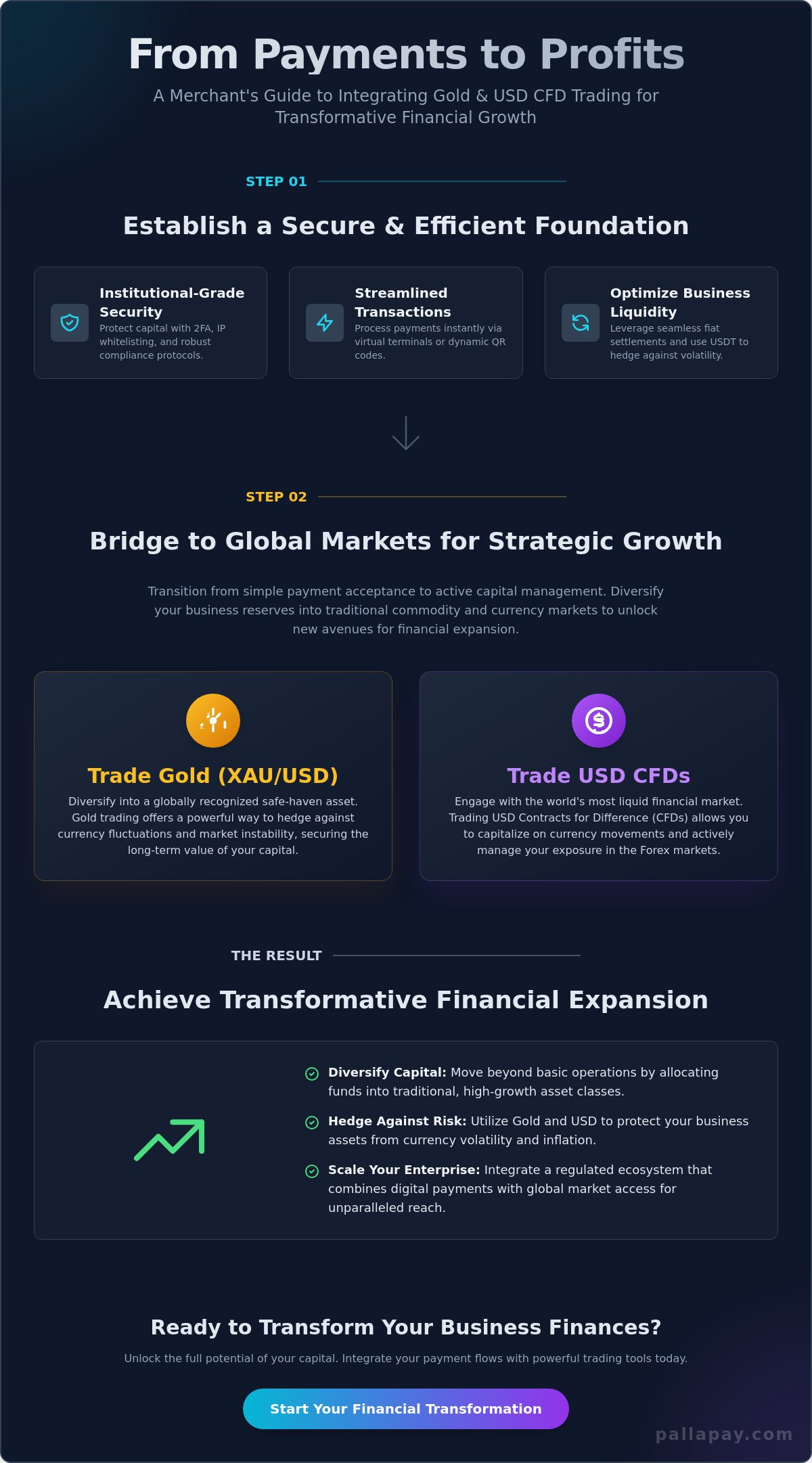
Tag: USD CFD

  • Gold and USD CFD Trading: How It Works, What It Risks, and What to Consider in 2026

    Gold and USD CFD Trading: How It Works, What It Risks, and What to Consider in 2026

    A gold or USD CFD can move your finances in either direction, but it doesn’t mean you own gold or dollars. Even a question like how to buy crypto with cash safely concerns acquiring an asset; CFD trading instead creates exposure to price movements, often with leverage that can magnify losses as well as gains. That distinction matters before considering whether a trade could make a meaningful difference to your financial life.

    If leverage, margin, and trading costs feel difficult to compare, you’re not alone. Understanding how a CFD tracks an underlying market is an essential first step, not a guarantee of a particular outcome. This guide explains how gold and USD CFD positions work, what can influence their prices, and how spreads, financing, and leverage can affect a trade. It also sets out a cautious way to assess the risks and explains how buying crypto with cash differs from CFD trading.

    Key Takeaways

    • A gold or USD CFD tracks price movements without transferring ownership of the underlying asset. Learn how that exposure differs from owning gold or currency.
    • Margin is the funds required to open or maintain a position, while leverage can magnify both gains and losses. Understand these mechanics before setting an exposure level.
    • Gold and USD CFDs respond to different market drivers, and their relationship can change. Compare the factors affecting each market before forming a trade thesis.
    • CFDs can provide market exposure, but they can also lead to rapid losses and ongoing costs. Don’t treat trading as a reliable route to changing your financial circumstances.
    • Separate CFD decisions from questions such as how to buy crypto with cash safely. For either activity, understand the transaction, assess the risks, and avoid acting on assumptions.

    What Gold and USD CFDs Let You Trade, and What You Actually Own

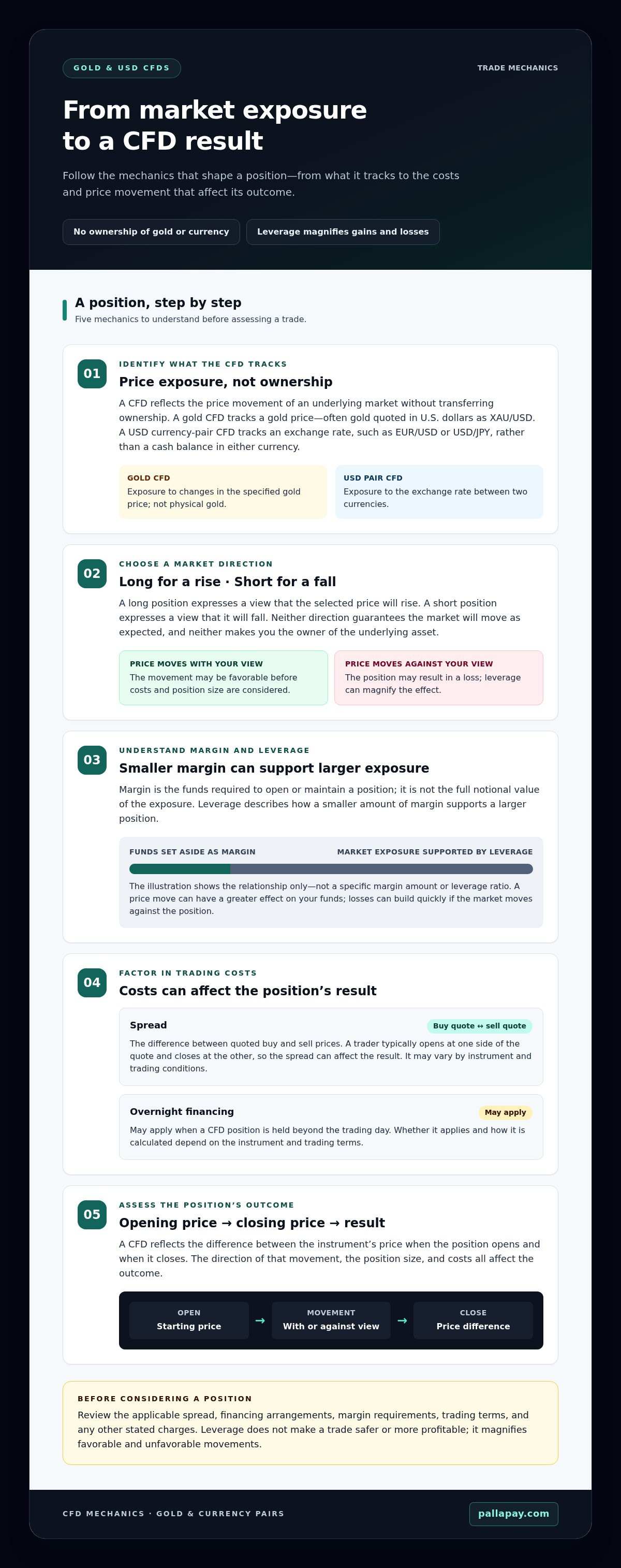
    A contract for difference (CFD) tracks an asset’s price movement without transferring ownership of that asset. With a gold CFD, you get exposure to changes in a gold price, not physical gold. With a USD currency-pair CFD, your exposure follows the exchange rate between two currencies, not a cash balance in either one. The distinction is central: a CFD is a trading agreement, not a purchase of the underlying asset. The Contract for Difference reference provides a general overview of how these contracts work.

    How a CFD position follows a market price

    A CFD reflects the difference between the instrument’s price when a position opens and when it closes. If the closing price moves in the direction of your position, the price movement may be favorable; if it moves against you, it may result in a loss. Costs and the position size also affect the outcome.

    A long position expresses a view that the selected price will rise. A short position expresses a view that it will fall. Neither direction guarantees the market will move as expected, and neither makes you the owner of gold or currency. For example, taking a long position on a gold CFD means your result is tied to changes in the gold price specified by that instrument, not to holding bullion.

    Gold exposure versus USD currency exposure

    Gold is a commodity market. A gold CFD, often represented by XAU/USD, tracks gold’s price quoted in U.S. dollars. A USD currency-pair CFD instead tracks an exchange rate, such as EUR/USD or USD/JPY. In a pair, the first currency is compared with the second, so a position reflects the pair’s exchange-rate movement rather than the value of the U.S. dollar in isolation.

    The selected instrument determines which price movement affects your position. Gold and currency pairs can respond to different forces, and their movements should not be assumed to follow a fixed relationship. Imagine a trader expects gold to rise and opens a long gold CFD. If gold falls instead, the position moves against that view. A separate position on a USD currency pair could move differently because it follows that pair’s exchange rate.

    This differs from learning how to buy crypto with cash safely. Buying crypto with cash involves acquiring a digital asset, while a CFD provides price exposure through a contract. When acquiring crypto, check that you understand the asset, the quoted amount, any transaction costs, and the destination details before completing a purchase. Knowing what you own, and what you don’t, helps clarify the risks of either transaction.

    How Gold and USD CFD Trades Work: Margin, Leverage, and Costs

    With a CFD, the amount needed to open a position can be smaller than the full market exposure. That difference comes from margin and leverage, which affect how gains and losses respond to price movements. Understanding both, alongside trading costs, helps you assess what a position could mean for your funds before entering it.

    What margin and leverage mean in practice

    Margin is the funds required to open or maintain a CFD position; it isn’t the full notional value of the exposure. Leverage describes how a smaller amount of margin supports a larger position, so a price movement can have a greater effect on your funds than it would without leverage.

    Imagine setting aside a portion of your available funds as margin to open exposure to a gold CFD. The position’s market exposure is larger than that initial amount, so even a modest move in gold’s price can affect the position proportionally. If the price moves in your favor, the effect may be positive; if it moves against you, the loss can build quickly and may reduce the funds in your account. Leverage doesn’t make a trade safer or more profitable. It magnifies both favorable and unfavorable movements.

    This is why Australian Government’s Moneysmart resource explains the high-risk nature of CFDs, including the role of leverage and the potential for losses. Margin requirements and the consequences of a position moving against you depend on its terms, so understand them before trading.

    Which trading costs can affect a CFD position

    The spread is the difference between the quoted buy and sell prices. Because a trader typically opens at one side of the quote and closes at the other, the spread can affect the position’s result. It may vary by instrument and trading conditions, so don’t assume the cost is identical for gold and USD currency-pair CFDs.

    Overnight financing may also apply when a CFD position is held beyond the trading day. Whether it applies, and how it is calculated, depends on the instrument and the trading terms. Review the applicable spread, financing arrangements, margin requirements, and any other stated charges before opening a position; no single cost assumption fits every trade.

    Understanding how to buy crypto with cash safely also means paying attention to the transaction and its costs, but a cash crypto purchase is different from a leveraged CFD position. Pallapay offers the option to buy USDT with cash. Before any purchase, make sure you understand the asset and transaction details involved.

    Gold CFDs vs. USD CFDs: Compare Market Drivers Before Taking a Position

    Choosing between a gold CFD and a USD currency-pair CFD means assessing different underlying markets. Gold is a commodity priced against a currency, while a currency pair shows one currency’s value relative to another. Their prices can react to overlapping events, but neither follows a fixed relationship with the other. Compare what drives the instrument and what your position would actually respond to before forming a view.

    Instrument Possible price drivers Exposure question
    Gold CFD, such as XAU/USD Interest-rate expectations, currency movements, and investor demand What could influence gold’s price in the quote currency?
    USD currency-pair CFD, such as EUR/USD Economic data and central-bank decisions affecting either currency Which currency may strengthen relative to the other, and why?

    What can influence gold CFD prices?

    Gold prices may respond to changing expectations about interest rates, movements in the U.S. dollar, and shifts in investor demand. These influences can interact: an event may affect currency markets and investor preferences at the same time. The result isn’t automatic. A factor that appears supportive of gold doesn’t guarantee its price will rise, and market expectations may already shape prices before new information arrives.

    For a gold CFD quoted in U.S. dollars, consider both the gold market and the currency used to quote it. Ask what could change the market’s view, rather than treating a single headline or indicator as a certain signal. A useful check is to identify what information would challenge your thesis, not just what appears to support it.

    What can influence USD currency CFD prices?

    A currency pair measures the relative value of its two currencies. Economic releases, such as information about growth or inflation, and central-bank decisions can influence expectations for either side of the pair. Their impact depends on what markets expected and how the news compares with those expectations.

    A USD position isn’t a standalone measure of dollar strength. For example, if the U.S. dollar strengthens against one currency but also faces changing conditions against another, different pairs can behave differently. Identify the pair’s base and quote currencies, then consider the factors affecting both.

    Use the same discipline that underpins decisions about how to buy crypto with cash safely: understand the asset or instrument and the transaction before acting. For added context on CFD risk, the North American Securities Administrators Association outlines the dangers of CFDs. Market drivers can inform a thesis, but they can’t guarantee its outcome.
    Gold and USD CFD Trading: How It Works, What It Risks, and What to Consider in 2026

    Can Gold and USD CFD Trading Change Your Financial Life? Understand the Risks

    Gold and USD CFDs can provide access to price movements, but they can’t reliably transform personal finances or replace stable income. A position may move in your favor, yet it can also lose value quickly, and trading costs can affect the result. Risk limits and a written plan can support more disciplined decisions, but they can’t remove uncertainty or guarantee an outcome.

    Why leverage makes loss exposure easy to underestimate

    Leverage means your market exposure can exceed the margin set aside for a position. As a result, a relatively small adverse price movement may have a material effect on the funds supporting that trade. The same mechanism applies whether the position tracks gold or a USD currency pair, though each instrument responds to its own market drivers.

    Price changes may be abrupt. Volatility can intensify movements, and a market gap may mean the next available price differs from the one you expected. If you hold a position overnight, financing costs may also affect its overall result. Position size, price movement, and applicable charges all matter, so don’t assess risk by looking only at the margin required to open a trade.

    What responsible expectations look like

    CFD trading shouldn’t be treated as dependable income, a planned way to repay debt, or a reliable wealth-building strategy. Before considering a position, think about whether you can afford a loss and whether the risk fits your personal circumstances. Money needed for essential expenses should not be exposed to uncertain market outcomes.

    A written plan can help you define why you’re considering a trade, how much exposure you’re willing to take, and what conditions would prompt you to review or close it. Risk limits can help contain decisions, but they can’t prevent every loss, eliminate execution uncertainty, or make a strategy successful. Reassess your assumptions as market conditions change rather than relying on a hoped-for result.

    Just as how to buy crypto with cash safely involves understanding the steps and risks of acquiring crypto, CFD trading calls for clarity about the product and potential loss before acting. This information is educational, not individualized financial advice. If you’re considering buying USDT with cash, Pallapay offers that service. For a CFD, first understand the product’s terms, costs, and risks.

    A Practical First-Trade Framework for Gold and USD CFDs

    Preparation can’t remove market risk, but a clear process can help you understand the exposure before committing funds. Use these steps to assess whether a gold or USD CFD trade fits your knowledge, financial position, and risk tolerance.

    • Choose the market. Decide whether you’re studying gold exposure, such as XAU/USD, or a particular USD currency pair. They track different markets, so identify which price movement would affect your position.
    • Learn the instrument’s terms. Review how the CFD is priced and how long you might hold it. Understand the required margin, leverage, spread, possible overnight financing, and how costs could affect your result.
    • Write down your thesis. State why you’re considering the trade and which market conditions support your view. Include an invalidation point, the condition that would show your reasoning may no longer hold. A market view is a possibility, not a prediction you can rely on.
    • Plan your review. Set out when you’ll reassess the position and what changes in your thesis would prompt action. Record the outcome and any costs so you can evaluate whether your process was disciplined, separate from whether one trade gained or lost.

    The question of how to buy crypto with cash safely concerns acquiring a crypto asset. Preparing for a CFD trade is different: it means understanding contractual price exposure and deciding what loss you can tolerate before entering a position. Don’t use funds needed for essential expenses, and don’t rely on trading to provide dependable income or meet financial obligations.

    Explore buying USDT with cash through Pallapay

    If your goal is to acquire crypto rather than take CFD exposure, Pallapay offers a way to buy USDT with cash. Before proceeding, understand the transaction details, asset, and costs involved. A cash crypto purchase and a leveraged CFD are different products, with different risks and outcomes.

    Buy USDT with cash through Pallapay

    Approach Gold and USD CFDs With a Clear Plan

    Gold and USD CFDs provide exposure to price movements, not ownership of gold or currency. Margin and leverage can amplify market moves, while spreads and possible overnight financing can affect the outcome. Before considering a position, identify the market, write down your thesis, set an affordable exposure limit, and decide when you’ll review the trade.

    Trading shouldn’t be treated as guaranteed income or a dependable way to transform your finances. As with understanding how to buy crypto with cash safely, sound decisions begin with knowing what the transaction involves and what risks you’re accepting. A cash purchase of USDT through Pallapay is a separate option for acquiring crypto, not a CFD trade.

    Explore buying USDT with cash through Pallapay if you want to acquire a crypto asset. For CFD trading, keep your approach informed, measured, and aligned with your personal risk tolerance.

    Frequently Asked Questions

    What is a CFD in gold or forex trading?

    A CFD, or contract for difference, is an agreement whose value reflects the price change of an underlying market between opening and closing a position. A gold CFD tracks gold’s price, while a forex CFD tracks the exchange rate between two currencies. The trader’s result depends on the price movement and applicable costs. A CFD provides market exposure through a contract, not ownership of the underlying asset.

    Can you trade gold and USD CFDs without owning gold or currency?

    Yes. A gold CFD provides exposure to changes in gold’s price without transferring ownership of physical gold. A USD currency-pair CFD follows the exchange rate between the U.S. dollar and another currency, rather than giving you ownership of either currency. For example, an EUR/USD CFD tracks the pair’s relative price movement. Check the instrument’s terms to understand exactly which market price determines your position’s result.

    How does leverage affect gold and USD CFD trades?

    Leverage lets a trader take market exposure larger than the margin set aside for a position. This magnifies the effect of price changes on the funds supporting the trade: a favorable movement may have a greater effect, but an adverse move can also increase losses quickly. Leverage doesn’t make a position safer or guarantee a gain. Consider the exposure and potential loss, not just the initial margin.

    What costs can apply when trading CFDs?

    Costs can include the spread, which is the difference between quoted buy and sell prices, and overnight financing when a position is held beyond the trading day. Other charges may apply depending on the instrument and its terms. Costs affect the overall result, so review the applicable pricing, financing arrangements, and other stated charges before opening a position. Don’t assume gold and currency CFDs have identical costs.

    Is gold CFD trading safer than USD CFD trading?

    Neither market is inherently safer. Gold and USD currency-pair CFDs respond to different influences, and both can move unpredictably. Leverage can magnify losses in either, while spreads and possible financing charges can affect the outcome. Assess the instrument’s volatility, market drivers, position size, and terms against your own risk tolerance. Choosing a market you understand may support better-informed decisions, but it can’t remove the possibility of loss.

    Can trading gold and USD CFDs guarantee a profit?

    No. There’s no guaranteed profit from trading gold or USD CFDs. Prices may move against your position, and leverage can magnify the effect of those movements. Trading costs can also reduce a positive result or add to a loss. CFDs shouldn’t be treated as dependable income or a reliable way to transform your finances. Only consider risking funds you can afford to lose, and make decisions based on a clear plan.

    What should a beginner understand before placing a CFD trade?

    Before trading, understand that a CFD provides price exposure rather than ownership, and learn how margin, leverage, spreads, and possible overnight financing apply. Choose whether you’re studying gold or a specific currency pair, write down your reason for the trade, and set an exposure limit and review plan. Knowing how to buy crypto with cash safely concerns acquiring crypto, a different process from taking leveraged CFD exposure.

    Disclaimer

    The information provided on this website and blog is for general informational and educational purposes only and does not constitute financial, investment, legal, tax, or other professional advice.
    Cryptocurrency and digital asset services may be subject to regulatory restrictions in certain jurisdictions. Users are solely responsible for ensuring compliance with applicable local laws and regulations before using any products or services mentioned on this website.
    PallaPay does not guarantee the accuracy, completeness, or timeliness of any information published and accepts no liability for any loss or damages arising from reliance on the content. Any opinions expressed are those of the respective authors and may change without notice.
    Certain services, features, or products referenced may be provided through third-party partners, licensed entities, or affiliated service providers subject to separate terms and regulatory approvals. Availability of services may vary by country or region.
    This website may contain references to digital assets, virtual currencies, or blockchain-related services that are not available to residents of certain jurisdictions, including where prohibited by law. Nothing on this website constitutes an offer, solicitation, or recommendation to buy or sell any financial instrument or virtual asset.

  • How to Verify a Crypto Company Is Legitimate: The 2026 Professional Guide

    How to Verify a Crypto Company Is Legitimate: The 2026 Professional Guide

    In the high-stakes world of digital finance, the difference between a life-changing financial breakthrough and a total loss of capital often comes down to a single due diligence check. Knowing how to verify a crypto company is legitimate is a fundamental requirement for anyone looking to bridge the gap between digital assets and traditional markets. You’re right to feel cautious; the market is currently saturated with shadow platforms that mimic professional fintech leaders with alarming precision.

    Whether you’re scaling your portfolio through XAUUSD or managing USD CFD positions, your success depends entirely on the stability of your financial partner. It’s exhausting to filter through the hype while trying to find a secure environment for your Forex and gold trading ambitions. This guide provides you with a clear vetting checklist to ensure your capital remains secure and your trading remains profitable.

    We’ll explore the essential framework used by institutional professionals to validate global fintech providers. You’ll gain the confidence to choose a long-term partner by understanding the importance of multi-jurisdictional MSB registrations and tangible physical infrastructure. We’ll also examine how a secure crypto bridge can transform your trading experience by providing a reliable, professional path between digital assets and traditional commodity markets.

    Key Takeaways

    • Learn to identify why active MSB registrations in the United States and Canada serve as the primary indicator of a provider’s institutional reliability.
    • Master the professional framework on how to verify a crypto company is legitimate by cross-referencing global regulatory databases and anti-money laundering protocols.
    • Evaluate the importance of physical infrastructure, including OTC desks in Singapore and Istanbul, to differentiate established leaders from digital-only shadow platforms.
    • Secure your path toward financial transformation by verifying price feed transparency for high-impact Gold (XAUUSD) and USD CFD trading.
    • Discover how a regulated payment gateway functions as a secure off-ramp to protect and manage the profits generated from your Forex market operations.

    The 2026 Landscape: Why Crypto Company Verification Is Critical

    The 2026 financial landscape has shifted into a high-tech frontier where the line between innovation and deception is thinner than ever. AI tools now generate perfectly spoofed trading environments that mirror institutional platforms with terrifying accuracy. Professional investors realize that unregulated options are no longer a viable risk category. Learning how to verify a crypto company is legitimate is the only way to safeguard your capital before committing to the markets.

    Institutional grade security is the prerequisite for modern wealth management. As digital assets increasingly serve as the primary gateway to broader financial instruments like Forex and Gold (XAUUSD), the stakes have never been higher. You aren’t just looking for a place to swap tokens; you’re looking for a professional bridge that connects disruptive tech with established financial reliability.

    The Evolution of Digital Asset Scams

    Digital asset scams have transitioned from crude phishing emails to deep-fake brokers and multi-layered social engineering. These criminals often leverage the high-growth appeal of Gold and USD CFD markets to lure victims into “pig butchering” schemes. By the time a trader realizes the platform is a hollow shell, their capital has already vanished into the complex web of cryptocurrency fraud and crime that plagues the unregulated sector.

    The psychological cost of this financial insecurity is devastating. Scammers use sophisticated trading interfaces that show fake profits, encouraging users to deposit more before the inevitable “liquidity lock” occurs. Identifying these red flags early is essential for anyone serious about long-term market participation.

    The Transformative Power of Legitimate Trading

    While the risks are real, the potential for financial transformation through secure trading remains unparalleled. Accessing the Forex market or trading Gold CFDs with a regulated partner can redefine an individual’s financial trajectory. It’s about moving beyond speculation and into a structured environment where technology facilitates growth rather than hindering it. Understanding how to verify a crypto company is legitimate allows you to focus on market strategy instead of platform solvency.

    A legitimate partner provides the foundation for long-term wealth generation by offering a reliable bridge between crypto liquidity and fiat stability. Utilizing a professional off-ramp ensures that your trading profits are accessible and secure. When your financial provider operates with the transparency of a regulated MSB in the United States and Canada, the friction of the digital-to-traditional transition disappears. This stability empowers you to trade with the confidence of a global industry leader, knowing your capital is backed by tangible infrastructure and institutional compliance.

    The 5-Point Regulatory Checklist for Global Fintech

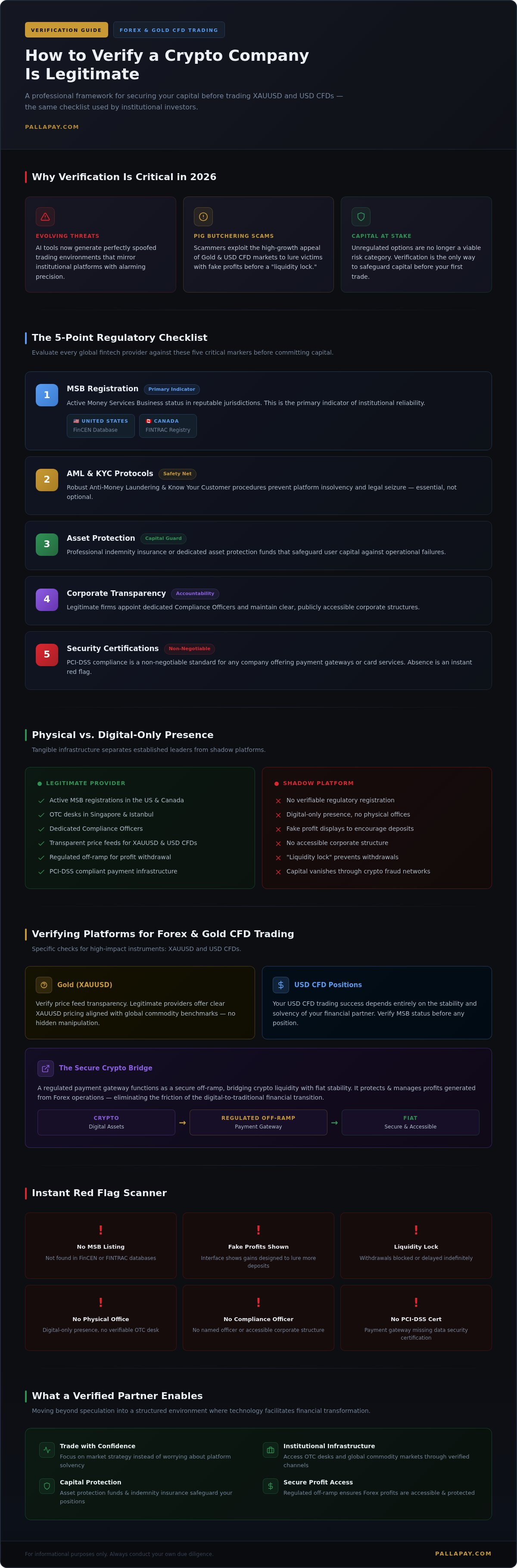
    Proactive vetting is the primary defense against capital loss. Relying on enforcement agencies to report scams after they occur is a reactive strategy that rarely recovers lost funds. To protect your capital, you must understand how to verify a crypto company is legitimate before you initiate your first trade. This requires a systematic evaluation of five critical regulatory and operational markers.

    • MSB Registration: A legitimate provider must hold active Money Services Business (MSB) status in reputable jurisdictions like the United States and Canada.
    • AML and KYC Protocols: Robust Anti-Money Laundering and Know Your Customer procedures aren’t just legal hurdles; they’re essential safety nets that prevent platform insolvency and legal seizure.
    • Asset Protection: Look for professional indemnity insurance or dedicated asset protection funds that safeguard user capital against operational failures.
    • Corporate Transparency: Legitimate firms appoint dedicated Compliance Officers and maintain clear corporate structures that are accessible to the public.
    • Security Certifications: For companies offering payment gateways or card services, PCI-DSS compliance is a non-negotiable standard for data security.

    Deep Dive: Understanding MSB Registration

    Verifying a company’s legal standing starts with the FinCEN database in the U.S. and the FINTRAC database in Canada. These registrations prove that the entity has submitted to federal oversight and maintains strict reporting standards. MSB status is a mandatory requirement for any provider facilitating crypto-to-fiat operations. A “tech startup” without these credentials is simply an unregulated risk; a “regulated financial technology provider” is a secure partner. This distinction is vital when you’re moving high-volume profits from Gold (XAUUSD) or USD CFD trading back into the traditional banking system. For those seeking professional oversight on the accounting side of these transitions, fvaccounts.com provides chartered services to ensure your financial reporting remains as robust as your trading strategy.

    In 2026, a multi-jurisdictional presence indicates that a company has passed the institutional vetting processes of several different regulatory bodies. This layer of oversight protects you as much as the company. When a platform requires detailed KYC, it ensures that the entire ecosystem remains clean, reducing the risk of your account being frozen due to third-party criminal activity. For those focused on the transformative potential of the markets, learning how Pallapay ensures secure fiat settlement provides a blueprint for how these compliance layers function in real-time operations.

    Selecting a partner that meets these five points allows you to focus on market strategy. If you’re ready to bridge your digital assets with institutional reliability, you can explore professional off-ramp solutions that prioritize your financial security.

    Physical vs. Digital Presence: Verifying Infrastructure

    A digital-only presence is a significant red flag for high-volume exchange services. While many startups operate entirely in the cloud, institutional-grade partners maintain a physical footprint in global financial hubs. Physical offices and Over-the-Counter (OTC) desks in locations like Singapore and Istanbul provide a layer of accountability that a website simply cannot match. When you’re managing large-scale profits from gold trading or USD CFD positions, you need the assurance that your partner has a tangible base of operations.

    Understanding how to verify a crypto company is legitimate requires looking beyond the screen to the company’s physical presence. Scammers often list prestigious addresses that belong to co-working spaces or unrelated businesses. A legitimate provider will have a verifiable presence where you can conduct high-volume OTC crypto exchange in person. Cross-referencing these addresses with local business registries and mapping services is a critical step in your due diligence process.

    The Value of Tangible OTC Desks

    Physical locations act as an anchor for institutional trust. They facilitate the transition between digital assets and traditional currency for high-net-worth individuals and corporate entities. For those trading XAUUSD, the ability to off-ramp profits via a physical desk adds an extra layer of security to the entire financial lifecycle. It proves the company isn’t just a collection of code; it’s a strategic partner grounded in the practicalities of modern commerce. This physical infrastructure ensures that there’s a real-world destination for your capital and a human point of contact for complex transactions.

    Hardware and Ecosystem Integration

    A company’s commitment to the industry is often visible through its hardware and technical integrations. Legitimate leaders don’t just offer an exchange; they provide a comprehensive ecosystem including crypto POS machines, Mastercard programs, and secure APIs. This level of infrastructure requires significant capital investment and deep partnerships with traditional financial systems. It signals a long-term business commitment rather than a temporary setup. To see how these tools work in the real world, you can explore our retail store solutions for secure crypto integration.

    By assessing the depth of a provider’s POS hardware and wallet ecosystem, you gain a clearer picture of their operational stability. A company that invests in physical card issuance and retail payment machines is building for the future of global commerce. This level of integration makes it much harder for a company to disappear overnight, providing the security you need to trade Forex and gold with total peace of mind. Learning how to verify a crypto company is legitimate means looking for these signs of deep, multi-layered industry commitment.

    How to Verify a Crypto Company Is Legitimate: The 2026 Professional Guide

    Verifying Platforms for Forex and Gold CFD Trading

    The mechanics of CFD (Contract for Difference) trading mean that you don’t own the underlying asset; you enter into a contract with a broker. In this model, the broker’s solvency and integrity are your primary risk factors. If the platform fails, your capital and your unrealized profits vanish. This is why knowing how to verify a crypto company is legitimate is the most important step before opening a position. You must confirm that the provider uses segregated account structures, ensuring that client funds are legally separated from the company’s operational capital.

    The Financial Impact of Gold and USD CFDs

    Trading Gold (XAUUSD) and major USD currency pairs offers a unique path toward financial independence. The volatility in these markets provides the liquidity necessary for significant portfolio growth. When executed through a professional partner, this type of trading can change an individual’s financial life by offering a scalable way to build wealth. However, this transformative potential is only realized when you have access to instant execution and low latency. Every millisecond counts when you’re trading commodities or currency CFDs. When researching how to verify a crypto company is legitimate, pay close attention to the execution speed and the source of their liquidity. You should verify price feed transparency by cross-referencing the platform’s quotes with institutional data from providers like Bloomberg or Reuters.

    Red Flags Specific to Trading Brokers

    The trading sector is unfortunately prone to aggressive marketing and deceptive promises. You should be wary of any company offering “guaranteed returns” or “secret” trading signals that promise a 100% win rate. These are classic hallmarks of fraudulent operations. High-pressure sales tactics, such as brokers calling you to demand more deposits to “save” a losing trade, are immediate disqualifiers. A professional fintech provider won’t pressure you into market exposure.

    A legitimate partner focuses on the utility of the bridge. You should always verify the “off-ramp” process before making your first deposit. A reliable provider makes it easy to securely off-ramp your trading profits to fiat. If the withdrawal process is shrouded in mystery or hidden fees, it’s a sign that the company isn’t a safe long-term partner. Secure your financial future by choosing a broker that prioritizes transparency over hype. Establish your professional trading account with a regulated leader today.

    The Pallapay Standard: A Blueprint for Secure Fintech

    Pallapay sets the benchmark for what institutional reliability looks like in the 2026 financial landscape. By integrating Money Services Business (MSB) regulations from both the United States and Canada into its global operations, the platform provides the exact compliance framework required for high-volume trading. Learning how to verify a crypto company is legitimate leads most professional investors to a single conclusion: transparency is the only currency that matters. Pallapay proves its standing through a multi-layered security architecture that protects every transaction within its Wallet and Payment Gateway.

    The transition between disruptive innovation and institutional stability is often where capital is most at risk. Pallapay bridges this gap by offering a comprehensive service suite that includes OTC crypto exchange services, physical POS machines, and the Pallapay Mastercard. This physical infrastructure serves as the ultimate proof of legitimacy. It moves the conversation beyond digital promises and into the realm of tangible financial utility. When you manage significant positions in gold or USD CFDs, you need a partner that handles the complex background processes of fiat settlement with effortless precision.

    A Global Partner for Professional Traders

    Professional traders in over 180 countries rely on Pallapay to facilitate the movement of their capital. High-volume exchange needs aren’t met by simple apps; they require 24/7 professional support and transparent fee structures that don’t erode your margins. Traders navigating the complexities of XAUUSD and USD CFD markets require a partner that doesn’t just promise security but proves it through operational depth. For a deeper look at protecting your portfolio, read our Definitive Guide to Crypto Security to understand the protocols that keep your digital assets safe.

    Empowering the Future of Commerce

    Pallapay enables both merchants and individuals to thrive in a digital economy that demands speed and safety. Secure APIs and retail-ready POS terminals turn complex technical conversions into standard business operations. This ecosystem allows you to focus on the transformative potential of the markets rather than the mechanics of the bridge. By providing a regulated environment for Forex and gold trading profits, Pallapay ensures your financial trajectory remains on an upward path. Experience the security of a regulated global leader. Get started with Pallapay today.

    Understanding how to verify a crypto company is legitimate is the first step toward financial freedom. By choosing a partner that meets the highest regulatory standards, you secure your capital and empower your future. Whether you’re off-ramping trading profits or integrating crypto payments into your business, Pallapay provides the stability you need to succeed in the modern commerce era.

    Securing Your Position in the 2026 Financial Evolution

    Success in the modern market requires more than just technical skill; it demands a foundation of absolute trust. Mastering how to verify a crypto company is legitimate is the first step toward a transformative trading career. By prioritizing providers with active MSB registrations in the United States and Canada, you ensure your capital is handled with institutional-grade compliance. Remember that physical infrastructure, such as OTC desks in Singapore and Istanbul, provides a level of accountability that digital-only platforms cannot replicate.

    Whether you’re scaling your wealth through XAUUSD or managing complex USD CFD positions, your choice of partner determines your long-term stability. A regulated partner operating across 180 countries offers the security needed to turn market volatility into a strategic advantage. This professional bridge allows you to focus on the mechanics of growth while your background processes remain secure. Secure your financial future with Pallapay; the regulated bridge to global crypto and fiat markets. You have the tools and the framework to trade with confidence. It’s time to step into the future of global commerce with a partner that values your security as much as your success.

    Frequently Asked Questions

    How can I check if a crypto company is registered as an MSB?

    You can check registration status through official federal databases. In the United States, use the FinCEN MSB Registrant Search tool. In Canada, verify credentials via the FINTRAC registry. These platforms allow you to input a company’s legal name to confirm their standing. This process is a critical component of learning how to verify a crypto company is legitimate. Regulated firms like Pallapay maintain active registrations to ensure institutional reliability for all users.

    What are the most common red flags of a fake Forex or Gold trading platform?

    Common red flags include guaranteed high returns and a lack of transparent regulatory disclosure. Fake platforms often use high-pressure sales tactics or promote exclusive trading signals. If a broker doesn’t provide a verifiable physical address or clear fee structures, it’s likely a shadow operation. Legitimate CFD trading for Gold (XAUUSD) requires a regulated environment that prioritizes price feed transparency. Avoid any platform that pressures you to deposit more capital to save a position.

    Is it safe to buy USDT with cash at an OTC desk?

    It’s safe provided the desk is operated by a regulated MSB with a physical footprint. Tangible OTC locations in cities like Singapore and Istanbul offer a level of accountability that digital-only platforms lack. You’ll need to complete KYC protocols to ensure the transaction remains compliant. Regulated providers ensure that the transition between cash and digital assets is secure. This protects your capital from the risks often found in unregulated peer-to-peer trading environments.

    How do I verify a crypto company’s physical office locations?

    Start by cross-referencing listed addresses with local business registries and mapping services. A professional global entity will have a verifiable presence in financial hubs like Singapore or Istanbul. Look for evidence of physical infrastructure, such as OTC desks or retail POS machines. Verifying these tangible assets is a reliable strategy when you’re researching how to verify a crypto company is legitimate. Don’t rely on a website’s footer alone; confirm the location’s operational status.

    What is the difference between a crypto exchange and a CFD broker?

    A crypto exchange facilitates the direct purchase and ownership of digital assets, allowing users to transfer holdings to self-custody solutions like Lumo Wallet where private keys remain safely on their own device. A CFD broker allows you to trade price movements without owning the underlying commodity or currency. CFD trading often involves leverage and covers diverse instruments like Forex and Gold (XAUUSD). While an exchange provides asset liquidity, a broker focuses on market execution. This means the broker’s regulatory status and solvency are your primary risk factors when trading these contracts.

    Why is MSB registration in the US and Canada important for global users?

    These jurisdictions maintain some of the highest anti-money laundering and consumer protection standards globally. When a company registers with FinCEN or FINTRAC, it submits to rigorous vetting and mandatory reporting. This oversight provides a universal trust signal for users in over 180 countries. Even if you aren’t based in North America, choosing a partner that meets these strict requirements ensures your capital is managed by a globally recognized and professional fintech leader.

    Can I use crypto to trade Gold (XAUUSD) and Forex safely?

    Trading these markets is safe when you utilize a regulated bridge that connects digital liquidity with traditional assets. The transformative potential of Gold and USD CFD trading can redefine your financial trajectory when managed through a secure partner. Confirm that your provider uses segregated account structures and offers low-latency execution. This professional setup allows you to safely use your crypto capital to access the growth opportunities found in the global Forex and commodity markets.

    What should I do if I suspect a crypto company is a scam?

    Cease all deposits immediately and attempt to withdraw any remaining capital. You should report the entity to federal authorities like the FTC or the Canadian Anti-Fraud Centre. Document every communication, transaction ID, and wallet address associated with the platform. Alerting the website’s hosting provider and payment processors can also help disrupt their operations. Warning the broader trading community on reputable forums is a vital step in preventing further capital loss within the ecosystem.

    Disclaimer

    The information provided on this website and blog is for general informational and educational purposes only and does not constitute financial, investment, legal, tax, or other professional advice.
    Cryptocurrency and digital asset services may be subject to regulatory restrictions in certain jurisdictions. Users are solely responsible for ensuring compliance with applicable local laws and regulations before using any products or services mentioned on this website.
    PallaPay does not guarantee the accuracy, completeness, or timeliness of any information published and accepts no liability for any loss or damages arising from reliance on the content. Any opinions expressed are those of the respective authors and may change without notice.
    Certain services, features, or products referenced may be provided through third-party partners, licensed entities, or affiliated service providers subject to separate terms and regulatory approvals. Availability of services may vary by country or region.
    This website may contain references to digital assets, virtual currencies, or blockchain-related services that are not available to residents of certain jurisdictions, including where prohibited by law. Nothing on this website constitutes an offer, solicitation, or recommendation to buy or sell any financial instrument or virtual asset.

  • What Is a Crypto MSB License? 2026 FINTRAC Guide

    What Is a Crypto MSB License? 2026 FINTRAC Guide

    Understanding the MSB License: The Foundation of Crypto Compliance

    For high-volume investors and traders operating in global markets, regulatory compliance is not a bureaucratic hurdle—it is the bedrock of security, liquidity, and long-term success. In Canada, the framework governing digital assets is anchored by the Money Services Business (MSB) license, a designation that separates professional, institutional-grade platforms from unregulated exchanges. Understanding this license is the first step toward protecting your capital and unlocking the full potential of your financial strategy.

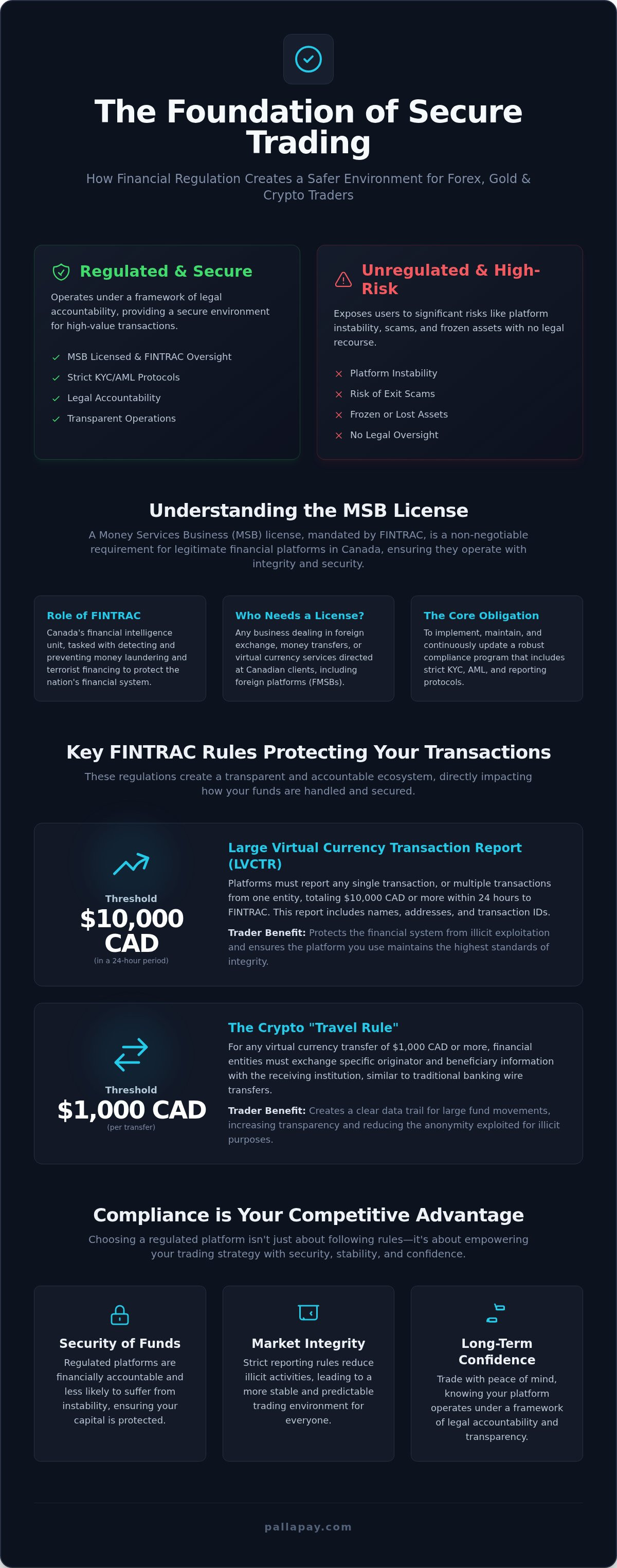
    • Definition: A Money Services Business (MSB) license is a regulatory requirement mandated by the Financial Transactions and Reports Analysis Centre of Canada (FINTRAC). It applies to any entity providing services like foreign exchange dealing, money transferring, or dealing in virtual currencies.
    • The Role of FINTRAC: As Canada’s financial intelligence unit, FINTRAC’s primary mission is to detect, prevent, and deter money laundering and the financing of terrorist activities. It monitors MSBs to ensure the integrity of Canada’s financial system.
    • Why It Matters for Crypto: For cryptocurrency platforms, obtaining an MSB license is non-negotiable. It legally obligates them to implement and maintain a robust compliance program, including strict Know Your Customer (KYC) and Anti-Money Laundering (AML) protocols.
    • The Difference: A standard, unregulated exchange operates without this oversight, exposing users to significant risks like platform instability, exit scams, and frozen assets. A regulated MSB like Pallapay, in contrast, operates under a framework of legal accountability, providing a secure environment for high-value transactions.

    Who Needs an MSB License in 2026?

    As regulatory scrutiny intensifies, the definition of an MSB has become increasingly clear. By 2026, FINTRAC’s enforcement will be laser-focused on any business engaged in virtual currency activities that touch the Canadian market. An MSB license is mandatory for:

    • Any platform, whether online or physical, that exchanges fiat currency for virtual currency (e.g., Canadian dollars for Bitcoin) or vice versa.
    • Businesses that provide virtual currency transfer services, moving digital assets from one person or entity to another.
    • Foreign Money Services Businesses (FMSBs) that do not have a physical presence in Canada but direct their services to Canadian clients. This ensures a level playing field and protects Canadian market participants.

    The MSB Registration Process

    Obtaining an MSB license from FINTRAC is a rigorous process designed to filter out bad actors and ensure only responsible, well-structured organizations can operate. It is not a simple certificate but a commitment to ongoing transparency and security. The key requirements include:

    • A Comprehensive Compliance Program: The applicant must develop and submit detailed policies and procedures that address risk assessment, reporting, record-keeping, and client identification.
    • Appointment of a Compliance Officer: A dedicated, qualified individual must be appointed to oversee the implementation and management of the compliance program, acting as the primary point of contact with FINTRAC.
    • Ongoing Reporting and Record-Keeping: Once registered, an MSB must adhere to strict reporting obligations for specific types of transactions and maintain detailed records for a minimum of five years.

    Key FINTRAC Crypto Regulations: Reporting and the Travel Rule

    For traders, understanding an MSB’s operational requirements is crucial. These rules are not just internal procedures; they directly impact how your transactions are handled and secured. FINTRAC’s regulations create a transparent and accountable ecosystem, which is essential for the stability required in Forex and Gold CFD trading.

    • The 24-Hour Rule: This rule requires MSBs to aggregate multiple transactions made by the same individual or entity within a 24-hour period. If the total value meets the reporting threshold, it must be reported as a single transaction, preventing attempts to structure payments to avoid detection.
    • Large Virtual Currency Transaction Reports (LVCTR): This is one of the most critical reporting obligations. Any transaction or series of transactions totaling $10,000 CAD or more in a 24-hour period must be reported to FINTRAC.
    • The Crypto Travel Rule: When a virtual currency transfer of $1,000 CAD or more occurs, MSBs must exchange specific originator and beneficiary information with the receiving institution. This ensures that a clear data trail accompanies large fund movements.
    • Record-Keeping: MSBs are legally required to store comprehensive transaction data for at least five years. This includes client information, transaction amounts, dates, and wallet addresses, ensuring a complete audit trail is available for regulatory review.

    Reporting Large Transactions (LVCTR)

    The $10,000 CAD threshold for Large Virtual Currency Transaction Reports (LVCTR) is a cornerstone of Canada’s AML framework. This rule is designed to provide FINTRAC with the intelligence needed to identify and investigate suspicious financial flows that could destabilize the market.

    • Requirement: When you conduct a transaction (or multiple transactions) of $10,000 CAD or more within 24 hours, your regulated platform is obligated to file an LVCTR.
    • Information Included: The report contains essential data points, such as your name, address, the transaction amount, transaction IDs, and the sending and receiving wallet addresses.
    • System Protection: This reporting mechanism protects the broader financial system from being exploited for illicit purposes. For legitimate traders, it ensures the platforms they use maintain high standards of integrity, reducing the risk of association with criminal funds.

    Travel Rule Implementation in Canada

    The Crypto Travel Rule adds another layer of transparency to the digital asset ecosystem, aligning it more closely with the standards of traditional banking. It specifically targets the anonymity that can be exploited in cross-platform transfers.

    • The CAD $1,000 Threshold: For any virtual currency transfer equivalent to $1,000 CAD or more, the originating MSB must collect and transmit key information to the beneficiary MSB. This includes names, addresses, and account details of both parties.
    • Impact on Wallets: The rule primarily affects transfers between regulated entities (e.g., two exchanges). While transfers to self-hosted wallets have different nuances, regulated platforms must still collect and retain the information on their end.
    • Global Compliance: This rule is not unique to Canada; it is part of a global standard set by the Financial Action Task Force (FATF). Adherence demonstrates that a platform is a reliable partner in the international financial community. Learn more about how our fiat settlement services comply with global standards.

    The Impact of MSB Regulation on Forex and Gold CFD Trading

    While FINTRAC regulations may seem focused on compliance, their true impact for a professional trader is far more profound. This regulatory framework is the institutional bridge that transforms crypto from a speculative asset into a powerful tool for accessing global Forex and Gold CFD (Contract for Difference) markets. Without it, the trust required for high-stakes trading would evaporate.

    • A Secure Environment: MSB licensing ensures that the on-ramps and off-ramps you use to fund your trading accounts are secure, audited, and legally accountable. This eliminates the risk of sudden platform collapses or frozen funds when you need liquidity most.
    • Institutional-Grade Markets: Regulation fosters the stability and predictability that institutional liquidity providers demand. Their participation deepens market liquidity, resulting in tighter spreads, faster execution, and better pricing for your Gold (XAU/USD) and Forex trades.
    • Funding and Settlement: Regulated crypto gateways allow you to use digital assets like USDT to fund and settle USD-based currency and commodity trades with unprecedented speed and efficiency, bypassing the delays of traditional banking systems.
    • Partner Preference: Major financial institutions, brokers, and liquidity partners will only work with MSB-licensed platforms. By choosing a regulated provider, you are ensuring your capital is part of a professional, interconnected global financial network.

    Trading Gold and USD CFDs with Crypto

    The convergence of regulated digital assets and traditional derivatives markets has created one of an exceptional opportunity for modern traders. Using crypto as the underlying settlement layer for CFD trading offers a distinct strategic advantage.

    • The Mechanics: Traders can use stablecoins like USDT to post margin or settle profits from CFD positions on major currency pairs or commodities like Gold (XAU/USD). This process is faster and more cost-effective than traditional wire transfers.
    • The Stability of the Bridge: MSB regulation ensures this bridge between crypto and fiat is structurally sound. Rigorous KYC and AML checks prevent illicit funds from contaminating the ecosystem, guaranteeing the legitimacy of every transaction.
    • The Financial Impact: Operating within a secure, regulated ecosystem allows you to focus entirely on market strategy. You can trade with confidence, knowing that your platform’s compliance framework protects your capital from operational and regulatory risks.

    Transforming Your Financial Life Through Secure Trading

    CFD trading provides unique leverage, allowing you to control a large market position with a relatively small amount of capital, thereby amplifying the potential for significant returns. However, this power can only be harnessed effectively within an environment of absolute trust and reliability. This is where the choice of a regulated platform becomes the most critical decision in your trading career.

    • The Role of Institutional Reliability: Long-term trading success is not built on a single winning trade but on consistent execution within a stable system. A regulated MSB provides the institutional reliability needed to build and scale a trading strategy over time without fear of systemic failure.
    • Seamless Settlement: The ability to move profits from a successful trade back into your portfolio or bank account is paramount. A compliant framework ensures these final settlement processes are as smooth and secure as the trade itself. Explore our crypto-to-bank transfer options for seamless trading settlement.

    What Is a Crypto MSB License? 2026 FINTRAC Guide

    Compliance as a Competitive Advantage for Investors

    In the evolving landscape of 2026, savvy investors no longer view compliance as a burden—they see it as a powerful competitive advantage. Choosing a platform that prioritizes regulatory adherence is a strategic move to de-risk your portfolio and position your capital for growth.

    • Mitigating Exit-Scam Risks: Unregulated platforms can disappear overnight, taking user funds with them. A FINTRAC-registered MSB operates under legal oversight, making such scenarios virtually impossible.
    • Protecting High-Volume OTC Trades: For large over-the-counter (OTC) transactions, MSB compliance ensures that both sides of the trade are subject to verification and that the transaction is recorded, providing a crucial layer of security.
    • Preventing Account Takeovers: The robust identity verification protocols required by FINTRAC are your first line of defense against unauthorized access and account takeovers, safeguarding your assets from theft.
    • Transparency in Fees: Regulated MSBs are held to a higher standard of transparency. This often translates to clearer fee structures and more honest spreads, which is a hallmark of a professional trading environment.

    Verifying a Platform’s MSB Status

    Trust should always be verified. Before committing significant capital to any platform, it is essential to confirm its regulatory standing. Fortunately, FINTRAC provides a public tool for this purpose.

    • Use the FINTRAC MSB Registry: FINTRAC maintains a publicly accessible online registry. You can search for a company by name to confirm if it is officially registered as a Money Services Business in Canada.
    • Review the Terms of Service: A compliant platform will clearly state its regulatory status and compliance obligations in its legal documentation. Look for mentions of the PCMLTFA (Proceeds of Crime (Money Laundering) and Terrorist Financing Act).
    • Further Protection: Verifying a platform’s MSB status is a key step in a comprehensive security strategy. For more tips, see our guide on crypto security and wealth diversification.

    Navigating the KYC Process

    The Know Your Customer (KYC) process, which involves submitting identification documents, is a mandatory component of MSB compliance. Rather than viewing it as an inconvenience, sophisticated traders recognize it as a prerequisite for secure, high-volume financial activity.

    • A One-Time Necessity: Document verification is typically a one-time process that unlocks a lifetime of secure access. It confirms your identity, protecting your account from fraud.
    • Data Protection: Regulated platforms are bound by strict data privacy laws governing how they handle and protect your sensitive information. They invest heavily in cybersecurity to safeguard user data.
    • Enabling Large-Scale Settlements: A verified identity is essential for enabling large-scale fiat settlements. It proves to banks and payment processors that the funds are legitimate, ensuring your withdrawals are processed without issue.

    Pallapay: A Regulated Bridge for the Future of Global Trading

    In a financial world where digital speed meets institutional demands, Pallapay stands as the regulated bridge for the future of global trading. Our unwavering commitment to compliance is not just about following rules—it is about building the secure, reliable, and efficient ecosystem that professional traders require to succeed.

    • Dual MSB Registration: Pallapay maintains official MSB registrations in both Canada and the United States, adhering to the highest standards of regulatory compliance in two of the world’s most important financial jurisdictions.
    • Seamless Market Access: We provide a compliant gateway to Forex and Gold CFD markets, allowing you to leverage the power of digital assets for funding, settlement, and strategic diversification.
    • Institutional OTC Desk: For transactions that exceed standard exchange limits, our OTC desk offers deep liquidity and discreet execution, all within a fully compliant and transparent framework.
    • Integrated Financial Solutions: We support the global evolution of finance by providing the tools—from payment gateways to APIs—that businesses and traders need to thrive in the new economy. For entrepreneurs seeking to expand their corporate presence internationally, Intercompany Solutions offers a fast, remote way to establish a Dutch BV.

    Our Comprehensive Suite of Compliant Services

    Pallapay offers a complete ecosystem designed to meet the needs of modern finance, from individual traders to global enterprises. Every service is built on a foundation of regulatory integrity and institutional-grade security.

    • Diverse Offerings: From enabling you to Buy USDT with Cash to providing high-speed API integrations, our solutions cover the full spectrum of digital finance.
    • Developer and Business Tools: For businesses looking to integrate secure crypto payments, our solutions are second to none. Integrate our secure Payment API for your business.
    • High-Volume Trading: For institutional clients and high-net-worth individuals, our OTC services provide the liquidity and execution needed for large-scale operations. Learn more about our institutional OTC exchange services.

    Accelerate Your Progress with a Professional Partner

    Success in modern markets requires focus. Pallapay handles the complex, background processes of compliance, security, and settlement, so you can concentrate on what you do best: analyzing markets and executing your strategy. With a global presence and a reputation for reliability, we are the professional partner you need to accelerate your financial progress.

    Join the Pallapay ecosystem today and trade with confidence.

    Frequently Asked Questions (FAQs)

    Is an MSB license required for all crypto exchanges in Canada?
    Yes. Any crypto exchange that provides services to Canadian residents, whether physically located in Canada or not, must register with FINTRAC as a Money Services Business (MSB) and comply with all associated regulations.

    What is the current FINTRAC reporting threshold for crypto transactions in 2026?
    The primary reporting threshold remains the Large Virtual Currency Transaction Report (LVCTR). Regulated MSBs must report any virtual currency transaction (or series of transactions) valued at $10,000 CAD or more within a 24-hour period.

    Does the Travel Rule apply when I send crypto to a self-hosted wallet?
    The Travel Rule primarily applies to transfers between two regulated entities (like exchanges). When you send funds to a self-hosted (unhosted) wallet, the sending MSB is still required to collect and retain the relevant information about the transaction, but there is no receiving institution to transmit it to.

    How does FINTRAC define “Virtual Currency” in its 2026 guidance?
    FINTRAC defines a virtual currency as a digital representation of value that can be used for payment or investment purposes and is not issued by a central bank. This includes cryptocurrencies like Bitcoin (BTC), Ethereum (ETH), and stablecoins like Tether (USDT).

    Can a crypto platform lose its MSB registration?
    Absolutely. FINTRAC can revoke an MSB registration if a platform fails to comply with its legal obligations, such as reporting, record-keeping, or maintaining an effective compliance program. This is why choosing a platform with a long-standing commitment to compliance is critical.

    What information must I provide to a regulated MSB for a large trade?
    For a large transaction, you will typically need to have a fully verified (KYC) account, which includes providing your full legal name, address, date of birth, and a government-issued identification document. This information is required for the platform to fulfill its LVCTR reporting duties.

    Why is MSB compliance important for Forex and Gold CFD traders?
    MSB compliance is vital because it ensures the platform you use for funding and settling trades is secure, stable, and legally accountable. It creates a trustworthy environment that attracts institutional liquidity, leading to better pricing and execution while protecting your capital from regulatory and operational risks.

    What is the 24-hour rule in FINTRAC crypto reporting?
    The 24-hour rule requires an MSB to aggregate all transactions conducted by a single client over a 24-hour period. If the total of these transactions meets the $10,000 CAD reporting threshold, the MSB must file a single LVCTR, even if no individual transaction was that large.

    Disclaimer

    The information provided on this website and blog is for general informational and educational purposes only and does not constitute financial, investment, legal, tax, or other professional advice.
    Cryptocurrency and digital asset services may be subject to regulatory restrictions in certain jurisdictions. Users are solely responsible for ensuring compliance with applicable local laws and regulations before using any products or services mentioned on this website.
    PallaPay does not guarantee the accuracy, completeness, or timeliness of any information published and accepts no liability for any loss or damages arising from reliance on the content. Any opinions expressed are those of the respective authors and may change without notice.
    Certain services, features, or products referenced may be provided through third-party partners, licensed entities, or affiliated service providers subject to separate terms and regulatory approvals. Availability of services may vary by country or region.
    This website may contain references to digital assets, virtual currencies, or blockchain-related services that are not available to residents of certain jurisdictions, including where prohibited by law. Nothing on this website constitutes an offer, solicitation, or recommendation to buy or sell any financial instrument or virtual asset.
  • Mastering the Crypto Merchant Dashboard: A 2026 Tutorial for Global Growth

    Mastering the Crypto Merchant Dashboard: A 2026 Tutorial for Global Growth

    In 2026, a professional interface serves as more than a ledger; it functions as a sophisticated bridge between digital commerce and global financial markets. You likely recognize the frustration of managing multi-currency settlements while fearing that interface lag might cause you to miss pivotal market movements. This crypto merchant dashboard tutorial is designed to eliminate that friction, providing a clear path to integrate your payment flow with high-growth assets.

    Transitioning from simple payment acceptance to active capital management is the most effective way to secure long-term stability. It’s vital to establish a streamlined workflow that offers total visibility on fiat settlements and the ability to diversify instantly into Gold (XAU/USD) and USD CFDs. This guide explores how to navigate your dashboard to unlock these transformative trading opportunities, moving your business from basic operations to strategic financial expansion through Forex and commodity markets.

    Key Takeaways

    • Establish a secure foundation for digital asset management by configuring your dashboard for maximum efficiency and real-time visibility.
    • Master the step-by-step transaction workflow within this crypto merchant dashboard tutorial to generate payment requests via virtual terminals or dynamic QR codes.
    • Optimize business liquidity by leveraging seamless fiat settlements and utilizing USDT reserves to hedge against currency fluctuations.
    • Unlock transformative growth by integrating Gold (XAUUSD) and USD CFD trading to diversify capital into traditional commodity and currency markets.
    • Scale your enterprise operations through a regulated ecosystem that combines digital payment gateways with physical POS infrastructure for global reach.

    Setting Up Your Crypto Merchant Dashboard for Maximum Efficiency

    Establishing a secure foundation is the first step in this crypto merchant dashboard tutorial. When you first log in, you aren’t just opening a software tool; you’re accessing a professional gateway to global liquidity and institutional-grade financial markets. Security configuration starts with robust two-factor authentication (2FA) to protect merchant capital from unauthorized access. This isn’t optional for serious enterprises. You should also review MSB compliance requirements within your settings to ensure your operations align with US FinCEN or Canadian FINTRAC standards, depending on your specific registration status.

    The main interface provides immediate visibility into key performance indicators. You can track total settled volume, pending transaction statuses, and current fiat balances at a glance. Understanding how payment processors work in a decentralized context helps you manage the transition from digital assets to local currency more effectively. For growing teams, configuring multi-user access is vital. You can grant specific permissions to accounting for settlement reports while giving sales teams the ability to generate payment links without accessing sensitive wallet settings. Customizing notification triggers ensures you stay informed on instant payment confirmations, which is essential for high-volume environments.

    Security Protocols and 2FA Integration

    Protecting your assets requires more than just a strong password. Implementing IP whitelisting for API-driven environments adds a layer of defense by restricting dashboard access to verified business locations. This level of security is standard for institutional-grade financial operations. By securing your dashboard early, you create a stable environment where you can eventually transition business capital into more active markets like Gold and Forex CFDs without worrying about the safety of your underlying liquidity.

    Tailoring the Dashboard to Your Industry

    Every business has unique operational needs that the interface must reflect. For hotels and high-ticket hospitality, the dashboard allows for manual entry or virtual terminal requests for large deposits. If you operate retail stores, you can optimize the interface for high transaction volumes, ensuring that staff can process payments quickly at the point of sale. For those integrating with e-commerce platforms, the focus shifts to automated checkouts and webhook notifications that trigger order fulfillment the moment a transaction is confirmed. This level of customization ensures that the dashboard serves your specific growth strategy rather than being a generic tool.

    Managing Payments: A Step-by-Step Tutorial on Transaction Workflows

    Efficiency in payment processing defines modern commerce. Your dashboard streamlines this through a logical progression from initiation to settlement. In this crypto merchant dashboard tutorial, we focus on the mechanics of the transaction lifecycle to ensure you maintain total control over your capital. Generating a new payment request is a simple matter of choosing between a virtual terminal for manual entry or a dynamic QR code for customer-facing interactions. Both methods prioritize speed and accuracy, ensuring that conversion rates are locked in at the moment of the request.

    Tracking the status of every transaction is essential for maintaining a clean ledger. The interface categorizes payments into three distinct stages. “Pending” indicates the transaction is detected on the blockchain but awaits verification. “Confirmed” means the network has validated the transfer. “Settled” signifies the funds are fully available in your account. As businesses scale, they often require sophisticated multi-asset crypto management to handle the influx of diverse digital tokens. This clarity prevents the common pain point of missing market volatility due to slow interface updates.

    Professional protocols for refunds and partial payments are built directly into the workflow. If a customer sends an incorrect amount, the dashboard allows you to issue a precise refund or request the remaining balance without restarting the entire process. For tax compliance and internal audits, you can export comprehensive financial reports in multiple formats. These documents provide the visibility needed to justify fiat settlements and prepare your business for the next stage of growth, such as exploring the full merchant ecosystem to leverage your capital in global markets.

    The Virtual Terminal for In-Person Sales

    The virtual terminal is designed for speed in physical environments. You simply input the fiat amount, and the system generates real-time crypto conversion rates. Selecting the optimal blockchain network, such as a low-fee Layer 2 or a stablecoin-native chain, ensures both you and your customer save on overhead. Always verify the “Confirmed” status on your screen before handing over high-value goods or services to ensure the transfer is irreversible.

    Automating Online Checkouts via API

    For digital enterprises, leveraging the payment API allows for seamless web integration that reduces cart abandonment. Testing webhooks is a critical step; it ensures that your website receives real-time updates to trigger inventory changes or digital deliveries. This automation transforms your checkout process into a high-performance engine, allowing you to focus on strategic goals like diversifying your revenue into USD and Gold CFDs.

    Optimizing Business Growth via Multi-Asset Management

    Strategic growth requires a shift from passive payment acceptance to active capital optimization. While the previous section of this crypto merchant dashboard tutorial focused on the mechanics of transaction workflows, this phase examines how to leverage those funds for long-term enterprise value. A sophisticated dashboard acts as a command center where you can manage diverse digital assets and transition them into traditional financial structures. By mastering the fiat settlement process, you ensure that your digital revenue is converted into local bank deposits with precision, providing the liquidity needed for daily operations or large-scale investments.

    Managing stablecoin reserves, particularly USDT, provides a vital hedge against the inherent volatility of the broader crypto market. You don’t always need to exit to fiat immediately; instead, holding USDT allows you to maintain a digital “cash” position that is ready for instant redeployment. This flexibility is enhanced by integrating an off-ramp solution, which offers liquidity on demand. Whether you’re paying global suppliers or preparing to enter the Forex market, having a streamlined path from your dashboard to your bank account is essential for maintaining a competitive edge.

    Data-driven decision-making is another pillar of business growth. Your dashboard provides historical data that allows you to analyze customer payment trends and forecast seasonal growth. If you notice an uptick in Bitcoin payments during specific quarters, you can adjust your settlement strategy to capitalize on market strength. This foresight transforms your dashboard from a simple ledger into a predictive tool, helping you build a financial cushion that supports your eventual expansion into Gold and USD CFD trading.

    Fiat Settlement vs. Crypto Retention

    Deciding when to hold digital assets and when to convert to fiat is a balance of risk and utility. Strategic timing can help you minimize conversion spreads. The following table outlines typical settlement windows for major currencies within a professional dashboard environment:

    Currency Pair Settlement Speed Strategic Use Case
    Crypto to USD Instant to 24 Hours Collateral for CFD and Forex trading
    Crypto to EUR Same Business Day Settling European supply chain costs
    Crypto to USDT Real-Time Hedged reserve for market volatility

    Real-Time Market Monitoring

    Precision is everything in global finance. Use your interface to monitor major pairs like BTC/USD and ETH/USD in real time. Setting price alerts allows you to optimize your settlement windows, ensuring you convert assets only when market conditions are favorable. This proactive approach ensures you’re never forced to settle during a dip, preserving the value of your hard-earned revenue as you prepare to diversify into more traditional assets like Gold (XAUUSD).

    Mastering the Crypto Merchant Dashboard: A 2026 Tutorial for Global Growth

    Transformative Financial Growth: Integrating Gold and USD CFD Trading

    Moving beyond the operational basics covered in this crypto merchant dashboard tutorial, we enter the phase of active capital appreciation. A professional merchant interface shouldn’t just function as a digital ledger; it serves as a launchpad for transformative financial growth. By integrating Contracts for Difference (CFD) trading, you gain the ability to access global markets without the logistical burden of owning the underlying physical assets. This allows you to speculate on price movements in real time, turning market volatility from a risk into a strategic advantage for your enterprise.

    The mechanics of CFD trading are built for speed and efficiency. When you trade CFDs, you enter an agreement to exchange the difference in the value of an asset from the time a contract is opened to when it is closed. This model is particularly beneficial for merchants who already manage digital liquidity. Instead of allowing settled funds to remain stagnant, you can transition that liquidity into the Forex market to seek capital appreciation. This strategic participation has the potential to change your financial trajectory, moving your business from a state of simple revenue collection to one of sophisticated wealth generation.

    To begin your journey toward market-driven growth, you can access our professional trading tools and integrate your merchant capital with global liquidity today.

    Gold (XAUUSD) as a Strategic Asset

    Gold remains the ultimate hedge for modern merchants seeking to protect their purchasing power. While digital assets offer high growth potential, they often correlate with broader market sentiment. Gold (XAUUSD) typically moves independently of crypto volatility, providing a stabilizing force for your business reserves. XAUUSD CFDs represent a high-leverage tool for diversifying merchant revenue by allowing businesses to hedge against currency devaluation through gold market exposure. Using USD-based CFDs further allows you to capitalize on global currency fluctuations, ensuring your capital remains productive regardless of regional economic shifts.

    Forex Trading for Business Diversification

    Scaling from a local merchant to a global investor requires a fundamental psychological shift. You must move from the daily habit of “earning” to the institutional strategy of “compounding” business profits. Understanding leverage and risk management in USD currency pairs is the key to this transition. By using the same dashboard that handles your payments, you can monitor Forex signals and execute trades that diversify your holdings. This integrated approach ensures that your business doesn’t just survive market cycles but thrives by capturing value across multiple asset classes, from traditional commodities to the world’s primary reserve currencies.

    Scaling Your Enterprise with the Pallapay Integrated Ecosystem

    Scaling a global enterprise requires more than a functional interface; it demands a comprehensive financial ecosystem that bridges the gap between digital innovation and institutional reliability. This final stage of our crypto merchant dashboard tutorial focuses on integrating your operational success with professional-grade tools designed for expansion. A regulated ecosystem provides the security and compliance necessary for long-term stability, ensuring that your business remains resilient as you move into high-volume markets. By unifying your revenue streams, you create a foundation for the transformative financial growth that comes from strategic market participation.

    Efficiency is maximized when you combine a digital crypto payment gateway with physical infrastructure. This 360-degree approach allows you to capture value across all customer touchpoints, whether they occur online or in person. For high-volume needs, expanding into an institutional-grade OTC crypto exchange provides the deep liquidity required for large-scale settlements. This capability is essential for merchants who wish to fund significant positions in the Forex or Gold markets without the friction of traditional banking delays. Future-proofing your business involves preparing for an evolution where digital payments and traditional asset trading exist within a single, seamless workflow.

    Global Compliance and MSB Registration

    Stability is the cornerstone of global commerce. Working with a fintech provider registered as a Money Services Business (MSB) with FinCEN in the United States and FINTRAC in Canada ensures your operations meet rigorous international standards. This regulatory framework supports businesses in over 180 countries, providing a secure environment for cross-border settlements. It eliminates the fear of regulatory uncertainty, allowing you to focus on compounding your profits through USD and Gold CFD trading rather than managing compliance risks.

    Next Steps: Activating Your Growth Strategy

    The path to global expansion begins with a clear implementation plan. Your first step is to apply for a professional merchant account to gain full access to the dashboard features discussed throughout this guide. For physical locations, integrating hardware solutions like a crypto POS machine ensures your retail operations are as modern as your digital ones. If your business requires a custom setup, contacting support for personalized integration assistance can help align our technology with your specific goals. Adopting these tools is an investment in your financial future, turning daily transactions into a engine for wealth generation in the global Forex and commodity markets.

    Driving the Evolution of Global Merchant Finance

    Mastering the tools outlined in this crypto merchant dashboard tutorial transforms your business from a simple payment processor into a strategic financial entity. By establishing secure workflows and leveraging real-time visibility, you’ve built the foundation for institutional-grade growth. The transition from digital settlements to the high-performance worlds of Gold (XAUUSD) and Forex CFD trading represents a significant shift in how you manage enterprise capital. This strategic pivot allows you to move beyond daily operations and into the realm of compounding wealth.

    Scaling with a partner that operates as a regulated MSB in the United States and Canada provides the stability required for global expansion. With a presence in over 180 countries and physical OTC desks in major global hubs, the infrastructure supports your move into diverse asset classes. It’s time to embrace a comprehensive ecosystem that facilitates both commerce and capital appreciation. Empower your business growth with the Pallapay Merchant Dashboard today. Your path to transformative financial success starts with a single, integrated platform designed for the modern global economy.

    Frequently Asked Questions

    What is a crypto merchant dashboard and how does it work?

    A crypto merchant dashboard is a centralized command center that facilitates the acceptance, tracking, and settlement of digital asset transactions. It works by bridging decentralized blockchain networks with your business’s financial infrastructure. This interface allows you to monitor incoming payments in real time, manage liquidity, and initiate fiat settlements. It serves as the primary tool for reconciling digital sales with traditional accounting practices.

    How can I integrate the dashboard with my existing e-commerce site?

    Integration is achieved through a secure developer API or specialized plugins for major e-commerce platforms. The dashboard provides the necessary API credentials and documentation to link your digital storefront to the payment gateway. This process enables automated checkout flows where customers pay in crypto while you receive real-time confirmations. Testing via webhooks ensures that inventory and order statuses update instantly upon network verification.

    Is it possible to receive payments in crypto but settle in fiat currency?

    You can certainly accept cryptocurrency and receive settlements in your local fiat currency. The dashboard allows you to configure automatic conversion settings to mitigate exposure to price volatility. This feature ensures that the exact fiat value of your sale is preserved and transferred to your linked bank account. It’s a critical component of this crypto merchant dashboard tutorial for businesses seeking traditional financial stability.

    How does Gold CFD trading benefit my business financial strategy?

    Gold CFD trading offers a sophisticated way to hedge your business capital against currency devaluation and market shifts. By trading XAUUSD CFDs, you gain exposure to gold’s price movements without the logistical challenges of physical ownership. This strategy helps diversify your reserves, turning static business profits into active, compounding assets. It provides a reliable counterweight to the faster-moving digital asset market.

    What are the fees associated with using a merchant dashboard for crypto?

    Transaction fees for crypto merchant services are generally lower than the 2.9% plus $0.30 often charged by credit card processors. Most digital gateways range between 0.5% and 2%, though specific withdrawal and network fees vary by asset. You’ll find a detailed breakdown of processing costs and potential discounts for holding native platform tokens within your account settings. This cost-efficiency significantly improves annual profit margins for high-volume enterprises.

    How secure is my data and capital on the Pallapay dashboard?

    Capital and data security are maintained through institutional-grade encryption and mandatory two-factor authentication. The dashboard includes advanced features like IP whitelisting and multi-user permission levels to prevent unauthorized access. Because the platform is a registered Money Services Business in both the US and Canada, it adheres to strict global compliance standards. These protocols ensure that your business liquidity remains protected against external threats.

    Can I manage multiple retail locations from a single dashboard account?

    Managing multiple retail locations from a single dashboard account is a standard feature for scaling enterprises. You can assign unique identifiers to different physical branches or POS machines to track individual performance. This centralized visibility allows you to monitor global sales volume and manage staff access levels from one login. It’s an essential tool for maintaining operational consistency across a growing international footprint.

    What is the difference between a crypto gateway and a standard payment processor?

    A crypto gateway facilitates direct blockchain transfers, while standard processors rely on traditional banking rails and intermediary clearinghouses. This difference results in faster settlement times and the total elimination of fraudulent chargebacks. This crypto merchant dashboard tutorial highlights how gateways bypass the high fees and delays of legacy systems. They provide a more efficient path for global commerce by connecting merchants directly to the digital economy.

    Disclaimer

    The information provided on this website and blog is for general informational and educational purposes only and does not constitute financial, investment, legal, tax, or other professional advice.
    Cryptocurrency and digital asset services may be subject to regulatory restrictions in certain jurisdictions. Users are solely responsible for ensuring compliance with applicable local laws and regulations before using any products or services mentioned on this website.
    PallaPay does not guarantee the accuracy, completeness, or timeliness of any information published and accepts no liability for any loss or damages arising from reliance on the content. Any opinions expressed are those of the respective authors and may change without notice.
    Certain services, features, or products referenced may be provided through third-party partners, licensed entities, or affiliated service providers subject to separate terms and regulatory approvals. Availability of services may vary by country or region.
    This website may contain references to digital assets, virtual currencies, or blockchain-related services that are not available to residents of certain jurisdictions, including where prohibited by law. Nothing on this website constitutes an offer, solicitation, or recommendation to buy or sell any financial instrument or virtual asset.