
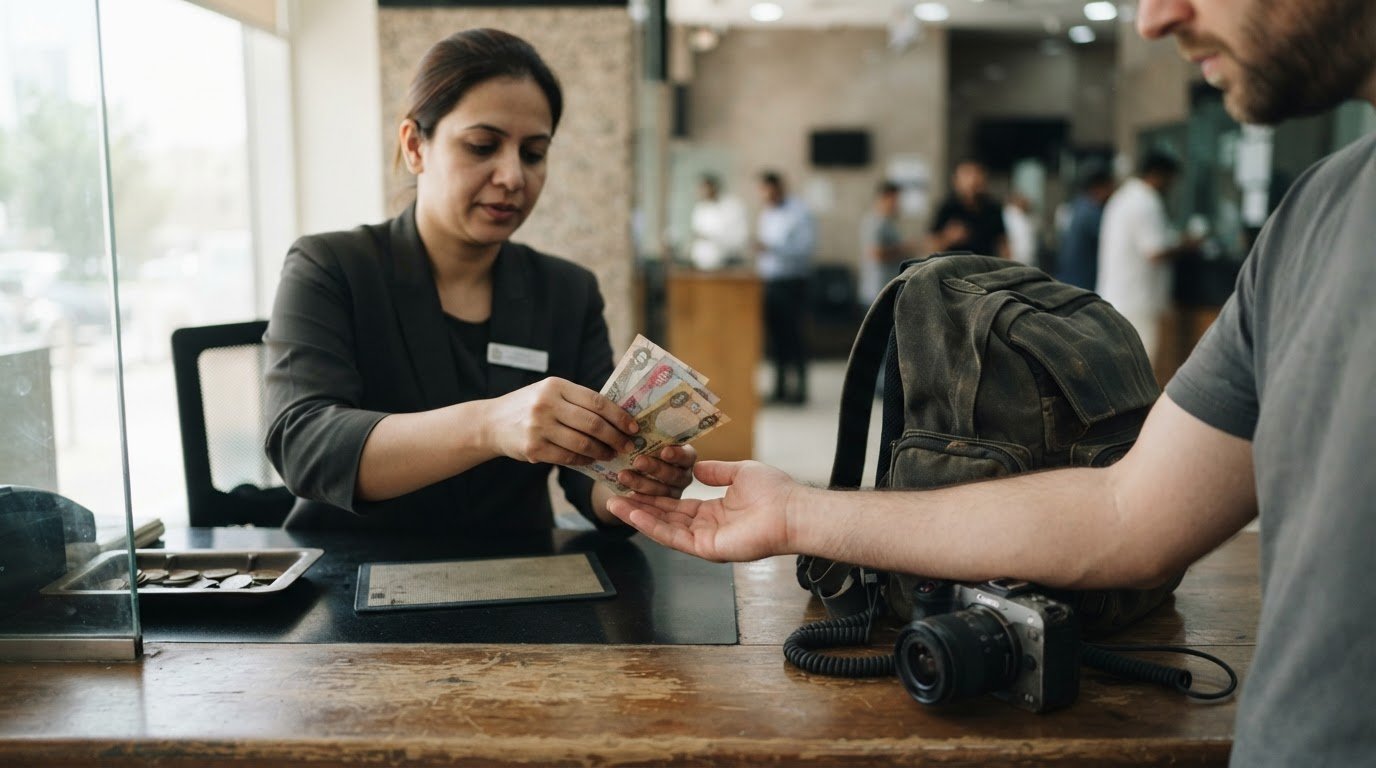
For freelancers in the UAE, receiving USDT and using it for payments are separate decisions. Crypto for freelancers in the UAE means understanding how to receive earnings, access funds and convert them when needed, while keeping freelance income separate from trading capital.
It’s reasonable to want more control over how clients pay you and how you manage your earnings. Clear payment terms and a planned cash-out route help you make practical decisions without treating a crypto balance as automatically spendable income.
This guide covers ways to receive cryptocurrency, access or exchange earnings, and manage the risks involved. It also considers forex, gold and USD CFD trading as separate activities, where market exposure can affect your finances and losses are possible.
Key Takeaways
- Understand how currency price movements create potential forex opportunities and expose trades to risk.
- Learn how gold CFDs track price changes and why those movements can affect both gains and losses.
- Identify key considerations in USD CFD trading, including leverage, trading costs and the possibility of losing money.
- Assess how CFD trading could affect your finances while accounting for uncertain outcomes and potential losses.
Forex Trading: How Currency Markets Work for Freelancers Using Crypto in the UAE
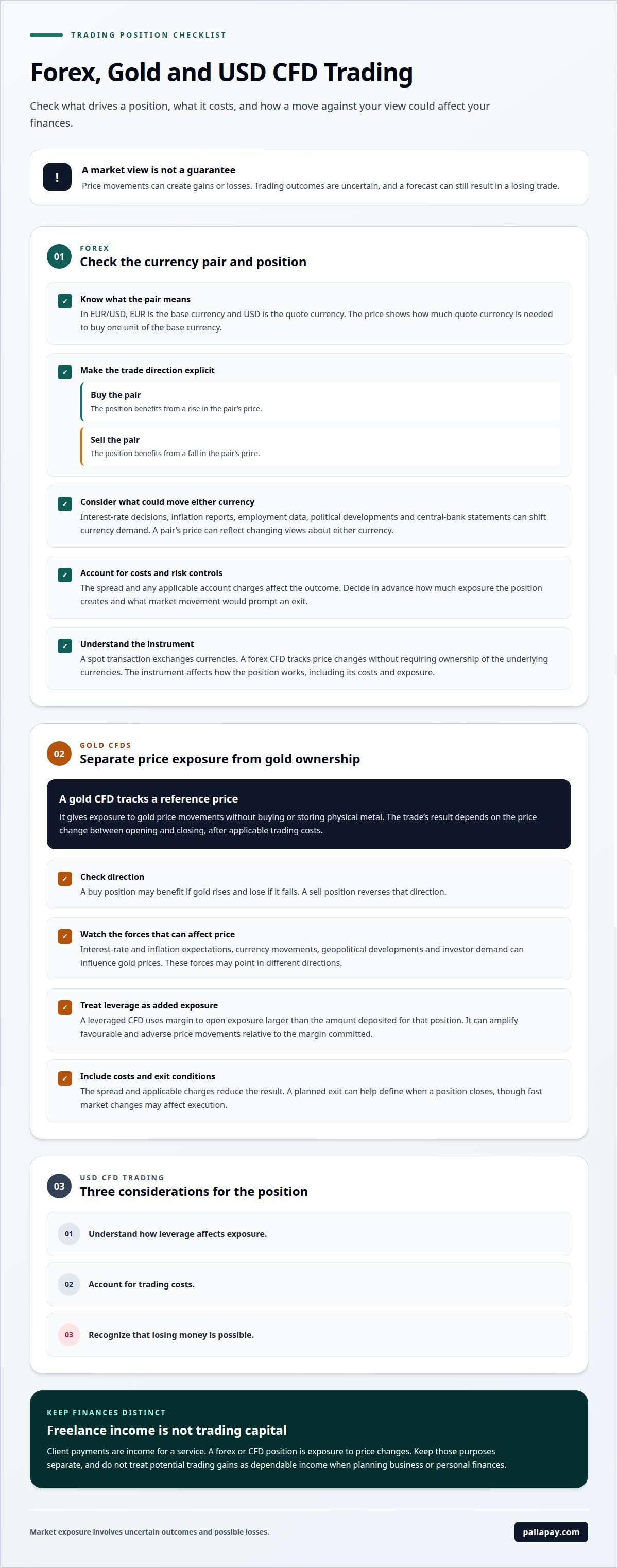
Forex trading means buying one currency while selling another, with each trade based on the exchange rate between them. Currencies are quoted in pairs, such as EUR/USD: the first is the base currency and the second is the quote currency. The price shows how much of the quote currency is needed to buy one unit of the base currency. Traders seek to benefit from changes in that relationship, but price movements can cause losses as well as gains.
Imagine a trader expects the euro to strengthen against the US dollar. They might buy EUR/USD, aiming to close the position after the pair rises. If the euro weakens instead, the trade moves against them. A trader expecting the opposite movement could sell the pair, aiming to benefit if its price falls. These examples show how direction works, not what will happen: a market expectation is not a guarantee.
Currency values respond to changing expectations about economies and financial conditions. Interest-rate decisions, inflation reports, employment data, political developments and central-bank statements can all shift demand for a currency. Because each pair compares two currencies, a price move can reflect changing views about either one. A currency may strengthen against one trading partner while weakening against another, depending on the forces affecting each pair.
This creates opportunities when a trader’s analysis anticipates a price move, but it also makes timing difficult. Markets can react quickly to new information, and an initial move may reverse as traders reassess what it means. A forecast can be directionally correct yet still result in a losing trade if the price changes before the position is opened or after it is closed. Decisions depend on the pair, entry and exit levels, position size and how long the trade remains open.
Before opening a forex position, understand the practical details that shape its result:
- Pair selection: Identify which two currencies are involved and what might influence each one.
- Trade direction: A buy position benefits from a rise in the pair’s price; a sell position benefits from a fall.
- Trading costs: The spread and any applicable account charges affect the outcome, so a small market move may not be enough to produce a net gain.
- Risk controls: Decide in advance how much exposure the position creates and what market movement would prompt an exit.
Forex trading uses different instruments. In a spot transaction, currencies are exchanged. A contract for difference, or CFD, tracks price changes without requiring the trader to own the underlying currencies. The instrument determines how the position works, including its costs and exposure. A forex account provides access to trading, but it doesn’t remove market risk or make a currency forecast more reliable.
For freelancers receiving crypto for their work in the UAE, client payments and forex trading serve different financial purposes. Freelance income is payment for a service; a forex position is exposure to currency-price changes. Keeping that distinction clear helps prevent potential trading gains from being treated as dependable income when planning business or personal finances.
Trading Gold Through CFDs
Gold trading through a contract for difference (CFD) lets a trader take a position on gold’s price movement without buying or storing physical metal. The CFD tracks a reference price, and the trade’s result depends on how that price changes between opening and closing the position, after applicable trading costs. This provides market exposure, not ownership of gold.
A trader who expects gold to rise may open a buy position. A buy position may gain when gold’s price rises and lose when it falls, though the outcome also depends on the position and applicable costs. A sell position reverses the direction: a fall may benefit the position, while a rise may move against it. The outcome depends on the size of the price change and the position’s exposure, not simply on whether the initial forecast sounded reasonable.
For example, imagine a trader buys a gold CFD because they expect uncertainty to increase demand for gold. If the reference price rises, the position moves in the trader’s favour. If prices fall after new economic information or a shift in market expectations, the same position loses value. The example illustrates the trade-off: CFDs allow traders to act on a price view in either direction, but they don’t make that view more reliable.
Gold prices can respond to several interacting forces. Expectations about interest rates and inflation may change how attractive gold appears relative to interest-bearing assets. Currency movements can also matter because gold is commonly quoted in US dollars, while geopolitical developments and shifts in investor demand can affect buying and selling pressure. These drivers may point in different directions, so one headline does not necessarily explain a sustained price move.
Position size and leverage affect how strongly a price change influences the account. With a leveraged CFD, the trader provides margin to open exposure larger than the amount deposited for that position. This can amplify the effect of a favourable move, but it also magnifies the effect of an adverse move. Even a modest change in the gold price may have a substantial impact relative to the margin committed, making exposure control central to risk management.
Before taking a position, consider the mechanics that shape its outcome:
- Direction: A buy position benefits from a rise; a sell position benefits from a fall.
- Exposure: Position size and leverage determine how strongly the account responds to price movement.
- Trading costs: The spread and any applicable charges reduce the result, so the market must move far enough in the intended direction to offset them.
- Exit conditions: A planned exit can help define when the position closes, though fast market changes may affect execution.
- Holding period: Keeping a CFD open can involve ongoing costs, depending on the instrument and contract terms.
Gold CFDs suit traders seeking exposure to short-term or longer-term price movements without handling bullion, but they aren’t a substitute for owning gold. A CFD is a leveraged trading instrument, and even a correct view of the broad trend may result in a loss if the timing, position size or exit decision is poor. Gold CFD trading therefore requires understanding both the market thesis and the contract mechanics, including how price changes, leverage and costs combine in the final result.
USD CFD Trading: Key Considerations
USD CFD trading gives you exposure to price movements in an instrument linked to the US dollar without requiring you to own the underlying currency. The term can refer to a contract on a currency pair involving USD or another USD-linked market instrument. The contract’s details determine which price it tracks and how the trade is settled, so understand the underlying market before opening a position.
In a currency-pair CFD, USD may appear as either the base or quote currency. In EUR/USD, for example, the quote expresses the value of the euro in US dollars. A position’s result depends on the direction of the pair’s price movement and whether you buy or sell. If you buy and the price falls, the position loses value; if you sell and the price rises, it moves against you. A correct view of the dollar alone doesn’t guarantee a profitable trade, because the other currency in the pair also affects the exchange rate.
Leverage allows a trader to open market exposure greater than the margin committed to the position. It amplifies the effect of price movements on the margin: a favourable move can increase returns relative to the funds set aside, while an adverse move can deepen losses just as quickly. Assess risk based on the full exposure, not the margin alone. If the market moves sharply, losses can consume the available account balance, subject to the contract and account terms.
Trading costs also affect the result. A spread, the difference between the buy and sell prices, impacts the position from the outset. Depending on the instrument and account terms, charges may also include commission, financing for positions held overnight or currency conversion. These costs can accumulate while a position remains open, so a trade that moves slightly in your favour may still produce a net loss after charges.
Before considering a USD CFD position, assess its mechanics and downside together:
- Underlying instrument: Identify the market and price the contract follows, including the currencies involved in a pair.
- Direction: Confirm how a buy or sell position responds to a rise or fall in the quoted price.
- Leverage and margin: Understand the total exposure created and how an adverse movement affects the account.
- Costs and holding period: Account for the spread and any applicable charges, especially if the position stays open.
- Exit plan: Set a clear point for closing the position and consider how rapid price changes can affect execution.
For instance, a trader who expects the US dollar to strengthen against another currency might buy a CFD on a pair where a stronger dollar would lift the quoted price. If the other currency strengthens instead, the trade loses value. A stop order can define an intended exit level, but it doesn’t remove market risk or guarantee execution at that exact price in all conditions.
USD CFD trading is not the same as exchanging dollars for an invoice or holding dollars as savings. It is a leveraged trading activity with costs and exposure to changing market prices. Treat potential gains as uncertain, account for the possibility of losing money, and don’t rely on CFD returns to fund essential expenses.
How CFD Trading Can Change Your Financial Life
CFD trading can affect your finances through the possibility of gains as well as losses, but it doesn’t provide dependable income or a guaranteed path to greater wealth. Its impact depends on the positions you take, the capital exposed, trading costs and how you respond to changing prices. Treat it as a high-risk financial activity, not a replacement for earnings, savings or a long-term financial plan.
A profitable position may increase the funds in an account and give you more flexibility in how you use that capital. A losing position can reduce money available for bills, savings or other priorities. Because CFDs can use leverage, the financial effect of a market move may be larger than the margin committed to a trade suggests. Assess the total exposure, not just the amount set aside to open a position.
Consider a freelancer who budgets client income for household expenses and business needs, then sets aside a separate amount for CFD trading. If a trade loses, the immediate impact is less likely to disrupt essential spending. If trading capital and money needed for routine commitments come from the same pool, a loss can create pressure to delay bills, draw down savings or take on additional risk. Separating funds supports clearer decisions, though it cannot prevent losses.
Trading may also affect financial habits and peace of mind. Watching rapid price changes can encourage frequent account checks, impulsive trades or attempts to recover a loss immediately. Those responses may increase exposure when caution matters most. A written plan can set boundaries for markets, position size, exits and pauses. Such rules help only when applied consistently, including during a difficult trading period.
Before trading, consider the financial boundaries that can help keep risk manageable:
- Protect essential funds: Keep money for regular expenses and near-term obligations separate from speculative trading capital.
- Set a loss limit: Decide what amount you can afford to lose before opening a position, and don’t raise it impulsively.
- Account for costs: Include spreads and other applicable charges when assessing the overall result.
- Review your budget: Consider the effect of trading gains or losses on your wider financial commitments, not only your trading account.
- Pause when needed: After a loss, reassess your plan rather than placing another trade simply to recover the money.
CFDs can provide market exposure without requiring ownership of the underlying asset, but access to a market doesn’t create a financial advantage by itself. Decisions still depend on the instrument, market conditions, exposure and costs. Treat possible gains as uncertain, and don’t rely on trading returns to pay essential expenses, build emergency savings or replace freelance income.
The financial effect of CFD trading depends on decisions and price movements, and losses are possible. A plan covering crypto for freelancers in the UAE should keep client earnings, essential funds and any speculative trading capital clearly separate. Make choices based on what your finances can withstand, not an assumed return, and leave room in your budget for ordinary commitments.
Build your financial plan around the distinction between earned income and market exposure. Freelance payments support your work and day-to-day commitments; CFD trading is a separate activity that can affect your finances in either direction. Keeping those roles clear helps you make deliberate choices about receiving crypto, converting it to cash and deciding what money, if any, belongs in a trading account. For freelancers considering crypto in the UAE, a well-defined cash-out plan is a practical next step.
When you need to access crypto earnings, Best Crypto Debit Cards 2026: Visa & Mastercard Compared offers reliable crypto debit card and cash-out services. Choose the route that fits how you intend to use your funds, then move forward with a clear understanding of the transaction. Explore crypto card and cash-out options and take your next step with greater clarity.
Frequently Asked Questions
Is USDT legal for payments in the UAE?
USDT is not automatically prohibited for every payment, but its use depends on the transaction, the service involved and applicable rules. The Central Bank of the UAE issued its Payment Token Services Regulation in 2024, establishing a framework for certain payment-token services. Receiving USDT as payment for freelance work differs from operating an exchange or payment service, which may involve separate requirements.
Can freelancers in the UAE legally receive payment in cryptocurrency?
Freelancers may agree with a client to receive cryptocurrency for completed work, but the permitted scope depends on their authorised activity and the transaction. Crypto for freelancers in the UAE should be treated as payment for their own services, not as permission to exchange, hold or transfer crypto for other people. Keep the payment arrangement connected to the work being invoiced and distinguish it from regulated financial services.
What UAE rules regulate cryptocurrency payments for freelancers?
The relevant framework depends on the token, payment arrangement and service provider. The Central Bank of the UAE issued its Payment Token Services Regulation in 2024, which concerns payment-token services. A freelancer receiving payment for their own work has a different role from a business providing exchange, custody or payment services to customers. The freelance activity and the transaction should be considered separately.
Do UAE freelance permits or visas allow crypto payments?
A freelance permit authorises an individual to provide specified services under their own name; it is not blanket authorisation for regulated financial activity. A permit is also distinct from a residence visa, and holding one does not by itself determine whether a particular crypto activity is allowed. Keep client payments connected to permitted work, rather than treating a freelance permit as approval to operate an exchange or custody service.
How can a professional help a freelancer in the UAE invoice clients for cryptocurrency payments?
A professional payment setup can make invoice and settlement terms clear for both parties. Best Crypto Debit Cards 2026: Visa & Mastercard Compared offers a crypto payment link that can create crypto invoices settling in fiat currency, including USD or EUR. An invoice can identify the freelance service, agreed amount, payment terms and settlement preference, helping reduce confusion about what the client owes and how the freelancer expects to receive the proceeds.
What are the risks of accepting crypto as a freelancer in the UAE?
Risks include price changes between invoicing and conversion, sending funds over the wrong network, incorrect wallet details and fraudulent payment claims. Transfers may be difficult or impossible to reverse once completed. For crypto for freelancers in the UAE, keeping each transaction connected to its invoice and the work delivered can support accurate records. Agreeing on the token, network and settlement method before work begins can also help prevent payment disputes.
How can UAE freelancers securely store and cash out cryptocurrency with professional support?
Choose a storage and cash-out method based on how you need to access the funds, and retain records linking payments to invoices. A freelancer should check that any chosen provider supports the relevant token and cash-out method before relying on it. Before a transaction, align the token and network details with the intended route, then keep the transaction record with the related invoice for clearer income tracking.
Which cryptocurrencies and payment platforms are most practical for UAE freelancers?
USDT is the cryptocurrency specifically mentioned for receiving freelance payments. The material does not identify payment platforms.
Disclaimer
The information provided on this website and blog is for general informational and educational purposes only and does not constitute financial, investment, legal, tax, or other professional advice.
Cryptocurrency and digital asset services may be subject to regulatory restrictions in certain jurisdictions. Users are solely responsible for ensuring compliance with applicable local laws and regulations before using any products or services mentioned on this website.
PallaPay does not guarantee the accuracy, completeness, or timeliness of any information published and accepts no liability for any loss or damages arising from reliance on the content. Any opinions expressed are those of the respective authors and may change without notice.
Certain services, features, or products referenced may be provided through third-party partners, licensed entities, or affiliated service providers subject to separate terms and regulatory approvals. Availability of services may vary by country or region.
This website may contain references to digital assets, virtual currencies, or blockchain-related services that are not available to residents of certain jurisdictions, including where prohibited by law. Nothing on this website constitutes an offer, solicitation, or recommendation to buy or sell any financial instrument or virtual asset.